War Inventions and How they were Invented - Charles Gibson |
How Guns Were Invented
You know that when the shepherd boy went out to fight the great big Philistine soldier neither of them had a gun. You know the reason why: guns had not been invented at that time.
If you had happened to be one of the children living about three thousand years ago, and if you had seen David and Goliath, I wonder what you would have thought about their weapons of war. Of course you can judge better now that you know the result of the fight, but if you had seen them before the fight I have no doubt that you would have said that the shepherd boy could not have any chance against the giant soldier who possessed such a large sword.
It is true that the Philistine soldier's great sword was a deadly weapon of war, but it was of no use until he got close up to his enemy, whereas the shepherd boy was able to attack the huge soldier from a distance. You know how the boy threw a stone from his sling, with such force and with such a practised aim that the stone struck the soldier right on his forehead and killed him.
You have heard, doubtless, how the ancient Romans used to fling heavy stones at their enemies by means of a simple machine called a balista, and how they shot heavy metal bolts by means of large catapults. Then you know of the powerful cross-bows which shot deadly arrows, and how that gave rise to the long-bows which the archers could carry conveniently.
In all these weapons you see that the idea was to attack the enemy from a distance. The archer himself had to supply the energy which forced the arrow towards the enemy. With a gun it is different, for the soldier merely points the gun in the proper direction and pulls a trigger, when bang goes the gunpowder or other explosive, and off flies the bullet towards the enemy.
Who, then, invented guns? And when was the first gun invented? These are very simple and direct questions, but they are not answered so easily. I could tell you who invented the different kinds of guns within the last hundred years or so, but no one can find out when or by whom the first gun was invented. From that fact you will be able to guess that it must have been a very long time ago.
We have old writings which tell us of guns being used seven hundred years ago, and we believe that there must have been some sort of guns more than two thousand years ago, which takes us back before the time of Christ. A Greek historian, writing at the time of one of the wars of Alexander the Great, tells us that the Hindus "had the means of discharging flame and missiles on their enemies from a distance."
You must not picture these ancient people as possessing guns at all similar to what we know as guns nowadays. The early attempt at guns may have helped to frighten the enemy from approaching the walls of a besieged city, but it is not likely that they did any real damage to the enemy at a distance. However, we see that away back before the time of Christ, people had the idea of guns.
But a gun that would shoot far and straight was not made so easily as you might imagine; it is only in recent times that we have been able to make really accurate guns.
The first idea was to make a gun from long bars of iron, fixing them firmly together so as to form a tube, iron hoops being used to tie them together, just as a wooden barrel is hooped together. These tubes, or guns, were called cannons, because the French word for a tube is canon.
These early guns shot heavy stone balls. Then, about five hundred years ago, came the idea of making a solid cast-iron cannon and solid cast-iron cannon-balls. We have preserved many of these old weapons of war, and you have probably seen some of them in our parks or other public places. If you were to examine one of these old guns you would find that it is just a great iron tube closed at one end. We call the closed end the breech of the gun, just as we speak of the hinder part of a horse's harness as the breeching. Then we speak of the open end or mouth of the gun as the muzzle, just as we may speak of the projecting nose and mouth of an animal as its muzzle.
If the old cast-iron cannon which you examine has been very well preserved, you should find a small hole near the closed end or breech of the gun. You probably know that this little chimney, or passage, leading down into the open bore of the gun, is called the touch-hole.
I have no doubt you have pictured to yourself some old-time soldiers firing one of these guns. We see them putting a quantity of gunpowder in at the open muzzle of the gun, and pushing it along the barrel until it is hard up against the breech or hinder part of the gun. Then they place a soft wad against the powder to keep it in its place. Then we see them place a big, round, solid ball of iron into the muzzle and ram it back against the wad. The cannon-ball is a loose fit for the bore of the gun, so the soldier wraps it in an oily cloth, before ramming it home. Then a little gunpowder is poured down the touch-hole. This is called the priming charge, as its duty is to set off the big charge of gunpowder crowded in behind the cannon-ball. You see the connection between the word "priming "and the word "primer," which describes your first lesson-books. Both words are made from a Latin word meaning "first."
When these soldiers of long ago have their gun all ready, we see one of them apply a light to the powder in the touch-hole, and this priming charge soon passes the flame on to the large charge of gunpowder within the gun. The sudden explosion of the powder sends the cannon-ball flying out of the muzzle of the gun, and towards the enemy.
All this seems very primitive to us nowadays, and yet it was with such weapons that the Duke of Wellington and Napoleon fought at Waterloo in 1815, and which our armies have used even in later wars.
Large cannons were very heavy things to move about with an army, so attempts were made long ago to supply the foot soldiers with small guns which they would be able to carry about just as the old archers carried their long-bows. Some six or seven hundred years ago the infantryman was given a miniature cannon, mounted with a wooden butt end, which he could steady against his chest. These hand-guns had a touch-hole, to which the soldier applied a flame just as in the larger cannons. Then someone suggested that the soldier would be able to take much better aim if he had not to worry about finding the touch-hole. And so a trigger was attached, and when this was pulled, it brought a lighted match down on to the touch-hole. It is not difficult to guess what led to this invention, for the old cross-bows had triggers, which when pulled released the springs and shot the bolts or arrows.
Then it was found that the soldier could not get his eye down low enough to take proper aim, while the butt of the gun rested on his chest. This difficulty suggested the butt being made suitable to rest against the shoulder, and you know that this plan, which was adopted four hundred years ago, is still in use to-day.
These early hand-guns, in which a trigger pulled a lighted match against the touch-hole, were called "match-lock muskets." The lock of any gun is the mechanism by which it is fired, so you see the meaning of the word match-lock. But why should the gun be called a musket? This was a name given to describe the quickness of firing; the name having been made up from the French word for a sparrow-hawk. You know how very rapid are the movements of these birds.
You must not picture these old-time soldiers with matches such as we possess. If you have any friends who are "very old," you will find that they can remember the invention of the matches that light by merely rubbing their heads. The musketeers who used the match-lock muskets had no such self-lighting matches. They had to carry several yards of slow match wound round their muskets, and when they wished to shoot, they had first to produce a spark by means of a flint and steel, and thus light the end of the slow match. Imagine a musketeer on the battle-field, with wind and rain extinguishing his match, and the wind blowing the gunpowder out of the small pan fixed over the touch-hole.
These difficulties led to the invention of the wheel-lock musket, in which the lock, or firing mechanism, consisted of a small wheel, with teeth, which by rubbing on a piece of flint produced sparks which set the powder alight. When the trigger was pulled, not only did it set the wheel in motion, but it also uncovered the pan at the same moment. Before the trigger was pulled, the soldier had to wind up the firing mechanism, just as you wind up a clock. All this meant delay.
By-and-by the difficulties of this wheel-lock musket led to the invention of the flint-lock musket, in which a piece of flint was made to strike a piece of furrowed steel, and thus produce the necessary sparks. This was done without any clockwork, and therefore saved a lot of time. It was these flint-lock muskets that were used in the battle of Waterloo. Among the soldiers of the Duke of Wellington this musket was nicknamed "Brown Bess," from the colour of its barrel.
Although it was a famous musket in its day, it was really a very poor affair. One of the great soldiers of these days said that this musket might shoot a man if he were only 80 yards away, but that a soldier would be very unfortunate indeed to be wounded by one of these muskets if the enemy was firing from a distance of 150 yards. He adds these words: "provided his antagonist aims at him." By this he means that a soldier might be hit by a stray bullet flying along, but he need have no fear of anyone who was trying to shoot him from a distance of 150 yards. Then he goes on to say that to try and shoot at a man 200 yards away would be as ridiculous as to try and shoot at the moon, as he would have the same hopes of hitting it.
Although this "Brown Bess" was a great improvement on the older match-lock musket, it became evident that soldiers must have something better. It was certainly a step in advance to have done away with the necessity of a naked flame to ignite the powder, but this flint and steel lock did not always produce sufficient sparks to set off the gunpowder.
Some boys know how annoying it is if a toy pistol keeps misfiring. How very much more annoying it must have been to Wellington's soldiers to find their muskets continually miss-firing when they had a real enemy to attack. But people could see no way out of this difficulty until a solution of it came from a very unexpected quarter. A clergyman in Scotland invented an entirely new method of firing guns. His name was the Rev. Alex. Forsyth, and his church was in Aberdeenshire. Up to this time all guns had been fired by bringing a flame or a spark in contact with a small priming charge of gunpowder, which carried the flame to the gunpowder within the gun. This clergyman's idea was to make the pulling of the trigger cause a small hammer to strike a small brass cap containing some chemicals, which would go bang whenever they were struck. The explosion of this small percussion cap was the means of setting off the charge of gunpowder within the gun.
I have no doubt that many of the seemingly wise people of these days would pooh-pooh the invention because it was the idea of a clergyman. What could a clergyman know about guns? But it very soon proved to be a good idea, as we shall see.
It may interest you to know that this is not the only case in which a clergyman has become an inventor. It was a clergyman who invented the first power-loom for weaving cloth by machinery. Strange to say, it was also a clergyman who invented the first knitting machine, and the descendants of this machine now enable a girl to knit one hundred pairs of socks in a day. Then it was also a clergyman who invented the reaping machine, which saves the farmer so much time and labour in cutting down his hay and corn.
But what about this warlike invention of the Rev. Alexander Forsyth? The Government gave it a fair trial. It was tested against the famous "Brown Bess." So that the test would be fair in every way, it was agreed to fire 6000 shots with the flint-lock muskets, and other 6000 shots with the new percussion-cap muskets. Each misfire was to be counted as a bad mark against the gun. The famous "Brown Bess "got very nearly 1000 bad marks in firing 6000 shots. The clergyman's percussion-cap gun was then fired 6000 times, and at once it became apparent that it was making very few misfires, and when it finished, instead of having 1000 bad marks, it had only 36. No further proof was required as to which of the two guns would be the better for soldiers to fight with.
Even when Queen Victoria ascended the throne of Great Britain, it was the custom to load guns from the muzzle. There was no other way of getting the cannon-ball into the cannon, except by the mouth or muzzle, as the hinder part or breech was closed in. Of course there was the open touch-hole, but no one but a lunatic would try to put a cannon-ball down the touch-hole.
Some people had made guns that would open at the breech end to allow of loading, but such guns had not been a success. These guns were called breech-loaders, to distinguish them from muzzle-loaders. You may think that our great-grandfathers were rather stupid to have worked away so long with guns which could be loaded only by the muzzle. But there was a real difficulty in making a breech-loading gun, for the breech end, which was to be capable of opening, might be blown out by the force of the explosion within the gun. If the breech-plug was shot backwards in place of the bullet being shot forwards, the gunner might be killed instead of the enemy. The plug which closes the breech after loading has to be so secure that it cannot be blown out, and it must fit so well that none of the gases produced by the explosion can escape.
You will remember that when the old-time soldier was loading the cannon-ball into the cast-iron cannon, the ball was such a loose fit that he wrapped an oily cloth around it before ramming it along the barrel of the gun. A cannon-ball, if made a tight fit for the bore of the gun, could not have been used. It was only when the breech of the gun was made to open that a really well-fitting ball could be used. This was a great advance. Not only did it enable the shot to take full advantage of the explosion, but we shall see in the next chapter how it enabled the shots to fly much straighter when they left the gun.
How Guns Were Made to Shoot Straight
In our nursery days we used to try to shoot peas out of small toy cannons, and we were disappointed that we could not shoot straight. Sometimes the toy cannon-ball went one way, and sometimes it went another way. You may be surprised to learn that the real soldiers of not so very long ago had the same trouble with their large cannons, and with their hand-guns, and in their case it was, of course, a much more serious affair.
Listen to what our own gunners reported to the Government in the year 1841, which was the year when the late King Edward was born. The Royal Engineers were asked to make a fair trial of the accuracy of the new musket, the one invented by the clergyman. They had proved already that this percussion-cap musket was very much surer of going off when the trigger was pulled than was the case with any other gun. That would enable the soldier to take better aim, but it did not ensure that the bullet would fly straight to the object at which the soldier aimed.
After the Royal Engineers had given the gun a fair trial, they reported that they had shot at a target which was twice as high and twice as broad as a man, and that with very careful shooting they were only able to hit the target three times out of every four shots, and only if they were fairly near the target: not more than 150 yards away. When they went farther back from the target they could not hit it at all, nor could they even find where the bullets went. Nowadays we are not only sure of hitting the target, but a man who is a "good shot" can hit the very centre mark, which we call the bull's-eye.
If you think of your toy cannon which shot peas, it is not difficult to understand why it could not shoot straight. The pea was such a loose fit for the gun that when it was shot along the barrel of the gun it would go zigzagging along, and whatever side of the barrel it chanced to strike as it left the muzzle, that would determine the direction in which the pea would travel. Sometimes it would go to one side and sometimes to the other; sometimes it would go upwards and at other times it would go downwards. The real guns had the very same fault, and although their bullets were not such very loose fits as the peas for your toy cannon, yet you have seen what very bad shooters the guns were.
The first thing that enabled guns to shoot straight was when the bullets could be put in at the breech end of the gun. The bullet, being made to fit tightly to the bore of the gun, was shot off much straighter than the loose-fitting bullet which had to zigzag its way along the barrel. But there was another very important invention which ensured the bullet flying straight.
You know that the hand-gun of to-day is called a rifle. But why? If you should see a picture of one of Wellington's soldiers with his hand-gun, you would not be right in speaking of his gun as a rifle. Wherein is the difference? The earlier guns had smooth bores through which the bullets travelled along the barrels. The rifle has a grooved bore, a sort of corkscrew, or spiral groove, on the inside of the barrel. The word "rifle" was made up to describe this groove, and the word was made from an old Anglo-Saxon word meaning a groove.
But why do we cut this screw-thread in the bore of the gun? So that when the bullet is forced along the bore of the gun, by the explosion of the gunpowder, the bullet, fitting into these grooves, will spin round and round and leave the muzzle of the gun with a very rapid spinning motion. But what does it matter whether the bullet is spinning round or not as it flies through the air? Ask the old Zulu warrior why, when throwing his assagai, he gives it a spinning motion by means of his fingers and thumb. He does this because he finds that it will travel much straighter through the air. For the same reason the archers used to place the feathers, on the tails of their arrows, at an angle which would cause the arrow to spin round as it flew through the air.
When you walk about on a perfectly calm day you are not conscious that the air offers any resistance to your passage through it. If there is a high wind blowing, you then feel the air rushing past you, and if you are not careful it may carry your hat away with it. Even when the air is perfectly still, it offers a great deal of resistance to a motor-car flying through it at a high speed. Let us make an experiment in our imagination.
We get into a very low motor-car which has a nice sharp nose that can pierce its way through the air. The car has a large wind-screen, behind which we can shelter, but when we set out we leave this screen lying down on the car, ready to put up whenever we wish shelter. It is a perfectly calm day, but by the time the speedometer of the car indicates that we are travelling 35 miles per hour, we have to take care that we do not lose our hats. We can feel the great resistance that the air is offering to our passage through it. We are travelling on a long level road, and the speedometer is standing steadily at 35 miles per hour. I ask you to keep your eye on the speedometer, while I put the wind-screen up in position. You call to me that we are going slower, and yet we have kept the same power on the engine. The indicator of the speedometer soon points to 30 miles per hour; the whole loss of speed is due entirely to the resistance of the air on our wind-screen. If we were to exceed the speed limit to a greater extent, and travel on a racing track at 60 miles per hour, we should find even a greater resistance offered by the air.
Now you will have no difficulty in realising what a great resistance the air must offer to a bullet flying at a speed of 30 miles per minute. Eighteen hundred miles per hour! That is about the speed which a rifle bullet possesses at the moment it leaves the muzzle of the gun, but having to force its way through the air, the bullet falls off in speed very quickly. The first bullets used to be round balls, but the bullet of to-day is long-shaped, and has a pointed nose, as you will see from the accompanying drawing.
![[Illustration] from War Inventions by Charles Gibson](books/gibson/war/zpage038.gif "[Illustration] from War Inventions by Charles Gibson") FIG. 1. THIS SHOWS A SHARP NOSED BULLET AND ALSO THE BULLET IN POSITION IN THE CARTRIDGE CASE, WHICH IS THE PART IN WHICH IT IS PLACED IN THE GUN. |
I need hardly tell you why this long-shaped bullet was invented. If you think of our imaginary experiment with the motor-car, you will remember that we travelled faster when we had no wind-screen up, the reason being that we did not have such a large surface to force through the resisting air. It must be apparent to you that the sharp-nosed bullet is much better able to force its way through the air than was the clumsy round ball. Therefore the long-nosed bullet of to-day travels faster and farther than the old round bullet.
People did try rifling some of their big guns before these long-shaped bullets were invented. However, the early idea of rifling was not the same as ours, so we need not trouble about these early guns which had the bores made with grooves. We have seen that our idea in rifling guns nowadays is to make the bullets travel straight through the air, without being forced by the air to alter their course. We shall see later that torpedoes have an ingenious arrangement which makes them go straight through the water without altering their course. Meantime you will remember that our idea in giving the bullet a spinning motion is not to make it travel any farther, but to make it go straight; we are doing exactly what the Zulu warrior did with his assagai.
But does the bullet fit into the groove or screw-thread of the bore of the gun, in the same way as a screw-bolt fits into a metal nut? You may be surprised when I say that it does. You say that the bullet has no projecting screw-thread on it, and if you have ever tried to screw a smooth rod of metal into a metal nut, you must have found that it was of no use, as the smooth rod had nothing to fit into the grooves. Indeed, those boys who are fond of working with mechanical things know that a screw-bolt must have exactly the same size of thread before it will fit into a metal nut.
The old-time bullets did have little projections to fit into the grooves in the bore of the gun, and yet our bullets have no such projections. If you have never thought of the matter, you might puzzle a long time before guessing how the modern smooth bullet can possibly fit into the rifled bore of the gun. If I were to tell you that although there are no projections on the bullet so long as it lies idle in your hand, but that there are projections on it just for the moment when it flies along the bore of the gun, you might think I was talking nonsense. A bullet which can possess projections just for a moment, when required, seems to belong to a fairy tale rather than real life. It is a clever invention, and yet extremely simple. This is how it is done.
![[Illustration] from War Inventions by Charles Gibson](books/gibson/war/zpage041.gif "[Illustration] from War Inventions by Charles Gibson") FIG. 2 THIS DRAWING REPRESENTS A CARTRIDGE CASE CUT OPEN SO THAT YOU CAN SEE HOW IT IS FILLED WITH EXPLOSIVE. WHEN THE EXPLOSIVE CATCHES FIRE THE BULLET IS FORCED OUT OF THE GUN. |
The bullet is made with a hollow or depression on its end, so when the explosion takes place in the gun, the end of the bullet expands and fits into the spiral groove in the barrel. This turns the bullet round and round as it is forced along the rifle bore. By the time it leaves the muzzle of the gun the bullet is spinning round and round like a top which is spinning very fast. In the case of a shell which is fired from a large gun, there is a soft copper band added round its waist, and when the shell is fired along the barrel this copper is squeezed out so that it fills up the grooves in the bore. So the copper provides the necessary projections to catch in the spiral groove.
The spinning of the bullet is to help it to travel straight, but when a soldier is shooting at a distant object he does not point the muzzle of the gun straight at the object; he points his gun as though the bullet was to pass right over the object. Why? You can easily answer this question yourself, for all boys and girls have some practice in throwing balls to one another. If your playmate is at some distance from you, and you wish to throw a ball to him or her, you throw it high into the air, so that it takes a curved path. Boys sometimes do try to throw a cricket ball in a straight line to a playmate, but only if he is at close quarters. To succeed in doing so the ball must be thrown with great force. Why? So that the ball will not have time to fall to the ground.
It will be quite apparent to you why the gunner shoots his bullets higher than the distant object. He knows that the bullet will tend to fall towards the ground, and so the farther the bullet has to travel, the more time it will have to fall, and therefore the higher he must aim.
It is not left to the soldier to judge how high he must aim. You know that he has "sights" fixed on his gun. These are shown in the accompanying drawing.
![[Illustration] from War Inventions by Charles Gibson](books/gibson/war/zpage043.gif "[Illustration] from War Inventions by Charles Gibson") FIG. 3.—THE SIGHTS OF A GUN THERE IS A FIXED PROJECTION AT B AND A SLIDING PIECE AT A. BY GETTING THE TWO SIGHTS IN LINE WITH THE DISTANT OBJECT THE PROPER ELEVATION IS GIVEN TO THE GUN. |
The back sight (A) has a little slide on it which can be moved up or down at will. If the soldier moves this slide into a certain position (marked 500 yards), and then looks along his rifle till the slide is in line with the small fixed projection (B), the gun is then tilted the required amount for hitting an object which is 500 yards away. If he raises the slide on the back sight to the point marked 800 yards, it will be evident to you that when he aims to bring the slide in line with the front sight he will, of necessity, tilt the muzzle of the gun still higher. And so the more distant the object, the higher will he raise the back sight, and the higher will the gun shoot.
Suppose for a moment that a soldier is very careless, and that he sets his sight for 1000 yards, while he wishes to shoot at an enemy who is on horseback, and who is already very much nearer him than 1000 yards. What will happen? He pulls the trigger and finds that he has failed to hit the enemy. The soldier guesses that the bullet must have gone right over the enemy's head, so he now aims low at the feet of the horse, thinking to make sure that the bullet will not rise too high this time. But having the sight still set for 1000 yards, the ballet still goes over the enemy's head, as shown in the accompanying drawing.
![[Illustration] from War Inventions by Charles Gibson](books/gibson/war/zpage044.gif "[Illustration] from War Inventions by Charles Gibson")
You will see how important it is to have the sight of a gun properly set for the required distance. You will understand how important it is, also, to get rid of this upward curved path, so far as that is possible. If a bullet would only fly from the muzzle of the gun straight to the distant object, without rising any higher, it would be much more dangerous to the enemy. It would not matter whether or not we knew exactly how far off the enemy was, we should merely have to point the muzzle of the gun straight at him.
How can we get a bullet to fly lower? The boy who threw the cricket ball straight to his companion can tell us what we must do. We must throw the bullet very fast, so that it will have little time to fall to the ground. And so it was that by using a long-shaped, sharp-nosed bullet we were able to get it to travel faster through the air.
The bullets used to be made of lead, but the lead was too soft for rifled guns, as particles of lead were apt to fill up the grooves. A solid steel bullet would be too light, and you know that it is not easy to throw a light object to a distance. This led to the invention of a new kind of bullet. The new bullet was made with a hard nickel-steel jacket with a heavy core of lead within it, and these are the kind of bullets we use to-day.
This small-sized heavy bullet enables our guns to shoot more directly at the distant object without having to throw the bullet so high into the air. We use a big word to describe the path taken by a bullet; we call the path the trajectory. Some boys and girls like big words, and these are always of interest if we inquire into the make-up of the big word. Those who know something of Latin will easily guess the derivation of the word trajectory. It is made up of two Latin words, trans, which means across or over, and jacio, meaning, I throw. In this connection we have the Latin words, trajicio and trajectum. And so our English word trajectory means the path described by an object which is thrown.
When you hear that a certain gun has a very flat trajectory you will understand what is meant, and you will know that the enemy has not much chance of escape. You will remember that we are able to get a flatter trajectory by making the bullet travel very fast, thus giving it less time to fall to the ground. On the other hand, you will remember that we get bullets to travel straight through the air by giving them that quick spinning motion which is obtained by rifling the bore of the gun.
It really does not matter very much whether a rifle can send a bullet 4000 or 5000 yards, so long as it can shoot straight at an object 1000 yards away. The soldier will not likely be asked to fire at an enemy until he is within 1000 yards, and probably not till he is very much nearer.
I was very much amused by the way in which an American writer sought to impress his readers with this point. He wanted them to understand that so long as a bullet could keep a flat trajectory, and thus go straight at an object 1000 yards away, it did not matter what happened to the bullet if it went farther, and this is how he put the matter. "Promise a fighting man a rifle that had a danger zone of 1000 yards, but the bullet of which faded into thin air at 1500 yards, and he'd fall on your neck and call you brother, and probably try to pick your pockets of the plans of the new weapon."
Guns That Fire One Thousand Shots Per Minute
Suppose for a moment that you had been living one hundred years ago, and that you had happened to meet one of the soldiers who fought in the battle of Waterloo. If you had suggested to him that one day we should have guns that could fire 1000 shots per minute, he would probably have said: "Go and tell that to the Marines," or if he had no equivalent to that classic saying, he would have brushed your suggestion aside as absolute nonsense.
Why, it took the old-time soldier the best part of a minute to load his gun and prepare it for firing! And he would tell you that his "Brown Bess" or flint-lock musket was a very great improvement on the hand-guns used in earlier times. He might tell you of one battle in which the soldiers, armed with the old match-lock musket, only succeeded in firing seven volleys during a battle lasting eight hours. Wellington's soldier would no doubt be very proud of his "Brown Bess." To speak of a gun that would be able to fire even 10 shots per minute might seem to him to be going much too far. To speak of 100 shots per minute would seem ridiculous, but the idea of any gun ever being able to fire 1000 shots per minute would be quite unthinkable. He would tell you that such things might happen in fairy tales, but certainly never in real life. It would take you many minutes to count 1000. Even if you were to say "one—one—one" a thousand times it would take you about five minutes. That being so, how could it ever be possible for a man to load and reload a gun one thousand times in a minute.
We quite sympathise with this imaginary old-time soldier whose best weapon was a flint-lock musket. He had not seen any of the mechanical appliances which you and I have seen. If he had happened to be well posted in the history of guns, which was not at all likely, he could have told you that someone had tried, long before his time, to make a gun that would fire one shot immediately after another, and that it was no good at all.
This early idea was to fix a number of guns on one stand or mounting so that the guns might be fired in rapid succession. It was really a "battery" of hand-guns made into one machine. The action of this early machine-gun was very poor; indeed there was no use of attempting to make a machine-gun in these days, because they had no satisfactory means of loading such a gun with the explosive. And so our old-time soldier would have been quite justified in saying the attempt to make a machine-gun had been an entire failure.
But the French, later on, made a machine-gun: what they called a "mitrailleuse." They invented this at the time of the Franco-Prussian War (1870), in which, you will remember, Louis Napoleon, nephew of the first Emperor, was beaten by the Germans. Terrible tales were told of what this machine-gun would be able to do, but it did not enable Napoleon III. to win the war; indeed, the gun was not a great success.
Some years earlier an American had invented another machine-gun. The American's name was Gatling, and you have heard, no doubt, of the Gatling gun. If you had seen the original gun at some distance you would have thought it was a large cannon, but when you got nearer to it you would have noticed that instead of one large barrel there were ten small barrels combined together in a bundle, as it were. Four men looked after each gun, although only two of them took part in the actual firing. One of these two men looked after the supply of cartridges, while the other turned a handle as though he were playing a barrel-organ. In reality the turning of the handle worked the mechanism, which brought each of the ten barrels in turn into the firing position.
These machine-guns which were invented by Dr Gatling were used in the American Civil War (1862), and they have been greatly improved since that time. However, they have been replaced now by the Maxim gun, the French mitrailleuse, and other types of machine-guns.
The one machine-gun which will be of most interest to you is the Maxim gun, because it is largely used by our own soldiers and sailors. This gun was invented by Sir Hiram Maxim in 1884, and it is a terrible weapon for the enemy to face. During the Great War we read continually of how these guns mowed down the enemy. The effect of the torrent of bullets was similar to that of a scythe cutting down grass. The sacrifice of human life in a modern war is too terrible to think of, and we can only hope that wars will be made impossible in the future.
This Maxim gun is a very clever invention; we wish to see how it works. If we had happened to meet the inventor at the time he was experimenting with this gun he would have pointed out to us that the great advantage of his gun was that its action is entirely automatic. In the Gatling and other machine-guns the soldier had to keep turning a handle in order to fire each shot in succession, whereas the Maxim gun works all its mechanism on its own account. To turn the handle of the Gatling gun required the expenditure of some energy on the part of the soldier, and it goes without saying that the Maxim gun will require a supply of energy to turn its mechanism. Where does it get this energy?
When the gunpowder is exploded in a gun it not only forces the bullet along the barrel, but it also gives the gun itself a push backwards. This is called the recoil of the gun, or you might describe it as the back kick of the gun. I remember hearing the following story when I was probably about your age. It told of an Irishman who went out to shoot sparrows and frighten them away from the fields in which seed had been sown. This Irishman had no experience in shooting, and the weapon he took with him was a very old-fashioned one, which happened to have a very energetic recoil or back kick. Taking good aim at one of the guilty sparrows, the Irishman pulled the trigger, when bang went the gun and off hopped the sparrow, chirping till it was clear of the danger zone. This was a surprise to Pat, whose shoulder now ached with the kick of the gun, and he shouted to the sparrow: "Begorrah! if you had been at this end of the gun you would not have been so chirpy." It was this natural recoil of the gun that Sir Hiram Maxim caused to work the machine-gun. Of course the first shot has to be fired by pulling the trigger, then the back kick fires the next shot, and the back kick of that shot fires the next one, and so on and on this goes so long as the gun is supplied with cartridges to fire.
The work that has to be done by this back kick is not merely the equivalent of pulling the trigger. It has to do all that the individual soldier does. It has to load the cartridge into the barrel of the gun, pull back the trigger, fire it, extricate the empty cartridge and throw it out, then bring forward a new cartridge, load it and repeat these movements hundreds of times in a minute.
We are not going to worry about the detail of the Maxim, but just to notice that the barrel of the gun is arranged to slide back within an outer casing. When the recoil forces the barrel back, it extends a strong spring which not only pulls the barrel back into the casing but at the same time operates the necessary mechanism to load, fire and unload the gun. The outer casing has double walls, and between the walls is water to help to keep the gun cool. The cartridges for a machine-gun are placed in a long band or belt, which carries them into the gun. Each belt holds 250 cartridges, and additional belts can be made to follow one another in rapid succession. The cartridges are arranged like a regiment of soldiers marching in single file. Suppose we are watching the inventor giving a demonstration with his gun, and we ask him how many shots his gun fires in a minute. He tells us that it usually fires from 400 to 600 shots per minute, but you say that Dr Gatling's gun can fire 1000 shots per minute. Sir Hiram Maxim would then explain that his gun could also fire 1000 shots per minute, but he prefers it to go slower, as the gun can then be kept cooler. Besides, even 400 shots per minute is fast enough.
The inventor points out to us that the advantage in his gun being entirely automatic is not only that it saves the soldier turning a handle to fire the gun, but it leaves the soldier quite free to aim on the approaching enemy. We shall suppose that the inventor is shooting at a target, and in order to show us how very easily the gun is moved, while it is being fired, he traces his own name with bullet marks on the target. What a difference between this machine-gun and the old match-lock musket!
Picture an old-time soldier preparing to fire upon an approaching enemy. He takes his powder horn and pours some gunpowder down the muzzle of his gun. He then inserts a wad and a round bullet, and pushes these down until they rest against the gunpowder. He then endeavours to light the end of his slow match, but it is not easy, in the excitement of the moment, to get the flint and steel to produce sufficient sparks to set the match alight. At last the match is ready, but the wind has blown the gunpowder from the touch-hole, and when the trigger is pulled the gun does not go off.
Picture our soldiers of to-day with the Maxim gun. They have their guns in position in the trenches, as an attack by the enemy is expected. When a telephone message warns the soldiers that the enemy are about to charge the trench the gunner simply presses a lever, which fires the first shot, then, watching the approaching enemy, he keeps the gun right on them, and we read later that the enemy attacked us at a certain point and that they were mown down by the fire of the machine-guns and the attack failed; the enemy were repulsed.
These Maxim guns are used both by our soldiers and sailors. The guns can be very conveniently mounted in any position. In the Great War we even mounted machine-guns in the side cars attached to motorcycles, so that they could be hurried into action at any required point.
Another gun which came into prominence in the Great War was the Lewis machine-gun, which was the invention of an American. In this gun the force which operates the mechanism is obtained from the pressure of the gases of explosion instead of from the recoil of the gun. Instead of a long belt of cartridges there is a rotating drum magazine which holds fifty cartridges. These can be discharged by the gun in four seconds, and a fresh magazine can be put in position in two seconds.
Those of us who were out of the nursery before you were born can remember that there was a gun called a pom-pom, which was used in the South African War. It was not unlike an overgrown Maxim gun, but it fired explosive shells instead of solid bullets. We shall have a talk about shells later on, when we come to consider what an explosive is. Meantime we wish to have a look at some of the giant guns of to-day.
Giant Guns
If we could only step back a few hundred years, and have a talk with one of the Generals who commanded an army of soldiers whose large guns were what we now describe as the old-fashioned cast-iron cannons, which had to be loaded by the muzzle, and fired by applying a light to the touch-hole, we should indeed be able to surprise him. Although it is impossible to step backwards in time in real life, we may do so quite conveniently in our imagination.
We see some soldiers urging the horses to pull one of their heavy iron cannons along a difficult road, and we tell the General that even his heavy gun is as a plaything compared to what will be in use in the twentieth century. We can imagine the old-time General saying that if we are going to have such giant guns we shall require giant men to work them and giant horses to pull them along. We could not blame the General of these days if he should say that the thing would be impossible. He could not know anything of the mechanical appliances which were to be invented, and how by the mere moving of a hand-lever the great gun could be made to turn about just as desired. He could not guess that one day we should have motor-cars which, without the energy of men or horses, could carry far heavier guns than his from place to place.
The particular twentieth-century gun of which we were thinking during our imaginary conversation with the old-time General was the famous Skoda mortar of the Austrians. You will see a photograph of it facing this page. Look how it seems as though it were about to shoot at the moon. I think you will be able to guess why it is aiming so high, but we shall have a talk about that later on. Meantime we wish to see what this giant gun can do, and how easily it can be handled.
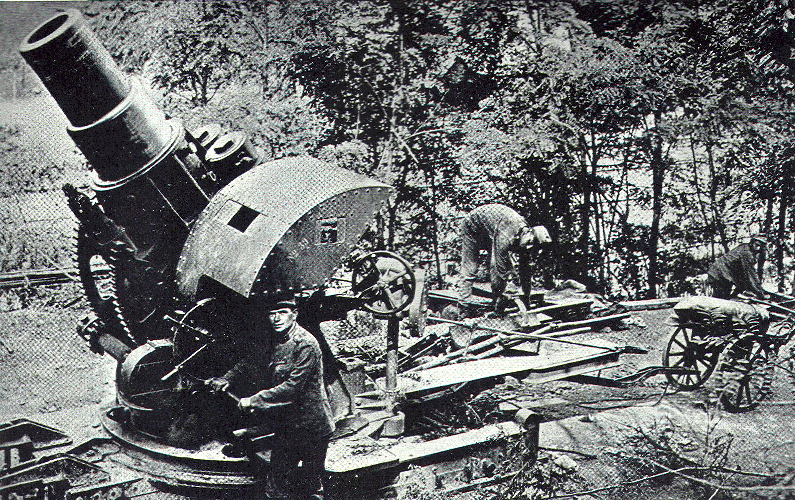
We are very sorry that the gun was an invention of the enemy. It was this kind of gun which made it impossible for the French to hold the forts of Liege and Namur, and other strong fortifications in the Great European War. And it was such guns as those that forced the brave Belgians out of Antwerp. Of course there are giant British guns as well, but this enemy gun was very prominent in the Great War.
Our old-time General would never have believed us if we had told him that this giant gun would be able to hit and destroy any particular building that was desired even if the building were many miles away. You remember how erratic was the flight of the solid iron ball fired from his old cast-iron cannon.
We may not think less of the Austrians because they invented such a murderous weapon of war; we have been trying at all times to do the same. Why we thought very hard things of our enemies in the Great War was because they would not abide by the rules of warfare to which they had previously agreed. But what we set out to talk about was the Great War inventions, and this Austrian Skoda mortar is one of the most remarkable.
In the Austrian Army Museum in Vienna there is exhibited a cupola of a building with part of a great shell still embedded in it. The Austrian guide would be proud to tell you that this cupola was brought all the way from Antwerp, because it was a proof of the great accuracy of their famous giant guns.
This cupola was in a building which it was desired to destroy, but the great gun could not get nearer than 7 miles, and from that position the gunners could not see the building at all. Very careful measurements were made from a map on which the building was shown, and the muzzle of the great gun was directed so that it might land a shell on that particular building which was invisible to the gunners. A shell weighing more than 800 pounds was placed in the gun, and it flew through the air for 7 miles, and landed right through the cupola of the building which the gunners desired to hit. No wonder that Antwerp, although the second strongest fortified place in the world, had to give way to such guns.
The remarkable thing was how very quickly the enemy could bring forward these giant guns, and how little time it required to remove them to another place. The reason was that three special motor-cars of 100 h.p. each were able to carry the gun, the mount and the foundation. It is usual to dig a pit for the foundation, and the car carrying the foundation platform is brought forward and the foundation is lowered into position by a crane or winch carried on the car itself. Then the car carrying the mount drives up and goes right on to the foundation, on which the mount is lowered and securely bolted. Then the third car brings the great gun forward and it is pulled into the cradle. All this has been done in twenty-four minutes, and can be done in almost any circumstances in forty minutes.
When the gun is to be loaded it is not pointing upwards, but straight along in the position which we describe as horizontal, as it points towards the horizon. The great breech-block is then opened on its hinges to allow the shell to be loaded in the gun. You will observe one of these shells on a small truck in the photograph facing page 64. By moving a lever the loading-pan raises the heavy shell into position, so that it can be easily pushed into the breech of the gun. The breech-block is then closed, and the gun again is pointed upwards as shown in the photograph. The exact angle at which it points is, of course, dependent upon the distance the shell is required to travel before coming to the ground. When we come to have a talk about the naval guns we shall see that we have made guns that are even greater than this Skoda mortar, but the remarkable thing about this Austrian invention is the ease with which it can be moved about from one place to another.
After the outbreak of the Great War we were surprised to find that the enemy were using a still greater giant gun, which was able to throw deadly shells into a French town (Dunkirk) from a distance of 22 ½ miles. Imagine what a tremendous explosion must be required to throw a heavy shell so many miles.
An aeroplane can travel a very long distance, because it carries an engine and propellers which keep driving it along. The shell, however, has no means of keeping itself in motion. It has to be thrown all the way by the gun. You know that when you are throwing a stone you must send it off at a great speed if you wish it to travel far, but by the time it reaches the distant object it has not much energy left, and falls down exhausted of all energy. If you wish to throw a stone far, you select a fairly light one. You cannot throw a heavy stone far, because you cannot give it the necessary speed or velocity at the send-off. Imagine then what a tremendous velocity must be given to a heavy shell which, after leaving the muzzle of the gun, has to continue flying through the air for more than 20 miles. The shell sets off with the enormous speed of 2000 miles per hour.
The giant gun which threw shells at Dunkirk from a distance of 22 ½ miles was what we call a 16 ½-inch gun. One boy might tell another that he had a 2 ½-inch cannon, and his friend would know that the cannon measured 2 ½ inches in length. But when we speak of a 16 ½-inch gun, you don't imagine that we are referring to its length. We are speaking of the size of its bore. We say that that is the diameter of the bore, which is another way of saying that the open muzzle measures 16 ½ inches across. This also tells us the diameter of the shell which the gun is to shoot.
We used to speak of a 68-pound gun, meaning that it threw a shell weighing 68 pounds, and we also spoke of a 110-ton gun, which described the weight of the gun itself, but nowadays we always describe a gun by the diameter of its bore. This great 16 ½-inch German gun is not so easily moved about as the 12-inch Skoda mortar of the Austrians. The great giant has to be firmly embedded in solid concrete before it can be used, then when it is desired to remove it to some other place, it is necessary to blast the concrete with explosives in order to get the gun free.
You are sure to have heard of the famous "75" guns of the French, for those guns did terrible havoc amongst the enemy in the Great War. You will see a photograph of one of those famous guns in the illustration facing page 72. It is not such a giant as its name might lead you to think. Most of you could guess to what measurement the 75 refers. Being a modern gun, you will know that the figures describe the diameter of its bore, and it is quite evident that the opening of the muzzle does not measure anything like 75 inches. One boy suggests that it is 75 centimetres, but he forgets how much the centimetre is, or he would know that 75 centimetres is about 29 inches, and it is quite evident from the photograph that the bore is very much less than that. Then he guesses it is 75 millimetres, and he is correct this time, and if he understands the French measurements he will be able to tell you that the bore of the gun is somewhere about 3 inches in diameter.
Looking at the photograph opposite page 72, you will see that the gunners have removed the breech-block in order to give their gun a thorough cleaning. You will also see, in the left-hand corner, a store of the shells used in this gun, and you see from this that the diameter is just about 3 inches.
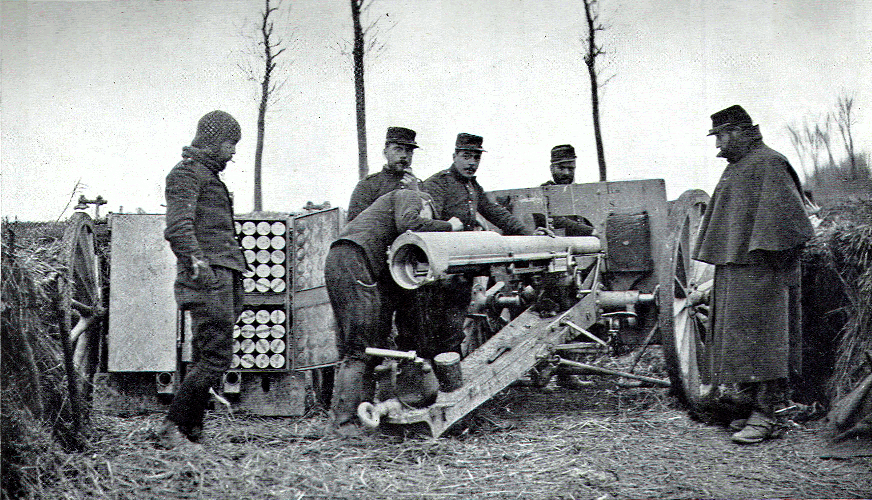
You might say that these 75-millimetre guns are not really giants. They are not of gigantic size, but they can do gigantic deeds, for they fire shells which carry high explosives into the midst of the enemy. A French writer has said that they create a danger zone "in which nothing before living can any longer live." When the signal is given that the enemy is advancing, these guns are quickly brought into action. The plan of their operations is not unlike what you would do with a hosepipe if you were watering the garden lawn. Four guns, acting as a battery, sweep the ground in front, so that they cover the whole area before them. Then the muzzles are raised very slightly, and the guns sweep across the new area, and so on, until a dozen acres have been cleared of the enemy.
There are many giant guns in the Navy, and instead of requiring giants to work these, we have merely to move small levers which control the guns. The old-fashioned heavy cannon called for a great expenditure of energy on the part of the gunners. After the ship's cannon was fired in the primitive manner already described, the crew had to pull the muzzle of the gun in with ropes to clean the barrel and recharge the gun. Even the heaviest guns had to be loaded by hand. We could not handle our modern guns in the same fashion, and there is no need to do so.
Suppose we pay an imaginary visit to one of our great battleships and see for ourselves how the giant guns are handled. We are told that the largest guns on this particular dread-nought are 12 inches, and from this you know that the bore of this gun is 12 inches in diameter. We notice that these guns are very long, and we are told that they measure 50 feet in length. We climb a ladder on to the roof of the great iron turret in which the gun is placed, and going down from a cupola or trap door we enter the turret. Here we see the gunners and the levers which control the hydraulic and electric power required to move the great guns. But how are the men to handle the shells which weigh 850 pounds each? And then behind the shell is to be placed a charge of cordite weighing 350 pounds. Therefore each loading of the gun means lifting 1200 pounds, which, you know, is more than half-a-ton.
We watch a pair of automatic rammers pushing the shell and the charge of cordite from a cage into the breech of the gun, but we can see no more shells and cordite charges about. Where are these kept?
We go right down within the turret to the lower platform, and there we see the stock of shells. We watch a grab mounted on rails lifting one shell from the stock and placing it on a travelling tray, which carries it to the cage of a hoist. While this is being done at the lower platform, the cordite charge is being placed on another cage of the same hoist at the upper platform, which is immediately above the lower one. Then the hoist lifts this double cage to the gun-room, where the shell and cordite are transferred to another double cage, which carries them to the breech of the gun. We have already seen how the two automatic rammers push the shell and then the cordite into the breech of the gun.
One boy remarks that when the gun is turned round in another direction it will not be in a position to take advantage of the hoist and these automatic rammers. But that is not the case, for the whole turret in which this mechanism is contained turns round along with the gun; it is the turret which revolves, carrying the gun with it. These large guns are usually fired electrically, and may fire two rounds in one minute. Each shot costs £100, and the gun with its mechanism costs about £12,000.
One boy asks what advantage is gained by having the gun so long as 50 feet. It is in order to take advantage of the full pushing power of the explosive. While travelling along the barrel of the gun the shell gets a long push off. But the boy says that the giant mortars throw shells to great distances, and yet they are not nearly so long. That is so. But in the mortar a higher explosive is used, causing a more violent explosion, which we do not wish on board ship.
The Queen Elizabeth's guns can throw one-ton shells to a distance of 24 miles. In the illustration facing page 112 you see this super-dreadnought in action.
What is an Explosive?
If I were to ask each of you the question which I have put as the title of this chapter, I think that many of you would reply that an explosive is a thing that goes off with a bang when it catches fire. Some of you might add that certain chemicals will explode when they are struck a sharp blow. Most boys and girls have seen an explosion of some sort, either in real life or photographed by a cinematograph.
I have heard the story of an Irishman who said that he would much rather be killed by a collision than by an explosion. When Pat was asked for his reason, he said: "Well, you see, in a collision there you are, but in an explosion where are you?"
In war inventions we use explosives for two different purposes. One is to throw the bullets and shells at the enemy by means of guns. The other is to explode the shells when they reach the enemy. We use explosives also in bombs, or grenades, in torpedoes, and in mines, both on land and at sea. We shall have a talk about all these inventions a little later. Meantime we wish to see exactly why gunpowder and other explosives do explode.
Of course you know that we use explosives in peaceful industries as well as in warfare. You have heard the quarrymen blasting some great rocks, thus doing in a moment an amount of work which would have taken them a very long time to do with pickaxes and chisels. When you are travelling by train you sometimes see parts of the railroad which have been cut through solid rock, and you know that explosives were used to clear these passages.
Then as you walk along the street you occasionally hear a bang from a motor-car or motor-cycle, which reminds you that it is an explosion of petrol vapour and air, which propels these machines along. But none of these facts tell us just what an explosion really is. So I shall suppose that you put the question to me:
"What is an explosive?"
You may be surprised when I say that when a thing explodes it merely burns away very quickly. Surely there must be something more than that! Well, let us examine the matter.
If I were to ask you what happens when a thing burns away, many of you could explain what happens in the household fireplace. You could tell me that the combustion (or burning away) of the coal was due to the carbon of the coal joining hands with the oxygen of the air. There are other chemical combinations also which take place, but that is the principal fact. You know very well that the presence of air is necessary if the coal is to burn. You know how the blacksmith blows air through his burning coal by means of a huge pair of bellows. Our grandmothers used to keep a pair of bellows beside the fireplace, but nowadays, with grates and chimneys made on more scientific principles, we do not require bellows. I wish you to notice that there are two parties to the action of combustion; there is the coal and there is the air, or, to be more exact, we should say the carbon and the oxygen. If either of these two is absent there will be no combustion.
Take a look at an electric glow-lamp in which a little carbon thread is so white-hot that it sends out quite a big lot of light. Before the invention of the metallic filament lamps, we used these carbon filament lamps entirely. You know this little thread of carbon is kept white-hot by a current of electricity passing through it, and yet there is no combustion; the carbon thread does not burn away. Why? Because there is no air in the little globe; the lamp-maker has pumped out all the air, and then sealed up the globe.
Let's take another look at the coal fire. It is not burning very briskly, so we take the poker and break the coal, into smaller pieces. Why? Because the burning only takes place on the surface of the coal, where the air can reach it, and by breaking up the coal we allow the air to get through among it, and thus reach more surface. We shall see in a moment that this is where the sudden burning away which we call an explosion differs from an ordinary burning away. First of all we wish to see what happens when the coal burns.
If the fire has burnt briskly, there is nothing left but a few ashes. If I ask you where the coal has gone, you will tell me that it has gone up the chimney in the form of gases and smoke. The solid coal has been transformed into flimsy gases. If you could catch the gases and keep them you would find that they occupy a very much larger space than the coal did. Now let us watch what happens when some gunpowder burns.
I am not suggesting that you should make any experiment in this matter. We can make the experiment in imagination, and then we shall not get into any trouble. We make a little heap of gunpowder, and laying a small train of it to a safe distance, we set a light to the end of the train and we see the whole powder go off in a single puff. You say that it burnt away in a "jiffy," but why did it burn so very quickly? Because it did not depend upon getting oxygen from the air; it had a great deal of oxygen within itself. Therefore, instead of merely burning on the surface, it all burnt at the one time.
I have no doubt that many boys, and perhaps some girls, know that gunpowder is just a mixture of certain quantities of saltpetre, charcoal and sulphur. The saltpetre is in the form of white grains, not unlike common salt, but of coarser grain. It contains a great deal of oxygen, so if you were to see anyone making gunpowder, you would understand why they use so much saltpetre; they wish to have plenty of oxygen to ensure a good combustion.
You know what charcoal is like, and I need hardly tell you that it contains the carbon which you wish to unite with the oxygen of the saltpetre, and thus give combustion. But what about the sulphur? It is merely an assistant; the saltpetre and the charcoal are the two active parties in the combustion. The sulphur is added to make the gunpowder more easily fired, and this gives a more sudden burning away, and so our little heap of gunpowder was burnt away in a single puff, but no harm was done; there was no explosion. Why? Because when the gunpowder was transformed into a great quantity of gases they had plenty of room in the open air. Had we burnt the gunpowder in a box of any kind, the sudden arrival of all the gases in place of the gunpowder would have burst the box open; there would have been an explosion.
That was what took place in the old-fashioned cannons; the gunpowder was suddenly burnt away, and the gases had to escape as best they could. If they could have taken plenty of time they might have escaped gradually through the touch-hole, but they had to get away at once or else they would have burst the gun. Their easiest way of escape was through the open muzzle of the gun, and the only thing in their way was the solid iron cannon-ball. The sudden rush of the gases drove the cannon-ball out of the cannon with great energy, and off it flew towards the enemy.
Suppose for a moment that you are away in the Wild West of America, and that you have a quantity of gunpowder stored in the hut in which you live, as you require the explosive for some peaceful operations. When you have occasion to cook your food in the hut, you begin to wish that the gunpowder was not present. You wish that you had kept the different ingredients separate from one another, and then there would have been no fear of an explosion. You get so nervous about this gunpowder that you determine to separate the parties that are so willing to unite with a big bang when any flame reaches them. You have learnt some chemistry at school, and you know that the saltpetre will dissolve in water, and that the charcoal will not dissolve. You are not worrying about the sulphur as it is not one of the active agents in the explosion, and so you boil the gunpowder in water, and when the saltpetre has dissolved you pour the whole contents of the pot into a large sheet of blotting-paper, which you hold over an empty vessel. Only some clear liquid gets through, and you know very well that what is caught by the blotting-paper is a mixture of charcoal and sulphur; the saltpetre having dissolved in the water has been carried with it through the blotter into the vessel beneath. When this clear liquid cools you see little white crystals, and you know these to be saltpetre. Your gunpowder is now quite safe, and you may make up the mixture again when required.
I have made up this little imaginary story about your being away in a Wild West hut with gunpowder, not merely to amuse you, but to try and impress you with the fact that it requires two active contracting substances to make an explosion, otherwise when I come to speak of gun-cotton, someone might ask if cotton is explosive.
Gunpowder is a very, very old invention; indeed we cannot trace its origin; it was certainly known before the time of Christ, and some suppose that it even existed in the time of Moses. Be that as it may, what concerns us at present is that gunpowder had the whole field to itself for a long time. It had no rival until the invention of gun-cotton in the nineteenth century, less than one hundred years ago.
No one is to ask if cotton is an explosive, for I have surely made it clear that no one single substance is explosive; it requires two different substances to unite before there can be an explosion. Neither saltpetre nor charcoal are of themselves explosive, but you have to be careful when they are mixed together in the form of gunpowder.
You know that cotton grows on a little grass-like plant, but you may not know that this cotton which Nature produces is composed chiefly of a substance which we call cellulose. It is this cellulose which is one of the active agents in gun-cotton. I have no doubt that some of you can guess that the other active agent is to be oxygen, and that we must get the oxygen into close touch with the cellulose in the cotton. This is done by steeping the cotton well in a strong solution of nitric and sulphuric acids. Any boy or girl who has learnt a little chemistry will be able to tell me which of these two acids is going to play the active part. Indeed some quick-thinking girl or boy who knows no chemistry may be able to recognise that the sulphuric acid is quite apparently related to the sulphur which you will remember was put into the gunpowder merely to hasten the explosion. And those who know that nitre is another name for saltpetre will recognise that there is some close family connection between nitric acid and saltpetre. From this you will be able to see that the nitric acid (like the saltpetre) provides the necessary oxygen.
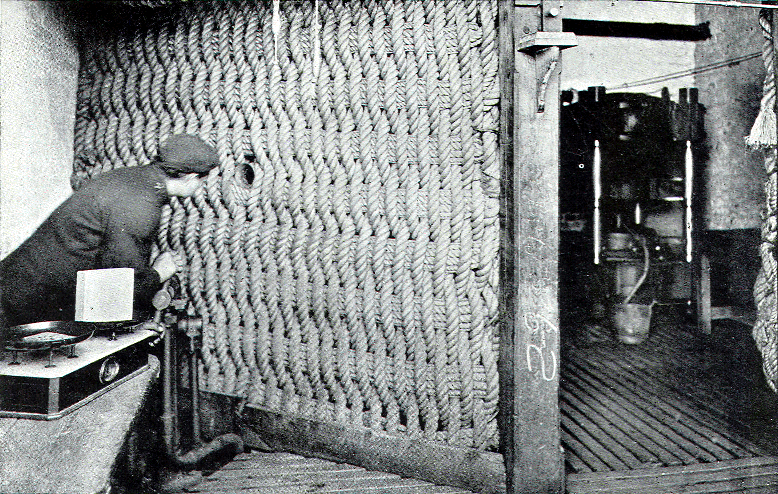
After the cotton-wool has been well steeped in the acids, it is washed and dried, and is then a much more violent explosive than gunpowder. We describe gun-cotton as a high explosive, while we speak of gunpowder as a low explosive. Gun-cotton was looked upon at first as being too dangerous a substance to risk making; several factories attempting to make it were blown to pieces. Later on better ways and means were found of making it, but even to-day great care has to be taken when pressing it, as will be seen in the photograph facing page 88. Here we see a workman protected by a rope screen while he is operating a press for the gun-cotton.
If I were to ask you to name some high explosives, I think the first that would occur to you would be "dynamite," and you may be interested to know how it was invented. It was found that cotton was not the only substance which could be rendered explosive when treated with nitric acid. Glycerine and nitric acid go to make a very high explosive called "nitro-glycerine." Being a liquid, it is not convenient to handle, and it was soon found to be a most dangerous explosive. It was then that Alfred Nobel tried mixing nitro-glycerine with a porous earth, which absorbed the liquid and produced that solid explosive substance which we call dynamite. Dynamite is too energetic an explosive to use in guns; it would burst the gun before the projectile had time to escape from the barrel.
Many boys and girls know that the explosives which we use in modern guns are called "smokeless powders." This descriptive name requires no explanation, but some of you may be curious to know what these smokeless powders are. For instance, what is the British "cordite"?
It is cordite which throws the shells from our great naval guns as well as the bullets from our rifles. It is a mixture of gun-cotton and nitro-glycerine, but these two high explosives would produce too sudden and violent an explosion. How can we slow down their action? We have to add some substance which is not explosive, and which will prevent these high explosives burning too quickly. It is for this reason that we add some vaseline in the manufacture of the cordite; we are able to give the projectile a good long push off, without over-straining the gun.
In the succeeding chapter we shall see the part played by the high explosives.
How Shells were Invented
There is a great difference between the old-fashioned solid iron cannon-balls and the shells which guns fling among the enemy to-day. The cannon-ball was a very harmless thing so long as it did not hit anyone, but a shell explodes among the enemy and may kill many who are at some distance from it. We wish to see how such shells were invented.
Shells were originally called bombs, and that word seems more expressive of an explosion than the word "shell" does. You can guess that the word "shell" is descriptive of the empty shell or casing which holds the explosive. Explosive shells were used in war some four hundred or five hundred years ago. At that time, and indeed until recent times, the shell was an empty ball of cast-iron; some were the size of a large rubber ball, and others as large as a football. The iron walls of the ball were sometimes one-half inch in thickness, and in others as much as two inches.
These early shells had a bung-hole such as a barrel has, and through this hole the shell was filled with gunpowder and small pieces of metal. The bung-hole was then closed by a plug of slow-burning powder, which when lighted would require a certain number of seconds to elapse before the flame could reach the gunpowder in the shell.
In some old books I have seen pictures of those bombs with a man standing with a lighted taper in each hand. With one taper he is setting a light to a slow-burning fuse in the bomb, and with the other he is setting a light to the gunpowder in the gun, which is to throw the bomb among the enemy. The old-time gunner who did this ran considerable risk, for after lighting the fuse which would explode the bomb in so many seconds he had to set the gun off, and if he failed to do so in time, through the powder in the gun misfiring, then the bomb would explode in the gun and probably kill the gunner.
During the Great European War, our enemy used hand bombs or grenades in which they had to pull a string, which started the fuse that exploded the bomb in a few seconds. Some of our officers informed me that the enemy soldier had such a fear of his bomb exploding, while still in his hand, that he took no time to judge the distance or direction to which he should throw it, so that most of the hand-thrown bombs never reached our trenches.
We used hand-bombs also, but there was no fear of these going off while in the soldier's hand. In our bombs there was a little lever which when allowed to spring up would start a fuse, and in so many seconds after that the bomb would explode. Until the soldier was ready to throw the bomb the little lever was held down by a metal pin. When the soldier withdrew this pin, the lever was still held down by the hand with which he threw the bomb, and not until it left his hand did the fuse begin to burn.
The French provided their bomb-throwers with a special arrangement. The bomb-thrower had a leather bracelet which was fastened round his wrist, and to this bracelet there was attached a strong cord with a hook at the free end. When about to throw a bomb, the soldier slipped this hook into a small ring which was attached to the time-fuse of the bomb. He then threw the bomb, and not until it pulled the cord tight did the time-fuse begin to act. The fuse, being long enough, could burn some seconds before exploding the bomb. In this way the bomb did not explode until it had time to reach the enemy's trenches. Of course the ring to which the bomber attached his bracelet hook was pulled out of the bomb when the cord tightened; it was the sudden withdrawal of the small friction tube attached to the ring which set the fuse alight, just as one does in striking a match.
You will see that this arrangement which was used by the French was very much safer than that used by our enemy bombers, for when a man had to start the time-fuse before throwing the bomb there were grave risks if the bomber should be shot before he had succeeded in throwing the bomb. In that case he would fall in his own trench and probably kill some of his companions, but if the French bomber was unfortunate enough to be shot while in the act of throwing the bomb, he would cause no danger to his friends, as the bomb in falling into his own trench would reach the ground before the cord could pull out the friction tube, so that the time-fuse would not be set off.
Another form of small bomb was what was called a rifle bomb or grenade. From its descriptive name you will understand that it was a bomb thrown by a rifle. In these bombs or grenades there was no time-fuse, but merely a detonator with a percussion-cap which was set off when the bomb struck the ground or any other obstacle. It was just like a rocket, being a hand grenade with a long metal rod attached to it. The rod fitted the barrel of the rifle, and therefore took the place of an ordinary bullet. When the grenade was shot off by the rifle, the nose of the bomb would be sure to strike first, as the heavy head would fall before the rod which acted as a tail.
Some hand-thrown bombs acted in the same way as these rifle grenades. They had no time-fuse to be started in the act of throwing, but depended upon a percussion cap exploding the bomb on striking the obstacle. These hand bombs required to have bushy rope tails attached to them to ensure that they would fall nose first, otherwise the percussion cap would not be operated, and the bomb would not explode.
There were larger bombs, which were thrown out of our trenches by means of catapults or by very large-mouthed guns called "mortars." Why are they called mortars? I think you will have seen a mortar and pestle as used by chemists for grinding or pulverising their chemicals. The chemist's mortar is a shallow bowl, wide-mouthed and with heavy thick walls. It looks as though it ought to have been bigger for the weight and strength of its walls. Now a gun for firing bombs is not wanted to grind or pulverise the bomb, so there is no connection between the use of a chemist's mortar and one of these guns. However, if you have a look at one of these guns which shoot bombs to a short distance you will see that they do remind you somewhat of a chemist's mortar, because they are short, wide-mouthed, and have thick walls.
If a mortar has to throw a shell to some distance, then the mortar has to be made longer, as you will see in the photograph facing page 64. Of course, all our large guns now throw explosive shells, but these shells which have to travel to a long distance are more like great, long-shaped bullets having explosives within them. How then were such shells invented? You have all heard of shrapnel shells, and if you have thought of the matter at all, you have no doubt asked why these are called shrapnel shells. If there was no one about to tell you, you could guess that they have been called after the inventor. If you have looked up any encyclopedia or other book upon the subject, you will find that the inventor is described as Lieut. Shrapnel, or Major Shrapnel, or Colonel Shrapnel, from which you will see that he was an army officer who gained promotion.
![[Illustration] from War Inventions by Charles Gibson](books/gibson/war/zpage099.gif "[Illustration] from War Inventions by Charles Gibson")
The shrapnel shell looks exactly like a giant bullet in a giant cartridge, but in the accompanying drawing part of the outer case has been removed.
You know that the shell contains an explosive; it also contains bullets, so it is in reality a gun in itself. Not only does it explode like a bomb, but when it bursts it shoots out a shower of bullets in the direction in which it is travelling. The time-fuse is arranged so as to cause the shell to burst at about 100 yards from the point at which it would fall to the ground. It therefore explodes right in front of the enemy and acts like a gun firing at close quarters.
But how can the gunner be sure that the shrapnel shell will explode at the right moment? He has to arrange the length of the fuse so that the flame will reach the explosive just before the shell gets to the end of its journey. If the gun is going to throw the shell to a distance of two miles, the gunner knows that it will take the shell so many seconds (say five seconds) to travel that distance. The gunner therefore sets the time-fuse so that it will explode the shell at the right moment. This he does by setting the time-fuse to a certain mark, and in doing this the fuse is adjusted automatically to the required length. The flame therefore reaches the explosive at the right moment, bang goes the shell and off fly the bullets with their message of death.
It is possible that through some fault in the fuse it might go out before its flame reached the explosive, in which case the shell would fail to burst, and would be no more effective than the old solid cast-iron ball. But the modern shell is usually fitted with a percussion-cap in the nose of the shell, so that if the time-fuse should happen to fail, this shell will burst whenever it strikes the ground or other obstacle.
We have seen how the fuse of the old-time shell had to be set alight by the gunner immediately before he set alight the explosive in the gun. We appreciate the risks that the early gunner ran. The modern gun throws its shrapnel shell with great speed, and if the distance the shell has to travel is not great, it may be required to explode in two seconds. If the gunner sets the time-fuse for two seconds, how can he find time to place the shell in the gun, close the breech-block, and fire the gun before the shell explodes? It goes without saying that the shell does not explode in two seconds after the time-fuse is set. The setting of the fuse merely arranges the length of the fuse, but does not set the fuse alight. The sudden shock which the shell experiences when the gun flings it at the enemy causes the detonator to light the fuse; and two seconds later the shell explodes, having by that time reached the enemy.
If it is intended to destroy a great military fort the shell is arranged so that it will not burst until it has pierced the concrete wall. This is done by using a fuse which does not begin to burn until the shell strikes the fort, and the flame does not reach the explosive until the shell has had time to pass through the fortifications. Similar shells are used in naval warfare, and must pierce the great armour plate which protects the battleship; they are usually called armour-piercing shells.
I have seen a photograph of a large 12-inch shell which had been shot through a steel target a foot in thickness. Of course this shell had not been loaded with the usual explosive, or it could not have been photographed after doing its work, as it would have burst into fragments. You remember that when we speak of a 12-inch shell we mean one that will fit into a gun or mortar with a 12-inch bore. The 12-inch shell of which I am telling you was standing on its end on the ground when photographed, and beside it stood a man. The nose of the shell reached up to the man's waist. What interested me most were the huge scratches made upon the shell by ripping its way through the heavy steel target. The interesting point was that these great scratches were at an angle, which showed the heavy shell was still spinning round while it forced its way through the target.
The Great European War brought terrible evidence of the damage that can be done by modern shrapnel shells. It was difficult to realise what an enormous number of shells were used in that war. It was said that in one short engagement the enemy fired 700,000 shells.
One who has had experience of war has said that the sound of a large shrapnel shell flying through the air is like a moan, a groan, a shriek and a wail, all rolled into one; that it is not unlike a winter gale howling through the branches of a pine-tree.
How We Came to Make Iron Ships
Of course you know that all ships of to-day arc made of iron; there seems nothing strange in this, but if you had been on board H.M.S. Victory a little more than one hundred years ago, and if you had suggested to Lord Nelson that one day we should have ships made entirely of iron, I have no doubt that he would have been willing to prove to you that the thing was impossible. Wood floats on water, but iron does not. I have seen a piece of solid iron floating about on the surface of molten lead in the same manner and for the same reason that a piece of solid wood floats on water. Every boy and girl knows why wood floats on water, but when you were a little younger you did not know. I asked a little girl of seven years of age if she knew why wood floated on water, and she assured me that she did. However, her explanation was that wood floated on water because it was wood. Her elder sister, aged twelve years, explained to her that it was because the wood was lighter than the water. Then this girl asked me how ice could float on water, seeing the ice is just made of water. I told her it was because the water expanded when frozen, and therefore occupied more space for the same weight, which is just another way of saying that it became lighter. But as my purpose in opening the conversation with these children was really to find out what their ideas were about iron ships, and not wishing to be dragged into other subjects, I asked: "Why do iron ships float on water?"
I did not look for any help from the younger girl, as her explanation about wood floating was really no reason at all; "just because" is not an explanation. I found that my question puzzled the twelve-year old girl more than I had expected, but she was anxious to explain the matter. It happened, however, that she was very much in the same position as the Highlander who said that he did not understand it, but thought he could explain it. She said that the iron ship kept afloat because its engines kept driving it along so that it did not sink. I suggested that it would be rather hard lines for the passengers when the iron steamer came to rest alongside the pier. It may be that she thought that this was the reason why they fastened steamers by ropes to the pier to prevent their sinking, but I think that she would hardly have let her imagination go so far. When she saw that I thought her answer amusing about the steamer keeping on the move to prevent its sinking, she tried another line of reasoning. It was because the ship was made of a thin sheet of iron that it kept afloat. But when I told her that a thin sheet of iron as large as the floor of the room would not float, she jumped to the conclusion that it was because the iron ship was filled with air which caused it to float. But air has weight; a box full of air is heavier than a box with no air in it. Perhaps someone says air does really float things, for look at the "wings" which children use when bathing. The wings will not keep us afloat unless you fill them with air. The wings full of air are really heavier than the wings without air, but when filled with air they occupy a much larger space. The wings filled with air are certainly very much lighter than they would be if filled with water, therefore the air-filled wings are lighter than water, and will float on water.
Now I think you will understand why an iron ship floats on water. If you had a great box the size of a ship, and filled it with water, it would certainly sink, but the empty box occupies so much space for its weight that it is very much lighter than the same volume of water would be, and so it floats. Of course, if the ship were to fill with water it would sink; indeed that is the reason why ships do sink.
Some of you may wonder why I have brought the subject of iron ships into a book which deals with war inventions. Surely there are far more iron ships carrying on peaceful business than there are warships. That is quite true, but the iron ship was none the less an invention due to war. The steamship was not a war invention, as it was invented for peaceful operations. Therefore we are not going to talk about how steamers were invented, although it might interest you to hear of this in some future volume of this series.
You have heard warships spoken of as "ironclads," and originally they were merely wooden ships clad in iron: the old wooden ships with an iron jacket. When I think of the beginning of iron ships I think of Gibraltar. You all know of the great rocky fort which keeps guard at the entrance to the Mediterranean Sea. Even when only a few miles from Gibraltar, you would think it was an island rock, for the narrow peninsula which connects it to Spain lies very low. Gibraltar has been in the hands of the British for more than two hundred years, but not without other nations trying to steal it from us.
The most memorable of all the sieges of Gibraltar was when the Spaniards made a desperate effort to dislodge the British from it in 1782. In order to protect their ships from the cannon-balls shot by the British from the peninsula, Spain made iron roofs to protect her ships. The British then made the cannon-balls red-hot before firing them, and they also used shells which would burst into flame, and by this means they were able to set even those iron-protected ships on fire. So far as we know, this was the first occasion on which iron was used as a protection for ships.
Later on, guns were improved to such an extent that even the thick walls of wooden ships were burst by the shots, and so the French covered one of their wooden warships with an iron coat 41 inches thick. The British Navy followed the example of the French, and tried to go one better by building a warship with an iron framework, making the outside of the ship an iron shell 41 inches thick, then inside that they built a wooden wall made of 18-inch solid teak wood, on the inside of which they made another coat or skin of iron.
The people of old times thought that the wooden walls of the ship were necessary to keep her afloat, but as the gun-makers made guns capable of piercing those iron jackets the ship-builders increased the thickness of those iron plates, until the walls of the ship were made entirely of iron.
It is of interest to compare a modern sea fight with one of a hundred years ago. Imagine that you are a sailor on board a British frigate which is taking part in the American war of 1812. The name of your ship is the Guerriere, and it is quite apparent that the name has been borrowed from the French. Your battleship is, of course, a sailing ship, as steamers had not been invented at that time. You take a walk round and count the number of cannons, and you find that there are 49, while you have 282 men. Your ship has been with a British squadron lying off New York, but you are at present making your way to Halifax to have your ship overhauled and to get some improvements made.
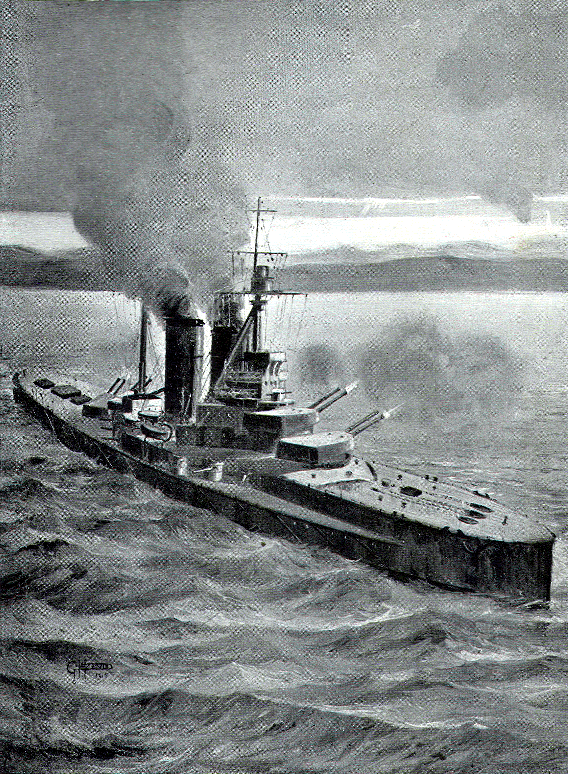
It is the afternoon, and everything goes along quietly until the look-out reports a ship in the distance. It soon becomes apparent that this is an enemy ship bearing down upon us. We find out later that she is the American Constitution, and that some American brig had taken her word of our presence. Our orders are to prepare for a fight, and while we await the arrival of the enemy, we load every gun and remain ready to fire as soon as the signal is given. At five o'clock comes the order to fire, and every gun on the one side of the ship goes bang, but not a single cannon-ball manages to hit the enemy ship. Our ship then wheels round in the wind in order to bring our other side to face the enemy. We fire another broadside, and this time we land two cannon-balls on the Constitution. For three-quarters of an hour we are busy firing broadsides, first from one side of the ship, then wheeling and firing from the other side, but we do very little damage, although our men work very hard.
The American ship kept bow on and had not troubled to fire any broadsides as yet, contenting herself to fire only her bow guns. Then the American set full sail to bring her alongside of us. We could see that she was a good deal bigger, and that she carried more guns, and we find later that she had 456 men against our 282. Apart from these advantages, we have to admit that she fought better than we did. She saved her ammunition until she felt she could do real damage, and when she did start, it only took her ten minutes to do a great deal of damage, and over went our mizen-mast. This disabled our ship, and we could not get her to answer her helm. The American ship, as she crossed our bows, fouled with our rigging, and fired in a broadside at close quarters, and our two remaining masts went by the board, leaving us quite helpless. It was now 6:30 P.M., and our captain realised that our ship was lost, and fired a shot away from the enemy, and surrendered.
Then an American lieutenant came on board, and finding that our ship was gradually sinking, and could not be towed to port, he ordered our crew to be removed to the Constitution, and after this was done they set our ship on fire. We had lost 15 men, killed, while the American ship had 7 killed. There were 63 of our men more or less wounded, while there were only 7 of the Americans wounded. We all felt that our enemy had been brave, and there was no trace of bitter feeling. Indeed, the Americans could not have been more considerate. They gave the greatest possible attention to our wounded, and they even took care to see that none of our sailors lost a trifle of their belongings. Both sides fought like gentlemen, and kept to the laws of war.
Let us now picture one of the sea fights which took place in 1915, during the Great European War. The fighting ships are no longer dependent upon their sails, but can steam along at 30 miles per hour. They do not require to wait until they are at close quarters, as their guns can throw shells on to a ship 10 miles away.
![[Illustration] from War Inventions by Charles Gibson](books/gibson/war/zpage116.gif "[Illustration] from War Inventions by Charles Gibson")
Here is the story of a North Sea fight as told by some of the German survivors from the Blücher whom we rescued and took prisoners. The British ships were away on the horizon when they started to fire. The hulls of the German vessels were not visible to those on deck the British battle cruisers. Only the officers on the look out upon the mast 100 feet above the deck could see the hulls of the enemy ships.
The shots came slowly at first. Some fell ahead and others fell short, but as each fell into the sea it sent a great water-spout up into the air. The British guns were finding their range. Those deadly water-spouts crept nearer and nearer. The men on deck watched them with a strange fascination. Soon one shell fell close to the ship, throwing a great volume of water right on to the decks; the range had been found. Then the shells came thick and fast, with a horrible droning hum. At once they did terrible execution. The electric machinery for giving light on the Blücher was soon destroyed, so that the ship was all dark within.
At first the great deadly shells seemed to drop down from the sky; then as the British ships got nearer, the shells commenced tearing great holes in the side of the ship. Some shells bored their way into the coal bunkers and set the coals on fire. There was no hope of hiding from the shells; they searched out all parts of the ship. It was like one continuous explosion, until the great ship turned over and sank to the bottom of the sea.
Ships that Go Under the Sea
The natural place for a ship to travel is on the surface of the sea. Indeed our great-grandfathers would have laughed at the idea of a ship being able to travel under the water. If I were to ask you why, I have no doubt you would give sufficient reasons. Where could the crew get air to breathe? How could they see their way about in the darkness, deep down in the sea? How could they use an engine without plenty of air? You know that fires require air or they would not burn. And you know that engines such as we use on motor-cars require air to unite with the petrol vapour, and cause the explosion which makes the engine go. Of course you know that ships can go under the sea; you could give plenty of reasons why this seems to be difficult. You know that we call these ships submarines: a word which we have made out of two Latin
Those of us who are no longer children can remember the first practical submarine, but the idea was by no means new, as we shall see. Of course the idea of a submarine boat was to be able to attack the enemy without being seen. Away back before the time of Christ the ancients had the idea of going down under water in a kind of diving bell. This was not a ship but it was a means of living under water.
Between three hundred and four hundred years ago an English gunner invented a submarine boat with leather joints so that he could make it larger or smaller by turning some screws inside. But why should he wish to make it smaller? Suppose he had it so arranged, when at its largest size, just to float nicely on the surface of the water. Then if he were to make it take up less room, it would still be as heavy but it would not be supported by so much water, so it would be less buoyant, and would therefore sink below the surface. But how could this old-time English gunner breathe when his strange boat went under the water? He had a long mast, which was in reality a tube through which he got air. Of course the top of this mast had always to be above the surface of the water.
Then in the time of King James I. a Dutchman invented a submarine which he tried in the River Thames. It is said that King James once went a trip with him, but possibly it remained upon the surface on that occasion. This same Dutchman proposed to King Charles I. that he should use submarines against the French, but this was not done.
The first time that any kind of submarine was actually used in war was in the American War of Independence, about one hundred and fifty years ago. An American made a small wooden submarine, by which he could go right under an enemy ship and attach an explosive bomb to the bottom of the ship. As you know from a previous chapter, the warships of these days were all wooden, and this enabled the man in the small submarine to fasten a large screw-nail into the bottom of the ship, and to this was attached a short piece of wire rope, at the end of which was the bomb. The bomb contained an explosive, and a clockwork which exploded the bomb in one hour after it was set.
This daring American succeeded in going right beneath one of our British warships and fastening a bomb to the bottom of the ship. He evidently found difficulty in fixing the screw; at least he did not make it very secure, which was fortunate for our sailors. One hour later there was an explosion, but it took place a long way from the ship, showing that the bomb had drifted away.
There were many other attempts to make submarines, but the inventors got very little encouragement. Some of these early submarines were rowed by oars under the water, while others had propellers which were driven by turning a crank either by the hands or by foot pedals.
A famous American, Robert Fulton, who invented the first American steamship, was also the inventor of a submarine, and he offered to make submarines by which Napoleon might attack Great Britain. The offer was not accepted.
Another American thought to rescue Napoleon from his imprisonment on the island of St Helena. This American actually constructed a submarine with this object in view, but the banished French Emperor died before the boat was ready. The submarine which the American used in the War of Independence in his attempt to blow up a British warship was called a "turtle." It was a small upright boat in which one man could sit. He could submerge this boat, and while under the water he could continue to row the boat with oars.
It is interesting to note that it was this American who invented a safety keel which he could let go if necessary if anything went wrong with his submarine. This idea was adapted later by the French and the Americans when they came to make practical submarines.
The attempt to blow up a British warship with the aid of one of these turtles took place in the American War of Independence (1775). Nearly a hundred years later, another and more successful attempt was made by an American in the American Civil War (1864). This new idea was to carry the explosive at the end of a spar projecting from the bow of the submarine, and then run under the water right against the warship, and thus blow it up. One warship was blown up in this manner during the Civil War, and others were damaged, but it is evident that the submarine and its occupants could not escape being blown up along with the ship. We shall see later that this arrangement was more like a torpedo with a man on board than like a submarine.
A Swedish engineer was the first to invent a submarine with a steam-engine. He could travel along on the surface with his steam-engine, but how could he travel under water? When he was ready to submerge (go under water) he put his fire out, and he had to depend upon what steam remained in the boiler and in some steam chests. Of course this meant that he could not travel very far under water. However, he was the first to make a ship go under water by means of an engine.
Then the French, in 1889, began in earnest to invent reliable submarines, and by this time electric motors had been invented. This was a great help. You know how electric motors can be driven by means of batteries which are not dependent upon the air as engines are.
The first French submarine was just about the size of an ordinary rowing boat, and could carry two, or at most three, men. It had now become apparent that to be useful a submarine must be larger, and so they went on experimenting with larger and yet larger boats until these were 100 feet in length.
One of the French submarines was able to approach a large French warship and fasten an unloaded torpedo to the bottom of the ship without being observed by those on board. In actual warfare the submarine could have sent the torpedo under water from some distance, which would have been a much easier thing than going right up to the ship, as was done in the experiment.
While the French were making these experimental submarines the Americans were also making practical experiments, and with equal success. Indeed, when our Navy saw that those could be really practical vessels, they too began to build some submarines on similar lines.
By this time the conning-tower had been invented. Then this was merely a sort of cupola about 2 feet in diameter and 18 inches in height, by which the men could enter within the boat. You know how this turret or conning-tower now stands right up like a tower. The men have to climb up from the deck by a ladder to get into the conning-tower.
Suppose we go an imaginary cruise on a modern submarine. We get on board while the boat is in harbour, and at this time the boat floats well out of the water, like an ordinary ship. Its high conning-tower stands up at the middle of the boat. There are several submarines in the harbour, and we watch one of these leaving; the crew have all gone below, with the exception of one or two men on deck, who keep at the base of the conning-tower. We see two officers in the conning-tower looking out. So long as she is travelling on the surface of the water the submarine uses her oil engines to drive her propellers, and she can go along at about 20 miles per hour.
Watching the submarine going out to sea, we find that she looks like a cloud of white spray moving quickly along the surface. Then after all the men have climbed in through the conning-tower, and the lid or cupola is securely fastened, we see her give a heave forward and dip under the water, leaving only her conning-tower visible above the surface. How did she manage to do this? By making herself heavier. This she does by partly filling her tanks with sea-water. In this position the submarine is said to be trimmed ready for diving right down under the water. Each sailor is now at his particular post, and he must remain there as long as the submarine is under water. The duty of some of the men is to remain at the pumps ready to fill the tanks with sea-water, and make her heavier and yet heavier, until she sinks down to the required depth. Other men are standing at the electric motors which drive the propellers and cause the ship to move along under the water like a great fish. Other men are at the tubes, ready to launch torpedoes whenever ordered to do so.
Suppose we are now on board a submarine and we have trimmed ready for diving. Perhaps we had expected to find a sort of awesome silence, but we find we can scarcely hear one another speak for the noise of the machinery. The men give their whole attention to their various duties; orders must be promptly obeyed. Only the officer at the periscope can see what is happening on the surface. We shall have a talk about the periscope when we get to the surface again.
Perhaps you wonder where is the cage of white mice that you have heard is always carried on a submarine. There are none. At first the sailors did always take some white mice with them, as these little creatures were able to detect the presence of any poisonous fumes long before the men could do so. If the mice began squealing, the men knew it was time they were going to the surface for fresh air. And why do they not carry the white mice with them now? Because the boats are made so safe that there is no need.
The sailors are perfectly calm, although they know very well that they are running great risks in cruising about under the water. They have volunteered for this work; no man need go on a submarine unless he desires to do so. There are always plenty of sailors willing to go.
Suppose you are a sailor on board a submarine which is taking part in a great naval war. We submerge and we have no idea where we are going; we are entirely at the mercy of the officer at the periscope; he decides when we may safely go to the surface, and when we must keep out of sight. After we have been travelling along for some time in the North Sea our officer at the periscope becomes puzzled. He sees a red buoy behind our boat, and this same buoy was there the last time he looked, and yet we have been travelling along.
It becomes evident to him that we are carrying the buoy along with us. He steers to the right and then to the left, yet this buoy follows us wherever we go. We must have caught the chain to which the buoy is attached. Just then the officer notices that a small steamer is following us and the buoy. Listening at the sounding apparatus, the officer hears the beats of several screw-boats, and he feels sure that a number of enemy torpedo boats are coming towards us. Very soon the officer is able to see by his periscope no fewer than five torpedo boats arranging themselves in a circle around us. The order comes to the men at the pumps to fill the water tanks, and down we go to a lower level.
Just then our boat begins to roll and heave in a most extraordinary manner. We are surprised, for even when it is rough on the surface we do not feel any motion whatever at this depth. It becomes evident that we are caught in an enemy net: a heavy wire netting set as a trap for submarines. We are becoming hopelessly entangled in the net, but our officer is not going to give in without putting up a good fight. For an hour and a half we try to shake off the net, but cannot. As a last attempt, our officer decides to make the submarine as heavy as possible, in the hope of breaking the netting. The men by the pumps get orders to pump in more water into the tanks, and still more. Some anxious moments, then a sudden shock, and we know that we are free once more.
But we remain down at a depth nearly 100 feet below, the surface. In the struggle our compass and some other instruments have been put out of order, so we must just wait under water till our officer thinks it safe to rise. It is a long wait. It seems like days and days, and we can scarcely believe that only eighteen hours have passed when the officer decides to go to the surface. Very gradually we let the water out of the tanks. We must not attract the attention of the enemy if he is still about. At last our periscope pops above the surface, and there is the enemy still patiently waiting. We try to steer round, but we find that our steering-gear is out of order, so we sink to the bottom again, and for six hours we work at the steering-gear and the damaged instruments, putting them into working order.
Once more we rise to the surface very quietly, but it is evident that our periscope is seen. For one of the torpedo boats makes straight for us, in an endeavour to ram us. We lose no time in diving under once more, and for two hours we remain hidden. Then we very cautiously turn round and steam away like a great fish. At nine o'clock in the evening we rise to the surface and find ourselves clear of the enemy; our adventure ends much more happily than we had expected at one time. The foregoing imaginary adventure has been based upon a description given to the American papers by an enemy submarine commander, and it serves to show to what a degree of perfection submarines have been brought.
I have heard boys and girls, when at the sea-coast, say that they wish they could walk along on the bottom of the ocean. Of course that is impossible, but you may be interested to know that some years ago an American built a sort of submarine car that could travel along on the bottom of the ocean. One boy suggests that if this machine were travelling along below the sea the occupants could not see where they were going, and therefore they might collide with some great rock, and damage the machine. But this submarine car had a powerful electric searchlight, which shone right in front and let the driver see where he was going.
This car was really a submarine boat with very large wheels, as large as those of an ordinary cart. The boat could travel along on the surface by means of a propeller, but when down on the bottom the wheels were driven round and the car could travel, but only at a smart walking pace. The vessel could not go down to a depth greater than 100 feet, as it was not strong enough to withstand the great water-pressure at a greater depth. If the car came upon a soft muddy bottom the propeller could be used instead of the wheels to drive her along.
Perhaps you think the inventor must have been "a little queer" to construct a submarine car of this kind, but he did not do this for amusement. His idea was to enable divers to work at a sunken wreck, using his submarine car as their base instead of a boat away up on the surface. He could take divers down to the bottom and drive his car to any desired position, then, by means of water-tight compartments, the divers could leave the car. The divers had telephones in their helmets, so that they could talk to those who watched them from the submarine boat. The divers could also talk to one another. Although this submarine car is not, properly speaking, a war invention, it was proposed that it could enter a harbour and blow up the enemy ships or destroy the mines protecting a harbour. Although this submarine proved to be able to travel 1000 miles without difficulty, it has remained merely an interesting experiment.
You know how it has become the custom to call submarines by a letter and a number instead of by a name, as we do the larger war vessels. In connection with warships we think of Hercules, Irresistible, Queen Elizabeth, and so on; our submarines are called E9, E12, D5, and such like. In the December (1915) number of the journal called The Navy there appeared some verses which made reference to this want of name. The submarine E9 had sunk some German ships, and the E3 had been sunk in the North Sea. Here are two of the verses:
|
Would we had found for you, Brave little fleet; Names of high sound for you, Good to repeat. You bear no name for us, Daring and fine, You who won fame for us, Gallant E9! All that belongs to us Ships to us gave; Names that are songs to us Float on the wave, You bear no name for us, Lost in the sea! You who died game for us, Gallant E3. |
Some Questions about Submarines
In setting out to write about this particular war invention—the submarine boat—I had no intention of giving you a detailed description of a modern submarine. In the first place, we cannot get more than very general information; our Navy does not talk about the mechanism on board a submarine. Indeed I have heard it said that very few men who are engaged on the building of submarines know the full details; each man has his own particular part to make. Yet there may be many questions which you would like to ask, and which could be answered in a general way. I shall suppose I am being cross-examined by some of you.
One boy asks what would happen if anything went wrong with the pumps while the submarine was deep down in the water. How could it ever rise again? The answer to that question is that the submarine is not dependent upon the pumps to get the water out of her tanks. The pumps are used to force the sea-water into her tanks, but there is plenty of compressed air stored in the submarine, and this can easily force the water out. Here is an old-fashioned toy which explains the matter very simply. In case you may not have played with one of these toys, I shall tell you about it.
![[Illustration] from War Inventions by Charles Gibson](books/gibson/war/zpage140.gif "[Illustration] from War Inventions by Charles Gibson")
Inside a glass jar filled with water there floats a little glass man. The mouth of the bottle is covered with a piece of strong rubber, so that the little man is a prisoner and cannot rise out of the water. But how does the little man manage to stand erect? Because he is hollow, and a little water has been put inside him to weigh his feet down.
If you now press your finger firmly upon the rubber cover the man immediately goes down and stands at the bottom of the glass. The moment you release the pressure upon the cover, up he comes again. You may get the little man to sink to any desired depth; he may stand half-way down or at any other place you wish. But what has all this to do with submarines? The principle of sinking the little glass man in the toy is the very same as that employed in sinking and floating a submarine.
What really happens to the little doll is that when you press upon the rubber cover you force some water into the doll through a very small hole in the glass. In doing so the doll becomes heavier and sinks, and as the doll was filled with air the water presses the air into a smaller space to make room for itself. When you release your pressure upon the rubber the compressed air forces the water out of the little doll, and thus regaining its former lightness, up it comes to the surface.
In the submarine we force the water into the tanks by means of pumps, but we need not worry about compressing the air in the tanks, as there is plenty of compressed air stored within cylinders in the submarine. Therefore when it is desired that the submarine should rise, all the crew have to do is to open certain valves leading to the tanks and let the compressed air force the water out again, and up rises the submarine.
Another boy asks how the commander of the submarine can tell to what depth he has sunk his boat. This is done very easily and by means of a pressure gauge. The open end of this pressure gauge passes out to the sea, and the deeper down the submarine goes, the greater will be the pressure of the water upon it, and so more water will be forced into the pressure gauge. The pressure will always be the same for the same depth, so the gauge is marked off to indicate feet, and by looking at the position of the water in this pressure gauge the Commander knows exactly to what depth he has taken his boat. The actual instrument will be made with a dial and an indicating finger to point to the number of feet, but this indicator will be moved directly by the rise and fall of the water in the gauge.
Another boy asks how the Commander can keep his boat level while under the water. That is quite a sensible question, for it is apparent that although the boat will remain level while on the surface of the sea, it might travel at almost any angle while wholly immersed in the sea. One boy suggests that they could have a sort of pendulum arrangement which would show when the boat was level. If the bow of the boat were tilted upwards then the bob of the pendulum would swing towards the stern, and so on. When the pendulum, hanging straight down, is perpendicular with the floor of the submarine, then the boat will be level.
But suppose the Commander finds his boat has set her nose to dive upwards or downwards, how can he right her? He has two diving rudders, one on either side of the ship at the stern. These rudders go out sideways from the boat, what we describe as horizontally, and are not upright or vertical, like a steering rudder. By moving these diving rudders the Commander can make the boat dive upwards or downwards at will. And so by operating these and watching the pendulum indicator he can run the vessel along on the level although he is far below the surface of the ocean.
Another question refers to the firing of torpedoes. How can these be shot out of a ship under water without the water rushing into the ship? One boy says that the torpedo does not require to be shot out of the submarine, as the torpedo has propellers to drive it along just like a miniature submarine. That is quite true of the torpedo, as we shall see in the following chapter. But the torpedo must be launched out of the submarine, and it must get a send-off in the proper direction, and so the submarine is equipped with torpedo tubes.
The torpedo tubes are in the bow of the submarine. The tube has a water-tight door at each end, so that by opening the inner door while the outer door remains closed, the torpedo may be placed in position in the launching tube. Then the inner door is securely closed before the outer door is opened, and now the torpedo is free to pass out of the submarine. We shall see how the torpedo goes when we come to look at this invention in the following chapter.
Another question is: How do the men get air to breathe down below the water? You know that a man in a diving dress gets a regular supply of air from the surface and that air is forced down from a boat by means of an air-pump through long rubber tubes, connecting the diver to the air-pump. This cannot be done in the case of a submarine, for the whole idea of a submarine is that it may be quite independent of any other vessel, and approach an enemy without being observed. However, the crew of a submarine have no fear of a shortage of fresh air, as they have such a quantity of compressed air stored away, and if necessary they can draw upon this store. In reality they may never have to open any of the air valves, for there are so many air tubes and valves from which there must always be some air escaping into the submarine, and this alone may be sufficient to give them plenty of air for breathing.
One boy asks if it would not be a good plan to carry some cylinders of compressed oxygen, as it is that gas which we use from the air in breathing. Probably this boy has known of someone, who was very ill, being given oxygen by the doctor's orders. The object of this is to revive the patient. If the crew of the submarine were to breathe pure oxygen it would have too much of a reviving effect; it would excite them, and their duties are such that they must keep very cool. It is true that it is the oxygen of the air which we use, but when we take a breath we inhale a mixture of nitrogen and oxygen. There is about four times as much nitrogen as oxygen, and our breathing apparatus is adapted for dealing with this diluted mixture.
One boy is anxious to know if the crew could escape from a submarine if the boat should happen to be run down and sunk. The answer to this question is that under certain circumstances they might escape, but it is not likely that they could, and if the boat sank into very deep water they certainly could have no hope. A plan of escape has been invented, and this has been tried in a large experimental tank in the Naval Dock at Portsmouth. At the bottom of the tank is what we might call a dummy submarine, and here the men may practise putting on a special diver's helmet and waist-coat. Equipped with this, the sailor may open the hatch of the conning-tower and float to the surface. But one boy suggests that if the submarine should fill with water the men would be drowned before they could find and don these divers' helmets, and one boy says that in any case the diver would only have water to breathe if he did succeed in putting on the helmet. That is what would happen unless the sailor could find air to breathe in the damaged submarine, but this can be arranged in the following simple manner. Inside of the submarine two partitions hang down from the roof as shown in the drawing on page 148.
You will see that even if a hole should be made right in the very top of the submarine the inrush of water would lock a certain amount of air between the partitions and the sides of the boat. It is in this space that the divers' helmets are kept, and with a little practice in the Naval Tanks the men can find the best means of donning the safety waistcoats and helmets.
![[Illustration] from War Inventions by Charles Gibson](books/gibson/war/zpage148.gif "[Illustration] from War Inventions by Charles Gibson")
But one boy asks where the sailor is to get air when he has once closed the helmet. The man could not live very long inside a closed helmet; he would soon be suffocated. Why? Because he would gradually use up all the oxygen, and breathing out carbonic acid gas, he would soon be choked. But there are some chemicals placed in the helmet, and the moisture of the man's breath causes the chemicals to take up the carbonic acid, and to give off oxygen. These chemicals will keep the air all right for about an hour, and if the man can get out of the submarine through the hatch, he will float to the surface. Here he can open the little window in the diver's helmet, and he is once more in the open air. To add to his safety he can blow air into a part of the waistcoat, which acts exactly like "wings" used by children while learning to swim. Then all the man requires is a friendly steamer to pick him up.
This safety helmet is of interest from the invention point of view, but I doubt if it is reckoned of much service in war time. It was invented before modern submarines had ever fought in war, and what suggested the invention was that on more than one occasion the submarine, while practising in peace time, was sunk by accident, and the crew were trapped in the sunken boat and drowned.
One boy asks how long a submarine can remain submerged in one position, with its periscope above the surface, on the look out for an enemy. I ask him to guess how long, but he says that his reason for asking the question is that he wondered if the submarine could really lie still at one depth. He is quite right in doubting this, and I am curious to know what made him think of this difficulty.
He tells me that on one occasion he filled a bath with water, and taking an empty glass bottle and a well-fitting cork, he tried to make the bottle represent a submarine. He had no difficulty in making the empty bottle float; representing a submarine on the surface. By filling the bottle with water instead of air, he could make his imitation submarine go to sleep at the bottom of his miniature ocean. He then tried filling the bottle part with water and part with air, and he could get it to sink very gradually. When he tried the bottle with a little less water, and then placed it under the water, the would-be submarine would rise upwards very gradually, but try all he could, he found it impossible to get the bottle to remain submerged at any given depth.
If this boy had a real submarine to experiment with, he would find that it acted in the very same manner as his disobedient bottle. The submarine has to keep on the move, or she would rise to the surface. She is always left with some buoyancy, so the Commander can steer her up and down at will. The only time that she can stay under water without moving is when she goes to sleep at the bottom of the sea. Of course she might be anchored at any depth, but that is not very convenient.
One boy asks if it is true that submarines carry a safety keel which they can unfasten in case of accident, and thus enable the boat to float to the surface, in the event of its being impossible to force out the water ballast. All I can say is that some submarines do still use this invention, which was first used in one of the very primitive submarines to which I referred in the last chapter. The Austro-Hungarian Navy allowed an American to describe one of the Austrian submarines which was launched in 1915, and which had a detachable keel weighing five tons.
At what speed can a submarine travel? It is apparent that it will be able to travel much faster on the surface, when it can use its powerful oil engines, than it can do under water, where it must depend upon the storage batteries to drive its electric motors. The speed on the surface may be as much as twenty miles an hour or more, but under water it cannot be much more than half that speed.
How far can a submarine travel on its own account without having to get a further supply of oil? The possible distance will depend upon the speed at which the boat travels. To go at a high speed, a ship requires to use a much greater proportion of fuel than when it is travelling at a low speed. This is due to the greater resistance of the water to any object moving quickly through it. If a submarine were to go on the surface at a high speed it might cover a distance of 3000 miles, but it could almost double that distance if it went more economically at a low speed.
That the submarine is a very useful war invention was proved at the very outset of the Great European War, when three British warships were sunk by one enemy submarine. Unfortunately the enemy began to use their submarines for destroying non-fighting ships, and drowning innocent passengers, which, of course, was entirely against the rules of warfare.
About the Deadly Torpedo
If I were to ask you what a torpedo is, some of you might reply that it is a small ship that goes under the water and attacks a large ship. Others might say that this is rather the description of a submarine, and that a torpedo is a projectile shot from a submarine. But a torpedo is not a projectile; it does act like a big shell in exploding when it strikes the enemy ship, but it is not thrown at the ship as a shell is.
You remember that when we were talking about bullets flying through the air we found that the ocean of air offered a great resistance to the passage of the quickly flying bullet. And yet you can move your hand to and fro in the air quite freely. You have no difficulty in realising that water is much thicker or what we call denser than air. When you are bathing, you find that you cannot move your hand to and fro under the water, without some effort. If the water did not offer considerable resistance to the movements of your hands and feet, you could not push your way along as you do in the act of swimming.
When you are throwing a stone through the air the resistance of the air does not worry you very much, but if you try to throw a stone under water, you will find that the great resistance of the water prevents your throwing the stone to any distance. And so it is apparent that if a submarine had to shoot a torpedo at the enemy ship, the submarine would require to be close up to the ship. It would also mean that the enemy ship would require to be at rest, whereas a ship may be torpedoed while it is steaming along. It would also mean that the submarine being so close would be blown up along with the enemy ship.
The boys or girls who suggested that a torpedo is a small ship that goes under the water and attacks an enemy ship were quite correct. A torpedo is just a small submarine; it has propellers and engines to drive it along; it has a steering rudder and also diving rudders to keep it at the required depth. But there is no one on board this small ship to control it. Therefore it must be self-acting, or what we call automatic.
Of course the engines could be started before the torpedo left the submarine, and the torpedo could travel along as your mechanical toys do. Those boys who have had clockwork boats will agree that a clockwork engine would not be good enough for a torpedo which has to travel a long distance and which must go very quickly if it is to hit the moving enemy ship. A steam-engine cannot be used, as the torpedo is a submarine. However, we may use compressed air to drive an air-engine instead of a steam-engine. This is the most convenient kind of engine to put on board a torpedo, so we have one part of the torpedo filled with compressed air.
We all had one complaint against our mechanical toys: they set off very well, but they fell off in speed very quickly, getting slower and slower, until they came to a standstill. The reason was that as the clockwork spring unwound, the pressure became less and less. Now there is the same difficulty about compressed air; as the air is withdrawn to drive the engines the pressure of the remaining air becomes less and less. This would not matter if the torpedo could reach the enemy ship before the falling off of the air pressure began to tell. But the submarine may be required to strike the enemy ship from a distance of, say, a quarter of a mile, and before the torpedo had travelled that distance its speed would have begun to fall off considerably. As for discharging torpedoes from battleships, it is not likely that the ships would ever get within such close range, unless in fog or darkness, for their great guns would enable them to destroy one another from a greater distance. You can understand how necessary it is that the speed of a torpedo must not fall off. In the great naval battle off Jutland (June, 1916) some of our warships discharged torpedoes at enemy ships which were about three miles distant. The invention which enables the torpedo to continue at full speed is very ingenious, but unfortunately it is not permissible to describe it.
You must not picture the torpedo travelling along at a speed similar to that of a mechanical toy. If the torpedo cannot travel quickly it is of no use; it must make haste if it is to strike the moving steamer. I ask the boys to guess at what speed the torpedo travels. Knowing that the great shells from some of our giant guns set off with a speed of 2000 miles per hour, one boy guesses that a torpedo travels about 1000 miles per hour. But this boy forgets the great resistance offered by the water, and he also forgets, what is of more importance, that the torpedo is not shot off like a shell. Remembering that a submarine does not travel any more than ten miles an hour while under water, another boy suggests that a torpedo travels at a similar speed, but a torpedo can travel four times as fast as a submarine. The speed of a modern torpedo may reach 36 knots, which means 36 nautical miles per hour, and as a knot is equal to about 14 land miles, 36 knots is equal to about 41 miles per hour.
 A TORPEDO ON BOARD A MAN-OF-WAR YOU CAN SEE THAT THE TORPEDO IS SOMETHING LIKE A GREAT FISH, AND HAS A PROPELLER AT ITS TAIL. HOW THESE DEADLY WEAPONS CAME TO BE INVENTED IS EXPLAINED IN CHAPTER 11. |
We see how this little automatic ship, called the torpedo, can fly along through the water from the submarine to the enemy ship. But suppose a current of water should turn the nose of the torpedo to one side, off it would go in a wrong direction. That would render it useless, as it would not strike an enemy ship. But one boy says that the torpedo has a steering rudder to keep it travelling straight; if he thinks for a moment, he will remember that when out in a boat we do not use the rudder only when we wish to alter our course. We have to keep using it to counteract the effect of the water currents which would turn us out of our way. But the torpedo would appear to be in a hopeless state, as it has no one on board to control the steering rudder. It looks as though we must just set the rudder as we think best, and chance that being able to keep the torpedo on a straight course, but that is not what we do.
There is a very clever invention which controls the steering rudder of a torpedo. This is called a "gyroscope." The gyroscope was not invented for this purpose. It is far older than torpedoes, but it has been applied to the torpedo. Most of you will know what a gyroscope is. Some of you have played with a small gyroscope sold as a toy. It is like the fly-wheel of an engine mounted within a ring. Here is a drawing of a simple gyroscope.
![[Illustration] from War Inventions by Charles Gibson](books/gibson/war/zpage161.gif "[Illustration] from War Inventions by Charles Gibson") FIG. 9.—THE GYROSCOPE YOU MAY HAVE SEEN ONE OF THESE GYROSCOPES USED AS A SPINNING TOP. IN THE STORY YOU WILL READ HOW THESE GYROSCOPES ARE USED IN SUBMARINES. |
You know how it resists any attempt to turn it into another position; it wants to stand steady in one position. Suppose you mount a small gyroscope on a toy boat. You could turn the boat to the right or the left, and the gyroscope would keep on pointing in one direction. In a torpedo the gyroscope will keep acting in the same manner, but this action does not prevent the torpedo turning one way or the other. The gyroscope is made to control the steering rudder. If the torpedo tends to turn to the left, the gyroscope, refusing to turn, pulls the steering rudder so that the torpedo cannot go to the left. If the torpedo tends to turn to the right, then the gyroscope pulls the rudder the other way and keeps the nose of the torpedo straight.
One boy suggests that a very strong water current, by keeping pressing the nose of the torpedo round, might cause such a strain on the rudder that it would in the end succeed in turning the gyroscope. He is quite right; the gyroscope could be forced to alter its position in this way, but the difficulty is overcome just in the same way as the difficulty in steering a great steamer is overcome. If a sailor had to turn the rudder of a very large steamer, he might find a current of water pushing his ship round so hard that he could not pull the rudder against it, and so the rudder might force his steering wheel round in the opposite direction to that in which he tried to move it. You know how this difficulty is overcome by making small engines do the actual work of turning the rudder. The man at the wheel only controls those little engines which turn the rudder. When he turns his steering wheel in one direction, one of the two engines pulls the rudder to the right, and when he turns the wheel in the other direction, the other engine pulls the rudder to the left. No matter what water current opposes the movement of the rudder, these do not worry the man at the wheel, as the engines take up all the strain. The gyroscope is just in the same position as the man at the wheel. All the gyroscope does is to control two small air engines which turn the steering rudder. Any opposition to the movements of the rudder does not reach the gyroscope. And so we see how the torpedo can be kept steering straight at the enemy ship. But it is most important that the torpedo does not duck down any lower in the water or rise to the surface.
We saw how the Commander of the submarine had to operate his diving rudders constantly, to keep the submarine at the required depth; how the Commander had to watch a pendulum arrangement to see that his boat was travelling in a level course; and how the water-pressure gauge told him at what depth he was. How is the torpedo to do all this on its own account?
Instead of an ordinary water-pressure gauge, which merely indicates the amount of pressure, and leaves the observer to take action, the torpedo has a special water gauge. The pressure of the water pushes against a little metal plate; what we call a diaphragm. You have such a diaphragm in a telephone receiver; it is made of a thin sheet of iron, and is fairly flexible. In the water gauge the diaphragm is caused to bulge inwards when the pressure increases, and you know that the pressure will increase if the torpedo should sink into deeper water. Therefore if the torpedo should tend to duck downwards this diaphragm will bulge inwards, and in so doing it will move the diving rudders, so that they cause the torpedo to steer upwards. On the other hand, if the torpedo should dive too far upwards, the diaphragm will not bulge in, and the diving rudders still steer the torpedo downwards. Of course the diaphragm and the diving rudders have to be arranged to balance each other at the depth at which the torpedo is to keep.
While this ingenious arrangement would ensure that the torpedo did not rise too high or fall too low, the torpedo's course might be something like that of a switchback; in any case, it is not likely that its course would be level, and so there is added a pendulum arrangement, which also controls the diving rudders and helps to keep the torpedo level.
By the very clever invention just described, we can depend upon the torpedo travelling straight to the enemy, provided it is well aimed to start with.
Although the torpedo is not to be shot at the enemy ship, it is necessary to give it a good send-off. We saw in the previous chapter that it is dispatched from a torpedo tube. As the submarine is not at rest, and as the enemy ship is almost sure to be in motion also, it is necessary to lose no time in setting off the torpedo. The necessary push-off may be given by compressed air.
When it reaches the enemy ship, the torpedo must explode, and how this takes place will be explained in the following chapter. But we have been talking about the torpedo as though it belonged entirely to the submarine, and if you knew nothing of the subject you might imagine that the idea of the torpedo had been got from the invention of the submarine. The torpedo is practically an automatic submarine, having propellers, steering rudders, and diving rudders, which might pass as copies of those of the submarine. But that is not how the torpedo came to be invented, for this ingenious torpedo was invented before we had any submarines.
Our great battleships carry torpedoes, but ships which have guns capable of hitting the enemy ten miles away cannot often have opportunities of using torpedoes. A torpedo may be fired from a tube on the deck as well as from a tube under water, as, once in the water, the torpedo will keep the required depth. Seeing that the great battleships were not likely to get close enough to the enemy to use their torpedoes, it was suggested that we should have special torpedo boats. Although it is possible to send a torpedo nearly three miles, it would not be easy to hit a moving ship at such a distance.
You have heard people speak of torpedo boats and torpedo boat destroyers, and I have been asked more than once what is the difference between these two kinds of boats. The torpedo boat was built specially to get close enough to the enemy ship to fire torpedoes at her. In the dark one of these torpedo boats might succeed in getting close enough to send a torpedo, but in daylight the only hope would be for a group of these boats to approach the enemy, and trust to one of them striking the enemy ship before the torpedo boats were all sunk.
The invention of these torpedo boats gave rise to the torpedo boat destroyers. These destroyers were made to travel so fast that they could overtake the enemy torpedo boats, and with quick-firing guns destroy the torpedo boat, thus ridding the great battleship from the danger of torpedo attacks. These destroyers were fitted with torpedo tubes, so that they became torpedo boats and destroyers combined, and therefore we have no need of the original boat nowadays. It requires very little imagination to realise that the submarine has a far better chance of using torpedoes, as the under-water boat can get within half-a-mile or even a quarter of a mile of the enemy ship without being seen.
In the illustration facing page 160 we see that a modern battleship still carries torpedoes in case she should happen to get close enough to an enemy ship. But for the invention of a submarine the torpedo would never have come to be the deadly weapon which it now is.
How Torpedoes and Mines are Exploded
We have seen how the miniature automatic submarine which we call a torpedo can make its way along under water to an enemy ship. We wish to see now how the torpedo explodes on reaching the enemy.
Picturing the torpedo as a great fish, we think of the head being filled with explosives. At the very nose is a projecting pin which, if driven forcibly inwards, will explode the contents of the head. Therefore as soon as the torpedo strikes the enemy ship a violent explosion occurs, causing a great hole to be torn in the hull of the ship, so that she sinks very quickly.
The torpedo contains a very powerful or what we call a very high explosive, so great care must be taken that it is not exploded accidentally when handling the torpedo. In the illustration facing page 160 you see some sailors cleaning a torpedo, but you may be very sure that it has no explosive head. While practising torpedo-firing, the explosive head is replaced by a dummy head filled with wood to bring it up to the weight of the real head. Even in warfare, when a torpedo has to be fired at an enemy ship, the explosive head is not attached until required.
It would be disastrous if the torpedo were to be accidentally exploded while getting it into the tube, so a safety-pin is kept in until the torpedo is being pushed into the tube. This makes it quite impossible for the torpedo to be exploded by an accidental blow. But there must be no possible chance left of the torpedo exploding during the act of sending it off from the tube, and this is arranged by a clever invention.
I have seen children in a country village running about with little paper windmills on the ends of sticks, probably having got them from some travelling rag merchant in exchange for some rags. As the children run through the air these little windmills spin round and round, just as propellers do. Perhaps some of you have seen little brass propellers used as an ornament or mascot at the front of a motor-car. As the motor-car travels through the air this little propeller spins round. There is an arrangement something like this on the nose of a torpedo.
It is needless to say that the little propeller or water-wheel arrangement on the front of a torpedo is not for ornament. As the torpedo is forced through the water this little water-wheel spins round. When the torpedo sets out on its journey, this little water-wheel is in a position which prevents the piston-pin being driven in to cause the explosion. As the torpedo flies through the water, the little water-wheel gradually works its way along a spindle, and by the time the torpedo has travelled about fifty yards, the piston is free of the water-wheel and may now be driven inwards.
Even this ingenious precaution is not considered sufficient. The resistance of the water is great, so there must be no possibility of the piston being driven in by the pressure of the water. To secure this the piston is still held by a little copper pin, and only a powerful blow will break this pin, and release the piston or plunger which is to provide the explosion. When the torpedo travelling about 30 or 40 miles per hour strikes the ship, this little copper pin is broken, allowing the plunger to fire the explosives.
If you should read the history of torpedoes you will find it stated that during the American Civil War at least 25 of the Federal ships were blown up by torpedoes. This statement is misleading to us nowadays, when we have come to think of a torpedo as a small automatic ship, propelled under water. The torpedoes used in the American Civil War were not like that; they were mostly floating mines, which would explode when a ship struck them. We still use such mines. One of the vessels in the American Civil War was destroyed by a moving torpedo, but in this case the torpedo was carried on a spar at the bow of a boat, which was mostly submerged in the water, so that it could creep up to a warship in the dark. Late one evening the Commander of a United States warship thought he saw a plank in the water coming towards his ship, and then a great explosion took place beneath his ship. This early attempt at a submarine was a boat not entirely under the water, and the whole boat really acted as a torpedo, which meant that when the explosion occurred down went the crew of the attacking boat along with the enemy ship.
The next idea was to send out torpedoes attached to cables, by means of which they were driven along and guided also. It was such a torpedo that was the ancestor of our modern torpedo. About fifty years ago, an officer in the Austrian Navy invented a small automatic ship which could carry an explosive. It travelled on the surface of the water, being driven along by means of a small engine, and it was guided by ropes attached to it. This little ship exploded when it struck the enemy ship. The Austrian Government did not think much of the invention, but the inventor thought it might be made into a practical war machine, and he applied to an English engineer, who happened to be in charge of some engineering works in Hungary. The name of this English engineer was Whitehead, and his name has become famous in connection with torpedoes. Many boys have heard of the Whitehead torpedo. It was through the failure of this Austrian naval officer that Whitehead came to think about torpedoes. He got a trusted mechanic and his own son (then a boy) to work with him in secret. It took them two years of hard work to turn out the first Whitehead torpedo. It was rather erratic in its behaviour, but the British Government saw that there were great possibilities in a weapon of this kind, so they bought the patent rights of the invention, and they encouraged Whitehead to go on improving this little automatic ship. One improvement followed another, until there appeared the torpedo as described in the previous chapter.
You can easily guess that a torpedo must cost a very great deal more than a high explosive shell. The torpedo has so much delicate machinery, and has to be so very carefully made, that the latest American torpedoes have cost as much as $7000, which is equal to about £1400. This is a lot of money, but a single torpedo may sink a great battleship costing £1,000,000.
During the great European War we heard a great deal about floating mines. Many of these drifted about and were struck by warships. The mines thereupon exploded and the great ships were sunk. These deadly mines are ingenious inventions, but they are descended from the early mines, which were very simple affairs. The first idea was that a soldier might bury barrels of gunpowder in the ground, so that when the enemy tramped over them the explosives would go bang, and blow them up. You can see from this how these weapons of war came to be called mines. Our armies still make mines in the ground, and to get near the enemy they have to dig tunnels, just as the coal miner does.
When the Navy came to place explosives, say, at the entrance to a harbour, there was really no connection with mining, but because the object was similar to that of the Army, the same word, "mines," was used to describe this means of blowing up an enemy. Fixed mines in the water might be blown up by means of an electric spark, wires leading out an electric current from the shore station.
You see that such mines were intended merely to defend our harbours and rivers against an enemy seeking to invade us, but if our ships were in harbour, and were to sink a large enemy battleship in the entrance to the harbour, we might lock our own ships in and render them useless until we could clear the entrance, and so when the submarine boat was invented, we counted these boats as much more able to deal with an invading enemy.
What are floating mines like? They might be described as steel shells or buoys filled with explosives, and having projecting horns, which, if knocked by any passing ship will cause the floating mine to explode, but that is not all. As the mine is floating freely the blow from the passing steamer might not be sufficient to cause an explosion, as is done in the case of a fast-travelling torpedo. To overcome this difficulty the horns may be made of glass protected by a lead cover, so that the passing ship bends the lead, and thus breaks the glass tube within. This frees some chemicals which act on a battery and cause the explosives to go off. There are some very ingenious floating or drifting mines which are called torpedo mines. These have a tank for compressed air, and they are provided with a propeller underneath them. The propeller is driven by clockwork, but the idea is not to make the mine travel along, but merely to keep it under water, and yet not too deep, so that it will remain in the way of a passing steamer. When it sinks below this depth the water pressure switches on the clock-work, and the propeller causes the mine to rise until, the water pressure being relieved, the propeller stops. In this way the mine, which would gradually sink, is prevented going below the depth at which it can trap a steamer. These torpedo mines have horns which when struck bring a battery into play and cause the mine to explode.
These mines, which are the invention of a Swedish engineer, were used by the Turks against some of our battleships in the Great European War, and the loss of several of our ships, and also one of the French battleships, was said to be brought about by these floating torpedo mines. However, by far the greatest number of mines are anchored, as will be explained in the following chapter.
It is apparent that drifting mines may be a great danger, as they may drift away beyond the war area, and be struck by a merchant or passenger ship not engaged in war, and belonging to nations that are not at war with anyone, therefore ships are not at liberty to scatter these mines wherever they like. Hence the wider use of mines that are anchored.
A Very Dangerous Occupation
During every war there are many trophies brought home by soldiers to their friends. At the close of the Boer War an English clergyman received from a soldier friend one of the shells used in the great pom-pom guns. The clergyman kept this trophy in his study for years, sometimes using it as a weight to keep his door open. One day he accidentally let the shell fall on the floor, whereupon it exploded and very seriously injured him. Of course the clergyman knew that shells containing explosives have to be handled carefully, but he never thought through these years that he was handling explosives. He supposed the shell to be empty.
When shells or naval mines are charged with explosives, we may describe them as live shells or live mines, just as we speak of a wire carrying a dangerous electric current as a live wire. Of course our soldiers must handle live shells, and we know how every care is taken and how a safety-pin is kept in a shell until it is being placed in the gun.
You have heard of sailors engaged in mine-laying and in mine-sweeping, and I have no doubt that you realise that these are very dangerous occupations. A mine-laying vessel may cover quite a large area with explosive mines during a single night. When this area has been supplied with a lot of mines, all anchored in position, we call it a mine-field. These mines do not float on the surface but are held some distance below the surface, and they will be of little use unless they are all anchored at the correct depth. They must not be too low or the enemy ships may pass over them without striking them, yet we do not wish them to float on the surface, or the enemy will see them. How can this be arranged?
One boy suggests that the mine-layer finds out how deep the water is by means of a sounding line, and then arranges the length of the anchor rope of the mine to suit the depth. That would be far too slow a process; the mine-layer must be able to drop the mines quickly as she steams along, and no matter how the depth varies from place to place, the mines must go automatically to the correct depth. But how can this be done?
One girl suggests that the mine is made just too heavy to float on the surface, and yet not heavy enough to let it sink more than a few feet below the surface. Our answer is that this is easier said than done, and we fear that this girl has not caught on to the meaning of the floating torpedo mines described in the previous chapter. This mine did float just at the required depth, but it required machinery to keep it at the proper depth, and even then was liable to drift away from the position in which it was laid.
The only satisfactory way will be to use a mine which would float on the surface, but which is held down by an anchor and rope, the rope being just long enough to let the mine rise within a few feet of the surface. Held in that position, the mine will not be seen by the enemy, and if the enemy ship should pass over it, the mine will be struck and explode, and the great ship will be seriously damaged if not sunk.
But we are no nearer a means of anchoring each mine at the required depth, which, we have seen already, will vary for almost every mine that the mine-layer drops overboard. I think you could guess for a long time before being able to suggest how this difficulty can be overcome. And yet when you are let into the secret it seems quite simple.
Suppose that instead of an ordinary anchor you have a metal box in which there is a large bobbin or reel. The anchor rope is wound upon this reel. If you were to take this mine and its curious anchor out in a small boat, and put them overboard, the mine would float on the surface and the anchor (the box and the reel) would sink down to the bottom of the sea, paying out the anchor rope as it descends. It is evident that we must have something more, or the mines would still float on the surface. It is this additional part of the invention which is interesting.
If any boy or girl does not know what a "pawl" and a ratchet-wheel are, they have only to look at any mechanical toy, and in the clockwork they will see a wheel with teeth all round its rim and a little catch which falls in between two of the teeth and prevents the winding wheel turning back again. Suppose we put a ratchet-wheel on the end of the reel on which the anchor rope is wound, and then have a small catch or pawl to prevent the wheel turning. What will happen?
One boy suggests that the mine will float and hold the anchor-rope up, while another boy thinks that the anchor will pull the mine down to the bottom of the sea. Both boys may be right; it will depend upon how buoyant the mine is, and how heavy the anchor is, but for our purpose neither of these things must happen. You say that nothing else can happen, as the wheel is locked, so that the anchor rope cannot be paid out. But suppose we have some means of lifting the catch out of the way of the ratchet-wheel, what will happen then? The anchor will fall to the bottom of the sea, paying out rope all the way, then the mine will still float on the surface, but if we could drop the catch into the teeth of the wheel, just when the anchor is a few feet from the bottom, then the reel in the anchor would stop paying out rope, and in falling these last few feet, the anchor would pull the mine just as many feet below the surface of the water. But how can we know when to drop the little catch into the ratchet-wheel?
We cannot ask the man on board the mine-layer to do any such thing, for he must simply drop the mines overboard one after another as she continues steering along. But suppose we have a heavy weight attached to the anchor by a few feet of rope, so that the weight will hang down from the anchor. We can very easily cause the pull of this weight to keep the little catch free from the ratchet-wheel. So long as the weight is not pulling at the connecting rope the catch holds the wheel, but when we drop the mine, anchor and weight overboard, the weight, being the heaviest, sinks first, pulling the lighter anchor after it, and at the same time keeping the catch off the wheel. This leaves the reel free to pay out the anchor rope to the mine which is floating on the surface, but as soon as the heavy weight reaches the ground, it can no longer hold the catch off the wheel. As soon as the catch stops the reel the anchor refuses to pay out any more rope to the floating mine, and so the mine is pulled below the surface until the anchor itself rests on the bottom beside the weight which got down a little earlier.
Now you see how the men in the mine-layer can drop the mines one after another without worrying about differences of depth of the ocean at each place; each mine will sink to the required depth.
If I ask you how the men on the mine-layer can make the mine sink 5 feet below the surface, I think you could tell me. They have only to make the rope between the heavy weight and the anchor 5 feet long, and then the anchor will stop paying out rope to the floating mine for the last 5 feet, so that the mine will be pulled 5 feet below the surface. It is all very simple when you know how to do it, but I think you will agree that it is a clever invention.
As the anchor containing the reel and rope is in a square box, four small wheels are added to convert the box into a little truck, so that it may be pushed along a pair of rails on board the mine-layer. This little rail track runs down to the stern of the ship, and projects over the water. As one truck is pushed along after another, it drops into the water and anchors the mine in the manner already explained.
One girl asks if there is no fear of the mines going off with a bang when they fall into the water. That is quite a thoughtful question. If the mine is to be set off by a steamer bumping against it, very much the same thing should happen when the mine strikes the sea. This accident would really happen unless precautions were taken to prevent it.
The mine-layers have no time to place the mines gently in the water; besides, they might easily get a sudden jar while on board ship. How then are they made safe to handle? One boy suggests that there is a safety-pin such as is used in a torpedo, and until this pin is withdrawn the mine cannot explode, but when this boy is asked how the pin is to be pulled out after the mine has dropped from the rails and struck the water, he sees that his suggestion will not work.
We must have something self-acting; something automatic. I believe some boys might suggest a means if I reminded them of the manner in which the diving rudders of torpedoes are controlled. You remember how a flexible iron plate or diaphragm was made to bulge inwards more and more as the torpedo sank into deeper water; this bulging in was due to the pressure of the water.
Suppose we have a similar metal diaphragm, which while in its normal or usual position prevents the mine being exploded, but when the diaphragm bulges inwards it leaves the mine free to go off if struck by a steamer. In this way the mine will be quite safe so long as it is on board the mine-layer. It is also safe while it strikes the water, and not until it has sunk several feet below the surface is the water pressure sufficient to bulge in the diaphragm and leave the mine free to be exploded.
Even with every possible precaution, mine-laying remains a dangerous occupation. If a mine-layer is sighted by the enemy, and an explosive shell is landed in the boat laden with mines, it does not require much imagination to realise the disaster which would occur from the explosion of the mines.
When our Navy finds that the enemy has set a mine-field to trap them, how can they ever hope to get past it? They send out the mine-sweepers. You will agree that sweeping up live mines is a very dangerous occupation. The steam trawler used as a mine-sweeper may run on a mine at any moment, although a most careful look out is kept. But why is it called sweeping? Because two trawlers each take one end of a long cable, and drag it along at or near the bottom of the sea. This cable will catch the anchor ropes of any mines that happen to lie hidden in the space between the two trawlers. One boy suggests that he would call this mine-fishing rather than mine-sweeping. It is certainly quite like a fishing operation; so much so that the men for the mine-sweepers are recruited from fishermen. Sweeping for floating or drifting mines is even more like fishing, for in this case a strong net has to be used, as there are no anchor ropes to catch.
But when the mine-sweepers with the cable do catch an anchor rope of a mine, how are they going to get the live mine on board without exploding it? They have no intention of bringing the live mine on board. They merely wish to explode the mines and thus render them harmless. It is most likely that the mine will explode whenever the sweeping cable catches its anchor rope, for the mine will receive a sudden jerk. If the mine does not explode, then the sweepers may pull their cable so that the mine will rise to the surface, and being still at a safe distance from them, they may fire a gun at it and thus explode it.
During the Great European War some Dutch sailors found a drifting mine near their coast, and they tried to take it ashore. When they got it on land it exploded, and unfortunately killed several of the sailors.
One girl asks how the Navy can get men to do such dangerous work as mine-laying and mine-sweeping. The answer is that no sailor is forced to do this work; it is all done voluntarily, and we are proud to say that there are always plenty of willing volunteers.
The Eye of the Submarine
The title of this chapter may remind you of one-eyed ogres which used to live in your story books, although never in real life, but the eye of the submarine is something quite different. You know that it is called a periscope, and you also know that part of it consists of a long metal tube like a mast, the top of which remains above the surface when the submarine is cruising along beneath the water.
When we were talking about submarines in an earlier chapter, I took for granted that every boy and girl knows what a periscope is. Then we went on to talk about the torpedo which the submarine used, and the explanation of the exploding torpedo led us to think about explosive mines and mine laying and sweeping, but I can imagine some boy or girl wishing to ask how the periscope works.
It goes without saying that an ordinary telescope is of no use to the man in the submarine so long as he keeps under the water. If he did have a long telescope reaching above the surface, he would only be able to see the sky. Why? One boy suggests that it is because you cannot see round a corner, and another says it is because light travels in straight lines.
Suppose you were standing at a corner of a building which formed the corner of a street. You could not see what was going on round the corner, for the light reflected from the people and objects round the corner travels only in straight lines, and therefore could not enter your eyes because of the obstructing wall. But perhaps this statement about Light travelling only in straight lines is a little mysterious to you. I think it will become quite simple if you once realise what Light is.
I think every boy and girl realises what sound is, or in any case have some idea about it. You know that when the dinner-gong is struck the whole gong shakes or vibrates, and that the quick to and fro motions of the particles of the gong set up waves in the surrounding air. You cannot see these air waves, but when they enter your ears they produce those sensations which we call hearing; you hear that the gong is vibrating.
Light is also waves but not air waves. If it were the air that carried those waves which we call Light, then no light could reach us from the far-distant sun, as the ocean of air does not reach to the sun; it reaches only a few hundred miles upwards. But there is a great ocean of nether which fills all space, and vibrating particles in the sun cause waves in this ocean of æther, and it is these nether waves which we call Light. You know also how we imitate the sun with lamps of different kinds, all capable of setting up waves in this ocean of nether in which we live.
Having once realised what Light is, it is easy to understand that the æther waves must travel out in straight lines. But one girl says that while she can understand that the sun and fires and lamps produce waves in the surrounding æther, she does not see how people and the things around us send out Light. I might answer her by asking if she has ever played with a ball, throwing it against a wall at some distance, and then tried to catch the ball as it came back from the wall. How does the wall manage to throw the ball to her? She says the wall did not really throw the ball, it merely came back off the wall. I might say that the objects around did not really produce æther waves, but merely sent back or reflected æther waves which fell upon them. If the girl were a little older I should prefer to use a much better picture of what really happens, but for the present this will help her to think of Light being reflected from different objects to our eyes.
If we go back to the building at the corner of the street it is not difficult to realise a means of seeing round the corner. One boy suggests that you have merely to put your head out a little to catch the æther waves coming from the different objects, but that would not be seeing round a corner. It would be looking direct at the objects. The man in the submarine cannot push his head above the water to catch the æther waves which are being reflected from ships on the surface. In making our experiment at the corner of the building we must remain round the corner. I think you can all guess what we must do to see what is going on round the corner.
We must take a mirror and place it at an angle so that the æther waves will strike the mirror and glance off at an angle and thus reach our eyes. It was a straight line from the objects to the mirror, and it was a straight line from the mirror to our eyes. With the aid of mirrors the man in the submarine may see what is going on at the surface of the water above him, but in his case it cannot be quite so simple an arrangement as the single mirror at the corner of a building. The single mirror is used by the motormen on cars and buses, to see the back platform of their vehicles, so that they may not start when any passenger is boarding or alighting.
The long tube of the periscope is to hold the mirror up above the water where the æther waves of Light from surrounding objects may reach it. The little mirror then reflects the nether waves down the long tube to the lower end which is within the submarine. The officer does not wish to lie on his back to look up the tube, so he has another mirror at the bottom of the tube, which reflects the waves to his eye while he is in an erect position.
Perhaps you have seen simple periscopes such as just described. These were often shown in the shop windows of opticians during the Great War. Of course these periscopes were not intended for use in submarines, but to enable the soldiers in the trenches to see over the parapet without exposing their heads in doing so. Although the principle of the periscope for the submarine is exactly the same, the construction is different. Instead of ordinary mirrors there are little prisms of glass which are arranged to act as mirrors, and glass lenses are used to focus the light after passing through the prisms. One boy asks if the little prism or mirror at the top of the tube is facing the bow of the submarine to give a view of what is in front of the boat. This would be a very awkward arrangement, as an enemy might approach from either side or from behind without being observed, and if the man in the submarine wished to see round about, he would require to turn the whole boat in the direction in which he wished to look. How then does he get over this difficulty?
I think every boy and girl could suggest a very simple way out of the difficulty, enabling the man in the submarine to see what is going on in any particular direction. If any boys or girls cannot guess how this is done, let them hold a small mirror in front of them, and keeping the mirror just where it is, but turning it round to face one side and then the other side, it will be evident what a wide view of the surroundings may be got. And so the man in the submarine must be able to turn the little mirror at the top of the tube, so that he may face the bow, either side, or the stern. In this way he can spy the whole horizon.
In the lower part of the illustration facing the title-page, you see the Commander of a submarine looking into a periscope, and in the upper part of the illustration is the view which the man sees. The enemy ship which he is watching is not really sinking, but the sea is rough, and the waves partly hide the ship from the eye of the submarine, which is just above water. Looking at the illustration, some boy asks: How can there be telegraph poles out at sea? But these are not telegraph poles. They are marks made within the instrument itself, and you will notice there are other lines, which look as though they were to measure the height of the steamer.
The marks are really to enable the officer to measure how far the enemy ship is from him.
It will be of interest to make a simple experiment to help you to realise how difficult it would be to judge the distance of a ship when looking through a periscope. Take two common pins, and make one stick up in the centre of a pincushion, or on the top of a table, if you like. Place this pin just where you can reach it at arm's-length. Hold the second pin in your hand and bring the head of this pin right down on to the head of the other pin. You have no difficulty in doing this, but close one eye and try to do the same thing. You will find it so difficult that I think I could safely offer you a prize if you could hit the mark in the first three trials. Of course you must not feel about with the second pin until you touch the fixed pin; you must shoot forward your arm each time straight to the mark. The man in the submarine can only see with one eye, and that is why he must have some other means of judging the distance.
Someone asks if a submarine only uses its periscope when the boat is below the water. That is the chief use of the periscope, but it is also very useful when the submarine is on the surface, and for the same reason as the look out on a large ship is high up on the mast. The reason ought to be apparent, and yet someone asks why. One boy explains that it is for the same reason that you would climb to a height in order to get a good view, but this explanation receives some criticism. At sea there are no hills or other similar objects to obstruct one's view; all seems perfectly level. Of course the waves might obstruct your view of near objects, but why climb high up on a mast? Because the earth is a great ball, and the higher you get up the farther you can see along its curved surface. And so the periscope is of use as a look out when the submarine is on the surface.
Some boy wishes he could see through the periscope of a submarine, but I fear he may not have his desire fulfilled unless he becomes a naval officer. However, there is an instrument called a camera obscura which is practically a large periscope. There are not many camera obscuras to be found now. Of several that I knew in Scotland when I was your age, I can find only one now, and that is near to the Castle in Edinburgh. Upon the top of the hill is a high building with a look-out tower, and a room at the top is used as a camera obscura. Above the domed roof is a mirror and lens which reflect the image of the surrounding streets into the darkened room. This image falls on the white surface of a table in the centre of the darkened room, and there you see a cinematograph of all that is going on in the surrounding district.
On one occasion when I had taken some children to see the camera obscura, a lady expressed surprise that the picture was coloured. As it is merely the reflection from a mirror which one sees, the image is, of course, a coloured one. Most of you have looked through an ordinary camera, and have seen the coloured picture on the ground-glass screen below the dark cloth covering. When looking at a camera obscura it is just as though you were inside a huge camera.
The principle of the periscope is just the same as the camera obscura, but instead of throwing the image on a table, the officer looks through an eye-piece into the periscope. The mirror of the camera obscura can only face in one direction at a time, but by turning the mirror round into other positions, one can get a panoramic view of the whole neighbourhood.
Who invented the periscope? Some writers say that it is of French origin, but the Americans claim that the first periscope ever used was made by an engineer in the United States Navy. During the American Civil War (1864) a low-lying naval boat, called a monitor, was keeping guard on a river. As the boat went to and fro on this river the sailors were being shot one by one by some cavalry soldiers of the Federates, who could pick off the sailors without themselves being seen. The sailors, being low down on the river, were at a decided disadvantage. It was then that one of the engineers, Thomas Doughty, made what we now call a periscope. He fixed a long iron tube, like a mast, from the engine-room so that the upper end was right above the deck. With the aid of a mirror at the top and another down in the engine-room, Doughty could see what was going on along the high banks of the river. As soon as he saw the cavalrymen approaching, he signalled the gunners, who, turning the guns in the right direction, soon beat off the enemy. It was a mystery to the enemy how this monitor all at once seemed to have acquired a special gift of sight, and they soon learnt to give the boat a wide berth, or, in other words, to keep out of her way.
The French are quite correct in claiming the finished periscope, with its reflecting prisms and lenses, as their invention, and it may be that they knew nothing of this primitive American periscope. Both inventions might be said to be descendants of that very old invention which we call a camera obscura. The principle of that instrument was discovered accidentally by an Italian philosopher, who happened to see, on the wall of a darkened room, an inverted image of the view he usually got from that window. There chanced to be a small hole in the shutter which closed the window, so that the room acted as a great camera. But one young amateur photographer asks how there happened to be a glass lens at this hole in the shutter. There was no lens. I have beside me some very beautiful photographs taken by a camera without a lens: merely a small, very regularly shaped hole in a dark box. The lens merely enables us to focus or gather together more light.
When that Italian philosopher, who lived nearly four hundred years ago, added a lens to the dark shutter of his room, and placed the shutter on the roof instead of in the wall, and used a movable mirror to reflect the image down into the darkened room, we might say that he had really invented the first periscope.
On the last occasion when I visited the camera obscura the owner of the instrument told me that some sailors from the Navy had said that in some submarines the periscopes showed an image on a table just as in the camera obscura, but I think the sailors must have been mistaken, as I cannot see how sufficient light could be brought down the small tube of the periscope. The principle is the same, but the officer uses the periscope as a telescope, and the image of the surrounding scene on the surface is reflected down the tube from the mirror at the top to the one at the bottom, and then through an eye-piece directly into the eye of the officer.
There has been invented a panoramic periscope into which the officer looks in the usual way, whereupon he sees, in a ring round the central image, a complete view of all around the submarine, but this instrument is a much more complicated affair than the ordinary periscope.
Measuring the Distance to the Enemy
If the Commander of one of our battleships should pick out an enemy in the distance, how can he find out the exact distance to that enemy? No boy or girl who has read the earlier chapters will suggest that it does not matter what the exact distance is so long as the gunners shoot straight at the distant object. Any boy or girl who would make that suggestion has forgotten that a gun has to throw the shells high up into the air to enable them to travel to the distant object before being pulled down to the earth. And it does not require any great powers of imagination to see that if the gun throws the shell too far, or too short, it will not strike the enemy. It is therefore of the very greatest importance that the gunners should know the exact distance between themselves and the enemy.
In looking through a telescope the officer will see the enemy much more distinctly than with his unaided eye, but he cannot tell how far off the enemy is. If you have tried the experiment with two pins which I have suggested in the last chapter, you will know how difficult it is to judge even a small distance unless you can use both eyes.
I think every boy and girl will know what a triangle is, and those who get geometry at school can imagine one straight line drawn from the distant object to one eye, and another straight line drawn from the object to the other eye, and then, by drawing another short line from one eye to the other, we have, in our imagination, formed a great triangle. Those who know some geometry will tell you that every triangle must have three angles and three sides, and if you tell them the length of one side of a triangle, and the sizes of two of the angles, they will complete the triangle for you, and tell you all its other measurements. Now suppose we were able to draw a great triangle with its point or apex where the enemy is, and the base of the triangle where our gunners are.
It is evident that we could not measure the angle at the apex, as it is far beyond our reach, nor could we measure the length of the long sides of the triangle, which reach out to the enemy, but we could measure the base of this great imaginary triangle, as it is beside our own gunners, and we could also measure the two angles which are formed at the ends of this base line. Perhaps some boys and girls have thought geometry to be a very useless sort of thing. If so, they have been greatly mistaken, for by our knowledge of geometry we can calculate the lengths of those long sides of the triangle that reach out to the enemy. We can tell the exact distance to the enemy. I am quite sure that there is some boy or girl wondering how you can measure the angles of an imaginary triangle which does not really exist. Where the gunners are you could draw a straight line of any desired length to form the base line of a great triangle, but the straight lines which are to form the sides of the triangle which reach out to the enemy cannot exist. If I say that they can exist, you may think that I am either joking or meaning that they can exist in imagination in our minds, but I mean that they can exist in real life and not in imagination only. What then forms the sides of this great triangle? Suppose you place a telescope at each end of the base line which you have drawn beside the gunners, or let us suppose that we are on board a great battleship, and we wish to measure the distance to an enemy ship. We take the length of the ship to be the base line of our triangle, and we fix one telescope at the bow and another at the stern of the ship. If we now fix the telescopes so that they are both looking straight at one of the masts of the enemy ship, are there not straight lines between the enemy mast and the telescope? You admit that you imagine straight lines drawn between these points. I am speaking of real things; I am thinking of the light that travels in straight lines. Of course you cannot see these æther waves which we call light, but they are none the less real. But how are these straight lines of light going to help us to tell the distance to the enemy mast?
Suppose that the enemy ship is very near, or if you cannot imagine an enemy ship being near to one of our battleships, you must imagine that you are focusing the telescope on the mast of a friendly vessel quite close at hand. If this ship should happen to be at the centre of our battleship, then the two telescopes will point inwards. If the friendly ship should happen to be opposite the stern while we are turned broadside on to the ship, then the stern telescope will point straight out, and the bow one would point very much inwards. The position of the friendly ship will determine the angles at which the telescopes are placed. The length of the ship is the base line of our triangle, and the straight lines of light entering each telescope form the sides of the triangle, while the point or apex of the triangle is at the mast of the friendly ship. Having measured the length of our base line, which is the distance between the telescopes, and having measured the angles formed between the telescopes and this base line, we have sufficient figures to enable us to calculate by geometry the lengths of the sides of the triangle, and thus we may find out the distance to the friendly ship.
All this arrangement of telescopes and measuring of angles would take time, and perhaps before we had got to the end of our calculations the observed ship might have changed her position. It is here that our war invention comes in. Instead of using two telescopes and going through the actual measuring of angles, we have a single telescope arrangement which we call a "range-finder." The reason for this name is that its purpose is to find out the range at which our large guns have to fire to be sure of hitting the enemy. If you knew nothing about range-finders and you chanced to come upon a man using one, you might think that he was acting in a very strange manner. He has a long telescope mounted on a stand, but instead of looking in at one end in the usual way, he is looking in at the centre of the long telescope tube. You ask him what he is measuring, and he points to a small object at a great distance in front of him. This is strange, as the telescope is not pointing in that direction, but is lying broadside on to the object. A range-finder being used on board a ship to measure the distance to a ship right opposite the centre of our ship would be pointing towards the bow and stern, and not out from the side of the ship, as one might expect. If it were an ordinary telescope you could only look either to the bow or to the stern, and you could never see a distant ship which is at the side. But when you take a look at the range-finder you see that the two ends of the telescope are closed up, and if you go round to the front you find that the light enters at two apertures or holes, one placed near each end of the long tube. Now we see why the man is looking in through holes at the centre placed at the back of the tube. It is quite evident that the light entering at the holes in the front is being sent by mirrors along the tube to the centre, and that when it reaches the centre it is being reflected to pass out at the back of the instrument.
![[Illustration] from War Inventions by Charles Gibson](books/gibson/war/zpage219.gif "[Illustration] from War Inventions by Charles Gibson")
Instead of mirrors the range-finder has little glass prisms. The construction of a range-finder is very ingenious, but we are not going to worry about the details except to notice that when the observer looks through the range-finder he sees the distant object cut in two, and by moving a thumbscrew he can make the two images overlap to form one image. In moving the thumbscrew he is altering the position of a small prism within the tube, and when this prism has bent the light so that the two images overlap, the position of the prism is made to indicate the actual distance of the object.
I remember the first occasion on which I saw through a range-finder. It was at the works where range-finders were being made. The instrument was directed at a distant church spire, and then I was asked to measure the distance to the spire. Looking at the spire I saw it as if it were split into two separate portions; I turned the thumb-screw till the two portions exactly overlapped. Then it was the instrument and not I who did the actual measuring. The indicator pointed to the distance on a scale. Of course it was the inventor of this instrument who arranged this scale and made range-finding so simple.
Ships that Go Up in the Air
In old Greek mythology there is a story of a man named Dædalus who was said to be very clever in making inventions. According to the myths he escaped from imprisonment by means of wings fastened to his body with wax. I can remember when at school reading of his son Icarus trying to fly and falling into the sea.
The poet tells us how Dædalus warned his son Icarus that he must fly in the middle air, that he must not go too low lest the waves might wet his wings, that he must not go too high lest the sun should melt the wax with which his wings were fastened on.
The poet then proceeds:
|
"Thus teaching, with a fond concern, his son He took the wings and fix'd them on: He fix'd with trembling hands; and, as he speaks, The tears rolled gently down his aged cheeks." |
And it happened that Icarus, flying too high, had the wax melted by the sun, and losing his wings, he fell into the Ægean Sea, a part of which the Greeks called after Icarus. But the flying, like that of Peter Pan, only took place in the story. However, you see how the idea of flying through the air is a very, very old one, for those who wrote the Greek story lived before the time of Christ.
Probably you all know something of that clever English monk, Roger Bacon, who lived about seven hundred years ago. Here is one sentence from his writings: "There may be made some flying instrument, so that a man sitting in the middle of the instrument and turning some mechanism may put in motion some artificial wings which may beat the air like a bird flying." That is a remarkable prophecy, and although the wings of an aeroplane do not flap like the wings of a bird, yet many such experimental machines were made when your father was still a boy.
You know that a bird is heavier than air, else it could not alight. To keep up in the air the bird must beat the air with its wings; it may glide along as it comes downwards. You know that an aeroplane is heavier than air, and that it must keep the propeller going in order to keep up in the air; it may also glide downwards like a bird.
Before we ever had an aeroplane, people saw that it would be very much easier and safer to fly with a machine which was lighter than air, for it would be able to float in the air.
But what could be lighter than a globe filled with air? One boy suggests that a globe with no air in it would be lighter. He is quite right, and this same idea occurred to an inventor more than two hundred years ago. This man made four huge brass globes, meaning to withdraw all the air from them, thinking they would then float in air. Why did it not succeed? One boy suggests that it was because he could not withdraw the air, but that was not the reason, for the air pump had been invented at that time. Of course the inventor knew that there was no use in using heavy copper globes, as the withdrawal of the air would make very little difference in the actual weight of the globes. And so he made the globes of extremely thin copper, but he had not considered the matter carefully enough, for as soon as he withdrew the air from the inside of these copper globes, the pressure of the surrounding atmosphere crushed inwards the thin walls of the globes, just as it crushed the thin walls of your toy balloons when there was no air inside.
Knowing that when air becomes heated it expands, so that the same quantity will occupy a much larger space, some inventors got the idea of filling a large bag with heated air. At first they tried paper bags, then linen and silk, and by burning a fire beneath the open mouth of a large bag or balloon, it was possible to expand the air so much that the balloon soared right up into the air. A basket containing some living animals, a sheep, a cock, and a duck, was attached to one of these balloons, and even then the balloon could fly up into the air. Then a young Frenchman was bold enough to venture up in the basket of one of those hot-air balloons. Of course he could not travel very far, as the air soon cooled.
Even before the success of these hot-air balloons, some people had tried to fill a balloon with hydrogen gas, which, you know, is very much lighter than air. The difficulty was to get any material which would prevent the hydrogen escaping through it. A bag made of linen allowed the gas to escape, and so the inventors abandoned hydrogen and tried hot air. However, they very soon found how to make bags which would imprison the hydrogen gas.
Although the first balloons were not war inventions, it soon became apparent that they would be most useful in time of war. After Paris was surrounded by the Germans in 1870, two balloons rose from the French capital and soared away over the heads of the enemy. It was by this means that Gambetta, the most popular of French statesmen, was able to escape from the besieged city, and thus render great assistance from without. Having brought carrier pigeons with them out of Paris, it was easy to send word back to the imprisoned city.
It also became apparent that balloons would be of great use in war as a means of observing the enemy. But so long as a balloon was merely a gas bag with a basket-car attached, it must be at the mercy of the winds, and could not be made to go anywhere its master desired.
Then came the idea of having an air-ship with an engine and propellers, but in order to carry so much weight the balloon would require to be very large. This large balloon would make its way through the air much more easily if shaped like an egg. The first attempt at such an air-ship was made in France. It was called a "dirigible balloon," to signify that its direction could be controlled. The earliest inventions were French, Russian and British. As the size of the balloon was increased in order to carry the heavy engines, the shape of the balloon became more like a great fish, or a giant sausage. and less egg-like, and so we came to have that kind of air-ship which is usually described as a Zeppelin, after Count Zeppelin, of Germany, who built many such ships.
We are proud of our huge battleships; they are our protectors. There is something grand and noble about a dreadnought, but the Zeppelin does not stand out as a noble craft, because the Germans have put it to a very ignoble use. Had we built our warships for the purpose of murdering men, women and children in defenceless coast towns, we should no longer be proud of our battleships. The British Navy would not be our pride, but our shame; this state of affairs is unthinkable. And so those great air-ships which were used largely by the enemy in the European War are inventions to be abhorred because of the use to which they were put. Many air-ships were built in Great Britain during the Great War, but the purpose of these was to act as scouts for our Navy.
One boy asks how big the enemy's Zeppelins were. We know that one of these monsters, which was wrecked in Sweden, measured 650 feet long and 80 feet in diameter. The measurement round its waist would be about 250 feet. The earliest air-ships measured only about 50 feet in length, so they have grown to thirteen times their original size.
This enemy air-ship which was wrecked in Sweden had six motors of 800 h.p., whereas the earliest air-ships had only propellers to be driven by hand, and the first with an engine was only 3 h.p.
In the illustration facing page 232 you see part of a great Zeppelin, with one of its gondolas or cabins. The air-ship is so large that the artist would have had to draw it on a very small scale, as though it were very distant, in order to get it into the picture. But he wished to show us what the inside of a Zeppelin is like, and so he could only get a part of the ship into the picture.
The damage to the air-ship is not that it has a great part of the outer cover torn off, for as the legend below the illustration states, it is the artist who has done this in his imagination, to let us see how one of the crew can climb up under the outer cover to mend a puncture in any of the balloons. Of course you know that instead of one giant balloon there are a great many sections all built alongside of one another under the outer envelope.
But why must air-ships be made in such giant sizes? Why make the balloon part any bigger than the cabin? For the same reason as you would not think of going to sea on a broomstick: it could not support the weight of your body. Why? Because all the water which presses against it is not sufficient to support your weight. The more weight we wish to float on the sea the larger must we make the boat. You know that air cannot lift or support things as water can. Water has a thousand times more lifting power. That is why we have to spread the weight of the air-ship over such a large space.
Aeroplanes
You will agree that the idea of sailing about in the air on a lighter-than-air machine seems a much simpler thing than flying through the air on a heavier-than-air machine. We are not surprised that balloons were invented long before aeroplanes. Balloons seem quite ancient things; grown-up people will be able to remember the beginning of aeroplanes. It was just a few days before Christmas of 1903 when the first aeroplane made its first flight. It was not a long journey. Nowadays we can reckon an aeroplane flight in hours, but this first flight could not be reckoned even in minutes, as it did not occupy one minute. The flying machine remained in the air for fifty-nine seconds.
I think you are sure to have heard of the brothers Wright of America: Wilbur and Orville Wright. They were the first men to fly. For three years before this they had been busy making experiments with what are termed "gliders"; you would call them aeroplanes without engines. Of course these never went high up in the air, but they gave people the sensation of flying just like large birds gliding down with outstretched wings to alight on the ground. Many other inventors as well as the Wrights were busy making and trying gliders, but the Wrights were of a mechanical bent, and they added guiding planes, by which they could cause the glider to rise or fall a little during the short glide. They also had means by which they balanced the machine in the air. When the Wrights made their experiments with a real flying machine having an engine and air propeller, they did not tell the world what they were doing. They made their experiments very quietly in a country district, and when the country people carried the news to town telling about the doings of the Wrights, no one believed them; the idea of men flying was too absurd. But these brothers did not care whether the people believed them or not; they were bent on conquering the air.
In 1904 Orville Wright wrote to a friend in London, telling him that he had succeeded in flying a distance of 24 miles without coming down; some people believed this, and others did not. The Wrights still kept their flying machines a secret, as they were trying to get the French Government to buy the patent rights. There was a long delay, and in the meantime other inventors were making progress. One inventor in France had already succeeded in making long hops with his aeroplane, just like a bird. Then others increased the length of the hops, until someone actually flew a distance of one mile, returning to the same point at which he set out, and gaining a prize of £2000 for doing this. Another experimenter remained up in the air for nine minutes; France was making real headway.
At last the Wrights came before the world. Wilbur came to France, and he certainly astonished the world. The aviators did not think much of the look of his machine, but he soared up into the air and flew about for more than two hours without alighting. He even took up a number of passengers with him to a height of 400 feet. The air was really conquered, and so one improvement after another was made, until in 1916 an aeroplane could carry four passengers to a height of over two miles, and by this time it was possible for a man to fly about for twelve hours without alighting.
Now that we have seen how flying machines were invented, we shall have a talk about their uses in actual warfare.
We have had hymns asking protection for our soldiers and sailors, and during the Great European War A Hymn for Aviators was written which was set to music by Sir Hubert Parry. Here are two verses of it:
|
"Lord, guard and guide the men who fly, Through the great spaces of the sky, Be with them traversing the air In darkening storm or sunshine fair. Thou who dost keep with tender might, The balanced birds in all their flight, Thou of the tempered winds be near, That, having Thee they know no fear." |
War in the Air
A few years ago a title such as "War in the Air" could have appeared only in a fairy tale or other book of fiction. To think of actual fighting while we are up in thin air would have seemed absurd. Perhaps we have been too much impressed with the nothingness of the air. Let us make a very simple experiment.
Take a large sheet of paper, and after climbing up on to a chair or table let it fall to the ground. If the paper remains flat, you can see how it receives considerable support from the air; the paper will not fall as a heavy book does, but will glide down gently to the floor. This is a very simple experiment, but it may help you to realise the kind of support that an aeroplane with its outstretched wings or planes does receive from the air.
An old-fashioned paper kite shows us how an object which is heavier than air can float about in the ocean of air. You remember that when you ran along holding the string of the kite it soared away up into the air. You chose a day when there was some wind. Why? Because the ocean of air was running past you, and that saved you running so fast through the air. More than that, if there had been no wind you would have had to keep running all the time in order to keep a kite up in the air; when the air kept running past you, you could then stand still.
When men began experimenting with gliders (aeroplanes without engines) they always set out against a gentle breeze for the same reason as you face the wind with your kite. But when it became possible to drive an aeroplane through the air by means of an engine, then flying machines became independent of the wind.
I remember attending the first Aviation Meeting in Scotland. We had to go some thirty miles into the country. The trains were so crowded that passengers having third-class tickets did not hesitate to get into the first-class carriages, and many having first-class tickets were glad to squeeze into the third-class compartments. Each train carried a full load, even all the available standing room being crowded. Few of the passengers had ever seen a flying machine as yet. A vast crowd had gathered at the ground, and there was great interest centred in the aeroplanes. After a little, one became used to the sight; it began to appear less dangerous.
Some hours later I noticed what appeared to be a large bird in the distance. I suggested to some friends that this was a flying machine coming across country; they laughed at the idea as absurd. A little later it became evident that it was an aeroplane flying at a great height. It came nearer and nearer, then, circling round the grounds, it alighted exactly like a great bird. The applause was very great. This was a much more daring deed than flying round the grounds.
We were very patient in those days; for several hours we had to wait until the wind died down, as at that time flying machines could not venture up except in calm weather. Now all that has been changed. Just as we speak of ships being seaworthy, we may say that the modern aeroplane is very airworthy. An aeroplane can now fly through a gale, and even face a storm in which the air is flying past at the rate of 60 miles an hour. The change has been brought about by building larger and more powerful machines and altering the design according to experience gained in flying.
In 1909 the world marvelled when an aeroplane succeeded in remaining in the air for one hour. In 1916 little attention was paid to the announcement that an aeroplane remained in the air for sixteen hours.
In 1909 the world was amazed when Louis Bleriot flew across the Channel from France to England. Year by year great improvements were made, and by 1914, when the Great European War broke out, the aeroplane was in a position to render much assistance. At first we thought of the flying machine only as a scout, and it was not difficult to realise what a great deal of assistance these air-scouts would be able to render.
Before the advent of air-scouts the Commander of an army was dependent for information regarding the enemy upon small patrols of men on horseback or on foot. These outposts tried to pierce the opposing outposts, and see what the enemy were doing, to find where they were gathering for an attack, or where their artillery was stationed, or how strong was the enemy force that the Commander had to face. What a tremendous advantage to be able to soar in the air above the enemy, and get a bird's-eye view of all that was going on, and so we began to build larger numbers of aeroplanes to act as war-scouts. The French were foremost in this matter, and by means of their manœuvres, or what you would call sham fights, they found that the air-scouts entirely altered the conditions of warfare. A squadron of aeroplanes could go out and bring back in an hour a complete report of where the enemy were and what they were doing.
The Commander who was planning an attack would be at a great disadvantage, for the enemy air-scouts would warn their Commander of every movement. Therefore these enemy aeroplanes must be destroyed if possible. The simplest way seemed to be to provide the army with guns which could shoot right up into the air, and thus bring these great enemy birds down. Some experiments with early anti-aircraft guns did not prove very satisfactory; it seemed as though the aircraft would be able to keep out of range of these guns by flying high and by darting about in a zigzag course. Why not have some aeroplanes—aerial destroyers—with guns mounted on them?
When making a kite you have to be careful that you do not make it too heavy or it will not fly. The same thing is to be watched in connection with aeroplanes; they can only carry a definite weight, according to their size and shape. Calculations and experiments showed that an aeroplane of moderate size could carry a quick-firing machine-gun, and such war-planes or battle-planes had been invented before the outbreak of the Great European War.
Seeing that the air-scouts were to face the enemy aerial destroyers, it became necessary for the outgoing air-scouts either to carry guns or to be accompanied by aerial destroyers of their own. And so it became apparent that there would be war in the air, for the enemy would not suffer our air-scouts to come and go at will, and our scouts would not be driven off without a stiff fight. That is the real meaning of war in the air, and you see how it came about.
 A FIGHT IN MID-AIR YOU CAN RECOGNISE THE BRITISH AEROPLANE BY ITS EYE-LIKE MARK, AND YOU HAVE NO DIFFICULTY IN PICKING OUT THE GERMAN MACHINE WITH ITS CROSSES. |
In the illustration facing page 240 we see a British war-plane attacking a German machine. The artist has drawn this picture to represent a fight which took place on Sunday, 20th June 1915. While at a height of 4000 feet our war-plane was attacked by the German machine. You can easily distinguish the machines by their marks. You see the black crosses on the German machine, and the eye-like mark on the British war-plane. The German machine at first circled round ours, shooting at it with a machine-gun, but did not succeed in doing any real damage. One of our officers navigated the British war-plane into a good position, bringing it within 200 yards of the German machine, thus enabling his brother officer to use the machine-gun with great effect. In the illustration you can see how the British war-plane is in a position from which it can attack the enemy, while the enemy cannot bring his gun to bear on the British machine. The British war-plane poured forth a stream of bullets upon the enemy war-plane, which commenced to waver. Another round of the machine-gun and the engines were put out of action. As already stated, the fight took place at a height of 4000 feet: three quarters of a mile from the ground. The British officers succeeded in crippling the enemy craft, which dived down 2000 feet, and then made for the ground in a very erratic fashion.
During the fight our war-plane was hit by one of the enemy anti-aircraft guns fired from the ground, and unfortunately this set the British war-plane on fire. Although the officers were both severely burnt, they managed to land in the British lines. They both recovered, and it was not long before they were ready for another combat in the air.
The foregoing gives us a very good idea of what is meant by war in the air. Some people have the idea that future battles will be fought chiefly in the air, but there does not seem to be much evidence to suggest this. War in the air has been brought about as a means of preventing the air-scouts of the enemy getting information as to the movements and plans of the opposing armies.
In the Great War, aeroplanes were put to another use. It was evident that while perched up in the air over the heads of the enemy they could drop explosive bombs and do considerable damage. We heard of many daring raids made by our air squadrons upon the Zeppelin sheds, railway stations, munition stores and other possessions of the enemy. The world was stirred by the daring attack made by a light-racing aeroplane upon a great Zeppelin. Soaring above the huge enemy air-ship, the British aeroplane swept down like a hawk and threw a bomb right on to the Zeppelin. There was a terrific explosion, which nearly caught the attacking aeroplane. The back of the Zeppelin was broken, its gas-bags burst, and down it went to certain death.
Then there was the case of an aviator following a German submarine as a hawk follows its prey, and at the right moment swooping down, dropped an explosive right on board the submarine, which was completely wrecked.
In such incidents as the two just cited, we see the aeroplane no longer confined to scouting. Yet its greatest use is to act as the eye of the Army and Navy. The scouting aeroplane may carry a wireless telegraphic apparatus, by means of which messages could be sent to Headquarters, while the aeroplane is still in the air over the enemy's head. It is not difficult to realise how useful the aeroplane is in searching out the enemy's hidden guns. When the flying man sights a battery of guns, he comes down to a certain pre-arranged height, and while immediately over the guns he signals to his own gunners. Two officers take observations of the position of the aeroplane, and the range-finder determines the actual distance. The guns are then set, and the aeroplane flies to and fro, watching the shells fall, reporting each time whether short or beyond the unseen battery at which they are firing. Then when he reports that the shells are landing true, the gunners, knowing their range is right, lose no time in making things very hot for the enemy.
At one time it was thought that aeroplanes would be of very little use to the Navy, as the deck of a battleship was not a convenient place on which to land, nor would it be easy to set off from the deck. Someone tried to get over this difficulty by inventing an arrangement of wires from which the aeroplane might soar into the air, but the real solution of the difficulty was to make the aeroplane like a sea-bird, giving it floats instead of wheels. Floating on the surface of the sea, it could start its air propeller and skim along the water until it had sufficient way on to lift it into the air. Then the sea gives a grand landing-place.
At first there was great confusion as to what to call these new sea-birds; some called them hydro-aeroplanes, but others confused that with hydroplanes, which are boats that skim along the surface of the sea at a great speed, but never leave the water. There is no confusion now, as we call the aeroplane which can alight on the water a sea-plane or water-plane.
One boy asks: What chance of escape has an aviator if his engine breaks down while he is high up over the enemy's lines? Here the simple experiment with which we began this chapter will help us to realise that under such circumstances the flying man is not hopelessly lost. In falling, the sheet of paper may glide along to quite a distance before reaching the floor. The aeroplane, with its engine stopped, can do very much better than the sheet of paper. It may make a long, slow glide, and turn its face homewards, and it may continue in this way for a long time, coming down to a lower level very gradually. Of course if the aviator is not high in the air he may be forced to come down in the enemy's lines. However, if he is even at the height of 1500 feet he may glide to a distance of nearly two miles. If he is 5000 feet up he can do very much better, and so in the Great War we heard of many aeroplanes getting into difficulties while over the enemy and yet returning safely to their own lines.
The Conclusion of the Whole Matter
In these pages we have considered inventions for waging war on land, on sea, under sea, and in air. There are many other inventions, such as the telephone, the line telegraph, wireless telegraphs, electric searchlights, X-ray apparatus to aid the surgeons, motor vehicles, and such like, all of which are of great assistance in war, but these are not primarily war inventions.
The Great European War has been called a "War of Machinery," signifying the very important part played by war inventions, and I have heard some people say that we had no right to make such machines of war. It goes without saying that the more destructive we can make our weapons, the more chance we have of saving the lives of our men. However, the conclusion of the whole matter is that with the dreadful experience of the Great War all nations may agree to combine together in a real endeavour to make further wars impossible. The poet Longfellow has dealt with the material side in the following lines;
"Were half the power that fills the world with terror, Were half the wealth bestow'd on camps and courts, Given to redeem the human mind from error, There were no need for arsenals nor forts."
The material side is of little consequence compared with the terrible loss of valuable human lives, but we are confident that our children's children will agree that we did the right thing in taking part in the Great War. All the so-called arguments of the pacifist who would have peace on any terms, and the conscientious objectors who refuse to fight, are worthless.
When this subject was before the public in connection with the Great War, the Rev. A. J. Gossip, of Glasgow, when preaching a sermon upon "The Conscientious Objector," used the parable of the Good Samaritan with reference to Belgium in the following words:
"A certain little nation fell among thieves, who stripped it and wounded it, and left it half dead. And by chance a certain pacifist came down that way, who, when he saw it lying in its blood, passed by on the other side. Likewise a conscientious objector, when he was at the place, came and looked at it, and passed by on the other side. But a certain boy as he journeyed through life, came to where it was, and when he saw it, he had compassion on it, and leaving home and everything, risking life and limb, bearing much grievous discomfort and sore pain, did what he could to right it. Tell me, therefore, which of these three was neighbour unto that little nation that fell among thieves?"