Opening the West with Lewis and Clark - Edwin Sabin |
Seeking the Bird-Woman's People
The was a series of five falls, said Captain Lewis, connected by cataracts; and in the top of a tall cotton-wood tree on an island at the foot of the uppermost fall an eagle had built her nest. The lowest fall was only five miles above the camp; but the boats would have to be carried around all the falls.
Captain Clark took some of the men, to explore across country, from the camp to the head of the falls, and stake the best route for the portage or carry.
A big cottonwood tree near camp was cut down. Its trunk was twenty-two inches through, and cross-sections were sawed off, to supply wheels for wagons on which the boats should be loaded. The mast of the white pirogue was brought ashore, for wagon axles. The white pirogue was hidden in some willows, and a hole was started, as another cache where more goods were to be left.
The men were told to double-sole their moccasins, because the prickly pear cactus grew thickly all along the line of march. And hunters were sent out, to get meat and skins.
The captain had fixed upon a spot above the upper fall, opposite several islands, for the end of the portage. It was eighteen miles.
"I dunno," commented black York, shaking his woolly head dubiously. "A monster white b'ar done hab dat place already."
For York had been chased clear into camp by a bear; and when the captain had taken three men and gone out to find the bear it had driven another of the hunters, John Collins, into the river.
"Nice quiet place to camp," spoke Dick Windsor.
A quantity of the baggage and one canoe were loaded upon one of the little wagons, and led by the two captains, the men ranged themselves before and behind, to haul and push. Away they went, with the wagon jolting and creaking, and threatening to fall apart.
Chaboneau and York and Peter had been left here at Portage Creek to care for Sa-ca-ja-we-a again. The Bird-woman had improved so much that she was able, to walk about—but thereupon she had eaten a lot of dried fish and little ground apples (poinme blanc: white apple, Chaboneau called it), which had made her ill once more and also had made the captains very angry at Chaboneau and at Peter too. The Bird-woman was hard to control; she thought she ought to eat, to get well.
In the morning Captain Clark came back down with all the men except Sergeant Pat, Joe Fields and John Shields, after another load. The wagon had broken on the trip up, and they had had to carry the baggage half a mile on their backs. They were very tired.
"Dat cactus so bad it steeck my moccasin to my feets," complained Cruzatte.
There was quite a bit of news, time to time, from the White-bear Islands camp, where Patrick Gass and a few other men under Captain Lewis stayed to cover the frame of an iron canoe with skins. The bears were bad. Joe Fields had met three at once and had been chased into the river; had fallen, cut his hand and knee on the rocks and bent his gun. Drouillard and Reuben Fields had climbed a tree, and from it Drouillard had killed a bear with one shot through the head. The bear's nose was as large as an ox's, his front foot measured nine inches wide, his hind foot measured nearly twelve inches long, not counting the claws. That same night another bear entered the camp and carried away some of the buffalo meat. The little black dog was kept busy all the nights, growling and barking.
"Dose islands full of bear," said old Cruzatte. "I never know bear so mean. Mebbe if we don' go in dere an' clean dem out, dey eat some of us. I sleep on my gun de whole night."
"One good thing: that pesky swivel's been cached at the foot of the first falls," quoth Robert Frazier.
"We don't have to lug a cannon around any more."
By the last of June all the stuff had been moved from Portage Creek. But there had been a rain, making the trail soft; so part of the final two wagon-loads was dumped about four miles on the way, and camp was made, with the rest, at Willow Run Creek, two miles further along, inland from the Great Falls.
In the morning everybody except Captain Clark, York, Peter, and the Chaboneau family went back, with one of the two carts, to bring on the baggage that had been left behind on the plain.
"Wouldn't Sa-ca-ja-we-a like to see the Great Falls?" asked the captain, kindly.
The little Bird-woman grinned at the Red Head's notice of her. He was, to her, a big chief. Of course she would like to see the wonders of this medicine river that roared.
"I fink I like to see, myself," ventured Chaboneau. "I been so busy I see notting yet."
And that was so, not only with Chaboneau, but with others of the men; for the Portage Creek end of the trail was!below the falls and the White-bear Islands end was above the falls, and the trail itself cut across several miles from the river.
"We'll go over, while the baggage is being brought up," said the captain. "York, you come if you want to." He surveyed Peter—anxious Peter. "Peter, I'll have to detail you to guard the baggage here. You must be a soldier. I'll lend you my pistol. You won't need to use it. But keep the stuff spread out to dry. We'll be back soon. It's only three or 'four miles."
Away they hastened, the Bird-woman carrying small Toussaint in a net on her back. Watching them go, Peter gulped. Was he never to see the roaring falls? Still, he felt proud to be left on guard, like any soldier.
How hot and sultry was the morning! All the landscape of rock and prickly pear and low stiff brush lay smothering, and no sound was to be heard save the dull booming of the river, unseen in the north. Peter sat down, in the shade of the baggage on the wagon.
Presently a black cloud welled over the crests of the shining snow mountains in the west. More rain? Peter watched it vigilantly. It grew swiftly, and rolled into mid-sky. Peter rose with haste and covered the baggage with buffalo hides again. It was a fearful looking cloud, as it bellied and muttered, and let fall a dense veil.
On swept the veil, hanging from the cloud; under the wagon crept Peter. A moment more—and whish! crackle! r-r-r-r-r-r! Wind! Rain! Hail! The air turned black! Such wind! Such rain! But such hail!!
Listen to the shouts! See! The party sent for the baggage were legging to camp! They had left, trudging gaily, laughing and gamboling and stripped to the waist, because of the heat and the work ahead. And here they were, a confused crowd, heads down, naked shoulders high, beating through the storm for shelter while the fierce* hail lashed their skins.
It was rather funny—and it was serious, too. The hail pelted like grape-shot; some of the hailstones were as large as Peter's fist. Ah! One-eyed Cruzatte was down. He could not see very well, anyway, and the hail had knocked him flat and sprawling. Down were George Gibson and John Potts, and Nat Pryor—only, all, to stagger to their feet and lurch onward again.
In charged the crowd, blinded and bleeding, to dive frenziedly underneath the wagon, or to grab right and left for shirts and robes, and crouch, gasping but covered.
"I t'ought I was knock' dead," panted old Cruzatte. "Feel as though I'd had a lickin'," panted William Werner.
The hail was followed by a furious deluge of rain. The sky cleared—and here came the captain and squad. What a sight they were, not only drenched, but muddy from head to feet. They had been caught in a ravine, near the Great Falls, where they had sought the protection of shelf-rock. But in a twinkling the ravine had filled with water—a rushing mass carrying stones and driftwood. They tried to climb. The water rose almost as fast as they climbed. The captain and Chaboneau helped the Bird-woman. She lost her net, but saved little Toussaint. The captain lost his compass and an umbrella that he had carried; Chaboneau lost his gun and bullet-pouch and tomahawk. York was up on the plain hunting buffalo, and although badly bruised, fared the best of anybody, except Peter. So, after all, Peter was satisfied that he had not been along. Willow Run had risen six feet, and now was impassable. Because of that, and the mud, two more days were required, to take all the baggage into the White-bear Islands camp.
That evening, July 2, the captains ordered an attack on the largest island, ruled by a king of the white bears.
"Sure, they're so sassy we got to tache 'em a lesson," quoth Pat.
But although the island was thoroughly searched, by all hands, including Peter, only one bear fell. Drouillard shot him through the heart as he was charging, and he died without doing any damage.
"Have ye seen the falls, boy?" queried Pat, of Peter, the next morning. Peter shook his head. "Well, nayther have I," continued Pat. "I've been work in' too hard—an' so 've ye. But with the permission of the commandin' officers we'll jest take a day off, b' gorry, an' make a tour of inspection. We'll lave the other lads to finish the iron boat."
And inspect the falls they did, from end to end. It was a marvelous spectacle—ten miles of rush and roar and spray and foam. The eagle was on her nest in the top of the lone cottonwood on the island. The Indians at the Mandan and Minnetaree villages had said there would be an eagle.
"An' ten thousand buff'lo!" exclaimed Sergeant Pat, surveying from the brink of one of the falls. "Ten thousand graain', an' another thousand drowned in the rapids. Sure, they're bein' carried down like chips."
To the south and west and north were the mountains, those to the northward snowy, those to the southward more bare.
"An' those are the wans we have to cross, I reckon," sighed Patrick.
But the iron boat did not prove a success. After days of labor at 'dressing skins, both elk and buffalo, and stretching them over the frame, and cementing the seams with a mixture of beeswax, buffalo tallow and pounded charcoal, she leaked so 'that she had to be taken apart again and buried.
So Captain Clark, with most of the men, went out in search of trees from which canoes might be hollowed; and it was the middle of July before the expedition was fairly on its way again.
"Faith, we'll be lucky if we reach the Paycific before winter," remarked Sergeant Pat.
The river led southwest, toward the mountains. It grew swifter and shallower, and was frequently broken by islands. There were days of arduous wading, hauling, struggling, sometimes in rain and hail, and again in the hot sun with the thermometer at eighty and above.
The mosquitoesand flies bothered. The shores grew rougher, and higher, until at one spot the river boiled down, 150 paces wide, through a gap in solid cliffs 1200 feet high, black granite below, creamy yellow above. The channel was too deep for wading, or for the poles; and the boats were rowed, a few inches at a time, with the oars. This gap was named the Gate of the Mountains.
"I told you we'd find a gate," reminded Pat, to Peter. "Now what's inside, an' where be the Snakes?"
For this was the Sho-sho-ne country, at last. The Sho-sho-nes were horse Indians. The captains counted on getting horses from them, and leaving the canoes. The firing of guns was limited, lest the Snakes should hear and be alarmed. Indian trails and abandoned camps were passed. The snowy range of the Shining Mountains was nearer, in the west. Captain Clark took Chaboneau and Joe Fields and York and John Potts, and set out ahead, by land, to find some Indians, if possible.
Sa-ca-ja-we-a began to remark familiar places, where she and other Sho-sho-ne women had been, before she was captured by the Minnetarees. Now little flags were hoisted on the canoes, to tell the Sho-sho-nes that the United States soldiers were coming in peace.
"Soon de river make t'ree forks, Sa-ca-ja-we-a say," informed old Cruzatte, at the evening camp after Captain Clark had been gone almost nine days.
"An' which is the trail then, I wonder," mused Sergeant Pat. "Sure we ought to be crossin' the mountains before we get much furder south. It's near August, already."
At breakfast time the next morning, July 27, the crew hauling the leading boat against the stiff current suddenly cheered, frightened the big-horn sheep that had been following along the tops of the cliffs and peeping over curiously, watching the strange white men.
"De Sho-sho-nes!" gasped Lepage, who was on the line of the second boat, wherein Peter sat, fending with an oar. This was Peter's job, when the current was very swift.
"Hooray!" cheered the men all.
Everybody expected to see Captain Clark waiting with some of the Snakes. But the first crew had not cheered because of any Indians. They had cheered because the cliffs ceased, and now there extended a broadly-rolling green meadowland rimmed about with high mountain ranges white and gray. The mountains closed in behind, on the east and north and west; and the meadow lay before, on the east and south and west. All lovely it looked in the sunrise.
First, a river came in on the left, from the southeast. While breakfast was being cooked Captain Lewis, climbing a rocky outcrop on the bank of this river, saw, beyond, two other forks—a middle fork and a southwest fork, where the Missouri again split.
"The Three Forks, Sa-ca-ja-we-a?" he inquired.
The Bird-woman nodded, smiling.
"We'll breakfast and go on to those upper forks, men," informed the captain. "We may find word there from Captain Clark, as to which is the better. Sa-ca-ja-we-a doesn't know."
So they proceeded. But deserted lay the meadow-land. However, at the juncture of those forks was found a note, stuck in a cleft pole planted on the bank. Captain Clark said that the southwest fork was the better.
Captain Lewis ordered camp made a short distance up this fork, until Captain Clark should return. Right glad were all, including Peter, to rest awhile; eat, sleep, mend the tow-ropes and repair moccasins, and kill meat.
The Bird-woman was especially delighted.
"She say here on dis spot is where de Snake camp was surprise' by de Minnetaree, five year ago, an' chase' into de timber. De Minnetaree keel four warrior, an' capture four boys an' all de women," explained Drouillard. "Sa-ca-ja-we-a was capture', too."
That noon Captain Clark returned, with Chaboneau, Joe Fields, John Potts and York. They had not seen a single Indian; but they had had a hard tramp. Chaboneau's feet had given out several times, and the captain was sick. He thought that he had drunk too much cold water while he was hot.
The first fork was named Gallatin's River, in honor of the secretary of the treasury of the United States. The middle fork was named Madison River, in honor of James Madison, the secretary of state, at Washington. But the southwest fork was named the Jefferson, in honor of the President himself.
The two captains agreed that the Jefferson River was the main fork of the Missouri; and up the Jefferson they all went.
"Arrah!" groaned Pat. "An' how d' ye like it, Peter? Bad cess to that Bird-woman. Didn't she say we'd meet her people, an' where be they?"
"Those Snakes are a wandering tribe, Pat," answered Sergeant Pryor. "And Sa-ca-ja-we-a hasn't been here since she was a girl, five years ago, remember."
But Sa-ca-ja-we-a was remembering. This was her home country. She pointed out a high shoulder of rock not far from the river, to the west, and exclaimed.
"Dat she say is w'at ze Snakes call ze Beaver's Head," explained Chaboneau. "Ze Snakes spen' deir summer 'cross ze mountains jes' ze odder side, an' she t'ink some sure to be on dis side, too. She t'ink we meet some of dem on dees river, furder up a leetle way."
"To-morrow I'm going in yonder and not come back till I find the Snakes and their horses, Will," declared Captain Lewis.
Immediately after breakfast Captain Lewis resolutely slung his knapsack on his back, donncd his cocked hat, and with Drouillard, John Shields and Hugh McNeal, struck into the west.
"Keep traveling up river, Will," he directed, as last word. "I'll stay out this time till I find Indians and horses. You won't see me again, before."
This was August 9. For a week the canoes were hauled and pushed on up the crooked, rapid Jefferson, with never a word from the search party.
"We'll all be turnin' into fishes," groaned Pat. "Me toes are webbed like a beaver's, already. Sure, it's an awful empty country; an' we're thray thousand miles from home."
On August 16 they approached where the river forked once more. It was always forking, decided Peter. Before, not many miles, was a gap in the mountain range. The river seemed to lead for the gap. Were they going to follow it in? And then where would they be? The trees were ceasing. There were only three in sight. What would the camps do for wood? Ahead were brush and rocks; and this night the camp fires were made from willow branches. Whew, but the water was cold—the source of the river evidently was near, in the melting snow.
The river doubled in a great curve, before it reached the forks. Captain Clark had sent Reuben Fields and George Shannon ahead, to the forks, but they reported no news. In the morning he set out, with Chaboneau and Sa-ca-ja-we-a, to walk across the bend, while the boats were hauled around by way of the river.
As all were hauling and puffing, somebody cried aloud. It was Sergeant Ordway, on the foremost rope.
"Look, lads!" he bade. "The captain's sighted something!"
"Look at Sa-ca-ja-we-a! Has she gone crazy?"
"Hooray!" cheered Patrick Gass. "'Tis the Injuns they're meetin'. I see some on horseback. Hooray! Heave, lads, on the lines."
For Sa-ca-ja-we-a had run ahead of the captain—she was dancing—back she ran to him, and danced about him, her fingers in her mouth. Little Toussaint bobbed in his net.
"She suck her finger," proclaimed old Cruzatte. "Dat mean she see her own peoples! Now she point. Dere dey come, on de hoss. Hooray!"
"Chaboneau swings his cap! The captain makes the peace sign!"
"Frinds, lads!" croaked Pat. "Heave, now; heave on the lines, or they'll get away from yez!"
How the men tugged, even Peter laying his weight sturdily to the rope. Yonder, ahead to the left, inside the curve (and a long, vexatious curve it was), half a dozen Indians were galloping for the captain's squad. They met Sa-ca-ja-we-a first, then Chaboneau, then the captain; all mingled together. The Indians were singing and prancing, and taking the captain up toward the forks. One jumped to earth and made the captain sit the horse. Hooray!
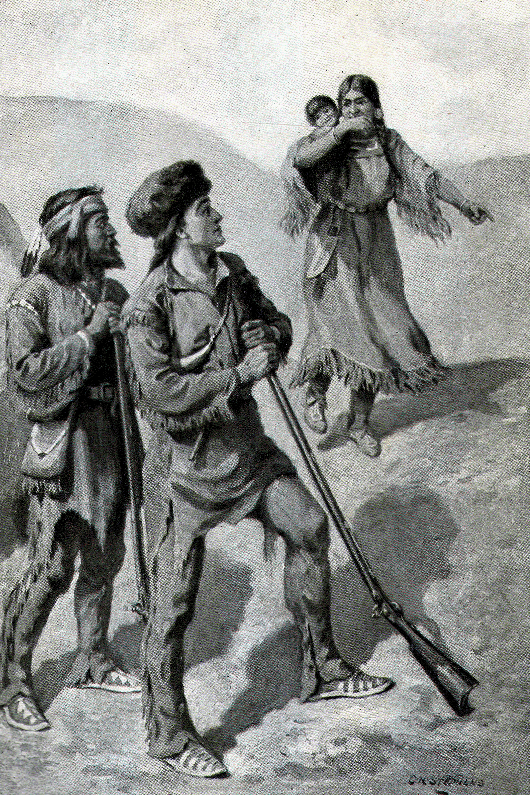 'DAT MEAN SHE SEE HER OWN PEOPLES.' |
"There's a village beyant," gasped Patrick. "Heave, lads, or else we're dreamin'."
"I see Drouillard dere, with dose Injuns," asserted Labiche, whose eyes were keen. "He dress jes' like Injun. I guess he trade clothes."
"Heave, lads!"
The Indian camp grew plainer, as the boats rounded the curve. More Indians were flocking out, afoot and ahorse. Sa-ca-ja-we-a and another woman had rushed together; they were hugging each other. But before the canoes could arrive at the bank, the captain and Chaboneau and Sa-ca-ja-we-a had disappeared into a large willow lodge and most of the Indians had flowed in after.
Hugh McNeal met the boats, at the landing, and he had a long story to tell.