Wonders of Scientific Discovery - Charles Gibson |
A Big Subject
A formidable list of sciences—Their real relationship—Is a little learning a dangerous thing?—The day of specialists—The building of the great edifice of science—Its beginning in the long-ago—Different ways of discovering things—Man's knowledge.
Some time ago a noted chemist, then well advanced in years, remarked to the author that in his youth he could boast that he knew the whole of Chemistry as it was then known, but that no youth of to-day could hope to say the same. This remark referred to one branch of Science alone, so it goes without saying that the most learned scientist of to-day cannot possibly know the whole of Science. What, then, of the average person who cannot devote his life to study?
Not many of us would undertake to write down from memory even the names of all the sciences, while for the meaning of some of the names not a few people of ordinary intelligence would require to consult a dictionary. We should have no difficulty in writing down:—Astronomy, Anatomy, Anthropology, Archaeology, Biology (which includes both Botany and Zoology), Geography, Geology, History, Meteorology, Philosophy, Physiology, Psychology, Sociology, and Theology. Then we might follow with the names of some sciences which end in the letters "ic" or "ics," such as:—Ethics, Logic, Mathematics, Mechanics, Metaphysics, Politics, and Physics. And those of us who are more interested in Science might add: Cosmology, Embryology, Epistemology, Histology, Hexicology, Morphology, Ornithology, Paleontology, and Philology. After that we might name a few of the branches or sub-divisions: Acoustics, Algebra, Arithmetic, Chemistry, Crystallography, Dermatology, Dynamics, Electricity, Ethnology, Etiology, Etymology, Geometry, Hydraulics, Ichnology, Ichthyology, Metallurgy, Mineralogy, Magnetism, Optics, Pneumatics, Statics, and many others.
No apology is required to accompany the statement that this volume does not profess to cover the whole field of Science. But there is another object in putting down this formidable list of sciences. We must not look upon the different sciences as we might picture so many separate or individual buildings—not even as so many rooms in one great building, but rather as different parts of one great room.
If one examines this list of sciences it is quite apparent that each interpenetrates another. Any person commencing the study of one particular branch of Science will find that he has entered other branches also. It has been said that to know any one branch of Science is to possess a private door into the whole realm of Nature.
If we wish to make a serious study of Science we must select one subject, or even one branch of that subject. On the other hand, there is a great interest in taking a wider view of Science. One so often hears the words of Pope—"a little learning is a dangerous thing"—being used where they do not apply. There is no danger whatever in learning the general principles involved in any branch of Science without learning all the detail. Perhaps if this fact were more generally recognised there would be more real knowledge acquired by our young people.
The present is the day of Specialists, and there can be no doubt that in the future it will become more and more necessary to specialise. It is the natural outcome of the accumulation of knowledge which man has been building up, and with what a quickening pace is the edifice now arising! But we must not run away with the idea that all the actual building has been done in these modern times. While these islands of ours were peopled with ignorant and semi-barbarous natives, learned men were at work in the East, and had it not been for the serious study of these students of long-past ages the edifice of Science could not have reached its present proportions. As Macaulay has said:
"Every generation enjoys the use of a vast hoard bequeathed to it by antiquity, and transmits that hoard, augmented by fresh acquisitions, to future ages."
In the long-ago, Science was confined to the few "wise-men" in each generation, and even in quite recent times Science was considered "dry stuff" so long as its story was to be found only in scientific textbooks. But now that Science has been applied to such a great extent in our everyday life, it attracts in some measure the attention of all thinking persons. The lad who studies Science instead of sensational novelettes has much more real pleasure in his reading.
In his presidential address to the British Association for the Advancement of Science, in 1909, Sir J. J. Thomson said:—"I think a famous French mathematician and physicist was guilty of only slight exaggeration when he said that no discovery was really important or properly understood by its author unless and until he could explain it to the first man he met in the street."
Our present subject is Scientific Discovery, and it is obvious that things may be discovered in several different ways. Professor Roentgen was surprised to discover the X-rays while he was experimenting with some vacuum tubes.
In one sense his discovery was accidental, but only in a qualified sense, as we shall see later.
But some great discoveries have been made in the same sense as a gold-digger discovers the gold for which he is searching. M. and Mme. Curie were searching deliberately for a radioactive substance when they discovered Radium.
The discovery of electric waves, or what some people think of as "wireless waves," was also the result of a deliberate search. Their existence had been predicted many years before they were discovered. The youthful German professor, Heinrich Hertz, had no doubt whatever of the existence of electric waves, and he succeeded in devising means by which he could discover their whereabouts.
Yet another kind of discovery is illustrated by the experience of the ancient mathematician Archimedes, who was born about three hundred years before Christ. Most of us heard the story of Archimedes while we were still in the nursery, or at least before we could understand how his plunging into a bath could enable him to discover whether the king's crown was made of pure gold, or whether the goldsmith had cheated the king by stealing some of the gold given to him and substituting silver in its place. We knew that the discovery must have been of great importance or Archimedes would not have rushed shouting through the streets to his own home without waiting to dress. These particular discoveries, mentioned here by way of illustration, will be dealt with in later chapters. Our present purpose is to note that all discoveries are not made in the same way.
It must be quite evident that man has discovered everything he knows concerning this planet on which he lives; concerning the great Universe in which his planet is but a little thing; and concerning himself and every existing thing. We wish to consider how some of his great discoveries have been made, and the most natural point to set out from is the world in which he finds himself.
|
Look, the world tempts our eye, And we would know it all, We map the starry sky, We mine this earthen ball, We measure the sea-tides, we number the sea-sands, We scrutinise the dates Of long-past human things, The bounds of effaced states, The lives of deceased kings: We search out dead men's words, and works of dead men's hands. ARNOLD. |
Our Planet's Movements in Space
The true shape of the solid Earth—Early ideas—The Earth supposed to be the centre of the Universe—A revolution of ideas—Difficulty in realising that the Earth is flying through space—Astrology—Kepler's discovery—How we discovered the "year"—Why we require leap-years—The whole solar system moving en bloc
From our infancy we have been taught that the world is not unlike an orange in shape. But if we draw a diagram of the Earth to scale, it is obvious that the actual flattening of the poles is very much less than that of an orange. But how did we discover that this Earth upon which we live is a great round planet floating in space?
Some people imagine that this was a modem discovery, and that all the Ancients believed the Earth to be a flat disc floating upon water. But the astronomers who lived many centuries before Christ pictured this world as a huge sphere, and some of these early astronomers even taught that the Earth was spinning round upon its axis like a top. It is true that this idea was formed before the discovery of any proof that their picture was a true one. The first argument was that the Earth must be round because a sphere is the most perfect form. But while those learned men in the East did not doubt the rotundity of the Earth, the ignorant people who inhabited the British Isles and the West of Europe continued to believe that the world was flat, right on to the time of William the Conqueror.
Quite recently there appeared in one of our daily papers the report of a meeting of a society the members of which still maintain that the Earth is flat. These cranks are only advertising their own ignorance, for if any thoughtful person considers our present knowledge of the subject he cannot fail to be convinced of the roundness of the Earth. It was discovered that a ship on the horizon appears or disappears bit by bit, just as though it were ascending or descending a steep hill. No matter on what part of the world this observation is made, and no matter in what direction the mariner is looking, the result is always the same. Therefore there can be no doubt as to the shape of the Earth. Then we can actually see the shadow of the round earth cast upon the moon.
In these days of modern travel it seems incredible that anyone can imagine the Earth to be flat. A journey round the world is a comparatively common event. As children we were doubtless amused with the idea that the people on the other side of the world must be walking about, like flies on a-ceiling, with the Earth above them instead of beneath them. But later on when we came to consider that there is no up and down except relative to the earth, the mystery disappeared. We realised that no matter on what part of the great ball we happen to be we are held down to its surface by that force which we call gravitation, and the boundless sky is overhead.
It was a long time before man discovered the true position of his planet in the great Universe. He thought of his world as the one thing of greatest importance, and he pictured the starry vault of heaven as a great crystal dome resting upon the Earth, or encircling it. Even when the wise men studied their movements of the Sun and the other heavenly bodies, they believed the Earth to be the centre of the Universe around which all the heavenly bodies travelled. It does look as though the Sun rose in the east, climbed up over the sky, and dropped down in the west. When in a railway station, we ourselves have sometimes been cheated as to whether it was the train we were on board or a neighbouring train that was in motion.
While the most natural picture was that of the solid Earth at rest, there were some ancient philosophers who declared that the Sun was the central body and that the Earth travelled around the Sun. But these philosophers could not bring forward any observed facts to prove their theory, and so it was that their ideas were abandoned by succeeding generations, and men continued to believe the Earth to be the central body right on to the time when Queen Elizabeth ruled over England. It happened to be during her lifetime that the great Italian astronomer Galileo Galilei forced men to believe that the Earth goes round the Sun. The actual proofs of this great fact had been established several generations earlier by the great Polish astronomer Copernicus, but it was Galileo who brought the subject into prominence and caused a complete revolution in man's ideas.
Even now, after this great discovery has been firmly fixed in man's mind for three hundred years, it is no easy matter to realise that we are on the surface of a great planet which is spinning round and at the same time is flying through space at a prodigious speed. As we go about our daily duties it is difficult to realise that we are being carried through space at the speed of one thousand miles per minute, a thousand times faster than the most reckless motor-car, and sixty times faster than a rifle bullet. No wonder that it took man a long time to accept this great discovery!
It is true that the ancient astronomers were apt to let their science drift into "Astrology," which was practically fortune-telling, but we should remember that away back in those far-off days some of the astronomers did make a serious study of the heavenly bodies. If we are apt to think of all Science as being of very modern origin, we should keep before us the fact that when Julius Caesar besieged Alexandria, there was a great university in that town, where for centuries many learned professors had been at work. We should remember that it was there and then that Professor Euclid wrote those books on geometry which have worried many schoolboys, but which are indispensable in modern Science and Engineering.
The professors of that ancient university believed the heavenly bodies to move in circles, because the circle gave the most perfect motion, but the great German astronomer Johann Kepler discovered that the planets moved in ellipses or oval-shaped orbits. Kepler made this discovery in a rather curious way. He kept guessing different ways in which the planets might move, and then testing how each particular path would account for the observed motions of the planets. Formerly the astronomers had been forced to make a most elaborate arrangement of circles, one moving within another, in order to try and explain the motions of the planets. But Kepler's simple ellipses did away with all these intricate theories; he had discovered one of the great secrets of Nature.
Now we picture ourselves on board the Earth making a continuous journey in a great elliptical path around the Sun. We know that this journey takes us one year of 365 days; it will be of interest to consider how we discovered this great fact.
It was an easy matter for the Ancients to divide time into days, as each day is marked off clearly by the accompanying night. Then it was obvious to them that there was a regularly recurring cycle of the phases of the moon, and they noted that twenty-nine days elapsed between one "new moon" and the succeeding one. We have discovered since these early days that the month, the time of the moon's journey around the Earth, is not exactly twenty-nine days. It is almost twenty-nine and a half days, the actual time being 29 days 12 hours 44 minutes and 2.86 seconds.
The discovery of the "year" was not so easy, for the completion of our circuit around the Sun is not so apparent. However, it was obvious that there were regularly recurring seasons, and that the Sun was much higher in the heavens at noon in summer than in winter. This fact would cause the shadow of an object to be much shorter at noon in summer than in winter. By watching the shadow cast by some fixed object, it became clear which was the longest and which was the shortest day; mid-summer and midwinter. Then again, the shadows cast at sunrise and sundown would keep changing gradually their direction day by day, so that by noting carefully its positions at sunrise and sunset on any day, and counting the number of days until the shadows again reached the very same positions, it was possible to determine the length of the year. Indeed, the Egyptians discovered about five thousand years ago that the year consisted of three hundred and sixty-five days. This discovery was based upon the seasons alone. The Greeks had a year of three hundred and fifty-four days, and other nations had a different number of days.
Some centuries later the Egyptians discovered that the actual journey around the Sun took about a quarter of a day more than three hundred and sixty-five days, and now we know that the exact time of the journey is 365 days 5 hours 48 minutes and 48i seconds.
It is generally known that a "leap year" is introduced in order to get rid of this awkward fraction of a day coming into each year. It was our old friend Julius Caesar who introduced the leap year of 366 days in every fourth year. This would have cleared away the disturbing fraction if the figures had been exactly 365 ¼ days, but as already stated, the exact fraction is a little less than a quarter. At a much later date it was agreed to omit a leap year at every hundredth excepting the four hundredth year. The reason for all this juggling is very simple.
We start at a particular point in our orbit at the beginning of the year, but at the close of the last day of the year we have not quite reached that starting-point. We require an additional 5 hours 48 minutes and 48 seconds to reach that point. We get later by that amount each year, so that in four years we are about 231 hours behind time. We put an extra day in the fourth year to give our planet time to reach its proper starting-place before the next year opens. The extra day means 24 hours, whereas the planet will reach its goal in 281 hours. The Earth has set off f hour in advance of its proper time, and it will get ahead by that amount every fourth year, so that in one hundred years it will be about 19 hours in advance. We therefore agree to omit the leap year at every hundredth year, thus taking 24 hours off that year. This not only disposes of the hours which we had to spare but robs us of other 5 hours, making us late again to that extent. As we shall lose another 5 hours at every hundredth year, we shall be 20 hours late in four hundred years, and therefore we agree not to omit the leap year at that point. By keeping in the extra day we allow the Earth to reach its proper starting-place in good time. Indeed, we shall have a fraction to spare at every four-hundredth year, but it will take some thousands of years before this occasional addition reaches the total of one day, so that we can, leave some far distant descendants to put matters right then.
We picture ourselves on board this planet Earth, with our attendant moon, waltzing round this great elliptical path around the Sun. We picture the other planets making similar movements, some nearer and some farther from the Sun. Even then we must not picture the solar system as being fixed in space, for in these modern times we have discovered that the whole solar system is moving through space, and that even the far-distant "fixed" stars are in motion.
Having formed a picture of the Earth's movements in space, it will be of interest to consider some of the things we have discovered concerning our planet itself.
Some Discoveries Concerning our Planet
When was the Earth created?—How we can tell the age of the Earth—How the Oceans became salt—The birth of the Moon—The inside of the Earth—Eruption of Krakatoa—What we learn from earthquakes—The thickness of the Earth's crust—The evidence of meteorites
We know that our planet has not existed for all time, but had a definite beginning; it was created. Is it possible to discover when it was created? Our forefathers thought they could reckon back to the time of the creation, and their estimate was that it took place in the year 4004 B.C. Unfortunately, they had such confidence in that estimate that they placed that particular date opposite the first chapter of Genesis in our printed Bibles. It is even more unfortunate that the printers continue to put this date down as the actual date of the creation, for we have discovered that the age of the Earth must be reckoned in millions of years. It would be only reasonable to withdraw the erroneous date from our Bibles, as it was put there merely on the authority of a learned archbishop who was living at the time the Bible was translated into English. From actual discoveries of the buried ruins of ancient cities we can trace the history of civilised nations as far back and beyond the date given.
Before considering what we have discovered concerning the age of the Earth, it will be of some assistance to picture its early youth. There is no doubt that at one time it was a great mass of incandescent gas. It was not "burning," because there was no air surrounding it at that time. However, it was natural that this great fiery mass should cool down. As it cooled it became smaller and smaller; it passed into the state of a molten liquid and then a white-hot solid. By this time an envelope of water vapour had formed around the solid globe. The pressure of this envelope of steam would exert an immense pressure on the surface of the hot planet, and there is little doubt this pressure played an important part in distorting the surface of the Earth, depressing it at some places and raising it at others. When things had so far cooled down that the water vapour could condense upon the Earth, there were formed boiling and steaming oceans of water lying in the hollows.
The foregoing short description will enable us to appreciate two of the calculations made concerning the age of the Earth. Knowing that the Earth had cooled from a highly heated body to its present condition, the late Lord Kelvin set himself the task of calculating how long it had taken the planet to cool down. The final result was that at least twenty million years had elapsed since the Earth was a molten globe. Since the discovery of Radium in the Earth's crust it is contended that these twenty million years must be very substantially increased, and that now the Earth is increasing in temperature because of these radioactive substances. However, Lord Kelvin's calculation leaves no doubt that this planet upon which we reside has been in existence for many millions of years.
Professor Joly, of Dublin, has put forward a very interesting theory, but one which some geologists do not accept. He maintains that the sea has become salt very gradually by the rivers washing down sodium compounds from the rocks. He has calculated how long it would take the rivers to bring down the necessary amount of sodium compounds to account for the present saltness of the sea. He has calculated that all the rivers of the Earth could bring down about one hundred and sixty million tons of sodium in each year. He finds that the total amount of sodium contained in the oceans of the Earth is at least ninety million times more than these figures, so that the age of the Earth must be at least ninety million years. Some of the geologists claim one thousand million years as necessary for the formation of the Earth's crust.
Yet another method of calculation has been used in trying to fix the age of our planet. We have no doubt that our faithful satellite the Moon was at one time a part of this great planet. The Earth must have been in a very plastic condition when it threw off that portion of itself, which drifted away and became the Moon. The late Sir George Darwin calculated how long ago the birth of the Moon must have occurred, and the figures come out about fifty-six million years. Again we are among the tens of millions, and all those calculations go back only to the time when this world was a molten mass of, say, five thousand degrees temperature. But when the Earth was a mass of incandescent gas, its temperature was that of the stars, the hottest of which is about thirty thousand degrees. There must have been an enormous lapse of time to allow of this great drop of temperature. But if we consider only the time required to form the crust of the Earth, even then we have to count the age of our planet in many millions of years. This will become apparent when we consider the building up of the Earth's crust in a succeeding chapter.
Some people have held very queer ideas about the inside of the Earth. One of the strangest ideas has been that the Earth was hollow, and that the inside was the habitation of living beings. The idea was not that these inhabitants were fiery demons, such as are represented in a pantomime by some Mephistopheles being shot up from the lower regions. The recorded descriptions tell of a beautifully mild climate within the Earth, which was reached by an opening at the North and at the South poles of the Earth. Needless to say that the Arctic and Antarctic explorers did not search for any such entrances. It is quite apparent that the writers of these absurd notions were not scientists, and yet we have such writings put down in all seriousness within the last hundred years.
If one desires to know what is inside anything, the best plan is to make a direct investigation and examine the contents. In the case of the Earth this is impossible; we cannot sink a shaft to any great depth. When one is going down a deep coal-mine for the first time it seems quite a long journey, but the deepest mine ever made goes down only about one mile into the Earth. To reach down to the centre of the planet would mean a journey four thousand times as great. But it would be quite impossible to continue the journey to any great depth. Even if we were able to overcome the difficulties of the increasing temperature and the increasing pressure of air, it would take more than a lifetime to dig a depth of ten miles. Suppose for a moment that it were possible to continue at the same rate of progress, it would take thirty thousand years to reach the centre. But the whole idea is quite ridiculous, so we may give up all hope of ever discovering the contents of the inner Earth by direct investigation. Our discoveries must be made by the study of phenomena occurring in the Earth. We can only question and cross-examine these phenomena as we should do witnesses.
Our conceptions of the inside of the Earth have changed greatly within quite recent years. Some thirty years ago there occurred a tremendous volcanic eruption in the island of Krakatoa. Although this volcanic island is situated far away in the East, the eruption threw such immense volumes of dust particles into the air that for the succeeding three years our sunsets in Great Britain were more than usually red. A great wave also swept through the oceans of the planet. In a public lecture dealing with this great eruption, and delivered some years after the occurrence, an eminent astronomer described the relation of the solid crust of the Earth to be to the molten interior no more than the solid shell is to the liquid of an egg. Since then we have had to alter this picture very materially. Not only does the solid crust extend to nearly one quarter of the four thousand miles, but we have reason to believe that the contents of the Earth are even more solid at the centre. Indeed, that within the great rock mantle there exists a solid metallic core. We have strong evidence in this direction from one witness in particular: the phenomena of earthquakes.
When an earthquake occurs at some great distance, we are able to take a record of it here, and at any other part of the globe where there is a delicate seismograph. One form of such an instrument is a very delicately poised indicator which will move will every tremor of the Earth. The movements of the indicator are recorded by means of a ribbon of photographic paper. There are now about one hundred different seismological or earthquake stations spread over the planet. On comparing the records obtained at different stations we can see how long it has taken the tremors to travel to the different points. The tremors going along the solid crust of the Earth will take a time proportional to the distance travelled by them. But there are other tremors which go right through the Earth from the place of the eruption to the distant recording station. If the Earth were of homogeneous material throughout, then the rate of travel would be proportional to the distance of this short-cut route through the Earth from point to point. But the earthquake records show that if the short-cut, from place to place through the Earth, pass through a greater depth than eight or nine hundred miles, there is a considerable increase in the velocity of the tremors. Indeed, the tremors pass about twice as fast through the core, and the change of velocity is quite sudden at a depth of eight or nine hundred miles. The evidence of this witness is that the core of the Earth is of different materials from its crust. By supposing the centre to be a great metallic core we can get the different records of earthquakes to agree. Indeed, this seems the only satisfactory way in which we can account for the evidence, although all geologists are not agreed upon the point.
It will be of interest to inquire if there is no other witness we can call to give evidence on the question of the metallic core of the Earth. We have discovered the weight of the planet, as we shall see in the succeeding chapter, and this brings us some further evidence. We know that the weight of the whole Earth is five and a half times that bulk of water. But the rock mantle weighs not more than three and a half times the weight of water, therefore the centre is heavier. If we allow even one thousand miles for the depth of this rock mantle, we find that the centre core must be about eight times as heavy as water. It so happens that iron is about eight times heavier than water, but is there any more reason why we should think of the Earth's core being iron in preference to copper or gold? Yes, we have several witnesses to call. The rocks thrown up from a great depth by active volcanoes have been found to be very rich in iron.
Picture the molten Earth cooling, it would be natural for the heavier material, say iron, to fall to the bottom while the lighter material which forms the rock mantle would float to the surface. We know that in the blast furnace the stones or slag float to the surface of the molten iron, and are conveniently drawn off.
Sir Isaac Newton is said to have guessed the density of the Earth to be between five and six times that of water. It was no blind guess. He argued that when the Earth was cooling from a molten to a solid state that the lighter materials would float to the surface, and he made his calculations accordingly. It is remarkable that these figures arrived at some two hundred and fifty years ago are found to be correct.
There is still another witness to give evidence. When lumps of matter have fallen on to our planet from stellar space, we find most of meteorites to be very rich in iron. Again, we shall see in a later chapter how we have discovered the contents of our far-distant Sun, but mean-time it is of interest to note that iron is one of its constituents.
We have seen that the Moon was thrown off by the molten earth during its process of cooling. If at the time of the birth of the Moon the slag were on the surface of the molten metal, we should expect to find that the Moon is made of the rocky material alone. The weight of the Moon corroborates this, for its total density is about the same as the rock mantle of the Earth. The most recent calculations concerning the Earth give a "crustal zone" of about 30 miles in depth, with a mean density of 2.8. Then a "stony zone" or rock mantle estimated to be from 600 to 900 miles in depth, and having a density of 3.4.
It may be that there still remains a layer of molten material within the Earth, but we can no longer picture the centre of the Earth as a fiery mass; we have strong evidence in support of the rock mantle with a solid iron core.
Before considering what we have discovered concerning the crust of the Earth, it will be of interest to see how we discovered the weight of the Earth itself.
How We Discovered the Weight of the Earth
Weighing large masses—Weighing a mountain—More exact methods—Measuring gravitation by a clock pendulum—A most interesting experiment in weighing the Earth—The difficulties which the experimenter had to overcome—The actual weight of the Earth—An imaginary demonstration showing the enormous difference between a million and a billion—Pioneer experiments by Cavendish
To weigh a very large mass of iron, which could not be handled, would not be difficult if the mass were regular in shape. The cubic contents of a square or rectangular block could be calculated by a schoolboy. Then a cubic inch of iron might be weighed, and a simple multiplication sum would give the total weight of the large mass. Even if the iron mass were in the form of a large ball, its contents and weight could be calculated without much trouble.
We know the size of the Earth, and we might set about weighing it in the same fashion; first of all weighing a block of the crust of the Earth and then using our multiplication table. This will not do, however, for, as we have seen in the preceding chapter, the Earth is not of the same density throughout. But if we consider what the weight of an object is we can appreciate another method of weighing. Without the aid of Science we know that a large mass is attracted by the Earth with a greater gravitative pull than a smaller mass. It is easy to realise that the force of gravity between the Earth and any object on its surface depends upon the mass of the object. If we could only cut some great block from the Earth's crust, and a similar block from the core, we could test the gravitative pull of these two great masses upon some light object. We could determine not only whether the crust or the core was the heavier, but we could obtain the relative densities of the two objects. It goes without saying that this cannot be done, but a mountain is practically a great lump of the Earth's crust. But how are we to test the attractive pull of the mountain?
When a mason wishes to test if his building is quite perpendicular, he suspends a weight on the end of a string. He calls it a plumb line, but it might also be called a pendulum. The weight or bob of the pendulum is pulled straight down to the Earth, and the line supporting it is exactly perpendicular. As every particle of matter attracts every other particle, the building must have some attractive pull upon the suspended weight, but this will be so very insignificant compared with the pull of the Earth, that it will be inappreciable. But would a great massive mountain have any measurable pull? One might suppose that even in this case the difference in mass would be so very great that the comparatively feeble pull of the mountain would not be observed. But when an English scientist, Dr. Maskelyne, tested the matter with one of the great steep mountains of Scotland, he found that the mountain did pull a sensitive pendulum away from the perpendicular. Similar experiments had been attempted at Peru about a generation earlier.
The foregoing discovery was made more than one and a half centuries ago. The task was not a suitable amusement for a summer holiday. Experiments were made on both sides of the mountain, so that the pull could be observed in directions exactly opposite to one another. The distance through which the weight was pulled was found by an astronomical method. Then the mountain had to be measured and its cubic contents calculated; not an easy task for such an irregularly shaped mass. After that work was done, it was necessary to make extensive collections of samples of the rocks of the mountain, so that its density might be known. Then by comparing the pull of this mass upon the plumb-line with the pull of the whole Earth, it became apparent that the density of the Earth was greater than that of the mountain. This was looked upon as a fair method of weighing the mountain.
When these early experiments were made, the methods were not very exact, but with the aid of more sensitive apparatus and more exact methods we have arrived at the figures given in the preceding chapter. The crust of the Earth is three and a half times as heavy as water, and the average density of the Earth is five and a half times that of water.
An ingenious way of determining the local density of the crust of the Earth has been discovered. We know that the planet is flattened at its poles and distended at its equator. Therefore the attractive pull at the poles will be greater than at the equator. This difference in the gravitative pull should affect the swing of a clock pendulum; the greater the pull the faster should the clock go. This we find to be the case. A pendulum clock set to keep perfect time at the equator would gain about half an hour every week when transferred to the neighbourhood of the North Pole. Very sensitive apparatus has been made with pendulums swinging in air-tight boxes in a partial vacuum and at a constant temperature. The swing of the pendulums has to be compared with the beat of a chronometer, which having no pendulum is not affected by changes in gravitation. The chronometer causes an electric flash to occur at every half second so that the swing of the pendulum can be determined conveniently. If the swing of the pendulum is faster than the chronometer then it is apparent that the attractive pull of gravitation has increased, while a falling off in speed indicates a lessening in gravitation. By this means we can tell the density of the Earth at any particular place. The general finding is that the Earth beneath the oceans is most dense, while that forming mountains is not so dense.
Other methods of weighing the Earth have been discovered. One of the most interesting of these was used a few years ago by Professor Poynting, who won the "Adams prize" for an essay on the density of the Earth.
The general idea of the experiment was to suspend two weights, one at either end of a sensitive balance, so that the pull of the Earth upon each was exactly balanced. If some massive piece of matter were then placed beneath one of the balanced weights there would be a slightly greater mass attracting that end. The learned Professor knew very well that the additional pull would be so very small that it would be extremely difficult to observe and measure. That he did succeed in this experiment is remarkable. He used two fifty-pound weights on the balance, and a large mass of metal weighing three hundred and fifty pounds was placed beneath one of these. The movement of the balance was so small that it had to be observed by a telescope. A microscope would have served the purpose if the Professor could have remained close beside the apparatus, but the smallest movement near the balance would affect it. He had to place his weighing-machine in a cellar and look down upon it through a hole in the ceiling. He found that a movement of anyone in the house disturbed his apparatus. To obviate this he had to place the instruments on large blocks of rubber.
The Professor's intention was to bring the three hundred and fifty pound mass under one of the suspended weights and measure the attraction. Then he wished to place the heavy mass under the opposite end of the balance and measure the attraction again as a check upon his first figures. But there was an unforeseen difficulty; he found that when he moved this heavy mass from one place to the other it actually altered the level of the cellar floor. Of course, the difference of level could only be detected by sensitive apparatus, yet this difficulty had to be overcome also. In passing it may be remarked that with the aid of a sensitive seismograph the level of a substantial building has been found to alter ever so slightly after an ordinary shower of rain.
It is remarkable that Professor Poynting succeeded in measuring the actual attractive pull of his three hundred and fifty pound weight. With this data he calculated the density of the Earth, and his figures worked out practically the same as had been obtained by other methods; the density of the Earth was approximately five and a half times that of water. But what is the actual weight of this planet upon the surface of which we are being whirled through space?
As we know both the density and the size of the Earth, it is not difficult to discover its actual weight. The tonnage put down in figures reads 6,000,000,000,000,000,000 tons. The figures take us far out of our depth, and even when we try to think of the Earth as weighing six trillions of tons, we find it quite unthinkable. It is even difficult to realise the enormous weight of coal taken out of the Earth every year. Recent statistics show that the total is over one thousand million tons per annum.
To anyone who has not realised the enormous difference between a million, a billion, and a trillion, one thousand million tons of coal every year may seem an appreciable encroachment on the total of sixty trillion tons representing the weight of the whole planet. Of course, our deepest coal mines are merely as pin-pricks on the very surface of the planet, and the total weight of the coal withdrawn annually is a mere nothing when compared with the weight of the Earth.
As we shall have occasion to refer to millions and billions in connection with different subjects in succeeding chapters, it will be worth while realising the enormous difference. Suppose we were to attempt to give an actual demonstration of a million. In our imagination we can erect a large tank to hold exactly one million dried peas. Suppose we arrange a clockwork apparatus to let one pea drop from the foot of the tank at the end of each second of time. We should soon realise the rate of discharge, and after watching the regular counting of the peas for a little, we should feel that it was unnecessary to wait through the whole demonstration. A simple calculation would tell us that we could return in a little less than a fortnight to see the millionth pea leave the tank. Working continuously night and day the tank would be emptied in eleven and a half days.
Now suppose we desired to have a similar demonstration of a billion. In our imagination we construct a larger tank to hold one billion peas, and of course we are prepared for a much longer demonstration. A simple calculation will tell us that we need not cancel any previous engagement to enable us to be present at the appearance of the billionth pea, as we shall have disappeared from the planet long before the end of the demonstration. Nor will our great-great-great-great-grandchildren be in the land of the living then. Indeed, had this demonstration of a billion peas been begun before the time of Christ, there would be little appreciable difference in the tank of peas to-day. It would take thirty thousand years to empty the tank.
It is apparent that no one need have difficulty in realising the enormous difference between a million and a billion. A million is to a billion as a fortnight is to thirty thousand years. We are reckoning a billion as a million million.
To make a similar comparison between a million and a trillion we should have to say that a million is to a trillion as one second is to thirty thousand years. Although it is not easy to realise the latter length of time, the great difference is easily appreciated. Therefore, when we say that this great globe upon which we live weighs six trillion tons, we think of something very different from six million tons.
Before leaving the subject of the density of the Earth, it should be noted that pioneer experiments were made by that wonderful genius, and eccentric millionaire, the Honourable Henry Cavendish, about one hundred and fifty years ago. Cavendish's method forms the basis of Professor Poynting's experiments, which we have considered in the present chapter. We need not trouble with the detail further than to remark that, instead of a gravity balance, Cavendish used what is known as a torsion balance, and that he measured the force of attraction between two heavy spherical masses of metal and two small metal balls forming the ends of the beam of his torsional balance.
How the Crust of the Earth was Formed
The ups and downs of the planet—Fossil shells discovered before the time of Christ—Fossil fish—A time when the British Isles were not—A great continent of long ago—The surface of the planet—Where the soil came from—How the chalk cliffs were formed—Microscopic creatures—How the rocks were formed—Microscopic plants—How they multiply—Different kinds of rocks—The great coalfields—When the mountains appeared—The Ice Ages
Man discovered, long ago, that different parts of the Earth's crust have had their ups and downs. It became evident to him that the land we know to-day was once at the bottom of the ocean, and that what forms the bed of an ocean to-day was at one time dry land. Fossil shells were found away up on mountains far from the sea, so long ago as 500 B.C. But although some of the ancient philosophers declared that this Earth's surface was different entirely from what it had been at one time, it has taken man a long time to accept that fact. This doctrine, begun two thousand five hundred years ago, was opposed in quite recent times. But those in opposition had to invent strange suggestions to account for sea-shells being buried in the rocks on mountain-tops. One suggestion was that the shells had been carried there by the Flood in the days of Noah. Another was that pilgrim had carried the shells there, but neither of these suggestions appeals to ordinary reason.
Fossil shells are found to-day on mountain ranges three miles above the present level of the sea. Of course, this does not signify that the ocean level was three miles higher when these shells were deposited. The mountain has been forced up, and doubtless the sea-level has fallen also.
By careful study the geologist and the zoologist have been able to map out some of the ups and downs in the past history of our planet. It is quite certain that our British Isles were not always in evidence; more than once they have been at the bottom of the ocean. Just as surely do we know that during another period of long-ago Britain was part of a great continent, and primitive man could walk across valleys now covered by the English Channel and the German Ocean. But there is evidence that some parts of the Earth have remained dry land right away back so far as geological records go. For instance, Norway and Sweden have never been entirely under the sea, nor has the whole of Africa, India, or Australia been hidden completely as our island home has been.
At one time there existed an enormous continent upon which one could have travelled from South America right overland to Africa and thence to India, and again right overland to Australia. This great one-time continent, which we call "Gondwanaland," was a very ancient one. Although it was not the abode of man, it was peopled with plants and animals. Indeed it is the distribution of the fossil remains of these prehistoric plants which tells us that this continent must have existed in the long-ago.
It is the geologist who has discovered the past history to the Earth. He has found that its crust has been built up of different layers, laid one upon another. He has been able to make some calculation as to the time which would be occupied in the formation of the different coatings. It was the geologist who declared first that the Earth was many millions of years in the making.
We know that to-day the surface of the planet is composed of soft soil, sand, gravel, and clays, with hard rock coming through at places. Even the amateur geologist is convinced easily that the soft soil has been made from the material which forms the rocks. The storms of past ages have helped to attack the rocks, the changes of temperature even now are helping to crack them, the rain has played its part, and chemical action has taken a leading hand in bringing about what we might call the rotting or decaying of the solid rock. When we open up the ground to cut up the solid rock for building purposes, the life history of the soft soil may be read; the decayed and broken rock is seen to form a subsoil between the soft soil and the hard rock.
We require this layer of soft soil wherever plants are to grow; the better soil the better growth. This soft soil must have existed wherever we find traces of vegetable life buried in the Earth, and there must have been vegetable life wherever there are traces of animal life.
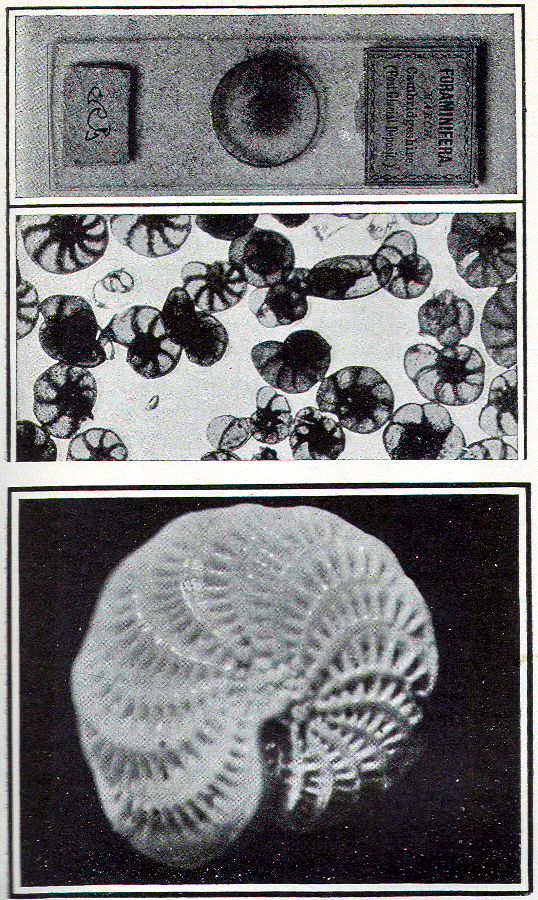
At certain well-known places we find great chalk or limestone cliffs projecting through the Earth's surface. These are the deposits of past oceans, and the discovery of their formation is most interesting. A German professor, early last century, was examining pieces of these limestone rocks by means of his microscope, when he discovered that the rock was composed of very minute shells, not broken fragments of shells, but myriads of complete microscopic shells (see the illustration facing page 26). A million of these shells might be sent by letter-post for a penny.
These are tiny fossil shells, each of which was the home of a living creature in long-past ages. It goes without saying that the bodies of these minute creatures had no definite structures; they might be described as individual specks of jelly-like living substance. These microscopic creatures were named "Foraminifera." They are not all alike; one variety of these tiny creatures formed the rocks from which our Parisian friends have used great quantities of stones to build their houses.
While the Foraminifera were alive they floated about in the great oceans, and at their death their tiny shells sank to the bottom of the ocean. We are picturing what took place long before the creation of man, but similar Foraminifera live and die to-day. If we think of any great chalk cliffs which we know, it is difficult to realise that those vast deposits have been built up by the gradual and imperceptible deposit of almost invisible shells. The thickness of some of these deposits can be measured in hundreds of feet.
The shells of some of those apparently insignificant creatures go to form part of many important mountain ranges; among these are the Alps and the Himalayas. We marvel at the ingenuity of ancient man in building the great Pyramids of Egypt. Is it not much more marvellous that, by means of these small shell-creatures, Nature has built the great stones of which the Pyramids are made?
The ordinary chalk, with which the schoolmaster writes upon his blackboard, is made of minute microscopic shells, which are allied to those found in the Pyramids. This may be seen by examining a very thin slice of the chalk with the aid of a microscope.
When the German scientist made this discovery concerning the constitution of chalk, it was thought that only the softer kinds of rock, such as chalk and limestone, had been formed in this fashion. However, with other methods of preparing microscopic specimens of some harder rocks, it was seen that many hard rocks had been formed in a similar fashion.
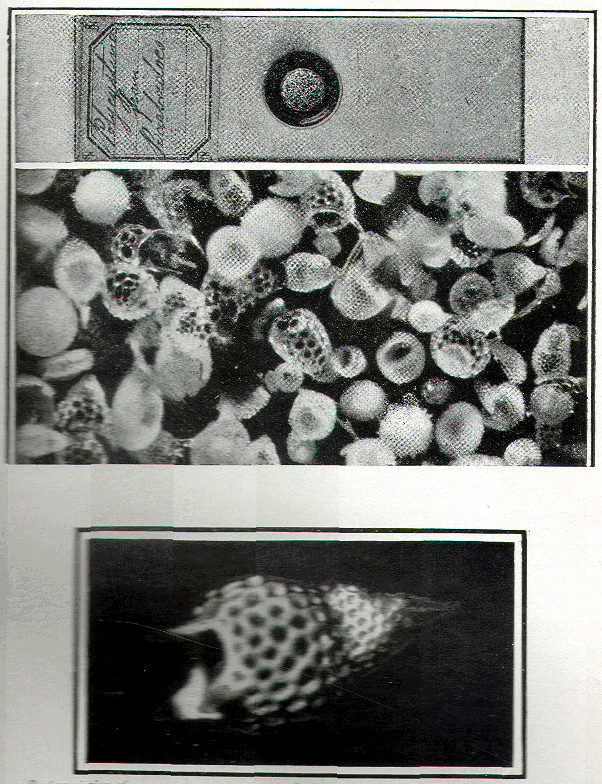
These harder rocks had not been formed by the chalky shells which belong to the Foraminifera family, but by even more beautiful microscopic objects. In the illustration facing page 46 we can see a photograph of a few of these objects very greatly magnified. To the unaided vision each of these objects looks like a tiny speck of white dust or sand. The specimens are obtained by crushing a tiny fragment of the hard rock, and then washing the powdered rock in a strong solution of acid. By this means all the chalky matter or lime is dissolved and only these tiny microscopic objects are left. From the treatment given to this specimen it is apparent that these tiny objects are made of some very hard substance which is not easily dissolved by acid. We are not surprised to learn that they are made of that hard, flinty, glass-like substance known as "Silica."
The name of the class of these microscopic objects is "Polycystina," or "Radiolaria," and although they are referred to as shells, they are in reality the skeletons of tiny gelatinous creatures. The hard flinty objects, which are shown in the photographs, do not form a protecting shell; the living substance of the radiolaria is on the outside as well as on the inside of the hard skeleton. The living creatures float near the surface of warm oceans, and at their death they sink, leaving a cemetery of dead skeletons on the bed of the ocean. This deposit, becoming buried, produces in long ages a great variety of hard rocks. As in the ease of the Foraminif era, so we have living representatives of these radiolaria, whose fossil skeletons are sometimes called polycystinae.
Yet another class of microscopic objects take an important part in the formation of some rocks. In the photograph facing page 50 we see specimens of this third class, which are known as "Diatoms." This time we have not to deal with living animals, but with tiny aquatic plants. The microscopic plants possess a hard flinty covering, and it is these coatings which remain after the plant is decomposed. The quantities of these diatoms are enormous. Each diatom grows rapidly and divides into two, each of these two diatoms divides again, and so on, at a very remarkable rate.
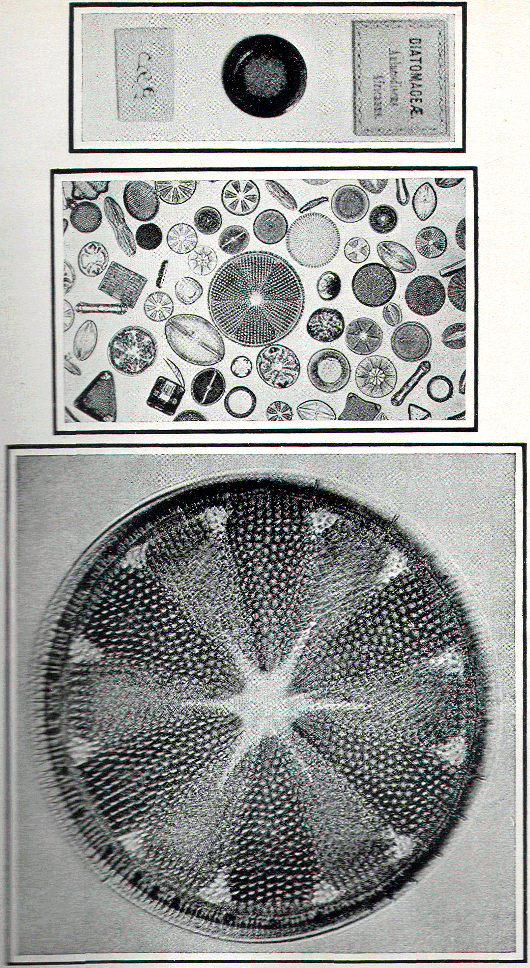
In the process of division the succeeding diatoms get smaller very gradually, and when the offspring becomes reduced to about half the original size, the plant then casts off its flinty case, which sinks to the bottom of the ocean or lake. These diatoms are not necessarily marine as are the Foraminifera and the Radiolaria, indeed, we may find diatoms in the ordinary mud of any pond. Many of these beautiful diatoms are quite invisible to the unaided eye, and yet there are thousands of varieties. They are found in the oceans, lakes, and rivers of every part of the world.
It will be observed that the life history of the diatom, being a plant, is different from that of the other tiny creatures which go to form these deposits which ultimately become rock. The diatom plant does not lose its flinty coat merely at death; millions of diatoms are constantly shedding their coats, then growing larger, forming new flinty cases, again subdividing, and so on.
But for the microscope we should never have discovered the history of these different varieties of rock. Examine any one of those photographs of Foraminifera, Radiolaria or diatomacea; and try to realise that all that mass of detailed structure is contained in the tiniest speck which you can detect with the unaided vision.
Of course, we must not run away with the idea that all rocks have been formed in this fashion. Such sedimentary rocks could only be formed beneath an ocean, or in the case of the diatoms beneath an ocean or lake. We know that the solid rock mantle of the planet must have been formed before the oceans could exist. We know that this great globe was a molten mass at one time. We picture the heavier metallic substance sinking to form a core, and the stony material rising to form an outer crust. It is apparent that this solid rock mantle was formed by the solidification of molten matter. We speak of these rocks as "primary," because they were formed first. Another name we give them is "igneous," because they are fire-hardened.
When the amateur chemist makes a hot solution of some salts, and finds that in cooling there are beautiful crystals formed, the action is not unlike that which took place in the formation of some of the primary rocks, such as granite.
This hard rock mantle was subjected to atmospheric action, changes of temperature, and the action of water. Fragments were broken off and washed down by the running water, and in time these deposits formed sandstone and such-like "secondary rocks." And so we see that the rocks formed by the shells of the microscopic creatures and plants, already described, constitute only a part of the sedimentary or secondary rocks. All these deposited rocks occur in layers, and thus differ from the original unstratified rocks.
It goes without saying that the fossil shells, the fossil fish, and all fossils are found only in the sedimentary rocks, or in the deposits of gravel and other material on their surface. No shells, plants, or animals existed at the time when the fire-hardened rocks were formed.
The primary rock mantle is not hidden entirely by the secondary or deposited rocks. We see the hard, unstratified rock sticking up through the crust of the Earth in mountain ranges. Thus in the Highlands of Scotland there are many huge masses of primary rock.
There is no intention of considering in detail the geology of different classes of rocks, but one well-known class cannot be passed over, as its formation is so distinctly different from those already described. We are very familiar with that soft black rock which we call "coal," and the method of its formation is well known to all. But how do we know that the coal-fields are the mineralised vegetation of a far distant age? The geologist has no difficulty in convincing us of this fact. In the rocks which enclose the coal-beds he can show us innumerable fossils of ferns and trees. Many of us made collections of these during our school days. The geologist can show us the whole trunk of a tree fossilised with its roots still in the underclay. He may point to the peat-bogs of the present day and suggest that if these beds of peat were sunk gradually beneath the ocean, and in the process of time became covered over with deposits of sand and limestone, the peat would in due time become mineral coal. But better than all these arguments, he can give us direct evidence from the coal itself. By cutting thin slices of coal and examining them in a microscope, we can see even what particular kinds of plants went to form the coal. We can tell whether the plants belonged to the family of cone-bearing trees, to ferns, to horse-tail plants, or to club-mosses.
So it has been discovered that our coal-fields are due to the decayed vegetation of great forests; forests of fern-trees, cone-bearing trees, horse-tails, and club-mosses. We find that these grew to gigantic proportions in those far-off days. They varied from sixty to eighty or even one hundred feet in height, and the foliage was exceedingly rich. It is impossible to discover the exact condition of the Earth at that time, but the general evidence is that these great forests grew in a warm, moist atmosphere, and that the ground was soft and slimy, and thus well able to deal with the falling vegetation.
The coal-beds occur, one seam above another, with great deposits of clay and other sedimentary rocks between. Here we have another proof that these parts of the Earth have had their ups and downs. Each of these coal-seams was at one time on the surface of the Earth, so when we find a dozen or more different coal-seams in one mine, we know that that particular part of the globe was a dozen or more times covered by forests or swamps.
These great coal-seams were laid down a very long time ago, but even before that time the first mountains appeared on the surface of the Earth. There is no doubt that these upheavals were due to the Earth's crust trying to adjust the pressure of its plastic centre. One reasonable explanation is that the rivers, having been busy for millions of years transferring matter from the land to the ocean-beds, the balance of pressure was upset, and in the readjustment there occurred great uprisings and depressions of land. Some of our great rivers of to-day carry down hundreds of millions of tons of matter in a single year.
Long after the formation of these first mountains there was a further upset of the balance between the crust and the interior, due to the formation of the great masses of sedimentary rock built up by the microscopic creatures as already described. The weight of these immense deposits of limestone forced mountain ranges to appear very gradually but on a larger scale than the earlier mountains. This mountain building continued, up to so recent a period as two million years ago, long after there was animal life upon the planet.
During all these geologic changes we think of the Earth cooling very gradually, but we do not picture its surface as a tropical climate becoming more temperate. We know that even to-day there is a great variation of climate at different places, and that the Earth's polar regions are covered with ice. In the long ago, our own part of the world was covered with ice, not only once but possibly several times. Although we have discovered, from evidences in the Earth's crust, that great glaciers did exist in these parts, leaving their marks behind, and that parts of both Europe and America were covered with an enormous thickness of ice, yet we have failed to discover exactly how these conditions came about, or exactly when these ice ages occurred. Some geologists believe they have evidence that the whole ice ages occurred some twenty to sixty thousand years ago. Others see traces which they say take us back a few hundred thousand years, while they put down the disappearance of the last ice age to so long ago as eighty thousand years, and others seek to push its date still farther back.
In the present chapter we have seen how the solid crust of the Earth has been formed. It will be of interest to examine something of the history of the Earth which has been locked up in these gradual deposits. In the succeeding chapter we shall confine our attention to those discoveries which have special reference to the animal life of the Earth of long ago.
Living Creatures of Past Ages
Curious ideas about fossils—The pages of the Earth's history—Interesting finds within the Earth—The ancestors of the horse—The ancestors of the birds—Gigantic reptiles rule the Earth—Life when the coal-fields were being laid down—Abundance of fish—Curious extinct fish—Poverty of life in lowest deposits—The origin of life
Mother earth can be the only historian of the early life which existed in the oceans and on her surface long before the arrival of man upon this planet.
In the preceding chapter we have seen that the discovery of fossils is not of recent date. The ancients found fossil shells and fossil fish, and some of the earlier philosophers really discovered the meaning of these. So long ago as two thousand five hundred years the presence of these buried fossils was declared to be a proof that those portions of the Earth had formed the bed of an ocean at some earlier date. At the same time many ancient writers had very fantastic ideas concerning the Earth. However, there were books written upon the subject of fossils before the dawn of the Christian Era.
Nearly two thousand years after the declarations of the early philosophers (to be more exact, in the fifteenth century) there arose great disputes concerning fossils. Some scientists argued that fossils were merely freaks of nature, while others even suggested that they were carved stones, Other philosophers, whom we know to have been in the right, declared that the marine organisms that had lived in the shells had inhabited the ocean exactly where the shells were buried. These disputes were not settled easily, and long after geologists were convinced of the origin of fossils, the facts were disputed from the religious side, these wranglings being still in evidence in the days of our grandfathers.
The different layers of geological deposit may be regarded as the different pages of the Earth's history. The deposits nearer the surface are naturally the later pages, while the deeper layers give us the earlier history.
Our present object is to consider what has been discovered concerning the early life upon this planet. It is fortunate that it is not necessary to dig down into the different deposits in order to read this history. If this had been necessary we should never have been able to open anything but the later pages; the lower deposits would have remained a sealed book. The book has opened of itself at a great many places, for as mentioned in the preceding chapter, the lower strata have been forced to the surface and project through the outer crust. It does not matter if the layers are no longer in a horizontal position; their relative position is perfectly clear, and that is all we require.
Turning the pages of this great history backwards, we are not surprised to find that the fossil remains which have been discovered in the uppermost deposits are well represented by living animals with which we are familiar. We find among these the fossil remain l of lions, bears, wolves, horses, dogs, deer, reindeer, bisons, camels, hares, weasels, mice, and such-like. From the discovery of these we learn that all these contemporaries of ours lived also in ages long past.
We find also the fossil remains of existing birds, such as the eagle, goose, duck, pigeon, ostrich, and so on. But in addition to all these we find the remains of some gigantic animals similar to the elephant, but now quite extinct. Traces of these "mammoths" or woolly elephants are found sometimes not very far from the present surface of the Earth. Men, busy digging the foundations of buildings in some of our large cities, have discovered the fossil remains of extinct animals. In Australia the uppermost layers show that kangaroos were at one time twice as large as at present.
It will be understood that even some of these later pages of the Earth's history take us back a few million years. We have seen that among these deposits we find horses very similar to our domesticated friends of to-day, but as we go to deeper layers we find horses with three toes on each foot, only the centre toe being capable of touching the ground. Still lower we find that their ancestors had as many as four toes, all capable of resting on the ground, but these horse-like animals are no bigger than a child's rocking-horse of small size. Lower still we find the fossil remains of a more primitive horse, no bigger than those toy horses which very little children delight to pull along the nursery floor. But we must not picture a miniature horse such as the toy. This small ancestor of the horse, measuring about one foot in height, was considerably different in appearance from the horse as we know it to-day. His head and neck were shorter, and his back was curved upwards, yet his fossil remains show quite clearly that he was a direct ancestor of the horse of to-day. The words "direct ancestor" are used here in a different sense than in such terms as "our great-great-great-grandfather"; this ancestor of the horse lived some millions of years ago, long before man inhabited the Earth. By means of other fossil remains we can trace the ancestry of the elephant, the pig, the rat, and many other classes of animals.
Among the fossils of these uppermost deposits, we find a great abundance of fish, serpents, crocodiles, and tortoises. In addition to the ordinary birds, already mentioned, we find some extinct birds with traces of teeth, and still lower down we find birds with teeth. In this turning back of the Earth's history book we have already reached a time some millions of years ago.
If we continue the downward search for birds, we find some strange-looking specimens, not only armed with teeth, but having three claws at the corner of each wing, and although they have feathered coats they possess long lizard-like tails. These strange birds are not large, being about the size of an ordinary pigeon. Some of the birds had no wings, and evidently swam about on the waters all their lives. Continuing this search backwards, and keeping a look-out for fossils of birds, we find that earlier than this period there were no real birds. There are complete skeletons of what can only be described as flying lizards. These have no feathers, and their bat-like wings, when spread for flight, must have measured in some cases as much as twenty feet from tip to tip. Some of these flying reptiles grew to an enormous size; some authorities estimate them at sixty feet from the point of the nose to the end of the tail. The sitting-room in an average dwelling-house is only about twenty feet, so that one may gather a fair idea of the size of these flying reptiles. When we remember that reptiles keep on growing as long as they live, we have only to presume a very long life for these creatures to enable them to reach such proportions. In the deposits of an earlier date we find no sign of birds, and it is clear that their earlier ancestors were true reptiles. By this time we have reached a very remote period.
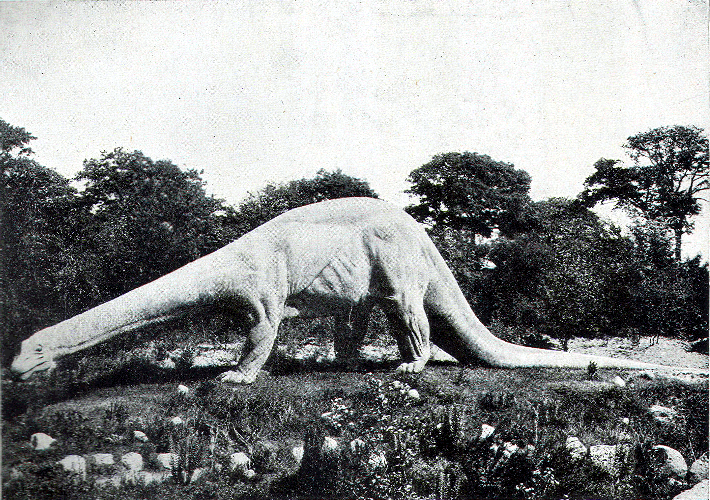 MODEL OF THE DIPLODICUS COMPLETED THIS IS THE MODEL SHOWN UNDER CONSTRUCTION. THIS GIGANTIC REPTILE OF LONG AGO WAS A VEGETARIAN, AND PERFECTLY HARMLESS. HE MEASURED EIGHTY FEET IN TOTAL LENGTH. |
Before that time we have lost trace of any forms of apes, which had become more and more primitive as we descended. We find only traces of mammals, or breast-animals. We still find reptiles which, of course, are egg-laying animals, and do not suckle their young as the mammalians do. The reptiles in these lower deposits are the largest ever known. Some excellent skeletons of these have been discovered, and with the knowledge obtained from these Dr. Carl Hagenbeck, of Hamburg, has made life-size models representing the actual creatures.
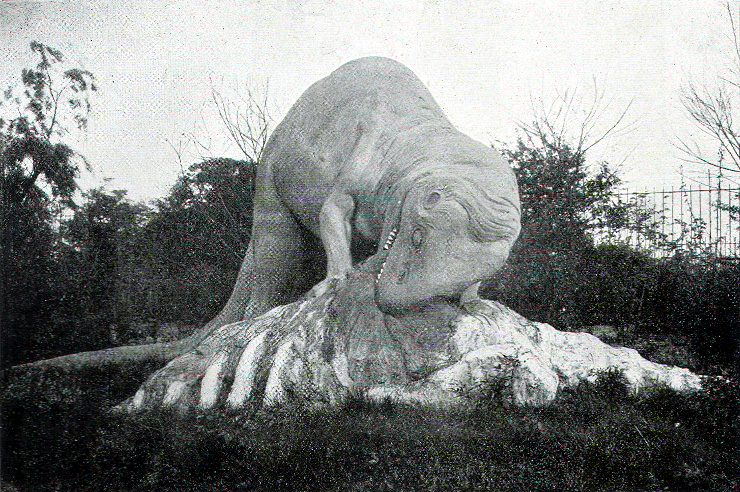
In the illustration facing page 58 we see one of these models under construction, and this picture gives us a good estimate of the size of the great creature. In the illustration facing this page we see the complete model as it stands in the Hamburg Tierpark. This "Diplodocus," which measures eighty feet in length, is not the largest animal of that period. It was a very harmless vegetarian, whereas there were gigantic land animals, such as the "Allosaurus," seen in the illustration facing page 62. Some of these land animals had powers of destruction which must have put terror into the lives of the smaller creatures living within their reach. Of course, there are living animals of to-day with huge bodies, such as the elephant, the hippopotamus, and the whale.
It seems probable that during the period when reptiles ruled the Earth the land became so crowded that some land animals had to take to the sea as a dwelling, while others took to the air, very gradually evolving wings, until their descendants became more birds than reptiles.
Still farther back we find reptiles of a much clumsier make, and it is apparent that some of them had paddles to propel them through the water. These were preceded by similar reptiles, but having feet in place of paddles, the feet being evolved into paddles when the animals left the land for the surface of the sea.
Still farther back we find abundance of amphibious creatures, capable of living under the water or on dry land as they desired. We may think of them as frog-like animals. During this period there was a comparative scarcity of animal life.
Below this we come upon the great coal-beds of the world. From what has been said, at the close of the preceding chapter, of the heated moist atmosphere, we are not surprised to learn that there were plenty of snake-like creatures which could live in the swamps of the gigantic forests. There were present also a great variety of shark-like creatures and lung-fish. There are fossils of land snails which probably made their homes on the trees, while there is evidence of spiders, beetles, and other insects that could live in a watery atmosphere. The gigantic vegetation was of a simple form, with large leaves measuring about twenty inches across. But even with this enormous growth of vegetable life the great accumulations required to form the coal-beds must have taken many thousands of years to produce.
Lower down than the coal-beds we find fish more abundant than ever. Some of these are as long as eighteen feet and are provided with jaws of enamelled bone, which evidently could be used like shear-blades. Fish are said by some never to reach an adult size, but, like the reptiles, they grow till death. The humorist might add that in our own days the fish caught by some enthusiastic anglers continue to grow even after death.
Along with these early fish we find gigantic crabs, some measuring six feet across, and as we go farther back we find fish protected on the head and shoulders with plates of bone. Still lower down we discover fish completely armoured in this fashion, and it is interesting to know that our contemporaries, the sea-urchins, had direct ancestors living away back in those far-off times. We have proof that there was some land vegetation at that time, as there are fossil remains of insects.
In our backward search we come across even more primitive types of plated fish, and an abundance of a very simple form of crab-like creatures, which we call "Trilobites." These were strange-looking creatures, some measuring about two feet in length, and having their bodies divided into three lobes. They had eyes, and could move or roll about. A few descendants of these are found as high up as the coal-bed period, but it is in the lower deposits that they are plentiful, even when there are no traces of fish at all, not even the simple forms of boneless fish, unless that class which we describe as star-fish.
In these lower deposits we find no trace of land animals, not even insects, and from this we gather that what land there was above water was probably too barren to support animal life. In the lowest deposits we find no traces of life. But the first forms of life would be of soft, jelly-like material, and would leave no record.
In the address of Professor Schafer at the Dundee meeting of the British Association in 1912, he dealt exhaustively with the subject of the origin of life upon this planet. His belief is that life was evolved very gradually from lifeless matter, and that its first appearance would be as a mass of colloidal slime, which could assimilate other matter and therefore grow, and by subdividing it could reproduce itself. But these philosophical conceptions of the origin of life are without the scope of actual discovery.
Discoveries Concerning Man
The poetic story of creation—The advance of civilised man—Discovery of ancient Nineveh—Deciphering a lost language—History of mummification—Curious customs—"Druid Stones"—Pile-villages on the lakes—Valley deposits and cave-dwellings—Remains of primitive man—The Mammoth—Discoveries during digging operations—Man's early implements—A prehistoric Venus—Rock-shelters—Cave drawings—The artist's pencils—Attempts at perspective—Pictures of the Woolly Elephant—The duration of the Stone Age—The earliest stone implements
When considering the discoveries concerning the past history of living creatures, in the preceding chapter, the subject of man was omitted purposely. Not because man has no connection with these other living creatures, for we shall see that there is a relationship, nor yet was the omission made because a few people dislike to think that man was not specially created just as we find him to-day, only less cultured and learned. We have seen that the biblical story of the Creation is of a poetic nature, summing up the ideas of ancient man, and not intended to be taken literally. We agree with Galileo who said, some three hundred years ago, that the Bible was not designed to teach us how the heavens go, but how to go to heaven. Before considering the great discovery that man's body has been evolved gradually from simpler forms, it may be of interest to continue the plan of the preceding chapter and see what the Earth itself has to tell us of the early history of man.
If we seek to turn back the pages of the Earth-written history, we find upon the surface, which is not yet a part of the bound book, that living man differs very much in different parts of the Earth. There is a great contrast between the man of culture and the wild savage of heathen lands. This inequality goes a long way back in the history of man. Although the British Isles were occupied by semi-barbarous people less than two thousand years ago, when Julius Caesar made his first invasion, yet we all know that the people of the East were cultured and lived lives very similar to those of quite recent times. Indeed, until the advent of the steam-engine, and the consequent advance of mechanical power, the life of man was not remotely different from that of the cultured ancients.
It is less than one hundred years since we discovered ancient Nineveh buried in the East. An interesting find was that of ancient libraries of brick-books and cylinders of clay. These writings were in a language which had disappeared from the Earth, and it was supposed that these strange books could never be read. Indeed, it was quite reasonable to suppose that the meaning of these groups of horizontal, vertical, and slanting strokes of the Assyrians was lost for ever. But, thanks to the efforts of many students, it was discovered that the written characters of the Persians were founded upon similar signs, although the appearance of the languages was very different. A fortunate discovery was the finding, on a cliff in Persia, of an inscription which was written in Persian and in Assyrian, and placed there by King Darius, who figures in biblical history. As the two languages were different, it would seem impossible to discover that the one writing was a translation of the other, but it so happened that there were a great many proper names occurring in the two inscriptions. The names were kept the same in both languages, so this gave, a starting point from which enthusiastic students were able to decipher the Assyrian signs. Records of ancient kings were discovered, of whose existence we had no previous knowledge except that their names were mentioned in the Bible. Many records of wars upon early Palestine were found, and it became apparent that the compilers of the Book of Genesis had been acquainted with these stone-books.
There is a tablet shown in the British Museum which goes back to four thousand five hundred years before Christ, and there is evidence of much earlier writings, but these are not the only records of an ancient past. Much information has been gained by the discovery of mummies. We can even trace how the Ancients discovered the art of mummification.
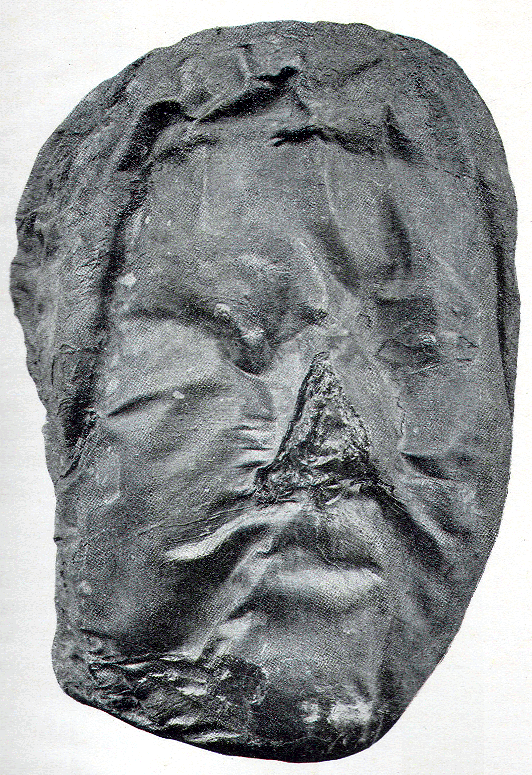
We find that it was their custom originally to bury their dead in shallow holes scraped in the soil. They discovered that when the body was placed in the hot dry sand the corpse was preserved in an incorruptible form. There is evidence that this fact became known to the Ancients through disgraceful acts of robbing graves for articles of value which had been buried with the bodies. Then we find the Ancients seeking to protect the body of the dead by placing it in a sarcophagus (coffin) or in a rock-cut tomb. We must remember that their belief was that the body had to be preserved if eternal life was to be obtained. But the improved method of burial was found to be defeating this end; the bodies were no longer preserved. It was then that the Ancients commenced to use means of embalming the bodies in order to preserve them.
The cosmetics required for embalming were already in use in those far-off days, being used by the ladies of that time in that ridiculous art of seeking to improve their natural charms by the addition of an artificial complexion. The ingredients of these cosmetics were what the embalmers required for their new art.
In an interesting paper read before the Royal Philosophical Society of Glasgow, Professor G. Elliot Smith, F.R.S., who has done so much original research work in connection with mummies, explained many points of interest. It is found that during a certain period it was customary to bury a little model or image of the deceased along with the mummy, but that, later on, this practice ceased. It has been discovered that these mummies, having an accompanying image, are not good specimens of the embalmers' art. It is evident that at this period, when the preservation of the features was very deficient, it was considered necessary to bury a likeness of the deceased along with the mummy, lest the soul upon its return might not recognise its former habitation. When the art of embalming improved these images were dispensed with.
Another point of interest to the general reader is that, believing the heart to be the seat of the soul, the embalmers made a copy of the heart in wax, and placed this in the body along with the human heart, lest by any accident the original dwelling-place should not remain till the return of the soul. To make assurance doubly sure, it was sometimes the custom to place a second artificial heart, made of stone, in the sarcophagus, so that the soul upon its return would be sure to find a resting-place.
But as the oldest mummy is less than five thousand years old (see illustration facing page 66), and as at that time man was a civilised being, it is evident that even this ancient history of mummification takes us back only a very short way towards the earliest man. But there are other sources of information.
On the very surface of the Earth we find some evidence of early man. The so-called "Druid Stones" or upstanding stones are familiar objects to many of us. Some of these are very massive, and the country folk sometimes have queer notions as to whence these came. Some years ago the author was looking at some of these upstanding stones on the Island of Arran (Scotland), when an intelligent middle-aged native woman came along. When asked where the stones came from, she said that as children they were told that the giants had flung them there, and others told her that these huge stones had fallen from heaven; she knew in any case that no man could have put them there.
Until recently these stones were associated with the Druids, but now we know that they are of much earlier origin, having been erected before the close of the Stone Age. In many cases the stones are set in large circles, and undoubtedly mark burial-places. Some of these upstanding stones are claimed by one authority to have been connected with Sun-worship.
The deposits of old lakes tell us something of early man, when he built pile-villages over the water for protection against wild creatures. There is evidence that these early men cultivated wheat and barley, and that they had tamed some of the animals, such as the ox, goat, and dog. These early people have left us traces of their pottery-ware and even of coarse weaving.
![[Illustration] from Scientific Discoveries by Charles Gibson](books/gibson/discovery/zpage069.gif "[Illustration] from Scientific Discoveries by Charles Gibson")
It is of interest to inquire how much of man's earliest history is preserved within the Earth. We do not expect to find great quantities of human remains. So long as man's remains were left on the surface of the Earth, they would disappear in a comparatively short time. Even when man became a religious being and desired to bury the dead, we know that the bones would continue to disappear very gradually by chemical action. But it might happen that a man would be accidentally buried beneath falling rocks, or that in some of his cave-dwellings (rock-shelters) his bones became deposited under conditions in which chemical action would not take place so easily. And so it is that remains of prehistoric man have been found in valley deposits and in rock-shelters.
Traces of human remains of primitive man were discovered more than half a century ago, but for some time the finds were few and far between, and consisted in most cases of a single jaw. Our present interest does not lie in the order in which the discoveries have been made, but in the knowledge gained by the total discoveries.
One important discovery was that man was living at the same time as the great woolly elephant or "Mammoth." The first discoveries were made accidentally during digging operations, but the great finds have been made by systematic search. Only very occasionally have nearly complete skeletons been found, but even when the only remains are a skull and, say, a thigh bone the expert can tell a great deal about the one-time owner. He can say that the primitive creature was an old man, or a female, or a youth. That his intelligence was very low, that indeed in a few cases it is very difficult to say whether the individual was a man or an ape, and that it would be better to call this particular find an "ape-man." Other remains show a very primitive state of man, and from the want of development of a particular part of the under-jaw (the place to which the tongue muscle attaches), the expert declares that this primitive type of real man had no spoken language.
One fact is perfectly clear, that the farther back we can trace the skulls of prehistoric man the smaller is his brain capacity, until it reaches that point, already mentioned, when it becomes difficult to classify; the brain capacity being less than that of any known human remains, and yet greater than that of an ape.
The information as to the customs of primitive man, which we can get from these finds of human remains, is rather meagre. One strange find has been a number of heads all buried together, with their faces all turned towards the setting sun. It is perfectly clear that these heads were complete when buried, and that the bodies were not buried with them. Those of the women and children had necklaces of shells made of the teeth of stags. This was certainly a curious burial custom and must date back a very long time.
Fortunately, we are not dependent entirely upon the remains of man himself in tracing his first existence. Primitive man used tools, and it is the remains of his industries which tell us of his very early existence. The early use of iron and bronze implements falls within the scope of authentic history, and we are not surprised to know that earlier implements of stone have been found in deposits within the Earth. Indeed, we might conjecture that this would be so, as we find savages of modern times working with stone tools. The Tasmanians made practical use of stone implements right up to the time of their extinction some forty years ago. This people remained primitive after they had been cut off from the mainland of Australia, of which their island was once a part. The small community of men made little progress towards civilisation.
In trying to read the history of early man from stone and flint instruments found deposited in the Earth, it is not an easy matter to place them in any definite chronological order. Even to-day we find very different stages of civilisation, and so we may be sure that the different stages of the Stone Age would be lived by different people in different places at the same time. This is perfectly clear from the fact that the use of primitive stone implements has persisted not only in Tasmania but in other distant lands right into the days of the steam-engine.
The discoveries which appeal most to the imagination are those made in the cave-dwellings of early man, but before considering these it will be well to refer to the valley deposits.
Some finds were made while digging out the foundations for modern factories and other large buildings. On one such occasion in France the workmen found over one thousand different objects of prehistoric interest, these being chiefly flint implements made for various purposes. The fact of so many implements being found at one particular place suggested the idea that this must have been a workshop in which these tools were made. It is a strange thought that a modern factory should happen to be placed right over the scene of a flint tool factory of prehistoric man. Other finds have been made while constructing docks and railways. One of the most complete discoveries was made, a few years ago, during the making of a railway in Austria. Nine different layers of deposits, one upon another, were found to be quite distinct, and it was evident that prehistoric man had dwelt at this place.
In the uppermost layers were found beautifully finished stone implements, and a remarkable female statuette carved in limestone. The figure measured about five inches in height, and it has been christened the "Venus of Willemdorf," having been found at the place of that name. But we must not let our imagination run away with the idea of beauty in this ancient Venus. Those of us who have seen the figure, or a photograph of it, would not associate its appearance with that of the Venus de Milo. There is no attempt to make any features for the face, but the hair is represented in a negro-like fashion. The figure is by no means graceful, indeed, all would agree in describing it as being ugly, even apart from the fact that the arms and legs are out of all proportion. Nevertheless, the statuette is of great prehistoric value. It tells us that the primitive women of these days wore bracelets on their wrists, if they did not wear any clothes. Of course, we are not to imagine that the women were as ugly as the statuette, but rather that the prehistoric sculptor was exaggerating certain parts, and that he could not attempt to reproduce a face. More female figures have been found, similar to this, but others, again, show a more pleasing and slender figure. The remains of fireplaces were found near these statuettes, but there was no trace of human bones remaining. A human jaw was found in a corresponding layer in another valley, and along with it were bones of the extinct mammoth, the horse, the reindeer, and the fox.
Continuing the search down into the lower of the nine distinct layers the searchers found bone implements, and shafts made of reindeer horn, which had been used as handles for some of their stone implements. In addition to bones of animals such as found in the higher deposits there were discovered here remains of the cave-lion and the wolf. Still lower down were found implements made of hornstone, and some of these were in the form of scrapers, probably used in skinning animals. As the searchers got into lower deposits they found the stone implements to be of a more primitive type. The flint work was very poor, while in the lowest deposits these implements were of an extremely simple style.
As valley deposits are of very great extent, and very numerous, doubtless we shall make many more finds in that direction. The rock-shelters or cave-dwellings are numerous, but necessarily more limited; these have been favourite search-places for palaeontologists.
In the successive deposits, forming the floor of these caverns, we find a great deal of interest. Many thousands of primitive implements have been found in the floor of a single cave, and occasionally there have been discovered the beginnings of sculpture. Stone implements have been found in deposits which must have been laid down more than twenty thousand years ago. Other evidence seems to prove the existence of man more than one hundred thousand years ago.
Another interesting discovery has been the finding of drawings made by prehistoric man. When it was reported, a generation ago, that actual drawings, made by primitive man, had been discovered in a cavern, the statement was not accepted as fact. People thought there must be some misunderstanding, and they continued to think so, for nearly twenty years, till further similar discoveries were made. During recent years much research has been made in this direction, and some caves have been found to contain more than a hundred distinct pictures. Occasionally there have been found drawings of animals upon pieces of bone or horn, and on blocks of stone, but the greatest finds are those upon the walls and ceilings of the rock-shelters. Sometimes these pictures are life size, and they are almost entirely of animals. Most of them are really engravings made by a sharp tool. Some are merely line drawings, but others are filled in and shaded, while others again of a presumably later date are worked in coloured ochres.
Within the deposits of the cave-floors there have been found some of the ochre pencils with which the prehistoric artist made his pictures. Some of these ochres have been made in the form of a triangle, similar to that still adopted in tailor's chalk. This gave the artist three separate points which he could use at will. In some cases the cave drawings have been made with a regular paint material, so that we are not surprised to find among the floor deposits stone mortars in which the colours had been mixed with some fatty matter. Stone lamps have been found also, and no doubt the artist used these while executing his drawings.
![[Illustration] from Scientific Discoveries by Charles Gibson](books/gibson/discovery/zpage075.gif "[Illustration] from Scientific Discoveries by Charles Gibson")
In one cave there are twenty-five figures on the ceiling, worked out in red, brown, black, and yellow. In practically every case the picture of the animal is shown in profile. Where any attempt at a group of animals has been made, the artist has failed sadly; he had no idea of perspective. So long as he kept to a simple profile his work was sometimes remarkably good, as is evidenced by the examples which have been found. In the accompanying illustration, Fig. 2, is shown an attempt of the primitive artist to reproduce a hunting scene. Of course, he has taken a good deal of licence, and evidently merely wished to express his ideas without producing any detail. Other hunting scenes show animals with a number of arrows stuck in their sides, the blood from the wounds being represented by red paint.
More than one attempt to reproduce the front view of an animal has been found upon pieces of bone or horn. These are extremely poor, although the artists have evidently thought differently, for in these cases it is clear that the prehistoric artist has desired to append his signature. One artist uses a circle with four dots above it as his sign or crest, and he appends this to each of his attempts to represent the front view of an animal, as though he were proud of the production.
From some of these pictures made in the long-ago by prehistoric man, we learn that the mammoth, or woolly elephant, had a real coat of shaggy hair (see Fig. 1, page 69). We also find some primitive drawings of women showing the whole body covered with a distinct coat of hair.
All these drawings were made in what we call the "Stone Age." We believe the earliest Stone Age to have covered a period very much longer than historic times have reached. Indeed, it seems certain that prehistoric man worked away with the most simple stone implements for at least one hundred thousand years. It took him all that vast time to reach the advance represented by polished stone axes, saws, knives, and arrows. It is estimated that the beginning of the Stone Age goes back about half a million years. Think of the slow progress made by prehistoric man in five thousand centuries, and contrast it with the progress of civilised man in the past century.
In trying to turn back to even earlier periods in the life of primitive man we have discovered many stones, so simple in their formation that some authorities believe them to have been fashioned by nature and not by human intelligence. These "eoliths," or earliest stones, have been very carefully examined, and there is considerable evidence in favour of the assertion that they are the handiwork of man. One authority claims that about ninety-five per cent of his large collection of these eoliths show the chipping to have been done according to a fixed rule. The blows producing the chips were always from the front toward the back, and the tiny scars left by the chipping begin at the margin and extend over the back. There is too much method in it to be the result of chance. If these eoliths are truly the work of intelligent man, then his history dates back several millions of years.
The story disclosed by all these discoveries makes a romance. Our imaginations can picture many scenes of primitive life in these dark caverns. One enterprising firm, who make cinematograph films, has reproduced an imagined scene in the life of prehistoric man. The size of these rock-shelters varies greatly, but the largest measures not far short of three-quarters of a mile in length, there being an entrance hall with many passages leading into other halls.
The evolution of man does not rest upon the evidence of the palaeontologist, although his discoveries go to support the theory of evolution. It is the zoologist and the physiologist who bring forward conclusive proofs, as we shall see in the succeeding chapter.
Whence Came Man?
The value of the evidence of the palaeontologist—Comparative anatomy—Five fingers within the flipper of a whale—The same within the wing of the bat—The anatomy of man and the horse compared—Origin of the unicorn—Before Darwin—Darwin's great book—Violent opposition—The origin of man—Our forty-second cousins—Some highly trained apes—Could apes evolve into men?—Natural selection—The survival of the fittest—Eugenics—Heredity and variation—Mimicry—Embryology—The latest stage of man's evolution
In the preceding chapter we have seen what the palaeontologist has to say concerning the evolution of animals and man. Picturing the paleontologist as a witness giving evidence, we could imagine the opposing counsel pointing out that this evidence is merely circumstantial. It is true that the more simplified forms of animal life are found the farther down we can read into the hidden history of our globe, but it does not follow necessarily that the more complex has been evolved from the more simple. It might be maintained that there have been successive periods of separate creation. It might be pointed out also that only a very small number of the total animals have died in circumstances likely to lead to the preservation of their remains. Further, that man has merely scratched the surface of the Earth at a very limited number of places, and that therefore the evidence gained is not sufficient to warrant a general statement. Those who have studied the case carefully would not be willing to take this view. However, all will admit that the evidence of the palaeontologist corroborates the evidence of the zoologist and the physiologist.
The zoologist, by a careful comparison of the forefoot of the horse, the wing of the bat, the flipper of the whale, and the hand of man, has discovered that all these apparently different organs are in reality extremely like one another in their structure; indeed, we can trace the finger bones and joints in each case. It becomes evident that all these animals have descended from one common ancestral form.
Those of us who in our boyhood sought to know something of the doctrine of Evolution may remember some particular evidence which appealed to us as conclusive. Probably one of these proofs was the fact that the flipper of the whale had within it a series of bones exactly like a human hand. If the Creator had made a special creation of the whale, surely He would not have arranged, within the flipper, this complex structure of bones which, embedded there, could not serve any useful purpose. The accompanying diagram represents the bones within the whale's flipper and those within the human hand.
No one would suggest that these two structures were not definitely connected, and it is reasonable to suppose that the two structures have been evolved from some common stock.
![[Illustration] from Scientific Discoveries by Charles Gibson](books/gibson/discovery/zpage080.gif "[Illustration] from Scientific Discoveries by Charles Gibson") FIG. 3. THE FLIPPER OF A WHALE; THE HAND OF A MAN THE CLOSE RESEMBLANCE OF THE BONES BURIED IN THE FLIPPER OF A WHALE TO THOSE WITHIN OUR OWN HANDS IS VERY OBVIOUS. |
In many other animals and in man himself we find traces of organs which serve no useful purpose. We feel justified in saying that these are relics of some bygone ancestor, and having fallen into disuse, owing to new environments, the organs are disappearing very gradually. Many people must wish that the vermiform appendix in man had been disposed of already by nature, as its presence is a great source of trouble in its present stage of evolution, giving rise to the too-well-known disorder called "appendicitis."
Again, the wing of a bat has five finger bones, four of which go to form the framework of the wing, while the fifth, the thumb, remains free and is provided with a strong nail. The general arrangement of the finger bones within the wing will be seen clearly in the accompanying diagram of the bat's skeleton.
![[Illustration] from Scientific Discoveries by Charles Gibson](books/gibson/discovery/zpage081.gif "[Illustration] from Scientific Discoveries by Charles Gibson")
If we examine the anatomy of a horse with that of a man, we must be impressed with the great similarity of structure. Any person visiting the Natural History Museum in London has a good opportunity of making such a comparison. Here we find the skeletons of a horse and of a man placed side by side, and showing all the corresponding bones similarly numbered.
These facts have all been discovered within recent times.
In the so-called good old days of our great-grandfathers they had very little knowledge of the animal world. They had no menageries or zoological gardens in which they could see strange animals. They were dependent upon the tales of travellers, and how very far from the truth their imaginations could carry them is well evidenced in the picture of the unicorn. While it is true that there is no unicorn such as represented, the artist did seek originally to represent a real animal as described by a traveller.
This traveller, while on a visit to South Africa, sent home the description of a strange animal which he had seen. It is evident that his powers of description were not very great, for it was a rhinoceros which he endeavoured to describe. He wrote that he had seen an animal about the size of a horse and with a single horn on its face. It so happened that the narwhal had been discovered in the Mediterranean about that time, and a specimen of its long horn-like sword had been sent to this country. The artist drew a picture of a horse and placed this newly discovered horn on its forehead, thinking that he representing what we know now as the South African rhinoceros.
It will be of interest to note very briefly how the discovery of Evolution came about. Of course, the name of Charles Darwin is very prominent in our minds in connection, but we know that the idea did not originate with him, nor in his day. The idea of Evolution goes back much farther than the unscientific person imagines. Away back some two thousand five hundred years ago it was suggested that the different creations had been evolved one from the other, but there were no observed facts brought forward to support this idea. These proofs were not forthcoming until last century.
Our grandfathers who lived in the first half of last century were not prepared to accept the doctrine of Evolution. Even to-day there are some good-hearted folk who refuse to admit the truths of Evolution, but surely in no such case can there have been a serious study of discovered facts! The Evolutionist is not an Atheist. Because we believe that we have discovered the plan of creation we need not seek to drive the Creator from His Universe, nor to deprive man of his soul.
So long ago as one hundred years the great French naturalist Lamarck declared that each kind of animal had been evolved from a simpler type or species. He was bold enough to include even man himself in this theory of Evolution, but he had not sufficient facts to prove his theory to be correct.
A few years ago the whole scientific world celebrated the one hundredth anniversary of the birth of Charles Darwin, and to-day we have some of his sons among us, each of them actively engaged in the furtherance of Science.
It was Darwin who proved a true case for the doctrine of Evolution. He did not give his ideas to the public without long consideration, nor did he even make up his own mind in any hasty manner. In the Introduction to his Origin of Species he tells us how the ideas of the causes of Evolution occurred to him during his voyage as Naturalist on board H.M.S. Beagle. He thought that something might be made of these ideas "by patiently accumulating and reflecting on all sorts of facts which could possibly have any bearing on it." Then he adds: "After five years' work I allowed myself to speculate on the subject." It is evident also that Darwin did not desire to stir up strife concerning the origin of man, for in the Introduction to his later book, The Descent of Man, he says: "It seemed to me sufficient to indicate, in the first edition of my Origin of Species, that by this work light would be thrown on the origin of man." Indeed, his only reference to man occurs in the following short sentence on the second last page of his great book. Referring to future researches he says: "Much light will be thrown on the origin of man and his history." Yet the very suggestion of such revolutionary ideas met, not unnaturally, with vigorous opposition, but Darwin felt confident that the truth would prevail in the end. Our present interest is to consider the discovery of the facts upon which the theory of Evolution is built.
The naturalists before Darwin's days had been busy classifying the different animals and plants. The classifications were very elaborate, and were put down in the form of a tree with multitudinous branches, not that they believed it to be in reality a family tree. In this picture we see a short tree trunk representing the very simplest forms of organisms of which they had any knowledge; so simple a form of life that it would be difficult to say that they were either plants or animals. Then this short trunk divides off into two separate branches, one representing the vegetable kingdom and the other the animal kingdom. These branches again subdivide into smaller branches representing family groups, and finally there are the leaves which represent species. The very appearance of this pre-Darwinian tree would seem to us now to be a clear indication of Evolution.
Our particular interest is "Whence came man?" Some might prefer the question to be put in this way: Whence came these bodies in which we live, and which we must leave behind us some day? Our bodies share a common structure with the animals, and are governed by similar physiological laws, yet self-conscious man, possessed of a moral sense, stands apart from all other created beings.
In one sense we may say that it is ridiculous to speak of men as having been evolved from monkeys, or from such anthropoid apes as we know in these days. Looking at other branches of the tree of Evolution, we may say that we are no more descended from monkeys than from our "forty-second cousins twice removed." Yet there is no gainsaying the fact that not only the anatomy, but the physiology of man is extremely like that of the anthropoid ape, even the arrangement of the blood-vessels and the reaction of the blood itself rendering the apes liable to human diseases from which all other animals are immune. The teeth of the ape and those of man are very similar, and yet different from those of other animals. Man's body is still covered with a coating of very fine hair, and if one examines the hair on the outer part of the forearm, it will be observed that the hair grows in a direction backwards from the wrist. This is the case also with apes, and is believed to be due to these animals placing their arms over their heads to shelter them from the rain-storms in those primeval days.
The author remembers being present many years ago when the late Professor Henry Drummond was inspecting a regiment of boys at drill. He asked all the boys who could move their ears to and fro to do so. He was amused how proficient some of the boys were in this long-lost art. He then told them how this was a relic of long-past ages, when our animal ancestors required to move their long ears to and fro, and then he proceeded to expound to them the meaning of Evolution, pointing to Christian morals as he went along.
We have seen in the preceding chapter that the palaeontologists find it very difficult to determine whether some of the fossil remains found in the Earth belonged to man or to the ape. For the purpose of entertainment a few apes have been trained to imitate man, wearing clothes, eating and drinking from ordinary dishes, paying the waiter from a purse, using a toothpick, smoking a cigarette, undressing and going to bed, blowing out the candle, and so on. One of the trained apes has a bedroom in the hotels, and is treated as though he were a man. But no one would suggest that any amount of training would ever cause an ape to evolve into a man. The evolution of man has taken not only thousands, but millions of years, and the special circumstances which gave rise to the appearance of man have passed.
But we are not to suppose that the evolution of man came about as the result of blind forces. Alfred Russel Wallace, the great evolutionist and contemporary of Charles Darwin, has said: "I admit that such forces and such rudimentary mind-power may and probably do exist, but I maintain that they are wholly inadequate, and that some vast intelligence, some pervading spirit, is required to guide these lower forces in accordance with a preordained system of Evolution of the organic world."
Darwin's theory was based upon what he called "Natural Selection," the meaning of which is perhaps more easily grasped from another name which was suggested by Herbert Spencer, this title being "The survival of the fittest." Has it not become an axiom that "the weak must go to the wall"? In these modern times the fit are endeavouring to enable the unfit to live also. The unfortunate thing is that the unfit are multiplying at a much greater rate than the fit. The result of this will be that our race will deteriorate unless some way out of the difficulty can be found. It is to this end that the Science of "Eugenics" has been set on foot within the last few years. Those who are taking an active part in the work of these Eugenic Societies are doing a noble and far-reaching work. This work will be helped greatly if the rising generation will make a serious study of the Sciences of Zoology and Evolution.
We need not trouble about the laws of heredity and variation, but in these present days of scientific horse-breeding we have ample demonstration. Occasionally a specially bred horse will fetch as large a sum as four thousand guineas. This has been arrived at by mating together horses having the finest qualities. The same has been done with other animals. One farmer desires some particular quality in sheep, and in course of time he is able to rear sheep with that particular quality exaggerated, while another farmer has raised a breed of sheep exhibiting some other desired quality. These special species have been arrived at under the guidance of man, but they will serve as analogies for "Natural Selection."
Darwin saw that if all the animals which are born into the world should live, and each pair have a family equally numerous, there would be an enormous population of these animals in a comparatively short time. What does happen in reality is that one pair is represented in a later generation by another single pair or thereabouts. It is self-evident that in nature it will be the fittest that will survive.
This survival of the fittest has led to some very interesting results. We find the wild animals in some countries to be coloured and marked so like their surroundings that they cannot be detected while at rest. In South America there are two classes of wild cats quite differently coloured, but each harmonising with its environment. The jaguar which steals along the river banks in a dull speckly light is coloured accordingly. On the other hand, the puma which moves about among the reddish grass tops has a coat to harmonise with the grass. This protective colouring is not the sole possession of cats; it is common to lizards, snakes, frogs, beetles, butterflies, and others.
One may often see in Natural History museums specimens of leaf-butterflies, and it will be observed that, while at rest, the underside of the butterfly's wings are scarcely distinguishable from the leaf of the bush. We have a most interesting collection of such insects and animals at the Natural History Museum in London.
One of the most interesting phases of this mimicry is that of some tropical butterflies, which, through long ages of evolution, have succeeded in protecting themselves against their enemies by imitating the colouring of a poisonous butterfly which their enemies will not eat. Very gradually would these protective colourings be evolved. At first the resemblance may not have been very great, but those having some similarity to the inedible butterfly would escape destruction, and through a long inheritance the resemblance would be increased until the present final stage was reached. Another case is that of a beetle which has evolved a colouring which is a perfect imitation of a wasp. Those individuals which were the poorest imitations would, of course, be cut off by their enemies. And so we see that "adaptation to environment" and "heredity" have played an important part in "Natural Selection."
Although the zoologist cannot trace out a definite pedigree for man, he sees many proofs of the fact that man has been evolved from the very simplest organisms. The embryologist has much of value to add by way of corroborative evidence, but it will not be convenient to touch upon that side of the subject in a volume such as the present, except to give a few very simple illustrations.
We know how the butterfly is evolved from the caterpillar's chrysalis. We know how the frog is evolved from the fish-like tadpole. The tadpole is really a fish; has lungs and gills, and its general structure is just like the lung-fish of Australia. In Chapter VI we found that the palaeontologist declares that all frog-like or amphibious creatures were evolved from fish, and we now see that the frog in its embryonic state goes through similar phases.
Again, if we examine the embryo chicken within the egg we find that it commences with a small and simple jelly-like organism. Then at a certain stage we find on the sides of its neck a series of gill clefts like those of a fish, while the blood-vessels are arranged not as they are in the fully developed bird, but in the same way as they are in a fish. Further, the embryo chick shows no signs of wings or feet, but merely a simple paddle-like structure. Indeed, if this, embryo chick were found living free in nature it would be in reality a fish.
Probably many of us have seen the slow and imperceptible growth of a flowering plant reproduced by the cinematograph in a few minutes. The embryo chick, in the short time required for its development, reproduces over again the long life-history of its evolution in ages past. This truth was set forth by the great German naturalist Haeckel, in the following words: "The individual in its development recapitulates the history of the race."
When speaking of the extinct creatures of long ago, one is sometimes asked how it was that these animals became extinct. It might be thought sufficient to point out that the law of "the survival of the fittest" applies to the race as well as to the individual. Also that a change of environment and climate might annihilate a species. It is true also that one species of animal becoming superior to another would prey upon it, the climax being the superiority of man, and his conquest of all other living creatures. But all these reasons are not sufficient; the question of extinction is a very complex one.
At the meeting of the British Association, in 1912, the following resolution was passed deploring the rapid destruction of animals and flowers throughout the world. The resolution was adopted in the following terms: "That the British Association for the Advancement of Science deplores the destruction of fauna and flora throughout the world, and regards it as an urgent duty that steps should be taken, by the formation of suitably placed reserves, or otherwise, to secure the preservation of examples of all species of animals and plants, irrespective of their economic or sporting value, except in cases where it has been clearly proved that the preservation of particular organisms, even in restricted numbers and places, is a menace to human welfare."
In a preceding chapter we had occasion to consider the industrial methods of the primitive natives of Tasmania. How, then, did that primitive race of mankind become extinct within quite recent times, and within the short space of fifty years after the advent of the Europeans on the island? This Van Diemen's Land, as it was christened by the Dutch discoverer nearly three hundred years ago, was left in peace for a very long time. There are no visits recorded during the following century, but it was explored by French and English navigators about the beginning of the nineteenth century. Shortly after this a few soldiers and convicts were sent from Sydney to form a settlement. Then many settlers arrived and were granted land to cultivate, being provided also with convicts to work for them.
At that time there would be about three thousand primitive natives living on the island. These formed several distinct tribes occupying different parts of the island, and each tribe was quite foreign to the other, having different dialects and different customs. We have seen how very primitive were their stone implements. Their dress, when any was worn, was as primitive, and so was their food. Indeed, at certain seasons they occupied the shores and subsisted entirely on shell-fish.
It is often stated that the presence of the settlers caused the natives of Tasmania to go inland, and that the foreign tribes, coming into conflict with one another, commenced a warfare which ultimately extinguished the whole population. But the white man's actions were not entirely passive. Unfortunately some of the settlers shot down the natives without mercy, the primitive creatures having only spears and clubs with which to defend themselves. After some years the total native population was reduced to a few hundreds. One settler had compassion upon the poor helpless natives, and he succeeded in getting the remnant of the different tribes transferred to a neighbouring island, but the population decreased gradually. In less than twenty years there were not fifty natives left, and fifteen years later there were only six survivors, and finally the last of these passed away.
Occasionally one sees a band of Esquimaux at one or other of our great International Exhibitions. There is something pathetic about such a sight, for these primitive people were at one time a great race, but are now disappearing; indeed, there are not many thousands left. The white man is not directly responsible in this case; it is the Red Indian who does the massacring, but the presence of the white man has introduced diseases which have increased the death-rate to a great extent. And so we see how it is possible for extinction to occur even among intelligent human beings.
As already indicated, we should keep in mind that the question of extinction is not a simple one. The only way in which we can account for the extinction of some animals is that they had become so specialised to suit particular conditions, and that a change in these conditions would render them helpless. Not only were there great changes of climate from tropical to arctic, but the very level of the land kept changing. We have traced some of the factors which lead to extinction, but there is much still to be discovered.
Anthropologists have traced out a possible pedigree for man right back to the very simplest forms of life, but particular interest attaches to the last stage in which man was evolved from the ape. What determined this great evolution? Was it because the primate acquired an erect attitude, leaving its hands free, or was it the acquisition of speech, or did the development of the brain precede these? Eminent men have championed, each of these factors as being the primary one. The most recent address upon this subject at the British Association meetings was that of Professor G. Elliot Smith, who maintains that the development of the brain came first. This enabled the primate to make skilled movements of the hands, and then followed the erect attitude, which in turn stimulated the further advance of the brain.
But what caused man to differ so very much from his living "forty-second cousins," the gorilla and the chimpanzee? In the address referred to, the learned anthropologist, with his intimate knowledge of natural science, draws this interesting picture: "Long ages ago the ancestors common to man, the gorilla, and the chimpanzee became separated into groups, and the different conditions to which they became exposed after they parted company were in the main responsible for the contrasts in their fate. In one group the distinctively primate process of growth and specialisation of the brain, which had been going on in their ancestors for many thousands, even millions, of years, reached a stage when the more venturesome members of the group, stimulated perhaps by some local failure of the customary food, or maybe led forth by a curiosity bred of their growing realisation of the possibilities of the unknown world beyond the trees which hitherto had been their home, were impelled to issue forth from their forests, and seek new sources of food and new surroundings on hill and plain, wherever they could obtain the sustenance they needed. The other groups, perhaps because they happened to be more favourably situated or attuned to their surroundings, living in a land of plenty which encouraged indolence in habit and stagnation of effort and growth, were free from this glorious unrest, and remained apes, continuing to lead very much the same kind of life (as gorillas and chimpanzees) as their ancestors had been living since early times. That both of these unenterprising relatives of man happen to live in the forests of tropical Africa has always seemed to me [Professor Elliot Smith] to be a strong argument in favour of Darwin's view that Africa was the original home of the first creatures definitely committed to the human career; for while man was evolved amidst the strife with adverse conditions, the ancestors of the gorilla and chimpanzee gave up the struggle for mental supremacy simply because they were satisfied with their circumstances; and it is more likely than not that they did not change their habitat."
Very gradually there was a further development of the brain, filling out the frontal part which gives man his distinctively human forehead. Then from making simple cries and grimaces, such as all social groups of animals employ when desiring to communicate with their fellows, there was evolved very gradually an intelligent speech. The least imaginative among us can realise what an immense impetus would be given to further evolution by the ability to pass on a statement of experiences from individual to individual. If we think of our early school life, it is clear how the beginnings of our own personal knowledge were dependent entirely upon speech; gradually we have acquired the common stock of beliefs. If we once realise the vast importance of speech, we cease to marvel at the very long period during which primitive man continued to use simple stone implements and roughly chipped flints.
Having once acquired an intelligent speech he then made great strides.
We have seen in the preceding chapter that there has been practically no evolution in man himself since he became a civilised being. A careful study of the most ancient mummies has failed to show any signs of present evolution in a period of six thousand years. But there are very marked signs of evolution in man's industries. The primitive distaff and spindle has evolved into the simple spinning-wheel, and that again into the modern spinning machinery. In all branches of industry we can trace a true evolution, but this is beyond our present province, and the present author has already dealt with this subject in his Romance of Modern Manufacture.
With the crowding together of civilised man into cities, with their confining influences, it is more difficult to keep the machinery of the human body in good working order. People get "run down in health," and the doctor orders them away to the open country for a holiday. It will be of interest to consider what discoveries have been made concerning our own bodies.
Discoveries Concerning Our Bodies
Should we know our own anatomy?—Curious ideas of the Ancients—Harvey's discovery of the circulation of the blood—A large model of the human heart—Why the earliest anatomists made little progress—Scene in a graveyard—Stealing a corpse from the gallows—What led Harvey to his discovery—Mysterious spirits within the body—Discovery of "cells "—Great impetus to medical science—The human brain—Some curious ideas—Phrenology—Word-blindness—Word-deafness—Brain and personality—Brain surgery
It is remarkable how very little of his own body is known by the average man. There is an idea abroad that the less a person knows of his bodily organs the more peace of mind he will have, the argument being that the more he knows, the more will he imagine all sorts of ailments. The author's experience has been that those who know least imagine most; they picture things that could not possibly occur. If we understood really the functions of our various organs, and if we acted according to such knowledge, we should doubtless suffer less. However, our present subject is not hygiene nor yet physiology, but more properly the history of physiology; we desire to see how man came to discover the meaning of the different parts of his own anatomy.
The Ancients had some curious ideas of the functions of their different organs. They believed the mind to be situated in the kidneys, and did not connect the brain with the actions of thought. The heart was the seat of the soul, and from the heart came forth good or evil. We still use such expressions as "a good heart" or "a hard heart" as being descriptive of a person's nature, but, of course, we do so only in a figurative sense. In passing, it may not be out of place to remark that in teaching the young it is a mistake to carry the symbolic idea too far. For instance, a clergyman tells the children that their hearts are hard as stone, or black with sin. The child pictures the actual heart, indeed there has been no attempt to cause it to think otherwise, the symbol becomes the reality, and to some thoughtful children the idea appears absurd, and more harm than good is done. There is no doubt that even in adults a great deal of religious doubt arises simply from mistaking symbols for realities. Symbols are of much value so long as they are recognised as symbols.
The ancient belief that the mind was located in the kidneys will explain to us such Old Testament phrases as "They had the Lord in their mouths, but not in their kidneys." In similar fashion the Ancients believed the bowels to be the seat of all tender emotions, and the spleen to be the organ of melancholy.
The great Aristotle, whose scientific dogmas were unquestioned for century after century, declared that the brain was a sort of cooling chamber through which the blood was passed in order to prevent its temperature rising too high. It is remarkable that one ancient philosopher, who lived five hundred years before the time of Christ, did declare the brain to be the seat of the mind and the source of feeling and movement, but no heed was paid to these "ridiculous notions." Very gradually it became evident that this theory was correct, yet there was little actual progress made in gaining information concerning the brain until modern times.
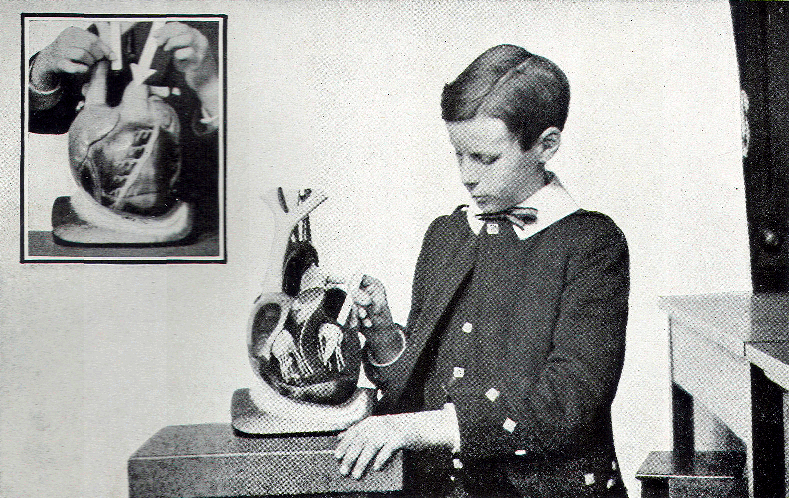
Perhaps the one discovery which stands out most prominently in the mind of the average man is Harvey's discovery of the circulation of the blood. We shall see presently that there is another discovery of even wider influence, but Harvey's discovery has been of immense importance.
Before considering what led up to this great discovery made by Dr. William Harvey, who acted as physician to King Charles I, nearly three hundred years ago, it will be well to keep in mind a simple picture of the circulatory system.
In the illustration facing this page we see a large model of the human heart. The inset photograph shows the outward appearance, while the larger picture, with the interior displayed, will help to make matters quite plain to anyone who has not considered the subject. It will be observed that there are four distinct chambers in this hollow muscle which we call the heart. The lower left-hand chamber drives the blood out into those tubes or blood-vessels which we call the arteries. These arteries carry the blood to every part of the body; they branch off as they go, dividing and subdividing again and again till they terminate in thread-like tubes so very small that they cannot be seen without the aid of a microscope. From these extremely fine endings of the arteries the blood escapes and is transferred to similar thread-like tubes which are attached to the small veins, and these act as tributaries to larger veins, and so on, leading back to the top chamber on the opposite side of the heart. During this circular course the blood has carried nourishment to all parts of the body, and has also conveyed waste matter to the various organs capable of dealing with it. Therefore the bright arterial blood which set out from the left-hand side of the heart has been returned to the right-hand side as blood with less nutriment and more waste matter, and has a purple colour. This venous blood passes down into the lower chamber of the right-hand side, and from there it is forced, by the contraction of the heart, into blood-vessels leading to the lungs. These blood-vessels end in similar thread-like tubes like those in the main system. The air-tubes of the lungs also end in similar fine tubes, through the thin walls of which the oxygen of the breathed air passes into chemical combination with the blood, while the waste carbonic acid passes out.
When the blood is oxygenated by the lungs it returns by blood-vessels as before, and this time to the upper chamber on the left-hand side. Thence it passes to the lower chamber on the same side, which brings our consideration back to the point from which we set out originally. It will be observed that there are two distinct systems, one from the left-hand side of the heart throughout the entire body and back to the right-hand side of the heart; the other system is from the right-hand side of the heart to the lungs and back to the left-hand side, the latter being a very much simpler system.
Long before the days of William Harvey it was known that blood flowed from the heart to the lungs and back to the heart, and it was even observed that the blood was "made thin "by the air. The discoverer of this fact writes rather sarcastically thus: "Anatomists, not very wise, begging their pardon, think that the lungs receive the I know not what smoky fumes discharged from the heart. About this, all one can say is that it pleases them, for they certainly seem to think that the same state of things exists in the heart as in the chimney, as if there were green logs in the heart which gave out smoke when burnt," Then he proceeds to expound his own discovery that the blood merely returns, as he describes it, "mixed with air," and he lays emphasis upon the fact that he is not merely expounding a theory but an actual discovery which he has made by examining both dead bodies and living animals.
There was no thought of a circulatory system throughout the body; it being believed that the heart sent blood to all parts of the body where it was used up, fresh blood being continually manufactured.
We cannot blame the early anatomists for having made so little progress in their knowledge of the human body; indeed, we can blame only the Church as the cause of this ignorance. The human corpse was considered so sacred that doctors were not allowed to examine it, punishment being attached to any disobedience. It was not long before Harvey's time that the Church began to lose its power in such matters.
The early anatomists were free to examine any bones of skeletons which might be found in old and superficial burying-grounds, so that the anatomy of the skeleton was known before the physiology of the body. Two enthusiasts of those days relate how they were searching an old burial-place in Paris when they were attacked by a band of wild, hungry dogs, who had come also in search of bones, but for a different purpose. These same two anatomists found it so difficult to procure a corpse for examination that they tried to steal the body of a man who had been hanged and left on the public gallows as a warning to others. The enthusiasts made this attempt in broad daylight, but were caught when climbing the gallows, and were shut out of the city. However, they returned when night came on, and succeeded in securing their object. One of these daring enthusiasts was Andreas Vesalius, who wrote a pioneer work which laid the foundations of modern anatomy and modern physiology. This book was written thirty years before William Harvey was born, and it was the work of Vesalius that formed the basis of Harvey's great discovery.
This great discovery associated with the name of Harvey was that the heart did not keep sending out newly made blood, but that the blood after passing throughout the body actually returned to the heart, from which again it went to the lungs to be revitalised, returning once more to the heart, and again throughout the body, keeping up a regular circulation.
All this seems very simple to us, but when Harvey first sought after the truth by means of vivisections he found it so difficult to trace the action that he began to think "that the motion of the heart was only to be comprehended by God." It was only with very patient study and the examination of many animals that he hit upon the truth. Anatomists knew of the presence of veins carrying dark-coloured blood, but they believed that this blood was flowing from the heart just as the bright arterial blood was, and that the body required these two different bloods to nourish it.
It is said sometimes that it was the presence of the little pocket-like valves in the veins which led Harvey to his discovery (these little valves prevent the blood passing backwards through the veins), but it seems quite clear from Harvey's own writings that it was not this which gave him the clue. He tells us that it was the great quantity of blood passing from the heart which led him to the truth. He could not account for the production of so much blood, and he says: "I began to think whether there might not be a motion, as it were in a circle." When he had grasped this idea, he found that it would explain many difficulties, and he was able to prove that there was a real circulatory system, not only from the heart to the lungs and back, but also, what was much more difficult to imagine, a complete circulation throughout every part of the body.
We might say also that Harvey discovered there were no such things as mysterious spirits at work within the body. Formerly it was supposed that there were natural, vital, and animal spirits which took an active part in the work of the blood-vessels, but now this simple mechanical circulatory system cleared away the necessity for these, and gave a reasonable explanation of the blood passing through other organs such as the liver and kidneys. It was soon recognised that the blood not only carried nourishment to all parts of the body, but that it also carried the waste matter, due to the wear and tear of the tissue, to be disposed of by the lungs, the skin, the kidneys, and the liver. But for our present purpose we do not require to know any more physiology than will enable us to appreciate one or two of the most outstanding discoveries concerning our own bodies.
There is no doubt that the most far-reaching discovery was made in the nineteenth century, and this was when it was discovered that all living matter, whether vegetable or animal, is built up of microscopic particles which we call "cells." The very simplest form of living creature, such as the Foraminifera mentioned in an earlier chapter, is composed of one or more of these unit cells; minute specks of protoplasm or jelly-like substance. The human body is composed of many millions of such cells; not only the soft tissue but the fibres, the nerves, and the bones. One of the greatest of anatomists has said that this discovery of the cells is "the greatest discovery in the natural sciences in modern times."
The names most prominently associated with this discovery are those of the two German physiologists Schwann and Schleiden. This great discovery is one of the triumphs of the microscope. Professor Schafer has said, in his famous address to the British Association when dealing with the origin of life, that we could never have guessed that we were formed of aggregates of cells, each possessing its own life, each cell being the direct descendant of another. "Nor could we suspect by intuition that what we term our life is not a single indivisible property, capable of being blown out with a puff like the flame of a candle; but is the aggregate of the lives of many millions of living cells of which the body is composed."
The great advance in medical science made during the nineteenth century is due to this discovery that our bodies are great colonies of living cells. One particularly interesting extension of this discovery was made in connection with our blood. We know that blood is a chemical solution containing a great deal of water with nutritious substances which have been extracted from our food, and that the solid matter in the blood is composed of red corpuscles and white corpuscles, which are, of course, only seen with the aid of the microscope. As is pretty generally known, it is the multitude of red corpuscles which gives the blood its characteristic colour, there being hundreds of red corpuscles to every white one.
It has been discovered that the chief duty of the red corpuscles is to carry oxygen to every part of the body, while the blood fluid removes the waste matter (wear and tear) to the different organs which dispose of it.
Our present interest lies in the white corpuscles, for it has been discovered that these are independent living organisms. These little living cells act as scavengers within us, for on meeting any particle of solid matter in the blood they surround it and by chemical means cause it to disappear. A very interesting exhibition of these white corpuscles at work has been given by means of the cinematograph. Actual moving pictures were taken through the microscope, and when reproduced they showed these white corpuscles attacking some disease germs (microbes) which had gained access to the blood. We may regard disease as a battle between these white corpuscles and the invading germs, the final victory deciding whether the patient recovers or not, but the subject of microbes will be dealt with in the succeeding chapter.
We know that when a person has been partially paralysed through an effusion of blood into some portion of the brain the patient sometimes recovers the use of the affected parts. The thanks of such patients is due to these little white corpuscles in the blood, for they have clustered round the blood-clot which causes the trouble, and they have devoured the red corpuscles which have become encased in a clot.
When we think of the actions of such cells we must marvel at the great Mind which created these. Some German scientists have sought to minimise the marvellous powers of the cell as being due to mere complex chemical actions. In opposition to this we have the declaration of the great evolutionist, Alfred Russel Wallace, which he has made when speaking of the formation of the simple cell, and how it contains all the forces which lead on to the evolution. This great thinker says: "What we must assume in this case is not merely a force. What we absolutely require is a mind far higher, greater, more powerful than any of the fragmentary minds we see around us; a mind not only adequate to direct and regulate all the forces at work in living organisms, but which is itself the source of all those other forces and energies, as well as of the more fundamental forces of the whole universe."
Before passing on to the epoch-making discovery of that invisible world of microbes, detected only with high-power microscopes, it will be of interest to consider a few things which have been discovered concerning that most interesting organ the human brain.
A very brief description of the brain may be of service in considering the discoveries concerning its operations. It is common practice to speak of a person's brains, and one is quite entitled to do so, as the main part of the brain is divided into two parts, forming a left-hand and a right-hand hemisphere. Then in addition to the main part of the brain there is a small or lesser brain situated at the back of the head and below the main hemispheres. The general appearance of the brain is that of a soft gray material, everywhere folded upon itself. One might describe it as being crumpled or creased together, producing the appearance of furrows. Beneath the gray matter there lies a great white mass of nerve 'fibres connected to the gray matter like a great array of telephone wires leading into an exchange. The gray matter is the seat of the conscious mind, and as this lies directly beneath the skull, we see how any injury to the head is a serious matter. We all know that great bundles of nerves leave the brain by the spinal cord, and are distributed to all parts of the body. It may be remarked that although the early physiologists recognised that there existed nerves conveying impulses that give rise to sensations and nerves controlling motions, yet the exact differentiation of these was not discovered until the nineteenth century.
There still exists considerable mystery concerning most of the operations of the brain, but many important discoveries have been made, and the most important of these all lie within the last fifty years.
We have seen already that the Ancients did not discover that the brain was the organ of thought; probably they believed it to be too passive an organ to serve such a purpose. They were led to think of the conscious mind as existing in the blood, for when there was any great loss of blood there was also a loss of consciousness, and if the blood became poisoned the consciousness often became deranged also. As they believed the heart to be the seat of the soul, it seemed reasonable to suppose that the blood issuing from the heart should contain conscious thought. The one early anatomist already mentioned who declared the brain to be the seat of the conscious mind was ruled out of court by the other great thinkers of his day. And yet this pioneer was not merely guessing, for his conclusion was based upon his discovery that when the optic nerve leading to the brain was severed there could be no sight.
Some two hundred years later, which leaves us still about three hundred years B.C., the learned men of Alexandria carried out careful dissections of the brain, and they were able to trace the nerves of the special senses. Little progress was made for several centuries, till in A.D. 170 an important discovery was made. This was that the nerves from the brain to the body were crossed; nerves leaving the right-hand side of the brain going to the left-hand side of the body, while those from the left-hand side of the brain go to the right-hand side of the body. This discovery has proved of much value, but progress at that time and right through the Middle Ages was imperceptible. We know that the practical death of Science during the Middle Ages in Europe was due to men trying to work out the meaning of things by studying only the causes instead of the phenomena and trying to trace the causes from these.
For a long time the early physiologists could not get away from the idea that the brain was a great gland, and that it secreted a subtle substance called thought, which they spoke of as "animal spirits," a sort of living flame. Not till the advent of the microscope did they abandon these ideas. It was the microscope which showed that the brain was not a gland, and did not secrete anything. Indeed, it was shown that the brain was an independent organ, having its different parts linked up to the body by nerves.
By examining the brain in this new light it was discovered that separate portions or localities were connected to definite parts of the body. No less than twenty-four distinct parts of the brain were suggested to represent as many different qualities of mind, then this was increased to thirty-eight, and later to sixty. Every individual peculiarity in a person was suggested to be due to the development of one or other of these different parts of the brain. Then arose the art of reading the natural "bumps" of the head by the phrenologist. Phrenology was firmly believed in by our fathers forty years ago. The encyclopaedias of that date devote many pages to the subject and declare it to be a discovery of great importance even from a practical point of view. The attempts to read the capabilities and character from the bumps of the skull was not a charlatan profession; the originators had made a careful comparative study of skulls, but it became evident that they had not studied a sufficient number from which to draw general conclusions. The so-called mathematical bumps were found to be developed greatly in men who had no knowledge whatever of mathematics, while men who were very learned in one particular subject showed no special development of the corresponding bump. Nowadays the subject of phrenology is confined chiefly to the realms of boys' comic papers.
When the supposed discovery of phrenology was believed to be a mistaken idea, men went to the other extreme and said that the brain had no special sections, but acted as a whole, and although it was known that the brain was a double organ, it was considered that the two parts acted just as the two separate lungs act.
Then came a really great discovery. An eminent physician in France found on making a number of post-mortem examinations on the brains of persons who had died with paralysis of the right side of the body that in every case not only was the injury to the brain on the left side, but when the person had lost the power of speech there was in each case an injury to one particular area of the brain. It was clear that speech was controlled by one specific part of the brain, and yet the anatomists would not accept the truth of this discovery for several years. This attitude was probably due to the fact that the new discovery seemed to corroborate the idea of phrenology, for by this time the physicians had rejected phrenology, although the general public continued to believe in the art for many years.
Other important discoveries followed and confirmed this fact concerning the special functions of different parts of the brain. One of the most interesting steps was the discovery of the cause of a very strange symptom in brain diseases known as "aphasia." One or two well-known cases will illustrate this phenomenon.
Professor W. A. Thomson, of New York, relates how he was hurriedly sent for on one occasion by an old patient whom he found to be much disturbed by a strange experience which had befallen her. The previous day she had put an advertisement in the newspapers for a waitress, and when the girls applied the next morning the lady found that she could not read their references. She then took up the printed newspaper and found that she could not read a word of it either. At first she thought that something had gone wrong with her eyesight, but she could see all around her distinctly, and she could even see to do her crochet work. As a last test she opened her Bible, thinking to turn to some part that she knew well, but she could recognise nothing in, it. She saw the pages and the printing, but the words had no meaning to her. Then she sent off post-haste for the doctor. He tried to calm her excitement as best he could, and explained to her that a small blood-vessel supplying a very small area in the brain had failed to do its duty by becoming clogged. In this particular area she had built up her knowledge of written words; all the experience of words which she had acquired by means of her eyes was cut off from access for the time being. It was some consolation to her that she could still recognise spoken words; her knowledge of these had been gained by her ears, and the record of these was in a different small area of the brain. She could express herself perfectly in speech, but she could not write a single word. Unfortunately, she did not recover her power of reading; the white corpuscles of the blood failed to remove the obstacle.
The case of a young man of thirty was different, and was much more alarming. He was a clerk in a mercantile warehouse, and his people thought he had suddenly become insane, for he commenced to talk a complete gibberish, and could not understand what his friends said to him. Fortunately, it was found that he could still read and write, and to every written question he could give a perfectly intelligent answer. The poor fellow had become word-deaf through a cause similar to that in the case of word-blindness, just referred to, but in his case it was a different part of the brain which had been cut off from its blood supply. His hearing was not affected in any way; he could recognise and appreciate all sounds, but words had no meaning to him.
Such cases are fortunately rare, but there is a considerable variety of experience. One learned man, who was master of several foreign languages, suddenly found that he could not read any letter written in English, although he could read, very hesitatingly, words printed in English; English was his mother tongue. He was a most proficient French scholar, but now he could not read a word of French, although he could still speak that language. He could only make a little sense of Latin books with which he had been perfectly familiar. His Greek remained as it was, but as this was the only language he could write now, he was greatly handicapped in correspondence.
From such phenomena as those just described it was discovered that in a particular part of the brain, a little mass of gray matter no larger than a hazel nut, there are registered all the multitudes of words which we know.
Another interesting discovery has been made, it being found that the word and speech centres of the majority of people are in the left hemisphere of the brain; but that in the case of left-handed people their speech centres are in the right hemisphere. What led to this discovery was the fact that in cases of paralysis, when there had been loss of speech, it had been generally the right side of the body which had been paralysed. And further, that when loss of speech accompanied paralysis of the left side of the body, in such cases it was found that the patient had been left-handed. A further study by means of post-mortem examinations showed that the speech area was in the left hemisphere of the brain of all right-handed patients, and in the right hemisphere of the brain in cases of left-handedness.
It goes without saying that we are born without the register of a single word in the brain, and that the building up of the records is a very gradual process. It is apparent that these registers are made in the particular hemisphere which controls the hand with which the child seeks to do things, and upon which it concentrates attention. It is apparent that there is a direct connection between speech and the gesture of the arms.
The large majority of us are either right-handed or left-handed, there being very few people really "ambidexterous," or able to use both hands equally well. The Japanese made an experiment of training a number of children to use both hands equally, but the result was not satisfactory. It was found that no child trained in this fashion was ever so expert with either hand as a right-handed or left-handed child. No information is available as to whether there were two speech areas brought into use, indeed, so far as the author knows, this question has never been discussed.
It is patent that everything which is stored in the brain has been derived from without by way of the sensations, and it is evident that the chief gateways are the eye and the ear. Hence our difficulty in teaching the blind and the deaf. The most remarkable illustration of these facts is to be seen in the life story of Helen Keller, who, when she was still an infant of nineteen months, became blind, and deaf, and consequently dumb. The only gateways she had left were the senses of smell, taste, and touch. It would seem absolutely hopeless to get such a child to learn anything: but at the age of seven years she was taught to trace upon her hand such words as "doll" and "water." In less than a month the child could trace eighteen nouns and a few verbs, but she could only repeat the tracings made by her teacher; the child had no idea what the tracings meant. How could this meaning be shown to her? Her teacher took her to a water-pump and let her hold a mug to receive the water, and when the water flowed over on to the girl's hand she (the teacher) traced anew the word water on the palm of the child's hand. All at once the girl dropped the mug, and a bright look came into her face. She traced the word water several times on the palm of her hand, and indicated that she understood. She was so delighted with her new knowledge that she even tried to teach her pet dog the meaning of the word water by tracing the letters on its paw.
Those who have not read the life-story of Hellen Keller have missed much. In the fourth year of her education we find her becoming a true scientist, writing down such questions as: "Who made the Earth and the seas and everything? What makes the Sun hot? Why does not the Earth fall; it is so large and heavy?" And so on. She not only took a most intelligent interest in things, but she succeeded in taking a University degree. Her subjects included Advanced Greek, Advanced Latin, Algebra, and Geometry, in some of which she passed with honours. However, our present interest lies in the fact that a brain may be so stored with knowledge, although the usual gateways are permanently closed. Surely this remarkable case ought to act as a stimulus to those of us who have all our gateways open.
Some of us have been trusted with fewer talents than others, but from what has been discovered concerning the brain it must be clear that we ourselves are responsible for the making of our "brains." No matter how fortunate an individual may have been in receiving a very plastic brain, we are all born with brains which contain no knowledge whatever. We are left to acquire this. It has been said—"a great personality may make a brain, but no brain can make a great personality."
The discoveries concerning the brain have enabled surgeons to make many wonderful operations. In cases of paralysis of some particular parts of the body the surgeon has been able to know exactly the area of the brain in which the disorganisation has taken place. In many such cases he has been able to diagnose that the trouble is caused by a tumour, and he has been able to open the skull at the exact spot and to remove the source of the trouble.
The Discovery of Microbes
A merchant's hobby—Microscopic living organisms—Spontaneous generation—Pasteur's great discovery—What microbes are like—What they are—Some animal microbes—Microbes and sunlight—Experimenting upon microbes—Frozen meat—Microbes' assistance in bread-making—Microbe scavengers—Protecting the living against the dead—Disease germs—A cold in the head—The way of fighting microbes—Epidemics of enteric fever—Sterilising milk—A world of life beyond the microscope
We have become quite familiar with the idea of a world of invisible microbes existing around and within us. The direct connection between this invisible world and the infectious diseases of the human body has made us realise the great importance of the discovery of microbes. How, then, was this discovery made?
Nearly three hundred years ago a linen draper in Holland made a hobby of microscopy. So enthusiastic was he that he was not content with the simple microscopes of those days. He set about making improvements, and in time made the first true microscope on the principles which we use to-day. Our present interest is not in the instrument, but in what it enabled him to discover. With the aid of this instrument he was able to see minute micro-organisms in water, in the intestines of animals, and in the saliva of the mouth. As these tiny organisms could "swim backwards and forwards and twist themselves in an extremely lively fashion," he thought that they were a low form of animal life, and so he called them "animalcule".
This discovery did not receive much attention, as it was believed that the presence of the microscopic objects was merely accidental, and for a long time those little living organisms were left to themselves. But in the middle of the eighteenth century it was observed that the micro-organisms were always present in any substance undergoing decomposition or putrefaction. Then an Italian priest, Spallanzani, who became a great anatomist, made the discovery that if vegetable matter were hermetically sealed in a flask, and then boiled for some time, no living organisms could be found in it, and so long as it was kept protected from the air decomposition would not set in. When he admitted air to the flask then there were signs of decomposition, and he could trace micro-organisms in the decaying matter.
These early experiments were not extended much until about the middle of the nineteenth century. Then it was discovered that air might be present and do no harm if it was purified by passing it through sulphuric acid, or through tubes raised to a high temperature. In this way it was discovered that the air of itself had no ill effect, but that the air carried the micro-organisms which brought about decomposition.
It had been supposed for a long time that living organisms might arise within vegetable and animal matter and bring about decomposition and putrefaction. The name of "spontaneous generation" was given to the supposed origination of living organisms within a substance, but this discovery of the air carrying the organisms to the substance, and the discovery that the boiled substance kept protected from the air could not decay, went to show that there was no such thing as spontaneous generation. However, it is well known that long-established ideas die hard, and the true death-knell of spontaneous generation was not sounded until the famous French chemist, Louis Pasteur, made a series of further experiments.
Pasteur collected dust from the air, and by placing it in suitable media he was able to obtain these living organisms, proving beyond doubt the invisible world of life did exist in the atmosphere. He took samples of dust from the air of various places. He discovered that in the air of the Swiss mountains there were practically no living organisms. There were more in the air of the valleys, though comparatively few in any fresh country air, whereas in the air of towns there were present a hundred, or even hundreds, for every single one in fresh air.
Although it had been known for some time that these living micro-organisms were present always in putrefying matter, it had not been suggested that they were the cause of the decomposition. This discovery belongs to Pasteur, and the enormous value of this discovery cannot be over-estimated. The layman probably thinks of Pasteur in connection with hydrophobia, but, important as that work was, as we shall see later, it is not of the same far-reaching importance as his earlier discovery.
The first important practical application of Pasteur's discovery, that all fermentation is due to the presence of living micro-organisms, was the work of the late Lord Lister, which will be dealt with in the succeeding chapter.
Before tracing the discovery of microbes in connection with diseases it will be well to form a clear idea of the nature of these tiny organisms. We have seen that at first they were believed to belong to the animal kingdom. It is very amusing to find some intelligent people of to-day picturing microbes as infinitesimally small insects.
On one occasion the present author was examining some photo-micrographs which had been taken by a friend. Among these were some photographs of the cheese-mite, the sheep-tick, and such-like microscopic creatures. There were also some photographs of different bacteria. A visitor happened to ask what the photographs represented. He was told that there were some pictures of microbes among them, and when he saw the uppermost photograph, which happened to be the cheese-mite, he mistook it for a microbe and said, "These are the little villains that hunt us out and give us so much trouble." The average man would not make this mistake, but many people who have taken no special interest in the subject have curious ideas as to the appearance and the capabilities of these microscopic creatures.
Speaking generally, all these micro-organisms belong to the vegetable world, but to describe them as microscopic plants might be a little misleading. They belong to that family of vegetable life which we describe as fungi. But again, we are all familiar with that umbrella-like fungus which we call a mushroom, and which has no leaves or roots or green chlorophyl, but we must not picture microbes as microscopic mushrooms, nor even as moulds. So far as the most powerful microscopes can detect, these microbes are all of very simple construction. Before they can be seen and studied they require to be magnified five hundred to a thousand diameters. Some are in the form of little round cells, some are like tiny rods, while others have a bent or spiral form. There is also a class having a thread-like appearance, known as the higher bacteria. When some microbes are prepared with chemical stains they show little hair-like processes extending from their ends and sides.
In the early days of bacteriology some workers described some micro-organisms as plant animals and others as animal plants. The difficulty was so great that other workers made a class between animal and vegetable, but this only tended to complicate matters. It was because of these difficulties that a French scientist suggested the word "Microbe" (Greek: mikros, small, bios, life), which could include all micro-organisms whether vegetable or animal. To the outsider it might seem ridiculous to worry whether a speck of jelly-like substance was animal or vegetable, but to the scientist it is different, for there is a distinction in their method of assimilating food.
But, as already stated, the great majority of microbes are vegetable; only a very few may be classed as very low forms of animal life. These few include the microbes responsible for the tropical diseases, malaria, sleeping-sickness, and such-like, of which more will be said in the succeeding chapter.
When it was discovered by the bacteriologist that he could grow colonies of the different microbes in suitable media, such as pure beef-broth, he was able to study the life history of each class. It was discovered that there are different methods of reproduction. In the round, the rod-shaped, and the spiral forms the microbe merely becomes constricted at one particular place and then divides into two, each of these parts growing to full-size and then dividing in the same manner as their parent had done.
A second method of reproduction takes place by the formation of a "spore"—a minute glancing globule within each microbe. This is seen in some of the rod-shaped forms. When the spore is freed by the death of the parent microbe, it grows into a young microbe, which in turn at once begins to multiply by division. The rate of multiplication is enormous; thousands may result from a single germ in a few hours, provided the conditions are quite favourable to growth. Fortunately for man all conditions are not favourable, or microbes and not man would be in possession of the planet.
We need not be alarmed by the fact that microbes are all around us, not only in the air we breathe and the water we drink, but within our own bodies. We may go about with the microbe of pneumonia in our mouth and not suffer any inconvenience, for if our tissue is in a healthy condition it does not prove a good breeding-place for microbes. These protective conditions are particularly prominent in the tissue surrounding the entrance to the throat, and also in the tonsils. These parts defy the entrance of intruding microbes. This fact alone should impress us with the great importance of keeping our bodies in a fit condition.
Even if the microbes succeed in entering our blood-vessels, they meet with natural enemies in the blood, as was mentioned in the previous chapter, and this meeting results in a battle. It is the fierceness of this battle which raises the temperature and causes the fever in the invaded person. In most cases the microbes act indirectly by producing chemical poisons that bring about the disastrous effects.
Our special interest centres round the actual discoveries. Having prepared colonies or "cultures" of specific microbes, the bacteriologist can expose these cultures to different conditions and watch the results. He cultivates these colonies by placing some of the microbes in a suitable medium in a test-tube, and then by keeping it at a certain temperature in an incubator he can breed large colonies. In this way it has been discovered that an exposure to sunlight prevents the growth of the microbes. In testing for the effect of sunlight, a tube containing a culture may be covered with black paper to shelter it, and then only a small window cut in the paper to admit the Sun's rays to one particular part; at this place there is an arrestment of growth, while at all the sheltered parts the microbes multiply as usual.
By means of other experiments it was discovered that most microbes could be killed off by heat. Indeed, at a temperature of 150 degrees Fahrenheit few bacteria can live. This temperature is fifty degrees above that of the human body. The discovery that a high temperature spells death to the microbes has led to some practical applications, such as the disinfection of the clothes of infectious patients, the sterilising of milk and other foods, and the sterilising of all surgical instruments and dressings.
Other experiments led to the discovery that some bacteria, although they or their spores can survive an intense degree of cold, have their activities arrested by a freezing temperature. Hence the practical application of freezing or "chilling" meat, in which condition it may be carried from the ends of the Earth without fear of its becoming affected by microbes.
Fortunately it is only a very small variety of microbes that give rise to diseases in man. Many microbes are man's good friends. On one occasion the author was being shown over a large bread factory at work, and when the manager was explaining how at a certain stage the dough or "sponge" was laid aside for an hour and a half, the author remarked that this was to give the microbes another chance of assisting the men in their work, whereupon the manager protested vehemently that there were no microbes in his bread. When it was pointed out that the whole actions of the yeast were due to the activities of microbes, the manager remarked that if that were so "they must be very healthy microbes."
The average man pays more attention to the disease germs than to those others which aid man in all processes in which fermentation plays a part. But far more important than these actions of the microbes is the function of that class which acts as the scavengers of the Earth. What would be the condition of the surface of the Earth if all the carcasses of all the creatures that ever lived had been allowed to accumulate where they fell? What would be our plight if even all the vegetable matter that ever existed had remained, as it was, where it fell? Our thanks are due to myriads of these invisible microbes for ridding us of these dead remains of life; microbes protect the living against the dead. It is the action of the microbes which has decomposed these substances and broken them up into simple elements capable of being assimilated by new vegetation. Here we see a complete cycle of life.
The first disease germ to be discovered was that which produces "anthrax" in cattle, and more rarely in man. More than sixty years ago micro-organisms were discovered in the blood of animals that had succumbed to anthrax (splenic fever), but it could not be proved that the presence of these bacteria was the cause of the trouble. Not for a quarter of a century was there any positive proof to be found, until the great German bacteriologist Robert Koch showed that the disease was entirely consequent upon the invasion of these microbes.
Koch's discovery dates back to 1876, and a few years later was followed by the detection of the microbes which give rise to—suppuration or inflammation, tuberculosis (consumption), tetanus (lock-jaw), diphtheria, typhoid fever, cholera, and others. A little later (1892) an extremely small microbe was discovered to be the cause of that prevalent trouble "influenza." Even an ordinary cold in the head is due to the presence of microbes; quite a large variety are responsible for this common trouble.
Colds are not caught by mere exposure to cold. We have the record of a whaling vessel long away from land, and all the crew perfectly free from colds, although greatly exposed to very low temperatures. But one day the steward brings out an old floor rug that had not been unrolled since leaving land. The steward shakes the rug, and not long afterwards all on board are suffering from cold in the head. In our imagination we see the microbes freed from their captivity and, floating in the air, they enter the breathing apparatus of the sailors.
Similar evidence has been given by Arctic explorers. Again, the survivors of the ill-fated Titanic were exposed to extreme cold, from which a number of the passengers and crew died, but they did not suffer from cold in the head.
Not long after the different disease germs were isolated and systematically studied, a most valuable discovery was made. It had been found that the harmful agency of microbes was due to chemical poisons or "toxins" which they produced in the blood. Indeed, it had been recognised that in all resulting changes brought about by microbes, whether disease germs or otherwise, their actions were due to these chemical effects. It was found possible to filter a fluid culture of microbes by means of a very fine porcelain filter, so that the microbes were entrapped in the pores of the porcelain, while the poisonous toxins leaked through. An experiment was made with the toxin obtained in this way from diphtheria germs, and when an injection of this toxin was given to an animal it was found to bring about the disease just as though the microbes themselves had been present. Similar results were found to occur with relation to tetanus (lock-jaw). After repeated injections it was found that there was formed in the blood of the animal a substance which was named "anti-toxin." When some blood is drawn from the animal, and allowed to form a clot, there separates a fluid "serum," which if injected into the blood of a person suffering from diphtheria, neutralises the poisons produced by the diphtheric germs. The earlier in the fight this serum is injected the better chance has it of victory. Would anyone object to such experiments being made upon living animals, when thousands of children's lives are saved each year as a result of this one discovery?
Our picture is this. The microbes produce a poison, and the tissues of the body produce an antidote to neutralise it. These facts have been used as a means of diagnosing diseases. A sample of blood is taken from the patient and sent to a bacteriological laboratory. If typhoid fever is suspected, the bacteriologist dilutes a drop of the blood and brings it in contact with typhoid bacteria. If the bacteria become clumped together, he is sure that the patient's case is typhoid fever, for the patient's blood will have no effect upon other disease germs. The same serum diagnosis is carried out in connection with a number of other suspected troubles, such as cholera and meat-poisoning.
It has been discovered that some microbes, such as that of leprosy, cholera, typhoid, and others, which prove so serious in the case of man, have no effect at all when injected into the blood of animals. This is the case with most of man's infectious diseases, and we have the converse, that few of the infectious diseases from which animals suffer have any effect upon nan. On the other hand, it should be noted that such microbes as the typhoid germs may be entrapped by living oysters, placed at the exits of rivers carrying town drainage to the sea. When such oysters have been eaten raw, epidemics of typhoid fever have resulted. The moral is not necessarily to avoid oysters, but to prohibit the placing of oysters in such positions, no matter how well the oysters may thrive there. Within recent years the drainage of large towns is treated so that it is freed of any infectious germs before it enters the river.
Because dead animal flesh is decomposed by microbes we need not be afraid of eating meat, lest some harmful microbes enter our system. We must remember that the microbes that act as the scavengers are not disease germs. These latter are rarely found in meat, and on such rare occasions are probably due to preventable causes.
The germs of enteric, or typhoid, fever have been carried , by ice-cream and have produced epidemics of enteric, but this fact does not condemn the use of ice-cream. In one case when typhoid germs were found in ice-cream which was being sold in the streets of London, it was discovered that the ice-cream had actually been made in a room where a patient was suffering from typhoid fever.
It would not do if we were too easily scared, for there is plenty of proof that at times fresh milk is the means of spreading several kinds of disease germs; it would be a great mistake to avoid the use of milk. It is certainly wise to sterilise the milk, and thus kill off the germs, during any known epidemic in the immediate neighbourhood.
While we have seen immense strides made in our knowledge by the discoveries related in the present chapter, no one must imagine that we have discovered all that exists. Although deliberate search has been made for the germs of such diseases as scarlet fever, measles, and typhus, effort has so far failed. Recent investigations indicate that there exists a world of living organisms beyond the reach of the most powerful microscope. Who can guess what future discoveries are held in store for us or our descendants?
Some Humane Discoveries
Ancient discovery concerning smallpox—Inoculation experiment in London upon six criminals—Jenner's discovery—His ambition—First experiments in vaccination—Discovery of anaesthetics—Davy and laughing-gas—Faraday and ether—Simpson and chloroform—Spinal anaesthesia—Lister's great discovery—Hospital wards before his discovery—Lister and Pasteur—What suggested carbolic acid—Lister's highest reward—Pasteur and hydrophobia—Malaria—Plague—Sleeping-sickness—How does the white man escape generally?
More than a thousand years ago the Arabs, the Chinese, and the Brahmins of India observed that if a person had smallpox once, he seemed to be protected against a second attack. In those early days it was discovered that the disease could be produced artificially by giving a person an injection of some of the poisonous matter produced by smallpox. In such cases the disease was very much milder, and yet it protected the inoculated person against the ravages of smallpox when an epidemic occurred.
This practice of inoculating with smallpox was not approved by the physicians, but many women practised it, often combining it with a sort of witchcraft. The Turkish women also practised this art, and about two hundred years ago the wife of the English Ambassador in Constantinople happened to see such an operation performed by an old woman, who claimed to have inoculated no less than forty thousand persons. The English lady had so much confidence in the art that she had her little son inoculated, and on her return to England she made known the success of the operation.
That the English authorities did not place implicit confidence in this practice of inoculation is apparent from the fact that when an experiment was proposed, they asked the permission of King George I to allow inoculation to be carried out on six condemned criminals in Newgate Prison. These operations were performed by the physician who had been attached to the English Embassy at Constantinople. However, when it was found that these cases were successful, a few hundred people offered themselves for inoculation, and even some of the children of the Royal Family underwent the operation. But the clergy objected to the practice as being opposed to the divine rights, and as a few deaths resulted from the treatment, it began to meet with general opposition in this country, although the practice was continued on the Continent.
Then came the famous discovery of Edward Jenner, which has done so much to protect against smallpox. While this discovery was the result of long and patient observation and experiment, the idea seems to have been suggested to Jenner in the following manner. When still a youth, and pursuing his studies in the house of his master, there came a young country-woman seeking medical advice. During her visit she happened to remark that she had no fear of taking smallpox as she had already had cow-pox. This idea so impressed itself upon the mind of young Jenner that he determined to make a very careful study of cow-pox in the hope that it might act as a protection against the ravages of smallpox.
It is difficult for us to realise what smallpox meant to our forefathers; they counted it the worst scourge of the human race. Epidemics were disastrous, even although most adult persons were protected by a previous attack of the disease; it cut off many thousands of young persons every year. The most striking demonstration of the fatality of this disease is in cases where an epidemic has broken out among people, none of whom have been protected by a previous attack. For instance, the first epidemic in Greenland killed two-thirds of the total inhabitants.
Jenner's ambition was to banish smallpox from the face of the Earth, but he required many years of careful study before he could proceed to put his idea into practice. Twenty-six years elapsed between the conversation with the country-woman about cow-pox and Jenner's first experiment upon a patient. His experiment was to take the fluid or "lymph" from cases of cow-pox, and inoculate the patient with this. But that could not be a conclusive experiment; it might so happen that this patient might have chanced to escape smallpox in any case. So Jenner attempted to give the vaccinated patient smallpox by inoculating that disease.
He found it impossible to produce smallpox in any one of a number of persons whom he had treated previously with lymph from a cow suffering with cow-pox. One name for cow-pox is "vaccinia," and so the new method of inoculating with calf-lymph was called "vaccination."
It should be understood clearly that there was a very great difference between Jenner's vaccination with lymph and the early inoculation with smallpox. Smallpox inoculation brought about a real attack of the disease, though in a mild form. Still the inoculated person became ill and was placed in an Inoculation Hospital till the fever had run its course, while three in every thousand inoculations proved fatal. How very different is the method of vaccination discovered by Jenner! In most cases the adult person may be vaccinated, and continue to go about his daily business, with little discomfort. Another serious disadvantage in the old method of inoculation was that the inoculated person, although suffering only a mild form of the disease, could spread the disease of smallpox in the ordinary way, whereas there is no such possibility in Jenner's method.
Although the great value of Jenner's discovery was not recognised for some years, its great importance was acknowledged ultimately by nearly every learned Society in Europe, while the British Government voted him a grant of ten thousand pounds, and, later, a second grant of double that amount.
Another humane discovery was the introduction of anaesthetics, enabling operations to be carried out by the surgeon while the patient remained unconscious. The Ancients used several drugs which when inhaled produced insensibility to pain. In the Middle Ages we find a "quintessence" used for a similar purpose, and of which it was said: "It is applied to the nostrils of the sleeper, who draws in the most subtile power of the vapour by smelling, and so blocks up the fortress of the senses, that he is plunged into the most profound sleep, and cannot be roused without the greatest effort. . . . These things are plain to the skilful physician, but unintelligible to the wicked." These drugs, however, fell into disuse.
In the beginning of the nineteenth century the famous chemist, Sir Humphry Davy, was an assistant in a hospital for treating patients with different gases in the hope of curing their diseases. When trying the effects of nitrous oxide gas, which had been discovered a generation earlier, Davy found that it had a peculiar intoxicating effect when inhaled. Further experiments proved that it rendered a person insensible. Davy had a tooth extracted painlessly under the influence of this "laughing-gas," and he even suggested that it might be used to advantage in surgical operations, but the idea lay dormant for half a century.
In the meantime Davy's successor as Professor in the Royal Institution in London, the renowned Michael Faraday, discovered that sulphuric ether had the same effects as laughing-gas. The demonstration of the properties of these two gases became a favourite lecture experiment. Many years later a dentist happened to be present at a lecture in America when a student inhaled laughing-gas. The student, when going under the influence of the gas, fell and cut his hand, but he was not aware of it till some time later when he saw the blood. The dentist was impressed with this fact, and as he was about to have one of his own teeth extracted, he asked the lecturer to give him an inhalation of the gas before the operation. He felt no pain whatever, and he was so pleased that he began to give it to any patient who desired painless extraction. This dentist saw that it would be very useful in surgery, but he could not get any surgeon to take the matter up.
One of the pupils of the dentist, referred to in the fore-going paragraph, tried sulphuric ether on one occasion when he could not obtain laughing-gas. This proved so successful that he patented the method, pretending that the substance used was some secret concoction which he called "letheon." However, the substance soon declared itself by its odour.
The foregoing experiments were made in the United States, but when news of them reached Great Britain, ether was tried by both dentists and surgeons. Among the Scotch doctors who adopted this "anesthetic "(which name was suggested by Oliver Wendell Holmes) was James Y. Simpson, of Edinburgh. He did not find it entirely satisfactory, and he sought to get some better substitute, which would act equally well and not have the disadvantages attached to the use of sulphuric ether, which, by the way, was not the same as the ether treatment now in use.
One of Simpson's colleagues gives us a full description of the discovery of chloroform. Simpson and two of his friends acting as his assistants spent a great deal of their spare time testing all sorts of liquids in the hope of discovering a suitable anesthetic. Among many suggestions offered to them was chloroform, a substance scarcely known at that time, but Simpson and his friends, upon receiving a sample of it, thought it much too heavy a liquid, and it was put aside. Late on the evening of 4th November, 1847, Simpson and his friends sat down to test a number of other liquids. Each held glasses of liquids to his nose, but one after another the prepared liquids proved of no avail. Then Simpson made a search for the sample bottle of chloroform, which had been mislaid among some waste paper. All three commenced inhaling this chloroform as they had done with the other liquids. "Suddenly an unwonted hilarity seized the party, they became bright-eyed, very happy, and very loquacious, expatiating on the delicious aroma of the new fluid," Without any warning the three doctors were soon prostrate on the floor, to the alarm of the others who were present. As soon as they had recovered their senses they all expressed their delight at the results, and they repeated the experiment many times that night. A niece of Mrs. Simpson, who happened to be one of the party, offered to try the effects. She folded her arms across her breast as she inhaled the vapour and fell asleep, crying, "I'm an angel! Oh, I'm an angel!"
Simpson commenced the use of chloroform in his own practice, and its great advantages appealed to physicians, so that it came into general use very quickly. Simpson was appointed one of the physicians to Queen Victoria, who created him a baronet in 1866. Sir James Young Simpson was an eminent physician quite apart from his great discovery of chloroform as an anesthetic.
The only discovery of importance in connection with anaesthetics made in recent years is that method which is described as "spinal anesthesia." By injecting cocaine or other allied substance, not into the tissues to be cut but into the spinal canal, a temporary paralysis of that part of the spinal cord is brought about, and all sensation from the part of the body to be operated upon is completely cut off from reaching the brain. In this case the patient retains consciousness although feeling no pain whatever. This method, however, does not appear to be making much headway.
It is not easy for us to realise the difficulties of operations before the days of anaesthetics. Very occasionally an operation has still to be carried out without an anaesthetic, because of the condition of the patient's heart. A famous surgeon, who had to do so recently, remarked on coming out of the operating theatre that if surgery meant operating without chloroform, he for one could not continue his work, and it was quite apparent what a strain it had been upon his nervous system.
One great advantage of anaesthetics is that the operation can be performed with every care upon a person offering no resistance, instead of having to hurry through as quickly as possible while the patient was often held down by strong arms.
Another very humane discovery is what is known as the "antiseptic treatment." It is difficult for the younger generation to realise the tremendous importance of the discovery of antiseptics by Joseph Lister (afterwards Lord Lister). To attempt to realise this importance we must picture the condition of things when Lister was a professor in the University of Glasgow, and acting as a, surgeon in the Royal Infirmary in that city.
The number of operations had greatly increased with the introduction of chloroform, but the result of an operation was most uncertain. It was said by some that Simpson's discovery would die of its own success. No matter how cleverly the surgeon performed an operation, its result was too often fatal, because of troubles such as gangrene, erysipelas, and blood-poisoning occurring in the wound. Indeed, so frequent was the result fatal that some people declared that the surgeons operated merely "to satisfy a scientific curiosity" and not with any real hope of saving life. It is true that more than one half of those patients who had to lose an arm or a leg lost their lives also. Indeed, the death-rate in all operations in Lister's own infirmary ward was very nearly one half of the total cases, being forty-five per cent.
Lister was a man with a big heart, and he worried very much over this high death-rate. The inflammation or suppuration of wounds was considered to be necessary to the healing of the wound; it was only when inflammation became excessive that it was thought wise to try and relieve it. It had been observed, however, that operations performed in a private house gave a better chance of recovery than' those 'performed in a hospital ward, where the inflammation of wounds was much greater. It was observed also that operations on the battlefield were practically free of this trouble of inflammation.
In a very interesting address delivered by Sir William McEwan, F.R.S., at the Royal Institution, London, in 1912, he gave a vivid description of the hospital ward before Lister's discovery: "The handling of highly inflamed wounds was a source of pain, and the dressing (sometimes done several times a day) was anticipated by the patients with an apprehension akin to terror, especially as the exhausting process, with its accompanying high fever, reduced the resisting powers of the individual to a low ebb. The effect was soon shown in the high temperature, the violent rigors, the final delirium which all too frequently ended in death. Sometimes every patient in a ward who had a serious operation performed upon him would be swept away. The wards would then be emptied, lime-washed, well ventilated, and reopened, soon to be the scene of further pyaemic ravages. All this was most depressing for the attendants, and many of the young student dressers had at times to retire to the restoring influence of the open air, and there debate within themselves whether it were physically possible for them to continue their work in the midst of such scenes of suffering. Surgeons and patients alike dreaded operations, owing to their terrible results, and only operations of dire necessity were permitted to be performed. Severe compound fractures were treated by amputation of the limbs, as to attempt to save them was to court disaster. Consequently amputations in those days were common. It is impossible for students of the present day adequately to realise the conditions which previously existed."
While Lister and others were struggling on under these depressing conditions, Pasteur was throwing a clear light upon the true nature of putrefaction; that it was due to the presence of living organisms, as explained in the preceding chapter. Some writers have said that Lister's discovery was quite independent of this knowledge, and that his treatment would have been originated even had the nature of putrefaction not been discovered previously. But there seems to be no room for doubt upon this matter, for Lister refers to Pasteur's work in the first paper describing his antiseptic treatment. Again, on the occasion of a banquet given in his honour in Paris, Lister said, "What could I have done, if it had not been for your Pasteur?"
Lister set himself to find out in what manner these organisms producing suppuration or inflammation might be fought. He was impressed with a published statement that a substance known as "carbolic acid" had been applied to the sewage of Carlisle with the result that there had been a great diminution in the amount of putrefaction. Lister sent for a sample of this carbolic acid, which was at that time quite a chemical curiosity. He tried washing the wounds with this, and while it seemed to have very beneficial results it had a rather serious burning effect. Further experiment showed that a very little of the acid in water was equally good.
As there were several means by which the microbes could enter a wound, Lister had to fight in each possible direction. He saw that the germs might float in the air and drop into the wound, so he kept a carbolic spray playing upon the part of the body upon which the operation was being performed. He washed his own hands very thoroughly in a carbolic solution, and steeped all his instruments in a strong solution, allowing them to remain there for some time before the operation. The results were truly marvellous. He was able to declare very soon that his hospital wards were the happiest in the world, while similar wards separated from his only by a passage a few feet broad, where former modes of treatment were for a while continued, retained their previous fearful death-rate. In less than two years the death-rate in Lister's wards was reduced from forty-five per cent to fifteen per cent.
Later he discovered that it was unnecessary to use the carbolic spray, as the air was not the chief, nor even an important, factor in the trouble. He found that the disease germs were chiefly upon the skin of the patient, the hands of the surgeon, and upon the instruments, and so he treated all those with his antiseptic solution. Further experience showed that it was unnecessary to treat the wound itself unless it was inflamed already; the one essential was to try and prevent microbes reaching the wound. With this alteration the treatment became known as "aseptic," which term must not be mistaken for something in opposition to "antiseptic"; it is merely a modification of Lister's original treatment.
At first Lister had to fight on single-handed, with the assistance of a few admiring students. Not only was the new treatment looked upon with scepticism and coldness, but even with open hostility. We must remember that disease germs had not been actually found at that time, although Pasteur had proved that all fermentation was due to their presence. In the address already referred to, Sir William McEwan says: "The usual fate meted out to innovators or disturbers of settled doctrines was shared by Lister. He and his theory were virulently assailed both from within the hospital and from without. Some colleagues, some governors, and a host of free lances all joined in the fray, the most ignorant being ever the loudest. He was despitefully used, and had to bear the derision and cackle of fools."
It soon became apparent, however, that Lister was meeting with success, such as the most skilful surgeons in the world could not claim, and gradually his discovery came to be recognised as of very great importance. Foreign surgeons became enthusiastic, even before those at home. Operations on the internal organs, and even on the brain, became commonplace now that the former risks were abolished.
It is a pleasing fact that this great discoverer was honoured, by his own people also, during his lifetime. He was the first surgeon to be created a peer, and honours were showered upon him by all countries. It has been said truly that he has saved millions of lives.
Over the door of the chief hospital in Rome there is a bas-relief representing the great English surgeon dressing a wound.
Lister's own words, when receiving the freedom of the City of Edinburgh, were these: "I regard this and all worldly distinctions as nothing in comparison with the hope that I have been the means of reducing in some degree the sum of human misery."
It has been remarked in the preceding chapter that in the mind of the general public it is in connection with hydrophobia that the name of Pasteur is best known. The year before Pasteur's discovery there were sixty-seven deaths from hydrophobia in Great Britain alone. In France there were no less than three hundred deaths in one year, while the death-rate in Prussia and Austria was even more serious.
When a person was bitten by a mad dog, or more correctly a dog suffering from rabies, there was grave danger of hydrophobia setting in. The trouble did not appear immediately; the wound healed, and in about a month or sometimes longer there appeared very distressing symptoms. Not every person bitten by a mad dog died, but if hydrophobia did set in there was practically no chance of recovery. The writer of the article on Hydrophobia in Chambers's Encyelopaedia (1876) says: "Little need be said of the treatment of hydrophobia, for there is no well-authenticated case of recovery on record."
The malady showed itself in a feeling of unrest, and the patient's face became terror-stricken, giving suspicious side-long glances as though constantly looking for hidden dangers. Then followed a great difficulty in swallowing, especially any fluid; even the sight or sound of water brought on paroxysms. The spasms were not unlike those accompanying lock-jaw (tetanus); the patient became delirious and ultimately died of suffocation.
Pasteur's discovery was that by inoculating a person with matter taken from the spinal cord of an animal which had died as a result of modified hydrophobia, he could bring about protection against the fearful malady. It was not a cure, indeed hydrophobia is still incurable, but it was a protection. A very weakened injection is given at first, then a stronger one, and so on over a period of some days. Fortunately it is not necessary for every person to be inoculated against the small chance of being bitten by a mad dog. It is time enough to think of the treatment after one has been bitten, for the disease is slow in developing, taking at least a month to appear. Before this time of incubation has elapsed the treatment brings about a condition of things that protects the patient against the germs.
Of course Pasteur did not commence with experiments upon human beings. It meant the death of many dogs and rabbits before he gained sufficient knowledge of the different injections. Surely the results which followed justified the death of these dumb creatures! It is well to emphasise one point which the anti-vivisectionists omit to mention that none of these operations are carried on except with the aid of an anaesthetic. For a single injection it was sufficient to give a local anaesthetic. One of our professors who visited the Pasteur Institute says that the animal "does not suffer even discomfort, and I have seen a rabbit going on eating while the operation was being performed." When it was necessary to carry out any surgical operation the animal was chloroformed in the usual way.
After Pasteur had satisfied himself that he could protect animals against the occurrence of hydrophobia, his next step was to try the treatment upon a human being. The first case was that of a little fellow of nine years of age, who had been very severely bitten by a rabid dog. There were no less than fourteen different wounds upon the boy, and when Pasteur consulted two of the most eminent physicians, they said that they were perfectly willing to accept responsibility for the experiment, as it was certain that the boy would develop hydrophobia, and there was, of course, no possible chance of recovery. Pasteur commenced his treatment of inoculation, and when the time of incubation expired, there were no signs of hydrophobia, and the boy made an excellent recovery.
One eminent British physician who visited the Pasteur Institute has given us the following description: "He [the assistant] handed the syringe to the operating doctor, who, taking a fold of the skin (which had been previously washed and purified with carbolic acid), inserted the point of the needle, injected about half a syringeful, withdrew the needle, and the patient passed on. The syringe was handed back to the assistant, who carefully sterilized it. The whole operation seemed to take only a few seconds. A continual stream kept passing from one room to another, each patient, as he went through, undergoing the same process of inoculation. Everything was done in the most orderly fashion, and one could not but feel that Pasteur, who was standing in the room whilst this was going on, had every right to feel proud."
People who had been bitten by rabid animals flocked to Paris from other countries, and during the first year about fifteen hundred patients were treated. Of course, the whole of these cases would not have developed hydrophobia. In some cases the teeth of the animal might have been cleaned in passing through the clothing of the person, and in other cases the dog or other animal might not have been really rabid. But according to the ordinary death-rate among people who are bitten, at least one hundred and eighteen of these cases should have proved fatal. Even had Pasteur reduced the death-rate by one half he would have been a great benefactor, but as a matter of fact he reduced it to four deaths out of the one hundred and eighteen cases destined to be fatal.
The most outstanding discovery in the medical world towards the close of the nineteenth century was that connected with malarial fever. At first it was believed that this distressing malady was due to the conditions of the atmosphere; hence its name from the Italian mala (bad) aria (air). Then some authorities supposed that it was due to marshy ground, others said that it came from stagnant water, and yet others said the trouble arose from the soil. But all these were far from the truth.
About thirty-five years ago a French army doctor discovered a microbe present in the blood of a malaria patient, but it could not be discovered how this parasite got entry to the blood. Nearly twenty years elapsed before it was discovered by a band of students that malaria was introduced into the human being by mosquitoes. It was proved beyond a doubt that these insects were carrying the disease from man to man. Then it was discovered that only one particular class of mosquito was taking part in this unfortunate business, and further that only the female of that class was the guilty party. Different classes of mosquitoes were allowed to suck blood from malaria patients, and the insects' stomachs were then examined for the malaria parasite, and in this way it was found who was the active party.
In order to prove the truth of this discovery, one of the doctors produced malaria in his own son by allowing some of these malaria mosquitoes to bite the boy. To prove that if one kept free from the mosquitoes one could not take malaria, two experimenters spent a summer in one of the places where malaria was at its worst. The only precaution they took was to close all entries to their houses, during the night, by means of screens of very fine wire-netting, through which mosquitoes could not pass. The experiment was entirely successful; the inmates escaped the fever. Then the experiment was tried on a much larger scale. They protected from mosquitoes all the inhabitants of a given zone, while those of the neighbouring localities were not protected. The result was remarkable; not a single case of malaria appeared in the protected area, which included one hundred and thirteen persons, while only two persons in a hundred escaped in the surrounding localities.
It was Major Sir Ronald Ross, of the British Army, who discovered the complete life-history of this parasite which produces malaria fever. The importance of this discovery is not confined to malaria alone; it opened up the way to a very wide field of research.
Among other diseases which are carried by different insects are yellow fever, bubonic plague, and sleeping-sickness. Probably every one of us has recollections of our first hearing of the Great Plague, which played such havoc in London in 1665, cutting off no less than sixty thousand persons in the one autumn. Some three centuries earlier, one quarter of the whole population of Europe perished at the hands of this "Black Death." It was not till 1894 that the plague germ was discovered by a Japanese doctor, Professor Kitasato, who had studied under Koch in Germany, and then undertaken researches on his own account. The insect guilty of spreading plague was discovered, by Major Liston of the Indian Army, to be a flea which infested rats, and when these rats died of plague, and no other rats were conveniently at hand, the insects often made their way to human beings, and thus introduced the disease to men.
Another interesting discovery was that of the parasite which produces sleeping-sickness. This microbe was discovered by Sir David Bruce, the celebrated Scottish physician, a few years ago. This mysterious disease had proved very fatal among the natives of West Africa, from whence it spread to other districts of that continent. When Bruce had discovered the parasite in the blood of patients suffering from sleeping-sickness, he sought to find out what insect was guilty in this case. He employed a large number of natives to collect flies throughout a belt of about thirty miles in the country. A vast collection of thousands of flies was made, it being noted very carefully from what district they had been brought. When this collection of flies was examined by experts at the Natural History Museum, in London, one particular kind of fly was selected as the probable culprit. It resembled the tsetse fly, although it differed from this insect which spreads the tsetse fly disease among cattle in other parts of Africa.
Bruce found that this suspected insect had been brought in by the natives from all districts in which sleeping-sickness was prevalent, and it was absent from districts that were free of the malady. Then experiments were made upon monkeys, by which it was discovered that this fly could carry the parasite of sleeping-sickness from an infected negro to a monkey. White men may fall victims to sleeping-sickness, but fortunately the cases are not common. It has been suggested that the reason for the white man's escape is that he has a natural dislike to the mere touch of a fly alighting upon him, and that he drives off the invader before any injection has been made.
Although no antidote has been found with which to fight these insect-borne parasites in the blood, yet the discovery of the means of infection is of very great importance, and has enabled the diseases to be fought in a practical manner. Prevention is better than cure.
Each of the discoveries dealt with in this chapter forms a romance, but it will be understood that these are only a small part of the sum-total; they are merely examples of some humane discoveries.
Discoveries in Botany
Is it a dry subject?—The wrong kind of botanist—The vegetable soul—An interesting experiment—The cell theory—Large artificial cells—How the cell grows—A demonstration of cellular action—The growth of seeds—Artificial soils—The death-blow to "vital force"—Where does the plant get nitrogen?—Nitro-bacteria—The plant and carbon—Importance of the leaf—Taking the respirations of a leaf—Priestley's experiment concerning carbonic acid gas—What makes the plant green?—Male and female trees—Sexes of flowers—How plants are reproduced—Fossil plants—Evolution
Botany is looked upon by many young people as a particularly dry subject. Indeed, the great collections of dead and dried flowers seem to them to be quite symbolic of the nature of Botany itself.
A Russian professor has put the matter very neatly in the following words: "It is not, I think, much beside the mark to say that the word 'botanist' still calls up in the minds of many even well-educated people not conversant with Science one of two pictures. Either they expect in the botanist a tedious pedant with an inexhaustible vocabulary of double-barrelled Latin names, sometimes most barbarous, who is able to name at a glance any kind of plant, the type of botanist who bores one to death, and is certainly incapable of inciting any interest in his subject; or, on the other hand, 'botanist' depicts the somewhat less sombre figure of the passionate lover of flowers, who flits like a butterfly from one bloom to another, admiring their bright colouring, inhaling their perfume, singing the praises of the proud rose and the modest violet. These are the two extreme types associated in the minds of so many people with the word `botany.'"
Possibly some readers in coming to the title of the present chapter have even hesitated to begin it, deeming it to be necessarily a dry and uninteresting subject. It certainly requires an enthusiast to make a great collection of dried specimens of all the flowers in a particular locality. Such work often takes the form of a competition, with or without the encouragement of a prize. The hobby may become quite fascinating as the collection accumulates, but the Latin names are soon forgotten and the interest in the collection soon lost if the collector's chief aim has been merely to collect a greater number of specimens than any other competitor. Botany is of real interest only to those who study the science of the subject.
The Ancients studied Botany not as a science, but in the hope of finding new medicinal properties with which the physician might cure the sick. The why and wherefore of the growth, the nourishment, and the reproduction of the plant were all explained by the simple assumption that the plant possessed a soul. The possession of a mysterious soul satisfied the inquiries of the Ancients in many departments of Science. When they rubbed a piece of amber and found that it attracted light objects towards it, the explanation was that the amber possessed a soul. So in the botanical world there was a vegetable soul which counted for much with the Ancients. They endeavoured to discover the seat of this soul in plants, and believed it to be at the junction of the root and stem.
Although the subject of Botany has been existent for thousands of years, the Science of Botany is only a few hundred years old. People began to inquire where the substance of the plant really came from. It was obvious that the huge amount of material which grew out of the ground came from somewhere, and it was natural to suppose that this transformed matter came out of the soil itself. In order to discover if this really were the case, a botanist made the following experiment.
He took a very large earthenware pot, and having dried a quantity of earth so as to drive out all the moisture, he weighed the exact quantity required to fill the large pot. This happened to be two hundred pounds of dry earth. Having filled the pot, he then planted in it a slip of a willow tree, which plant weighed exactly five pounds. He took the precaution of protecting the top of the pot with perforated tin-foil so that none of the soil could be blown out of the pot, nor could any be added. Having placed the pot in the ground, he watered the plant regularly. He watched it flourish for five years, by which time it had reached considerable dimensions. He then weighed this five-year-old tree, and found that what had weighed originally only five pounds now weighed one hundred and sixty-nine pounds three ounces. After deducting the original five pounds there remained one hundred and sixty-four pounds three ounces of vegetable matter to be accounted for. He then weighed the earth contained in the pot, taking care to dry it as nearly as possible as he had done five years previously. Ile found that there was practically no difference whatever, the earth still weighing two hundred pounds all but two ounces, and this after a lapse of five years. It was perfectly clear that the soil had not been transformed into vegetable matter. The only other source seemed to be the water which had been supplied at regular intervals, and without which the plant would have died. This appeared to the people of that time (about 1600) to be the only alternative; the atoms going to build up the plant must have been transformed out of the water. But the inquiry once started went on until, with the advance of Chemistry and the introduction of the microscope, it was discovered exactly how a plant does grow. When the chemist was able to tell the botanist of what elements his plants were composed, it became easier to discover from whence these materials came.
Salts were found in the soil, and these salts were compound substances, containing some of the chemical elements of which the plants were composed. It became clear that the sap of the plant could carry these elements from the soil to the different parts of the plant. It soon became apparent also that the leaves played an important part in the nourishment of the plant.
The chief elements composing the plant are carbon, hydrogen, oxygen, and nitrogen. We know that the chief constituents of the air are oxygen and nitrogen, while carbon and hydrogen exist in the atmosphere in very small quantities, but all these four elements are contained in the compound salts existent in the soil. How, then, does the plant absorb these, and how does it grow?
We had no clear understanding of these things until the discovery of the "cell." This discovery has been mentioned already in connection with the discoveries concerning our own bodies. Just as our bodies are the aggregate life of a myriad of individual microscopic cells, so is the body of the plant. We have seen that a cell is a tiny speck of protoplasm surrounded by a cell wall. We know that the cells grow and divide, thus multiplying and producing the phenomena of growth, but how does the cell itself grow?
About forty years ago a chemist made an interesting experiment in which he produced large artificial cells. He took a solution of tannic acid and placed a drop of a syrupy solution of gelatine in this. Immediately there was a chemical action between the surface of the gelatinous drop and the tannic acid, and a colloidal wall or skin was formed around the drop. It was observed that the gelatinous contents of this artificial cell continually drew water through the outer skin, thus increasing the size of the cell. The following simple laboratory experiment should make this action quite clear.
Suppose we have a glass vessel containing a colourless solution of iron salts. We have another solution containing tannin, and this also is colourless, but if we mix a little of these two solutions together they become black, and might serve as a writing-ink. Indeed, a good black ink is a tanno-gallate of iron, a small quantity of gum being added to retain the precipitate ini solution. Suppose wte have a glass vessel with a partition wall dividing it into two compartments. If we fill one compartment with the solution of tannin and the other with the iron salt solution, they will, of course, remain colourless so long as they are kept separate. But suppose the partition were made of a collodion membrane, such as is used sometimes for making experimental balloons, and which has been used also for making the film on photographic plates. We should find now that the compartment containing the tannin solution would become black, and from our previous experiment we should know that some of the iron salts had found their way into the tannin solution. It is evident that these iron salts have penetrated the collodion partition, and it is also obvious that the tannin solution cannot penetrate the partition, for the compartment containing the iron salts remains colourless, whereas it too would become black if the tannin could reach it.
Suppose we try to represent a magnified cell by filling a collodion bladder with a colourless solution of tannin. There is, of course, no leakage through the solid wall of the bladder. We place this giant cell in a clear solution of iron salts and immediately we find the liquid in the bladder turns gray and then black. From this result we know that iron salts have passed through the bladder wall into the model cell, causing the tannin solution to become black. We notice again that there is no passage of tannin out of the bladder into the surrounding liquid. It is a one-sided operation. We find that this penetration by the iron salts continues until all the iron salts have been transferred from the outer vessel to the inside of the collodion bladder.
Now we are in a position to realise the action of a cell in the root of a plant. We can picture the cell absorbing salts from the soil, we can think of chemical actions thus stimulated within the cell, the productions of which cannot pass back through the cell wall. There is of necessity an accumulation of matter within the cell; the cell grows. When it reaches its maximum size it divides in two, and each of these parts becomes an individual cell, and in turn grows and divides.
This action of the cells is not confined to the roots. The cells forming the green parts of the plant are exposed to the atmosphere, from which they absorb carbonic acid gas.
When this enters the cell it combines with water in the cell and forms carbohydrates, which accumulate gradually. A vegetable cell has been described as a trap which lets things pass easily one way, but does not let them out again. We have noticed that this action takes place in the roots and also in the green parts, and of the latter the leaves give a large working surface. By means of an ingenious apparatus we can actually record the rate at which the leaves of a plant are absorbing the carbonic acid gas from the atmosphere.
Those of us who have seen green cress seeds sown upon the bare back of an earthenware pig or other object, or upon a piece of damped felt, may wonder where the cells get nourishment in such cases, there being no soil laden with salts. Such experiments serve a useful purpose if they impress us with the fact that the seed is practically independent of the soil. The seed contains the necessary chemicals, which are stimulated into action by the water. The cells of the seed absorb oxygen gas and exhale carbonic acid gas; in other words, the seeds breathe. By the time the seedling has used up all its internal store of nourishing matter it has its roots and leaves ready to absorb nourishment from the salts in the soil and from the gases in the air.
In an earlier chapter we saw that the soft soil is composed of decayed rock, and we have no difficulty in realising that the growing plant cannot look to the soil itself for nourishment. We have seen that this fact was discovered by the old chemist who grew a willow slip in a fixed quantity of soil. It is clear that so far as the roots are concerned, the food of the plant is in the substances contained or entangled in the soil. But how can we discover which of all these elements are necessary for the growth of the plait?
A series of experiments was made by placing two exactly similar plants in similar soils. By abstracting one element after another from the soil of one plant, and by comparing the growth of the plant placed in this depleted soil with the similar plant grown in the original soil, it was soon discovered which elements were absolutely necessary to the growth of the plant. Hence have followed all the practical applications of artificial manures.
Recent experiments have made this matter very clear, for it has been found possible to grow plants in artificial soils composed of sand, crushed pumice-stone, glass beads, and similar materials, so long as the necessary chemical substances are added. In this way a most unfertile soil is converted into a very fertile soil. By such means it is easy to discover the exact results of different chemical substances.
We have seen how the Ancients got over many difficulties by assuming the presence of a vegetable soul. Even so late as the beginning of last century it was a common practice to pass over any process, which was difficult to explain by physical or chemical laws, by attributing the phenomenon in question to the effects of "vital force." But it soon became apparent that this too was a mere assumption, used in order to help the botanist out of a difficulty. We have seen that the growth of a plant is due to ordinary chemical and physical laws, and that we need no longer introduce a vital force or a vegetable soul to account for the phenomenon of growth.
As nitrogen gas forms about four-fifths of the whole atmosphere, and as nitrogen is one of the important elements in the composition of a plant, one might suppose that the leaves would absorb the necessary nitrogen from the surrounding atmosphere, but fifty years ago it was discovered that this was not the plan of Nature. The cells of the leaves are incapable of absorbing the nitrogen gas, and it is only when nitrogen is combined with other elements in compound substances in the soil that the root cells can absorb it, and thus obtain the necessary supply of nitrogen. The leaf used to be considered a rather unnecessary appendage to a plant, and it took botanists a long time to realise the great importance of the leaf in the obtaining of food for the plant.
About the close of the nineteenth century it became apparent that one way in which nitrogen is made ready as a food for the plant is by means of certain microbes in the soil. It was not an easy matter to discover what microbe was the active agent, but after many experiments and much careful study it was discovered that two classes of microbes were at work. One of these nitro-bacteria has the power of constructing nitrites from ammonia, while the other class combines oxygen with the nitrites and thus forms nitrates. Once discovered, these two microbes were distinguished easily again, as the first was of a globular or oval shape, and the second one of a slender rod-like form and among the smallest known bacteria.
Experiments show that a plant may live in a soil from which it cannot possibly obtain any carbon, and as nearly one half of the whole composition of the plant is carbon, it is evident that this most important food must be obtainable by means of the leaves. Although these experiments do not prove that the plant is incapable of absorbing some carbon by means of its roots, it is obvious that the leaves must be the chief gateway.
By collecting the gas given off by the leaves of a plant when exposed to light, we find on testing it that it is oxygen gas. We have been familiar, no doubt, from childhood with the fact that a plant inhales carbonic acid gas and exhales oxygen gas, this being exactly the converse of what we ourselves do. In the case of the plant what happens really is that it absorbs carbonic acid gas, which is composed of one part of carbon and two parts of oxygen, and the carbon enters into the composition of the plant, while the oxygen is freed and escapes. A century ago the Rev. Dr. Joseph Priestley, the famous pioneer chemist, made a very simple experiment which proved this action of the leaves of a plant. The experiment was as follows.
Taking a glass bell-jar, he placed a lighted candle in it, along with a little water to dissolve the smoke, and in this way he soon had the bell-jar filled with carbonic acid gas. This was his simplest means of combining all the oxygen of the enclosed air with the carbon of the candle. As soon as all the oxygen had disappeared the candle would cease to burn. A lighted taper put into the jar would be extinguished immediately. Having prepared the carbonic acid gas, known to him as "fixed air," he placed some fresh green leaves in the gas. He then exposed the bell-jar and its contents to sunlight for some time in order to stimulate the action of the leaves. He found that when he then introduced a lighted taper into the bell-jar the combustion was increased instead of the flame being extinguished as before; indeed, he now had a bell-jar of oxygen where only cabonic acid gas had been present at the outset. The leaves had absorbed the carbon and freed the oxygen.
It was discovered that this transformation of carbonic acid gas into oxygen takes place only in cells containing a substance known as chlorophyl, which material gives the green colour to the leaves and stems. The microscope reveals green chloroplasts within the cell. It is these chloroplasts stimulated by the Sun's rays that decompose the carbonic acid gas absorbed by the cells. What about those plants which possess no green chlorophyl? Such plants or fungi, of which the mushroom is a well-known member, can exist only in soil where organic matter is present already.
It is stated sometimes that it is a mistake to think of a plant's breathing as being the converse of that of an animal, and that the plant really absorbs oxygen and gives off carbonic acid gas just as an animal does. It is necessary to recognise that there are two distinct functions. There is a genuine breathing of oxygen and exhaling of carbon dioxide; a true "respiration." There is also that very important function by which the green parts of the plant assimilate carbon dioxide, throwing off the surplus oxygen, and this "photosynthesis" is a special property of plants. The "respiration" is of interest as being common to all living things, both animal and vegetable.
When botanists endeavoured by means of the microscope to see the cells multiplying and producing actual growth it was discovered that this phenomenon took place for the most part at night during the absence of light. At first the experimenters sat up at night to make such observations, but later it was found that if the plant were placed in a cool cellar during the night, its cell division was arrested, and could be examined the following day. In the domain of arithmetic it would be paradoxical to speak of multiplication being due to division; we might multiply the number of parts, but there would be no increase. In the case of the cell multiplication there is in the first place a division, giving in itself no increase, but we have seen how each cell grows by absorption; and it is this which produces actual growth. What really happens is that when a cell has reached its maximum size a partition forms within it, a regular dividing wall, and gradually the cell parts in two, each half becoming an independent cell, just as we saw was the case with certain bacteria. In this way a single cell becomes a complex plant.
The Ancients were aware that there were male and female trees in such species as the date-palm, the juniper, and some others. But more than two centuries ago it was discovered definitely that there were males and females among plants. It was believed that this was the case only with flowering plants, but now we have discovered that all plants have two sexes, except in very simple organisms, which multiply by simple subdivision.
But all plants are not distinctly male and female, for in many cases the male and female flowers grow on the same individual plant, as in the birch, the oak, the pine, and in maize. In the greater number of plants there is not even this distinction of male and female flowers, for the male stamen and the female pistil are present in one and the same flower.
We are all familiar with the appearance of the male stamens; the graceful upright filaments with their small sacs at the points. We may have seen these little sacs burst and shed a yellow dust, which is one of the fertilising elements. But how is the one element to be carried to the other? It is well over a century since botanists first noticed that many insects acted as carriers of the male element in one flower to the female in another. When this became known man recognised that the bright colours of the flowers, their sweet perfumes, and their honey had not been created for his special benefit, but in order to attract the insects to the flowers and thus cause them to act as carriers in the process of fertilisation. In this one subject there is a world of interesting detail. The flower is shaped to suit the form and habits of the visiting insect, and details are so arranged that the insect is bound to touch the stamen of one flower, and when it reaches another flower the same part of its body must touch the stigma on the sticky surface of which it leaves the fertilising element, and from whence this pollen element can extend tubes to reach the other element within the pistil.
Those plants which have neither highly coloured flowers, nor scent, nor honey, are dependent upon the wind acting as the carrier, and how often does the horticulturist or amateur gardener wish that the wind would do its planting of weeds in other ground than that which has been set aside for flowers. In the wind-fertilised plants there is not the wealth of beauty associated with the insect-fertilised plants.
Just as we find a clear case for Evolution in the animal world, so do we find convincing evidence of this in the vegetable world. An examination of fossil plants shows that the farther back in the Earth's history we can get, the simpler were the forms of plants. In the most remote periods we find only water-weeds, then mosses make their appearance, then horsetails and club-mosses, which were so abundant during the time in which our coal-fields were laid down. All these are spore-plants; they do not reproduce in the manner described in the preceding paragraphs. They have spores attached to the fern leaves, and these small spores are wafted away by the wind, and under certain conditions these simple cells are developed into new plants. The seed plants were evolved from these at a later date, the first transformation being the cone-bearing trees, and then the flowering seed plants, which are so prominent in the world of to-day. If it seems marvellous that the complex plants to-day have been evolved from the simple plants of past ages, it must seem even more remarkable that the beautiful flowers, with all their details of petals, stamens, and pistils, must have been evolved from a simple leaf.
Before leaving the subject of Botany, which has been so very briefly touched upon in the present chapter, it will be of interest to consider one of the newest developments—"Growing crops and plants by electricity."
Although no special chapter has been devoted to Zoology, which along with Botany forms the subject of Biology, it is not because of any lack of interesting detail in Zoology. The reason is that the whole field covered by the discoveries in Science is so very wide, and something of Zoology has been included already in the chapter dealing with the living creatures of long ago, and in the chapter of Evolution entitled "Whence came Man?"