Story Lives of Great Scientists - F. J. Rowbotham |
Francis Bacon
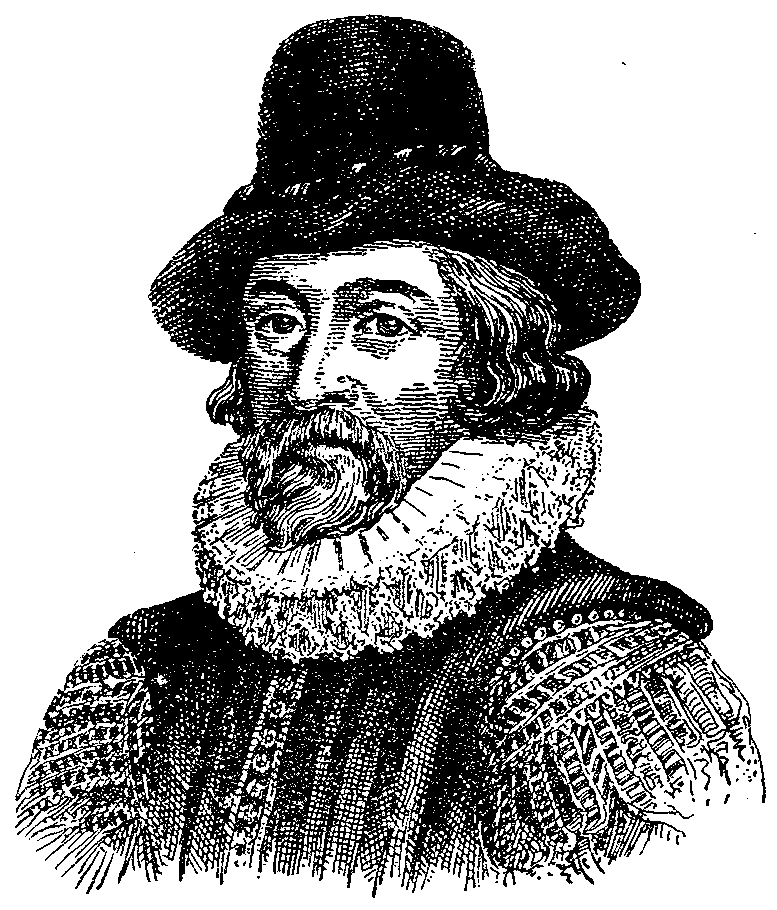 FRANCIS BACON. |
In a low-roofed room, with oak-panelled walls, and windows that overlooked the garden of Gray's Inn, Holborn, a young man of about twenty years of age was pacing restlessly to and fro; stopping occasionally to gaze absently through the dusty panes at the grassy quadrangle below, now bathed in the morning sunshine, where a crowd of blackbirds, starlings, and sparrows were chattering and wrangling over a late breakfast.
Forgotten for the moment were the musty room, and the mustier books that lay open on the desk; the student for those brief moments was a student no longer, but a dreamer of dreams—the would-be designer of a great scheme that should carry his name down to posterity as a benefactor of mankind; for he placed no limits to his dreams. The law was his chain; he dragged it heavily then; he was destined to drag it still more heavily for many years to follow, ere he could cast its burden from him for ever.
In appearance the young man was comely; he had a natural grace and ease of movement that suggested the courtier rather than the student. Yet the grave earnestness which marked his looks, while it afforded the truest index to his character, served also to distinguish him from the class of young men of his day who spent their time mainly about the Court.
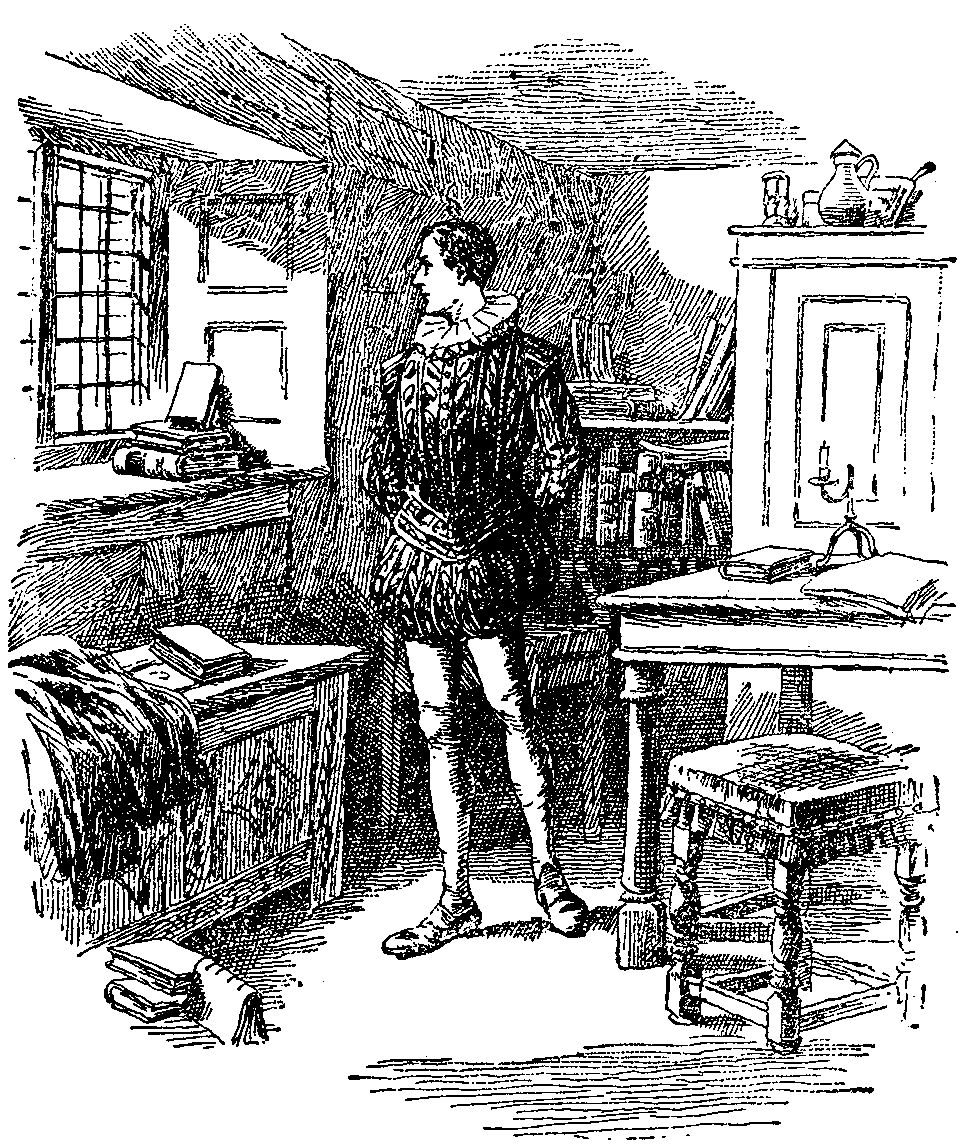 STOPPING OCCASIONALLY TO GAZE ABSENTLY THROUGH THE DUSTY PANES. |
Nevertheless, Francis Bacon, though no an admitted student of Gray's Inn, had been reared in the atmosphere of the Court, and had imbibed something of its manners and associations. The youngest son of Sir Nicholas Bacon, Lord Keeper of the Great Seal, Francis had passed many of his boyish days at the Court, where his "quick wit and precocious gravity" had marked him out for notice, not only by the great men and women, but also by the Queen herself. Elizabeth in playful mood had even gone so far as to dub the bashful little fellow who timidly approached her throne "her young Lord Keeper".
Francis Bacon was born at York House, in the Strand, his father's London home, on January 22, 1561, and here passed the years of his childhood until he went to Cambridge. Though modest and shy by nature, Francis seems to have been possessed of an inquiring, not to say inquisitive, turn of mind. What he desired to know he would take extraordinary pains to find out; and he was generally successful, though it would appear that with characteristic modesty he concealed the extent of his knowledge from those about him. There is no doubt that as a boy—as afterwards, when a man—his interests were extremely wide; and every scrap of information gleaned from books or conversation, or gained by personal observation, was carefully treasured for future use. Keenly, though quietly, observant of every fact and occurrence in the world which was daily opening to his view, the boyish mind of Bacon had already embarked upon that voyage of inquiry and investigation which had no ending for him whilst he lived.
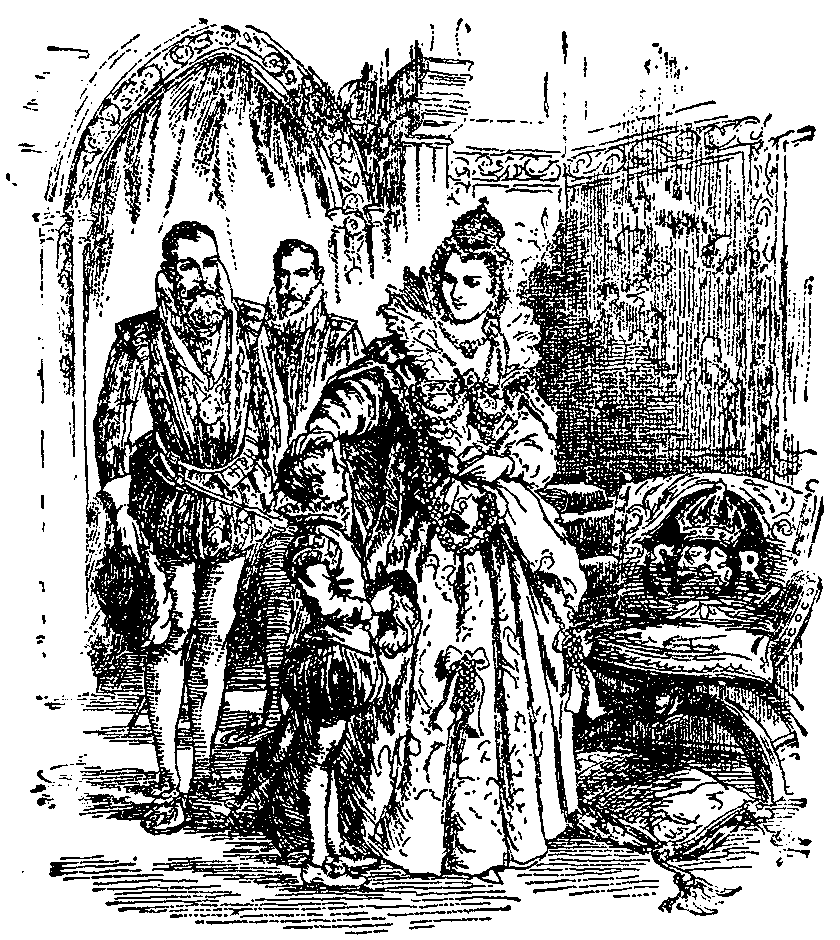 HER YOUNG LORD KEEPER. |
In the gardens of York House, and more especially at Gorhambury, his father's country seat in Hertfordshire, where he was brought more directly into contact with nature, Francis must have acquired his love of gardening, which he describes as "the purest of human pleasures".
His mother, Ann Bacon, was a daughter of Sir Antony Cook, "a person deep in the confidence of the reforming party, who had been tutor of Edward VI." Another of Sir Antony's daughters was married to William Cecil, afterwards the famous Lord Burghley, who thus became Francis's uncle. From his mother Francis may have inherited some of the talent for acquiring knowledge which distinguished him. Ann Bacon, we are told, was a remarkably accomplished woman—one "exquisitely skilled in the Greek and Latin tongues", "learned, eloquent, religious, full of affection and puritanic fervour." How far she influenced the mind of Francis is doubtful; for he appears to have begun to think for himself on religious as well as on other great questions of the day at a very early age. It is also probably that his mother's masterful and somewhat tyrannical spirit met its match in her son.
When he had attained his twelfth year Francis accompanied his brother Antony to Cambridge, where he was entered at Trinity and placed under Dean Whitgift (afterwards Archbishop of Canterbury) and where he remained till 1576. As a boy Francis was delicate—a fact which may have conduced to his studious habits. A reference to this delicacy occurs in a letter of this time from Ann Bacon to her elder son, in which Antony is warned to look after his health and to avoid imitating his brother's ill-ordered habits. "I verily think," says the writer, "your brother's weak stomach to digest hath been much caused and confirmed by untimely going to bed, and then musing nescio quid when he should sleep, and then in consequent by late rising and long lying in bed; whereby his men are made slothful and himself continueth sickly. But my sons haste not to hearken to their mother's good counsel in time to prevent."
It was whilst studying at Cambridge that Bacon's attention was seriously drawn to science. What was called "Natural Philosophy" formed the principal part of the teaching at the Universities in those days; and this teaching was based upon the writings of Aristotle, to whose rules, or "laws", all questions relating to science were invariably referred. From this authority there was no appeal, but Bacon was by no means the first to discover the shallowness and narrowness of the system of philosophy then in vogue. At fifteen he had convinced himself of the "unfruitfulness", as he expressed it, of the Aristotelian method and of the desirability of discovering a better.
In September, 1576, Francis left Cambridge to proceed to France in the suite of Sir Amyas Paulet, the English Ambassador. This step had been taken by Sir Nicholas Bacon with the object of enabling the youth to pick up a knowledge of the politics and manners of the French Court. Francis divided his time between Paris, Blois, Tours, and Poitiers. In Paris he found ample stores of literature in the libraries of the university—not then, however, as earlier, the seat of learning, where his great namesake and predecessor, Roger Bacon, had taught three centuries before.
If politics formed the chief subject of Bacon's studies during his residence in France, his favourite subject was not neglected. We know for certain that he devoted a part of his leisure to inventing a system of cipher-writing—a method which as Dean Church reminds as, "was of daily and indispensable use for rival statesmen and rival intriguers"; though to Bacon it may have been chiefly interesting "as an example of the discovery of new powers by the human mind".
In March, 1579, Francis was recalled to England by his father's death, to find himself deprived by this unlooked-for event of the worldly means and prospects which he had been confidently led to expect. He chose the law as a profession, actuated by the hope that he might thereby become qualified to take some post in the Queen's service that would make him independent of the ordinary practice at the Bar, the more so because he was the bearer from France of a dispatch from Sir Amyas Paulet to the Queen, in which the Ambassador referred to young Francis Bacon as one "of great hope, endued with many good and singular parts", one who, "if God gave him life, would prove a very able and sufficient subject to do her Highness good and acceptable service."
Shortly after his return Francis took up his residence at Gray's Inn and settled down to the study of the law. In the forefront of his desires he placed the obtaining of a post in the Queen's service, and the influence he needed to further his interests he now hoped to find in the person of his powerful relative, Lord Burghley, Elizabeth's Secretary of State. As Dean Church reminds us: "Bacon was ambitious—, in the first place, of the Queen's notice and favour. He was versatile, brilliant, courtly, besides being his father's son."
Apart from this desire for personal advancement, Bacon well knew that as a poor man he would be unable to carry out the resolution which he had formed whilst yet a student at Cambridge, to devote his knowledge and powers to the service of the human race.
So far time had failed to reveal any practical result from his uncle's mediation, and Bacon in his Gray's Inn retreat, knitting his brows over the musty books of the law, began to grow impatient at the delay. He was young and generous-minded, and he had yet to be convinced (it was a truth hard to be received by a son of one so respected and beloved as Sir Nicholas Bacon) that loyalty and devotion were in themselves poor qualities for recommendation, even when, as in his own case, they were accompanied by gifts of no common order. Thus was begun, at the period at which our story opens, that system of importuning and paying court to those high in favour and power with the sovereign, which was never abandoned; it warped and undermined the better side of his nature; it rendered him incapable of acting up to the standard of his noble ideals, and it cramped and dwarfed his highest intellectual efforts.
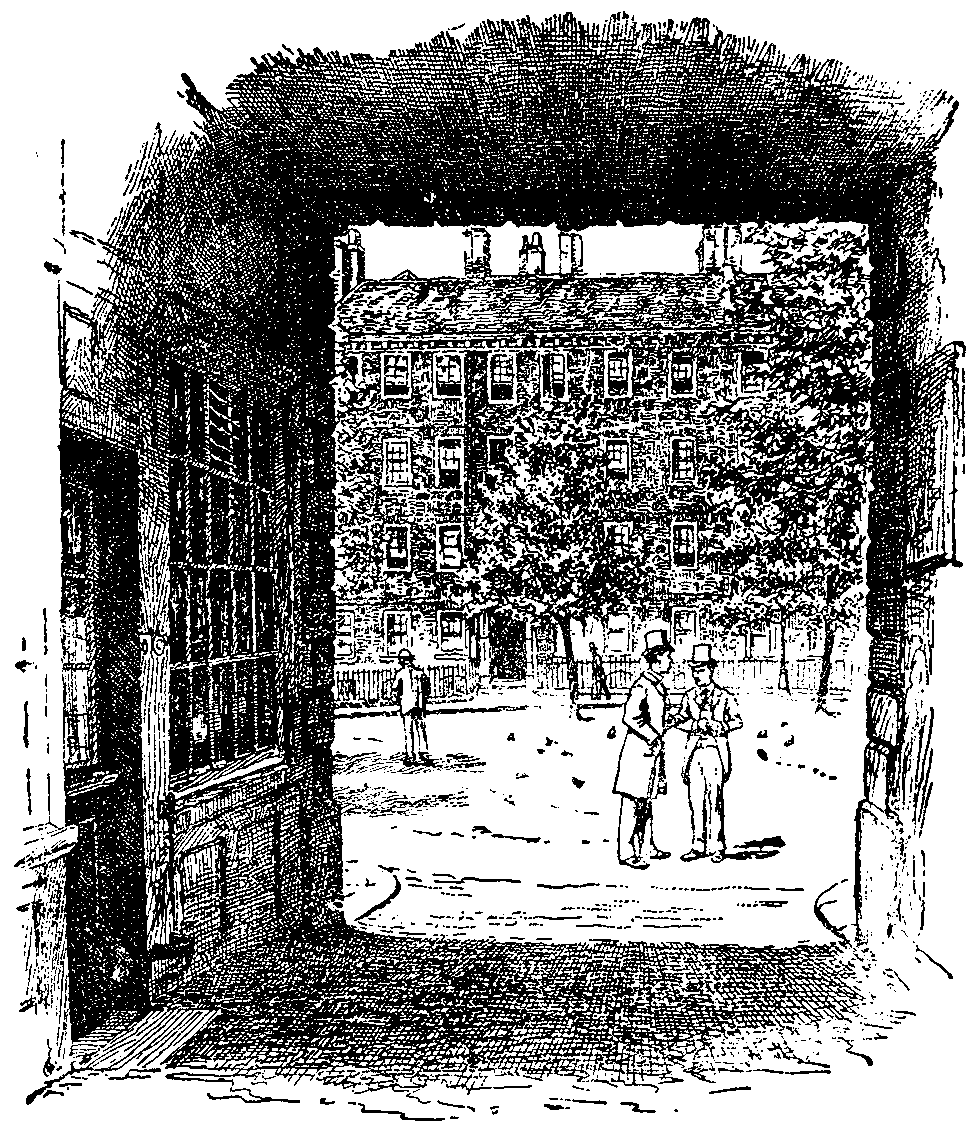 ENTRANCE TO GRAY'S INN FROM GRAY'S INN LANE. |
For ten years Bacon continued to drudge on at the law, hoping against hope; but for some reason or other, strange though it must appear, beyond empty promises or half-promises, his appeals produced no effect. He saw others promoted to post of greater or less emolument, and himself passed over without a word of explanation or apology. They were years not idly spent, for, apart from his legal studies, Bacon had manfully sought to raise himself from obscurity without the aid of his friends in the Government. In 1584, when twenty-three, he had entered Parliament as member for Melcombe Regis, and he had become a Bencher of his Inn in 1586. There is no doubt also that he spent a part of his time in maturing his great scheme for the benefiting of mankind. From this time we are to imagine him as pondering his great problem at all times and in all places, as amassing observation and inquiry and arrange and re-arranging these accumulations so as to fit them into his vast scheme, and as waiting and longing in his innermost heart for that day when, favoured by wealth and leisure, he could give himself up wholly to the fulfilment of his life task.
In the meantime he published his first collection of Essays, in 1597. The number in subsequent editions was raised from ten to fifty-eight, the last edition being published in 1625 shortly before Bacon's death.
It is said that Bacon himself had a tender regard for these Essays, as representing the happiest of his compositions (they were his first literary venture), penned in moments of comparative freedom from care, and that he kept the book constantly by his side, altering and adding to the material as fresh thoughts or ideas occurred to his mind. The ground which they cover is extremely wide: Truth, Love, Friendship, Fortune, Youth and Age, Studies, Praise, Building, Gardens, Plantations, Beauty, Health, Marriage, Cunning, Travel, Counsel, Wisdom, Expense, Parents and Children, Sedition, Empire.
It would be easy to fill pages with wise precepts and pithy sayings culled from these "Counsels, moral and political", as Bacon himself styles them. "To spend too much time in studies is sloth; to use them too much for ornament is affectation." "Crafty men contemn studies; simple men admire them; and wise men use them." "Some books are to be tasted, others to be swallowed, and some few to be chewed and digested." "Reading maketh a full man, conference a ready man, and writing an exact man." It is worth noting that Macaulay quotes these passages as an example of Bacon's power of compressing much thought into a small space.
The reign of Elizabeth came to a close without witnessing any material advance in Bacon's fortunes, and it was not until her successor has been seated on the throne for several years that Bacon's persevering endeavours to make himself indispensable to James were at length rewarded. Thenceforth his promotion was rapid. In June, 1607, he was appointed Solicitor-General, being then forty-seven; six years later—viz. in October, 1613 he became Attorney-General, the post for which he had waited for thirty years. In March 1617, he attained the highest point of his ambition by succeeding Lord Ellesmere as Lord Chancellor. In July, 1618, he was created a peer, taking the title of Baron Verulam, and in January, 1621, he was raised a step higher in the peerage as Viscount St. Albans.
Amidst the cares and claims of a busy official life, however, he had found time to construct and elaborate his plans for his great philosophical work, and in 1605 he opened his design to the world by the publication of the Advancement of Learning forming the first of the three works of which we have now to speak:—
- The Advancement of Learning (1605).
- The Novum Organum (1620)
- The De Augmentis Scientiarum (1623).
These three works comprise Bacon's "system" of philosophy—the De Augmentis being an expanded version (translated into Latin) of the Advancement, in nine books. The Advancement, as first written, was intended merely as the Preface in a series of treatises which were ultimately to form an Instauratio Magna (Great Instauration), but the Novum Organum (New Instrument), itself imperfect, was, says Dean Church, "the crown of all Bacon lived to do." The Novum Organum was followed two years later, by two separate treatises (the History of the Winds, the History of Life and Death), which Bacon intended as materials for the new method to work upon. Other papers were prepared or sketched out, but were never published, and the great scheme was left uncompleted.
The Advancement of Learning (which, it is interesting to note, was published in October, 1605, "at a bookshop at the gateway of Gray's inn in Holborn") is described by Dean Church as "a careful and balanced report on the existing stock and deficiencies of human knowledge." But Bacon himself warns us that his endeavours are "but as an image in a cross-way, that may point out the way, but cannot go it". The Advancement, indeed, "shadowed out, but only shadowed out, the lines of his proposed reform of philosophical thought; it showed his dissatisfaction with much that was held to be sound and complete, and showed the direction of his ideas and hopes." There he left it for the time, and when in later years he took up the thread again it was to write a separate book, the Novum Organum, which was published in 1620, on the eve of his fall.
The Novum Organum (to quote Dean Church once more) is "the avowed challenge to the old philosophies, the engine and instrument of thought and discovery which was to put to shame and supersede all others, containing, in part at least, the principles of that new method of the use of experience which was to be the key to the interpretation and command of nature, and, together with the method, an elaborate but incomplete exemplification of its leading processes. Here were summed up, and stated with the most solemn earnestness, the conclusions to which long study and continual familiarity with the matters in question had led him. And with the Novum Organum was at length disclosed, though only in outline, the whole of the vast scheme in all its parts, object method, materials, results, for the 'Instauration' of human knowledge, the restoration of powers lost, unused, neglected, latent, but recoverable by honesty, patience, courage and industry. It was twelve years in hand, and twelve times underwent his revision. Severe as it is, it is instinct with enthusiasm. The Latin in which it is written answers to it; it has the conciseness, the breadth, the lordliness of a great philosophical legislation".
The printed works of Bacon represent only a tithe of the labour expended upon their production. The amazing fertility of his resources—the inexhaustible stores of knowledge at his command—together with is varied powers of expression, seemingly made it difficult at times to decide upon the form in which his ideas should be presented; and we are told that "some of the freshest and most felicitous forms of his thoughts" are contained in abandoned chapters and essays.
"We may, as we trust," said Bacon, "make no despicable beginnings. The destinies of the human race must complete it, in such a manner perhaps as men looking only at the present world would not readily conceive. For upon this will depend, not only a speculative good, but all the fortunes of mankind, and all their power." Bacon in this passage clearly shows his confidence in his powers of bringing men to a new way of acquiring knowledge—and not only a new, but a sure way as well—with results that shall be free from speculation or doubt, and that shall lead directly to the advancement of the powers and the fortunes of posterity. But he overlooked the important consideration with regard to science, viz.: that the mere collecting of facts is useless in itself unless it furnishes us with the means of deducing from such facts an explanation, or hypothesis, regarding the working of natural laws. And this brings us to the startling truth with regard to Bacon's method; not only did it bear no fruit under his own hands, but the scientific men who lived in his own time, or who followed after him, could make nothing of it; whilst modern scientific men have rejected it as worthless from the point of view of practical science.
"Bacon," writes Mr. Spedding, "failed to devise a practicable method for the discovery of the Forms of Nature because he misconceived the conditions of the case…. For the same reason he failed to make any single discovery which holds its place as one of the steps by which science has in any direction advanced. The clue with which he entered the labyrinth did not reach far enough; before he had nearly attained his end he was obliged either to come back or to go on without it."
Unlike his great contemporary, Galileo, he entered the field of scientific labour by half-equipped in the sense of a mind capable of estimating the value of Truth wherever it was to be found, and but feebly equipped as regards those branches of knowledge which are essential for the successful prosecution of scientific research. Himself ignorant of mathematics (the foundation on which Galileo was so surely building), he imagined that mathematics were unnecessary as a means of probing the secrets of nature; consequently he missed the one great avenue by which Truth was obtainable. He deliberately shut the door against deductive science, and heaped ridicule upon those who upheld this method, claiming that by the observation of facts alone would men in the future be able to read the history of nature and comprehend the working of her laws.
What, then, made Bacon great? "The great and wonderful work which the world owes to Bacon," says Dean Church, "was in the idea, and not in the execution." It is this idea, this certainty of a new unexplored Kingdom of Knowledge within the reach and grasp of man—this announcement of a new system of thought, a prize and possession such as man had not yet imagined—this weighty and solemn call to learning, than which nothing had before existed to equal it in its ardour of hope and promise of future glory—which placed Bacon amongst the great discoverers of the human race. "Aristotle first, and for his time more successfully, and Bacon after him, ventured on the daring enterprise of 'taking all knowledge for their province', and in this they stood alone."
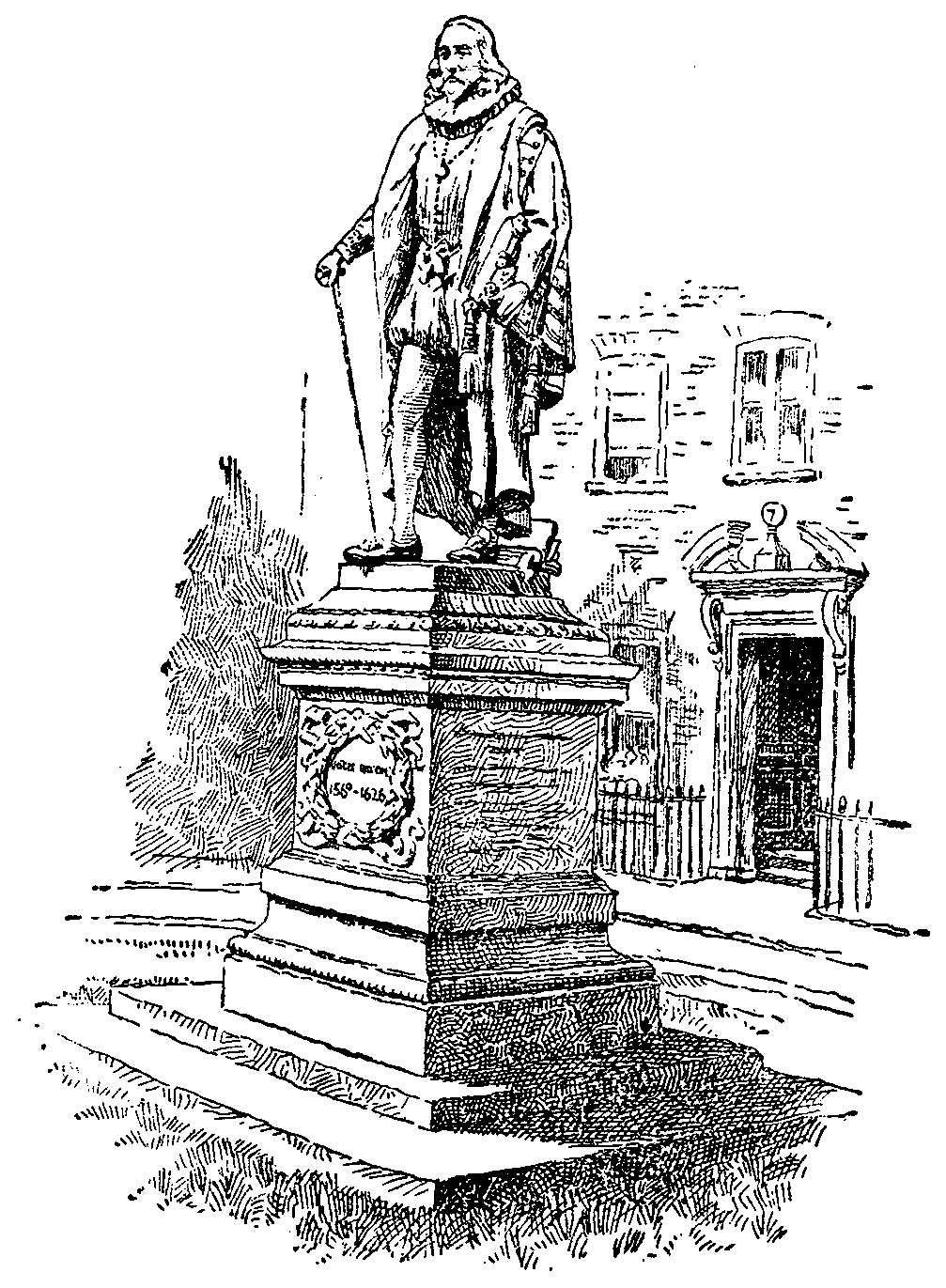 STATUE OF SIR FRANCIS BACON, GRAY'S INN. |
"Bacon," says Mr. Balfour, "was a prophet and a seer. . . . . What he saw was the neglect by the scientific mind, engaged in verbal disputes, of the patient and childlike attitude of those who come to Nature, not to impose upon Nature their own ideas, but to learn from Nature what it is that she had to teach us. . . . Bacon had fine hopes of what man could discover in order that the kingdom of man over Nature could be established. He was full of courage, full of insight, yet knowing how slow must be this process of gradually building up learning, and recognising how small was the actual contribution which he and his contemporaries could make towards it, and how great was the final structure of which he and his contemporaries were laying the first layer. . . . He always looked on the estate of man with pity, and to improve the estate of man in succeeding generations was one of his great objects. . . . Surely that imagination which foresaw all that science could do for the estate of man was no imagination that crawled upon the ground, that could not look up to Heaven, could not see the magnificence of the prospect which was, as he believed, opening out to humanity. I should like to ask how soon this prophesy of Bacon really began to be accomplished. Though dates cannot be fixed, I believe it will be found that it is within the last three of four generations that industry has really been the child of scientific discovery. Bacon did for science all that a philosopher can do—as a great philosopher and a great writer, as distinguished from an investigator, can do. He created the atmosphere in which scientific discovery flourishes."
The story of Bacon's fall must be read elsewhere; in the years that followed, the ex-Lord Chancellor gave himself wholly to science, and it only remains to tell how Bacon died. An old man at 85, yet active in mind to the last, the manner of his death was a tribute to the science he had so earnestly advocated. On a cold day in March, 1626, whilst driving through the snow towards Highgate, he resolved to try an experiment to determine whether extreme cold would arrest putrefaction. Stopping his coach at a cottage he bought a dead hen from the woman, and proceeded to stuff the hen with snow. The exposure brought on a severe chill, which forced him to stop at the house of a stranger (Lord Arundel) by the way. The illness increased, and he could not be removed; and here, a few days later, on Easter morning, April 9, 1626, he died.
Galileo
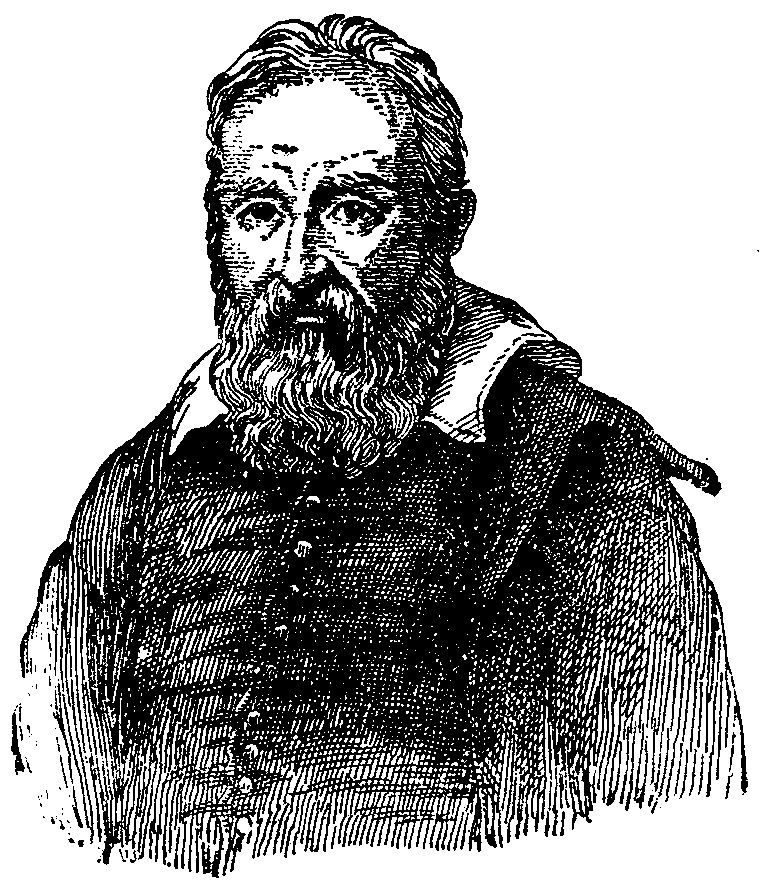 GALILEO. |
In 1582, whilst Francis Bacon was studying law at Gray's Inn, and secretly cherishing his great scheme for inaugurating a new system of thought—a new philosophy of science—which should place the human mind 'on a level with things and nature', a young Italian student named Galileo Galilei was poring over his medical books in the University of Pisa. His father, Vincenzo Galilei, though in poor circumstances, was of noble descent, and proud of the title of philosopher, to which his learning gave him a just claim, though his talents were chiefly exercised in the direction of music, in the theory and practice of which art he excelled. Galileo was the eldest of a family of three sons and three daughters, and when his father cast about to find an opening for him in life it was as an apprentice in the woollen trade that he first designed to place him. But young Galileo soon showed so much promise in the convent school to which he had been sent, that the idea of a business career was abandoned, and in November, 1581, Galileo entered Pisa University as a student of medicine.
At the university Galileo was placed under the tuition of Cesalpino, the celebrated botanist, who held the chair of medicine and whose researches with regard to the structure and action of the heart entitles him to rank as one of the forerunners of Harvey, the discoverer of the circulation.
Galileo soon showed the material of which he was made. He gave the professors little peace, for he refused to accept for fact any statement that could not be demonstrated, or the truth of which he could not ferret out by his own inquiry. A spirit of contradiction was his most noticeable characteristic in the eyes of his instructors; but they mistook for such his earnest love of truth—a love which never forsook him, and which in after years made him doubt and question his own conclusions quite as much as he had done those of his masters. He studied for himself Aristotle and Plato, and the rest of the "ancients", instead of blindly accepting their axioms as established truths, and he persevered in this course, even at the risk of offending those who presumed to know.
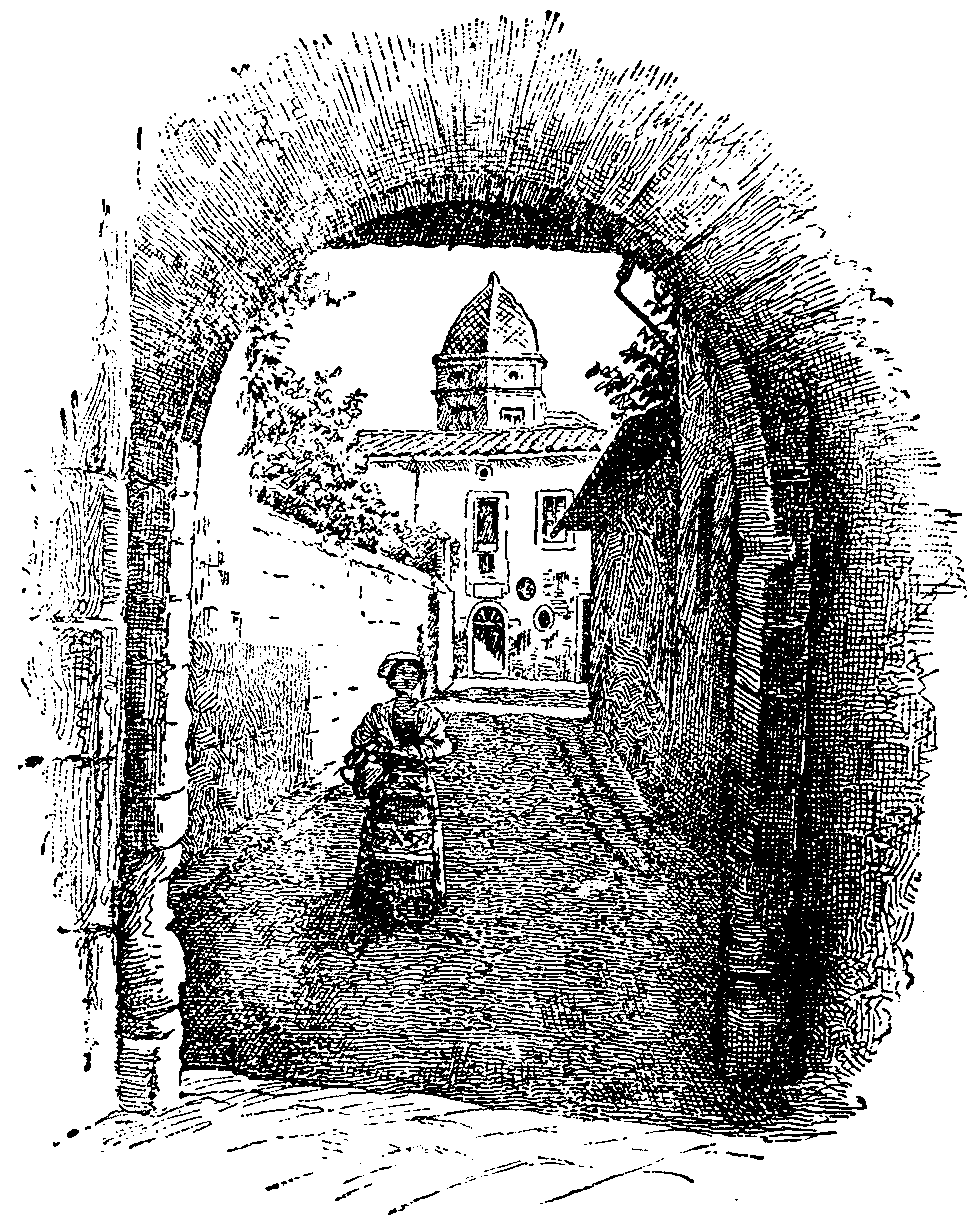 BIRTHPLACE OF GALILEO, PISA. |
It was not long before this spirit of inquiry let to a practical result. Seated one day in the Cathedral of Pisa, at dusk, he observed the verger lighting the great bronze lamp which was suspended from the roof. When the numerous wicks had been ignited the verger left the lamp swinging to and fro, and Galileo watched its movements, at first idly, and then with growing interest. For an idea connected with the swinging lamp had entered his mind and he wanted to verify its truth. He noticed that the swings, whatever their range, were executed in equal times; in other words, though the momentum of the lamp slackened, and the distance traversed in each oscillation grew less, the time occupied in swinging from one point to another was exactly, or very nearly, the same. This discovery (it is known as the isochronism of the pendulum) he proceeded to turn to practical use by constructing a pendulum of proper length for measuring the speed and regularity of the pulse. The apparatus was extremely simple, consisting of a light weight attached to a thread, which in turn was affixed to a graduated scale, but it served its purpose and it was probably the first instrument ever devised for precise observation of phenomena in a living organism. Fifty years later Galileo applied the principle of the pendulum to the construction of astronomical clocks.
Of mathematics Galileo was as yet quite ignorant, but in the summer of 1586 the Tuscan Grand-Ducal Court visited Pisa, and amongst the suite was Ostilio Ricci, a distinguished mathematician and a friend of Galileo's family. Chance made Galileo a listener to a lesson in Euclid which was being given by Ricci to the pages of the court. The student listened like one entranced; in a flash the light broke in upon his mind—here was the key which would unlock the secrets of nature, and enable him to penetrate those mysteries which he had pondered and puzzled over so long! Scarcely waiting for the end of the lesson, Galileo flung himself into Ricci's presence and begged him to teach him more. Ricci, pleased with the student's enthusiasm for his own subject, readily consented, and Galileo joyfully entered upon his new study.
In a short time he had mastered the whole of Euclid, and then passed on to Archimedes, concentrating his attention upon that portion of the great geometer's researches which deals with the lever and the specific gravity of floating bodies. As a result of his studies he constructed a balance for solving in a simpler and more exact manner the problem with King Hiero had set to Archimedes with respect to the crown of gold alloyed with silver. How Archimedes acquitted himself of his task may be briefly told as follows. Hiero had given to a goldsmith a certain weight of gold to be made into a crown. When the work was finished he suspected that the gold had been alloyed with some baser metal, and he applied to Archimedes in the hope that the latter would be enabled to detect the supposed imposture. The weight of the crown being correct, the problem was to measure its bulk; for silver being, weight for weight, of greater bulk than gold, any alloy of the former, in place of an equal weight of the latter, necessarily increase the bulk of the crown. To measure the bulk, however, was difficult without melting the crown into a regular figure. Archimedes on stepping into his bath one day observed that a quantity of water of the same bulk as his body must flow over before he could immerse himself, and this suggested a plan to his mind. He procured two masses of metal each of equal weight with the crown—one of gold and the other of silver—and having filled a vessel accurately with water he plunged into it the silver and marked the exact quantity of water that overflowed. He then treated the gold in the same manner, and observed that a less quantity of water overflowed than before. He next plunged the crown into the same vessel full of water, and observed that it displaced more of the fluid than the gold had done, and less than the silver, from which he inferred that the crown was neither pure gold nor pure silver, but a mixture of both.
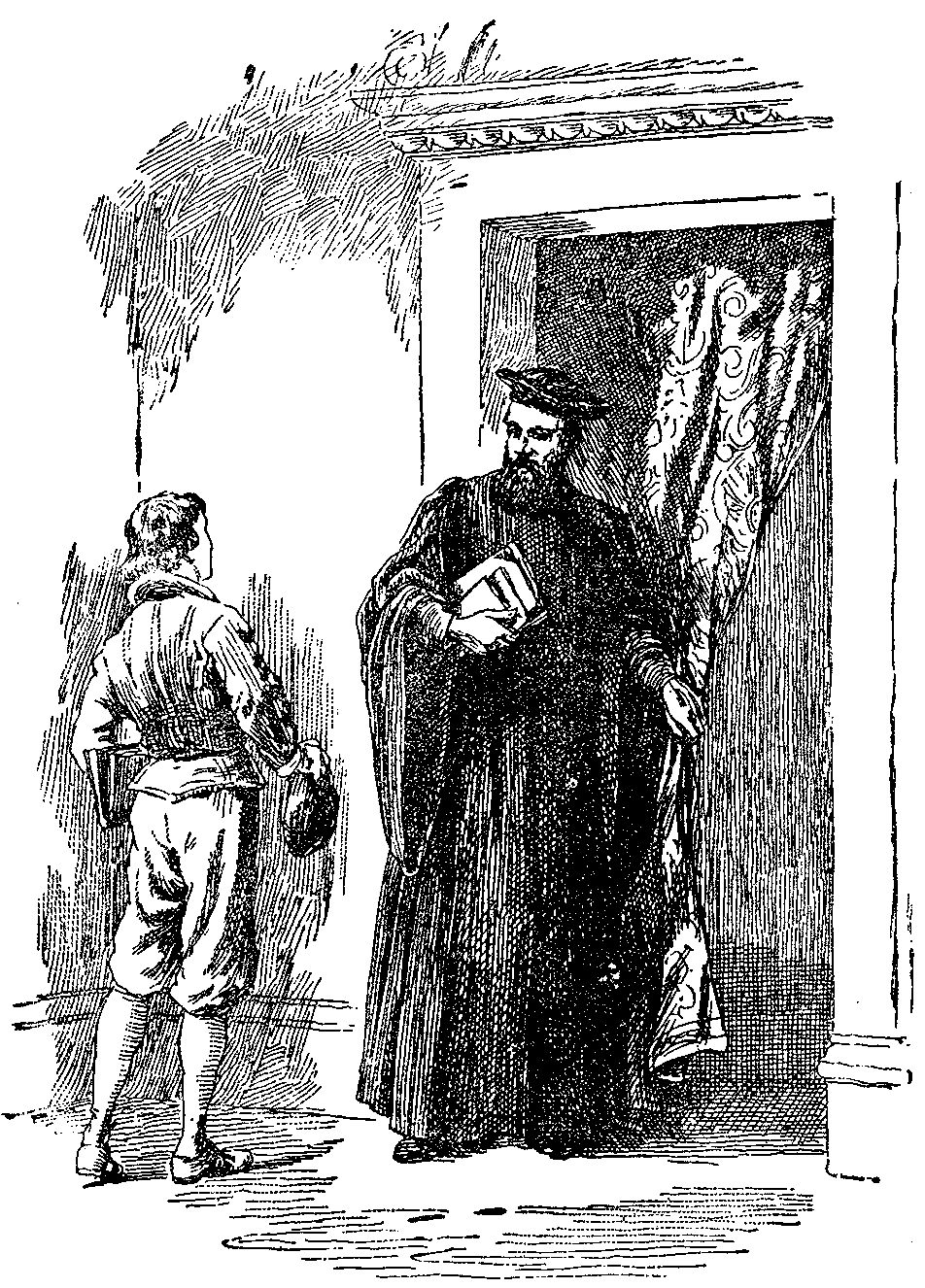 HE BEGGED RICCI TO TEACH HIM MORE. |
Galileo's balance secured him the interest and patronage of the Marchese Guidobaldo of Pesaro, who was distinguished for his mathematical acquirements, and at whose instance Galileo in 1588 wrote an essay on the Centre of Gravity in Solids, which was the means of making his name known throughout Italy. The interest of the Marchese did not stop here, for in the following year he used his influence to obtain for Galileo the post of mathematical lecturer at the university. As for Galileo himself, the smallness of the salary was of less moment than the fact that the necessity of eking it out by private teaching restricted his leisure for independent research. For he had now some important work to carry out.
He had set himself no less formidable a task than that of disproving the teaching which passed under the name of Aristotle, of the falsity of which he had convinced himself by his inquiries. It was "his first crusade against the decrepit philosophy of his time, in which Aristotle's conjectures had been petrified into a creed, while of the open mind and patient observation of the great master not a trace was left".
Galileo's first trial of strength with the university professors was connected with his researches into the laws of motion as illustrated by falling bodies. It was an accepted axiom of Aristotle that the speed of falling bodies was regulated by their respective weights: this, a stone weighing two pounds would fall twice as quick as one weighing only a single pound, and so on. No one seems to have questioned the correctness of this rule, until Galileo gave it his denial. He declared that weight had nothing to do with the matter, and that it was the resistance of the air which determined the rate of speed of a body falling through it; if, therefore, two bodies of unequal weight could overcome the resistance to the same extent they would reach the ground at the same moment. As Galileo's statement was flouted by the body of professors, he determined to put it to a public test. So he invited the whole University to witness the experiment which he was about to perform from the Leaning Tower. On the morning of the day fixed Galileo, in the presence of the assembled University and townsfolk, mounted to the top of the tower, carrying with him two iron balls, one weighing one hundred pounds and the other weighing one pound. Balancing the balls carefully on the edge of the parapet, he rolled them over together; they were seen to fall evenly, and the next instant, with a loud clang, they struck the ground together. The old tradition was false, and modern science, in the person of the young discoverer, had vindicated her position.
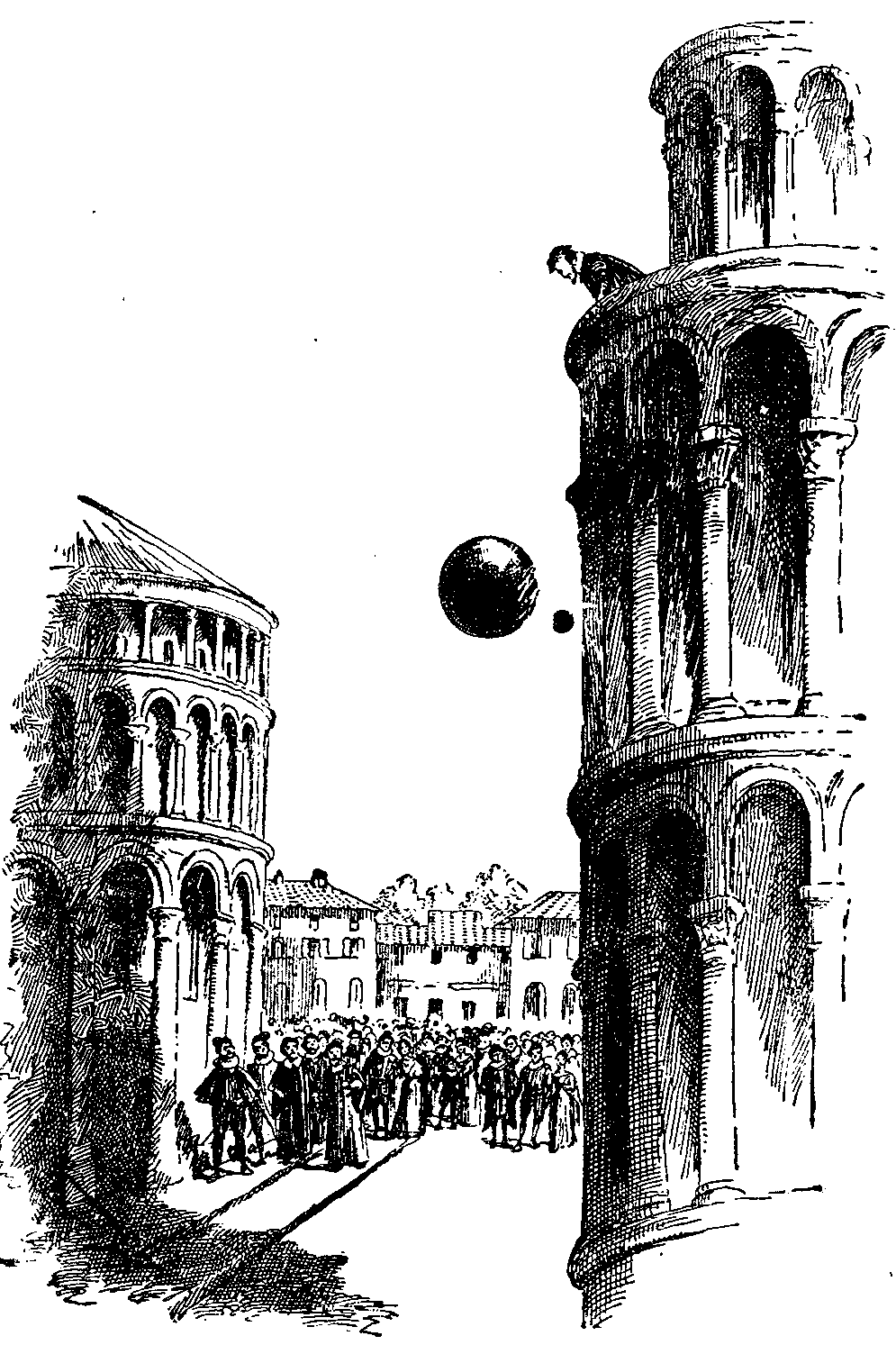 DEMOSTRATING HIS THEORY OF THE SPEED OF FALLING BODIES. |
In 1591 Galileo resigned his post and went to Florence.
In the following year, through the influence of his first patron, Guidobaldo, he was appointed professor of mathematics at Padua University, the appointment being for six years, and the salary 180 florins. The death of his father just before this event, made it necessary for Galileo to contribute towards the support of the family, so that once more he was compelled to resort to private teaching to increase his means. His fame as a lecturer spread rapidly; the lecture hall, which was capable of seating two thousand persons, was crowded with students, including many strangers from every part of Europe, who listened with delight to Galileo's brilliant descriptions of his discoveries and to his suggestions for researches in various branches of physical science.
On the completion of the first period of his engagement Galileo was re-elected for a further term of six years, with an increased salary of 320 florins; at this time his reputation extended to all the principal seats of learning in Europe, and his lectures were attended by members of the reigning royal families who visited Italy.
We now pass to Galileo's work in astronomy; and here it is necessary to say a few words regarding the opinions held at that time on the subject of the structure of the universe and the movement of the heavenly bodies. The system of astronomy then taught was that founded by (or to speak more correctly, ascribed to) Ptolemy, who flourished 130-160 A.D. In reality the system was founded upon the researches of still earlier philosophers, chief amongst whom is to be reckoned Hipparchus (about 150 B.C.), to whose observations and discoveries Ptolemy owed a great part of the "immense reputation enjoyed by him through the times of Arabian and mediaeval astronomy".
It would take too long to describe the Ptolemaic system as it was accepted and taught under the sanction of the Church of Rome in Galileo's time; but so far as the system concerned the movements of the heavenly bodies and their relation to the earth, it may suffice to say that the belief was that the sun and the planets revolved in regular circles round the earth as a centre.
In conformity with the custom of the day Galileo taught the Ptolemaic system to his pupils; but he had for some time secretly become a convert to the views of Copernicus, and acute observer and deep reasoner in astronomical science, whose book, De Revolutionibus Orbium Cælestium, containing the results of his life-work, was published in 1543, the year of his death. Copernicus (who was himself a canon of the Church) in a dedicatory epistle to the Pope Paul III, had modestly disclaimed any intention of opposing his theories to the version of astronomy sanctioned by the Holy Office, and by this means had secured for his book the toleration, and even the approval, of the Church. He had never thrust his opinions forward, and it was only with great reluctance that he consented to their publication when on his deathbed.
Yet the far-reaching importance and significance of the views thus modestly advanced by Copernicus were apparent to Galileo, and to others beside, though they were, for obvious reasons, not held openly or taught in the schools.
We will now consider, briefly, what these views implied. Copernicus, impressed by the complexity of the Ptolemaic system, sought to simplify it by an hypothesis to the effect that the sun, and not the earth was the centre of the universe, and that the earth and the planets revolved round the sun. He did not arrive at this momentous conclusion (it was indeed a discovery though he put it forward as a mere hypothesis) without numberless observations, undertaken with poor instruments and extending over many years, and he supported it by calculations worked out with marvellous patience and exactitude. To say that the views advanced by Copernicus were momentous, is to convey only a faint impression of their bearing upon the scientific thought and belief of the age. If the idea of the sun as the central point in the universe were to be accepted, it meant that the teaching with regard to the importance of the earth relatively to the other heavenly bodies would now have to be abandoned. Instead, the earth must be numbered in importance only with the planets (possibly to be exceeded in size by one or more of those bodies), whilst preconceived notions of the sun, planets, and stars being attendant luminaries of the earth would be no longer tenable. Moreover, though the idea of the solid earth revolving in and travelling through space has long been familiar to us, the advancement of such an idea in the state of knowledge which prevailed in the sixteenth century must have been so startling as to tax the credulity of all but the deepest thinkers of the time. Nor was the shock to religious thought and belief any less great; for if the idea of the earth as the one fixed and central figure in the universe were to be given up, what was man's place in the scheme of creation, or where lay his future hopes? Or, again, how were the doctrines of the Church to be maintained? So startling an innovation—so complete a revolution of current ideas and beliefs—could not have been tolerated by the Church had it been in opposition to the received doctrines. As it was, however, Copernicus's views were clothed in modest dress, and buried in a learned treatise such as few were likely to read and fewer still to understand; and "so long as the new doctrine was confined to the learned the Church did not care to interfere with it".
Among the astronomers of the day who welcomed the new system with enthusiasm was the German, Kepler, of whom it must be said that, in spite of poverty, ill-health, and misfortune—all of which pursued him relentlessly—he was destined by his discoveries to shed a lustre on the science to which he devoted his life. It is to Kepler's untiring energy and genius (aided, as he undoubtedly was, by his association with that prince of observers, Tycho Brahe, whose work he continued after Tycho's death) that we owe our knowledge of the laws governing the movements of the planets. To mention the chief of those laws—that the planets move in ellipses, instead of circles—is to indicate the point of discovery at which the new astronomy (as distinguished from the ancient order of circular motion) took its rise.
Galileo seems to have made the acquaintance of Kepler in 1597, when the latter sent him a copy of his work Mysterium Cosmographicum. In a letter acknowledging the gift, Galileo, after deploring the fact that the lovers of truth were so few in number, goes on: "Many years ago I became a convert to the opinions of Copernicus, and by that theory have succeeded in fully explaining many phenomena, which on the contrary hypothesis are altogether inexplicable. I have drawn up many arguments and confutations of the opposite opinions, which, however, I have not hitherto dared to publish, for fear of sharing the fate of our master, Copernicus, who, although he has earned immortal fame with some, yet with very many (so great is the number of fools) has become an object of ridicule and scorn."
One of the axioms of Aristotle was the "incorruptibility of the heavens": the universe was incapable of either change or decay; it was finite and perfect; nothing could be added to it and nothing taken away from it. There were seven planets, corresponding to the number of days in the week, viz. Moon, Mercury, Venus, Sun, Mars, Jupiter, Saturn; the various constellations were known, and the number of stars contained in each was fixed and certain. The sudden appearance of a new star in the constellation Serpentarius, in the month of September, 1604, therefore naturally excited much interest amongst the astronomers. Kepler observed it, and Galileo made it the subject of a course of three lectures delivered to great audiences, to whom he took occasion to administer a rebuke for taking so deep an interest in a phenomenon of a temporary nature, whilst they showed indifference towards the permanent wonders that surrounded them. His attach upon the Aristotelians, whom he did not spare in wit or sarcasm, was bitterly resented, and a controversy arose in which Galileo was induced to throw aside his reserve and boldly declare himself an upholder and defender of the Copernican theory.
But Galileo was soon to weild against his challengers a weapon more powerful than argument, however forcible or well founded, more potent than satire, however pointed—a weapon which was destined in his hands to carry conviction to the minds of many doubters and to inflict defeat and dismay upon the enemies of truth. A dangerous weapon, too, when all is said; for it laid him who used it under the danger of the law which had no part or interest in the search for truth and no scruple in subjecting those who transgressed its doctrines to the penalties of imprisonment, torture, and death.
This "weapon" was the Telescope—as yet unknown to science and in its beginnings a mere toy. In June, 1609, a rumour reached Venice and found its way to the ears of Galileo, that a Dutchman, named Johannes Lippershey, an optician of Middleburg, had in the previous year petitioned the States-General of the Low Countries for the exclusive rights in manufacture of "an instrument for increasing the apparent size of remote objects". This rumour set Galileo thinking, and the results of his cogitations may best be told in his own words. In a letter to his brother-in-law, Landucci, on August 29, 1609, he says:
"I write now because I have a piece of news for you, though whether you will be glad or sorry to hear it I cannot say, for I have now no hope of returning to my own country, though the occurrence which has destroyed that hope has had results both useful and honourable. You must know, then, that about two months ago there was a report spread here that in Flanders someone had presented to Count Maurice (of Nassau) a glass [occhiale, eye-glass; spectacles in the plural], manufactured in such a way as to make distant objects appear very near, so that a man at the distance of two miles could be clearly seen. This seemed to me so marvellous that I began to think about it; as it appeared to me to have a foundation in the science of perspective, I set about thinking how to make it, and at length I found out, and have succeeded so well that the one I have made is far superior to the utch telescope. It was reported to Venice that I had made one, and a week since I was commanded to show it to His Serenity and to all the members of the Senate, to their infinite amazement."
The letter goes on to relate how Galileo took his telescope to the Senate to present it to the Doge as a gift, that the present was accepted, and that he was told that the Senate would elect him to the professorship for life, with a yearly stipend of one thousand florins. The election was carried out at once, and without a single dissentient voice.
"But the greatest marvel of all" (writes Galileo in a letter to a friend, describing his discoveries) "is the discovery I have made of four new planets; I have observed their proper motions in relation to themselves and to each other, and wherein they differ from all other motions of the stars. And these new planets move round another very great star, in the same way as Venus and Mercury, and peradventure the other known planets, mover round the Sun." He is here referring to his great discovery of the four satellites of Jupiter on the nights of the 7th to the 12th of January, 1910.
The whole University flocked to hear Galileo's lectures on the new satellites of Jupiter. Some were convinced, some only pretended to be convinced, and some (though these latter were a small minority) declared that even if they were forced to look through the telescope and see the satellites, they would not believe them to be in the sky—"because the heavens were unchangeable." The force of this argument is obvious; the satellites were not there before Galileo saw them.
The Senate had expressed their honourable sense of Galileo's services to astronomy by conferring upon him a life professorship with a salary of one thousand florins; but about the same time he had received an invitation from the reigning Grand Duke, Cosmo II (who had been one of Galileo's pupils) to come to Florence, and take up his abode at the Court. As the salary offered was equal to that fixed by the Senate, with the additional advantage of freedom from teaching, Galileo decided to accept the offer, and in July, 1610, he left Padua for Florence, where he was established as Philosopher and Mathematician Extraordinary at the Grand Ducal Court. We need not question the motives which induced Galileo to take this step; he had passed eighteen years of active work at Padua, and he ardently desired rest and leisure for carrying out the great ideas which he had formed in his mind. But in thus abruptly severing his connection with the University which had been the scene of his recent triumphs he acted in a manner that was hardly consistent with a sense of what was due to those who had honoured his genius. And as events showed, the step was a disastrous one, for "from that time till his death he never knew peace".
As yet, however, there were no signs of the coming trouble, and Galileo found ample opportunity for continuing his telescopic observations.
In 1611 he visited Rome for the first time, and was received with the respect and distinction which his talents and reputation had ensured for him. He took with him his best telescope and exhibited it in the Quirinal Garden to numbers of admiring friends and disciples, who were allowed to see the sun-spots, the mountains of the moon, and the other marvels connected with Galileo's discoveries. He discoursed freely on these subjects, and made no secret of his intention to devote the rest of his life to the establishment of the Copernican doctrine. Galileo's progress, in fact, had been marked by a fatal facility in the art of making enemies. His successes and discoveries provoked hostility, not so much by rason of the envy they aroused as by the use he made of them to enforce, in language the reverse of conciliatory, the truths which he upheld. Ultimately, on February 24, 1616, the Holy Office issued its decree, condemning the propositions of the sun's fixity and the earth's diurnal motion as heretical, and ordering that Galileo should be admonished by Cardinal Bellarmin not thenceforward to "hold, teach, or defend" the condemned doctrine. The admonition was given, and Galileo promised obedience; for seven years he remained silent, living in studious retirement partly at his house in Florence and partly in his villa at Arcetri close to the town. Except for occasional attacks of illness (for he was now grown old and rheumatic) his life was one of quiet happiness, the happier by reason of his constant intercourse with his two daughters, who were nuns at the neighbouring convent of St. Matthew. One of these daughters, known as Sister Maria Celeste, was specially beloved by the old man for her gentle, affectionate disposition, as well as for her striking intellectual gifts.
In 1630 Galileo set himself to produce his famous Dialogues on the Two Systems. The manuscript was finished in 1630, but it was not until two years later (and after much difficulty) that leave was obtained to print it at Florence. The book spread rapidly though Europe, and was everywhere received with applause. Of the Dialogues and the plan on which they are composed, Miss Agnes Clerke writes: "It would be difficult to find in any language a book in which animation and elegance of style are so happily combined with strength and clearness of scientific exposition. Three interlocutors, named respectively Salviati, Sagredo, and Simplicio, take part in the four dialogues of which the work is composed. The first-named expounds the views of the author; the second is an eager and intelligent listener; the third represents a well-meaning but obtuse Peripatetic, whom the others treat at times with undisguised contempt. Salviati and Sagredo took their names from two of Galileo's early friends, the former a learned Florentine, the latter a distinguished Venetian gentleman; Simplicio ostensibly derived his name from the Sicilian commentator of Aristotle, but the choice was doubtless instigated by a sarcastic regard to the double meaning of the word. There were not wanting those who insinuated that Galileo intended to depict the Pope himself in the guise of the simpleton of the party; and the charge, though preposterous in itself, was supported by certain imprudences of expression, which Urban was not permitted to ignore."
The effects of the publication were instantaneous. The sale of the book was prohibited, and Galileo was summoned to Rome.
In vain his friends (including the Tuscan ambassador) interceded in his behalf, pleading his age, his ill-health, the season of the year, and the miseries of the quarantine existing on account of the plague. The Pope (Urban VIII, who as Cardinal Barbarini had been his friend), acting, it is believed, under extreme pressure, was inexorable. Worn out with fatigue and anxiety, Galileo arrived in Rome on February 14, and was lodged in the palace of the Tuscan ambassador.
In April he was removed to the Holy Office, where he was shown every consideration, and where his first examination took place. After a few days' confinement, however, his health broke down, and he was once more allowed to take up his quarters at the ambassador's house, leave being obtained for him to drive out in the public gardens in a half-closed carriage. His defence had in the meantime been prepared; but the difficulty of finding any plausible justification of his offence appeared insurmountable, and the artifice to which he resorted of trying to show that the decree of 1616 did not specifically enjoin him not to teach in any manner the condemned doctrine, was held to be an aggravation of his crime.
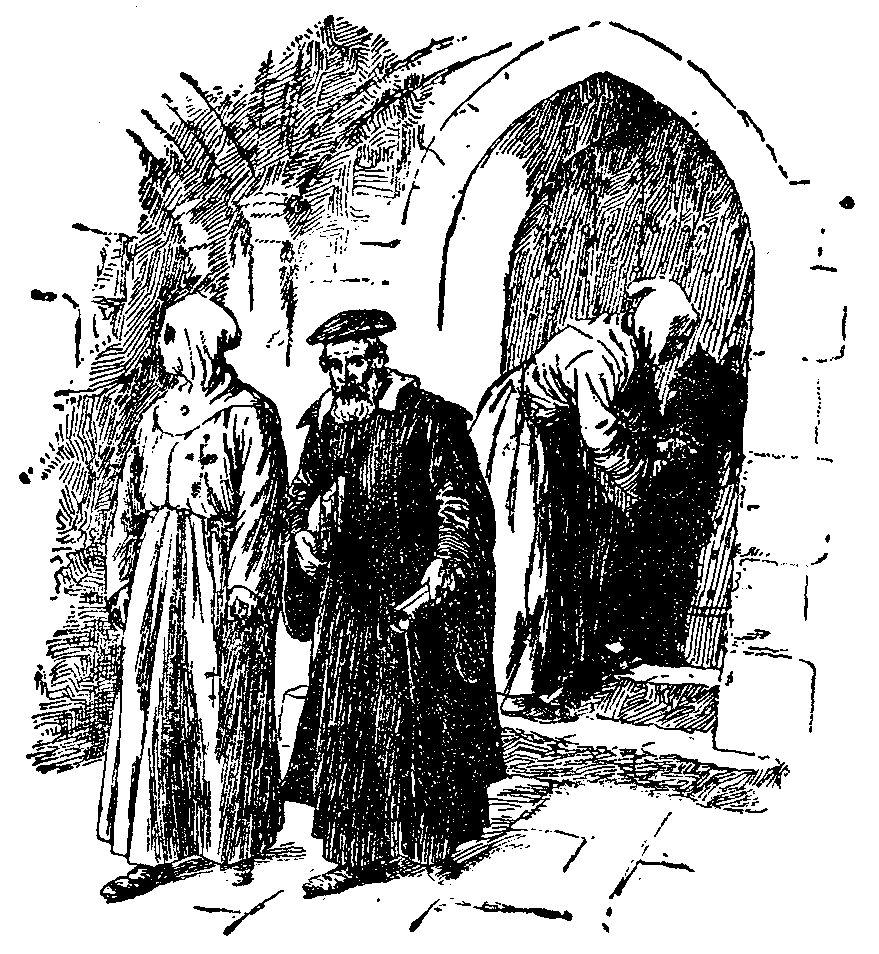 THE DOORS WERE CLOSED BEHIND HIM. |
From February to June he was kept in a state of suspense as to his ultimate fate, but early in the morning of June 21 Galileo was conducted to the court, and the doors closed behind him. Exactly what happened during his examination is not known, for no outsider was present, and Galileo himself was bound by the laws of secrecy which guarded the proceedings of the Inquisition. It is, however, certain that Galileo was not subjected to the rack. The ordeal comprised five stages, of which the threat of the torture (twice uttered) formed the first and second; the entry of the torture chamber and the showing of the instruments, the third; while the fourth and fifth stages were the preparation for and actual subjection to the rack. But the last stage was never reached. Galileo gave way and promised to recant, and he was removed to a cell while the court drew up his special form of perjury.
On the 22nd he was clothed in the dress of a penitent and taken to the Convent of Minerva, where the Inquisition was assembled to pass judgement. The sentence was that he should adjure and curse the heresies which he had cherished; that he should be imprisoned during the pleasure of the Inquisition; and that he should recite once a week the seven Penitential Psalms. The judgement having been read, Galileo "fell upon his knees before the assembled Cardinal; and laying his hands upon the Holy Evangelists, he invoked the Divine aid in abjuring and detesting, and vowing never again to teach the doctrine of the earth's motion, and of the sun's stability. He pledged himself that he would never more, either in words or in writing, propagate such heresies; and he swore that he would fulfil and observe the penances which had been inflicted upon him. At the conclusion of this ceremony, in which he recited his abjuration, word for word, and then signed it, he was conveyed, in conformity with his sentence, to the prison of the Inquisition."
Broken both in spirit and in health, he was allowed, after a short imprisonment in Rome, to go to Siena, where he was lodged in the palace of the Archbishop Piccolomini. The Archbishop was one of Galileo's best friends, and though confined to the grounds of the palace no other restrictions were imosed upon him. He was cheered and consoled by a letter from Maria, telling him how greatly she rejoiced at his escape and how, to relieve him of a part of his burden, she had recited the Penitential Psalms for him every week.
After spending six months beneath the roof of his friend Galileo obtained permission to return to his villa at Arcetri under similar restrictions. But amidst the rejoicings at his return a cruel blow fell upon him; his beloved daughter, "whose loving care had been his mainstay for years," fell ill, and in six days passed away. Galileo was overwhelmed with grief, and for long remained in a state of melancholy from which nothing could rouse him. Then, as he slowly recovered, he became desirous of changing his residence from Arcetri to Florence. But the permission he sought was sternly refused; he must remain at Arcetri; he was to see no friends; and if he persisted in his requests he would be subjected to more stringent measures. For five years longer, therefore, he continued a semi-prisoner in his villa, and sought by diligent application to his studies to overcome the tedium of his confinement.
In 1636 he completed his Dialogues on the two Sciences of Mechanics and Motion. In this, which is considered to be his greatest work, he recapitulates the results of his early experiments and later mediations on the principles of mechanics. The Dialogues were printed in Leyden in 1638, and "excited admiration equal to and more lasting than that accorded to his astronomical treatises". For astronomy he performed one more service—the discovery of the moon's libration (i.e., the periodical changes in the outlines of the moon's disc). Then his sight began to fail, and in a short time he became totally blind. This last calamity completed the sum of his misfortunes. "Alas!" he writes to one at this time, "your dear friend and servant has become totally and irreparably blind. These heavens, this universe, which by wonderful observation I had enlarged a thousand times beyond the belief of past ages, are henceforth shrunk into the narrow space which I myself occupy. So it pleases God; it shall, therefore, please me also." "The noblest eye," said Gastelli, "which nature ever made, is darkened." Still, he was not to be turned aside from his work, and being allowed an amanuensis, he with the help of his pupils, Torricelli, and Viviani, completed several important papers of observations, amongst them one on the adaptation of the pendulum to measurement of time. Visitors were also allowed him, and amongst those who journeyed to Arcetri to pay their respects to the blind astronomer during these last years was John Milton, then a young man of twenty-nine, travelling in Italy. Galileo often complained that his head was too busy for his body; and in truth the body was to succumb before the active mind. At the end of 1641, whilst still full of plans for future work, he was attacked by fever, and after lingering for two months he died on January 8, 1642, in his 78th year.
His telescopic discoveries, though they make the strongest appeal to our imagination, do not comprise the best of even the most brilliant part of his work. Galileo's fame rests mainly on the fact that he was the first to demonstrate the true laws of Motion, and thus to lay the foundation of a Science of Mechanics. "The problem of the heavens," says Miss Clerke, "is essentially a mechanical one; and without the mechanical conception of the dependence of motion upon force which Galileo familiarized to men's minds, that problem might have remained a sealed book even to the intelligence of Newton." The firstfruits of the new system of investigation was his determination of the laws of falling bodies.
The best eulogium of Galileo, it has been said, consists in the fallacies which he exposed. And the secret of his power in combating and destroying the erroneous opinions which prevailed in his day regarding natural philosophy, was his reliance upon mathematical science. To quote his own words: "Philosophy is written in the great book of the Universe which lies always open. But we must first understand the language and the character in which it is written. That language is mathematics. Its characters are triangles, circles, and other geometric figures, without which we cannot, humanly speaking, understand the words, and wander aimlessly through a dark labyrinth."
William Harvey
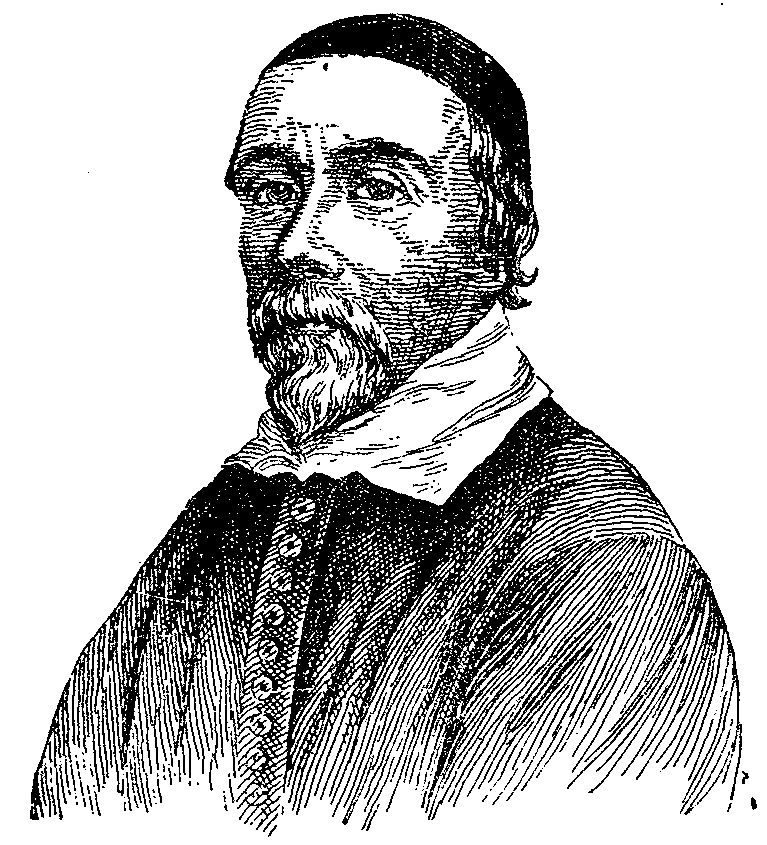 WILLIAM HARVEY. |
The Little anatomical theatre in the University of Padua, with its wainscoting of curiously carved oak, and its carved desks rising almost perpendicularly one above the other, was filled with students who were listening to the lecture then in progress. The faces of the students—some eager, some indifferent—were only dimly visible in the feeble light of the candles placed upon the table below; they were of every nationality, for Padua, three hundred years ago, was the most famous school of medicine in Europe, and young men flocked thither to attend the lecture of the great anatomist, Hieronymus Fabricius of Aquapendente. As the demonstration proceeded attention was concentrated upon the one bright spot in the dimly lighted room where the lecturer with unerring finger was tracing out the structures of the body stretched upon the table.
From among the shadows one pair of eyes was following the words and action of the anatomist with a keenness and intelligence that betokened the depth of interest taken by their owner in the subject. The student in question was of short stature, with a rounded face, and eyes of a blackness that matched in intensity of colour the raven locks clustering about his broad forehead. There was no mistaking the fire and spirit which burnt in those eyes. Fabricus himself (who had already observed with satisfaction the rapid progress of his clever pupil) may have caught the intelligent glance which shot from those black eyes when, in describing the structure of the blood-vessels, he pointed proudly to the valves in the veins as his own discovery and descanted upon their probably use. That his explanations failed to satisfy one at least of his hearers, he did not know then, any more than he could have guessed how this one fact would stimulate the young student in his determination to find out the true meaning of the various structures connected with the movements of the blood that were puzzling his brain at this moment.
William Harvey, as the student was named, was an Englishman and a native of Folkestone, in which town he was born on April 1, 1558. Of his father, Thomas Harvey, we know nothing beyond the fact that he was a Kentish yeoman of good standing and reputation in the town. The character of his mother, Joane Harvey, may be read in the epitaph in the old parish church of St. Nicholas, which records that she was: "A Godly harmles Woman: A chaste loveing Wife: A careful tederharted Mother." Joane Harvey died in 1605; her husband survived her eighteen years, dying in 1623. William was the eldest of seven sons.
Of William's early years nothing, unfortunately, has been recorded, and we are left to imagine him as a child rambling with his brothers on the shore, watching the fishermen unloading their boats or mending their nets at their cottage doors, as we may see them at the present day in the old fisher quarter of the town which abuts upon the harbour. At the age of ten he was sent to the grammar school at Canterbury, where he remained till he was fifteen. Then, having meanwhile "laid a proper foundation of classical learning", he went to Cambridge, and was admitted as a pensioner to Gonville and Caius College on may 31, 1593. He gained his B.A. degree in 1597, and having resolved to take up the study of medicine he left Cambridge and travelled through France and Germany to Padua.
At the end of five years Harvey received his degree as doctor of medicine, and the diploma expressed the warm satisfaction of the professors of Anatomy, Surgery, and Medicine at the manner in which he had prosecuted his studies and with the abilities he had displayed. He now returned to England, and having graduated M.D. at Cambridge, settled down to practise in London. In 1604 he became a member of the College of Physicians, and three years later was elected a fellow. Among his patients at this time, it is interesting to note, was Bacon—then recently appointed to the Solicitor-Generalship, and famous as the author of the Essays.
On February 25, 1609, Harvey applied to the governors of St. Bartholomew's Hospital in Smithfield for the reversion of the office of physician, bringing in support of his application a recommendation from the King and testimonials from the President and several of the senior doctors of the College of Physicians. Here is the extract relating to his appearance before the governors, taken from the journals of the hospital: —
"Curia cent Subti xxv die Februarii A° Dni 1608/9. In presence of Sr John Spencer, Knight, Psydent. . . .[and others].
"Mr Dr Harvey.
"This day Mr Willyam Harvey Doctor of Phisycke made sute for the re'con of the office of the Physicon of this howse when the same shalbe nexte voyd, and brought the Kinge's Ma his Ires [letters] directed to the Gov'nors of this howse in his behalfe, and showed forthe a Testimony of his sufficiency for the same place under the hande of Mr Doctr Adkynson presydent of the Colledge of ye phisytions and div'se others doctors of the auncientest of the said Colledge It is graunted at the contemplacon of his Ma l'res that the said Mr Harvey shall have the said office nexte after the decease or other dep'ture of Mr Doctor Wilkenson whoe nowe holdeth the same wth the y'ly ffee & dewtyes thereunto belonginge, Soe that he be not founde to be otherwise imployed, that may lett & hynder the chardge of the same office, which belongeth thereunto."
Dr. Wilkinson died in the summer, and Harvey, not being "otherwyse imployed" to the detriment of his discharge of the duties "toward the poore of this hospitall", was admitted to the office of physician on October 14, 1609, and the charge was read to him. In this he was solemnly enjoined to attend at the hospital "one day in the weeke at the leaste thorough the yeare, or oftner as neede shall requyer", to give to the poor "the beste of his knowledge in the profession of phisicke"; to prescribe only such medicines as should "doe the poore good, without any affeccon or respecte to be had to the apothecary"; to take "noe gifte or reward of any of the poore of the house for his counsell"; and to render account for any negligence on his part.
The hall in which Harvey received his patients was a spacious room (pulled down about 1728) with a huge fireplace, to the fire of which Henry III had granted a supply of wood from Windsor forest. Harvey sat at a table, and the patients brought to him sat upon a settle beside it, the apothecary, the steward, and the matron standing by. Those patients who could not walk he visited in the wards. For his services Harvey received a stipend of twenty-five pounds a year, but in 1626, in lieu of residence, this was increased to thirty-three pounds six shillings and eightpence.
In 1615 we reach a most important period of Harvey's life. In August of that year he was appointed Lecturer in Anatomy to the College of Physicians, and in the following April he delivered his first course of lectures at the college, in which he made the first public announcement of his views regarding the circulation of blood. Ever since the time when he had witnessed Fabricus's demonstrations on the valves in the veins he had set himself to discover the true meaning of these structures, and more especially the action of the heart in relation to the movements of the blood. He would not trust to books or to other men's eyes, but went direct to nature for his information. He dissected the human body, and the bodies of every species of animal which he thought might assist his purpose (and these were days when human subjects were very difficult to obtain); he performed endless experiments and wrote careful accounts of his observations—in the true spirit of scientific inquiry taking nothing for granted, but questioning and comparing each particular structure and every observable action in the living and the dead form, to find the true answer to this great problem. And now he was prepared to lay the results of his labours—the firstfruits of these years of study and experiment—before his pupils and any others who chose to attend his lectures, inviting all to test the truth of his conclusions by the witness of their own eyes.
For over ten years the lectures and demonstrations were continued, but nothing so far had been printed. At length, at the end of 1627, yielding to the entreaties of his most distinguished friends and colleagues, Harvey consented to publish his discovery to the world. In 1628 there issued from a printing-house at Frankfort-on-Main a slender book, of quarto size, containing seventy-two pages and two plates of diagrams, under the title of Exercilatio Anatomica de Motu Cordis et Sanguinis in Animalibus.
Harvey's discovery may be stated in a few words. He demonstrated that there was a continuous flow of blood through the entire body. The centre and origin of this movement was the heart, the muscular contraction of which impelled the blood into the arteries; thence it passed into the veins and was eventually returned to the heart. This was the "circulation" of the blood, in its complete sense. But the circulation was in reality of a double nature: one circle being traced from the right side of the heart through the lungs to the left side (the Pulmonary, or Lesser, Circulation, as it was called); the other going from the left side of the heart through the rest of the body to the right side (called the Systemic, or Greater, Circulation).
Several famous anatomists before Harvey had, it is true, come very near to forestalling him, in some points at least of his discovery. Servetus, more especially, and, after him, Columbus and Cæsalpinus, had had some glimmerings of the truth; but their conclusions were incomplete, or imperfect, and for the most part merely conjectural. It is quite certain that none of these observers had any clear idea of the Systemic Circulation, nor, what is far more important, "any conception of the muscular contraction of the heart as the mechanical force that impelled the blood." The views held with regard to the action of the heart as the organ principally concerned in the movement of the blood, were both erroneous and highly fantastic. A student of Harvey's university days would have been taught that the heart was the source of the heat of the body and the workshop for the manufacture of the vital spirits that were necessary for its support; that the arteries contained spirituous blood, or blood and air mixed together, or in some cases only air, while the veins were used for conveying nutriment; that the arteries expelled "fuliginous vapours" (impure gases) in their contraction, through the pores of the skin, and in their swelling absorbed air through the same medium; that the pulse and the respiration had the same end, viz. to "fan and refrigerate" the blood; and, finally, that the swelling of the heart (by which it attracted blood from the vessels) was caused by the effervescence of the spirits contained in it, while its collapse was due to the withdrawal of nutriment into the veins. As regards the movement of the blood, it was believed that such movement partook of the nature of the tides, the blood rising and falling in the vessels as it surged backwards and forwards between the heart and the extremities.
It would take too long to tell how Harvey in his book confutes these errors, one by one; how he demonstrates that the force which impels the blood is exerted by the heart in its contraction, the swelling of the heart representing the period of rest—thus exactly reversing the meaning attached to these movements by previous anatomists; how he shows that the arteries are the conveyors of the bright blood which has previously passed through the lungs, to every part of the body (Systemic Circulation), while the veins are employed in conveying the dark, impure blood back to the heart, to be passed thence to the lungs (Pulmonary Circulation); how the true use of the valves in the veins is to prevent the return of the venous blood into the general circulation; and, finally, how the septum dividing the heart into its two principal chambers, instead of being riddled with holes like a sieve to enable the blood to pass from one side to the other, as was believed, is complete and impervious, as required for the twofold nature of the circulation. His book should be read by all who desire to know more about a subject which, in its important bearing upon the scientific knowledge of the human body and its functions, and consequently upon the treatment of the body in sickness and disease, is to be reckoned amongst the most glorious achievements of mankind. "To medical practice," says Sir John Simon, "it stands much in the same relation as the discovery of the mariner's compass to navigaton; without it, the medical practitioner would be all adrift, and his efforts to benefit mankind would be made in ignorance and at random…. The discovery is incomparably the most important ever made in physiological science, bearing and destined to bear fruit for the benefit of all succeeding ages."
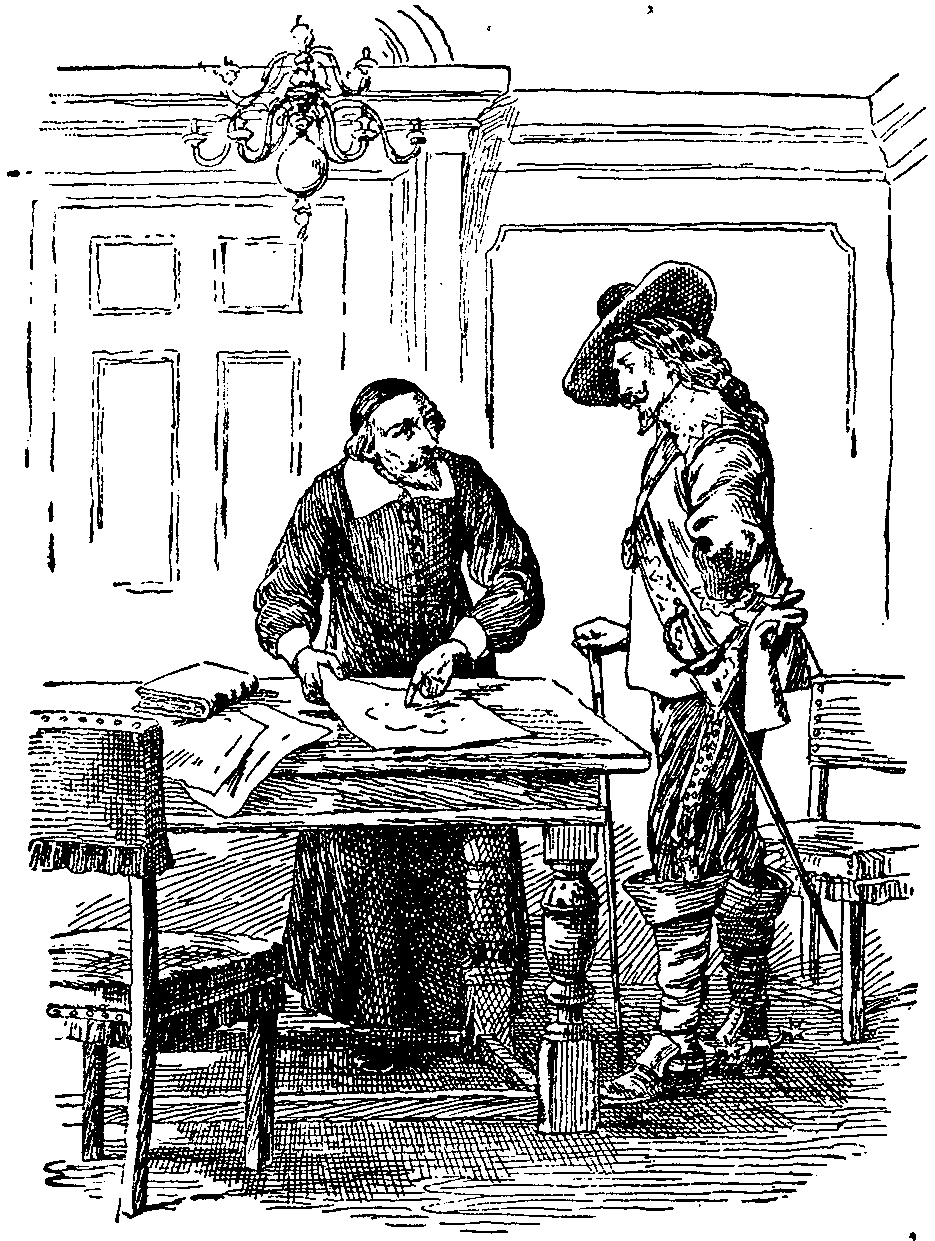 THE KING, CHARLES I, WAS BOTH PATRON AND FRIEND. |
To the medical world generally, Harvey's conclusions came as a complete surprise, and for some time they were regarded as the idle dreams of a fanciful innovator. Many members of his profession, while envying him his discovery, considered themselves far too respectable to be associated with such new-fangled theories. John Aubrey, the writer, who knew Harvey, says: "I have heard him say that after his booke of the Circulation of the Blood came out he fell mightily in his practice, and 'twas believed by the vulgar that he was crack-brained, and all the physitians were against him; with much adoe at last in about 20 or 30 years time it was received in all the universities in the world."
It is an interesting fact with respect to Harvey's discovery that in one essential point it was incomplete. Though he was convinced that the course of the blood was from the heart to the arteries and back to the heart by the veins, he was unable to demonstrate the actual passage of the blood from the arteries to the veins. As Dr. Robert Willis, the translator of Harvey's works, points out, Harvey did not see, and possessed no means of seeing, the transition, by continuity of their canals, from arteries to veins, and so he erroneously concludes that no such transition exists. His idea seems to have been that the arteries ended in the tissues which they supplied, and that the veins, arising in the same manner, drank up the blood, having done its office, that had been shed for the nutrition and vital endowment of the parts. A microscope of even moderate power would have revealed to Harvey the true mode of communication between the two kinds of vessels. The lung of the frog, or the web of its foot, the tail of the newt, or the bat's wing, would have shown him his discovery in actual operation—the blood coursing through the network of fine tubes called capillaries, which serve to connect the arteries with the veins. But Harvey had no such means at hand, and it was not until 1661—four years after Harvey's death—that the improvement of the microscope enabled the Italian anatomist, Malpighi, to observe the precise mode of the circulation in the lung of the frog.
The King, Charles I, was both patron and friend to Harvey, appointing him his body physician and showing a deep interest in his discovery. To assist Harvey in his researches the King supplied him with deer from Hampton Park. In 1630 Harvey was ordered to accompany the young Duke of Lennox on his travels on the Continent, and in a letter to Lord Dorchester of his time he requests that his place of physician at the Court shall be kept vacant during his absence, and describes how the countries he passed through were so wretched "that by the way we could scarcely see a dogg, crow, kite, raven, or any bird or anything to anatomise, only sum few miserable people, the reliques of the war and the plague, where famine had made anatomies before I came."
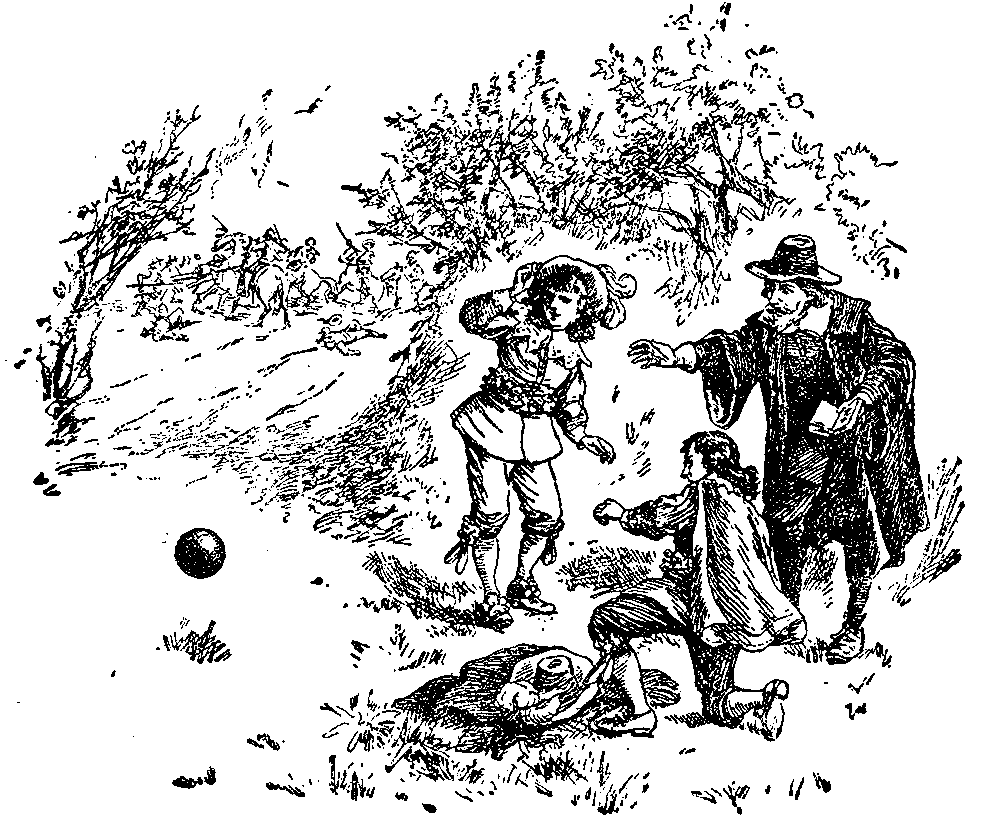 A BULLET OF A GREAT GUN GRAZED ON THE GROUND. |
In May, 1633, Harvey accompanied the King on a visit to Scotland, and seized the opportunity of visiting the Bass Rock in the Firth of Forth. His description of the gannets inhabiting the famous rock has been preserved, and shows how closely he observed nature out of doors. About this time the governors of St. Bartholomew's Hospital appointed an assistant physician in order to give Harvey more liberty, but they continued to pay Harvey his salary as before, out of regard for his merit and the services he had rendered to the hospital.
When the Civil War broke out, Harvey retained his position as physician to the King, not only with the consent, but by the desire of the Parliament. He attended the King when the royal family left London, and while the forces of Charles were assembling he visited his friend Percival Willughby at Derby, and discussed the treatment of diseases. He was also present at the battle of Edgehill, and Aubry says had charge of the Prince of Wales and the Duke of York during the fight. "He told me that he withdrew with them under a hedge, and tooke out of his pocket a booke and read. But he had not read very long before a bullet of a great gun grazed on the ground near him, which made him remove his station."
During the King's residence at Oxford Harvey remained in attendance, pursuing his studies, and seizing every opportunity that offered itself for making dissections. His great lament at this time was that his lodgings at Whitehall had been plundered at the outbreak of the war, and that his observations upon the structure and generation of numerous animals and insects which he had dissected had disappeared. It is related that whilst at Oxford he used to visit a medical friend at Trinity College who kept a hen to hatch eggs in his chambers, and that the eggs were daily opened to watch the progress and way of generation. In this way he was collecting materials for his second book, though he had then no intention of publishing his observations. In 1645 he was made by royal mandate warden of Merton College, but he only held the post for a year; for in 1646, on the surrender of Oxford, he gave up the wardenship and returned to London. As he was now nearly seventy, he retired from his position of physician to the King (he had resigned his connection with St. Bartholomew's Hospital in 1643), and went to live with his brothers, who were wealthy merchants in the City. For the sake of pure air and a pleasant prospect he established a summer residence at Coombe, in Surrey, where he spent much of his time in retirement. It is said that, "to indulge a whim he had of delighting in being in the dark, he caused caves to be made in the earth, in which, in summer time, he was pleased to meditate."
At Coombe he was visited by his friend Dr. George Ent, in 1651, by whom he was persuaded to allow the manuscript of his treatise on The Generation of Animals to be published. In this book, which comprises seventy exercises, Harvey discusses the origin and development of animal life, basing his conclusions on the example of the hen's egg. Its chief interest, however, lies in the fact that it enunciates the great generalization omne vivum ex ovo (all life proceeds from the egg) — a generalization which has since been abundantly verified. In another respect the book is remarkable as an instance of prophetic vision, though this latter point is hardly to be expressed in simple language. It is this: that Harvey here brings forward the doctrine that the new organism is formed from the uniform substance of the germ, not by a sudden transformation of the substance into a miniature of the whole organism (as was then believed), but by the successive separation of the parts. In other words, that all parts are not formed at once and together, but in succession one after the other. This, in brief, was the result of his observation, but the microscope was needed to confirm and make clear much of what Harvey only saw imperfectly. It is with reference to passages in the book dealing with this subject that Professor Huxley wrote: "In these words, by the divination of genius, Harvey in the seventeenth century summarized the outcome of the work of all those who, with appliances he could not dream of, are continuing his labours in the nineteenth century."
The remaining years of this useful and active life show Harvey in the light of a munificent patron of the science and the profession he had served so ably and so long. In 1651 he offered to the College of Physicians, through its President, Dr. Prujean, to find the means for building a Library and Convocation Hall. The offer was gratefully accepted, and on the fact of Harvey being the donor becoming known the College voted the erection of his statue. On February 2, 1654, the buildings were complete, and Harvey formally handed them over to the College, together with the books, surgical instruments, and anatomical preparations with which he had furnished them. In September of the same year Dr. Prujean resigned the presidency, and Harvey was elected to succeed him; but while sensible of the honour thus conferred upon him by his colleagues, he felt compelled to decline it on account of his age and infirmities. For two years, however, he continued to serve on the council, and then resigning the anatomical lectureship he gave his paternal estate at Burwash, in Sussex, to the College and took leave of the Fellows. In making the donation Harvey stipulated that a certain sum should be employed each year in the delivery of an Oration in commemoration of the benefactors of the College, and of those who had contributed to the knowledge of medicine during the year. This provision has been faithfully carried out ever since, and under the title of the Harveian Oration the memory of Harvey and the inestimable services he rendered to science have been preserved.
Harvey had had many attacks of gout, and he used to check it by putting his feet into a pail of cold water, "till he was almost dead with cold, and betake himself to his stove, and so 'twas gone," as Aubrey relates. In old age the attacks became more frequent, and he died on June 3, 1657. His body was followed by the Fellows of the College of Physicians far beyond the limits of the city on its way to Hempstead, in Essex, where it was deposited, "lapt in lead," in a vault belonging to his brother Eliab. On his breast (there being no coffin) was inscribed the words: "Docter William Harvey. Decesed the 3 of June 1657. Aged 79 years." On St. Luke's Day, October 18, 1883, the remains were translated, in the presence of the President (Sir William Jenner) and several Fellows of the College, to a white marble sarcophagus provided by the College in the Harvey Chapel erected in Hempstead Church.
Sir Isaac Newton
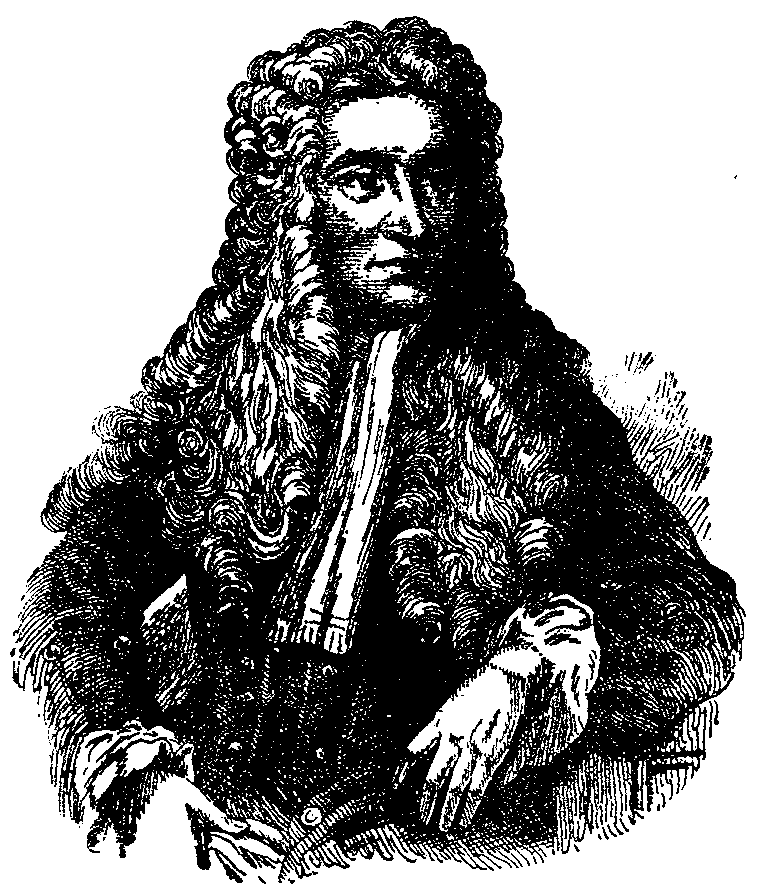 SIR ISAAC NEWTON. |
On a certain Christmas morning, two hundred and seventy-five years ago (the date was 1642, just eleven months after the death of Galileo), when the bells of Colsterworth were ringing, and the folk were wending their way to church, a fatherless child was born in the old manor-house of Woolsthorpe, about 8 miles south of Grantham in Licolnshire. The child was a boy of so diminutive a size and so feeble a frame that his life was despaired of from the first, and two women who were sent to the house of a neighbour at North Witham to procure some strengthening medicine for the infant, did not expect to find him alive on their return. "Providence, however, had otherwise decreed; and that frail tenement, which seemed scarcely able to imprison its immortal mind, was destined to enjoy a vigorous maturity, and to survive even the average term of human existence."
The child was named Isaac after his father, Isaac Newton, who had died shortly after his marriage to Hannah Ayscough. The father's station was that of a yeoman, who owned and farmed the small estate of Woolsthorpe, which had been in the possession of his family for about a hundred years. The manor, we are told, was worth only £30 a year, but Mrs. Newton owned another property at Sewstern, in the neighbouring county of Leicestershire, which brought her income up to about £80, and with these slender means, aided by the cultivation of the little farm on which she resided, she supported herself and her child. Some two years after Isaac's birth the widow married the Rev. Barnabas Smith, the rector of North Witham, to whom she had been recommended as "an extraordinary good woman", and when she went to reside at the Rectory little Isaac was left at Woolsthorpe in the charge of his grandmother, Mrs. Ayscough.
Of Isaac's childhood nothing is known beyond the fact that he attended two village schools at Skillington and Stoke. At the age of twelve he was sent to the grammar school at Grantham, kept by a Mr. Stokes, and was boarded with Mr. Clark, an apothecary in the town. He seems to have been a very indifferent scholar at first, and consequently was placed very low in the school. One day a boy above him administered a kick which aroused Isaac's temper, and in the fight which followed Isaac came off victorious. This proved to be the stimulus necessary to awaken his dormant faculties; Isaac was determined to get above his antagonist. By sticking to his books he at length accomplished this feat, and thenceforth continued to rise until he became head of the school. The fight had made him popular, and his popularity was increased by his cleverness in constructing mechanical toys. Amongst other things he made a working model of a windmill which had been erected near the town; this he fixed on the roof of his lodging so that it could be turned by the wind. Another of his contrivances was a water-clock, the hands of which were moved by a piece of wood which either fell or rose by the action of dropping water. The clock stood in his bedroom, and he supplied it every morning with sufficient water to keep it going for the day; it was used as a clock by the Clark family, and remained in the house long after its inventor had quitted Grantham. He also made kites on scientific principles for his schoolfellows, and paper lanterns to light his way to school on winter mornings. On a dark night he would tie on fo these lanterns on to the tail of his kite so as to make the country people believe they had seen a comet. He seems also to have had some talent for drawing, for Mr. Clark told Dr. Stukely when the latter visited Grantham that the walls of Newton's bedroom were covered with charcoal sketches of birds, beasts, men, ships, and mathematical figures, all of which were very well designed. These were all framed by his own hands.
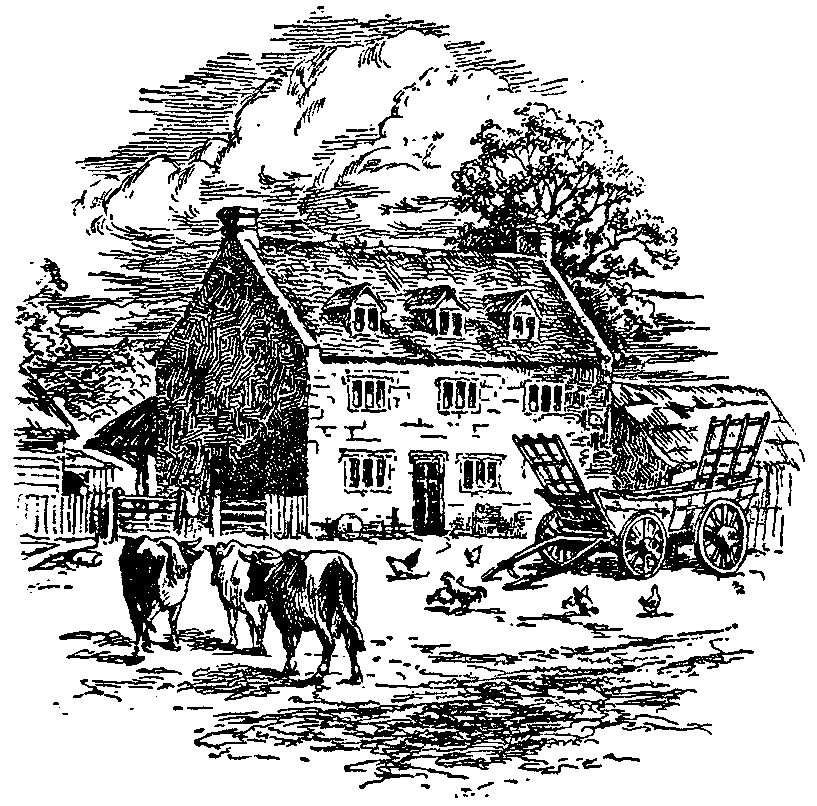 THE BIRTHPLACE OF NEWTON. |
Upon the death of the Rev. Barnabas Smith in 1656 the widow returned to Woolsthorpe with her three children, Mary, Benjamin, and Hannah Smith, and Newton was called home to help his mother on the farm. As may be imagined, the student, who was now as forward with his studies as at first he had been behindhand, was not very willing to exchange his books for the plough. Isaac obeyed his mother's wishes, however, and undertook his duties cheerfully; but on Saturday mornings, as this was market-day at Grantham, he was sent in the company of an old servant to the town to sell grain and purchase necessaries for the house. Newton, however, left the old woman to do the marketing, and betook himself to his garret at the apothecary's, where he spent the time reading books borrowed from Mr. Clark's parlour. After a while he took to deserting his companion at an earlier stage of the journey, and ensconcing himself in a hedge beguiled the time with a book till the servant returned from Grantham. "The perusal of a book, the execution of a model, or the superintendence of a water-wheel of his own construction, whirling the glittering spray from some neighbouring stream, absorbed all his thought; whilst the sheep were going astray, and the cattle were devouring or treading down the corn."
His thoughts, too, were now turned to the movements of the celestial bodies. Remembering the imperfections of his water-clock, he sought to obtain a more accurate measurement of time by observations of the sun. He traced the sun's passage upon the walls of the house and garden, and having marked the hourly and half-hourly subdivisions by means of fixed pins, he constructed two sun-dials. One of these, known as "Isaac's dial", was constantly referred to by the neighbours to learn the hour of the day, and was in existence at Woolsthorpe long after Newton's death.
Isaac's presence at the farm seemed to promise small benefit either to his mother or himself, and at length his uncle, Mr. William Ayscough, the Rector of Burton Coggles, wisely went to the mother and urged her not to thwart the young man in his pursuits, but to send him back to Grantham to complete his studies with a view to going to Cambridge. The widow decided to accept this good advice, and as Mr. Ayscough was himself a Trinity man Isaac entered that college in the ensuing term.
He became a scholar in 1664, and took his B.A. degree in the following year. In 1667 he was made a Junior Fellow of his college. He proceeded m.A. in 1668, and in the same year was appointed to a Senior Fellowship. In 1669, at the age of twenty-seven, he was appointed to the Lucasion Chair of Mathematics on the resignation of his friend and tutor, Dr. Barrow.
Dr. Barrow's lectures were, in fact, the means of drawing Newton's attention to the subject of light, in which he was destined to make some of his most brilliant discoveries. We learn of his going to Stourbridge fair to buy a prism for the purpose of testing Descarte's theory of colours; and his account-book for 1664, containing the entry relating to the purchase, has been preserved. His experiments, however, according to his own account, appear to have been begun in 1666. Thus he says: "In the beginning of the year 1666 I procured me a triangular glass prism to try therewith the celebrated phenomena of colours"; and he adds: "Amidst these thoughts I was forced from Cambridge by the intervening plague, and it was more than two years before I proceeded further."
During this enforced absence from Cambridge, Newton's thoughts were first turned to the subject of universal gravitation. "As he sat alone in a garden" (says Henry Pemberton, his intimate friend of later years), "he fell into a speculation on the power of gravity; that as this power is not found sensibly diminished at the remotest distance from the centre of the earth to which we can rise… it appeared to him reasonable to conclude that this power must extend much further than is usually thought. Why not as high as the moon? Said he to himself, and, if so, her motion must be influenced by it; perhaps she is retained in her orbit thereby."
We owe the story that this train of thought was started by the fall of an apple from the tree to Voltaire, who received it from Newton's step-niece, Mrs. Conduitt. There is, fortunately, no reason to doubt its truth. For many years tradition pointed out the tree in the garden at Woolsthorpe, and it was shown to Sir David Brewster when he visited the spot in 1814. In 1820 the tree was cut down, but a portion of the wood was preserved.
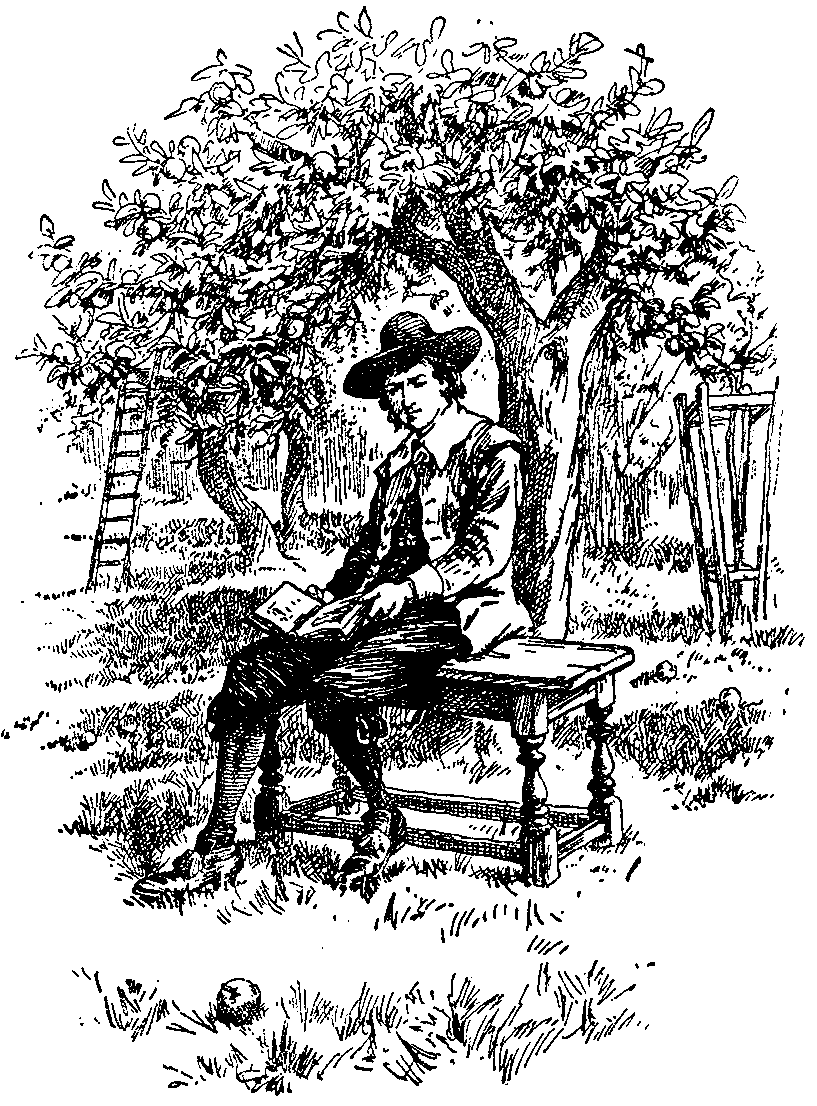 WHY AN APPLE FALLS. |
It would be unjust, as well as mistaken, to ignore the fact of Newton's indebtedness to those who had patiently wrestled with the great problems of the heavens and established the laws by which they were governed upon a scientific footing. It is sometimes stated that Newton "discovered" the force of gravitation; whereas in reality he did nothing of the sort. Gravitation—i.e. the attractive force exercised by the earth upon objects resting upon its surface—was a commonly accepted theory long before Newton's time. What Newton did was to demonstrate by the aid of mathematical science the existence of a universal law of gravity extending throughout the whole of space—to show that the force which acted at the surface of our globe did not belong exclusively to the earth, but extended to and was shared by every one of the celestial bodies, however distant from the earth; and that these bodies acted and reacted upon one another in a degree of intensity regulated by their relative sizes and the distances which separated them.
Having made his calculations with regard to the supposed influence of the earth's attraction upon the moon and compared these with the observed motions of that planet, however, Newton found that the two things were not, as he had hoped, in exact agreement. "I found them," to use his own words, "answer pretty nearly"; but this was not enough for his purpose. There was a discrepancy, for which he could not account at the time, between his theory and the known facts regarding the moon's motions; and so he quietly laid his proofs aside; the fact was that Newton, in order to make his calculation, had been compelled to rely upon the estimate then in use among geographers, which was based on the supposition that a degree of latitude contained 60 miles. But, as Pemberton says: "As this is a very faulty supposition, each degree containing about 69 1/2 of our miles, his computation did not answer expectation, whence he concluded that some other cause must at least join with the power of gravity on the moon." As this cause was unknown to him he abandoned his investigations till in 1671 a fresh series of measurements by a French observer named Picard was published at Paris, giving 69 1/10 miles to the degree; and this discovery was announced at a meeting of the Royal Society early in 1672. Newton was then a Fellow of the Society, and "when he repeated his work with Picard's numbers some years later, he found an exact agreement between the theory and the fact".
"Every body in the universe attracts every other body with a force which varies inversely as the square of the distance." The establishment of this profound and universal law we owe to the genius of Newton, but for five years the world remained in ignorance of his achievements; in the month of August, 1684, a visit paid to Newton at Cambridge, by Halley, the astronomer, elicited the fact that Newton had solved the great problem of the elliptical path of the planets some years before, but that he was unwilling to make it public. Halley's own account of the matter is given in a letter to Newton, dated June 29, 1686; the object in writing the letter being to clear up a dispute regarding the claim of Robert Hooke to have been the first to solve the problem in question. In this letter Halley says:
"And this I know to be true, that in January, 1684, I, Having from the consideration of the sesquialterate proportion of Kepler concluded that the centripetal force decreased in the proportion of the squares of the distances reciprocally, came on Wednesday to town, where I met with Sir Christopher Wren and Mr. Hooke, and falling in discourse about it, Mr. Hooke affirmed that upon that principle all the laws of the celestial motion were to be demonstrated, and that he himself had done it. I declared the ill-success of my own attempts, and Sir Christopher, to encourage the inquiry, said he would give Mr. Hooke or me two months' time to bring him a convincing demonstration thereof, and, besides the honour, he of us that did it should have from him a present of a book of forty shillings. Mr. Hooke then said he had it, but would conceal it for some time, that others, trying and failing, might known how to value it when he should make it public. However, I remember that Sir Christopher was little satisfied that he could do it; and though Mr. Hooke then promised to show it him, I do not find that in that particular he has been as good as his word. The August following, when I did myself the honour to visit you, I then learned the good news that you had brought this demonstration to perfection; and you were pleased to promise me a copy thereof, which the November following I received with a great deal of satisfaction from Mr. Paget [mathematical master at Christ's Hospital]."
On April 28, 1686, the MS. of the first book of the Principia was presented to the Royal Society. Dr. Birch, in his History of the Society already quoted, says: "Dr. Vincent presented to the Society a manuscript treatise entitled Philosophiae Naturalis Principia Mathematica, and dedicated to the society by Mr. Isaac Newton, wherein he gives a mathematical demonstration of the Copernican hypothesis, and makes out all the phenomena of the celestial motions by the only supposition of a gravitation to the centre of the sun decreasing as the squares of the distance reciprocally. . . ."
The Principia was published in 1687, about mid-summer (it is undated). The MS. is preserved in the Royal Society's library, but it is not in Newton's handwriting. "It consists", says Brewster, "of three books. The first and second, which occupy three-fourths of the work, are entitled On the Motion of Bodies—the first treating of their motions in free space, and the second of their motions in a resisting medium; whilst the third bears the title, On the System of the World. The first two books contain the mathematical Principles of Philosophy, namely, the laws and conditions of motions and forces. . . . The object of the third book is to deduce from these principles the constitution of the system of the world; and this book has been drawn up in as popular a style as possible, in order that it may be generally read."
We are told that "the conclusions of the Principia excited almost as much interest, however, among philosophers and literary men as among mathematicians." W. W. Ball's Essay on Newton's Principia. For instance, the Earl of Halifax appealed to Newton to know whether there was any way of mastering the subject except by the aid of mathematics. Newton replied that it was impossible. Thereupon the nobleman set himself to learn mathematics from Machin, to whom he gave fifty guineas as an encouragement; but he found the task too hard, and abandoned it in despair. Though there were numerous readers, there were at first but few converts to the new order of things. By many of the philosophers on the Continent (where Descartes's system still reigned supreme) Newton's discoveries and conclusions were resisted with all the strength which long-standing error and deep-rooted prejudice could bring to bear against them; and it was not until long after Newton himself had passed away that the truths expounded in his Principia were accepted by the scientific world of Europe.
Newton's position in the eyes of his countrymen was always deservedly high, though he remained for long in comparatively poor circumstances. How poor at the time when he was proposed as a Fellow of the Royal Society, and when he was engaged upon his immortal work, may be guessed from the fact that he was excused the weekly payment of one shilling to the society; he had also expressed a wish to resign, alleging as the cause the distance between Cambridge and London.
In 1699 Newton was appointed Master of the Mint, performing his incongruous duties with scrupulous care and efficiency. A distinction he valued more highly was his election to the Presidentship of the Royal Society in 1703. He represented his University in Parliament from 1688 to 1705, and in 1705 he was knighted by Queen Anne.
There are numerous facts and stories concerning Newton, his traits, habits, and personal appearance, and one description, coming from an authentic source, holds us like a charm. Mr. Conduitt (who married Newton's niece) said of Newton that he "had a very lively and piercing eye, a comely and gracious aspect, with a fine head of hair as white as silver". In size he was not above the middle height; and he was usually untidy and slovenly in his dress. Humphrey Newton says: "I never knew him to take any recreation or pastime, either in riding out to take the air, walking, bowling, or any other exercise whatever; thinking all hours lost that were not spent in his studies, to which he kept so close that he seldom left his chamber, except at term time, when he read in the schools. . . . He very rarely went to dine at the hall, except on some public days; and then if he has not been minded, would go very carelessly with shoes down at heel, stockings untied, surplice on, and his hair scarcely combed." Dr. Stukely, who knew him intimately, also relates that "when he had friends to entertain, if he went into his study to fetch a bottle of wine, there was danger of his forgetting them". The same writer tells that on one occasion when Newton was going home to Colstersworth from Grantham, "he led his horse up Spittlegate Hill, at the town end; when he designed to remount, his horse had slipped the bridle and gone away without his perceiving it, and he had only the bridle in his hand all the while." He had constantly to be reminded of the fact that he had not dined, and he ate and drank very sparingly at all times. Once when Dr. Stukely called upon him at his college rooms, he found the table laid for dinner, but Newton himself was absent. After waiting for some time, Dr. Stukely, who was aware of Newton's absent-mindedness in regard to meals, resolved to play off a joke upon him. Lifting the cover, he found a roasted chicken, which he devoured, and then replaced the bones on the dish beneath the cover. Presently Newton appeared, and having apologized for his delay, went to the table and lifting the cover disclosed the remnants of the chicken. For a moment he seemed surprised, then he said, "Ah, I thought I had not dined; but I see I have."
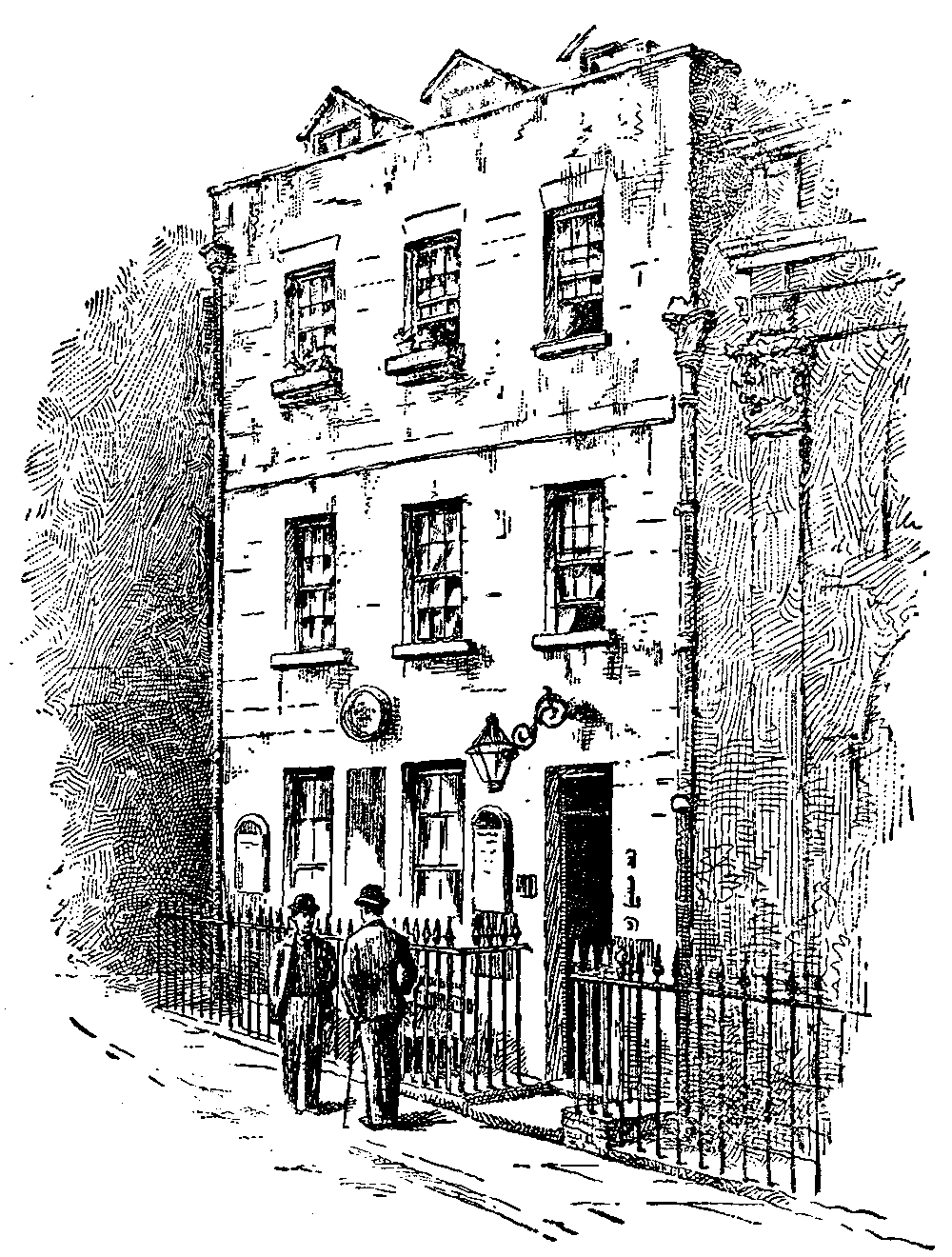 NEWTON'S LONDON HOUSE, PULLED DOWN IN 1914. |
In London, Newton lived first in Jermyn Street, Piccadilly; then for a short time in Chelsea; afterwards in Haydon Square, Minories, in a house pulled down in 1852. From 1710 until 1727 he occupied a large plain-build brick house (to which he added a small observatory) next Orange Street Chapel, in St. Martin's Street, Leicester Square. A Society of Arts tablet has been placed upon the front of this house. Article "Newton" in Dictionary of National Biography. For the most part his years were spent at Cambridge, his rooms at Trinity being on the first floor to the right of the staircase leading from Neville's Court. The college authorities built a small observatory for his use on the roof of the Gate Tower. It was in these rooms that the "distressing accident which some believe to have shaken his great mind for a time" occurred in 1692. The story as commonly received runs as follow: "One winter morning having shut his pet dog Diamond in his study, Newton came back from early chapel to find all his manuscripts upon the theory of colours, notes upon the experiments of twenty busy years, reduced to a heap of tinder. The dog had knocked down a lighted candle, and set the papers in a blaze. 'Ah! Diamond, Diamond, little do you know the mischief you have done,' was the only rebuke the dog received, though, as a Cambridge student writing in his diary at that very time tells us, 'Every one thought Newton would have run mad; he was so troubled thereat that he was not himself for a month after.'"
Newton died at Kensington on March 20, 1727, in the 85th year of his age. He was buried in Westminster Abbey on March 28; the grave is immediately below the monument, and on the stone are the words: "Hic depositum est quod mortale fuit Isaaci Newtoni" ("Here lies what was mortal of Isaac Newton").
In the Chapel of Trinity College is Roubillac's wonderfully fine statue of Newton, given to the college in 1755 by the then Master, Dr. Robert Smith; and in 'The Prelude' we read how, from his bed, Wordsworth loved to gaze on moonlight nights at the windows of the Chapel—
|
". . . . .where the statue stood Of Newton, with his prism and silent face, The marble index of a mind for ever Voyaging through strange seas of Thought, alone." |
Pope's famous epitaph (which is engraved on a tablet in the room at Woolsthorpe in which Newton was born) echoes the wide appreciation in which Newton's genius was held:—
|
"Nature and Nature's laws lay hid in night: God said, 'Let Newton be!' and all was light." |
Newton's own estimate of himself was uttered shortly before his own death: "I do not know what I may appear to the world, but to myself I seem to have been only like a boy playing on the sea shore, and diverting myself in now and then finding a smoother pebble or a prettier shell than ordinary, whilst the great ocean of truth lay still undiscovered before me."
Linnaeus
 LINNAEUS IN LAPLAND DRESS. |
Early in the morning of the 23rd of May in the year 1707 the worthy pastor of Rashult, in Smaland, Sweden, paced up and down his garden with a beaming face. His favourite flowers seemed to return his greeting as though they knew his secret and shared his pleasure. The bees in the hives which he so carefully tended were already astir, and their humming sounded a note of welcome. The surface of the lake which stretched from the foot of the slope was glinting in the morning sunshine, while from the wooded hills on either side a soft and balmy air laden with the scent of larch and pine blew gently upon his face. Overhead a lark was carolling joyously as she mounted to the sky. All nature had awakened to a new day, and the pastor's heart warmed with joy and thankfulness as he retraced his steps to the little wooden cottage which formed his home. Crossing the threshold softly that he might not disturb the slumbers of the new-born infant and its mother, he entered the parlour, and opening the Bible which lay on the table, inscribed on the fly-leaf the name and date of birth of his first-born child: "Carl Linnaeus. Born between 12 and 1 in the night dividing the 22nd and 23rd May, 1707."
Nils Linnaeus, who had at first acted as curate to the pastor of Rashult village, had married his employer's daughter, Christina Broderson, and on the death of the pastor he had succeeded to the living. He was a simple, Godfearing man, with a passion for flowers; he eked out his scanty means by cultivating his garden and his bees, and a year after the birth of Carl Nils obtained the rectorship of Stenbrohult, the neighbouring parish, whither he removed with his family.
Nils and his wife Christina, we are told, "received their first-born with joy, and devoted the greatest attention to impressing on his mind the love of virtue, both in precept and example." "Flowers," says Stoever, "were the first things they gave the smiling babe, and it seemed to take a natural delight in the variety of their colours." One of Carl's earliest recollections was of an excursion to Moklen with his father, when he was barely four years old. A rural fête was held, and "in the evening, it being a very pleasant season of the year, the guests seated themselves on the turf and listened to the good pastor, who talked to them about the names and properties of the plants which grew around them, showing them roots of Succisa, Tormentilla, Orchis, etc." Carl listened with eagerness, and from that time, he says, he never ceased harassing his father with questions about the name, qualities, and nature of every plant he met with. Very often he asked more than his father could answer, and as he quickly forgot all he was told, and especially the names of the plants, it became necessary to put some check upon his pertinacity. To cure him his father refused to answer his questions unless he promised to remember what was told him. From this moment he ever afterwards retained with ease whatever he heard; and besides this retentiveness of memory we are told that he possessed an astonishing quickness of sight.
Carl almost lived in his father's garden, which formed his first playground. At eight years old he was given a separate plot to himself, and "Carl's garden" soon became crowded with all sorts of wild plants which he had collected during his rambles in the fields and woods. The stranger weeds throve amazingly, to the boy's delight; they also invaded the pastor's trim beds, and threatened to overrun the whole garden, to the good man's dismay, who found it "a painful job" to eradicate the intruders. Nor were Carl's innovations restricted to weeds; he brought wild bees home in his cap and introduced them to his father's hives, with the result that the newcomers "by their hostile demeanour began to desolate the paternal hives". Nevertheless, the pastor regarded these signs of a love of nature with complacency, for they were after his own heart; and as the boy grew older his chief delight was to assist his father in the work of the garden.
But Nils and his wife had already planned Carl's future. He was to be trained for the pulpit; and after receiving some tuition from his father's relative, John Tiliander, a morose and passionate man, he was sent in 1717 to the Latin school in the adjacent town of Wexio. But he made no figure whatever at school studies; his passion was all for plants, and whenever he could break away from school he was scouring the woods and fields, so that, as his biographer says, "on holidays no pupil was so little found at home as Linnaeus." As he made no progress in anything else he was removed in 1719 and placed under the care of another tutor, Gabriel Hok, a man of mild disposition and some capacity for teaching, who afterwards became related to Linnaeus by marriage. He married the sister of Linnaeus. But not even Hok's gentle persuasion could avail to overcome the boy's distaste for school studies. In 1722 Linnaeus entered the higher form of Wexio School, known as the "circle", the chief result of which was to give him more liberty for pursuing his bent. Two years later, on attaining qualifying age, he entered the superior college, or "gymnasium"; but here, once more, though he studied mathematics and physics, his progress was extremely slow. Only in natural history was he quite at home. He formed a little library of botanical books, which he studied day and night (this was his first taste of the literature of his favourite science), and among the masters and scholars he was known as "the little botanist".
In 1726 his father came to Wexio, hoping to hear flattering accounts of Carl's progress; but his hopes were dashed by the report. The boy's conduct left nothing to be desired, but for the rest Nils was assured that it was throwing money away to continue him at school. Manual employment of some kind would suit him far better, and apprenticeship to "a taylor or a shoemaker" was suggested. The father's grief at the failure of his plans was great; for Carl had now been at school twelve years, and the expense had been a sever strain upon the good man's slender income. Linnaeus, struck with remorse, promised to obey his father's wishes in regard to studying divinity; but at the same time he honestly avowed his disinclination for the calling of a priest. Nils was unwilling to enforce compliance, and reluctantly came to the conclusion that the college authorities were right, and that the only thing to be done was to apprentice Carl to a trade. Without money a scientific career was hopeless, and Nils had neither money nor interest. It was with much dejection that the good pastor prepared to carry home to Christina the ill news that her darling ambition for Carl, to see him one day wearing the cassock, must be dismissed as an idle dream, and that they must be content instead if he could earn a livelihood by stitching clothes or working at a cobbler's bench. As for Carl himself, he was probably undismayed by this outlook—all he wanted was leisure to pursue his botanical studies; and if he had to choose between preaching and mending boots he would prefer the latter calling as interfering less with his freedom of action.
At this critical juncture a "friend in need" was found in John Rothmann, a well-known physician of Wexio, and lecturer on physics at the college. He begged Nils not to be hasty in judging his son's capacities, and offered to provide the means for testing the promise which Carl had shown for science by taking him into his own house and instructing him in medicine during the year that he had to remain at the college.
So generous an offer could not be refused, and the pastor, having expressed his gratitude to Dr. Rothmann, and taken an affectionate farewell of Carl, bent his steps homeward. To Christina he pointed out that after all the boy might prove a credit to the family, though not in the direction they had wished; and Christina, stifling her own disappointment, had the wisdom to join with her husband in hoping for the best.
Linnaeus was rejoiced to find himself free, and he made good use of his freedom by ransacking his patron's library and devouring the botanical works which it contained. Rothmann was not long in discovering the genius of his pupil, and he gave him every encouragement and assistance. Among other books Linnaeus studied the French botanist Tournefort's Elements of Botany (1700), with the result that he was "never easy until he could refer every plant he collected to its proper place in Tournefort's system". But he found many puzzles which, owing to insufficient examination, could not be reduced to that system.
In 1727, after spending three years at the Gymnasium, Linnaeus was sent to finish his education at the University of Lund, where Professor Humaerus, a relative of the family, had undertaken his support.
He was house with Dr. Kilian Stobaeus, professor of medicine and botany, and one of the king's physicians, who showed much interest in his welfare. This kindness the young student repaid by zealously attending the professor's lectures and making a diligent use of the opportunity afforded him of studying the specimens in Stobaeus's museum. By these means he speedily won the affectionate regard of Stobaeus, who gladly availed himself of such services as Linnaeus could render in adding to his collections.
Linnaeus was now incited to begin a collection of dried plants—his "hortus siccus", as he calls it in his Diary—by glueing plants to paper. Upon this delightful occupation he expended much time and care, making frequent excursions into the country to procure his specimens; one day in the early summer of 1728, however, Linnaeus, whilst searching for plants in the woods, was bitten in the arm by a venomous snake. The poison spread, and for some time Linnaeus's life was in danger. When he had sufficiently recovered he was sent home to Stenbrohult, where he spent the ensuing vacation. Here he met his friend and patron, Dr. Rothmann, who advised him, instead of returning to Lund, to go to Upsala, as that university offered exceptional advantages for a student of science. At Upsala, the most ancient seat of learning in Sweden, there were to be found, in addition to the two celebrated professors, Olaf Rudbeck the younger and Roberg, a rich public library and an extensive botanical garden—the last-named in itself a feature of special attraction to Linnaeus. It is, therefore, not surprising that he should have been eager to follow his friend's advice, more especially when it was pointed out to him that he might remedy the poverty of his circumstances by means of one of the royal foundations attached to the university. But that he should have decided upon this step without consulting or even taking leave of Stobaeus, to whose kindness and protection he was so much indebted was as strange as, in point of gratitude, it was inexcusable.
However, the decision was taken, and at Michaelmas, 1728, Linnaeus quitted Stenbrohult for Upsala. Here he was soon to taste the bitter fruits of poverty. The struggle against fate aroused his every endeavour. He continued his vigils and exertions in his darling science.
Linnaeus's fortunes were at this low ebb when one day in the autumn of 1729, whilst he was examining some plants in the botanical garden, he was accosted by a venerable clergyman, who, seeing the young man bending over the flowers, began to question him concerning his knowledge of botany. Linnaeus's replies were so accurate and showed so much observation that the clergyman's interest was aroused; he invited the student to his house, and revealed himself as no less a personage than Dr. Olaus Celsius, Professor of Divinity in the university. Dr. Celsius, who had lately returned from Stockholm, was at this time preparing a great work on the plants mentioned in Scripture, The work was published in two volumes in 1745 and 1752 And having inspected Linnaeus's herbarium and learnt the distressful circumstances in which he was placed, he offered him board and lodging in his own house in return for his services in collecting and describing plants. Linnaeus joyfully accepted this generous offer, which not only brought him into personal contact with one of the most learned scholars in Sweden, but afforded him access to a library extremely rich in botanical works. Linnaeus's struggles with poverty were now ended, and he was able to pursue his studies in peace.
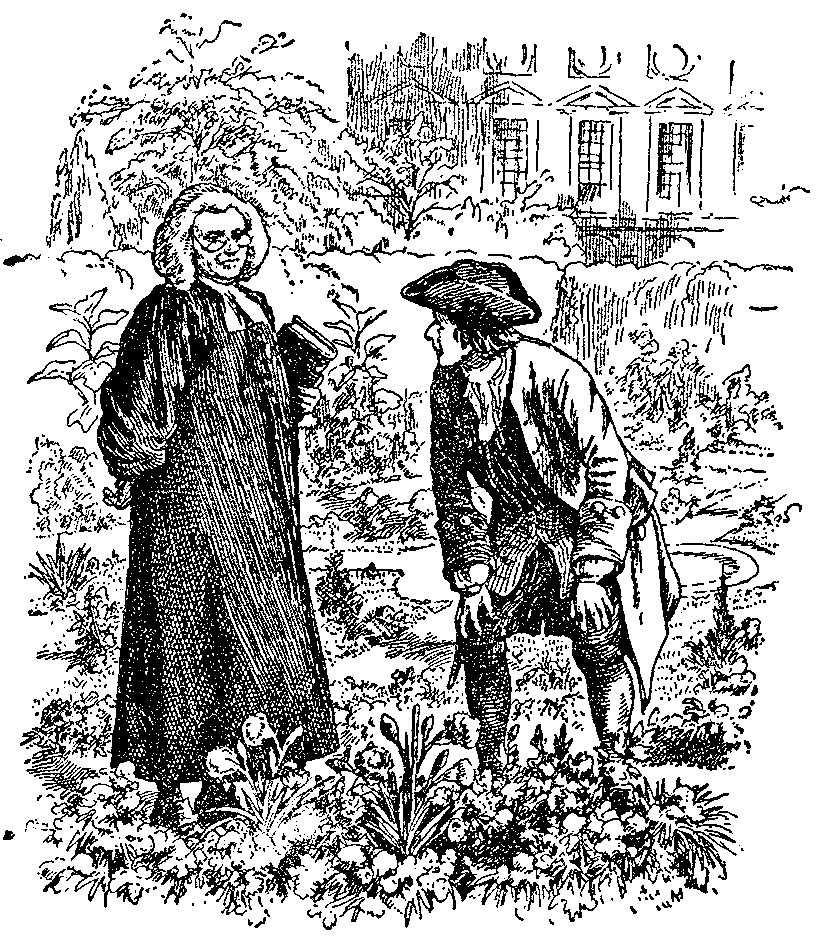 THE CLERGYMAN'S INTEREST WAS AROUSED. |
Shortly after Linnaeus became an inmate of Celsius's house he came across the review of a book by the French botanist Sébastien Vaillant, on the structure of flowers. Sermo de Structure Florum, Leiden, 1718. The author's observations on the stamens and pistils fixed Linnaeus's attention upon these organs, and led him to observe the facts minutely for himself. Among the various systems of classification then in use that propounded by Vaillant (who died in 1722), which was founded upon the form and quality of the flower, was predominant. Vaillant's system, however, in common with other systems based upon the structure of the fruits, etc., had many deficiencies as a means of identifying plants—chiefly on account of the variable nature of the characters employed. These deficiencies were apparent to Linnaeus when he compared the condition of the essential organs in different flowers. On the other hand, he was struck by the importance of these organs as affording a trustworthy and simple means of classification by reason of their fixity in numbers and arrangement. Fired by this idea, he gradually thought out a system or order dependent upon the numbers of the stamens and pistils, and finally drew up his scheme in the form of a small treatise, which he submitted to Dr. Celsius.
Celsius was so pleased with the MS. that he lost no time in showing it to Dr. Rudbeck, who, we are told, "honoured it with the highest approbation" and expressed a wish to know the author. From this moment Linnaeus's advancement was assured, and when, in 1830, Rudbeck on the score of advanced age obtained leave of the faculty to execute a part of his office by deputy, her recommended that Linnaeus should be appointed to lecture in the botanical garden. It is noteworthy that in bestowing the post of "adjunctus" upon Linnaeus the faculty were willing to overlook the shortness of his time as a student, in consideration of the fact that "no other person was so proper" to fill it. The joy of Linnaeus at receiving this appointment may be imagined; but in order to understand the significance of the honour thus conferred upon a student of less than three years' standing, as well as the importance which Dr. Rudbeck attached to what Linnaeus had written on the classification of plants, a word must be said about the state of scientific education at the university at this period. Rudbeck, we are told, "exhibited beautiful coloured drawings of birds, and Professor Roberg lectured on problems of Aristotle, according to the principles of Descartes"; but "in anatomy and chemistry there was a profound silence, neither did our botanist ever hear a single lecture, public or private, on the study of plants". It is evident, therefore, that to the genius and industry of Linnaeus must be ascribed the awakening of interest in a branch of natural science which up till then had been neglected.
Linnaeus had held his post of garden-teacher for a twelvemonth when he heard that a royal command had been given to the Academy of Sciences to dispatch a person to explore the territory of Lapland. An expedition with this object had been sent out in 1695, under Olaf Rudbeck the elder, who brought back considerable collections; but these results had been destroyed in the great fire at Upsala in 1702, in which year also the explorer died. It was now proposed to compensate the Academy for this loss by dispatching another traveller to the country, and Linnaeus, perceiving an opportunity for rendering valuable service to the cause of science, offered himself for the work. Beyond the honour and the love of discovery there was nothing to attract Linnaeus to the undertaking, for the country was known to be bleak and inhospitable and the travelling attended by many hardships. But Linnaeus's zeal was not to be turned aside by obstacles, and, his offer having been accepted, he set about his preparations without delay.
On May 12, 1732, he began his lonely journey on horseback. His equipment, which was restricted to the barest necessaries, is thus described in his Diary: "My clothes consisted of a light coat of West Gothland linsey-wolsey cloth, without folds, lined with red shalloon, having small cuffs and collar of shag; leather breeches; a round wig; a green leather cap; and a pair of half-boots. I carried a small leather bag, half an ell in length, but somewhat less in breadth, furnished on one side with hooks and eyes, to that it could be opened and shut at pleasure. This bag contained one shirt, two pairs of false sleeves, two half-shirts [vests], an inkstand, pencase, microscope, and spying-glass; a gauze cap to protect me occasionally from the gnats, a comb, my journal, and a parcel of paper stitched together for drying plants, both in folio; my MS. Ornithology, Flora Uplandica, and Characteres Generici. I wore a hanger at my side, and carried a small fowling-piece, as well as an octangular stick graduated for the purpose of measuring. My pocket-book contained a passport from the governor of Upsala, and a recommendation from the Academy."
Linnaeus returned, after strange and wonderful experiences, to Upsala towards the end of October, 1732, having covered in his travels nearly 4,000 English miles, most of them on foot. The Diary tells us modestly enough that "on his arrival home he delivered to the Academy of Sciences an account of his expedition, which obtained their approbation, and they gave him 112 silver dollars [about £10 sterling], and travelling expenses". He wrote a catalogue and short description of the plants of Lapland, under the title of Flora Lapponica, and from all the plants collected during his travels he selected one to transmit his name to posterity. This was the Linnaea Borealis, which he describes in his Critica Botanica as "an humble, despised, and neglected Lapland plant, flowering at an early age". In this flower his own "neglected fate and early maturity are said to be typified". It need hardly be said that the "little northern plant", with its trailing stem and pendulous flowers, is regarded with reverence and affection by all botanists.
The novelty of his subject (he was the first to lecture on mineralogy at Upsala), the vivacity of his style, and the clearness of his explanations secured Linnaeus numerous pupils. To improve his knowledge of mineralogy he made a tour of the principle Swedish mining districts, and at Fahlun met a certain Dr. Moraeus, with whom he became on terms of friendship, and with whose daughter, Elizabeth, he fell in love.
Six years later the fact that Linnaeus was now in receipt of an income equal to about £250 sterling removed the only obstacle to his union with her. The father's consent having been obtained, they were married on June 26, 1739, at Sveden, near Fahlun, the country house of Dr. Moraeus.
In 1736—after travels in Europe and in England—he finished and published his Fundamenta Botanica—"the harbinger of his reform"—following this up with his Bibliotheca Botanic (a much longer work), his Classes Plantarum. and Genera Plantarum (the three last being published at Leyden in 1737). Linnaeus was impressed with the importance of losing no time in bringing his system in its entirety before the scientific world in order that the misconceptions which he had encountered amongst foreign botanists might be removed. On October 3, 1736, he was made a member of the Imperial Academy of Sciences of Leyden, under the name of "Dioscorides Secundus".
A few words must now be said about the scope of the Genera Plantarum, which is to be regarded as the starting point of modern systematic botany. Comprising 384 pages octavo, this work describes the characters of the genera according to the number, form, situation, and proportion of the reproductive organs (i.e. the stamens and pistils). At the same time, Stoever reminds us, Linnaeus "rectified the names of the genera by those distinctive marks which were true to nature, and applicable to any system which might have been adopted for the limitation of the classes and orders. Had he not done this, such a change would only have created more confusion and disorder". Proper names having thus been given to the genera, he proceeded to re-name most of the species. Linnaeus tells us that up to this time he had examined the characters of nearly 80,000 plants. He had described in the above work upwards of 935 genera of plants. This number, says Stoever, was afterwards augmented by one-half in the eleven different editions, with his own and foreign additions. In the same year (1737) he published a supplement to the Genera Plantarum (Corollarium Generum Plantarum, 25 pages), in which he described sixty new genera. To this he added a concise view of the sexual system—Methodus Sexualis, in 23 pages.
In 1737 also appeared, in 372 page octavo, his Flora Lapponica, a preliminary list of the species enumerated in which had, as we have seen, been published in the Transactions of the Royal Society of Upsala in 1732 and 1735. The plants were described in accordance with the new sexual system, and the habitat, properties, etc., of each were given. The work was embellished by twelve large copper-plates, containing fifty-eight figures, engraved at the expense of the Amsterdam Academy. "At the solicitation of Gronovious [says Stoever], he permitted one of the Lapponian plants, called Campanula serpyllifolia, to be, after his own name, denominated Linnaea, and represented on a plate of that work—an honour which he so well deserved."
The book, Hortus Cliffortianus which was begun in 1737, on the completion of the arrangement of Clifford's collection and garden, was a work of love and gratitude towards the man who had treated him as his own son. The Hortus took him nine months to complete (it was published the same year, and comprised 506 pages folio, with thirty-six plates), and in the intervals of its preparation Linnaeus, we are told, whenever he was fatigued by it, used to amuse himself with the Critica Botanica (270 pages), which was printed at Leyden in 1737. The Critica was an elaboration of the Aphorisms 210-314 of the Fundamenta Botanica.
With the establishment of Linnaeus in the chair of botany in 1741, a new epoch in the history of the University of Upsala was begun. The normal number of students in the science classes had been 500, but during Linnaeus's professorship this number rose to 1,500. His lectures, both in the classroom and the garden, formed the most brilliant part of the teaching, and his pupils were drawn from every part of Europe and even from America. Nor did he confine his efforts to improving the garden, but gave interest and permanence to his scientific work by establishing a museum in the university, for which he obtained many valuable gifts from the principle collections in his own and foreign countries.
In 1751 Linnaeus published his Philosophia Botanica, forming a commentary on the various axioms which he had published in 1735 in his Fundamenta Botanica. The work (which it is to be noted was dictated to his pupils during an attack of the gout) comprised a review of all the botanical systems; explanations of plant-structure, terms used, etc.; rules and definitions for establishing the characters of classes, orders, and genera; rules for establishing specific characters, and for distinguishing varieties; rules for describing and naming the species, and for giving their complete history in a scientific manner; together with a chapter treating of the virtues of plants. At the end of the volume were some directions to pupils for forming herbaria and for conducting botanical excursions (the latter a notable feature of Linnaeus's teaching), the method of laying out a botanical garden, and lastly, an "Idea of a Complete Botanist", in which some of the principal botanists were mentioned. "In this work," says Pulteney, "it is difficult to determine whether we ought to admire the genius of its author most in its inventive power, or in that exquisite scientific arrangement which he has given to the whole; the two circumstances together certainly render it a most extraordinary and pre-eminent performance." Rousseau declared it to be the most philosophical book he had ever seen. Linnaeus himself seems to have regarded this work as complete, for it underwent no alteration at his hands.
In 1753 appeared what Haller emphatically termed Linnaeus's "maximum opus et aeternum"—the Species Plantarum—in two octavo volumes, containing 1,200 pages. This work, says Stoever, with is System of Nature became the immortal monument of his diligence and ingenuity both for his own age and for posterity. On this great work, which contained his portrait, Linnaeus expended many years of labour. It forms a complete catalogue of all the plants till then known to Linnaeus, and enumerates 7,300 species, without reckoning their varieties. Dedicating this work to the King and Queen of Sweden, Linnaeus says in his Preface: "Never have I retorted upon mine enemies the arrows which they let fly against me. I have quietly borne offences of the satyrs, and the ironies and attacks of malice. They have at all times been the reward of the labours of great men; but they cannot hurt a single hair of my head. . . . My age, my profession, my character, do not permit me to combat my opponents. I will bestow the few years I have to live upon making useful observations. Errors in natural history will admit of no defence, nor can the truth be concealed. I appeal, therefore, to the judgement of posterity."
The Species Plantarum was supplemented by Linnaeus in a second edition published in 1762 and 1763, which was pirated by the German booksellers the year after. It should be noted that Linnaeus in his Preface gives an account of the assistance he had received and the pains he had taken to bring the work to its present state. He specifies the countries travelled, the botanical gardens visited, the herbaria examined, the names of pupils educated under him, and their various peregrinations, and the many liberal communications of seeds and specimens sent to him from all parts of the world by the first botanists of the time.
From Upsala—now the centre of attraction for students, professors, and collectors of every degree and of every nationality—were dispatched the disciples of Linnaeus to remote countries. Their subsequent fame, as it sprang from his teaching, reflected his genius and enthusiasm, and they became "the priests and teachers of nature in all parts of the world".
Linnaeus, as we have seen, was now in touch with naturalists in every quarter of the globe. Honours as well were bestowed upon him. In 1753 the year of publication of his Species Plantarum, he was created a Knight of the Polar Star by the King of Sweden, being the first scientific man of his country to receive this honour. The Royal Academy of Sciences of Stockholm, which he had been instrumental in founding, awarded him a Gold Medal. From the Imperial Academy of Sciences at St. Petersburg he received a premium for his paper on the Sexes of Plants in 1759—a treatise to which he affixed his motto: "Famam Extendere Factis"—"To spread fame by deeds." In 1761 his sovereign granted him a patent of nobility, antedated April 11, 1757, under which he assumed the style of Von Linné. He was also the recipient of distinctions from various foreign academies, and the King of Spain invited him to settle at Madrid, promising him a pension of 2,000 pistoles, letters of nobility, and the free exercise of his own religion. The last-named tempting offer he declined, saying that what abilities he possessed should be devoted to the country of his birth.
In 1758 Linnaeus published the tenth edition of his System Naturae—the first part of which, relating to the animal kingdom, comprised 821 pages (augmented in the twelfth edition to 1,327 pages). The three volumes published at Stockholm in 1766-7-8 are to be considered (says Pulteney) as having received the author's finishing hand. The three kingdoms are distinguished in the following manner:—
- MINERALS. Concrete bodies, not endued with life or sensation.
- VEGETABLES. Organized bodies, endued with life, but not with sensation.
- ANIMALS. Organised bodies, endued with both life and sensation.
He subdivides the Animal Kingdom as follows: Mammalia, Birds, Amphibia, Fishes, Insects, Vermes—each sub-kingdom being again divided into orders. In regard to the Vegetable Kingdom, it must be borne in mind that the system of classification invented by Linnaeus is entirely artificial, being based, as we have seen, on a single character, the sexuality of plants. In the existing state of botanical knowledge no other or better system could have been devised, and its utility in furthering the study of plants came to be universally admitted. But Linnaeus himself was emphatic in maintaining the necessity for a Natural system—i.e. one based, not on any single character, but on the sum of real affinities, as revealed by the examination and comparison of the structure and life development of plants. A sketch or outline of some such system was actually begun by Linnaeus, but it was left to be perfected by others. Meanwhile, the value of the Linnaean system—the impulse which it gave to study by the substitution of order for confusion, of clear, definite language, methodical treatment of organs each in its turn, and with special terms for describing each organ and for expressing the differences between them, for the lengthy and cumbrous method then in use—such value was simply incalculable.
Linnaeus was now nearing the end of his long and laborious life. In 1763 his son Charles, then in his twenty-second year was appointed assistant professor of botany at Upsala, with the promise of succeeding his father in the chair. In 1774 Mr. Pennant, the zoologist, wrote to Linnaeus, entreating him not to forget his promise of writing the natural history of Lapland which he had made in the preface of his Flora Lapponica. To this Linnaeus answered that "it would now be too late to begin—Nunc nimis sero inciperens".
In his last days, when deprived by an apoplectic seizure of the power of audible speech and incapable of writing or walking, "he used to be carried to his museum, where he viewed the treasures which he had collected with so much labour, and manifested a particular delight in examining the rarities and new productions which during the latter part of his life had been brought him by M. Mutis from Carthagena and New Grenada, and by his other pupils from the Cape of Good Hope and Asia." He died January 10, 1778, in his seventy-first year, at Upsala, and was buried in the cathedral of that city.
Jean Baptiste Lamarck
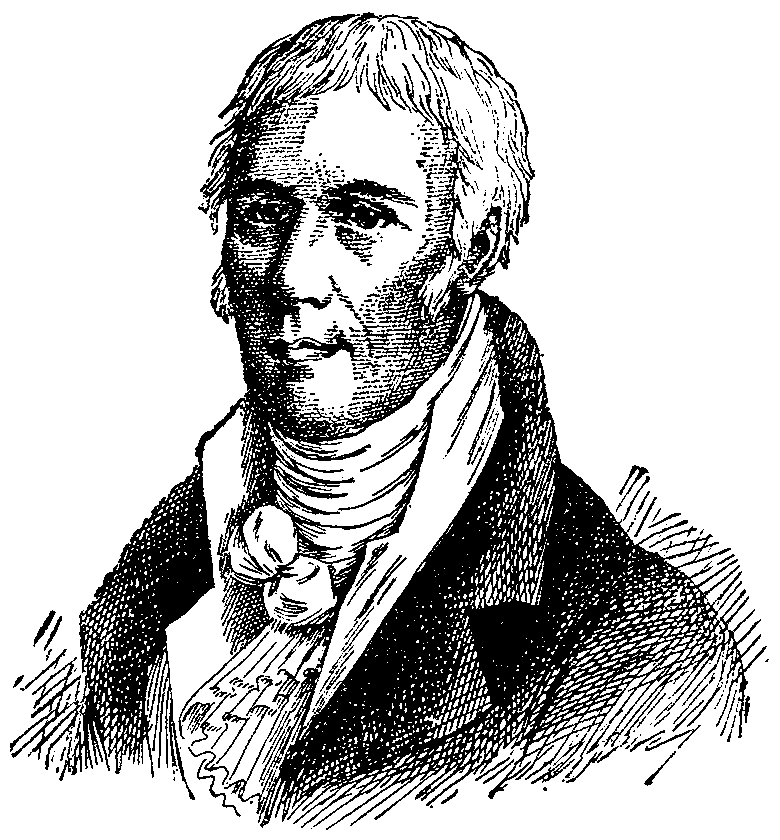 JEAN BAPTISTE LAMARCK. |
Jean Baptiste Pierre Antoine was born on August 1, 1744, at the village of Bazentin, in Picardy. His father is described in the register of birth as Philippe de Monet, Chevalier de Lamarck. The family was of ancient origin, but poor, and Jean was the youngest of eleven children. There appears to have been a good deal of soldiering in the family; the eldest son had met his death at the siege of Bergen, and two other sons were serving in the Army; and Lamarck in his turn was seized with the desire to serve in the field. His father, however, intending him for the priesthood, sent him to the Jesuits' school at Amiens. Here he remained till 1760, when the news of his father's death reaching him, he at once quitted the school and returned to his home. His mind was made up to join the Army, then campaigning in Westphalia, and having procured a horse (a sorry animal, it is told) and a letter of recommendation to the colonel of the regiment of Beaujolais, he set out in company with a lad of the village for the seat of war.
Possibly the colonel was inclined to set small store by the raw youth of seventeen (whose stunted figure, moreover, made him look younger than his years, or possibly he was too busy to pay much attention to the matter. At any rate, Lamarck was sent to his quarters and then forgotten. A battle was impending the next day, and when the colonel rode down the lines he was surprised to find the new recruit in the front rank of a company of grenadiers. He was ordered to the rear, but as he begged hard to be allowed to keep his position his wish was eventually granted.
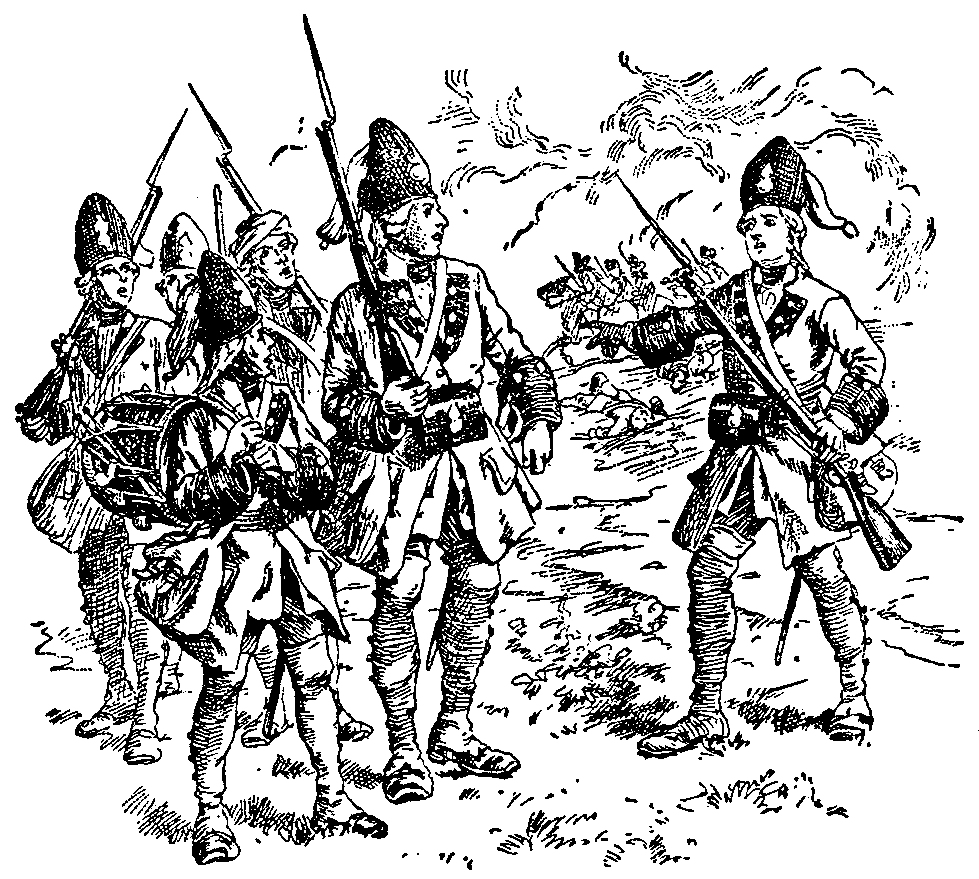 'NO', SAID HE, 'WE CANNOT RETREAT WITHOUT ORDERS.' |
In the battle which followed the French forces were beaten, and in the confusion of the retreat Lamarck's company was overlooked. All the officers had been killed, and when it was evident that the rest of the French army had left the field the oldest man of the company suggested that they should follow their example. But Lamarck, who had taken upon himself the command, refused to listen to this advice. "No," said he, "we cannot retreat without orders." Later on, when news was carried to the colonel that the company was still in the field, he dispatched an orderly to them by a protected route with orders to retire.
For his bravery in refusing to quit the post of danger without orders Lamarck was then and there installed in the Army, and a short time afterwards was given a commission. But his soldiering was of brief duration for when at the peace the regiment went into garrison at Monaco a fellow-officer for a joke lifted Lamarck by the head; inflammation of the glands of the neck ensued, and he was compelled to quit the Army and go to Paris to obtain special treatment.
During the four following years of residence in Paris he appears to have supported himself upon a family pension of 400 francs and his earnings as a clerk in a bank. His choice of profession fell upon medicine, but he was as yet too poor to give the necessary time to study. Meanwhile we learn of his spending his leisure hours in the Royal Garden (he appears to have formed some acquaintance with plants while at Monaco), in reading such botanical books as he could get hold of, and in studying the formation of clouds form his garret window. At the end of the four years we find him hesitating whether to adopt music or medicine as a profession, and being urged by his elder brother to stick to his original intention. The brothers at this time were living and studying together in a village near Paris. Here they encountered Rousseau, and Lamarck's taste for botany was strengthened by his being permitted to accompany the philosopher on his botanical rambles. The idea of following medicine seems to have been definitely abandoned at the age of twenty-four in favour of natural science, and Lamarck entered upon a course of botanical study under the celebrated botanist Bernard de Jussieu.
Ten years later (viz. in 1778) Lamarck published his Flora Françoise—a systematic arrangement and description in three volumes of the plants native to his country. The writing of this work occupied, according to Cuvier, six months of unremitting toil, but its composition must be regarded as the fruits of many years' study pursued amidst privations and difficulties of which we know nothing. As a contrast to these hardships one likes to think of the poor student spending sunny hours in the Royal Garden, or wandering in the country in search of new plants and bringing specimens home for dissection and study in his lodging, or studying the formation of clouds from his attic. In 1778 the influence of Rousseau had rendered the study of flowers exceedingly popular amongst the fashionable world of Paris—botany, as Cuvier expressed it, was "une science à la mode"—and Lamarck's work brought him immediate fame.
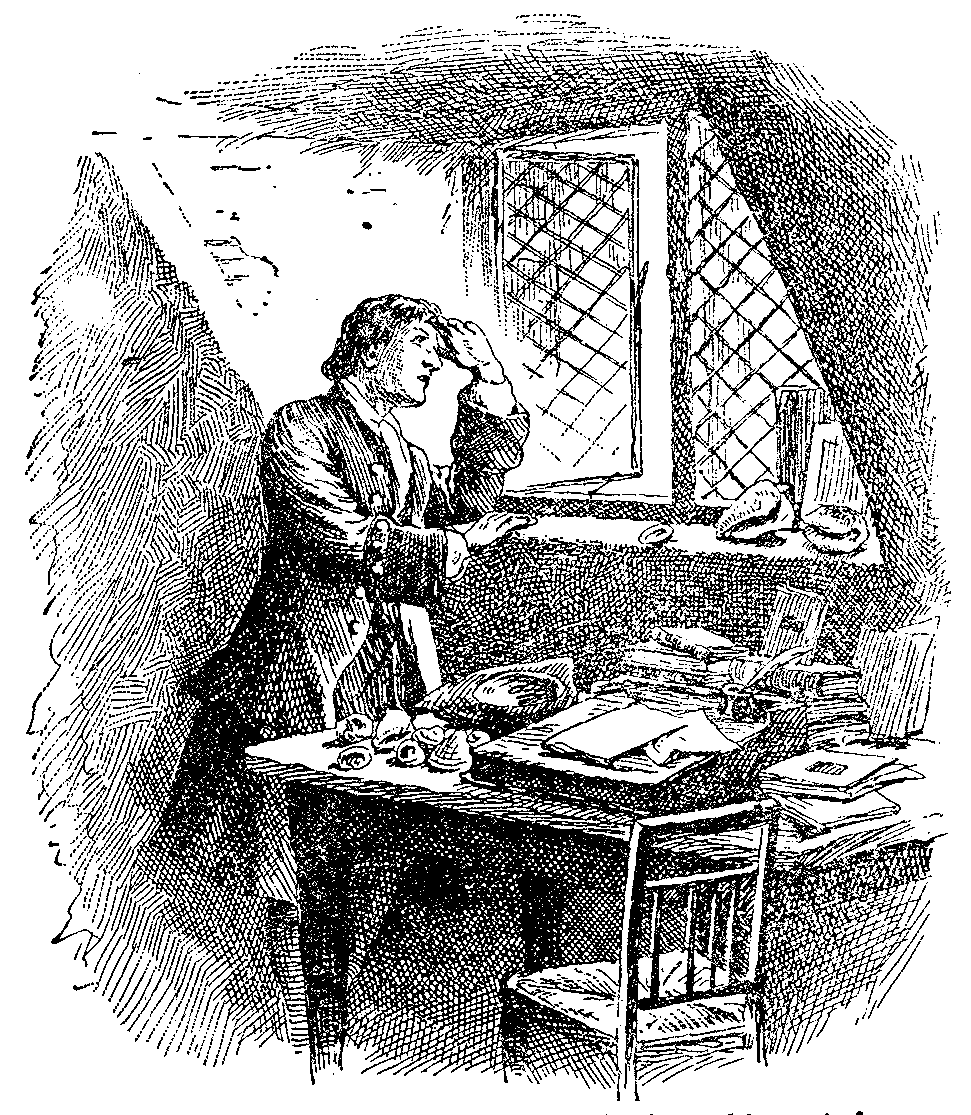 STUDYING THE FORMATION OF CLOUDS FROM HIS ATTIC. |
In the following year, by the King's preference, Lamarck was elected a member of the Academy of Sciences, though his name was in the second rank of presentations, and shortly after his return to Paris in 1782 he was made keeper of the royal herbarium—a post specially created for him by d'Angiviller, who had succeeded Buffon as Intendant of the Royal Garden, and who was a relative of Lamarck's family. The salary attached to the post was 1,000 francs, and on this meagre sum and the profits of his published works Lamarck had to support himself and his family of five children. From this time onwards "grinding poverty" was fated to be the lot of the naturalist, who, after basking for a brief period in the sunshine of court favour, was allowed to sink into obscurity and neglect. In 1790, owing to a reduction in the expenses of the Royal Garden, he was actually discharged, but his prompt appeal to the National Assembly had the effect of restoring him to his post with an increased salary of 1,800 francs.
In this appeal Lamarck, in addition to giving a full account of his work and travels, sketched out a plan for reorganizing the Royal Garden and Museum on a scale of increased usefulness and efficiency, such as would serve to place Paris on a level in respect to science with other great Continental cities. The plan, though not adopted by the Government, led to an inquiry into the whole subject of the administration of the Royal Garden. As the result of this inquiry the existing Museum of Natural History was established in 1793.
Lamarck appears to have pursued his labours undisturbed by the events of "the Terror"—fighting the grim battle of poverty meanwhile as best he could, or enduring with philosophical patience the evils which could not be remedied—until in 1793 we find him embarking upon a new line of research in connection with the newly established Museum of Natural History. It was found impossible to assign to Lamarck a professorship of Botany, and he undertook the charge of that "which everybody had neglected"—namely, the department of the invertebrate animals, including under that designation more than nine-tenths of the whole animal kingdom. We do well to lay stress upon this point of comparative numbers, for otherwise we should be apt to form but a poor estimate of the extent of the burden thus cast upon the shoulders of a single naturalist. Lamarck had practically to begin at the beginning; and he began by inventing the terms Vertebrates and Invertebrates—the first to include the Mammalia, Birds, Amphibia, and Fishes, comprising the four first classes of Linnaeus, and the second to embrace the Insects and Worms, forming the two remaining classes distinguished by Linnaeus. These two great divisions thus established by Lamarck have ever since been recognized by science.
The majority of the animals comprised in the second of Lamarck's sub-kingdoms, however, had been left practically untouched by Linnaeus. When, therefore, Lamarck entered upon his labours he had to face a vast assemblage of forms representing every variety and degree of structure, from the simplest organism discoverable by the microscope to such comparatively complex organisms as the insects and mollusca. Of these various kinds of animals large collections had been brought together at the Museum, but no agreement had been arrived at amongst the naturalists as to the manner in which they should be classified. It would be more accurate perhaps to say that no naturalist since Linnaeus had ever attempted to deal with the question of their classification as a whole, whilst the structure and life-histories of many of the lowlier forms had never been studied. So small was the amount of exact knowledge which was possessed at that time regarding most of the subdivisions of the Invertebrates, that Lamarck had to break new ground at almost every turn. The difficulties attending the subject, which had repelled others from the task, were surmounted by the infinite patience and pains which Lamarck brought to bear upon them. By slow degrees he solved each knotty problem, and defined the degrees of difference and relationship between the various groups, with the result that out of uncertainty and chaos he evolved order and precision.
In 1801 Lamarck published his Système des Animaux sans Vertèbres, containing the results of his labours in the department assigned to him eight years before. In this work he distinguishes ten classes of Invertebrates, ranging them in the following order: Mollusca, Cirripedia (Barnacles), Annelida, Crustacea, Arachnida (Spiders), Insecta, Vermes, Radiata (Starfish), Polyps (Sponges), Infusoria (microscopic animals). An enlarged edition of this work, in seven volumes, was published in the years 1815 and 1822. This is his great work, on which his reputation as a naturalist rests.
In the course of his labours amongst the groups of lower animals Lamarck had been struck with the difficulty of determining between "species" and "varieties", owing to the complete gradation which was observable between many of the forms thus classified by older naturalists. Confronted by these facts, he was led to the conclusion that species were not separate creations, but had descended from pre-existing species. Many naturalists before Lamarck had entertained similar views, and had even expressed these views in their published writings; but none had propounded an hypothesis or theory to explain the process by which this descent of species had been accomplished. To Lamarck, therefore, belongs the honour of being the first to propound a genuine theory of the progression of life, and of demonstrating that this progress has been the result of continuous laws.
What was the nature of the reception accorded to these views? Strange to relate, whilst the Animaux sans Vertèbres was welcomed with approbation, and adjudged to be worthy of ranking beside the work of Cuvier on the Vertebrate animals, the theory of the origin of species, where it was not passed over in silence, was referred to in terms of derision—"far-fetched," "absurd," "fantastic," being amongst the milder forms of criticism that were levelled against the new doctrine. The strangeness of this reception is not lessened, but it is partly explained perhaps, by the weakness of construction of the theory; by the preponderance which it exhibits of speculation as compared with statement of fact; and lastly by the wording of many of the passages—e.g. that dealing with the elongation of the neck of the giraffe—which lent itself only too easily to ridicule. Lamarck may or may not have been conscious of these drawbacks; on the other hand, he may have been content to rest his claims with regard to the truth of his theory upon the judgement of posterity: we cannot tell. All we know is that he devoted the years of his life after 1801 to elaborating and perfecting his views, and that, as we have already stated, he repeated and enforced those views in his old age. But so far as the opinion of his contemporaries was concerned his labours were of no avail, and it was an added bitterness to the trials which attended his closing years that he had to bear with the condemnation and ridicule of those whom he had hoped to convert.
Six years before the date of the first publication of his theory—viz. in 1795—Lamarck had seized the chance which then offered itself of bettering his worldly position by applying for a share of the 300,000 livres voted by the National Assembly as an indemnity to be paid to those citizens who had achieved eminence in literature and art. That his petition did not err on the side of undue modesty, will be apparent from the following extracts:—
"During the twenty-six years that he has lived in Paris, the citizen Lamarck has unceasingly devoted himself to the study of natural history, and particularly to botany. He has done it successfully, for it is fifteen years since he published, under the title of Flore Français, the history and description of the plants of France, with the mention of their properties and of their usefulness in the arts—a work printed at the expense of the government, will received by the public, and now much sought after and very rare." He next proceeds to describe the second of his great botanical undertakings—the Illustration des Genres, with nine hundred plates—which occupied several volumes of the Encyclopédie Méthodique begun by Diderot and D'Alembert. He states that for ten years past he has kept busy "a great number of Parisian artists, and three printing presses for different works", besides delivering a course of lectures.
The petition was granted, and though we are not told the amount which Lamarck received, we may be sure that the aid was timely, for a pension of 3,000 francs which had been paid to him by the Academy of Sciences had lately ceased, and he was married for the second, if not the third, time. In renewing his application for assistance from the national fund in the following year, Lamarck draws a picture of his distressful state. As regards his work, the second edition of "that useful work" his French botany, which he design as "a new present to his country", is stayed for lack of fund. But he has another and a far greater project on hand, for which money is needed. "For a long time," he says, "I have had in view a very important work—perhaps better adapted for education in France than those I have already composed or undertaken—work, in short, which the National Convention should without doubt order, and of which no part could be written so advantageously as in Paris, where are to be found abundant means for carrying it to completion." It is to be a "Système de la Nature"—"a work analogous to the Systema Natura of Linnaeus, but written in French, and presenting the picture complete, concise, and methodical, of all the natural productions observed up to this day." He states that Linnaeus's work, though indispensable to young Frenchmen devoting themselves to the study of natural history, "is the object [? subject] of speculation by foreign authors, and has already passed through thirteen different editions. Moreover, their works, which, to our shame, we have to use, because we have none written expressly for us, are filled with gross mistakes."
He estimates that, "written with the greatest possible conciseness," the work could not be comprised in less than eight volumes of octavo size, allotted as follows: Quadrupeds and Birds, one volume; Reptiles and Fishes, one volume; Insects, two volumes; Worms (comprising the molluscs, madrepores, lithphytes, and naked worms), one volume; Plants, two volumes; Minerals, one volume.
For a work of this character national assistance is indispensable, and he proposes that the nation shall pay him 20,000 francs in one payment, for which sum he will undertake the entire responsibility, and will agree, if he live, to complete the work in seven years.
The proposal was not entertained; and indeed it is difficult to see how so vast a work could have been accomplished by one man, and in so short a space of time as that named by the proposer. Yet Lamarck says that he only adopted the one-man plan "after much thought". That he should have believed himself capable of such an undertaking seems to argue a degree of self-confidence that is astonishing, unless we admit that he idea may have gained force from the pressure of his circumstance. That those circumstances were at the time very straightened is certain. He appears to have gone to some lengths to raise money, and also to have been extremely improvident in disposing of such money when raised. Thus we learn of his selling his thirty-years' collection of shells to the Government for 5,000 francs, and of his laying out this sum in the purchase (or part purchase) of a small "national estate" at Héricourt-Saint-Samson, about 50 miles from Paris. Here, in a "modest farm-house", he sought rest and seclusion in the summer from his official work; he was married no less than four times.
In his last years Lamarck became quite blind—partly, no doubt, as the result of his long-continued use of magnifying glasses and the microscope. The progress of the disease, or whatever it was, was gradual, but complete blindness seems to have prevailed during the last ten years. Very little is known as to the manner in which Lamarck spent the thirty years preceding his death; but probably they were passed in seclusion and in the unbroken routine of lecturing and museum work. It is said that he was fond of novels, which his daughters read to him. We learn of his regular attendances at the board of professors of the museum; of his presence at the meeting on July 15, 1818, when he laid before the assembly the sixth volume of his work.
The self-sacrificing devotion of his eldest daughter, Cornélie, alone enabled Lamarck's greatest work to see the light. Thus, the whole of the seventh, and last, volume of the Animaux sans Vertèbres was dictated to this daughter, on whom Lamarck leant entirely during the period of his decline. It was she who accompanied him on his walks, and who attended him constantly indoors when in later days he was confined to the house. Cuvier has testified to this devotion by his statement that "at her first walk out of doors after the end came she was nearly overcome by the fresh air, to which she become so unaccustomed. She, indeed, practically sacrificed her life to her father". At her father's death the museum authorities, in view of the unfortunate position of the family, gave this brave daughter employment in the botanical laboratory with a salary of 1,000 francs.
Lamarck died December 28, 1829, aged 85 years. He was buried in the cemetery of Montparnasse, December 30, and eulogies were pronounced at the graveside by M. Latreille, in the name of the Academy of Sciences, and Geoffroy St. Hilaire, on behalf of his colleagues at the Museum of Natural History.
In recent years a movement has taken place on the Continent and in America in favour of a revival (or a part-revival) of Lamarck's theory of evolution, under the name of "Neo-Lamarckism". The views of the "Neo-Lamarckians" are opposed by those of a second body styling themselves "Neo-Darwinians", and claiming to represent the modern phase of evolutionary thought based upon the views of Darwin. Into the merits of this controversy we cannot enter; but whatever differences of opinion may exist with respect to Lamarck as an exponent of evolution, there can be no question about his right to be regarded as the founder of modern Invertebrate Zoology—and this, apart from anything else, is the great debt which science owes to his memory.
Sir Humphry Davy
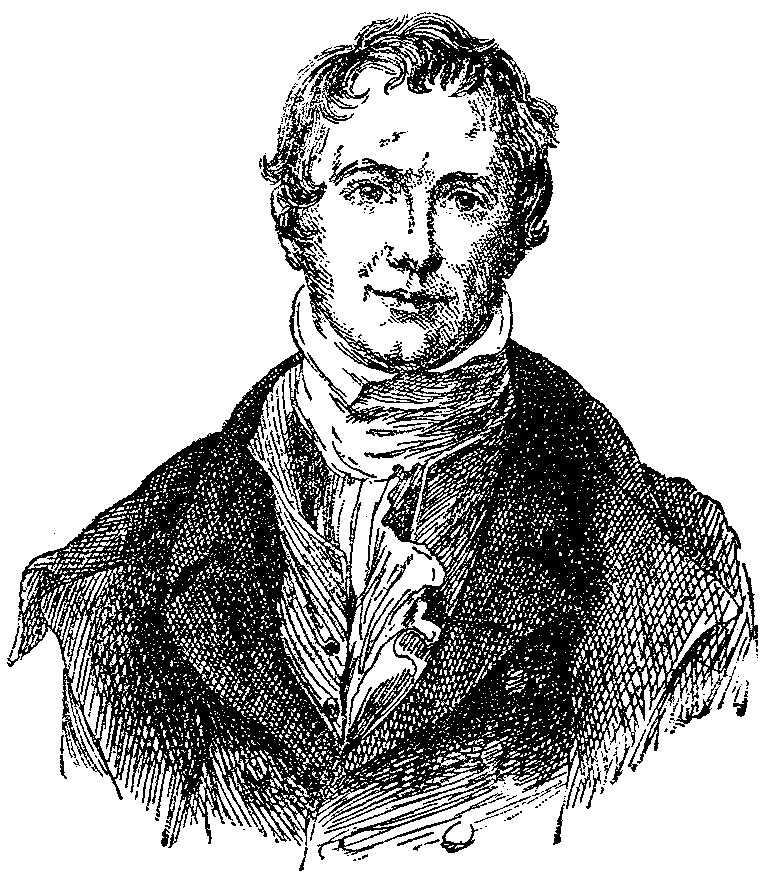 SIR HUMPHRY DAVY. |
It was the afternoon of market-day in Penzance, and Market Jew Street was almost deserted save for the gossips, who were scattered in little knots here and there; for, next to the buying and selling of goods the bartering of news was held to be an indispensable feature of the weekly gathering. Round the doorway of the old "Starr Inn" some score or so of men were engaged in drinking and in discussing the topics of the market, preparatory to starting on their homeward journey. In the inn-yard were standing several of the country carts which had brought the folk into the town in the early hours of the day, whilst the horses that were to draw them home were still enjoying their rest in the stables.
From one of the carts a chubby-faced schoolboy was haranguing a circle of boys gathered around him. Every minute a straggler would join the circle, and nudge his neighbour in schoolboy fashion to inquire what the speech was about. As his audience increased the speaker waxed more eloquent, waving his arms, or drawing imaginary outlines in the air to illustrate or emphasize his story. When, on half-holidays, word was passed round that Humphry Davy had a story to tell, the story-teller was sure of a good and attentive audience. As for the materials out of which he fashioned his stories, they were derived from various sources, but chiefly, at first, from books. Even as early as eight years old the boy was an omnivorous reader, and the rate at which he devoured a book was only equalled by the accuracy with which he could remember what he had read. His first book, the Pilgrim's Progress, gave him special delight, and by firing his imagination led him to seek for legends in places as well as in books. Nor had he far to seek. The countryside abounded in folklore of every description; there was scarcely a village or hamlet that could not boast of a witch, living or dead, to whose machinations all sorts of misfortunes, real and imaginary, were ascribed; whilst every cave and rocky fastness along the wild and rugged coast had its legend of the past.
To tales and legends of land, sea, and rock Humphry Davy listened with eagerness, and his natural gift for story-telling enabled him to weave them into yarns for the entertainment of his school-fellows; also, he was a capital hand at the flying of kites, the carving of turnip-lanterns, and the making of fireworks, with a "speciality" of his own invention in the shape of a detonating compound, which went by the delightful name of "Thunder-powder".
The boyhood of Humphry Davy dates back to a period of more than a century ago, for he was born on December 17, 1778. The place of his birth was Penzance, where his father, Robert Davy, worked as a wood-carver. During the childhood of Humphry the family, consisting of Humphry, the eldest child, John, the second son, and three daughters, removed to Varfell, and shortly after he was placed at a preparatory school. Later Davy was sent to the Penzance grammar school, under the Rev. I. C. Coryton, who had an unpleasant way of reminding his scholars of their deficiencies by pulling their ears—a treatment to which Davy showed his resentment by appearing one day with a huge plaster on each ear, gravely explaining that he had "put the plasters on to prevent mortification". His love of reading and of story-telling were accounted a species of idleness, or the vagaries of a mind not sufficiently tractable to confine itself to the narrow limits of classical studies. He gave further proof of this idleness by seizing every opportunity for fishing the streams, or wandering off along the coast to explore the caves, with a notebook or sketch-book for his companion. At other times he would "shut himself up in his room, arrange the chairs, and lecture to them by the hour together". Yet again he would steal time from school to spend it in the company of a Quaker saddler in the town, named Robert Dunkin, a clever mechanic, who, it is said, gave Davy his first taste of experimental science.
In 1794 Robert Davy died, the widow returned with her family to Penzance, where she set up a small millinery business in partnership with a friend, and Humphry was apprenticed, in February of the following year, to Mr. John Bingham Borlase, a surgeon-apothecary of the town. Dunkin, Humphry's Quaker friend, had already imbued him with a taste for science, and the resources of the apothecary's dispensary soon made him a chemist. His garret bedroom was in these days the scene of many experiments, and his apparatus, where not made by his own hands, consisted of pots and pans borrowed from the kitchen, tobacco pipes, and vessels "annexed" from the dispensary. The experiments were of a simple kind, such as the preparing of gases, effects of acids and alkalis on vegetable colours, the solution and precipitation of metals, etc., and as there was no fireplace in his bedroom he was obliged to bring his crucible down to the kitchen. It is interesting to note the order of his studies: thus, his attention was first given to the theory of chemistry as expounded by the great French chemist Lavoisier; he speculated upon what he read; the speculations led him to experiment; and experimenting led him once more to speculate. The immediate result of the chemical operations was to cause the elder inmates of the house to exclaim: "Humphry is incorrigible; he will blow us all into the air!"
He was, as we have seen, launched upon scientific speculations and seized with the fever of discovery, even before he had got his hand in with experimental work. This was the earliest indication of that tendency to "put the cart before the horse" which characterized his scientific attitude in later years. Said Robert Dunkin to him one day: "I tell thee what, Humphry, thou art the most quibbling hand at a dispute I ever met with in my life."
On his evening walks to Marazion, to drink tea with his aunt, he takes with him his geological hammer and seeks for rock specimens on the beach. Instead of physicking his master's patients he is hammering the rocks, and, according to Dr. Paris, he "paid much more attention to philosophy than to physic", and "thought more of the bowels of the earth than of the stomachs of his patients". We have seen how, as a boy, he used to lecture the chairs; and this fondness for declaiming seems to have pursued him when an apprentice. He indulged in it during his walks and solitary rambles. On one occasion it is recorded of him that, on his way to visit a poor patient in the country, in his fervour of declamation he threw out of his hand a vial of medicine which he had to administer, and that, when he arrived at the bedside of the poor woman, he was surprised at the loss of it!
On October 2, 1798, having been appointed assistant to Dr. Beddoes, a well-known scientist, Davy quitted Penzance for Bristol, reaching his destination in time to witness the arrival of the mail-coach from London, "covered with laurels and ribbons, and bringing the news of Nelson's glorious victory of the Nile."
Nine days later he writes to his mother in the highest of spirits: "I have now a little leisure time, and I am about to employ it in the pleasing occupation of communicating with you an account of all the new and wonderful events which have happened to me since my departure." He is very pleased with his hosts and their kind reception of him, with the house, his rooms, and above all with the "excellent laboratory". Beddoes he describes as "one of the most original men I even saw—uncommonly short and fat, and with little elegance of manners, and with no external signs of genius or science, extremely silent—in fact, a bad companion". Beddoes (who had previously seen Davy's MS. Essay on Heat and Light) has paid him "the highest compliments on my discoveries, and has, in fact, become a convert to my theory, which I little expected". Mrs. Beddoes he finds to be the reverse of her husband—"extremely cheerful, gay, and witty. With a cultivated understanding and excellent heart, she combines an uncommon simplicity of manners. We are already very great friends." He sums up by saying: "My expectations are answered, and my situation is just what I could wish."
Mrs. Beddoes, it should be noted, was Anna Edgeworth, a sister of Maria Edgeworth, the author; and it was through Mrs. Beddoes that Davy became acquainted with the Edgeworth family, as well as with Southey, Coleridge, the Tobins, and others.
In 1798 appeared Contributions to Physical and Medical Knowledge, principally from the West of England; collected by Thomas Beddoes, M.D., the first half of this volume being occupied by two essays by Davy—"On Heat, Light, and the Combinations of Light, with a new Theory of Respiration," and "On the Generation of Phosoxygen [Oxygen gas], and the Causes of the Colours of Organic Beings".
"With all their faults of hasty speculation, of partial reasoning, and, in very many instances, erroneous experiments," says Dr. John Davy, "I cannot help thinking that posterity will pass on these essays a sentence different from that of their author, and would, on no account, have them blotted out from the records of science; this is the true test of their value, and of their deserving, not the unqualified censure which some critics have bestowed on them, but the qualified praise which they who know how difficult is the investigation and discovery of truth, and the navigation of the ocean of science, will most willingly give."
How Davy learnt his lesson—the lesson of his life in regard to science—is best told by extracts from his notebooks. In August of the year in which the essays appeared he wrote: "When I consider the variety of theories that may be formed on the slender foundation of one or two facts, I am convinced that it is the business of the true philosopher to avoid them altogether. It is more laborious to accumulate facts than to reason concerning; but one good experiment is of more value than the ingenuity of a brain like Newton's."
In the same notebook, and at about the same time, alluding to his essays, he says: "I was perhaps wrong in publishing, with such haste, a new theory of chemistry. My mind was ardent and enthusiastic. I believed that I had discovered the truth. Since that time my knowledge of facts is increased—since that time I have become more sceptical."
He never forgot the lesson thus learned, and in after years its effects were shown in his unwillingness to advance a hypothesis with regard to any of his investigations.
Davy's residence at Clifton seems to have been (in every respect) fortunate. To his mother he writes: "We are going on gloriously; our patients are getting better; and, to be a little conceited, I am making discoveries every day." In a letter to Gilbert (April 10, 1799) he describes some recent experiments with vegetable tissues (reeds, corn, and grasses) to prove the existence of silex in epidermis, which experiments he had been led to make by the observation of one of the children that two bonnet-canes rubbed together in the dark produced a luminous appearance. But the most interesting and important part of this letter is that dealing with his experiments in the respiration of nitrous oxide gas (one of the gaseous compounds discovered by Priestley in 1776). After saying that they had now begun to investigate the effects of the gases in respiration, he goes on: "I made a discovery yesterday which proves how necessary it is to repeat experiments. The gaseous oxide of azote (the laughing gas) is perfectly respirable when pure. It is never deleterious but when it contains nitrous gas. I have found a means of obtaining it pure." He then relates that in order to test this fact he breathed sixteen quarts of the gas for nearly seven minutes, and that it "absolutely intoxicated me". It made him "dance about the laboratory like a madman, and has kept my spirits in a glow ever since".
During this year (1799) he published a full account of his experiments in Researches, Chemical and Philosophical, chiefly concerning Nitrous Oxide and its Respiration. In the concluding portion of his paper he hinted at the probable utility of nitrous oxide in surgical operations. Public attention was at once drawn to these Researches by reason of the novel and striking facts and discoveries which they contained, and Davy at twenty-one, on paying his first visit to London in December, 1799, found that his fame had preceded him in the capital, and that the circle of his friends and well-wishers had considerably enlarged.
When once the respirability of nitrous oxide gas was established patients were eager to try its effects. Southey, Coleridge, Tobin (the dramatist), Joseph Priestley (son of the famous chemist), the Wedgewoods, and others, were induced to breathe the gas and to record their sensations. The taking of laughing-gas became almost a fashion—greatly to the profit of Beddoes and his Institution—and a French writer, M. Fiévée, in his Lettres sur l'Angleterre (1802), whimsically introduced it into the catalogue of follies to which the English were addicted, and said that the practice amounted to a national vice.
In a letter to Gilbert, written some time during the summer of 1800, Davy says that he has been "repeating the galvanic experiments with success", in the intervals of experiments on the gases, which "almost incessantly occupied him from January to April." "Galvanism," he says, "I have found by numerous experiments to be a process purely chemical, and to depend wholly on the oxidation of metallic surfaces, having different degrees of electric conducting power." "Galvanism" was the term used for electricity. Volta's discovery of the electric pile, to which his name was afterwards attached, had just been announced in England, and philosophers were eagerly discussing its merits and possibilities and repeating the experiments performed by the famous Italian.
We come now to the period when Davy made his "grand move" in life. The first intimation of this step is contained in the following letter to his mother, dated January 31, 1801:—
"My dear Mother,—During the last three weeks I have been very much occupied by business of a serious nature. This has prevented me from 130 writing to you, to my Aunt, and to Kitty. I now catch a few moments only of leisure to inform you that I am exceedingly well, and that I have had proposals of a very flattering nature to induce me to leave the Pneumatic Institution for a permanent establishment in London.
"You have perhaps heard of the Royal Philosophical Institution, established by Count Rumford, and others of the aristocracy. It is a very splendid establishment, and wants only a combination of talents to render it eminently useful.
"Count Rumford has made proposals to me to settle myself there, with the present appointment of assistant lecturer on chemistry, and experimenter to the Institute; but this is only to prepare the way for my being in a short time sole professor of chemistry, &c.; an appointment as honourable as any scientific appointment in the kingdom, with an income of at least £500 a year.
"I write to-day to get the specific terms of the present appointment, when I shall determine whether I shall accept it or not. Dr. Beddoes has honourably absolved me from all engagements at the Pneumatic Institution, provided I choose to quit it. However, I have views here which I am loath to leave, unless for very great advantages.
"You will all, I daresay, be glad to see me getting amongst the Royalists, but I will accept of no appointment except upon the sacred terms of independence.
"I am your most affectionate Son,
"H. DAVY."
In the middle of February he went to London, whence he wrote that he was negotiating with Rumford, adding: "His proposals have not been unfair; and I have nearly settled the business."
Six weeks later (on April 25) he gave his first public lecture; three courses of lectures were delivered by Davy during the spring, and he seems to have given satisfactory proof of his abilities to the managers. In June Dr. Garnett, the first professor of chemistry, resigned his position through ill-health, and was succeeded by Dr. Young. In the same month Davy made his first communication to the Royal Society; the paper, which was called "An account of some Galvanic Combinations, formed by an arrangement of single metallic plates and fluids, analogous to the Galvanic Apparatus of M. Volta", being read on June 18. In July the managers, following out the object of the Institution in assisting the industries, resolved that a course of lectures on the chemical principles of the Art of Tanning should be given by Davy, to begin in November. At the same time it was decided that Davy should have permission to absent himself during July, August, and September, "for the purposes of making himself more particularly acquainted with the practical part of the business of tanning."
Davy seized the opportunity of the interval to visit his home and to make a tour of the Cornish coast in the company of a friend named Underwood; in connection with this tour, Underwood (according to Paris) related that on one occasion, having bought a fine large bass, they took the fish to an inn and directed that it should be cooked for dinner. While waiting in the parlour Underwood missed Davy, and presently heard a great noise and commotion proceeding from the kitchen. On going to ascertain the cause he encountered the philosopher in full flight, pursued by the landlady, uttering irate cries and brandishing the frying-pan. It seems that Davy, presuming upon his knowledge of the manner in which a fish should be dressed, had invaded the kitchen and proffered his assistance in making the sauce and stuffing—to the indignation of the hostess, who had driven him away in a rage.
Davy's work at the Royal Institution comprised analyses of rocks and minerals, and in 1802 he was requested to take up the subject of Agricultural Chemistry with a view to giving practical advice to the farmers on various points connected with the treatment of soils and the growth of crops. In order that his investigations might obtain publicity through the proper channels, it was arranged that he should deliver a course of lectures on the subject at the Board of Agriculture, the department recently established by Sir John Sinclair. At that date the application of science to agriculture had hardly made a beginning; farmers knew nothing about the chemistry of farming, and hence could do very little towards improving the soils or perfecting the methods of cultivation. Information on these subjects was badly needed, and Davy's lectures may be said to have been the first effort to bring the department into practical touch with the farming community of England.
Davy realized the importance of the subject and entered with thoroughness into the work of preparation for his lectures, which obtained a popularity at this period scarcely to be imagined. Men of the first rank and talent, the literary and the scientific, the practical, the theoretical, blue stockings, and women of fashion, the old, the young, all crowded, eagerly crowded, lecture-room.
In 1803 Davy was appointed Chemical Professor to the Board of Agriculture. This was a year of honours, for in July the engagement of Arthur Young terminated, and Davy received the style of Professor of Chemistry at the Royal Institution. On February 24 he read before the Royal Society his first paper—on "Astringent Vegetables, and their Operation in Tanning". He was proposed a Fellow on April 21 and elected November 17. To complete the record, on July 7 he was elected an honorary member of the Dublin Society; from these events we pass to the year 1807, in which Davy made his brilliant discoveries with reference to the compound nature of the bodies called the "fixed alkalis". It appears that as far back as 1800—the year of the discovery of the voltaic pile—Davy had entertained the opinion that chemical combination might be due to the attraction of oppositely electrified substances. With this idea present in his mind he now sought to utilize the power with the invention of the voltaic pile had placed in his grasp to effect the decomposition of the fixed alkalis, potash and soda. His earliest experiments were made with single batteries of small power, and these were without result, but on the 19th of the same month he delivered before the Royal Society his memorable Bakerian lecture—"On some new Phenomera of Chemical Changes produced by Electricity, particularly the Decomposition of the fixed Alkalis, and the exhibition of the new substances which constitute their bases; and on the general Nature of Alkaline Bodies."
The new metals were named by Davy Potassium and Sodium. In appearance potassium resembled quicksilver, but its metallic lustre was at once destroyed by exposure to the air, and by the absorption of oxygen and moisture the metal was re-converted into potash. Sodium likewise resembled silver, and like potassium quickly altered on exposure to the air. Owing to the fact there was considerable difficulty in preserving the metallic substances, but Davy eventually found that they could be preserved in naphtha.
The discovery of the metallic bases of potash and soda was completed within a very short space of time—between October 16 and 19, according to Paris. Dr. Davy speaks of "the extreme delight which he [Davy] felt when he first saw the metallic basis of potash." "I have been told [he says] by Mr. Edmund Davy [his cousin and assistant] that when he saw the minute globules of potassium burst through the crust of potash, and take fire as they entered the atmosphere, he could not contain his joy—he actually danced about the room in ecstatic delight," and it was some time before he was sufficiently composed to continue the experiment.
The feverish excitement under which Davy had laboured during these experiments—the results of which were put together with almost incredible speed—coupled with his low condition of health at the time,
It was not till the middle of March that he was able to resume his lectures, and of his aims as well as of his activity at this period we may judge from the following extract from a letter to his mother (August, 1809): "At present, except when I resolve to idle for health's sake, I devote every moment to labours which I hope will not be wholly ineffectual in benefiting society, and which will not be wholly inglorious for my country hereafter; and the feeling of this is the reward which will continue to keep me employed." Twelve months after the publication of his first Bakerian lecture Davy received the intelligence that the prize of 3,000 francs, established by Napoleon for the best experience made on the galvanic fluid, had been awarded to him by the Institute of France, "for his discoveries announced in the Philosphical Transactions for the year 1807."
In 1810 Davy was invited by the Dublin Society to give a course of lectures in that city on his recent discoveries in electro-chemical science. The invitation was accepted; Davy lectured to crowded audiences, and received for his fee sum of 500 guineas.
On April 8, 1812, he was knighted by the Prince Regent, and on the following day he delivered his farewell lecture as Professor of Chemistry at the Royal Institution. Michael Faraday (not yet engaged as assistant in the laboratory) was present on this occasion, on the look-out for the characteristics of a lecturer, and made the following entry in his notebook concerning Davy's style: "During the whole of these observations his delivery was easy, his diction elegant, his tone good, and his sentiments sublime." Another event closely concerning his happiness was impending—he was engaged to be married to Mrs. Apreece, widow of Mr. Shuckburgh Ashby Apreece, eldest son of Sir Thomas Apreece; she was the daughter and heiress of Charles Kerr of Kelso, and a distant connection of Sir Walter Scott.
He was married on April 11, 1812, and shortly after this event he writes to his brother concerning his position at the Royal Institution: —
"I was appointed Professor (honorary) to the Institution at the last meeting," he writes on April 10, 1813. "I do not pledge myself to give lectures. . . If I lecture it will be on some new discoveries, should it be my fortune to make them; and I give up the routine of lecturing, merely that I may have more time to pursue original inquiries, and forward more the great objects of science. This has been for some time my intention, and it has been hastened by my marriage. . . ."
The minutes of the Royal Institution record that on April 5, 1813, Davy begged leave to resign his situation of Professor of Chemistry, when Earl Spencer moved—"That, in order more strongly to mark the high sense entertained by this meeting of the merits of Sir H. Davy, he be elected honorary Professor of Chemistry."
The working of our coal-mines during the early years of the last century was attended by what was then a new and special danger: this danger consisted in the liability of the gases of the mine to explode, or "fire", on coming into contact with the naked candles carried by the miners; and on November 9 Davy, having visited the Newcastle district, read a paper on the subject before the Royal Society: "On the Fire-damp of Coal-mines, and on methods of lighting the mine so as to prevent its explosion." In this paper he describes the results of his experiments and confirms the opinion of other chemists that fire-damp is light carburetted hydrogen gas, and hence analogous to the inflammable gas of marshes. He establishes the following important points with regard to the inflammability of the gas: —
- That it required to be mixed with a large proportion of ordinary air to produce an explosion.
- That the heat required to cause an explosion was far greater than that required to explode other inflammable gases; thus, fire-damp could not be exploded by red-hot charcoal or red-hot iron.
- That the heat produced by its explosion being less than that produced by any other inflammable gas the expansive effect from heat attending its explosion was also less.
- That the mixture could not be fired in tubes of less than a certain diameter.
"In comparing," says Davy, "the power of tubes of metal and those of glass, it appeared that the flame passed more readily through glass tubes of the same diameter; and that explosions were stopped by metallic tubes of one-fifth of an inch when they were an inch and a half long; and this phenomenon probably depends upon the heat lost during the explosion in contact with so great a cooling surface, which brings the temperature of the first portions exploded below that required for the firing of the other portions." Metal is a better conductor of heat than glass; and it has been already shown that fire-damp requires a very strong heat for its inflammation."
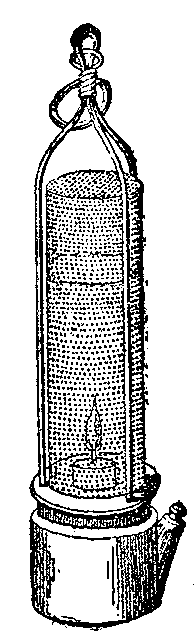 THE LAMP AS ACTUALLY USED. |
Davy's first lamps were formed with small tubes for supplying air to the flame, but as he soon found that the metallic tubes represented by the meshes of wire gauze resisted equally well the passage of flame, he was led to surround the flame of the lamp with a cylinder of wire gauze. The gas readily passed through the meshes of the gauze and was consumed within it, filling the cylinder with a bright flame; but the explosion could not pass outwards, even although the wire became red-hot.
Thus Davy perfected a lamp which was successful because it captured the demon gas and destroyed it safely, or allowed it to explode itself harmlessly—the gas in the act of its explosion affording the light which the miner needed for his work, and some months later he was taken down into the pit and saw his lamp in actual use. He was urged to patent his invention, but refused, though by its universal adoption he might have secured a considerable fortune. "I never thought of such a think," was his reply; "my sole object was to serve the cause of humanity; and if I have succeeded, I am amply rewarded in the gratifying reflection of having done so."
In 1816 the Royal Society awarded him their Rumford Medal for his work in connection with the safety lamp and flame.
In October, 1818, Davy was made a baronet. Earlier in the same year he went to Naples at the instance of the Prince Regent to unfold and render legible the ancient papyri deposited in the museum of that city. He spent some time travelling on the Continent and returned to England early in 1820.
On the death of Sir Joseph Banks in June, 1820, Davy was elected to succeed him in the Presidential chair of the Royal Society. It was Sir Joseph's desire that Dr. Wollaston should be nominated his successor—he thought Davy "rather too lively to fill the chair of the Royal Society with that degree of gravity which it is most becoming to assume". Wollaston, however, declined to be nominated; and Davy, for his part, realized that "the President's chair, after Sir Joseph, will be no light matter". The voting was almost unanimous in his favour, and his popularity is shown by the fact that he was re-elected seven years in succession before his health compelled him to resign. He invariably took the chair in full Court dress, with the mace of office in front of him. He is thus depicted in the picture hanging in the rooms of the Royal Society.
The story of Davy's last years must be briefly told. In September, 1826, his mother died at an advanced age, having lived to witness her son's attainment to the highest position which it was in the power of science to bestow upon her votaries. Towards the end of the same year Davy had a slight apoplectic seizure. Though he recovered from the attack some paralysis remained, and he decided to spend the winter in Italy. He resigned the Presidentship in July, 1827, and in October returned to England. Shortly afterwards he published his Salmonia, or Days of Fly-fishing, a pleasant book, founded upon the model of Walton's famous work. In the spring of 1828 he quitted England for the last time, in the company of his brother John. The latter's duties as Army surgeon, however, called him away, and Humphry was left alone. On February 6, 1829, he writes to his friend Thomas Poole, from Rome: "Would I were better . . . but I am here wearing away the winter, a ruin amongst ruins." It was whilst meditating amidst the ruins of the Forum that he planned and wrote his last book, Consolations in Travel; or, The Last Days of a Philosopher, which was published after his death.
Davy died at Geneva on May 29, 1829, in the fifty-first year of his age, and was buried in the cemetery of Plain-Palais. A tablet to his memory was placed by his widow in the transept of Westminster Abbey, and later on a statue of Davy was erected in Market Jew Street, Penzance, the scene of his boyish exploits in story-telling.
Michael Faraday
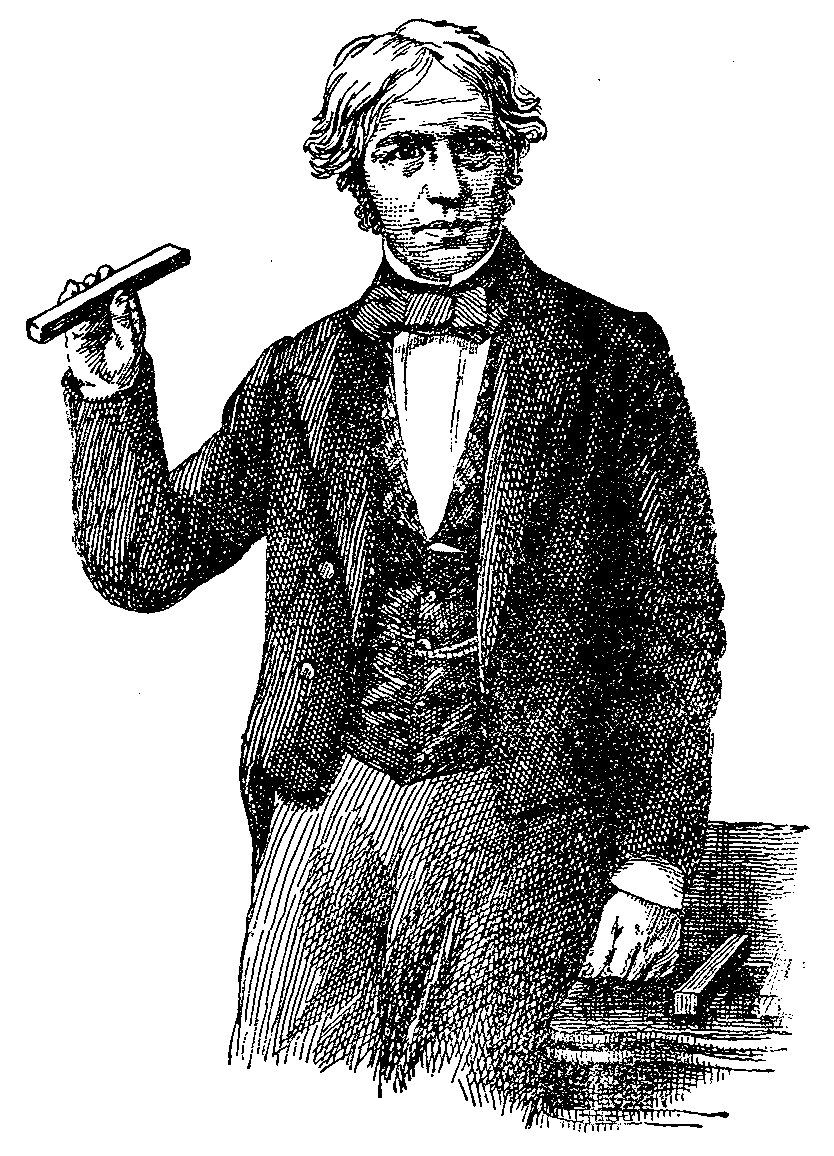 MICHAEL FARADAY. |
The new errand-boy at Mr. Riebau's, bookseller and stationer, of Blandford Street, Manchester Square, had just taken down the shutters of his master's shop one morning in the autumn of 1804. The shutters having been stowed away the boy was given a large parcel of newspapers to deliver, with injunctions to be careful to leave them at the right houses. In those days newspapers were often lent out, and after being delivered had to be called for again. It not unfrequently happened on Sunday mornings that the paper when called for was not ready, so that the boy had to go over the same ground twice. This was very irksome to the lad, his anxiety being to get home and tidy himself in order to accompany his parents to their place of worship. To save himself the double journey he would plead for the paper to be given to him, and wait patiently at the door until the late-risen customer had devoured his muffins and the news together.
It was a long and weary round; but after all, it was better than playing marbles in the street, or taking his baby sister for an airing round the Square. At any rate he was helping his parents (who were very poor) to keep himself and his little brothers and sisters, as his elder brother was doing. So thought young Michael Faraday; and he soon had good cause to feel glad at having found employment under a kind master such as Mr. Riebau proved to be.
At the time our story opens Michael's parents were living in rooms over a coach-house in Jacob's Well Mews, Charles Street, Manchester Square. Robert Faraday had very bad health, and found it a difficult matter to support his family by working as journeyman for a firm in the neighbourhood. During the distress of 1801, when the price of corn rose to over £q a quarter, the Faradays, in common with numbers of poor families at that period, received parish relief, and Michael, who was then nine, received for his share one loaf a week, and had to make it last for that time. Hence there was a necessity for the boys becoming wage-earners at an early age, and Michael in his turn, on reaching his twelfth year, and having received some rudimentary, instruction at a common day-school, was sent on trial for one year to the shop of Mr. Riebau, the bookseller of Blandford Street.
It was a small beginning, but Michael soon found his interest awakened in connection with his master's stock-in-trade. Being surrounded by books and having to handle them constantly, he grew familiar with their titles first and afterwards was led to taste their contents. When his year's trial came to an end he was bound apprentice to the bookbinding trade, and the indenture of apprenticeship contained this testimony to his conduct: "In consideration of his faithful service no premium is given." He writes of these early days:—"Whilst an apprentice I loved to read the scientific books which were under my hand." Amongst others, Mrs. Marcet's Conversations in Chemistry excited his interest and occupied his spare moments. Watts' On the Improvement of the Mind made him think, and an article on Electricity in the Encyclopedia Britannica, which he read as he bound the volume, first turned his attention seriously to science. He was called upon to bind other books of a scientific kind, such as Lyon's Experiments on Electricity and Boyle's Notes about the Producibleness of Chymicall Principles; and dipped into them as he bound them.
About this time, he tells us, "I made such simple experiments in chemistry as could be defrayed in their expense by a few pence per week, and also constructed an electrical machine, first with a glass phial, and afterwards with a real cylinder, as well as other electrical apparatus of a corresponding kind." He had thus made a real beginning in science, and these first steps led on to others. Riebau seems to have taken a friendly interest in his studies and to have encouraged him by allowing him to read the books he wanted.
One day early in the year 1810 Faraday's eye caught an announcement in a shop window to the effect that a course of lectures on Natural Philosophy would be given by Mr. Tatum at his house No. 53 Dorset Street, Fleet Street, at 8 o'clock; price of admission one shilling per lecture. His weekly pittance did not allow of his treating himself to this intellectual feast, but his elder brother Robert, the blacksmith, good-naturedly put the first shilling into his hand, and followed this up by other like gifts from time to time; so that Michael joyfully wended his way to Dorset Street upon some dozen occasions between February, 181 o, and September, 181 1. He took full notes of what he heard, afterwards writing out each lecture at length. To illustrate his notes, as he had no knowledge of drawing, he sought the help of an artist named Masquerier, a French refugee, who lodged at Riebau's, and who had acquired some fame by painting the portrait of Napoleon. Masquerier took a liking to Faraday, and not only gave him some lessons but lent him a book on perspective, by the aid of which Faraday was enabled to make correct diagrams.
Tatum's house was the resort of numerous students—young and enthusiastic, as Faraday himself was—and here he made the acquaintance of Magrath, Newton, Huxtable, Nicol, and Abbott. With several of these he soon got on terms of friendship, and Benjamin Abbott, a young Quaker of good education, and holding the position of confidential clerk in a City house, became his most intimate friend and correspondent. Huxtable, who was a medical student, lent him books on chemistry. The picture of Faraday at this time is that of an earnest student, striving to educate himself in the face of poverty, though by no means struggling against other adverse conditions such as have assailed many young men of worth and ability; for Faraday had in his favour good health, natural energy, an absence of responsibility outside his own requirements, and kindly disposed friends—circumstances, all of them of powerful effect in assisting his progress when weighed against mere shortness of money.
He possessed a natural capacity for making friends and of enlisting sympathy, and thus it came about that Mr. Dance, a member of the Royal Institution, and one of Riebau's customers, was so favourably impressed by what he had observed of Faraday's diligent pursuit of science, that he procured him admission to the last four lectures given by Sir Humphry Davy at the Royal Institution (February to April, 1812). This privilege Faraday made the best use of by taking full notes of each lecture at the time and writing them out fully and fairly afterwards, introducing his own sketches in illustration. The fire which had already been kindled now burnt fiercely within him, and his longing for a scientific occupation led him to write a letter to Sir Joseph Banks, then President of the Royal Society, begging to be employed in some capacity in science. Needless to say, "No answer" was the reply left with the porter. But more than this dash of cold water was needed to quench Faraday's desire.
His time expired October 7, 1812, and he became a journeyman bookbinder under a disagreeable master, so that he longed more than ever to be free. To Huxtable he wrote: "With respect to the progress of the sciences I know but little, and am now likely to know still less; indeed, as long as I stop in my present situation (and I see no chance of getting out of it just yet), I must resign philosophy entirely to those who are more fortunate in the possession of time and means." He is in "very low spirits". At last he took the bold step of writing to Sir Humphry Davy, expressing his wishes, and begging that if opportunity came in his way the great man would favour his views. At the same time he sent the bound notes of Davy's lectures. Davy's reply (December 24, 1812) was "immediate, kind, and favourable". He was obliged to go out of town till the end of January, but he would see Faraday on his return. The interview took place at the Royal Institution. Davy advised him to stick to his business as a bookbinder, and promised to give him the work of the Institution as well as his own. Faraday had the wisdom to receive in a proper spirit advice which was both kindly meant and disinterested, and also the patience to await his opportunity. Nor had he to wait long, for in March the incident occurred which was to be the turning-point in his fortunes. The family were then living in Weymouth Street (No. 18), Portland Place, where James Faraday had died in 181o. One night as Faraday was undressing, the rattle of wheels awoke the echoes of the quiet street, a carriage and pair drew up at No. i8, and the footman having knocked loudly at the door delivered a note from Sir H. Davy. The next morning an interview took place, at which Davy offered Faraday the place of assistant in the laboratory of the Royal Institution, at a salary of twenty-five shillings a week, with two rooms at the top of the house. The late assistant had been summarily dismissed, and Faraday was duly installed in his post on March I.
In the autumn of this year he set forth with Sir H. Davy and his wife on their Continental tour. This pilgrimage—the opening of a new passage in Faraday's life—though in itself of short duration, by introducing him to scenes and people wholly new had the effect of widening his mind and correcting some of his ideas. Davy wished to travel, and had offered to take Faraday with him as his amanuensis. To Faraday, who had never travelled more than a few miles out of London, every mile of progress was a revelation. He kept a full journal of the tour, which Bence Jones says "is remarkable for the minuteness of the description of all he saw".
At Paris Davy's high name carried them everywhere, and Faraday was a spectator, as well as assistant and chronicler, at the interviews and experiments between Davy and the great scientific men of the capital. From Paris, where they stayed two months, the travellers proceeded through France to Montpellier, thence to Nice, and from Nice they crossed the Alps to Turin. The next place of lengthened stay was Florence, whence they went to Rome.
Faraday's powers of observation, exercised to the full, allowed nothing to escape. We get word-portraits of the postilion in jack-boots; the thin pigs of Morlaix (capable of outrunning their post-horses for a mile); and a thumb-nail sketch of the First Napoleon visiting the Senate in full state—"He was sitting in one corner of his carriage, covered and almost hidden from sight by an enormous robe of ermine, and his face over-shadowed by a tremendous plume of feathers that descended from a velvet hat." At Florence they made the "grand experiment of burning the diamond" by the sun's heat in a globe filled with oxygen gas by means of the Grand Duke's gigantic lens, and proved that the invisible result was carbonic acid. They visited and examined the springs of inflammable gas at Pietra Mada and the molten minerals of Vesuvius. The lighter side of the tour is illustrated by the Carnival Week at Rome, into the follies of which he entered with full enjoyment, "and between us we puzzled them mightily, and we both came away well entertained."
On his return to England in 11815 Faraday was re-engaged at the Royal Institution as assistant in the laboratory and mineralogical collection and superintendent of apparatus, at a salary of thirty shillings a week and apartments. In his love for knowledge and his earnest search after it he rejoices at "the glorious opportunity I enjoy of improving in the knowledge of chemistry and the sciences with Sir H. Davy"—tempered by "I have learned just enough to perceive my ignorance", and "the little knowledge I have gained makes me wish to know more". His appreciation of Davy's genius and powers was unbounded. He had compared him with the French philosophers whilst helping him in his discovery of iodine; and he was just about to see him engage in those researches on fire-damp and flame, which ended in the glorious invention of the Davy lamp, and gave to Davy a popular reputation even beyond that which he had gained in science by the greatest of all his discoveries—potassium. Part of Faraday's duties was to copy Davy's rough MSS., and he carefully preserved the originals and bound them into volumes.
On January 17, 1816, Faraday gave his first lecture at the City Philosophical Society, the subject being the general properties of matter. He followed this up with six more lectures dealing mainly with chemical subjects during the year. These his earliest lectures he wrote out with great care, and the subjects—the unity, relationships, and nature of matter and force—were those which occupied his thoughts to the end of his life. In the same year he published his first contribution to science—a paper on an analysis of caustic lime from Tuscany—in the Quarterly Journal of Science. His time was now fully occupied with his duties, his experiments, and what he terms "school" work, i.e. the continuation of the system of self-teaching which he had begun long before, so that he had little spare time for social engagements, and had to plead work to clear himself of the charge of "deserting his old friends for new ones". In 1818 (says Tyndall) he experimented on "Sounding Flames", correcting and completing with great acuteness a previous investigation by the elder De la Rive. In 182o he sent to the Royal Society a paper On Two New Compounds of Chlorine and Carbon, and on a New Compound of Iodine, Carbon, and Hydrogen. This was the first paper of his to be honoured with a place in the Philosophical Transactions.
The year 1821 was that of Faraday's marriage to Sarah Barnard, the daughter of Mr. Barnard, a working silversmith of Paternoster Row, and the same year marks the beginning of Faraday's career as an independent discoverer. His first notable discovery, and his first success in electro-magnetic research—the field of his most fruitful discoveries—was the "production of the rotation of magnets and of wires conducting the electric current round each other". This is the descriptive title; it is filled shortly, the electro-magnetic rotations. He had resolved to investigate the subject, and as a means of disciplining himself for the work wrote a history of electro-magnetism down to that date, which was published in the Annals of Philosophy: During the writing of this sketch Faraday repeated for his own satisfaction almost all the experiments which he described. As a result he was led to the discovery of the true nature of the movement, and on Christmas Day, 1821, he led his wife into the laboratory and showed her for the first time the revolution of a magnetic needle round an electric current.
His next discovery of importance—the liquefaction of chlorine gas, in 1823—was the outcome of an inquiry into the nature of a substance which had long been regarded as the chemical element of chlorine in a solid state, but which Davy in 1810 had proved to be hydrate of chlorine, that is, a compound of chlorine and water. Faraday had analyzed this substance and written an account of its composition. This account he had submitted to Davy, who suggested the heating of the hydrate under pressure in a sealed glass tube. This was done. The hydrate fused at a blood-heat, the tube became filled with a yellow atmosphere, and was found to contain two liquid substances. Dr. Paris, the biographer of Davy, relates that he happened to enter the laboratory while Faraday was at work, and seeing the oily liquid in the tube, rallied the experimenter upon his carelessness in using soiled vessels. Later on in the day, Faraday filed off the end of the tube, whereupon the contents exploded and the oily matter vanished. The next morning Dr. Paris received the following note from Faraday:—
"Dear Sir,—The oil you noticed yesterday turns out to be liquid chlorine.
"Yours faithfully,
M. FARADAY.
He afterwards found that the gas could be liquefied by compression with a, syringe. The success of this experiment led to similar trials with other gases, and with a like result in each case. The results of these experiments, says Tyndall, went to prove that all gases are but the vapours of liquids possessing very low boiling-points. A. paper on the first investigation was read before the Royal Society on April 10, 1823, and published in Faraday's name in the Philosophical Transactions. Twenty years later Faraday again took up this subject and considerably expanded its limits. In 1825 the Philosophical Transactions contained a paper by Faraday On New Compounds of Carbon and Hydrogen'; this paper contained the announcement of his important discovery of the substance called Benzol, "which, in the hands of modem chemists, has become the foundation of our splendid aniline dyes."
In February, 1825, Faraday's position at the Royal Institution underwent a change, and from being merely the assistant of Sir H. Davy and Professor Brande he was, on the former's recommendation, appointed by the managers Director of the Laboratory; at the same time, "because of his occupation in research," he was relieved of the duty of acting as chemical assistant at the lectures. His salary at this time was £100 a year. In January of the previous year he had been elected a Fellow of the Royal Society.
We now come to the greatest of Faraday's discoveries—the discovery of Magneto-Electricity and the production of Induced Currents. His notebook for 1822 contained this memorandum: "Convert magnetism into electricity." This, the relation of the magnet and the electric current, was the problem which he had set himself to solve, which he was to ponder for the ensuing ten years, and which during that time and while following up other lines of research, he was never actually to lose touch with. It was the problem which hinged on to his discovery of the magnetic rotations, as that discovery had hinged upon the discovery of Oersted. It had been found possible to produce magnetism from electricity—why, then, should not the converse be true?
Tyndall reminds us of Faraday's characteristic —that he never could work from the experiments of others, however clearly described—he hardly trusted himself to reason upon an experiment that he had not seen. This was why, in the autumn of 1831, he began to repeat the experiments with electric currents which, up to that time, had produced no positive results; and that he succeeded where others had failed was due, in a, great measure, to a power which he possessed in an extraordinary degree. "He united" (says Tyndall) "vast strength with perfect flexibility. His momentum was that of a river, which combines weight and directness with the ability to yield to the flexures of its bed."
We must pass quickly over the description of the manner in which the actual discovery of induced currents was brought about—the two wires, one "living", the other "dead"—the induced current showing itself in the dead wire by the movement of the galvanometer needle to which it was attached; but such movements (for there were two kinds) being limited to the moments of switching on and switching off the current, between which,, and while the current was flowing through the first wire, the needle remained motionless. The movement in either case was very slight, and the direction of the movement when the circuit was interrupted was contrary to that observed on the completion of the circuit. Slight and momentary as these movements were they sufficed to show Faraday that "the battery current through the one wire did in reality induce a similar current through the other; but that it continued for an instant only, and partook more of the nature of the electric wave from a common Leyden jar than of the current from a voltaic battery". Further experiments with differently constructed apparatus went to confirm this conclusion, and to show that these induced currents existed only when the "living" and "dead" wires were in motion; when neither was moved, no matter how close their proximity might be, no induced current was generated.
His next step, as his notebook entry of 1822 already quoted showed, was to discover the method of inducing electricity from the magnet (the converse of what he had already accomplished). He experimented with a welded iron ring surrounded by two separate coils of covered wire, and having magnetized the iron ring by an induced current sent into one section of the wire, he found the galvanometer needle connected with the other section sent spinning round several times. As before, the action was limited to the onset, or the closing, of the current—or in other words, to the magnetization or demagnetization of the ring. The effects obtained with the welded ring were also obtained with straight bars of iron, or, abandoning the use of iron, by merely thrusting a permanent steel magnet into a coil of wire. "A rush of electricity through the coil accompanied the insertion of the magnet; an equal rush in the opposite direction accompanied its withdrawal. The precision with which Faraday describes these results, and the completeness with which he defines the boundaries of his facts," says Tyndall, "are wonderful. The magnet, for example, must not be passed quite through the coil, but only half through; for if passed wholly through, the needle is stopped as by a blow, and then he shows how this blow results from a reversal of the electric wave in the helix (coil). He next operated with the powerful magnet of the Royal Society, and obtained with it, in an exalted degree, all the foregoing phenomena."
He was now prepared to attack a problem which had puzzled and baffled the greatest investigators abroad and at home—the meaning of Arago's discovery of 1824 that a disk of non-magnetic metal had the power of bringing a vibrating magnetic needle suspended over it rapidly to rest; and that on causing the disk to rotate the magnetic needle rotated along with it. "Faraday saw mentally the rotating disk, under the operation of the magnet, flooded with his induced currents, and from the known laws of interaction between currents and magnets he hoped to deduce the motion observed by Arago. That hope he realized, showing by actual experiment that when his disk rotated currents passed through it, their position and direction being such as must, in accordance with the established laws of electro-magnetic action, produce the observed rotation." He spun a disk connected with a galvanometer between the poles of the great magnet of the Royal Society, and thereby obtained a constant flow of electricity—the direction of the current being determined by the direction of the motion, the current being reversed when the rotation was reversed. "He now states the law which rules the production of currents in both disks and wires, and in so doing uses, for the first time, a phrase which has since become famous. When iron filings are scattered over a magnet, the particles of iron arrange them selves in certain determinate lines called magnetic curves. In 1831, Faraday for the first time called these curves 'lines of magnetic force'; and he showed that to produce induced currents neither approach to nor withdrawal from a magnetic source, or centre, or pole, was essential, but that it was only necessary to cut appropriately the lines of magnetic force."
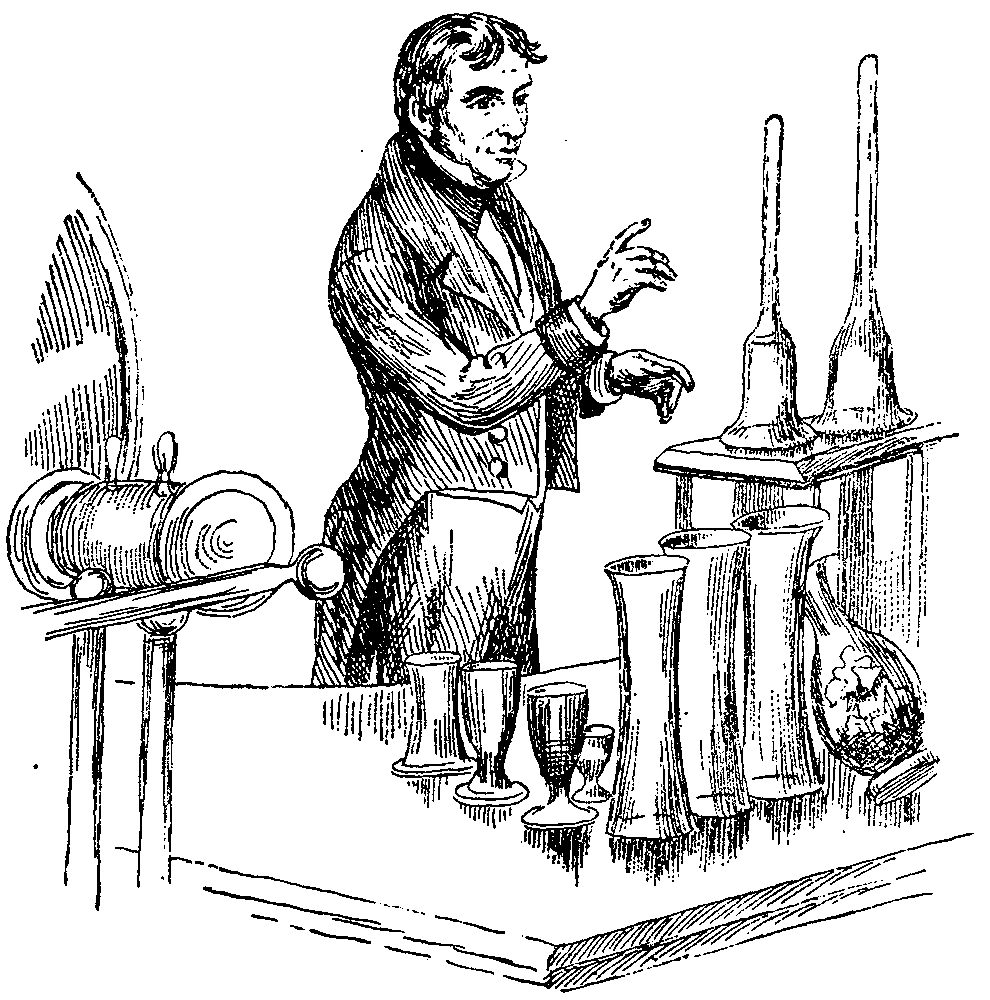 LECTURING AT THE ROYAL INSTITUTION IN 1835. |
The familiar arrangement of the iron filings upon the magnet, then, represented "lines of magnetic force". Cut these lines of force and you produce induced currents: here was the solution of the problem of the rotating disk and the following magnetic needle. The mind of Faraday expands with the idea. The earth itself is a great magnet—cut its lines of magnetic force, and induced currents will be set up. He spins a copper disk across the earth's lines of force, producing such currents; he describes the portions of the disk wherein no current could be produced by its motion. "He plays with the earth," says Tyndall, "as with a magnetic toy. He sees the invisible lines Along which its magnetic action is exerted, and sweeping his magician's wand across these lines evokes this new power."
In the short account we have given of his work we have scarcely advanced beyond the threshold of his discoveries in that department of science which occupied the best part of his working life; and we have only space left to mention his experiments in Electric Conduction, in which he proved that the self-same substance, conducts, or refuses to conduct, According as it is liquid or solid—the current, for example, which passes through water cannot pass through ice—and so on; his reformation of the technical language of electrical science by the invention of terms which have since become the terms of everyday use; his invention of the "Voltameter", based upon the measurement of the quantity of electricity which passes through a liquid by the quantity of gas evolved during the operation; his masterly demonstration of the source of the power in the voltaic pile, in which he showed that chemical action, and not mere contact of different metals, was the true source of voltaic power; and, finally, his important inquiry into the means by which electrical power is transmitted. In regard to the last-named subject, Faraday, says Tyndall, was always perplexed and bewildered by the idea of action at a distance: he contended that there must be a medium. In the case of the decomposition of a fluid he was certain that the current was propagated from particle to particle, and he became more and more impressed with the conviction that ordinary electric induction was also transmitted and sustained by the action of contiguous particles. "In our own day the idea of action at a distance is almost lost in the background, and it is held that both electric and magnetic actions, like those of light, are transmitted through an all-embracing medium."
In 1841 Faraday's health broke down, and for three years he did nothing—not even "reading on science". He went to Switzerland with his wife and brother-in-law.
In November, 1845, returning to England, he announced a new discovery under the title of The Magnetization of Light, and the Illumination of the Lines of Electric Force—which Tyndall translates into "the rotation of the plane of polarization by magnets and by electric currents", and in which he demonstrated the relations between magnetic force and light; but the experiments and their results cannot be described here. It was in this research that Faraday employed with success the famous "heavy glass" which he had made many years before at the Royal Institution. This heavy glass also played an important part in his next discovery—that of "Diamagnetism"—which followed quickly upon the last. By "diamagnetic" Faraday meant those bodies which were repelled by the poles of a magnet—as distinguished from those which were attracted, for which the term "magnetic" was reserved. Finding by experiment that a bar of his heavy glass was repelled when placed between the poles of a magnet, he proceeded to experiment with all kinds of substances—crystals, powders, resins, oils, salts, vegetable and animal tissues, aqueous solutions, etc.—and found that no known solid or liquid was insensible to magnetic power when it was developed in sufficient strength. Many of his experiments, especially those with crystals and flames, were extremely beautiful. He filled soap-bubbles with oxygen gas and found them strongly amenable to magnetic influence. He finally tried to find a "magnetic zero", or a substance which should be neutral to the magnet when excited to its uttermost. "After a series of experiments of the rarest beauty and precision" (says Tyndall) "he came to the conclusion that nitrogen was 'like space itself'—neither magnetic nor diamagnetic."
In old age, Lady Pollock describes him on his return to his lecture table in the Royal Institution after an absence caused by illness:—
"As soon as his presence was recognized, the whole audience rose simultaneously and burst into a spontaneous utterance of welcome, loud end long. Faraday stood in acknowledgment of this enthusiastic greeting, with his fine head slightly bent; . . . a certain resemblance to the pictures and busts of Lord Nelson . . . was always observable in his countenance."
Honours and appointments were freely bestowed upon Faraday following his discovery of magneto-electricity. In 1832 Oxford made him an honorary D.C.L., and at the same time he received the Copley Medal from the Royal Society—the highest award it had to bestow. In 1836 he was nominated by the Crown a Member of the Senate of the University of London, retaining this position for twenty-seven years.
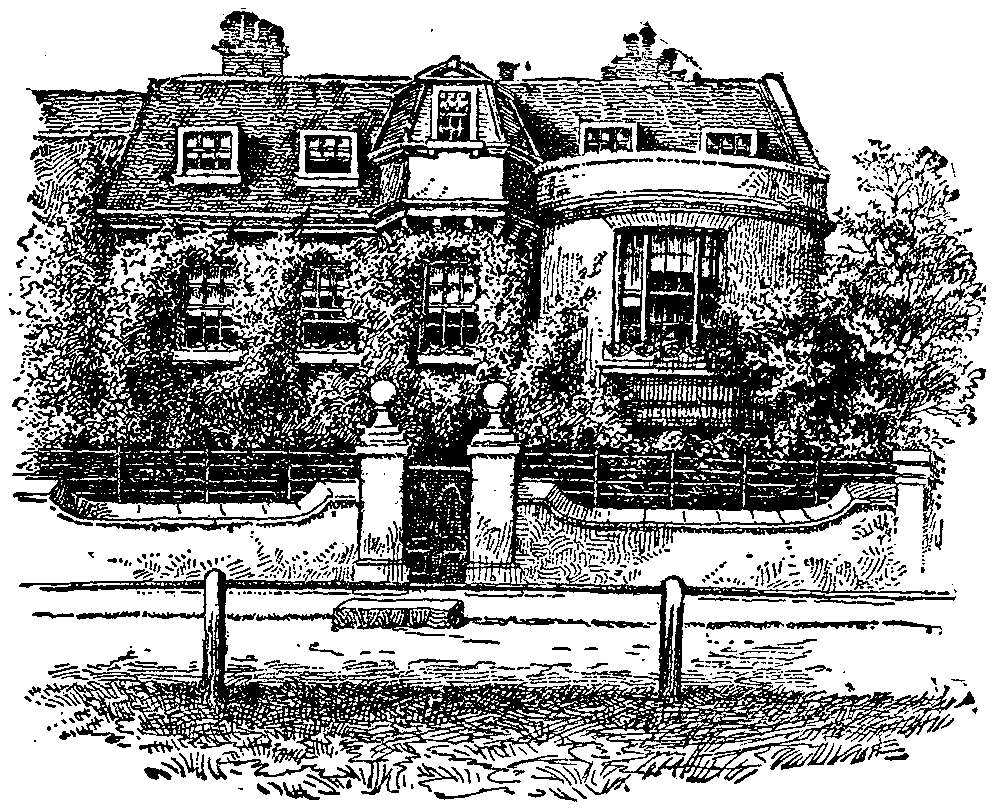 HOUSE AT HAMPTON COURT. |
From the date of his marriage up till 1858 Faraday and his wife had continued to reside at the Royal Institution; but in the latter year the Queen placed at his disposal for life a comfortable house at Hampton Court, on the Green. Faraday was delighted with this mark of Royal recognition, which it is said was conferred at the instance of the Prince Consort, and under his direction, though his name never appeared in the correspondence. The Hampton Court house remained the home of Faraday till his death.
His decline was heralded by a loss of memory, and this was followed by other symptoms of decaying power. "Barlow," he said to the friend who had long directed with him the affairs of the Royal Institution, but who was then half paralysed—"Barlow, you and I are waiting; that is what we have to do now; and we must try to do it patiently." On August 25, 1867, Faraday peacefully expired, seated in his armchair in his study. He was buried in Highgate Cemetery.
"Nature, not education, made Faraday strong and refined," wrote Tyndall. "A favourite experiment of his own was representative of himself. He loved to show that water, in crystallizing, excluded all foreign ingredients, however intimately they might be mixed with it. Out of acids, alkalis, or saline solutions, the crystal came sweet and pure. By some such natural process in the formation of this man, beauty and nobleness coalesced, to the exclusion of everything vulgar and low."
"His standard of duty," says Bence Jones, in conclusion, "was supernatural. It was not founded upon any intuitive ideas of right and wrong; nor was it fashioned upon any outward expediencies of time and place; but it was formed entirely on what he held to be the revelation of the will of God in the written Word, and (throughout all his life his faith led him to act up to the very letter of it."
Sir Charles Lyell
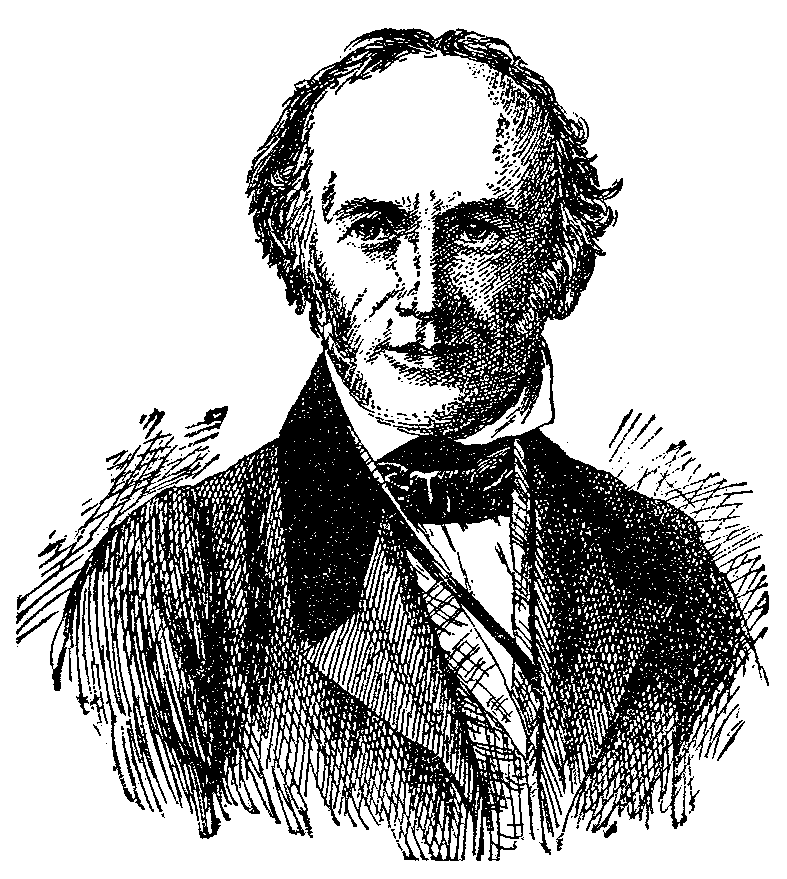 SIR CHARLES LYELL. |
At Old Sarum Camp a group of "new" boys from Dr. Radcliffe's School, Salisbury, stood at the mouth of a long deep subterranean tunnel. It was enclosed by mounds and trenches; long ago, the garrison had used it when it was necessary to fetch water from a river in the plain below, but whilst the newcomers shivered, listening to "all sorts of tales . . . how it grew steeper far down, and ended in a pool of water. . . ." some of the older boys behind them, knocked off their hats, which immediately rolled out of sight. In the end, after crawling on hands and knees through a very dark cave, they found the hats, "greatly improved, of course, by knocking about upon dripping chalk and hard flints in their descent"; one of those boys was Charles Lyell, afterwards the great geologist, but he seems to have been much more concerned about the prospect of walking hatless through the streets of Salisbury, than about the calcedony and sparkling quartz which he might have seen in the piled-up flints!
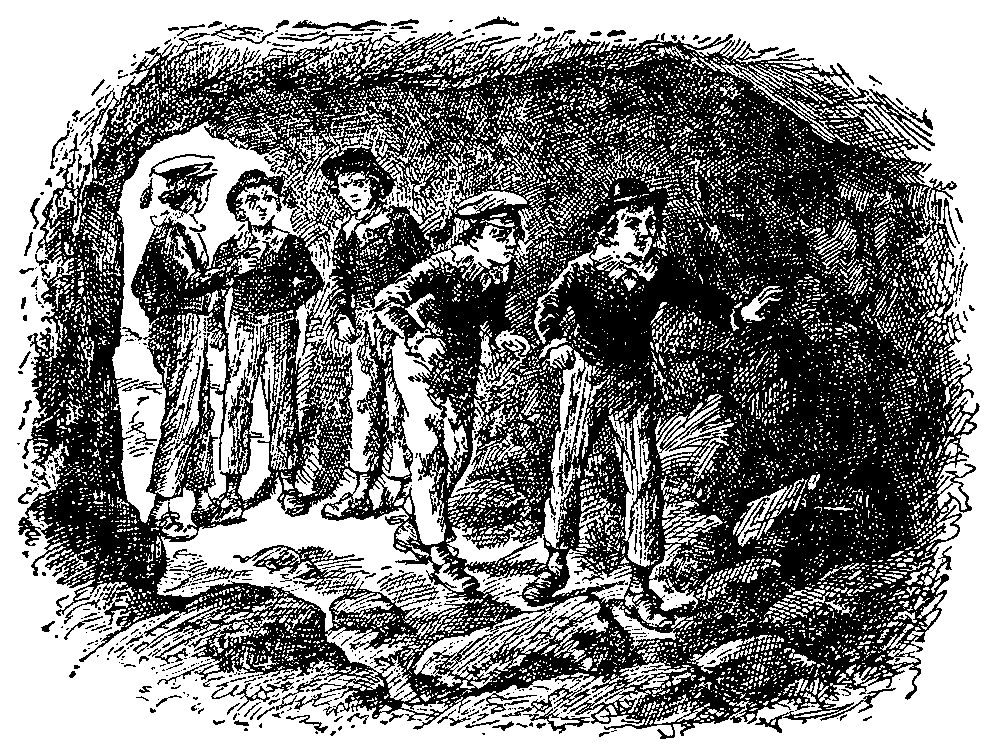 THE NEWCOMERS SHIVERED, LISTENING. |
Charles Lyell was born in 1797 at Kinnordy, Forfarshire, and the only remarkable thing about his infancy was that "it was more than twelve months before I cut a single tooth, and some old women . . . finding that my gums were very hard, and that I could eat well, very considerately tried to persuade my mother that her first-born would never have any teeth!" When Charles was three or four years old, his parents removed to Bartley Lodge, in the New Forest, and he was sent to school, at the age of seven and three-quarters, to Ringwood, where, before his first holidays, bonfires were lit, and bands played "Rule Britannia" to celebrate the victory of Trafalgar. Three years later, he went to Dr. Radcliffe's school, and the headmaster, "full of the chances of invasion," caused his boys to be drilled twice a week, armed with guns with tin barrels and locks. Charles, however, soon fell ill, and "as I did not like Sarum, I did not try to make light of it, and was taken home for three months ". He had "an excessive aversion to work unless forced to it", but was miserable when unemployed, and just as he began to long for school again, he found, in his father's library, some books about entomology. From that day, Charles Lyell wandered happily through the New Forest, confining his attention at first to butterflies and moths, but later, "became fond of watching the singular habits of the aquatic insects, and used to sit whole mornings by a pond, feeding them with flies, and catching them if I could."
When he returned to school, Lyell could seldom resist the temptation to spend his leisure hours in the same manner; his moths, when captured, were put between the leaves of his dictionary, so that when he looked out a word, two pages would be firmly glued together, and the worst of it was, other boys laughed at his "butterfly-hunting—a contemptuous appellation which . . . always nettled me."
It was now decided that Lyell should leave Salisbury, and go to a new and last school. There was an interregnum of half a year during which Charles and his brother, Tom, read Virgil with their father, and Charles, no doubt, did a good deal of "butterfly-hunting"; not that those sunshiny hours in the New Forest were wasted, for already he was beginning to learn some of the fundamental laws on which the study of all science depends.. Long afterwards he insisted on "making everything subordinate to his one ruling idea, that of establishing the principles of geology upon a thoroughly logical basis". It seemed hard, of course, that his hobby should bring him ridicule, and "hints that the pursuits of other boys were more manly" . . . "yet I knew most accurately to distinguish several hundred species, some very minute and still retained a very perfect recollection of nearly all, and could select the English butterflies and moths out of a foreign collection, and without the aid of books gave names to certain tribes, such as the 'fold-up moths', 'the yellow under-wings', etc., etc., which I afterwards found were natural genera or families, and my rule of thumb classification had thrown them into natural groups. . . . I could not see a rare moth without catching it, especially if not exposed to be laughed at by any witnesses of such a queer fancy. . . . The disrepute in which my hobby was held had a considerable effect on my character, for I was very sensitive of the good opinion of others, and therefore followed it up almost by stealth; so that although I never confessed to myself that I was wrong, but always reasoned myself into the belief that the generality of people were too stupid to comprehend the interest of such pursuits, yet I got too much into the habit of avoiding being seen, as if I was ashamed of what I did." Probably this bitter experience helped to teach Lyell toleration; in later life it was characteristic of him to advocate freedom of scientific thought, and whilst he "fearlessly pushed his principles to their legitimate conclusions", he never cared whether they were in agreement with accepted doctrines, or "cut directly across the grain of popular prejudice".
Eventually it was settled that Charles should enter Winchester College; he was now "past the age of twelve, and no longer reckoned one of the little boys". Here, during his second half-year, he fought with a boy named Tilt—and the fight lasted two days, five or six hours each day, "for we were pretty equal!" In the end Lyell got the better of his opponent, who was obliged to go to bed, and Lyell himself was very much hurt, and when he walked uphill found it necessary to lean on the arm of a friend.
Altogether he seems to have been often unhappy, with the "picks and cuffs I received," but comforted himself by trying to get a high mark in his class, and by this means gradually conquered his disinclination to work and his absence of mind. He won a prize, when he was sixteen years old, for English verses written in the metre of Scott's Lady of the Lake, and from that moment took it into his head that he should one day "do great things in a literary way".
At the age of seventeen Lyell matriculated at Exeter College, Oxford; Bakewell's Geology, found in his father's library, had already stimulated his imagination, but it was Dr. Buckland's lectures which finally attracted him to this science. "A new meaning had just been given to fossils by the publication, in 1816, of William Smith's Strata identified by Organized Fossils, in which the succession of faunas and their utility in determining the relative ages of deposits had been conclusively and for the first time pointed out. A great change was in consequence coming over the methods of observation in geology, and the study of rocks and minerals became only a small portion of the subject. The discovery of the differences between successive faunas opened up the quest of their origin and extinction, and thus a correct appreciation of the principles of geology became essential to the zoologist who would understand the relations between existing genera and species . . . the insistence that the processes of the past must be judged by those now in progress forms the keynote of the whole of Lyell's scientific work."
In the meantime Lyell attended Dr Buckland's lectures, taking careful notes of them, and in 1817, when he was staying with friends at Yarmouth, "had time to examine and consider the geological wonders" of the county. It was here that he learnt from Dr. Joseph Arnold, a naturalist who had discovered in Sumatra a new genus of plants, afterwards named Rafflesia Arnoldi, many curious and interesting facts about some recent changes in the coastline near Norwich. This Dr. Arnold struck him at first as being impenetrable—"the only subject on which he launches out is on Fossil Remains, and then only if you get him quite alone"; when he found, however, that Lyell's conclusions were exactly like his own, which nobody ever knew he had made, he . . . became in consequence very communicative, and quite another person. "The Doctor told me," Lyell added, in a letter to his father, "that he has always thought that it was the meeting of the great north current with that of the English Channel that burst open the Straits of Dover. With this I was delighted, for he did not know that to the very same cause both Werner, Humboldt, Buckland, and others, as well as myself, have been attributing the existence of Great Britain as to its insular and probably political situation. . . . Between Dr. Arnold's long catalogue of Norfolk fossils, and a map which I think I shall be able to make of this country, I flatter myself I shall be able to compile some interesting information for Buckland . . . I want to find chalk cliffs at Norwich, which must exist, I am confident. . ."
In 1818 Lyell made a tour with his father, mother, and two eldest sisters, in France, Switzerland, and Italy. In Paris he regretted that Cuvier, the famous naturalist, was at that time in England, but though it was impossible to hear him speak Lyell looked into his lecture-room, "filled with fossil remains, among which are three glorious relics of a former world, which have added several new genera to the Mammalia." Already he was convinced that "the first, second, and third requisite for a modern geologist" was—travelling, but he did not at this period formulate any startling geological theories; he was content to see, and wonder; and in 1819 took the degree of B.A., obtaining a second class in classical honours. In 1821 he became M.A., and two years later was appointed secretary of the Geological Society. After leaving Oxford, he had been entered at Lincoln's Inn, but suffered already from a weakness of the eyes which lasted still the end of his life; and one is irresistibly reminded of the childish illness which had compelled his removal from school—not to his regret l At all events, he gave up work, again travelling both in England and abroad; in 1825, his first published paper, "On Serpentine Dyke in Forfarshire," was printed in the Edinburgh Journal of Science, and perhaps it would be more accurate to regard his exertion, not so much as a holiday, but as a "feeling about" for the work he really wanted to do—just as, in childhood, he had learnt his school lessons only when forced to it, but spent whole days watching the habits of aquatic insects.
In the following year he accepted the foreign secretaryship of the Geological Society, and by this time he had met in Paris Cuvier, and by him was introduced to several geologists—and to Humboldt. Humboldt wrote Lyell, in 1823, "was not a little interested in hearing me detail the critiques which our geologists have made on his last geological work, a work which would give him a rank in science if he had never published aught besides. He made me a present of his work, and I was surprised to find how much he has investigated the details of our English strata." Humboldt was then hard at work at astronomy, and lived in a garret for the sake of study. In this year, also, Lyell had attended lectures in Paris on mining, geology, and zoology, but at his father's request he presently returned to the Temple. In 1827 he was actually on circuit—though his letters contain a great deal more information about insects, wayside flowers, and geological excursions, than about barristers and sessions. Next year he was again travelling, through Paris, Auvergne, and Padua to Naples. "The times were rough with Tripoli pirates still scouring the Mediterranean," but "Pompeii afforded me some good geological hints", and eventually he writes, in a letter from Catania, in Sicily: "I saw that same day [i.e. day of the Giant's Causeway] was on the mainland at the foot of Etna, and some peasants assured me that it contained 'roba di diluvio', so I hastened thither, and found 700 feet and more up Etna, in beds alternately with old lavas, sea-shells, fossils, but many I know of modern Mediterranean species. This is just what everyone in England, and at Naples and Catania, told me I should not find, but which I came to Sicily to look for—the same which I discovered in Ischia, and what, if my geological views be just, will be found near all recent volcanoes, and wherever earthquakes have prevailed for some thousand years past. I have set a man and a boy to work, at so much per day, and if they do their duty I shall find, when I return from Etna, something that will fix the zoological date of the oldest part of Etna." Later, he says, "I have made such progress in the geology of the isle, and have such a near prospect of completely mastering the difficult points, which no one ever did before, that I mean after the late fine weather to penetrate to Castrogiovanni. . . ." By mule-riding and walking, he saw enough in Sicily to convince himself that the "relative value of later deposits could be determined by the proportion of living to extinct molluscan species which they contained, and to this we owe his division of the Tertiary strata into eocene, miocene, and pliocene, which has met with worldwide acceptance".
In 1830 was published the first volume of Lyell's Principles of Geology, which had been long in preparation; it was "an attempt to explain the former changes of the earth's surface by references to causes now in action". This book passed through eleven editions during its author's lifetime, and it set forth the great doctrine of uniformitarianism, which "he nobly supported to the day of his death, although modified of course by the progress of scientific inquiry."
"The only explanation which seemed possible to him of the perpetual change of life revealed by successive strata was, that when the material conditions of any district became so changed that the old inhabitants died out, a new creative fiat went forth, by virtue of which the district was again peopled with fresh inhabitants especially adapted to its new conditions."
Believing the system of terrestrial change to be uniform and "that the modifications produced by man had been exaggerated", he laid stress on "a uniform order of physical events", and did "great service in substituting his views of the gradual extinction of species and the continuous creation of new ones for the catastrophes which even entered into the theories of Hutton, and were supposed to sweep off whole faunas at a time."
To some critics this appeal to existing causes has made Lyell's doctrine seem opposed to the theory of evolution. Later, when Darwin showed, however, in his Origin of Species, that causes were at work gradually modifying the characters of plants and animals, till they became adapted to the changing circumstances, Lyell would not shut his mind against this fresh evidence; he accepted Darwin's doctrine, though it meant the overthrow of much of his own work.
The aim of Principles of Geology is perhaps best summed up in a letter written to a friend early in the year before its publication: "I shall never hope to make money by geology, but not to lose, and tax others for my amusement; and unless I can secure this, it would in my circumstances be selfish in me to devote myself as much as I hope to do to it. . . . My work is in part written, and all planned. It will not pretend to give even an abstract of all that is known in geology, but it will endeavour to establish the principle of reasoning in science; and all my geology will come in as illustration of my views of those principles and as evidence strengthening the system necessarily arising out of the admission of such principles, which, as you know, are neither more nor less than that no causes whatever have from the earliest time to which we can look hack, to the present, ever acted, but those now acting; and that they never acted with different degrees of energy from that which they now exert. I must go to Germany and learn German geology and the language, after this work is published, and before I launch out in my tables of equivalents. . . . This year we have by our joint tour fathomed the depth and ascertained the shallowness of the geologists of France and Italy as to their original observations. . . . If I can but earn the wherewith to carry on the war, or rather its extraordinary costs, depend upon it, I will waste no time in bookmaking for lucre's sake. . ."
In 1831 Lyell was appointed Professor of Geology at King's College, London. He had, however, little inclination for lecturing, and to his annoyance the authorities excluded women from his second course; still, he was able to write in his journal to Miss Mary Horner, to whom he was engaged to be married: "I begin to flatter myself that I am . . . doing good to science by these lectures, which at all events are talked of over London, but politics are of course the chief and absorbing subject. . . . Your father will tell you what an actor-like sort of celebrity my lectures obtain me, but I will look to something more solid." In the same letter he adds triumphantly: "The Duke of Wellington has been unable to make a ministry: so much the better, so Lord Grey and the rest are back again,"—and a month later the Reform Bill became law.
In July he was married, and now settled at No. 16 Hart Street, London—which Charles Darwin called his "morning house of call". Dean Milman, Rogers, Hallam, and in fact most of the leading men in science, politics, and literature, met constantly at Hart Street. In 1835 Lyell was President of the Geological Society; three years later he published Elements of Geology, a book which he had had in mind since he first studied under Dr. Buckland, and in 1839 he visited the United States, lecturing to enormous crowds, and returning to write Travels in North America, with Geological Observations. Four times Lyell visited America, and during the Civil War his sympathies were strongly with the Northern States. In consideration of the distinguished situation he occupied, and his scientific reputation, he received the honour of knighthood in 1848, and shortly afterwards, as he records with a good deal of satisfaction, "I had a most agreeable geological exploring on the banks of the Dee, into which Prince Albert entered with much spirit."
The winter of 1853–54 was spent in the Canary Islands, and by this time Lyell had travelled, "hammer in hand, over half the earth's surface. . . . He pointed out the absurdity of drawing conclusions from phenomena observable in only one country." New ascents of Mount Etna were included in the year's work of 1854, and practically his last published work was On the Structures of Lavas which have consolidated on steep slopes. He was never tired of wandering—but the sea-shore pleased him most, and he would tread the shingle "now speaking of the great problems of earth's history, now of the little weed the wave left at his feet. . . . His mind was like the lens that gathers the great sun into a speck, and also magnifies the little grain we could not see before. He loved all nature."
He was President of the British Association in 1864, and in his address at Bath spoke of the thermal springs, and the phenomena of glaciers, alluding afterwards to the antiquity of man, a subject which was beginning to attract general attention. This year he became a baronet, but though in the last few months he discussed "Paleozoic and recent volcanic rocks" as vigorously as, forty-seven years before, he had discussed "changes in the coast line near Norwich", he died, at his house in Harley Street, on February 22, 1875—two years after his wife's death; he was buried in the nave of Westminster Abbey.
Lyell had been a good classical scholar, a lover of poetry, and keenly interested in politics; but he had given his life to Geology. It was necessary, owing to his short-sightedness, that much of his work should be dictated; Lyell would pace the room restlessly, or flinging himself on the sofa, as he spoke, absently trace patterns with his fore-finger on the carpet. He was methodical, however, in his hours for beginning and ending work—not that his work ever was ended, in one very important sense, for as Dean Stanley said of him: "from early youth to extreme old age it was to him a solemn religious duty to be incessantly learning, constantly growing, fearlessly correcting his own mistakes, always ready to receive and reproduce from others that which he had not himself. . . . It was the advancement of the philosophy of geology, not the advancement of self, that he was constantly seeking."
Sir James Clark Ross
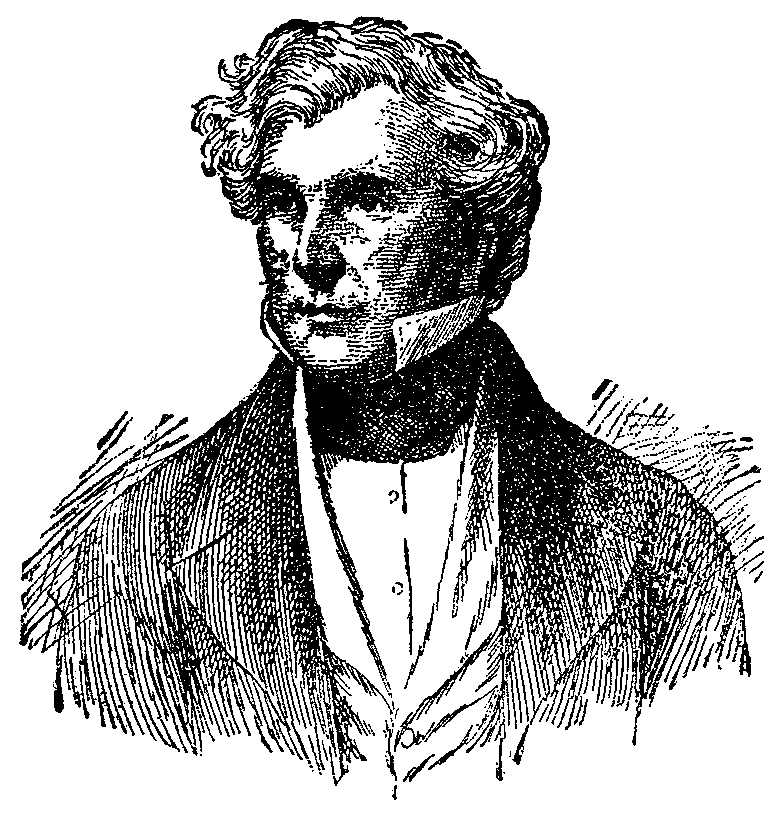 SIR JAMES CLARK ROSS. |
James Clark Ross, the hero of Antarctic scientific exploration, was born in the April of 1800—the son of George Ross, of Balsarroch, Wigtownshire, and the nephew of the Arctic navigator, Rear-Admiral Sir John Ross, who was to endeavour, in 1818, to make the North-West passage through Davis' Strait.
No doubt, like the boys in the storybooks, he longed "to go to sea", from his earliest years, and probably it was largely due to his uncle's stories of dangers and discoveries that, when he was twelve years old, James Clark Ross entered the Navy. Henceforth the sea was his education—one might almost say his home, and during the next six years, on his uncle's ship Briseis, and afterwards on the Actaeon and Driver, he must have learnt, not only mathematics, but navigation, and the elements of that mysterious science, terrestrial magnetism.
Before the year 1800 there had been no delicate instruments for measuring the forces, light, heat, electricity, and magnetism, included under one head—"transformations of energy." The earth, it was generally accepted, was a great magnet, and Benjamin Franklin had declared that in all iron bodies there existed a magnetic fluid, equally attracted by all their parts, and equally diffused—unless the equilibrium was disturbed by "a power superior to the attraction of the iron". This was "the fluid theory of magnetism", but the "molecular theory" declared that the atoms of a bar of iron are small magnets, which, when the bar is unmagnetized, point indiscriminately in all directions, but when it is magnetized "a certain number of these little magnets point in a different direction". The discovery of electrons, however, has shown us how each atom of iron acts as a minute magnet; the electric charges rotating round the atoms of iron (which we call electrons) constitute the electric current of each atom, and act like magnets.
In order to determine the magnetic force acting in every point of the earth's surface, three co-ordinates must be given: the declination of the force (or the deviation of the magnetic needle from the true north), the dip or inclination of the horizon, and the total intensity. As these magnetic constants differ in every place, and vary from hour to hour, from day to day, it is important that their "experimental determination" should be made at as many stations as possible; this was the object which scientific explorers kept in view. They were seeking, not merely excitement and novelty, but at every step there were charts and records to be made, and the search for knowledge led them further and further, studying the ever-varying conditions of Life. In the case of James Clark Ross, science and adventure seem always to have gone hand in hand, and in 1818 he was appointed to the Isabella, sailing from England in April, and following the route of Baffin's voyage in 1616. Besides the Isabella, a hired whaler, commanded by Captain James Ross, there was the Alexander, commanded by Lieutenant Edward Parry, and the chief importance of the expedition was that it vindicated Baffin's accuracy as a discoverer. Also, as a practical result, it showed the way to a valuable fishery in the North Water of Baffin's Bay, but whilst Captain Ross was of opinion that the inlets reported by Baffin were merely bays, Parry believed that to the westward there was a wide opening through Lancaster Sound of Baffin. Ross, attempting to proceed westward through this Sound, was deceived, presumably by a mirage, and on his return to England described the passage as barred by mountains, which he named Croker Mountains. Before he heard the last of those mountains, however, he must have been heartily sick of the name; at first his report was accepted as conclusive, he was promoted to post-rank, and in 1819 published A Voyage of Discovery made under the orders of the Admiralty in His Majesty's ships 'Isabella' and 'Alexander', for the purpose of exploring Baffin's Bay and inquiring into the possibility of a North-West passage.
Next year the Admiralty, learning that there were some doubts about the reality of the Croker Mountains, sent Parry in command of a new expedition, and James Clark Ross sailed with him. The two ships, Hecla and Griper, passed through Lancaster Sound, advancing westwards, with an archipelago on the starboard, since known as the Parry Islands. Parry was unfortunately hindered however, by "that impenetrable polar pack of vast thickness which appears to surround the archipelago to the north of the American continent", and was compelled to spend the winter on the south coast of Melville Island. Throughout the winter, Parry's sanitary precautions were admirable, and in 82o the expedition returned safely to England, bringing proof that Ross had judged too hastily. This proof led to an undue disparagement of Ross's work, and he was naturally anxious to make another attempt. In the meantime his nephew accompanied Parry's next expedition in the Fury, passing the first winter again on the Melville Peninsula, and the second among the Eskimo at Igloo-like, in 69° 20' N.; Parry also discovered a channel leading from the head of Hudson's Bay, which he called, after the two ships of his expedition, "Fury and Hecla Strait."
In 1823 the expedition returned; James Clark Ross was now a lieutenant, and no sooner was he safely on shore, than the thought of the straining ships, the ice and the snow, and the unknown northern lands, called him once more to the sea. Parry's friend, Franklin (afterwards Sir John Franklin, the greatest of Arctic explorers), had meantime made strenuous efforts to reach the northern shores of America by land; he had proceeded to the Great Slave Lake, and from the mouth of the Coppermine River explored 550 miles of coastline, enduring the greatest of hardships, from cold and hunger, on the return journey. It was now thought desirable that an attempt should be made to connect Cape Turnagain, the furthest point which Franklin had reached, with Parry's discoveries, but Captain Lyon, sailing in the Griper, was compelled to return unsuccessfully to England.
In 1824 three expeditions were organized, and James Clark Ross once more sailed with Parry to Lancaster Sound in the Fury, and was in her when she was wrecked down a great opening to the south, named Prince Regent's Inlet; Captain Beechey, however, succeeded in entering Behring's Strait, and Franklin, making a second journey to Arctic America, descended the Mackenzie River, exploring the coast for 374 miles to the westward, and finally returned in 1826.
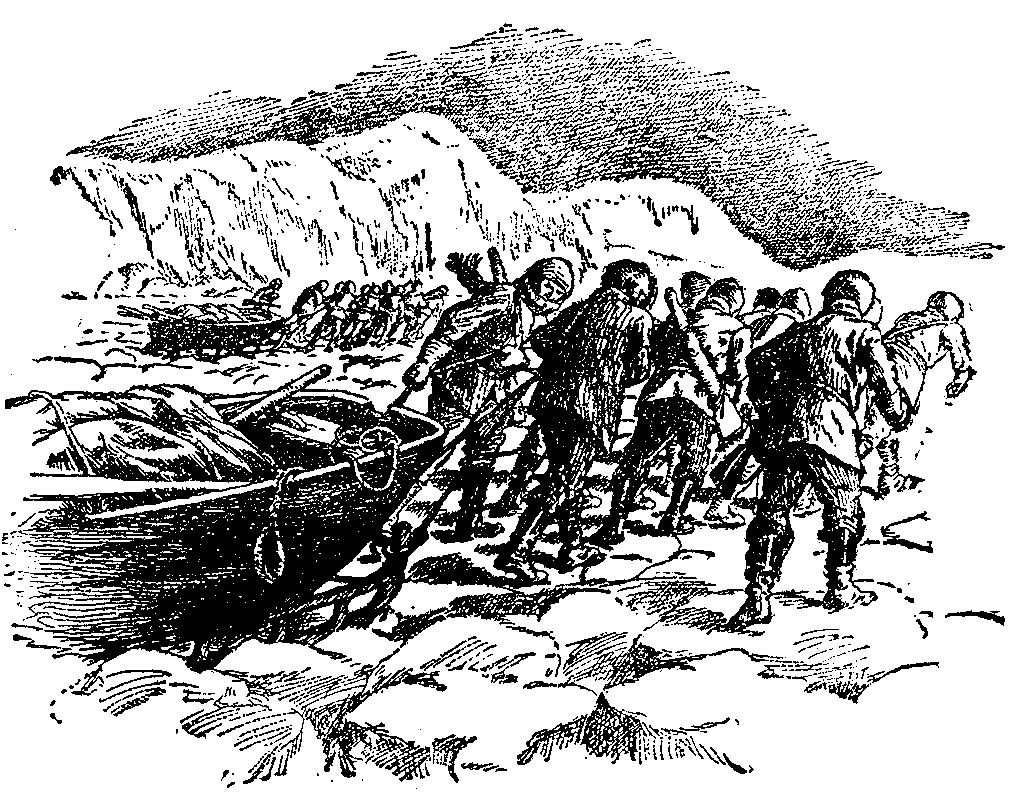 TRAVELING OVER ICE IN SLEDGE-BOATS. |
In the following year James Ross was again with Parry, this time on the Hecla, in an expedition to Spitzbergen, with the object of reaching the North Pole by travelling over ice, in sledge-boats. With twenty-four men Parry dragged two flat-bottomed boats as far as the latitude 82° 45' N., the experiment proving the futility of leaving the land and trusting to drifting pack. On his return James was made a commander, and in the meantime his uncle had not forgotten the affair of the Croker Mountains; he was extremely anxious to try his fortune once more, and in the Felix Booth expedition of 1829–33 Captain Ross the younger accompanied his uncle in the little Victory, on a private voyage of discovery, the funds being provided by Felix Booth, a wealthy distiller. They proceeded down Prince Regent's Inlet to the Gulf of Bothia, wintering on the eastern side of a land, named—obviously out of compliment to the distiller—Boothia Felix. During the many exploring expeditions of the summer months, James Clark Ross crossed this land, actually discovering, on June 1, 1831, the position of the North magnetic pole. (The magnetic needle, or the light bar of the mariner's compass, being magnetized, points always to the north; therefore the magnetic north is that point of the horizon which is indicated by the direction of the magnetic needle, and the magnetic poles are two points, nearly opposite, where the "dip" of the needle is 90°.)
He also discovered a land to the westward of Boothia, which was named King William Land, and reached the most northerly point, Cape Felix, on May 29, 1830. Unfortunately, the uncle and nephew could not get their ship out of its winter quarters; during the fourth winter, they were obliged to fall back on the stores left at Fury, Beach, and eventually were picked up, with their crew, by a whaler in Barrow Strait. In the meanwhile Sir George Back had been sent in search of them, but after wintering at the Great Slave Lake, and descending the Great Fish River, which is obstructed by many falls in the course of a rapid and tortuous course of 530 miles, he was obliged, for lack of supplies, to return, and in his absence Ross had already come safely to England.
The main principles of Polar exploration have been thus summed up—they are a sufficient commentary on the work of James Clark Ross, before the year 1839, when he commanded the English Antarctic Expedition:
- Arctic research is of the highest importance for a knowledge of nature's laws;
- geographical research is valuable in proportion as it opens the field of scientific research generally;
- the north pole has, for science, no greater significance than any other point in the higher latitudes, and is not in itself the object to be sought, but the exploration of the unknown area with a view to scientific results.
In 1838 James Clark Ross was employed by the Admiralty on a magnetic survey of the United Kingdom; and in the following year he was appointed to command an expedition fitted out for magnetic and geographical discovery in the Antarctic. Two old ships, the Erebus and the Terror, were sent under the command of James Ross, with Captain Crozier in the Terror. Leaving Chatham in September, they proceeded first to the Cape, and thence southwards to Kerguelen Island, which they reached in May, 1840—and carefully surveyed. Three months later Ross established a magnetic observatory at Hobart Town, and the second season's cruise began in November, from Tasmania. First the Auckland Islands and Campbell Islands were visited and surveyed—and if, in imagination, you intend to "put a girdle round the earth" you must of course follow the voyage of the Erebus on the map. On New Year's Day, 1841, the Antarctic Circle was crossed—in about 172° E. Soon afterwards the two ships were slowly and patiently grinding their way through the ice pack, and by January 1 they were clear of it, passing the highest latitude reached by Captain Cook, and sighting lofty peaks, covered with perennial snow.
Approaching nearer, there was a clear view of mountains rising to 10,000 feet, and "glaciers filling the intervening valleys and projecting into the sea". Ross had calculated that the South magnetic pole was in 76° S. and 145° 20' E., or about 500 miles southwest from the ship's position. The land interposed an insuperable obstacle to any nearer approach to it. Ross landed, however, though with great difficulty, owing to the strong tide and dangerous drifting ice, on a small island, named Possession Island, inhabited by myriad's of penguins, but no vegetation could be seen. On the 23rd they were again sailing south, in an unexplored sea, and thus passed the most southerly latitude previously reached. Sailing along the newly discovered coast, Captain Ross landed with much difficulty on an island named after Sir John Franklin; four days later they came upon an active volcano, 12,400 feet above the sea, emitting smoke in great profusion, and this they named Mount Erebus, whilst an extinct volcano to the eastward was named Mount Terror.
As far as the eye could reach, there was a perpendicular cliff of ice to the east, "perfectly level at the top, and without any fissures and promontories on its smooth seaward face." Above it could be seen the summits of a range of mountains, to which the name of Parry was given, and for 450 miles Ross followed the cliff, till, in the spring, new ice formed, but luckily a strong breeze enabled the ship to force its way through. The whole of the great southern land which Ross discovered was named Victoria Land, and after studying the stories of recent Antarctic explorers the value of his work becomes increasingly apparent.
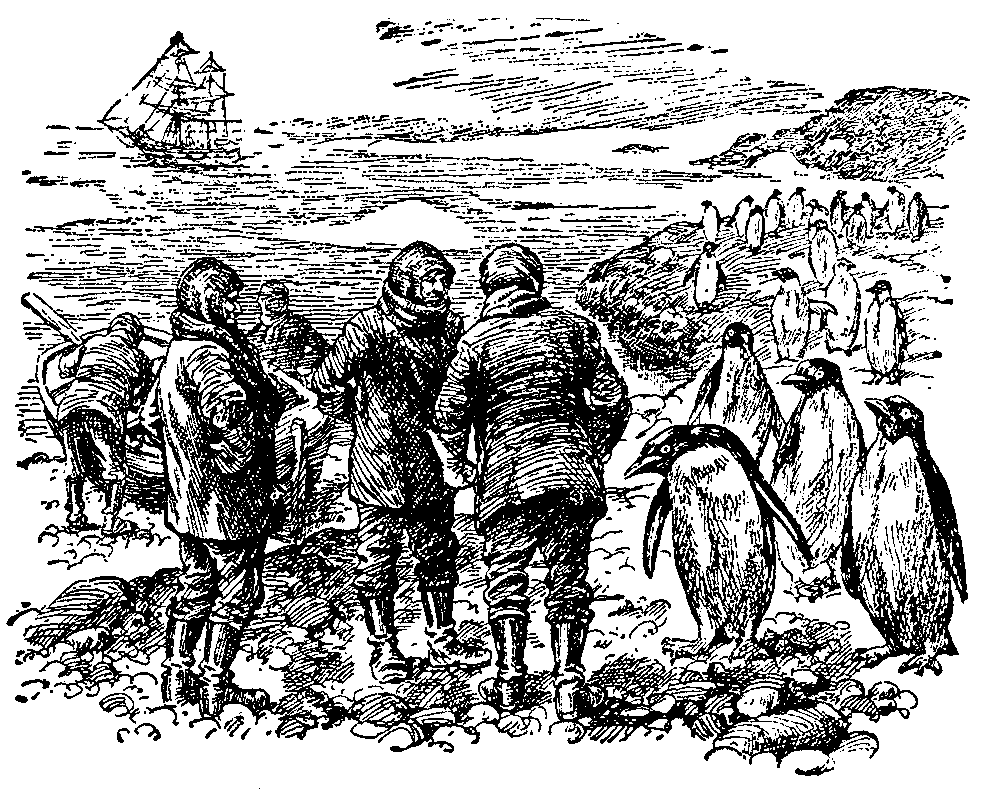 LANDED ON A SMALL ISLAND INHABITED BY MYRIADS OF PENGUINS. |
In November, 1841, the Erebus and the Terror again entered the ice pack, once more crossing the Antarctic Circle on New Year's Day. After very perilous navigation the Great Icy Barrier was sighted, and on February 23 the expedition reached a latitude of 78° 11' S., and after "imminent dangers in navigating through chains of huge ice-bergs", Captain Ross turned northwards, and wintered at the Falkland Islands. In February, next year about 160 miles of the pack were examined, and on March 11 the Antarctic Circle was recrossed for the last time. In September the expedition returned to England, and thus after four years of most diligent work, this ably conducted and quite unparalleled voyage to the south polar regions came to an end.
In this year James Clark Ross married Anne, daughter of Thomas Coulman, of Whitgift Hall, near Beverley in Yorkshire. It was said that an agreement with her family prevented him from accepting the command of the Franklin Expedition, which was in the first instance offered to him. She died in 1857, leaving three sons and one daughter.
The success of the Antarctic expedition, and the completion of the northern coastline by the Hudson's Bay Company's servants, gave rise in 1845 to a fresh attempt to make the passage from Lancaster Sound to Behring Strait. Sir John Franklin—Ross having refused the command—sailed with an expedition consisting of the gallant Erebus and Terror. In 1848 great anxiety was felt, and Ross was sent with two ships, the Enterprise and the Investigator, by way of Lancaster Sound, but was compelled to return without news of Franklin, though it was not till long after that hope was abandoned. The Franklin catastrophe led to 7,000 miles of coastline being discovered, securing very considerable additions to geographical knowledge, including the discovery that King William Land was an island. The scientific results of the many search expeditions proved invaluable, and also it was now established, beyond doubt, that similar catastrophes could, to a very large extent, be avoided, by making careful arrangements for a retreat, and leaving a depot ship within reach of the advancing expedition. We know, however, that the utmost prudence and foresight is not always sufficient to protect Polar explorers from the tragic but glorious end which, a few years ago, awaited Captain Scott and his companions.
In 1844 Ross was given the honorary degree D.C.L., Oxford, four years later he was knighted, and in 1847 he published A Narrative of a Voyage in the Antarctic Regions. He died in 1862, and it has been well said that there is no man to whom Antarctic scientific exploration owes more than it owes to Sir James Clark Ross.
Charles Darwin
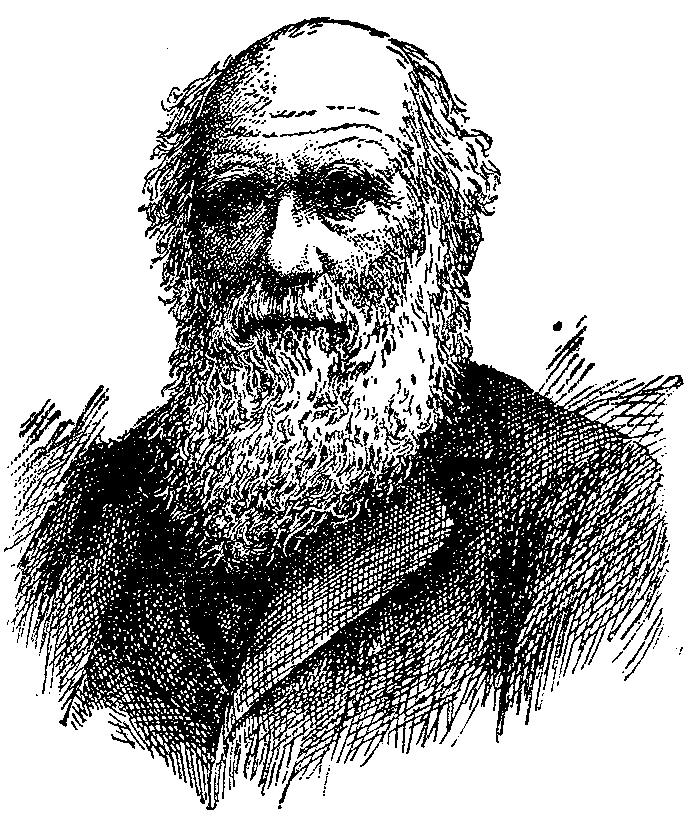 CHARLES DARWIN. |
"What a glorious day the 4th of November will be to me! My second life will then commence, and it shall be as a birthday for the rest of my life."
Thus wrote Charles Darwin to Captain Fitz-Roy, in October, 1831, when his appointment as naturalist on Board of the Beagle had been settled, and he was looking forward with keen interest to realizing his dream of visiting tropical countries and seeing what a tropical forest was like.
His reading of Humboldt had fired him with a desire for travel, and in April of this same year he had written to his second-cousin and fellow-collegian, W. Darwin Fox:
"At present I talk, think, and dream of a scheme I have almost hatched of going to the Canary Islands. I have long had a wish of seeing tropical scenery and vegetation, and, according to Humboldt, Teneriffe is a very pretty specimen."
Darwin's whole course of life had been completely changed by the chance which fortune had thrown in his way of serving as naturalist on the Beagle. Taste and inclination had made him a naturalist before this event, but no branch of science had been seriously followed.
Born on February 12, 18o9, at Shrewsbury, where his father, Robert Waring Darwin, practised as a physician, Charles Robert early developed a taste for natural history, more especially for collecting, the passion for which, he says, was very strong in him. When at eight years of age he was sent with his elder sisters to a day-school in Shrewsbury, he collected everything that came in his way, "shells, seals, franks, coins, and minerals." He also tried to make out the names of plants, and his mother had aroused his curiosity by telling him that he could find out the name of a plant by looking inside the blossom. This information he imported to a little schoolfellow, who was eager to know how it was done, but the secret was beyond Charles's powers to reveal. Inventiveness seems to have been likewise strongly developed in him as a boy, and he was given to concocting stories, or rather fibs, for the sake of causing excitement. Thus he relates, "I once gathered much valuable fruit from my father's trees and hid it in the shrubbery, and then ran in breathless haste to spread the news that I had discovered a hoard of stolen fruit." On another occasion he boasted to a schoolfellow that he could "produce variously coloured polyanthuses and primroses by watering them with certain coloured fluids, which was of course a monstrous fable, and had never been tried by me."
After spending a year at the day-school Darwin was sent as a boarder to Dr. Butler's great school in Shrewsbury, where he remained till he was sixteen. Beyond "living the life of a true school-boy", however, he derived little advantage from his schooling. "The school as a means of education to me," he says, "was simply a blank." In one thing only he excelled, and that was in learning verse by heart, getting off forty or fifty lines of Virgil or Homer whilst attending morning chapel; but as he forgot all he learnt in forty-eight hours this exercise was useless. His schoolmasters had a poor opinion of him as a scholar, and his father, in a fit of anger, declared that he "cared for nothing but shooting, dogs, and rat-catching, and would be a disgrace to himself and all his family".
Charles's brother Erasmus, however (who was his senior by more than four years), spent much of his time studying chemistry, for which purpose he had fitted up the toolhouse in the garden as a laboratory. Here the brothers worked together often till late at night, Charles being allowed to assist in the experiments as a servant. The subject interested him greatly, and he read up several large books on chemistry. In after-life he regarded this time as the best part of his education at school, for it showed him practically the meaning of experimental science. The chemical experiments got to be known at the school, where they earned for Charles the nickname of "Gas", besides bringing down upon him a public rebuke from the headmaster for wasting his time on such useless subjects.
Outside science, Darwin was fond of reading, more especially books of poetry. Shakespeare's historical plays were read in hours of leisure, seated in one of the old windows of the school. The earliest dawning of his wish to travel came with the reading of a book owned by one of his schoolfellows—The Wonders of the World—the statements contained in which were the subject of many disputes with his fellows. The passionate love of sport, which had its beginnings in the latter part of his school life, and which held him in its thrall during his early manhood, was no doubt an outgrowth of his deep interest in natural history pursuits. "I do not believe," he writes, "that anyone could have shown more zeal for the most holy cause than I did for shooting birds. How well I remember killing my first snipe, and my excitement was so great that I had much difficulty in reloading my gun from the trembling of my hands."
In October, 1825, Darwin, who was then sixteen was sent with his brother to Edinburgh University, the one to complete his medical studies, the other to begin them. The teaching was wholly by lectures, and these made no impression on Darwin's mind except by their intolerable dullness. Long afterwards he wrote of this time: "Dr.— made his lectures on human anatomy as dull as he was himself, and the subject disgusted me." "I shall ever hate the name of the Materia Medica, since hearing Duncan's lectures at eight o'clock on a winter's morning—a whole, cold, breakfastless hour on the properties of rhubarb!" But he always regretted that he was not urged to continue dissection, for "the practice would have been invaluable for all my future work". This, as well as his inability to draw, was regarded by him as an "irremediable evil". The sight of suffering patients in the hospital wards distressed him greatly, and he rushed away from two serious operations (they were long before the blessed days of chloroform) which he was called upon to witness, and never attended again.
In 1828, the idea of becoming a doctor having been abandoned, Darwin went to Cambridge and entered Christ's College, with the intention of studying for holy orders, and by associating with young men of a different stamp he acquired a taste for pictures and music. As regards music, he says that while he derived intense pleasure (including a shivering sensation down the backbone) from listening to a good performance, he was so utterly destitute of an ear as to be unable to hum a tune correctly. Of this defect his musical friends were not slow to take advantage by making him pass an examination to see how many tunes he could recognize. He came off badly at such trials, for even "God Save the King" puzzled him sorely when played more slowly than usual!
But his chief occupation, and that which seemed to fulfil best his keenness for out-of-door pursuits when not scouring across the country on horseback, was the collecting of beetles. He gives the following proofs of his zeal In securing specimens: "One day, on tearing off some old bark, I saw two rare beetles, and seized one in each hand; then I saw a third and new kind, which I could not bear to lose, so that I popped the one which I held in my right hand into my mouth., Alas! it ejected some intensely acrid fluid, which burnt my tongue so that I was forced to spit the beetle out, which was lost, as was the third one." By employing a labourer to scrape off the moss from old trees in the winter, and likewise to collect the rubbish at the bottom of the barges which brought reeds from the fens, he secured some very rare species. "No poet," he says, "ever felt more Delighted at seeing his first poem published than I did in seeing, in Stephen's Illustrations of British Insects, the magic words, 'captured by C. Darwin, Esq.'"
In his final B.A. examination he was fourth on the list, and in 1831 he was offered an appointment on the Beagle. Captain Fitz-Roy, who had been engaged by the Government to survey the southern extremity of America, required a companion who would be qualified to act as naturalist with the expedition, the ship being fitted out expressly for scientific purposes combined with the survey. The captain was represented as a young man of pleasing manners and very zealous in his profession. Though no salary was proposed, the naturalist would be given an official appointment and every accommodation, while the ship would be at his disposal for natural history researches. The object of the voyage was to complete the survey of Pantagonia and Tierra del Fuego, commenced under Captain King in 1826 to1830; to survey the shores of Chile, Peru, and some islands in the Pacific; and to carry a chain of chronometrical measurements round the world. The Beagle is described as a "a well-built little vessel, of 235 tons, rigged as a barque, and carrying six guns," and in after years Darwin used to say that it was the absolute necessity of tidiness in the cramped space on the Beagle that helped to give him his methodical habits of working.
His letters contain glowing descriptions of tropical scenery. Writing from Rio de Janeiro, in June 1832, he says: "We have already seen Teneriffe and the Great Canary; St. Jago, where I spent three most delightful weeks, reveling in the delights of first naturalizing a tropical volcanic island; and besides other islands, the two celebrated ports in the Brazils, viz. Bahia and Rio. I was in my hammock till we arrived at the Canaries, and I shall never forget the sublime impression the first view of Teneriffe made on my mind."
Geology, which of all the branches of natural science had first interested him least, now occupied the largest share of his attention. He writes to Henslow: "Tell Professor Sedgwick he does not know how much I am indebted to him for the Welsh Expedition; it has given me an interest in geology which I would not give up for any consideration." And to another college friend, C. Whitley: "I find in geology a never-failing interest, as it has been remarked, it creates the same grand ideas respecting this world which astronomy does for the universe." To his cousin, W. D. Fox, he writes: "I am glad to hear you have some thoughts of beginning geology. I hope you will; there is so much larger afield for thought than in the other branches of Natural History. J am become a zealous disciple of Mr. Lyell's views, as known in his admirable book. . . . Geology is a capital science to begin, as it requires nothing but a little reading, thinking, and hammering."
On October 2, 1836, the Beagle arrived at Falmouth, and two days later Darwin found himself at Shrewsbury after an absence of five years and two days. From this date till his marriage in January, 1839, he was busily at work arranging his collections and notes. "These two years and three months (he says) were the most active ones I ever spent, though I was occasionally unwell, and so lost time."
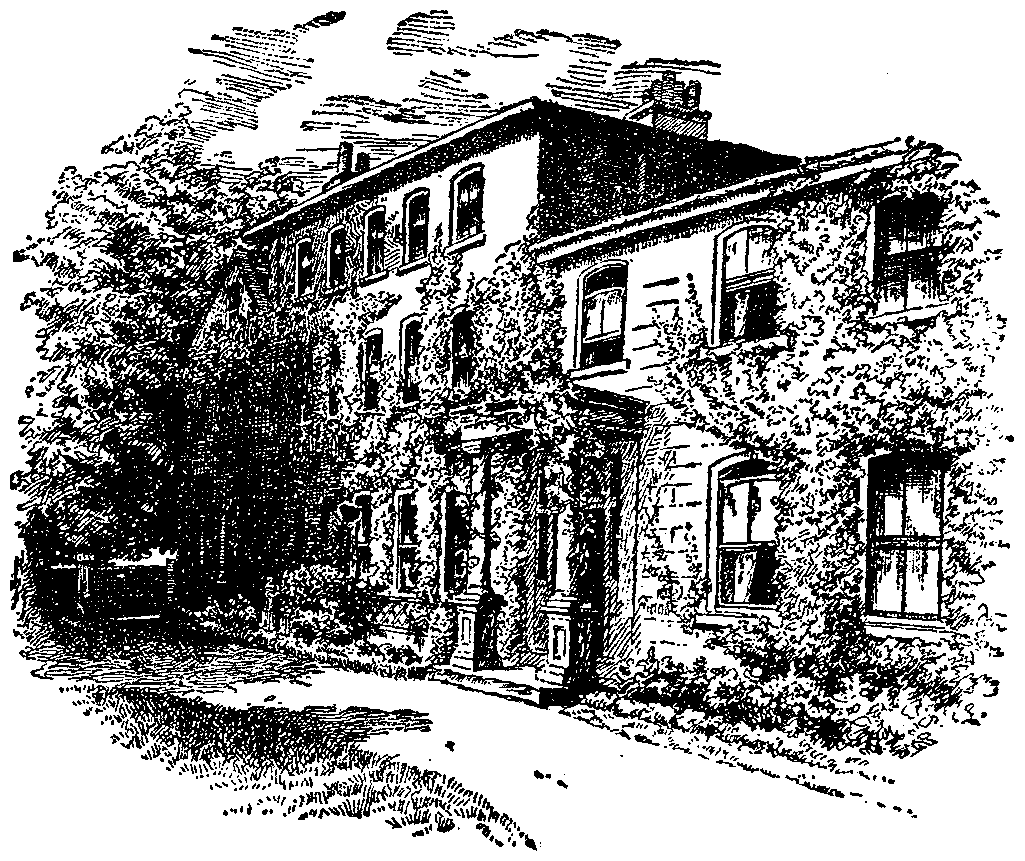 HIS HOUSE AT DOWN, KENT. |
On January 29, 1839, he married his cousin, Emma Wedgwood, the daughter of his uncle Josiah Wedgwood, and the granddaughter of the founder of the Etruria Pottery Works. The first few years of their married life were spent in London, at No. 12 Upper Gower Street. His health, however, necessitated frequent short holidays, the result of which seemed to be to convince him that work was the only cure for his discomfort. "I have derived this much good," he wrote after one of these absences, "that nothing is so intolerable as idleness." It was finally determined to leave London and settle in the country, and in 1842 he removed with his family to a house at Down, in Kent, which at that time was distant from town some twenty miles by coach.
Darwin had kept a careful journal of the voyage, and the intervals of arranging and classifying his specimens were devoted to preparing the MS. for publication. The Journal and Remarks appeared in 1839 as the third volume of Captain Fitz-Roy's Narrative. In 1845 the Journal was republished (with corrections) as a separate volume, under the title of Journal of Researches into the Natural History and Geology of the Countries visited during the Voyage of H.M.S. Beagle round the World, under the Command of Capt. Fitz-Roy, R.N. From having been buried in the official narrative, the book now came before the public as an independent work of travel, and its success was at once established. Darwin in his Autobiography says of this book: "The success of this my first literary child always tickles my vanity more than that of any of my other books."
He was now free to give his undivided attention to a subject which had been fermenting in his mind for many years, and which under his masterly treatment was destined to form not only the greatest achievement of his life, but also the greatest work on natural philosophy which the present age has produced. From September, 1854; he says,
"I devoted my whole time to arranging my huge pile of notes, to observing, and to experimenting in relation to the transmutation of species. During the voyage of the Beagle I had been deeply impressed by discovering in the Pampean formation great fossil animals covered with armour like that on the existing armadillos; secondly, by the manner in which closely allied animals replace one another in proceeding southwards over the continent; and, thirdly, by the South American character of most of the productions of the Galapagos archipelago, and more especially by the manner in which they differ slightly on each island of the group; none of the islands appearing to be very ancient in a geological sense.
"It was evident that such facts as these, as well as many others, could only be explained on the supposition that species gradually become modified; and the subject haunted me. But it was equally evident that neither the action of the surrounding conditions nor the will of the organisms (especially in the case of plants) could account for the innumerable cases in which organisms of every kind are beautifully adapted to their habits of life—for instance, a woodpecker or a tree-frog to climb trees, or a seed for dispersal by hooks or plumes. I had always been much struck by such adaptations, and until these could be explained it seemed to me almost useless to endeavour to prove by indirect evidence that species have been modified."
After his return to England it occurred to him that by following the example of Lyell in Geology, and by collecting all facts which bore in any way on the variation of animals and plants under domestication and nature, some light might perhaps be thrown on the whole subject, and it was on the advice of Lyell, in 1856, that he began to write an abstract of his views on a scale three or four times as extensive as that which was afterwards followed in the Origin of Species. His letters to his correspondents tell us a good deal about his doings during this period. His time is fully occupied with his writings, and with breeding pigeons, experiments with floating seeds in salt water (to illustrate the distribution of plants), preparing skeletons and measuring the bones of different animals at different ages, and so on. He is comparing the structure of animals at different ages, and writes to Fox: "Should an old wild turkey ever die, please remember me; I do not care for a baby turkey, nor for a mastiff. Very many thanks for your offer. I have puppies of bull-dogs and greyhounds in salt, and I have had cart-horse and race-horse young colts carefully measured. Whether I shall do any good I doubt."
Darwin got through about half of his Abstract on the enlarged scale begun in 1856. "But" (he says) "my plans were overthrown, for early in the summer of 1858 Mr. Wallace, who was then in the Malay Archipelago, sent me an essay On the Tendency of Varieties to depart indefinitely from the Original Type; and this essay contained exactly the same theory as mine. Mr. Wallace expressed the wish that, if I thought well of his essay, I should send it to Lyell for perusal."
As may be imagined, this extraordinary coincidence of ideas in the minds of the two naturalists was something of a blow to Darwin, whose only consolation was the knowledge that he owed none of his own thoughts to his rival. In the letter to Lyell accompanying the Wallace essay, Darwin says "Your word's have come true with a vengeance—that I should be forestalled. . . . I never saw a more striking coincidence; if Wallace had my MS. sketch written out in 1842, he could not have made a better abstract I Even his terms now stands as heads of my chapters. Please return me the MS., which he does not say he wishes me to publish, but I shall, of course, at once write and offer to send to any journal. So all my originality, whatever it may amount to, will be smashed, though my book, if it will ever have any value, will not be deteriorated; as all the labour consists in the application of the theory."
Eventually the two papers were read together at a meeting of the Linnean Society on July 1, 1858. "The interest excited was intense," writes Sir J. Hooker, "but the subject was too novel and too ominous for the old school to enter the lists, before armouring," and the joint papers were afterwards published in the Society's Journal, but attracted very little attention, owing no doubt to the abbreviated form in which the theory as presented.
Darwin now set to work to prepare a summary, or as he called it abstract, of his previous extended work for publication; and after thirteen months' hard labour he completed the MS. on this reduced scale. The book was published on November 24, 1859, under the title, On the Origin of Species by means of Natural Selection, or the Preservation of Favoured Races in the Struggle of Life.
The success of the book was instantaneous: the first edition of 1,250 copies being sold by Murray on the day of issue. A second edition of 3,000 copies was at once prepared, and was published in January, 1860; this likewise was soon disposed of, and other editions rapidly followed. By 1876 16,000 copies of the book had been sold in England alone, and it was translated into almost every European tongue. "Even an essay in Hebrew appeared on it, showing that the theory is contained in the Old Testament!" Darwin himself attributed its success (from the scientific standpoint) to the fact that "innumerable well-observed facts were stored in the minds of naturalists ready to take their proper places as soon as any theory which would receive them was sufficiently explained".
Only the briefest description of Darwin's great work can here be attempted; and this description must be limited to the main idea on which the argument is based, leaving it to the reader who desires to follow up the subject to do so by careful study of the book itself.
In the first place a few words must be said regarding the methods adopted by man in controlling the production of domesticated animals and plants. This control has been exercised in two ways, viz. consciously and unconsciously. In the first case man selects for breeding purposes those individuals which present the modifications he requires; and by keeping strictly to this rule of breeding only from selected individuals and rejecting all others, he gradually alters the stock.
In the second case the breeder works upon a different plan. He merely chooses the best Individuals, or those which in his eyes represent the most perfect type of the animal; and by breeding only from such individuals and from their offspring, he gradually improves the stock. This is Unconscious Selection.
What does Darwin mean by "Natural Selection?" In the first place, species in a state of nature, like domesticated animals and plants, though in a lesser degree, are liable to vary; the variations thus produced tend to be inherited by their offspring at a corresponding, or somewhat earlier, age. Every species tends to multiply to an unlimited extent, and produces a Tar greater number of offspring than can possibly survive. This over-production involves a struggle for existence between the progeny of rival species.
Natural Selection acts by preserving such variations as are serviceable to the organism and destroying those which are useless or injurious. The manner in which it does this may be explained by supposing the individuals of a species to vary, to ever so slight an extent, in a direction which gives the possessors some advantage over their rivals in the struggle of life; if these beneficial variations are transmitted to the next generation, it follows that the members of this endowed species will stand a better chance, not only of surviving, but also of beating their rivals out of the field and spreading themselves over a wider area. This result of the action of Natural Selection Darwin calls the "Survival of the Fittest". It implies that those organisms only which are sufficiently well adapted to their surroundings to hold their own in the battle of life will succeed in transmitting their characters to their progeny, and will thus give rise to a race of beings more and more capable in each succeeding generation of withstanding changes in the physical conditions of the country and of resisting the competition of other and unequally adapted forms. At the same time the unsuccessful competitors, by being reduced in numbers, will in the end be exterminated.
There are many eloquent passages in the book, such as that in which the descent of organic beings—with their struggles, their modifications, and their vicissitudes—is likened to a great tree whose outer-most extremities are still fresh and budding, whilst all its past history lies buried in the great limbs below and in the dead and fallen branches which strew the ground. But no passage perhaps is more eloquent, or at the same time serves better to epitomize the whole argument, than that with which Darwin closes his volume, and with which we may conclude this brief and imperfect sketch of his theory:
"It is interesting to contemplate a tangled bank, clothed with many plants of many kinds, with birds singing on the bushes, with various insects flitting about, and with worms crawling through the damp earth, and to reflect that these elaborately constructed forms, so different from each other, and dependent upon each other in so complex a manner, have all been produced by laws acting around us. These laws, taken in the largest sense, being Growth with Reproduction; Inheritance, which is almost implied by reproduction; Variability from the indirect and direct action of the conditions of life, and from use and disuse; a Ratio of increase so high as to lead to a Struggle for Life, and as a consequence to Natural Selection, entailing Divergence of Character and the Extinction of less-improved forms. Thus, from the war of nature, from famine and death, the most exalted objects which we are capable of conceiving, namely, the production of the higher animals, directly, follows. There is grandeur in this view of life, with its several powers, having been originally breathed by the Creator into a few forms or into one; and that, whilst this planet has gone cycling on according to the fixed law of gravity, from so simple a beginning endless forms most beautiful and most wonderful have been and are being evolved."
In 1871 appeared The Descent of Man—the expression of the author's conviction (dating from about 1838 and foreshadowed in the Origin) that the law regulating the production of species must be held to include man in its operation.
His last book, The Formation of Vegetable Mould through the Action of Earthworms, was published in May, 1881, a year before his death. Despite its somewhat unattractive title, the Earthworms proved exceedingly popular, a result due, no doubt, to the freshness and interest with which he invested his subject. "The subject," he wrote to a scientific friend, "has been to me a hobby-horse, and I have perhaps treated it in foolish detail." "My book," he wrote to another, "has been received with almost laughable enthusiasm, and 3,500 copies have been sold !!!" One reviewer said of the book: "In the eyes of most men the earthworm is a mere blind, dumb, senseless, and unpleasantly slimy annelid. Mr. Darwin undertakes to rehabilitate his character, and the earthworm steps forth at once as an intelligent and beneficent personage, a worker of vast geological changes, a planer down of mountain sides, a friend of man, and an ally of the Society for the Preservation of Ancient Monuments."
The man who wrote the Origin of Species—which Sir Joseph Hooker declared to be "the very hardest book to read, to full profit, that I ever tried"—was a man of the simplest habits and tastes; one to whom very little things often gave genuine pleasure. He took great delight in his garden and in the beauty of flowers. "In admiring flowers" (writes his son) "he would often laugh at the dingy high-art colours, and contrast them with the bright tints of nature. I used to like to hear him admire the beauty of a flower; it was a kind of gratitude to the flower itself, and a personal love for its delicate form and colour. I seem to remember him gently touching a flower he delighted in; it was the same simple admiration that a child might have." He was very fond of novels; these were mostly read aloud to him whilst he rested from work, and he found them a wonderful relief and pleasure. Another quality was his power of sticking to a subject. "He used almost to apologize for his patience, saying that he could not bear to be beaten, as if this were rather a sign of weakness on his part"; and he often quoted the saying "It's dogged as does it". "And I think," adds his son, "doggedness expresses his frame of mind almost better than perseverance."
"If the character of my father's working life," says Mr. F. Darwin, "is to he understood, the conditions of ill-health, under which he worked, must be constantly borne in mind." Thus writes his son, adding: "He bore his illness with such uncomplaining patience that even his children can hardly, I believe, realize the extent of his habitual suffering."
In his letters he frequently excuses his inability to give long answers or to master new subjects, on the ground of his health, but he exacted from himself all that he could give for the cause of science, and we are told that "he kept an accurate journal of the days on which he worked and those on which his ill-health prevented him from working, so that it would be possible to tell how many were idle days in any given year."
During the early months of 1882 the occurrence of attacks of pain in the region of the heart, accompanied by giddiness and exhaustion, indicated that the illness from which he suffered had taken a serious turn. Although he rallied from this condition and regained some of his cheerfulness, the recovery proved to be only temporary. On April 17 he was sufficiently well to be able to record the progress of an experiment on which his son was engaged, but on the following night "he had a severe attack and passed into a faint, from which he was brought back to consciousness with great difficulty. He seemed to recognize the approach of death, and said, 'I am not the least afraid to die.' All the next morning he suffered from terrible nausea and faintness, and hardly rallied before the end came. He died at about four o'clock on Wednesday, April 19, 1882, in the 74th year of his age." The grave is in the north aisle of the nave in Westminster Abbey, close to the angle of the choir-screen, and a few feet from the grave of Sir Isaac Newton.
Contributions to the Memorial Fund for biological research were received from nearly every country in the world, and from all classes of the community. In the case of Sweden alone, 2,296 subscriptions were received, and they came "from all sorts of people, from the bishop to the seamstress, and in sums from five pounds to two pence."
Louis Pasteur
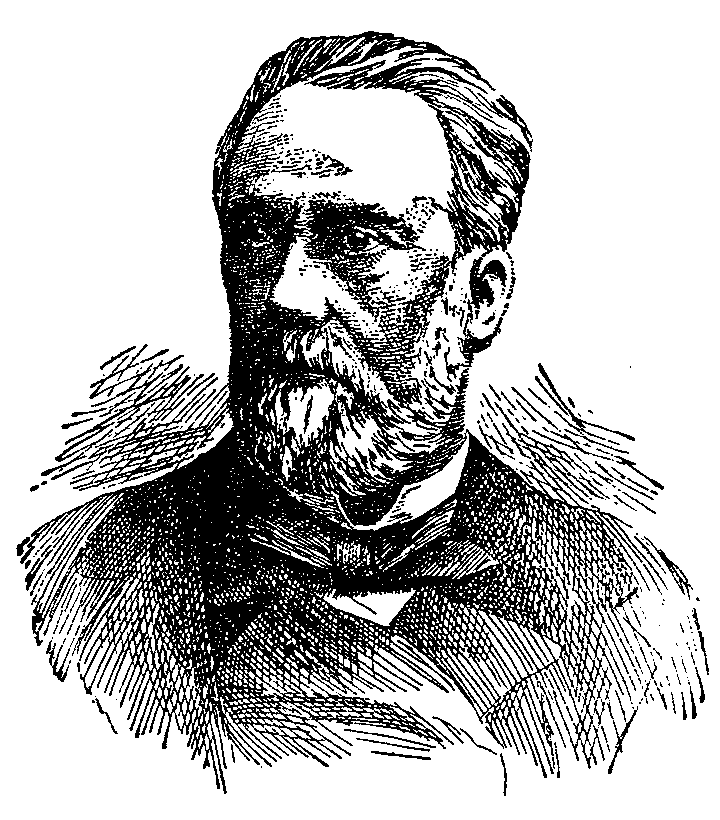 LOUIS PASTEUR. |
In the Place du Pantheon, at Paris, a noisy crowd had gathered round a wooden stage, bearing these words: "Autel de la Patric." Two or three weeks before, Louis Philippe had fled to England. Republicanism was to be the hope and glory of France, and hearing that money might be offered for the cause, a young student in the crowd hastened back to the Ecole Normale, where he had worked for the last five years, emptied his savings out of a drawer, and returned to "deposit them in thankful hands ".
Then, certain that his action would meet with approval and sympathy, he wrote home to his father. Was not Jean Joseph Pasteur an old soldier of the Empire? By trade he was a tanner, like his father and grandfather before him, but as a conscript he had served through the Peninsular War, and it was not till Napoleon had retired to Elba that Jean Joseph and his young wife settled in the "Street of the Tanners" at Dole. Later, he moved to Arbois, and the little boy, Louis, and his three sisters used to play all day in the tannery yard. Louis's first school was the Ecole Primaire, attached to the Arbois college, and here he seems to have worked hard, taken a few prizes, and shown a marked preference for drawing with coloured chalks. He was slow, though imaginative; very sweet-natured, though shy; and "he never affirmed anything of which he was not absolutely sure". His parents, poor and toiling from morning till night, considered their children's education almost as essential as their daily bread, and in 1838, when Louis was sixteen, he was sent to M. Barbet's school at Paris, a forty-eight hours' journey from Arbois, with its square-towered church and distant view of the grey Jura heights.
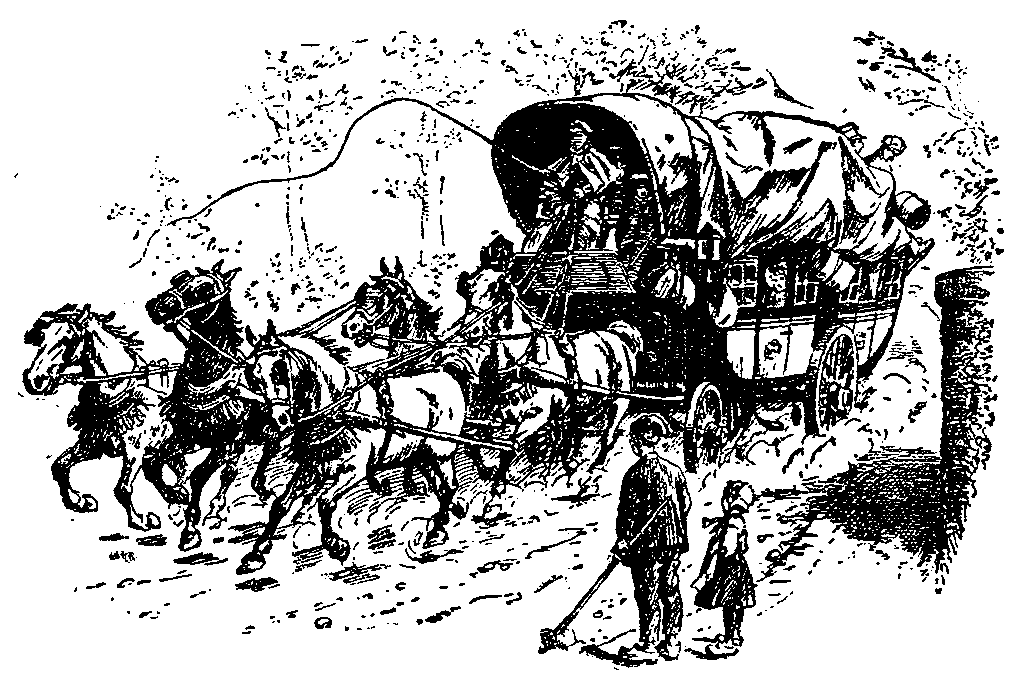 SENT TO SCHOOL AT PARIS. |
At the Barbet school Louis Pasteur went about white-faced and miserable; he was eager to learn, but, said he to the friend who had accompanied him from Arbois, "if I could only get a whiff of the tannery yard I feel I should be cured." Eventually Jean Joseph came to fetch him; it was a bitter disappointment, but since Louis could not get the better of his homesickness there was no Help for it. He went home to his chalks, and at the end of the year entered the college at Besancon, forty kilometers from Arbois; it was obvious that further separation would be necessary if Louis was to become as he wished, a Professor of Science, and, determined to nerve himself for the ordeal, he prepared for the examinations of the Ecole Normale at Paris. His sisters, who seem to have been less industrious, constantly received long affectionate letters from Louis, urging them to study: "To will is a great thing", he wrote, "and Work usually follows Will, and almost always Work is accompanied by success." For his own part, he was thinking daily of Paris—"Paris, where study is deeper," and in 1842 he returned as pupil-teacher to M. Barbet's boarding-school.
Twenty years of age, tall and confident, the separation from home was still a painful ordeal to him: "I have but one pleasure," he cried, ". . . oh, do write often, very long letters!" He passed fourth on the list, into the Ecole Normale, in 1843, and in every letter his father implored him not to work too hard, not to deny himself sleep and exercise. This father, who had taught his little boy to read and write, now became his son's pupil. He had never had the instruction he desired, but now Jean Joseph would sit up half the night working out the problems and rules that Louis sent him. The "Normalien" was chiefly anxious to qualify himself to assist in experiments; in the examination-room students passed him whom he should easily have beaten, but Pasteur was never satisfied unless step by step his knowledge had been proved. A "laboratory pillar" he was called ironically, and only his friend Chappuis would look wise and shake his head, and say: "You will see what Pasteur will be!" Balard, one of the great men of Parisian science, had an inkling that Chappuis was right. He took Pasteur into his laboratory, and it was here that he first came under the notice of Auguste Laurent, poet and scientist, professor of the Bordeaux Faculty and correspondent of the Academie des Sciences. Already Pasteur had shown the keenest interest in crystallography, but now, with Laurent's help, he experimented, published papers on the formations of a very fine series of combinations, all very easily crystallized, tartaric acid and tartrates, and presently began to be known for his researches, In his excitement he would rush out into the street, embrace the curator or Chappuis, or indeed anybody who crossed his path, and drag him into the Luxembourg garden to explain his discovery. His thirst for knowledge could not be satisfied; he spent his holidays learning German, but in 1848 Pasteur was stationed as a member of the city militia at the Orleans Railway. France was "standing on the top of golden hours"; Lamartine, both as politician and visionary, moved the whole nation, and it was in this year that Louis emptied the drawer of his savings and poured them out on "l'autel de la patrie."
Early the following year he was made Professor of Chemistry at Strasburg. It was hard for him to leave masters and colleagues; in Pasteur's opinion his researches should have been permitted to stand first, whereas at Strasburg the preparation of lectures naturally took up much of his time. He did not conceive greater happiness than his laboratory life, but the appointment was made by the Minister of Public Instruction; he was bound to go, and in the same year Pasteur became engaged to the daughter of Auguste Laurent. He was, perhaps, though very happy and hopeful, little surprised that his affection for Mlle. Marie drew him so constantly from his laboratory: "I, who did so love my crystals!" They were married later in the year, and Mme. Pasteur seems readily to have agreed that science should take a foremost place in her own life as well as in her husband's. She had seen him at work, she had seen him raise his head from the crystals, eyes shining with enthusiasm, and she was content that "the laboratory should come before everything else".
In the summer vacation, 1850, Pasteur was able to draw up an "extract" of the result of his researches, and present it to the Academie des Sciences; his work was praised by Biot, the famous French physicist, who even in his old age kept an open mind, willing to learn from this young scientist, not yet thirty years of age. He offered Pasteur affectionate advice, insisting that his researches gave him a place in chemistry rather than in physics, and adding, in a letter dated 1852, "be assured that my interest in hard workers is the only thing which yet makes me wish to live."
For Pasteur the days were too short, the nights too long. He was already on the "verge of mysteries", and when Mme. Pasteur begged him to rest, he assured her that he should bring her fame. He was at this time concerned with the manner in which he could modify the crystalline forms of certain substances . . ."and speaking of molecular dissymmetry", he said: "The universe is dissymetrical; for, if the whole of the bodies which compose the solar system were placed before a glass moving with their individual movements, the image in the glass could not be superposed to the reality." These studies subsequently gave birth to a new science: "stereo-chemistry", or the chemistry of space.
In 1853 Pasteur sent his triumphant telegram to Blot: "I transform tartaric acid into racemic acid." "The discovery," he adds, "will have incalculable consequences." He was granted the Legion of Honour, and in the following year appointed Professor and Dean of the Faculte des Sciences at Lille. Among his new students was the son of M. Bigo, who had recently met with failure and disappointment in manufacturing beet-root alcohol. It was natural that he should ask advice of his son's Professor, and Pasteur consented to experiment, spending a certain number of hours each day at the factory, and in his little laboratory at home, where he had only a student's microscope and a most primitive coke-fed stove, he watched the yeast-cells change their shape and multiply. He studied also the fermentation, known as lactic fermentation, in sour milk, drawing in his notebook the tiny globules that he found in a grey substance where fermentation had taken place. Hitherto these globules had escaped observation, but, as Pasteur saw, "that grey substance was indeed the ferment. . . . Whence came those ferments, those microscopic bodies, those transforming agents, so weak in appearance, so powerful in reality?"
Tremendous issues were at stake; but until Pasteur actually held the proofs he would not make the facts public. "I am pursuing as best I can," he wrote in January, 1859, "these studies on fermentation, which are of great interest, connected as they are with the impenetrable mystery of Life and Death. I am hoping to mark a decisive step very soon by solving without the least confusion the celebrated questions of spontaneous generation."
M. Pouchet, director of the Natural History Museum at Rouen, believed, and professed that he was able to prove, that the minute living organisms, seen under the microscope, "sprang into life"; they "came into being out of dead matter", "spontaneously generated in Artificial Air and in Oxygen Gas." Pasteur, on the other hand, held that, in experimental science, it is a mistake to believe anything, unless the facts compel affirmation. What was it in the air which "provokes organization"?
After a year's study Pasteur was ready to refute Pochet's "proofs". He insisted that putrefaction took place only when the living organisms in the air reached the putrescible matter, and to begin with, he opened twenty flasks, in which putrescible matter had been sealed, on a high road near his parents' home in Arbois. Eight showed "putrefactive changes", but when Pasteur climbed a mountain only five out of twenty showed putrefaction. He would have liked to go up in a balloon; instead, however, he opened flasks on the Mer de Glace; only one showed putrefaction, though of twenty opened in a crowded lecture-room all had changed. Pasteur went on to declare that the dust in the air contains 'germs of inferior organized beings'. He once more half-filled a flask with putrescible matter, heated the neck, and when the glass was soft bent it downwards. In order to reach the matter air had to creep up the drawn-out neck, depositing its dust in the neck. No dust reached the putrescible fluid. It remained pure, "limpid as distilled water," because, Pasteur explained in the great lecture he delivered at the Sorbonne on April 7, 1864, "I have kept it from the only thing man cannot produce, from the germs which float in the air, from Life, for Life is a germ, and a germ is Life. Never will the doctrine of spontaneous generation recover from the mortal blow of this simple experiment."
The applause was enthusiastic; the Academie des Sciences accepted his demonstration, and indeed it had never been doubted that the study of putrefaction was supremely important. "For a long time men had hoped to gain thereby a knowledge of diseases, and especially of those grouped together as putrid. . . . Certain microbes could actually live like fish without free oxygen, and died when exposed to it. These microbes caused putrefaction in the deep lavers of putrescible fluid, and took their oxygen again, like fish, from the fluid itself, turning it into carbonic acid gas. Other microbes preferred to live upon the surface, and took their oxygen directly from the air. Thus putrefaction could be superficial or it could be deep. It occurred where there was no free air, provided only the microbes had access to the putrescible stuff. In all dead, putrescible matter one condition, and one condition only, was necessary to its putrefaction, namely the presence of microbes." This is the excellent summary of Pasteur's discoveries given in the Life of Lord Lister, by G. T. Wrench, M.D. (Lond.), and of all the doctors and surgeons the one mind ready to receive enlightenment was Lister's.
Pasteur himself, though not a doctor, desired both to cure and to prevent disease. Unhappily, two of his daughters had died of typhoid fever; these personal sorrows seem only to have intensified Pasteur's longing to serve humanity. Gradually the germ theory was extended to disease. Those infinitely small organisms preyed not only on putrid but on living tissues, and Pasteur insisted on the importance of absolute cleanliness in surgical operations, the sterilizing of instruments, etc., etc. He met with jealousy, suspicion, ignorance, and was often indignant. "They will have to see, I will make them see," he cried once, enraged by what he considered the doctors' indifference or apathy. By diseases of silkworms, the silk industry of France had been almost ruined. Pasteur was induced to investigate this subject, and was able to suggest precautions. He had been made Professor of Chemistry at the Sorbonne, and was happy in his laboratory, stimulating the young men who worked under him to enthusiasm and scientific curiosity. "I am sorry to die," he cried, in a serious illness in 1868, "I wanted to do much more for my country."
From this illness, however, Pasteur recovered, and was soon at work again investigating beer, as, some years earlier, he had investigated wine, and he presently attacked the problem of splenic fever. The bacillus had already been discovered by Davaine (1862), but Pasteur showed that it was possible to attenuate the virulence of these micro-organisms by culture, or by transmission through various organisms (see "Pasteur" in Chambers' Encyclopedia). Finally, in 188o, he entered on the study of hydrophobia. This terrible disease is communicated (through the saliva) by one animal biting another, and after many experiments and long investigation Pasteur discovered a system of innoculation: that is to say, the product of the disease could be artificially introduced into the patient, and in the case of hydrophobia the special value of the discovery was that if the preventive innoculation was made soon after a bite from a rabid animal the usual subsequent attack of rabies was counteracted. Patients, children especially, were brought to Pasteur from the ends of the earth. He "enjoyed days of incomparable happiness during that period of enthusiasm, joys of the mind in its full power, joys of the heart in all its expansion; for good was being done".
A characteristic story is told in the Life of Pasteur: J. B. Jupille, a fourteen-year-old shepherd boy, seeing six of his companions attacked by a mad dog, bravely turned on the foaming animal to protect them. Armed with a whip, he wrestled with the dog, succeeded in kneeling on him, and holding him by the neck securely fastened its jaws with the lash. Then, taking his wooden sabot, he battered the dog's head, and dragged the body down to a little stream, where he held the head under water for several minutes. Death was now certain, but unfortunately the boy was bitten on both hands, and the Mayor of that town wrote to Pasteur, telling him that the lad would die of his own courage unless the new treatment intervened. "The answer came immediately: Pasteur declared that after five years' study he had succeeded in making dogs refractory to rabies, even six or eight days after being bitten; that he had only once yet applied his method to a human being, but that once with success, and that, if Jupille's family consented, the boy might be sent to him. 'I shall keep him near me in a room, of my laboratory; he will be watched and need not go to bed; he will merely receive a daily prick, not more painful than a pin-prick.'"
The treatment was entirely successful; the boy's life was saved, and "Pasteur's solicitude did not confine itself to his first two patients, but was extended to all those who had come under his care; his kindness was like a living flame". For the last twenty-five years of his life, he worked at the Pasteur Institute, and on September 28, 1895, he died: "his weakened hand might now drop the torch which had set so many others alight". Just as in his student days he had poured out his savings on "L'Autel de la Patrie", so all his life he had devoted toil and thought to the glory of France.
Lord Kelvin
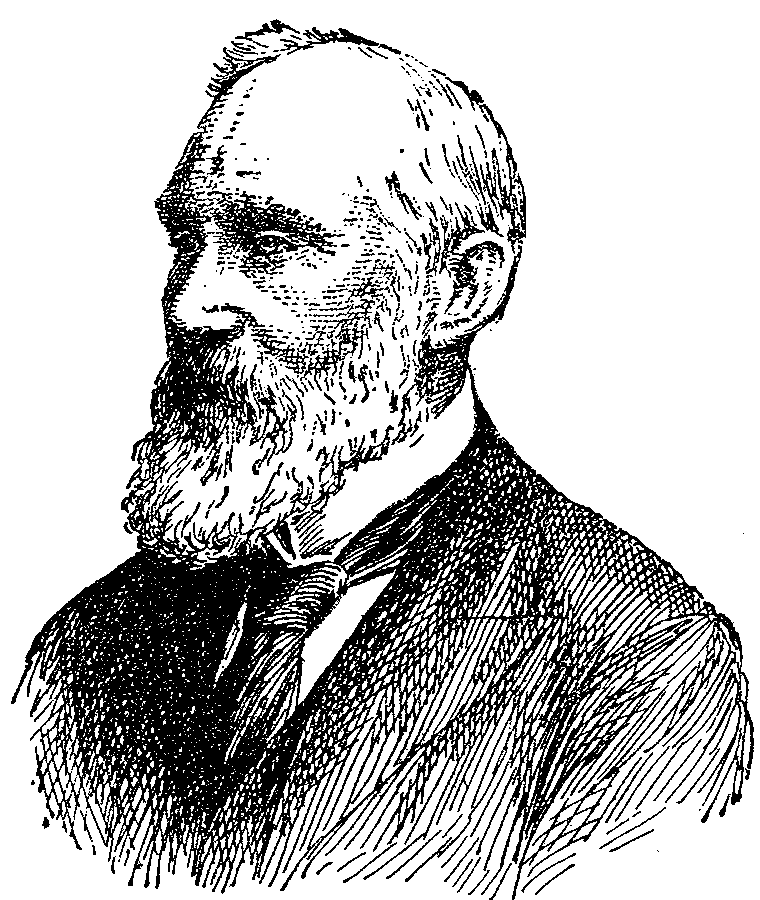 LORD KELVIN. |
In 1907 Lord Kelvin was buried in Westminster Abbey, the last of six children who had played nearly eighty years before in the sunlit meadows round the College at Belfast. At this newly-established "Academical Institution" their father was teacher of Arithmetic and Geography, and the three elder children, coming home, laden with daisies and buttercups on June 26, 1824, learnt that a brother was born, the brother who became the greatest natural philosopher of his time, William Thompson, afterwards Lord Kelvin.
From a very early age he seems to have been admired and praised. When William was two years old, an artist asked his mother's permission to paint him as an angel, but he became a charming, unspoiled boy, and it was the happiest of homes till, in 1830, Mrs. Thompson died. Two years later her husband was appointed Professor of Mathematics in Glasgow University, and from their new home, overlooking the old High Street, the children could hear the "dead carts" which in that terrible year of cholera rumbled towards the Cathedral.
The two elder boys, James and William, attended their father's Junior Mathematical Class, more as listeners than as pupils; they were not intended either to sit for examination or to write the exercises, though Mrs. Elizabeth King, in her Reminiscences, relates that on one occasion, in a very large class, "not one of whom could answer a certain question," William startled everybody by calling out in his high-pitched voice: "Do, papa, let me answer!"
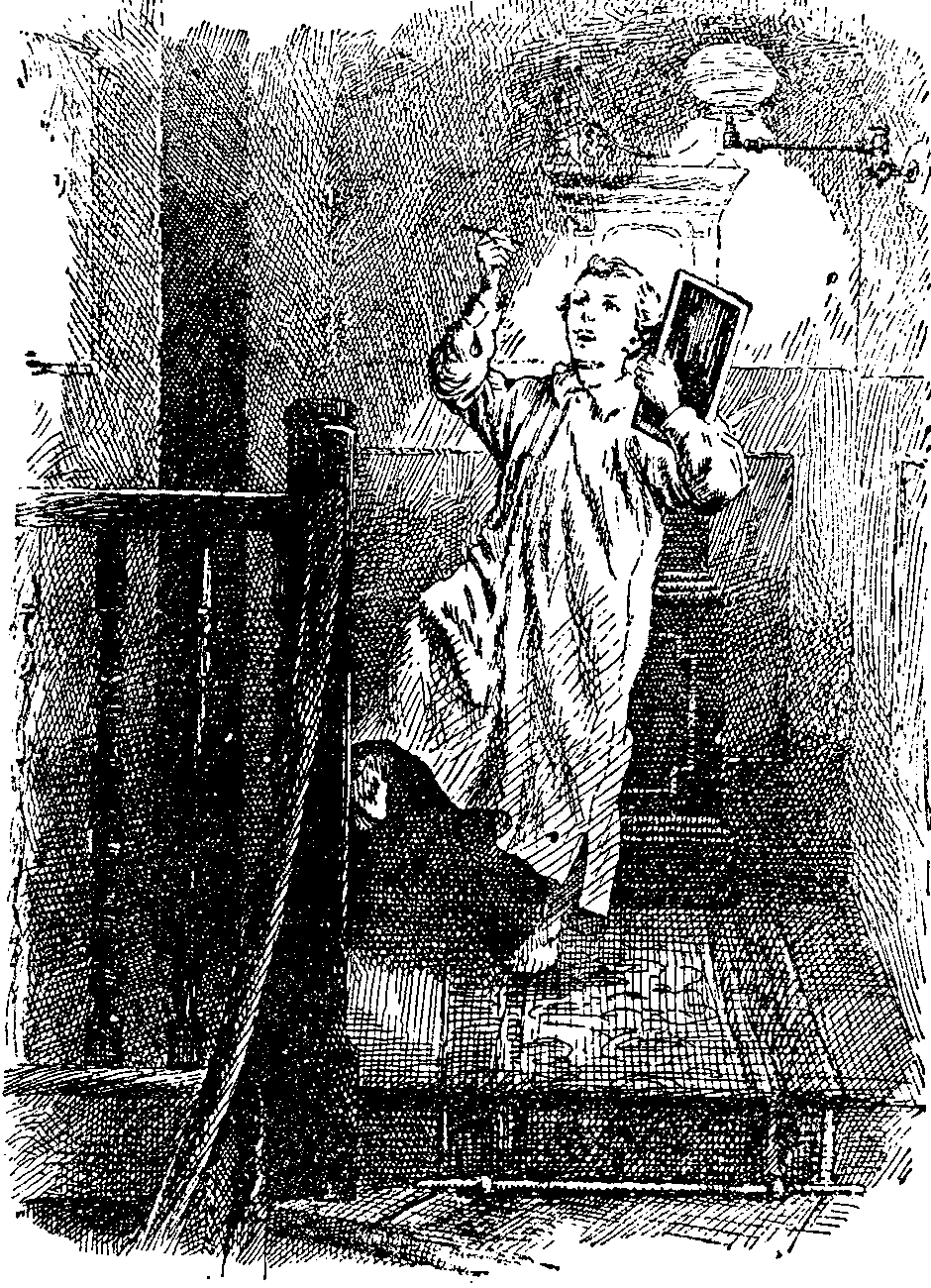 HE COULD NOT REFRAIN FROM SHOUTING IN TRIUMPH. |
At another time he was heard skipping about the landing, outside his bedroom, long after the children were supposed to be fast asleep. Some problem had been set for the elder students in William's class, and determined to solve it he had gone to bed with a slate on the chair beside him. Suddenly the answer flashed on his mind, and hastily scribbling it on his slate by the light of the staircase gas, he could not refrain from shouting in triumph!
Mathematics to this twelve-year-old boy was an enthralling adventure; he never lost his zest for learning, but on winter evenings, when the slates were put away, Professor Thompson would read aloud Pope's Iliad and Odyssey, Shakespeare's plays, Goldsmith and Sheridan, the girls sewing flannel petticoats under an aunt's supervision whilst James and William, in order that they should grow up straight and strong, lay flat on their backs, with arms extended, at his feet. William, says Mrs. King, "had the strongest sense of humour of any of them"; he was, however, "easily irritated if he were crossed, and then he became snappish a little, and we would say, 'Willie's in the crabbs, don't mind him.'"
In Glasgow College prizes were awarded by the students, not the masters: that is to say, the class were asked to vote, and William, though he was younger than James, invariably took a higher place. Not that there was ever the shadow of jealousy or suspicion between them, but very early William Thompson showed exceptional promise; in 1840 he attended the Natural Philosophy Glass, and soon afterwards entered St. Peter's College, Cambridge. In his first letter to Elizabeth he begs her to tell him how he should make coffee—whether the coffee should be put in "after or before the water was boiling"; he worked diligently and well, however, and in 1845 graduated as Second Wrangler; he also became Smith's Prizeman, and in the following year was appointed to the Chair of Natural Philosophy in the Glasgow University. He was thus fellow-professor with his father, very happy, very ambitious in the work he had set himself to do, and at his first prize-giving his students cheered the young Professor till they were hoarse. "William himself looked so young and modest," adds his sister Elizabeth, "that it was really quite touching to see him."
Grief followed closely on this first success; in 1848–49 cholera again ravaged Glasgow, and one sentence in the letter which William Thompson wrote to tell his sister of their father's death is specially worth remembrance. "I felt," he says, "that in the recollection of one so calm and so gentle and so good all clamorous, grief must be laid aside, and that the greatest honour I could pay to his beloved memory was to try to live worthy of such a father. . ."
His ideals were immensely high; not only was he a scientist, but like Humphrey Davy, he was always a poet at heart. "He uttered," says Sir Ray Lancaster, "with a delightful simplicity the thoughts, however romantic and fanciful, that bubbled up in his wonderful brain. . . . Atoms and molecules and vortices . . . were all pictured in his mind's eye, and used as counters of thought to give shape and the equivalent of tangible reality to his conceptions."
In his Cambridge days, he had already begun to ponder the molecular theory of matter, and he was bent on bringing all physical phenomena within the scope of dynamics, the science, that is to say, of matter and energy. But "our mechanical ideas and language are all derived from masses and their movement; and our chemical ideas and language mostly from molecules and their constituent atoms; there arises consequently a difficulty, inherent in the terms we use . . . when we try to explain or even describe electrons or ether. . . . Lord Kelvin's effort seems to have been to find a theory to reduce the necessary concepts to the smallest number—matter and energy. . . . In the end he found it necessary to bring in electricity as well. But who shall call this failure?"
In 1852 Thompson communicated to the Edinburgh Royal Society a brief paper laying down his famous theory of the "Dissipation of Energy". To perfect the available data for further developments, Thompson embarked upon a large number of experimental investigations which occupied much of his time for some years. He worked with Joule, who had already proved that work (e.g. friction) may be converted into heat; also that heat (e.g. steam-engine) may be converted into work; but to Thompson it occurred that the process is not reversible: it cannot go on for ever. You may, for example, easily produce heat from wood by vigorously rubbing a brass button on wood, but you cannot turn that heat back Into work. Davy and Rumford, he declared, "in concluding from their experiments that heat is a state of motion, had prepared the way for that great generalization which marks the fourth decade of the, nineteenth century as an era in Natural Philosophy. They had not made this generalization, nor quite proved that they had even imagined it. Day, when he said that the communication of heat follows the laws of the communication of motion, did not suggest the idea that in the generation of this kind of motion there may be no loss of energy by frictions and impacts as there always is in the communication of visible palpable motions. But when Rumford . . . finds that nine wax candles all burning at once generate heat as fast as a single horse working hard driving a cannon-boring machine, he gives us a reckoning in horse-power to measure the activity of a fire. And when he tells us that in no case can it be economical to keep horses for generating heat by friction, because more heat could be obtained by burning their food, he anticipates . . . Joule's discovery that the heat of combustion of a horse's food is from four to six times that obtainable through friction from a horse's work, and comes very near to that deepest part of Joule's and Mayer's philosophy in which it is concluded that animal energy and heat together make up an exact equivalent to the heat that would be generated by the chemical action in the living body if these were allowed to take place without any performance of mechanical work."
This is a long quotation; it opens up, however, a very interesting train of thought, and briefly Thompson summed up his own conclusions as follows:
- There is at present in the material world a universal tendency to the dissipation of energy.
- Any restoration of energy, without more than an equivalent of dissipation, is impossible in inanimate material processes, and is probably never affected by means of organized matter, either endowed with vegetable matter or subjected to the will of an animated creature.
- Within a finite period of time past the earth must have been, and within a finite period of time to come the earth must again be, unfit for the habitation of man as at present constituted, unless operations have been or are to be performed which are impossible under the laws to which the known operations going on at present in the material world are subject.
In the same year William Thompson became engaged to Miss Margaret Crum, whom he had known from boyhood, and it is worth noticing that they were, married at Thernliebank by the Rev. Dr. Brown of Edinburgh, father of the John Brown who wrote Rab and his Friends. Hitherto, Thompson's work had been chiefly concerned with thermodynamics, "wrestling in his laboratory with the properties of matter," but in the fifties he was led towards the practical applications of Science for which he is best known to the non-scientific reader: in 1857–58 and 1865–66 he was Electrician for the Atlantic Cable.
Volta, fifty years before, had discovered the pile, "the primitive battery capable of producing a steady and continuous silent flow of electricity through the conducting wire which constituted a circuit. Oersted had discovered the power of the current to deflect a compass needle. . . . Surgeon had invented the soft-iron electro-magnet—the magnet which is controlled from a distance through the electric wire that conveys the current to it—the magnet which attracts only when the circuit is completed, and obedient to the hand of the distant operator, ceases to attract from the moment when the circuit is broken." Still more important, Faraday, by his discoveries of the "electro-magnetic rotations", had paved the way for modern electrical engineers, and in 1840 the Morse telegraph was at work in America: "based upon the attraction of an iron keeper by an electromagnet, thereby moving a lever which printed dots and dashes, or gave audible sounds in its movement." Soon there were land lines in Europe also; messages could be sent hundreds of miles, and in 1849 short submarine cables were laid: there was presently the Dover to Calais line, besides others connecting England with Ireland and Scotland, but this was as nothing compared to the two thousand miles separating Great Britain from America.
To begin with, there was the weight—to say nothing of the cost–of a cable of this enormous length, and even if it were made no single ship was capable of holding it. Also "the working speed of signalling through cables of such a length was believed to be very slow . . . a retardation arising from the charging of the surface of the gutta-percha coating by the current on its way to the distant end. . . . What retardation might be expected from a cable 2,000 miles long? Would it not so greatly reduce the speed of signalling as to make the undertaking unremunerative?"
Thompson's attention had been directed to submarine telegraphy in 1854; as the result of his calculations he insisted that in cable signalling to signal, "sent off as a short sharp sudden impulse, in being transmitted to greater and greater distances is changed in character, smoothed out into a longer-lasting impulse, which rises gradually to a maximum and then gradually dies away. Even though at the distant station the commencement of the signal may be practically instantaneous, an appreciable time may elapse for the retarded impulse to reach its maximum; and so the signal is for effective purposes retarded." Thompson was the first to show the law which governs this retardation: in proportion to the capacity and resistance of the cable, it varies, and his plan was to regulate the "time of contact with the battery". A regulated galvanic battery was therefore employed, and when it was found that for a long cable ordinary methods of registering failed, Thompson invented that most delicate of instruments, the mirror-galvanometer. An instrument was needed which would work with the smallest possible electric current, and for the heavy needle of the German galvanometer he substituted a tiny piece of steel watch-spring, cemented to the back of a glass mirror suspended by cocoon silk within the wire coil. Thompson was short-sighted, and from the eye-glass hung with a ribbon round his neck he conceived the idea of directing upon the mirror "a beam of light from a lamp, which beam, reflected on the mirror, fell upon a long white card, marked with the divisions of a scale, which was shaded from daylight, or set up in a dark corner. When, on the arrival of an electric current the suspended magnet turned to right or left it deflected the spot of light to right or left upon the scale, and so showed the signal. . . ."
Twice he accompanied the Atlantic squadron on its course; in his enthusiasm he would even have taken a turn at the wheel, if necessary, and doubtless the idea of linking Europe and America in close communication appealed strongly to his imagination.
At Windsor Castle on November 10, 1866, William Thompson was knighted by Queen Victoria; unhappily four years later his wife died, and it was long before this sorrow lifted from his life. He found time, in spite of the many varied interests of these strenuous years, to devote himself to his students. Professor Ayrton, in an article of Kelvin in the Sixties, describes him coming into his lecture-room, without a thought of what he was going to talk about. Perhaps he would give an enthusiastic account of a conversation with Peter Guthrie Tait, the friend collaborating with him in the famous Treatise of Natural Philosophy, published in 1867. Perhaps he would discuss the progress of the manuscript, but in his mathematical physics lectures his remarks were so far above the heads of most of his students that the room would gradually empty itself, and Thompson, putting up his monocle, would peer at the empty spaces, "remarking on the curious gradual diminution of density. . . ." To those, however, who had had some training in the elements of Natural Philosophy, "his suggestions, his buoyancy, were like the rays of brilliant May sunshine following April showers."
The Treatise sold rapidly; the contributions of the two authors seem to have acted each as a happy complement to the other, and the book was at one time actually out of print. Its object had been (a) to give a complete review, in "language adapted to the non-mathematical reader", of what is known as Natural Philosophy, and (b) to show those more qualified to judge, "the analytical processes by which the greater part of that knowledge has been extended into regions as yet unexplored by experiment."
In 1871, as President of the British Association, Sir William Thompson's address was awaited eagerly; he was introduced by Huxley, with whom "he had already crossed sword with knightly courtesy, indeed, but with deadly earnest, in the matter of Geological Time; and he was known to be opposed to some of the developments of the doctrines of Evolution that for a decade had been revolutionizing men's minds as to the origin of things." The address was long and discursive, but it was brilliantly interesting. Speaking of recent advances in particular branches of science, Thompson said: "Accurate measurement and minute measurement seems to the non-scientific imagination a less lofty and dignified work than looking for something new. But nearly all the grandest discoveries of science have been but the rewards of accurate measurement and patient long-continued labour in the minute shifting of numerical results." His instances were the discovery of the theory of gravitation by Newton, and Faraday's discovery of specific inductive capacity. Then he went on to speak of that branch which more particularly concerned his own labours, emphasizing the fact that science, even "in its most lofty speculations, gains in return for benefits conferred by its application to promote the social and material welfare of man". "Those who periled and lost their money in the original Atlantic Telegraph were impelled and supported by a sense of the grandeur of their enterprise, and of the worldwide benefits which must flow from its success; they, were at the same time not unmoved by the beauty of the scientific problem directly presented to them . . ." Still later in his address, Thompson said with profound significance: "I confess to being deeply impressed by the evidence put before us by Professor Huxley, and I am ready to adopt, as an article of scientific faith, true through all space and through all time, that life proceeds from life, and from nothing but life. . ." a pronouncement, by the bye, to hold in mind, when we read the story of Pasteur's war against the doctrine of Spontaneous Generation.
In 1874 Thompson married his second wife; there were, however, no children. On New Year's Day, 1892, Queen Victoria conferred on him a peerage of the realm. It was Elizabeth, the sister who has written very touchingly of his boyhood and youth, who suggested the name "Kelvin" from the Kelvin River, flowing below the Glasgow University buildings. Thompson turned impetuously to his wife: "Do you hear that? . . . That decides us; it shall be Lord Kelvin; I will write to Salisbury at once."
Lady Kelvin outlived her husband. He died in 1907, and was buried in Westminster Abbey, in the grave next to Sir Isaac Newton. His life had been a life of unceasing toil; he had gone from one effort to another, and his works live after him. But there lives also the memory of a joyous spirit which, in his own phrase, had "taken a journey far more wonderful than that of Aladdin on the enchanted carpet. . . . and the most marvellous thing about it all was that it was true."
Lord Lister
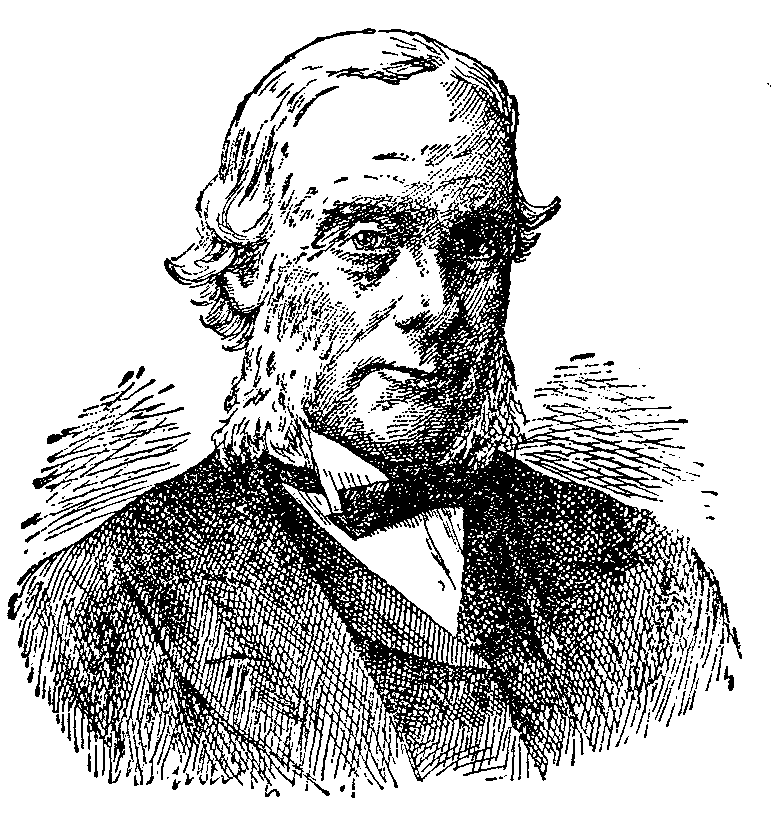 LORD LISTER. |
Early fifty years ago William Ernest Henley travelled from Gloucester to the Old Infirmary, Edinburgh. He was poor and friendless; already his disease had compelled the amputation of one foot, it was feared that he might lose the other, and he went to Edinburgh because, as he boldly announced on his arrival, other doctors considered Professor Lister "totally incompetent!"
The foot was saved; for twenty months Henley was Lister's patient at the Edinburgh Infirmary, and during this time he wrote the famous series of poems, In Hospital, and this in a sonnet called The Chief—is the description he gives of Joseph Lister, Professor of Clinical Surgery:
|
"His brow spreads large and placid, and his eye Is deep and bright with steady looks that still. Soft lines of tranquil thought his face fulfil— His face at once benign and proud and shy. If envy scout, if ignorance deny His faultless patience, his unyielding will, Beautiful gentleness and splendid skill, Innumerable gratitudes reply. We hold him for another Heracles, Battling with custom, prejudice, disease." |
It was fortunate for Henley (and for lovers of poetry) that he entered the Infirmary in 1873, instead of ten years earlier. Then, a sick man was safer in his own bedroom, or even in a schoolroom, a church, on a dunghill or in a stable, than in the hospitals built to relieve his sufferings. In the surgical wards, every patient was a victim of that terrible disease known as "hospital gangrene". Wounds, which to-day would heal cleanly and quickly, inevitably became poisoned, and it was only in the rarest cases that patients recovered from amputation. In 1847 chloroform was used for the first time; the result was—more operations, more gangrene Surgeons were in despair, but the first man to make his hospital sweet and clean, a place of healing instead of a danger to its inmates, was Joseph Lister, born at West Ham on April 5, 1827.
Lister's father was himself a distinguished Fellow of the Royal Society. "As a child he (the father) was shortsighted, and in order to see the landscape more comfortably from his nursery window he was accustomed to glue his eye to an air-bubble which had become imprisoned in the glass. The air-bubble acted as a lens, and enabled the boy to see the country with greater ease." I Later he "educed a common principle upon which the construction of the high-power lenses of the microscope have since been based . . . being the first man to establish a firm reputation upon a bubble".
He married in 1818 the daughter of a Cumberland Quaker, and Joseph was the second of seven children—an affectionate boy, high-spirited at home, shy with strangers, gravely conscientious. He was sent to a Quaker School, Grove House, Tottenham, and its records "give a picture of unerring and almost stupefying goodness. The masters were good, the boys were good . . . and he proved himself an able pupil, distinguished by thoroughness rather than brilliance." Both at school and at home, under his father's direction, Lister learnt to observe and accurately record; he was familiar with the microscope, and in 1844 he proceeded to University College, Gower Street. He matriculated in the following year, and later took the B.A. degree without gaining either honours or a gold medal. From University College he went direct to University College Hospital, and it was now that Lister began to show his worth. "Directly he entered medicine . . . he was recognized as the best student of his year, and it was clear that he was destined for high honours. The University examiners gave four gold medals. Lister procured two of them, and was very close to securing the other two." He took the degree of M. B. Lond. in 1852, and in the same year he was made a Fellow of the Royal College of Surgeons, but. what was more important, he came under the notice of William Sharpey, the most talented and original physiologist of his time.
As house-surgeon under William Sharpey, Lister became acquainted at University College Hospital with "the appalling forms of blood-poisoning, and above all the terrible disease . . . in which wounds that should heal cleanly became the centres of spreading mortification, and the living tissues rotted away with fearful rapidity. . . . The method in vogue was to put the patient under chloroform and burn the mortified flesh away with caustics. Sometimes this treatment was successful, sometimes in a few days the greyish film would appear at the edge of the wound again, presaging . . . death. But the very fact that the treatment was sometimes successful riveted the attention of the positive, constructive mind of Lister. To discover how that success was brought about, therein lay the clue to the disease and its conquest."
Putrefaction in wounds was then thought to be due to the oxygen in the atmosphere setting up "fermentation in the juices of the wound". Lister saw, however, that if it was possible to burn away the disease, something in the wound itself—not the oxygen in the air—was destroyed; that something was the cause of the disease. Through his microscope he examined pieces of diseased tissue, and saw certain peculiar objects; he "held in his thought the possibility of a minute living organism as the local cause of the disease", but for the time being advanced no further. Winning golden opinions at University College, he went with an introduction from Sharpey to James Syme, one of the most famous surgeons of his time, and although Lister went to Edinburgh intending only to make a short visit, it was arranged that he should become Syme's house-surgeon in the Edinburgh Infirmary, and eventually he stayed in Scotland twenty-five years.
Lister was at this time a serious-looking, slender young man, of average height, graceful, with a large intellectual head. He dressed in black, wearing a high collar and black stock to show that, like his parents, he was a Quaker; he was fond of outdoor exercise, especially swimming, not quick to make friends, but impressing those with whom he came in contact by his "zeal and earnestness", and in 1856 he married James Syme's elder daughter, Agnes.
Till 1855 Lister had acted as Syme's house-surgeon; he then became assistant surgeon to the Infirmary, and once more attacked the problems which had aroused his curiosity at University College Hospital. First, he investigated the inflammatory condition which preceded putrefaction of the blood; he found, "by watching with the naked eye and the microscope, that what happened after something irritating had been applied to living tissues which did not kill them outright was: Firstly the blood-vessels contracted and their lumen became very small; the part became pale. Secondly, the vessels after an interval, dilated; the part became red. Thirdly, some of the blood in the most injured blood-vessels slowed down in its flow and coagulated; redness occurred which, being solid, could not be pressed away. Lastly, the fluid of the blood passed through the vessel walls and formed a 'blister' about the seat of injury." Touch your skin with a glowing match-head, and this process will become perfectly plain!
Why did the blood-vessels contract and dilate? Lister found, by a series of the most delicate and fascinating experiments, that "the clotting of the blood resulted from a direct and local loss of the vitality of the cells forming the inner lining of the blood-vessel . . . he determined therefore to keep wounds, whether accidental or operative, as free from any dirt, foreign matter, or rough handling as possible". In his experiments he had necessarily made use of dead substances as artificial irritants; but suppose there were "a living, minute, microbic enemy . . . whose attacks would vary, as everything that is living varies, and sometimes be long and protracted, sometimes suddenly fierce, sometimes slow but with outbreaks of ferocity? . . . What new weapons would be forged, what new defences erected, what new strategy and tactics devised!"
In 1860 Lister was appointed Professor of Clinical Surgery in the University of Glasgow. The wards were hotbeds of infection and pollution, and we need dwell on this gruesome subject only long enough to emphasize the changes that Lister effected. In the first place, he insisted on rigorous cleanliness in the wards and in the operating theatre. Lister used so many dressings that the authorities accused him of extravagance, till it was found that owing to the unusual cleanliness of the wards under his care the annual "spring-cleaning" was no longer needed. At that time surgeons neglected to wash their hands before operating because "they would so soon be dirty again". The house-surgeon would go his rounds, his lancet in his coat-pocket, and to the same pocket it would be returned, after use, unwashed. Twenty-five out of every hundred patients in the 'Hotel Dieu' at Paris never left it alive, and at one time in the great hospital at Munich eighty out of every hundred surgical patients were seized with this terrible pestilence, hospital gangrene.
Lister was the first man to insist that its ravages were not necessary, that it was not natural for wounds to suppurate—unless they were irritated—and meantime, "always on the lookout for aid," he read every scientific book, in English, French, or German, on which he could lay his hands, and at last, in the work of Louis Pasteur, he found the answer he sought.
He saw that innumerable tiny enemies were awaiting the paralysis, or loss of vitality, of the living tissues; that when, through an accident or an operative incision, these tissues were no longer able to defend themselves, microbes began their dreadful work. Of all his contemporaries, he was the only surgeon ready to receive enlightenment, to see Pasteur's work "in the light of a first principle", and he had now to seek some chemical which would kill the microbes setting up putrefaction.
Carbolic acid had already been used to destroy the odour of sewage, and Lister immediately concluded that it destroyed the odour by killing the causes of putrefaction, namely, the microbes. He therefore used carbolic acid in his first attempts of the new treatment, and a very disagreeable-looking fluid it was, dark and tarry. Its effect was to cause bleeding of the wounded edges—blood, mingling with the carbolic acid, formed a hard antiseptic scab, and neither air nor dirt could pass to the paralyses tissues incapable of defending themselves.
His first indisputable success came in 1865; a little boy had been run over by a cart, and one of the broken bones protruded through the skin of his leg. Lister dressed the wound with a piece of lint, soaked in carbolic acid; the bones were set, and the leg put into splints. Instead of suppuration, fever, and pain, the child was cheerful and healthy; he rapidly recovered. But in the next case Lister met with disappointment. All went well till he was called away from Glasgow for a few weeks; the patient—he had been kicked on the leg by a horse—was supposed to be recovering, except for a small superficial sore, due to irritation set up by the crude carbolic acid. No sooner was Lister absent than poison seized on this, and the patient recovered only after amputation of his leg, and a long, serious illness. It was necessary that Lister, and he alone, should conduct the new treatment; gradually, however, he trained nurses and students in his methods, and presently was able to announce, in 1866, that seven out of thirteen patients who had undergone antiseptic treatment had recovered without suppuration . . . a success wholly unprecedented. Two out of the thirteen had died; two had suffered from hospital gangrene, but recovered; two had slight skin wounds which Lister did not consider sufficiently important to include, but the seven remaining cases "constituted the dawn of a success which grew quickly to the midday of a complete triumph."
Speaking in 1870, Lister declared that when his antiseptic system had been nine months in operation not a single case of hospital gangrene had occurred in his wards, and this seemed the more extraordinary since it had recently been discovered that a few inches below the ground, on a level with the floor of the two lowest accident wards, was "the uppermost tier of a multitude of coffins which had been placed there at the time of the cholera epidemic of 1849". Nevertheless Lister made his wards "models of cleanliness".
In 1869 James Syme suffered from an apoplectic stroke, but recovered sufficiently to insist that Lister should fill the post which he was compelled to resign. Lister therefore became Professor of Clinical Surgery at Edinburgh He purged the new wards as he had purged the old, and Henley was only one of many who might have said—
|
"His wise-rare smile is sweet with certainties, And seems in all his patients to compel Such love and faith as failures cannot quell." |
He was never known to speak sharply or hastily either to nurse or dresser or student; but by members of his own profession (especially by the famous surgeon Sir James Simpson) Lister was bitterly attacked. First he was ignored, then slighted, lastly it was declared that his discoveries had been anticipated and that he was "strutting in borrowed plumes". Gradually, very gradually, the good news spread; other doctors tried Lister's methods with surprising results, but though at the outbreak of the Franco-Prussian war he published a pamphlet advising a simple antiseptic treatment for wounds, in the face of strong opposition he could do nothing; the treatment was as yet too new, and it was not until Lister became Professor of Clinical Surgery at King's College Hospital, London, that his doctrines found general acceptance.
In 1877 he left Edinburgh; he had insisted upon being allotted separate wards at King's College Hospital, to which he could appoint Edinburgh nurses and dressers, and at first it was a melancholy experience. No patients came! Lister's lecture-rooms had been crowded with eager students at Edinburgh, now twelve or twenty listless men lounged into the hall to hear this new professor; but it was only a question of weeks. By and bye opportunities came; Lister forced his colleagues to open their eyes, and in two years London surgeons congratulated him on "a signal triumph of that great principle in surgery, which had been accepted everywhere else almost before it was even listened to in London".
By this time Lister had convinced himself that a solution of carbolic acid in twenty parts of water, "while a mild and cleanly application, may be relied on for destroying any germs that may fall upon the wound during an operation." Originally he had spread carbolic putty, made from chalk and carbolic oil, upon thin metal sheets, and placed this dressing on the wound to serve as an artificial scab; later he spread the putty on stiff calico, but neither of these "plasters" proved entirely satisfactory, and he experimented with various materials, even trying a dressing of oakum, and eventually he sat up all night in his house in Charlotte Square, Edinburgh, preparing "antiseptic gauze". Cheap muslin was dipped in a mixture of shellac, paraffin, and carbolic acid, and at the infirmary next morning Lister explained to his students the meaning of its "constituents and manufacture". Later still he finally produced the bland, double cyanide of mercury and zinc gauze. This is to-day the most perfect antiseptic gauze in existence. It is the first field dressing which our soldiers carry to battle, sewn into their tunics, ready for emergency. The gauze is covered with a pad of cotton wool and the whole kept firmly in its place by bandages.
In 1879 Lister was fifty-two years of age; the antiseptic system had been finally accepted, and in his house in Park Crescent overlooking Regent's Park he continued his researches. He became Sergeant-Surgeon to Queen Victoria, and in 1,897 she raised him to the Peerage. It is interesting to notice that on one occasion Lister and Louis Pasteur met in Paris, at the celebration of Pasteur's Jubilee; they met on other occasions, but then, unable to control his emotion, Pasteur embraced him before the huge audience thundering applause. His married life has been described as "a life-long honeymoon"; unfortunately there were no children, and Lister did not long survive his wife. He died at Walmer on February 19, 1912, and was buried in Hampstead Cemetery.
It was Joseph Lister who made modern surgery possible. Before his time abdominal operations had been out of the question, but Lister knew how to combat the foes which attack paralysed tissues, he knew how to rob the battlefield of one of its worst horrors—gangrenous wound's—and he knew how to destroy, in crowded cities, the dangers that civilization has brought us. Nobody now questions the supreme value of Lister's discoveries, and in the present, as in the future—further than we can see—"innumerable gratitudes reply. . ."
Sir William Crookes,
Pierre and Madame Curie
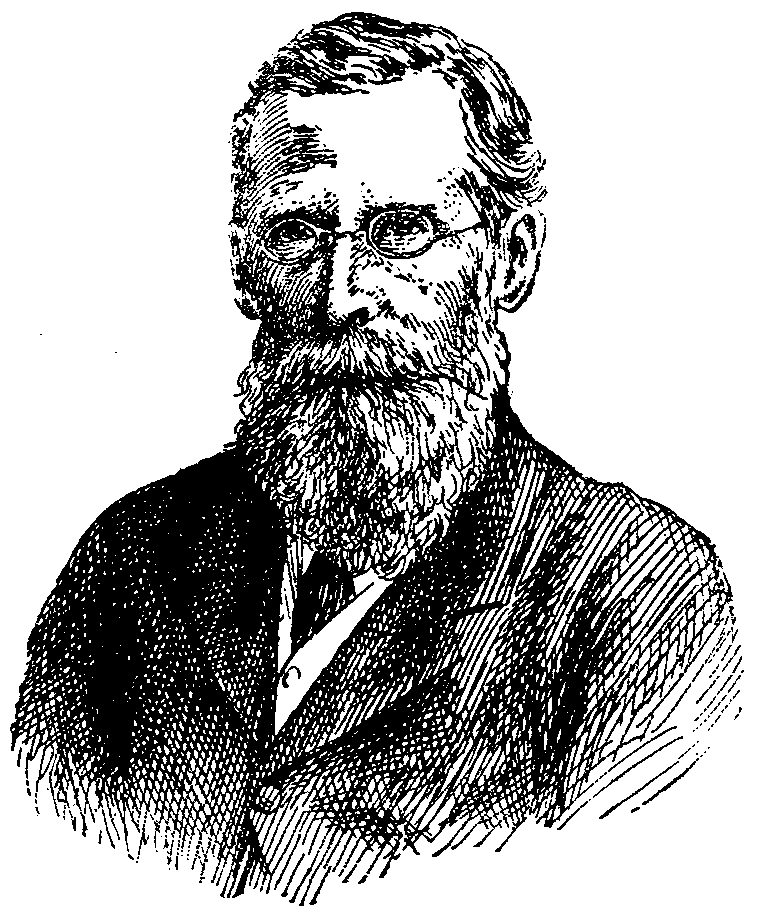 SIR WILLIAM CROOKS |
William crookes was born in London in 1832. Lister was then five years old, William Thompson, aged eight, was playing with his brothers and sisters in the Belfast meadows, and Lyell was eagerly discussing with Miss Mary Horner the prospects of the Reform Bill.
In 1848 William Crookes entered the Royal College of Chemistry, as a pupil of Dr. Hofman, and it was here that he began his earliest scientific researches, publishing in the Quarterly Journal of the Chemical Society a paper On the Seleno-Cyanides in 1851. From that time he was steadily engaged in the study of chemistry and physics, and three years later was appointed to superintend the meteorological department at the Radcliffe Observatory, Oxford; it was in 1861, when he had been six years Professor of Chemistry at the Chester Training College, that he isolated the new element, Thallium. Whilst holding the residue of the iron pyrites deposited in "the flues of a sulphuric acid chamber" in the flames of a Bunsen burner, he noticed a green line, to which he could not give a name. Traced to its source he found that this soft metal, almost white in colour, closely resembled lead in its physical properties. It tarnished quickly, volatilizing at a red heat, and occurred chiefly in copper and iron pyrites. In the same year, having discovered the new metal by means of spectroscopic analysis and chemical reactions, he produced a series of analytical notes on thallium, but his researches on its atomic weight were laid before the Royal Society only after eight years' laborious work.
In the meantime he had discovered a method, known as the sodium amalgamation process, for separating gold and silver from their ores, and, being already regarded as an authority on sanitary matters, he was appointed by the Government in 1866 to report upon the use of disinfectants in arresting the spread of the cattle plague. So varied had been his studies that five years later, as a member of the English expedition to Oran, in Algeria, Crookes was making reports neither on chemistry nor disease, but this time on the total phase of the solar eclipse occurring in December, 1871. He began next year to conduct experiments on "Repulsion resulting from Radiation", and as a Fellow of the Royal Society, published many papers on this and collateral subjects, his work being an "extension of experiments begun by others so long ago as 1790" or even earlier. At all events Faraday had experimented with vacuum tubes, and nearly two hundred years before Otto von Guericke had invented a workable air-pump. It was not till the mercury air-pump was used, however, producing a very high degree of exhaustion, that the disturbance of ether resulted which is now known as X-rays. At that time (1865) nobody suspected their existence; there was in consequence nobody to see them, till Roentgen, who wished to learn all that there was to learn about vacuum tubes, observed a mysterious shadow on his luminescent screen. Now, the tube was enclosed in thick black cardboard, but Roentgen, driven to the belief that the rays proceeded from it, investigated their power of penetrating wood, cloth, paper, and metal. Metal offered a certain amount of resistance; the other substances were of no more use to keep out these unknown invisible rays than glass to keep out sunlight. In short, the bones of the human skeleton could be viewed, by X-ray photography, through the body, and Roentgen's preliminary discovery in 1895 aroused worldwide interest. It was Professor Henri Becquerel, however, who discovered what he and Sylvanus P. Thompson, investigating the same subject in London, thought to be the action of X-rays reversed; that is to say, X-rays produced fluorescence (or the blue luminous appearance of certain substances when exposed to sunlight), but could fluorescent salts, stimulated by the sunlight, produce X-rays? Uranium salts did, it was proved, give off radiations, markedly affecting the sensitive photographic plates; Becquerel presently discovered, however, that this action was due to something inherent in uranium, and was not the "converse" of X-rays. Some substances, of which uranium was one, were "radio-active", and one substance, which was clearly radio-active above all others (as we shall see later), was named Radium.
Crookes' work was an extension of the experiments of Faraday and others; on the other hand the work of Becquerel, and later of the Curies, was an extension of his investigations, resulting, notably, in the invention of the Radiometer. This delicate instrument consists of four light vanes, suspended horizontally and radially, in a vacuum, and capable of freely rotating round a vertical axis. Each disk or vane has one side white, one black, and light or heat repels the blackened surface, so that in the dark the vanes are motionless, but when brought into the light they rotate in a definite direction. The blackened sides absorb the heat rays and increase in temperature; the molecules still present (a perfect vacuum being impossible) therefore rebound with greater velocity from each blackened surface than from the white, and the recoil forces the vanes round. This instrument showed many remarkable phenomena of "repulsion and attraction", and Crookes obtained, by his radiometer experiments, pressures as low as .00015 mm. or the 2 millionth of an atmosphere. He was thus led to his famous researches on phenomena produced by the discharge of electricity, through highly exhausted tubes (Crookes' tubes), so that in a very real sense his work made possible the discovery of Roentgen rays.
From 1883 onwards William Crookes was engaged in Radiant Matter researches, his "Radiant Matter" test being a method of spectroscopic examination which "seemed likely to throw a side-light on the origin and constitution of the elements", and he developed a theory, amongst many other important discoveries and investigations, that all the elements are derived from one primordial stuff, protyle. He received from the French Academie des Sciences, in 1880, a gold medal and a prize of 3,000 francs in recognition of his researches in Molecular Physics and Radiant Matter. He was knighted in 1897, made President of the British Association in the following year, and in 1906 celebrated his golden wedding.
In 1859, when William Crookes was Professor of Chemistry at Chester, Pierre Curie was born, the man who was to continue Henri Becquerel's work, and to discover Radium. He was educated at the Sorbonne, Paris, where he afterwards became Licencie es Sciences Physiques, and Docteur es Sciences, and from 1900 onwards held the chair of physics. His wife, Maire Sklodowska, was a Polish girl, who had come to study in Paris. When she married Pierre Curie, the two worked together, and it would be hard to say how much the world owes to their learning, imagination, and patience.
Two years after Becquerel discovered the radio-activity of uranium, the Curies found, by testing samples of pitchblende—the mineral from which uranium is obtained—that it was more radio-active even than the uranium salts. Their task was therefore to discover the substance in pitchblende besides uranium which was radio-active. They discovered, after careful analysis, that the waste rock from which uranium was extracted, contained a new element, which Madame Curie christened Polonium, after her native land. Further examination, however, ended in the isolation of a third substance more radio-active either than uranium or polonium, and this they called Radium. To the unscientific world, radium appeared to be a kind of Aladdin's lamp; there was no end to the miracles it was to work, especially as it was generally understood that the new substance would endure for ever, and that all the energy hitherto produced by steam-engines and other engines could be procured from one minute piece of radium. All diseases were to be cured, and man himself was to look to radium for the light and heat needed to keep him alive.
If radium possessed life-giving powers, however, it was nevertheless dangerous, and many investigators, including Professor Curie, suffered from painful ulcers on the hands due to the handling of this mysterious white powder. Animals exposed to radium lost fur, skin, and eyesight, and finally died; on the other hand, radium has healed diseases thought to be incurable: it is a good servant, a bad master.
Sir William Crookes, and other scientists all over the world, were devoting themselves to the study of radium and its radiations; having been long engaged in studying the nature of Radiant Matter—substances, that is to say, whose heat is due not to contact, but to the rays emitted—Crookes invented an instrument, known as the "Spinthariscope", devised to show the scintillations which are produced on a "blende" screen when a piece of radium nitrate is brought near it, a short brass tube, having at one end a blende screen with la speck of radium salt about a millimetre in front of it, and at the other end, a simple convex lens.
In the meantime prolonged and careful investigation brought to light the following facts. In the first place radium is exceedingly difficult to obtain. Pitchblende appears in the veins of gold, silver, and mica, chiefly in Bohemia; but thousands of tons must be refined to procure even a kilogramme of radium. In the second place, three different kinds of rays are emitted from radium, known as the alpha, beta and gamma rays. The alpha rays are "easily absorbed by metals, and are projected bodies, not waves. These bodies are about the size of a hydrogen atom, they are positively charged, and travel with about one-tenth of the velocity of light". The beta, or cathode rays, on the other hand, are negatively charged, more penetrative, and more easily deviated, and appear to consist of particles of about one-thousandth the mass of the hydrogen atom. The gamma rays, closely resembling Roentgen rays, possess a very great power of penetration, but the alpha radiation is by far the most important. "The determination of the mass of the alpha body," wrote Professor Rutherford in an article in Nature, August 20, 1903, "taken in conjunction with the experiments on the production of helium by emanation, supports the view that the a particle is in reality helium." Now, helium was a gas discovered by Lockyer in the sun's atmosphere (hence helium, from Greek helios, sun), and believed at first to be an element existing only in the sun and stars. The "helium radiation" of radium was this mysterious gas, which had been thought lacking in our own planet, and according to Professor Rutherford, when an atom of radium breaks down, some of the electrons composing it are free, and become beta rays, whilst the others become alpha or helium rays.
The matter remaining after the a radiation has been thrown off condenses at low temperatures, and may deposit itself on bodies with which it comes into contact. That is to say, this "emanation" causes objects in its neighbourhood—from the cardboard box which may have contained radium tubes, to the experimenter's skin—to become radio-active; they are temporarily infected with the active principle of radium, and can disturb the working of delicate scientific instruments.
One surprise has followed another; and there was never a scientific discovery so sensational as the discovery of radium. Whence come these unknown radiations? This is the question which has yet to be answered, and that radium will throw light on many of the problems of electricity, and of life, seems highly probable. Pierre Curie was killed in 1906 by an accident, an irreparable loss; but Madame Curie continues the work they had begun together, and we are still very far from realizing to what discoveries the world will be led by radium, the "Miracle of Science".
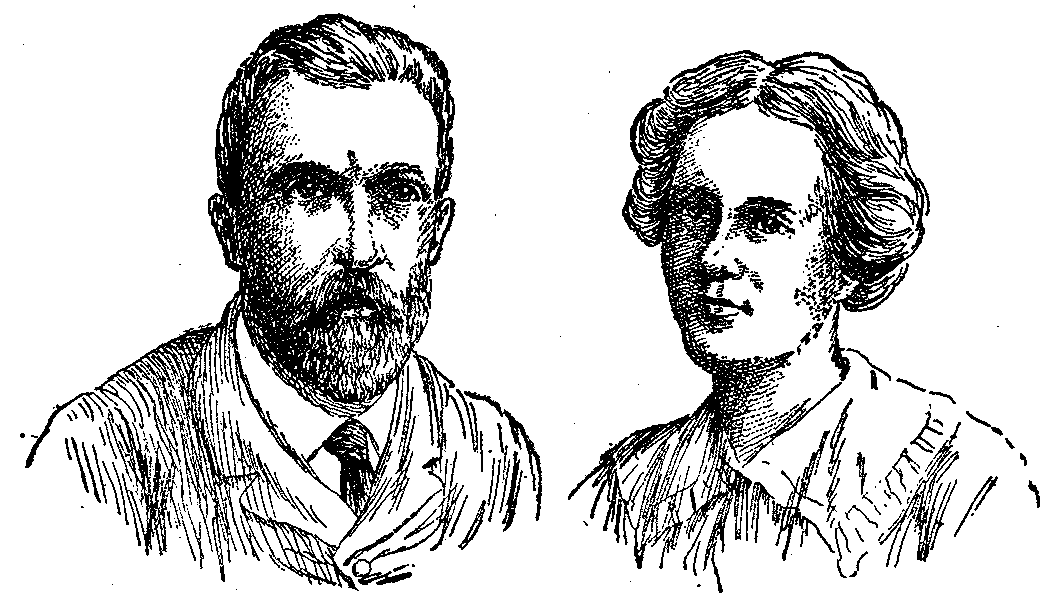 M. AND MADAME CURIE. |