Story of the Bible Told for Young and Old - Jesse Hurlbut |
The Story of a Beautiful Garden
This great round world, on which we live, is very old; so old that no one knows when it was made. But long before there was any earth, or sun, or stars, God was living, for God never began to be. He always was. And long, long ago, God spoke, and the earth and the heavens came. But the earth was not beautiful as it is now, with mountains and valleys, rivers and seas, with trees and flowers. It was a great smoking ball, with land and water mingled in one mass. And all the earth was blacker than midnight, for there was no light upon it. No man could have breathed its air, no animals could walk upon it, and no fish could swim in its black oceans. There was no life upon the earth.
While all was dark upon earth, God said, "Let there be light," and then the light began to come upon the world. Part of the time it was light, and part of the time it was dark, just as it is now. And God called the dark time Night, and the light time day. And that was the first day upon this earth after a long night.
Then at God's word, the dark clouds all around the earth began to break, and the sky came in sight, and the water that was in the clouds began to be separate from the water that was on the earth. And the arch of the sky which was over the earth God called Heaven. Thus the night and the morning made a second day.
Then God said, "Let the water on the earth come together in one place, and let the dry land rise up." And so it was. The water that had been all over the world came together, and formed a great ocean, and the dry land rose up from it. And the great water God called Sea, and the dry land he named Earth: and God saw that the Earth and the Sea were both good. Then God said, "Let grass and trees, and flowers, and fruits, grow on the earth." And at once the earth began to be green and bright with grass, and flowers, and trees bearing fruit. This made the third day upon the earth.
Then God said, "Let the sun, and moon, and stars come into sight from the earth." So the sun began to shine by day, and the moon and the stars began to shine in the night. And this was done on the fourth day.
And God said, "Let there be fishes in the sea, and let there be birds to fly in the air." So the fishes, great ones and small, began to swim in the sea; and the birds began to fly in the air over the earth, just as they do now. And this was the fifth day.
Then God said, "Let the animals come upon the earth, great animals and small ones; those that walk and those that creep and crawl on the earth." And the woods and the fields began to be alive with animals of all kinds. And now the earth began to be more beautiful, with its green fields and bright flowers, and singing birds in the trees, and animals of every kind walking in the forests.
But there were no people in the world—no cities nor houses, and no children playing under the trees. The world was all ready for men and women to enjoy it: and so God said, "I will make man, to be different from all other animals. He shall stand up and shall have a soul, and shall be like God; and he shall be the master of the earth and all that is upon it."
So God took some of the dust that was on the ground, and out of it he made man; and God breathed into him the breath of life, and man became alive, and stood up on the earth.
And so that the man whom God had made might have a home, God planted a beautiful garden on the earth, at a place where four rivers met. Perhaps we might rather call it a park, for it was much larger than any garden that you have ever seen, for it was miles and miles in every direction. In this garden, or park, God planted trees, and caused grass to grow, and made flowers to bloom. This was callcd "The Garden of Eden," and as in one of the languages of the Bible the word that means "garden," or "park," is a word quite like the word "Paradise," this Garden of Eden has often been called "Paradise." This garden God gave to the man that he had made; and told him to care for it, and to gather the fruits upon the trees and the plants, and to live upon them. And God gave to the first man the name Adam: and God brought to Adam the animals that he had made, and let Adam give to each one its name.
But Adam was all alone in this beautiful garden. And God said, "It is not good for man to be alone. I will make some one to be with Adam, and to help him." So when Adam was asleep, God took a rib from Adam’s side, and from it God made a woman; and he brought her to Adam, and Adam called her Eve. And Adam and Eve loved one another; and they were happy in the beautiful garden which God had given them for a home.
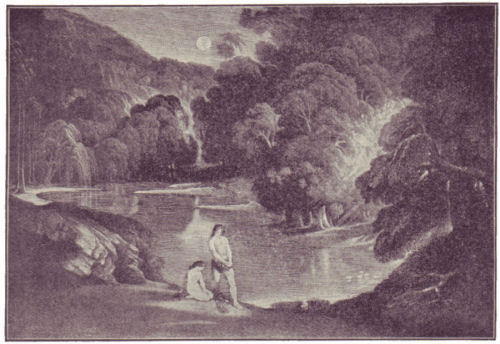 ADAM AND EVE IN THE GARDEN OF EDEN |
Thus in six days the Lord God made the heavens and the earth and the sea, and all that is in them. And on the seventh day God rested from his work.
For a time, we do not know how long, Adam and Eve were at peace in their beautiful garden. They did just as God told them to do, and talked with God as a man would talk with his friend; and they did not know of anything evil or wicked. It was needful for Adam and Eve to understand that they must always obey God’s commands. So God said to Adam and Eve:
"You may eat the fruit of all the trees in the garden except one. In the middle of the garden grows a tree, with fruit upon it that you must not eat and you must not touch. If you eat of the fruit upon that tree, you shall die."
Now among the animals in the garden there was a snake: and this snake said to Eve, "Has God told you that there is any kind of fruit in the garden, of which you are forbidden to eat?"
And Eve answered the snake, "We can eat the fruit of all the trees except the one that stands in the middle of the garden. If we eat the fruit of that tree, God says that we must die."
Then the snake said, "No, you will not surely die. God knows that if you eat of the fruit of that tree, you will become as wise as God himself, for you will know what is good and what is evil."
Eve listened to the snake, and then she looked at the tree and its fruit. As she saw it, she thought that it would taste good; and if it would really make one wise, she would like to eat it, even though God had told her not to do so. She took the fruit, and ate it; and then she gave some to Adam, and he too ate it.
Adam and Eve knew that they had done wrong in not obeying God’s words: and now for the first time they were afraid to meet God. They tried to hide themselves from God’s sight among the trees of the garden. But the Lord God called and said, "Adam, where are you?" And Adam said, "Lord, I heard thy voice in the garden, and I was afraid, and I hid myself."
And God said, "Why were you afraid to meet me? Have you eaten the fruit of the tree of which I told you that you must not touch it?" And Adam said, "The woman whom thou gavest to be with me, she gave me some of the fruit, and I ate it."
Then God said to the woman, "What is this that you have done?" And Eve said, "The snake told me that it would do me no harm if I should eat the fruit, and so I took some of it and ate it."
Then the Lord God said to the snake, "Because you have led Adam and Eve to do wrong, you shall no more walk as do other animals; you shall crawl in the dust and the dirt forever. You shall hate the woman, and the woman shall hate you. You shall try to kill her and her children, and her children’s children forever, and they shall try to kill you.
And the Lord God said to the woman, "Because you led your husband to disobey me, you shall suffer and have pain and trouble all the days of your life."
And God said to Adam, "Because you listened to your wife when she told you to do what was wrong, you too must suffer. You must work for everything that you get from the ground. You will find thorns and thistles and weeds growing on the earth. If you want food, you must dig and plant and reap and work, as long as you live. You came out from the ground, for you were made of dust, and back again into the dust shall your body go when you die."
And because Adam and Eve had disobeyed the word of the Lord, they were driven out of the beautiful Garden of Eden, which God had made to be their home. They were sent out into the world; and to keep them from going back into the garden, God placed his angels before its gate, with swords which flashed like fire.
So Adam and his wife lost their garden, and no man has ever been able to go into it from that day.
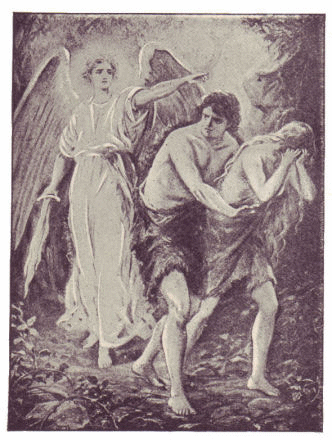 ADAM AND EVE SENT OUT INTO THE WORLD |
The First Baby in the World, and his Brother
So Adam and his wife went out into the world to live and to work. For a time they were all alone, but after a while God gave them a little child of their own, the first baby that ever came into the world. Eve named him Cain; and after a time another baby came, whom she named Abel.
When the two boys grew up, they worked, as their father worked before them. Cain chose to work in the fields, and to raise grain and fruits. Abel had a flock of sheep and became a shepherd.
While Adam and Eve were living in the Garden of Eden, they could talk with God, and hear God's voice speaking to them. But now that they were out in the world, they could no longer talk with God freely, us before. So when they came to God, they built an altar of stones heaped up, and upon it they laid something as a gift to God, and burned it, to show that it was not their own, but was given to God, whom they could not see. Then before the altar they made their prayer to God, and asked God to forgive their sins, all that they had dome that was wrong; and prayed God to bless them and do good to them.
Each of these brothers, Cain and Abel, offered upon the altar to God his own gift. Cain brought the fruits and the grain which he had grown; and Abel brought a sheep from his flock, and killed it and burned it upon the altar. For some reason God was pleased with Abel and his offering, but was not pleased with Cain and his offering. Perhaps God wished Cain to offer something that had life, as Abel offered; perhaps Cain's heart was not right when he came before God.
And God showed that he was not pleased with Cain; and Cain, instead of being sorry for his sin, and asking God to forgive him, was very angry with God, and angry also toward his brother Abel. When they were out in the field together, Cain struck his brother Abel and killed him. So the first baby in the world grew up to be the murderer of his own brother.
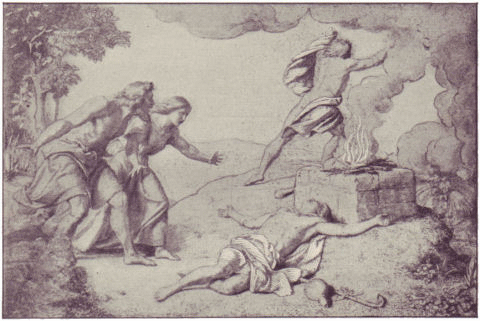 CAIN KILLS HIS BROTHER ABEL |
And the Lord said to Cain, "Where is Abel your brother?"
And Cain answered, "I do not know; why should I take care of my Brother?"
Then the Lord said to Cain, "What is this that you have done? Your brother's blood is like a voice crying to me from the ground. Do you see how the ground has opened, like a mouth, to drink your brother's blood? As long as you live, you shall be under God's curse for the murder of your brother. You shall wander over the earth, and shall never find a home, because you have done this wicked deed."
And Cain said to the Lord, "My punishment is greater than I can bear. Thou hast driven me out from among men; and thou hast hid thy face from me. If any man finds me he will kill me, because I shall be alone, and no one will be my friend."
And God said to Cain, "If any one harms Cain, he shall be punished for it." And the Lord God placed a mark on Cain, so that whoever met him should know him, and should know also that God had forbidden any man to harm him. Then Cain and his wife went away from Adam's home, to live in a place by themselves, and there they had children. And Cain's family built a city in that land; and Cain named the city after his first child, whom he had called Enoch.
The Great Ship That Saved Eight People
After Abel was slain, and his brother Cain had gone into another land, again God gave a child to Adam and Eve. This child they named Seth; and other sons and daughters were given to them, for Adam and Eve lived many years. But at last they died, as God had said that they must die, because they had eaten of the tree that God had forbidden them to eat.
By the time that Adam died, there were many people on the earth; for the children of Adam and Eve had many other children; and when these grew up, they also had children; and these too had children. And in those early times people lived much longer than they do now. Very few people now live to be a hundred years old; but in those days, when the earth was new, men often lived to be eight hundred or even nine hundred years old. So after a time that part of the earth where Adam's sons lived began to be full of people.
It is sad to tell that as time went on more and more of these people became wicked, and fewer and fewer of them grew up to become good men and women. All the people lived near together, and few went away to other lands; so it came to pass that even the children of good men and women learned to be bad, like the people around them.
And as God looked down on the world that he had made, he saw how wicked the men in it had become, and that every thought and every act of man was evil and only evil continually.
But while most of the people in the world were very wicked, there were some good people also, though they were very few. The best of all the men who lived at that time was a man whose name was Enoch. He was not the son of Cain, but another Enoch, who came from the family of Seth, the son of Adam who was born after the death of Abel. While so many around Enoch were doing evil, this man did only what was right. He walked with God, and God walked with him and talked with him. And at last, when Enoch was three hundred and sixty-five years old, God took him away from earth to heaven. He did not die, as all the people have died since Adam disobeyed God, but "he was not, for God took him." This means that Enoch was taken up from earth without dying.
Enoch left a son whose name was Methuselah. We do not know anything about Methuselah, except that he lived to be nine hundred and sixty-nine years old, which was longer than the life of any other man who ever lived. But at last, Methuselah died like all his people, except his father Enoch. By the time that Methuselah died, the world was very wicked. And God looked down on the earth, and said:
"I will take away all men from the earth that I have made; because the men of the world are evil, and evil continually."
But even in those bad times, God saw one good man. His name was Noah. Noah tried to do right in the sight of God. As Enoch had walked with God, so Noah walked with God, and talked with him. And Noah had three sons: their names were Shem and Ham and Japheth.
God said to Noah, "The time has come when all the men and women on the earth are to be destroyed. Every one must die, because they are all wicked. But you and your family shall be saved, because you alone are trying to do right."
Then God told Noah how he might save his life and the lives of his sons. He was to build a very large boat, as large as the largest ships that are made in our time; very long and very wide and very deep; with a roof over it; and made like a long wide house in three stories, but so built that it would float on the water. Such a ship as this was called "an ark." God told Noah to build this ark, and to have it ready for the time when he would need it.
"For," said God to Noah, "I am going to bring a great flood of water on the earth, to cover all the land and to drown all the people on the earth. And as the animals on the earth will be drowned with the people, you must make the ark large enough to hold a pair of each kind of animals, and several pairs of some animals that are needed by men, like sheep and goats and oxen; so that there will be animals as well as men to live upon the earth after the flood has passed away. And you must take in the ark food for yourself and your family, and for all the animals with you, enough food to last for a year, while the flood shall stay on the earth."
And Noah did what God told him to do, although it must have seemed very strange to all the people around, to build this great ark where there was no water for it to sail upon. And it was a long time, even a hundred and twenty years, that Noah and his sons were at work building the ark, while the wicked people around wondered, and no doubt laughed at Noahfor building a great ship where there was no sea. At last the ark was finished, and stood like a great house on the land. There was a door on one side, and a window on the roof, to let in the light. Then God said to Noah, "Come into the ark, you and your wife, and your three sons, and their wives with them; for the flood of waters will come very soon. And take with you animals of all kinds, and birds, and things that creep; seven pairs of those that will be needed by men, and one pair of all the rest; so that all kinds of animals may be kept alive upon the earth."
So Noah and his wife, and his three sons, Shem, Ham, and Japheth, with their wives, went into the ark. And God brought to the door of the ark the animals, and the birds, and the creeping things of all kinds; and they went into the ark, and Noha and his sons put them in their places, and brought in food for them all. And then the door of the ark was shut, so that no more people and no more animals could come in.
In a few days the rain began to fall, as it had never rained before. It seemed as though the heavens were opened to pour great floods upon the earth. The streams filled, and the rivers rose, higher and higher, and the ark began to float on the water. The people left their houses and ran up to the hills, but soon the hills were covered, and all the people on them were drowned.
Some had climbed up to the tops of higher mountains, but the water rose higher and higher, until even the mountains were covered and all the people, wicked as they had been, were drown in the great sea that now rolled over all the earth where men had lived. And all the animals, the tame animals—cattle and sheep and oxen—were drowned; and the wild animals—lions and tigers and all the rest—were drowned also. Even the birds were drowned, for their nests in the trees were swept away, and there was no place where they could fly from the terrible storm. For forty days and nights the rain kept on, until there was no breath of life remaining outside of the ark.
After forty days the rain stopped, but the water stayed upon the earth for more than six months; and the ark, with all that were in it, floated over the great sea that covered the land. Then God sent a wind to blow over the waters and to dry them up; so by degrees the waters grew less and less. First the mountains rose above the waters, then the hills rose up; and finally the ark ceased to float, and lay aground on a mountain which is called Mount Ararat. But Noah could not see what had happened on the earth, because the door was shut, and the window may have been in the roof. But he felt that the ark was no longer moving, and he knew that the water must have gone down. So, after waiting for a time, Noah opened a window and let loose a bird called a raven. Now the raven has strong wings; and this raven flew round and round until the waters had gone down, and it could find a place to rest, and it did not come back to the ark.
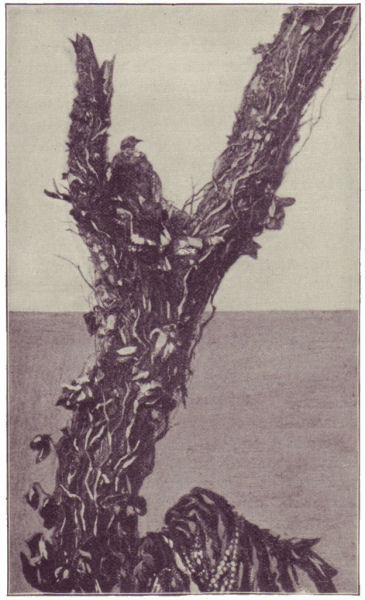
After Noah had waited for it a while, he sent out a dove; but the dove could not find any place to rest, so it flew back to the ark, and Noah took it into the ark again. Then Noah waited a week longer, and afterward he sent out the dove again. And at the evening, the dove came back to the ark, which was its home; and in its bill was a fresh leaf which it had picked off from an olive tree.
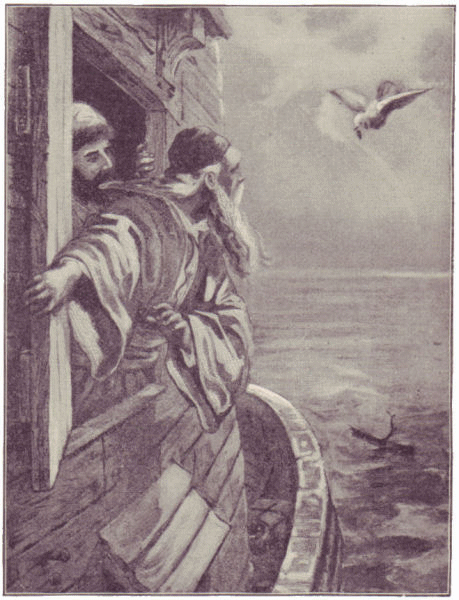 THE DOVE CAME BACK TO THE ARK |
So Noah knew that the water had gone down enough to let the trees grow once more. He waited another week, and sent out the dove again; but this time the dove flew away and never came back. And Noah knew that the earth was becoming dry again. So he took off a part of the roof and looked out, and saw that there was dry land all around the ark. Noah had now lived n the ark a little more than a year, and he was glad to see the green land and the trees once more. And God said to Noah:
"Come out of the ark, with your wife, and your sons, and their wives, and all the living things that are with you in the ark."
 THE DOVE RETURNED NOT AGAIN |
So Noah opened the door of the ark, and with his family came out, and stood once more on the ground. All the animals and birds and creeping things in the ark came out also, and began again to bring life to the earth.
The first that Noah did, when he came out of the ark, was to give thanks to God for saving all his family when the rest of the people on the earth were destroyed. He built an altar, and laid upon it an offering to the Lord, and gave himself and his family to God, and promised to do God's will.
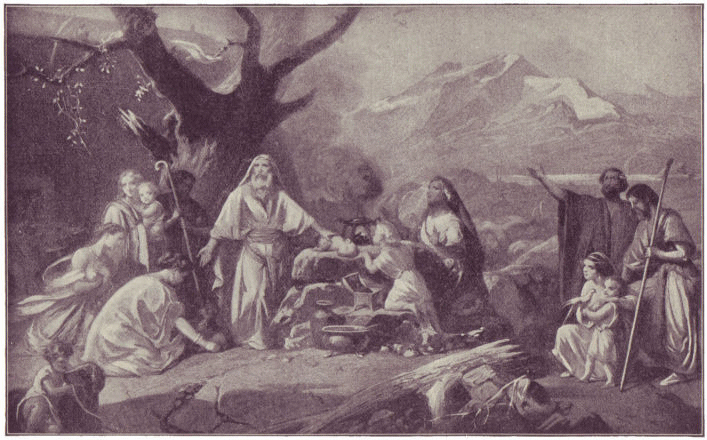 NOAH'S OFFERING AFTER THE FLOOD |
And God was pleased with Noah's offering, and God said:
"I will not again destroy the earth on account of men, no matter how bad they may be. From this time no flood shall again cover the earth; but the seasons of spring and summer and fall and winter shall remain without change. I give to you the earth; you shall be the rulers of the ground and of every living thing upon it."
Then God caused a rainbow to appear in the sky, and he told Noah and his sons that whenever they or the people after then should see the rainbow, they should remember that god had placed it in the sky and over the clouds as a sign of his promise that he would always remember the earth and the people upon it, and would never again send a flood to destroy men from the earth.
So, as often as we see the beautiful rainbow, we are to remember that it is the sign of God's promise to the world.
The Tower That Was Never Finished
After the great flood, the family of Noah and those who came after him grew in number until, as the years went on, the earth began to be full of people once more. But there was one great difference between the people who had lived before the flood and those who lived after it. Before the flood, all the people stayed close together, so that very many lived in one land and no one lived in other lands. So far as we know, all the people on the earth before the great flood, lived in the lands where the two great rivers flowed, called the Tigris and Euphrates. This part of the world was very full of people; but few or none crossed the mountains on the east, or the desert on the west; and the great world beyond was without people living in it. After the flood, families began to move from one place to another, seeking for themselves new homes. Some went one way, and some another.
This moving about was a part of God's plan to have the whole earth used for the home of men, and not merely a small part of it. Then, too, a family who wished to serve God, and do right, could go away to another land if the people around them became evil; and in a place by themselves they could bring up their children in the right way.
From Mount Ararat, where the ark rested, many of the people moved southward into a country between two great rivers, the rivers Tigris and Euphrates; and there they built houses for themselves. They undertook to build a great city, which should rule all the peoples around them. They found that the soil in that country could be made into bricks, and that the bricks could be heated and made hard; so that it was easy to build houses to live in, and walls around their city to make it strong against enemies.
And the people said to each other, "Let us build a great tower, that shall stand on the earth and shall reach up to the sky; so that we may be kept together, and not scattered abroad on the earth."
So they began to build their great tower out of bricks, which they piled up, one story above another. But God did not wish all the people on the earth to live close together, just as they had lived before the great flood. God knew that if they all kept together, those that were wicked would lead away from God those that were good, and all the world would become evil again, as it had been before the flood.
This was the way that God kept people from staying in one place. While they were building this great city and tower which they intended to rule the world, God caused their speech to change. At that time, all men were speaking one language, so that everybody could understand what every other person said.
God caused men to change their language, perhaps not all at once, but by degrees, little by little. After a time, the people that belonged to one family found that they could not understand what the people of another family were saying, just as now Germans do not understand English, and French people cannot talk to Italians, until they have learned their different languages.
As people began to grow apart in their speech they moved away into other places, where the families speaking one language could understand each other. So the men who were building the city and the great tower could no longer understand each other's speech; they left the building without finishing it, and many of them went away into other lands. So the building stayed forever unfinished.
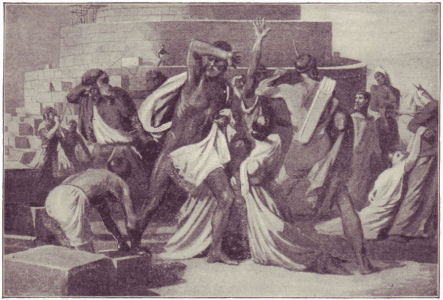 THE PEOPLE WERE SCATTERED FROM THE TOWER OF BABEL |
And the city was named Babel, a word which means "confusion." It was afterward known as Babylon, and for a long time was one of the greatest cities of that part of the world, even after many of its people had left it to live elsewhere.
Part of the people who left Babylon went up to the north, and built a city called Nineveh, which became the ruling city of a great land called Assyria, whose people were called Assyrians.
Another company went away to the west, and settled by the great river Nile, and founded the land of Egypt, with its strange temples and pyramids, its Sphynx, and its monuments.
Another company wandered northwest until they came to the shore of the great sea which we call the Mediterranean Sea. There they founded the cities of Sidon and Tyre, where the people were sailors, sailing to countries far away, and bringing home many things from other lands to sell to the people of Babylon, and Assyria, and Egypt, and other countries.
So after the flood, the earth again become covered with people living in many lands and speaking many languages.
The Story of a Long Journey
Not far from the city of Babylon, where they began to build the tower of Babel, was another city, called Ur of the Chaldees. The Chaldees were the people who lived in the country which was called Chaldea, where the two rivers Euphrates and Tigris come together. Among these people, at Ur, was living a man named Abram. Abram was a good man, for he prayed to the Lord God, and tried always to do God's will.
But the people who lived in Ur, Abram's home, did not pray to God. They prayed to idols, images made of wood and stone. They thought that these images were gods, and that they could hear their prayers and could help them. And as these people who worshipped idols did not call on God, they did not know his will, and they did many wicked things.
The Lord God saw that Abram was good and faithful, though wicked people were living all around him. And God did not wish to have Abram's family grow up in such a place, for then they too might become wicked. So the Lord spoke to Abram, and said:
"Abram, gather together all vour family and go out from this place, to a land far away, that I will show you. And in that land I will make your family to become a great people, and I will bless you and make your name great, so that all the world shall give honor to your name. If you will do as I command you, you shall be blessed, and all the families of the earth shall obtain a blessing through you."
Abram did not know just what this blessing meant that God promised to him. But we know that Abram's family grew after many years into the Israelite people, out of whom came Jesus, the Saviour of the world, for Jesus was a descendant of Abram: that is, Jesus came a long time afterward from the family of which Abram was the father; and thus Abram's family became a blessing to all the world by giving to the world a Saviour.
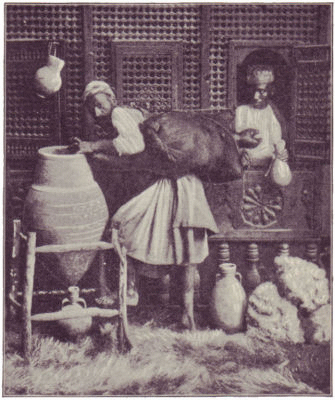 A NATIVE OF EGYPT AND HIS WATER BOTTLE |
Although Abram did not know just what the blessing was to be that God promised to give him, and although he did not know where the land lay, to which God was sending him, he obeyed God's word. He took all his family, and with them his father Terah, who was very old, and his wife, whose name was Sarai; and his brother Nahor and his wife, amd another brother's son whose name was Lot; for Lot's father, Haran, who was the younger brother of Abram, had died before this time. And Abram took all that he had, his tents, and his flocks of sheep, and herds of cattle, and went forth on a long journey, to a land of which he did not even know the name.
He journeyed far up the great river Euphrates to the mountain region, until he came to a place called Haran, in a country called Mesopotamia. The word Mesopotamia means "between the rivers"; and this country was between the two great rivers Tigris and Euphrates. At Haran they all stayed for a time. Perhaps they stopped there because Terah, the father of Abram, was too old to travel further; for they stayed at Haran until Terah died.
After the death of Terah, his father, Abram again went on his journey, and Lot, his brother's son, went with him; but Nahor, Abram's brother, stayed in Haran, and his family, and children, and children's children, whom they call "his descendants," lived at Haran for many years.
From Haran, Abram and Lot turned toward the southwest, and journeyed for a long time, having the mountains on their right hand and the great desert on their left. They crossed over rivers, and climbed the hills, and at last they came into the land of Canaan, which was the land of which God had spoken to Abram.
This land was calledl Canaan, because the people who were living in it were the descendants, or children's children, of a man who had lived long before, whose name was Canaan. A long time after this it was called "the land of Israel," from the people who lived in it; and because in that same land the Lord Jesus lived many years afterward; we now call it "The Holy Land."
Wheen Abram came into the land of Canaan, he found in it a few cities and villages of the Canaanites. But Abeam and his people did not go into the towns to live. They lived in tents, out in the open fields, whore they could find grass for their sheep and cattle. Not far from a city called Shechem, Abram set up his tent under an oak tree on the plain. There the Lord came to Abram, and said:
"I will give this land to your children, and to their children, and this shall be their land forever."
And Abram built there an altar, and made an offering, and worshipped the Lord. Wherever Abram set up his tent, there he built his altar and prayed to God; for Abram loved God, and served God, and believed God's promises.
Abram and Lot moved their tents and their flocks to many places, where they could find grass for their flocks and water to drink. At one time they went down to the land of Egypt, where they saw the great river Nile. Perhaps they saw also the Pyramids, and the Sphinx, and the wonderful temples in that land, for many of them were built before Abram lived.
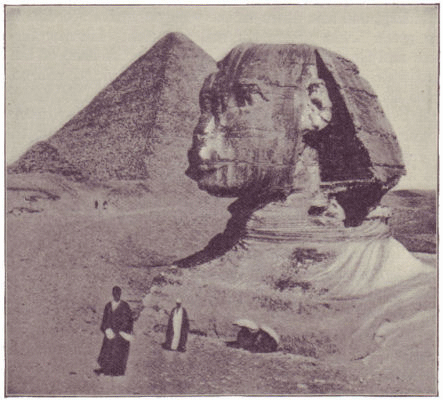 THE SPHINX AND PYRAMID IN EGYPT |
Abram did not stay long in the land of Egypt. God did not wish him to live in a land where the people worshipped idols; so God sent Abram back again to the land of Canaan, where he could live apart from cities, and bring up his servants and his people to worship the Lord. He came to a place where afterward a city called Bethel stood; and there as before he built an altar and prayed to the Lord.
Now Lot, the son of Abram's younger brother who had died. was with Abram; and Lot, like Abram, had flocks of sheep and herds of cattle, and many tents for his people. Abram's shepherds and Lot's shepherds quarreled, because there was not grass enough in one place for both of them to feed their flocks; and besides these people, the Canaanites were also in the land, so that there was not room for them all.
When Abram heard of the quarrel between his men and the men under Lot, he said to Lot:
"Let there be no quarrel between you and me, nor between your men and my men; for you and I are like brothers to each other. The whole land is before us; let us go apart. You shall have the first choice, too. If you will take the land on the right hand, then I will take the land on the left; or if you choose the left hand, then I will take the right."
This was noble and generous in Abram, for he was the older, and might claim the first choice. Then, too, God had promised all the land to Abram, so that he might have said to Lot, "Go away, for this land is all mine." But Abram showed a kind, good heart in giving to Lot his choice of the land.
And Lot looked over the land from the mountain where they were standing, and saw down in the valley the river Jordan flowing between green fields, where the soil was rich. He saw the cities of Sodom and Gomorrah upon the plain, near the head of the Dead Sea, into which the Jordan flows. And Lot said, "I will go down yonder to the plain."
And he went down the mountain to the plain, with his tents and his men, and his flocks of sheep and his cattle, leaving the land on the mountains, which was not so good, to his uncle Abram. Perhaps Lot did not know that the people in Sodom were the most wicked of all the people in the land; but he went to live near them, and gradually moved his tent closer to Sodom, until after a time he was living in that wicked city.
After Lot had separated from Abram, God said to Abram:
"Lift up your eyes from this place, and look east and west, and north and south. All the land that you can see, mountains and valleys and plains, I will give it to you, and to your children, and their children, and those who come after them. Your descendants shall have all this land, and they shall be as many as the dust of the earth; so that if one could count the dust of the earth, they could as easily count those who shall come from you. Rise up, and walk through the land wherever you please, for it is all yours."
Then Abram moved his tent from Bethel, and went to live near the city of Hebron, in the south, under an oak tree; and there again he built an altar to the Lord.
How Lot's Choice Brought Trouble and Abram's Choice Brought Blessing
So Lot lived in Sodom, and Abram lived in his tent on the mountains of Canaan. At that time in the plain of Jordan, near the head of the Dead Sea, were five cities, of which Sodom and Gomorrahh were two; and each of the five cities was ruled by its own king. But over all these little kings and their little kingdoms was a greater king, who lived far away, near the kind of Chaldea, from which Abram had come, and who ruled all the lands, far and near.
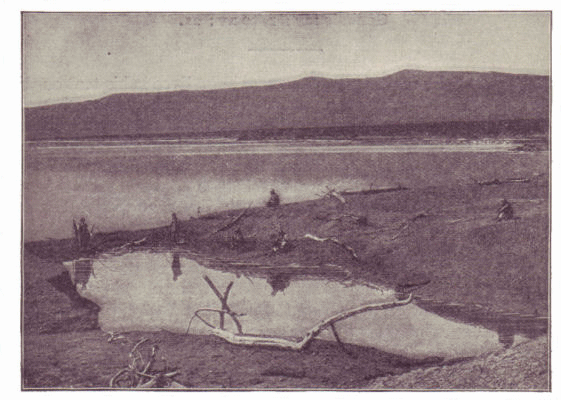 THE DEAD SEA NEAR WHERE STOOD SODOM AND GOMORRAH |
After a time these little kings in the plain would not obey the greater king; so he and all his army made war upon them. A battle was fought on the plain, not far from Sodom, and the kings of Sodom and Gomorrah were beaten in the battle, and their soldiers were killed. Then the king who had won the victory over his enemies came to Sodom, and took everything that he could find in the city, and carried away all the people in the city, intending to keep them as slaves. After a battle, in those times, the army that won the victory took away all the goods, and made slaves of all the people on the side that had been beaten.
So Lot, with all that he owned, was carried away by enemies, who went up the valley from Sodom, and did not stop to rest until they came to the head-waters of the river Jordan, at a place afterward called Dan. So, all that Lot's selfish choice gained for him was to lose all that he had, and to be made a prisoner and a slave.
Some one ran away from the battle, and came to Abram, who was living in his tent under the oak tree near Hebron. As soon as Abram heard what had happened, he called together all the men who were with him, his servants, his shepherds, and his people, and his friends; and he led them after the enemy that had taken away Lot. He followed as fast as his men could march, and found the enemy, with all the goods they had taken and all their prisoners, at Dan, one of the places where the Jordan River begins.
Abram rushed upon the enemies at night, while they were asleep, and fought them, and drove them away; so suddenly that they left behind them everything, and ran far off among the mountains. And in their camp Abram found his nephew Lot, safe, with his wife and daughters, and all his gods, and besides, all the goods and all the other people that had been carried away from Sodom.
Then the king of Sodom came• to meet Abram, at a place near the city of Jerusalem, which was afterward called "The King's Valley." And with him came the king of Jerusalem, which at that time was called Salem. The name of this king was Melchizedek, and unlike most other kings in the land at that time, he was a worshipper of the Lord God, as Abram was. And the King Melchizedek blessed Abram, and said, "May the Lord God Most High, who made heaven and earth, bless Abram; and blessed be the Lord God Most High, who has given your enemies into your hand."
And Abram made a present to the King Melchizedek, because he worshipped the Lord. And Abram gave to the king of Sodom all the people and all the goods that had been taken away; and he would not take any pay for having saved them.
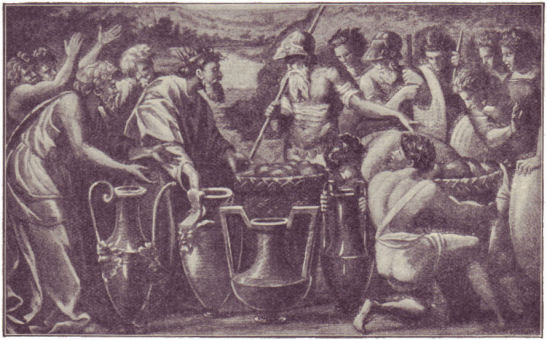 ABRAM MEETS KING MELCHIZEDEK |
You would have thought that after this, Lot would have seen that it was wrong for him to live in Sodom; but he went back to that city, and made his home there once more, even though his heart was made sad by the wickedness that he saw around him.
After Abram had gone back to his tent under the oak trees at Hebron, one day the Lord God spoke to him, and said:
"Fear not, Abram; I will be a shield to keep you safe from enemies; and I will give you a very great reward for serving me."
And Abram said, "O Lord God, what good can anything do to me, since I have no child to whom I can give it; and after I die, the man who will own everything that I have is not my son, but a servant." For although Abram had a large family of people around him, and many servants, he had no heir, and he was now an old man, and his wife Sarai was also old.
And God said to Abram, "The one to receive what you own shall not be a stranger, but shall be your own son."
And that night God brought Abram out of his tent, under the heavens, and said to him:
"Look now up to the sky, and count the stars, if you can. The people who shall spring from you, your descendants, in the years to come, shall be many more than all the stars that you can see."
Abram did not see how this promise of God could be kept; but he believed God's word, and did not doubt it. And God loved Abram because he believed the promise. Although Abram could not at that time see how God's promise could be kept, yet we know that it was kept, for the Israelite people in the Bible story, and the Jews everywhere in the world now, all came from Abram.
After that, one day, just as the sun was going down, God came to Abram again, and told him many things that should come to pass. God said to Abram:
"After your life is ended, those who are to come from you, your descendants, shall go into a strange land. The people of that land shall make slaves of them, and shall be cruel to them. And they shall stay in that strange land four hundred years; and afterward they shall come out of that land, not any more as slaves, but very rich. And after the four hundred years they shall come back to this land, and this shall be their home. All this shall come to pass after your life, for you shall die in peace and be buried in a good old age. And all this land where you are living shall belong to your people."
So that Abram might remember this promise of God, God told Abram to make ready an offering of a lamb and a goat and a pair of pigeons, and to divide them in pieces, and place them opposite to each other. And that night Abram looked, and saw a smoke and fire, like a flaming torch, that passed between the pieces of the offering.
So a promise was made between God and Abram. God promised to give Abram a son and a people and a land, and Abram promised to serve God faithfully.
Such a promise as this, made by two people to each other, was called a covenant; and this was God's covenant with Abram.
The Angel by the Well
You Remember that Abram's wife, who had journeyed with him from Ur of the Chaldees, and who lived in his tent all those years, was named Sarai. Now Sarai had a maid, a servant that waited on her, whose name was Hagar. She came from the land of Egypt, where were the pyramids and the temples. But Sarai and her maid Hagar had some trouble; they could not agree, and Sarai was so sharp and severe with Hagar, that at last Hagar ran away from Sarai's tent.
She went out into the desert, and took the road that led down to Egypt, her own country, the land from which she had come. On the way she stopped beside a spring of water. There an angel from the Lord met her, and said to her:
"Hagar, are you not the servant of Sarai, Abram's wife? What are you doing here? Where are you going?"
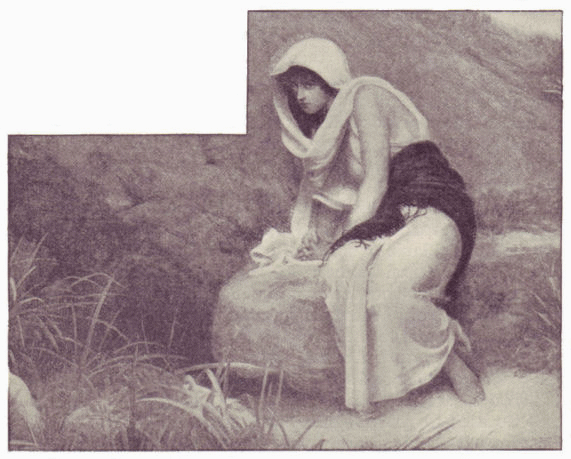 HAGAR BY THE SPRING OF WATER |
And Hagar said to the angel:
"I am going away from my mistress Sarai, because I do not wish to stay with her and serve her any longer."
Then the angel said to Hagar:
"Go back to your mistress Sarai, and submit to her, for it is better for you than to go away. God knows all your troubles, for he sees you and hears you, and he will help you. By and by you shall have a son, and you shall call his name Ishmael, because God has heard you."
The word Ishmael means "God hears." So whenever Hagar should speak her boy's name, she would think "God has heard me."
Then the angel told Hagar that her son Ishmael should be strong and fierce, and that no one should be able to overcome him, or his children, or his descendants, those who should come after him.
So Hagar was comforted, and went back again to serve Sarai.
And afterward the well where she saw the angel was called by a name which means "The well of the Living One who sees me." And after this, Hagar had a son; and as the angel told her, she called his name Ishmael; that is, "God hears." We shall read more about Hagar and Ishmael a little later. After this, while Abram was living near Hebron, the Lord came to him again and spoke to him, while Abram bowed with his face to the ground. God said:
"I am the Almighty God; walk before me, and be perfect; and I will make you a father of many nations. And your name shall be changed. You shall no more be called Abram, but Abraham, a word that means "Father of a multitude," because you shall be the father of many nations of people. And your wife's name shall also be changed. She shall no more be called Sarai, but Sarah; that is, "princess." And you and Sarah shall have a son, and you shall call his name Isaac; and he shall have sons when he becomes a man, and his descendants, those who spring from him, shall be very many people." So from this time he was no longer Abram, but Abraham, and his wife was called Sarah.
The Rain of Fire That Fell on a City
One day Abraham,—for we shall call him now by his new name,—was sitting in the door of his tent, when he saw three men coming toward him. He knew from their looks that they were not common men. They were angels, and one of them seems to have been the Lord God himself, coming in the form of a man.
When Abraham saw these men coming, he went out to meet them, and bowed to them; and he said to the one who was the leader:
"My Lord, do not pass by; but come and rest a little under the tree. Let me send for water to wash your feet; and take some food; and stay with us a little while."
So this strange person, who was God in the form of a man, sat with his two followers in Abraham's tent, under the oak-trees at Hebron. They took some food which Sarah, Abraham's wife, made ready for them, and then the Lord talked with Abraham. He told Abraham again that in a very little time God would send to him and Sarah a little boy, whose name should be Isaac. In the language that Abraham spoke, the name Isaac means "laughing;" because Abraham and Sarah both laughed aloud when they heard it. They were so happy that they could scarcely believe the news.
Then the three persons rose up to go, and two of them went on the road which led toward Sodom, down on the plain of Jordan, below the mountains. But the one who Abraham called "My Lord" stopped after the others had gone away, and said:
"Shall I hide from Abraham what I am going to do? For Abraham is to be the father of a great people, and all the world shall receive a blessing through him. And I know that Abraham will teach his children and all those that live with him to obey the will of the Lord, and to do right. I will tell Abraham what I am going to do. I am going down to the city of Sodom and the other cities that are near it, and I am going to see if the city is as bad as it seems to be; for the wickedness of the city is like a cry coming up before the Lord."
And Abraham knew that Sodom was very wicked, and he feared that God was about to destroy it. And Abraham said:
"Wilt thou destroy the righteous with the wicked, the good with the bad, in Sodom? Perhaps there may be fifty good people in the city. Wilt thou not spare the city for the sake of fifty good men who may be in it? Shall not the Judge and Ruler of all the earth do right?'
And the Lord said:
"If I find in Sodom fifty good people, then I will not destroy the city, but will spare it for their sake."
Then Abraham said again:
"Perhaps I ought not to ask anything more, for I am only a common man, talking with the Lord God. But suppose that there should be forty-five good people in Sodom, wilt thou destroy the city because it needs only five good men to make up the fifty?"
And the Lord said, "I will not destroy it, if there are forty-five good men in it." And Abraham said, "Suppose there are forty good people in it,—what then?" And the Lord said, "I will spare the city, if I find in it forty good men." And Abraham said, "O Lord, do not be angry, if I ask that if there are thirty good men in the city, it may be spared." And the Lord said, "I will not do it, if I find thirty good men there." And Abraham said, "Let me venture to ask that thou wilt spare it if twenty are there." The Lord said: "I will not destroy it for the sake of twenty good men, if they are there." Then Abraham said, "O, let not the Lord be angry, and I will speak only this once more. Perhaps there may be ten good men found in the city." And the Lord said, "If I find ten good men in Sodom, I will spare the city."
And Abraham had no more to say. The Lord in the form of a man went on his way toward Sodom; and Abraham turned back, and went to his tent.
You remember that Lot, the nephew of Abraham, chose the land of Sodom for his home (Story Five), and lived there, though the people were so wicked. You remember, too, how Lot was carried away captive when Sodom was taken by its enemies, and how he was rescued by Abram. (Story Six.) But after all that had happened, Lot went to live in Sodom again; and he was there when the angels came to Abraham's tent, as we read in the last story.
Two of the angels who had visited Abraham went down to Sodom, and walked through the city, trying to find some good men; for if they could find only ten, the city would be saved. But the only good man whom they could find was Lot. He took the angels, who looked like men, into his house, and treated them kindly, and made a supper for them.
The men of Sodom, when they found that strangers were in Lot's house, came before the house in the street, and tried to take the two men out that they might do them harm, so wicked and cruel were they. But the men of Sodom could do nothing against them, for when they tried to break open the door, and Lot was greatly frightened, the two angels struck all those wicked men blind in a moment, so that they could not see, and felt around in the dark for the door.
Then the angels said to Lot:
"Have you here any others besides yourself, any sons, or sons-in-law, or daughters? Whomever you have, get them out of this city quickly, for we are here to destroy this place, because it is so very wicked."
Then Lot went to the houses where the young men lived who had married some of his daughters, and said to them:
"Hurry, and get out of this place, for the Lord will destroy it."
But his sons-in-law, the husbands of his daughters, would not believe his words; they only laughed at him. What a mistake it was for Lot to live in a wicked city, where his daughters were married to young men living there!
And when the morning was coming, the two angels tried to make poor Lot hasten away. They said:
"Rise up quickly, and take your wife, and your two daughters that are here. If you do not haste, you will be destroyed with the city."
But Lot was slow to leave his house, and his married daughters, and all that he had; and the two angels took hold of him, and of his wife, and his two daughters; and the angels dragged them out of the city. God was good to Lot, to take him out of the city before it was destroyed.
And when they had brought Lot and his wife and his daughters out of the city, one of the angels said to him:
"Escape for your life; do not look behind you; do not stop anywhere in the plain; climb up the mountain, or you may be destroyed!"
And Lot begged the angels not to send him so far away. He said, "O my Lord, I cannot climb the mountain. Have mercy upon me, and let me go to that little city that lies yonder. It is only a little city, and you can spare it. Please to let me be safe there."
And the angel said, "We will spare that city for your sake; and we will wait until you are safe before we destroy these other cities."
So Lot ran to the little city, and there he found safety. In the language of that time, the word "Zoar" means little; so that city was afterward called Zoar. It was the time of sunrise when Lot came to Zoar.
Then, as soon as Lot and his family were safely out of Sodom, the Lord caused a rain of fire to fall upon Sodom and the other cities on the plain. With the fire came great clouds of sulphur smoke, covering all the plain. So the cities were destroyed, and all the people in them; not one man or woman or child was left.
While Lot and his daughters were flying from the city, Lot's wife stopped, and looked back; and she became a pillar of salt, standing there upon the plain. Lot and his two daughters escaped, but they were afraid to stay in the little city of Zoar. They climbed up the mountain, away from the plain, and found a cave, and there they lived. So Lot lost his wife, and all that he had, because he had made his home among the wicked people of Sodom.
And when Abraham, from his tent door on the mountain, looked down toward the plain, the smoke was rising from it, like the smoke of a great furnace.
And that was the end of the cities of the plain, Sodom, and Gomorrah, and the other cities with them. Zoar alone was saved, because Lot, a good man, prayed for it.
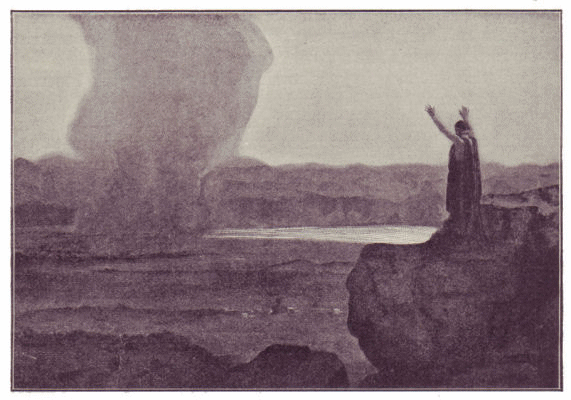 SODOM AND GOMORRAH BURNED UP |
The Boy Who Became an Archer
After Sodom and Gomorrah were destroyed, Abraham moved his tent and his camp away from that part of the land, and went to live near a place called Gerar, in the southwest, not far from the Great Sea. And there at last, the child whom God had promised to Abraham and Sarah was born, when Abraham his father was a hundred years old.
They named this child Isaac, as the angel had told them he should be named. And Abraham and Sarah were so happy to have a little boy, that after a time they gave a great feast to all the people, in honor of the little Isaac.
You remember the story about Sarah's maid Hagar, the Egyptian woman, and how she ran away from her mistress, and saw an angel by a well, and afterward came back to Sarah, and had a child whose name was Ishmael (Story Seven). So now there were two boys in Abraham's tent, the older boy, Ishmael, the son of Hagar, and the younger boy, Isaac, the son of Abraham and Sarah.
Ishmael did not like the little Isaac, and did not treat him kindly. This made his mother Sarah very angry, and she said to her husband:
"I do not wish to have this boy Ishmael growing up with my son Isaac. Send away Hagar and her boy, for they are a trouble to me."
And Abraham felt very sorry to have trouble come between Sarah and Hagar, and between Isaac and Ishmael; for Abraham was a kind and good man, and he was friendly to them all.
But the Lord said to Abraham, "Do not be troubled about Ishmael and his mother. Do as Sarah has asked you to do, and send them away. It is best that Isaac should be left alone in your tent, for he is to receive everything that is yours. I the Lord will take care of Ishmael, and will make a great people of his descendants, those who shall come from him."
So the next morning, Abraham sent Hagar and her boy away, expecting them to go back to the land of Egypt, from which Hagar had come. He gave them some food for the journey, and a bottle of water to drink by the way. The bottles in that country were not like ours, made of glass. They were made from the skin of a goat, sewed tightly together. One of these skin bottles Abraham filled with water, and gave to Hagar.
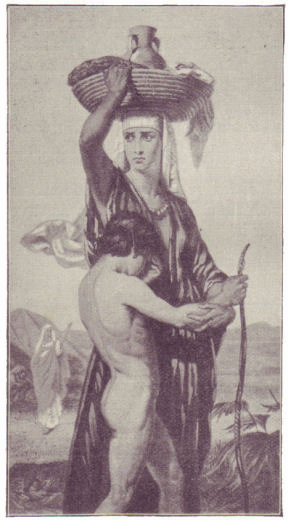 HAGAR GOES INTO THE WILDERNESS |
And Hagar went away from Abraham's tent, leading her little boy. But in some way she lost the road, and wandered over the desert, not knowing where she was, until all the water in the bottle was used up; and her poor boy, in the hot sun and the burning sand, had nothing to drink. She thought that he would die of his terrible thirst, and she laid him down under a little bush; and then she went away, for she said to herself:
"I cannot bear to look at my poor boy suffering and dying for want of water."
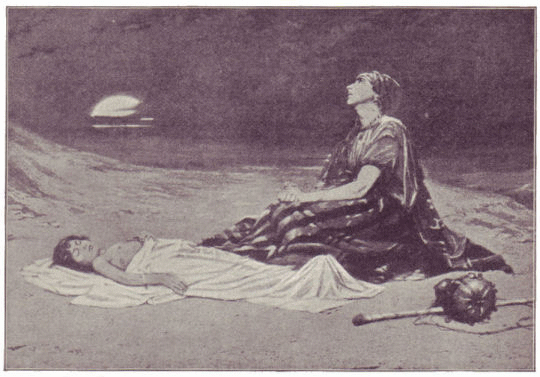 HAGAR AND HER LITTLE BOY IN THE DESERT |
And just at that moment, while Hagar was crying, and her boy was moaning with thirst, she heard a voice saying to her:
"Hagar, what is your trouble? Do not be afraid. God has heard your cry, and the cry of your child. God will take care of you both, and will make of your boy a great nation of people."
It was the voice of an angel from heaven; and then Hagar looked, and there close at hand was a spring of water in the desert. How glad Hagar was, as she filled the bottle with water, and took it to her suffering boy under the bush!
After this, Hagar did not go down to Egypt. She found a place near this spring, where she lived and brought up her son in the wilderness, far from other people. And God was with Ishmael, and cared for him. And Ishmael grew up in the desert, and learned to shoot with the bow and arrow. He became a wild man, and his children after him grew up to be wild men also. They were the Arabians of the desert, who even to this day have never been ruled by any other people, but wander through the desert and live as they please. So Ishmael came to be the father of many people, and his descendants, the wild Arabians of the desert, are living unto this day in that land, just as the Jews, who are the descendants of Isaac, are living all over the world.
How an Angel's Voice Saved a Boy's Life
You remember that in those times of which we are telling, when men worshipped God, they built an altar of earth or of stone, and laid an offering upon it, as a gift to God. The offering was generally a sheep, or a goat, or a young ox, some animal that was used for food. Such an offering was called "a sacrifice."
But the people who worshipped idols often did what seems to us very strange and very terrible. They thought that it would please their gods, if they would offer as a sacrifice the most precious living things that were their own: and they would take their own little children and kill them upon their altars as offerings to the gods of wood and stone, that were no real gods, but only images.
God wished to show to Abraham, and all his descendants, those who should come after him, that he was not pleased with such offerings as those of living people, killed on the altars. And God took a way to teach Abraham, so that he and his children after him would never forget it. Then at the same time he wished to see how faithful and obedient Abraham would be to his commands; how fully Abraham would trust in God, or as we should say, how great was Abraham's faith in God.
So God gave to Abraham a command which he did not mean to have obeyed, though this he did not tell to Abraham. He said:
"Take now you son, your only son Isaac, whom you love so greatly, and go to the land of Moriah; and there, on a mountain that I will show you, offer him for a burnt offering to me."
Though this command filled Abraham's heart with pain, yet he would not be as surprised to receive it as a father would in our day; for such offerings were very common among all those people in the land where Abraham lived. Abraham never for one moment doubted or disobeyed God's word. He knew that Isaac was the child whom God had promised, and that God had promised, too, that Isaac should have children, and that those coming from Isaac should be a great nation. He did not see how God could keep his promise with regard to Isaac, if Isaac should be killed as an offering: unless, indeed, God should raise him up from the dead afterward. But Abraham undertook at once to obey God's command. He took two young men with him, and an ass laden with wood for the fire; and he went toward the mountain in the north, Isaac his son walking by his side. For two days they walked, sleeping under the trees at night in the open country. And on the third day, Abraham saw the mountain far away. And as they drew near to the mountain, Abraham said to the young men:
"Stay here with the ass, while I go up yonder mountain with Isaac to worship; and when we have worshipped, we will come back to you."
For Abraham believed that in some way God would bring back Isaac to life. He took the wood from the ass, and placed it on Isaac, and the two walked up the mountain together. As they were walking Isaac said, "Father, here is the wood, but where is the lamb for the offering?" And Abraham said, "My son, God will provide himself the lamb."
And they came to the place on the top of the mountain. There Abraham built an altar of stones and earth heaped up, and on it he placed the wood. Then he tied the hands and the feet of Isaac, and laid him on the wood on the altar. And Abraham lifted up his hand, holding a knife to kill his son. A moment longer, and Isaac would be slain by his own father's hand. But just at that moment the angel of the Lord out of heaven called to Abraham, and said, "Abraham! Abraham!" And Abraham answered, "Here I am, Lord." Then the angel of the Lord said:
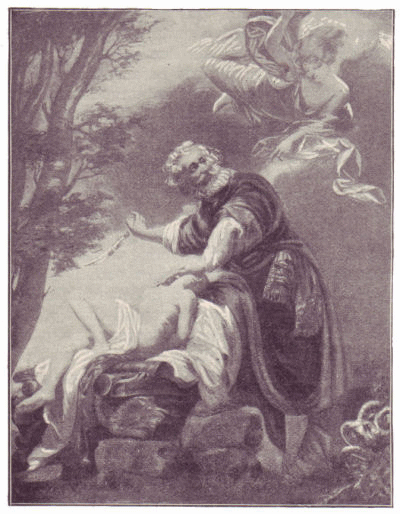 "ABRAHAM! ABRAHAM!" |
"Do not lay your hand upon your son. Do no harm to him. Now I know that you love God more than you love your only son, and that you are obedient to God, since you are ready to give up your son, your only son, to God." What a relief and a joy these words from heaven brought to the heart of Abraham! How glad he was to know that it was not God's will for him to kill his son! Then Abraham looked around, and there in the thicket was a ram caught by his horns. And Abraham took the ram, and offered him up for a burnt offering in place of his son. So Abraham's words came true, when he said that God would provide for himself a lamb. The place where this altar was built Abraham named Jehovah-jireh, words meaning, in the language that Abraham spoke, "The Lord will provide."
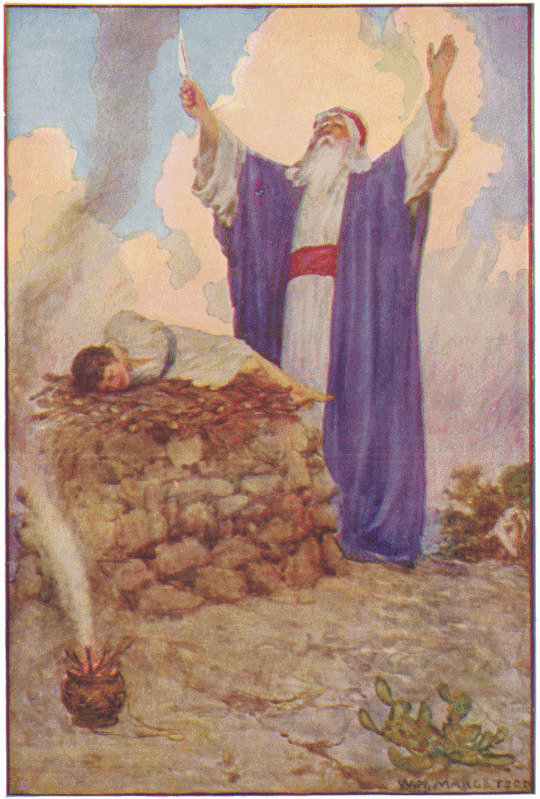 ABRAHAM AND ISAAC ON MOUNT MORIAH |
This offering, which seems so strange, did much good. It showed to Abraham, and to Isaac also, that Isaac belonged to God, for to God he had been offered; and in Isaac, all those who should come from him, his descendants, had been given to God. Then it showed to Abraham, and to all the people after him, that God did not wish children or men killed as offerings for worship; and while all the people around offered such sacrifices, the Israelites, who came from Abraham and from Isaac, never offered them, but offered oxen and sheep and goats instead. And it looked onward to a time when, just as Abraham gave his son as an offering, God should give his Son Jesus Christ to die for the world. All this was taught in this act of worship on Mount Moriah.
Some think that on the very place where this offering was given, the altar in the temple many years afterward stood on Mount Moriah. If that be true, the rock is still there, and over it is a building called "The Dome of the Rock." Many people now visit this rock under the dome, and think of what took place there so long ago. At this time Abraham was living at a place called Beersheba, on the border of the desert, south of the land of Canaan. From Beersheba he took his journey to Mount Moriah, and to Beersheba he came again after the offering on the mountain. Beersheba was the home of Abraham during most of his later years. After a time, Sarah, the wife of Abraham and the mother of Isaac, died, being one hundred and twenty years old. And Abraham bought of the people of Hebron a cave, called the cave of Machpelah; and there he buried Sarah his wife. This place is still known as the city of Hebron, but the people who live there will not allow any strangers to visit it.
The Story of a Journey after a Wife
After the death of Sarah, Isaac, her son, was lonely; and as he was now old enough to marry, Abraham sought a wife for him; for in those countries the parents have always chosen the wives for their sons, and husbands for their daughters. Abraham did not wish Isaac to marry any woman of the people in the land where he was living, for they were all worshippers of idols, and would not teach their children the ways of the Lord. For the same reason, Abraham did not settle in one place, and build for himself and his people a city. By moving from place to place, Abraham kept his people apart.
You remember that when Abraham made his long journey to the land of Canaan (see Story Five), he stayed for a time at a place called Haran, in Mesopotamia, between the two rivers Tigris and Euphrates, far to the northeast of Canaan. When Abraham left Haran to go to Canaan, his brother Nahor and his family stayed in Haran. They worshipped the Lord, as Abraham and his family did; and Abraham thought that it would be well to find among them a wife for his son Isaac.
As Abraham could not leave his own land of Canaan and go to Haran in Mesopotamia to find a wife for his son Isaac, he called his chief servant, Eliezer, the man whom he trusted, who cared for all his flocks and cattle, and who ruled over his other servants, and sent him to Haran to find a wife for his son Isaac.
And the servant took ten camels, and many presents and went on a long journey, and at last came to the city of Haran, where the family of Nahor, the brother of Abraham, was living. And at the well, just outside of the city, at the time of evening, he made his camels kneel down. Then the servant prayed to the Lord that he would send to him just the right young woman to be the wife of his master's son Isaac.
And just as the servant was praying, a beautiful young woman came to the well, with her pitcher upon her shoulder. As she drew the water and filled her pitcher, the servant came up and bowed to her, and said, "Will you kindly give me a drink of water from your pitcher?"
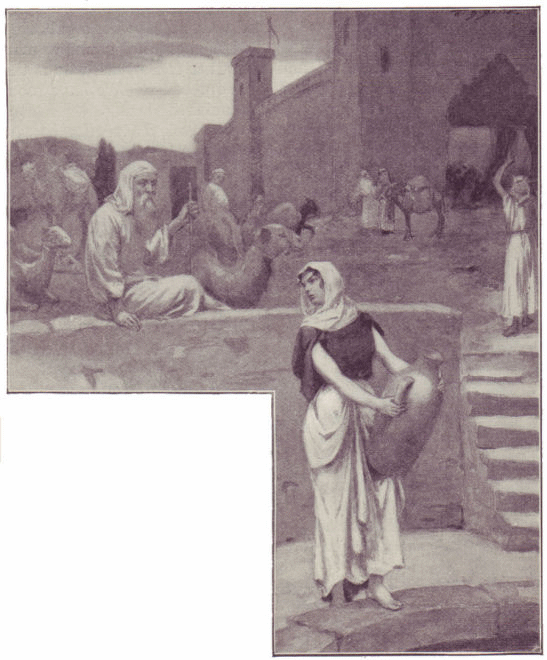 ABRAHAM'S SERVANT MEETING REBEKAH AT THE WELL |
And she said, "Drink, my lord," and she held her pitcher for him to drink. And then she said, "I will draw some water for your camels also to drink."
And she emptied her pitcher into the trough by the well, and drew more water, until she had given drink to all the camels.
And the servant of Abraham looked at her, and wondered whether she might be the right woman for Isaac to marry. And he said to her, "Will you tell me your name, young lady, and whose daughter you are? And do you suppose that I could find a place to stay at your father's house?" And then he gave her a gold ring and gold bracelets for her wrists. And the beautiful young woman said, "My name is Rebekah; and my father is Bethuel, who is the son of Nahor. You can come right to our house. We have room for you, and a place and food for your camels."
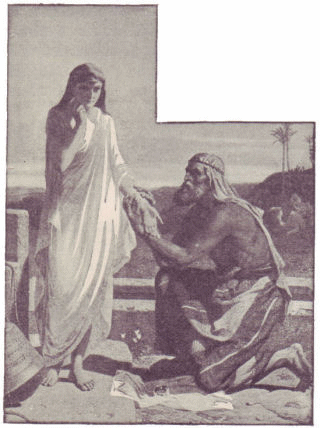 HE GAVE HER GOLD BRACELETS AND A GOLD RING |
Then the man bowed his head and thanked God, for he saw that his prayer was answered, since this kind and lovely young woman was a cousin to Isaac, his master's son. And he told Rebekah that he was the servant of Abraham, who was to near a relative to her own family.
Then Rebekah ran home and told her parents of the stranger, and showed them the presents that he had given to her. And her brother Laban went out to the man, and brought him into the house, and found a place for his camels. And they washed his feet, for that was the custom of the land, where people did not wear shoes, but sandals: and they set the table for a supper, and asked him to sit down and eat with them. But the man said, "I will not eat until I have told my errand."
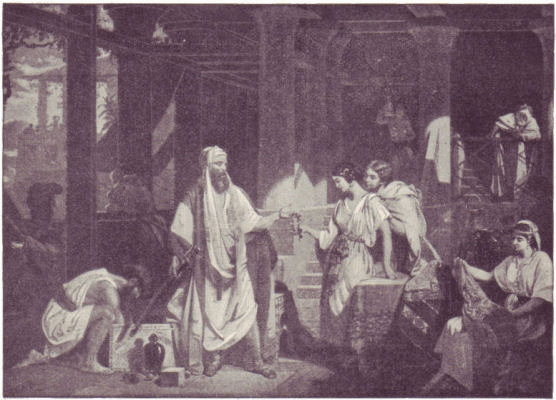 ABRAHAM'S SERVANT SHOWS THE PRESENTS |
After this he told them all about Abraham's riches: and how Abraham had sent him to Haran to find a wife for Isaac, his son; and how he had met Rebekah, and felt sure that Rebekah was the one whom the Lord would choose for Isaac's wife: and then he asked that they would give him Rebekah to be taken home to be married to Isaac.
When he had told his errand, Laban, Rebekah's brother, and Bethuel, her father, said, "This comes from the Lord; it is his will; and it is not for us to oppose it. Here is Rebekah; take her, and let her be the wife of your master's son, for the Lord has shown it to be his will."
Then Abraham's servant gave rich presents to Rebekah, and to her mother, and her brother Laban. And that night they had a feast, with great joy. And the next morning Abraham's servant said, "Now I must go home to my master." But they said, "O, not so soon! Let Rebekah stay with us for a few days, ten days at least, before she goes away from her home."
And he said to them, "Do not hinder me; since God has given me what I came for, I must go back to my master."
And they called Rebekah, and asked her, "Will you go with this man?" And she said, "I will go."
So the servant of Abraham went away, and took with him Rebekah, with good wishes, and blessings, and prayers, from all in her father's house. And after a long journey, they came to the place where Abraham and Isaac were living. And when Isaac saw Rebekah, he loved her; and she became his wife, and they were faithful to each other as long as they both lived.
Afterward Abraham, great and good man that he was, died, almost a hundred and eighty years old. And Isaac and Ishmael buried Abraham in the cave where Abraham had buried Sarah at Hebron. Then Isaac became the owner of all the riches of Abraham, his tents, and flocks of sheep, and herds of cattle, and camels, and servants. Isaac was a peaceful, quiet man. He did not move his tents often, as his father had done, but stayed in one place nearly all his life.
How Jacob Stole His Brother's Blessing
After Abraham died, his son Isaac lived in the land of Canaan. Like his father, Isaac's home was a tent; and around him were the tents of his people, and many flocks of sheep and herds of cattle feeding wherever they could find grass to eat and water to drink.
Isaac and his wife Rebekah had two children. The older was named Esau and the younger Jacob. Esau was a man of the woods, and fond of hunting; and he was rough, and covered with hair. Even as a boy he was fond of hunting with his bow and arrow. Jacob was quiet and thoughtful, staying at home, and caring for the flocks of his father. Isaac loved Esau more than Jacob, because Esau brought to his father that which he had killed in his hunting; but Rebekah liked Jacob, because she saw that he was wise and careful in his work.
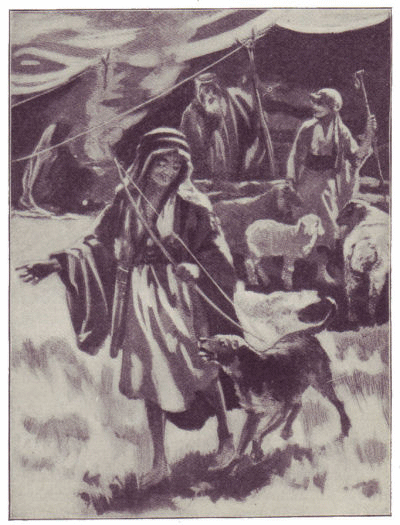 ESAU WAS FOND OF HUNTING |
Among the people in those lands, when a man dies, his older son receives twice as much as the younger of what the father has owned. This was called his "birthright," for it was his right as the oldest born. So Esau, as the older, had a "birthright" to more of Isaac's possessions than Jacob. And besides this, there was the privilege of the promise of God that the family of Isaac should receive great blessings.
Now Esau, when he grew up, did not care for his birthright or the blessing which God had promised. But Jacob, who was a wise man, wished greatly to have the birthright which would come to Esau when his father died. Once, when Esau came home, hungry and tired from hunting in the fields, he saw that Jacob had a bowl of something that he had just cooked for dinner. And Esau said: "Give me some of that red stuff in the dish. Will you not give me some? I am hungry."
And Jacob answered, "I will give it to you, if you will first of all sell to me your birthright."
And Esau said, "What is the use of the birthright to me now when I am almost starving to death? You can have my birthright if you will give me something to eat."
Then Esau made Jacob a solemn promise to give to Jacob his birthright, all for a bowl of food. It was not right for Jacob to deal so selfishly with his brother; but it was very wrong in Esau to care so little for his birthright, and with it God's blessing.
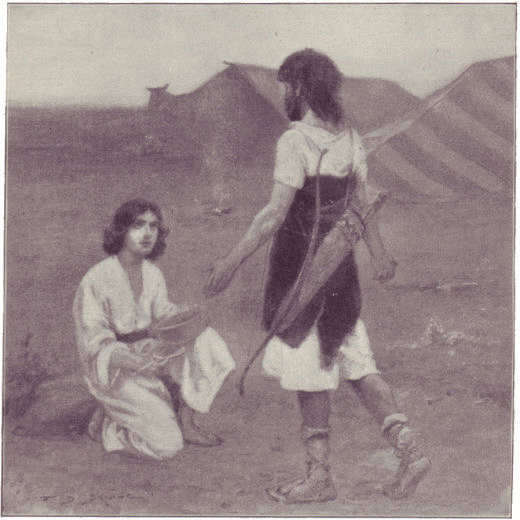 ESAU SELLING HIS BIRTHRIGHT FOR A MEAL |
Some time after this, when Esau was forty years old, he married two wives. Though this would be very wicked in our times it was not supposed to be wrong then; for even good men then had more than one wife. But Esau's two wives were women from the people of Canaan, who worshipped idols, and not the true God. And they taught their children also to pray to idols, so that those who came from Esau, the people who were his descendants, lost all knowledge of God, and became very wicked. But this was long after that time.
Isaac and Rebekah were very sorry to have their son Esau marry women who prayed to idols and not to God; but still Isaac loved his active son Esau more than his quiet son Jacob.
Isaac became at last very old and feeble, and so blind that he could see scarcely anything. One day he said to Esau:
"My son, I am very old, and do not know how soon I must die. But before I die, I wish to give to you, as my older son, God's blessing upon you, and your children, and your descendants. Go out into the fields, and with your bow and arrows shoot some animal that is good for food, and make me a dish of cooked meat, such as you know I love; and after I have eaten it, I will give you the blessing.
Esau ought to have told his father that the blessing did not belong to him, for he had sold it to his brother Jacob. But he did not tell his father. He went out into the fields hunting, to find the kind of meat which his father liked the most.
Now Rebekah was listening, and heard all that Isaac had said to Esau. She knew that it would be better for Jacob to have the blessing than for Esau; and she loved Jacob more than Esau. So she called to Jacob, and told him what Isaac had said to Esau, and she said:
"Now, my son, do what I tell you and you will get the blessing instead of your brother. Go to the flocks and bring to me two little kids from the goats: and I will cook them just like the meat which Esau cooks for your father. And you will bring it to your father; and he will think that you are Easu [should be Esau], and will give you the blessing; and it really belongs to you."
But Jacob said, "You know that Esau and I are not alike. His neck and arms are covered with hair, while mine are smooth. My father will feel of me, and he will find that I am not Esau; and then, instead of giving me a blessing, I am afraid that he will curse me."
But Rebekah answered her son, "Never mind, you do as I have told you, and I will take care of you. If any harm comes, it will come to me; so do not be afraid, but go and bring the meat."
Then Jacob went and brought a pair of little kids from the flock, and from them his mother made a dish of food, so that it would be to the taste just as Isaac liked it. Then Rebekah found some of Esau's clothes, and dressed Jacob in them; and she placed on his neck and his hands some of the skins of the kids, so that his neck and hands would feel rough and hairy to the touch.
Then Jacob came into his father's tent, bringing the dinner, and speaking as much like Esau as he could, he said:
"Here I am, my father."
And Isaac said, "Who are you, my son?"
And Jacob answered, "I am Esau, your oldest son. I have done as you bade me; now sit up, and eat the dinner that I have made; and then give me your blessing, as you promised me."
And Isaac said, "How is it that you found it so quickly?"
Jacob answered, "Because the Lord your God showed me where to go, and gave me good success."
Isaac did not feel certain that it was his son Esau, and he said, "Come nearer and let me feel you, so that I may know that you are really my son Esau."
And Jacob went up close to Isaac's bed, and Isaac felt of his face, and his neck, and his hands, and he said:
"The voice sounds like Jacob, but the hands are the hands of Esau. Are you really my son Esau?"
And Jacob again told a lie to his father, and said, "I am."
Then the old man ate the food that Jacob had brought to him, and he kissed Jacob, believing him to be Esau, and he gave him the blessing, saying to him:
"May God give you the dew of heaven, and the richness of the earth, and plenty of grain and wine. May nations bow down to you and people become your servants. May you be the master over your brother; and may your family and descendants that shall come from you rule over his family and his descendants. Blessed be those that bless you, and cursed be those that curse you."
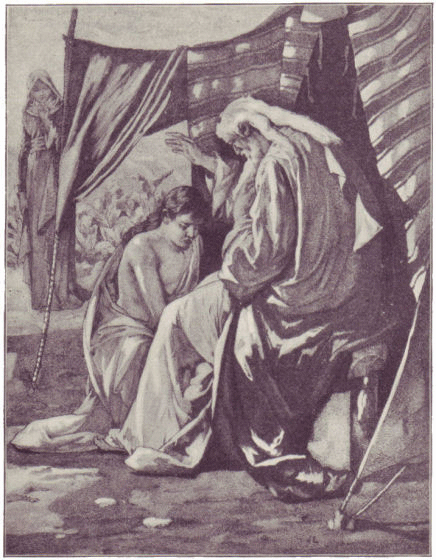 ISAAC BLESSES JACOB |
Just as soon as Jacob had received the blessing he rose up and hastened away. He had scarcely gone out, when Esau came in from his hunting, with the dish of food that he had cooked, and he said:
"Let my father sit up, and eat the food that I have brought, and give me the blessing."
And Isaac said, "Why, who are you?"
Esau answered, "I am your son, your oldest son Esau."
And Isaac trembled and said, "Who then is the one that came in, and brought to me food? And I have eaten his food, and have blessed him; yes, and he shall be blessed."
When Esau heard this he knew that he had been cheated; and he cried aloud, with a bitter cry, "O my father, my brother has taken away my blessing, just as he took away my birthright! But cannot you give me another blessing, too? Have you given everything to my brother? And Isaac told him all that he had said to Jacob.
He said, "I have told him that he shall be the ruler, and that all his brothers and their children will be under him. I have promised him the richest ground for his crops, and rains from heaven to make them grow. All these things have been spoken, and they must come to pass. What is left for me to promise you, my son?"
But Esau begged for another blessing, and Isaac said:
"My son, your dwelling shall be of the riches of the earth, and of the dew of heaven. You shall live by your sword, and your descendants shall serve his descendants. But in time to come they shall break loose, and shall shake off the yoke of your brother's rule, and shall be free."
All this came to pass many years afterward. The people who came from Esau lived in a land called Edom, on the south of the land of Israel, where Jacob's descendants lived. And after a time the Israelites became rulers over the Edomites; and, later still, the Edomites made themselves free from the Israelites. But all this took place hundreds of years after both Esau and Jacob had passed away. The blessing of God's covenant or promise came to Israel, and not to the people from Esau.
It was better that Jacob's descendants, those who came after him, should have the blessing, than that Esau's people should have it; for Jacob's people worshipped God, and Esau's people walked in the way of the idols, and became wicked. But it was very wrong in Jacob to obtain the blessing in the way that he obtained it.
Jacob's Wonderful Dream
After Esau found that he had lost his birthright and his blessing, he was very angry against his brother Jacob; and he said to himself, and told others, "My father Isaac is very old, and cannot live long. As soon as he is dead, then I shall kill Jacob for having robbed me of my right."
When Rebekah heard this, she said to Jacob, "Before it is too late, do you go away from home, and get out of Esau's sight. Perhaps when Esau sees you no longer, he will forget his anger; and then you can come home again. Go and visit my brother Laban, your uncle, in Haran, and stay with him for a little while, until Esau's anger is past."
You remember that Rebekah came from the family of Nahor, Abraham's younger brother, who lived in Haran, a long distance to the northeast of Canaan; and that Laban was Rebekah's brother, as was told in Story Eleven.
So Jacob went out of Beersheba, on the border of the desert, and walked alone toward a land far to the north, carrying his staff in his hand. One evening, just about sunset, he came to a place among the mountains, more than sixty miles distant from his home. And as he had no bed to lie down upon, he took a stone and rested his head upon it for a pillow, and lay down to sleep. We would think that a hard pillow, but Jacob was tired, and soon feel asleep.
And on that night Jacob had a wonderful dream. In his dream he saw stairs leading up to heaven from the earth where he lay; and angels were coming down and going up upon the stairs. And above the stairs, he saw the Lord God standing. And God said to Jacob:
"I am the Lord, the God of Abraham, and the God of Isaac your father; and I will be your God, too. The land where you are lying all alone, shall belong to you and to your children after you; and your children shall spread abroad over the lands, east, and west, and north, and south, like the dust of the earth: and in your family all the world shall receive a blessing. And I am with you in your journey, and I will keep you where you are going, and will bring you back to this land. I will never leave you, and I will surely keep my promise to you."
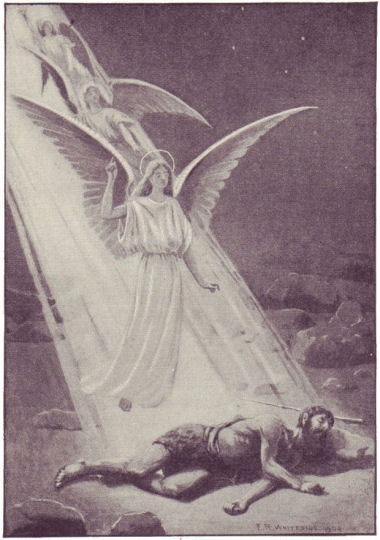 JACOB'S WONDERFUL DREAM |
And in the morning Jacob awaked from his sleep, and he said, "Surely the Lord is in this place and I did not know it! I thought that I was all alone, but God has been with me. This place is the house of God; it is the gate of heaven!"
And Jacob took the stone on which his head had rested, and he set it up as a pillar, and poured oil on it as an offering to God. And Jacob named that place Bethel, which in the language that Jacob spoke means "The House of God."
And Jacob made a promise to God at that time, and said:
"If God really will go with me, and will keep me in the way that I go, and will give me bread to eat, and will bring me to my father's house in peace, then the Lord shall be my God; and this stone shall be the house of God; and of all that God gives me, I will give back to God one-tenth as an offering."
Then Jacob went onward in his long journey. He waded across the river Jordan in a shallow place, feeling the way with his staff; he climbed mountains, and journeyed beside the great desert on the east, and at last he came to the city of Haran. Beside the city was the well, where Abraham's servant had met Jacob's mother, Rebekah (see Story Eleven); and there, after Jacob had waited for a time, he saw a young woman coming with her sheep, to give them water.
Then Jacob took off the flat stone that was over the mouth of the well, and drew water, and gave it to the sheep. And when he found that this young woman was his own cousin Rachel, the daughter of Laban, he was so glad that he wept for joy. And at that moment he began to love Rachel, and longed to have her for his wife.
Rachel's father, Laban, who was Jacob's uncle, the brother of Rebekah, Jacob's mother, gave a welcome to Jacob, and took him into his home.
And Jacob asked Laban if he would give his daughter Rachel to him as his wife; and Jacob said, "If you will give me Rachel, I will work for you seven years." And Laban said, "It is better that you should have her than that a stranger should marry her."
So Jacob lived seven years in Laban's house, caring for his sheep and oxen and camels; and such was his love for Rachel that the seven years seemed like a few days.
At last the day came for the marriage; and they brought in the bride, who after the manner of that land was covered with a thick veil, so that her face could not be seen. And she was married to Jacob; and when Jacob lifted up her veil, he found that he had married, not Rachel whom he loved, but her older sister Leah, who was not beautiful, and whom Jacob did not love at all.
Jacob was very angry that he had been deceived, though that was just the way in which Jacob himself had deceived his father and cheated his brother Esau (see Story Twelve). But his uncle Laban said:
"In our land we never allow the younger daughter to be married before the older daughter. Keep Leah for your wife, and work for me seven years longer, and you shall have Rachel also."
For in those times, as we have seen, men often had two wives or even more than two. No one thought that it was wrong then o have more than one wife, although now it is considered very wicked. So Jacob stayed seven years more, fourteen years in all, before he received Rachel as his wife.
While Jacob was living at Haran, eleven sons were born to him. But only one of these was the child of Rachel, whom Jacob loved. This son was Joseph, who was dearer to Jacob than any other of his children, partly because he was the youngest, and also because he was the child of his beloved Rachel.
A Midnight Wrestling Match
Jacob stayed a long time in the land of Haran, much longer than he had expected to stay. And in that land Jacob became rich. As wages for his work with Laban, Jacob took a share of the sheep, and oxen, and camels. And since Jacob was very wise and careful in his work, his share grew larger, until Jacob owned a great flock and much cattle. At last, after twenty years, Jacob decided to go back to the land of Canaan, and to his father Isaac, who was still living, though now very old and feeble.
Jacob did not tell his uncle Laban that he was going away; but while Laban was absent from home, Jacob gathered together his wives, and children, and all his sheep and cattle, and camels, and he stole away quietly. When Laban found that Jacob had left him, he was not at all pleased; for he wished Jacob still to care for the things that he owned, for Jacob managed them better than Laban himself, and God blessed everything that Jacob undertook. Then, too, Laban did not like to have his two daughters, the wives of Jacob, taken so far away from him.
So Laban and the men who were with him followed after Jacob; but that night God spoke to Lagan in a dream and said:
"Do no harm to Jacob, when you meet him."
Therefore, when Laban came to where Jacob was in his camp on Mount Gilead, on the east of the river Jordan, Laban spoke kindly to Jacob. And Jacob and Laban made a covenant, that is a promise between them. They piled up a heap of stones, and on it they set up a large rock like a pillar; and beside the heap of stones they ate a meal together; and Jacob said to Laban:
"I promise not to go past this heap of stones, and this pillar to do you any harm. The God of your grandfather, Nahor, and the God of my grandfather, Abraham, be the judge between us."
And Laban made the same promise to Jacob; and then he kissed his daughters, Jacob's two wives, and all of Jacob's children, and bade them good-by; and Laban went back to Haran, and Jacob went on to Canaan.
And Jacob gave two names to the heap of stones where they had made the covenant. One name was "Galeed," a word which means, "The heap of Witness." The other was "Mizpah," which means "Watch-tower." For Jacob said, "The Lord watch between you and me, when we are absent from each other."
While Jacob was going back to Canaan, he heard news that filled him with fear. He heard that Esau, his brother, was coming to meet him, leading an army of four hundred men. He knew how angry Esau had been long before, and how he had threatened to kill him. And Jacob feared that Esau would now come upon him, and kill, not only Jacob himself, but his wives and his children. If Jacob had acted rightly toward his brother, he need not have feared Esau's coming; but he knew how he had wronged Esau, and he was terribly afraid to meet him.
That night Jacob divided his company into two parts; so that if one part were taken the other part might escape. And he sent onward before him, as a present to his brother, a great drove of oxen and cows, and sheep and goats, and camels and asses; hoping that by the present his brother might be made more kind toward him. And then Jacob prayed earnestly to the Lord God to help him. After that he sent all his family across a brook that was in his path, called the brook Jabbok, while he stayed alone on the other side of the brook to pray again.
And while Jacob was alone, he felt that a man had taken hold of him, and Jacob wrestled with this strange man all the night. And the man was an angel from God. They wrestled so hard, that Jacob's thigh was strained in the struggle. And the angel said:
"Let me go, for the day is breaking."
And Jacob said:
"I will not let thee go until thou dost bless me." And the angel said:
"What is your name?"
And Jacob answered, "Jacob is my name."
Then the angel said:
"Your name shall no more be called Jacob, but Israel, that is 'He who wrestles with God.' For you have wrestled with God and have won the victory."
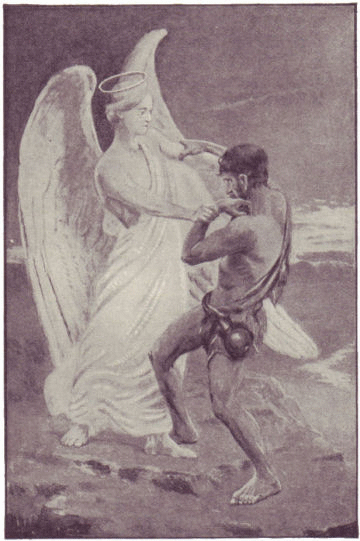 JACOB AND THE ANGEL |
And the angel blessed him there. And the sun rose as the angel left him; and Jacob gave a name to that place. He called it Peniel, or Penuel, words which in the language that Jacob spoke mean "The Face of God." "For," said Jacob, "I have met God face to face." And after this Jacob was lame, for in the wrestle he had strained his thigh.
And as Jacob went across the brook Jabbok, early in the morning, he looked up, and there was Esau right before him. He bowed with his face to the ground, over and over again, as people do in those lands when they meet some one of higher rank than their own. But Esau ran to meet him, and placed his arms around his neck, and kissed him; and the two brothers wept together. Esau was kind and generous to forgive his brother all the wrong that he had done; and at first he would not receive Jacob's present, for he said: "I have enough, my brother." But Jacob urged him, until at last he took the present. And so the quarrel was ended, and the two brothers were at peace.
Jacob came to Shechem, in the middle of the land of Canaan, and there he set up his tents; and at the foot of the mountain, although there were streams of water all around, he dug his own well, great and deep; the well where Jesus sat and talked with a woman many ages after that time; and the well that may be still seen. Even now the traveler who visits that place may drink water from Jacob's well.
After this Jacob had a new name, Israel, which means, as we have seen, "The one who wrestles with God." Sometimes he was called Jacob, and sometimes Israel. And all those who come from Israel, his descendants, were called Israelites.
After this Isaac died, very old, and was buried by his sons Jacob and Esau, in the cave at Hebron where Abraham and Sarah were buried already. Esau with his children and his cattle went away to a land on the southeast of Canaan, which was called Edom. And Jacob, or Israel, and his family lived in the land of Canaan dwelling in tents, and moving from place to place, where they could find good pasture, or grass upon which to feed their flocks.
The Rich Man's Son Who Was Sold as a Slave
After Jacob came back to the land of Canaan with his eleven sons, another son was born to him, the second child of his wife Rachel, whom Jacob loved so well. You remember we told in Story Thirteen how long Jacob worked for Laban caring for his sheep and oxen in order that he might have Rachel for his wife. But now a great sorrow was to come to Jacob, for soon after the baby came, his mother Rachel died, and Jacob was filled with sorrow. Even to this day you can see the place where Rachel was buried, on the road between Jerusalem and Bethlehem. Jacob named the child whom Rachel left, Benjamin; and now Jacob had twelve sons. Most of them were grown-up men, but Joseph was a boy, seventeen years old, and his brother Benjamin was almost a baby.
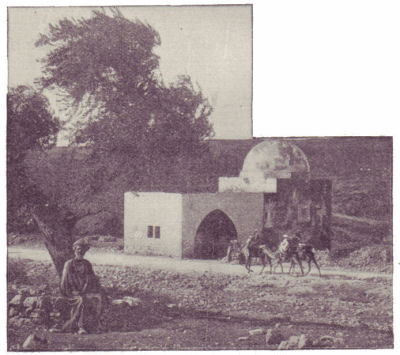 RACHEL'S TOMB |
Of all his children, Jacob loved Joseph the best, because he was Rachel's child, because he was so much younger than most of his brothers, and because he was good, and faithful, and thoughtful. Jacob gave to Joseph a robe or coat of bright color made somewhat like a long cloak with wide sleeves. This was a special mark of Jacob's favor to Joseph, and it made his older brothers very envious of him.
Then, too, Joseph did what was right, while his older brothers often did very wrong acts, of which Joseph sometimes told their father, and this made them very angry at Joseph. But they hated him still more because of two strange dreams that he had, and of which he told them. He said one day:
"Listen to this dream that I have dreamed. I dreamed that we were out in the field binding sheaves, when suddenly my sheaf stood up, and all your sheaves came around it, and bowed down to my sheaf." And they said, scornfully, "Do you suppose that the dream means that you will some time rule over us, and that we shall bow down to you?" Then a few days after Joseph said, "I have dreamed again. This time I saw in my dream the sun and the moon and eleven stars all come and bow down to me."
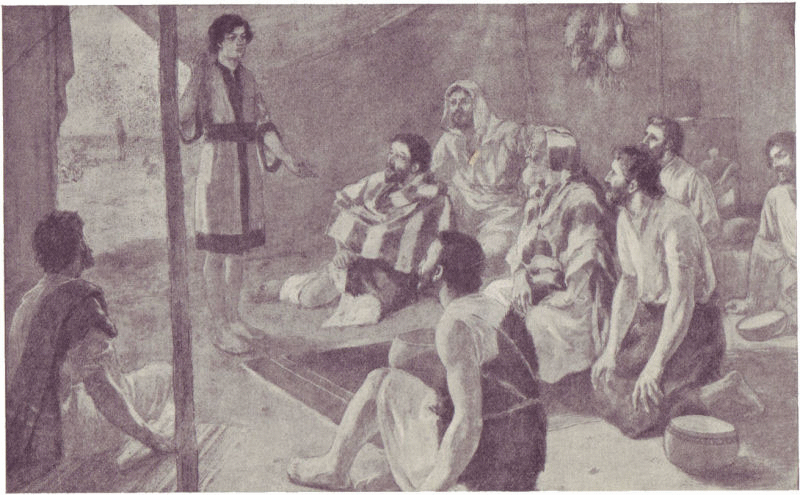 JOSEPH TELLING HIS DREAM TO HIS BROTHERS |
And his father said to him, "I do not like you to dream such dreams. Shall I, and your mother, and your brothers, come and bow down before you, as if you are a king?"
His brothers hated Joseph, and would not speak kindly to him; but his father thought much of what Joseph had said.
At one time, Joseph's ten older brothers were taking care of the flock in the fields near Schechem, which was nearly fifty miles from Hebron, where Jacob's tents were spread. And Jacob wished to send a message to his sons, and he called Joseph, and said to him, "Your brothers are near Schechem with the flock. I wish that you would go to them, and take a message, and find if they are well, and if the flocks are doing well; and bring me word from them."
That was quite an errand for a boy to go alone over the country, and find his way, for fifty miles, and then walk home again. But Joseph was a boy that could take care of himself, and could be trusted; so he went forth on his journey, walking northward over the mountains, past Bethlehem, and Jerusalem, and Bethel,—though we are not sure that any of those cities were then built, except Jerusalem, which we know was already a strong city.
When Joseph reached Schechem he would not find his brothers, for they had taken their flocks to another place. A man met Joseph wandering in the field, and asked him, "Whom are you seeking?" Joseph said, "I am looking for my brothers, the sons of Jacob. Can you tell me where I will find them?" And the man said, "They are at Dothan; for I heard them say that they were going there." Then Joseph walked over the hills to Dothan, which was fifteen miles further. And his brothers saw him afar off coming towards them. They knew him by his bright garment; and one said to another:
"Look, that dreamer is coming! Come, let us kill him, and throw his body into a pit, and tell his father that some wild beast has eaten him; and then we will see what becomes of his dreams."
One of his brothers, whose name was Reuben, felt more kindly toward Joseph than the others; but he did not dare to oppose the others openly. Reuben said:
"Let us not kill him; but let us throw him into this pit, here in the wilderness, and leave him there to die."
But Reuben intended, after they had gone away, to lift Joseph out of the pit, and take him home to his father. The brothers did as Reuben told them; they threw Joseph into the pit, which was empty. He cried, and begged them to save him, but they would not. They calmly sat down to eat their dinner on the grass, while their brother was calling to them from the pit.
After the dinner, Reuben chanced to go to another part of the field, so that he was not at hand when a company of men passed by with their camels, going from Gilead, on the east of the river Jordan, to Egypt, to sell spices and fragrant gum from trees to the Egyptians. Then Judah, another of Joseph's brothers said, "What good will it do us to kill our brother? Would it not be better for us to sell him to these men, and let them carry him away? After all, he is our brother; and we would better not kill him."
His brothers agreed with him; so they stopped the men who were passing, and drew up Joseph from the pit; and for twenty pieces of silver, they sold Joseph to these men; and they took him away with them down to Egypt.
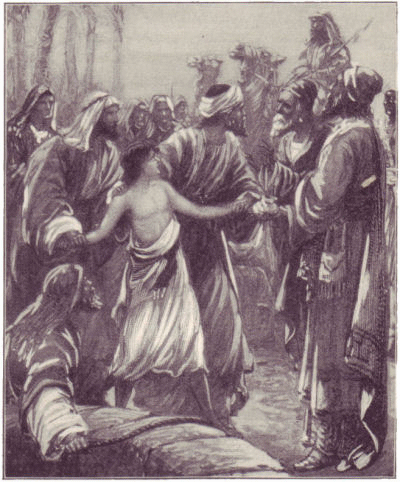 JOSEPH SOLD BY HIS BROTHERS |
After a while, Reuben came to the pit, where he had left Joseph, and looked into it; but Joseph was not there. Then Reuben was in great trouble, and he came back to this brothers saying, "The boy is not there! What shall I do?"
Then his brothers told Reuben what they had done, and they all agreed together to deceive their father. They killed one of the goats, and dipped Joseph's coat in its blood, and they brought it to their father, and they said to him, "We found this coat out in the wilderness. Look at it, and see if you think it was your son's." And Jacob knew it at once. He said, "It is my son's coat. Some wild beast has eaten him. There is no doubt that Joseph has been torn in pieces!"
And Jacob's heart was broken over the loss of Joseph, all the more because he had sent Joseph alone on the journey through the wilderness. They tried to comfort him, but he would not be comforted. He said:
"I will go down to the grave mourning for my poor lost son."
So the old man sorrowed for his son Joseph; and all the time his wicked brothers knew that Joseph was not dead; but they would not tell their father the dreadful deed that they had done to their brother, in selling him as a slave.
From the Prison to the Palace
The men who bought Joseph from his brothers were called Ishmaelites, because they belonged to the family of Ishmael, who, you remember, was the son of Hagar, the servant of Sarah (Story Nine). These men carried Joseph southward over the plain which lies beside the great sea on the west of Canaan; and after many days they brought Joseph to Egypt. How strange it must have seemed to the boy who had lived in tents, to see the great river Nile, and the cities, thronged with people, and the temples, and the mighty pyramids!
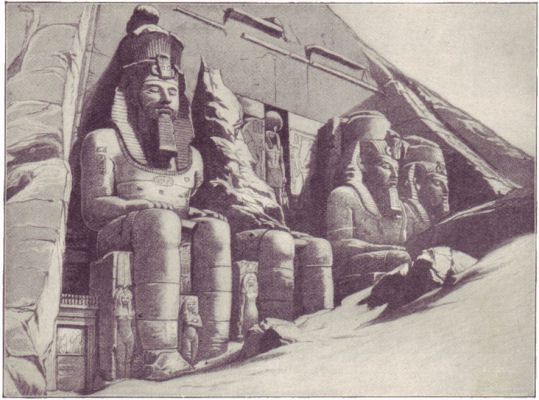 A GREAT TEMPLE IN EGYPT |
The Ishmaelites sold Joseph as a slave to a man named Potiphar, who was an officer in the army of Pharaoh, the king of Egypt. Joseph was a beautiful boy, and cheerful and willing in his spirit, and able in all that he undertook; so that his master, Potiphar, became very friendly to him, and after a time he placed Joseph in charge of his house, and everything in it. For some years Joseph continued in the house of Potiphar, a slave in name, but in reality the master of all his affairs, and ruler over his fellow-servants.
But Potiphar's wife, who at first was very friendly to Joseph, afterward became his enemy, because Joseph would not do wrong to please her. She told her husband falsely that Joseph had done a wicked deed. Her husband believed her, and was very angry at Joseph, and put him in the prison with those who had been sent to that place for breaking the laws of the land. How hard it was for Joseph to be charged with a crime, when he had done no wrong, and to be thrust into a dark prison among wicked people!
But Joseph had faith in God, that at some time all would come out right: and in the prison he was cheerful, and kind, and helpful, as he had always been. The keeper of the prison saw that Joseph was not like the other men around him, and he was kind to Joseph. In a very little while Joseph was placed in charge of all his fellow-prisoners, and took care of them; just as he had taken care of everything in Potiphar's house. The keeper of the prison scarcely looked into the prison at all, for he had confidence in Joseph, that he would be faithful and wise in doing the work given to him. Joseph did right, and served God; and God blessed Joseph in everything.
While Joseph was in prison, two men were sent there by the king of Egypt, because he was displeased with them. One was the king's chief butler, who served the king with wine; the other was the chief baker, who served him with bread. These two men were under Joseph's care, and Joseph waited on them, for they were men of rank.
One morning, when Joseph came into the room in the prison where the butler and the baker were kept, he found them looking quite sad. Joseph said to them:
"Why do you look so said to-day?" Joseph was cheerful and happy in his spirit, and he wished others to be happy, even in prison.
And one of the men said, "Each one of us dreamed last night a very strange dream; and there is no one to tell us what our dreams mean."
For in those times, before God gave the Bible to men, he often spoke to men in dreams; and there were wise men, who could sometimes tell what the dreams meant.
"Tell me," said Joseph, "what your dreams were. Perhaps my God will help me to understand them."
Then the chief butler told his dream. He said, "In my dream I saw a grave-vine with three branches; and as I looked the branches shot out buds, and the buds became blossoms, and the blossoms turned into clusters of ripe grapes. And I picked the grapes, and squeezed their juice into King Pharaoh's cup, and it became wine; and I gave it to King Pharaoh to drink, just as I used to do when I was beside his table."
Then Joseph said, "This is what your dream means. The three branches mean three days. In three days King Pharaoh will call you out of prison, and will put you back in your place; and you shall stand at his table, and shall give him his wine, as you have given it before. But when you go out of prison, please to remember me, and try to find some way to get me, too, out of this prison. For I was stolen out of the land of Canaan, and sold as a slave; and I have done nothing wrong, to deserve being put in this prison. Do speak to the king for me, that I may be set free."
Of course the chief butler felt very happy to hear that his dream had so pleasant a meaning; and then the chief baker spoke, hoping to have an answer as good.
"In my dream," said the baker, "there were three baskets of white bread on my head, one above the other, and on the top-most basket were all kinds of roasted meat and food for Pharaoh; and the birds came, and at the food from the baskets on my head."
And Joseph said to the baker:
"This is the meaning of your dream, and I am sorry to tell it to you. The three baskets are three days. In three days, by order of the king, you shall be lifted up, and hanged upon a tree; and the birds shall eat your flesh from your bones as you are hanging in the air."
And it came to pass, just as Joseph had said. Three days after that, King Pharaoh sent his officers to the prison. They came and took out both the chief butler and the chief baker. The baker they hung up by his neck to die, and left his body for the birds to pick in pieces. The chief butler they brought back to his old place, where he waited at the king's table, and handed him his wine to drink.
You would have supposed that the butler would remember Joseph, who had given him the promise of freedom, and had shown such wisdom. But in his gladness, he forgot all about Joseph. And two full years passed by, while Joseph was still in prison, until he was a man thirty years old.
But one night, King Pharaoh himself dreamed a dream, in fact two dreams in one. And in the morning he sent for all the wise men of Egypt, and told them his dreams; but there was not a man who could give the meaning of them. And the king was troubled, for he felt that the dreams had some meaning, which it was important for him to know.
Then suddenly the chief butler, who was by the king's table, remembered his own dream, in the prison two years before, and remembered, too, the young man who had told its meaning so exactly. And he said:
"I do remember my faults this day. Two years ago King Pharaoh was angry with his servants, with me and the chief baker, and he sent us to the prison. While we were in the prison, one night each of dreamed a dream, and the next day a young man in the prison, a Hebrew from the land of Canaan, told us what out dreams meant; and in three days them came true, just as the Hebrew had said. I think that, if this young man is in the prison still, he could tell the king the meaning of his dreams."
You notice that the butler spoke of Joseph as "a Hebrew." The people of Israel, to whom Joseph belonged, were called Hebrews as well as Israelites. The word Hebrew means "one who crossed over," and it was given to the Israelites, because Abraham their father, had come from a land on the other said of the great river Euphrates, and had crossed over the river on his way to Canaan.
Then King Pharaoh sent in haste to the prison for Joseph; and Joseph was taken out, and he was dressed in new garments, and was led in to Pharaoh in the palace. And Pharaoh said to Joseph: "I have dreamed a dream, and there is no one who can tell what it means. And I have been told that you have power to understand dreams and what they mean."
And Joseph answered Pharaoh: "The power is not in me; but God will give Pharaoh a good answer. What is the dream that the king has dreamed?"
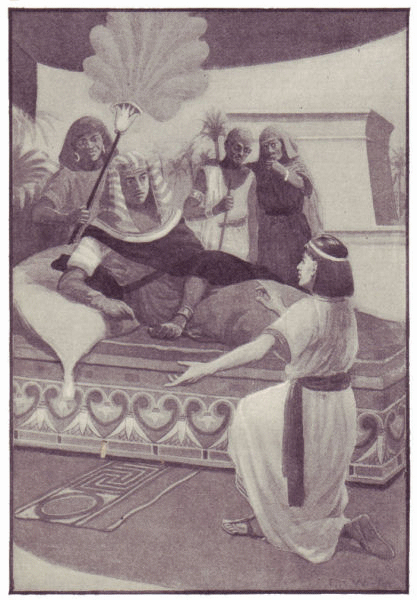 JOSEPH BEFORE PHARAOH |
"In my first dream," said Pharaoh, "I was standing by the river; and I saw seven fat and handsome cows come up from the river to feed in the grass. And while they were feeding, seven other cows followed them up from the river, very thin, and poor, and lean, such miserable creatures as I had never seen. And the seven lean cows ate up the seven fat cows; and after they had eaten them, they were as lean and miserable as before. Then I awoke.
"And I fell asleep again, and dreamed again. In my second dream, I saw seven heads of grain growing upon one stalk, large, and strong, and good. And then seven heads came up after them, that were thin, and poor, and withered. And the seven thin heads swallowed up the seven good heads, and afterward were as poor and withered as before.
"And I told these two dreams to all the wise men, and there is no one who can tell me their meaning. Can you tell me what these dreams mean?"
And Joseph said to the king:
"The two dreams have the same meaning. God has been showing to King Pharaoh what he will do in this land. The seven good cows mean seven years, and the seven good heads of grain mean the same seven years. The seven lean cows, and the seven thin heads of grain also mean seven years. The good cows and the good grain mean seven years of plenty, and the seven thin cows and thin heads of grain mean seven poor years. There are coming upon the land of Egypt seven years of such plenty as have never been seen; when the fields shall bring greater crops than ever before; and after those years shall come seven years when the fields shall bring no crops at all. And then for sever years there shall be such need, that the years of plenty will be forgotten, for the people will have nothing to eat.
"Now, let King Pharaoh find some man who is able and wise, and let him set this man to rule over the land. And during the seven years of plenty, let a part of the crops be put away for the years of need. If this shall be done, then when the years of need come there will be plenty of food for all the people, and no one will suffer, and al will have enough."
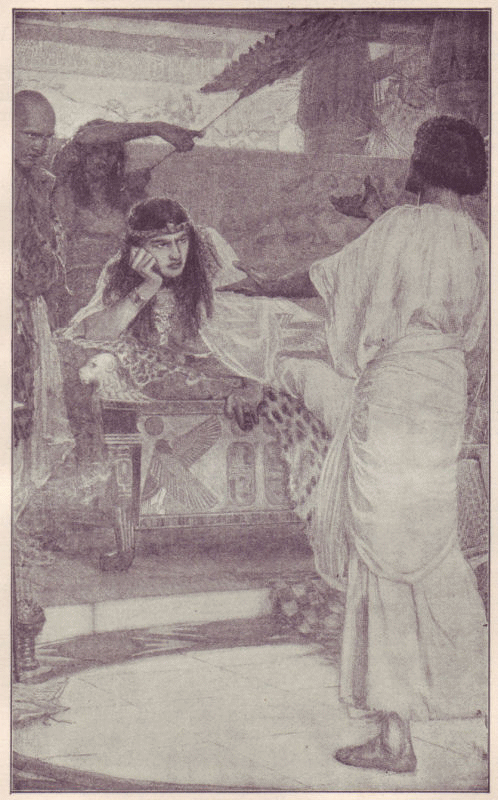 JOSEPH TELLING PHARAOH THE MEANING OF HIS DREAM |
And King Pharoah said to Joseph:
"Since God has shown you all this; there is no other man as wise as you. I will appoint you to do this work, and to rule over the land of Egypt. All the people shall be under you; only on the throne of Egypt, I will be above you."
And Pharaoh took from his own hand the ring which held his seal, and put it on Joseph's hand, so that he could sign for the king, and seal in the king's place. And he dressed Joseph in robes of fine linen, and put around his neck a gold chain. And he made Joseph ride in a chariot when was next in rank to his own. And they cried out before Joseph, "Bow the knee." And thus Joseph was ruler over all the land of Egypt.
So the slave boy, who was sent to prison without deserving it, came out of prison to be a prince and a master over all the land. You see that God had not forgotten Joseph, even when he seemed to have left him to suffer.
How Joseph's Dream Came True
When Joseph was made ruler over the land of Egypt, he did just as he had always done. It was not Joseph's way to sit down and rest, and enjoy himself, and make others wait on him. He found his work at once, and began to do it faithfully and thoroughly. He went out over all the land of Egypt, and saw how rich and abundant were the fields of grain, giving much more than the people could use for their own needs. He told the people not to waste it, but to save it for the coming time of need.
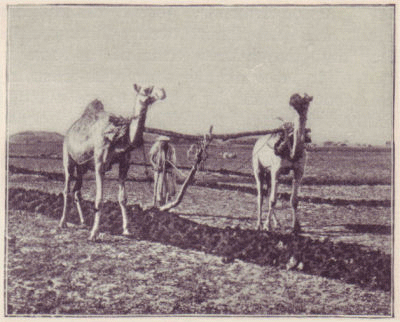 PLOWING IN BIBLE TIME |
And he called upon the people to give him for the king, one bushel of grain out of every five, to be stored up. The people brought their grain, after taking for themselves as much as they needed; and Joseph stored it up in great store-houses in the cities; so much at last that no one could keep account of it.
The king of Egypt gave a wife to Joseph from the noble young women of his kingdom. Her name was Asenath; and to Joseph and his wife God gave two sons. The oldest son he named Manasseh, a word which means, "making to forget."
"For," said Joseph, "God has made me forget all my troubles, and my toil as a slave."
The second son he named Ephraim, a word that means, "fruitful."
"Because," said Joseph, "God has not only made the land fruitful, but he has made me fruitful in the land of my troubles."
The seven years of plenty soon passed by, and then came the years of need. In all the lands around people were hungry, and there was no food for them to eat; but in the land of Egypt everybody had enough. Most of the people soon used up the grain that they had saved: many had saved none at all, and they all cried to the king to help them.
"Go to Joseph," said King Pharaoh, "and do whatever he tells you to do."
Then the people came to Joseph, and Joseph opened the store-houses, and sold to the people all the grain that they wished to buy. And not only the people of Egypt came to buy grain, but people of all the lands around as well, for there was great need and famine everywhere.
And the need was as great in the land of Canaan, where Jacob lived, as in other lands. Jacob was rich in flocks and cattle, and gold and silver; but his fields gave no grain, and there was danger that his family and his people would starve. And Jacob,—who was now called Israel also,—heard that there was food in Egypt, and he said to his sons:
"Why do you look at each other, asking what to do to find food? I have been told that there is grain in Egypt. Go down to that land, and take money with you, and buy grain, so that we may have bread, and may live."
Then the ten older brothers of Joseph went down to the land of Egypt. They rode upon asses, for horses were not much used in those times, and they brought money with them. But Jacob would not let Benjamin, Joseph's younger brother, go with them, for he was all the more dear to his father, now that Joseph was no longer with him; and Jacob feared that harm might come to him.
Then Joseph's brothers came to Joseph to buy food. They did not know him, grown up to be a man, dressed as a prince, and seated on a throne. Joseph was now nearly forty years old, and it had been almost twenty-three years since they had sold him. But Joseph knew them all, as soon as he saw them. He resolved to be sharp and stern with them, not because he hated them, but because he wished to see what their spirit was, and whether they were as selfish, and cruel, and wicked as they had been in other days.
They came before him, and bowed, and with their faces to the ground. Then, no doubt, Joseph thought of the dream that had come to him while he was a boy, of his brothers' sheaves bending down around his sheaf. He spoke to them as a stranger, as if he did not understand their language, and he had their words explained to him in the language of Egypt.
"Who are you? And from what place do you come?" said Joseph, in a harsh, stern manner.
They answered him, very meekly, "We have come from the land of Canaan to buy food."
"No," said Joseph, "I know what you have come for. You have come as spies, to see how helpless the land is, so that you can bring an army against us, and make war on us."
"No, no," said Joseph's ten brothers, "we are no spies, we are the sons of one man, who lives in the land of Canaan; and we have come for food, because we have none at home."
"You say you are the sons of one man, who is your father? Is he living? Have you any more brothers? Tell me all about yourselves."
And they said, "Our father is an old man in Canaan. We did have a younger brother, but he was lost; and we have one brother still, who is the youngest of all, but his father could not spare him to come with us."
"No," said Joseph, "you are not good, honest men. You are spies. I shall put you all in prison, except one of you; and he shall go and bring that youngest brother of yours; and when I see him, then I will believe that you tell the truth."
So Joseph put all the ten men in prison, and kept them under guard for three days; then he sent for them again. They did not know that he could understand their language, and they said to each other, while Joseph heard, but pretended not to hear:
"This has come upon us because of the wrong that we did to our brother Joseph, more than twenty years ago. We heard him cry, and plead with us, when we threw him into the pit, and we would not have mercy on him. God is giving us only what we have deserved."
And Reuben, who had tried to save Joseph, said, "Did I not tell you not to harm the boy? And you would not listen to me. God is bringing our brother's blood upon us all."
When Joseph heard this, his heart was touched, for he saw that his brothers were really sorry for the wrong that they had done him. He turned away from them, so that they could not see his face, and he wept. Then he turned again to them, and spoke roughly as before, and said:
"This I will do, for I serve God, I will let you all go home, except one man. One of you I will shut up in prison; but the rest of you can go home, and take food for your people. And you must come back, and bring your youngest brother with you, and I shall know then that you have spoken the truth."
Then Joseph gave orders, and his servants seized one of his brothers, whose name was Simeon, and bound him in their sight, and took him away to prison. And he ordered his servants to fill the men's sacks with grain, and to put every man's money back into the sack before it was tied up, so that they would find the money as soon as they opened the sack. Then the men loaded their asses with the sacks of grain, and started to go home, leaving their brother Simeon a prisoner.
When they stopped on the way to feed their asses, one of the brothers opened his sack, and there he found his money lying on the top of the grain. He called out to his brothers, " 'See, here is my money given again to me!" And they were frightened; but they did not dare to go back to Egypt, and meet the stern ruler of the land. They went home, and told their old father all that had happened to them; and how their brother Simeon was in prison, and must stay there until they should return, bringing Benjamin with them.
When they opened their sacks of grain, there, in the mouth of each sack, was the money that they had given; and they were filled with fear. Then they spoke of going again to Egypt, and taking Benjamin, but Jacob said to them:
"You are taking my sons away from me. Joseph is gone, and Simeon is gone, and now you would take Benjamin away. All these things are against me!"
Reuben said, "Here are my own two boys. You may kill them, if you wish, in case I do not bring Benjamin back to you."
But Jacob said, "My youngest son shall not go with you. His brother is dead, and he alone is left to me. If harm should come to him, it would bring down my gray hairs with sorrow to the grave."
A Lost Brother Found.
The food which Jacob's sons had brought from Egypt did not last long, for Jacob's family was large. Most of his sons were married and had children of their own; so that the children and grand-children, were sixty-six, besides the servants who waited on them, and the men who cared for Jacob's flocks. So around the tent of Jacob was quite a camp of other tents and an army of people.
When the food that had come from Egypt was nearly eaten up, Jacob said to his sons:
"Go down to Egypt again, and buy some more food for us."
And Judah, Jacob's son, the man who years before had urged his brothers to sell Joseph to the Ishmaelites (see Story Fifteen), said to his father:
"It is of no use for us to go to Egypt, unless we take Benjamin with us. The man who rules in that land said to us, 'You shall not see my face, unless your youngest brother be with you.'"
Israel said, "Why did you tell the man that you had a brother? You did me great harm when you told him."
"Why," said Jacob's sons, "we could not help telling him. The man asked us all about our family. Is your father yet living? Have you any more brothers? And we had to tell him, his questions were so close. How should we know that he would say, 'Bring your brother here for me to see him.'"
And Judah said, "Send Benjamin with me, and I will take care of him. I promise you, that I will bring him safely home. If he does not come back, let me bear the blame forever. He must go, or we shall die for want of food; and we might have gone down to Egypt and come home again, if we had not been kept back." And Jacob said, "If he must go, then he must. But take a present to the man, some of the choicest fruits of the land, some spices, and perfumes, and nuts, and almonds. And take twice as much money, besides the money that was in your sacks. Perhaps that was a mistake, when the money was given back to you. And take your brother Benjamin; and may the Lord God make the man kind to you, so that he will set Simeon free, and let you bring Benjamin back. But if it is God's will that I lose my children, I cannot help it."
So ten brothers of Joseph went down a second time to Egypt, Benjamin going in place of Simeon. They came to Joseph's office, the place where he sold grain to the people; and they stood before their brother, and bowed as before. Joseph saw that Benjamin was with them, and he said to his steward, the man who was over his house: "Make ready a dinner, for all these men shall dine with me to-day."
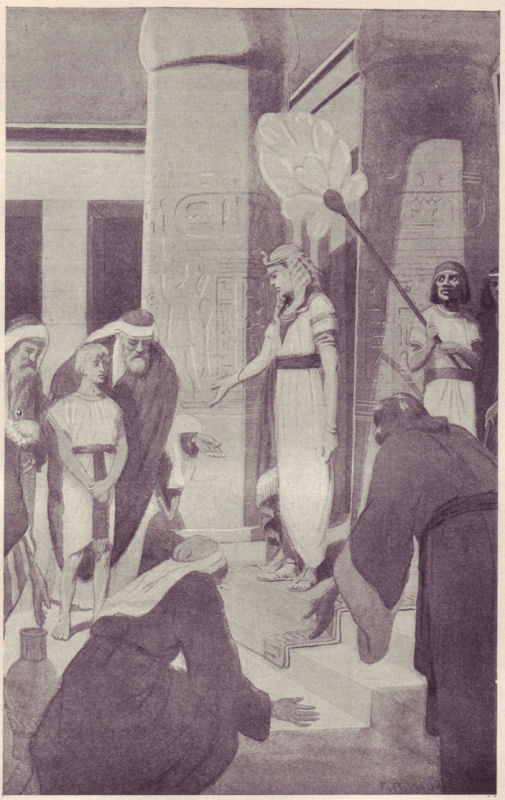 BENJAMIN IS BROUGHT TO JOSEPH |
When Joseph's brothers found that they were taken into Joseph's house, they were filled with fear; they said to each other:
"We have been taken here on account of the money in our sacks. They will say that we have stolen it; and then they will sell us all for slaves."
But Joseph's steward, the man who was over his house, treated the men kindly, and when they spoke of the money in their sacks, he would not take it again, saying: "Never fear; your God must have sent you this as a gift. I had your money." The steward received the men into Joseph's house, and washed their feet, according to the custom of the land. And at noon, Joseph came in to meet them. They brought him the present from their father, and again they bowed before him, with their faces on the ground.
And Joseph asked them if they were well, and said; "Is your father still living, the old man of whom you spoke? Is he well?"
And they said, "Our father is well, and he is living." And again they bowed to Joseph. And Joseph looked at his younger brother, Benjamin, the child of his own mother, Rachel; and he said: "Is this your youngest brother, of whom you spoke to me? God be gracious unto you, my son."
And Joseph's heart was so full that he could not keep back his tears. He went in haste to his own room, and wept there. Then he washed his face, and came out again, and ordered the table to be set for dinner. They set Joseph's table for himself, as the ruler, and another table for his Egyptian officers, and another for the eleven men from Canaan; for Joseph had brought Simeon out of the prison, and had given him a place with his brothers.
Joseph himself arranged the order of the seats for his brothers, the oldest at the head; and all in order of age down to the youngest. The men wondered at this, and could not see how the ruler of Egypt should know the order of their ages. And Joseph sent dishes from his table to his brothers; and he gave to Benjamin five times as much as to the others. Perhaps he wished to see whether they were as jealous of Benjamin as in other days they had been toward him.
After dinner, Joseph said to his steward, "Fill the men's sacks with grain, as much as they can carry; and put each man's money in his sack. And put my silver cup in the sack of the youngest, with his money."
The steward did as Joseph had said; and early in the morning the brothers started to go home. A little while afterward, Joseph said to his steward:
"Hasten, follow after the men from Canaan, and say, 'Why have you wronged me, after I had treated you kindly? You have stolen my master's silver cup, out of which he drinks.'" The steward followed the men, and overtook them, and charged them with stealing. And they said to him:
"Why should you talk to us in this manner? We have stolen nothing. Why, we brought back to you the money that we found in our sacks; and is it likely that we would steal from your lord his silver or gold? You may search us; and if you find your master's cup on any of us, let him die, and the rest of us may be sold as slaves."
Then they took down the sacks from the asses, and opened them; and in each man's sack was his money, for the second time. And when they came to Benjamin's sack, there was the ruler's silver cup! Then, in the greatest sorrow, they tied up their bags again, and laid them on the asses, and came back to Joseph's palace.
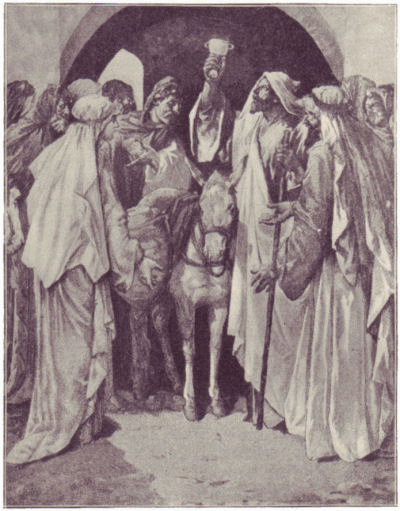 THE CUP WAS FOUND IN THE SACK OF BENJAMIN |
And Joseph said to them:
"What wicked thing is this that you have done? Did you not know that I would surely find out your deeds."
Then Judah said, "O my lord, what can we say? God has punished us for our sins; and now we must all be slaves, both us that are older, and the youngest in whose sack the cup was found."
"No," said Joseph, "only one of you is guilty, the one who has taken away my cup; I will hold him as a slave, and the rest of you can go home to your father."
Joseph wished to see whether his brothers were still selfish, and were willing to let Benjamin suffer, if they could escape.
Then Judah, the very man who had urged his brothers to sell Joseph as a slave, came forward, and fell at Joseph's feet, and pleaded with him to let Benjamin go. He told again the whole story, how Benjamin was the one whom his father loved the most of all his children, now that his brother was lost. He said:
"I promised to bear the blame, if this boy was not brought home in safety. If he does not go back, it will kill our poor old father, who has seen much trouble. Now let my youngest brother go home to his father, and I will stay here as a slave in his place!"
Joseph knew now what he had longed to know, that his brothers were no longer cruel nor selfish, but one of them was willing to suffer, so that his brother might be spared. And Joseph could not any longer keep his secret, for his heart longed after his brothers, and he was ready to weep again, with tears of love and joy. He sent all his Egyptian servants out of the room, so that he might be alone with his brothers, and then said:
"Come near to me, I wish to speak with you;" and they came near, wondering. Then Joseph said:
"I am Joseph, is my father really alive?" How frightened his brothers were, as they heard these words, spoken in their own language by the ruler of Egypt, and for the first time, knew that this stern man, who had their lives in his hand, was their own brother whom they had wronged! Then Joseph said again:
"I am Joseph your brother, whom you sold into Egypt. But do not feel troubled because of what you did. For God sent me before you to save your lives. There have been already two years of need and famine, and there are to be five years more, when there shall neither be plowing of the fields nor harvest. It was not you who sent me here, but God, and he sent me to save your lives. God has made me like a father to Pharaoh and ruler over all the land of Egypt. Now, go home, and bring down to me my father and all his family, for that is the only way to save their lives."
Then Joseph placed his arms around Benjamin's neck, and kissed him, and wept upon him. And Benjamin wept on his neck. And Joseph kissed all his brothers, to show them that he had fully forgiven them; and after that his brothers began to lose their fear of Joseph, and talked with him more freely.
Afterward Joseph sent his brothers home with good news, and rich gifts, and abundant food. He sent also wagons in which Jacob and his wives and the little ones of his family might ride from Canaan down to Egypt. And Joseph's brothers went home happier than they had been for many years.
From the Land of Famine to the Land of Plenty
So Joseph's eleven brothers went home to their old father with the glad news that Joseph was alive and was ruler over the land. It was such a joyful surprise to Jacob that he fainted. But after a time he revived; and when they showed him the wagons that Joseph had sent to bring him and his family to Egypt, old Jacob said, "It is enough; Joseph my son is yet alive; I will go and see him before I die."
Then they went on their journey, with their wives, and children, and servants, and sheep and cattle, a great company. They stopped to rest at Beersheba, which had been the home of Isaac and of Abraham, and made offerings to the Lord, and worshipped. And that night the Lord appeared to Jacob, and said to him:
"Jacob, I am the Lord, the God of your father; fear not to go down to Egypt; for I will go down with you; and there you shall see your son Joseph; and in Egypt I will make of your descendants, those that come from you, a great people; and I will surely bring them back again to this land."
They came down to Egypt, sixty-six of Jacob's children and grand-children. Joseph rode in his chariot to meet his father, and fell on his neck, and wept upon him. And Jacob said, "Now, I am ready to die, since I know that you are still alive; and I have seen your face." And Joseph brought his father in to see King Pharaoh; and Jacob, as an old man, gave his blessing to the king.
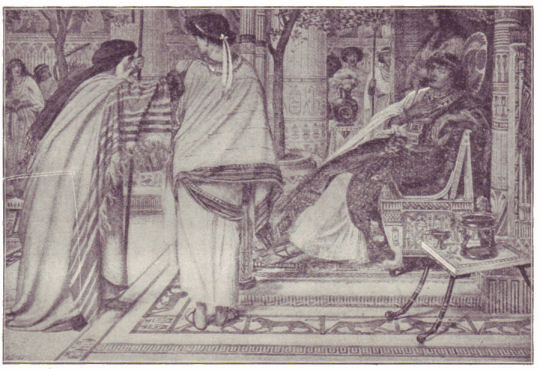 JOSEPH BRINGS JACOB TO PHARAOH |
The part of the land of Egypt where Joseph found for his brothers a home, was called Goshen. It was on the east, between Egypt and the desert, and it was a very rich land, where the soil gave large harvests. But at that time, and for five years after, there were no crops, because of the famine that was in the land. During those years, the people of Israel in the land of Goshen, were fed as were all the people of Egypt, with grain from the storehouses of Joseph.
Jacob lived to be almost a hundred and fifty years old. Before he died he blessed Joseph and all his sons, and said to them:
"When I die, do not bury me in the land of Egypt, but take my body to the land of Canaan, and bury me in the cave at Hebron, with Abraham, and Isaac my father."
And Joseph brought his two sons, Manasseh and Ephraim, to his father's bed, Jacob's eyes were dim with age, as his father Isaac's had been (see Story Twelve), and he would not see the two young men. And he said, "Who are these?"
And Joseph said, "They are my two sons, whom God has given me in this land."
"Bring them to me," said Jacob, "that I may bless them before I die."
And Jacob kissed them, and put his arms around them, and he said:
"I had not thought that I should ever see your face, my son; and God has let me see both you and your children also."
And Jacob placed his right hand on Ephraim's head, the younger, and his left on Manasseh the older. Joseph tried to change his father's hands, so that his right hand should be on the older son's head. But Jacob would not allow him, and he said:
"I know what I am doing, God will bless the older son; but the greater blessing shall be with the younger, for his descendants, those who spring from him, shall be greater and stronger than the descendants of his brother."
And so it came to pass many years after this; for the tribe of Ephraim, the younger son, became greater and more powerful than the tribe of Manasseh, the older son.
When Jacob died a great funeral was held. They carried his body up out of Egypt to the land of Canaan, and buried it,—as he had said to them,—in the cave of Machpelah, where Abraham and Isaac were buried already.
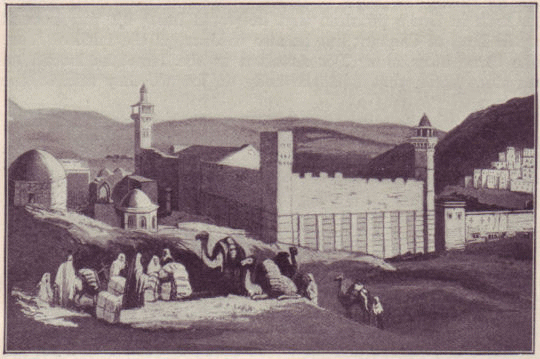 THE TOMB OF ABRAHAM, ISAAC AND JACOB |
When the sons of Jacob came back to Egypt after the burial of their father, they said one to another:
"It may be that Joseph will punish us, now that his father is dead, for the wrong that we did to him many years ago."
And they sent a message, asking Joseph to forgive them, for his father's sake. And again they came and bowed down before him, with their faces to the ground; they said, "We are your servants; be merciful to us."
Jacob wept when his brothers spoke to him, and he said:
"Fear not. Am I in God's place to punish and to reward? It is true that you meant evil to me, but God turned it to good, so that all your families might be kept alive. Do not be afraid; I will care for you, and for your children."
After this Joseph lived to a good old age, until he was a hundred and ten years old. Before he died he said to his children, and to all the children of Israel, who had now increased to very many people:
"I am going to die; but God will come to you, and will bring you up out of this land, into your own land, which he promised to your fathers, to Abraham, and Isaac, and Jacob. When I die do not bury me in Egypt, but keep my body until you go out of this land, and take it with you."
So when Joseph died they embalmed his body, as the Egyptians embalmed the dead; so that the body would not decay, and they placed his body in a stone coffin, and kept it in the land of Goshen among the people of Israel. Thus Joseph not only showed his faith in God's promise, that he would bring his people back to the land of Canaan; but he also encouraged the faith of those who came after him. For as often as the Israelites looked on the stone coffin that held the body of Joseph, they said to one another.
There is the token, the sign, that this land is not our home. This coffin will not be buried until we bury it in our own land, the land of Canaan, where God will lead us in his own time."
The Beautiful Baby Who Was Found in a River
The children of Israel stayed in the land of Egypt much longer than they had expected to stay. They were in that land about four hundred years. And the going down to Egypt proved a great blessing to them. It saved their lives during the years of famine and need. After the years of need were over, they found the soil in the land of Goshen, that part of Egypt where they were living, very rich, so that they could gather three or four crops every year.
Then, too, some of the sons of Israel, before they came to Egypt, had begun to marry the women in the land of Canaan, who worshipped idols, and not the Lord. If they had stayed there, their children would have grown up like the people around them, and soon would have lost all knowledge of God.
But in Goshen, they lived alone and apart from the people of Egypt. They worshipped the Lord God, and were kept away from the idols of Egypt. And in that land, as the years went on, from being seventy people, they grew in number, until they became a great multitude. Each of the twelve sons of Jacob was the father of a tribe, and Joseph was the father of two tribes, which were named after his two sons, Ephraim and Manasseh.
As long as Joseph lived, and for some time after, the people of Israel were treated kindly by the Egyptians, out of their love for Joseph, and who had saved Egypt from suffering by famine. But, after a long time another king began to rule over Egypt, who cared nothing for Joseph or Joseph's people. He saw that the Israelites (as the children of Israel were called) were very many; and he feared lest they would soon become greater in number and in power than the Egyptians.
He said to his people, "Let us rule these Israelites more strictly. They are growing too strong."
Then they set harsh rulers over the Israelites, who laid heavy burdens on them. They made the Israelites work hard for the Egyptians, and build cities for them, and give to the Egyptians a large part of the crops from their fields. They set them at work in making brick, and in building store-houses. They were so afraid that the Israelites would grow in number, that they gave orders to kill all the little boys that were born to the Israelites; though their little girls might be allowed to live.
But in the face of all this hate, and wrong, and cruelty, the people of Israel were growing in numbers, and becoming greater and greater.
At this time, when the wrongs of the Israelites were the greatest, and when their little children were being killed, one little boy was born. He was such a lovely child that his mother kept him hid, so that the enemies did not find him. When she could no longer hide him, she found a plan to save his life, believing that God would help her and save her beautiful little boy. She made a little box like a boat, and covered it with something that would not let the water into it. Such a boat as this, covered over, was called "an ark." She knew that at certain times the daughter of King Pharaoh, ,—all the kings of Egypt were called Pharaoh, ,—would come down to the river for a bath. She placed her baby boy in the ark, and let it float down the river where the princess, Pharaoh's daughter, would see it. And she sent her own daughter, a little girl named Miriam, twelve years old, to watch close at hand. How anxious the mother and the sister were as they saw the little ark floating away from them on the river.
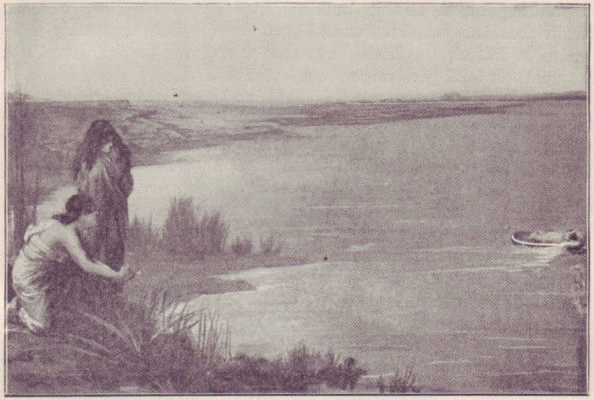 THE BABY IN THE ARK FLOATS DOWN THE RIVER |
Pharaoh's daughter, with her maids, came down to the river; and they saw the ark floating on the water, among the reeds. She sent one of her maids to bring it to her, so that she might see what was in the curious box. They opened it, and there was a beautiful little baby, who began to cry to be taken up.
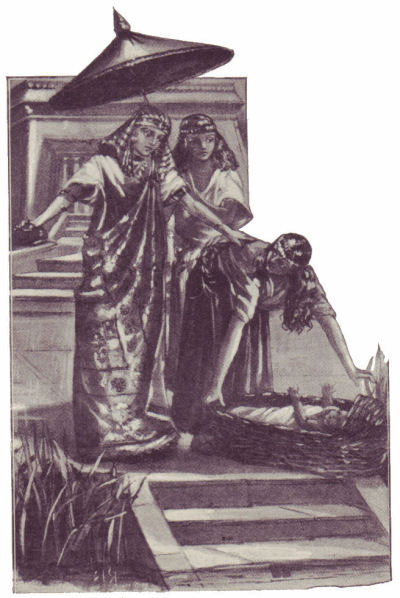 THE PRINCESS FINDS THE BABY |
The princess felt kind toward the little one, and loved it at once. She said: "This is one of the Hebrews' children." You have heard how the children of Israel came to be called Hebrews (see Story Sixteen). Pharaoh's daughter thought that it would be cruel to let such a lovely baby as this die out on the water. And just then a little girl came running up to her, as if by accident, and she looked at the baby also, and said:
"Shall I go and find some woman of the Hebrews to be a nurse to the child for you, and take care of it?"
"Yes," said the princess, "Go and find a nurse for me."
The little girl,—who was Miriam, the baby's sister,—ran as quickly as she could and brought the baby's own mother to the princess. Miriam showed in this act that she was a wise and thoughtful little girl. The princess said to the little baby's mother:
"Take this child to your home and nurse it for me, and I will pay you wages for it."
How glad the Hebrew mother was to take her child home! No one could harm her boy now, for he was protected by the princess of Egypt, the daughter of the king.
When the child was large enough to leave his mother, Pharaoh's daughter took him into her own home in the palace. She named him "Moses," a word that means "Drawn out," because he was drawn out of the water.
So Moses, the Hebrew boy, lived in the palace among the nobles of the land, as the son of the princess. There he learned much more than he could have learned among his own people; for there were very wise teachers among the Egyptians. Moses gained all the knowledge that the Egyptians had to give. There in the court of the cruel king who had made slaves of the Israelites, God's people, was growing up an Israelite boy who should at some time set his people free.
Although, Moses grew up among the Egyptians, and gained their learning, he loved his own people. They were poor and were hated, and were slaves, but he loved them, because they were the people who served the Lord God, while the Egyptians worshipped idols and animals. Strange it was that so wise a people as these should bow down and pray to an ox, or to a cat, or to a snake, as did the Egyptians!
When Moses became a man, he went among his own people, leaving the riches and ease that he might have enjoyed among the Egyptians. He felt a call from God to life up the Israelites, and set them free. But at that time he found that he could no nothing to help them. They would not let him lead them, and as the king of Egypt had now become his enemy, Moses went away from Egypt, into a country in Arabia called Midian.
He was sitting by a well, in that land, tired from his long journey, when he saw some young women come to draw water for their flocks of sheep. But some rough men came and drove the women away, and took the water for their own flocks. Moses saw it, and helped the women, and drew the water for them.
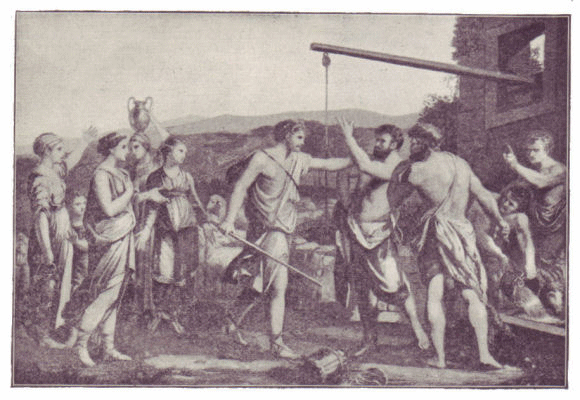 MOSES DROVE OFF THE ROUGH MEN |
These young women were sisters, the daughters of a man named Jethro, who was a priest in the land of Midian. He asked Moses to live with him, and to help him in the care of his flocks. Moses stayed with Jethro, and married one of his daughters. So from being a prince in the king's palace in Egypt, Moses became a shepherd in the wilderness of Midian.
The Voice from the Burning Bush.
It must have been a great change in the life of Moses, after he had spent forty years in the palace as a prince, to go out into the wilderness of Midian, and live there as a shepherd. He saw no more the crowded cities, the pyramids, the temples of Egypt, and the great river Nile. For forty years Moses wandered about the land of Midian with his flocks, living alone, often sleeping at night on the ground, and looking up by day to the great mountains.
He wore the rough skin mantle of a shepherd; and in his hand was the long shepherd's staff. On his feet were sandals which he wore instead of shoes. But when he stood before an altar to worship God he took off his sandals. For when we take off our hats, as in church or a place where God is worshipped, the people of those lands take off their shoes, as a sign of reverence in a sacred place.
Moses was a great man, one of the greatest men that ever lived. But he did not think himself great or wise. He was contented with the work that he was doing; and sought no higher place. But God had a work for Moses to do, and all through those years in the wilderness God was preparing him for that work.
All through those years, while Moses was feeding his flock in Midian, the people of Israel were still bearing heavy burdens and working as slaves in Egypt, making brick and building cities. The king who had begun the hard treatment of the Israelites died, but another king took his place, and was just as cruel. He was called by the same name, Pharaoh, for this was the name given to all the kings of Egypt.
One day, Moses was feeding his flock on a mountain, called Mount Horeb. This mountain was also called Mount Sinai, and is spoken of by both names in the Bible. On the mountain Moses saw a bush which seemed to be on fire. He watched to see it burn up, but it was not destroyed, though it kept burning on and on. And Moses said to himself:
"I will go and look at this strange thing, a bush on fire, yet not burning up."
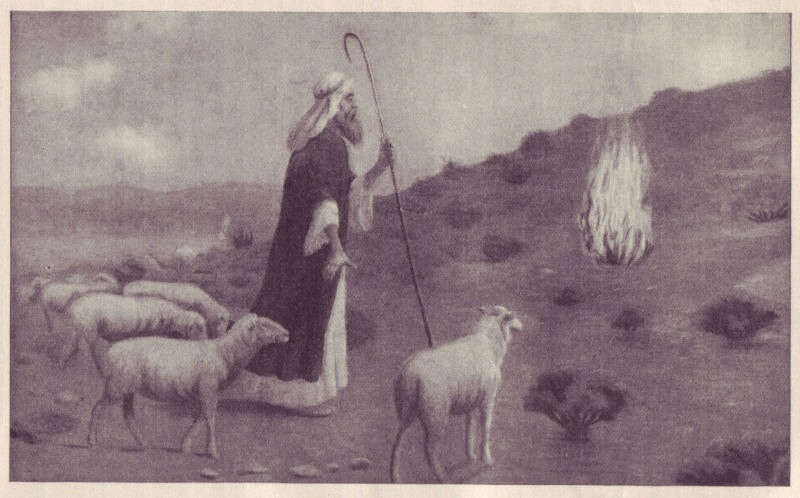 MOSES SEES THE BUSH ON FIRE |
As Moses was going toward the bush, he heard a voice coming out of the bush, calling him by name, "Moses, Moses!" He listened, and said, "Here I am."
The voice said, "Moses, do not come near; but take off your shoes from your feet, for you are standing on holy ground."
So Moses took off his shoes, and came near to the burning bush. And the voice came from the bush, saying:
"I am the God of your father, the God of Abraham, and of Isaac, and of Jacob. I have seen the wrongs and the cruelty that my people have suffered in Egypt, and I have heard their cry on account of their task-masters. And I am coming to set them free from the land of the Egyptians, and to bring them up to their own land, the land of Canaan, a good land, and large. Come, now, and I will send you to Pharaoh, the king of Egypt, and you shall lead out my people from Egypt."
Moses knew what a great work this would be, to lead the Israelites out of Egypt, from the power of its king. He dreaded to take it up such a task; and he said to the Lord:
"O Lord, who am I, a shepherd here in the wilderness, to do this great work, to go to Pharaoh, and to bring the people out of Egypt. It is too great a work for me."
And God said to Moses:
"Surely I will be with you, and will help you to do this great work. I will give you a sign of my presence with you. When you have led my people out of Egypt, you shall bring them to this mountain, and they shall worship me here. And then y ou shall know that I have been with you."
And Moses said to God:
"When I go to the children of Israel in Egypt, and tell them that the God of their fathers has sent me, they will say to me, 'Who is this God? What is his name? For they have suffered so much, and have sunk so low, that I fear they have forgotten their God."
You remember that Moses had been out of Egypt and afar from his people for forty years, a long time, and in that time he did not know whether they had continued the worship of God.
And God said to Moses:
"My name is 'I AM,' the One who is always living. Do you go to your people and say to them, 'I AM hath sent me to you." Do not be afraid; go to your people, and say to them what I have said to you, and they will listen to you and believe. And you shall take the elders of your tribes, the leading men among them, and shall go to King Pharaoh, and shall say to him, 'Let my people go, that they may worship me in the wilderness.' At first he will not let you go; but afterward, I will show my power in Egypt, and then he will let you go out of the land."
But Moses wished some sign, which he could give to his people, and to the Egyptians, to show them that God had sent him. He asked God to give him some sign. And God said to him:
"What is that which you have in your hand?" Moses said, "It is a rod, my shepherd's staff, which I use to guide the sheep."
And God said, "Throw it on the ground." Then Moses threw it down, and instantly it was turned into a snake. Moses was afraid of it, and began to run from it.
And God said, "Do not fear it, but take hold of it by the tail." Moses did so, and at once it became again a rod in his hand.
And God said again to Moses, "Put your hand into your bosom, under your garment, and take it out again."
Then Moses put his hand under his garment, and when he took it out it had changed, and was now as white as snow, and covered with a scaly crust, like the hand of a leper. He looked at it with fear and horror. But God said to him again:
"Put your hand into your bosom once more." Moses did so, and when he took it out, his hand was like the other, with a pure skin, no longer like a leper's hand.
And God said to Moses, "When you go to speak my words if they will not believe you, show them the first sign, and let your rod become a snake, and then a rod again. And if they still refuse to believe your words, show them the second sign; turn your hand into a leper's hand, and then bring it back as it was before. And if they still will not believe, then take some water from the river, and it shall turn to blood. Fear not, go and speak my words to your own people and to the Egyptians."
But Moses was still unwilling to go, not because he was afraid, but because he did not feel himself to be fit for such a great task. And he said to the Lord:
"Oh, Lord, thou knowest that I am not a good speaker; I am slow of speech, and cannot talk before men."
And God said, "Am not I the Lord, who made man's mouth? Go, and I will be with your lips, and will teach you what to say."
But Moses still hesitated, and he said, "O Lord, choose some other man for this great work; I am not able to do it."
And God said, "You have a brother, whose name is Aaron. He can speak well. Even now he is coming to see you in the wilderness. Let him help you, and speak for you. Let him do the speaking, and do you show the signs which I have given you."
At last Moses yielded to God's call. He went from Mount Sinai with his flocks, and took them home to Jethro his father-in-law; and then he went toward Egypt, and on the way he met his brother coming to see him. Then the two brothers, Moses and Aaron, came to the elders of Israel in the land of Goshen. They told the people what God had said, and they wrought before them the signs which God had given.
And the people said, "God has seen all our troubles, and at last he is coming to set us free." And they were glad, and gave thanks to God who had not forgotten them; for God never forgets those who call upon him.
The River That Ran Blood
After Moses and Aaron had spoken to the people of Israel the words which God had given them, they went to meet Pharaoh the king of Egypt. You remember that all the kings of Egypt bore the name of Pharaoh. Moses and Aaron did not at first ask Pharaoh to let the people go out of Egypt, never to return, but they said:
"Our God, the Lord God of Israel, has bidden us to go out, with all our people, a journey of three days into the wilderness, and there to worship him. And God speaks to you through us, saying, "Let my people go, that they may serve me."
But Pharaoh was very angry. He said, "What are you doing, you Moses and Aaron, to call your people away from their work? Go back to your tasks and leave your people alone. I know why the Israelites are talking about going out into the wilderness. It is because they have not work enough to keep them busy. I will give them more work to do."
The work of the Israelites, at that time, was mostly in making brick, and putting up the walls of buildings for the rulers of Egypt. In mixing the clay for the brick they used straw, chopped up fine, to hold the clay together. Pharaoh said:
"Let them make as many bricks as before; but give them no straw. Let the Israelites find their own straw for the brick making."
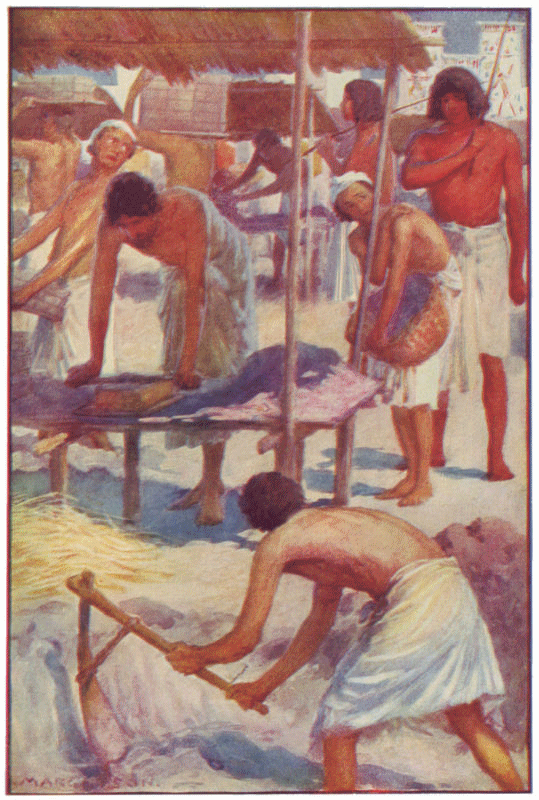 THE PEOPLE OF ISRAEL WORKING FOR THE EGYPTIANS |
Of course this made their task all the harder, for it took much time to find the straw; and the Israelites were scattered all through the land finding straw and stubble, for use in making the brick; and yet they were called upon to bring as many brick each day as before. And when they could not do all their task they were cruelly beaten by the Egyptians. Many of the Israelites now became angry with Moses and Aaron, who, they thought, had brought more burden and trouble upon them. They said:
"May the Lord God judge you, and punish you! You promised to lead us out, and set us free; but you have only made our suffering the greater!"
Then Moses cried to the Lord, and the Lord said to him:
"Take Aaron, your brother, and go again to Pharaoh; and show him the signs that I gave you."
So they went in to Pharaoh, and again asked him in the Lord's name, to let the people go. And Pharaoh said:
"Who is the Lord? Why should I obey his commands?" What sign can you show that God has sent you?"
Then Aaron threw down his rod, and it was turned into a snake. But there were wise men in Egypt who had heard of this; and they made ready a trick. They threw down their rods, and their rods became snakes, or seemed to. They may have been tame snakes, which they had hidden under their long garments, and then brought out, as if they had been rods.
But Aaron's rod, in the form of a snake, ran after them, and swallowed them all; and then it became a rod again in Aaron's hand. But King Pharaoh refused to obey God's voice.
Then Moses spoke to Aaron, by God's command: "Take your rod and wave it over the waters of Egypt, over the river Nile, and the canals, and the lakes."
Then Aaron did so. He lifted up the rod, and struck the water, in the sight of Pharaoh. And in a moment all the water turned to blood, and the fish in the river all died; and a terrible stench, a foul smell, arose over the land. And the people were in danger of dying. But in the land of Goshen, where the Israelites were, the water remained as it had been, and was not turned to blood. So God made a difference between Israel and Egypt.
The people of Egypt dug wells, to find water; and the wise men of Egypt brought some water to Pharaoh, and made it look as though they had turned it to blood. And Pharaoh would not listen, nor let the people go.
After seven days Moses took away the plague of blood, but he warned Pharaoh that another plague was coming, if he refused to obey. And as Pharaoh still would not obey, Aaron stretched forth his rod again, and then all the land was covered with frogs. Like a great army they ran over all the fields, and they even filled the houses. Pharaoh said:
"Pray to your God for me; ask him to take the frogs away, and I will let the people go."
Then Moses prayed; and God took away the frogs. They died everywhere; and the Egyptians heaped them up and buried them. But Pharaoh broke his promise, and would not let the people go.
Then, at God's command by Moses, Aaron lifted his rod again, and struck the dust; and everywhere the dust became alive with lice and fleas. But still Pharaoh would not hear, and God sent great swarms and clouds of flies all over the land, so that their houses were filled with them, and the sky was covered. But where the Israelites lived there were no lice, nor fleas, nor flies.
Then Pharaoh began to yield a little. He said:
"Why must you go out of the land to worship God? Worship him here in this land."
But Moses said, "When we worship the Lord, we must make an offering: and our offerings are of animals which the people of Egypt worship, oxen and sheep. It would make the Egyptians angry to see us offering a sacrifice of animals which they call gods."
"Well," said Pharaoh, "you may go; but do not go far away, and come back." But when Moses and Aaron had taken away the plague, Pharaoh broke his promise again, and still held the people as slaves.
Then another plague came. A terrible disease struck all the animals in Egypt, the horses and asses, the camels, the sheep, and the oxen; and they died by the thousand in a day, all over the land. But no plague came upon the flocks and herds of the Israelites.
But Pharaoh was still stubborn. He would not obey God's voice. Then Moses and Aaron gathered up in their hands, ashes from the furnace, and threw it up like a cloud into the air. And instantly boils began to break out on men and on beasts all through the land.
Still Pharaoh refused to obey; and then Moses stretched out his rod toward the sky. At once a terrible storm burst forth upon the land; all the more terrible because in that land rain scarcely ever falls. Sometimes there will not be even a shower of rain for years at a time. But now the black clouds rolled, the thunder sounded, the lightning flashed, and the rain poured down, and with the rain came hail, something that the Egyptians had never seen before. It struck all the crops growing in the field, and the fruits on the trees, and destroyed them.
Then again Pharaoh was frightened, and promised to let the people go; and again when God took away the hail at Moses' prayer, he broke his word, and would not let the Israelites leave the land.
Then after the hail came great clouds of locusts, which ate up every green thing that the hail had spared. And after the locusts came the plague of darkness. For three days there was thick darkness, no sun shining, nor moon, nor stars. But still Pharaoh would not let the people go. Pharaoh said to Moses:
"Get out of my sight. Let me never see your face again. If you come into my presence you shall be killed."
And Moses said, "It shall be as you say, I will see your face no more."
And God said to Moses, "There shall be one plague more, and then Pharaoh will be glad to let the people go. He will drive you out of the land. Make your people ready to go out of Egypt; your time here will soon be ended."
The Night When a Nation Was Born
While all these, terrible plagues, of which we read in the last story, were falling upon the people of Egypt, the Israelites in the Land of Goshen were living in safety under God's care. The waters there were not made blood; nor did the flies or the locusts trouble them. While all was dark in the rest of Egypt, in the land of Goshen the sun was shining.
This made the Egyptians feel that the Lord God of the Israelites was watching over his own people. They brought gifts to the Israelites, of gold and silver, and jewels, and precious things of every kind, to win their favor, and to win the favor of their God. So the Israelites, from being very poor, began suddenly to be very rich.
Now Moses said to the people:
"In a few days you are to go out of Egypt, so gather together, get yourselves in order by your families, and your twelve tribes; and be ready to march out of Egypt."
And the people of Israel did as Moses bade them. Then said Moses:
"God will bring one plague more upon the Egyptians, and then they will let you go. And you must take care, and obey God's command exactly, or the last terrible plague will come upon your houses with the Egyptian houses. At midnight, the angel of the Lord will go through the land, and the oldest child in every house shall die. Pharaoh's son shall die, and every rich man's son, and every poor man's son, even the son of the beggar that has no home. But your families shall be safe if you do exactly as I command you."
Then Moses told them what to do. Every family was bidden to find a lamb and to kill it. They were to take some of the blood of the lamb and sprinkle it at the entrance of the house, on the door-frame overhead, and on each side. Then they were to roast the lamb, and with it to cook some vegetables, and to eat it standing around the table, with all their garments on, ready to march away as soon as the meal should be ended. And no one was to go out of his house that night, for God's angel would be abroad, and he might be killed if the angel should meet him.
The children of Israel did as Moses commanded them. They killed the lamb, and sprinkled the blood, and ate the supper in the night, as God had told them to do. And this supper was called "the Pass-over Supper," because when the angel saw the doors sprinkled with blood, he passed over those houses, and did not enter them. And in memory of this great night, when God kept his people from death, the Israelites were commanded to eat just such a supper on that same night every year. This became a great feast of the Israelites, and was called "The Passover."
Does not that slain lamb, and his blood sprinkled to save the people from death, make you think of Jesus Christ, who was the Lamb of God, slain to save us all?
And that night a great cry went up from all the land of Egypt. In every house there was one, and that one the oldest son, who died. And Pharaoh the king of Egypt saw his own son lie dead, and knew that it was the hand of God. And all the people of Egypt were filled with terror, as they saw their children lying dead in their houses.
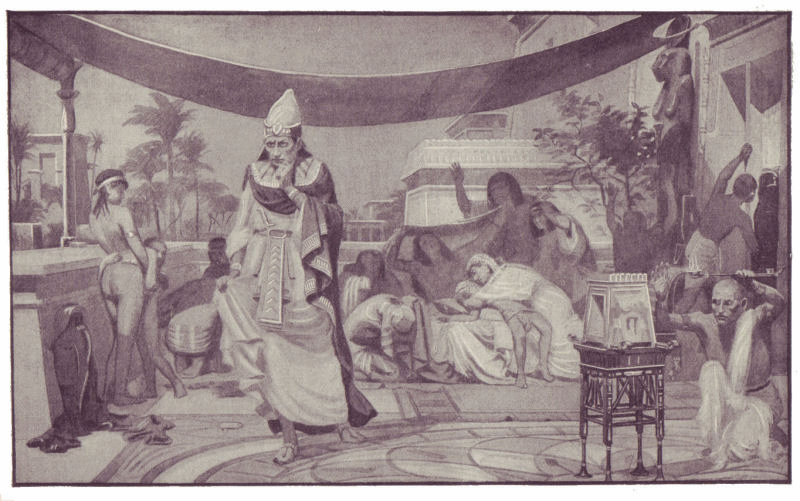 PHARAOH'S OWN SON LAY DEAD |
The king now sent a messenger to Moses and Aaron, saying:
"Make haste; get out of the land; take everything that you have; leave nothing. And pray to your God to have mercy upon us, and to do us no more harm."
So suddenly at the last, early in the morning, the Israelites, after four hundred years in Egypt, went out of the land. They went out in order, like a great army, family by family, and tribe by tribe. They went out in such haste, that they had no time to bake bread to eat on the journey. They left the dough in the pans, all ready mixed for baking, but not yet risen as bread is before it is baked: and they set the bread-pans on their heads, as people do in that land when they carry loads. And as a memory of that day, when they took the bread without waiting for it to rise, the rule was made that for one week in every year, and that same time in the year when they went out of Egypt, all the people of Israel should eat bread that is "unleavened," that is bread made without yeast, and unrisen. And this rule is kept to this day by the Jews, who belong to the Israelite family.
And the Lord God went before the host of Israel, as they marched out of Egypt. In the day time there was a great cloud, like a pillar in front; and at night it became a pillar of fire. So So both by day and night, as they saw the cloudy and fiery pillar gong before, they could say, "Our Lord, the God of heaven and earth, goes before us."
When the pillar of cloud stopped, they knew that was a sign that they were to pause in their journey and rest. So they set up their tents, and waited until the cloud should rise up and go forward. When they looked, and saw that the pillar of cloud was higher up in the air, and as though moving forward, they took down their tents, and formed in order for the march. Thus the pillar was like a guide by day and a guard by night.
You remember that when Joseph died (see the end of Story Nineteen), he commanded the Israelites not to bury his body in Egypt, but to keep it in a stone coffin, unburied, as long as they should stay in the land. When they were going out of Egypt, the two tribes of Ephraim and Manasseh, who had sprung from Joseph, his descendants, as they are called,—took with them on their journey this stone coffin which held the body of Joseph their father. And thus the Israelites went out of Egypt, four hundred years after they had gone down to Egypt to live.
How the Sea Became Dry Land, and the Sky Rained Bread
When the children of Israel came out of Egypt it was their aim to go at once to the land of Canaan, from which their fathers had come. The shortest road was that following the shore of the Great Sea, and entering Canaan on the southwest. But in this region lived the Philistines, a strong and warlike people; and the Israelites, after ages of slavery, were not fit to carry on war. The other way was by the southeast, through the desert of Mount Sinai, where Moses knew the land, for it was there that he had been a shepherd four many years.
So the Israelites, led by the pillar of cloud and fire turned to the southeast, directly toward the Red Sea, which rolled between them and the desert. In a very few days they came to the shore of the sea, with the water before them, and high mountains on each side.
As soon as the Israelites had left their homes, and were on the march, King Pharoah was sorry that he had let them go; for now they would no more be his servants and do his work. Word came to Pharaoh that the Israelites were lost among the mountains, and held fast by the sea in front of them. Pharaoh called out his army, his chariots, and his horsemen, and followed the Israelites, intending either to kill them, or to bring them back. Very soon the army of Egypt was close behind the host of Israel, and the hearts of the people were filled with fear. They cried to Moses, saying:
"Why did you bring us out into this terrible place, shut in by the mountains and the sea, and with our enemies close behind us? It would be better to serve the Egyptians, than to die here in the wilderness!"
"Fear not," answered Moses. "Stand still, and see how God will save you. As for the Egyptians, whom you now see following you, you will see them no more forever. The Lord will fight for you, and you shall stand still and see your enemies slain." That night the pillar of fire, which was before the host of Israel went behind them, and stood between the camp of the Egyptians and the camp of the Israelites. To Israel it was bright and dazzling with the glory of the Lord, but to the Egyptians it was dark and terrible; and they dared not enter it.
And all that night there blew over the sea a mighty east wind, so that the water was bloem away, and when the morning came them was a ridge of dry land between water on one side and water on the other, making a road across the sea to the land beyond, and on each side of the road the water lay in great lakes, as if to keep their enemies away from them.
Then Moses told the people to go forward, and the pillar of cloud again went before them; and the people followed, a great army. They walked across the Red Sea as on dry land, and passed safely over into the wilderness on the other side. So God brought his people out of Egypt, into a land that they had never seen.
When the Egyptians saw them marching into the sea, they followed, with their chariots and their horses. But the sand was no longer hard; it had become soft, and their chariot-wheels were fastened in it, and many of them broke off from the chariots. And the horses became mired, and fell down, so that the army was in confusion; and all were frightened. The soldiers cried out:
"Let us fly from the face of the Israelites! The Lord is fighting for them, and against us!"
By this time, all the Israelites had passed through the Red Sea, and were stranding on the high ground beyond it, looking at their enemies slowly struggling through the sand, all in one heaped up mass of men, and horses, and chariots. Then Moses lifted up his hand, and at once a great tide of water swept up from the water swept up from the sea on the south; the road over which the Israelites had walked in safety was covered with water; and the host of Pharoah, with all his chariots and his horses and their riders were drowned in the sea, before the eyes of the people of Israel. They saw the dead bodies of the Egyptians tossed up by the waves on the shore.
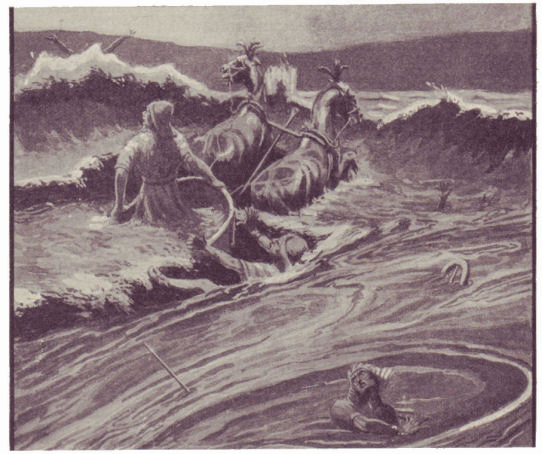 THE EGYPTIANS WERE DROWNED IN THE SEA |
Moses wrote a great song, and all the people sang it together, over this great victory, which God had wrought for them. It began thus:
|
"I will sing unto the Lord, for he hath triumphed gloriously, The horse and his rider hath he thrown into the sea, The Lord is my strength and song, And he is become my salvation." |
And now the people of Israel were no longer in a level land, with fields of grain, and abundance of food, and streams of water. They were in the great desert, with a rocky path under them, and mountains of rock rising all around, with only a few springs of water, and these far apart. Such a host of men, and women, and children, with their flocks, would need much water, and they found very little.
They saw in the distance some springs of water, and ran to drink of it, for they were verv thirsty. But when they tasted, they found it bitter, so that they could not drink it. Then the people cried to Moses, and Moses cried to the Lord; and the Lord showed Moses a tree, and told him to cut it down and throw it into the water. Moses did so, and then the water became fresh, and pure, and good, so that the people could drink it. This place they named Marah, a word which means "bitterness," because of the water which they found there.
After passing Marah, they came to another and more pleasant place, where they saw twelve springs of fresh water, and a grove of seventy palm-trees around them. And there they rested under the cool shade.
But soon they were in a hot desert of sand, which lies between the waters of Elim and Mount Sinai; and again they were in great trouble, for there was no food for such an army of people.
Then Moses called upon God, and the Lord said, "I will rain bread from heaven upon you; and you shall go out and gather it every day."
The next morning, when the people looked out of their tents, they saw all around the camp, on the sand, little white flakes, like snow or frost. They had never seen anything like it before, and they said, just as anybody would say. "What is it?" In the language of the Israelites, the Hebrew language, "What is it?" is the word "Manhu." So the people said to one another "Manhu? Manhu?" And this gave a name afterward to what they saw, the name Manna.
And Moses said to them, "This is the bread which the Lord has given you to cat. Go out and gather it, as much as you need. But take only as much as you need for to-day, for it will not keep; and God will give you more to-morrow."
So the people went out, and gathered the manna. They cooked it in various ways, baking it and boiling it; and the taste of it was like wafers flavortd with homes. Some took more than they needed, not trusting God's word that there would be more on the next day. But that which was left over, after it was gathered, spoiled, and smelled badly, so that it was useless. This was to teach the people that each day they should trust God for their daily bread.
But the manna which was left on the ground did not spoil. When the sun came up, it melted away, just like frost or snow flakes. Before the sixth day of the week came, Moses said to the people:
"To-morrow, on the sixth day of the week, take twice as much manna as usual; for the next day is the Lord's Sabbath, the day of rest, and the manna will not come on that day."
So the next morning, all the people went out as before to gather the manna. On that day, they found that the manna which was not used did not spoil, but kept fresh until the next morning.
On the Sabbath-day, some of the people who had failed to hear Moses, and had not gathered the manna in advance for the Sabbath, went out, and they could find none. So that day, these people had nothing to eat; and all Israel learned the lesson, which we also should remember, that one day in each week belongs to God, and is to be kept holy to the Lord.
All the time that the Israelites lived in the wilderness, which was forty years, they ate the manna which God gave them day by day. Not until they entered the land of Canaan, did the manna cease to fall.
Do vow remember, who it was, long after this, that said "I
am the bread of life. He that cometh to me shall never hunger,
and he that believeth on me. shall never thirst?"
The Mountain That Smoked and the Words That Were Spoken From It
While the Israelites were journeying through the desert they had great trouble from want of water. Between the wells of Elim and Mount Sinai, they found no streams nor springs. Their sheep and men suffered fnim thirst, and the little children were crying for water, The people came to Moses, and said in great anger:
"Give us water, or we shall die. Why have you brought us up from Egypt to kill us here in the desert?"
And Moses called on God, and said:
"Lord, what shall I do to this people? They are almost ready to stone me in their anger. How can I give them water?"
Then God told Moses what to do; and this was what Moses did:
He brought the people together before a great rock, and with his rod he struck the rock. Then out of the rock came forth a stream of water, which ran like a little river through the camp, and gave them plenty of water for themselves and for their flocks.
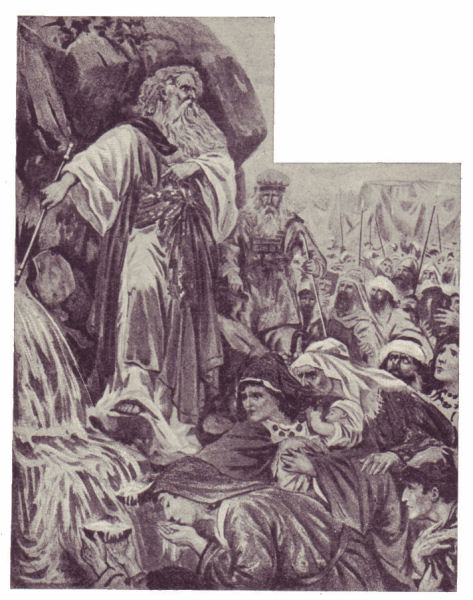 MOSES STRIKES THE ROCK |
While they were in camp around this rock at Rephidim the wild people who had their homes in the desert, and were called the Amalekites, made sudden war on the Israelites. They came down upon them from the mountains, while they were weary with marching, and killed some of the Israelites. Then Moses called out those of the people who were fit for war, and made a young man named Joshua their leader; and they fought a battle with the Amalekites.
While they were fighting, Moses stood on a rock, where all could see him, and prayed the Lord God to help his people. His hands were stretched out toward heaven; and while Moses' hands were reaching upward the Israelites were strong, and drove back the enemy. But when Moses' arms fell down, then the enemy drove back the men of Israel.
So Aaron, Moses' brother, and Hur (who is thought to have been Moses' brother-in-law, the husband of his sister Miriam), stood beside Moses, and held up his hands until the Israelites won the victory, and overcame the men of Amalek.
In the third month after the Israelites had left the land of Egypt they came to a great mountain which rises straight up from the plain, so straight that one can walk up to it and touch it with his hand. This was Mount Sinai; and it was one of a group of mountains called Horeb, where Moses saw the burning bush, and heard God's voice, as we read in Story Twenty-one.
The Israelites made their camp in front of Mount Sinai, and stayed there for many days. And God said to Moses:
"Let none of the people go up on the mount, or come near to touch it. If even one of your cattle or sheep shall touch the mountain it must be killed. This is a holy place, where God will show his glory."
And a few days after this, the people heard the voice as of many trumpets sounding on the top of the mountain. They looked, and saw that the mountain was covered with clouds and smoke, and lightnings were flashing from it, while the thunder rolled and crashed. And the mountain shook and trembled, as though an earthquake were tearing it in pieces.
The people were filled with alarm. They came out of their tents, and ran back from the foot, of the mountain, and stood far off, trembling with fear. Then God spoke in the hearing of all the people, as with a voice of thunder, and said:
"I am the Lord thy God, who brought thee out of the land of Egypt, out of the house of bondage."
And then God spoke to all the people the words of the Ten Commandments, to which you have listened many times. The words are these:
I.
Thou shalt have none other gods but me.
II.
Thou shalt not make unto thee any graven image, nor any likeness of anything that is in heaven above, or that is in the earth beneath, or that is in the water under the earth. Thou shalt not bow down thyself to them, nor serve them; for I the Lord thy God am a jealous God, visiting the iniquity of the fathers upon the children, unto the third and fourth generation of them that hate me; and showing mercy unto thousands of them that love me and keep my commandments.
III.
Thou shalt not take the name of the Lord thy God in vain; for the Lord will not hold him guiltless that taketh his name in vain.
IV.
Remember the Sabbath-day to keep it holy. Six days shalt thou labor, and do all thy work; but the seventh day is the Sabbath of the Lord thy God; in it thou shalt not do any work, thou, nor thy son, nor thy daughter, thy man-servant, nor thy maid-servant, nor thy cattle, nor thy stranger that is within thy gates; for in six days the Lord made heaven and earth, the sea, and all that in them is, and rested the seventh day; wherefore the Lord blessed the Sabbath-day, and hallowed it.
V.
Honor thy father and thy mother; that thy days may be long upon the land which the Lord thy God giveth thee.
VI.
Thou shalt not kill.
VII.
Thou shalt not commit adultery.
VIII.
Thou shalt not steal.
IX.
Thou shalt not bear false witness against thy neighbor.
X.
Thou shalt not covet thy neighbor's house, thou shalt not covet thy neighbor's wife, nor his man-servant, nor his maid-servant, nor his ox, nor his ass, nor anything that is thy neighbor's.
And all the people heard these words spoken by the Lord God; and they saw the mountain smoking, and the lightning flashing, and they were frightened. They said to Moses:
"Let not God speak to us any more; for the sound of his voice will take away our lives. Let God speak to you, Moses, and do you speak to us God's words."
"Fear not," said Moses, "for God has come to you, to speak with you, that you may fear him, and do his will."
And Moses drew near to the mountain, where the clouds and darkness and lightnings were. Then God called Moses up to the top of the mount; and Moses went up, and with him was his helper, the young man Joshua. Joshua stayed on the side of the mountain, but Moses went up alone to the top, among the clouds.
And there Moses stayed upon the mountain, alone with God, for forty days, talking with God, and listening to the words which God spoke to him, the laws for the people of Israel to obey. And God gave to Moses two flat tablets of stone, upon which God had written with his own hand the Ten Commandments.
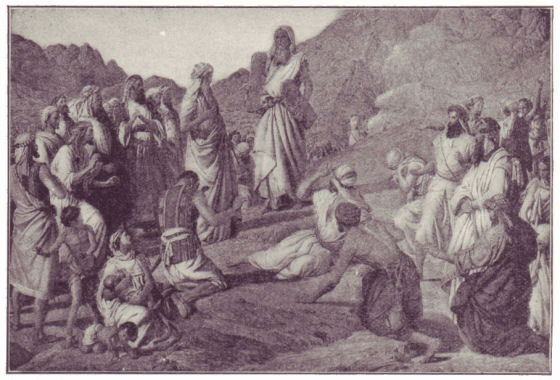 MOSES COMES DOWN FROM MT. SINAI WITH TABLES OF STONE |
How Aaron Made a Golden Calf, and What Became of It
While Moses was in the mountain alone with God, a strange and wicked thing was done in the camp on the plain. At first the people were alarmed when they saw the mountain smoking, and heard the thunder. But soon they grew accustomed to it, and when day after day passed, and Moses did not come down, at last they said to Aaron:
"Come now, make us a god that we may worship, and that we may have to lead us. As for Moses, the man who brought us out of the land of Egypt, we do not know what has become of him."
Aaron was not a man of strong will, as Moses was. When his brother Moses was not by his side Aaron was weak, and ready to yield to the wishes of the people. Aaron said:
"If you must have a god that you can look at; then break off the gold earrings that are in your ears, and in the ears of your wives and children, and bring them to me."
Then the people brought their gold to Aaron; and Aaron melted the gold rings into one mass, and shaped it with a graving tool into the form of a calf, and this he brought out and stood up before the people. They they all cried out:
"This is your god, O Israel, that brought you out of the land of Egypt."
And Aaron built an altar before the image, and he said to all the people, "To-morrow shall be a feast to the Lord."
Perhaps Aaron thought that if the people could have before them an image that they could see, they might still be kept to the worship of the Lord God. But in this he was greatly mistaken. The people came to the feast, and offered sacrifices; and then they began to dance around the altar, and to do wicked deeds together, as they had seen the people of Egypt doing before their idols. And all this time the mountain was smoking and flashing with fire, almost over their heads!
And the Lord, up in the mountain, spoke to Moses, and said:
Hasten, and get down to the camp; for your people have done very wickedly. They have made for themselves an idol, and they are worshipping it now. I am angry with them, and am ready to destroy them all, and to make of your children a great nation."
And Moses pleaded with the Lord for Israel, and God did not destroy the people; but he sent Moses down to them, holding in his hands the two stone tables on which God had written the Ten Commandments. As he went down the mountain Joshua joined him, and said to him:
"I can hear noise of war in the camp. It is not the sound of men who are shouting for victory, nor is it the cry of those who are beaten in battle; it is the voice of singing that I hear."
And in a moment more, as they stood where they could look down upon the camp, there was standing the golden calf, and around it were the people making offerings, and feasting, and dancing and singing.
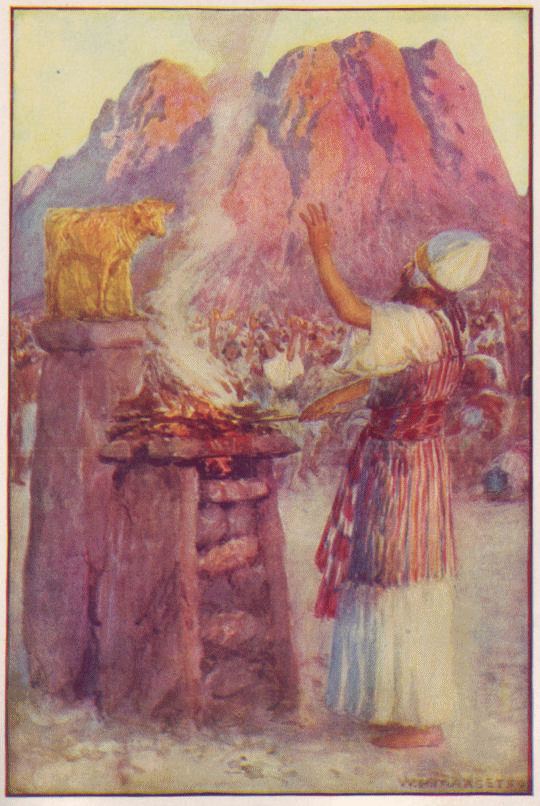 THE PEOPLE OF ISRAEL BOWING BEFORE THE GOLDEN CALF |
And Moses was so angry when he saw all the wickedness and shame of his people, that he threw down the two tables out of his hands, and broke them in pieces upon the rocks. What was the use of keeping the tables of stone, he may have thought, while the people were breaking the laws written upon them?
Moses came straight into the midst of the throng, and at once all the dancing and merry-making stopped. He tore down the golden calf, and broke it in pieces, and burned it in the fire, and ground it to powder, and threw it into the water; and he made the people drink the water filled with its dust. He meant to teach the people that they would suffer punishment like bitter water, for their wicked deed.
Then Moses turned to Aaron:
"What led you to such an act as this?" said Moses. "Why did you let the people persuade you to make them an image for worship?"
And Aaron said, "Do not be angry with me; you know how the hearts of this people are set to do evil. They came to me and said, 'make us a god,' and I said to them, 'give me whatever gold you have.' So they gave it to me, and I threw the gold into the fire, and this calf came out!"
Then Moses stood at the entrance to the camp, and called out:
"Whoever is on the Lord's side, let him come and stand by me!" Then one whole tribe out of the twelve tribes of Israel, the tribe of Levi, all sprung from Levi, one of Jacob's sons, came and stood beside Moses. And Moses said to them:
"Draw your swords, and go through the camp, and kill every one whom you find bowing down to the idol. Spare no one. Slay your friends and your neighbors, if they are worshipping the image."
And on that day three thousand of the worshippers of the idol were slain by the sons of Levi.
Then Moses said to the people, "You have sinned a great sin; but I will go to the Lord, and I will make an offering to him, and will ask him to forgive your sin."
And Moses went before the Lord, and prayed for the people, and said:
"Oh Lord, this people have sinned a great sin. Yet, now, forgive their sin, if thou art willing. And if thou wilt not forgive their sin, then let me suffer with them, for they are my people."
And the Lord forgave the sin of the people, and took them once again for his own, and promised to go with them, and to lead them into the land which he had promised to their fathers.
And God said to Moses, "Cut out two tables of stone, like those which I gave to you, and which you broke; and bring them up to me in the mountain, and I will write on them again the words of the law."
So Moses went up a second time into the holy mount; and there God talked with him again. Moses stayed forty days on this second meeting with God, as he had stayed in the mountain forty days before. And all this time, while God was talking with Moses, the people waited in the camp; and they did not again set up any idol for worship.
Once more Moses came down the mountain, bringing the two stone tables, upon which God had written the words of his law, the Ten Commandments. And Moses had been so close to God's glory, and had been so long in the blaze of God's light, that when he came into the camp of Israel, his face was shining, though he did not know it. The people could not look on Moses' face, it was so dazzling. And Moses found that when he talked with the people, it was needful for him to wear a vail over his face. When Moses went to talk with God, he took off the vail; but while he spoke with the people, he kept his face covered, for it shone as the sun.
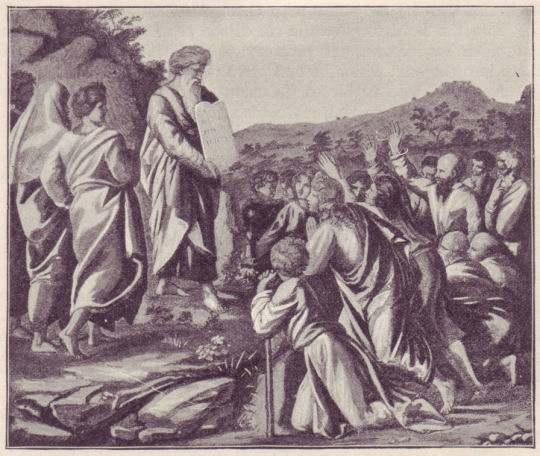 MOSES BRINGS THE TABLES OF STONE |
The Tent Where God Lived among His People
It may seem strange that the Israelites, after all that God had done for them, and while Mount Sinai was still showing God's glory, should fall away from the service of God to the worship of idols, as we read in the last Story (Twenty-six). But you must keep in mind that all the people whom the Israelites had ever met, both in Canaan and in Egypt, were worshippers of images; and from their neighbors the Israelites also had learned to bow down to idols. In those times everywhere people felt that they must have a god that they could see.
God was very good to the Israelites after they had forsaken him, to take them again as his own people: and God gave to the Israelites a plan for worship, which would allow them to have something that they could see, to remind them of their God; and yet, at the same time, would not lead them to the worship of an image, but would teach them a higher truth, that the true God cannot be seen by the eyes of men.
The plan was this: to have in the middle of the camp of Israel a house to be called, "The House of God," which the people could see, and to which they could come for worship. Every time that an Israelite looked at this house he might say to himself, and might teach his children, "That is the house where God lives among his people," even though no image stood in the house.
And as the Israelites were living in tents, and were often moving from place to place, this House of God, would need to be something like a tent, so that it could be taken down, and moved, as often as the camp was changed. Such a tent as this was called a Tabernacle. The Tabernacle then was the tent where God was supposed to live among his people, and where the people could meet God. We do not know just how the tent looked but from the description given of it many have tried to draw it. We give you one picture drawn in this way.
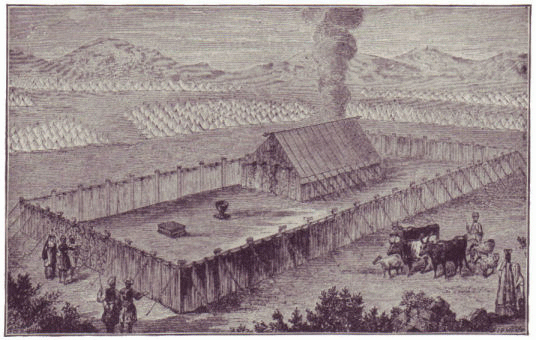 THE TABERNACLE IN THE WILDERNESS |
We know that God is a Spirit, and has no body like ours; and that he is everywhere. Yet it was right to say that God lived in the Tabernacle of the Israelites, because there God showed his presence in a special way, by having the pillar of cloud over it all day, and the pillar of fire all night. And it was believed by the Israelites that in one room of this Tabernacle the glory and brightness of God's presence might be seen.
This Tabernacle stood exactly in the middle of the camp of the Israelites in the wilderness. In front of it, and a little distance from it, on the east, stood the tent where Moses lived, and from which he gave the laws and commands of God to the people.
Around the Tabernacle there was what we might call an open square, though it was not exactly square, for it was about a hundred and fifty feet long by seventy-five feet wide; that is its length and twice its width. Around it was a curtain of fine linen, in bright colors, hanging upon posts of brass. The posts were held in place by cords fastened to the ground with tent-pins or spikes. Some think that these posts were not of brass, but of copper; for we are not sure that men knew how to make brass in those times. This open square was called the Court of the Tabernacle. The curtain around it was between seven and eight feet high, a little higher than a man's head. In the middle, on the end toward the east, it could be opened for the priests to enter into the court; but no others except the priests and their helpers were ever allowed to enter it.
Inside this court, near the entrance, stood the great Altar. You remember that an altar was made generally of stone, or by heaping up the earth; and that it was the place on which a fire was kindled to burn the offering or sacrifice. The offering or sacrifice, you remember, was the gift offered to God whenever a man worshipped; and it was given to God by being burned upon his altar. (See Story Two.)
But as a stone-altar or an earth-altar could not be carried from place to place, God told the Israelites to make an altar of wood and brass, or copper. It was like a box, without bottom or top, made of thin boards so that it would not be too heavy, and then covered on the inside and the outside with plates of brass or copper, so that it would not take fire and burn. Inside, a few inches below the top, was a metal grating on which the fire was built; and the ashes would fall through the grating to the ground inside.
This altar had four rings on the corners, through which long poles were placed, so that the priests could carry it on their shoulders when the camp was moved. The altar was a little less than five feet high, and a little more than seven feet wide on each side. This was the great altar, sometimes called "The Altar of Burnt-Offering," because a sacrifice was burned upon it every morning and every evening. Near the altar in the court of the Tabernacle, stood the Laver. This was a large tank or basin, holding water which was used in washing the offerings. For the worship of the Tabernacle much water was needed; and for this purpose the Laver was kept full of water.
The Tabernacle itself stood in the court. It was a large tent, not unlike the tents in which the people lived, while they were journeying through the wilderness, though larger. Its walls, however, were not made of skins or woven cloth, as were most tents, but of boards standing upright on silver bases, and fastened together. The boards were covered with gold. The roof of the Tabernacle was made of four curtains, one laid above another; the inner curtain being beautifully decorated, and the outer curtain of rams' skins to keep out the rain. The board-walls of the Tabernacle were on the two sides and the rear end; the front was open, except when a curtain was hung over it. The Tabernacle, half tent and half house, was about forty-five feet long, and fifteen feet wide, and fifteen feet high. Its only floor was the sand of the desert.
This Tabernacle was divided into two rooms, by a vail which hung down from the roof. The larger room, the one on the eastern end, into which the priest came first from the court, was twice as large as the other room. It was thirty feet long, fifteen feet wide, and fifteen feet high, and was called the Holy Place. In the Holy Place were three things: on the right side, as one entered, a table covered with gold, on which lay twelve loaves of bread, as if each tribe gave its offering of feed to the Lord; on the left side, the Gold Lampstand, with seven branches, each having its light. This is sometimes called the Golden Candlestick, but as it held lamps, and not candles, it should be called "the lampstand."
At the further end of the Holy Place, close to the vail, was the Golden Altar of Incense: a small altar on which fragrant gum was burned, and from which a silvery cloud floated up. The fire on this altar was always to be lighted from the great altar of brass or copper that was standing outside the Tabernacle in the court. Everything in this room was made of gold, or covered with gold, even to the walls on each side.
The inner room of the Tabernacle was called the Holy of Holies; and it was so sacred that no one except the high-priest ever entered it, and he on only one day in each year. It was fifteen feet wide, fifteen feet long, and fifteen feet high. All that it held was a box or chest, made of wood and covered with places of gold on both the outside and the inside; and with a cover of solid gold, on which stood two strange figures called cherubim, also made of gold. This chest was called the Ark of the Covenant, and in it were placed for safe-keeping, the two stone tables on which God wrote the Ten Commandments. It was in this room, the Holy of Holies, that God was supposed to dwell, and to show his glory. But in it there was no image, to tempt the Israelites to the worship of idols.
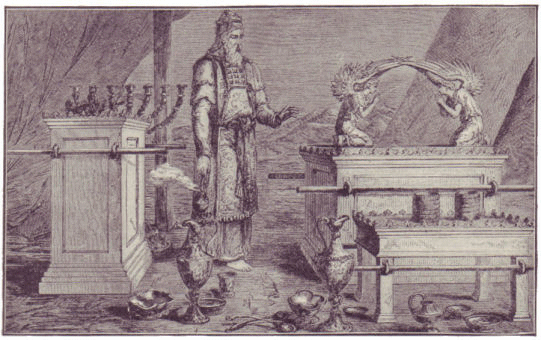 THE HIGH PRIEST, THE TABLE FOR BREAD AND THE HOLY ARK |
Whenever the camp in the desert was to be changed, the priests first carefully covered with curtains all the furniture in the Tabernacle,—the Table, the Lampstand, the Altar of Incense, and the Ark of the Covenant; and they passed rods through the rings which were on the corners of all these articles. They took down the Tabernacle and tied its gold-covered boards and its great curtains, its posts and its pillars, in packages to be carried. And then the men of the tribe of Levi, who were the helpers of the priests, took up their burdens and carried them out in front of the camp. The twelve tribes were arranged in marching order behind them; the Ark of the Covenant unseen under its wrappings, upon the shoulders of the priests, led the way, with the pillar of cloud over it. And thus the children of Israel removed their camp from place to place for forty years in the wilderness.
When they fixed their camping-place after each journey, the Tabernacle was first set up, with the court around it, and the altar in front of it. Then the tribes placed their tents in order around it, three tribes on each of its four sides.
And whenever an Israelite saw the altar with the smoke rising from it, and the Tabernacle with the silver-white cloud above it, he said to himself, "Our God, the Lord of all the earth, lives in that tent. I need no image, made by men's hands, to remind me of God."
How They Worshipped God in the Tabernacle
Now we will tell about some of the services that were held at the Tabernacle, the tent where God lived among his people.
Every morning at sunrise the priests came to the great altar that was before the Tabernacle, and raked the fire, and placed fresh wood upon it, so that it would burn brightly. This fire was never allowed to go out. God had kindled it himself; and the priests watched it closely, and kept wood at hand, so that it was always burning.
Even while the altar was being carried from one place to another, the embers and live coals of the fire were kept in a covered pan, and were taken to the new place for the altar without being allowed to die out; and from the embers of the old fire a new fire was made on the altar.
From this altar outside the Tabernacle the priest took every morning and every afternoon a fire-shovel full of burning coals, and placed them in a bowl hanging on chains, so that, with the fire in it, the bowl could be carried by hand. This bowl with the chains was called "a censer." Upon these burning coals the priest placed some fragrant gum called incense, which when laid on the live coals made a bright silvery cloud and sent forth a strong, pleasant odor. The incense in the censer the priest carried into the Holy Place, and there laid it on the golden altar of incense, which stood next to the vail. This was to teach the Israelites that, like the cloud of incense, their prayers should go up to God.
About nine o'clock in the morning the priest brought a young ox or lamb, and killed it, and caught its blood in a basin. Then he laid the ox or the lamb on the wood which was burning on the altar in front of the Tabernacle, and on the fire he poured also the blood of the slain beast; and then he stood by while the blood and the animal were burned to ashes.
This was the offering, or sacrifice, for all the people of Israel together, and it was offered every morning and every afternoon. It meant that as the lamb, or the ox, gave up his life, so al the people were to give themselves to God, to be his, and only his. And it meant also, that as they gave themselves to God, God would forgive and take away their sins.
There was another meaning in all this service. It was to point to the time when, just as the lamb died as an offering for the people, Jesus, the Son of God, should give his life on the cross, the Lamb of God, dying to take away the sins of the world. But this meaning, of course, the Israelites of that time could not understand, because they lived long before Christ came.
Sometimes a man came to the priest with a lamb or an ox as an offering for himself. It must always be a perfect animal, and the best, without any defects, for God will only take from man his best. The man who wished to worship God led his lamb to the entrance of the court, by the altar; and laid his hands upon its head, as if to say, "This animal stands in my place; and when I give it to God, I give myself." Then the priest killed it, and laid it on the burning wood on the altar, and poured the animals blood upon it. And the man stood at the entrance of the court of the Tabernacle and watched it burn away, and offered with it his thanks to God and his prayer for the forgiveness of his sins. And God heard and answered the prayer of the man who worshipped him with the offering at his altar.
Every day the priest went into the Holy Place and filled the seven lamps on the Lampstand with fresh oil. These lamps were never allowed to go out; that is, some of them must always be kept burning. While the lamps on one side were put out, in order to be refilled, those on the other side were kept burning until these had been filled and lighted once more. So the lamps in the house of God never went out. Does not this make you think of One who long after this said, "I am the light of the world"?
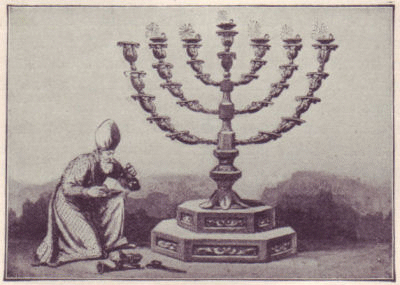 THE GOLDEN CANDLESTICK |
On the gold-covered table in the Holy Place were always standing twelve loaves of unleavened bread; that is, bread made without any yeast. One loaf stood for each tribe of Israel. On every Sabbath morning the priests came in with twelve fresh loaves, which they sprinkled with incense, and laid on the table in place of the stale loaves. Then, standing around the table, they ate the twelve old loaves. Thus the bread on the table before the Lord was kept fresh at all times.
God chose Aaron and his sons to be the priests for all Israel; and their children, and the descendants who should come after them were to be priests as long as the worship of the Tabernacle, and of the Temple that followed it, should be continued. Aaron, as the high-priest, wore a splendid robe; and a breast-plate of precious stones was over his bosom; and a peculiar hat, called "a miter," was on his head. It may seem strange to us, that when Aaron and his sons were in the Tabernacle, they wore no shoes or stockings, but stood barefooted. This was because it was a holy place, and as we have seen (see Story Twenty-one), in those lands people take off their shoes, as we take off our hats, when they enter places sacred to God and his worship.
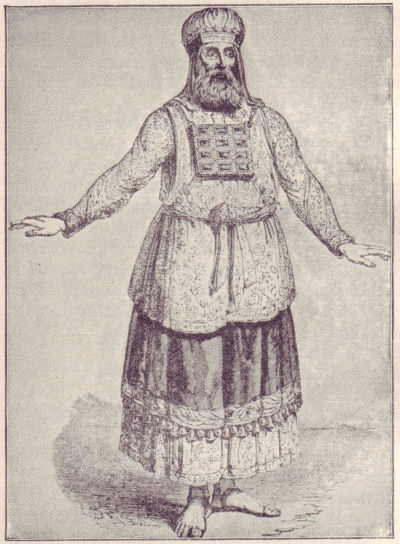 THE HIGH PRIEST |
Aaron and his sons, as Moses also, belonged to the tribe of Levi, the one among the tribes which stood faithful to God, when the other tribes bowed down to the golden calf. This tribe was chosen to help the priests in the services of the Tabernacle; though only Aaron and his sons could enter the Holy Place; and only the high-priest could go into the Holy of Holies, where the Ark of the Covenant was; and he could enter on but one day in each year.
What Strong Drink Brought to Aaron's Sons
Soon after the Tabernacle was set up in the middle of the camp of Israel, and the priests began the daily service of worship, a sad event took place, which gave great sorrow to Aaron the priest, to his family, and to all the people. The two older sons of Aaron, whose names were Nadab and Abihu, were one day in the Holy Place. It was a part of their work to take in a censer some burning coals from the great altar of burnt-offering in front of the Tabernacle, and with these coals to light the fire in the small golden altar of incense, which stood inside the Holy Place, near the vail.
These young men had been drinking wine, and their heads were not clear. They did not think of what they were doing; and instead of taking the fire from the altar of burnt-offering, they took some other fire, and with this went into the Holy Place to burn the incense upon the golden altar. God was angry with these young men for coming into his holy house in a drunken state, and for doing what he had forbidden them to do; for no fire except that from the great altar was allowed in the Holy Place.
While they were standing by the golden altar, fire came out from it, and they both fell down dead in the Holy Place. And when Moses heard of it, he said: "This is the sign that God's house is holy, and that God's worship is holy; and God will make people to fear him, because he is holy." And Moses would not allow Aaron, the father of these two men, to touch their dead bodies. He said, "You have on the robes of the high-priest, and you are leading in the service of worship. God's work must go on, and must not stop for your trouble, great as it is."
Then Aaron stood by the altar, and offered the sacrifice, though his heart was very sad. And the cousins of Aaron, by the command of Moses, went into the Holy Place and carried out the dead bodies of the two young men, dressed as they were in their priests' robes. And they buried these men outside the camp, in the desert.
And Moses said:
"After this, let no priest drink wine or strong drink before he enters the Tabernacle. Be sober, when you are leading the worship of the people, so that you will know the difference between the things that are holy and those that are common; and so that you may teach the people all the laws which the Lord has given them"
The rule that Moses gave to the priests to be kept when they were leading the worship of the people, not to drink wine or strong drink, is a good rule for every one to keep, not only when worshipping God, but at all times.
Besides these two sons of Aaron who had died, there were two other sons, named Eleazar and Ithamar. These young men took their older brothers' places in the services of the Tabernacle; and they were very careful to do exactly as the Lord had bidden them.
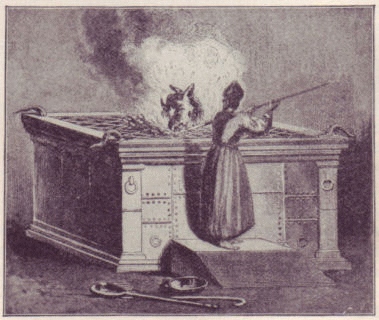 THE BRAZEN ALTAR |
The Scapegoat in the Wilderness
You have read that only the high-priest could enter the inner room of the Tabernacle, called the Holy of Holies, where was the ark of the covenant, and where God was supposed to live. (See Story Twenty-seven.) And even the high-priest could go into this room on but one day in the year. This day was called "the Great Day of Atonement."
The service on that day was to show the people that all are sinners, and that they must seek from God to have their sins taken away. God teaches us these things by word in his book, the Bible; but in those times there was no Bible, and very few could have read a written book; so God taught the people then by acts which they could see.
As a beginning of the service on the day of atonement, everybody was required to fast from sunset on the day before until three o'clock on that afternoon, the hour when the offering was placed on the altar. No person could eat anything in all that time. Even children, except nursing babies, were not allowed to have any food. They were to show a sorrow for sin, and were to appear before God as seeking for mercy.
Early in the morning of that day the high-priest offered on the altar before the Tabernacle what was called "a sin-offering," for himself and his family. It was a young ox, burned upon the altar. He took some of the blood of this ox, and carried it through the Holy Place, lifted the vail, entered into the Holy of Holies, and sprinkled the blood on the golden lid to the ark of the covenant before the Lord. This was to show the priest himself as a sinner, seeking mercy and forgiveness from God. The priest must himself have his own sins forgiven, before asking forgiveness for others.
Then the priest came again to the great altar before the Tabernacle. Here two goats were brought to him. Lots were cast upon them and on the forehead of one goat was written, "For the Lord," and on the other words that meant, "To be sent away." These two goats were looked upon as bearing the sins of the people. One was killed, and burned on the altar; and the priest, with some of the blood of the slain goat, again entered the Holy of Holies, and sprinkled the blood on the ark of the covenant, as before, thus asking God to receive the blood and the offering, and to forgive the sins of the people.
Then the high-priest came out of the Tabernacle again, and laid his hands on the head of the living goat, the one whose forehead was marked "To be sent away," as if to place upon him the sin of all the people. Then this goat, which was called the "Scapegoat," was led away into the wilderness, to some desolate place from which he would never find his way back to the camp; and there he was left, to wander as he chose. This was to show the sins of the people as taken away, never to come back to them.
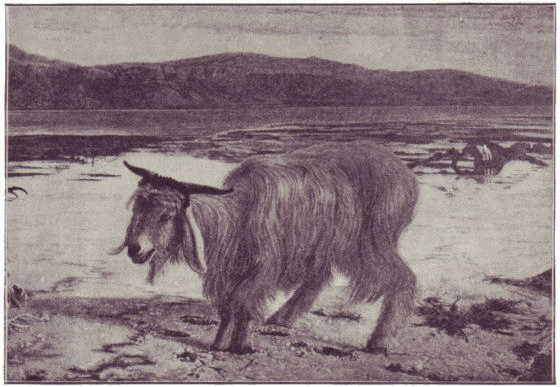 THE SCAPEGOAT |
When this service was over, the people were looked upon as having their sins forgiven and forgotten by the Lord. Then the regular afternoon offering was given on the altar; and after that the people could go home happy, and end their long fast with all the food that they wished to eat.
In all this God tried to make the people feel that sin is terrible. It separates from God; it brings death; it must be taken away by blood. Thus so long before Christ came to take away our sins by his death, God showed to men the was of forgiveness and peace.
The Cluster of Grapes from the Land of Canaan
The Israelites stayed in their camp before Mount Sinai almost a year, while they were building the Tabernacle and learning God's laws given through Moses. At last the cloud over the Tabernacle rose up; and the people knew that this was the sign for them to move. They took down the Tabernacle and their own tents, and journeyed northward toward the land of Canaan for many days led by the pillar of cloud by day, and the pillar of fire by night.
At last they came to a place just on the border between the desert and Canaan, called Kadesh, or Kadesh-barnea. Here they stopped to rest, for there were many springs of water and some grass for their cattle. While they were waiting at Kadesh-barnea, and were expecting soon to march into the land which was to be their home, God told Moses to send onward some men who should walk through the land, and look at it, and then come back and tell what they had found; what kind of a land it was, and what fruits and crops grew in it, and what people were living in it. The Israelites could more easily win the land, if these men after walking through it could act as their guides, and point out the best places in it and the best plans of making war upon it. There was need of wise and bold men for such a work as this, for it was full of danger.
So Moses chose out some men of high rank among the people, one ruler from each tribe, twelve men in all. One of these was Joshua, who was the helper of Moses in caring for the people, and another was Caleb, who belonged to the tribe of Judah. These twelve men went out, and walked over the mountains of Canaan, and looked at the cities, and saw the fields. In one place, just before they came back to the camp, they cut down a cluster of ripe grapes which was so large that two men carried it between them, hanging from a staff. They named the place where they found this bunch of grapes Eshcol, a word which means "a cluster." These twelve men were called "spies," because they went "to spy out the land." After forty days they came back to the camp; and this was what they said:
"We walked all over the land, and found it a rich land. There is grass for all our flocks, and fields where we can raise grain, and trees bearing fruits, and streams running down the sides of the hills. But we found that the people who live there are very strong, and are men of war. They have cities with walls that reach almost up to the sky; and some of the men are giants, so tall that we felt that we were like grasshoppers beside them."
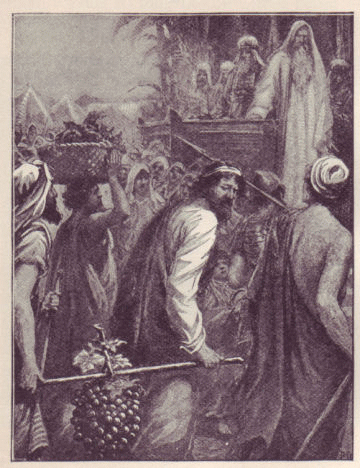 THE TWO YOUNG MEN CARRIED A CLUSTER OF GRAPES BETWEEN THEM |
One of the spies, who was Caleb, said, "All that is true, yet we need not be afraid to go up and take the land. It is a good land, well worth fighting for. God is on our side, and he will help us to overcome those people."
But all the other spies, except Joshua, said, "No; there is no use in trying to make war upon such strong people. We can never take those walled cities, and we dare not fight those tall giants."
And the people, who had journeyed all the way through the wilderness to find this very land, were so frightened by the words of the ten spies, that now on the very border of Canaan they dared not enter it. They forgot that God had led them out of Egypt, that he had kept them in the dangers of the desert, that he had given them water out of the rock, and bread from the sky, and his law from the mountain.
All that night, after the spies brought back their report, the people were so filled with fear that they could not sleep. They cried out against Moses, and blamed him for bringing them out of the land of Egypt. They forgot all their troubles in Egypt, their toil and their slavery; and they resolved to go back to that land. They said, "Let us choose a ruler in place of Moses, who has brought us into all these evils, and let us turn back to the land of Egypt!"
But Caleb and Joshua, two of the spies, said, "Why should we fear? The land of Canaan is a good land; it is rich with milk and honey. If God is our friend and is with us, we can easily conquer the people who live there. Above all things, let us not rebel against the Lord or disobey him and make him our enemy."
But the people were so angry with Caleb and Joshua that they were ready to stone them and kill them. Then suddenly the people saw a strange sight. The glory of the Lord, which stayed in the Holy of Holies, the inner room of the Tabernacle, now flashed out and shone from the door of the Tabernacle in the faces of the people.
And the Lord out of this glory spoke to Moses, and said:
"How long will this people disobey me and despise me? They shall not go into the good land that I have promised them. Not one of them shall enter in except Caleb and Joshua, who have been faithful to me. All of the people who are twenty years old and over it, shall die in the desert; but their little children shall grow up in the wilderness, and when they become men they shall enter in and own the land that I promised to their fathers. You people are not worthy of the land that I have been keeping for you. Now turn back into the desert, and stay there until you die. After you are dead, Joshua shall lead your children into the land of Canaan. And because Caleb showed another spirit, and was true to me, and followed my will fully, Caleb shall live to go into the land, and shall have his choice of a home there. To-morrow, turn back into the desert by the way of the Red Sea."
And God told Moses that for every day that the spies had spent in Canaan, looking at the land, the people should spend a year in the wilderness; so that they should live in the desert forty years, instead of going at once into the promised land.
When Moses told all God's words to the people, they felt worse than before. They changed their minds as suddenly as they had made up their minds. "No," they all said; "we will not go back to the wilderness. We will go straight into the land, and see if we are able to take it, as Joshua and Caleb have said."
"You must not go into the land," said Moses, "for you are not fit to go; and God will not go with you. You must turn back into the desert, as the Lord has commanded."
But the people would not obey. They rushed up the mountain, and tried to march at once into the land. But they were without leaders and without order, a mob of men untrained and in confusion. And the people in that part of the land, the Canaanites and Amorites, came down upon them and killed many of them, and drove them away. Then, discouraged and beaten, they obeyed the Lord and Moses, and went once more into the desert.
And in the desert of Paran, on the south of the land of Canaan, the children of Israel stayed nearly forty years; and all because they would not trust in the Lord.
It was not strange that the Israelites should act like children, eager to go back one day, and then eager to go forward the next day. Through four hundred years they had been weakened by living in the hot land of Egypt; and their hard lot as slaves had made them unfit to care for themselves. They were still in heart slavish and weak. Moses saw that they needed the free life of the wilderness; and that their children, growing up as free men and trained for war, would be better fitted to win the land of promise than they had shown themselves to be. So they went back into the wilderness to wait and to be trained for the work of winning their land in war.
How the Long Journey of the Israelites Came to an End
So the Israelites, after coming to the border of the promised land, went back into the wilderness to wait there until all the men who had sinned against the Lord in not trusting his word, should die. Moses knew that the men who had been slaves in Egypt, were in their spirit slaves still, and could not fight as brave men to win their land. There was need of men who had been trained up to a free life in the wilderness; men who would teach their children after them to be free and bold.
They stayed for nearly all the forty years of waiting in the wilderness of Paran, south of Canaan. Very few things happened during those years. The young men as they grew up were trained to be soldiers and one by one the old men died, until very few of them were left.
When the forth years were almost ended, the people came again to Kadesh-barnea. For some reason they found no water there. Perhaps the wells from which they had drawn water before were now dried up. The people complained against Moses, as they always complained when trouble came to them, and blamed him for bringing them into such a desert land, where there was neither fruit to eat nor water to drink, only great rocks all around.
Then the Lord said to Moses:
"Take the rod, and bring the people together, and stand before the rock, and speak to the rock before them; and then the water will come out of the rock, and the people and their flocks shall drink."
Then Moses and Aaron brought all the people together before a great rock that stood beside the camp. And Moses stood in front of the rock, with the rod in his hand; but he did not do exactly what God had told him to do, to speak to the rock. He spoke to the people instead, in an angry manner.
"Hear now, ye rebels," said Moses. "Shall we bring you water out of this rock?"
And Moses lifted up the rod, and struck the rock. Then he struck it again, and at the second blow the water came pouring out of the rock, just as it had come many years before from the rock at Rephidim, near Mount Sinai (see Story Twenty-five); and again there was a plenty of water for the people and their flocks.
But God was not pleased with Moses, because Moses had shown anger, and had not obeyed God's command just as God had given it. And God said to Moses and to Aaron:
"Because you did not show honor to me, by doing as I commanded you, neither of you shall enter into the land that I have promised to the children of Israel."
One act of disobedience cost Moses and Aaron the privilege of leading the people into their own land of promise! About this time, Miriam, the sister of Moses and Aaron, died at Kadesh-barnea. You remember that when she was a little girl she helped to save the baby Moses, her brother, from the river (see Story Twenty). She also led the women in singing the song of Moses after the crossing of the Red Sea as told in Story Twenty-four. And soon after her death Moses and Aaron, and Eleazar, Aaron's son, walked together up a mountain called Mount Hor; and on the top of the mountain Moses took off the priest's robes from Aaron, and placed them on his son Eleazar; and there on the top of Mount Hor Aaron died, and Moses and Eleazar buried him. Then they came down to the camp and Eleazar took his father's place as the priest.
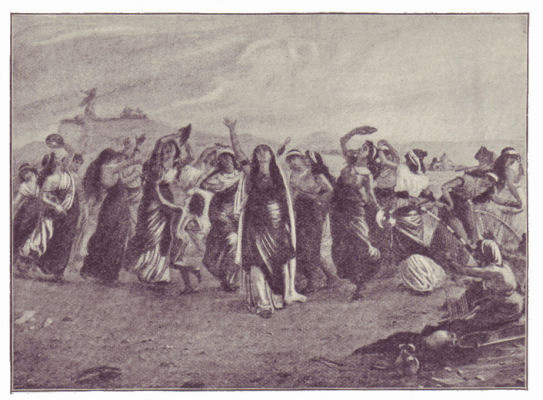 MIRIAM SINGING THE SONG MOSES WROTE |
While they were at Kadesh-barnea, on the south of Canaan, they tried again to enter the land. But they found that the Canaanites and Amorites who lived there were too strong for them; so again they turned back to the wilderness, and sought another road to Canaan. On the south the Dead Sea, and southeast of Canaan, were living the Edomites, who had sprung from Esau, Jacob's brother, as the Israelites had sprung from Jacob (see Story Twelve). Thus you see the Edomites were closely related to the Israelites.
And Moses sent to the king of Edom, to say to him:
"We men of Israel are your brothers. We have come out of the land of Egypt, where the people of Egypt dealt harshly with us, and now we are going to our own land, which our God has promised to us, the land of Canaan. We pray you let us pass through your land, on our way. We will do no harm to your land nor your people. We will walk on the road to Canaan, not turning to the right hand nor the left. And we will not rob your vineyards, nor even drink from your wells, unless we pay for the water that we use."
But the king of Edom was afraid to have such a great host of people, with all their flocks and cattle, go through his land. He drew out his army, and came against the Israelites. Moses was not willing to make war on a people who were so close in their race to the Israelites, so instead of leading the Israelites through Edom, he went around it, making a long journey to the south, and then to the east, and then to the north again.
It was a long, hard journey, through a deep valley which was very hot; and for most of the journey they were going away from Canaan, and not toward it; but it was the only way, since Moses would not let them fight the men of Edom.
While they were on this long journey the people again found fault with Moses. They said, "Why have you brought us into this hot and sandy country? There is no water; and there is no bread except this vile manna, of which we are very tired! We wish that we were all back in Egypt again!"
Then God was angry with the people; and he let the fierce snakes that grew in the desert crawl among them and bite them. These snakes were called "fiery serpents," perhaps because of their bright color, or perhaps because of their eyes and tongues, which seemed to flash out fire. Their bite was poisonous, so that many of the people died.
Then the people saw that they had acted wickedly in speaking against Moses; for when they spoke against Moses they were speaking against God, who was leading them. They said:
"We have sinned against the Lord, and we are sorry. Now pray to the Lord for us, that he may take away the serpents from us."
So Moses prayed for the people, as he had prayed so many times before. And God heard Moses' prayer, and God said to him:
"Make a serpent of brass, like the fiery serpents; and set it up on a pole, where the people can see it. Then every one who is bitten may look on the serpent on the pole, and he shall live."
And Moses did as God commanded him. He made a serpent of brass, which looked like the fiery snakes; and he lifted it up on a pole where all could see it. And then, whoever had been bitten by a snake looked up at the brazen snake, and the bite did him no harm.
This brazen snake was a teaching about Christ, though it was given so long before Christ came. You remember the text which says, "As Moses lifted up the serpent in the wilderness, even so must the Son of man be lifted up; that whatsoever believeth in him may have eternal life."
Northeast of the Dead Sea, above a brook called the brook Arnon, lived a people who were called the Amorites. Moses sent to their king, whose name was Sihon, the same message as he had sent to the king of Edom, asking for leave to go through his land. But he would not allow the Israelites to pass through. He led his army against Israel, and crossed the brook Arnon, and fought against Israel at a place called Jahaz. The Israelites here won their first great victory. In the battle they killed many of the Amorites, and with them their king, Sihon, and they took for their own all their land, as far north as the brook Jabbok. Do you remember how Jacob one night prayed by the brook Jabbok? (See Story Fourteen.)
And after this they marched on toward the land of Canaan, coming from the east. And at last they encamped on the east bank of the river Jordan, at the foot of the mountains of Moab. Their long journey of forty years was now ended, the desert was left behind them, before them rolled the Jordan River, and beyond the Jordan they could see the hills of the land which God had promised to them for their own.
What a Wise Man Learned from an Ass
When the Israelites had traveled around the land of Edom, and encamped beside the river Jordan, a little north of the Dead Sea, they did not sit down to rest, for Moses knew that a great work was before them, to take the land of Canaan. He had already won a great victory over the Amorites at Jahaz, and slain their king, and won their land. Again Moses sent out an army into the north, a region called Bashan. There they fought with King Og, who was one of the giants, and killed him, and took his country. This made the Israelites masters of all the land on the east of the river Jordan, and north of the brook Arnon.
South of the brook Arnon and east of the Dead Sea were living the Moabites. This people had sprung from Lot, the nephew of Abraham, of whom we read in earlier Stories (Six and Eight). In the five hundred years since Lot's time, his family or descendants had become a people who were called Moabites, just as Jacob's descendants were the Israelites. The Moabites were filled with alarm and fear as they saw this mighty host of Israel marching around their land, conquering the country and encamping on their border. The Moabites were ruled by a king whose name was Balak, and he tried to form some plan for driving away the people of Israel from that region.
There was at that time a man living far in the east, near the great river Euphrates, whose name was Balaam. This man was known far and wide as a prophet, that is, a man who talked with God, and heard God's voice, and spoke from God, as did Moses. People believed that whatever Balaam said was sure to come to pass; but they did not know that Balaam could only speak what God gave him to speak.
Balak, the king of the Moabites, sent men to Balaam at his home by the river, with great presents. He said to Balaam:
"There is a people here who have come up out of Egypt, and they cover the whole land. I am afraid of them, for they have made war and beaten all the nations around. Come and curse them for me in the name of your God; for I believe that those whom you bless are blessed and prosper, and those whom you curse are cursed and fail."
The men from Moab brought this message and promised to Balaam a great reward if he would go with them. And Balaam answered them, "Stay here to-night, and I will ask my God what to do."
That night God came to Balaam, and said to him:
"Who are these men at your house, and what do they want from you?"
The Lord knew who they were, and what they wanted, for God knows all things. But he wished Balaam to tell him. And Balaam said:
"They have come from Balak, the king of Moab, and they ask me to go with them, and to curse for them a people that have come out of Egypt."
And God said to Balaam, "You must not go with these men; you shall not curse this people, for this people are to be blessed."
So the next morning Balaam said to the men of Moab, "Go back to your land; for the Lord will not let me go with you."
When these men brought back to their king, Balak, the message of Balaam, the king still thought that Balaam would come, if he should offer him more money. So he sent other messengers, of high rank, the prices of Moab, with larger gifts. And they came to Balaam, and said:
"Our King Balak says that you must come; he will give you great honors, and all the money that you ask. Come now, and curse this people for King Balak."
And Balaam said:
"If Balak should give me his house full of silver and gold, I cannot speak anything except what God gives me to speak. Stay here to-night, and I will ask my God what I may say to you."
Now Balaam knew very well what God wished him to say; but Balaam, though he was a prophet of the Lord, wished to be rich. He wanted to go with the men, and get Balak's money, but he did not dare to go against God's command. And that night God said to Balaam:
"If these men ask you to go with them, you may go; but when you go to Balak's country, you shall speak only the words that I give you to speak."
At this Balaam was very glad, and the next day he went with the princes of Moab, to go to their land, which was far to the southwest. God was not pleased with Balaam's going, for Balaam knew very well that God had forbidden him to curse Israel; but he hoped in some way to get Kin Balak's money.
And God sent his angel to meet Balaam in the way. In order to teach Balaam a lesson, the angel appeared first to the ass on which Balaam was riding. The ass could see the angel with his fiery sword standing in front of the way, but Balaam could not see him. The ass turned to one side, out of the road, into an open field; and Balaam struck the ass and drove it back into the road, for he could not see the angel, whom the ass saw.
Then the angel appeared again, in a place where the road was narrow, with a stone wall on each side. And when the ass saw the angel it turned to one side, and crushed Balaam's foot against the wall. And Balaam struck the ass again.
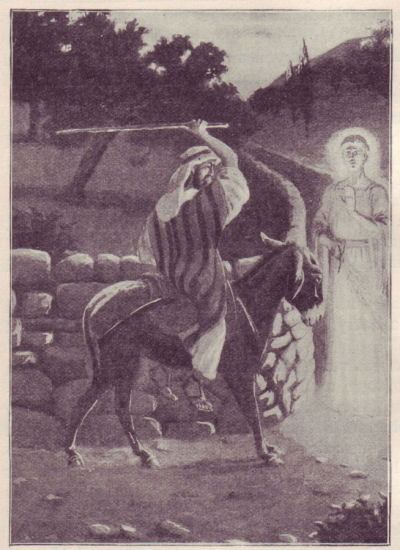 THE ANGEL MEETS BALAAM IN THE WAY |
Again the angel of the Lord appeared to the ass in a place where there was no place to turn aside; and the ass was frightened, and fell down, while Balaam struck it again and again with his staff.
Then the Lord allowed the ass to speak; and the ass said to Balaam, "What have I done that you have struck me these three times?"
And Balaam was so angry that he never thought how strange it was for an animal to talk; and he said: "I struck you because you will not walk as you should. I wish that I had a sword in my hand; then I would kill you."
And the ass spoke again to Balaam, "Am I not your ass, the one that has always carried you? Did I ever disobey you before? Why do you treat me so cruelly?"
And then God opened Balaam's eyes, and let him see the angel standing with a drawn sword in front of him. Then Balaam leaped off from the ass to the ground, and fell down upon his face before the angel. And the angel said to Balaam, "Balaam, you know that you are going in the wrong way. But for the ass, which saw me, I would have killed you. The road that you are taking will lead you to death."
And Balaam said, "I have sinned against the Lord; now let the Lord forgive me, and I will go home again."
But the angel knew that in his heart Balaam wanted to go on to meet King Balak; and the angel said:
"You may go with these men of Moab; but be sure to say only what God gives you to speak."
So Balaam went on, and came to the land of Moab; and King Balak said to him:
"So you have come at last! Why did you wait until I sent the second time? Do you now know that I will pay you all that you want, if you will only do what I wish?"
And Balaam said, "I have come to you as you asked; but I have no power to speak anything except what God gives me."
King Balak thought that all Balaam said about speaking God's word was spoken only to get more money. He did not understand that a true prophet could never say anything except what was the will of God. He took Balaam up to the top of a mountain, from which they could look down upon the camp of the Israelites, as it lay with tents spread on the plain, and the Tabernacle in the middle, overshadowed by the white cloud.
Then Balaam said, "Build for me seven altars, and bring me for an offering seven young oxen and seven rams."
They did so, and while the offering was on the altar God gave a word to Balaam; and then Balaam spoke out God's word:
"The king of Moab has brought me from the east, saying, 'Come, curse Jacob for me; come, speak against Israel.' How shall I curse those whom God has not cursed? How shall I speak against those who are God's own people? From the mountain-top I see this people dwelling alone and not like other nations. Who can count the men of Israel, like the dust of the earth? Let me die the death of the righteous; and let my last end be like his!"
And King Balak was surprised at Balaam's words. He said:
"What have you done? I brought you to curse my enemies, and instead you have blessed them!"
And Balaam answered, "Did I not tell you beforehand, that I could only say the words that God should put into my mouth?"
But King Balak thought that he would try again to obtain from Balaam a curse against Israel. He brought him to another place, where they could look down on the Israelites, and again offered sacrifices. And again God gave a message to Balaam; and Balaam said:
"Rise up, King Balak, and hear. God is not a man, that he should lie, or that he should change his mind. What God has said, that he will do. He has commanded me to bless this people; yea, and blessed shall they be. The Lord God is their king, and he shall lead them, and give them victory."
Then King Balak said to Balaam:
"If you cannot curse this people, do not bless them, but leave them alone!"
And Balaam said again, "Did I not tell you, that what God gives me to speak, that I must speak?"
But King Balak was not yet satisfied. He brought Balaam to still another place, and offered sacrifices as before. And again the Spirit of God came on Balaam. Looking down on the camp of Israel, he said:
"How goodly are your tents, O Israel! And your tabernacles, O Jacob! God has brought him out of Egypt; and God shall give him the land of promise. He shall destroy his enemies; Israel shall be like a lion when he rises up. Blessed be every one who blesses him; and cursed be every one that curses him!"
And Balak, the king of Moab, was very angry with Balaam the prophet.
"I called you," said Balak, "to curse my enemies; and you have blessed them over and over again. Go back to your own home. I meant to give you great honor and riches; but your God has kept you back from your reward!"
And Balaam said to Balak:
"Did I not say to your messengers, 'If Balak should give me his house full of silver and gold, I cannot go beyond God's command, to say good or evil? What God speaks, that I must speak.' Now let me tell you what this people shall do to your people in the years to come. A star shall come out of Jacob, and a scepter shall be stretched forth from Israel that shall rule over Moab. All these lands, Edom, and Mount Seir, and Moab, and Ammon, shall some time be under the rule of Israel."
And all this came to pass, though it was four hundred years afterward, when David, the king of Israel, made all those countries subject to his rule.
But Balaam soon showed that although for a time God spoke through his lips, in his heart he was no true servant of God. Although he could not speak a curse against the Israelites, he still longed for the money that King Balak was ready to give him if he would only help Balak to weaken the power of Israel. And he tried another plan to do harm to Israel.
Balaam told King Balak that the best plan for him and his people would be to make the Israelites their friends, to marry among them, and not to make war upon them. And this the Moabites did; until many of the Israelites married the daughters of Moab, and then they began to worship the idols of Moab.
This was worse for the Israelites than making war upon them. For if the people of Israel should be friendly with the idol-worshipping people around them, the Moabites east of the Dead Sea, the Ammonites near the wilderness, and the Edomites on the south, they would soon forget the Lord, and begin to worship idols.
There was danger that all the people would be led into sin. And God sent a plague of death upon the people, and many died. Then Moses took the men who were leading Israel into sin, and put them to death. And after this the Israelites made war upon the Moabites, and their neighbors, the Midianites, who were joined with them. They beat them in a great battle, and killed many of them. And among the men of Moab they found Balaam the prophet; and they killed him also, because he had given advice to the Moabites which brought harm to Israel.
It would have been better for Balaam to have stayed at home, and not to have come when King Balak called him; or it would have been well for him to have gone back to his home when the angel met him. He might then have lived in honor; but he knew God's will, and tried to go against it, and died in disgrace among the enemies of God's people.
sHow Moses Looked upon the Promised Land
While the Israelites were in their camp on the plain beside the river Jordan, at the foot of the mountains of Moab, God told Moses to count the number of the men who were old enough and strong enough to go forth to war. And Moses caused the men to be counted who were above twenty years of age, and found them to be a little more than six hundred thousand in number. Besides these were the women and children.
And among them all were only three men who were above sixty years of age, men who had been more than twenty years old forty years before, when the Israelites came out of Egypt. The men who had been afraid to enter the land of Canaan, when they were at Kadesh-barnea the first time (see Story Thirty), had all died. Some of them had been slain by the enemies in war; some had died in the wilderness during the forty years; some had perished by the plague; some had been bitten by the fiery serpents. Of all those who had come out of Egypt as men, the only ones living were Moses, and Joshua, and Caleb. Moses was not a hundred and twenty years old. He had lived forty years as a prince in Egypt, forty years as a shepherd in Midian, and forty years as the leader of Israel in the wilderness. But although he was so very old, God had kept his strength. His eyes were as bright, his mind was as clear, and his arm and heart were as strong as they had been when he was a young man.
The people of Israel had now full possession of all the land on the east of the river Jordan, from the brook Arnon up to the great Mount Hermon. Much of this land was well fitted for pasture; for grass was green and rich, and there were many streams of water. There were two of the twelve tribes, and half of another tribe, whose people had great flocks of sheep and goats, and herds of cattle. These were the tribes which had sprung from Reuben and Gad, the sons of Jacob, and half of the tribe of Manasseh, the son of Joseph. For there were two tribes that had sprung from Joseph, his descendants, the tribes of Ephraim and Manasseh.
The men of Reuben, Gad, and half the men of Manasseh came to Moses, and said:
"The land on this side of the river is good for the feeding of sheep and cattle; and we are shepherds and herdsmen. Cannot we have our possessions on this side of the river, and give all the land beyond the river to our brothers of the other tribes?"
Moses was not pleased at this; for he thought that the men of these tribes wished to have their home at once in order to avoid going to war with the rest of the tribes; and this may have been in the minds.
So Moses said to them:
"Shall your brothers of the other tribes go to the war? And shall you sit here in your own land, and not help them? That would be wicked, and would displease the Lord your God." Then the men of the two tribes and the half-tribe came again to Moses, and said to him:
"We will build sheepfolds here for our sheep, and we will choose some cities to place our wives and our children in; but we ourselves will go armed with our brothers of the other tribes, and will help them to take the land on the other side of the Jordan. We will not come back to this side of the river until the war is over, and our brothers have taken their shares of the land, each tribe its own part; and we will take no part on the other side of the river, because our place has been given to us here. And when the land is all won and divided, then we will come back here to our wives and our children."
Then Moses was satisfied with the promise that they had given, and he divided the land on the east of the Jordan to these tribes. To the men of Reuben he gave the land on the south; to the men of Gad the land in the middle; and to the half-tribe of Manasseh the land on the north, the country called Bashan. And after their wives and children and flocks had been placed safely, the men of war came to the camp, ready to go with the other tribes across the river when God should call them.
And now the work of Moses was almost done. God said to him:
"Gather the children of Israel together, and speak to them your last words, for you are not to lead the people across the Jordan. You are to die in this land, as I said to you at Kadesh." (See Story Thirty-one.)
Then Moses called the leaders of the twelve tribes before his tent, and said to them many things, which you can read in the book of the Bible called Deuteronomy. There all the long speech of Moses is given. He told them what wonderful things God had done for their fathers and for them. He gave them again all the words of God's law. He told them that they must not only keep God's law themselves, but must teach it to their children, so that it might never be forgotten. And Moses sang a song of farewell and wrote down all his last words.
Then he gave a charge to Joshua, whom God had chosen to take his place as the ruler and leader of the people; though no man could take Moses' place as a prophet of God and the giver of God's law. He laid his hands on Joshua's head; and God gave to Joshua some of his Spirit that had been on Moses.
Then Moses, all alone, went out of the camp, while all the people looked at him and wept. Slowly he walked up the mountain side, until they saw him no more. He climbed to the top of Mount Nebo, and stood alone upon the height, and looked at the Land of Promise, which lay spread out before him. Far in the north he could see the white crown of Mount Hermon, where there is always snow. At his feet, but far below, the river Jordan was winding its way down to the Dead Sea. Across the river, at the foot of the mountains, was standing the city of Jericho, surrounded with a high wall. On the summits of the mountains beyond he could see Hebron, where Abraham, and Isaac, and Jacob were buried; he could see Jerusalem, and Bethel, and the two mountains where Shechem lay hidden in the center of the land. And here and there, through the valleys, he could see afar in the west the gleaming water of the Great Sea.
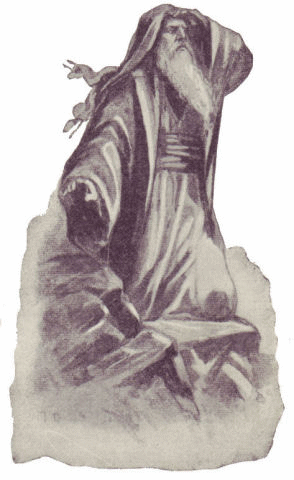 MOSES LOOKS UPON THE PROMISED LAND |
Then Moses, all alone, lay down on the mountain's top, and died. Aaron and Hur, who had held up the hands of Moses in battle (see Story Twenty-five), had both died and there was no man on Mount Nebo to bury Moses; so God himself buried him, and no man knows where God laid the body of Moses, who had served God so faithfully.
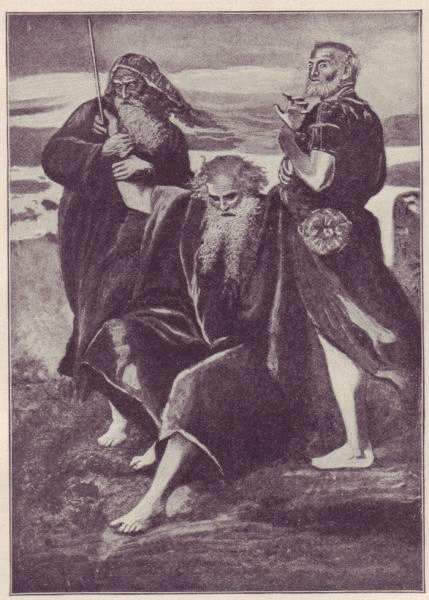 MOSES' HANDS UPHELD |
And after Moses there was never a man who lived so near to God, and talked with God so freely, as one would talk face to face with his friend, until long afterward Jesus Christ, the Son of God, and greater than Moses, came among men.
The Story of Job
At some time in those early days—we do not know just at what time, whether in the days of Moses or later—there was living a good man named Job. His home was in the land of Uz, which may have been on the edge of the desert, east of the land of Israel. Job was a very rich man. He had sheep, and camels, and oxen, and asses, counted by the thousand. In all the east there was no other man so rich as Job.
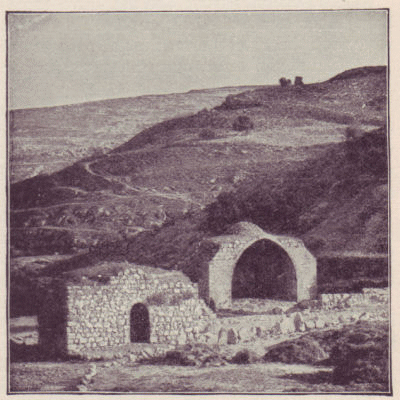 THE WELL OF JOB |
And Job was a good man. He served the Lord God, and prayed to God every day, with an offering upon God's altar, as men worshipped in those times. He tried to live as God wished him to live, and was always kind and gentle. Every day, when his sons were out in the field, or were having a feast together in the house of any of them, Job went out to his altar, and offered a burnt-offering for each one of his sons and his daughters, and prayed to God for them; for he said:
"It may be that my sons have sinned or have turned away from God in their hearts; and I will pray God to forgive them."
At one time, when the angels of God stood before the Lord, Satan the Evil One came also, and stood among them, as though he were one of God's angels. The Lord God saw Satan, and said to him, "Satan, from what place have you come?" "I have come," answered Satan, "from going up and down in the earth and looking at the people upon it."
Then the Lord said to Satan, "Have you looked at my servant Job? And have you seen that there is not another man like him in the earth, a good and a perfect man, one who fears God and does nothing evil?" Then Satan said to the Lord: "Does Job fear God for nothing? Hast thou not made a wall around him, and around his house, and around everything that he has? Thou hast given a blessing upon his work, and has made him rich. But if thou wilt stretch forth thy hand, and take away from him all that he has, then he will turn away from thee and will curse thee to thy face."
Then the Lord said to the Evil One, "Satan, all that Job has is in your power; you can do to his sons, and his flocks, and his cattle, whatever you wish; only lay not your hand upon the man himself."
Then Satan went forth from the Lord; and soon trouble began to come upon Job. One day, when all his sons and daughters were eating and drinking together in their oldest brother's house, a man came running to Job, and said:
"The oxen were plowing, and the asses were feeding beside them, when the wild men from the desert came upon them, and drove them all away; and the men who were working with the oxen and caring for the asses have all been killed; and I am the only one who has fled away alive!"
While this man was speaking, another man came rushing in; and he said:
"The lightning from the clouds has fallen on all the sheep, and on the men who were tending them; and I am the only one who has come away alive!"
Before this man had ended, another came in; and he said:
"The enemies from Chaldea have come in three bands, and have taken away all the camels. They have killed the men who were with them; and I am the only left alive!"
Then at the same time, one more man came in, and said to Job:
"Your sons and your daughters were eating and drinking together in their oldest brother's house, when a sudden and terrible wind from the desert struck the house, and it fell upon them. All your sons and your daughters are dead, and I alone have lived to tell you of it."
Thus in one day, all that Job had—his flocks, and his cattle, and his sons and his daughters—all were taken away; and Job, from being rich, was suddenly made poor. Then Job fell down upon his face before the Lord, and he said:
"With nothing I came into the world, and with nothing I shall leave it. The Lord gave, and the Lord has taken away; blessed be the name of the Lord."
So even when all was taken from him Job did not turn away from God, nor did he find fault with God's doings.
And again the angels of God were before the Lord, and Satan, who had done all this harm to Job, was among them. The Lord said to Satan, "Have you looked at my servant Job? There is no other man in the world as good as he; a perfect man, one that fears God and does no wrong act. Do you see how me holds fast to his goodness, even after I have let you do him so great harm?" Then Satan answered the Lord, "All that a man has he will give for his life. But if thou wilt put thy hand upon and touch his bone and his flesh, he will turn from thee, and will curse thee to thy face."
And the Lord said to Satan, "I will give Job into your hand; do to him whatever you please; only spare his life."
Then Satan went out and struck Job, and caused dreadful boils to come upon him, over all his body, from the soles of his feet to the crown of his head. And Job sat down in the ashes in great pain; but he would not speak one word against God. His wife said to him, "What is the use of trying to serve God? You may as well curse God, and die!"
But Job said to her, "You speak as one of the foolish women. What? Shall we take good things from the Lord? And shall we not take evil things also?" So Job would not speak against God. Then three friends of Job came to see him, and to try to comfort him in his sorrow and pain. Their names were Eliphaz, and Bildad, and Zophar. They sat down with Job, and wept, and spoke to him. But their words were not words of comfort. They believed that all these great troubles had come upon Job to punish him for some great sin, and they tried to persuade Job to tell what evil things he had done, to make God so angry with him.
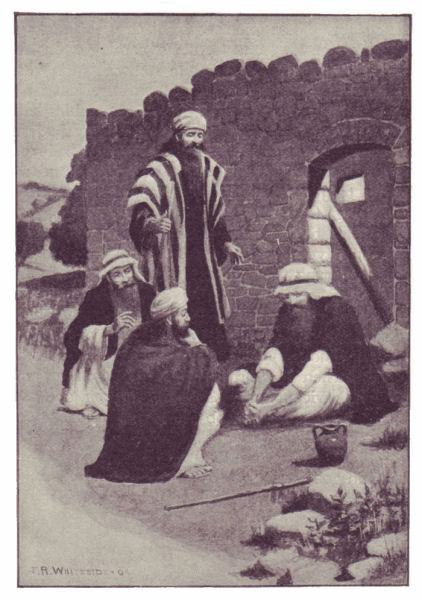 THREE FRIENDS COME TO SEE JOB |
For in those times most people believed that trouble, and sickness, and the loss of friends, and the loss of what they had owned, came to men because God was angry with them on account of their sins. These men thought that Job must have been very wicked because they saw such evils coming upon him. They made long speeches to Job, urging him to confess his wickedness.
Job said that he had done no wrong, that he had tried to do right; and he did not know why these troubles had come; but he would not say that God had dealt unjustly in letting him suffer. Job did not understand God's ways, but he believed that God was good; and he left himself in God's hands. And at last God himself spoke to Job and to his friends, telling them that it is not for man to judge God, and that God will do right by every man. And the Lord said to the three friends of Job:
"You have not spoken of me what is right, as Job has. Now bring an offering to me; and Job shall pray for you, and for his sake I will forgive you."
So Job prayed for his friends, and God forgave them. And because in all his troubles Job had been faithful to God, the Lord blessed Job once more, and took away his boils from him, and made him well. Then the Lord gave to Job more than he had ever owned in the past, twice as many sheep, and oxen, and camels, and asses. And God gave again to Job seven sons and three daughters; and in all the land there were no women found so lovely as the daughters of Job. After his trouble, Job lived a long time, in riches, and honor, and goodness, under God's care.
The Story of a Scarlet Cord
After the death of Moses, while the children of Israel were still encamped upon the east bank of the river Jordan, God spoke to Joshua, and said:
"Now that Moses my servant is dead, you are to take his place and to rule this people. Do not delay, but lead them across the river Jordan, and conquer the land which I have given to them."
Then God told Joshua how large would be the land which the Israelites were to have, if they should show themselves worthy of it. It was to reach from the great river Euphrates, far in the north, down to the border of Egypt on the south, and from the desert on the east to the Great Sea on the west. And God said to Joshua:
"Be strong and of a good courage. I will be with you as I was with Moses. Read constantly the book of the law which Moses gave you, and be careful to obey all that is written in it. Do this and you will have good success."
Then Joshua gave orders to his officers. He said, "Go through the camp, and tell the people to prepare food for a journey; for in three days we shall pass over the river Jordan, and shall go into the land which the Lord has promised us."
To say this was very bold; for at that time of the year, in the spring, the Jordan was much larger than at other times. All its banks were overflowed, and it was running as a broad, deep, swift river, down to the Dead Sea, a few miles to the south. No one could possibly walk through it; only a strong man could swim in its powerful current; and the Israelites had no boats in which they could cross it.
On the other side of the river, a few miles distant, the Israelites could see the high walls of the city of Jericho, standing at the foot of the mountains. Before the rest of the land could be won, this city must be taken, for it stood beside the road leading up to the mountain country.
Joshua chose two careful, brave, and wise men, and said to them, "Go across the river, and get into the city of Jericho; find out all you can about it, and come back in two days."
The two men swam across the river, and walked over to Jericho, and went into the city. But they had been seen, and the king of Jericho sent men to take them prisoners. They came to a house which stood on the wall of the city, where was living a woman named Rahab; and she hid the men.
But these strange men had been seen going into her house, and the king sent his officers after them. The woman hid the men on the roof of the house, and heaped over them stalks of flax, which are like long reeds, so that the officers could not find them. After the officers had gone away, thinking that the two spies had left the city, the woman Rahab came to the two men, and said to them:
"All of us in this city know that your God is mighty and terrible, and that he has given you this land. We have heard how your God dried up the Red Sea before you, and led you through the desert, and gave you victory over your enemies. And now all the people in this city are in fear of you, for they know that your God will give you this city and all this land."
"Now," said Rahab, "promise me in the name of the Lord, that you will spare my life, and the lives of my father and mother, and of my brothers and sisters, when you take this city."
And the men said, "We will pledge our life for yours, that no harm shall come to you; for you have saved our lives."
This woman's house stood on the wall of the city. From one of its windows Rahab let down outside a rope, upon which the men could slide down to the ground. It happened that this rope was of a bright scarlet color.
The two spies said to Rahab, "When our men come to take this city, you shall have this scarlet rope hanging in the window. Bring your father, and mother, and family into the house, and keep them there while we are taking the city. We will tell all our men not to harm the people who are in the house where the scarlet cord hangs from the window; and thus all your family will be safe when the city is taken."
Then the two men, at night, slid down the rope and found their way to the river, and swam over it again, and told their story to Joshua. They said, "Truly the Lord has given to us all the land; for all the people in it are in terror before us, and will not dare to oppose us."
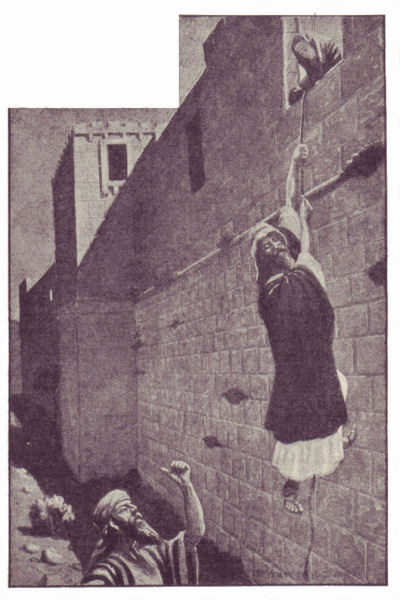 THE TWO SPIES LET DOWN BY A ROPE |
One fact was a great help to the Israelites in their plans for taking the land of Canaan. It was not held by one people, or ruled over by one king, who could unite all his people against the Israelites. There were many small nations living in the land, and each little tribe, and even each city, was ruled by its own king. So it would be easy for the Israelites to destroy them one by one, so long as they kept apart and did not band themselves together into one army.
The Israelites were now a strong and united people, trained for war, and willing to obey one leader, so that all the twelve tribes were ready to fight as one man.
How the River Jordan Became Dry, and the Walls of Jericho Fell Down
After the two spies had come back from Jericho to the camp of Israel, Joshua commanded the people to take down their tents and remove from their camping place to the bank of the river Jordan. Then the priests took apart the Tabernacle, and covered the ark and all the furniture in the Holy Place; and ran the poles through the rings for carrying the altar, and made ready for leaving the camp. At the same time the people took down their tents, and rolled them up, and brought together their flocks and cattle, and stood ready to march.
Then Joshua gave the word, and they marched down toward the river, which was rolling high and strong in front of them. Joshua said:
"Let the priests carry the ark of the covenant in front, and let there be a space between it and the rest of the people of three thousand feet. Do not come nearer than that space to the ark."
And all the people stood still, wondering, while the ark was brought on the shoulders of the priests far out in front of the ranks of men, until it came down to the very edge of the water. They could not see the ark, for it was covered, but they knew that it was under its coverings on the shoulders of the priests.
Then said Joshua to the priests, "Now walk into the water of the river."
Then a most wonderful thing took place. As soon as the feet of the priests touched the water by the shore, the river above stopped flowing, and far away, up the river, they could see the water rising and piling up like a great heap. And below the place where they were standing the water ran on, until it left a great place dry, and the stones on the river's bed were uncovered. Then, at Joshua's command, the priests carried the ark down to the middle of the dry bed of the river, and stood there with it on their shoulders.
And Joshua gave order to the people to march across the river. In front came the soldiers from Reuben, Gad, and the half-tribe of Manasseh, who had already received their homes on the east of the river, but were with the other tribes to help in the war (see Story Thirty-three in Part First). After them came all the other tribes, each by itself, until they had all passed over the river; and all this time the priests stood on the river's dry bed holding the ark.
Then Joshua called for twelve men, one man from each tribe; and he said to them:
"Go down into the river and bring up from it twelve stones, as large stones as you can carry, from the place where the priests are standing."
They did so; and with these stones Joshua made a stone-heap on the bank; and he said:
"Let this heap of stones stand here to keep in memory what has taken place to-day. When your children shall ask you, 'Why are these stones here?' you shall say to them, 'Because here the Lord God made the river dry before the ark of the covenant, so that the people could cross over into the land that God had promised to their fathers.'"
And Joshua told these twelve men to take also twelve other stones, and heap them up in the bed of the river where the priests stood, with the ark, so that these stones also might stand to remind all who should see them of God's wonderful help to his people.
When all this had been done, and the two heaps of stone had been piled up, one on the bank, the other in the bed of the river, Joshua said to the priests, "Come now up from the river, and bring the ark to the shore."
They did so; and then the waters began to flow down from above, until soon the river Jordan was rolling by as it had rolled before. So now at last the children of Israel were safely in the land which God had promised to their fathers more than five hundred years before.
They set up a new camp, with the Tabernacle in the middle, the altar before it, and the tents of the tribes around it in order. The place of the camp was near the river, on the plain of Jordan, and was called Gilgal. And there the main camp of the Israelites was kept all the time that they were carrying on the war to win the land of Canaan.
When they came into the land, it was the time of the early harvest; and in the fields they found grain and barley in abundance. They gathered it, and ground it, and made bread of it; and some of it they roasted in the ear; and on that day the manna which God had sent them from the sky through forty years ceased to fall, now that it was needed no more. (See Part First, Story Twenty-four.)
There, in full view of the new camp, stood the strong walls of Jericho. Joshua went out to look at the city; and he saw a man all armed coming toward him. Joshua walked boldly up to the man, and said to him, "Are you on our side, or are you one of our enemies?"
And he said, "No; but as captain of the Lord's host have I come."
Then Joshua saw that he was the angel of the Lord; and as he bowed down before him, said, "What word has my Lord to his servant?"
And the captain of the Lord's host said to Joshua, "Take off your shoes from your feet, for it is holy ground where you are standing."
Joshua did so; for the one who was speaking to him was not merely an angel, but the Lord himself appearing as a man. And the Lord said to Joshua, "I have given to you Jericho, and its king, and its mighty men of war; and I will destroy the city of Jericho before you."
Then the Lord told Joshua the way in which the city should be taken; and Joshua went back to the camp at Gilgal, and made ready to march as God commanded. During the next seven days all that was done was according to the word spoken by the Lord to Joshua.
They drew out the army as if to fight against the city. In front came the soldiers from the tribes on the east of the river. Then came a company of priests with triumph made of rams' horns, which they blew long and loud. Then came the ark of the covenant, borne on the shoulders of the priests. And, last of all, came the host of Israel, marching in order. No one shouted, nor was any noise heard, except the sound of the rams'-horn trumpets. They marched around the walls of Jericho once on that day, and then all marched back to the camp.
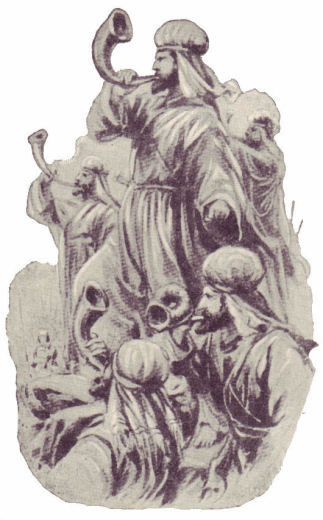 THE PRIESTS BLOWING THEIR HORNS |
The next morning they all formed in the same order, and again marched around the walls of the city; and so they did again and again, marching once each day for six days.
On the seventh day, by God's command, they rose very early in the morning, and did not stop when they had marched around the walls once; but kept on marching round and round, until they had gone about the walls seven times. As they went by they saw at one window on the wall a scarlet cord hanging down; and they knew that this was the house of Rahab, who had saved the lives of the two spies.
When the seventh march was ended, they all stood still. Even the trumpets ceased, and there was a great silence for a moment, until the voice of Joshua rang out, "Shout, for the Lord has given you the city!"
Then a great shout went up from the host; and they looked at the wall, and saw that it was trembling, and shaking, and falling! It fell down flat at every place but one. There was one part of the wall left standing, where the scarlet cord was hanging from the window.
And Joshua said to the two spies, "Go and bring out Rahab and her family, and take them to a safe place."
They went into Rahab's house on the wall and brought her out, and with her her father and mother, and all their family. They cared for them, and kept them safely in the camp of the Israelites until all the war against the people of the land was ended.
While some of the soldiers were taking care of Rahab, all the rest of the army was climbing up over the ruined wall. The people in the city were so filled with fear when they saw the walls falling down on every side, that they did not try to defend it, but sank down helpless and were slain or taken prisoners by the Israelites.
Thus the city was taken, with all that was within it. But the Israelites were forbidden to use for themselves any of the treasures in the city. Joshua said to them, "Nothing in this city belongs to you. It is the Lord's, and is to be destroyed as an offering to the Lord."
So they brought together all the gold, and silver, and precious things, and all that was in the houses. They took nothing for themselves, but kept the gold and silver and the things made of brass and iron for the Tabernacle. All the rest of what they found in the city they burned and destroyed, leaving of the city of Jericho nothing but a waste and a desolation. And Joshua said:
"Let the Lord's curse rest on any man who shall ever build again the city of Jericho. With the loss of his oldest born shall he lay its foundation, and with the loss of his youngest son shall he set up the gates of it."
After this Rahab, the woman who had saved the spies, was taken among the people of Israel just as though she had been an Israelite born. And one of the nobles of the tribe of Judah, whose name was Salmon, took her for his wife. And from her line of descendants, of those who came from her, many years after this, was born David the king. She was saved and blessed, because she had faith in the God of Israel.
The Story of a Wedge of Gold
While the Israelites at God's word were destroying the city of Jericho there was one man who disobeyed God's command. A man named Achan, of the tribe of Judah, saw in one house a beautiful garment that had come from Babylon, and a wedge-shaped piece of gold and some silver. He looked at it, longed to have it for his own, took it secretly to his tent, and hid it. He thought that no one had seen him do this thing. But God saw it all; and Achan's robbery of God, to whom everything belonged that was in Jericho, brought great trouble to Israel.
From Jericho there was a road up the ravines and valleys leading to the mountain country. On one of the hills above the plain stood a little city called Ai. Joshua did not think it needful for all the army to go and take Ai, because it was a small place. So he sent a small army of three thousand men. But the men of Ai came out against them, and killed a number of them, and drove them away, so that they failed to take the city.
And when the rest of the people heard of this defeat they were filled with fear. Joshua was alarmed, not because he was afraid of the Canaanites, but because he knew that God was not with the men who went against Ai. And Joshua fell on his face before the Lord, and said:
"O Lord God, why hast thou led us across Jordan only to let us fall before our enemies? What shall I say, O Lord, now that the men of Israel has been beaten and driven away?"
And God said to Joshua:
"Israel has sinned. They have disobeyed my words, and have broken their promise. They have taken the treasure that belongs to me, and have kept it. And that is the reason why I have left them to suffer from their enemies. My curse shall rest on the people until they bring back that which is stolen, and punish the man who robbed me." And God told Joshua how to find the man who had done this evil thing.
The next morning, very early, Joshua called all the tribes of Israel to come before him. When the tribe of Judah came near God showed to Joshua that this was the tribe. Then as the divisions of Judah came by God pointed out one division; and in that division one household, and in that household one family, and in that family one man. Achan was singled out as the man who had robbed God.
And Joshua said to Achan, "My son, give honor to the Lord God, and confess your sin to him; and tell me now what you have done. Do not try to hide it from me."
And Achan said, "I have sinned against the Lord. I saw in Jericho a garment from Babylon, and a wedge of gold, and some pieces of silver, and I hid them in my tent." Then Joshua sent messengers, who ran to the tent of Achan, and found the hidden things, and brought them out before all the people.
Then, because Achan's crime had harmed all the people, and because his children were with him in the crime, they took them all, Achan, and his sons and his daughters, and the treasure that had been stolen, and even his sheep and his oxen, and his tent, and all that was in it. And the people threw stones upon them until all were dead; then they burned their bodies and all the things in the tent. And over the ashes they piled up a heap of stones, so that all who saw it would remember what came to Achan for his sin.
Thus did God show to his people how careful they must be to obey his commands, if they would have God with them. After this Joshua sent another army, larger than before, against Ai. And they took the city, and destroyed it, as they had destroyed Jericho. But God allowed the people to take for themselves what they found in the city of Ai.
Then they marched on over the mountains, until they came near to the city of Shechem, in the middle of the land of Canaan. The people of the land were so filled with fear that none of them resisted the march of the Israelites. Near Shechem are the two mountains, Ebal on the north, and Gerizim on the south. Between these is a great hollow place, like a vast bowl. There Joshua gathered all the people of Israel, with their wives and their children.
In the midst of this place they built an altar of unhewn stones heaped up, for they had left the Tabernacle and the brazen altar standing in the camp at Gilgal, by Jordan. On this new altar they gave offerings to the Lord and worshipped.
Then before all the people Joshua read the law which Moses had written. And all the people, with their wives, and even the little children, listened to the law of the Lord. Half of the tribes stood on the slope of Mount Ebal on the north, and these, as Joshua read the words of warning which God had given to those who should disobey, all answered with one voice "Amen." And the other half of the tribes stood on the slope of Mount Gerizim on the south; and as Joshua read God's words of blessing to those who should obey the law, these answered "Amen."
When they had done all this, and thus given the land to the Lord and pledged themselves to serve God, they marched again down the mountains, past the smouldering ruins of Ai, past the heap of stones that covered Achan, and past the broken walls of Jericho, back to the camp at Gilgal beside the river.
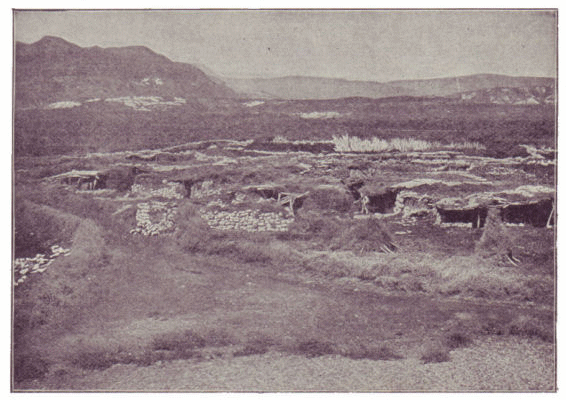 JERICHO AS IT NOW IS |
How Joshua Conquered the Land of Canaan
The news of all that Joshua and the men of Israel had done at Jericho and at Ai, how they had destroyed those cities and slain their people, went through all the land. Everywhere the tribes of Canaan prepared to fight these strangers who had so suddenly and so boldly entered their country.
Near the middle of the mountain region, between Jerusalem and Shechem, were four cities of a race called either the Hivites, or the Gibeonites, from their chief city, Gibeon. These people felt that they could not resist the Israelites; so they undertook to make peace with them. Their cities were less than a day's journey from the camp at Gilgal, and quite near to Ai; but they came to Joshua at the camp, looking as if they had made a long journey.
They were wearing old and ragged garments, and shoes worn out; and they brought dry and mouldy bread, and old bags of food, and wine-skins torn and mended. They met Joshua and the elders of Israel in the camp, and said to them:
"We live in a country far away; but we have heard of the great things that you have done; the journey you have made, and the cities you have taken on the other side of the river Jordan; and now we have come to offer you our friendship and to make peace with you." And Joshua said to them, "Who are you? And from what land do you come?"
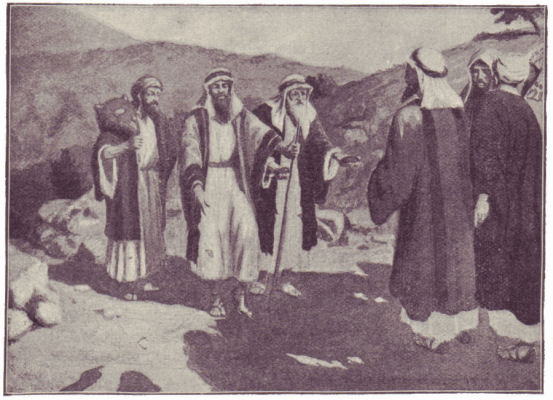 THE GIBEONITES COME TO JOSHUA |
"We have come," they said, "from a country far away. See this bread. We took it hot from the oven, and now it is mouldy. These wine-skins were new when we filled them, and you see they are old. Look at our garments and our shoes, all worn out and patched."
Joshua and the elders did not ask the Lord what to do, but made an agreement with these men to have peace with them, not to destroy their cities, and to spare the lives of their people. And a very few days after making peace with them they found that the four cities where they lived were very near.
At first the Israelite rulers were very angry, and were inclined to break their agreement, but afterward they said:
"We will keep our promise to these people, though they have deceived us. We will let them live, but they shall be made our servants, and shall do the hard work for the camp and for the Tabernacle."
Even this was better than to be killed, and to have their cities destroyed; and the Gibeonite people were glad to save their lives. So from that time the people of the four Gibeonite cities carried burdens, and drew water, and cut wood, and served the camp of Israel.
The largest city near to the camp at Gilgal was Jerusalem, among the mountains, where its king, Melchizedek, in the days of Abraham, five hundred years before, had been a priest of the Lord, and had blessed Abraham, as we read in Story Six in Part First. But now, in the days of Joshua, the people of that city worshipped idols and were very wicked.
When the king of Jerusalem heard that the Gibeonites, who lived near him, had made peace with Israel, he sent to the kings of Hebron and Lachish and several other cities, and said to them:
"Come, let us unite our armies into one great army and fight the Gibeonites and destroy them; for they have made peace with our enemies, the people of Israel."
As soon as the people of Gibeon heard this they sent to Joshua, saying:
"Come quickly and help us; for we are your servants; and the king of Jerusalem is coming with a great army to kill us all, and destroy our cities. The whole country is in arms against us; come at once, before it is too late!"
Joshua was a very prompt man, swift in all his acts. At once he called out his army, and marched all might up the mountains. He came suddenly upon the five kings and their army at a place called Beth-horon. There a great battle was fought, Joshua leading his men against the Canaanites. He did not give his enemies time to form in line, but fell upon them so suddenly that they were driven into confusion, and fled before the men of Israel.
And the Lord helped his people b a storm which drove great hailstones down on the Canaanites; so that more were killed by the hailstones than by the sword. It is written in an old song that on that day Joshua said before all his men:
|
"Sun, stand thou still over Gibeon. And thou, moon, in the valley of Ajalon, And the sun stood still, and the moon stayed, Until the people had taken vengeance upon their enemies." |
If ever in all the history of the world there was a battle when the sun might well stand still, and the day be made longer, to make the victory complete, it was that day more than any other. For on that day the land was won by the people of the Lord. If Israel had been defeated and destroyed, instead of Canaan, then the Bible would never have been written, the worship of the true God would have been blotted out, and the whole world would have worshipped idols. The battle that day was for the salvation of the world as well as of Israel. So this was the greatest battle in its results that the world has ever seen. There have been man battle where more men fought, and more soldiers were slain, than at the battle of Beth-horon. But no battle in all the world had such an effect in the years and the ages after, as this battle.
After the victory Joshua followed his enemies as they fled, and killed many of them, until their armies were broken up and destroyed. The five kings who had led against Joshua were found hidden in a cave, were brought out and were slain, so that they might no more trouble the Israelites. By this one victory all the part of the land of Canaan on the south was won, though there were a few small fights afterward.
Then Joshua turned to the north, and led his army by a swift march against the kings who had united there to fight the Israelites. As suddenly as before he had fallen on the five kings at Beth-horon, he fell upon these kings and their army, near the little lake in the far north of Canaan, called "the waters of Merom." There another great victory was won; and after this it was easy to conquer the land. Everywhere the tribes of Canaan were made to submit to the Israelites, until all the mountain country was under Joshua's rule.
In the conquest of Canaan, there were six great marches and six battles; three in the lands on the east of the Jordan, while Moses was still living, the victories over the Amorites, the Midianites, and the people of Bashan, on the northeast, and there on the west of the Jordan, the victories at Jericho, at Beth-horon, and Lake Merom, under Joshua.
But even after these marchings and victories, it was a long time before all the land was taken by the Israelites.
The Old Man Who Fought against the Giants
The great war for the conquest of Canaan was now ended, though in the land some cities were still held by the Canaanite people. Yet the Israelites were now the rulers over most of the country, and Joshua prepared to divide the land among the tribes of Israel.
One day the rulers of the tribe of Judah came to Joshua's tent at Gilgal, and with them came an old man, Caleb, whom you remember as one of the twelve spies sent by Moses from Kadesh-barnea to go through the land of Canaan. (See Part First, Story Thirty.) This had been many years before, and Caleb was now, like Joshua, an old man, past eighty years of age. He said to Joshua:
"You remember what the Lord said to Moses, the man of God, when we were in the desert at Kadesh-barnea, and you and I with the other spies brought back our report. I spoke to Moses the word that was in my heart, and I followed the Lord wholly, when the other spies spoke out of their own fear, and made the people afraid. On that day, you remember that Moses said to me, 'The land where your feet have trodden and over which you have walked shall be yours, because you trusted in the Lord.'
"That was forty-five years ago," Caleb went on to say, "and God has kept me alive all those years. To-day, at eighty-five years of age, I am as strong as I was in that day. And now I ask that the promise made by Moses be kept, and that I have my choice of the places in the land."
"Well," said Joshua, "you can take your choice in the land. What part of it will you choose?"
And Caleb answered:
"The place that I will choose is the very mountain on which we saw the city with the high walls, where the giants were living then, and where other giants, their sons, are living now, the city of Hebron. I know that the walls are high, and the giants live there. But the Lord will help to take the cities, and to drive out the people who live in them. Let me have the city of Hebron."
This was very bold in so old a man as Caleb, to choose the city which was not yet taken from the enemies, and one of the hardest cities to take, when he might have chosen some rich place already won. But Caleb at eighty-five showed the same spirit of courage, and willingness to war, and faith in God, that he had shown in his prime at forty years of age. Then Joshua said to Caleb, "You shall have the city of Hebron, with all its giants, if you will gather together your men, and take it." And the old soldier brought together his men, and led them against the strong city of Hebron, where was the tomb of Abraham, Isaac, and Jacob. (See Stories Ten, Eleven and Nineteen.) By the help of the Lord, Caleb was able to drive out the giants, tall and mighty as they were. They fled from Caleb's men and went down to the shore on the west of the land, and lived among the people of that region, who were called the Philistines; while Caleb, and his children, and his descendants long after him, held the city of Hebron in the south of the land.
After this, by the command of the Lord, Joshua divided the land among the tribes. Two tribes and half of another tribe had already received their land on the east of Jordan; so there were nine tribes and a half tribe to receive their shares. Judah, one of the largest, had the mountain country west of the Dead Sea, from Hebron to Jerusalem; Simeon was on the south toward the desert; Benjamin was north of Judah on the east, toward the Jordan, and Dan north of Judah on the west, toward the Great Sea.
In the middle of the country, around the city of Shechem, and the two mountains, Ebal and Gerizim, where Joshua had read the law to the people (see Story Three in this Part), was the land of the tribe of Ephraim. This was one of the best parts of all the country, for the soil was rich and there were many springs and streams of water. And here, near Mount Ebal, they buried the body of their tribe-father Joseph, which they had kept in its coffin of stone, unburied, ever since they left Egypt, more than forty years before. As Joshua himself belonged to the tribe of Ephraim, his home was also in this land.
North of Ephraim, and reaching from the river Jordan to the Great Sea, was the land of the other half of the tribe of Manasseh. Both tribes of Ephraim and Manasseh had sprung from Joseph. So Joseph's descendants had two tribes, as had been promised by Jacob when he was about to die. (See Story Nineteen in Part First.)
The northern part of the land was divided among four tribes. Issacher was in the south, Asher on the west beside the Great Sea, Zebulun was in the middle among the mountains, and Naphtali was in the north, and by the lake afterward called the Sea of Galilee. At that time this lake was called the Sea of Kinnoreth, because the word "kinnor" means "a harp;" and as they thought that his lake was shaped somewhat like a harp, they named it "the Harp-shaped Sea."
But although all the land had been divided, it had not all been completely conquered. Nearly all the Canaanite people were there, still living upon the land, though in the mountain region they were under the rule of the Israelites. But on the plain beside the Great Sea, on the west of the land were the Philistines, a very strong people whom the Israelites had not yet met in war, though the time was coming when they would meet them, and suffer from them.
And even among the mountains were many cities where the Canaanite people still lived, and in some of these cities they were strong. Years afterward, when Joshua the great warrior was no longer living, many of these people rose up to trouble the Israelites. The time came when the tribes of Israel wished often that their fathers had driven out or entirely destroyed the Canaanites, before they ceased the war and divided the land.
But when Joshua divided the land, and sent the tribes to their new homes, peace seemed to reign over all the country. Up to this time we have spoken of all this land as the land of Canaan, but now and henceforth it was to be called "The Land of Israel," or "The Land of the Twelve Tribes," for it was now their home.
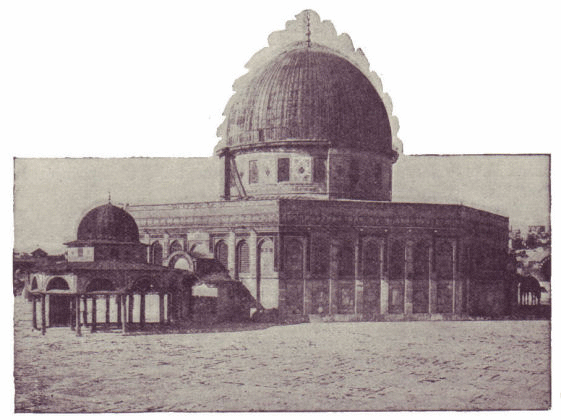 THE MOSQUE OF OMAR, OR THE DOME OF THE ROCK |
The Avenger of Blood, and the Cities of Refuge
There was among the Israelites one custom which seems so strange, and so different from our ways, that it will be interesting to hear about it. It was their rule with regard to any man who by accident killed another man. With us, whenever a man has been killed, the man who killed him, if he can be found, is taken by an officer before the judge, and he is tried. If he hilled the man by accident, not wishing to do harm, he is set free. If he meant to kill him he is punished; he may be sentenced to die for the other man's death; and when he is put to death it is by the officer of the law.
But in the lands of the east, where the Israelites lived, it was very different. There, when a man was killed, his nearest relative always took it upon himself to kill the man who had killed him; and he undertook to kill this man without trial, without a judge, and by his own hand, whether the man deserved to die, or did not deserve it. Two men might be working in the forest together, and one man's axe might fly from his hand and kill the other; or one man hunting might kill another hunter by mistake. No matter whether the man was guilty or innocent, the nearest relative of the one who had lost his life must find the man who had killed him, and kill him in return, wherever he was. If he could not find him, sometimes he would kill any member of his family whom he could find. This man was called "the avenger of blood," because he took vengeance for the blood of his relative, whether the one whom he slew deserved to die or not. When Moses gave laws to the children of Israel he found this custom of having an "avenger of blood" rooted so deeply in the habits of the people, that it could not be broken up. In fact, it still remains, even to this day, among the village people in the land where the Israelites lived.
But Moses gave a law which was to take the place of the old custom, and to teach the people greater justice in their dealings with each other. And when they came into the land of Canaan, Joshua carried out the plan which Moses had commanded.
Joshua chose in the land six cities, three on one side of the river Jordan, and three on the other side. All of these were well-known places and easy to find. Most of them were on mountains, and could be seen far away. They were so chosen that from almost any part of the land a man could reach one of these cities in a day, or at the most in two days. These cities were called "Cities of Refuge," because in them a man who had killed another by mistake could find refuge from the avenger of blood.
When a man killed another by accident, wherever he was, he ran as quickly as possible to the nearest of these cities of refuge. The avenger of blood followed him, and might perhaps overtake him and kill him before he reached the city. But almost always the an, having some start before his enemy, would get to the city of refuge first.
There the elders of the city looked into the case. They learned all the facts; and if the man was really guilty, and deserved to die, they gave him up to be killed by the avenger. But if he was innocent, and did not mean to kill the man who was dead, they forbade the avenger to touch him, and kept him in safety.
A line was drawn around the city, at a distance from the wall, within which line the avenger could not come to do the man harm; and within this line were fields, where the man could work and raise crops, so that he could have food.
And there at the city of refuge the innocent man who had killed another without meaning to kill, lived until the high-priest died. After the high-priest died, and another high-priest took his place, the man could go back to his own home and live in peace.
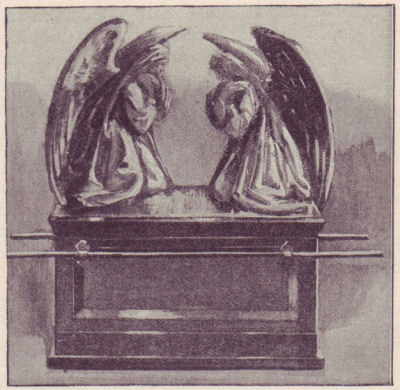 THE ARK WITH THE GOLDEN CHERUBIM |
These were the cities of refuge in the land of Israel: On the north, Kedesh in the tribe of Naphtali; in the center, Shechem, at the foot of Mount Gerizim, in the tribe of Ephraim; and on the south, Hebron, Caleb's city, in the tribe of Judah. These were among the mountains, on the west of the river Jordan. On the east of the river Jordan, the cities were Golan of Bashan in Manasseh, Ramoth of Gilead, in the tribe of Gad, and Bezer in the highlands of the tribe of Reuben.
This law taught the Israelites to be patient, and to control themselves, to protect the innocent, and to seek for justice, and not yield to sudden anger.
Among the tribes there was one which had no land given to it in one place. This was the tribe of Levi, to which Moses and Aaron belonged. The men of this tribe was priests, who offered the sacrifices, and Levites, who cared for the Tabernacle and its worship. Moses and Joshua did not think it well to have all the Levites living in one part of the country, so he gave them cities, and in some places the fields around the cities, in many parts of the land. From these places they went up to the Tabernacle to serve, each for a certain part of the year; and the rest of the year stayed in their homes and cared for their fields.
When the war was over, and the land was divided, Joshua fixed the Tabernacle at a place called Shiloh, not far from the center of the land, so that from all the tribes the people could come up at least once a year for worship. They were told to come from their homes three times in each year, and to worship the Lord at Shiloh.
These three times were for the feast of the Passover in the spring, when the lamb was killed, and roasted, and eaten with unleavened bread, of which we read in Story Twenty-eight of Part One; the feast of the Tabernacles in the fall, when for a week they slept out of doors in huts made of twigs and boughs, to keep in mind their life in the wilderness; and the feast of Pentecost, fifty days after the Passover, when they laid on the altar the first ripe fruits from the fields. All these three great feasts were kept at the place of the altar and the Tabernacle.
And at Shiloh, before the Tabernacle, they placed the altar, on which the offerings were laid twice every day. (See Part First, Stories Twenty-seven and Twenty-eight.)
God had kept his promise, and had brought the Israelites into a land which was their own, and had given them rest from all their enemies.
The Story of an Altar beside the River
When the war for the conquest of Canaan was ended, and the tribes were about to leave for their places in the land, Joshua broke up the camp at Gilgal, which had been the meeting place of the Israelites through all the war.
You remember that two of the tribes and half of another tribe had received their land on the east of Jordan (see Story Thirty-three in Part First), but their soldiers crossed the Jordan with the men of the other tribes. Joshua now called these soldiers, and said to them:
"You have done all that Moses the servant of the Lord commanded you; you have stood faithfully by your brothers of the other tribes; and now the time has come for you to go back to your wives and your children in your own tribe-lands on the other side of Jordan. Go to your homes, where your wives and children are waiting for you. Only remember always to keep the commandments of the Lord, and be true to the Lord, and serve him with all your heart and all your soul."
Then Joshua gave them the blessing of the Lord, and sent them away. They left Shiloh, where the Tabernacle was standing, and came to the river Jordan. There on a great rock where it could be seen from far, they built a high altar of stone.
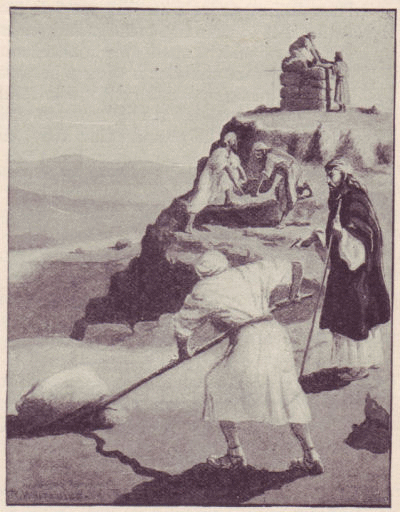 THE ALTAR WHICH STOOD AS A WITNESS |
Soon it was told among the tribes that the men of the two tribes and a half-tribe had built for themselves an altar. God had commanded the people to have but one altar for all the tribes and one high-priest, and one offering for all the tribes upon the altar. This was for the purpose of keeping all the people together, as one family, with one worship.
The people of Israel were greatly displeased when they found that these tribes had built an altar, while there was already one altar for all the tribes at Shiloh. They were almost ready to go to war against the tribes on the east of the Jordan on account of this altar.
But before going to war they sent one of the priests, Phinehas, the son of Eleazar, and with him ten of the princes of Israel, one from each tribe, to ask the men of the tribes on the east for what purpose they had built this altar. These men came to the men of Reuben and Gad, and the half-tribe of Manasseh, and said to them:
"What is this that you have done in building for yourselves an altar? Do you mean to turn away from the Lord and set up your own gods? Have you forgotten how God was made angry when Israel worshipped other gods? Do not show yourselves rebels against God by building an altar while God's altar is standing at Shiloh."
Then the men of the two tribes and a half answered:
"The Lord, the only God, he knows that we have not built this altar for the offering of sacrifices. Let the Lord himself be our judge, that we have done no wrong. We have built this altar so that our children may see it, standing as it stands on your side of the river and not on our side: and then we can say to them, 'Let that altar remind you that we are all one people, we and the tribes on the other side of Jordan.' This altar stands as a witness between us that we are all one people and worship the one Lord God of Israel."
Then the princes of the nine tribes and a half were satisfied. They were pleased when they knew that it was an altar for witness and not for offerings. They named the altar Ed, a word which means witness. "For," they said, "it is a witness between us that the Lord is our God, the God of us all."
Joshua was now a very old man, more than a hundred years old. He knew that he must soon die, and he wished to give to the people his last words. So he called he elders and rulers and judges of the tribes to meet him at Shechem, in the middle of the land and near his own home.
When they were all together before him, Joshua reminded them of all that God had done, for their fathers and for themselves. He told them the story of Abraham, how he left him home at God's call; the story of Jacob and his family going down to Egypt; and how after many years the Lord had brought them out of that land; how the Lord had led them through the wilderness and had given them the land where they were now living at peace. Joshua then said:
"You are living in cities that you did not build, and you are eating of vines and olive-trees that you did not plant. It is the Lord who has given you all these things. Now, therefore, fear the Lord, and serve him with all your hearts. And if any of you have any other gods, such as Abraham's father worshipped beyond the River, and as your fathers sometimes worshipped in Egypt, put them away, and serve the Lord only. And if you are not willing to serve the Lord, then choose this day whatever god you will serve; but as for me and my house, we will serve the Lord."
Then the people answered Joshua:
"We will not turn away from the Lord to serve other gods; for the Lord brought us out of Egypt where we were slaves; and the Lord drove out our enemies before us; and the Lord gave us this land. We will serve the Lord, for he is the God of Israel."
"But," said Joshua, "you must remember that the Lord is very strict in his commands. He will be angry with you if you turn away from him after promising to serve him; and will punish you if you worship images, as the people do around you."
And the people said, "We pledge ourselves to serve the Lord, and the Lord only."
Then Joshua wrote down the people's promise in the book of the law, so that others might read it and remember it. And he set up a great stone under an oak-tree in Shechem, and he said:
"Let this stone stand as a witness between you and the Lord, that you have pledged yourselves to be faithful to him."
Then Joshua sent the people away to their tribe-lands, telling them not to forget the promise that they had made. After this Joshua died, at the age of a hundred and ten years. And as long as the people lived who remembered Joshua, the people of Israel continued serving the Lord.
The Present That Ehud Brought to King Eglon
You would supposed that, after all that God had done for the Israelites, and after their own promises to serve him faithfully, they would never turn to the idols which could not save their own people, the Canaanites. Yet, when Joshua was no longer living, and the men who knew Joshua had also died, the people began to forget their own God and to worship images of wood and stone.
Perhaps it was not so strange after all. In all the world, so far as we know, at that time the Israelites were the only people who did not worship idols. All the nations around them, the Egyptians, from whose land they had come, the Edomites on the south, the Moabites on the east, the Philistines on the west beside the Great Sea,—all these bowed down to images, and many of them offered their own children upon the idol-altars.
Then, too, you remember that the Canaanites had not been driven out of the land. They were there still, in their own cities and villages everywhere, and their idols were standing under the trees on many high places. So the Israelites saw idols all around them, and people bowing down before them; while they themselves had no God that could be seen. The Tabernacle was far away from some parts of the land; and the people were so busy with their fields and their houses that few of them went up to worship.
And so it came to pass that the people began to neglect their own worship of the Lord, and then to begin the worship of the idols around them. And from idol-worship they sank lower still into wicked deeds. For all this the Lord left them to suffer. Their enemies came upon them from the lands around, and became their masters; for when God left them they were helpless. They were made poor, for these rulers who had conquered them robbed them of all their grain, and grapes, and olive-oil.
After a time of suffering the Israelites would think of what God had done for them in other times. Then they would turn away from the idols, and would call upon God. And God would hear them, and raise up some great man to lead them to freedom, and to break the power of those who were ruling over them. This great man the called "a judge;" and under him they would serve God, and be happy and successful once more.
As long as the judge lived and ruled, the people worshipped God. But when the judge died the forgot God again, and worshipped idols and fell under the power of their enemies as before, until God sent another judge to deliver them. And this happened over and over again in the three hundred years after Joshua died. Seven nations in turn ruled over the Israelites, and after each "oppression," as this rule was called, a "deliverer" arose to set the people free.
The idols which the Israelites worshipped most of all were those named Baal and Asherah. Baal was an image looking somewhat like a man; and Asherah was the name given to the one that looked like a woman. These images were set up in groves and on hills by the Canaanite people, and to these the Israelites bowed down, falling on their faces before them.
The first nation to come from another land against the Israelites was the people of Mesopotamia, between the great rivers Euphrates and Tigris on the north. Their king led his army into the land and made the Israelites serve him eight years. Then they cried to the Lord, and the Lord sent to them Othniel, who was a younger brother of Caleb, of whom we read in Story Five in this Part. He set the people free from the Mesopotamians, and ruled them as long as he lived, and kept them faithful to the Lord. Othniel was the first of the judges of Israel.
But after Othniel died the people again began to worship images, and again fell under the power of their enemies. This time it was the Moabites who came against them from the land east of the Dead Sea. Their king at this time was named Eglon, and he was very hard in his rule over the Israelites. Again they cried to the Lord, and God called a man named Ehud, who belonged to the tribe of Benjamin, to set the people free.
Ehud came one day to visit King Eglon, who was ruling over the land. He said:
"I have a present from my people to the king. Let me go into his palace and see him."
They let Ehud into the palace, and he gave to the king a present; then he went out, but soon came back, and said:
"I have a message to the king that no one else can hear. Let me see the king alone."
As he had just brought a present they supposed that he was a friend to the king. Then, too, he had no sword on the side where men carried their swords. But Ehud was left-handed, and he carried on the other side a short, sharp sword which he had made, like a dagger. This sword was out of sight under his garment.
He went into the room where King Eglon was sitting alone, and said, "I have a message from the Lord to you, and this is the message."
And then he drew out his sword and drove it up to the handle into the king's body so suddenly that the king died without giving a sound. Ehud left the sword in the head body of the king, and went out quietly by the rear door. The servants of the king thought he was asleep in his room, and for a while did not go in to see why he was so still; but when they found him dead Ehud was far away.
Ehud blew a trumpet and called his people together, and led them against the Moabites. They were so helpless without their king that Ehud and his men easily drove them out of Israel and set the people free. Ehud became the second judge over the land. And after that it was many years before enemies again held rule over Israel.
The next enemies to Israel were the Philistines, who lived on the shore of the Great Sea on the west. They came up from the plain against the Israelites; but Shamgar, the third judge, met them with a company of farmers, who drove the Philistines back with their ox-goads, and so kept them from ruling over the land.
How a Woman Won a Great Victory
Again many of the people of Israel were drawn away from the worship of the Lord, and began to live like the people around them, praying to idols and doing wickedly. And again the Lord left them to suffer for their sins. A Canaanite king in the north, whose name was Jabin, sent his army down to conquer them under the command of his general, named Sisera. In Sisera's army were many chariots of iron, drawn by horses; while soldiers in the chariots shot arrows and threw spears at the Israelites. The men of Israel were not used to horses, and greatly feared these war-chariots.
All the northern tribes in the land of Israel fell under the power of King Jabin and his general, Sisera; and their rule was very harsh and severe. This was the fourth of these "oppressions," and it bore most heavily upon the people in the north. But it led those who suffered from it to turn from their idols, and to call upon the Lord God of Israel.
At that time a woman was ruling as judge over a large part of the land; the only woman among the fifteen judges who, one after another, ruled the Israelites. Her name was Deborah. She sat under a palm-tree north of Jerusalem, between the cities of Ramah and Bethel, and gave advice to all the people who sought her. So wise and good was Deborah that men came from all parts of the land with their difficulties and the questions that arose between them. She ruled over the land, not by the force of any army, or by any appointment, but because all men saw that God's Spirit was upon her.
Deborah heard of the troubles of the tribes in the north under the hard rule of the Canaanites. She knew that a brave man was living in the land of Naphtali, a man named Barak, and to him she sent this message:
"Barak, call out the tribes of Israel who live near you; raise an army, and lead the men who gather about you to Mount Tabor. The Lord has told me that he will give Sisera and the host of the Canaanites into your hands."
But Barak felt afraid to undertake alone this great work of setting his people free. He sent back to Deborah this answer:
"If you will go with me, I will go; but if you will not go with me, I will not go."
"I will go with you," said Deborah; "but because you did not trust God, and did not go when God called you, the honor of this war will not be yours, for God will deliver Sisera into the hands of a woman."
Deborah left her seat under the palm-tree and went up to Kedesh, where Barak lived. Together Deborah and Barak sent out a call for the men of the north, and ten thousand men met together with such arms as they could find. This little army, with a woman for its chief, encamped on Mount Tabor, which is one of three mountains standing in a row on the east of a great plain called "the plain of Esdraelon," "the plain of Jezreel," and "the plain of Meggido,"-for it bears all these three names. On this plain, both in Bible times and also in the times since the Bible, many great battles have been fought. Over this plain winds the brook Kishon, which at some seasons, after heavy rain, becomes a foaming, rushing river.
From their camp on the top of Mount Tabor the little army of Israel could look down on the great host of the Canaanites with their many tents, their horses and chariots, and their general, Sisera. But Deborah was not afraid. She said to Barak:
"March down the mountain with all your men, and fight the Canaanites. The Lord will go before you, and he will give Sisera and his host into your hand."
Then Barak blew a trumpet and called out his men. They ran down the side of Mount Tabor and rushed upon their enemies. The Canaanites were taken so suddenly that they had no time to draw out their chariots. They were frightened and ran away, trampling each other under foot, chariots and horses and men in a wild flight.
And the Lord helped the Israelites; for at that time the brook Kishon was swollen into a river, and the Canaanites crowded after each other into it. While many were killed in the battle, many were also drowned in the river.
Sisera, the general of the Canaanites, saw that the battle had gone against him and that all was lost. He leaped from his chariot and fled away on foot. On the edge of the plain he found a tent standing alone, and he ran to it for shelter and hiding.
It was the tent of a man named Heber, and Heber's wife, Jael, was in front of it. She knew Sisera, and said to him, "Come in, my lord; come into the tent; do not be afraid."
Sisera entered the tent, and Jael covered him with a rug, so that no enemy might find him. Sisera said to her, "I am very thirsty; can you give me a little water to drink?"
Instead of water she brought out a bottle of milk and gave him some: and then Sisera lay down to sleep, for he was very tired from the battle and from running. While he was in a deep sleep, Jael crept into the tent quietly with a tent-pin and a hammer in her hand. She placed the point of the pin upon the side of his head, near his ear, and with the hammer gave blow after blow, driving it into his brain and through his head until it went into the ground underneath. After a moment's struggle Sisera was dead, and she left his body upon the ground.
In a little time Jael saw Barak, the chief of the Israelite army, coming toward the tent. She went out to meet him, and said, "Come with me, and I will show you the man whom you are seeking."
She lifted the curtain of the tent, and led Barak within; and there he saw lying dead upon the ground the mighty Sisera, who only the day before had led the army of the Canaanites.
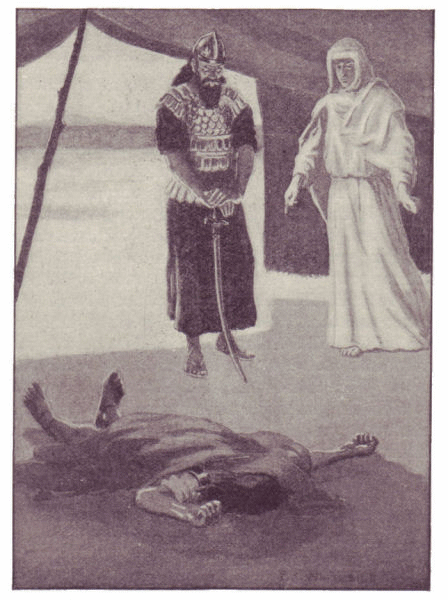 BARAK SEES THE MIGHTY SISERA |
That was a terrible deed which Jael did. We should call it treachery and murder; but such was the bitter hate between Israelite and Canaanite at that time that all the people gave great honor to Jael on account of it, for by that act she had set the people free from the king who had been oppressing Israel. After this the land had rest for many years.
Deborah, the judge, wrote a great song about this victory. Here are some verses from it:
|
"Because the elders took the lead in Israel, Because the people offered themselves willingly, Bless ye the Lord. Hear, O ye kings; give ear, O ye princes; I, even I will sing unto the Lord; I will sing praise to the Lord, the God of Israel. . . . . . . . . The kings came and fought. Then fought the kings of Canaan, In Taanach by the waters of Meggido. They took no gain of money. They fought from heaven, The stars in their courses fought against Sisera. The river Kishon swept them away, That ancient river, the river Kishon. O my soul, march on with strength; . . . . . . . . Blessed among women shall Jael be, The wife of Heber the Kenite, Blessed shall she be among women in the tent. He asked water, and she gave him milk, She brought him butter in a lordly dish. . . . . . . . . At her feet he bowed, he fell, he lay; At her feet he bowed, he fell. Where he bowed, there he fell down dead. Through the window a woman looked forth and cried, The mother of Sisera cried through the lattice, Why is his chariot so long in coming? Why tarry the wheels of his chariot? . . . . . . . . So let all thine enemies perish, O Lord; But let them that love him be as the sun, When he goeth forth in his might. |
Gideon and His Brave Three Hundred
Again The people of Israel did evil in the sight of the Lord in worshipping Baal; and the Lord left them again to suffer for their sins. This time it was the Midianites, living near the desert on the east of Israel, who came against the tribes in the middle of the country. The two tribes that suffered the hardest fate were Ephraim, and the part of Manasseh on the west of Jordan. For seven years the Midianites swept over their land every year, just at the time of harvest, and carried away all the crops of grain, until the Israelites had no food for themselves and none for their sheep and cattle. The Midianites brought also their own flocks, and camels without number, which ate all the grass of the field. These Midianites were the wild Arabs, living on the border of the desert, and from their land they made sudden and swift attacks upon the people of Israel.
The people of Israel were driven away from their villages and their farms; and were compelled to hide in the caves of the mountains. And if any Israelite could raise any grain, he buried it in pits covered with earth, or in empty wine-presses, where the Midianites could not find it.
One day a man named Gideon was threshing out wheat in a hidden place, when suddenly he saw an angel sitting under an oak-tree. The angel said to him, "You are a brave man, Gideon; and the Lord is with you. Go out boldly, and save your people from the power of the Midianites."
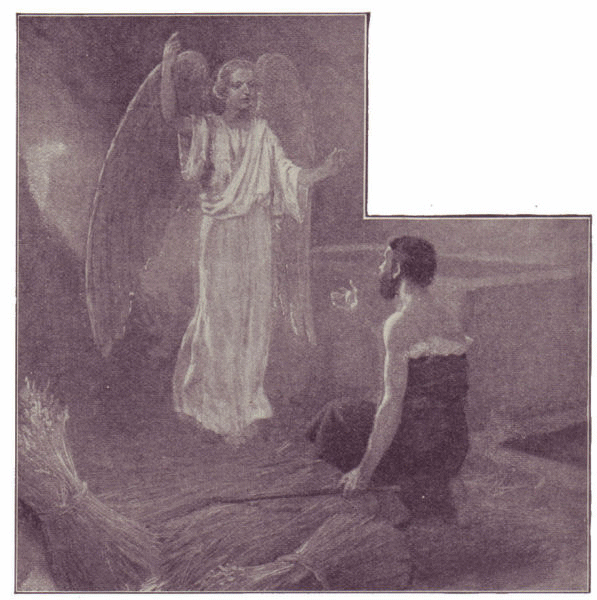 THE ANGEL SPEAKING TO GIDEON ON THE THRESHING FLOOR |
Gideon answered the angel, "O Lord, how can I save Israel? Mine is a poor family in Manasseh, and I am the least of my father's house."
And the Lord said to him, "Surely I will be with you, and I will help you drive out the Midianites."
Gideon felt that it was the Lord who was talking with him, in the form of an angel. He brought an offering, and laid it on a rock before the angel. Then the angel touched the offering with his staff. At once a fire leaped up and burned the offering; and then the angel vanished from his sight. Gideon was afraid when he saw this; but the Lord said to him, "Peace be unto you, Gideon; do not fear, for I am with you."
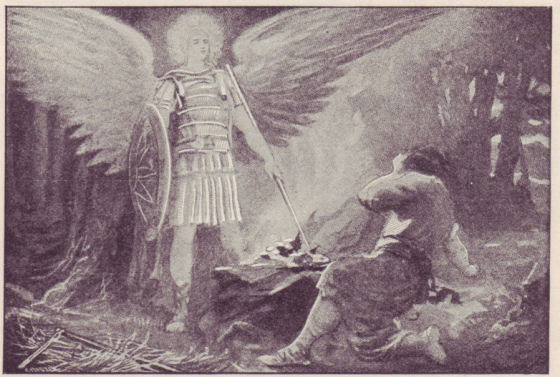 THE ANGEL TOUCHED GIDEON'S OFFERING |
On the spot where the Lord appeared to Gideon, under an oak-tree near the village of Ophrah, in the tribe-land of Manasseh, Gideon built an altar, and called it by a name which means "The Lord is peace." This altar was standing long afterward in that place.
Then the Lord told Gideon that before setting his people free from the Midianites, he must first set them free from the service of Baal and Asherah, the two idols most worshipped among them. Near the house of Gideon's own father stood an altar to Baal, and the image of Asherah.
On that night Gideon went out with ten men, and threw down the image of Baal, and cut in pieces the wooden image of Asherah, and destroyed the altar before these idols. And in place he built an altar to the God of Israel, and on it laid the broken pieces of the idols for wood, and with them offered a young ox as a burnt-offering.
On the next morning, when the people of the village went out to worship their idols, they found them cut in pieces, the altar taken away; in its place stood an altar of the Lord, and on it the pieces of the Asherah were burning as wood under a sacrifice to the Lord. The people looked at the broken and burning idols, and they said, "Who has done this?"
Some one said, "Gideon, the son of Joash, did this last night." Then they came to Joash, Gideon's father, and said, "We are going to kill your son because he has destroyed the image of Baal, who is our god."
And Joash, Gideon's father, said, "If Baal is a god, he can take care of himself; and he will punish the man who has destroyed his image. Why should you help Baal? Let Baal help himself."
And when they saw that Baal could not harm the man who had broken down his altar and his image, the people turned from Baal back to their own Lord God.
Gideon sent men through all his own tribe of Manasseh and the other tribes in that part of the land, to say, "Come and help us drive out the Midianites." The men came, and gathered around Gideon. Very few of them had swords and spears, for the Israelites were not a fighting people, and were not trained for war. They met beside a great spring on Mount Gilboa, called "the fountain of Harod." Mount Gilboa is one of the three mountains on the east of the plain of Esdraelon, or the plain of Jezreel, of which we read in the last story. On the plain, stretching up the side of another of these mountains, called "the Hill of Moreh," was the camp of a vast Midianite army. For as soon as the Midianites heard that Gideon had undertaken to set his people free, they came against him with a mighty host. Just as Deborah and her little army had looked down from Mount Tabor on the great army of the Canaanites (see Story Nine in this Part), so now, on Mount Gilboa, Gideon looked down on the host of the Midianites in their camp on the same plain.
Gideon was a man of faith. He wished to be sure that God was leading him; and he prayed to God, and said, "O Lord God, give me some sign that thou wilt save Israel through me. Here is a fleece of wool on this threshing-floor. If to-morrow morning the fleece is wet with dew, while the grass around it is dry, then I shall know that thou art with me, and that thou wilt give me victory over the Midianites."
Very early the next morning Gideon came to look at the fleece. He found it wringing wet with dew, while all around the grass was dry. But Gideon was not yet satisfied. He said to the Lord, "O Lord, be not angry with me; but give me just one more sign. To-morrow morning, let the fleece be dry, and let the dew fall all around it; and then I will doubt no more."
The next morning Gideon found the grass and the bushes and the trees wet with dew, while the fleece of wool was dry. And Gideon was now sure that God had called him, and that God would give him victory over the enemies of Israel.
The Lord said to Gideon, "Your army is too large. If Israel should win the victory, they would say, 'We won it by our own might.' Send home all those who are afraid to fight." For many of the people were frightened as they looked at the host of their enemies; and the Lord knew that these men in the battle would only hinder the rest.
So Gideon sent word through the camp, "Whoever is afraid of the enemy may go home," and twenty-two thousand people went away, leaving only ten thousand in Gideon's army. But the army was stronger though it was smaller, for the cowards had gone and only the brave men were left.
But the Lord said to Gideon, "The people are yet too many. You need only a few of the bravest and best men to fight in this battle. Bring the men down the mountain, beside the water, and I will show you there how to find the men whom you need."
In the morning Gideon by God's command called his ten thousand men out, and made them march down the hill, just as though they were going to attack the enemy. And when they were beside the water he noticed how they drank; and set them apart in two companies, according to their way of drinking. As they came to the water, most of the men threw aside their shields and spears, and knelt down and scooped up a draught of the water with both hands together like a cup. These men Gideon commanded to stand in one company.
There were a few men who did not stop to take a large draught of water. Holding spear and shield in the right hand, to be ready for the enemy if one should suddenly appear, they merely caught up a handful of the water in passing and marched on, lapping up the water from one hand.
God said to Gideon, "Set by themselves these men who lapped up each a handful of water. These are the men whom I have chosen to set Israel free."
Gideon counted these men, and found that there were only three hundred of them; while all the rest bowed down on their faces to drink. The difference between them was that these three hundred were earnest men, of one purpose; not turning aside from their aim even to drink, as the others did. Then, too, they were watchful men, always ready to meet their enemies. Suppose that the Midianites had rushed out on that army while nearly all of them were on their faces drinking, their arms thrown to one side,-how helpless they would have been! But no enemy could have surprised the three hundred, who held their spears and shields ready, even while they were taking a drink.
Some have thought that this test showed also who were worshippers of idols, and who worshipped God; for men fell on their faces when they prayed to the idols, but men stood up while they worshipped the Lord. Perhaps this act showed that most of the army were used to worship kneeling down before idols, and that only a few used to stand up before the Lord in their worship; but of this we are not certain. It did show that here were three hundred brave, watchful men, obedient to orders, and ready for the battle.
Then Gideon, at God's command, sent back to the camp on Mount Gilboa all the rest of his army, nearly ten thousand men; keeping with himself only his little band of three hundred. But before the battle God gave to Gideon one more sign, that he might be the more encouraged.
God said to Gideon, "Go down with your servant into the camp of the Midianites, and hear what they say. It will cheer your heart for the fight."
Then Gideon crept down the mountain with his servant, and walked around the edge of the Midianite camp, just as though he were one of their own men. He saw two men talking, and stood near to listen. One man said to the other:
"I had a strange dream in the night. I dreamed that I saw a loaf of barley bread come rolling down the mountain; and it struck the tent, and threw it down in a heap on the ground. What do you suppose that dream means?"
"That loaf of bread," said the other, "means Gideon, a man of Israel, who will come down and destroy this army; for the Lord God has given us all into his hand."
Gideon was glad when he heard this, for it showed that the Midianites, for all their number, were in fear of him and of his army, even more than his men had feared the Midianites. He gave thanks to God, and hastened back to his camp, and made ready to lead his men against the Midianites.
Gideon's plan did not need a large army; but it needed a few careful, bold men, who should do exactly as their leader commanded them. He gave to each man a lamp, a pitcher, and a trumpet, and told the men just what was to be done with them. The lamp was lighted, but was placed inside the pitcher, so that it could not be seen. He divided his men into three companies; and very quietly led them down the mountain, in the middle of the night; and arranged them all in order around the camp of the Midianites.
Then at one moment a great shout rang out in the darkness, "The sword of the Lord and of Gideon," and after it came a crash of breaking pitchers, and then a flash of light in every direction. The three hundred men had given the shout, and broken their pitchers, so that on every side lights were shining. Then men blew their trumpets with a mighty noise; and the Midianites were roused from sleep, to see enemies all round them, lights beaming and swords flashing in the darkness, while everywhere the sharp sound of the trumpets was heard.
They were filled with sudden terror and thought only of escape, not of fighting. But wherever they turned, their enemies seemed to be standing with swords drawn. They trampled each other down to death, flying from the Israelites. Their own land was in the east, across the river Jordan, and they fled in that direction, down one of the valleys between the mountains.
Gideon had thought that the Midianites would turn toward their own land, if they should be beaten in the battle; and he had already planned to cut off their flight. The ten thousand men in the camp he had placed on the sides of the valley leading to the Jordan. There they slew very many of the Midianites as they fled down the steep pass toward the river. And Gideon had also sent to the men of the tribe of Ephraim, who had thus far taken no part in the war, to hold the only place at the river where men could wade through the water. Those of the Midianites who had escaped from Gideon's men on either side of the valley were now met by the Ephraimites at the river, and many more of them were slain. Among the slain were two of the princes of the Midianites, named Oreb and Zeeb.
A part of the Midianite army was able to get across the river, and to continue its flight toward the desert; but Gideon and his brave three hundred men followed closely after them; fought another battle with them, destroyed them utterly, and took their two kings, Zebah and Zalmunna, whom he killed. After this great victory the Israelites were freed forever from the Midianites. They never again ventured to leave their home in the desert to make war on the tribes of Israel.
The tribe of Ephraim, in the middle of the land, was one of the most powerful of the twelve tribes. Its leaders were quite displeased with Gideon, because their part in the victory had been so small. They said to Gideon, in an angry manner, "Why did you not send word to us, when you were calling for men to fight the Midianites?"
But Gideon knew how to make a kind answer. He said to them, "What have I done as compared with you? Did you not kill thousands of the Midianites at the crossing of the Jordan? Did you not take their two princes, Oreb and Zeeb? What could my men have done without the help of your men?" By gentle words and words of praise Gideon made the men of Ephraim friendly.
And after this, as long as Gideon lived, he ruled as judge in Israel. The people wished him to make himself a king. "Rule over us as king," they said, "and let your son be king after you, and his son king after him." But Gideon said, "No; you have a king already; for the Lord God is the King of Israel. No one but God shall be king over these tribes."
Of all the fifteen men who ruled as judges in Israel, Gideon, the fifth judge, was the greatest, in courage, in wisdom, and in faith in God.
If all the people of Israel had been like him, there would have been no worship of idols, and no weakness before the enemies, Israel would have been strong and faithful before God. But as soon as Gideon died, and even before his death, his people began once more to turn away from the Lord and to seek the idol-gods that could give them no help.
Jephthah's Rash Promise, and What Came from It
Although Gideon has refused to become a king, even when all the tribes desired after him, after his death, one of his sons, whose name was Abimelech, tried to make himself a king. He began by killing all his brothers, except one who escaped. But his rule was only over Shechem and a few places near it, and lasted only a few years; so that he was never named among the kings of Israel. Abimelech is sometimes called the sixth of the judges, though he did not deserve the title. After him came Tola, the seventh judge, and Jair, the eighth. Of these two judges very little is told.
After this the Israelites again began to worship the idols of the Canaanites, and again fell under the power of their enemies. The Ammonites came against them from the southeast and held rule over the tribes on the east of Jordan. This was the sixth of "the oppressions;" and the man who set Israel free was Jephthah. He called together the men of the tribes on the east of Jordan—Reuben, Gad, and the half-tribe of Manasseh—and fought against the Ammonites.
Before Jephthah went to battle he said to the Lord: "If thou wilt give me victory over the Ammonites, then when I come back from the battle, whatever comes out of the house to meet me shall be the Lord's, and I will offer it up as a burnt-offering.:
This was not a wise promise, nor a right one; for God had told the Israelites long before what offerings were commanded, as oxen and sheep, and what were forbidden. But Jephthah had lived on the border near the desert, far from the house of God at Shiloh, and he knew very little about God's law.
Jephthah fought the Ammonites and won a victory, and drove the enemies out of the land. Then, as he was going back to his home, his daughter, who was his only child, came out to meet him, leading the young girls, her companions, dancing and making music, to welcome his return. When Jephthah saw her he cried out in sorrow, "Oh, my daughter, what trouble you bring with you! I have given a promise to the Lord, and now I must keep it!"
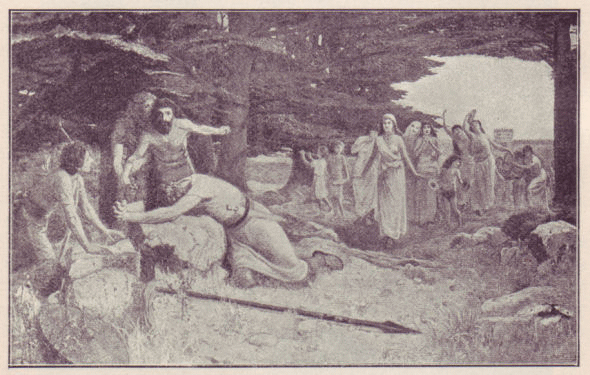 JEPHTHAH MOURNING FOR HIS DAUGHTER |
As soon as his daughter had learned what promise her father had made she met it bravely, as a true daughter of Israel. She said:
"My father, you have made a solemn promise to the Lord, and you shall keep it, for God has given to you victory over the enemies of your people. But let me live a little while and weep with my young friends over the death that I must suffer."
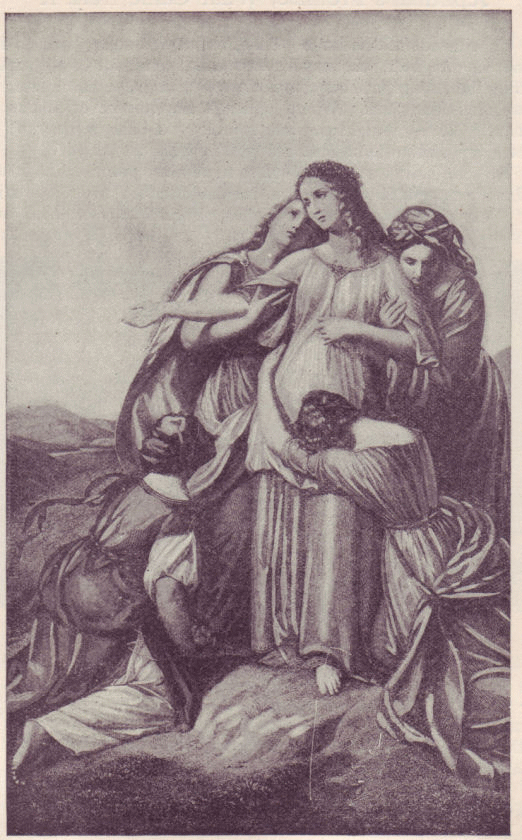 JEPHTHAH'S DAUGHTER AND HER YOUNG FRIENDS |
For two months she stayed with the young girls upon the mountains, for perhaps she feared that if she was at home with her father he would fail to keep his promise. Then she gave herself up to death, and her father did with her as he had promised.
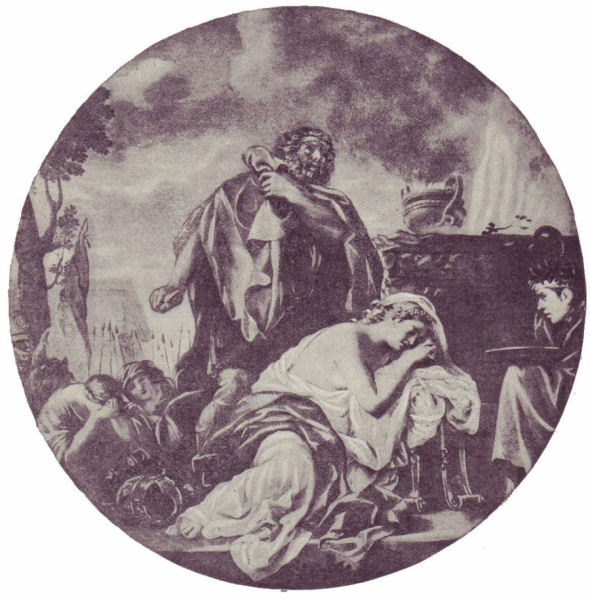 JEPHTHAH OFFERS UP HIS DAUGHTER |
In all the history of the Israelites this was the only time when a living man or woman was offered in sacrifice to the Lord. Among all the nations around Israel the people offered human lives, even those of their own children, to the idols which they worshipped.
But the people of Israel remembered what God had taught Abraham when he was about to offer up Isaac; and they never, except this once, laid a human offering upon God's altar. (See Story Ten, Part First.) If Jephthah had lived near the Tabernacle at Shiloh, and had been taught God's law, he would not have given such a promise, for God did not desire it, and his daughter's life would have been saved. From all these stories it is easy to see how the Israelites lived during the three hundred years while the judges ruled. There was no strong power to which all gave obedience; but each family lived as it chose. Many people worshipped the Lord; but many more turned from the Lord to the idols, and then turned back to the Lord, after they had fallen under the hand of their enemies. In one part of the land they were free; in another part they were ruled by the foreign peoples.
The Strong Man: How He Lived and How He Died
After Jephthah three judges ruled in turn, named Ibzan, Elon, and Abdon. None of these were men of ear, and in their days the land was quiet.
But the people of Israel again began to worship idols; and as a punishment God allowed them once more to pass under the power of their enemies. The seventh oppression, which now fell upon Israel, was by far the hardest, the longest, and the most widely spread of any, for it was over all the tribes. It came from the Philistines, a strong and warlike people, who lived on the west of Israel upon the plain beside the Great Sea. They worshipped an idol called Dagon, which was made in the form of a fish's head on a man's body.
Three people, the Philistines, send their armies up from the plain beside the sea to the mountains of Israel, and overran all the land.
They took away from the Israelites all their swords and spears, so that they could not fight; and they robbed their land of all the crops, so that the people suffered for want of food. And as before, the Israelites in their trouble cried to the Lord, and the Lord heard their prayer.
In the tribe land of Dan, which was next to the country of the Philistines, there was living a man named Manoah. One day an angel came to his wife, and said, "You shall have a son; and when he grows up he will begin to save Israel from the hand of the Philistines. But your son must never drink any wine or strong drink as long as he lives. And his hair must be allowed to grow long, and must never be cut, for he shall be a Nazarite under a vow to the Lord."
When a child was given especially to God, or when a man gave himself to some work for God, he was forbidden to drink wine, and as a sign, his hair was left to grow long while the vow or promise to God was upon him. Such a person as this was called a Nazarite, a work which means "one who has a vow," and Manoah's child was to be a Nazarite, and under a vow, as long as he lived.
The child was born, and was named Samson. He grew up to become the strongest man of whom the Bible tells. Samson was no general, like Gideon or Jephthah, to call out his people and lead them in war. He did much to set his people free; but all that he did was by his own strength, without any help from other men.
When Samson became a young man he went down to Timnath, in the land of the Philistines. There he saw a young Philistine woman whom he loved, and wished to have as his wife. His father and mother were not pleased that he should marry among the enemies of his own people. They did not know that God would make this marriage the means of bringing harm upon the Philistines, and of helping the Israelites.
As Samson was going down to Timnath, to see this young woman, a hungry young lion came out of the mountain, growling and roaring. Samson seized the lion, and tore him in pieces as easily as another man would have killed a little kid of the goats; and then went on his way. He made his visit, and came home, but said nothing to any one about the lion.
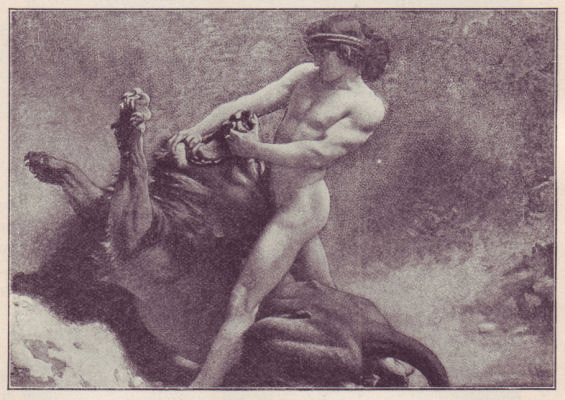 YOUNG SAMSON SLAYS THE LION |
After a time Samson went again to Timnath, for his marriage with the Philistine woman. On his way he stopped to look at the dead lion; and in its body he found a swarm of bees, and honey which they had made. He took some of the honey, and ate it as he walked; but told no one of it.
At the wedding-feast, which lasted a whole week, there were many Philistine young men; and they amused each other with questions and riddles.
"I will give you a riddle," said Samson. "If you answer it during the feast, I will give you thirty suits of clothing. And if you cannot answer it, then you must give me thirty suits of clothing."
"Let us hear your riddle," they said. And this was Samson's riddle for the young men of the Philistines to answer:
|
"Out of the eater came forth meat. And out of the strong came forth sweetness." |
They could not find the answer, though they tried to find it, all that day, and the two days that followed. And at last they came to Samson's wife, and said to her, "Coax your husband to tell you the answer. If you do not find it out, we will set your house on fire, and burn you and all your people."
And Samson's wife urged him to tell her the answer. She cried and pleaded with him, and said, "If you really love me, you would not keep this a secret from me."
At last Samson yielded, and told his wife how he had killed the lion and afterward found the honey in its body. She told her people, and just before the end of the feast they came to Samson with the answer. They said, "What is sweeter than honey? And what is stronger than a lion?"
And Samson said to them, "If you had not plowed with my heifer, you had not found out my riddle."
By his "heifer"—which is a young cow—of course Samson meant his wife. Then Samson was required to give them thirty suits of clothing. He went out among the Philistines, killed the first thirty men whom he found, took off their clothes, and gave them to the guests at the feast. But all this made Samson very angry. He left his new wife and went home to his father's house. Then the parents of his wife gave her to another man.
But after a time Samson's anger passed away, and he went again to Timnath to see his wife. But her father said to him, "You went away angry, and I supposed that you cared nothing for her. I gave her to another man, and now she is his wife. But here is her younger sister; you can take her for your wife instead."
But Samson would not take his wife's sister. He went out very angry, determined to do harm to the Philistines, because they had cheated him. He caught all the wild foxes that he could find, until he had three hundred of them. Then he tied them together in pairs, by their tails; and between each pair of foxes he tied to their tails a piece of dry wood which he set on fire. These foxes with firebrands on their tails he turned loose among the fields of the Philistines when the grain was ripe. They ran wildly over the fields, set the grain on fire, and burned it; and with the grain the olive-trees in the fields.
When the Philistines saw their harvests destroyed, they said, "Who has done this?"
And people said, "Samson did this, because his wife was given by her father to another man."
The Philistines looked on Samson's father-in-law as the cause of their loss; and they came, and set his house on fire, and burned the man and his daughter whom Samson had married. Then Samson came down again, and alone fought a company of Philistines, and killed them all, as a punishment for burning his wife.
After this Samson went to live in a hollow place in a split rock, called the rock of Etam. The Philistines came up in a great army, and overran the fields in the tribe-land of Judah.
"Why do you come against us?" asked the men of Judah. "What do you want from us?" "We have come," they said, "to bind Samson, and to deal with him as he has dealt with our people."
The man of Judah said to Samson, "Do you not know that the Philistines are ruling over us? Why do you make them angry by killing their people? You see that we suffer through your pranks.
Now we must bind you, and give you to the Philistines; or they will ruin us all."
And Samson said, "I will let you bind me, if you will promise not to kill me yourselves; but only to give me safely into the hands of the Philistines."
They made the promise; and Samson gave himself up to them, and allowed them to tie him up fast with new ropes. The Philistines shouted for joy as they saw their enemy brought to them, led in bonds by his own people. Little did they know what was to happen. For as soon as Samson came among them he burst the bonds as though they had been light strings; and picked up from the ground the jawbone of an ass, and struck right and left with it as with a sword. He killed almost a thousand of the Philistines with this strange weapon. Afterward he sang a song about it, thus:
|
"With the jawbone of an ass, heaps upon heaps, With the jawbone of an ass, have I slain a thousand men." |
After this Samson went down to the chief city of the Philistines, which was named Gaza. It was a large city; and like all large cities was surrounded with a high wall. When the men of Gaza found Samson in their city, they shut the gates, thinking that they could now hold him as a prisoner. But in the night, Samson rose up, went to the gates, pulled their posts out of the ground, and put the gates with their posts upon his shoulder. He carried them twenty miles away, and left them on the top of a hill not far from the city of Hebron.
After this Samson saw another woman among the Philistines, and he loved her. The name of this woman was Delilah. The rulers of the Philistines came to Delilah, and said to her:
"Find out, if you can, what it is that makes Samson so strong; and tell us. If you help us to get control of him, so that we can have him in our power, we will give you a great sum of money."
And Delilah coaxed and pleaded with Samson to tell her what it was that made him so strong. Samson said to her, "If they will tie me with seven green twigs from a tree, then I shall not be strong any more."
They brought her seven green twigs, like those of a willow-tree; and she bound Samson with them while he was asleep. Then she called out to him, "Wake up, Samson, the Philistines are coming against you!"
And Samson rose up, and broke the twigs as easily as if they had been charred in the fire, and went away with ease.
And Delilah tried again to find his secret. She said, "You are only making fun of me. Now tell me truly how you can be bound."
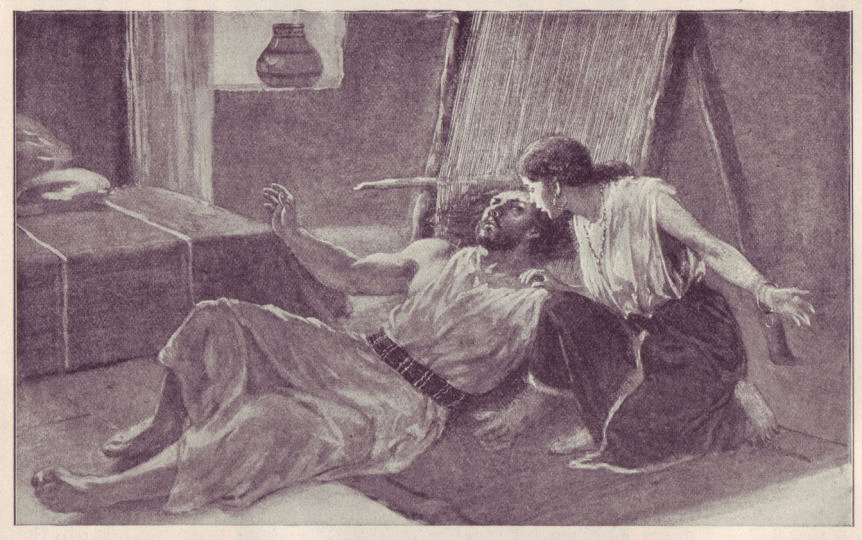 DELILAH TRIES TO LEARN FROM SAMSON THE SECRET OF HIS STRENGTH |
And Samson said, "Let them bind me with new ropes, that have never been used before; and then I cannot get away."
While Samson was asleep again, Delilah bound him with new ropes. Then she called out as before, "Get up, Samson, for the Philistines are coming!" And when Samson rose up, the ropes broke as if they were thread. And Delilah again urged him to tell her; and he said:
"You notice that my long hair is in seven locks. Weave it together in the loom, just as if it were the threads in a piece of cloth."
Then, while he was asleep, she wove his hair in the loom, and fastened it with a large pin to the weaving frame. But when he awoke, he rose up, and carried away the pin and the beam of the weaving-frame, for he was as strong as before.
And Delilah said, "Why do you tell me that you love me, as long as you deceive me, and keep from me your secret!" And she pleaded with him day after day, until at last he yielded to her, and told her the real secret of his strength. He said:
"I am a Nazarite, under a vow to the Lord not to drink wine, and not to allow my hair to be cut. If I should let me hair be cut short, then the Lord would forsake me, and my strength would go from me, and I would be like other men."
Then Delilah knew that she had found the truth at last. She sent for the rulers of the Philistines, saying, "Come up this once, and you shall have your enemy; for I am sure now that he has told me all that is in his heart."
Then, while the Philistine were watching outside, Delilah let Samson go to sleep, with his head upon her knees. While he was sound asleep, they took a razor and shaved off all his hair. Then she called out as at other times, "Rise up, Samson; the Philistines are upon you."
He awoke, and rose up, expecting to find himself strong as before; for he did not at first know that his long hair had been cut off. But he had broken his vow to the Lord, and the Lord had left him. He was now as weak as other men, and helpless in the hands of his enemies. The Philistines easily made him their prisoner; and that he might never do them more harm, they put out his eyes. Then they chained him with fetters, and sent him to prison at Gaza. And in the prison they made Samson turn a heavy millstone to grind grain, just as though he were a beast of burden.
But while Samson was in prison his hair grew long again; and with his hair his strength came back to him, for Samson renewed his vow to the Lord.
One day a great feast was held by the Philistines in the temple of their fish-god Dagon. For they said, "Our god has given Samson our enemy into our hands. Let us be glad together and praise Dagon."
And the temple was thronged with people, and the roof over it was also crowded with more than three thousand men and women. They sent for Samson, to rejoice over him; and Samson was led into the court of the temple, before all the people, to amuse them. After a time, Samson said to the boy who was leading him:
"Take me up to the front of the temple, so that I may stand by one of the pillars, and lean against it."
And while Samson stood between two of the pillars, he prayed to the Lord God of Israel, and said, "O Lord God, remember me, I pray thee, and give me strength only this once, O God; and help me, that I may obtain vengeance upon the Philistines for my two eyes!"
then he place one arm around the pillar on one side, and the other arm around the pillar on the other side; and he said, "Let me die with the Philistines."
And he bowed forward with all his might, and pulled the pillars over with him, bringing down the roof and all upon it upon those that were under it. Samson himself was among the dead; but in his death he killed more of the Philistines than he had killed during his life.
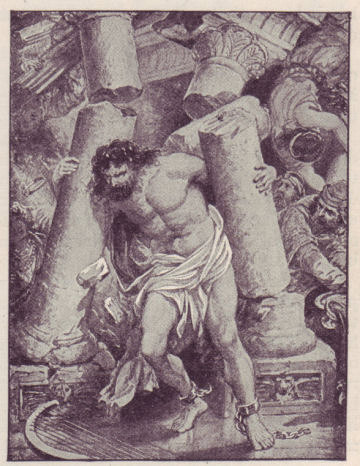 SAMSON PULLING DOWN THE TEMPLE |
Then in the terror which came upon the Philistines the men of Samson's tribe came down and found his dead body, and buried it in their own land. After that it was years before the Philistines tried again to rule over the Israelites.
Samson did much to set his people free, but he might have done much more, if he had led his people, instead of trusting alone to his own strength; and if he had lived more earnestly, and not done his deeds as though he was playing pranks and making jokes upon his enemies. There were deep faults in Samson, but at the end he sought God's help and found it; and God used Samson to begin to set his people free.
The tribe to which Samson belonged was the tribe of Dan, a people who lived on the edge of the mountain country, between the mountains and the plains by the sea-coast, which was the home of the Philistines. The tribe-land of Dan was northwest of Judah, southwest of Ephraim, and west of Benjamin. Samson ruled over his own tribe, but not much over the other tribes. Yet his deeds of courage and strength kept the Philistines, during his lifetime, from getting control over the lands of Judah and Benjamin; so that Samson helped to save Israel from its enemies.
The Idol Temple at Dan, and Its Priest
While the judges were ruling in Israel, at one time there was living in the mountains of Ephraim, near the road which ran north and south, a man named Micah. His mother, who was dwelling with him, found that some one had stolen from her a large sum of money. Now, the money had been taken by her son Micah, and after a time he said to her:
"Those eleven hundred pieces of silver which you lost, and of which you spoke, are with me; for I took them myself."
And his mother answered, "May the blessing of God rest upon you, my son, for bringing again to me my silver. This money shall be the Lord's. I will give it back to you, to be used in the service of the Lord."
But instead of taking the money to the Tabernacle of the Lord at Shiloh, Micah used it to make two images of silver, one carved and the other cast in metal. These he set up in his house to be worshipped. He appointed one of his sons as a priest, and thus made of his house an idol temple.
One day a man on a journey was passing by Micah's house. Micah saw from his dress that he belonged to the tribe of Levi, from which the priests came. He said to him, "Who are you? From what place do you come?"
The young man said, "I am a Levite, from Bethlehem in the land of Judah, and I am trying to find a place where I can earn my living."
"Stay here with me," said Micah, "and be a priest in my house. I will give you your food, and a place to sleep, and for each year a suit of clothes and ten pieces of silver."
The Levite was well pleased at this, and stayed in Micah's house, and became his priest. And Micah said to himself:
"I am sure that now the Lord will be pleased with me, since I have a house with gods and a Levite as my priest."
Already many in Israel had forgotten that God would not bless those who set up idols when they should worship the Lord God.
The tribe of Dan was living at that time between the country of the Philistines and the tribe of Benjamin, having Judah on the south and Ephraim on the north. The Philistines pressed closely upon them, and they sought some place where they could live with more room and at peace.
They sent out from their tribe-land five men as spies, to go through the country and find some better place for the home of their tribe. These five men walked through the land, and they came to the house of Micah. Micah took them into his house, for it was the custom thus to care for people who were on a journey.
These men from Dan, who were called Danites, had seen Micah's priest before in his earlier home. They knew him, and asked him how he came to be there. The young Levite told them that Micah had hired him to become his priest. He took them into the temple-room and showed them the images and the altar, and he offered a sacrifice and a prayer for them.
Then the five men left Micah's house and went on their way. They walked through all the tribes in the north; and far up among the mountains, near one of the great fountains where the river Jordan begins, they found a little city called Laish. The people of Laish were not Isrealites, but came from the country of Zidon. The Danites saw that their little city was far from Zidon, and that its people were living alone, with none of their own race to help them.
The men of Dan walked back over the mountains to their own people, near the Philistine country; and they brought back an account of their journey through the land. They said:
"We have found a good place, far up in the north, where there is room for us, and a rich soil, and plenty of water. Come with us, and let us that that place for our home."
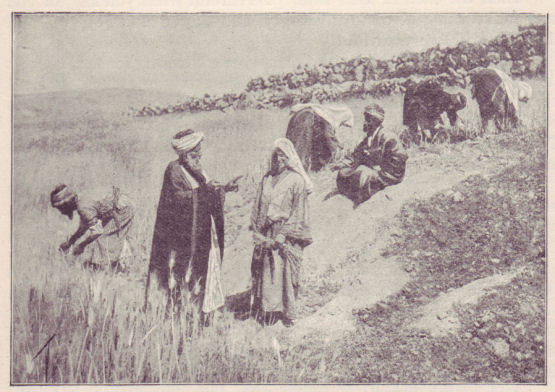 A HARVEST FIELD IN THE TIME OF THE JUDGES |
So a large part of the tribe of Dan, with their wives and their children, went up toward this place. Among them were six hundred men with shields, and swords, and spears for war. As they came near to Micah's house, one of the five men who had been there before said to them:
"Do you know that in one of these houses there is an altar, and a carved image, and another image, both of silver? Now think what you would better do."
Then the five men came again into Micah's temple while the six hundred soldiers stood outside. They were just about to carry away the silver images when the Levite said to them, "What are you doing?"
And the men said to him, "Never mind what we are doing. Keep still and come with us. Is it not better for you to be a priest to a whole tribe than to one man?"
Then the young priest said no more. He took away all the priestly robes, and the silver ornaments, and the images, and went away with the people of Dan. When Micah came home he found that his temple had been robbed and his images and his priest were taken away.
He gathered some of his neighbors, and they hastened after the people of Dan. When they caught up with them Micah cried out aloud to them. The men of Dan turned, and said to Micah:
"What is the matter with you, that you come after us with a company and make such a noise?"
And Micah answered, "You have taken away my gods which I made, and my priest; and now what is left to me? And you say to me, 'What is the matter?'"
Then the men of Dan said, "Be careful what you say, or you may make some of our men angry, and they will fall on you, and then you will lose your life!"
Micah saw that the men of Dan were too strong for him to fight them, so he went back to his house without his priest and without his images. The Danites went up to the little city of Laish, in the north. They took it, and killed all the people who were living there. Then they built the city again, and changed its name to Dan, the name of the father of their tribe.
There, at Dan, they built a temple, and in it they set up the images, and this Levite became their priest. And the strangest part of all the story is, that this Levite was a grandson of Moses, the man of God and the great prophet. So soon did the people of Israel fall into sin, and so deeply, that the grandson of Moses became the priest in a temple of idols. And at this time the house of God was at Shiloh; yet at Dan during those years and for many years afterward was a temple of idols, and within its walls a line of priests descended from Moses were worshipping and offering sacrifices to images.
And as the temple of idols in Dan was much nearer to the people in the northern part of the land than was the house of the Lord, the Tabernacle at Shiloh, very many of those who lived in the north, went to this idol-temple to worship. So the people of Israel were led away from God to serve idols. This was very displeasing to God.
How Ruth Gleaned in the Field of Boaz
In the time of the judges in Israel, a man named Elimelech was living in the town of Bethlehem, in the tribe of Judah, about six miles south of Jerusalem. His wife's name was Naomi, and his two sons were Mahlon and Chilion. For some years the crops were poor, and food was scarce in Judah; and Elimelech, with his family, went to live in the land of Moab, which was on the east of the Dead Sea, as Judah was on the west.
There they stayed ten years, and in that time Elimelech died. His two sons married women of the country of Moab, one woman named Orpah, the other named Ruth. But the two young men also died in the land of Moab, so that Naomi and her two daughters-in-law loved her and both would have gone with her, though the land of Judah was a strange land to them, for they were of the Moabite people.
Naomi said to them, "Go back, my daughters, to your own mothers' homes. May the Lord deal kindly with you, as you have been kind to your husbands and to me. May the Lord grant that each of you may yet find another husband and a happy home." Then Naomi kissed them in farewell, and the three women all wept together. The two young widows said to her, "You have been a good mother to us, and we will go with you, and live among your people."
"No, no," said Naomi. "You are young, and I am old. Go back and be happy among your own people."
Then Orpah kissed Naomi and went back to her people; but Ruth would not leave her. She said, "Do not ask me to leave you, for I never will. Where you go, I will go; where you live, I will live; your people shall be my people; and your God shall be my God. Where you die, I will die, and be buried. Nothing but death itself shall part you and me."
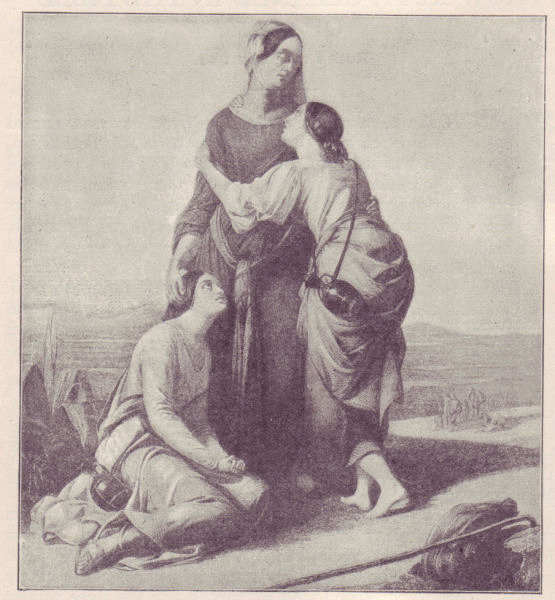 ORPAH LEAVES NAOMI |
When Naomi saw that Ruth was firm in her purpose, she ceased trying to persuade her; so the two women went on together. They walked around the Dead Sea, and crossed the river Jordan, and climbed the mountains of Judah, and came to Bethlehem.
Naomi had been absent from Bethlehem for ten years, but her friends were all glad to see her again. They said, "Is this Naomi, whom we knew years ago?" Now the name Naomi means "pleasant." And Naomi said:
"Call me not Naomi; call me Mara, for the Lord has made my life bitter. I went out full, with my husband and two sons; now I come home empty, without them. Do not call me 'Pleasant'; call me 'Bitter.'" The name "Mara," by which Naomi wished to be called, means "bitter." But Naomi learned later that "Pleasant" was the right name for her after all.
There was living in Bethlehem at that time a very rich man named Boaz. He owned large fields that were abundant in their harvests; and he was related to the family of Elimelech, Naomi's husband, who had died.
It was the custom in Israel when they reaped the grain not to gather all the stalks, but to leave some for the poor people, who followed after the reapers with their sickles, and gathered what was left. When Naomi and Ruth came to Bethlehem it was the time of the barley harvest; and Ruth went out into the fields to glean the grain which the reapers had left. It so happened that she was gleaning in the field that belonged to Boaz, this rich man.
Boaz came out from the town to see his men reaping, and he said to them, "The Lord be with you;" and they answered him, "The Lord bless you." And Boaz said to his master of the reapers, "Who is this young woman that I see gleaning in the field?"
The man answered, "It is the young woman from the land of Moab, who came with Naomi. She asked to leave to glean after the reapers, and has been here gathering grain since yesterday."
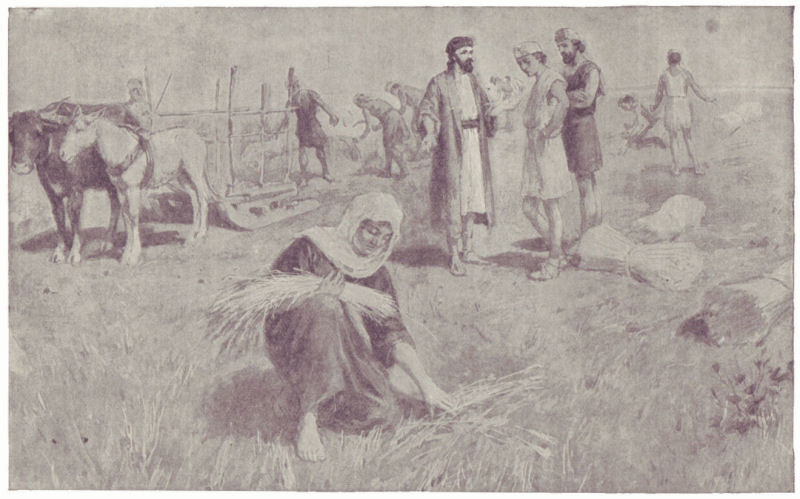 RUTH GLEANING IN THE FIELD OF BOAZ |
Then Boaz said to Ruth, "Listen to me, my daughter. Do not go to any other field, but stay here with my young women. No one shall harm you; and when you are thirsty, go and drink at our vessels of water."
Then Ruth bowed to Boaz, and thanked him for his kindness, all the more kind because she was a stranger in Israel. Boaz said:
"I have heard how true you have been to your mother-in-law, Naomi, in leaving your own land and coming with her to this land. May the Lord, under whose wings you have come, give you a reward!" And at noon, when they sat down to rest and to eat, Boaz gave her some of the food. And he said to the reapers:
"When you are reaping, leave some of the sheaves for her; and drop out some sheaves from the bundles, where she may gather them."
That evening Ruth showed Naomi how much she had gleaned, and told her of the rich man Boaz, who had been so kind to her. And Naomi said, "This man is a near relation of ours. Stay in his fields as long as the harvest lasts." And so Ruth gleaned in the fields of Boaz until the harvest had been gathered.
At the end of the harvest Boaz held a feast on the threshing-floor. And after the feast, by the advice of Naomi, Ruth went to him, and said to him, "You are a near relation of my husband and of his father, Elimelech. Now will you not do good to us for his sake?"
And when Boaz saw Ruth he loved her; and soon after this he took her as his wife. And Naomi and Ruth went to live in his home; so that Naomi's life was no more bitter, but pleasant. And Boaz and Ruth had a son, whom they named Obed; and later Obed had a son named Jesse; and Jesse was the father of David, the shepherd boy who became king. So Ruth, the young woman of Moab, who chose the people and the God of Israel, became the mother of kings.
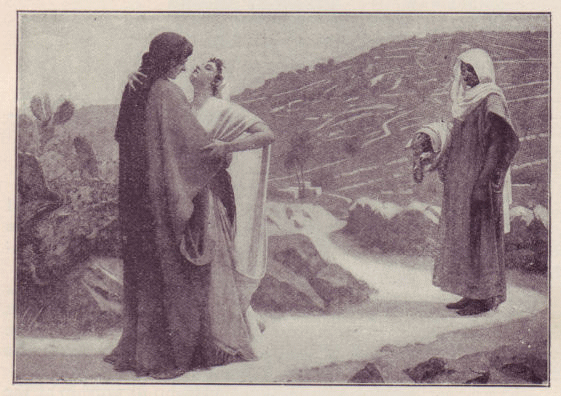 RUTH WILL NOT LEAVE NAOMI |
The Little Boy with a Linen Coat
Samson the strong man (see Story Twelve) ruled Israel as the thirteenth of the judges; and after him came Eli as the fourteenth judge. Eli was also the high-priest of the Lord in the Tabernacle at Shiloh.
While Eli was the priest and the judge, a man was living at Ramah in the mountains of Ephraim, whose name was Elkanah. He had two wives, as did many men in that time. One of these wives had children, but the other wife, whose name was Hannah, had no child.
Every year Elkanah and his family went up to worship at the house of the Lord in Shiloh, which was about fifteen miles from his home. And at one of these visits Hannah prayed to the Lord, saying:
"O Lord, if thou wilt look upon me, and give me a son, he shall be given to the Lord as long as he lives."
The Lord heard Hannah's prayer, and gave her a little boy; and she called his name Samuel, which means "Asked of God," because he had been given in answer to her prayer. While he was still a little child she brought him to Eli, the priest, and said to him:
"My Lord, I am the woman who stood here praying. I asked God for this child; and now I have promised that he shall be the Lord's as long as he lives. Let him stay here with you and grow up in God's house."
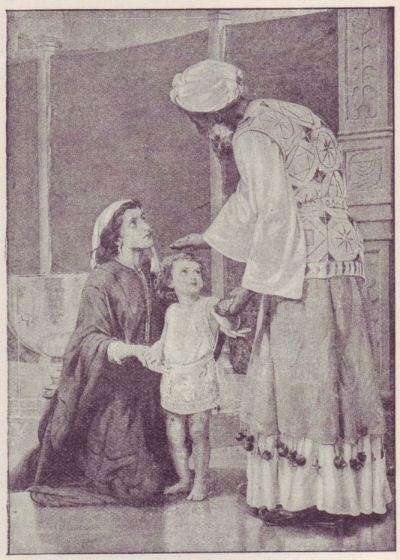 HANNAH BRINGS HER BOY TO ELI |
So the child Samuel stayed at Shiloh and lived with Eli the priest in one of the tents beside the Tabernacle. As he grew up he helped Eli in the work of the Lord's house. He lit the lamos, and opened the doors, and prepared the incense, and waited on Eli, who was now growing old and was almost blind.
Samuel was all the more a help and a comfort to Eli because his own sons, who were priests, were very wicked young men. Eli had not trained them to do right, nor punished them when they did wrong, when they were children; so they grew up to become evil, to disobey God's law, and to be careless in God's worship. Eli's heart was very sad over the sins of his sons; but now that he was old He could do nothing to control them.
It had been a long time since God had spoken to men, as in other days God had spoken to Moses, to Joshua, and to Gideon. The men of Israel were longing for the time to come when God would speak again to his people as of old.
One night Samuel, while yet a child, was lying down upon his bed in a tent beside the Tabernacle; he heard a voice calling him by name. It was the Lord's voice, but Samuel did not know it.
He answered, "Here I am!" and then he ran to Eli, saying, "Here I am. You called me; what do you wish me to do?"
And Eli said, "My child, I did not call you. Go and lie down again."
Samuel lay down, but soon again hear the voice calling to him, "Samuel! Samuel!"
Again he rose up and went to Eli, and said, "Here I am; for I am sure that you called me."
"No," said Eli, "I did not call you. Lie down again."
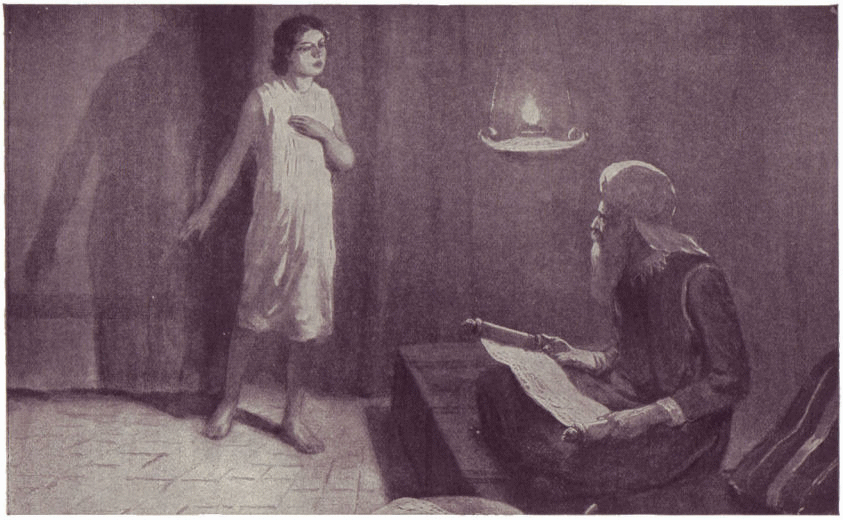 THE BOY WHO LIVED IN THE TEMPLE |
A third time the voice was heard; and a third time the boy rose up from his bed and went to Eli, sure that Eli had called him. Eli now saw that this was the Lord's voice that had spoken to Samuel. He said:
"Go, lie down once more; and if the voice speaks to you again, say 'Speak, Lord, for thy servant heareth.' "
Samuel went and lay down, and waited for the voice. It spoke as if some one unseen were standing by his bed, and saying, "Samuel! Samuel!"
Then Samuel said to the Lord, "Speak, Lord, for thy servant heareth."
And the Lord said to Samuel:
"Listen to what I say. I have seen the wickedness of Eli's sons. And I have seen that their father did not punish them when they were doing evil. I am going to give to them such a punishment that the story shall make every one's ears tingle who hears it."
Samuel lay in his room until the morning. Then he arose and went about his work as usual, preparing for the daily worship and opening the doors. He said nothing of God's voice until Eli asked him. Eli said to him:
"Samuel, my son, tell me what the Lord said to you last night. Hide nothing from me."
And Samuel told Eli all that God had said, though it was a sad message to Eli. And Eli said, "It is the Lord; let him do what seems good to him."
And then the news went through all the land that God had spoken once more to his people. And Hannah, the lonely mother in the mountains of Ephraim, heard that her son was the prophet to whom God spoke at his messenger to all Israel.
From that time God spoke to Samuel, and Samuel gave God's word to the twelve tribes.
How the Idol Fell Down Before the Ark
While the old priest Eli was still the judge, though he was now very feeble, the Philistines came up against Israel from the plain beside the sea. A battle was fought, and many of the Israelites were slain. Then the chiefs of the people said:
"We have been beaten in the battle, because the Lord was not with us. let us take with us against our enemies the ark of the covenant from the Tabernacle, and then the Lord will be among us."
So they went to Shiloh, and they took out from the Holy of Holies in the Tabernacle (see Story Twenty-seven in Part First) the ark of the covenant, and the two sons of Eli the priest went with the ark to care for it. When the ark was brought into the camp of the Israelites all the men of war gave a great shout, so that the earth rang with the sound.
And when the Philistines heard the shouting they wondered what caused it, and some one told them that it was because the God of the Israelites had come into their camp. The Philistines were afraid, and they said to each other:
"Woe unto us, for such a thing as this has never been seen! Who shall save us from this great God who sent plagues on the Egyptians? Let us be bold, and act like men, and fight, so that we may not be made servants to the Israelites, as they have been to us!"
The next day there was a great battle. The Philistines overcame the Israelites and slew thousands of them. They killed the two sons of Eli, and they took the ark of the Lord away with them into their own land.
On the day of the battle Eli, old and blind, was sitting beside the door of the Tabernacle, his heart trembling for the ark of the Lord. A man came from the army running, with his garments torn, and with earth on his head as a sign of sorrow. As the man came near the city and brought the news of the battle a great cry rose up from the people. When Eli heard the noise he said:
"What does this noise mean? What has happened?"
The man came before Eli, and said:
"I have just come from the army. There has been a great battle. Israel has fled before the Philistines, and very many of the people have been killed. Your two sons are dead, and the ark of God has been taken by the enemy."
When the old man heard this last word, that the ark of God was taken, he fell backward from his seat and dropped dead upon the ground. And all the land mourned and wept over the loss of the ark more than over the victory of the Philistines.
The Philistines took the ark of God down to Ashdod, one of their chief cities. They set it in the temple of Dagon, their fish-headed idol. The next morning, when they came into the temple, the image of Dagon was lying upon its face before the ark of the Lord. They stood the image up again; but on the next morning, not only was Dagon fallen down before the ark, but the hands and the head of Dagon had been cut off and were lying on the floor.
Besides all this, in the city of Ashdod, where the ark had been taken, all the people began to have boils and sores. They saw in this the hand of the God of Israel, and they sent the ark to Gath, another of their cities. There, too, the people broke out with boils and sores. They sent the ark to Ekron, but the people of that city said:
"We will not have the ark of God among us. Send it back to its own land, or we shall all die."
Then the rulers of the Philistines resolved to send back the ark of God into the land of Israel. They placed it upon a wagon, and before the wagon they yoked two cows. The cows had calves, but they tied the calves at home, in order to find whether the cows would go home to their calves or would take the ark away. But the cows took the road which led away from their own calves, straight up the hills toward the land of Israel, and they turned neither to the right hand nor the left.
The cows drew the ark up to the village of Beth-shemesh, where the people were reaping their wheat harvest on the hillsides. They saw the ark, and were glad. The cows stopped beside a great stone in the field. Then the men of Beth-shemesh cut up the wagon, and with it made a fire, and on the stone as an altar offered the two cows as an offering to the Lord.
But the men of Beth-shemesh opened the ark and looked into it. This was contrary to God's command, for none but the priests were allowed to touch the ark. God sent a plague upon the people of that place, and many of them died, because they did not deal reverently with the ark of God.
They were filled with fear and sent to the men of Kirjath-jearim, asking them to take the ark away. This did so, and for twenty years the ark stood in the house of a man named Abinadab in Kirjath-jearim.
They did not take the ark back to Shiloh, for after the death of Eli the place was deserted, the Tabernacle fell into ruins, and no man lived there again.
The Last of the Judges
When the ark of God was taken and the Tabernacle fell into ruins, Samuel was still a boy. He went to his father's house at Ramah, which was in the mountains, about four miles north of Jerusalem. Ramah was the home of Samuel after this as long as he lived.
For some years, while Samuel was growing up, there was no judge in Israel, and no head of the tribes. The Philistines ruled the people and took from them a large part of their harvests, their sheep, and their oxen. Often in their need they thought of the ark of the Lord, standing alone in the house at Kirjath-jearim. And the eyes of all the people turned to the young Samuel growing up at Ramah. For Samuel walked with God, and God spoke to Samuel, as God had spoken to Abraham, and to Moses, and to Joshua.
As soon as Samuel had grown up to be a man, he began to go among the tribes and to give to the people everywhere God's word to them. And this was what Samuel said:
"If you will really come back with all your heart to the Lord God of Israel, put away the false gods, the images of Baal, and of Asherah, and seek the Lord alone and serve him, then God will set you free from the Philistines."
After Samuel's words the people began to throw down the idols and to pray to the God of Israel. And Samuel called the people from all the land to gather in one place, as many as could come. They met at a place called Mizpah, in the mountains of Benjamin, not far from Jerusalem.
There Samuel prayed for the people, and asked God to forgive their sin in turning away from God to idols. They confessed their wrong-doings, and made a solemn promise to serve the Lord, and to serve the Lord only.
The Philistines upon the plain beside the Great Sea heard of this meeting. They feared that the Israelites were about to break away from their rule, and they came up with an army to drive the Israelites away to their homes and keep them under the rule of the Philistines.
When the Israelites saw the Philistines coming against them they were greatly alarmed. The Philistines were men of war, with swords, and shields, and spears, and they were trained in fighting; while the men of Israel had not seen war. It was more than twenty years since their fathers had fought the Philistines and twice had been beaten by them. They had neither weapons nor training, and they felt themselves helpless against their enemies. They looked to Samuel, just as children would look to a father, and they said to him, "Do not cease praying and crying to the Lord for us, that he may save us from the Philistines."
Then Samuel took a lamb and offered it up to the Lord as a burnt-offering for the people, and he prayed mightily that God would help Israel; and God heard his prayer.
Just as the Philistines were rushing upon the helpless men of Israel there came a great storm with rolling thunder and flashing lightning. Such storms do not come often in that land, and this was so heavy that it frightened the Philistines. They threw down their spears and swords in sudden terror and ran away.
The men of Israel picked up these arms and gathered such other weapons as they could find, and they followed the Philistines and killed many of them, and won a great victory over them. By this one stroke of power of the Philistines was broken, and they lost their rule over Israel. And it so happened that the place where Samuel won this great victory was the very place where the Israelites had been beaten twice before, the place where the ark of God had been taken, as we read in the last Story. On the battlefield Samuel set up a great stone to mark the place, and he gave it the name Eben-ezer, which means "The Stone of Help."
"For," said Samuel, "this was the place where the Lord helped us."
After this defeat the Philistines came no more into the land of Israel in the years while Samuel ruled as judge over the tribes. He was the fifteenth of the judges, and the last. He went throughout the land, and people everywhere brought to him their questions and their differences for Samuel to decide, for they knew that he was a good man and would do justly between man and man. From each journey he came back to Ramah. There was his home, and there he built an altar to the Lord.
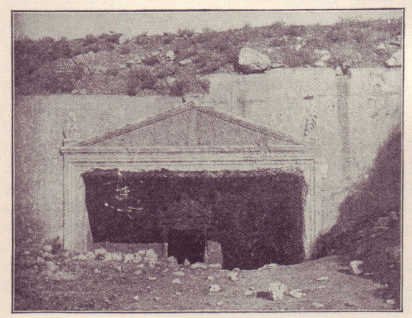 TOMB NEAR JERUSLAEM CALLED "THE TOMB OF THE JUDGES" |
Samuel lived many years, and ruled the people wisely, so that all trusted in him. He taught the Israelites to worship the Lord God, and to put away the idols, which so many of them had served. While Samuel ruled there was peace in all the tribes, and no enemies came from the lands around to do harm to the Israelites. But the Philistines were still very strong, and held rule over some parts of Israel near their own land, although there was no war. Samuel was not a man of war, like Gideon or Jephthah, but a man of peace, and his rule was quiet, though it was strong.
The Tall Man Who Was Chosen King
When Samuel, the good man and the wise judge, grew old he made his sons judge in Israel, to help him in the care of the people. But Samuel's sons did not walk in his ways. They did not try always to do justly. When men brought matters before them to be decided, they would decide for the one who gave them money, and not always for the one who was in the right.
The elders of all the tribes of Israel came to Samuel at his home in Ramah, and they said to him, "You are growing old, and your sons do not rule as well as you have ruled. All the lands around us have kings. Let us have a king also, and do you choose the king for us."
This was not pleasing to Samuel, not because he wished to rule, but because the Lord God was their king, and he felt that for Israel to have such a king as those who ruled the nations around them would be turning away from the Lord. Samuel prayed to the Lord, and the Lord said to him, "Listen to the people in what they ask, for they have not turned away fro you; they have turned away from me in asking for a king. Let them have a king, but tell them of the wrong that they are doing, and show them what trouble their king will bring upon them."
Then Samuel called the elders of the people together, and he said to them, "If you have a king, as do the nations around, e will take your sons away from you, and will make some of them soldiers, and horsemen, and men to drive his chariots. He will take others of your sons to wait on him, to work in his fields, and to make his chariots and his weapons for war. Your king will take the best of your fields and your farms, will give them to the men of his court who are around him. He will make your daughters cook for him, and make bread, and serve in his palace. He will take a part of your sheep, and your oxen, and your asses. You will find that he will be your master and you shall be his servants. The time shall come when you will cry out to the Lord on account of the king that you have chosen, and the Lord will not hear you." But the people would not follow Samuel's advice. They said, "No, we will have a king to reign over us, so that we may be like other nations, and our king shall be our judge and shall lead us out to war."
It was God's will that Israel should be a quiet, plain people, living alone in the mountains, serving the Lord and not trying to conquer other nations. But they wished to be a great people, to be strong in war and to have riches and power. And the Lord said to Samuel, "Do as the people ask, and choose a king for them."
Then Samuel sent the people to their homes, promising to find a king for them.
There was at that time in the tribe of Benjamin a young man named Saul, the son of Kish. He was a very large man and noble looking. From his shoulders he stood taller than any other man in Israel. His father Kish was a rich man, with wide fields and many flocks. Some asses that belonged to Kish had strayed away, and Saul went out with a servant to find them. While they were looking for the asses they came near to Ramah, where Samuel lived. The servant said to Saul, "There is in this city a man of God whom all men honor. Let us go to him and give him a present. Perhaps he can tell us where to find the asses."
In those times a man to whom God made known his will was called a seer; in later times he was called a prophet.
So Saul and his servant came to Ramah and asked for the seer; and while they were coming the seer, who was Samuel, met them. On the day before the Lord had spoken to Samuel, and had said:
"To-morrow, about this time, I will send you a man out of the tribe of Benjamin, and you shall make him the prince of my people, and he shall save my people fro the Philistines."
And when Samuel saw this tall and noble-looking young man coming to meet him, he heard the Lord's voice, saying:
"This is the man of whom I spoke to you. He is the one that shall rule over my people."
Then Saul came near to Samuel, not knowing who he was, and he said, "Can you tell me where the seer's house is?" And Samuel answered Saul, "I am the seer; come with me up to the hill. We are to have an offering and a feast there. As for the asses that were lost three days ago, do not be troubled about them, for they have been found. But on whom is the desire of all Israel? Is it not on you and on your father's house?" Saul could not think what the seer meant in those last words. He said, "Is not my tribe of Benjamin the smallest of all the tribes? And is not my family the least of all the families in the tribe? Why do you say such things to me?"
But Samuel led Saul and his servant into the best room at his house; at the table, where thirty had been invited, he gave Saul the best place, and he put before him the choicest of the meat, and he said, "This has been kept for you of all those invited to the feast."
That night Saul and his servant slept in the best room, which was on the roof of Samuel's house. And the next morning Samuel sent the servant on while he spoke with Saul alone. He brought out a vial of oil and poured it on Saul's head, and said:
"The Lord has anointed you to be prince over his land his people."
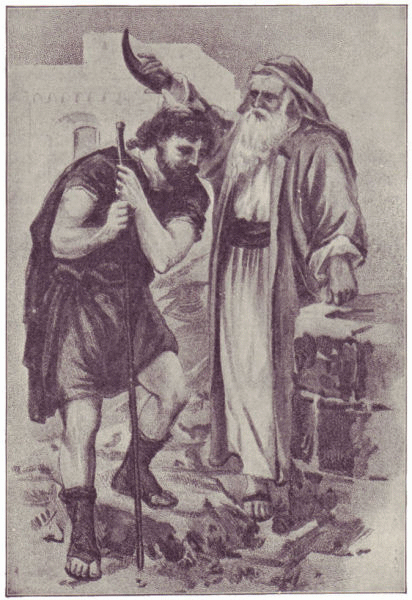 SAMUEL ANOINTS SAUL KING |
Then he told Saul just what he would find on the way, where he would meet certain people, and what he must do. He said:
"When you come to the tomb where Rachel is buried, two men will meet you and will say to you, 'The asses for which you were looking have been found, and now your father is looking for you.' Then under an oak you will meet three men carrying three kids, three loaves of bread, and a skin-bottle full of wine; and these men will give you as a present two loaves of bread. Next you will meet a company of prophets, men full of God's Spirit, with instruments of music, and the Lord's Spirit shall come upon you and a new heart shall be given to you. All these things will show you that God is with you. Now go, and do whatever God tells you to do."
And it came just as Samuel had said. These men met Saul, and when the prophets came near, singing and praising God, Saul joined them and also sang and praised the Lord. And in that hour a new spirit came to Saul. He was no more the farmer's son, for in him was the soul of a king.
 A COMPANY OF PROPHETS MEET SAUL |
He came home, and told at home how he had met Samuel, and that Samuel said to him that the asses had been found. But he did not tell them that Samuel had poured oil upon his head and said that he was to be the king of Israel.
Then Samuel called all the people to the meeting place at Mizpah. And he told them that they had wished for a king, and God had chosen a king for them.
"Now," said Samuel, "let the men of the tribes pass by, each tribe and each family by itself."
The people passed by Samuel, and when the tribe of Benjamin came, out of all the tribes Benjamin was taken; out of Benjamin one family, and out of that family Saul's name was called. But Saul was not with his family; he had hidden away. They found him and brought him out; and when he stood among the people his head and shoulders rose above them all. And Samuel said: "Look at the man whom the Lord has chosen! There is not another like him among all the people!" And all the people shouted "God save the king! Long live the king!"
Then Samuel told the people what should be the laws for the king and for the people to obey. He wrote them down in a book, and placed the book before the Lord. Then Samuel sent the people home, and Saul went back to his own house at a place called Gibeah, and with Saul went a company of men to whose hearts God had given a love for the king. So after three hundred years under the fifteen judges Israel now had a king. But among the people there were some who were not pleased with the new king, because he was an unknown man from the farm. They said, "Can such a man as this save us?" They showed no respect to the king and in their hearts looked down upon him. But Saul said nothing and showed his wisdom by appearing not to notice them.
How Saul Saved the Eyes of the Men of Jabesh
Saul was now the king of all the twelve tribes of Israel, but he did not at once n his manner of life set up the state of a king. He lived at home, and worked in the fields on his father's farm, just as he had always done.
One day, while Saul was plowing in the field with a yoke of oxen, a man came running with sad news. He said that the Ammonites, a fierce people living near the desert on the east, beyond the Jordan, had come up against Jabesh in Gilead, led by their king, Nahash. The people in that city were too few to fight the Ammonites, and they said, "We will submit to your rule, if you will promise to spare our lives."
And Nahash, the king of the Ammonites, said to the people of Jabesh, "You shall live, but within seven days I will come with my soldiers, and I will put out the right eye of every man in your city."
When a city was taken by its enemies in those times, such cruel deeds were common. Often all the people in it, young and old, were slain without mercy. The men of Jabesh sent a messenger to go to Saul as swiftly as possible, and to tell him of the terrible fate that was hanging over them.
 A MESSENGER BRINGS SAUL SAD NEWS |
When Saul heard of it the spirit of a king rose within him. He killed the oxen that he was driving, cut them into twelve pieces, and sent swift messengers through all the land, to say to every fighting man in the twelve tribes, "Whoever will not come out after Saul and after Samuel, so shall it be done to his oxen."
And the Lord gave to all the people the spirit of obedience to their king. At once a great army gathered at a place called Bezek, and he sent word to Jabesh, saying, "To-morrow, by the time the sun is hot, you will be set free from all fear of the Ammonites."
Saul and his men marched swiftly over the mountains of Benjamin and down into the Jordan valley. They walked across the river where it was shallow and climbed the mountains of Gilead. There they fell furiously upon the Ammonites early in the morning, killed many of them and scattered the rest, so that not even two of their men could be found together.
We read in the last Story that when Saul was made king some men were not pleased and were unwilling to submit to him. Now that a great victory had been won under Saul as leader, the people said with one voice, "Where are those men who would not honor our king? Bring them out, and let them be put to death."
But King Saul said, "There shall not a man be put to death this day, for to-day the Lord has set his people free from their enemies." Samuel was with Saul, and he said, "Let us go to Gilgal, where Joshua encamped long ago when our fathers crossed the Jordan; and there let us set up the kingdom again."
They came to Gilgal, and offered sacrifices to the Lord and worshipped. There Samuel gave up to the new king the rule over the land and spoke words of farewell. He said to the people:
"I have done as you asked me, and have given you a king. You king stands before you now. I am old and gray-headed, and I have lived before you from my youth up to this day. Here I am; now, in the presence of the Lord and of his anointed king, is there any man whom I have wronged? Have I taken any man's ox or ass? Have I taken a present from any man to make me favor him as judge? If I have robbed any man, let him speak, and I will pay him all that I have taken."
And all the people said to Samuel, "You have ruled justly, and have wronged no man, and have robbed no man."
And Samuel said, "The Lord is witness, and his anointed, the king, is witness, that I have taken nothing from any man."
And all the people said, "He is witness."
Then Samuel called to their minds all that God had done for his people since he had led them out of Egypt; how he had saved them from their enemies, and had given them judges. And he said, "Now the Lord has set a king over you. But if you disobey the Lord, then God will punish you, as he punished your fathers."
Then Samuel called upon God, and God sent thunder and rain on that day, showing his power. The people were filled with fear, and they cried to Samuel, "Pray to the Lord for us, for we have done wrong in asking for a king."
"Yes," said Samuel, "you have done wrong; but if you from this time do right, and seek the Lord, God will not forsake you. He will forgive you and bless you. I will always pray for you, and will teach you the right way. But if you do evil, God will destroy you and your king. So fear the Lord, and serve him in truth with all you heart."
After this Samuel went again to his own house at Ramah, and Saul ruled the people from Gibeah, the home of his family.
The Brave Young Prince
The people had hoped that when they should have a king to lead them in war they might break the power of the Philistines, who were still rulers over a large part of the land. But after Saul had been king two years the Philistines seemed to be stronger than ever. They held many walled towns on the hills, and from these their warriors went out robbing the villages and taking away the crops from the farmers, so that the men of Israel were kept very poor and in great fear.
The Philistines would not allow the Israelites to do any work in iron, in order to keep them from making swords, and spears for themselves. When a man wished to have his iron plowshare sharpened or to have a new one made, he must go to the Philistines for the work. So when Saul gathered an army, scarcely any of the men could find swords or spears, and Saul and his son Jonathan were the only ones who wore suits of armor to protect them from the darts of the enemy.
Saul gathered together a little army, of which a part was with him at Michmash, and another part with his son Jonathan at Gibeah, five miles to the south. Jonathan, who was a very brave young man, led his band against the Philistines at Geba, halfway between Gibeah and Michmash, and took that place from them. The news of this fight went through the land, and the Philistines came up the mountains with a great army, having chariots and horsemen. Saul blew a trumpet and called the Israelites to the old camp at Gilgal, down in the valley of the Jordan; and many came, but they came trembling with fear of the Philistines.
Samuel had told him not to march from Gilgal until he should come to offer a sacrifice and to call upon God. But Samuel delayed coming, and Saul grew impatient, for he saw his men scattering. At last Saul could wait no longer. He offered a sacrifice himself, though he was no priest. But while offering was still burning on the altar Samuel came. He said to Saul, "What is this that you have done?"
And Saul answered, "I saw that my men were scattering, and I feared that the enemy might come down upon me, so I offered the sacrifice myself, since you were not here."
"You have done wrong," said Samuel. "You have not kept God's commands. If you had obeyed and trusted the Lord, he would have kept you in safety. But now God will find some other man who will do his will, a man after his own heart, and God will in his own time take the kingdom from you and give it to him."
 "YOU HAVE NOT KEPT GOD'S COMMAND" |
And Samuel left camp and went away, leaving Saul. Saul led him men, only six hundred, up the mountains to Geba, the place which Jonathan had taken. Across the valley near Michmash was the host of the Philistines in plain sight. One morning Jonathan and the young man who waited on him went down the hill toward the camp of the Philistines. This servant of Jonathan was called his armor-bearer, because he carried Jonathan's shield, and sword, and spear, to have them ready when needed.
Jonathan could see the Philistines just across the valley. He said, "If the Philistines say to us, 'Come over,' we will go and fight then, even though we two are alone, for we will take it as a sign that God will help us."
The Philistines saw the two Israelites standing on a rock across the valley, and they called to them, "Come over here, and we will show you something."
Then Jonathan said to his armor-bearer, "Come on, for the Lord has given them into our hand."
Then they crossed the valley and came suddenly up to the Philistines, and struck them down right and left, without giving them a moment. Some fell down, but others ran away, and soon, as their fellow-soldiers saw them running, they, too, became frightened, and everybody began to run to and fro. Some fought the men who were running away, and before many minutes the Israelites on the hill across the valley could see the Philistines fighting and killing each other, the men running in every direction and their army melting away.
Then Saul and his men came across the valley and joined in the fight; and other Israelites who were in the camp of the Philistines, and under their control, rose against them; and the tribes near at hand came forth and pursued them as they fled. So on that day a great victory was won over the Philistines.
But a great mistake was made by King Saul on the day of the victory. He feared that his men would turn aside from following the Philistines to seize the spoil in their camp, and when the battle began King Saul said, "Let the curse of God light on any man who takes food until the evening. Whoever takes any food before the sun goes down shall die, so that there may be no delay in destroying our enemies."
So on that day no man ate any food until it was evening, and they were faint and feeble from hunger. They were so worn out that they could not chase the Philistines further, and many of the Philistines escaped. That afternoon, as they were driving the Philistines through a forest, they found honey on the trees; but no man tasted it, because of Saul's oath before the Lord, that whoever took a mouthful of food should be put to death."
But Jonathan had not heard of his father's command. He took some honey and was made stronger by it. They said to Jonathan, "Your father commanded all the people not to take any food until the sun goes down, saying 'May the curse of God come upon any one who eats anything until the evening.'" When Jonathan heard of his father's word, he said, "My father has given us all great trouble; for if the men could have taken some food they would have been stronger to fight and to kill their enemies."
On that night Saul found that Jonathan had broken his command, though he knew it not at the time. He said, "I have taken an oath before the Lord, and now, Jonathan, you must die, though you are my own son."
But the people would not allow Jonathan to be put to death, even to keep Saul's oath. They said, "Shall Jonathan die, after he had done such a great deed, and won the victory, and saved the people? Not a hair of his head shall fall, for he has done God's work this day!"
And they rescued Jonathan from the hand of the king and set him free. A great victory had been won, but Saul had already shown that he was not fit to rule, because he was too hasty in his acts and his words, and because he was note careful to obey God's command.
The Philistines after this battle stayed for a time in their own land beside the Great Sea, and did not trouble the Israelites upon the mountains.
Saul's Great Sin and His Great Loss
After the great victory over the Philistines, Saul led his men against the enemies of Israel on every side of the land. He drove back the Moabites to their country east of the Dead Sea, and the Ammonites to the desert regions across the Jordan. He fought the Edomites on the south and the kings of Zobah in the far north. For a time the land of Israel was free from its oppressors.
On the south of the land, in the desert where the Israelites had journeyed for forty years, were living the wild and wandering Amalekites, a people who had sought to harm the Israelites soon after they came out of Egypt, and had killed many of their people when they were helpless on their journey. (See Part First, Story Twenty-Five.) For this God had said that Israel should have war against the Amalekites until they were destroyed.
The time had now come for God's word against the Amalekites to be fulfilled, and Samuel said to Saul, "Thus says the Lord, the God of hosts, go down and make war against the Amalekites, and destroy them utterly."
Then Saul called out the men of war in all the tribes, and they marched southward into the desert where many years before their fathers had lived for forty years. There Saul made war on the Amalekites, and took their city and destroyed it. But he did not do what God commanded him. He brought Agag, the king of the Amalekites, and many of his people as prisoners, and a great train of their sheep and oxen, intending to keep them.
Then the word of the Lord came to Samuel, saying, "It would have been better never to have chosen Saul as king, for he does not obey my commands."
All that night Samuel prayed to the Lord, and the next day he went to meet Saul. When Saul saw him, he said, "May the blessing of the Lord be upon you. I have done what the Lord commanded me to do."
Then said Samuel, "If you have obeyed God's commands and destroyed all the Amalekites and all that they possessed, what is the meaning of this bleating of the sheep and the bellowing of the oxen which I hear?"
"They have bought them from the Amalekites," answered Saul, "for the people spared the best of the sheep and of the oxen, to offer in sacrifice to the Lord your God. All the rest we have utterly destroyed." This he said to excuse his wrong-doing and to put the blame for his disobedience to God's command on the people.
Then Samuel said, "I will tell you what God said to me last night. When you were humble in your own sight, God chose you to be king over Israel. He sent you on a long journey to the southward into the desert and said to you, 'Go and utterly destroy the Amalekites and leave nothing of them.' Why did you not obey God's word but did seize their oxen and sheep and save many of their people alive, disobeying God's voice?"
And Saul said, "I have done as God commanded, and have destroyed the Amalekites. But the people took some things that should have been destroyed, to offer in sacrifice to the Lord."
And Samuel said, "Is the Lord as well pleased with offerings as he is with obeying his words? To obey is better than sacrifice, and to listen to God's word is more precious than to place offerings on his altar. To disobey God's word is as evil as to worship idols. You have refused to obey the voice of the Lord, and the Lord will take away your kingdom from you."
Saul saw now how great was the harm that he had done, and he said, "I have sinned in not obeying God's word; but I was afraid of the people, and yielded to them. Now forgive my sin. Come with me, and I will worship the Lord."
"No," said Samuel, "I will not go with you, for God will refuse you as king."
As Samuel turned away, Saul took hold of his garment, and it tore in his hand. And Samuel said, "Even so has God torn the kingdom away from you; and he will give it to a man that is better than you are. And God is not like a man, to say one thing and do another. What God has said shall surely come to pass."
Saul begged Samuel so hard not to leave him, but to give him honor in presence of the people, that Samuel went with Saul, and Saul worshipped the Lord with Samuel.
After this Samuel went to his house at Ramah, and he never again met Saul as long as he lived; but he mourned and wept for Saul, because he had disobeyed the Lord, and the Lord had rejected him as king.
 SAMUEL TURNS AWAY FROM SAUL |
The Shepherd Boy of Bethlehem
When Samuel told Saul that the Lord would take away the kingdom from him, he did not mean that Saul should lose the kingdom at once. He was no longer God's king; and as soon as the right man in God's sight should be found, and should be trained for his duty as king, then God would take away Saul's power, and would give it to the man whom God had chosen. But it was many years before all this came to pass.
Samuel, who had helped in choosing Saul as king, still loved him, and he felt very sorry to find Saul disobeying God's commands. He wept much, and mourned for Saul. But the Lord said to Samuel:
"Do not weep and mourn any longer over Saul, for I have refused him as king. Fill the horn with oil, and go to Bethlehem in Judah. There find a man named Jesse, for I have chosen a king among his sons."
But Samuel knew that Saul would be very angry, if he should learn that Samuel had named any other man as king in his place. He said to the Lord, "How can I go? If Saul hears of it, he will kill me."
Then the Lord said to Samuel, "Take a young cow with you; and tell the people that you have come to make an offering to the Lord. And call Jesse and his sons to the sacrifice. I will tell you what to do; and you shall anoint the one whom I name to you."
Samuel went over the mountains southward from Ramah to Bethlehem, about then miles, leading a cow. The rulers of the town were alarmed at his coming, for they feared that he had come to judge the people for some evil-doing. But Samuel said, "I have come in peace to make an offering and to hold a feast to the Lord. Make yourselves ready and come to the sacrifice."
And he invited Jesse and his sons to the service. When they had made themselves reay they came before Samuel. He looked at the sons of Jesse very closely. The oldest was named Eliab; and he was so tall and noble-looking that Samuel thought:
"Surely this young man must be the one whom God has chosen." But the Lord said to Samuel:
"Do not look on his face, nor on the height of his body; for I have not chosen him. Man judges by the outward looks, but God looks at the heart."
Then Jesse's second son, named Shammah, passed by. And the Lord said, "I have not chosen this one." Seven young men came, and Samuel said:
"None of these is the man whom God has chosen. Are these all your children?"
"There is one more," said Jesse. "The youngest of all. He is a boy in the field caring for the sheep."
And Samuel said:
"Send for him; for we will not sit down until he comes." So after a time the youngest son was brought in. His name was David, a word that means "darling," and he was a beautiful boy, perhaps fifteen years old, with fresh cheeks and bright eyes.
As soon as the young David came, the Lord said to Samuel:
"Arise; anoint him, for this is the one whom I have chosen."
Then Samuel poured oil on David's head, in the presence of all his brothers. But no one knew at that time the anointing to mean that David was to be the king. Perhaps they thought that David was chosen to be a prophet like Samuel.
From that time the Spirit of the Lord came upon David; and he began to show signs of coming greatness. He went back to his sheep on the hillsides around Bethlehem, but God was with him. David grew up strong and brave; not afraid of the wild beasts which prowled around and tried to carry away his sheep. More than once he fought with lions and bears, and killed them, when they seized the lambs of his flock. And David, alone all day, practised throwing stones in a sling, until he could strike exactly the place for which he aimed. When he swung his sling, he knew that the stone would go to the very spot at which he was throwing it.
 THE BOY DAVID MEETING THE LION |
And, young as he was, David thought of God, and prayed to God. And God talked with David, and showed to David his will. And David was more than a shepherd and a fighter of wild beasts. He played upon the harp, and made music, and sang songs about the goodness of God to his people.
One of these songs of David we have all heard, and perhaps know so well that we can repeat it. It is called "The Shepherd Psalm," and begins with the words:
|
"The Lord is my Shepherd; I shall not want. He maketh me to lie down in green pastures: He leadeth me beside the still waters. He restoreth my soul; He leadeth me in the paths of righteousness for his name's sake. Yea, though I walk through the valley of the shadow of death I will fear no evil; for thou art with me; Thy rod and thy staff, they comfort me. Thou preparest a table before me in the presence of mine enemies; Thou anointest my head with oil; my cup runneth over. Surely goodness and mercy shall follow me all the days of my life: And I will dwell in the house of the Lord forever." |
Some think that David made this Psalm, while he was himself a shepherd, tending his flock. But it seems rather like the thoughts of a man than of a boy; and it is more likely that long after those days, when David was a king, and remembered his youth, and his flock in the fields, that he saw how God had led him, just as he had led his sheep; and then he wrote this Psalm.
But while the Spirit of God came to David among his sheep, that Spirit left King Saul, because he no longer obeyed God's words. Then Saul became very unhappy, and gloomy in his feelings. There were times when he seemed to lose his mind, and a madness would come upon him; and at almost all times Saul was sad and full of trouble, because he was no more at peace with God.
The servants around Saul noticed that when some one played on the harp and sang, Saul's gloom and trouble passed away, and he became cheerful. At one time Saul said:
"Find some one who can play well, and bring him to me. Let me listen to music; for it drives away my sadness."
One of the young men said:
"I have seen a young man, a son of Jesse in Bethlehem, who can play well. He is handsome in his looks, and agreeable in talking. Then I have heard that he is a brave young man, who can fight as well as he can play; and the Lord is with him."
Then Saul sent a message to Jesse, David's father. He said:
"Send me your son David, who is with the sheep. Let him come and play before me."
Then David came to Saul, bringing with him a present for the king from Jesse. When Saul saw him, he loved him, as did everybody who saw the young David. And David played on the harp, and sang before Saul. And David's music cheered Saul's heart, and drove away his sad feelings.
Saul like David so well that he made him his armor-bearer; and David carried the shield and spear and sword for Saul when the king was before his army. But Saul did not know that David had been anointed by Samuel. If he had known it, he would have been very jealous of David.
After a time Saul seemed well, and David left him, to be a shepherd once more at Bethlehem.
 DAVID PLAYS BEFORE SAUL |
The Shepherd Boy's Fight with the Giant
All through the reign of Saul there was constant war with the Philistines, who lived upon the lowlands west of Israel. At one time, when David was still with his sheep, a few years after he had been anointed by Samuel, the camp of the Philistines and the Israelites were set against each other on opposite sides of the valley of Elah ready to fight each other. In the army of Israel were the three oldest brothers of David, who were soldiers under King Saul.
Every day a giant came out of the camp of the Philistines, and dared some one to come from the Israelites' camp and fight with him. The giant's name was Goliath. He was nine feet high; and he wore armor from head to foot, and carried a spear twice as long and as heavy as any other man could hold; and his shield-bearer walked before him. He came every day and called out across the little valley:
"I am a Philistine, and you are servants of Saul. Now choose one of your men, and let him come out and fight with me. If I kill him, then you shall submit to us; and if he kills me, then we will give up to you. Come, now, send out your man!"
But no man in the army, not even King Saul, dared to go out and fight with the giant. The Israelites were mostly farmers and shepherds, and were not fond of war, as were the Philistines. Then, too, very few of the Israelites had swords and spears, except such rude weapons as they could make out of their farming tools. Forty days the camps stood against each other, and the Philistine giant continued his call.
One day old Jesse, the father of David, sent David from Bethlehem to visit his three brothers in the army. David came, spoke to his brothers, and gave them a present from his father. While he was talking with them, Goliath, the giant, came out as before in front of the camp, calling for some one to fight with him.
The Israelites said to one another, "If any man will go out and kill this Philistine, the king will give him a great reward and a high rank; and the kings' daughter shall be his wife."
And David said, "Who is this man that speaks in this proud manner against the armies of the living God? Why does not some one go out and kill him?"
David's brother Eliab said to him, "What are you doing here, leaving your sheep in the field? I know that you have come down just to see the battle."
But David did not care for his brother's angry words. He was thinking out some way to kill this boasting giant. While all the men were in terror, this boy thought of a plan. He believed that he knew how to bring down the big warrior, with all his armor. Finally, David said:
"If no one else will go, I will go out and fight with this enemy of the Lord's people."
They brought David before King Saul. Some years had passed since Saul had met David, and he had grown from a boy to a man, so that Saul did not know him as the shepherd who had played on the harp before him in other days.
Saul said to David, "You cannot fight with this giant. You are very young; and he is a man of war, trained from his youth."
And David answered King Saul, "I am only a shepherd, but I have fought with lions and bears, when they have tried to steal my sheep. And I am not afraid to fight with this Philistine. The Lord saved me from the lion's jaw and the bear's paw, and he will save me from this enemy, for I shall fight for the Lord and his people."
Then Saul put his own armor on David, a helmet on his head, and a coat of mail on his body, and a sword at his waist. But Saul was almost a giant, and his armor was far too large for David. David said:
"I am not used to fighting with such weapons as these. Let me fight in my own way."
So David took off Saul's armor; for David's plan to fight the giant did not need armor, but did need a quick eye, a clear head, a sure aim, and a bold heart; and all these David had, for God had given them to him. David's plan was very wise. It was to make Goliath think that his enemy was too weak for him to be on his guard against him; and while so far away that the giant could not reach him with sword or spear, to strike him down with a weapon which the giant would not expect, and would not be prepared for.
David took his shepherd's staff in his hand, as though that were to be his weapon. But out of sight, in a bag under his mantle, he had five smooth stones carefully chosen, and a sling,—the weapon he knew how to use. Then he came out to meet the Philistine. The giant looked down on the youth and despised him, and laughed at him.
"Am I a dog," he said, "that this boy comes to me with a staff! I will give his body to the birds of the air and the beasts of the field."
And the Philistine cursed David by the gods of his people. And David answered him:
"You come against me with a sword and a spear and a dart; but I come to you in the name of the Lord of hosts, the God of the armies of Israel. This day will the Lord give you into my hand; I will strike you down, and take off your head; and the host of the Philistines shall be dead bodies, to be eaten by the birds and the beasts; so that all may know that there is a God in Israel, and that he can save in other ways besides with sword and spear."
And David ran toward the Philistine, as if to fight him with his shepherd's staff. But when he was near enough for a good aim he took out his sling, and hurled a stone aimed at the giant's forehead. David's aim was good, the stone stuck the Philistine in his forehead. It stunned him, and he fell to the ground.
 DAVID RUNNING TO MEET GOLIATH |
While the two armies stood wondering, the scarcely knowing what had caused the giant to fall so suddenly, David ran forward, drew out the giant's own sword, and cut off his head.
Then the Philistines knew that their great warrior in whom they trusted was dead. They turned to fly back to their own land; and the Israelites followed after them, and killed them by the hundred and thousand, even to the gates of their own city of Gath.
So in that day David won a great victory; and stood before all the land as the one who had saved his people from their enemies.
The Little Boy Looking for the Arrows
After David had slain the giant he was brought before King Saul, still holding the giant's head. Saul did not remember in this bold fighting man the boy who a few years before had played in his presence. He took him into his own house, and made him an officer among his soldiers. David was as wise and as brave in the army as he had been when facing the giant, and very soon he was in command of a thousand men. All the men loved him, both in Saul's court and in his camp, for David had the spirit that drew all hearts toward him.
 DAVID BROUGHT BEFORE SAUL WITH THE GIANT'S HEAD |
When David was returning from his battle with the Philistines the women of Israel came to meet him out of the cities, with instruments of music, singing and dancing, and they sang:
|
"Saul has slain his thousands, and David his ten thousands." |
This made Saul very angry, for he was jealous and suspicious in his spirit. He thought constantly of Samuel's words, that God would take the kingdom from him and would gie it to one who was more worthy of it. He began to think that perhaps this young man, who had come in a single day to greatness before the people, might try to make himself king.
 THE WOMEN MEETING DAVID WITH DANCING AND SINGING |
His former feeling of unhappiness again came over Saul. He raved in his house, talking as a man talks who is crazed. By this time they all knew that David was a musician, and they called him again to play on his harp and to sing before the troubled king. But now, in his madness, Saul would not listen to David's voice. Twice he threw his spear at him; but each time David leaped aside, and the spear went into the wall of the house.
Saul was afraid of David, for he saw that the Lord was with David, as the Lord was no longer with himself. He would have killed David, but did not dare to kill him, because everybody loved David. Saul said to himself, "Though I cannot kill him myself, I will have him killed by the Philistines."
And he sent David out on dangerous errands of war; but David came home in safety, all the greater and the more beloved after each victory. Saul said, "I will give you my daughter Merab for your wife if you will fight the Philistines for me."
David fought the Philistines; but when he came home from the war he found that Merab, who had been promised to him, had been given as wife to another man. Saul had another daughter, named Michal. She loved David, and showed her love for him. Then Saul sent word to David, saying, "You shall have Michal, my daughter, for your wife when you have killed a hundred Philistines."
Then David went out and fought the Philistines, and killed two hundred of them; and they brought the word to Saul. Then Saul gave him his daughter Michal as his wife; but he was all the more afraid of David as he saw him growing in power and drawing nearer to the throne of the kingdom.
But if Saul hated David, Saul's son, Jonathan, loved David with all his heart. This was the brave young warrior of whom we read in Story Two of this Part, who with his armor-bearer went out alone to fight the Philistine army. Jonathan saw David's courage and nobility of soul, and loved him with all his heart. He took off his own royal robe, and his sword, and his bow, and gave them all to David. It grieved Jonathan greatly that his father, Saul, was so jealous of David. He spoke to his father, and said: "Let not the king do harm to David; for David has been faithful to the king, and he has done great things for the kingdom. He took his life in his hand, and killed the Philistine, and won a great victory for the Lord and for the people. Why should you seek to kill an innocent man?"
For the time Saul listened to Jonathan, and said, "As the Lord lives, David shall not be put to death."
And again David sat at the king's table, among the princes; and when Saul was troubled again David played on his harp and sang before him. But once more Saul's jealous anger arose, and he threw his spear at David. David was watchful and quick. He leaped aside, and, as before, the spear fastened into the wall.
 SAUL THROWS HIS SPEAR AT DAVID |
Saul sent men to David's house to seize him; but Michal, Saul's daughter, who was David's wife, let David down out of the window, so that he escaped. She placed an image on David's bed and covered it with the bed-clothes. When the men came, she said, "David is ill in the bed, and cannot go."
They brought the word to Saul, and he said, "Bring him to me in the bed, just as he is."
When the image was found in David's bed, David was in a safe place, far away. David went to Samuel at Ramah, and stayed with him among the men who were prophets worshipping God and singing and speaking God's word. Saul heard that David was there, and sent men to take him. But when these men came and saw Samuel and the prophets praising God and praying, the same spirit came on them, and they began to praise and to pray. Saul sent other men, but these also, when they came among the prophets, felt the same power, and joined in the worship.
Finally, Saul said, "If no other man will bring David to me, I will go myself and take him."
And Saul went to Ramah; but when he came near to the company of the worshippers, praising God, and praying, and preaching, the same spirit came on Saul. He, too, began to join in the songs and the prayers, and stayed there all that day and that night, worshipping God very earnestly. When the next day he went again to his home in Gibeah, his feeling was changed for the time, and he was again friendly to David.
But David knew that Saul was at heart his bitter enemy and would kill him if he could as soon as his madness came upon him. He met Jonathan out in the field away from the place. Jonathan said to David:
"Stay away from the king's table for a few days, and I will find out how he feels toward you, and will tell you. Perhaps even now my father may become your friend. But if he is to be your enemy, I know that the Lord is with you, and that Saul will not succeed against you. Promise me that as long as you live you will be kind to me, and not only to me while I live, but to my children after me."
Jonathan believed, as many others believed, that David would yet become the king of Israel, and he was willing to give up to David his right to be king, such was his great love for him. That day a promise was made between Jonathan and David, that they and their children, and those who should come after them, should be friends forever.
Jonathan said to David, "I will find how my father feels toward you, and will bring you word. After three days I will be here with my bow and arrows, and I will send a little boy out near your place of hiding, and I will shoot three arrows. If I say to the boy, 'Run, find the arrows, they are on this side of you,' then you can come safely, for the king will not harm you. But if I call out to the boy, 'The arrows are away beyond you,' that will mean that there is danger, and you must hide from the king."
So David stayed away from Saul's table for two days. At first Saul said nothing of his absence, but at last he said:
"Why has not the son of Jesse come to meals yesterday and to-day?"
And Jonathan said, "David asked leave of me to go to his home at Bethlehem and visit his oldest brother."
Then Saul was very angry. He cried out, "You are a disobedient son! Why have you chosen this enemy of mine as your best friend? Do you not know that as long as he is alive you can never be king? Send after him, and let him be brought to me, for he shall surely die!"
Saul was so fierce in his anger that he threw his spear at his own son Jonathan. Jonathan rose up from the table, so anxious for his friend David that he could eat nothing. The next day, at the hour agreed upon, Jonathan went out into the field with a little boy. He said to the boy, "Run out yonder, and be ready to find the arrows that I shoot."
And as the boy was running Jonathan shot arrows beyond him, and he called out, "The arrows are away beyond you; run quickly and find them."
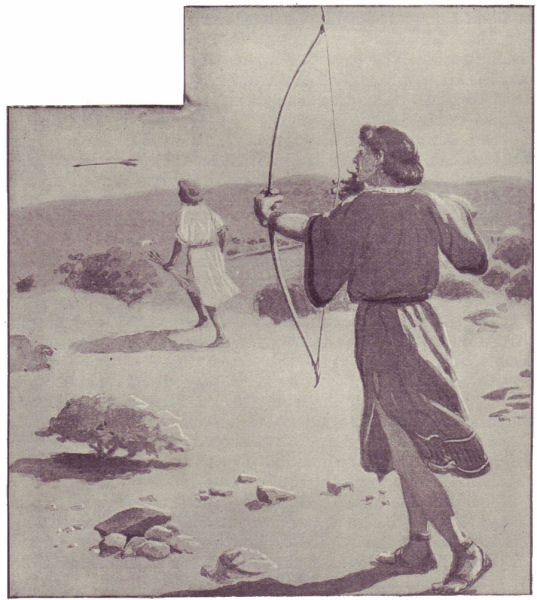 JONATHAN SHOOTS THE ARROW |
The boy ran, and found the arrows, and brought them to Jonathan. He gave the bow and arrows to the boy, saying to him, "Take them back to the city. I will stay here a while."
And as soon as the boy was out of sight David came from his hiding-place and ran to Jonathan. They fell into each other's arms and kissed each other again and again, and wept together. For David knew now that he must no longer hope to be safe in Saul's hands. He must leave home, and wife, and friends, and his father's house, and hide wherever he could from the hate of King Saul.
Jonathan said to him, "Go in peace; for we have sworn together saying, 'The Lord shall be between you and me, and between your children and my children forever."
Then Jonathan went again to his father's palace, and David went out to fid a hiding-place.
Where David Found the Giant's Sword
From his meeting with Jonathan, David went forth to be a wanderer, having no home as long as Saul lived. He went away so suddenly that he was without either bread to eat, or a sword for defence. On his way he called at a little city called Nob, where the Tabernacle was then standing, although the holy ark was still in another place by itself. (See Story Sixteen, Part Second.) The chief priest, Ahimelech, was surprised to see David coming alone. David said to him, "The king has sent me upon an errand of which no one is to be told, and my men are to meet me in a secret place. Can you give me a few loaves of bread?"
"There is no bread here," said the priest, "except the holy bread from the table in the holy house. The priests have just taken it away to put new bread in its place." (For an account of the table and the bread, see Story Twenty-seven in Part First.)
"Let me have that bread," said David, "for we are the Lord's, and are holy."
So the priest gave David the holy bread, which was to be eaten by the priests alone. David said also, "Have you a spear, or a sword, which I can take with me? The king's errand was so sudden that I had no time to bring my weapons."
"There is no sword here," said the priest, "except the sword of Goliath the Gath, whom you slew in the valley of Elah. It is wrapped in a cloth, in the closet with the priest's robe. If you wish that sword, you can have it." (See Story Five in this Part.)
"There is no sword like that," said David; "give it to me." So David took the giant's sword, and five loaves of bread, and went away. But where should he go? Nowhere in Saul's kingdom would he be safe; and he went down to live among his old enemies, the Philistines, on the plain.
 DAVID TOOK THE GIANT'S SWORD |
But the Philistines had not forgotten David, who had slain their great Goliath, and beaten them in many battles. They would have seized him and killed him; but David acted as though he was crazy. Then the king of the Philistines said, "Let this poor crazy man go! We do not want him here."
And David escaped from among them, and went to live in the wilderness of Judah. He found a great cave, called the cave of Adullam, and hid in it. Many people heard where he was, and from all parts of the land, especially from his own tribe of Judah, men who were not satisfied with the rule of King Saul, gathered around David. Soon he had a little army of four hundred men, who followed David as their captain.
All of these men with David were good fighters, and some of them were very brave in battle. Three of these men at one time wrought a great deed for David. While David was in te great cave, with his men, the Philistines were holding the town of Bethlehem, which had been David's home. David said one day: "How I wish that I could have a drink of the water from the well that is beside the gate of Bethlehem!"
This was the well from which he had drawn water and drank when a boy; and it seemed to him that there was no water so good to his taste.
Those three brave men went out together, walked to Bethlehem, fought their way through the Philistines who were on guard, drew a vessel of water from the well, and then fought their way back through the enemies.
But when they brought the water to David, he would not drink it. He said:
"This water was bought by the blood of three brave men. I will not drink it; but I will pour it out as an offering to the Lord, for it is sacred." So David poured out the water as a most precious gift to the Lord. Saul soon heard that David, with a band of men, was hiding among the mountains of Judah. One day while Saul was sitting in Gibeah, out of doors under a tree, with his nobles around him, he said, "You are men of my own tribe of Benjamin, yet none of you will help me to find this son of Jesse, who has made an agreement with my own son against me, and who has gathered an army, and is waiting to rise against me. Is no one of you with me and against mine enemy?"
 THE WATER FROM THE WELL OF BETHLEHEM |
One man, whose name was Doeg, an Edomite, sad, "I was at the city of the priests some time ago, and saw the sons of Jesse come to the chief priest, Ahimelech; and the priest gave him loaves of bread and a sword." "Send for Ahimelech and all the priests," commanded King Saul; and they took all the priests as prisoners, eighty-five men in all, and brought them before King Saul. And Saul said to them, "Why have you priests joined with David, the son of Jesse, to rebel against me, the king? You have given him bread, and a sword, and have shown yourselves his friends."
Then Ahimelech, the priest, answered the king, "There is no one among all the king's servants as faithful as David; and he is the king's son-in-law, living in the palace, and sitting in the king's council. What wrong have I done in giving him bread? I knew nothing of any evil that he had wrought against the king."
Then the king was very angry. He said, "You shall die, Ahimelech, and all your father's family, because you have helped this man, my enemy. You knew that he was hiding from me, and did not tell me of him."
And the king ordered his guards to kill all the priests. But they would not obey him, for they felt that it was a dreadful deed to lay hands upon the priests of the Lord. This made Saul all the more furious, and he turned to Doeg, the Edomite, the man who had told of David's visit to the priest, and Saul said to Doeg, "You are the only one among my servants who is true to me. Do you kill these priests who have been unfaithful to their king."
And Doeg, the Edomite, obeyed the king, and killed eighty-five men who wore the priestly garments. He went to the city of the priests, and killed all their wives and children, and burned the city.
One priest alone escaped, a young man named Abiathar, the son of Ahimelech. He came to David with the terrible news, that Saul had slain all the priests, and he brought the high-priest's breast-plate and his robes.
David said to him, "I saw this man Doeg, the Edomite, there on that day, and I knew that he would tell Saul. Without intending to do harm, I have caused the death of all your father's house. Stay with me, and fear not. I will care for your life with my own."
Abiathar was now the high-priest, and he was with David, and not with Saul. All through the land went the news of Saul's dreadful deed, and everywhere the people began to turn from Saul, and to look toward David as the only hope of the nation.
How David Spared Saul's Life
After this David and his men hid in man places in the mountains of Judah, often hunted by Saul, but always escaping from him. At one time Jonathan, Saul's son came to meet David in a forest, and said to him, "Fear not, for the Lord is with you; and Saul, my father, shall not take you prisoner. You will yet be the king of Israel, and I shall stand next to you; and my father knows this."
And Jonathan and David made again the promise to be true to each other, and to each other's children always. Then they parted; and David never again saw his dear friend, Jonathan.
At one time David was hiding with a few men in a great cave near the Dead Sea, at a place called En-gedi. They were far back in the darkness of the cave, when they saw Saul come into the cave alone, and lie down to sleep. David's men whispered to him, "Now is the time of which the Lord said, 'I will give your enemy into your hand, and you may do to him whatever you please.'"
Then David went toward Saul very quietly with his sword in his hand. His men looked to see him kill Saul, but instead, he only cut off a part of Saul's long robe. His men were not pleased at this; but David said to them, "May the Lord forbid that I should do harm to the man whom the Lord has anointed as king."
And David would to allow his men to harm Saul. After a time Saul rose up from sleep and went out of the cave. David followed him at a distance, and called out to him, "My lord the king!"
Saul looked around, and there stood David, bowing to him and holding up the piece of his royal robe. David said to Saul, "My lord, O king, why do you listen to the words of men who tell you that David is trying to do you harm? This very day the Lord gave you into my hand in the cave, and some told me to kill you, but I said, 'I will not do harm to my lord, for he is the Lord's anointed king.' See, my father, see the skirt of your robe. I cut it off to show you that I would do you no harm, though you are hunting after me to kill me. May the Lord judge between you and me, and may the Lord do justice for me upon you; but my hand shall not touch you."
When Saul heard these words his old love for David came back to him, and he cried out, "Is that your voice, my son David?" And Saul wept, and said, "You are a better man than I am, for you have done good to me, while I have been doing harm to you. May the Lord reward you for your kindness to me this day! I know that it is God's will that you shall be king, and you will rule over this people. Now give to me your word, in the name of the Lord, that you will not destroy my family, but that you will spare their lives."
And David gave his promise to Saul in the name of the Lord; and Saul led his men away from hunting David to his palace at Gibeah; but David kept still in his hiding-place, for he could not trust Saul's promises to spare his life.
And it was not long before Saul was again seeking for David in the wilderness of Judah, with Abner, Saul's uncle, the commander of his army, and under him three thousand -men. From his hiding-place in the mountains David looked down on the plain, and saw Saul's camp almost at his feet. That night David and Abishai, one of David's men, came down quietly and walked into the middle of Saul's camp, while all his guards were asleep. Saul himself was sleeping, with his spear standing in the ground at his head, and a bottle of water tied to it.
Abishai, David's follower, knew that David would not kill King Saul, and he said to David, "God has given your enemy into your hand again. Let me strike him through to the ground at one stroke; only once; I will not need to strike twice."
But David said, "You shall not destroy him. Who can strike the anointed of the Lord without being guilty of a crime? Let the Lord strike him, or let him die when God wills it, or let him fall in battle; but he shall not die by my hand. Let us take his spear and his water-bottle, and let us go."
So David took Saul's spear and his bottle of water, and then David and Abishai walked out of the camp without awakening any on. In the morning David called out to Saul's men and to Abner, the chief of Saul's army, "Abner, where are you? Why do you not answer, Abner?"
And Abner answered, "Who are you, calling to the camp?"
Then David said, "Are you not a great man, Abner? Who is like you in all Israel? Why have you not kept your watch over the king? You deserve to be put to death for your neglect! See, here is the king's spear and his bottle of water!"
Saul knew David's voice, and he said, "Is that your voice, my son David?"
And David answered, "It is my voice, my lord, O king. Why do you pursue me? What evil have I done? May God deal with the men who have stirred you up against me. I am not worth all the trouble you are taking to hunt for me. The king of Israel is seeking for one who is as small as a flea or a little bird in the mountains!"
Then Saul said, "I have done wrong; come back, my son David, and I will no longer try to do harm to you, for you have spared my life to-day!" David said, "Let one of the young men come and take the king's spear. As I have spared your life to-day, may the Lord spare mine."
So David went his way, for he would not trust himself in Saul's hands, and Saul led him men back to him home at Gibeah. David now was leading quite an army and was a powerful ruler. He made an agreement with the king of the Philistines who lived at Gath, King Achish, and went down to the plain by the Great Sea, to live among the Philistines. And Achish gave him a city called Ziklag, on the south of the tribe-land of Judah. To this place David took his followers, and there he lived during the last year of Saul's reign.
 DAVID SPARES SAUL'S LIFE |
The Last Days of King Saul
Once more the Philistines gathered together to make war on King Saul and the land of Israel. The king of the Philistines, Achish, sent for David, and said to him, "You and your men shall go with me in the army, and fight against the men of Israel."
For David was now living in the Philistine country and under their rule. So David came from Ziklag, with all his six hundred men, and they stood among the armies of the Philistines. But when the lords of the Philistines saw David and his men, they said, "Why are these Israelites here? Is not this the man of whom they sang,
|
'Saul slew his thousands, But David his ten thousands.' |
Will not this man turn from us in the battle, and make his peace with his king by fighting against us? This man shall not go with us to the war."
Then Achish, the king of the Philistines, sent away David and his men, so that David was not compelled to fight against his own people. But when he came to his own city, Ziklag, he found it had been burned and destroyed; and all the people in it, the wives and children of David's men, and David's own wives also, had been carried away by the Amalekites into the desert on the south.
The Lord spoke to David through the high-priest, Abiathar, saying, "Pursue these men, and you will overtake them, and take back all that they have carried away."
So David followed the Amalekites into the wilderness. His march was so swift that a part of his men could not endure it, but stopped to rest at the brook Bezor, while four hundred men went on with David. He found the Amalekites in their camp, without guards, feasting upon the spoil that they had taken. And David and his men fell upon them suddenly and killed all of them, except four hundred men who escaped on camels far into the desert, where David could not follow them. And David took from these robbers all the women and children that they had carried away from Ziklag, and among them David's own two wives; also he took a great amount of treasure and of spoil, not only all that these men had found in Ziklag, but what they had taken in many other places.
David divided all these things between himself and his men, giving as much to those who had stayed at the brook Bezor as to those who had fought with the Amalekites. This treasure taken from the Amalekites made David very rich; and from it he sent presents to many of his friends in the tribe of Judah.
While David was pursuing his enemies in the south, the Philistines were gathering a great host in the middle of the land, on the plain of Esdraelon, at the foot of Mount Gilboa. Saul and his men were on the side of Mount Gilboa, near the same spring where Gideon's men drank, as we read in Story Ten in Part Second. But there was no one like Gideon now, to lead the men of Israel, for King Saul was old, and weakened by disease and trouble; Samuel had died many years before; David was no longer by his side; Saul had slain the priests, through whom in those times God spoke to men; and Saul was utterly alone, and knew not what to do, as he saw the mighty host of the Philistines on the plain. And the Lord had forsaken Saul, and would give him no word in his sore need.
Saul heard that there was living at En-dor, on the north side of the Hill Moreh, not far from his camp, a woman who could call up the spirits of the dead. Whether she could really do this, or only pretended to do it, we do not know, for the Bible does not tell. But Saul was so anxious to have some message from the Lord, that at night he sought this woman. He took off his kingly robes and came dressed as a common man, and said to her, "Bring me up from the dead the spirit of a man whom I greatly long to meet."
And the woman said, "What spirit shall I call up?"
And Saul answered, "Bring me up the spirit of Samuel, the prophet."
 SAUL ASKS THE WOMAN TO CALL UP SAMUEL |
Then the woman called for the spirit of Samuel; and whether spirits had ever arisen from the dead before or not, at that time the Lord allowed the spirit of Samuel to rise up from his place among the dead, to speak to King Saul.
When the woman saw Samuel's spirit she was filled with fear. She cried out, and Saul said to her, "Do not fear; but tell me whom you see."
For Saul himself could not see the spirit whom the woman saw. And she said, "I see one like a god rising up. He is an old man, covered with a long robe."
Then out of the darkness a voice came from the spirit whom Saul's eyes could not see. "Why have you troubled me, and called me out of my rest?"
And Saul answered Samuel, "I am in great distress, for the Philistines make war upon me, and God has forsaken me. He will not speak to me either by a prophet, or a priest, or in a dream. And I have called upon you that you may tell me what to do." And the spirit of Samuel said to Saul, "If the Lord has forsaken you and has become your enemy, why do you call upon me to help you? The Lord has dealt with you as I warned you that he would do. Because you would not obey the Lord, he has taken the kingdom away from you and your house, and has given it to David. And the Lord will give Israel into the hands of the Philistines; and to-morrow you and your three sons shall be as I am, among the dead." And then the spirit of Samuel the prophet passed from sight. When Saul heard these words he fell down as one dead, for he was very weak, as he had taken no food all that day. The woman and Saul's servants who were with him raised him up, and gave him food, and tried to speak to him words of cheer. Then Saul and his men went over the mountain to their camp.
On the next day a great battle was fought on the side of Mount Gilboa. The Philistines did not wait for Saul's warriors to attack them. They climbed up the mountain, and fell upon the Israelites in their camp. Many of the men of Israel were slain in the fight, and many more fled away. Saul's three sons were killed, one of them, the brave and noble Jonathan.
When Saul saw that the battle had gone against him, that his sons were slain, and that the enemies were pressing closely upon him, he called to his armor-bearer, and said, "Draw your sword and kill me; it would be better for me to die by your hand than for the Philistines to come upon me and slaughter me."
But the armor-bearer would not draw his sword upon his king, the Lord's anointed. Then Saul took his own sword and fell upon it, and killed himself among the bodies of his own men.
 THE DEATH OF SAUL |
On the next day the Philistines came to strip off the armor and carry away the weapons of those who had been slain. The crown of King Saul and the bracelet on his arm had been already carried away; but the Philistines took off his armor and sent it to the temple of their idol, Dagon; and the body of Saul and those of his three sons they fastened to the wall of Beth-shan, a Canaanite city in the valley of the Jordan.
You remember how Saul, in the beginning of his reign, had rescued the city of Jabesh-gilead from the Ammonites. (See Story One in this Part.) The men of Jabesh had not forgotten Saul's brave deed. When they heard what had been done with the body of Saul they rose up in the night and went down the mountains and walked across the Jordan, and came to Beth-shan. They took down from the wall the bodies of Saul and his sons, and carried them to Jabesh; and that they might not be taken away again, they burned them and buried their ashes under a tree; and they mourned for Saul seven days. Thus came to an end the reign of Saul, which began well, but ended in failure and in ruin, because Saul forsook the Lord God of Israel.
Saul had reigned forty years. At the beginning of his reign the Israelites were almost free from the Philistines, and for a time Saul seemed to have success in driving the Philistines out of the land. But after Saul forsook the Lord, and would no longer listen to Samuel, God's prophet, he became gloomy and full of fear, and lost his courage, so that the land fell again under the power of its enemies. David could have helped him, but he had driven David away; and there was no strong man to stand by Sal and win victories for him. So at the end, when Saul fell in battle, the yoke of the Philistines was on Israel heavier than at any time before.
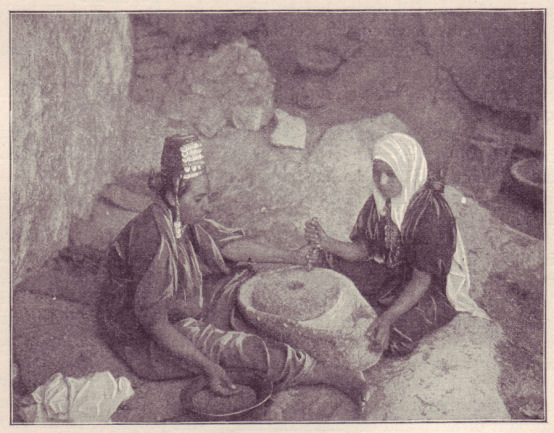 WOMEN GRINDING GRAIN IN BIBLE TIMES |
The Shepherd Boy Becomes a King
On the third day after the battle on Mount Gilboa, David was at his home is Ziklag, on the south of Judah, when a young man came into the town, running, with garments torn and earth on his head, as was the manner of those in deep grief. He hastened to David, and fell down before him. And David said to him, "From what place have you come?"
And the young man said, "Out of the camp of Israel I have escaped."
And David said to him, "What has taken place? Tell me quickly."
Then the man answered, "The men of Israel have been beaten in the battle; very many of them are slain, and the rest have fled away. King Saul is dead, and so is Jonathan, his son."
"How do you know that Saul and Jonathan are dead?" asked David.
And the young man said, "I happened to be on Mount Gilboa in the battle; and I saw Saul leaning upon his spear wounded, and near death, with his enemies close upon him. And he said to me, 'Come to me, and kill me, for I am suffering great pain.' So I stood beside him and killed him, for I saw that he could not live. And I took the crown that was on his head, and the bracelet on his arm, and I have brought them to you, my lord David."
Then David and all the men that were with him tore their clothes, and mourned, and wept, and took no food on that day, on account of Saul, and of Jonathan, and for the people of Israel who had fallen by the sword.
And David said to the young man who had brought to him the news, "Who are you? To what people do you belong?"
And he said, "I am no Israelite; I am an Amalekite."
"How was it," said David to him, "that you were not afraid to slay the king of Israel, the anointed of the Lord? You shall die for this deed."
And David commanded one of his men to kill him, because he had said that he had slain the king. He may have told the truth, but it is more likely that he was not in the battle, and that after the fighting he came upon the field to rob the dead bodies, and that he brought a false story of having slain Saul, hoping to have a reward. But as David would not slay the anointed king, even though he were his enemy, he would not reward, but would rather punish the stranger who claimed to have slain him.
And David wrote a song over the death of Saul and Jonathan. He taught it to the people of Judah, and called it
THE SONG OF THE BOW
|
Thy glory, O Israel, is slain upon thy high places! How are the mighty fallen! Tell it not in Gath. Publish it not in the streets of Ashkelon; Lest the daughters of the Philistines rejoice, Lest the daughters of the heathen triumph. Ye mountains of Gilboa. Let there be now dew nor rain upon you neither fields of offerings: For there the shield of the mighty was cast away as a vile thing. The shield of Saul, not anointed with oil. From the blood of the slain, from the fat of the mighty, The bow of Jonathan turned not back, And the sword of Saul returned not empty. Saul and Jonathan were lovely and pleasant in their lives, And in their death they were not divided: They were swifter than eagles, They were stronger than lions. Ye daughters of Israel, weep over Saul, Who clothed you in scarlet delicately, Who put ornaments of gold upon your apparel. On Jonathan, slain upon thy high places! I am distressed for thee, my brother Jonathan, Very pleasant has thou been unto me; Thy love to me was wonderful, Passing the love of women. How are the mighty fallen, And the weapons of war perished!" |
After this, at the command of the Lord, David and his men went up from Ziglag to Hebron, in the middle of the tribe-land of Judah. And the men of Judah met together at Hebron, and they made David king over their tribe. And David reigned in Hebron, over the tribe of Judah, for seven years.
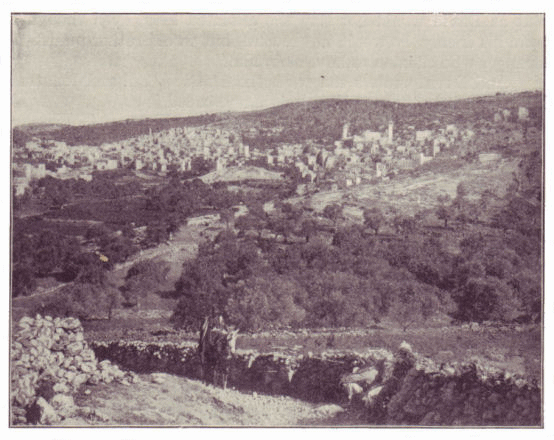 HEBRON, WHERE DAVID WENT |
But Saul's uncle, Abner, who had been the chief over his house and over his army, was not willing to have the kingdom go out of the family of Saul. He made a son of Saul king over all the tribes in the north of the land. This king was called Ish-bosheth, a name which means "a worthless man." He was weak and helpless, except for the strong will and power of Abner, who had made him king. For six years seemingly under Ish-bosheth, but really under Abner, the form of a kingdom was kept up, while Ish-bosheth was living at Mahanaim, on the east of Jordan.
Thus for a time there were two kingdoms in Israel, that of the north under Ish-bosheth, and that of the south under David. But all the time David's kingdom was growing stronger, and Ish-bosheth's kingdom was growing weaker.
After a time Abner was slain by one of David's men, and at once Ish-bosheth's power dropped away. Then two men of his army killed him, and cut off his head, and brought it to David. They looked for a reward, since Ish-bosheth had been king against David. But David said, "As the Lord lives, who has brought me out of trouble, I will give no reward to wicked men, who have slain a good man in his own house, and upon his own head. Take these two murderers away, and kill them!"
So the two slayers of the weak king, Ish-bosheth, were punished with death, and the head of the slain man was buried with honor. David had not forgotten his promise to Saul to deal kindly with his children.
The Sound in the Tree-Tops
After David had reigned as king over the tribe of Judah for seven years, and when Saul's son, Ish-bosheth, was dead, all the men in Israel saw that David was the one man who was fit to be king over the land. So the rulers and elders of all the twelve tribes came to David in Hebron, and said to him, "We are all your brothers; and in time past, when Saul was king, it was you who led the people; and the Lord said, 'David shall be the shepherd of my people, and shall be prince over Israel.' Now we are ready to make you king over all the land."
Then David and the elders of Israel made an agreement together before the Lord in Hebron; and they anointed David as king over all the twelve tribes of Israel, from Dan in the far north to Beersheba in the south. David was now thirty-seven years old, and he reigned over all Israel thirty-three years.
He found the land in a helpless state, everywhere under the power of the Philistines, and with many of its cities still held by the Canaanite people. The city of Jerusalem, on Mount Zion, had been kept as a stronghold by a Canaanite tribe called the Jebusites, ever since the days of Joshua. David led his men of war against it, but the Jebusites, from their high walls and steep rocks, laughed at him.
To mock King David, they placed on the top of the wall the blind and lame people, and they called aloud to David, "Even blind men and lame men can keep you out of our city."
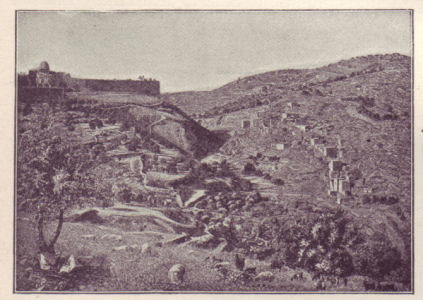 THE WALL OF JERUSALEM AS IT NOW IS |
This made David very angry, and he said to his men, "Whoever first climbs up the wall, and strikes down the blind and the lame upon it, he shall be the chief captain and general of the whole army."
Then all the soldiers of David rushed against the wall, each striving to be first. The man who was able first to reach the enemies and strike them down was Joab, the son of David's sister Zeruiah; and he became the commander of David's army, a place which he held as long as David lived. After the fortress on Mount Zion was taken from the Jebusites, David made it larger and stronger, and chose it for his royal house; and around it the city of Jerusalem grew up as the chief city in David's kingdom.
The Philistines soon found that there was a new king in Israel, and a ruler very different from King Saul. They gathered their army and came against David. He met them in the valley of Rephaim, a little to the south of Jerusalem, and won a great victory over them, and carried away from the field the images of their gods; but that the Israelites might not be led to worship them, David burned them all with fire.
A second time the Philistines came up and encamped in the valley of Rephaim. And when David asked of the Lord what he should do, the Lord said to him, "Do not go against them openly. Turn to one side, and be ready to come against them from under the mulberry-trees; and wait there until you hear a sound overhead in the tops of trees. When you hear that sound, it will be a sign that the Lord goes before you. Then march forth and fight the Philistines."
And David did as the Lord commanded him; and again a great victory was won over the Philistines. But David did not rest when he had driven the Philistines back to their own land. He marched with his men into the Philistines' country, and took their chief city, Gath, which was called "the mother city of the Philistines." He conquered all their land; and ended the war of a hundred years by making all the Philistine plain subject to Israel.
Now that the land was free, David thought that the time had come to bring the holy ark of the Lord out from its hiding-place, where it had remained all through the rule of Samuel and the reign of Saul. (See Story Sixteen in Part Second.) This was in Kirjath-jearim, called also Baale, a town on the northern border of Judah. David prepared for the ark a new Tabernacle on Mount Zion; and with the chosen men of all the tribes, he went to bring up the ark to Mount Zion.
They did not have the ark carried by the priests, as it had been taken from place to place in the earlier days; but they stood it on a wagon, to be drawn by oxen, driven by the sons of the man in whose house the ark had been standing, though these men were not priests. And before the ark walked David and the men of Israel, making music upon all kinds of musical instruments.
At one place the road was rough, and the oxen stumbled, and the ark almost fell from the wagon. Uzza, one of the men driving the oxen, took hold of the oxen, took hold of the ark to steady it. God's law forbade any one except a priest from touching the ark, and God was displeased with Uzza for his carelessness; and Uzza fell dead by the ark of the Lord.
This death alarmed David and all the people. David was afraid to have the ark of God come into his city. He stopped the procession and placed the ark in the house near by of a man named Obed-edom. There it stayed three months. They were afraid that it might bring harm to Obed-edom and his family; but instead it brought a blessing upon them all.
When David heard of the blessings that had come to Obed-edom with the ark, he resolved to bring it into his own city on Mount Zion. This time the priests carried it as the law commanded, and sacrifices were offered upon the altar. They brought up the ark into its new home on Mount Zion, where a Tabernacle was standing ready to receive it. Then as of old the priests began to offer the daily sacrifices, and the services of worship were held, after having been neglected through so many years.
David was now living in his palace on Mount Zion, and he thought of building a temple to take the place of the Tabernacle, for the ark and its services. He said to Nathan, who was a prophet, through whom the Lord spoke to the people, "See, now I live in a house of cedar; but the ark of God stands within the curtains of a tent."
"Go, to all that is in your heart," answered Nathan the prophet, "for the Lord is with you."
And that night the voice of the Lord came to Nathan, saying, 'Go and tell my servant David, thus saith the Lord, "Since the time when the children of Israel came out of Egypt, my ark has been in a tent; and I have never said to the people, build me a house of cedar. Say to my servant David, I took you from the sheep-pasture, where you were following the sheep, and I have made you a prince over my people Israel, and I have given you a great name and great power. And now, because you have done my will, I will give you a house. Your son shall sit on the throne after you, and he shall build me a house and a Temple. And I will give you and your children and your descendants, those who shall come from you, a throne and a kingdom that shall last forever."
This promise of God, that under David's line should rise a kingdom to last always, was fulfilled in Jesus Christ, who came long afterward from the family of David, and who reigns as King in heaven and earth.
The Cripple at the King's Table
As soon as the kings of the nations around Israel saw that a strong man was ruling over the tribes, they began to make war upon David, for they feared to see Israel gaining in power. So it came to pass that David had many wars. The Moabites, who lived on the eart of the Dead Sea, went to war with David, but David conquered them, and made Moab submit to Israel. Far in the north, the Syrians came against David; but he won great victories over them, and took Damascus, their chief city, and held it as a part of his kingdom. In the south, he made war upon the Edomites, and brought them under his rule.
For a number of years David was constantly at war, but at last he was at peace, the ruler of all the lands from the great river Euphrates on the north, down to the wilderness on the south, where the Israelites had wandered; and from the great desert on the eat to the Great Sea on the west. All these lands were under the rule of King David, except the people of Tyre and Sidon, who lived beside the Great Sea on the north of Israel. These people, the Tyrians, never made war on Israel, and their king, Hiram, was one of David's best friends. The men of Tyre cut down cedar-trees on Mount Lebanon for David, and brought them to Jerusalem, and built for David the palace which became his home.
When David's wars were over, and he was at rest, he thought of the promise that he had made to his friend Jonathan, the brave son of Saul (see Story Six in this Part), that he would care for his children. David asked of his nobles and the men at his court, "Are there any of Saul's family living, to whom I can show kindness for the sake of Jonathan?"
They told David of Saul's servant, Ziba, who had the charge of Saul's farm in the country; and David sent for him. Ziba had become a rich man from his care of the lands that had belonged to Saul.
David said to Ziba, "Are there any of Saul's family living, to whom I can show some of the kindness which God has shown toward me?"
And Ziba said, "Saul's son Jonathan left a little boy, named Mephibosheth, who is now grown to be a man. He is living at Lo-debar, on the east of Jordan."
This child of Jonathan was in the arms of his nurse when the news came of the battle at Mount Gilboa, where Jonathan was slain. The nurse fled with him, to hide from the Philistines, and in running fell; and the child's feet were so injured that ever after he was lame.
Perhaps he was kept hidden in the distant place on the east of Jordan, from fear lest David, now that he was king, might try to kill all those who were of Saul's family; for such deeds were common in those times, when one king took the power away from another king's children.
David sent for Mephibosheth, Jonathan's son; and he was brought into David's presence, and fell down in his face before the king, for he was in great fear. And David said to him, "Mephibosheth, you need have no fear. I will be kind to you, because I loved Jonathan, your father, and he loved me. You shall have all the lands that ever belonged to Saul and his family; and you shall always sit at my table in the royal palace."
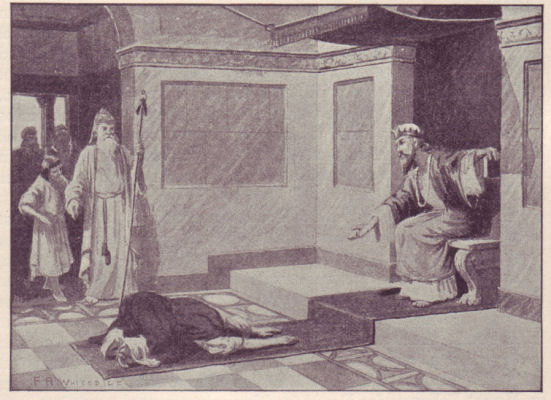 MEPHIBOSHETH, JONATHAN'S SON, BEFORE DAVID |
Then the king called Ziba, who had been the servant of Saul, and said to him, "All the lands and houses that once belonged to Saul I have given to Mephibosheth. You shall care for them, and bring the harvests and the fruits of the fields to him. But Mephibosheth shall live here with me, and shall sit down at the king's table among the princes of the kingdom."
So Mephibosheth, the lame son of Jonathan, was taken into David's palace, and sat at the king's table, among the highest in the land. And Ziba, with his fifteen sons and his twenty servants, waited on him, and stood at his command.
This kindness of David to Mephibosheth might have brought trouble to David; for Mephibosheth the son of Jonathan, and the grandson of Saul, might have been the king if David had not won the crown. By giving to Saul's grandson a place at his table, and showing him honor, David might have helped him to take the kingdom away from himself, if Mephibosheth bad been a stronger man, with a purpose to win the throne of Israel. But David was generous, and Mephibosheth was grateful, and was contented with his place in the palace.
The Prophet's Story of the Little Lamb
When David first became king he went with his army upon the wars against the enemies of Israel. But there came a time when the cares of his kingdom were many, and David left Joab, his general, to lead his warriors, while he stayed in his palace on Mount Zion.
One evening, about sunset, David was walking upon the roof of his palace. He looked down into a garden near by, and saw a woman, who was very beautiful. David asked one of his servants who this woman was, and he said to him, "Her name is Bath-sheba, and she is the wife of Uriah."
Now Uriah was an officer in David's army, under Joab; and at that time he was fighting in David's war against the Ammonites, at Rabbah, near the desert, on the east of Jordan. David sent for Uriah's wife, Bath-sheba, and talked with her. He loved her, and greatly longed to take her as one of his own wives, -- for in those times it was not thought a sin for a man to have more than one wife. But David could not marry Bath-sheba while her husband, Uriah, was living. Then a wicked thought came into David's heart, and he formed a plan to have Uriah killed, so that he could then take Bath-sheba into his own house.
David wrote a letter to Joab, the commander of his army. And in the letter he said, "When there is to be a fight with the Ammonites, send Uriah into the middle of it, where it will be the hottest; and manage to leave him there, so that he may be slain by the Ammonites."
And, Joab did as David had commanded him. He sent Uriah with some brave men to a place near the wall of the city, where he knew that the enemies would rush out of the city upon them; there was a fierce fight beside the wall; Uriah was slain, and other brave men with him. Then Joab sent a messenger to tell King David how the war was being carried on, and especially that Uriah, one of his brave officers, had been killed in the fighting.
When David heard this, he said to the messenger, "Say to Joab, 'Do not feel troubled at the loss of the men slain in battle, The sword must strike down some. Keep up the siege; press forward, and you will take the city."
And after Bath-sheba had mourned over her husband's death for a time, then David took her into his palace, and she became his wife. And a little child was born to them, whom David loved greatly. Only Joab, and David, and perhaps a few others, knew that David had caused the death of Uriah; but God knew it, and God was displeased with David for this wicked deed.
Then the Lord sent Nathan, the prophet, to David to tell him that, though men knew not that David had done wickedly, God had seen it, and would surely punish David for his sin. Nathan came to David, and he spoke to him this:
"There were two men in one city; one was rich, and the other poor. The rich man had great flocks of sheep and herds of cattle; but the poor man had only one little lamb that he had bought. It grew up in his home with his children, and drank out of his cup, and lay upon his lap, and was like a little daughter to him.
"One day a visitor came to the rich man's house to dinner. He did not take one of his own sheep to kill for his guest. He robbed the poor man of his lamb, and killed it, and cooked it for a meal with his friend."
When David heard this, he was very angry. He said to Nathan, "The man who did this thing deserves to die! He shall give back to his poor neighbor fourfold for the lamb taken from him. How cruel to treat a poor man thus, without pity for him!"
And Nathan said to David, "You are the man who has done this deed. The Lord made you king in place of Saul, and gave you a kingdom. You have a great house, and many wives. Why, then, have you done this wickedness in the sight of the Lord? You have slain Uriah with the sword of the men of Ammon; and you have taken his wife to be your wife. For this there shall be a sword drawn against your house; you shall suffer for it, and your wives shall suffer, and your children shall suffer, because you have done this."
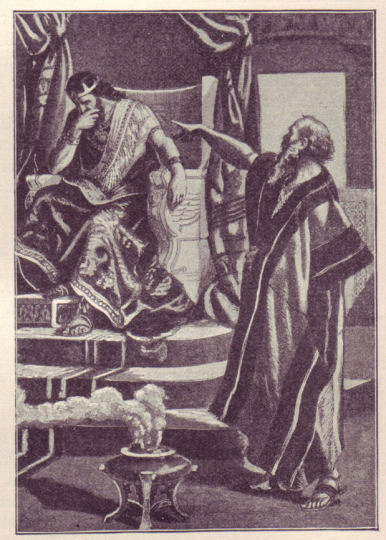 THE PROPHET NATHAN REPROVES DAVID |
When David heard all this, he saw, as he had not seen before, how great was his wickedness. He was exceedingly sorry, and said to Nathan, "I have sinned against the Lord."
And David showed such sorrow for his sin that Nathan said to him, "The Lord has forgiven your sin; and you shall not die on account of it. But the child that Uriah's wife has given to you shall surely die."
Soon after this the little child of David and Bath-sheba, whom David loved greatly, was taken very ill. David prayed to God for the child's life; and David took no food, but lay in sorrow, with his face upon the floor of his house. The nobles of his palace came to him, and urged him to rise up and take food, but he would not. For seven days the child grew worse and worse, and David remained in sorrow. Then the child died; and the nobles were afraid to tell David, for they said to each other, "If he was in such grief while the child was living, what will he do when he hears that the child is dead?"
But when King David saw the people whispering to one another with sad faces, "Is the child dead?"
And they said to him, "Yes, O king, the child is dead."
Then David rose up from the floor where he had been lying. He washed his face, and put on his kingly robes. He went first to the house of the Lord, and worshipped; then he came to his own house, and sat down to his table, and took food. His servants wondered at this, but David said to them, "While the child was still alive, I fasted, and prayed, and wept; for I hoped that by prayer to the Lord, and by the mercy of the Lord, his life might be spared. But now that he is dead, my prayers can do no more for him. I cannot bring him back again. He will not come back to me, but I shall go to him."
And after this God gave to David and to Bath-sheba, his wife, another son, whom they named Solomon. The Lord loved Solomon, and he grew up to be a wise man.
After God had forgiven David's great sin, David wrote the Fifty-first Psalm, in memory of his sin and of God's forgiveness. Some of its verses are these:
|
Have mercy upon me. O God, according to thy loving kindness According to the multitude of thy tender mercies blot out my transgressions Wash me thoroughly from mine iniquity, And cleanse me from my sin, For I acknowledge my transgressions; And my sin is ever before me. Against thee, thee only, have I sinned, And done that which is evil in thy sight. PoemSeparatorText(8, *, 4) Purge me with hyssop, and I shall be clean; Wash me, and I shall be whiter than snow. PoemSeparatorText(8, *, 4) Hide thy face from my sins, And blot out all my iniquities. Create in me a clean heart, O God, And renew a right spirit within me, Cast me not away from thy presence; And take not thy holy spirit from me, Restore unto me the joy of thy salvation; And uphold me with a free spirit. Then will I teach trangressors thy ways; And sinners shall be converted with thee. PoemSeparatorText(8, *, 4) For thou delightest not in sacrifice; else would I give it: Thou hast no pleasure in burnt-offering. The sacrifices of God are a broken spirit; A broken and a contrite heart, O God, thou will not despise. |
David's Handsome Son, and How He Stole The Kingdom
Not long after David's sin, the sorrows of which the prophet had foretold him, began to fall upon David. He had many wives, and his wives had many sons; but most of his sons had grown up wild and wicked, because David had not watched over them, and had not taught them in their youth to love God and do God's will. He had been too busy as a king to do his duty as a father.
The oldest of David's sons was Absalom, whose mother was the daughter of Talmai, the king of a little country called Geshur, on the north of Israel. Absalom was said to be the most beautiful young man in all the land. He had long locks of hair, of which he was very proud, because all the people admired them. Absalom became very angry with Amnon, another of David's sons, because Amnon had done wrong to Absalom's sister, named Tamar.
But Absalom hid his anger against Amnon, and one day invited Amnon with all the king's sons to a feast at his house in the country. They all went to the feast; and while they were all at the table Absalom's servants, by his orders, rushed in and killed Amnon. The other prices, the king's sons, were alarmed, fearing that they also would be slain; and they ran away in haste. But no harm was done to the other princes, and they came back in safety to David.
David was greatly displeased with Absalom, though he loved him more than any other of his sons; and Absalom went away from his father's court to that of his grandfather, his mother's father, the king of Geshur. There Absalom stayed for three years; and all the time David longed to see him, for he felt that he had now lost both sons, Absalom as well as Amnon. And after three years David allowed Absalom to come back to Jerusalem; but for a time would not meet him, because he had caused his brother's death. At last David's love was so strong that he could no longer refuse to see his son. He sent for Absalom, and kissed him, and took him back to his old place among the king's sons in the palace.
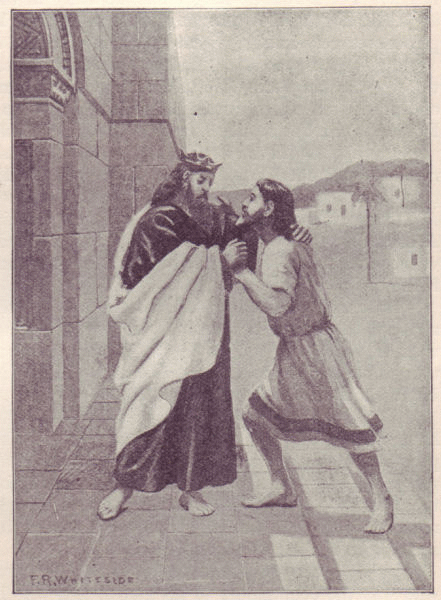 DAVID SENDS FOR ABSALOM AND KISSES HIM |
But Absalom's heart was wicked, and ungrateful, and cruel. He formed a plan to take the throne and the kingdom away from his father, David, and to make himself King in David's place. He began by living in great state, as if he were already a king, with a royal chariot, and horses, and fifty men to run before him. Then too, he would rise early in the morning, and stand at the gate of the king's palace, and meet those who came to the king for any cause. He would speak to each man, and find what was the purpose of his coming; and he would say:
"Your cause is good and right, but the king will not hear you; and he will not allow any other man to hear you in his place. O that I were made a judge! then I would see that right was done, and that every man received his due!" And when any man bowed down before Absalom as the king's son, he would reach out his hand, and lift him up, and kiss him as his friend. Thus Absalom won the hearts of all whom he met, from every part of the land, until very many wished that he was king instead of David, his father. For David no longer led the army in war, not did he sit as judge, nor did he go among the people; but lived apart in his palace, scarcely knowing what was being done in the land.
After four years Absalom thought that he was strong enough to seize the kingdom. He said to David, "Let me go to the city of Hebron, and there worship the Lord, and keep a promise which I made to the Lord while I was in the land of Geshur."
David was pleased at this, for he thought that Absalom really meant to serve the Lord. So Absalom went to Hebron, and with him went a great company of his friends. A few of these knew of Absalom's plans, but most of them knew nothing. At Hebron, Absalom was joined by a very wise man, named Ahithophel, who was one of David's chief advisers, and in one whom David trusted fully.
Suddenly the word was sent through all the land by swift runners, "Absalom has been made king at Hebron!" Those who were in the secret helped to lead others, and soon it seemed as though all the people were on Absalom's side and ready to receive him as king in place of David.
The news came to David in the palace, that Absalom had made himself king, that many of the rulers were with him, and that the people in their hearts really desired Absalom. David did not know whom he could trust, and he prepared to escape before it would be too late. He took with him a few of his servants who chose to remain by his side, and his wives, and especially his wife Bath-sheba, and her son, the little Solomon.
As they were going out of the gates they were joined by Ittai, who was the commander of his guard, and who had with him six hundred trained men of war. Ittai was not an Israelite, but was a stranger in the land, and David was surprised that he should offer to go with him. He said to Ittai, "Why do you, a stranger, go with us? I know not to what places we may go or what trouble we may meet. It would be better for you and your men to go back to your own land; and may mercy and truth go with you!"
And Ittai answered the king, "As the Lord God lives, and as my lord the king lives, surely in what place the king shall be, whether in death or in life, there will we, his servants, be with him."
So Ittai and his brave six hundred soldiers went with David out of the city, over the brook Kedron, toward the wilderness. And soon after came Zadok and Abiathar, the priests, and the Levites, carrying the holy ark of the Lord. And David said, "Take back the ark of God into the city. if I shall find favor in the sight of the Lord, he will bring me again to see it; but if the Lord says, 'I have no pleasure in David,' then let the Lord do with me as seems good to him."
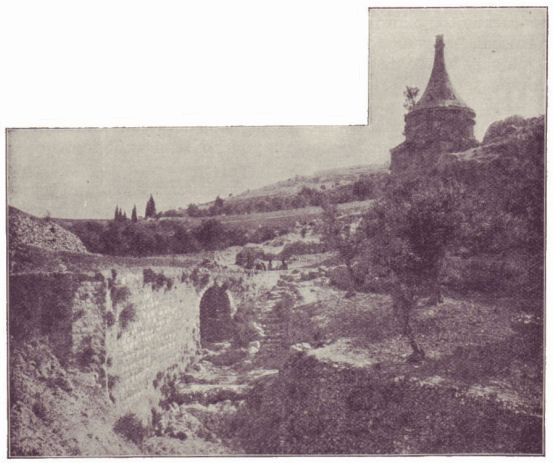 THE BROOK KEDRON |
And David thought also that the priests might help him more in the city than if they should go away with him. He said to Zadok, "Do you go back to the city and watch; and send word to me by your son, Ahimaaz, and Jonathan, the son of Abiathar. I will wait at the crossing place of the river Jordan for news from you."
So Zadok and Abiathar, the priests, carried the holy ark back to its Tabernacle on Mount Zion, and watched closely, that they might send David word of anything that would help his cause. David walked up the steep side of the Mount of Olives, on the east of Jerusalem, with his head covered and his feet bare, as one on mourning, weeping as he walked. And all the people who were with him, and those who saw him, were weeping in their sorrow over David's fall from his high place.
On the top of the hill David found another man waiting to see him. It was Hushai, who was one of David's best friends. He stood there in sorrow, with his garments torn and earth upon his head, ready to go into the wilderness with David. But David said to Hushai, "If you go with us you cannot help me in any way; but if you stay in the city, and pretend to be Absalom's friend, then perhaps you can watch against the advice that the wise man, Ahithophel, gives to Absalom, and prevent Absalom from following it. Zadok and Abiathar, the priests will help you, and through their sons, Ahimaaz and Jonathan, you can send word to me of all that you hear."
A little past the top of the hill another man was waiting for David. It was Ziba, the servant of Mephibosheth. You remember how kindly David had treated Mephibosheth, because he was the son of David's dear friend, Jonathan. Ziba had by his side a couple of asses saddled, and on them two hundred loaves of bread, and a hundred clusters of raisins, and a quantity of fruit, and a goat-skin full of wine. David said to Ziba, "For what purpose are all these things here?"
And Ziba said, "The asses are for the king; and here is food for the journey, and wine for those who may grow faint and may need it in the wilderness."
And David asked Ziba, "Where is Mephibosheth, your master?"
"He is in Jerusalem," said Ziba; "for he says that the kingdom may be given back to him, as he is the heir of Saul's house."
David felt very sad as he heard that Mephibosheth had forsaken him, and he said to Ziba, "Whatever has belonged to Mephibosheth shall be yours from this time."
But David did not know that all Ziba's words were false, and that Mephibosheth had not forsaken him. This man was Shimei, and he belonged to the family of King Saul. As David and his party walked along the crest of the hill, Shimei walked over the hill on the other side of a narrow valley, and as he walked he threw stones at David, and cursed him, shouting, "Get out, get out, you man of blood, you wicked man! Now the Lord is bringing upon you all the wrong that you did to Saul, when he was your king. You robbed Saul of his kingdom, and now your own son is robbing you. You are suffering just as you deserve, for you are a bloody man!"
Then Abishai, the son of Zeruiah, who was one of David's men, and David's own nephew, said, "Why should this dog be allowed to bark against my lord the king? Let me go across the valley, and I will strike off his head at one blow!"
But David said, "If it is the Lord's will that this man should curse David, then let him curse on. My own son is seeking to take away my life, and is it strange that this man of another tribe should hate me? It may be that the Lord will look upon the wrong done to me, and will do good to me."
So David and his wives, and his servants, and the soldiers who were faithful to him, went on toward the wilderness and the valley of the Jordan. Soon after David had escaped from the city, Absalom came into it with his friends and a host of his followers. As Absalom drew near, Hushai, David's friend, stood by the road, crying, "Long live the king! Long live the king!"
And Absalom said to Hushai, "Is this the way you treat your friend? Why have you not stayed beside your friend David?"
Hushai said to Absalom, "Whom the Lord and his people have chosen, him will I follow, and with him I will stay. As I have served the father, so will I serve the son."
Then Hushai went into the palace among the followers of Absalom. And Absalom said to Ahithophel, "Tell me what to do next?"
Now Ahithophel was a very wise man. He knew what was best for Absalom's success, and he said, "Let me choose out twelve thousand men, and I will pursue David this very night. We will come upon David when he is tired, while only a few people are with him, and before he has time to form any plans or to gather an army, I will kill David, and will harm no one else; and then you can reign as king in peace, and all the people will submit to you when they know that David is no longer living."
Absalom thought that this was wise advice; but he sent for Hushai. He told him what Ahithophel had said, and asked for his advice also. And Hushai said, "The advice that Ahithophel gives is not good for the present time. You know that David and his men are very brave, and just now they are as savage as a bear robbed of her cubs. David is with his men in some safe place, hidden in a cave or among the mountains, and they will watch against those who come out to seek for them, and will rush upon them suddenly from their hiding-place. Then, as soon as the news goes through the land that Absalom's men have been beaten, everybody will turn away from Absalom to David. The better plan would be to wait until you can gather all the men of war in Israel, from Dan in the north to Beersheba in the south. And then, if David is in a city, there will be men enough to pull the city in pieces, or if he is in the field we will surround him on every side." And Absalom and the rulers who were with him said to each other, "The advice of Hushai is better than the advice of Ahithophel. Let us do as Hushai tells us to do."
So Absalom sat down in his father's palace and began to enjoy himself while they were gathering his army. This was just what Hushai wished, for it would give David time to gather his army also, and he knew that the hearts of the people would soon turn from Absalom back to David.
Hushai told Zadok and Abiathar, the priests, of Absalom's plans, and they sent word by a young woman to their sons, Ahimaaz and Jonathan, who were watching outside the city, and these young men hastened to tell David, who was waiting beside the river Jordan. Then David and his men found a safe refuge in Mahanaim, in the tribe of Gad, across Jordan; and there his friends from all the land began to come to him.
When Ahithophel saw that his advice had not been taken, and that Hushai was preferred in his place, he knew at once that Absalom could not hold the kingdom, and that Absalom's cause was already as good as lost. He went to his home, put all his house and his affairs in order, and hanged himself; for he thought that it was better to die by his own hand than to be put to death as a traitor by King David.
Absalom for a little time had his wish. He sat on the throne, and wore the crown, and lived in the palace at Jerusalem as the king of Israel.
Absalom in the Wood: David on the Throne
The land on the east of Jordan, where David found a refuge, was called Gilead, a word which means "high," because it is higher than the land opposite on the west of Jordan. There, in the city of Mahanaim, the rulers and the people were friendly to David. They brought food of all kinds and drink for David and those who were with him; for they said, "The people are hungry, and thirsty, and very tired, from their long journey through the wilderness."
And at this place David's friends gathered from all the tribes of Israel, until around him was an army. It was not so large as the army of Absalom, but in it were more of the brave old warriors who had fought under David in other years. David divided his army into three parts, and placed over the three parts Joab, his brother Abishai, and Ittai, who had followed him so faithfully.
David said to the chiefs of his army and to his men, "I will go out with you into the battle."
But the men said to David, "No, you must not go with us; for if half of us should lose our lives, no one will care; but you are worth ten thousand of us, and your life is too precious. You must stay here in the city, and be ready to help us if we need help."
So the king stood by the gate of Mahanaim while his men marched out by hundreds and by thousands. And as they went past the king the men heard him say to the three chiefs, Joab, and Abishai, and Ittai, "For my sake, deal gently with the young man, Absalom."
Even to the last David loved the son who had done to him such great wrong, and David would have them spare his life.
A great battle was fought on that day at a place called "The Wood of Ephraim," though it was not in the tribe of Ephraim, but of Gad, on the east of the Jordan. Absalom's army was under the command of a man named Amasa, who was a cousin of Joab; for his mother, Abigail, and Joab's mother, Zeruiah, were both sisters of David. So both the armies were led by nephews of King David. Absalom himself went into the battle, riding upon a mule, as was the custom of kings.
David's soldiers won a great victory, and killed thousands of Absalom's men. The armies were scattered in the woods, and many men were lost, so that it was said that the woods swallowed up more men than the sword. When Absalom saw that his cause was hopeless he rode away, hoping to escape. But as he was riding under the branches of an oak-tree, his head, with its great mass of long hair, was caught in the boughs of the tree. He struggled to free himself, but could not. His mule ran away, and Absalom was left hanging in the air by his head.
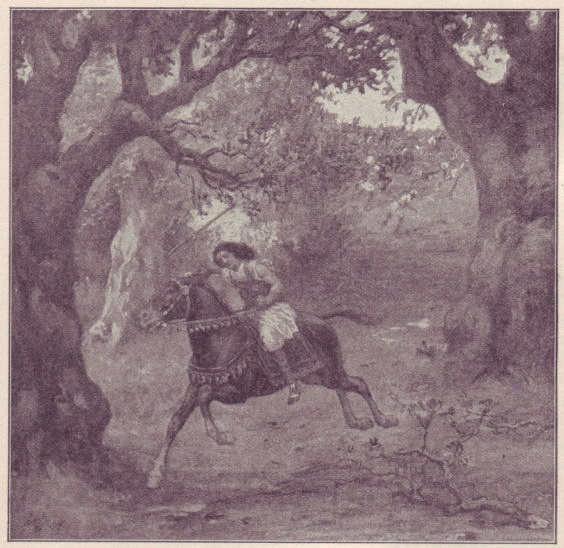 ABSALOM FLEEING THROUGH THE FOREST |
One of David's soldiers saw him, and said to Joab, "I saw Absalom hanging in an oak."
"Why did you not kill him?" asked Joab. "If you had killed him I would have given you ten pieces of silver and a girdle."
"If you should offer me a thousand pieces of silver," answered the soldier, "I would not touch the king's son; for I heard the king charge all the generals and the men, 'Let no one harm the young man Absalom.' And if I had slain him, you yourself would not have saved my life from the king's anger."
"I cannot stay to talk with you," said Joab; and with three darts in his hand he hastened to the place where Absalom was hanging. He thrust Absalom's heart through with the darts, and after that his followers, finding that Absalom was still living, pierced his body until they were sure that he was dead. Then they took down his body, and threw it into a deep hole in the forest, and heaped a great pile of stones upon it.
During his life Absalom had built for himself a monument in the alley of the Kidron, on the east of Jerusalem. There he had expected to be buried; but though the monument stood long afterward, and was called "Absalom's pillar," yet Absalom's body lay not there, but under a heap of stones in the wood of Ephraim.
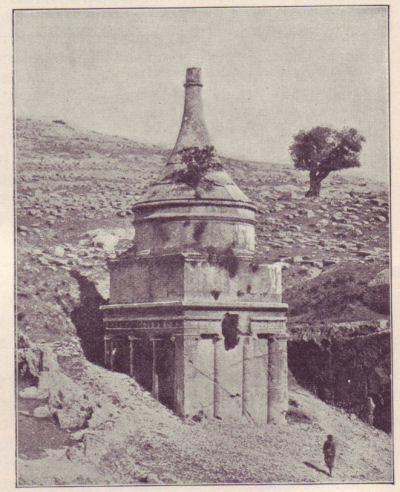 ABSALOM'S PILLAR |
After the battle Ahimaaz, the son of the priest Zadok, came to Joab. Ahimaaz was one of the two young men who brought news from Jerusalem to David at the river Jordan, as we read in the last Story. He said to Joab, "Let me run to the king, and take to him the news of the battle."
But Joab knew that the message of Absalom's death would not be pleasing to King David, and he said, "Some other time you shall bear news, but not to-day, because the king's son is dead."
And Joab called a negro who was standing near, and said to him, "Go, and tell the king what you have seen."
The negro bowed to Joab, and ran. But after a time Ahimaaz, the son of Zadok, again said to Joab, "Let me also run after the negro, and take news."
"Why do wish to go, my son?" said Joab; "the news will not bring you any reward."
"Anyhow, let me go," said the young man; and Joab gave him leave. Then Ahimaaz ran with all his might, and by a better road over the plain, though less direct than the road which the negro had taken over the mountains. Ahimaaz outran the negro, and came first in sight to the watchman who was standing on the wall, while King David was waiting below in the little room between the outer and inner gates, anxious for news of the battle, but more anxious for his son, Absalom.
The watchman on the wall called down to the king, and said, "I see a man running alone."
And the king said, "If he is alone, he is bringing a message." He knew that if men were running away after a defeat in battle there would be a crowd together. Then the watchman called again, "I see another man running alone."
And the king said, "He also is bringing some news."
The watchman spoke again, "The first runner is coming near, and he runs like Ahimaaz, the son of Zadok."
And David said, "He is a good man, and he comes with good news." Ahimaaz came near, and cried out as he ran, "All is well!"
The first words which the king spoke were, "Is it well with the young man Absalom?"
Ahimaaz was too wise to bring to the king the word of Absalom's death. He left that to the other messenger, and said, "When Joab sent me, there was a great noise over something that had taken place, but I did not stop to learn what it was."
A little later came the negro, crying, "News for my lord the king! This day the Lord has given you victory over your enemies!"
And David said again, "Is it well with the young man Absalom?"
Then the negro, who knew nothing of David's feelings, answered, "May all the enemies of my lord the king, and all that try to do him harm, be as that young man is!"
Then the king was deeply moved. His sorrow over Absalom made him forget the victory that had been won. Slowly he walked up the steps to the room in the tower over the gate, and as he walked he said, "O my son Absalom! my son, my son Absalom! I wish before God that I had died for you, O Absalom, my son, my son!"
The word soon went forth that the king, instead of rejoicing over the victory, was weeping over his son. The soldiers came stealing back to the city, not as conquerors, but as if they had been defeated. Every one felt sorry for the king, who sat in the room over the gate, with his face covered, and crying out, "O Absalom, my son! my son, my son Absalom!"
But Joab saw that such great sorrow as the king showed was not good for his cause. He came to David, and said to him, "You have to put to shame this day all those who have fought for you and saved your life. You have shown that you love those who hate you, and that you hate those who love you. You have said by your actions that your princes and your servants, who have been true to you, are nothing to you; and that if Absalom had lived and we had all died, you would have been better pleased. Now rise up, and act like a man, and show regard for those who have fought for you. I swear to you in the name of the Lord, that unless you do this, not a man will stay on your side, and that will be worse for you than all the harm that has ever come upon you in all your life before this day!"
Then David rose up, and washed away his tears, and put on his robes, and took his seat in the gate as a king. After this he came from Mahanaim to the river Jordan, and there all the people met him, to bring him back to his throne in Jerusalem.
Among the first to come was Shimei, the man who had cursed David and thrown stones at him as he was flying from Absalom. He fell on his face, and confessed his crime, and begged for mercy. Abishai, Joab's brother, said, "Shall not Shimei be put to death, because he cursed the king, the Lord's anointed?"
But David said, "Not a man shall be put to death this day in Israel, for to-day I am king once more over Israel. You shall not be slain, Shimei; I pledge you the word of a king."
And Ziba, the servant of Mephibosheth, was there with his sons and his followers; and Mephibosheth was there also to meet the king. And Mephibosheth had not dressed his lame feet, nor trimmed his beard, nor washed his clothes, from the day when David had left Jerusalem until the day when he returned in peace. And David said to him, "Mephibosheth, why did you not offer to go with me?"
"My lord, O king," said Mephibosheth, "my servant deceived me. He said, 'You are lame, and cannot go; but I will go in your name with the king, and will help him.' And he has done me wrong with the king; but what matters it all, now that the king has come again?"
David said, "You and Ziba may divide the land and the property."
And Mephibosheth said, "Let him have it all, now that the king has come in peace to his own house!"
The army of Absalom had melted away, and was scattered throughout all Israel. David was still displeased with Joab, the chief of his army, because he had slain Absalom, contrary to David's orders. He sent a message to Amasa, who had been the commander of Absalom's army, and who was, like Joab and Abishai, David's own nephew. He said to Amasa, "You are of my own family, of my bone and my flesh, and you shall be the general in place of Joab."
Joab and his brother were strong men, not willing to submit to David's rule; and David thought that he would be safer on his throne if they did not hold so much power. Also, David thought that to make Amasa general would please not only those who had been friends to Absalom, but many more of the people, for many feared and hated Joab.
At the river Jordan almost the whole tribe of Judah were gathered to bring the king back to Jerusalem. But this did not please the men of the other tribes. They said to the men of Judah, "You act as though you were the only friends of the king in all the land! We, too, have some right to David."
The men of Judah said, "The king is of our own tribe, and is one of us. we come to meet him because we love him."
But the people of the other tribes were still offended, and many of them went to their homes in anger. The tribe of Ephraim, in the middle of the land, was very jealous of the tribe of Judah, and unwilling to come again under David's rule. One man in Ephraim, Sheba, the son of Bichri, began a new rebellion against David, which for a time threatened again to overthrow David's power.
Amasa, the new commander of the army, called out his men to put down Sheba's rebellion. But he was slow in gathering his army, and Joab, the old general, went forth with a band of his own followers. Joab met Amasa, pretending to be his friend, and killed him, and then took the command. He shut up Sheba in a city far in the north, and finally caused him to be slain. So at last every enemy was put down; and David sat again in peace upon his throne. But Joab, whom David feared and hated because of many evil deeds that he had done, was, as before, the commander of the army and in great power. Joab was faithful to David, and was a strong helper to David's throne. Without Joab's courage and skill in David's cause David might have failed in some of his wars, and especially in the war against Absalom's followers. But Joab was cruel and wicked; and he was so strong that David could not control him. David felt that he was not fully the king while Joab lived.
But few people knew how David felt toward Joab; and in appearance the throne of David was now as strong as it had ever been; and David's last years were years of peace and of power.
The Angel with the Drawn Sword on Mount Moriah
After the death of Absalom, David ruled in peace over Israel for many years. His kingdom stretched from the river Euphrates to the border of Egypt, and from the Great Sea on the west to the great desert on the east. But again David did that which was very displeasing to God. He gave orders to Joab, who was the commander of his army, to send officers throughout all the tribes of Israel, and to count all the men who could go forth to battle.
It may be that David's purpose was to gather a great army for some new war. Even Joab, the general, knew that it was not right to do this; and he said to David, "May the Lord God make his people an hundred times as great as they are; but are they not all the servant of my lord the king? Why does the king command this to be done? Surely it will bring sin upon the king and upon the people."
But David was firm in his purpose, and Joab obeyed him, but not willingly. He sent men through all the twelve tribes to take the number of those in every city and town who were fit for war. They went throughout the land, until they had written down the number of eight hundred thousand men in ten of the tribes, and of nearly five hundred thousand men in the tribe of Judah, who could be called out for war. The tribe of Levi was not counted, because all its members were priests and Levites in the service of the Tabernacle; and Benjamin, on the border of which stood the city of Jerusalem, was not counted, because the numbering was never finished.
It was left unfinished because God was angry with David and with the people on account of this sin. David saw that he had done wickedly, in ordering the count of the people. He prayed to the Lord, and said, "O Lord, I have sinned greatly in doing this. Now, O Lord, forgive this sin, for I have done very foolishly."
Then the Lord sent to David, a prophet, a man who heard God's voice and spoke as God's messenger. His name was Gad. Gad came to David, and said to him, "Thus saith the Lord, 'You have sinned in this thing, and now you and your land must suffer for your sin. I will give you the choice of three troubles to come upon the land. Shall I send seven years of famine, in which there shall be no harvest? Or shall your enemies overcome you, and win victories over you for three months? Or shall there be three days when pestilence shall fall upon the land, and the people shall die everywhere?'"
And David said to the prophet Gad, "This is a hard choice of evils to come upon the land; but let me fall into the hand of the Lord, and not into the hands of men; for God's mercies are great and many. If we must suffer, let the three days of pestilence come upon the land."
Then the Lord's angel of death passed through the land, and in three days seventy thousand men died. And when the angel of the Lord stretched out his hand over the city of Jerusalem, the Lord had pity upon the people, and the Lord said to him, "It is enough; now hold back your hand, and cause no more of the people to die."
Then the Lord opened David's eyes, and he saw the angel standing on Mount Moriah, with a drawn sword in his hand, held out toward the city. then David prayed to the Lord, and he said:
"O Lord, I alone have sinned, and have done this wickedness before thee. These people are like sheep; they have done nothing. Lord, let thy hand fall on me, and not on these poor people."
Then the Lord sent the prophet Gad to David, and Gad said to him, "Go, and build an altar to the Lord upon the place where the angel was standing."
Then David and the men of his court went out from Mount Zion, where the city was standing, and walked up the side of Mount Moriah. They found the man who owned the rock on the top of the mountain threshing wheat upon it, with his sons; for the smooth rock was used as a threshing-floor, upon which oxen walked over the heads of grain, beating out the kernels with their feet. This man was not an Israelite, but a foreigner, of the race that had lived on those mountains before the Israelites came. His name was Araunah.
When Araunah saw David and his nobles coming toward him, he bowed down with his face toward the ground, and said, "For what purpose does my lord the king come to his servant?"
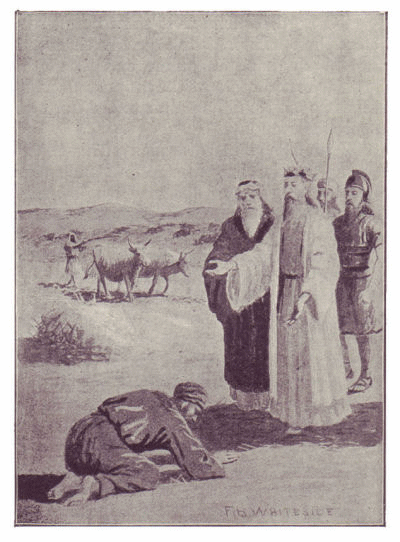 DAVID GETS THE THRESHING-FLOOR |
"I have come," said David, "to buy your threshing-floor, and to build upon it an altar to the Lord, that I may pray to God to stop the plague which is destroying the people."
And Araunah said to David, "Let my lord the king take it freely as a gift, and with it these oxen for a burnt-offering, and the threshing-tools and the yokes of the oxen for the wood on the altar. All this, O king, Araunah gives to the king."
"No," said King David; "I cannot take it as a gift; but I will pay you the price for it. For I will not make an offering to the Lord my God of that which costs me nothing."
So David gave to Araunah the full price for the land, and for the oxen, and for the wood. And there, on the rock, he built an altar to the Lord God, and on it he offered burnt-offerings and peace-offerings. The Lord heard David's prayer and took away the plague from the land.
And on that rock afterward stood the altar of the temple of the Lord on Mount Moriah. The rock is standing even to this day, and over it a building called "The Dome of the Rock." Those who visit the place can look upon the very spot where David built his altar and called upon the Lord.
Solomon on David's Throne
During the later years of David's reign he laid up great treasure of gold, and silver, and brass, and iron, for the building of a house to the Lord on Mount Moriah. This house was to be called "The Temple," and it was to be made very beautiful, the most beautiful building, and the richest, in all the land. David had greatly desired to build this house while he was the king of Israel, but God said to him:
"You have been a man of war, and have fought many battles, and shed much blood. My house shall be built by a man of peace. When you die, your son Solomon shall reign, and he shall have peace, and shall build my house."
So David made ready great store of precious things for the temple, also stone, and cedar to be used in the building. And David said to Solomon, his son:
"God has promised that there shall be rest and peace to the land while you are king; and the Lord will be with you, and you shall build a house, where God shall live among his people."
But David had other sons who were older than Solomon; and one of these sons, whose name was Adonijah, formed a plan to make himself king. David was now very old, and he was no longer able to go out of his palace and to be seen among the people.
Adonijah gathered his friends; and among them were Joab, the general of the army, and Abiathar, one of the two high-priests. They met at a place outside the wall, and had a great feast, and were about to crown Adonijah as king, when word came to David in the palace. David, though old and feeble, was still wise. He said, "Let us make Solomon king at once, and thus put an end to the plans of these men."
So, at David's command, they brought out the mule on which no one but the king was allowed to ride, and they placed Solomon upon it, and with the king's guards, and the nobles, and the great men, they brought the young Solomon down to the valley of Gihon, south of the city.
And Zadok the priest took from the Tabernacle the horn filled with holy oil that was used for anointing or pouring oil on the head of the priests when they were set apart for their work. He poured oil from this horn on the head of Solomon, and then the priests blew the trumpets, and all the people cried aloud, "God save King Solomon."
All this time Adonijah, and Joab, and their friends were not far away, almost in the same valley, feasting and making merry, intending to make Adonijah king. They heard the sound of trumpets and the shouting of the people. Joab said, "What is the cause of all this noise and uproar?"
A moment later Jonathan, the son of Abiathar, came running in. We read of him in Story Fourteen as one of the two young men who brought news from Jerusalem to David at the river Jordan. Jonathan said to the men who were feasting:
"Our lord, King David, has made Solomon king, and he has just been anointed in Gihon; and all the princes and the heads of the army are with him, and the people are shouting, 'God save King Solomon!' And David has sent from his bed a message to Solomon, saying, 'May the Lord make your name greater than my name has been! Blessed be the Lord, who has given me a son to sit this day on my throne!'"
When Adonijah and his friends heard this they were filled with fear. Every man went at once to his house, except Adonijah. He hastened to the altar of the Lord, and knelt before it, and took hold of the horns that were on its corners in front. This was a holy place, and he hoped that there Solomon might have mercy on him. And Solomon said, "If Adonijah will do right and be true to me as the king of Israel, no harm shall come to him; but if he does wrong he shall die." Then Adonijah came and bowed down before King Solomon, and promised to obey him, and Solomon said, "Go to your own house."
Not long after this David sent for Solomon; and from his bed he gave his last advice to Solomon. And soon after that David died, an old man, having reigned in all forty years, seven years over the tribe of Judah at Hebron, and thirty-three years over all Israel in Jerusalem. He was buried in great honor on Mount Zion, and his tomb remained standing for many years.
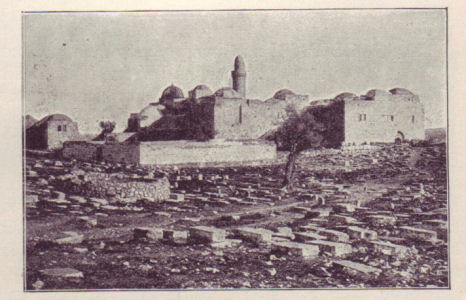 THE TOMB OF DAVID AS SHOWN TO-DAY IN JERUSALEM |
The Wise Young King
Solomon was a very young man, not more than twenty years old, when he became king and bore the heavy care of a great land. For his kingdom was larger than the twelve tribes of Israel, from Dan to Beersheba. On the north he ruled over all Syria, from Mount Hermon as far as the great river Euphrates. On the east, Ammon and Moab were under his power, and in the south all the land of Edom, far down into the desert where the Israelites had wandered long before. He had no wars, as David had before him, but at home and abroad his great realm was at peace as long as Solomon reigned.
Soon after Solomon became king he went to Gibeon, a few miles north of Jerusalem, where the altar of the Lord stood until the Temple was built. At Gibeon Solomon made offerings and worshipped the Lord God of Israel.
And that night the Lord God came to Solomon, and spoke to him. The Lord said, "Ask of me whatever you choose, and I will give it to you."
And Solomon said to the Lord, "O Lord, thou didst show great kindness to my father, David; and now thou hast made me king in my father's place. I am only a child, O Lord. I know not how to rule this great people, which is like the dust of the earth in number. Give me, O Lord, I pray thee, wisdom and knowledge, that I may judge this people, and may know how to rule them aright."
The Lord was pleased with Solomon's choice, and the Lord said to Solomon, "Since you have not asked of me long life, nor great riches for yourself, nor victory over your enemies, nor great power, but have asked wisdom and knowledge to judge this people, I have given you wisdom greater than that of any king before you, and greater than that of any king that shall come after you. And because you have asked this, I will give you not only wisdom, but also honor and riches. And if you will obey my words, as your father David obeyed, you shall have long life, and shall rule for many years."
Then Solomon awoke and found that it was a dream. But it was a dream that came true, for God gave to Solomon all that he had promised, wisdom, and riches, and honor, and power, and long life. Soon after this Solomon showed his wisdom. Two women came before him with two little babies, one dead and the other living. Each of the two women claimed the living child as her own, and said that the dead child belonged to the other woman. One of the women said, "O my lord, we two women were sleeping with our children in one bed. And this woman in her sleep lay upon her child, and it died. Then she placed her dead child beside me while I was asleep, and took my child. In the morning I saw that it was not my child; but she says it is mine, and the living child is hers. Now, O king, command this woman to give me my own child." Then the other woman said, "That is not true. The dead baby is her own, and the living one is mine, which she is trying to take from me."
The young king listened to both women. Then he said, "Bring me a sword."
They brought a sword, and then Solomon said, "Take this sword, and cut the living child in two, and give half of it to each one."
Then one of the women cried out, and said, "O my lord, do not kill my child! Let the other woman have it, but let the child live!"
But the other woman said, "No, cut the child in two, and divide it between us!"
Then Solomon said, "Give the living child to the woman who would not have it slain, for she is its mother."
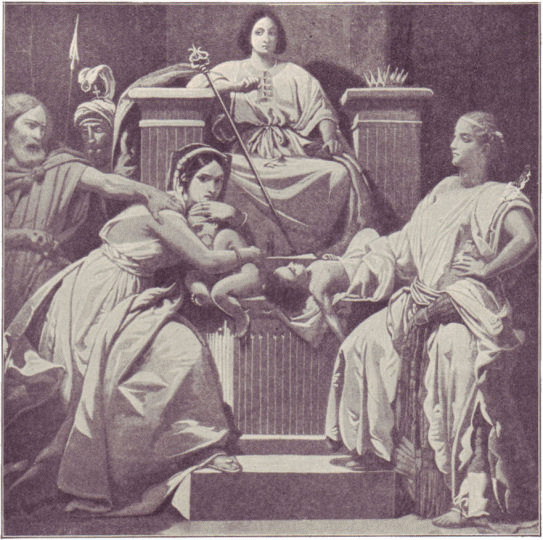 THE WISE DECISION OF THE YOUNG KING SOLOMON |
And all the people wondered at the wisdom of one so young; and they saw that God had gave him understanding.
Solomon chose some of the great men who had helped his father David, to stand beside his throne and do his will. Among those was a man named Benaiah, the son of Jehoioda. He was one of those who had come to David while he was hiding from Saul, as we read in Story Seven of this Part. At that time Benaiah, while still a young man, did a very bold deed. He found a lion in a deep pit, leaped into the pit, and killed the lion. For this act, Benaiah became famous, for few people would dare to venture so near to a lion, with the weapons in use at that time. This brave man was old in Solomon's day, but he was still strong, and Solomon gave him a high place, at the head of his guards.
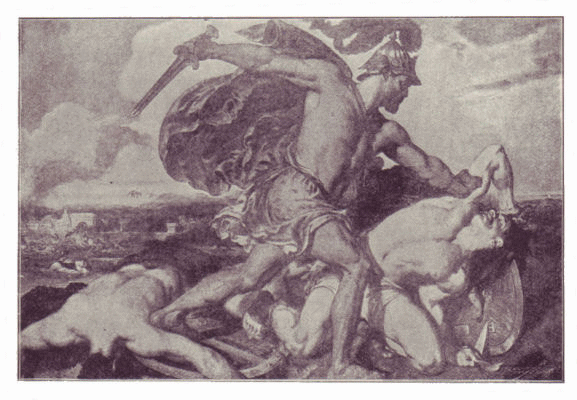 BENAIAH, THE BRAVE COMMANDER OF SOLOMON'S GUARD |
The House of God on Mount Moriah
The great work of Solomon's reign was the building of the house of God, which was called "The Temple." This stood on Mount Moriah, on the east of Mount Zion, and it covered the whole mountain. King David had prepared for it by gathering great stores of gold, and silver, and stone, and cedar-wood. The walls were made of stone, and the roof of cedar.
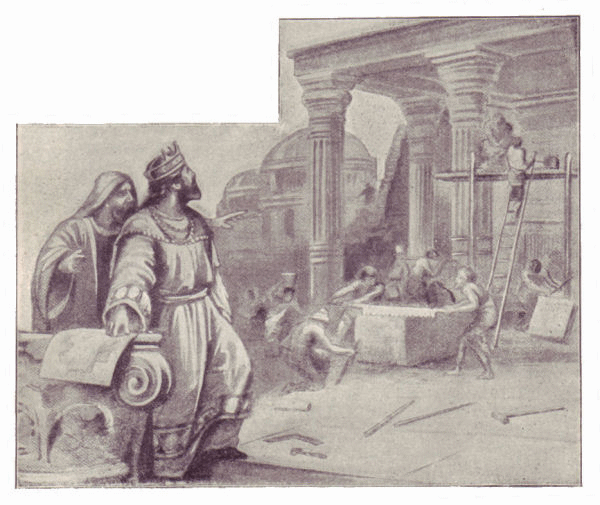 SOLOMON BUILDS THE TEMPLE |
For the building the cedar was brought from Mount Lebanon, where there were many large cedar-trees. The trees were cut down and carried to Tyre on the seacoast. There they were made into rafts in the Great Sea, and were floated down to Joppa. At Joppa they were taken ashore and were carried up to Jerusalem. All this work was done by the men of Tyre, at the command of their king, Hiram, who was a friend of Solomon, as he had been a friend of King David.
All the stones for the building of the Temple were hewn into shape and fitted together before they were brought to Mount Moriah. And all the beams for the roof and the pillars of cedar were carved and made to join each other; so that as the walls arose no sound of hammer or chisel was heard; the great building rose up quietly. You remember the form of the Tabernacle which was built before Mount Sinai, in the wilderness, with its court, its Holy Place, and its Holy of Holies. (See Part First, Story Twenty-seven.) The Temple was copied after the Tabernacle, except that it was much larger, and was a house of stone and cedar, instead of a tent.
The Tabernacle had one court around it, where the priests only could enter; but the Temple had two courts, both open to the sky, with walls of stone around them, and on the walls double rows of cedar pillars, and a roof above the pillars, so that people could walk around the court upon the walls protected from the sun. The court in front was for the people, for all the men of Israel could enter it, but no people of foreign race. This was called "the Fore-court." Beyond the Fore-court was the Court of the Priests, where only the priests were allowed to walk. At the east gate of this court stood the great altar of burnt-offerings, built of rough, unhewn stones, for no cut stones could be used in the altar. This altar stood on the rock which had been the threshing-floor of Araunah, where David saw the angel of the Lord standing.
Near the altar, in the Court of the Priests, stood a great tank for water, so large that it was called "a sea." It was made of brass, and stood on the backs of twelve oxen, also made of brass. From this the water was taken for washing the offerings.
Within the Court of the Priests stood the Holy House, or the Temple building, made of marble and of cedar. Its front was a high tower, called the Porch. In this were rooms for the high-priest and his sons.
Back of the Porch was the Holy Place. This was a long room in which stood the table for the twelve loaves of the bread, and golden altar of incense. In the Holy Place of the Tabernacle stood the golden lampstand. We are not sure whether it was in the Temple; for either in place of the lampstand, or perhaps in addition to it, Solomon placed ten lamps of gold in the Holy Place.
Between the Holy Place and the Holy of Holies was a great vail, as in the Tabernacle. And in the Holy of Holies the priests placed the Ark of the Covenant. This, you remember, was a box or chest of gold, in which were kept the two stone tablets of the Ten Commandments. This ark of the covenant was all that stood in the Holy of Holies; and into this room only the high-priest came, and he only on one day in the year, the great Day of Atonement, when the scapegoat was sent away.
Outside of the Temple building were rooms for the priests. They were built on the outer wall of the house, on the rear and the two sides, but not in front, three stories high; and were entered from the outside only. In these rooms the priests lived while they were staying at the Temple to lead in the worship.
Seven years were spent in building the Temple, but at last it was finished; and a great service was held when the house was set apart to the worship of the Lord. Many offerings were burned upon the great altar, the ark was brought from Mount Zion and placed in the Holy of Holies, and King Solomon knelt upon a platform in front of the altar and offered a prayer to the Lord before all the people, who filled the courts of the Temple.
One night, after the Temple was finished, the Lord appeared to Solomon in a dream for the second time. And the Lord said to Solomon, "I have heard the prayer which you have offered to me, and I have made this house holy. It shall be my house, and I will dwell there. And if you will walk before me as David, your father, walked, doing my will, then your throne shall stand forever. But if you turn aside from following the Lord, then I will leave this house, and will turn from it, and will let the enemies of Israel come and destroy this house that was built for me."
The Last Days of Solomon's Reign
Under King Solomon the land of Israel arose to greatness as never before and never afterwards. All the countries around Israel, and some that were far away, sent their princes to visit Solomon. And every one who saw him wondered at his wisdom and his skill to answer hard questions. It was said that King Solomon was the wisest man in all the world. He wrote many of the wise sayings in the Book of Proverbs, and many more that have been lost. He wrote more than a thousand songs. He spoke of trees, and of animals, and of birds, and of fishes. From many lands people came to see Solomon's splendor in living and to listen to his wise words.
In a land more than a thousand miles from Jerusalem, on the south of Arabia, in the land of Sheba, the queen heard of Solomon's wisdom. She left her home, with a great company of her nobles, riding on camels and bearing rich gifts; and she came to visit King Solomon. The queen of Sheba brought to Solomon many hard questions, and she told him all that was in her heart. Solomon answered all her questions, and showed her all the glory of his palace, and his throne, and his servants, and the richness of his table, and the steps by which he went up from his palace to the house of the Lord. And when she had heard and seen all, she said
"All that I heard in my own land of your wisdom and your greatness was true. But I did not believe it until I came and saw your kingdom. And not half was told me; for your wisdom and your splendor are far beyond what I had heard. Happy are those who are always before you to hear vour wisdom! Blessed be the Lord thy God, who has set thee on the throne of Israel!"
And the queen of Sheba gave to Solomon great treasures of gold, and sweet-smelling spices, and perfumes; and Solomon also made to her rich presents. Then she went back to her own land.
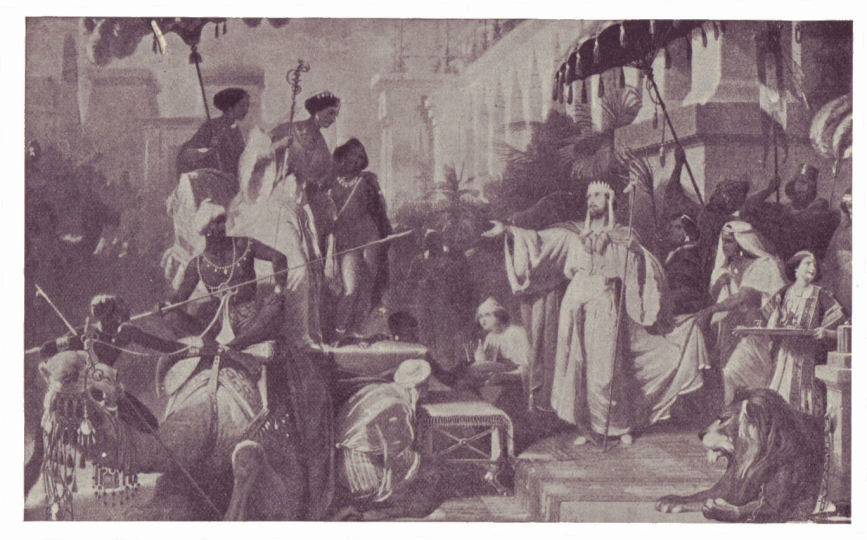 THE QUEEN OF SHEBA COMES TO SEE SOLOMON |
Solomon's great palace, where he lived in state, stood on the southern slope of Mount Moriah, a little lower than the Temple. Its pillars of cedar were very many, so that they stood like a forest; and on that account it was called "The House of the Forest of Lebanon." From this palace a wide staircase of stone led up to the Temple, and Solomon and his princes walked up these stairs when they went to worship.
But there was a dark side as well as a bright side to the reign of Solomon. His palaces, and the walled cities that he built to protect his kingdom on all sides, and the splendor of his court, cost much money. To pay for these he laid heavy taxes upon his people, and from all the tribes he compelled many of the men to work on buildings. to become soldiers in his arniy, to labor in his fields, and to serve in his household. Before the close of Solomon's reign the cry of the people rose up against Solomon and his rule, on account of the heavy burdens that he had laid upon the land.
Solomon was very wise in affairs of the world, but he had no feeling for the poor of the land, nor did he love God with all his heart. He chose for his queen a daughter of Pharoah, the king of Egypt, and he built for her a splendid palace. And he married many other women who were the daughters of kings. These women had worshipped idols in their own homes, and to please them, Solomon built on the Mount of Olives a temple of idols, in full view of the Temple of the Lord. So images of Baal, and the Asherah, and of Chemosh, the idol of the Moabites, and of Molech, the idol of the Ammonites, stood on the hill in front of Jerusalem; and to these images King Solomon himself offered sacrifices. How great was the shame of the good men in Israel when they saw their king surrounded by idol-priests, and bowing down upon his face before images of stone!
The Lord was very angry with Solomon for all this, and the Lord said to Solomon, "Since you have done these wicked things, and have not kept your promise to serve me, and because you have turned aside from my commands, I will surely take away the kingdom of Israel from your son, and will give it to one of your servants. But for the sake of your father, David, who loved me and obeyed my commands, I will not take away from your son all the kingdom, but I will leave to him, and to his children after him, one tribe."
The servant of King Solomon, of whom the Lord spoke, was a young man of the tribe of Ephraim, named Jeroboam. He was a very able man, and in the building of one of Solomon's castles he had charge over all the work done by the men of his tribe. One day a prophet of the Lord, named Ahijah, met the young Jeroboam as he was going out of Jerusalem. Ahijah took off his own manthle, which was a new one, and tore it into twelve pieces. Ten of these pieces he gave to Jeroboam, saying to him:
"Take these ten pieces, for thus saith the Lord, the God of Israel, I will tear the kingdom out of the hand of Solomon's son, and will give ten tribes to you. But Solomon's son shall have one tribe for my servant David's sake, and for the sake of Jerusalem. You shall reign over tem of the tribes of Israel, and shall have all that you desire. And if you will do my will, saith the Lord, then I will be with you, and will give to your children and children's children to rule long over this land."
When King Solomon heard what the prophet Ahijah had said and done, he tried to kill Jeroboam. But Jeroboam fled into Egypt, and stayed there until the end of Solomon's reign.
Solomon reigned in all forty years, as David had reigned before him. He died, and was buried on Mount Zion, and Rehoboam, his son, became king in his place.
Sometimes the reign of Solomon has been called "the Golden Age of Israel," because it was a time of peace, and of wide rule, and of great riches. But it would be better to call it "the Gilded Age," because under all the show and glitter of Solomon's reign there were many evil things, a king allowing and helping the worship of idols, a court filled with idle and useless nobles, and the poor of the land heavily burdened with taxes and labor. The empire of Solomon was ready to fall in pieces, and the fall soon came.
The Breaking Up of a Great Kingdom
When the strong rule of King Solomon was ended by his death, and his weak son, Rehoboam, followed him as king, all the people of Israel rose as one man against the heavy burdens which Solomon had laid upon the land. They would not allow Rehoboam to be crowned king in Jerusalem, but made him come to Sheehem, in the tribe-land of Ephraim, and in the center of the country. The people sent for Jeroboam, who was in Egypt, and he became their leader. They said to Rehoboam, "Your father, Solomon, laid upon us heavy burdens of taxes and of work. If you will promise to take away our load, and make the taxes and the work lighter, then we will receive you as king, and will serve you."
"Give me three days," said Rehoboam, "and then I will tell you what I will do."
So Jeroboam and the people waited for three days, while Rehoboam talked with the rulers and with his friends. Rehoboam first called together the old men who had stood before the throne of Solomon and had helped him in his rule. He said to these men, "What answer shall I give to this people, who ask to have their burdens made light?"
And these old men said to King Rehoboam, "If you will be wise to-day, and yield to the people, and speak good words to them, then they will submit to you, and will serve you always. Tell them that you will take off the heavy burdens, and that you will rule the land in kindness."
But Rehoboam would not heed the advice of these wise old men. He talked with the young prices who had grown up with him in the palace, and who cared nothing for the people or their troubles; and he said to these young men, "The people are asking to have their heavy burdens taken away. What shall I say to them?"
And the young nobles said to Rehoboam, "Say to the people this, 'My father made your burdens heavy, but I will make them heavier still. My father beat you with whips, but I will sting you with scorpions. My little finger shall be thicker than my father's waist.' "
On the third day Jeroboam and all the people came to Rehoboam for his answer. And the foolish young king did not follow the good advice of the old men who knew the people and their needs. He did as the haughty young princes told him to do, and spoke harshly to the people, and said, "My father made your yoke heavy, but I will add to it, and make it heavier. You will find my little finger thicker than my father's waist. My father struck you with whips, but I will sting you with scorpions." Then the people of Israel were very angry against the king. They said, "Why should we submit any longer to the house of David? Let us leave the family of David, and choose a king of our own. To your tents, O Israel! Now, Rehoboam, son of David, care for your own house!"
 REHOBOAM SPOKE HARSHLY TO THE PEOPLE |
Thus in one day ten of the twelve tribes of Israel broke away forever from the rule of King Rehoboam and the house of David. They made Jeroboam, of the tribe of Ephraim, their king. In his kingdom was all the land northward from Bethel to Dan, and also all the tribes on the east of the river Jordan. His kingdom being the larger, was called Israel; but it was also called "the kingdom of the Ten Tribes," and because Ephraim was its leading tribe, it was often spoken of as "the land of Ephraim."
When Rehoboam saw that he had lost his kingdom, he made haste to save his life by fleeing away from Sheehem. He rode in his chariot quickly to Jerusalem, where the people where his friends; and there he ruled as king, but only over the tribe of Judah and as much of Benjamin as was south of Bethel. The tribe of Simeon had once lived on the south of Judah, but some of its people were lost among the people of Judah, and others among the Arabs of the desert, so that is was no longer a separate tribe.
Rehoboam ruled over the mountain country on the west of the Dead Sea, but he had no control over the Philistine cities on the plain beside the Great Sea. So the kingdom of Judah, as it was called, was less than one-third the size of the kingdom of Israel, or the Ten Tribes.
David had conquered, and Solomon had ruled, not only the land of Israel, but Syria on the north of Israel, reaching up to the great river Euphrates, and Ammon by the desert on the east, and Moab on the east of the Dead Sea, and Edom on the south When the kingdom was divided, all the empire of Solomon was broken up. The Syrians formed a kingdom of their own, having Damascus as its chief city. The Ammonites, the Moabites, and the Edomites, all had their own kings, though the king of Moab was for a time partly under the king of Israel, and the king of Edom partly under the king of Judah. So the great and strong empire founded by David, and held by Solomon, fell apart, and became six small, struggling states.
Yet all this was by the will of the Lord, who did not wish Israel to become a great nation, but a good people. The Israelites were growing rich, and were living for the world, while God desired them to be his people, and to worship him only. So, when Rehoboam undertook to gather an army to fight the Ten Tribes, and to bring them under his rule, God sent a prophet to Rehoboam, who said to him, "thus saith the Lord, Ye shall not go up and fight against your brothers, the children of Israel. Return every man to his house; for it is God's will that there should be two kingdoms."
And the men of Judah obeyed the word of the Lord, and left the Ten Tribes to have their own kingdom and their own king.
The King Who Led Israel to Sin, and the Prophet Who Was Slain by a Lion
The Lord had told Jeroboam that he should become king over the Ten Tribes, as we read in Story Twenty of Part Third; and the Lord has promised Jeroboam that is he would serve the Lord, and do his will, then his kingdom would become great, and his descendants, those who should come after him, should sit long on the throne. But Jeroboam, though wise in worldly matters, was not faithful to the Lord God of Israel.
He saw that his people, though separated from the rule of King Rehoboam, still went up to Jerusalem to worship in the Temple, because there was the only altar in all the land. Jeroboam said to himself:
"If my people go up to worship at Jerusalem, then after a time they will become the friends of Rehoboam and his people; and then they will leave me, or perhaps kill me, and let Rehoboam rule again over all the land. I will build places for worship and altars in my own kingdom; and then my people will not need to go abroad to worship."
Jeroboam forgot that the Lord, who had given him the kingdom, could care for him and keep him, if he should be faithful to the Lord. But because he would not trust the Lord, he did that which was very evil. He chose two places, Bethel in the south, on the road to Jerusalem, and Dan far in the north; and made these places of worship for his people. And for each place he made a calf of god, and set it up; and he said to the people of Israel:
"It is too far for you to go up to Jerusalem to worship. Here are gods for you, at Bethel and at Dan. These are the gods which brought you up out of the land of Egypt. Come and worship these gods."
And as the priests of the tribe of Levi would not serve in Jeroboam's idol-temples, he took men out of all the tribes, some of them common and low men, and made them his priests. And all through the land, upon hills and high places, Jeroboam caused images to be set up, to lead the people in worshipping idols.
In the fall of the year there was held a feast to the Lord in Jerusalem, to which the people went from all the land. Jeroboam made a great feast at Bethel, a few weeks later than the feast at Jerusalem, in order to draw people to his idol-temple at Bethel, and to keep them away from the temple of the Lord at Jerusalem. At this feast King Jeroboam led his people away from the Lord to idols; and ever after this, when his name is mentioned in the Bible, he is spoken of as "Jeroboam, who made Israel to sin."
On a day when Jeroboam was offering incense at the altar, a man of God, a prophet, came from Judah; and he cried out against the altar, saying:
"O altar, altar, thus saith the Lord, Behold, in the time to come there shall rise up a man of the house of David, Josiah by name. And Josiah shall burn upon this altar the bones of the priests that have offered sacrifices to idols in this place. And this altar and this temple shall be destroyed."
The prophet from Judah also said to Jeroboam, "I will prove to you that I am speaking in the power of the Lord; and this shall be the sign. This altar shall fall apart, and the ashes upon it shall be poured out."
When King Jeroboam heard this, he was very angry. He stretched out his arm toward the prophet, and called to his guards, saying, "Take hold of that man!"
And instantly the hand which Jeroboam held out toward the prophet, dried up and became helpless And as if by an earthquake the altar before which the king stood was torn apart, and the ashes fell out upon the ground. Then the king saw that this was the work of the Lord. He said to the prophet, "Pray to the Lord your God for me, that he may make my hand well again."
Then the prophet prayed to the Lord, and the Lord heard his prayer, and made the king's hand well once more. Then King Jeroboam said to the prophet, "Come home with me, and dine, and rest; and I will give you a reward."
And the man of God said to the king:
"If you would give me half of your house, I will not go to your home, nor eat bread, nor drink water in this place. For the word of the Lord came to me, saying, 'Eat no bread, and drink no water in this place; and go to your home in the land of Judah by another way.' "
So the man of God left Bethel by a road different from that by which he came, and went toward his own home in the land of Judah.
There was living in Bethel at that time another prophet, and old man. His sons told him of the coming of the man of God from Judah, what he said, and what the Lord had wrought. The old man learned from his sons which road the prophet had taken, and followed after him, and found him resting under an oak tree. He said to him:
"Are you the man of God that came from Judah?"
And he said, "I am." Then said the old prophet of Bethel to him, "come home with me, and have supper with me."
But the man of God said to him, "The Lord has commanded me not to eat bread or drink water in this place; and I must therefore go back to my own home in the land of Judah."
Then the old man said:
"I am a prophet of the Lord as you are; and an angel spoke to me from the Lord, saying, 'Bring the prophet from Judah back to your house, and let him eat and drink with you.' "
Now this was not true. It was a wicked lie. Then the prophet from Judah went home with him, and took a meal at his house. This also was not right, for he should have obeyed what the Lord had said to him, even though another man claimed to have heard a different message from the Lord.
And even while they were sitting at the table, a word came from the Lord to the old prophet who had told the lie; and he cried out to the prophet from Judah, saying:
"Thus saith the Lord, 'Because you have disobeyed my command, have come back to this place, and have eaten bread and drunk water here, therefore you shall die and your body shall not be buried in the tomb with your fathers.' "
After dinner the prophet started again to ride upon his ass back to his own home. And on the way a lion came out, and killed him. But the lion did not eat the man's body. He stood beside it, and the ass stood by it also. And this was told to the old prophet whose lies had led him to disobey the Lord. Then the old prophet came, and took up his body, and laid it in his own tomb, and mourned over him. And he said to his sons:
"When I am dead, bury me beside the body of the prophet from the land of Judah For I know that what he spoke as the message of God against the altar at Bethel shall surely come to pass."
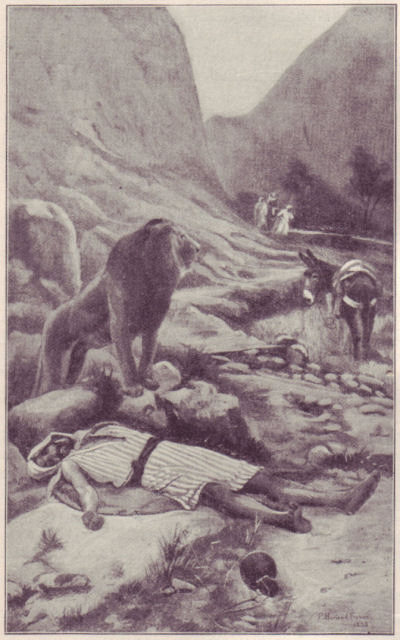 A LION CAME OUT AND KILLED THE PROPHET |
At one time the child of King Jerboam was taken very ill; and his mother, the queen, went to the prophet Ahijah, the one who had promised the kingdom to Jeroboam, who was now an old man and blind, if the child would be well again. But Ahijah said to her: "Tell King Jeroboam that thus said the Lord to him:
"You have done evil worse than any before you; and have made graven images, and have cast the Lord behind your back. Therefore the Lord will bring evil upon you and upon your house. Your sick child shall die, and every other child of yours shall be slain; and your family shall be swept away. The dogs shall eat the bodies of your children in the city, and the birds of the air shall eat those that die in the field. And in times to come God shall smite Israel, and shall carry them into a land far away, because of the idols which they have worshipped."
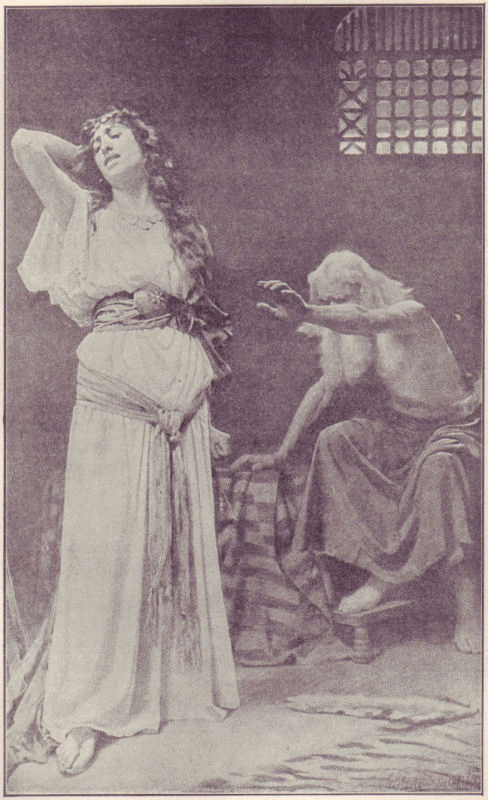 THE WIFE OF JEROBOAM AND THE BLIND PROPHET |
And after this Jeroboam died, and his son Nadab began to reign in his place. But after two years Baasha, one of his servants, rose up against Nadab, and killed him, and made himself king over Israel. And Baasha killed every child of Jeroboam, and left not one son or daughter of Jerboam alive, as Ahijah the prophet had said.
So, although Jeroboam was made king, as God had promised him, it came to pass that the kingdom was taken away from his family, because he did not obey the world of the Lord, but led his people into sin.
The Prophet Whose Prayer Raised a Boy to Life
After Jeroboam and Nadab, his son Baasha reigned as king of Israel. But he did as Jeroboam had done before him, disobeying the word of the Lord and worshipping idols. Therefore the Lord sent a prophet to Baasha, saying, "Thus saith the Lord to Baasha, king of Israel, I lifted you up from the dust and made you the prince over my people Israel. But you have walked in the way of Jeroboam, and have made Israel sin. Therefore your family shall be destroyed, like the family of Jeroboam."
When Baasha died, his son Elah became king; but while he was drinking wine and making himself drunk, his servant, Zimri, came in and killed him, and killed also all his family, and all the house of Baasha, so that not one was left.
Zimri tried to make himself king, but his reign was short, only seven days. Omri, the general of the Israelite army, made war upon him, and shut him up in his palace When Zimri found that he could not escape, he set his palace on fire and was burned up with it. After this there was war in Israel between Omri and another man, named Tibni, each trying to win the kingdom. But at last Tibni was slain, and Omri became king.
Omri was not a good man, for he worshipped idols, like the kings before him. But he was a strong king, and made his kingdom great. He made peace with the kingdom of Judah, for there had been war between Judah and Israel ever since Jeroboam had founded the kingdom. Omri bought a hill in the middle of the land, from a man named Shemer; and on the hill he built a city which he named Samaria, after the name of the man from whom he had bought the hill. The city of Samaria became in Israel what Jerusalem was in Judah, the chief city and capital. Before the time of Omri the kings of Israel had lived in different cities, sometimes in Sheehem, and sometimes in Tirzah; but after Omri all the kings lived in Samaria; so that the kingdom itself was often called "the kingdom of Samaria."
After Omri came his son, Ahab, as king of Israel, reigning in Samaria. He was worse than any of the kings before him. Ahab took for his wife Jezebel, the daughter of the king of Zidon, on the coast of the Great Sea; and Jezebel brought into Israel the worship of Baal and of the Asherah (see Story Eight in Part Second), which was far more wicked than even the worship of the golden calves at Bethel and Dan And Jezebel was so bitter against the worship of the Lord God of Israel that she sought out the prophets of the Lord everywhere, and slew them; so that to save their lives the prophets hid in caves among the mountains.
You remember that when Joshua destroyed and burned the city of Jericho, he spoke a curse, in the name of the Lord, upon any man who should ever build again the walls of Jericho (See Story Two in Part Second). In the days of Ahab, king of Israel, five hundred years after Joshua, the walls of Jericho were built by a man name Hiel, who came from Bethel, the place of the idol-temple. When he laid the foundation of the wall his oldest son, Abiram, died; and when he set up the gates of the city his youngest son, Segub, died. Thus came to pass the word of the Lord spoken by Joshua
In the reign of King Ahab a great prophet suddenly rose up, named Elijah. He came from the land of Gilead, beyond the river Jordan, and he lived alone out in the wilderness His clothing was a mantle of skin, and his hair and beard were long and rough. Without any warning, Elijah came into the presence of King Ahab, and said, "as the Lord God of Israel lives, before whom I stand, there shall not fall upon the ground any dew or rain until I call for it."
And then he went away as suddenly as he had come. At the Lord's command he hid himself in a wild place by the brook Cherith, which flows down from the mountains into the river Jordan. There he drank of the water in the brook, and every day the wild birds, the ravens, brought him food.
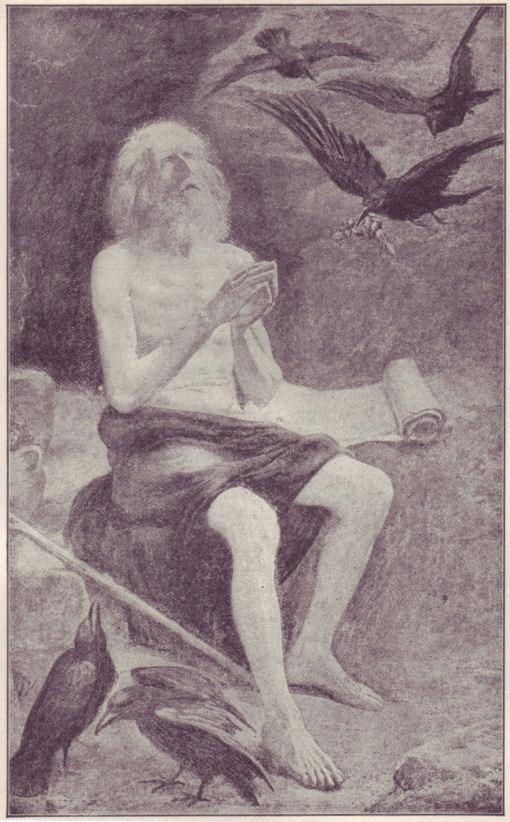 ELIJAH WAS FED BY THE BIRDS |
It came to pass as Elijah had said, that no rain fell upon the land, and there was not even any dew upon the grass. Every day the brook from which Elijah drank grew smaller, until at last it was dry, and there was no water. Then the Lord spoke to Elijah again, and said, "Rise up, and go to Zarephath, which is near to Zidon, by the Great Sea, on the north of the land of Israel. I have commanded a widow woman there to care for you."
So Elijah left the brook Cherith and walked northward through the land until he came near to the city of Zarephath. There, beside the gate of the city, he saw a woman dressed as a widow picking up sticks. Elijah said to her, "Will you bring to me some water, that I may drink?"
She went to bring him the water, and Elijah said again, "Bring me also, I pray you, a little piece of bread to eat."
And the woman said to Elijah, "As sure as the Lord your God lives, I have not in the house even a loaf of bread; but only one handful of meal in the barrel, and at little oil in a bottle; and now I am gathering a few sticks to make a fire, that I may bake it for me and my son; and when we have eaten it, there is nothing left for us but to die."
Then the world of the Lord came to Elijah, and he said to the woman, "Fear not; go and do as you have said; but first make me a little cake, and bring it to me, and afterward make for yourself and your son. For thus saith the Lord, the God of Israel, "The barrel of meal shall not waste nor the bottle of oil fail, until the day when the Lord sends rain upon the earth.' "
And the widow woman believed Elijah's word. She took from her barrel the meal and from her bottle the oil, and made a little cake for the prophet, and then found enough left for herself and for her son. And the barrel always had meal in it, and the bottle held oil every day. And the prophet, and the woman, and her son had food as long as they needed it.
After this, one day the son of the widow was taken very ill, and his illness was so great that there was no breath left in him. The boy's mother said to Elijah, "O man of God! Have you come here to cause my son to die?"
And Elijah said to her, "Give me your son."
And Elijah carried the boy up to his own room, and laid him on the bed. Then he cried to the Lord, and said, "O Lord God, hast thou brought trouble upon this woman, by taking away the life of her son?"
Then he stretched himself upon the child's body three times, and cried to the Lord again, "O Lord God, I pray thee, let this child's soul come into him again!"
And the Lord heard Elijah's prayer, and the child became living once more. Then Elijah carried the living boy back to his mother; and she said, "Now I am sure that you are a man of God, and that the word of the Lord which you speak is the truth."
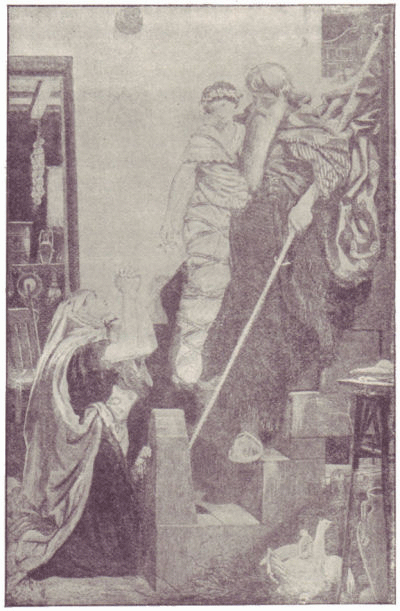 ELIJAH BRINGS THE BOY TO HIS MOTHER |
The Prayer That Was Answered in Fire
Three years passed after Elijah gave the message of the Lord to King Ahab, and in all that time no rain fell upon the land of Israel. Everywhere the brooks ceased to flow, the springs became dry, the ground was parches, and the fields gave no harvest There was no grass for the cattle and the flocks, and there was scarcely any food for the people.
King Ahab was in great trouble. He knew that Elijah had the power to call down rain; but Elijah was nowhere to be found. He sent men to search for him everywhere in the land, and he asked the kings of the nations around to look for him in their countries; for he hoped to persuade the prophet to set the land free from the long drought by calling for rain.
When the land was at its worst, in the third year, Ahab called the chief of his servants, the man who stood next to the king. His name was Obadiah, and, unlike Ahab, he was a good man, worshipping the Lord, and trying to do right. Once, when Queen Jezebel sought to kill all the prophets of the Lord, Obadiah his a hundred of them in two caves, fifty in each cave, and gave them food, and kept them in safety.
Ahab said to Obadiah, "Let us go through all the land, you in one part, and I in another, and look for running streams and fountains of water. Perhaps we can find some water, enough to save a part of the horses and mules, so that we may not lose them all."
And as Obadiah was going through his part of the country, looking for water, suddenly Elijah met him. Obadiah knew Elijah at once. He fell on his face before him, and said, "Is this my lord Elijah?"
And Elijah answered him, "Yes, it is I, Elijah. Go and tell your master that Elijah is here."
And Obadiah said, "Oh, my Lord, what wrong have I done, that you would cause King Ahab to kill me? For there is not a land where Ahab has not sent for you; and now when I go to tell him that you are here, the Spirit of the Lord will send you away to some other place, and then if Ahab cannot find you he will be angry at me, and kill me. Do you not know that I fear the Lord, and serve him?" And Elijah said, "As the Lord God lives, I will surely show myself to King Ahab to-day."
So Obadiah went to meet Ahab, and told him of Elijah's coming; and Ahab went to meet Elijah. When Ahab saw Elijah, he said to him, "Are you here, you that have brought all this trouble upon Israel?"
And Elijah answered the king, "I am not the one that has brought trouble upon Israel It is you, and your house; for you have turned away from the commands of the Lord, and have worshipped the images of Baal. Now send and bring all the people to Mount Carmel, and with them the four hundred prophets of Baal, and the four hundred prophets of the Asherah, who ate at Jezebel's table."
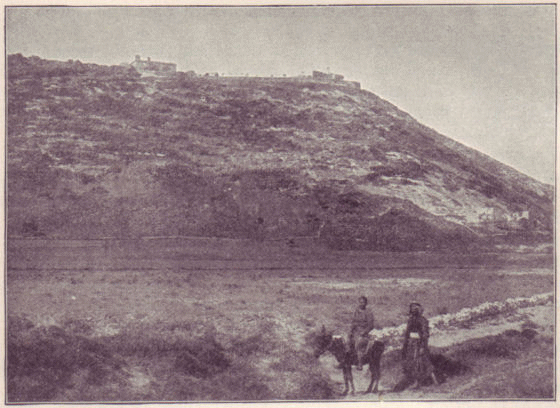 MOUNT CARMEL |
So Ahad did as Elijah commanded, and brought all the people to Mount Carmel, which stands by the Great Sea. And Elijah stood before all the multitude, and he said to them "How long will you go halting and limping back and forth between two sides, not choosing either? If the Lord is God, follow him; but if Baal is God, then follow him."
And the people had not a word to say. Then Elijah spoke again, and said, "I am alone, the only prophet of the Lord here to-day; but Baal's prophets are four hundred and fifty men. Now, let the people give us two young oxen, one for Baal's prophets, and one for me. Let the prophets of Baal take one ox, and cut it up, and lay it on the altar on the wood. But let no fire be placed under it. And I will do the same; then you call on your god, and I will call on the Lord. And the God who sends down fire upon his altar, he shall be the God of Israel."
And the people said, "What you have spoken is right. We will do as you say, and will see who is the true God."
Then the two oxen were brought, and one was cut in pieces and laid on the altar of Baal The prophets of Baal stood around the altar, and cried aloud, "O Baal, hear us!" But there was no answer, nor any voice. After a time the worshippers of Baal became furious. They leaped and danced around the altar, and they cut themselves with swords and lances, until the blood gushed out upon them And Elijah laughed at them, and mocked them, calling out, "Call out louder, for surely he is a god! Perhaps he is sitting still and thinking, or he has gone on a journey; or perhaps he is asleep, and must be awaked!"
But it was all in vain. The middles of the afternoon came, and there was no answer. The altar stood with its offering, but no fire came upon it. Then Elijah said to all the people, "Come near to me."
And they came near He found an old altar to the Lord that had been thrown down, and he took twelve stones, one for each of the twelve tribes, and piled them up to from the altar anew. Around the altar he dug a trench, to carry away water. Then he cut wood, and laid it on the altar, and on the wood he placed the young ox, cut into pieces for a sacrifice. Then he said, "Fill four barrels with water, and pour it on the offering."
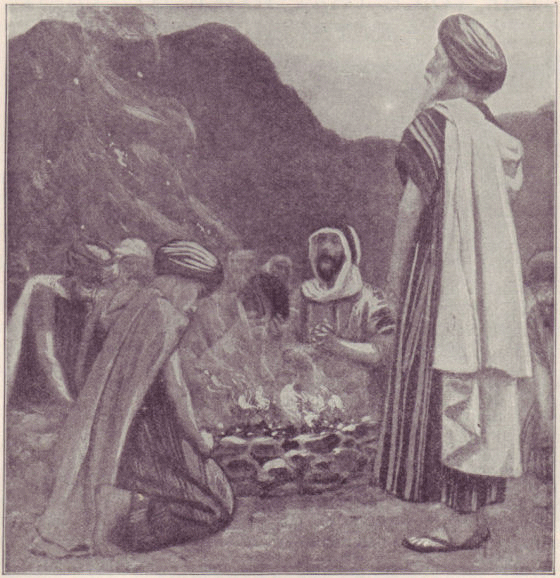 ELIJAH'S SACRIFICE ON MOUNT CARMEL |
The Great Sea was near at hand, in sight of all the people; and from it they brought four barrels of water, and poured it on the altar. He called upon them to do it again, and a third time, until the offering, and the wood, and the altar were soaked through and through, and the trench was filled with water.
Then, in the sight of all the people, Elijah, the prophet, drew near, and stood all alone before the altar, and prayed in these words, "O Lord, the God of Abraham, of Isaac, and of Israel, let it be known this day that thou art God in Israel, and that I am thy servant, and that I have done all these things at thy word. Hear me, O Lord, hear me, that this people may know that thou, Lord, art God, and that thou hast turned their hearts back again to thyself."
Then the fire fell from the Lord, and burned up the offering, and the wood, and the stones and the dust, and licked up the water that was in the trench. And when the people saw it, they fell on their faces, and they cried, "The Lord, he is God! The Lord, he is God!" And Elijah said to the people, "Seize the prophets of Baal; let not one of them escape!"
They took them all, four hundred and fifty men; and by Elijah's command they brought them down to the dry bed of the brook Kishon, at the foot of the mountain; and there Elijah caused them to be put death, because they had led Israel into sin.
Ahab, the king, was present upon Mount Carmel, and saw all that had been done. Elijah now said to Ahab, "Rise up; eat and drink; for there is a sound of a great rain."
While Ahab was eating and drinking, Elijah was praying upon Mount Carmel. He bowed down, with his face between his knees, and prayed to the Lord to send rain. After a time he sent his servant up to the top of the mountain, saying, "Go up and look toward the sea."
The servant went up, and came back, saying, "I can see nothing."
Elijah sent him up seven times; and at the seventh time his servant said, "I see a cloud rising out of the sea as small as a man's hand."
Then Elijah sent to Ahab, saying, "Hasten; make ready your chariot before the rain stops you."
In a little while the sky was covered with black clouds, and there came a great rain. And Ahab rode in his chariot to his palace at Jezreel, on the eastern side of the great plain. And the power of the Lord was on Elijah, and he ran before Ahab's chariot to the gate of the city.
Thus in one day a great victory was wrought for the Lord God, and the power of Baal was thrown down.
The Voice That Spoke to Elijah in the Mount
When King Ahab told his wife, Queen Jezebel, of all that Elijah had done; how the fire had fallen from heaven upon his altar, and how he had slain all the prophets of Baal with the sword, Queen Jezebel was very angry. She sent a messenger to Elijah with these words:
"May the gods do to me as you have done to the prophets of Baal, if I do not by to-morrow kill you, as you have killed them!"
Elijah saw that his life was in danger, and he found that not one man in all the kingdom dared to stand by him against the hate of Queen Jezebel. He rose up, and ran away to save his life. He went southward to the land of Judah, but did not feel safe even there. He hastened across Judah southward to Beersheba, which is on the edge of the desert, eighty miles away from Samaria. But not even here did Elijah dare to stay, for he still feared the wrath of Queen Jezebel. He left his servant at Beersheba, and went out alone into the desert, over which the children of Israel had wandered five hundred years before. After he had walked all day under the sun, and over the burning sand, he sat down to rest under a juniper-tree. He was tired, and hungry, and discouraged. He felt that his work had all been in vain, that in heart the people were still worshippers of Baal; and he felt, too, that he had shown weakness in running away from his place of duty in fear of Queen Jezebel Elijah cried out to the Lord, and said, "O Lord, I have lived long enough!" Take away my life, O Lord, for I am no better than my people!" Then, tired out, he lay down to sleep under the tree. But the Lord was very kind to Elijah. While he was sleeping an angel touched him, and said , "Arise, and eat."
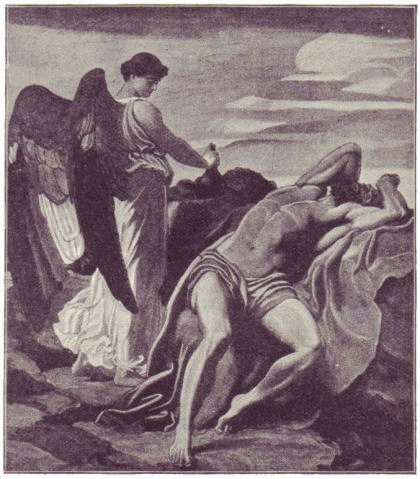 AN ANGEL TOUCHED ELIJAH |
He opened his eyes, and saw beside him a little fire, with a loaf of bread baking upon it, and near it a bottle of water. He ate and drank, and then lay down to sleep again. A second time he felt the angel touch him, and he heard a voice say, "Arise, and eat; because the journey is too long for you."
He arose, and ate once more. Then he went on his way, and in the strength given him by that food he walked forty days through the desert. He came at last to Mount Horeb, the mountain where Moses saw the burning bush, and where God spoke forth the words of the Ten Commandments. (See Stories Twenty-five in Part First). Elijah found a cave in the side of the mountain, and went into it to rest. While he was in the cave he heard God's voice speaking to him, and saying, "What are you doing here, Elijah?"
And Elijah said to the Lord, "O Lord God, I have been very earnest for thee; for the people of Israel have turned away from their promise to serve thee; they have thrown down thine altars, and have slain thy prophets with the sword; and now I, even I only am left; and they are seeking my life, to take it away."
Then the Lord said to Elijah, "Go out and stand upon the mountain before the Lord."
Then, while Elijah was standing upon the mountain, a great and strong wind swept by and tore the mountains apart, and broke the rocks in pieces; but the Lord was not in the wind. Then came an earthquake, shaking the mountains; but the Lord was not in the earthquake. And after the earthquake a fire passed by; but the Lord was not in the fire. And after the fire there was silence and stillness, and Elijah heard a low, quiet voice which he knew was the voice of the Lord.
Then Elijah wrapped his face in his mantle, for he feared to look upon the form of God, and he stood at the opening of the cave. The voice said to him, "What are you doing here, Elijah?"
And Elijah said, as he had said before, "O Lord, I have been very earnest for thee; for the people of Israel have turned away from their promise to serve thee; they have thrown down thine altars, and have slain thy prophets with the sword, and now I, even I only, am left; and they are seeking my life, to take it away."
Then the Lord said to Elijah, "Go back to the land from which you come, and then go to the wilderness of Damascus, and anoint Hazael to be king over Syria; and Jehu, the son of Nimshi, you shall anoint to be king over Israel; and Elisha, the son of Shaphat, of the village of Abel-meholah, in the land of Manasseh, west of Jordan, you shall anoint to take your place as prophet. And it shall come to pass that those who escape from the sword of Hazael, Jehu shall slay, and those that escape from the sword of Jehu shall Elisha slay. But there will be found some, even seven thousand men in Israel, who have not bowed the knee to Baal or kissed his image with their lips."
Here were tasks that would take all the rest of Elijah's life; for, as we shall see, some of them were not completed until after Elijah had passed away, though Elijah prepared the way for them. But they gave to Elijah what he needed most, work to do; a friend to stand beside him, so that he would no longer be alone; one also who could carry on his work after him; and the knowledge that he had not lived in vain, since there were still in the land seven thousand men faithful to the Lord God of Israel.
One of these commands Elijah obeyed at once. He left Mount Horeb, journeyed northward through the wilderness, across the kingdom of Judah, and into the land of Israel He found Abel-meholah, in the tribe-land of Manasseh on the west of Jordan, and there he saw Elisha, the son of Shaphat. Elisha was plowing in the field, with twelve yoke of oxen in front of him; for Elisha was a rich man's son, and cared for a large farm.
Elijah came to the field where Elisha was at work, and without a word, took off his own mantle of skin, and threw it upon Elisha's shoulders, and walked away. Elisha knew well who this strange, rough, hair-covered man was; and he knew, too, what is meant when Elijah cast mantle upon him. It was a call for him to leave his home, to go out into the wilderness with Elijah, to take up the life of a prophet, to face the danger of the queen's hate, and perhaps to be slain, as many prophets had been slain before. But Elisha was a man of God, and he did not hesitate to obey God's call. He left his oxen standing in the field; he ran after Elijah, and said to him, "Let me kiss my father and my mother, and then I will go with you."
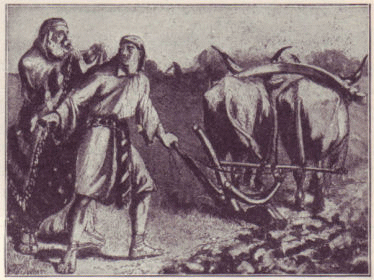 ELIJAH PLACES HIS MANTLE ON ELISHA |
Elijah said to him, "Go back, if you wish; for what have I done to you?"
Then Elisha went back to the field, killed the oxen, made a fire with the yokes and the wooden plow, roasted the flesh of the oxen on the fire, and gave them to be eaten by the people on the farm. This he did to show that he had left his farm forever Then he kissed his father and mother, and left them, and went forth to live with Elijah and to be Elijah's helper.
The Wounded Prophet and His Story
The country nearest to Israel on the north was Syria, of which the chief city and capital was Damascus; and its king was named Ben-hadad. His kingdom was far greater and stronger than Israel; and when he went to make war upon King Ahab, such was the fear of the Israelites for the Syrians, that Ahab could bring only seven thousand men against the Syrian army. The host of the Syrians filled all the valleys and plains around Samaria; but Ben-hadad and his chief rulers were drinking wine when they should have been making ready for the battle; and the little army of Israel won a great victory over the Syrians, and drove them back to their own land.
Again the Syrians came against Israel, with an army as large as before; but again God gave to Ahab and the Israelites a victory, and the Syrian army was destroyed. King Ben-hadad fled away to his palace, and King Ahab might easily have taken him prisoner and conquered all Syria. If he had done this, all danger from that land might have been forever removed. But Ben-hadad dressed himself in sackcloth, and put a rope around his waist, and came as a beggar to Aha, and pleaded with him for his life and his kingdom. Ahab felt very proud to have so great a king as Ben-hadad come kneeling before him. He spared his life, and gave him back his kingdom This was not wise; and God soon showed to Ahab what a mistake he had made.
By this time, through the teaching of Elijah and Elisha, there were many prophets of the Lord in Israel. The word of the Lord came to one of these prophets, and he said to a fellow-prophet, "Strike me, and give me a wound."
But the man would not strike him, and the prophet said, "Because you have not obeyed the voice of the Lord, as soon as you go away from me, a lion shall kill you."
And as the man was going away, a lion rushed out upon him, and killed him. Then the prophet said to another man, "Strike me, I pray you!"
The man struck him, and wounded him, so that the blood flowed. Then the prophet all bloody, with his face covered, stood by the road as King Ahab passed by, and he cried out to the king. The king saw him, and stopped, and asked him what had happened to him. Then the prophet said, "O king, I was in the battle; and a soldier brought to me a prisoner, and said to me, ‘Keep this man; if you lose him, then your life shall go for his life, or you shall pay me a talent of silver for him.' And while I was busy here and there, the prisoner escaped. Now, O king, do not let my life be taken or the man's life."
But the king said, "You have given sentence against yourself, and it shall be as you have said. Your life shall go for your prisoner's life."
Then the prophet threw off the covering from his face, and the king saw that he was one of the prophets. And the prophet said to the king, "Thus saith the Lord, "Because you have let go the king whom I willed to have destroyed, therefore your life shall go for his life, and your people for his people.' "
When Ahab heard this he was greatly troubled and displeased. He went to his palace in Samaria full of alarm, for he saw that he had not done wisely for his kingdom in sparing his kingdom's greatest enemy.
 THE PROPHET MAKES HIMSELF KNOWN TO THE KING |
What Ahab Paid for His Vineyard
King Ahab's home was at Samaria, the capital of the kingdom. But he had also a palace at Jezreel, which overlooked the great plain of Esdraelon. And beside Ahab's palace at Jezreel was a vineyard, belonging to a man named Naboth Ahab wished to own this vineyard, and he said to Naboth, "Let me have your vineyard, which is near my house. I would like to make of it a garden for vegetables. I will give you a better vineyard in place of it, or I will pay you the worth of it in money."
But Naboth answered the king, "This vineyard has belonged to my father's family for many generations, and I am not willing to give it up or to leave it."
 AHAB AND NABOTH |
Ahab was very angry when he heard this. He came into his house, and refused to eat; but lay down on his bed, and turned his face to the wall. His wife Jezebel came to him, and said, "Why are you so sad? What is troubling you?"
And Ahab answered her, "I asked Naboth to sell me his vineyard, or to let me give him another vineyard for it, and he would not."
Then Jezebel said to him, "Do you indeed rule over the kingdom of Israel? Rise up, and eat your dinner and enjoy yourself. I will give you the vineyard of Naboth" Then Queen Jezebel sat down, and wrote a letter in Ahab's name, and sealed it with the king's seal. And in the letter she wrote, "Let the word be given out that a meeting of the men of Jezreel is to be held, and set Naboth up before all the people. Have ready two men, no matter how worthless and wicked they may be, who will swear that they heard Naboth speak words of cursing against God and against the king. Then take Naboth out, and stone him with stones until he is dead."
Such was the fear of Queen Jezebel among all the people, that they did as she gave command They held a meeting, and set Naboth up in presence of the people; then they brought in two men, who told lies, declaring that they had heard Naboth speak words of cursing against God and against the king; and then they dragged Naboth out of the city, and stoned him, and killed him. Afterward they sent word to Queen Jezebel that Naboth was dead, and Jezebel said to Ahab, "Now you can go and take as your own the vineyard of Naboth in Jezreel; for Naboth is no longer living; he is dead."
Then Ahab rose in his chariot from Samaria to Jezreel, and with him were two of his captains, one named Jehu, and another named Bidkar. Just as they were riding in the vineyard that had been Naboth's, suddenly Elijah, the prophet, with his mantle of skin, stood before them.
Ahab was startled as he saw Elijah, and he called out, "Have you found me, O my enemy?"
"I have found you," answered Elijah, "because you have sold yourself to do evil in the sight of the Lord. In the place where dogs liked up the blood of Naboth, shall dogs lick up your own blood. I will bring evil upon you, and will sweep you away; and I will cut off every man-child from Ahab; and I will make your family like the family of Jeroboam, who made Israel to sin. And because your wife, Jezebel, has stirred you up to sin, she shall die, and the wild dogs of the city shall eat the body of Jezebel by the wall of Jezreel."
When Ahad heard these words of Elijah he saw how wickedly he had acted, and he felt sorrow for his sin. He put on sackcloth, and fasted, and sought for mercy. And the word of the Lord came to Elijah, saying, "Do you see how Ahab has humbled himself before me, and shows sorrow for his sin? Because of this, I will not bring the evil in his lifetime, but after he is dead, I will bring it upon his children."
The Arrow That Killed a King
After the two victories which King Ahab gained over the Syrians (see Story Six in this Part), there was peace between Syria and Israel for three years. But in the third year the Syrians became strong once more, and they seized a city of Israel on the east of Jordan, called Ramoth-gilead. At that time there was peace and friendship between the kingdoms of Israel and Judah; and Ahab, the king of Israel, sent to Jehoshaphat, the king of Judah, saying, "Do you know that Ramoth-gilead is ours, and yet we have done nothing to take it out of the hands of the king of Syria? Will you go up with me to battle at Ramoth-gilead?" And King Jehoshaphat sent word to the king of Israel, "I am with you, and my people are with your people, and my horses with your horses."
So the king of Israel and the king of Judah gathered their armies for war against the Syrians, and King Jehoshaphat came to Samaria to meet King Ahab. Jehoshaphat was a good man, and a worshipper of the Lord. He said to Ahab, "Let us ask the prophets to give us the word of the Lord before we go to battle."
Then the king of Israel called together his prophets, four hundred men, not prophets of the Lord, but false prophets of the idols, and he asked them, "Shall I go up to battle at Ramoth-gilead, or shall I remain at home?" And the prophets of the idols said, with one voice, "Go up; fro the Lord will give Ramoth-gilead to you."
But Jehoshaphat was not satisfied with the words of these men. He asked, "is there not here a prophet of the Lord of whom we can ask the Lord's will?"
"There is one prophet," answered Ahab; "his name is Micaiah, the son of Imlah; but I hate him; for her never prophesies any good about me, but always evil."
"Let not the king say that," said Jehoshaphat. "Let us hear what Micaiah will speak."
Then King Ahab sent one of his officers to bring the prophet Micaiah. And the officer said to Micaiah, "All the prophets have spoken good to the king; now, I pray you, let your words be like theirs, and do you speak good also.?
And Micaiah said, "as the Lord lives, what the Lord say to me, that I will speak, and nothing else."
The king of Israel and the king of Judah were seated together in their royal robes, at an open place in front of the gate of Samaria. And King Ahab said to Micaiah, "Micaiah, speak to me nothing but the truth, in the name of the Lord."
Then Micaiah said, "I saw all Israel scattered upon the mountains, as sheep that have no shepherd; and the Lord said, ‘These have no master; let every man go back to his own house."
Then the king of Israel said to Jehoshaphat, "Did I not tell you that Micaiah would prophesy about me no good, but only evil?"
For Ahab knew that the words of Micaiah meant that he would be slain in the battle.
And Micaiah went on and said, "Hear thou the word of the Lord; I saw the Lord sitting on his throne, and all the host of heaven standing around him, on his right hand and on his left. And the Lord said, ‘Who will go and deceive Ahab, so that he will go up and fall at Ramoth-gilead?" And one spirit came forth and said, ‘I will go, and will be a lying spirit in the mouth of all Ahab's prophets.' And the Lord said to the spirit, ‘Go and deceive him.' Now, there fore, the Lord has let all these false prophets deceive you; and the Lord has spoken evil against you."
Then the king of Israel said to his guards, "Take Micaiah, and lead him to the governor of the city, and say, ‘Put this fellow in prison, and let him have nothing to eat but dry bread and water until I come again in peace.' "
And Micaiah said, "If you return at all in peace, then the Lord has not spoken by me. Hear my words, all ye people."
So the kings of Israel and Judah led their armies across the river Jordan and up the mountains on the east, to battle at Ramoth-gilead. Ahab felt afraid after the prophecy of Micaiah, and he said to Jehoshaphat, "I will dress as a common soldier before going into the battle; but do you wear your royal robes."
Now the king of Syria had given word to all his captains to look out especially for the king of Israel, and to fight him, and kill him, even if they should kill no other man. When they saw Jehoshaphat in his kingly garments standing in his chariot, they thought that he was King Ahab, and they turned all battle toward him. But Jehoshaphat cried out, and then they found that he was not the king of Israel, and they left him. In the battle one soldier of the Syrians drew his bow, and shot an arrow, not knowing that he was aiming at the king of Israel. The arrow struck King Ahab just between his breastplate and his lower armor. He was badly wounded, but they held him up in his chariot, so that the men might not see him fall; and his blood was running out of the wound upon the floor of the chariot, until the sun set, when Ahab died. And the cry went through all the host of Israel, "Every man to his city, and every man to his country."
And then all knew that the king of Israel was dead. They brought his body to Samaria, and buried him there. And at the pool of Samaria they washed the king's chariot and his armor. And there the wild dogs of the city licked up Ahab's blood, according to the word of the Lord spoken by Elijah.
Thus died King Ahab, the son of Omri. He was not a bad man at heart, but he was weak in the hands of his wife, Jezebel, who led him and his kingdom into wickedness in the sight of the Lord.
Elijah's Chariot of Fire
After the death of Ahab, his son Ahaziah reigned for only two years as king of Israel He fell out of a window in his palace, and was injured so that he died; and as he had no son, his brother, Jehorma, became king in his place.
The work of Elijah, the prophet, was now ended, and the Lord was about to take him up to heaven. Elijah and Elisha went together to a place called Gilgal, not the place beside the river Jordan where the army of Israel was encamped under Joshua (see Part Second, Stories Two and Three), but another place of the same name among the mountains, not far from Bethel. And Elijah said to Elisha, "Stay here, I pray you, for the Lord has sent me to Bethel."
Elisha knew that Elijah would be taken from him very soon, and he said, "As surely as the Lord lives, and as your soul lives, I will not leave you."
So Elijah and Elisha walked together to Bethel. At Bethel were living many worshippers of the Lord, who were called "sons of the prophets," because they followed the teaching of the prophets, and some of them became prophets themselves. These men came to Elisha, and said to him, "Do you know that the Lord will take away your master from you very soon?"
And Elisha answered them, "Yes, I know it; but hold your peace; do not speak of it."
And at Bethel Elijah said to Elisha again, "Elisha, stay here; for the Lord has sent me to Jericho." But Elisha answered him, "As surely as the Lord lives, and as your soul lives, I will not leave you."
So Elijah and Elisha walked together down the steep road from Bethel to Jericho. And at Jericho the followers of the prophets came to Elisha, and said to him, "Do you know that the Lord will take your master away from you to-day?"
And he answered them, "Yes, I know it; but hold your peace, and say nothing." And Elijah said to him again, "Stay here at Jericho, I pray you, for the Lord has sent me to the river Jordan."
But Elisha said to Elijah once more, "As surely as the Lord lives, and as your soul lives, I will not leave you."
So Elijah and Elisha walked from Jericho to the river Jordan, about five miles. About fifty men of the sons of the prophets who lived at Jericho followed them at a distance When they came to the bank of Jordan, Elijah took his mantle, and wrapped it together, and struck the waters. Then the waters were divided on each side, and a path was made across the river; and the two prophets walked across on dry ground And as they walked, Elijah said, "As what I shall do for you, before I am taken away from you."
 ELIJAH STRIKES THE WATER WITH HIS MANTLE |
Elisha answered him, "All that I ask is that your spirit shall come upon me in greater power than comes upon any other man."
And Elijah said to him, "You have asked a great blessing; and if you see me when I am taken away, it shall come to you; but if you do not see me, it shall not come"
And as they still went on, and talked, suddenly a chariot of fire and horses of fire came between them, and parted them; and Elijah went up in a whirlwind on the fiery chariot to heaven.
And Elisha saw him going up toward heaven, and he cried out, "O my father, my father, the chariot of Israel, and the horsemen thereof!"
He meant that in losing Elijah the kingdom had lost more than an army of chariots and horsemen After this he saw Elijah no more; but he caught up the mantle of Elijah which had fallen from him. With the mantle he struck the waters of Jordan, saying, "Where now is the Lord God of Elijah?"
And as he struck the water with Elijah's mantle it parted on either side, and Elisha walked across the Jordan. The sons of the prophets who were standing near the river had not seen Elijah go up, but now they saw Elisha walking through the river alone, and they felt that God had taken Elijah away. They said, "The spirit of the Elijah now rests upon Elisha," and they came to meet him, and bowed down before him as their chief. So Elijah was taken away, but Elisha stood in his place as the Lord's prophet.
A Spring Sweetened by Salt; and Water That Looked Like Blood
After Elijah had been taken up to heave, Elisha stayed for a time at Jericho; for, unlike Elijah, Elisha did not live in the wilderness, away from the people. He lived in the cities, and helped many by the power which the Lord gave to him.
The people of Jericho said to Elisha, "This city stands in a pleasant place; but the water of its spring is very bitter, and cases disease and death; and the land around it is barren, giving no fruit."
Elisha said to them, "Bring me a small new bottle, and fill it with salt."
They brought it to him, and he poured the salt into the fountain that gave water to the city, and said:
"Thus saith the Lord, ‘I have healed these waters; from them there shall no more be death or unfruitfulness to the land.' "
And the waters became pure and sweet from that time onward. Many believe that the fountain which still flows at the foot of the mountain near the ruins where once stood Jericho is the one which was healed by the prophet; and it is called "The Fountain of Elisha."
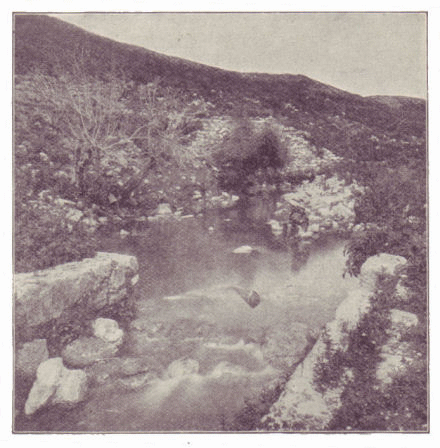 ELISHA'S FOUNTAIN |
At this time Jehorma, the son of Ahab, was king of Israel. He reigned twelve years, not so wickedly as his father Ahab had ruled, but still doing evil in the sight of the Lord. From the days of King David the land of Moab, on the east of the Dead Sea, had been under the control of Israel. The land was governed by its own king, but he paid every year a large sum to Israel. The king of Moab In the times of Ahab and Jehoram was named Mesha. He had great flocks of sheep, and he paid to the king of Israel every year the wool of a hundred thousand sheep and of as many rams.
When King Ahab was dead, the king of Moab rose against Israel, and tried to set his land free. Then King Jehoram sent for King Jehoshaphat of Judah, and these two kings gathered their armies, and made war on Mesha, the king of Moab. They led their armies southward through Judah, and then through Edom, on the south of the Dead Sea, and from Edom into the land of Moab; and with them was the king of Edom, who was under the king of Judah.
While they were on their march they found no water, either for the army or for the horses And the king of Israel said, "Alas! The Lord has brought together these three kings, only to let them fall into the hands of the king of Moab!"
But the good King Jehoshaphat said, "Is there not here a prophet of the Lord, so that we may ask of him to show us the Lord's will?
And one man said, "Elisha, the son of Shphat, is here; the man who poured water on the hands of Elijah, and was his servant."
And Jehoshaphat said, "The word of the Lord is with him; let us see him."
And the three kings went to find Elisha; but Elisha said to the king of Israel, "Why do you come to me? Go to the idol-prophets of your father Ahab and your mother Jezebel, and ask them!"
And the king of Israel said to Elisha, "You must help us; for the Lord has brought these three kings together, to let them fall into the hands of the king of Moab"
Then said Elisha, "As surely as the Lord of hosts lives, before whom I stand, if Jehoshaphat, the king of Judah, were not here, I would not look on you nor speak to you. But now bring me one who can play on the harp, a minstrel."
And while the minstrel made music on his harp, the power of the Lord came upon Elisha, and he said, "thus saith the Lord, ‘Make this valley full of ditches For the Lord tells me that you shall not see any rain, nor hear any wind, yet the valley shall be filled with water; and you shall drink, and your cattle and your horses also shall drink. And the Lord shall give the Moabites into your hand; and you shall take their cities, and cut down their trees, and stop their wells, and shall conquer their land."
And it came to pass as Elisha had said. They dug ditches in the valley, and the next morning they found them full of water, enough for all the host. And when the men of Moab saw the water in the light of the sun, it was red like blood. They said, one to another, "That is blood; the three kings have quarreled, and their armies have killed each other; now, men of Moab, hasten to take the camp of the three kings, and all the treasure that is in it!"
So the men of Moab came rushing unguarded and without their arms. But the army of Israel and of Judah, and of Edom, met them, and slew them, and won over them a great victory From that place they went on laying waste the land of Moab, until the cities were taken, and the whole land was made desolate. And Mesha, the king of Moab, was in such distress, that, hoping to please the god of his land, who was called Chemosh, he took his oldest son, who was to have reigned in his place, and killed him, and offered him up as a burnt-offering. But all was in vain, for the Moabites were still held under the power of the Israelites. The story of this war between Israel and Moab is written not only in the second Book of Kings in the Bible, but also on a stone pillar, which was set up by the king of Moab afterward. This pillar was found in the land of Moab not many years ago, and the writing upon it was read, showing that the history of this war as given in the Bible is true.
The Pot of Oil and the Pot of Poison
In many places in the land of Israel there were living families of people who listed to the teaching of the prophets, and worshipped the Lord. Thy were among the seven thousand in Israel who never bowed their knees to the images of Baal, as we read in Story Five of this Part. Elisha went through the land meeting these people, and teaching them, and leading them in their worship. They were called the "sons of the prophets," and among them were some to whom God spoke, men who themselves became prophets of the Lord.
The wife of one of these men, the sons of the prophets, came one day to Elisha, and said, "O man of God, my husband is dead; and you know that he served the Lord while he lived. He was owing some money when he died; and now the man to whom he owed it has come, and he says that he will take my two sons to be his slaves, unless I pay the debt."
For in those lands, when a man owed a debt, he could be sol, or his children, that the debt might be paid. Elisha said to the woman, "What shall I do to help you? What have you in the house?"
"I have nothing in the house, answered the woman, "except a pot of oil."
Then Elisha said to her, "Go to your neighbors and borrow of them empty jars, and vessels, and bowels; borrow a great many. Then go into the room, and shut the door upon yourself and your sons; and pour out the oil into the vessels, and as each vessel is filled set it aside."
The woman went out, and borrowed of all her neighbors vessels that would hold oil, until she had a great many. Then she went into the house, and shut the door, and told her sons to bring the vessels to her one by one; and she poured out oil, filling vessel after vessel until all were full. At last they said to her, "There is not another vessel that can hold oil."
And then the oil stopped running. If she had borrowed more vessels there would have been more oil. She came and told Elisha, the man of God; and he said, "go and sell the oil; pay the debt, and keep the rest of the money for yourself and yours sons to live upon."
At another time Elisha came to Gilgal among the mountains, near Bethel, and with him were some of these men, the sons of the prophets. It was a time when food was scarce, and they sought in the field for vegetables and green things to be eaten. One may by mistake brought a number of wild gourds, which were poisonous, and threw them into the pot to be cooked with the rest of the food.
While they were eating they felt suddenly that they had been poisoned, and they cried out, "O man of God, there is death in the pot! The food is poisoned!"
Then Elisha took some meal, and threw it into the pot with the poisoned food.
They did so; and there was no longer any poison in the food.
At one time a man came bringing to the prophet a present of loaves of barley-bread, and some ears of new corn in the husks. There were with Elisha said to his servant, "Give this to the people for their dinner."
The servant said, "What, should I give this for a meal to a hundred men?"
And Elisha said, "Yes, set it before them, and let them eat. For thus saith the Lord, ‘They shall eat, and shall have enough, and shall leave some of it"
So he gave them the food; and every man took as much as he wished, and some was left over, according to the word of the Lord.
Once a company of these sons of the prophets went down from the mountains to a place near the river Jordan, and began to guild a house; and Elisha was with them. As one of the men was cutting down a tree the head fell off from his axe, and dropped into the water. In those times iron and steel were very scare and costly. The man said, "O my master, what shall I do? For this was a borrowed axe!"
Then Elisha asked to be shown just where the axe-head had fallen into the water. He cut off a stick of wood, and threw it into the water at the place. At once the iron axe-head rose to the surface of the water, and floated, as if it were wood. The prophet said, "Reach out and take it," and the man took the iron, fitted it to the handle, and went on with his work.
By these words of power all the people came to know that Elisha was a true prophet of the Lord, and spoke as with the voice of the Lord to Israel.
The Little Boy at Shunem
The prophet Elisha went through the land of Israel, meeting in many places the people who worshipped the Lord, and teaching them. On one of his journeys he visited the little city of Shunem, which was on a hill looking over the great plain of Esdraelon from the east. A rich woman who was living in that place asked him to come to her house, and to take his meals there whenever he journeyed by. So, as often as Elisha came to Shunem on his journeys, he stopped for a meal or a night at this woman's home. After a time the lady said to her husband, "I see that this is a holy man of God who comes to our house so often. Let us build a little room for him on the side of the house; and let us place in the room for him a bed, and a table, and a stool, and a candlestick; so that when he comes it will be a home for him, and he can sleep there."
So they built the room, and as often as Elisha passed by he stayed there with his servant, the man who waited on him, as Elisha himself in other days had waited upon Elijah. The servant's name was Gehazi. At one time Elisha said to the woman, You have been very kind to me and to my helper, and have done much for us. Now, what can I do for you? Shall I ask the king to show you some favor? Or would you like anything that the chief of the army can do for you?" The woman said, "I live among my own people, and there is nothing else that I wish." Then Gehazi said to Elisha, "This woman has no son." And Elisha said to her, "A year from this time, god will give to you a little boy."
The promise made the woman very happy; but she could scarcely believe it to be true, until the little child came. He grew up, and became old enough to go with his father out into the field among the men who were reaping grain. Suddenly, in the field, the child cried out to his father, "O my head, my head!"
His father saw that he was very ill, and he told one of his men to take him to his mother. He lay in his mother's arms until noon, and then he died. The mother did not tell her husband that the boy was dead; but she rode as quickly as she could go to the prophet, who was on the other side of the plain, near Mount Carmel.
While she was yet far off, Elisha saw her coming, and he said to Gehazi, his servant, "Run to meet this lady of Shunem, and ask her, ‘Is it well with you? Is it well with your husband? Is it well with the child?' "
She answered, "It is well;" but she did not stop until she met the prophet, and then she fell down before him and took hold of his feet. Gehazi, the prophet's servant, did not think it was proper for her to seize him in this manner, and was about to take her away. But Elisha said to him, "Let her alone, for she is in deep trouble; and the Lord has hit it from me, and has not told me."
And the woman said, "did I ask for a son? Did I not say, ‘Do not deceive me?'" Then Elisha knew what had taken place. He said to Gehazi, "take my staff, and go at once to this woman's house. If you meet any man, do not stop to speak to him; and if any one speaks to you, do not sop to answer him. But go, and lay my staff on the face of the child."
But the mother was not content to have the servant only go to her house. She wanted Elisha himself to go; and she said, "As surely as the Lord lives, and as your soul lives, I will not leave you."
Then Elisha followed her back to Shunme, and across the plain. On the way they met Gehazi coming back. He had laid the staff, as he had been told to lay it, on the face of the child; and he said, "The child is not awaked."
When Elisha came he found the child dead, and laid upon the bed in the prophet's room, the staff upon his face. He shut the door, and prayed beside the bed to the Lord. And after his prayer, he lay with his face upon the child's face, and his hands on the child's hands; and as he lay the child's body began to grow warm. Then he rose up, and walked up and own in the house; and again he lay upon the child, and put his arms around him. Suddenly the child began to sneeze, and then he opened his eyes, alive once more.
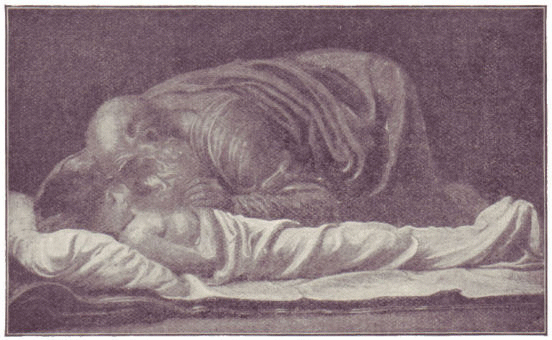 ELISHA LAYS HIS FACE ON THE CHILD'S FACE |
Elisha told his servant to call the mother, and when she came he said to her, "Take up your son."
the mother saw that her son was alive from the dead; she fell at Elisha's feet to show how great was her thankfulness to him, and then she took her son up in her arms, and went out.
How a Little Girl Helped to Cure a Leper
At one time, while Elisha was living in Israel, the general of the Syrian army was named Naaman. He was a great man in his rank and power; and a brave man in battle; for he had won victories for Syria. But one sad terrible trouble came to Naaman. He was a leper. A leper was one with a disease called leprosy, which is still found in those lands. The leper’s skin turns a deathly white and is covered with scales. One by one his fingers and toes, his hands and feet, his arms and limbs, decay, until at last the man dies; and for the disease there is no cure. Yet, strange to say, through it all, the leper feels no pain; and often will not for a long time believe that he has leprosy.
There was in Naaman’s house at Damascus, in Syria, a little girl, who waited on Naaman's wife. She was a slave-girl stolen from her mother's home in Israel, and carried away as a captive to Syria. Even when there was no open war between Syria and Israel, parties of men were going out on both sides, and destroying villages on the border, robbing the people, and carrying them away, to be killed or sold as slaves. But this little girl, even though she had suffered wrong, had a kind heart, full of sorrow for her master Naaman; and one day she said to her mistress:
“I wish that my Lord Naaman might meet the prophet who lives in Samaria; for he could cure his leprosy.”
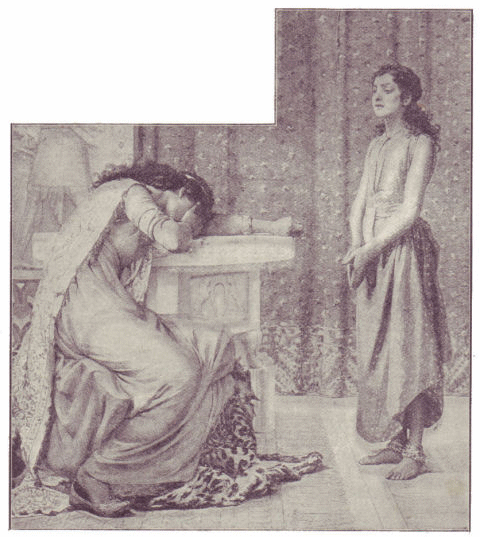 THE SLAVE GIRL AND NAAMAN'S WIFE |
Some one told Naaman what the little girl had said; and Naaman spoke of it to the king of Syria. Now the king of Syria loved Naaman greatly; and when he went to worship in the temple of his god, out of all his nobles he chose Naaman as the one person whose arm he leaned. He greatly desired to have Naaman's leprosy cured; and he said, “I will send a letter to the king of Israel, and I will ask him to let his prophet cure you.”
So Naaman, with a great train of followers, rode in his chariot from Damascus to Samaria, about a hundred miles. He took with him as a present a large sum in gold and silver, and many beautiful robes and garments. He came to the king of Israel, and gave him the letter from the king of Syria. And this was written in the letter:
"With this letter I have sent to you Naaman, my servant; and I wish you to cure him of his leprosy."
The king of Syria supposed that as this prophet who could cure leprosy was in Samaria, he was under the orders of the king of Israel, and must do whatever his king told him to do; and as he did not know the prophet, but knew the king, he wrote to him But the king was greatly alarmed when he read the letter.
"Am I God," he said, "to kill men and to make men live! Why should the king of Syria send to me to cure a man of his leprosy? Do you not see that he is trying to find an excuse for making war, in asking me to do what no man can do?"
And the king of Israel tore his garments, as men did when they were in deep trouble. Elisha the prophet heard of the letter, and of the king's alarm, and he sent a message to the king.
"Why are you so frightened? Let this man come to me, and he shall know that there is a prophet of the Lord in Israel."
So Naaman came with his chariots, his horses, and his followers, and stood before the door of Elisha's house. Elisha did not come out to meet him, but sent his servant out to him, saying:
"Go and wash in the river Jordan seven times, and your flesh and your skin shall become pure, and you shall be free from the leprosy."
But Naaman was very angry because Elisha had not treated with more respect so great a man as he was. He forgot, or he did not know, that by the laws of Israel no man might touch or even come near a leper; and he said:
"Why, I supposed that of course he would come out and meet me, and would wave his hand over the leper spot, and would call on the name of the Lord his God, and in that manner would cure my leprosy! Are not Abana and Pharpar, the two rivers of Damascus, better than all the waters in Israel? May I not wash in them and be clean?"
And Naaman turned and went away in a rage of anger. But his servants were wiser than he. They came to him, and one of them said:
"My father, if the prophet had told you to do some great thing, would you not have done it? Then why not do it, when he says, ‘Wash and be clean'?"
After a little Naaman's anger cooled, and he rode down the mountains to the river Jordan. He washed in its water seven times, and the prophet had bidden him And the scales of leprosy left his skin; and his flesh became like the flesh of a little child, pure and clean. Then Naaman, a leper no more, came back to Elisha's house with all his company; and he said, "Now I know that there is no God in all the earth, except in Israel. Let me make you a present in return for what you have done for me."
But the true prophets of God never gave their message or did their works for pay; and Elisha said to Naaman:
"As surely as the Lord lives, before whom I stand, I will receive nothing."
And Naaman urged him to take the present, but he refused. Then Naaman asked as a favor that he might be allowed to take away from the land of Israel as much soil as could be carried on two mules, with which to build an altar; for he thought that an altar to the God of Israel could be made only of earth from the land of Israel; and he said:
"From this time I will offer no burnt-offering or sacrifice to any other God except the God of Israel. When I go with my master, the king of Syria, to worship in the temple of Rimmon his god; and my master leans on my arm, and I bow down to Rimmon with him, then may the Lord forgive me for this, which will look as if I were worshipping another God."
And Elisha said to him, "God in peace."
Then Naaman went on his way back to his own land. But Gehazi, the servant of Elisha, said to himself:
"My master has let this Syrian go, without taking anything from him; but I will run after hi, and ask him for a present."
So Gehazi ran after Naaman; and Naaman saw him following, and stopped his chariot, and stepped down to meet him. And Gehazi said to him:
"My master has sent me to you to say that just now two young sons of the prophets have come to his house; will you give them a talent of silver and two suits of clothing?"
And Naaman said, "Let me give you two talents of silver."
So he put two talents of silver in two bags, a talent in each bag, and gave them to Gehazi, and with them two suits of fine clothing; and he sent them back by two of his servants. But before they came to Elisha's house, Gehazi took the gifts and hid them. Then Gehazi went into the house, and stood before Elisha. And Elisha said to him, "Gehazi, where have you been?"
And Gehazi answered, "I have not been at any place."
And Elisha said to him:
"Did not my heart go with you, and did I not see you, when the man stepped down from his chariot to meet you? Is this a time to receive gifts of money, and garments, or gifts of vineyards and olive yards, and of sheep and oxen? Because you have done this wickedness, the leprosy of Naaman shall upon you, and shall cling to you, and to your children after you forever!"
And Gehazi walked out from Elisha's presence, a leper, with his skin as white as snow.
The Chariots of Fire around Elisha
There was constant war between Israel and Syria through all the years of Elisha, the prophet. And the king of Israel found Elisha a greater help than his horses and chariots. For whenever the king of Syria told his officers to make an attack upon any place in the land of Israel, Elisha would send word to the king of Israel, saying, "Watch carefully that place, and send men to guard it, for the Syrians are coming to attack it."
And then, when the Syrian army came to the place, they were sure to find it strongly guarded, so that their soldiers could do nothing. This happened so many times that the king of Syria at last said to his nobles, "Some one among you is secretly helping the king of Israel, and is sending him word of all our plans. Will no one tell me who the traitor is?"
And they said, "No one of us, my lord, O king, has made known your plans; but Elisha, the prophet that is in Israel, tells the king of Israel the words that you speak in your own room."
Then the king of Syria said, "Go and find where that man is, so that I may send an army to take him."
After a time the king of Syria heard that Elisha was staying in Dothan. Then he sent to that place a great army, with horses and chariots. They came by night, and stood in a great ring all around the city, ready to seize the prophet. In the morning the prophet's helper rose up early; and he found the city surrounded on every side by a host of men, with swords and spears. He called Elisha, in great alarm, and said to him, "O my master, what shall we do?"
"Fear not," answered Elisha, "there are more men on our side than on theirs."
And then Elisha prayed to the Lord, saying, "O Lord, open the eyes of this young man, and let him see who are with us."
Then the Lord opened the eyes of the young man, and he saw what other men could not see, that the mountain on which the city stood was covered with horses and chariots of fire, sent by the Lord to keep his prophet safe. But this the Syrians could not see; and they came up to the gates of the city to take Elisha. Then Elisha prayed to the Lord, saying, "Lord, make these men blind for a little while" Then a mist came over the eyes of the Syrians, and they could not see clearly. And Elisha went out to them, ad said, "This is not the right city, but I will show you the way. Follow me."
And Elisha led them from Dothan to Samaria, and into the walls of the city, where the army of Israel were standing all around them. Then Elisha prayed, "O Lord, open the eyes of these men, that they may see."
And the Lord opened their eyes, ad they saw the walls of Samaria, and the host of Israel all around them. The king of Israel was glad to have his enemies in his power; and he said to Elisha, "My father, shall I kill them? Shall I kill them?"
But Elisha said to him, "You shall not kill them. Would you kill helpless men whom you had taken as prisoners? Give them bread to eat, and water to drink, and send them home to their master."
So, instead , of killing the Syrian soldiers or holding them as prisoners, the king of Israel set plenty of food before them, and gave them all that they needed. Then he sent them home to their master, the king of Syria. And after that it was a long time before the Syrian armies came into the land of Israel.
What the Lepers Found in the Camp
After a time there was another great war between Syria and Israel; and Ben-hadad, the king of Syria, led a mighty army into the land of Israel, and laid siege against the city of Samaria. So hard and so long was the siege that the people in Samaria could find nothing to eat; many died from want of food, and some killed their own children, and ate them.
But through all the siege Elisha encouraged the king of Israel not to give up the city. When it seemed that there could be no hope, Elisha said to the king, "Hear the word of the Lord, ‘To-morrow, at this hour, in the gate of Samaria, a peck of flour shall be sold for sixty cents, and two pecks of barley for sixty cents.'"
One of the nobles, on whose arm the king was learning, did not believe Elisha's word, and said, scornfully, "If the Lord would make windows in heaven, and rain down wheat and barley, then this might be." "You shall see it with your own eyes," answered Elisha,; "but you shall not eat any of the food."
On the next morning, about daybreak, four men that were lepers were standing together outside the gate of Samaria. Being lepers, they were not allowed by the laws of Israel inside the walls of the city. (We have read of leprosy and lepers in the story of Naaman, Story Thirteen in this part). These four men said to each other, "What shall we do? If we go into the city we must die there from the want of food; if we stay here we must die. Let us go to the camp of the Syrians; perhaps they will let us live; and at the worst they can do no more than kill us."
So the four men went toward the Syrian camp; but as they came near they were surprised to find no one standing on guard. They went into a test, and found it empty, as though it had been left very suddenly, for there were food, and drink, and garments, and gold, and silver. As no one was there they ate and drank all they needed; and then they took away valuable things and hid them. They looked into another tent, and another, and found them like the first, but not a man was in sight. They walked through the camp; but not a soldier was there, and the tents were left just as they had been when men were living in them.
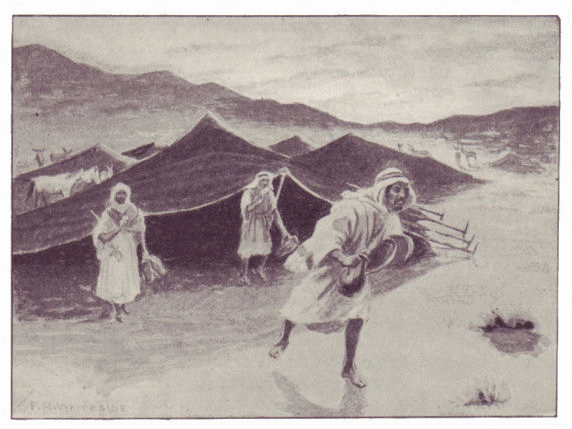 THE LEPERS VISIT A TENT OF THE SYRIANS |
In the night the Lord had caused the Syrians to hear a great noise, like the rolling of chariots, and the trampling of horses, and the marching of men. They said to each other, in great fear, "The king of Israel has sent for the Hittites on the north, and the Egyptians on the south, to come against us."
And so great and so sudden was their terror, that in the night they rose up and fled away, leaving everything in their camp even leaving their horses tied, and their asses, and all their treasure, and all their food, in their tents.
After a time the lepers said to each other, We do wrong not to tell this good news in the city. If they find it out, they will blame us for not letting them know, and we may lose our lives on account of it."
So they went up to the gate, and called the men on guard, and told them how they had found the camp of the Syrians, with tents standing, and horses tied, but not a man left The men on guard told it at the king's palace. But the king, when he heard it, thought that it was a trick of the Syrians to hide themselves, and to draw the men out of the city, so that they might take the city.
The king sent out two men with horses and chariots, and they found that not only had the camp been left, but that the road down the mountains to the river Jordan was covered with garments, and arms, and treasures that the Syrians had thrown away in their wild flight.
The news soon spread through the city of Samaria; and in a few hours all the city was at the gate. And when the food was brought in from the camp, there was abundance for all the people. And it came to pass as Elisha had said, a peck of grain, and two pecks of barley were sold for sixty cents in the gate of Samaria by noon of that day.
The king chose the noble upon whose arm he had leaned the day before to have charge of the gate. So he saw with his own eyes that which the prophet had foretold; but he did not eat of it, for the crowd was so great that the people pressed upon him, and he was trodden under their feet, and killed in the throng.
Thus the king and all the city of Samaria knew that Elisha had indeed spoken the word of the Lord.
We have seen how different from the ways of Elijah were the ways of Elisha. Elijah lived alone in the wilderness, and never came before kings except to tell them of their evil deeds, and to warn them of punishment. But Elisha lived in the city, at times even in the city of Samaria, often sent helpful messages to the king, and seemed to be his friend. Both these men were needed, Elijah and Elisha, one to destroy the evil in the land, and the other to build up the good.
Jehu, the Furious Driver of His Chariot
You remember that when the Lord came to the prophet Elijah at Mount Horeb in the wilderness (see Story Five in this Part), the Lord gave to Elijah a command to anoint or call Hazael to be king of Syria, and Jehu to be king of Israel. But to prepare the way for these changes of rule a long time was needed, and Elijah was taken home to heaven before these men were called to be kings.
The time to call these men had now come, and Elisha undertook the work that had been left to him by Elijah. He went to Damascus, the chief city of Syria: and Ben-hadad, the king of Syria, heard that the great prophet of Israel had come, for the fame of Elisha's deeds had made his name known through all those lands.
At that time King Ben-hadad was ill; and he sent one of his chief princes, whose name was Hazael, to ask Elisha whether he would be well gain. Hazael came to meet Elisha with a rich present, which loaded forty camels, and he spoke to Elisha with great respect, saying, "Your son, Ben-hadad, king of Syria, has sent me to you to ask, 'Shall I become well again from this sickness?' "
And Elisha said to Hazael, "You may tell Ben-hadad that he will get well; nevertheless, the Lord has shown me that he will surely die."
Then Elisha looked steadily upon Hazael's face, until Hazael felt ashamed, and Elisha wept as he looked upon him. Hazael said to him, "Why does my lord weep?" "I weep, said Elisha, "because I know the evil that you will do to the people of Israel. You will take their castles, and set them on fire; you will kill their young men, and you will destroy their children"
Hazael was surprised at this, and said, "I am nothing but a dog; and how can I do such great things?"
And Elisha answered him, "The Lord has shown me that you shall be king over Syria"
Then Hazael went to King Ben-hadad, and said to him, "the man of God told me that you will surely be well from your sickness."
And on the next day Hazael took the cover from the bed, and dipped it in water, and pressed it tightly over Ben-hadad's face, so that he died; and Hazael reigned in his place as king of Syria. As soon as Hazael became king, he made war upon the Israelites; and a battle was fought at Ramoth-gilead, the same place where King Ahab had been slain more than ten years before. In this battle Jehoram, the king of Israel, was wounded; and he was taken to Jezreel, beside the great plain of Esdralon, there to recover from his wounds. Ahaziah, who was at that time king of Judah, and who was a nephew of Jehoram, went to Jezreel to visit him while he was ill from his wounds.
By this time Elisha, the prophet, had returned from his visit to Syria. He knew that the time had now come to finish the work in Israel left to him by Elijah; and he called one of the sons of the prophets to him, and said, "Rise up, and go to the camp at Ramoth-gilead; and take with you this little bottle of oil. And when you reach Ramoth-gilead, find one of the captains of the army, Jehu, the son of Jehoshaphat, the son of Nimshi; and lead him into a room alone, and pour the oil on his head, and say, 'Thus saith the Lord, I have anointed you as king over Israel.' When you have done this, come back to me at once without waiting."
Then the young man, who was a prophet like Elisha, took the bottle of oil in his hand and went to Ramoth-gilead. In the camp of Israel he found the captains of the army sitting together. He came suddenly among them, and said, "O captain, I have an errand to you."
And Jehu, one of the captains, said to him, "To which one of us is your errand?"
He said to Jehu, "My errand is to you alone, O captain."
Then Jehu went with the young prophet into the house; and he poured the oil on his head, and said, "Thus said the Lord, the God of Israel, 'I have anointed you as king over my people Israel. And you shall destroy the family of Ahab, because they destroyed the prophets of the Lord. And I will make the house of Ahab like the house of Jeroboam, who made Israel to sin. And the wild dogs shall eat Jezebel in the city of Jezreel, and there shall be no one to bury her.' "
And after he had said this, the prophet opened the door, and went away as suddenly as he had come. Jehu came back to the other captains, and sat down again. One of the captains said to him, "Is all well? Why did this wild fellow call you out?"
Jehu said to them, "You the know the man, and you know what he said to me."
"No, no" they all said, "we do not know. Tell us what he said"
Then Jehu told them what the prophet had said, and that he had anointed him as king. This pleased all the captains. At once they took off their outer garments, and spread them as a carpet on the stairs of the house, and at the head of the stairs they placed Jehu; and they blew the trumpets and called out to the army, "Jehu is the king!"
Jehu said to the captains, "Do not let any one go out of the camp to bear word to Jehoram. I will go myself.:
Then Jehu made ready his chariot, and rode swiftly toward Jezreel, his company riding after him. The watchman on the tower at Jezreel saw him coming, and he called out to King Jehoram, "I see a company coming toward the city."
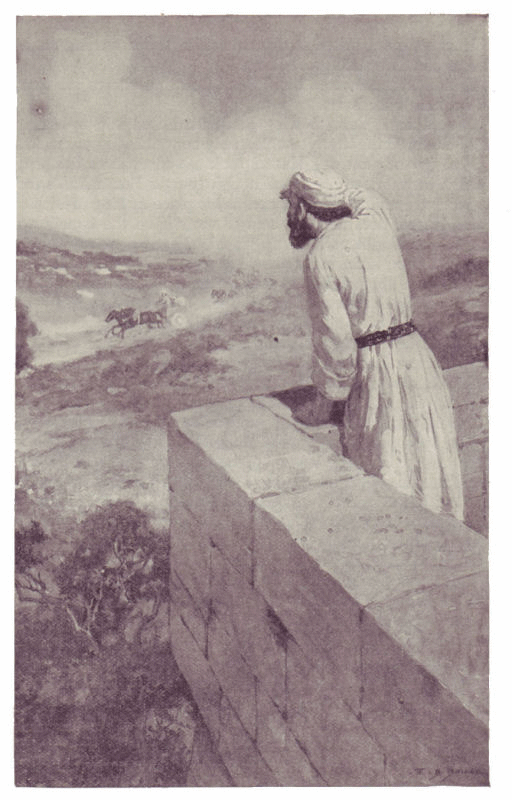 JEHU DRIVING HIS CHARIOT TO MEET KING JEHORAM |
Jehoram thought that they were bearing news of the war with the Syrians. He sent out a man on horseback to meet the company. The man came, and said, "Is all well?"
Jehu answered him, "What difference is it to you? Come after me."
Then the man turned, and joined Jehu's company; and so did another man whom Jehoram sent when the first man did not return. And the watchman called out to Jehoram again, "Two men gave gone out to meet the company that is drawing near, but they have not come back; and the man at the head drives like Jehu, the son of Nimshi, for he drives furiously"
Then Jehoram became anxious; he sent for his chariot, and went out to meet Jehu; and with him went Ahaziah, the king of Judah, each in his own chariot. It came to pass that they met Jehu in the very place which had been the vineyard of Naboth; the same place where Ahab had met Elijah, when that same Jehu was standing behind Ahab in his chariot. (See Story Seven in this Part.) As Jehoram drew near to Jehu, he called to him, "Is all well, Jehu?"
"Can anything be well," answered Jehu, "as long as your mother Jezebel lives, with all her wickedness?"
When Jehoram heard this he saw that Jehu was his enemy. He cried out to King Ahaziah, and turned his chariot, and fled. But he was too late, for Jehu drew his bow with all his strength and sent an arrow to his heart. Jehoram fell down dead in his chariot. Then Jehu said to Bidkar, whom he had made his chief captain, "Take away the body of Jehoram, and throw it into the field where the body of Naboth was thrown. Do you remember how, when you and I were riding in the chariot behind Ahab, his father, the Lord said, 'I have seen the blood of Naboth on this spot, and the punishment of Ahab and his sons shall be in this place?'"
When Ahaziah, the king of Judah, saw Jehoram fall, he, too, turned and fled. But Jehu pursued him, and ordered his followers to kill him. So Ahaziah, the son of Jehoshaphat, and grandson of Ahab (for his mother, Athalish, was a daughter of Jezebel), he also died at the hand of Jehu. His servants took the body of Ahaziah to Jerusalem, and buried it there.
When Jehu rode into the city of Jezreel Queen Jezebel knew that her end had come; but she met it boldly, like a queen. She put on her royal robes, and a crown upon her head, an sat by the window, waiting for Jehu to come. As he drew near, she called out to him, "Good day to you, Jehu, you who are like Zimri, the murderer of your master!"
You have read of Zimri, who slew King Elah, and was himself burned in his palace seven days after. (See Story Three in this Part). Jehu looked up to the window, and called out, "Who is on my side? Who?"
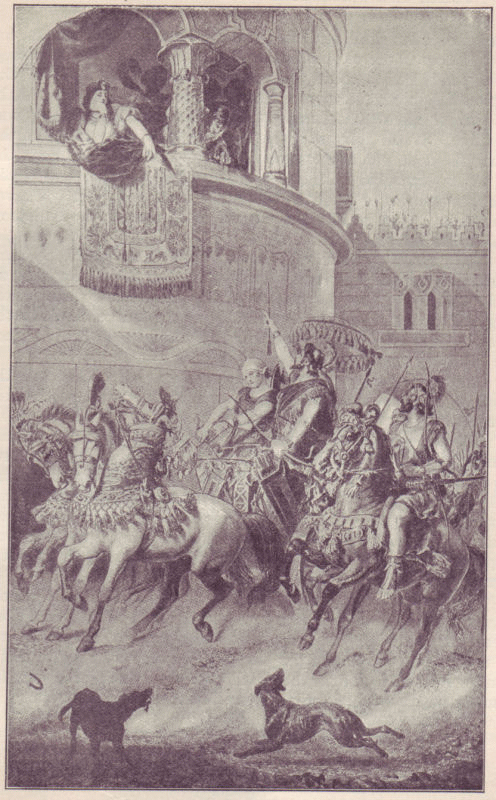 JEZEBEL CALLS FROM THE WINDOW TO JEHU |
And some men looked out to him, and he said, "Throw her out of the window."
They threw her down, and her blood was spattered on the wall and on the horses. King Jehu came into the palace, and sat down as master, and ate and drank. Then he said, "Take up the body of that wicked woman, Jezebel, and bury her, for, though wicked, she was the daughter of a king."
But when they looked on the pavement there was nothing left of her except her skull, and the bones of her feet and her hands, for the wild dogs of the city had eaten her body; and thus the wicked life of Jezebel came to an end, and the word of the Lord by the prophet Elijah came to pass. And Jehu slew all the sons of Ahab, and their children with them, so that not one of Ahab's family was left alive. When Jehu saw that he was safe and strong on the throne, he sent out a message to all the worshippers of Baal, the idol which Jezebel and the house of Ahab had brought into Israel. This message was, "Ahab served Baal a little, but Jehu will serve him much. Now, let all the priests of Baal meet in the temple of Baal in Samaria."
They came by hundreds, hoping that Jehu would be their friends as Ahab and his family had been. But when they were all in the temple, he brought an army of his soldiers, and placed them on guard around it; and when no one escape, he gave the order, "Go into the temple and kill all the priests of Baal; let not one get away alive."
And this was done in a cruel manner. He killed all the prophets and priests of Baal, and tore down the temple of Baal in Samaria.
But though Jehu broke up the worship of Baal, he did not worship the Lord God of Israel as he should. He continued to serve the golden calves which Jeroboam had set up long before at Bethel and at Dan. (See story two in this part). And the Lord sent a prophet to Jehu, who said to him, "Because you have done my will in destroying the house of Ahab, and in destroying those that worshipped Baal, your children to the fourth generation shall sit on the throne of Israel."
On account of the many sins of the people of Israel the Lord began in the days of Jehu to take away the land of the Ten Tribes. Hazael, the new king of Syria, made war on Jehu, and conquered all the land on the east of the Jordan, from the brook Amon to the land of Bashan in the north; so all that was left of Israel was the country on the west of Jordan, from Bethel northward to Dan.
Elisha and the Bow; Jonah and Nineveh
After Jehu, his son Jehoahaz reigned in Israel. He was not only a wicked but also a weak king; and under him Israel became helpless in the hands of its enemies, Hazael, the fierce king of Syria, and his son, Ben-dadad the second. But when Jehoahaz died, his son Joash became king, and under his rule Israel began to rise again.
Elisha, the prophet, was now an old man, and very feeble, and near to death. The young king, Joash, came to see him, and wept over him, and said to him, as Elisha himself had said to Elijah (Story Nine In this Part), "My father, my father, you are to Israel more than its chariots and its horsemen!"
But Elisha, though weak in body, was yet strong in soul. He told King Joash to bring to him a bow and arrows, and to open the window to the east, looking toward the land of Syria. Then Elisha caused the king to draw the bow, and he placed his hands on the king's hands. And as the king shot an arrow, Elisha said, "This is the Lord's arrow of victory, of victory over Syria, for you shall smite the Syrians in Aphek, and shall destroy them."
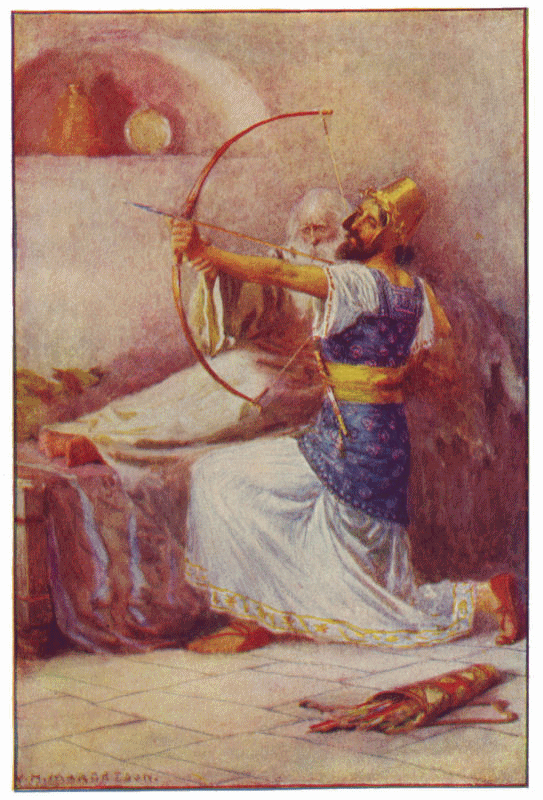 KING JOASH SHOOTING THE ARROW |
Then Elisha told the king to take the arrows, and to strike with them on the ground. The king struck them on the ground three times, and then stopped striking. The old prophet was displeased at this, and said, "Why did you stop? You should have struck the ground five or six times; then you would have won as many victories over Syria; but now you shall beat the Syrians three times, and no more."
Soon after this Elisha died, and they buried him in a cave. In the spring of the next year the bands of the Moabites came upon the place just as they were burying another man, and in their haste to escape from the enemies they placed the body in the cave where Elisha was buried. When the body of this man touched the body of the dead prophet, life came to it, and the man stood up. Thus, even after Elisha was dead, he still had power.
After the death of Elisha, Joash, the king of Israel, made war upon Ben-hadad the second, king of Syria. Joash beat him three times in battle, and took from him all the cities that Hazael, his father, had taken away from Israel. And after Joash, his son Jeroboam the second reigned, who became the greatest of all the kings of the Ten Tribes. Under him the kingdom grew rich and strong. He conquered nearly all Syria, and made Samaria the greatest city in all those lands.
But though Syria went down, another nation was now rising to power, Assyria, on the eastern side of the river Tigris. Its capital was Nineveh, a great city, so vast that it would take three days for a man to walk around its walls. The Assyrians were beginning to conquer all the lands near them, and Israel was in danger of falling under their power. At this time another prophet, named Jonah, was giving the word of the Lord to the Israelites. To Jonah the Lord spoke, saying, "Go to Nineveh, that great city, and preach to it, for its wickedness rises up before me."
But Jonah did not wish to preach to the people of Nineveh, for they were the enemies of his land, the land of Israel. He wished Nineveh to die in its sins, and not to turn to God and live. So Jonah tried to go away from the city where God had sent him He went down to Joppa, upon the shore of the Great Sea. There he found a ship about to sail to Tarshish, far away in the wet. He paid the fare, and went on board, intending to go as far as possible from Nineveh.
But the Lord saw Jonah on the ship, and the Lord sent a great storm upon the sea, so that the ship seemed as though it would in pieces. The sailors threw overboard everything on the ship, and when they could do no more, every man prayed to his god to save the ship and themselves. Jonah was now lying fast asleep under the deck of the ship, and the ship's captain came to him, and said, "What do you mean by sleeping in such a time as thus? Awake, rise up, and call upon your God. Perhaps your God will hear you, and will save our lives."
But the storm continued to rage around the ship, and they said, "There is some man on this ship who has brought upon us this trouble. Let us cast lots, and find who it is."
Then they cast lots, and the lot fell on Jonah. They said to him, all at once, "Tell us, who are you? From what country do you come? What is your business? To what people do you belong? Why you brought all this trouble upon us?" Then Jonah told them the whole story: how he came from the land of Israel, and that he had fled away from the presence of the Lord. And they said to him, "What shall we do to you, that the storm may cease?" Then Jonah said, "Take me up, and throw me into the sea; then the storm will cease, and the waters will be calm; for I know that for my sake this great tempest is upon you."
But the men were not willing to throw Jonah into the sea. They rowed hard to bring the ship to land, but they could not. Then they cried unto the Lord, and said, "We pray thee, O Lord, we pray thee, let us not die for this man's life; for thou, O Lord, hast done as it pleased thee." At last, when they could do nothing else to save themselves, they threw Jonah into the sea. At once the storm ceased, and the waves became still. Then the men on the ship feared the Lord greatly. They offered a sacrifice to the Lord, and made promises to serve him.
 JONAH THROWN OVERBOARD BY THE SAILORS |
And the Lord caused a great fish to swallow up Jonah; and Jonah was alive within the fish for three days and three nights. Long afterward, when Jesus was on the earth, he said that as Jonah was three days inside the fish, so he would be three days in the earth; so Jonah in the fish was like a prophecy of Christ. In the fish Jonah cried to the Lord; and the Lord heard his prayer, and caused the great fish to throw up Jonah upon the dry land.
By this time Jonah had learned that some men who worshipped idols were kind in their hearts, and were dear to the Lord. This was the lesson that God meant Jonah to learn; and now the call of the Lord came to Jonah a second time.
"Arise; go to Nineveh, that great city, and preach to it what I command you."
So Jonah went to the city of Nineveh, and as he entered into it, he called out to the people, "Within forty days shall Nineveh be destroyed" And he walked through the city all day, crying out only this, "Within forty days shall Nineveh be destroyed."
And the people of Nineveh believed the word of the Lord as spoken by Jonah. They turned away from their sins, and fasted, and sought the Lord, from the greatest of them even to the least. The king of Nineveh arose from his throne, and laid aside his royal robes, and covered himself with sackcloth, and sat in ashes, as a sign of his sorrow And the king sent out a command to his people, that they should fast, and seek the Lord, and turn from sin.
And God saw that the people of Nineveh were sorry for their wickedness, and he forgave them, and did not destroy their city. But this made Jonah very angry. He did not wish to have Nineveh spared, because it was the enemy of his own land, and also he feared that men would call him a false prophet when his word did not come to pass. And Jonah said to the Lord:
"O Lord, I was sure that it would be thus, that thou wouldest spare the city; and for that reason I tried to flee away; for I knew that thou wast a gracious God, full of pity, slow to anger, and rich in mercy. Now, O Lord, take away my life, for it is better for me to die than to live."
And Jonah went out of the city, and built a little hut on the east side of it, and sat under its roof, to see whether God would keep the word that he had spoken. Then the Lord caused a plant with thick leaves called a gourd to grow up, and to shade Jonah from the sun; and Jonah was glad, and sat under its shadow. But a worm destroyed the plant; and the next day a hot wind blew, and Jonah suffered from the heat; and again Jonah wished that he might die. And the Lord said to Jonah, "You were sorry to see the plant die, though you did not make it grow, and though it came up in a night and died in a night. And should not I have pity on Nineveh, that great city, where are more than a hundred thousand little children, and also many cattle, all helpless and knowing nothing?"
 JONAH AND HIS GOURD |
And Jonah learned that men, and women, ad little children, are all precious in the sight of the Lord, even though they know not God.
In most of the books of the Old Testament, we read of the Israelite people, and of God's care of them; but we do not find in the Old Testament much about God as the Father of all men of every nation and every land. The book of Jonah stands almost alone in the Old Testament, as showing that God loves people of other nations than Israel. Even the people of Nineveh, who worshipped images, were under God's love; God was ready to hear their prayer and to save them. So the book of Jonah shows us God as "our heavenly Father."
How the Ten Tribes Were Lost
The power and peace that Judah enjoyed under Jeroboam the second did not last after his death His great kingdom fell apart, and his son Zechariah reigned only six months. He was slain in the sight of his people by Shallum, who made himself king. But after only a month of rule, Shallum himself was killed by Menahem, who reigned ten years of wickedness and of suffering in the land, for the Assyrians spoiled the land and took away the riches of Israel. Then came Pekahiah, who was slain by Pekah, and Hoshea, who in turn slew Pekah. So nearly all the latter kings of Israel won the throne by murder, and were themselves slain. The land was helpless, and its enemies, the Assyrians from Nineveh, won victories, and carried away many of the people, and robbed those who were left. All these evils came upon the Israelites, because they and their kings had forsaken the Lord god of their fathers and worshipped idols.
Hoshea was the last of the kings over the Ten Tribes; nineteen kings in all, from Jeroboam to Hoshea. In Hoea's time, the king of Assyria, whose name was Shlmanezer, came up with a great army against Samaria. He laid siege against the city; but it was in a strong place, and hard to take, for it stood on a high hill. The siege lasted three years, and before it was ended, Shalmanezer, the king of Assyria, died, and Sargon, a great warrior and conqueror, reigned in his place. Sargon took Samaria, and put to death Hoshea the last king of Israel. He carried away nearly all the people from the land, and led them into distant countries in eh east, to Mesopotamia, to Media, and the lands near the great Caspian Sea. This Sargon did, in order to keep the Israelites from again breaking away from his rule.
As in their own land the children of Israel had forsaken the Lord and had worshipped idols, so after they were taken to these distant lands they sought the gods of the people among whom they were living. They married the people of those lands, and ceased to be Israelites; and after a time they lost all knowledge of their own God, who had given them his words and sent them his prophets. So there came an end to the Ten Tribes of Israel, for they never again came back to their own land, and were lost among the people of the far east.
But a small part of the people of Israel were left in their own land. The king of Assyria brought to the land of Israel people from other countries, and placed them in the land. But they were too few to fill the land, and to care for it; so that the wild beasts began to increase in Israel, and many of these strange people were killed by lions who lived among the mountains and in the valleys. They thought that the lions came upon them because they did not worship the God who ruled in that land, and they sent to the king of Assyria, saying, "Send us a priest who can teach us how to worship the God to whom this land belongs; for he has sent lions among us, and they are destroying us."
They supposed that each land must have its own God, as the Philistines worshipped Dagon, and the Moabites Chemosh, and the Tyrians and Zidonians, Baal and Asherah. They did not know that there is only one God, who rules all the world, and who is to be worshipped by all men.
Then the king of Assyria sent to these people a priest from among the Israelites in his land; and this priest tried to teach them how to worship the Lord. But with the Lord's worship, they mingled the worship of idols; and did not serve the Lord only, as God would have them serve him. In after time these people were called Samaritans, from Samaria, which had been their chief city. They had their temple to the Lord on Mount Gerizim, near the city of Shechem, and in that city a few of them are found even in our time.
The First Four Kings of Judah.
Now we turn from the story of the kingdom of Israel in the north to the story of the kingdom of Judah in the south. You read in Story One of Part Fourth how the Yen Tribes broke away from the rule of King Rehoboam and set up a kingdom of their own under Jeroboam. This division left the kingdom of Judah very small and weak. It reached from the Dead Sea westward to the land of the Philistines on the shore of the Great Sea, and from Beersheba on the south not quite to Bethel on the north; but it held some control over the land of Edom on the south of the Dead Sea. Its chief city was Jerusalem, where stood the Temple of the Land and the palace of the king.
After Rehoboam found that he could no more rule over the Ten Tribes, he tried to make his own little kingdom strong by building cities and raising an army of soldiers. But he did not look to the Lord as his grandfather David had looked; he allowed his people to worship idols, so that soon on almost every hill and in almost every grove of trees there was an image of stone or wood. God was not pleased with Rehoboam and his people, because they had forsaken him for idols. He brought upon the land of Judah a great army from Egypt, led by Shishak, the king of Egypt. They marched over all the land of Judah, they took the city of Jerusalem, and they robbed the Temple of all the great treasure in gold and silver which Solomon had stored up. This evil came upon Judah because its king and its people had turn away from the Lord their God.
After Rehoboam had reigned seventeen years he died, and his son Abijah, became king of Judah. When Jeroboam, the king of Israel, made war upon him, Abijah led his army into the land of Israel. But Jeroboam's army was twice as large as Abijah's, and his men stood not only in front of the men of Judah but also behind them, so that the army of Judah was in great danger of being destroyed. But Abijah told his men to trust in the Lord, and to fight bravely in the Lord's name. And God helped the men of Judah against Israel, and they won a great victory; so that Jeroboam never again came against Judah.
Abijah's reign was short, only three years; and after him came Asa, his son, who was a great warrior, a great builder of cities, and a wise ruler. Against Asa a great army of enemies came up from Ethiopia, which was south of Egypt. Asa drew out his little army against the Ethiopians at a place called Mareshah, in the south of Judah, near the desert. He had no hope of success in his soldiers, because they were so few and the enemies were no many. But Asa called upon the Lord, and said:
"O Lord, it makes no difference to three whether there are few or many. Help us, O Lord, for we trust in thee; and in thy name we fight this vast multitude. O Lord, thou art our God; let not man succeed against thee."
The Lord heard Asa's prayer, and gave him a great victory over the Ethiopians. Asa took against the cities in the south which had gone over to the side of the Ethiopians, and he brought to Jerusalem great riches, and flocks of sheep, and heads of cattle, and camels, which he had taken from his enemies.
Then the Lord sent to Asa a prophet named Azariah. He said, "Hear me, King Asa, and all Judah and Benjamin. The Lord is with you while you are with him. If you seek him you shall find him; but if you forsake the Lord he will forsake you. Now be strong, and put away the wickedness out of the land, and the Lord shall reward your work."
Then Asa rebuilt the altar of the Lord which had fallen into decay, and he called upon his people to worship. He went through the land, and broke down the idols, and burned them. He found that his own mother, the queen, had made an idol, and he cut it down and broke it in pieces; and he would not allow her to be queen any longer, because she had worshipped idols.
Until Asa was old he served the Lord; but in his old age he became sick, and in his sickness he did not seek the Lord. He turned to men who called themselves physicians or doctors, but they were men who tried to cure by the power of idols. This led many of Asa's people to worship images, so that when he died there were again idols throughout the land.
Asa's son, Jehoshaphat, was the next king, and he was the wisest and strongest of all the kings of Judah, and ruled over the largest realm of any. When he became king, Ahab was king of Israel, of whom we read in Part Fourth. Jehoshaphat made peace with Israel, and united with the Israelites against the kingdom of Syria. He fought against the Syrians in the battle at Ramath-gilead, where King Ahab was slain (see Part Fourth, Story Eight), and afterward with Ahab's son, Jehoram, he fought against the Moabites. (See Part Fourth, Story Ten.)
Jehoshaphat served the Lord with all his heart. He took away the idols that had again arisen in the land; he called upon his people to worship the Lord, and he sent princes and priests throughout all Judah to read to the people the law of the Lord, and to teach the people how to serve the Lord.
The Lord gave to Jehoshaphat great power. He ruled over the land of Edom, over the wilderness on the south, and over the cities of the Philistines upon the coast. And Jehoshaphat chose judges for the cities in all the land, and he said to them:
"Remember that you are not judging for men, but for the Lord; and the Lord as with you, and sees all your acts. Therefore fear the Lord, and do his will. Do not allow men to make you presents, so that you will favor them; but be just toward all, and be strong in doing right."
At one time news came to King Jehoshaphat that some of the nations on the east and south and north, Moabites, Ammonites, and Syrians, had banded together against him, and were encamped with a great army at En-gedi, near the Dead Sea. Jehoshaphat called forth his soldiers, but before they went to battle he led them to the Temple to worship the Lord. And Jehoshaphat called upon the Lord for help, saying:
"O Lord, the God of our fathers, art not thou God in heaven? Dost thou not rule over the nations of earth? Is not power thine, so that none can stand against thee? Now, Lord, look upon these hosts who have come against thy people. We have no might against this great company, and we know not what to do; but our eyes look toward thee for help."
Then the Spirit of the Lord came upon one of the Levites, a man named Jahaziel, and he said:
"Hear, ye men of Jerusalem and Judah, and hear, O King Jehoshaphat. Thus saith the Lord, 'Fear not this great host of your enemies, for the battle is not yours, but the Lord's. go out against them; but you will not need to fight. You shall stand still, and see how the Lord will save you. Do not fear, for the Lord is with you!'"
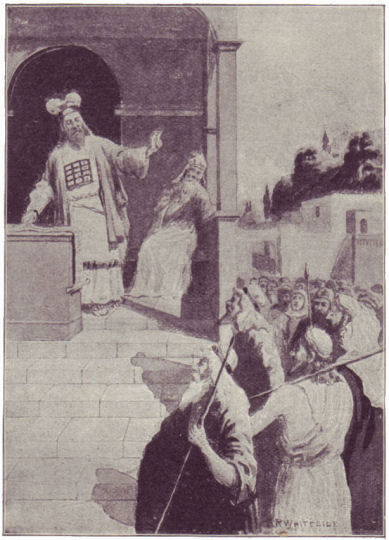 THE PRIESTS TEACH THE PEOPLE |
Then Jehoshaphat and all his people worshipped the Lord, bowing with the faces on the ground. And the next day, when they marched against the enemies, the Levites walked in front, singing and praising the Lord, while all the people answered.
"Give thanks to the Lord, for his mercy endureth forever."
When the men of Judah came to the camp of their enemies, they found that a quarrel had risen up among them. The Ammonites and the Moabites began to fight with the rest of the bands, and soon all the host were fighting and killing each other. And when the men of Judah came part of the host were lying dead, and the rest had fled away into the desert, leaving behind them great treasure. So it came to pass as the prophet Azariah had said, they did not fight, but the Lord fought for them, and saved them from their foes.
The place where this strange battle had taken place they named "the valley of Berachah," which means "blessing," because there they blessed the Lord for the help that he had given them. And afterward they came back to Jerusalem with songs, and praises, and the great riches which they had taken. And God gave to King Jehoshaphat peace and rest from his enemies, and great power as long as he lived.
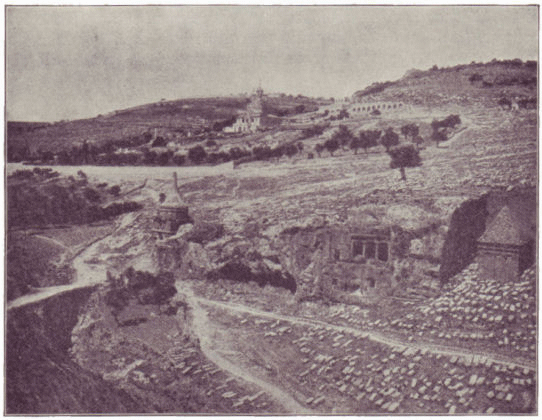 THE VALLEY OF JEHOSHAPHAT AT JERUSALEM AS SEEN TO-DAY |
The Little Boy Who Was Crowned King
Jehoshaphat, the king of Judah, was a good man and a wise king, but he made one mistake which brought great trouble upon his family and upon his land in after days. He married his son Jehoram to Athaliah, the daughter of Ahab and the wicked Jezebel. When Jehoshaphat died and Jehoram became king of Judah, his wife, Athaliah, led him into all the wickedness of the house of Arab. Jehoram killed all his brothers, the sons of Jehoshaphat, so that no one of them might rise up against him. His queen Athaliah, set up idols all around Jerusalem and in Judah, and led the people in worshipping them.
The prophet Elijah was still living in Israel when Jehoram began to reign in Judah. He sent to King Jehoram a letter containing a message from the Lord. He wrote:
"Thus saith the Lord, the God of David, 'Because you have not walked in the ways of your father, Jehoshaphat, but have walked in the ways of the kings of Israel, and have led the people of Jerusalem and of Judah to turn from the Lord to idols, and because you have slain your brothers, who were better than you, therefore the Lord will strike you and your house, and your people; and you shall have a terrible disease that none can cure."
And after this great troubles came upon Jehoram and his land. The Edomites on the south, who had been under the rule of Judah since the days of David, broke away from King Jehoram and set up a kingdom of their own. The Philistines on the west and the Arabians of the desert made war upon him. They broke into his palace, and carried away his treasures, and killed all his children except one, the youngest.
And upon Jehoram himself fell a sickness that lasted many years, and caused him great suffering. No cure could be found, and after long years of pain Jehoram died. So evil had been his reign of eight years that no one was sorry to have him die, and they would not allow his body to be buried among the kings of Judah.
After Jehoram his youngest son, Ahaziah, became king. His mother was the wicked Athaliah, the daughter of Jezebel. Ahaziah reigned only one year; for while he was visiting King Jehoram of Israel, his uncle, he was slain by Jehu, as we read in Story Sixteen in Part Fourth; for this was the time when Jehu rose against the house of Ahab, killed Jehoram, Ahab's son, and Jezebel, Ahab's widow, and make himself king of Israel. But Jehu gave to the body of Ahaziah a king's burial, for he said, "He was the son of Jehoshaphat, who sought the Lord with all his heart."
When Athaliah, the mother of Ahaziah, heard that her son was dead, all the fierceness of her mother Jezebel arose in her. She seized the princes who belonged to the family of David and killed them, so that there was not a man of the royal line left. And she made herself queen and ruler over the land of Judah. She shut up the house of the Lord, and built a temple for Baal; and for six years led the people of Judah in all wickedness.
In the slaughter of the royal family by Athaliah one little child of Ahaziah had been saved alive. His name was Joash. He was a baby, only a year old when his grandmother, Athaliah, seized the throne, and his aunt, a sister of Ahaziah and the wife of the priest Jehoiada, hid him in the Temple of the Lord, and kept him safe from the hate of Queen Athaliah. There he stayed for six years, while Jehoiada, the priest, brought him out of his hiding-place, and set him before the people and the rulers in the temple, and placed the crown upon his head. Then all the people shouted, "Long live the king! Long live the king!"
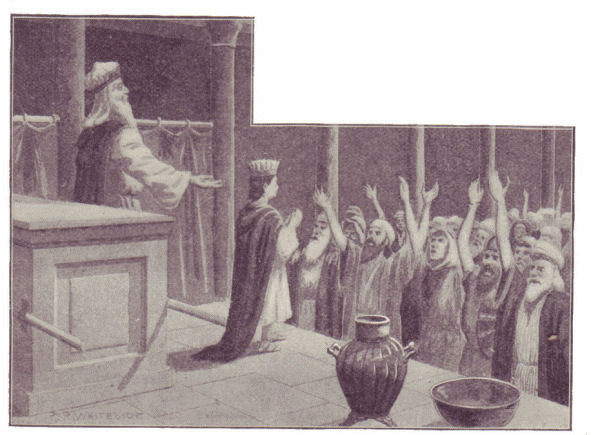 THE LITTLE JOASH IS CROWNED KING |
Queen Athaliah heard the noise of the shouting, and came out of her palace to see what had taken place. She saw the little boy-king standing by a pillar in the Temple, with the crown upon his head, and around him the soldiers and the people, crying aloud, "Long live the king!"
Athaliah was very angry as she saw all this. She called for her servants and her soldiers to break up this gathering of the people, and to take the boy-king. But no one would follow her, for they were tired of her cruel rule, and they wished to have for their king one who came from the line of David.
Jehoiada said to the soldiers, "Take this woman a prisoner, and carry her out of the Temple of the Lord. Let not her blood be spilled in the holy house."
So they seized Athaliah, and dragged her out of the Temple, and killed her. Then Jehoiada and all the people made a promise to serve the Lord only. They tore down the house of the idol Baal, and destroyed the images, and broke its altar in pieces. They made the Temple holy once more, and set the house in order, and offered the sacrifices, and held the daily worship before the altar. And all the people were glad to have a descendant of David, one of the royal line, once more on the throne of Judah.
As long as Jehoiada the good priest lived, Joash ruled well, and his people served the Lord. When King Joash grew up he wished to have the Temple of the Lord made new and beautiful; for in the years that has passed since the Temple had been built by Solomon, it had grown old, and had fallen into decay. Then, too, Queen Athaliah and the men who worshipped Baal had broken down the walls in many places, and they had carried away the gold and the silver of the temple to use in the worship of Baal.
At first King Joash told the priests and Levites, who served in the Temple, to go through the land, and ask the people for money to be spent in the fitting up of the Temple. But the priests and the Levites were slow in the work, and the king tried another plan for getting the money that was needed.
He caused a large box or chest to be made, and had it placed at the door of the Temple, so that all would see it when they went to worship the Lord. In the lid of the box was a hole through which they dropped money into the box. And the king caused word to be sent through all the land that the princes and the people should bring gifts of money, and drop it into the chest, whenever they came to the Temple.
The people were glad, and brought their gifts willingly; for they all wished to have God's house made beautiful. In a short time the box was full of gold and silver. Then the king's officers opened the box, and tied up the money in bags, and placed the bags of money in a safe place. The box was filled with gold and silver many times, until there was money in abundance to pay for all the work needed in the Temple, and for making new ornaments of gold and silver for the house.
When Jehoiada, the good priest, was very old, he died; and after his death there was no one to keep King Joash in the right way. The princes of the land loved to worship idols, and did not serve God, and they led King Joash into wicked ways after he had done so well. God was not pleased with Joash after he forsook the Lord, and God allowed the Syrians from the north to come upon the land. They robbed the cities and left Joash sick and poor. Soon after the coming of the Syrians his own servants killed him, and made Amaziah, his son, king in his place.
Three Kings and a Great Prophet
Amaziah was the ninth of the kings of Judah, if the years of Athaliah's rule be counted as a separate reign. Amaziah worshipped the Lord, but he did not serve the Lord with a perfect heart. He gathered an army of three hundred thousand men, to make war on Edom, and bring its people again under the rule of Judah. He hired also an army from Israel to help him in this war; but a prophet said to him, "O king, do not let the army of Israel go with you against Edom, for the Lord is not with the people of Israel. But go with your own men, and be strong and brave; and the Lord will help you."
"But how will I get back the money that I have paid to the army of Israel?" said Amaziah to the prophet.
"Fear not," said the prophet; "the Lord is able to give you much more than you have lost."
Then Amaziah obeyed the Lord, and sent back the men of Israel to their own land, and went against the Edomites with the men of Judah. The Lord gave him a great victory in the land of Edom; Amaziah was cruel to the people whom he conquered, and killed very many of them in his anger. And when he came back from Edom, he brought with him the idol-gods of that land, and although they could not save their own people, Amaziah set them up for his own gods, and burned incense to them and bowed down before them. And when a prophet of the Lord came to him, and warned him that God was angry with him, and would surely punish him for this wickedness, Amaziah said to the prophet, "Who has asked you to give advice to the king? Keep still, or you will be put to death!" And the prophet answered him, "I know that it is God's will that you shall be destroyed, because you will not listen to the word of the Lord."
Amaziah's punishment was not long delayed, for soon after this, he made war upon Joash, the king of Israel, whose kingdom was far greater and stronger than his own. We read the story of Joash in Part Fourth, Story Seventeen. The two armies met at Beth-shemesh, northwest of Jerusalem. Amaziah was beaten in a great battle, many of his men were slain, and Amaziah himself was taken prisoner by Joash, the king of Israel. Joash took the city of Jerusalem, and broke down the wall, and carried away all the treasures in the palace and in the Temple of the Lord. After this Amaziah lived fifteen years, but he never gained the power that he had lost. His nobles made a plan to kill him, and Amaziah fled away from the city to escape them. But they caught him, and slew him, and brought his body back to Jerusalem to be buried in the tombs of the kings. His reign began well, but it ended ill, because he failed to obey the word of the Lord.
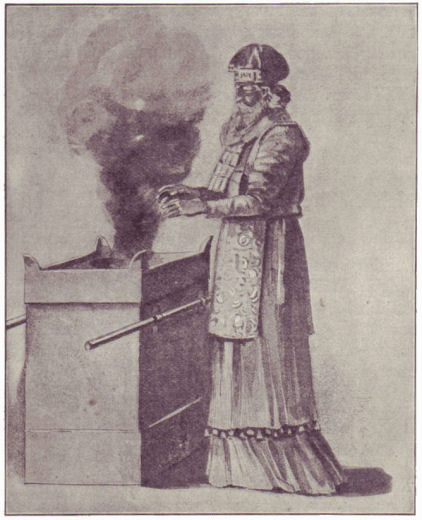 THE HIGH-PRIEST OFFERS SACRIFICE IN THE TEMPLE |
After Amaziah came his son Uzziah, who was also called Azariah. He was the tenth king of Judah. Uzziah was only sixteen years old when he began to reign, and he was king for fifty-two years. He did that which was right in the sight of the Lord during most of his reign. Uzziah found the kingdom weak and he made it strong, for the Lord helped him. He won back for Judah the land of the Philistines, the land of the Ammonites on the east of Jordan, and of the Arabians on the south. He built cities and made strong walls around them, with towers full of weapons for defence against enemies. He loved the fields, and planted trees and vineyards, and raised crops of wheat and barley.
But when Uzziah was strong and rich his heart became proud, and he no longer tried to do God's will. He sought to have the power of the high-priest as well as that of the king, and he went into the Holy Place in the Temple to offer incense upon the golden altar, which was allowed to the priests only. The high-priest Azariah followed Uzziah into the Holy Place with the other priests, and said to him:
"It is not for you to offer incense, O King Uzziah, nor to come into the Holy Place. This belongs to the priests alone. Go out of the Holy Place, for you have disobeyed the Lord's command; and it will not bring you honor, but trouble."
Uzziah was standing before the golden altar with a censer of incense in his hand. Instantly the white scales of leprosy rose upon his forehead. The priests saw in that moment that God had smitten Uzziah with leprosy; indeed, he felt it himself, and turned to leave the Holy Place. But they would not wait for him to go out; they drove him out, for the leper's presence made the house unholy. And from that day until he died, Uzziah was a leper. He could no longer sit as king, but his son Jotham took his place; nor was he allowed to live in the palace, but he stayed in a house alone. And when he died they would not give him a place among the tombs of the kings; but they buried him in a field outside. Jotham, the eleventh king, ruled after his father's death sixteen years. He served the Lord, but he did not stop his people from worshipping idols. He was warned by his father's fate, and was content to be a king, without trying at the same time to be a priest and to offer incense in the temple. God was with Jotham, and gave his kingdom some success.
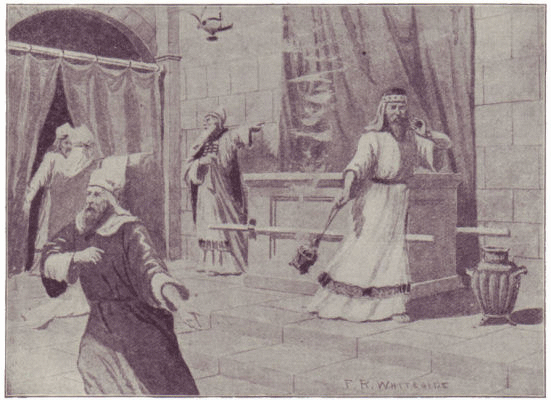 UZZIAH IS SMITTEN WITH LEPROSY |
The next king, the twelfth, was Ahaz, who was the wickedest of all the kings of Judah. He left the service of God, and worshipped the images of Baal. Worse than any other king, he even offered some of his own children as burnt-offerings to the false gods. In his reign the house of the Lord was shut up, and its treasures were taken away, and it was left to fall into ruin. For his sins and the sins of his people, God brought great suffering upon the land. The king of Israel, Pekah, came against Ahaz, and killed more than a hundred thousand of the men of Judah, among them the king's own son. The Israelites also took away many more,—men, women, and children,—as captives. But a prophet of the Lord in Israel, whose name was Oded, came out to meet the rulers, and said to them:
"The Lord God was angry with Judah, and gave its people into your hand. But do you now intend to keep your brothers of Judah as slaves? Have not you also sinned against the Lord? Now listen to the word of the Lord, and set your brothers free and send them home."
Then the rulers of Israel gave clothing to such of the captives as were in need, and set food before them; and they sent them home to their own land, even giving to those that were weak among them asses to ride upon. They brought them to Jericho, in the valley of the Jordan, and gave them to their own people.
When the Edomites came against Judah, King Ahaz sent to the Assyrians, a great people far away, to come and help him. The Assyrians came, but they did not help him, for they made themselves the rulers of Judah, and robbed Ahaz of all that he had, and laid heavy burdens upon the land. At last Ahaz died, leaving his people worshippers of idols and under the power of the king of Assyria.
In the days of these three kings, Uzziah, Jotham and Ahaz, God raised up a great prophet in Judah, whose name was Isaiah. The prophecies that he spoke in the name of the Lord are given in the book of Isaiah. In the ear that King Uzziah died, Isaiah was a young man. One day, while he was worshipping in the temple, a wonderful vision rose suddenly before his sight. He saw the form of the Lord God upon a throne, with the angels around him. He saw also strange creatures called seraphim, standing before the throne of the Lord. Each of these had six wings. With two wings he covered his face before the glory of the Lord, with two wings he covered his feet, and with two he flew through the air to do God's will. And these seraphim called out to one another, "Holy, holy, is the Lord of hosts; the whole earth is full of his glory!"
And the young Isaiah felt the walls and the floor of the Temple shaking at these voices; and he saw a cloud of smoke covering the house. Isaiah filled with fear. He cried out saying:
"Woe has come to me! for I am a man of sinful lips, and I live among a people of sinful lips: and now my eyes have seen the king, the Lord of hosts!"
Then one of the seraphim took into his hand the tongs that were used in the sacrifices. He flew to the altar, and with the tongs took up a burning coal. Then he flew to the place where Isaiah was standing, and pressed the fiery coal to Isaiah's lips: and he said, "This coal from God's altar has touched your lips, and how your sin is taken away, and you are made clean."
Then Isaiah heard the voice of the Lord saying: "Whom shall I send to this people? Who will bear the message of the Lord to them?"
And Isaiah said, "Here am I, Lord; send me!"
And the Lord said to Isaiah, "You shall be my prophet, and shall go to this people, and shall give to them my words. But they will not listen to you, nor understand you. Your words will do them no good, but will seem to make their hearts hard, and their ears heavy, and their eyes shut. For they will not hear with their ears, nor see with their eyes, nor understand with their hearts, nor will they turn to me and be saved."
And Isaiah said, "How long must this be, O Lord?"
And the Lord said:
"Until the cities are left waste without people, and the houses without men to live in them; and the land shall become utterly desolate; and the people shall be taken far away into another land. But out of all this there shall be a few people, a tenth part, to come back, and to rise like a new tree from the roots where the old tree has been cut down. This tenth part shall be the seed of a new people in the times to come."
By this Isaiah knew that, though his words might seem to do no good, yet he was to go on preaching, for long afterward a new Judah should arise out of the ruins of the old kingdom, and should serve the Lord.
Isaiah lived for many years, and spoke the word of the Lord to his people until he was a very old man. He preached while four kings, perhaps also a fifth, were ruling. Some of these kings were friendly, and listened to his words: but others were not willing to obey the prophet and do the will of God; and the kingdom of Judah gradually fell away from the worship of the Lord, and followed the people of the Ten Tribes in the worship of idols.
The Good King Hezekiah
After Ahaz, the wickedest of the kings of Judah, came Hezekiah, who was the best of the kings. He listened to the words of the prophet Isaiah, and obeyed the commands of the Lord. In the first month of his reign, when he was a young man, he called together the priests and the Levites, who had the charge of the house of the Lord, and he said to them:
"My sons, give yourselves once more to the service of the Lord, and be holy, as God commands you. Now open the doors of the house of the Lord, which have been shut for these many years; and take out of the house all the idols that have been placed in it; and make the place clean, and pure from all evil things. Because the people have turned away from the Lord, he has been angry with us, and has left us to our enemies; now let us go back to the Lord, and promise again to serve him. God has chosen you, my sons, to lead in his worship; do not neglect the work that the Lord has given you to do."
Then the Temple was opened as of old; the idols were taken away; the altar was made holy to the Lord, and the daily offering was laid upon it; the lamps were lighted in the holy place; the priest stood before the golden altar offering incense; the Levites in their robes sang the psalms of David, while the silver trumpets made music; and the people came up to worship in the Temple as they had not come in many years. (For an account of the services of worship see Part First, Story Twenty-eight.)
You remember that the great Feat of the Passover kept in mind how the children of Israel had come out of Egypt. (See Part First, Story Twenty-three.) For a long time the people had ceased to keep this feast, both in Judah and in Israel. King Hezekiah sent commands through all Judah for the people to come up to Jerusalem, and to worship the Lord in this feast. He also sent men through the land of Israel, the Ten Tribes, to ask the men of Israel also to come up with their brothers of Judah to Jerusalem, and to keep the feast. At that time Hoshea, the last king of Israel, was on the throne, the land was overrun by the Assyrians, and the kingdom was very weak, and nearing its end. (See Part Fourth, Story Eighteen.) Most of the people in Israel were worshippers of idols, and had forgotten God's law. They laughed at Hezekiah's messengers, and would not come to the feast. But in many places in Israel there were some who had listened to the prophets of the Lord, and these came up to worship with the men of Judah. For each family they roasted a lamb, and with it ate the unleavened bread made without yeast, and they praised the Lord who had led their fathers out of Egypt to their own land.
After the feast, when the people had given themselves once more to the service of God, King Hezekiah began to destroy the idols that were everywhere in Judah. He sent men to break down the images, to tear in pieces the altars to the false gods, and to cut down the trees under which the altars stood. You remember that Moses made a serpent of brass in the wilderness. (See Part First, Story Thirty-two.) This image had been brought to Jerusalem, and was still kept there in the days of Hezekiah. The people were worshipping it as an idol; and were burning incense before it. Hezekiah said, "It is nothing but a piece of brass," and he commanded that it should be broken up. Everywhere he called upon his people to turn from the idols, to destroy them, and to worship the Lord God.
When Hezekiah became king, the kingdoms of Israel, and Syria, and Judah, with all the lands near them, were under the power of the great kingdom of the Assyrians. Each land had its own king, but he ruled under the king of Assyria; and every year a heavy tax was laid upon the people, to be paid to the Assyrians. After a few years, Hezekiah thought that he was strong enough to set his kingdom free from the Assyrian rule. He refused to pay the tax any longer, and gathered an army, and built the walls of Jerusalem higher, and made ready for a war with the Assyrians. But Sennacherib, the king of Assyria, came into the land of Judah with a great army, and took all the cities in the west of Judah, and threatened to take Jerusalem also. Then Hezekiah saw that he had made a mistake. He was not able to fight the Assyrians, the most powerful of all the nations in that part of the world. He sent word to the king of Assyria, saying:
"I will no more resist your rule; forgive me for the past, and I will pay whatever you ask."
Then the king of Assyria laid upon Hezekiah and his people a tax heavier than before. To obtain the money, Hezekiah took all the gold and silver in the temple, all that was in his own palace, and all that he could find among the people, and sent it to the Assyrians. But even then the king of Assyria was not satisfied. He sent his princes to Jerusalem with this message:
"We are going to destroy this city, and to take you away into another land, a land far away; as we have taken the people of Israel away, and as we have carried captive other peoples. The gods of other nations have not been able to save those who trusted in them against us, and your God will not be able to save you. Now give yourselves up to the great king of Assyria, and go to the land where he will send you."
When King Hezekiah heard this, he was filled with fear. He took the letter into the house of the Lord, and spread it out before the altar, and called upon the Lord to help him and to save his people. Then he sent his princes to the prophet Isaiah, to ask him to give them some word from the Lord. And Isaiah said:
"Thus saith the Lord, 'The king of Assyria shall not come to this city, nor shall he shoot an arrow against it. But he shall go back to his own land by the same way that he came. And I will cause him to fall by the sword in his own land. For I will defend this city, and will save it for my own sake and for my servant David's sake.'"
Just at that time, Sennacherib, the king of Assyria, heard that a great army was marching against him from another land. He turned away from the land of Judah, and went to meet these new enemies. And the Lord sent upon the army of the Assyrians a sudden and terrible plague, so that in one night nearly two hundred thousand of them died in their camp. Then King Sennacherib hastened back to his own land, and never again came into the land of Judah; nor did he again send an army there. And years after this, while he was worshipping his idol-god in his temple at Nineveh, his chief city, two of his sons came upon him, and slew him with the sword. They escaped into a distant land, and Esar-haddon, another of his sons, became king over the lands ruled by the Assyrians. Thus did God save his city and his people from their enemies, because they looked to him for help. At the time while the Assyrians were in the land, and the kingdom was in great danger, King Hezekiah was suddenly stricken with a deadly disease. It was tumor or a cancer, which no physician could cure; and the prophet Isaiah said to him:
"Thus saith the Lord, 'Set your house in order, and prepare to leave your kingdom, for you shall die, and not live.'"
But King Hezekiah felt that in a time of such trouble to the land he could not be spared, especially as at that time he had no son who could take charge of the kingdom. Then Hezekiah upon his bed prayed to the Lord that he might live; and he said:
"O Lord, I beseech thee, remember now how I have walked before thee in truth and with a perfect heart, and have done that which was good in thy sight. Let me live and not die, O Lord!"
 POOL OF HEZEKIAH AT JERUSALEM |
The Lord heard Hezekiah's prayer, and before Isaiah had reached the middle of the city, on his way home, the Lord said to him, "Turn again, and say to Hezekiah the prince of my people, 'Thus saith the Lord, I have heard your prayer, I have seen your tears; I will heal you; and in three days you shall go up to the house of the Lord. I will add to your life fifteen years, and I will save this city from the king of Assyria.'"
Then Isaiah the prophet came again to Hezekiah, and spoke to him the word of the Lord; and he said, also, "Lay on the tumor a plaster made of figs, and he shall be cured."
When Hezekiah heard the words of Isaiah, he said, "What sign will the Lord give, to show that he will cure me, and that I shall again go up to the house of the Lord?"
And Isaiah said, "The Lord will give you a sign, and you shall choose it yourself. Shall the shadow on the dial go forward ten degrees, or go back ten degrees?" Near the palace was standing a sun-dial, by which the time of the day was shown, for there were no clocks in those years. And Hezekiah said, "It is easy for the shadow to go forward ten degrees. Let it go back ten degrees."
Then Isaiah the prophet called upon the Lord, and the Lord heard him; and caused the shadow to go backward on the sun-dial ten degrees. And within three days Hezekiah was well, and went to worship in the house of the Lord. After this Hezekiah lived fifteen years in honor. When he died all the land mourned for him as the host of the kings.
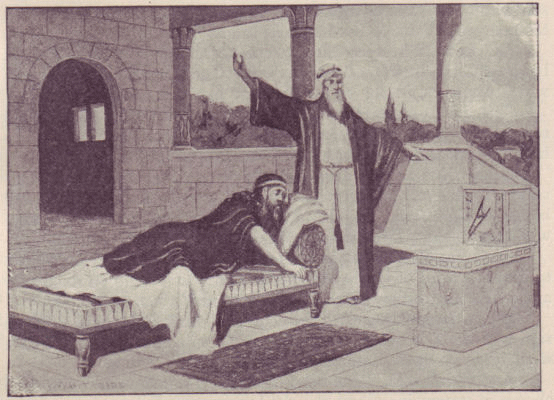 THE SHADOW ON THE DIAL GOES BACK |
The Lost Book Found in the Temple
Manasseh, the fourteenth king of Judah, followed the sins of his grandfather Ahaz, and not the good deeds of his father Hezekiah. He was only twelve years old when he began to reign, too young for so great a care as the kingdom; and in his youth he turned away from the teachings of the prophet Isaiah and from the service of the Lord. He built again the altars to Baal and the Asherah, which his father Hezekiah had thrown down; he worshipped the sun, and moon, and stars; he set up images even in the Temple, the house of the Lord. When Manasseh grew older, and had children of his own, he made them go through the fire, seeking to please the false gods. He would not listen to the prophets whom the Lord sent to warn him; and there is reason to believe,—though the Bible does not say it,—that he put to death the good prophet Isaiah.
And Manasseh in his wickedness reigned a long time, longer than any of the wicked kings who had gone before him; so that he led his people further away from God than even Ahaz, who had been as wicked as Manasseh. Because of Manasseh's sins, and the sins of his people, the Lord brought upon the land the generals of the Assyrian army with their host. They took Manasseh a prisoner, and bound him with chains, and carried him to the city of Babylon, where the king of Assyria was then living. There Manasseh was kept a prisoner for a time.
While he was in prison Manasseh saw how wicked he had been, and he sought the Lord. He prayed to be forgiven for his sins, and the Lord heard him. Afterward, the king of Assyria allowed Manasseh to rule over his land again. Then Manasseh knew that the Lord was the only true God; and from that time he worshipped the Lord only. He took the altars and the images of the false gods out of the Temple, and built again the altar of the Lord, and caused the offerings to be laid upon it. He commanded his people to worship the Lord, and to leave the idols; but they had gone too far to come back, and only a few of them followed their king's example in seeking the Lord. He could easily lead his people into sin, but he could not bring them back to God.
After a long reign of fifty-five years Manasseh died, and his son Amon became king. He reigned only two years, but they were years of wickedness and of worshipping idols. Then his servants in his own house killed Amon; but the people killed them in turn, and made his son Josiah king.
Josiah, the sixteenth king, was only eight years old when his father Amon was slain. At first he was too young to rule over the land, and the princes of his court governed in his name. But when Josiah was sixteen years old he chose the Lord God of his father David, the God whom Hezekiah had worshipped; and he served the Lord more fully than any of the kings who had gone before him. When he was twenty years old, he began to clear away the idols and the idol-temples from the land of Judah. He did this work more thoroughly than it had ever been done before, by Jehoshaphat or by Hezekiah; for he left in all the land not a single place where idols were worshipped. He went even beyond his own borders, into the land that had been the land of Israel, from which most of the people had been carried away captive long before: and in every place he broke down the altars, and burned the images, and even dug up the bones of the idol-priests, and burned them with their images.
He came to Bethel, twelve miles north of Jerusalem, where Jeroboam of Israel had built the temple for the worship of the golden calves, two hundred years before. (See Story Two in Part Fourth.) There, as he was burning the bones of the idol-priests upon the ruins of their own altars, he found a tomb, and asked who was buried there. They said, "This is the tomb of the man of God who came from Judah, and warned King Jeroboam of one who would do these very things that you are doing."
"Let his bones rest," said King Josiah. "Let no man touch the bones of the prophet."
While the men of King Josiah were at work in the Temple on Mount Moriah, taking away the idols, and making the house pure once more, they found an old book, written upon rolls of leather. It was the book of the law of the Lord, given by Moses, but it had been hidden so long that men had forgotten it. They brought the book, and read from it aloud to the king.
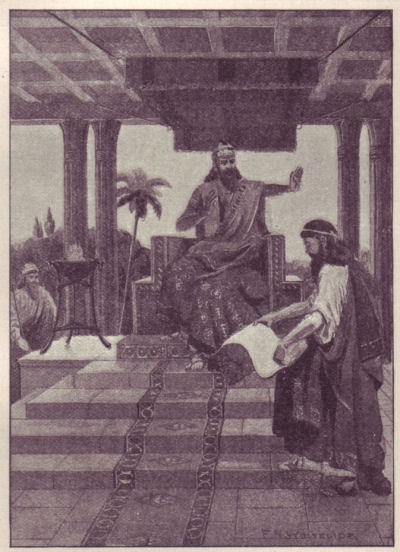 THE WORDS OF THE LAW ARE READ BEFORE THE KING |
And when King Josiah heard the words of the law, and the warning of the woes that were to come upon the people for disobeying them, the king was filled with alarm. He said to the rulers: "Go and ask of the Lord for me and for all the people. Great is the anger of the Lord against us, because our fathers have disobeyed the words of the Lord written in this book." They sought for a prophet to give them the word of the Lord, and they found a woman named Huldah, living in Jerusalem, to whom the word of the Lord came. She was called "a prophetess," and they brought to her the message of King Josiah. And the prophetess Huldah said to them, "Thus saith the Lord, the God of Israel, 'Go and tell the man who has sent you, Behold, I will bring evil on this place and on the people living in it, because they have forsaken the Lord and have worshipped other gods. My anger will fall upon this city and upon this land. But because King Josiah has sought the Lord, and has done God's will, and has called upon the Lord, therefore the Lord says that he will hold back his anger against this city and this land as long as Josiah lives, and he shall go down to his grave before all these evils come upon Judah and Jerusalem,'"
When Josiah heard this he called all the princes and the priests and the people to meet in the Temple of the Lord. There the king stood by a pillar and read to all the people the words of the book that had been found. Then the king and all his people made a promise to serve the Lord and to do his will, and to keep his law with all their hearts. And this promise they kept while Josiah lived; but that was only a few years.
All this time the kingdom of Judah, like all the kingdoms around, was a part of the greater kingdom or empire of Assyria. But the great kings of Assyria had passed away, and now the kingdom or empire of Assyria was becoming weak and falling apart. Pharaoh-nechoh, the king of Egypt, went to war with the Assyrians, and on his way passed through the land of Judah and what had once been Israel before its people were carried away captive. Josiah throught that as the king of Assyria was his over-lord, he must fight against the king of Egypt, who was coming against him.
Pharaoh-nechoh, the king of Egypt, sent a message to King Josiah, saying, "I have nothing against you, O king of Judah, and I am not coming to make war on you, but on the king of Assyria. God has sent me, and commanded me to make haste. Do not stand in my way, or you may be destroyed."
But Josiah would not heed the message of the king of Egypt. He went out against him with his army, and met him in battle on the great plain of Esdraelon, where so many battles had been fought before and have been fought since. There the Egyptians won a victory, and in the fight the archers shot King Josiah. He died in his chariot, and they brought his dead body to Jerusalem. And all the land mourned and wept for the king whom they loved because he had ruled wisely and well. And with the good King Josiah died the last hope of the kingdom of Judah.
The Last Four Kings of Judah, and The Weeping Prophet
When the good King Josiah fell in battle the people of the land made his son Jehoahaz king. At that time all the kingdoms around Judah were in confusion. The great empire of Assyria had been the ruler of nearly all that part of the world; but now it had been broken up, Nineveh, its chief city, had been destroyed, and Egypt, Babylonia, and other lands were at war, each striving to take the place of Assyria as the ruler of the nations.
Pharaoh-nechoh, the king of Egypt, whose warriors had slain King Josiah, became for a time the master of the lands between Egypt and the Euphrates river. He felt that he could not trust the young King Jehoahaz, and he took his crown from him, and carried him a captive down to Egypt, so that Jehoahaz, the seventeenth king, reigned only three months. The prophet Jeremiah, who arose during Josiah's reign, spoke thus of the young king who so soon was taken away a prisoner, "Weep not for the dead King Josiah, nor sorrow over him, but weep for him that goeth away, the King Jehoahaz, for he shall return no more, nor shall he again see his own land. In the place where they have led him captive, there shall he die, and he shall look upon this land no more."
The man whom Pharaoh-nechoh set up as king over Judah in place of Jehoahaz was his brother Jehoiakim, another son of Josiah. But he was not like his father, for he lived most wickedly, and led his people back to the idols which Josiah had tried to destroy. Jeremiah, the prophet, spoke to him the words of the Lord, and warned him that the evil way in which he was going would surely end in ruin to the king and the people. This made King Jehoiakim very angry. He tried to kill the prophet, and to save his life Jeremiah was hidden by his friends.
Jeremiah could no longer go out among the people nor stand in the Temple to speak the word of the Lord. So he wrote upon a roll God's message, and gave it to his friend Baruch to read before the people. While Baruch was reading it some officers of the king came and took the roll away, and brought it to the king. King Jehoiakim was sitting in his palace, with the princes around him, and a fire was burning before him, for it was the winter time. The officer began to read the roll before the king and the princes, but when he had read a few pages the king took up a knife and began cutting the leaves and throwing them into the fire. Even the princes were shocked at this, for they knew that the writing on the roll was God's word to the king and the people. They begged the king not to destroy the roll, but he would not heed them. He went on cutting up the roll and throwing it in the fire until it was all burned.
The king told his officers to take Jeremiah the prophet and Baruch, who read his words; and he would have killed them if he had found them. But they were hidden, and he could not find them, for the Lord kept them in safety.
Jehoiakim reigned a few years as the servant of the king of Egypt. But soon the Egyptians lost all the lands that they had gained outside of their own country; and the Babylonians, under Nebuchadnezzar, rose to power over the nations, and took the place of empire that had been held by the Assyrians. Nebuchadnezzar was the son of the king of Babylon, and at first was the general of his army. He came against Judah and Jerusalem, but Jehoiakim did not dare to fight with him. He promised to serve Nebuchadnezzar, and on that condition was allowed to remain king; but no sooner had the Babylonian army gone away than he broke his promise, and rose against Babylon, and tried to make himself free.
But in this King Jehoiakim did not succeed. Instead, he lost his kingdom and his life, for either by the Babylonians or by his own people he was slain, and his dead body, like that of a beast, was thrown outside the gate of the city. He had reigned in wickedness eleven years, and he died in disgrace.
Jehoiakim's young son Jehoiachin, who was also called Coniah or Jeconiah, was then made king by the people. But he reigned only three months, for Nebuchadnezzar, who was now the king of Babylon, and was conquering all the lands, came with his army and took the city of Jerusalem. He carried the young king a captive to Babylon, as Nechoh had carried Jehoahaz a captive to Egypt eleven years before. With King Jehoiachim were taken away many of the nobles and rulers, and the best people of the land. Most of these were worshippers of the Lord, who carried with them to the land of Babylonia a love for the Lord, and who served him there, for their trouble only drew them the closer to their God. After these captives had been taken away the Lord showed to Jeremiah in the temple a vision of what should come to pass. Jeremiah saw two baskets of figs. One basket was full of fresh, ripe figs, the best that could be found. The other basket was full of poor, decayed figs, not fit to be eaten. The Lord said, "Jeremiah, what do you see?"
And Jeremiah said, "Figs; the good figs very good; and the bad figs very bad, figs so bad that they cannot be eaten."
Then the Lord said to Jeremiah, "Like these good figs are the captives who have been taken away to the land of Babylon. I will care for them, and keep them, and will bring them again to this land. I will give them a heart to know me; and I will be their God, and they shall be my people. And the bad figs are like those who are left in this land, the king who shall reign over them, and his princes, and his people. They shall suffer, and shall die by the sword, and by famine, and by plague, until they are destroyed."
God showed Jeremiah in this way that the captives in Babylon were the hope of the nation. And afterward Jeremiah sent a letter to these captives, saying, "Thus saith the Lord to those who have been carried away captive, 'Build houses and live in them; and plant gardens, and eat the fruit of them; and have sons and daughters, and let your children be married in that land when they grow up. And pray the Lord to give peace to the city and the land where you are living, for you and your children shall stay there seventy years, and after seventy years they shall come again to their own land in peace. For my thoughts, saith the Lord, are thoughts of peace and kindness toward you. You shall call upon me, and I will hear you. You shall seek me and find me, when you seek me with all your heart.'"
 JEREMIAH WARNS THE PEOPLE OF JUDAH |
After Jehoiachin and the captives had been taken away, Nebuchadnezzar set up as king in Judah Zedekiah, the uncle of Jehoiachin and another son of Josiah. He was the twentieth and last king of the kingdom of Judah. He began by promising to be true and faithful to his over-lord, Nebuchadnezzar, the king of Babylon, who had made him king. But very soon he was led by the nobles who stood around his throne to break him promise and to throw off the rule of Babylon; also he left the worship of the Lord, as did his people, and began to pray to the idols of wood and stone that could give him no help.
Jeremiah the prophet told King Zedekiah that he was doing wickedly in breaking his promises and in turning from the Lord to idols. He told Zedekiah that he would fail, and would bring his kingdom to ruin. He said, "It is better to obey the king of Babylon than to fight against him, for God will not bless you and your people in breaking your word. The king of Babylon will come and will destroy this city. You shall see him face to face, and he will take you away a captive to his own land, and this city shall be destroyed."
 JEREMIAH TELLS THE KING HE SHALL BE TAKEN CAPTIVE |
This made the princes and nobles very angry against Jeremiah. They said, "This man Jeremiah is an enemy of his land and a friend to the king of Babylon. He is a traitor, and should be put to death." Zedekiah said to his nobles, "Jeremiah is in your hands; you can do with him what you choose. The king cannot help him against you."
Then these men seized Jeremiah, and took him to prison, and threw him into a dungeon, down below the floor, and filled with mud and filth, into which the prophet sank; and there they left him to die. But in the court of the king there was one kind man, a negro named Ebedmelech. He found Jeremiah in the dungeon, and let down to him a rope and drew him up, and brought him to a safe and dry place, though still in the prison.
By this time Nebuchadnezzar, the king of Babylon, and his army were again before the city of Jerusalem, laying siege to it. No one could go out or come in; no food could be found for the people, and many of them starved to death. The soldiers of Nebuchadnezzar built forts, and threw darts and stones, and broke down the gates, and made great openings in the walls of the city.
When King Zedekiah saw that the city must fall before its enemies he tried to escape. But the men of Babylon followed him and took him prisoner, and with him all his family, his wives and his sons. They were all brought before King Nebuchadnezzar, so that it came to pass as the prophet had said, Zedekiah saw the king of Babylon.
But he saw what was more terrible; he saw all his sons slain before him. Then Zedekiah's eyes were put out, and a blinded captive, he was dragged away to Babylon. The Babylonian soldiers killed all the leaders of the people who had led Zedekiah to rebel against Nebuchadnezzar; and the rest of the people, except the very poorest in the land, they took away to the land of Babylon. The king of Babylon was friendly to Jeremiah, the prophet, because of the advice that he had given to Zedekiah and his people. The ruler whom Nebuchadnezzar set over the city opened the door of Jeremiah's prison, and allowed him to choose between going to Babylon with the captives or staying with the poor people in the land. Jeremiah chose to stay; but not long after he was taken down to Egypt by enemies to the king of Babylon. And there in Egypt Jeremiah died; some think that he was slain. His life had been sad, for he had seen nothing but evil come upon his land; and his message from the Lord had been a message of woe and wrath. Because of his sorrow, Jeremiah has been called "the weeping prophet."
Nebuchadnezzar carried away all that was left of the valuable things in the Temple, and then he burned the buildings. He tore down the walls of Jerusalem and set the city on fire. So all that was left of the city of David and the Temple of Solomon was a heap of ashes and blackened stones. And thus the kingdom of Judah ended, nearly four hundred years after Rehoboam became its first king.
What Ezekiel Saw in the Valley
All that was left now of the people of Judah was a company of captives, carried away from their won land to the land of Babylon. Theirs was a long, sorrowful journey, with their wives and children, dragged by cruel soldiers over mountains and valleys almost a thousand miles. They could not go straight across the vast desert which lies between the land of Judah and the plains of Babylonia. They were led around this desert far to the north, through Syria, up to the Euphrates river, and then following the great river in all its windings down to the land of their captivity. There in the land of Babylonia or Chaldea they found rest at last.
 THE CAPTIVES IN BABYLON |
When they were once in their new home the captives met with less trouble than they had feared; for the people of the land under Nebuchadnezzar, the great king, treated them kindly, and gave them fields to work in as their own. The soil was rich, and they could raise large crops of wheat, and barley, and other grains. They planted gardens and built for themselves houses. Some of them went to live in the cities, and became rich, and some were in the court of King Nebuchadnezzar, and rose to high places as nobles and princes, standing next to the king in rank and honor.
And the best of all was that these captives in a strange land did not worship idols. They saw the images of the Babylonian gods all around them, but they did not bow down to them. They worshipped the Lord God of their fathers, and the Lord only. The idol worshippers in Judah had been slain, and most of the captives were good men and women, who taught their children to love and serve the lord.
And these people did not forget the land from which they had come. They loved the land of Israel, and they taught their children to love it by singing songs about it. Some of these songs which the captive Jews sang in the land of Chaldea are in the Book of Psalms. Here is a part of one of these songs:
|
"By the rivers of Babylon, There we sat down, yea, we wept, When we remembered Zion. Upon the willow-trees in the midst of that land We hanged up our harps For there they that led us captive asked us to sing; And they that wanted us asked us to be glad, saying, 'Sing us one of the songs of Zion.' How shall we sing the Lord's song In a foreign land? If I forget thee, O Jerusalem, Let my right hand forget her skill, Let my tongue cleave to the roof of my mouth, If I do not remember thee If I do not prefer Jerusalem Above my chief joy." |
From this time these people were called Jews, a name which means "people of Judah." And the Jews everywhere in the world belong to this people, for they have sprung or descended from the men who once lived in the land of Judah. And because they had once belonged to the twelve tribes of Israel, and ten of the tribes had been lost, and their kingdom had forever passed away, they were also spoken of as Israelites. So from this time "people of Judah," Jews, and Israelites, all mean the people who had come from the land of Judah, and their descendants after them.
God was good to his people in the land of Babylon, or Chaldea, another name by which this country was called. He sent to them prophets, who showed to them the way of the Lord. One of these prophets was Daniel, a young man who lived in the court of King Nebuchadnezzar. Another was a priest named Ezekiel, who lived among the captive people beside a river in Chaldea, called the river Cheban. God gave to Ezekiel wonderful visions. He saw the throne of the Lord, and the strange creatures with six wings, that the prophet Isaiah had seen long before. (See Story Three in this Part.) And he heard the voice of the Lord telling him of what should come to his people in the years to come.
At one time the Lord lifted up Ezekiel and brought him into the middle of a great valley. The prophet looked around, and saw that the valley was covered with the bones of men, as though a great battle had been fought upon it, and the bodies of the slain had been left there, and they had become a vast army of dry bones.
"Son of man," spoke the voice of the Lord to Ezekiel, "can these dry bones live again?"
And Ezekiel answered, "O Lord God, thou knowest whether these dry bones can live."
Then the Lord said to Ezekiel, "Preach to these dry bones, O son of man, and say to them, 'O ye dry bones, hear the voice of the Lord. Thus saith the Lord, I will send breath into you, and you shall live, and I will put flesh upon you, and cover you with skin, and you shall be alive again, and know that I am the Lord.'"
Then Ezekiel spoke to the army of dry bones spread over the valley, as the Lord bade him speak. And while he was speaking there sounded a noise of rolling thunder, and all through the field the different bones began to come together, one part to another part, until they were no more loose bones, but skeletons of bones fitted together. Then another change came. Suddenly the flesh grew over all the bones, and they lay on the ground like an army of dead men, a host of bodies without life.
Then the Lord said to Ezekiel, "Speak to the wind, O son of man; speak, and say, 'Come from the four winds, O breath, and breathe upon these slain, that they may live.'"
Then Ezekiel called upon the wind to come, and while he was speaking the dead bodies began to breathe. Then they stood up on their feet, a great army of living men, filling the whole valley. Then the Lord said to Ezekiel, "Son of man, these dry bones are the people of Israel. They seem to be lost, and dead, and without hope. But they shall live again, for I, the Lord, will put life into them; and they shall go back to their own land, and be a people once more. I, the Lord, have spoken to it, and I will do it."
When Ezekiel told the captive people this vision their hearts were lifted up with a new hope that they should see their own land again.
The Jewish Captives in the Court of the King
In Story Six of this Part, we read of Jehoiakim, the wicked son of the good King Josiah. While Jehoiakim was ruling over the land of Judah, Nebuchadnezzar, the great conqueror of the nations, came from Babylon with his army of Chaldean soldiers. He took the city of Jerusalem, and made Jehoiakim promise to submit to him as his master, a promise that Jehoiakim soon broke. And when Nebuchadnezzar went back to his own he took with him all the gold and silver that he could find in the Temple; and he carried away as captives very many of the princes and nobles, the best people in the land of Judah.
When these Jews were brought to the land of Chaldea or Babylon, King Nebuchadnezzar gave orders to the prince who had charge of his palace to choose among these Jewish captives some young men that were of noble rank, and beautiful in their looks, and also quick and bright in their minds, young men who would be able to learn readily. These young men were to be placed under the care of wise men, who should teach them all that they knew, and fit them to stand before the king of Babylon, so that they might be his helpers, to carry out his orders; and the king wished them to be wise, so that they might give him advice in ruling the people.
Among the young men thus chosen were four Jews, men who had been brought from Judah. By order of the king the names of these men were changed. One of them, named Daniel, was to be called Belteshazzar, the other three young men were called Shadrach, Meshach, and Abed-nego. These four young men were taught in all the knowledge of the Chaldeans; and after three years of training they were taken into the king's palace to stand before the king.
After they came to the palace the chief of the princes in the palace sent to these men as a special honor some of the dishes of food from the king's table, and some of the wine that was set apart for the king and his princes to drink. But both the meat and the wine of the king's table had been a part of the offerings to the idols of wood and stone that were worshipped by the Chaldeans. These young Jews felt that if they should take such food they, too, would be worshipping idols. Then, too, the laws of the Jews were very strict with regard to what kind of food might be eaten, and how it should be cooked. Food of certain kinds was called "unclean," and the Jews were forbidden to touch it.
These young Jews, far away from their own land and from their temple, felt that they must be very careful to do nothing forbidden by the laws which God had given to their people. They said to the chief of the nobles in the palace:
"We cannot eat this meat and drink this wine, for it is forbidden by our laws."
The chief of the nobles said to Daniel:
"If you do not eat the food that is given you, the king will see that you are not looking well. He will be angry with me for not giving you better care. What shall I do? I am afraid that the king may command me to be put to death."
Daniel said:
"Give us vegetable food, and bread. Let us eat no meat, and drink no wine for ten days; and see if we do not look well-fed."
The chief of the nobles, to whose care these young men had been given, loved Daniel; as every one loved him who knew him. So he did as Daniel asked. He took away the meat and the wine, and gave to these young Jews only vegetables and bread. At the end of ten days the four young men were brought into the room where the great King Nebuchadnezzar sat; and they bowed low before him. King Nebuchadnezzar was please with these four young men, more than with any others who stood before him. He found them wise, and faithful in the work given to them, and able to rule over men under them. And these four men came to the highest places in the kingdom of the Chaldeans.
 THE FOUR YOUNG MEN BEFORE THE KING |
And Daniel, one of these men, was more than a wise man. He was a prophet, like Elijah, and Elisha, and Jeremiah. God gave him to know many things that were coming to pass; and when God sent to any man a dream that had a deep meaning, like Joseph in Story Sixteen of Part First, Daniel could tell what was the meaning of the dream.
At one time King Nebuchadnezzar dreamed a dream which troubled him greatly. When he awakened he knew that the dream had some deep meaning, but in the morning he had forgotten what the dream was. He sent for the wise men who had in times past given him the meaning of his dreams, and said to them:
"O ye wise men, I have dreamed a wonderful dream; but I have forgotten it. Now tell me what my dream was, and then tell me what it means; for I am sure that it has a meaning."
The wise men said:
"O king, may you live forever! If you will tell us your dream, we will tell you its meaning. But we have no power to tell both the dream and its meaning. That only the gods can know."
The king became very angry, for these men had claimed that their gods gave them all knowledge. He said:
"Tell me the dream, and its meaning; and I will give you rich reward and high honot. But if you cannot tell, I shall know that you are liars, and you shall be put to death."
The wise men could not do what the king asked; and in great fury he gave command that all of them should be slain. Among these men were Daniel and his three friends, Shadrach, Meshach, and Abed-nego; and these four Jews were to be slain with the rest of the wise men. Daniel said to the chief captain, who had been sent to kill the wise men:
"Give me a little time; and I will call upon my God. I know that he will help me to tell to the king his dream and its meaning."
So time was given; and Daniel and his three friends prayed to the Lord God. That night the Lord gave to Daniel the secret of the king's dream and its meaning. Then Daniel gave praise and thanks to the Lord; and in the morning he said to the king's captain:
"Do not kill the wise men. Take me before the king, and I will show him his dream and its meaning."
Then in haste Daniel was brought before King Nebuchadnezzar. The king said to him:
"Are you able to tell me the dream that I dreamed and the meaning of it?"
Daniel answered:
"The wise men of Babylon, who look to their idol-gods, cannot tell the king his dream. But there is a God in heaven who knows all things; and he had given me his servant to know your dream and the meaning of it. This is the dream, O king. You saw a great image, tall and noble-looking. The head of this image was of gold, his breast and his arms were of silver, his waist and his hips of brass, his legs of iron, and his feet and toes were of iron and clay mixed together. And while this great image was standing, you saw a stone cut out without hands; and the whole image fell down; and was broken in pieces; and was crushed and ground into a powder so fine that the wind blew it away like chaff. And you saw the stone that struck the image grow until it became a mountain, and it filled the whole world. This was your dream, O king."
And Daniel went on, and said:
"And this, O king, is the meaning of the dream. God has shown to you what shall come to pass in the years that are to be. You are that head of gold, O king; for that head means your kingdom that now is. After your kingdom has passed away, another kingdom shall take its place; the shoulders and arms of silver. That kingdom shall be followed by another, -- the waist and hips of brass; and after that shall come one more kingdom, that of iron. But as you saw a stone cut out without hands; so while the last of these kingdoms shall be standing, the Lord God of heaven shall set up his kingdom. And God's kingdom like that stone, shall be small at first, but it shall break down and destroy all those kingdoms. They shall pass away and perish before it. And as you saw the stone grow into a mountain, so God's kingdom shall become great, and shall rule all the lands. And that kingdom of God shall never pass away, but shall last forever."
When King Nebuchadnezzar heard this he was filled with wonder. He bowed down before Daniel, and worshipped him, as though Daniel were a god. Then he gave to him great presents, and made him ruler over the part of his kingdom where the city of Babylon was standing. He gave to Shadrach, Meschach and Abed-nego, Daniel's friends, high offices; but Daniel himself he kept in his palace, to be near him all the time.
The Golden Image and the Fiery Furnace
At one time King Nebuchadnezzar caused a great image to be made and to be covered with gold. This image he set up as an idol to be worshipped, on the plain of Dura, near the city of Babylon. When it was finished, it stood upon its base or foundation almost a hundred feet high, so that upon the plain it could be seen far away. Then the king sent out a command for all the princes, and rulers, and nobles in the land to come to a great gathering, when the image was to be set apart for worship.
The great men of the kingdom came from far and near, and stood around the image. Among them, by command of the king, were Daniel's three friends, the young Jews, Shadrach, Meshach, and Abed-nego. For some reason Daniel himself was not there. He may have been busy with the work of the kingdom in some other place.
At one moment in the service before the image all the trumpets sounded, the drums were beaten, and music was made upon musical instruments of all kinds, as a signal for all the people to kneel down and worship the great golden image. But while the people were kneeling there were three men who stood up and would not bow down. These were the three young Jews, Shadrach, Meshach, and Abed-nego. They knelt down before the Lord God only.
Many of the nobles had been jealous of these young men because they had been lifted to high places in the rule of the kingdom, and these men, who hated Daniel and his friends, were glad to find that these three men had not obeyed the command of King Nebuchadnezzar. The king had said that if any one did not worship the golden image he should be thrown into a furnace of fire. These men who hated the Jews came to the king, and said, "O king, may you live forever! You gave orders that when the music sounded every one should bow down and worship the golden image; and that if any man did not worship he should be thrown into a furnace of fire. There are some Jews whom you have made rulers in the land, and they have not done as you commanded. Their names are Shadrach, Meshach, and Abed-nego. They do not serve your gods, nor worship the golden image that you have set up."
Then Nebuchadnezzar was filled with rage and fury at knowing that any one should dare to disobey his words. He sent for these three men, and said to them, "O Shadrach, Meshach, and Abed-nego, was it by purpose that you did not fall down and worship the image of gold? The music shall sound once more, and if you then will worship the image, it shall be well. But if you will not, then you shall be thrown into the furnace of fire to die."
These three young men were not afraid of the king. They said, "O King Nebuchadnezzar, we are ready to answer you at once. The God whom we serve is able to save us from the fiery furnace and we know that he will save us. but if it is God's will that we should die, even then, you may understand, O king, that we will not serve your gods, nor worship the golden image that you have set up."
This answer made the king more furious than before. He said to his servants, "Make a fire in the furnace hotter than ever it has been before, as hot as fire can be made, and throw these three men into it."
Then the soldiers of the king's army seized the three young Jews as they stood in their loose robes, with their turbans or hats on their heads. They tied them with ropes, and dragged them to the mouth of the furnace, and threw them into the fire. The flames rushed from the opened door with such fury that they burned even to death the soldiers who were holding these men; and the men themselves fell down bound into the middle of the fiery furnace.
King Nebuchadnezzar stood in front of the furnace, and looked into the open door. As he looked he was filled with wonder at what he saw; and he said to the nobles around him:
"Did we not throw three men bound into the fire? How is it then that I see four men loose, walking in the furnace, and the fourth man looks as though he were a son of the gods?"
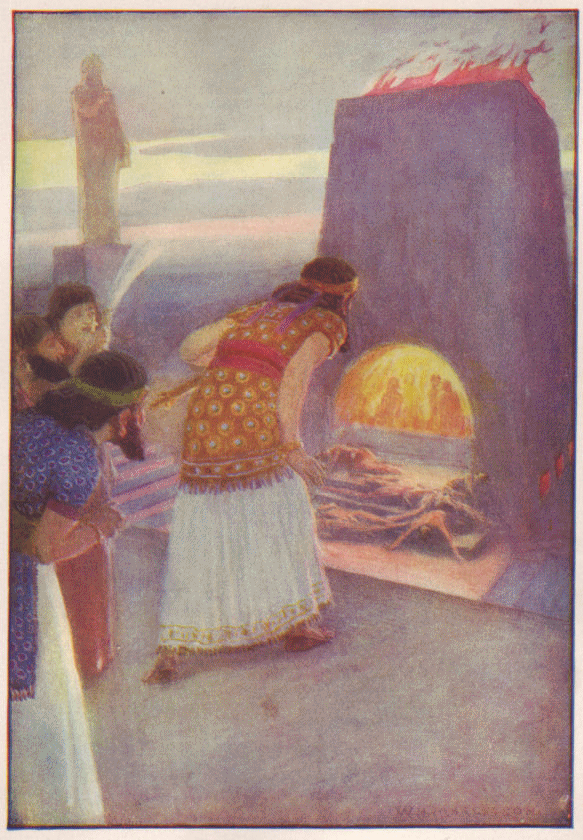 KING NEBUCHADNEZZAR LOOKING INTO THE FIERY FURNACE |
The king came near to the door of the furnace as the fire became lower, and he called out to the three men within it:
"Shadrach, Meshach, and Abed-nego, ye who serve the Most High God, come out of the fire and come to me."
They came out and stood before the king, in the sight of all the princes, and nobles, and rulers; and every one could see that they were alive. Their garments had not been scorched, not their hair singed, nor was there even the smell of fire upon them. The king, Nebuchadnezzar, said before all his rulers:
"Blessed be the God of these men, who has sent his angel and has saved their lives. I make a law that no man in all my kingdoms shall say a word against their God, for there is no other god who can save in this manner. And if any man speaks a word against their God, the Most High God, that man shall be cut in pieces, and his house shall be torn down." And after this the king lifted up these three young men to still higher places in the land of Babylon.
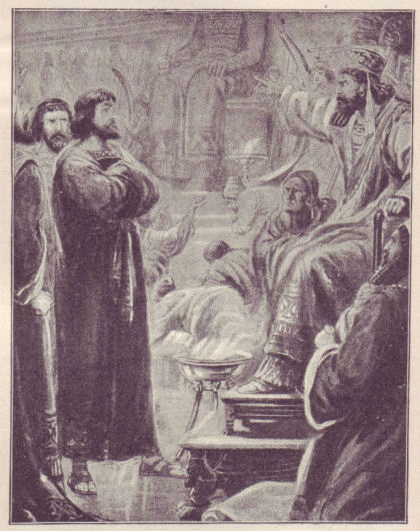 THE THREE YOUNG JEWS WERE NOT AFRAID OF THE KING |
The Tree That Was Cut Down and Grew Again
This is the story that King Nebuchadnezzar himself told to all the people in his great kingdom, of a strange dream that came to him, the meaning of the dream, as it was given by Daniel, and how the dream came true. He said, "Nebuchadnezzar the king sends this message to all the people, and nations, that live in all the world. May peace be given to you! It as seemed good to me to show you the signs and wonders that the Most High God has sent to me. His kingdom is without end, and his rule is from age to age forever!
"I, King Nebuchadnezzar, was at rest in my house, and was living at peace in my palace. One night a dream came to me which made me afraid, and my thoughts and my visions made me troubled in heart. I sent for all the wise men of Babylon to come before me, and to tell me the meaning of my dream. But they did not tell me what the meaning was because they could not. At last came Daniel, in whom is the spirit of the holy gods; and to him I said:
"O Daniel, master of the wise men, I know that in you is the spirit of the holy gods, and that no secret is hidden from you; now tell me what is the meaning of the dream that has come to me. This was the dream:
"I saw a tree standing upon the earth. It grew until the top of it reached up to heaven; and it was so great that it could be seen over all the earth. The leaves of it were beautiful, and its fruit was in plenty, and gave food for all. The beasts in the field stood in its shadow, and the birds of the heaven lived on its branches, and many people ate of its fruit.
"I saw in my dream that a Holy One came down from heaven. He cried aloud, and said:
" 'Hew down the tree, and cut off its branches, shake off its leaves, and scatter its fruit. Let the beasts get away from beneath it, and let the birds fly from its branches. But leave the stump of the tree with its roots in the ground, with a band of iron and of brass around it, and the grass of the field growing about it. Let the stump be wet with the dew from heaven, and let it be among the beasts eating the grass of the field. And let seven years pass over it; that those who live may know that the Most High God rules over the kingdoms of men, and gives them as is pleasing to his will.' This dream I saw, and now, O Daniel, whose name is Belteshazzar, tell me what it means. Then Daniel stood surprised and wondering, and was in deep trouble. And I, Nebuchadnezzar, said to him, 'Daniel, let not the dream give you trouble. Fear not to tell me what is the meaning of it.'
"Then Daniel said to me, 'My lord, O king, may the dream be to those who hate you, and the meaning to your enemies! The tree which you saw, with green leaves, and rich fruit, and height reaching to heaven, and in sight of all the earth; that tree is yourself. You have become great; your power reaches up to heaven, and your rule is over all the lands.
" 'And as you saw a Holy One coming down from heaven, saying, "Cut down the tree, and destroy it; but leave its stump in the earth, with a band of iron and of brass until seven years pass over it," this is the meaning, O king, and it is the command of the Most High God that shall come upon my lord the king.
" 'You, O king, shall be driven away from men. You shall live with the beasts of the field; you shall be made to eat grass like oxen; and you shall be wet with the dew of heaven; and seven years shall pass over you, until you know that the Most High God rules in your kingdom, and gives it to the one whom he chooses. And as the Holy One gave command to leave the stump of the tree with its roots, so it shall be with you. Your kingdom shall stand and shall be sure to you, and shall come back to you when you have known that he who sits in the heavens shall rule over the earth.
" 'And now, O king, take my advice, and break off from your sins, and do right, and show mercy to the poor. It may be that God will give to you more days of peace.'
"All this Daniel said to me, King Nebuchadnezzar; and it came to pass. Twelve months afterward I was walking in my kingly palace. I looked over the city, and said, 'Is not this great Babylon that I have built for my own royal home, by my power, and for my own glory?'
"While the word was in my mouth a voice fell from heaven, saying, 'O King Nebuchadnezzar, the word has been spoken, and your kingdom is gone from you!'
"And in that hour my reason left me, and another heart was given to me, the heart of a beast instead of the heart of a man. I was driven out of my palace, and lived among the beasts, and ate grass as oxen eat it; and my body was wet with the dew of heaven, until my hair was grown like eagles' feathers, and my nails like birds' claws.
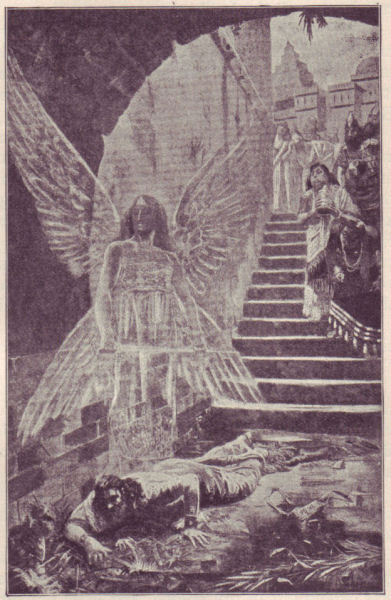 NEBUCHADNEZZAR'S REASON LEAVES HIM |
"And at the end of seven years my mind came back to me, and my reason returned. I blessed the king of heaven, and praised him that lives forever. My kingdom was given to me once more, my princes and rulers came to me again, and I was again the king over all the lands.
"Now I, Nebuchadnezzar, praise and honor the king of heaven. His words are truth and his works are right; and those who walk in pride he is able to make humble."
This was the story of the seven years' madness of King Nebuchadnezzar, and of his reason and his power coming back to him again.
The Writing upon the Wall
The great kingdom or empire of Nebuchadnezzar was made up of many smaller kingdoms which he had conquered. As long as he lived his kingdom was strong; but as soon as he died it began to fall in pieces. His son became king in his place, but was soon slain; and one king followed another quickly for some years. The last king was named Nabonidus. He made his son Belshazzar king with himself, and left Belshazzar to rule in the city of Babylon, while he was caring for the more distant parts of the kingdom.
But a new nation was rising to power. Far to the east were the kingdoms of Media and Persia. These two peoples had become one, and were at war with Babylon, under their great leader, Cyrus. While Belshazzar was ruling in the city of Babylon, Cyrus and his Persian soldiers were on the outside, around the walls, trying to take the city. these walls were so great and high that the Persian soldiers could not break through them.
But inside the city were many who were enemies of Belshazzar and were friendly to Cyrus. These people opened the gates of Babylon to Cyrus. At night he brought his army quietly into the city and surrounded the palace of King Belshazzar.
On that night King Belshazzar was holding in the palace a great feast in honor of his god. On the tables were the golden cups and vessels that Nebuchadnezzar had taken from the Temple of the Lord in Jerusalem; and around the table were the king, his many wives, and a thousand of his princes and nobles. They did not know that their city was taken, and that their enemies were at the very doors of the palace.
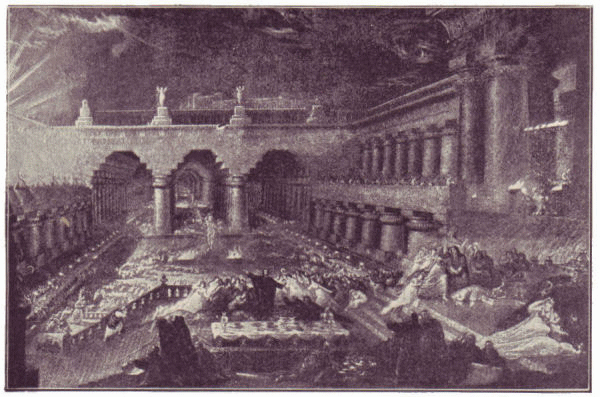 BELSHAZZAR GIVES A GREAT FEAST IN HONOR OF HIS GOD |
While they were all drinking wine together suddenly a strange thing was seen. On the wall appeared a great hand writing letters and words that no one could reveal. Every eye was drawn to the spot, and all saw the fingers moving on the wall, and the letters written. The king was filled with fear. His face became pale and his knees shook. He called for the wise men of Babylon, who were with him in the palace, to tell what the writing meant. He said, "Whoever can read the words on the wall shall be dressed in a purple robe, and shall have a chain of gold around his neck, and shall rank next to King Belshazzar as the third ruler in the kingdom."
But not one of the wise men could read it, for God had not given to them the power. At last the queen of Babylon said to Belshazzar, "O king, may you live forever! There is one man who can read this writing, a man in whom is the spirit of the holy gods, a man whom Nebuchadnezzar, your father, made master of all the wise men. His name is Daniel. Send for him, and he will tell you what these words are and what they mean."
Daniel was now an old man; and since the time when Nebuchadnezzar died he had been no longer in his high place as ruler and chief adviser of the king. They sent for Daniel, and he came. The king said to him, "Are you that Daniel who was brought many years ago by my father to this city? I have heard of you, that the spirit of the holy gods is upon you, and that you wisdom and knowledge. If you can read this writing upon the wal, and tell me what it means, I will give you a purple robe, and a gold chain, and a place next to myself as the third ruler in the kingdom."
And Daniel answered the king, "You may keep your rewards yourself, and may give your gifts to whom you please, for I do not want them; but I will read to you the writing. O king, the Most High God gave to Nebuchadnezzar this kingdom, and great power, and glory. But when Nebuchadnezzar became proud, and boasted of his greatness, then the Lord took from him his crown and his throne, and let him live among the beasts of the field, until he knew that the most High God rules over the kingdoms of men. I Belshazzar, you knew all this, yet you have not been humble in heart. You have risen up against the Lord, and have taken the vessels of his house, and have drunk wine in them in honor of your own gods of wood and stone; but you have not praised te Lord God who has given to you your kingdom and your power. For this reason God has sent this hand to write these words upon the wall. This is the writing, MENE, MENE, TEKEL, UPHARSIN. And this is the meaning, Numbered, Numbered, Weighed, Divided.
"MENE: God has counted the years of your kingdom, and has brought it to an end.
"TEKEL: You have been weighed in the balances, and have been found wanting.
"UPHARSIN: Your kingdom is divided, and taken from you, and given to the Medes and the Persians."
King Belshazzar could scarcely believe what he heard; but he commanded that the promised reward be given to Daniel. And almost while he was speaking his end came. The Persians and the Medes burst into his palace; they seized Belshazzar and killed him in the midst of his feast.
On that night the empire or great kingdom set up by Nebuchadnezzar came to an end. A new empire arose, greater than that of Babylon, called the Persian Empire. And in the place of Belshazzar, Cyrus, the commander of the Persians, made an old man named Darius king until the time when he was ready to take the kingdom for himself.
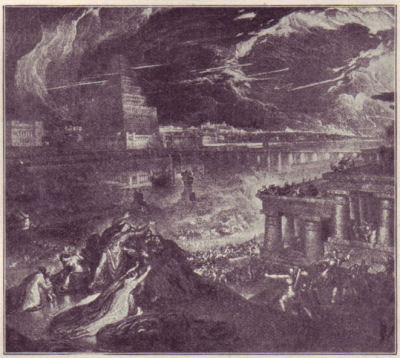 THE FALL OF BABYLON |
This empire of Persia was the third of the world-kingdoms of which we read in the Bible. The first was the Assyrian kingdom, having Nineveh for its capital. This was the kingdom that carried the Ten Tribes of Israel into captivity. The second was the Babylonian or Chaldean kingdom, which carried the Jews into captivity. And the third was the Persian kingdom, which lasted two hundred years, ruling all the lands named in the Bible.
Daniel in the Den of Lions.
The lands which has been the Babylonian or Chaldean empire now became the empire of Persia; and over these Darius was the king. King Darius gave to Daniel, who was now a very old man, a high place in honor and in power. Among all the rulers over the land Daniel stood first, for the king saw that he was wise, and able to rule. This made the other princes and rulers very jealous, and they tried to find something evil in Daniel, so that they could speak to the king against him.
These men knew that three times every day Daniel went to his room, and opened the window that was toward the city of Jerusalem, and looking toward Jerusalem made his prayer to God. Jerusalem was at that time in ruins, and the Temple was no longer standing; but Daniel prayed three times each day with his face toward the place where the house of God had once stood, although it was many hundreds of miles away.
These nobles thought that in Daniel's prayers they could find a chance to do him harm, and perhaps cause him to be put to death. They came to King Darius, and said to him:
"All the rulers have agreed together to have a law made that for thirty days no one shall ask anything of any god or any man, except from you, O king; and that if any one shall pray to any god, or shall ask anything from any man during thirty days, except from you, O king, he shall be thrown into the den where the lions are kept. Now, O king, make the law, and sign the writing, so that it cannot be changed, for no law among the Medes and Persians can be altered."
The king was not a wise man, and being foolish and vain, he was pleased with this law which would set him even above the gods. So, without asking Daniel's advice, he signed the writing; and the law was made, and the word was sent out through the kingdom that for thirty days no one should pray to any god, or ask a favor of any man.
Daniel knew that the law had been made, but every day he went to his room three times, and opened the window that looked toward Jerusalem, and offered his prayer to the Lord, just as he had prayed in other times. These rulers were watching near by, and they saw Daniel kneeling in prayer to God. Then they came to the king and said, "O King Darius, have you not made a law that if any one in thirty days offers a prayer, he shall be thrown into the den of lions?" "It is true," said the king. "The law has been made, and it must stand."
They said to the king, "There is one man who does not obey the law which you have made. It is that Daniel, one of the captive Jews. Every day Daniel prays to his God three times, just as he did before you signed the writing of the law."
Then the king was very sorry for what he had done, for he loved Daniel, and knew that no one could take his place in the kingdom. All day, until the sun went down, he tried in vain to find some way to save Daniel's life; but when evening came these men again told him of the law that he had made, and said to him that it must be kept. Very unwillingly the king sent for Daniel, and gave him order that he should be thrown into the den of lions. He said to Daniel, "Perhaps your God, whom you serve so faithfully, will save you from the lions."
They led Daniel to the mouth of the pit where the lions were kept, and they threw him in; and over the mouth they placed a stone; and the king sealed it with his own seal and with the seals of his nobles, so that no one might take away the stone and let Daniel out of the den.
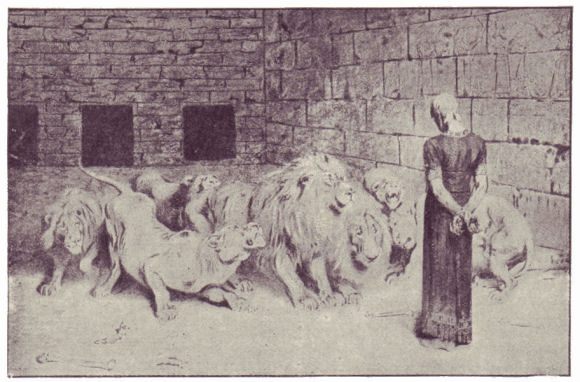 DANIEL IN THE DEN OF LIONS |
Then the king went again to his palace, but that night he was so sad that he could not eat, nor did he listen to music as he was used to listen. He could not sleep, for all through the night he was thinking of Daniel. Very early in the morning he rose up from his bed, and went in haste to the den of lions. He broke the seal, and took away the stone, and in a voice full of sorrow he called out, scarcely hoping to hear any answer except the roaring of the lions, "O Daniel, servant of the living God, has your God been able to keep you safe from the lions?"
And out of the darkness in the den came the voice of Daniel, saying, "O king, may you live forever! My God has sent his angel, and has shut the mouths of the lions. They have not hurt me, because my God saw that I had done no wrong. And I have done no wrong toward you, O king!"
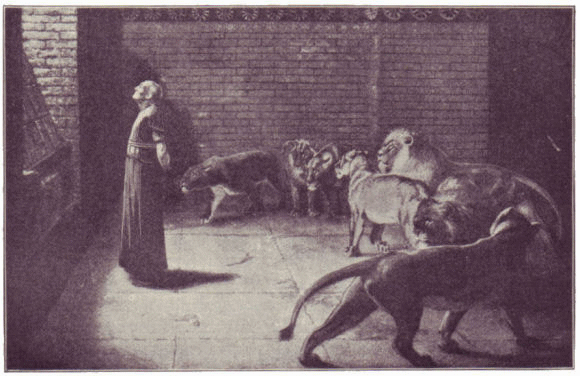 DANIEL ANSWERS THE KING |
Then the king was glad. He gave to his servants orders to take Daniel out of the den. Daniel was brought out safe and without harm, because he had trusted fully in the Lord God. Then, by the king's command, they seized those men who had spoken against Daniel, and with them their wives and their children, for the king was exceedingly angry with them. They were all thrown into the den, and the hungry lions leaped upon them, and tore them in pieces as soon as they fell upon the floor of the den.
It was very cruel and unjust to put to death with these men their wives and children, who had done no wrong, either to King Darius or to Daniel. But cruel and unjust as it was, such things were common in all the lands of that part of the world. The lives of people were but little cared for, and children often suffered death for their parent's crime.
After this King Darius wrote to all the lands and the peoples in the many kingdoms under his rule, "May peace be given to you all abundantly! I make a law that everywhere among my kingdoms men fear and worship the Lord God of Daniel, for he is the living God, above all other gods, who only can save men."
And Daniel stood beside King Darius unto the end of his reign, and afterward while Cyrus the Persian was king over all the lands.
Daniel lived for a number of years after being saved from the lions. He had several wonderful dreams and visions, which showed him what would come to pass many years afterward, and even to the coming of Jesus Christ.
The Story of a Joyous Journey
We have seen, in the story of the kingdom of Israel, or the Ten Tribes, how the great empire of Assyria arose from the city of Nineveh, on the Tigris river; how it ruled all the lands and carried away the Ten Tribes of Israel into captivity, from which they never came back to their own land. (Story Eighteen in Part Fourth.) We saw, too, how the empire of Assyria went down, and the empire of Babylon, or Chaldea, arose in its place under Nebuchadnezzar. (Story Six in this Part.) As soon as Nebuchadnezzar died, the empire of Babylon began to fall, and in its place arose the empire of Persia, under Cyrus, who is called Cyrus the Great, because of his many victories and his wide rule. His empire was much greater than either the Assyrian or the Chaldean empire, for it held in its rule the land of Egypt, all the lands known as Asia Minor, and also many lands in the far east.
Cyrus, the great king, was a friend to the Jews, who at this time were still living in the land of Chaldea, between the Tigris and Euphrates rivers. It was now seventy years since the first company of captives had been taken away from the land of Judah by Nebuchadnezzar (see Story Six in this Part), and fifty years since the city of Jerusalem had been burned. By that time the Jews were no longer looked upon as captives in the land of Chaldea. They lived in their own houses, and tilled their own farms, and were in peace. Many of them were rich, and some of them, like Daniel and his three friends, were in high places at the court of the king.
You remember that in the early days of the captivity, Jeremiah the prophet wrote a letter to those who had been carried away to Babylon, telling them that after seventy years they would come back to their own land. (Story Six.) The seventy years were now ended. The older men and women who had been taken away had died in the land of Chaldea, but their children, and their children's children still loved the land of Judah as their own land, although it was so far away.
The Lord put it into the heart of Cyrus, the king of Persia, very early in his reign, to send word among the Jews that they might now go back to their own land. This was the word, as it was written and sent out:
"Thus saith Cyrus, the king of Persia, The Lord, the God of heaven, has given me all the kingdoms of the earth; and he has commanded me to build him a house in Jerusalem, in the land of Judah. Therefore, let those of the people of God who are among you go up to Jerusalem, and help to build the house of the Lord. And those who do not go to Jerusalem, but stay in the places where they are living, let them give to those who go back to their own land gifts of gold and silver, and beasts to carry them, and goods, and also a free gift toward the building of the house of the Lord in Jerusalem."
At this the Jews in the land of Chaldea were very glad, for they loved their own land, and longed to see it. One of them wrote a song at this time. It is Psalm 126:
|
"When the Lord turned again the capitivity of Zion, We were like unto them that dream. Then was our mouth filled with laughter, And our tongue with singing. Then said they among the nations, 'The Lord hath done great things for them,' The Lord hath done great things for us; Whereof we are glad. Turn again our capitivity, O Lord, As the streams in the South, They that sow in tears Shall reap in joy, Though he goeth on his way weeping, Bearing forth the seed, He shall come again with joy, Bringing his sheaves with him." |
So the Jewish people began to make ready for going back to their own land. Those who were rich, and noble in rank, stayed in the land of Chaldea and in other lands of the Persian Empire. But though they did not go back to the land from which their fathers had come, they gave large gifts of gold and silver to help those who did go. And Cyrus, the king, took from the treasure-house in Babylon all the vessels of the Temple that had been taken away by Nebuchadnezzar, and gave them to the Jews, to be used in the new Temple which they were soon to build. These were plates, and dishes, and bowls, and cups of gold and silver, more than four thousand in all. So, with the gifts of the king, and the gifts of their own people, and what was owned by those who went to the land of Judah, the company took away a vast treasure of gold and silver.
It was a happy company of people that met together for the journey back to the land whch they still called their own, though very few of them had seen it. There were forty-two thousand of them, besides their servants to help them in the journey. They traveled slowly up the Euphrates river, singing songs of joy, until they reached the northern end of the great desert. Then they turned toward the southwest, and journeyed beside the Lebanon mountains, past Damascus, and through Syria, until at last they came to the land of their fathers, the land of Judah.
With all their joy they must have felt sad when they saw the city of Jerusalem all in ruins, its walls broken down, its houses heaps of blackened stone, its once beautiful Temple burned into a heap of ashes.
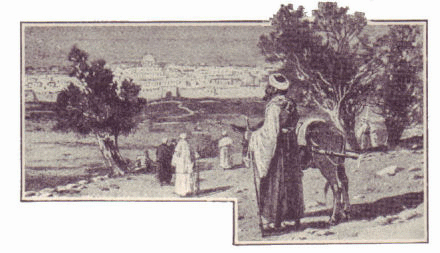 A DISTANT VIEW OF JERUSALEM |
As soon as they came, they found the rock where the altar of the Lord had stood, the same rock where David had long before offered a sacrifice (see Story Sixteen in Part Third), and the same rock upon which travelers look even in our time under the Dome of the Rock. From the smooth face of this rock they gathered up the stones, and swept away the ashes and the dust. Then they built upon it the altar of the Lord, and Joshua, the high-priest, began to offer the sacrifices which for fifty years had not been placed upon the altar. Every morning and every afternoon they laid on the altar the burnt-offering, and thus gave themselves to the Lord, and asked God's help.
From this time there were two branches of the Jewish race. Those who came back to the land of Judah, which was also called the land of Israel, were called "Hebrews," which was an old name of the Israelites. Those who stayed in the lands abroad, in Chaldea and throughout the empire of Persia, were called "the Jews of the Dispersion." There were far more of the Jews abroad than in their own land, and they were the richer, and the greater people. Many of them went up to Jerusalem to visit and to worship, and many others sent rich gifts; so that between the two great branches of the Jewish people, in their own land and in other lands, there was a close friendship, and they all felt wherever the Jews were they were still one people.
The Jews who had been captives in the land of Babylon were now free to go wherever they chose; and besides those who went back to the land of their fathers, there were many who chose to visit other lands, wherever they could find work and get gain. It was not many years before Jews were found in many cities of the Persian Empire. They went also to Africa; and also to Europe, choosing the cities for their home rather than the country. Everywhere, in all the great cities, the "Jews of the Dispersion" were found, besides those who were living in their own land of Israel.
When the Jews came back to their land their leader was named Zerubbabel, a word which means "One born in Babylon." He belonged to the family of David, and was called "the prince": but he ruled under the commands of Cyrus, the great king, for Judah (which now began to be spoken of as Judea) was a small part, or "province" as it was called, in the great empire of Persia.
The New Temple on Mount Moriah
After the Jews came back to their own land they first built the altar upon Mount Moriah, as we read in the last Story. Then they built some houses for themselves, for the winter was coming on. And early in the next year they began to build again the Temple of the Lord. Zerubbabel, the prince, and Joshua, the priest, led in the work, and the priests and Levites helped in it. They gave money to masons, and carpenters, and they paid men of Tyre and Sidon, on the shore of the Great Sea, to float down cedar-trees from Mount Lebanon to Joppa; and from Joppa they carried them up the mountains to Jerusalem for the building of the house.
When they laid the first stones in the new building the priests in their robes stood ready with trumpets, and the Levites with cymbals, to praise the Lord for his goodness in bringing them once again to their own land. The singers sang:
|
"Praise the Lord, for he is good; His mercy endureth forever toward Israel his people." |
And all the people shouted with a great shout as the first stones were laid. But some of the priests, and Levites, and Jews, were old men who had seen the first Temple, while it was still standing, more than fifty years before. These old men wept as they thought of the house that had been burned, and of their friends who had been slain in the destruction of the city. Some wept, and some shouted, but the sound was heard together, and those who heard at a distance could not tell the weeping from the shouting.
But these builders soon found enemies, and were hindered in their work. In the middle of the land, near the cities of Shechem and Samaria, were living the Samaritan people, some of whom from the old Ten Tribes, and others from the people that had been brought into the land by the Assyrians many years before. (See Story Eighteen in Part Fourth.) These worshipped the Lord, but with the Lord they worshipped other gods. These people came to Prince Zerubbabel, and said, "Let us join with you in building this house, for we seek the Lord as you do, and we offer sacrifices to him."
But Zerubbabel and the rulers said to them, "You are not with us, and you do not worship as we worship. You have nothing to do with us in the building the Lord's house. We will build up ourselves to our God, the God of Israel, as Cyrus, the king of Persia, has told us to build."
This made the people of Samaria very angry. They tried to stop the Jews from building, and frightened them, and wrote letters to the king, urging him to stop the work. Cyrus, the king, was a friend to the Jews, but he was in a land far away in the east, carrying on war, so that he could not help them; and soon after this he died. His son, who took his great kingdom, did not care for the Jews, and he, too, died in a few years. Then a nobleman of another family seized the throne, and held it nearly a year before he was slain. His name was Smerdis, but he is called in the Bible by another name, Artaxerxes. While this king was reigning, the Samaritan rulers wrote to him a letter, saying:
"Let it be known to the king that the Jews have come back to Jerusalem. They are building again the city which was always bad, and would not obey the kings when it was standing before. If that city be built, and its walls finished, then the Jews will not serve the king, nor pay to him their taxes. We are true to the king, and we do not wish to see harm come to his rule. Of old time this city was rebellious, and for that cause it was laid waste. If it is built again, soon the king will have no power anywhere on this side of the river Euphrates."
The King Smerdis, or Artaxerxes, wrote an answer to the chief men of Samaria, this:
"The letter which you sent has been read to me. I have caused search to be made in the records; and I find that the city of Jerusalem has been in old time a strong city, with great kings ruling in it, and ruling also the lands around it. I find, too, that this city did rise up and make war against the kings of empires in the past. Command the men who are building the city of Jerusalem to stop the work; and let it not go on until an order is given from the king."
The Samaritans and other enemies of the Jews were glad to have this letter come from the great king of Persia. They went to Jerusalem and made the work of building the Temple and the city stop. So the foundations of the Temple lay unfinished through several years.
But after a time two prophets arose in the land of Judea. They were Haggai and Zechariah; and they spoke the word of the Lord to the people, telling them to go forward with the building. Haggai said, "Is it a time for you to dwell in richly furnished houses of your own while the Lord's house lies waste? Go up to the mountains, and bring wood, and build; and I will be pleased with you, and will bless you, saith the Lord. The glory of this house shall be greater than the glory of the other house, and in this place I will give peace, saith the Lord of hosts."
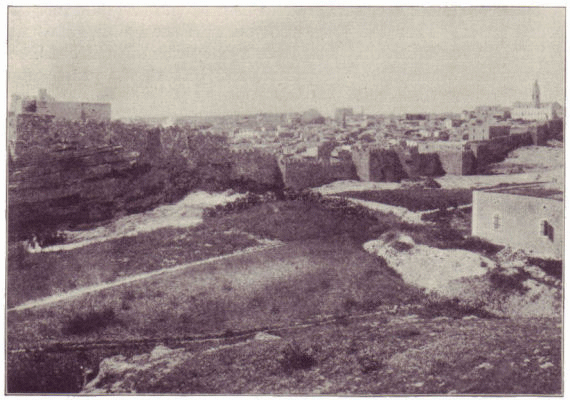 JERUSALEM OF TO-DAY |
And Zechariah, the other prophet, said, "It shall not be by might nor by power, but by my spirit, saith the Lord. The hands of Zerubbabel have laid the foundation of this house, and his hands shall finish it. He shall lay the head-stone with shoutings of 'Grace, grace upon it!'"
Then Zerubbabel, and Joshua, and the rest of the Jews, began again, and went on with the work. Soon after this a new king began to reign in Persia. He was a wise man and a great ruler, whose name was Darius.
King Darius looked in the records of Persia, and found it written that Cyrus, the king, had commanded the Temple to be built. He wrote a letter to the rulers in all the lands around Judea no longer to hinder the work, but to help it, and to give what was needed for it. Then the Jews went on with the building in great joy; and it was finished at last, twenty-one years after it had been begun, while Zerubbabel, the prince, and Joshua, the priest, were still ruling over the people.
The Temple, which was thus built for the second time, was like the one built by Solomon nearly five hundred years before (see Story Nineteen in Part Third); but though larger, it was not so beautiful nor costly. In front of it was an open court, with a wall around it, where the people could go to worship. Next to the people's court, on higher ground, was the priests' court, where stood the altar, and the laver for washing. Within this court rose the house of God, with the Holy Place, and the Holy of Holies, separated by a great vail. In the Holy Place, as before, stood the table for bread, the golden lampstand, and the golden altar for incense. But in the Holy of Holies there was no ark of the covenant, for this had been lost, and was never brought back to Jerusalem. In place of the ark stood a marble block, upon which the high-priest sprinkled the blood, when he went into the Holy of Holies, on the great day of atonement, once in each year. (See the account of the Tabernacle and its worship in Story Twenty-eight in Part First.)
The Beautiful Queen of Persia
When Darius, the great king, died, his son Xerxes, who is called in the Bible Ahasuerus, took his place upon the throne of Persia. Ahasuerus was not, like his father Darius, a wise man. He was hasty in his temper and did many foolish acts.
At that time the palace where the king of Persia lived was no longer at Babylon, but at a city named Shushan, among the mountains of a region called Elam. King Ahasuerus held at Shushan a great feast with his nobles. When the king and his company were all drunken with wine, he sent for his queen, Vashti, that he might let all the nobles see how beautiful she was. Among the Persians it was held to be very wrong for a woman ever to allow her face to be seen by any man except her husband. Queen Vashti refused to come to the feast that these drunken men might stare at her. This made the king very angry. He said that because Vashti would not obey him, she should not be queen any longer, and he put her away from him and from his house.
After this King Ahasuerus thought to choose another woman to be his queen instead of Vashti. He sent commands throughout all the kingdom that in every land and province they should find the most beautiful young women and bring them to the royal city of Shushan. There the king would see them all, and among them he would choose the one that pleased him best, and would take her as his queen. So from every land in the great empire of Persia the loveliest young women were brought to Shushan, and there they were left in the care of Hegai, the chief of the king's palace.
At that time many Jews were living in the cities of Persia, for we have seen that only a small part of the Jews went back to the land of Israel when King Cyrus allowed them to return. (See Story Thirteen in this Part.) There was a Jew living in Shushan, named Mordecai. He belonged to the tribe of Benjamin, and came from the same family and line with Saul, the first of the kings of Israel. At the house of Mordecai lived his cousin, a young girl named Hadassah, or Esther, a name which means "Star." Her father and mother had died, and she had been left alone; so Mordecai took her to his own house, and brought her up as his own daughter. Esther was very beautiful, and was as lovely in her heart as she was in her face. Among the other beautiful young women she was taken the to the palace as one of those who were to be brought before the king.
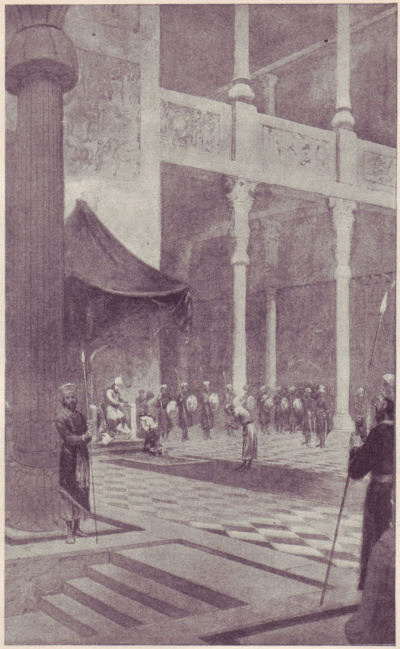 QUEEN ESTHER COMING TO THE KING |
When King Ahasuerus saw Esther, the Jewish girl, he loved her, and chose her out of all the young women to be his queen, and set upon her head the royal crown of Persia. Esther was taken into the king's palace; rooms and servants were given to her, and she lived in the state of a queen. When the king wisher to see her he sent for her, and she came to his room. No one could go to the king or could see him unless sent for. And if any one, man or woman, came before the king without being called, that person was seized by the guards, and was led away to death, unless the king held out toward him his golden scepter, the rod which he held.
In the palace Mordecai could no longer meet his cousin Esther, for no man except the king could enter the rooms set apart for the women. But Esther from her window could see Mordecai as he walked by, and by her servants she could send word to him, and in the same way could hear word from him. Mordecai loved the lovely young queen who was to him as a daughter, and every day sat at the gate of the palace to hear from her.
While Mordecai was sitting by the gate he saw two men who were keepers of the gate often whispering together. He watched them closely, and found that they had made a plan to kill King Ahasuerus. He sent word of this to Queen Esther, and Esther told the king of it. The men were taken, and, as Mordecai's word was found to be true, they were both slain by being hanged on a tree. And an account or story of all their plan, of how they were found out by Mordecai the Jew, and how they were punished by death, was written in the book of records of the kingdom.
After this a man named Haman arose to great power in the kingdom. The king have him a seat above all the other princes, and asked his advice in all matters, and allowed Haman to do whatever he pleased. Of course everybody in the palace showed great respect to Haman, the man who stood next to the king. When he came near, all the men in the palace and in the city bowed down before him, and many fell on their faces, even in the very dust. But Mordecai was a worshipper of God, and he would not fall upon his face before any man. Haman noticed that there was one man who did not bow down, as did the others around him. He said to his servants, "Who is that man sitting by the gate, who does not bow down when I pass by?"
They answered Haman, "That is Mordecai the Jew."
But they did not tell Haman, for they did not know, that Mordecai was the cousin of Queen Esther, and that the queen of Persia herself was a Jewess.
When Haman found that Mordecai was a Jew he became very angry, not only at Mordecai, but at all his people. He hated the Jews, and he resolved to have revenge on Mordecai, and on his account to make all Mordecai's people suffer. Haman went in to the king, and said to him, "O King Ahasuerus, there is a certain people scattered abroad through your kingdom and apart from all other peoples. Their laws are different from those of every other nation, and they do not keep the king's laws. It is not well to allow such a people to live. If it is pleasing to the king, let a law be made of putting them to death, and will place the money in the king's treasury."
The king, living in his palace and never going out among his people, knew nothing of the Jews, and believed Haman's words. He took from his hand the ring on which was the royal seal, and gave it to Haman, saying:
"Do as you please; write whatever law you wish, and stamp it with the king's seal. The money is yours, and I give this strange people to you. You can do with them as you please."
Then, by Haman's command, a law was written, and sealed with the king's seal, that on a certain day, which was the thirteenth day of the twelfth month, all the Jews in every part of Persia might be slain. Any one who chose to kill them might do so; and those who kill them might take for their own all their money, the gold, and silver, and garments which they might find in the houses of the Jews.
The copies of this law were sent to every city of the empire of Persia, to be read everywhere, so that all might know that the Jews were to be destroyed. Everybody who heard of it was filled with wonder, for no one knew of any evil against the king that the Jews had done to deserve death. They could not understand why the law had been made; but everywhere the enemies of the Jews made ready to destroy them, that they might have the Jews' riches; for in those times, even as now, there was great wealth among the Jews.
The news of this terrible law came to Mordecai, as it came to all the Jews in Shushan. Mordecai tore his clothes, as was the manner of those in deep grief; he put on garments of sackcloth; he covered his head with ashes, and he went forth in front of the palace, crying a loud and bitter cry. Queen Esther saw him and heard his voice. She sent one of her servants, named Hatach, to Mordecai, to find why he was in such deep trouble. Hatach came to Mordecai, and Mordecai told him of the law for killing the Jews on a certain day, the thirteenth day of the twelfth month, and gave him a copy of it to show to Queen Esther; and he told Hatach to ask the queen, in his name, to go in to King Ahasuerus and beg him to spare the lives of her people. Queen Esther heard Hatach's words, and sent this message to Mordecai:
"It is the rule of the palace that if any man or woman shall go in to the king in his own room, without being sent for by the king, he shall be slain unless the king holds out to him the golden scepter. But I have not been called to meet the king for thirty days."
When Mordecai heard this message he sent word again by Hatach to Queen Esther:
"Do not think that in the king's palace you are safe, and shall escape the fate of your people. If you keep still, and do nothing to save your people, God will surely save them in some other way; and you and your father's family shall be destroyed. Who can tel whether God has not raised you up and given you your royal place for such a time as this?"
Then Esther sent this answer to Mordecai, "Go, and bring together all the Jews in Shushan, and let them all pray for me, eating and drinking nothing, for three days. I and my maids in the palace will pray and fast also at the same time. And then I will go in to the king, even though it is against the law; and if it be God's will that I should die in trying to save my people, then I will die."
When Mordecai heard these words he was glad, for he felt sure that God would save his people through Queen Esther. For three days all the Jews in Shushan met together, praying; and in the palace Esther and her servants were praying at the same time.
The third day came, and Esther dressed herself in all her robes as queen. She went out of her own rooms, and across the open court, and entered the door in front of the throne where the king was sitting. The king saw her standing before him, in all her beauty, and his heart was touched with love for her. He held out toward her the golden rod or scepter that was in his hand. Esther came near, and touched the top of the scepter. The king said to her:
"What do you wish, Queen Esther? It shall be given to you, even to the half of my kingdom."
But Esther did not at once ask for all that was in her heart. She was very wise, and she said, "If it pleases the king, I have come to ask that the king and Haman, the prince, shall come this day to a dinner that I have made ready for them."
The king said, "Send word to Haman that he haste, and come to dine with the king and queen."
So that day King Ahasuerus and Haman sat at the table with the queen. She was covered with a veil, for even Haman was not allowed to look upon her face. While they were sitting together, the king said, "Queen Esther, is there anything that you wish? It shall be be given to you, whatever it is, even to half of the kingdom."
"My wish," answered the queen, "is that the king and Haman shall come again to a dinner with me to-morrow."
Haman walked out of the palace that day happy at the honor that had come to him, but when he saw Mordecai sitting by the gate, and not rising up to bow before him, all his gladness passed away, and he was angry in his heart. When he came to his own house he told his wife Zeresh, and his friends, how the king and the queen had honored him, and then he said, "But all this is as nothing to me when I see that man, Mordecai the Jew, sitting at the king's gate."
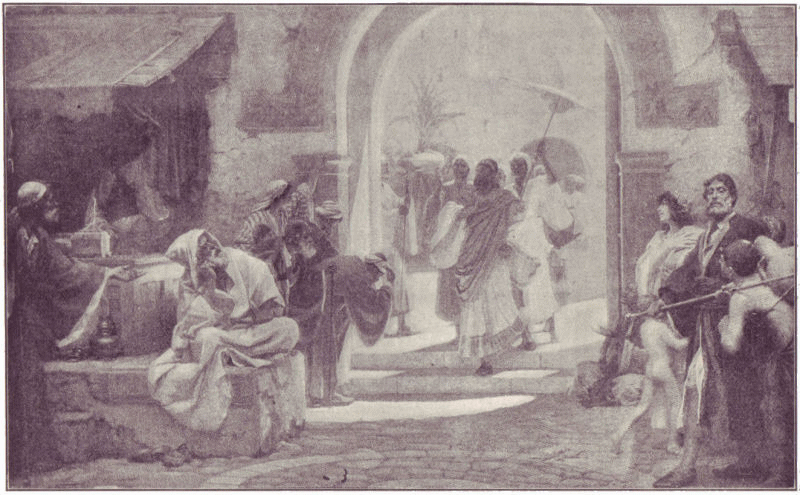 MORDECAI DOES NOT KNEEL BEFORE HAMAN |
But his wife said to him, "That is nothing. Before you go to the feast to-morrow, have a gallows made, and then ask the king to command that Mordecai be hanged upon it. The king will do whatever you wish, and then, when you have sent Mordecai to death, you can be happy at your feast with the king and the queen."
This was very pleasing to Haman; and on that very day he caused the gallows to be set up, ready for hanging Mordecai on the next day.
It so happened that on that night the king could not sleep. He told them to read in the book of records of the kingdom, hoping that the reading might put him to sleep. They read in the book how Mordecai had told of the two men who had sought to murder the king. The king stopped the reading, and said, "What reward has been given to Mordecai for saving the life of the king from these men?"
"O king," they answered, "nothing has been done for Mordecai."
Then said the king, "Is any one of the princes standing outside in the court?"
"Yes, O king," was answered; "the noble Haman is in the court."
Haman had come in at that very moment to ask the king that Mordecai might be put to death. The king sent word to Haman to come in, and as soon as he entered said to him, "What shall be done to any man whom the king wishes especially to honor?"
Now Haman thought within himself, "There is no man whom the king will wish to honor more than myself." Then he said, "The man whom the king wishes especially to honor, let him be dressed in the garments of the king, and let him sit on the horse that the king rides upon, and let the royal crown be set upon his head; let him ride through the man street of the city, and let one of the nobles call out before him, 'This is the man whom the king delights to honor.'"
Then the king said to Haman, "Make haste, and do all this that you have said to Mordecai the Jew, who sits in the king's gate. See that nothing is left out of what you have spoken."
Haman was astonished, and was cut to the heart, but he did not dare speak as he felt. He obeyed the king's command, sent for the king's horse, his robes, and his crown; dressed Mordecai like a king, mounted him on the horse, and went before him through the street of Shushan, calling aloud, "This is the man whom the king delights to honor!" And after that Haman hid his anger and his sorrow of heart, and sat down to the feast in the queen's palace. He had not said a word to the king of having Mordecai hanged upon the gallows which he had set up the day before.
King Ahasuerus knew very well that his queen had still some favor to ask; and at the feast he said to her, "What do you wish, Queen Esther? Tell me, and I will give it to you, even though it be half of my kingdom."
Then Esther saw that her time had come. She said to the king:
"If I have found favor in your sight, O king, and if it please you, let my life be given me, and the lives of my people. For we have been sold, I and all my people, to be destroyed, to be slain, and to perish. If only we had been sold as slaves, I would have said nothing; but we are to be slain, in order to please our enemy."
Then said the king, "Who is the man, and where is he, that has dared to do this thing?"
"The enemy," said Queen Esther, "is this wicked Haman!"
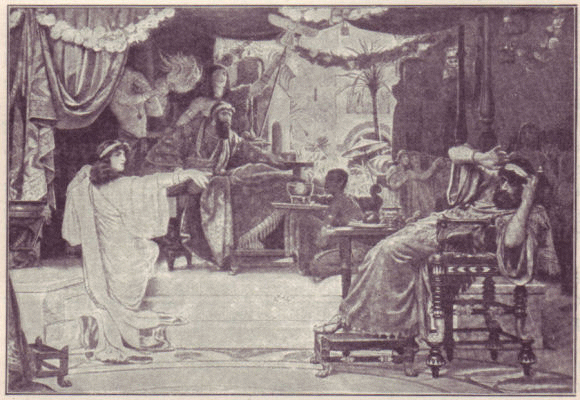 ESTHER POINTS TO HAMAN AS HER ENEMY |
As the king heard this he was so angry that he rose up from the table, and walked out into the garden. In a moment he came back and saw Haman fallen down upon his face, begging the queen to spare his life. The king looked at him in anger, and the servants at once covered Haman's face, as of one doomed to death. One of the officers standing near said, "There stands the gallows, seventy-five feet high, which Haman set up yesterday for Mordecai to be hanged upon it."
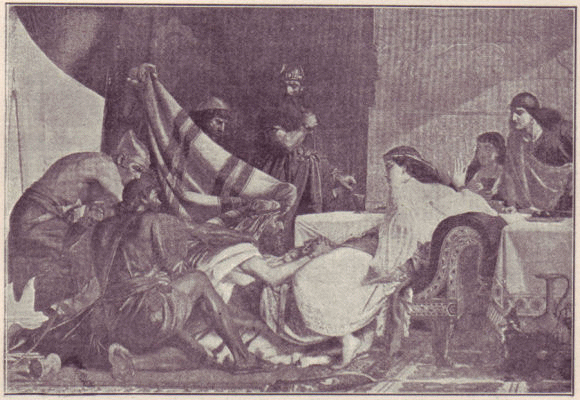 HAMAN BEGS FOR HIS LIFE FROM ESTHER |
"Hang Haman himself on it," commanded the king. So Haman died upon the very gallows that he had made for Mordecai.
And on that day the king gave Haman's place to Mordecai, and set him over the princes. He gave to Mordecai his own ring, with its seal. And all the family of Haman, his sons, were put to death for their father's evil-doing, according to the cruel usage of those times.
The law for killing the Jews on the thirteenth day of the twelfth month had been made and sent abroad; and no law of the Persians could be changed. But though this law could not be taken back, another law was made that the Jews could defend themselves against any who might try to do them harm. When the day came most of their enemies feared to harm the Jews, for now they were under the care of the king, and Mordecai, a Jew, stood next to the king; and such of their enemies as tried to kill them on that day were soon destroyed.
So everywhere, instead of sorrow and death, on the thirteenth day of the twelth month, the Jews had joy and gladness. And on the day following, the fourteenth day of the twelfth month, the Jews kept a feast of thanksgiving to God for his mercy in saving them from their enemies. The same feast was kept on that day, every year afterward, and it is still kept among the Jews in all lands, and is called the feast of Purim. On that feast the story of Esther, the beautiful queen, is read by all the Jewish people.
The Scribe Who Wrote the Old Testament
From the court of the great king at Shushan we turn once more to the Jews at Jerusalem and in Judea. For a long time after the first company came to the land under Zerubbabel (see Story Thirteen in this Part) very few Jews from other countries joined them. The Jews in Judea were poor, and discouraged. Many of them had borrowed money which they could not pay, and had been sold as slaves to richer Jews. Around them on every side were their enemies, the idol-worshipping people in the land, and the Samaritans on the north. These enemies robbed them of their crops in the field, and they also constantly sent evil and false reports of them to the Persian governors. Many of the men of Israel had married women of the land not of the Israelite race, and their children were growing up half heathen and half Jewish, unable to talk in the language of their fathers, and knowing nothing of the true God.
Ninety years after the Jews had come back to the land Jerusalem was a small town, with many of its hold houses still in ruins, and no wall around it. In those times no city could be safe from its enemies without a wall; so that Jerusalem lay helpless against bands of robbers who came up from the desert and carried away nearly all that the people could earn.
Just at the time when the land was in the deepest need God raised up two men to help his people. These two men were Ezra and Nehemiah. Through Ezra the people of Judah were led back to their God, to worship him, to serve him, and especially to love God's book as they never had loved it before. And about the same time Nehemiah gave new hope, and courage, and strength to the people by helping them to build a wall around Jerusalem. The work of these two men brought to Judea peace and plenty, and led many Jews from other lands to their own country.
Ezra was a priest, living in the city of Babylon, though he had sprung from the family of Aaron, the first priest. He was also a prophet, through whom God spoke to his people. But above all, Ezra was a lover of God's book I a time when the book of the Lord was almost forgotten. Nearly all the books of what we call the Old testament had been written for a long time; but in those days there were no printed books; each copy was written separately with a pen; and as the labor was great, there were very few copies of the different blocks of the Bible. And these copies were in different places; one book of the Bible was in one place, another book was in another place. No one man in those times before Ezra had ever owned or had ever seen the whole of the Old Testament in one book or set of books.
Ezra began to seek everywhere among the Jews for copies of these different books. Whenever he found one he wrote it out, and kept the copy, and also led other men to copy the books as they found them. At last Ezra had copies written of all the books in the Old Testament except the very latest books. They were written very nearly as we have them now, except that his copies were all in Hebrew, the language spoken by the men who wrote most of the Old Testament.
Ezra put all these different books together, making one book out of many books. This great book was written on parchment, or sheepskin, in long rolls, as in old time all books were written. When the book was finished it was called "The Book of the Law," because it contained God's law for his people, as given through Moses, and Samuel, and David, and Isaiah, and all the other prophets.
When Ezra had finished writing this book of the law, he went on a long journey through Babylon to Judea, taking with him the rolls of the book. With Ezra went a company of men whom he had taught to love the law, to write copies of it, to read it, and to teach it to others. These men, who gave their lives to studying, and copying, and teaching the law, were called "scribes," a word which means "writers."
Ezra was the first and the greatest of these scribes; but from his time there were many scribes among the Jews, both in Judea and in all other lands. For wherever the Jews lived they began to read the Bible and to love it. The time came, soon after Ezra's day, when in every place where the Jews met to worship at least one copy of all the books in the Old Testament was kept; so that there was no more danger that the Bible, or any part of it, would be lost.
You remember that there was only one Temple for all the Jews in the world, and only one altar. Upon this one altar, and there alone, was offered the sacrifice every day. But the Jews in distant places needed to meet together for worship, and there grew up among the Jews everywhere what was called "the Synagogue," a word which means "coming together." At first they met in a room, but afterward they built houses for the synagogues much like our churches. Some of these synagogues were large and beautiful, and in them the people met every week to worship God, to sing the psalms, to hear the law and the prophets read, and to talk together about what they had heard. It was something like a prayer-meeting; for any Jew who wished to speak in the meeting could do so. The men sat on mats laid on the floor; the rulers of the synagogue were on seats raised up above the rest; the women were in a gallery on one side, covered with a lattice-work, so that they could see and hear, but could not be seen. And on the end of the room nearest to Jerusalem there was a large box or chest, called "the ark," within which were kept the copies of the books of the Old Testament. Thus through the synagogue all the Jews in the world listened to the reading of the Old Testament until very many of them knew every word of it by heart. All this came to pass from Ezra's work in copying and teaching the word of the Lord.
And Ezra wrought another work almost as great as that of giving the Bible to the world. He taught the Jewish people, first in Israel, and then in other lands, that they were the people of God, and that they must live apart from other nations. If they had gone on marrying women of other races, who worshipped other gods, after a time there would have been no Jews, and no worshippers of God. Ezra made some of them give up their wives of other nations, and he taught the Jews to be a people by themselves, keeping away from those who worshipped idols, even though they lived among them. Thus Ezra led the Jews to look upon themselves as a holy people, given up to the service of God; and he taught them to live apart from other nations, with their own customs and ways of living, and very exact in obeying the law of God in the books given by Moses, even in some things that would seem small and not important. They were to be trained age after age in the service and worship of God. It was God's will that the Jews should be separate from other peoples, and very strict in keeping their law, until the time should come for them to go out and preach the gospel to all the world.
The Jews even now in our time continue to keep many of the rules that were given to their fathers long ago by Ezra; so next to Moses, Ezra had greater power over the Jews than any other prophet or teacher.
The Nobleman Who Built the Wall of Jerusalem
While the good scribe Ezra was at work finding the books of the Bible, and copying them, and teaching them, another great man was helping God's people in another way. This man was Nehemiah. He was a nobleman of high rank at the court of the great King Artaxerxes. Artaxerxes reigned after Ahasuerus, of whom we read in the story of the beautiful Queen Esther (Story Fifteen).
Nehemiah was "the cup-bearer" to the king of Persia at Shushan. It was his office to take charge of all the wine that wads used at the king's table, to pour it out and hand the cup to the king. This was an important office, for he saw the king every day at his meals, and could speak with him, as very few of even the highest princes could speak. Then, too, the life of the king was in his hands, for if he were an enemy he could have allowed poison to be put into the wine to kill the king. So the cup-bearer was always a man whom the king could trust as his friend.
Nehemiah was a Jew, and, like all the Jews, felt a great love for Jerusalem. At one time a Jew named Hanani, and certain of his friends who had come from Jerusalem, visited Nehemiah. Nehemiah asked them, "How are the Jews in Jerusalem doing? How does the city look?"
And they answered, "The people who are living in the land of Judea are very poor, and are looked down upon by all around them. The wall of Jerusalem is broken down, and its gates have been burned with fire."
When Nehemiah heard this he was filled with sorrow for his city and his people. After the Jews left him he sat down for days, and would eat nothing. He fasted, and wept, and prayed. He said, "O Lord God of heaven, the great God, who keeps his promises to those who love him and do his will; hear, O Lord, my prayer for the people of Israel, thy servants. We have done very wickedly, O Lord, and because of our sins thou hast scattered us among the nations. Now, O Lord, give me grace this day in the sight of this man, the king of Persia, and may the king help me to do good and to help my people in the land of Israel."
A few days after this Nehemiah was standing beside the king's table, while the king and queen were seated at their meal. As he poured out the wine the king saw that his face was sad, which was not usual, for Nehemiah was of cheerful spirit, and generally showed a happy face. The king said to him, "Nehemiah, why do you look so sad? You do not seem to be sick. I am sure that there is something that gives you trouble. What is it? Tell me."
Then Nehemiah was afraid that the king might be displeased with him, but he said, "Let the king live for ever! Why should not my face be sad, when the city where my fathers are buried lies waste, with its walls broken down, and its gates burned with fire?"
The king said, "Do you wish to ask of me any favor? Tell me what I can do to help you."
Then Nehemiah lifted up a silent prayer to God, and said, "May it please the king, I would be glad if you would send me to Jerusalem, in the land of Judah, with an order to build the walls."
The king said, "How long will the journey be? And when will you come back?"
Nehemiah fixed upon a time, and told the king how long it would be, and he asked also that he might have letters to the men who ruled the different provinces through which he would pass, for them to give him a safe journey; and also a letter to the keeper of the king's forest, to give him wood for the beams of a house which he wished to build, and for repairing the Temple, and for building the wall. The king was kind to Nehemiah, and he gave him all that he asked.
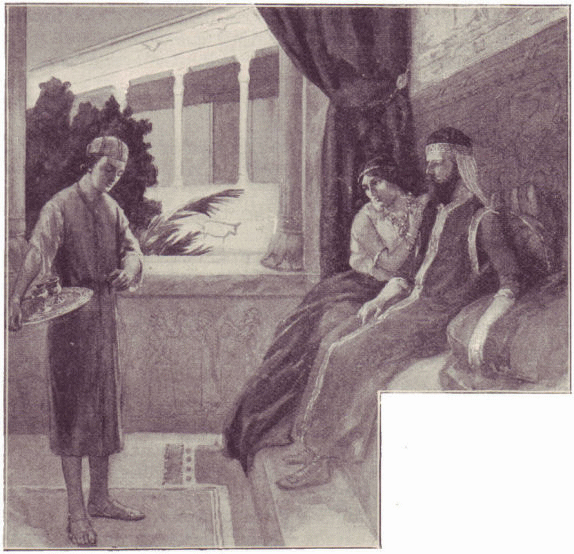 NEHEMIAH THE CUP-BEARER BEFORE THE KING AND QUEEN |
Nehemiah, with a company of horsemen and many friends, made the long journey of almost a thousand miles to Jerusalem. All the people were glad to have a visit from a man of such high rank, and the whole city rejoiced at his coming. But Nehemiah was distressed as he saw how poor and mean and helpless the city lay.
One night, without telling any of the men in the city his purpose, he rose up with a few of his friends, and by the light of the moon rode on his horse around the city. There he saw in how many places the walls were mere heaps of ruins, and gates were broken down and burned. He found great heaps of ashes, and piles of stone, so that in some places his horse could not walk over them. The next day he called together the rulers of the city and the chief priests, and he said to them, "You see how poor and helpless this city lies, without walls, or gates, and open to all its enemies. Come, let us build the wall of Jerusalem, so that no longer other people may look upon us with contempt." Then he told them how God had heard his prayer, and had made the king friendly, and had sent gifts to help them. Then the people and the rulers said, "Let us rise up and build the wall!" So at once they began the work. Each family in Jerusalem agreed to build a part of the wall. The high-priest said that he would build one of the gates, and the wall beside it to a certain tower. Some of the rich men built a long space, and others did very little, and some would do nothing. One man built just as much of the wall as would stand in front of his house, and no more, and another man only as much as fronted upon his own room. One man and his daughters hired workers to build; the goldsmiths built some, and so did the apothecaries, the men who sold medicines; and the merchants built a part. Almost all the men of the city, and some of the women, took part in the building, for the people had a mind to work.
Soon the news went abroad through Judea and the lands around, that the walls of Jerusalem were rising from their ruins. There were many who were far from pleased as they heard this, for they hated the Jews and their God, and they did not wish to see Jerusalem strong, as it had been of old. The leader of these enemies was a man named Sanballat, who came from Samaria, where all the people were jealous of the Jews.
"What are these feeble Jews doing?" said Sanballat. "Do they intend to make their city strong? Will they pile up stones out of the rubbish of the burned city?"
And his servant Tobiah was with him, saying, "Why, if a fox should go up, he could break down their little wall!"
The Arabians from the desert, and the Philistines from Ashdod on the plain, and the Ammonites from the east of Jordan, saw that if the wall should be built they could no more rob and plunder the city. They tried to form an army to come against the city and stop building. But Nehemiah prayed to God for help, and he chose watchmen who should go around the wall, and look out for the coming of the enemies. Half of Nehemiah's men worked on the wall, and the other half held the bows, and spears, and armor of the workers. And in some places a man would hold a spsear in one hand while he spread mortar with the other. At other places men worked with their swords hanging at one side, ready for the fight any moment.
Nehemiah rode on his horse around the wall, and his servant walked beside him with a trumpet. He said, "The work is large, and you are apart from each other. Whenever you hear the sound of the trumpet, leave your work, take your arms, and go to the place where it sounds; and there the Lord will fight for us."
But their enemies were not strong enough to fight the Jews; so Sanballat, and Tobiah, and another of their leaders named Geshem, sent a letter to Nehemiah, saying, "Come and meet us in one of the villages on the plain near the Great Sea, and let us talk over this matter."
Now Nehemiah knew that to go to this place and them come back again to Jerusalem would take more than a week; and he sent answer this, "I am doing a great work, and I cannot come down; why should the work stop, while I leave it, to come down and talk with you?"
Over and over again they sent for Nehemiah, but he refused to come. Finally, Sanballat sent a letter, with this message:
"It is told among all the people, and Geshem says it is a fact, that you are building this city to rebel against the king of Persia, and to set up a kingdom of your own. Come now, and let us talk with you, or trouble may come to you."
Nehemiah wrote back, "You know very well, that there is no truth in all these stories. You have made them up yourselves."
Some of the Jews in the city were friendly to these enemies outside, and these men tried to frighten Nehemiah. One of them made believe that he was a prophet, and said to Nehemiah, "Go into the Temple and hide, for in the night your enemies will come to kill you!"
"Should such a man as I am run away and hide himself?" said Nehemiah. "No; I will not go."
So earnestly did the men of Judah work that in fifty-two days after the work was begun it was finished, and the gates were hung, and guards were placed within, so that no enemies might enter. Thus Jerusalem began to rise from its weakness and helplessness, and once more to be a strong city.
Ezra's Great Bible Class in Jerusalem
When the wall of Jerusalem was finished, Nehemiah called together all the Jews from the villages and cities in the land to meet in Jerusalem. They met, a great company with their wives and children, in an open place before the Temple. Ezra, the good priest and scribe, who had wrought so great a work in bringing together and writing the books of the Old Testament (see Story Sixteen), was in the city at that time. They asked Ezra to bring the book, and to read the law of the Lord to the people.
He came, carrying with him the great rolls upon which the law was written, and stood up on a pulpit which they had built, where all the people could see him; and with Ezra were men whom he had taught in the law, so that they could teach it to others.
When Ezra stood up in the pulpit, above the heads of the people, and unrolled the scroll, all the people, who had been sitting upon the ground, rose up, while Ezra gave thanks to the Lord, who had given to them his law. Then the people said "Amen!" with a loud voice, and they bowed until their heads touched the ground, and worshipped.
Then Ezra began to read in the book, aloud, so that as many as possible could hear. But as the people did not all understand the old Hebrew tongue in which the book was written, men were chosen to stand by Ezra; and as he read each sentence, these men explained it to the people, while all the people stood listening. So, as Ezra read, these men told its meaning, so that the people could understand the word of the Lord.
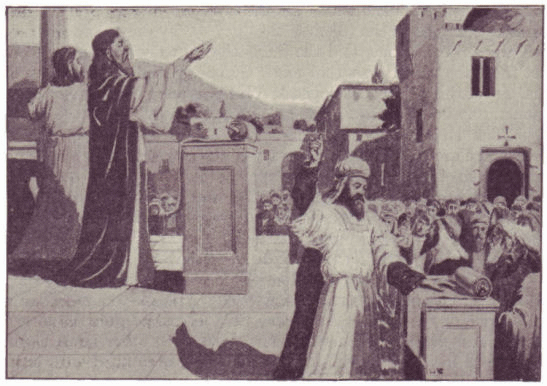 EZRA'S GREAT BIBLE CLASS |
Many of the people had never heard God's law read before, and they wept as they listened to it. But Nehemiah, who was there as the ruler, said to them, "This day is holy to the Lord; do not mourn nor weep, but rather be glad, and eat and drink, and send gifts of food to those who are in need, for you are strong in the Lord, and should be joyful."
And the Levites quieted the people, saying, "Hold your peace, for the day is holy. Do not weep, but be glad in the Lord."
And all the people went home to feast and to be glad, because they could hear and understand the words of God's law.
After this another great meeting was held, and the people confessed their sins before God, and the sins of their fathers in forsaking God's law, and in not doing his will. And all the people made a solemn promise that they would keep God's law, and would do his will; that they would be God's people, and no more give their sons to marry women who did not worship the Lord; that they would keep holy God's day, the Sabbath; and they would give to the Lord's house for all the offerings. And they wrote the promise on a roll, and all the princes and rulers and priests signed it, and placed their seals upon it.
Nehemiah had now finished the work for which he had made the long journey to Jerusalem. He went back to Shushan, and stood once more in his place, pouring the wine at the king's table. But after some years he came again to Jerusalem. He found that not all the people had fulfilled their promises to serve the Lord, and especially, that the Sabbath-day was not kept as it should be. People were treading wine-presses, and bringing into the city loads of grain, and selling wine, and grapes and figs, on the Sabbath-day. And men from the city of Tyre, beside the Great Sea, who were not worshippers of the Lord, brought in fish, and sold them on the Sabbath. When Nehemiah saw all these evils, he was greatly displeased, and said to the rulers of the city, "Why do you allow these evil things to be done, and the Sabbath-day to be broken? Were not these the very thigns that made God angry with our fathers, so that he let this city be destroyed? Will you bring God's anger upon us again by doing such things on God's holy day?"
Then Nehemiah gave orders that before the sun set on the evening before the Sababth the gates of the city should be shut, and not opened until the morning after the Sabbath was over. The men came with their things to be sold, and waited outside for the gates to be opened. Nehemiah looked over the wall, and saw them, and said to them, "What are you doing here? If you come here again on the Sabbath, I will put you in prison!"
Then they went away, and came no more upon the holy day. By such strong acts as these Nehemiah led the people to a more faithful service of the Lord. And after this Jerusalem grew large and strong, and was full of people. And Jews from other lands began to come to live in the land, until it was once more filled with cities and towns; and the hills over all the land were covered with vineyards and oliveyards, and the plains were waving with fields of grain.
A little after the time of Ezra and Nehemiah, Malachi arose as the last of the prophets of the Old Testament.
"Thus saith the Lord, Behold, I will send my messenger, and he shall prepare the way before me. and the Lord shall suddenly come to his Temple; behold, he cometh, saith the Lord. Behold, I will send you Elijah, the prophet, before the great day of the Lord shall come. And he shall turn the heart of the fathers to the children, and the heart of the children to their fathers."
And with these worlds the Old Testament ends.
The Angel by the Altar
At the time when the story of the New Testament began, the land of Israel called also the land of Judea, was ruled by a king named Herod. He was the first of several Herods, who at different times ruled either the whole of the land or parts of it. But Herod was not the highest ruler. Many years before this time, the Romans, who came from the city of Rome in Italy, had won all the land around the Great Sea, the sea which we call the Mediterranean; and above King Herod of Judea was the great king at Rome, who was called "Emperor," ruling over all the lands, and over the land of Judea among them. So Herod, though king of Judea, obeyed his over-lord, the emperor At Rome. At the time when this story began, the emperor at Rome was named Augustus Caesar.
At this time the land where the Jews lived was full of people. Jerusalem was its largest city, and in Jerusalem was standing the Temple of the Lord, which King Herod had begun to build anew, taking the place of the old Temple built in the time of Zerubbabel (see Story Fourteen in Part Fifth), which had long needed repair. There were also many other large cities besides Jerusalem. In the south was Hebron, among the mountains; on the shore of the Great Sea were Gaza and Joppa and Caesarea. In the middle of the land were Shechem and Samaria; and in the north were Nazareth and Cana; down by the shore of the Sea of Galilee were Tiberias, and Capernum, and Bethsaida. Far up in the north, at the foot of snowy Mount Hebron, was another Caesarea; but so that it might not be confused with Caesarea upon the sea-coast, this city was called Caesarea-philippi, or "Philip's Caesarea," from the name of one of Herod's sons.
One day, an old priest named Zacharias was leading the service of worship in the Temple. He was standing in front of the golden altar of incense, in the Holy Place, and was holding in his hand a censer or cup full of burning coals and incense; while all the people were worshipping in the court of the Temple, outside the court of the priests, where the great altar of burnt-offering stood (see Stories Twenty-seven and Twenty-eight in part First).
Suddenly Zacharias saw an angel from the Lord standing on the right side of the altar of incense. He felt a great fear when he saw this strange being, with shining face; but the angel said to him:
"Do not be afraid, Zacharias; for I have come from the Lord to bring you good news. Your wife Elizabeth shall have a son, and you shall name him John. You shall be made glad, for your son John shall bring joy and gladness to many. He shall be great in the sight of the Lord; and he shall never taste wine nor strong drink as long as he lives; but he shall be filled with God's Holy Spirit. He shall lead many of the people of Israel to the Lord, for he shall go before the Lord in the power of Elijah the prophet, as was promised by Malachi, the last of the old prophets (see the last Story). He shall turn the hearts of the fathers to the children, and those who are disobeying the Lord to do his will."
As Zacharias heard these words, he was filled with wonder, and could hardly believe them true. He was now an old man, and his wife Elizabeth was also old; so that they could not expect to have a child. He said to the angel: "How shall I know that your words are true, for I am an old man and my wife is old?"
"I am Gabriel, that stand in the presence of God." Said the angel, " and I was sent from the Lord to speak to you, and to bring you this good news. But because you did not believe my words you shall become dumb, and shall not be able to speak until this which I have said comes to pass."
All this time, the people outside in the court, were wondering why the priest stayed so long in the Temple. When at last he came out, they found that he could not speak a word; but made signs to them to tell them that he had seen a vision in the Temple.
After the days of his service were over, Zacharias went to his own home, which was near Hebron, a city of the priests, among the mountains in the south of Judea. When his wife Elizabeth found that God was soon to give her a child, she was very happy and praised the Lord. About six months after Zacharias saw the vision in the Temple, the same angel Gabriel was sent from the Lord to a city in the part of the land called Galilee, which was in the north. The city to which the angel was sent was Nazareth. There the angel found a young girl named Mary, who was a cousin to Elizabeth. Mary was soon to be married to a good man who had sprung from the line of King David, though he was not himself a king, or a rich man. He was a carpenter or wood-worker, living in Nazareth, and his name was Joseph. The angel came into the room where Mary was, and said to her:
"Hail, woman favored by the Lord; the Lord is with you!"
Mary was surprised at the angel's words, and wondered what they could mean. Then the angel spoke again and said:
"Do not be afraid, Mary. The Lord has given you his favor and chosen you to be the mother of a son whose name shall be Jesus, which means "salvation," because he shall save his people from their sins. He shall be great; and shall be called the Son of God; and the Lord shall give to him the throne of his father David. He shall be a king; and shall reign over the people of God forever, and of hid kingdom there shall be no end."
But Mary could not see how all this was to come to pass. And the angel said to her:
"The Holy Spirit shall come upon you, and the power of the Most High God shall be over you; and the holy child which you shall have shall be called the Son of God."
Then the angel told Mary that her cousin Elizabeth was soon to have a child through the power of the Lord. And when Mary heard all this she said, "I am the servant of the Lord, to do his will. Let it be to me as you have said."
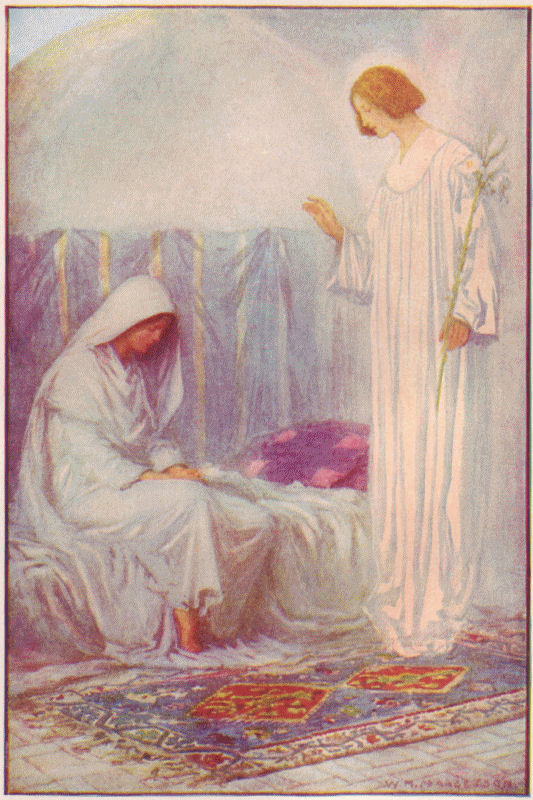 THE ANGEL SPEAKING TO MARY |
When the angel had given his message and had gone away, Mary rose up in haste, and made a journey to the home of Zacharias and Elizabeth, eighty miles away in the south country. When Elizabeth saw Mary, she was filled with the spirit of the Lord, and said, "Blessed is the woman who believed that the promise of the Lord to her shall be made true!"
 ELIZABETH GREETS MARY |
Then Mary was filled with the Spirit of the Lord, and broke out into a song of praise. She stayed with Elizabeth for nearly three months, and then went again to her own home at Nazareth.
As the angel had said, to the aged woman Elizabeth was given a son. They were going to name him Zacharias, after his father. But his mother said, "No, his name shall be John."
"Why," they said, "none of your family have ever been named John."
They asked his father Zacharias, by signs, what name he wished to be given to the child. He asked for something to write upon; and when they brought it, he wrote, "His name is John."
Then all at once the power to hear and to speak came back to Zacharias. He spoke, praising and blessing God; and he sang a song of thanks to God, in which he said:
"You, O child, shall be called a prophet of the Most High; to go before the Lord, and to make ready his ways."
When John was growing up, they sent him out into the desert on the south of the land and there he stayed until the time come for him to preach to the people, for this child became the prophet John the Baptist.
 THE WELL OF THE VIRGIN MARY, AT NAZARETH |
The Manger of Bethlehem
Soon after the time when John the Baptist was born, Joseph, the carpenter of Nazareth, the husband of Mary, had a dream. In his dream her saw an angel from the Lord standing beside him. The angel said to him:
"Joseph, I have come to tell you, that Mary, the young woman whom you are to marry will have a son, sent by the Lord God. You shall call his name Jesus, which means 'salvation', because he shall save his people from their sins."
Joseph knew from this that this coming child was to be the King of Isreal, of whom the prophets of the Old Testament had spoken so many times.
Soon after Joseph and Mary were married in Nazareth, a command went forth from the emperor, Augustus Caesar, through all the lands of the Roman empire, for all the people to go to the cities and towns from which their families had come and there to have their manes written down upon a list, for the emperor wished a list to be made of the the people under his rule. As both Joseph and Mary had come from the family of David the king, they went together from Nazareth to Bethlehem, there to have their names written upon the list. For you remember that Bethlehem in Judea, six miles south of Jerusalem, was the place where David was born, and where his father's family had lived for many years see Story Four in Part Third).
It was a long journey from Nazareth to Bethlehem; down the mountains to the river Jordan, then following the Jordan almost to its end, and then climbing the mountains of Judah to the town of Bethlehem. When Joseph and Mary came to Bethlehem they found the city full of people who, like themselves, had come to have their manes enrolled or written upon the list. The inn or hotel was full, and there was no room for them; for no one but themselves knew that this young woman was soon to be the mother of the Lord of all the earth. The best that they could do was to go to a stable, where the cattle were kept. There the little baby was born, and was laid in a manger, where the cattle were fed.
On that night some shepherds were tending their sheep in a field near Bethlehem. Suddenly a great light shown upon them, and they saw an angel of the Lord standing before them. They were filled with fear, as they saw how glorious the angel was. But the angel said to them:
"Be not afraid; for behold I bring you news of great joy which shall be to all the people; for there is born to your this day in Bethlehem, the city of David, a Saviour who is Christ the Lord, the anointed king. You may see him there; and may know him by this sign: He is a new-born baby, lying in a manager at the inn."
And then they saw that the air around and the sky above them were filled with angels, praising God and singing;
"Glory to God in the highest. And on earth peace among men in whom God is well pleased."
While they looked with wonder and listened the angels went out of sight as suddenly as they had come. Then the shepherds said one to another:
"Let us go at once to Bethlehem, and see this wonderful thing that has come to pass, and which the Lord has made known to us."
Then as quickly as they could go to Bethlehem, they went and found Joseph, the carpenter of Nazareth, and his young wife Mary, and the little baby lying in the manger. They told Mary and Joseph and others also, how they had seen the angels, and what they had heard about this baby. All who heard their story wondered at it; but Mary, the mother of the child said nothing. She thought over all these things, and silently kept them in her heart. After their visit the shepherds went back to their flocks, praising God for the good news that he had sent to them.
 JESUS IN THE MANGER, WITH ANGELS LOOKING ON |
When the little one was eight days old they gave him a name; and the name given was "Jesus," a word which means "salvation;" as the angel had told both Mary and Joseph that he should be named. So the very name of this child told what he should do for men; for he was to bring salvation to the world.
It was the law among the Jews that after the first child was born in a family, he should be brought to the Temple; and there an offering should be made for him to the Lord, to show that this child was the Lord's. A rich man would offer a lamb, but a poor man might give a pair of young pigeons for the sacrifice. On the day when Jesus was forty days old, Joseph and Mary brought him to the Temple; and as Joseph the carpenter was not a rich man, they gave for the child as an offering a pair of young pigeons.
 THE BABY JESUS BROUGHT TO THE TEMPLE |
At that time there was living in Jerusalem a man of God named Simeon. The Lord had spoken to Simeon, and had said to him that he should not die until the Anointed King should come, whom they called "the Christ," for the word Christ means "anointed". On a certain day the Spirit of the Lord told Simeon to go to the Temple. He went, and was there when Joseph and Mary brought the little child Jesus. The Spirit of the Lord said to Simeon"
"This little one is the promised Christ."
Then Simeon took the baby in his arms and praised the Lord and said:
|
"Now, O Lord, thou mayest let thy servant depart, According to thy word, in peace. For my eyes have seen thy salvation, Which thou hast given before all the peoples, A light to give light to the nations, And the glory of thy people Israel." |
When Joseph and Mary heard this, they wondered greatly. Simeon gave to them a blessing in the name of the Lord; and he said to Mary, "This little one shall cause many in Israel to fall, and to rise again. Many shall speak against him; and sorrow like a sword shall pierce your heart also."
You know how this came to pass afterward, when Mary saw her son dying on the cross.
While Simeon was speaking, a very old woman came in. Her name was Anna and God spoke to her as to a prophet. She stayed almost all the time in the Temple, worshipping God day and night. She, too, saw through the Spirit of the Lord, that this little child was Christ the Lord, and gave thanks to God for his grace.
Thus early in the life of Jesus God showed to a few that this little child should become the Saviour of his people and of the world.
The Star and the Wise Men
For some time after Jesus was born, Joseph and Mary stayed with him in Bethlehem. The little baby was not kept long in the stable, sleeping in the manger; for after a few days they found room in a house; and there another visit was made to Jesus by strange men from a land far away.
In a country east of Judea, and many miles distant, were living some very wise men, who studied the stars. One night they saw a strange star shining in the sky; and in some way they learned that the coming of this star meant that a king was soon to be born in the land of Judea. These men felt a call of God to go to Judea, far to the west of their own home, and there to see this new-born king. They took a long journey, with camels and horses, and at last they came to the land of Judea, just at the time when Jesus was born at Bethlehem. As soon as they were in Judea they supposed that every one would know all about the king; and they said: "Where is he that is born the King of the Jews? In the east we have seen his star; and we have come to worship him."
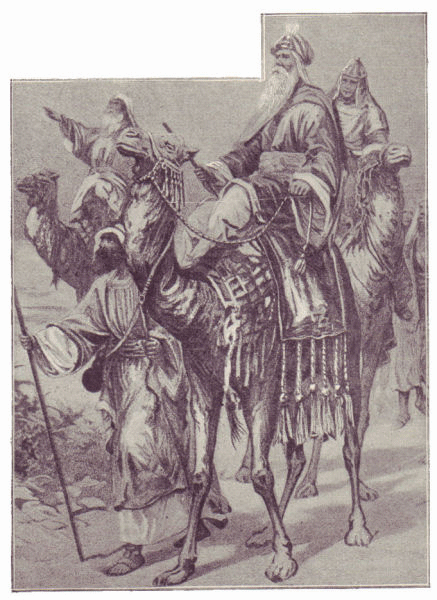 STRANGE MEN FROM FAR AWAY COME TO SEE THE NEWLY-BORN KING |
But no one of whom they asked had ever seen this king or had heard of him. The news of their coming was sent to Herod, the king, who was now a very old man. He ruled the land of Judea, as you know, under the emperor at Rome, Augustus Caesar. (See Story One of this Part.) Herod was a very wicked man; and when he heard of some one born to be a king he feared that he might lose his own kingdom. He made up his mind to kill this new king, and thus to keep his own power. He sent for the priests and scribes, the men who studied and taught the books of the Old Testament, and ask them about this Christ for whom all the people were looking. He said, "Can you tell me where Christ, the King of Israel, is to be born?" They looked at the books of the prophets, and then they said, "He is to be born in Bethlehem of Judea; for thus it is written by the prophet, 'And thou, Bethlehem, in the land of Judah, art not the least among the princes of Judah; for out of thee shall come forth one who shall rule my people Israel."
Then Herod sent for the wise men from the east, and met them alone, and found from them at what time the star was first seen. Then he said to them:
"Go to Bethlehem, and there search carefully for the little child; and when you have found him bring me work again, so that I also may come and worship him."
Then the wise men went on their way toward Bethlehem, and suddenly they saw the star again shining upon the road before them. At this they were glad, and followed the star until it led them to the very house where the little child was. They came in, and there they saw the little one, with Mary, its mother. They knew at once that this was the King, and they fell down on their faces and worshipped him as the Lord. Then they brought out gifts of gold and precious perfumes, frankincense and myrrh, which were used in offering sacrifices, and they gave them as presents to the royal child.
That night God sent a dream to the wise men, telling them not to go back to Herod, but to go home at once to their own land by another way. They obeyed the Lore, and found another road to their own country without passing through Jerusalem, where Herod was living. So Herod could not learn from these men who the child was that was born to be a king.
And very soon after these wise men had gone away the Lord sent another dream to Joseph, the husband of Mary. He saw and angel, who spoke to him saying:
"Rise up quickly; take the little child and his mother, and go down to the land of Egypt; for Herod will try to find the little child, to kill him."
Then at once, Joseph rose up in the night, without waiting even for the morning. He took his wife and her baby, and quietly and quickly went with them down to Egypt, which was on the southwest of Judea. There they all stayed in safety as long as the wicked King Herod lived, which was not many months.
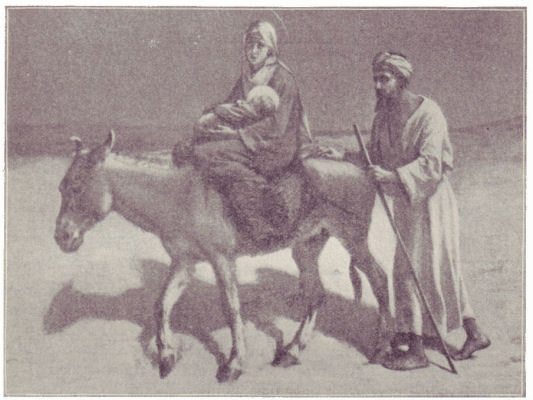 THE FLIGHT INTO EGYPT |
King Herod waited for the wise men to come back to him from their visit to Bethlehem; but he soon found that they had gone to their home without bringing to him any word. Then Herod was very angry. He sent out his soldiers to Bethlehem. They came, and by the cruel king's command they seized all the little children in Bethlehem who were three years old, or younger, and killed them all. What a cry went up to God from the mothers of Bethlehem as their children were torn from their arms and slain! But all this time the child Jesus, whom they were seeking, was safe with his mother in the land of Egypt.
Soon after this King Herod died, a very old man, cruel to the last. Then the angel of the Lord came again and spoke to Joseph in a dream, saying:
"You may now take the young child back to his own land, for the king who sought to kill him is dead."
Then Joseph took his wife and the little child Jesus and started to go again to Bethlehem, the city of David and there bring up the child. But he heard that in that part of the land Archelaus was now ruling, who was a son of Herod, and as wicked and cruel as his father. He feared to go under his rule, and instead took his wife and the child to Nazareth, which had been his own home and that of Mary his wife, before the child was born. Nazareth was in the part of the land called Galilee, which at that time was ruled by another son of King Herod, a king named Herod Antipas. He was not a good man, but was not so cruel nor bloody as his wicked father had been.
So again Joseph, the carpenter, and Mary his wife, were living in Nazareth. And there they stayed for may years while Jesus was growing up. Jesus was not the only child in their house, for other sons and daughters were given to them.
The Boy in His Father's House
Jesus was brought to Nazareth when he was a little child, not more than three years old; there he grew up as a boy and a Youngman; and there he lived until he was thirty years of age. We should like to know many things about his boyhood, but the Bible tells us very little. As Joseph was a workingman, it is likely that he lived in a house with only one room, with no floor except the earth, no window except a hole in the wall, no pictures upon the walls, and neither bedstead, nor cushions; they slept upon rolls of matting; and their meals were taken from a low table, not much larger than a stool.
Jesus may have learned to read at the village school, which was generally held in the house used for worship, called the "synagogue". The lessons were from rolls on which were written parts of the Old Testament; but Jesus never had a Bible of his own. From the time when he was a child he went with Joseph to the worship in the synagogue twice every week. There they sat on the floor, and herd the Old Testament read and explained; while Mary and the younger sisters of Jesus listened from a gallery behind a lattice-screen. The Jewish boys of that time were taught to know almost the whole of the Old Testament by heart.
It was the custom for the Jews from all parts of the land to go up to Jerusalem to worship at least once every year at the feast of the Passover, which was held in the spring. Some families also stayed to the feast of Pentecost, which was fifty days after Passover; and some went again in the fall to the feast of Tabernacles, when for a week all the families slept out of doors under roofs made of green twigs and bushes. (See Stories Twenty-three and Twenty-eight in Part First.) When Jesus was a boy twelve years old he was taken up to the feast of the Passover, and then for the first time he saw the holy city Jerusalem and the Temple of the Lord on Mount Moriah. Young as he was, his soul was stirred as he walked among the courts of the Temple, and saw the altar with its smoking sacrifice, the priests in their white robes, and the Levites with their silver trumpets. Though a boy, Jesus began to feel that he was the son of Gad and that this was his Father's house.
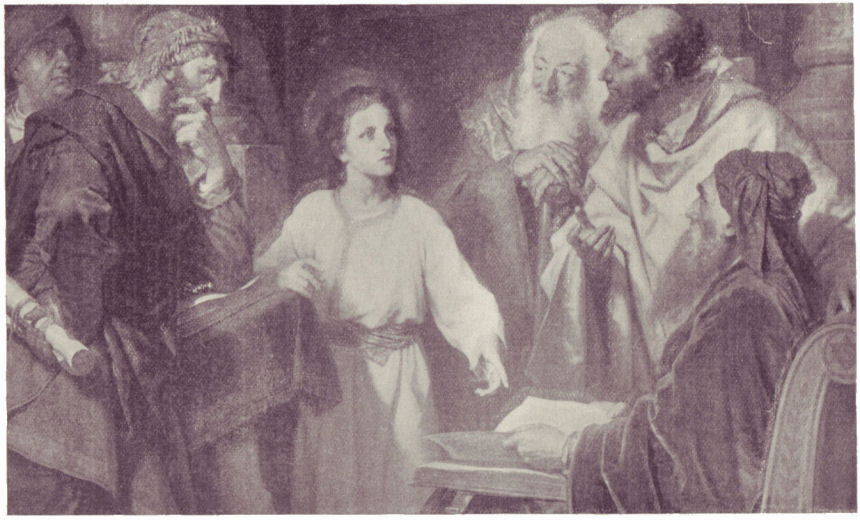 THE BOY IN THE TEMPLE |
His heart was so filled with the worship of the Temple, with the words of the scribes or teachers whom he heard in the courts, and with his own thoughts, that when it was time to go home to Nazareth he stayed behind, held fast by his love for the house of the Lord. The company of people who were traveling together was large, and at first he was not missed. But when night came and the boy Jesus could not be found, his mother was alarmed. The next day Joseph and Mary left their company and hastened back to Jerusalem. They did not at first think to go to the Temple. They sought him among their friends and kindred who were living in the city, but could not find him.
On the third day they went up to the Temple with heavy hearts, still looking for their boy. And there they found him, sitting in a company of teachers of the law, listening to their words and asking them questions. Everybody who stood near was surprised to find how deep was the knowledge of this boy in the work of the Lord.
His mother spoke to him a little sharply, for she felt that her son had not been thoughtful of his duty. She said:
"Child, why have you treated us in this way? Do you not know that your father and I have been looking for you with troubled hearts?"
"Why did you seek for me?" said Jesus. "Did you not know that I must be in my Father's house?"
They did not understand these words, but Mary thought often about them afterward, for she felt that her son was no common child and that his words had a deep meaning. Though Jesus was wise beyond his years, he obeyed Joseph and his mother in all things. He went with them to Nazareth, and lived contented with the plain life of their country home.
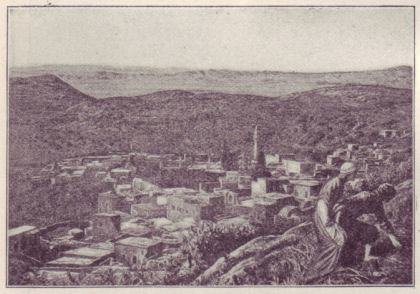 NAZARETH |
As the years went on Jesus grew from a boy to a young man. He grew, too, in knowledge, and in wisdom, and in the favor of God. He won the love of all who knew him, for there was something in his nature that drew all hearts, both young and old.
 JESUS AS A BOY AT THE HOUSE OF HIS FATHER AND MOTHER |
Jesus learned the trade of a carpenter or worker in wood with Joseph; and when Joseph died, while Jesus was still a young man, Jesus as the oldest son, took up the care of his mother and his younger brothers and sisters. And so in the work of the carpenter's shop and the quiet life of a country village, and the worship of the synagogue, the years passed until Jesus was thirty years of age.
The Prophet in the Wilderness
We come now to a time when Jesus, the son of Mary, was a young man about thirty years of age. John, the son of the priest Zacharias, was six months older, but these two young men had never met, for one was in the north at Nazareth, and the other was living in the desert on the south of Judea.
Suddenly the news went through all the land of Israel that a prophet had risen up and was giving to the people the work of the Lord. It was more than four hundred years since God had sent a prophet to his people; and when it was known that again a man was speaking what God had told him, and not what he had learned by studying the old writings, a thrill went through the hearts of all the people. From all parts of the land, out of cities and villages, people poured forth to the wild region beside the river Jordan, where the new prophet was preaching the word of the Lord.
This prophet was John, the son of Zacharias. He lived in the wilderness, where he was alone with God and listened to God's voice. In his looks and dress John was not like other men. His garment was made of rough cloth woven from camel's hair; around his waist was a girdle of skin; and the food which he ate was dried locusts and the wild honey from the trees. And this was his message, "Turn from sin to doing right, for the kingdom of heaven is at hand, and the King is soon to come." The people came to hear his words, and when they asked him, "What shall we do?" John said to them, "He that has two coats, let him give to him that has none; and he that has food, more than he needs, let him give to him that is hungry."
 JOHN THE BAPTIST IN THE WILDERNESS |
The men who gathered the taxes, and were called publicans, asked of John, "Master, what shall we do?" And John answered them, "Do not cheat the people nor rob them, nor take more money than the law tells you to take from them."
And when the soldiers cane to him, he said to them, "Do not harm any one, nor bring false charges against any; and be content twith the wages that are paid to you."
There came to John some people who were called Pharisees. These men made a great show of being good, and of worshipping often and of keeping the law of Moses. But in their hearts they were evil, and their goodness was not real. John said to these men when he saw them, "O ye brood of vipers! Who has told you to escape from the wrath of God that is soon to come? Turn from your sins to God, and do right. And do not say to yourselves, 'Abraham is our father,' for God is able out of these stones to raise up children to Abraham."
When men who heard the words of John wished to give themselves up to serve God and to do his will, John baptized them in the river Jordan, as a sign that their sins were washed away. And because of this he was called "John the Baptist". Some of the people began to ask, "Is not this man the Christ whom God promised long ago to send to rule over the people?"
John heard this, and he said "I baptize you with water, but there is one coming after me who is greater than I. He shall baptize you with the Holy Spirit and with fire. He is so high above me that I am not worthy even to stoop down and untie the strings of his shoes. This mighty one who is coming shall sift out the wheat from the chaff among the people. The wheat he will gather into his garner, but the chaff he will burn up with fire that no man can put out."
Nearly all the people in the land came to hear John in the wilderness, and were baptized by him. Among the last who came was Jesus, the young carpenter from Nazareth. When John saw Jesus something within told John that here was one greater and holier than himself. He said to Jesus, "I have need to be baptized by thee, and comest thou to me?"
Jesus answered him, "Let it be so now, for it is fitting that I should do all things that are right."
Then John baptized Jesus, as he had baptized others. And as Jesus came up out of the water, and was praying, John saw above the head of Jesus the heavens opening, and the Holy Spirit coming down like a dove and lighting upon him. And John heard from heaven a voice saying:
"This is my beloved Son, in whom I am well pleased."
And then John knew and told to others that this was the Son of God, the Christ whom God had promised to send to the people.
Jesus in the Desert, and beside the River
From the earliest years of Jesus the Holy Spirit of God was with him, growing as he grew. And in the hour when he was baptized and the form of a dove was seen hovering over him, Jesus was filled with the Holy Spirit as no man before him had been filled, for he was the son of God. At that hour he knew more fully than he had ever known before that work that he should do to save men. The Spirit of God sent Jesus into the desert, there to be for a time alone with God and to plan out his work for men.
So earnest was the thought of Jesus in the desert, so full was his union with God, that for forty days he never once ate anything, of felt any wish for food. But when the forty days were ended, then suddenly hunger came upon him, and he felt faint and starving, as any other man would feel who had fasted for so long a time.
At that moment Satan, the evil spirit, came to Jesus as he comes to us and put a thought into his mind. It was this thought:
"If you are the Son of God, you can do whatever you please, and can have whatever you wish. Why do you not command that these stones be turned into loaves of bread for you to eat?"
Jesus knew that he could do this, but he knew also that this power had been given to him, not for himself, but that he might help others. He said to the evil spirit, "It is written in God's book 'Man shall not live by bread alone, but by every word that cometh out of the mouth of God."
Then the evil spirit led Jesus to Jerusalem, the holy city, and brought him to the top of a high tower on the Temple, and said to him, "now show all the people that you are the Son of God by throwing yourself down to the ground. You know that it is written in the book of Psalms, 'He shall give his angels charge over thee; and in their hands they shall bear thee up, lest at any time thou dash they foot against a stone.' "
But Jesus knew that this would not be right, for it would be done not to please God, but to show himself before men and as a trial of God's power, when God himself had not commanded it. He answered, "It is written again, 'Thou shalt not tempt the Lord the God.' "
Again the evil spirit tried to lead Jesus into doing wrong, as he leads us all. He led him to the top of a high mountain, and caused a vision of all the kingdoms of the world and their glory to stand before the eyes of Jesus. Then he said, "All these shall be yours; you shall be the king of all the earth if you will only fall down and worship me."
The Jesus said to him, "Leave me, Satan, thou evil spirit! For it is written, 'Thou shalt worship the Lord thy God, and him only shalt thou serve.' "
When Satan found that Jesus would not listen to him, he left him; and then the angels of God came to Jesus in the desert and gave to him the food that he needed.
After this victory over the evil spirit, Jesus went again from the desert to the place at the river Jordan where he had been baptized. It was near a city sometimes called Bethabara, a word which means "a place of crossing," because it was one of the places where the river Jordan was so shallow that the people could walk across it. The city was called also "Bethany beyond Jordan," so that it would not be mistaken for another Bethany on the Mount of Olives, very near Jerusalem.
There John the Baptist saw Jesus coming toward him, and he said, "Behold the Lamb of God, who takes away the sin of the world! This is the one of whom I spoke, saying, 'There is One coming after me who is greater than I.' This is the Son of God."
And again, the next morning, John the Baptist was standing with two young men, his followers. They were fishermen who had come from the sea of Galilee to hear him. One was named Andrew, and the other John. John the Baptist saw Jesus walking near by, and he said again, "Behold the Lamb of God!"
When the two young men heard this they left John and went to speak with Jesus, although they had not known him before. Jesus saw that they were following him, and he said "What is it that you wish from me?"
They said to him, "Master, we would like to know where you are staying, so that we can see you and talk with you."
Jesus said to them, "Come and see."
They went with Jesus and saw where he was staying, and stayed and talked with him, and listened to his words all the rest of that day, for it was about ten o'clock in the morning when they first saw Jesus. And these two young men wert away from the meeting with Jesus, believing that Jesus was the Saviour and the King of Israel. These two, Andrew and John, were the first two men, after John the Baptist, to believe in Jesus.
 JESUS TEACHING BY THE SEA OF GALILEE |
Each of these two men had a brother whom he wished might know Jesus. Andrew's brother was named Simon, and John's brother was named James. These four men were all fishermen together upon the sea of Galilee. Andrew found his brother first and he said to him, "We have found the Anointed One, the Christ who is to be the King of Israel."
And Andrew brought his brother to meet Jesus. Jesus saw him coming, and without waiting to hear his name, he said, "Your name is Simon, and you are the son of Jonas. But I will give you a new name. You shall be called 'The Rock.' "
The word "rock" in Hebrew, the language the language of the Jews, was "Cephas," and in Greek, the language in which the New Testament was written, it is "Petros," or Peter. So from that time Simon was called Simon Peter, that is, Simon the Rock." So now Jesus had three followers, Andrew, John and Simon Peter. The next day he was going back to Galilee, the part of the land where was his home, he met another man named Philip, who had also come from Galilee. He said to Philip, "Follow me."
And Philip went with Jesus as the fourth of his followers. Philip found a friend, whose name was Nathanael. He came from a place in Gaililee, called Cana. Philip said to Nathanael, "We have found the one of whom Moses wrote in the law, and of whom the prophets spoke, the Anointed Christ. It is Jesus of Nazareth."
Nathanael lived not many miles from Nazareth, and he did not think that such a place as Nazareth could have in it one so great as the Christ, whom the Jews looked for as their king. He said to Philip, rather in scorn, "Can there any good thing come out of Nazareth?"
Philip knew that if Nathanael could only meet Jesus and hear his words he would believe in him, as the others believed. He said to Nathanael, "Come see for yourself."
And he brought Nathanael to Jesus. As soon as Jesus saw him he said, "Here is an Israelite indeed, a man without evil."
Nathanael was surprised at this, and he said to Jesus "Master, how did you know me?"
"Before Philip called you, when you were standing under the fig tree, I saw you," said Jesus.
At this Nathanael wondered all the more, for he saw that Jesus knew what no man could know. He said, "Master, thou art the Son of God! Thou art the King of Israel!"
Jesus said to Nathanael, "Do you believe in me because I tell you that I saw you under the fig tree? You shall see greater things than these. The time shall come when you will see heaven opened, and the angels of God going up and coming down through me, the Son of God."
Jesus had now five followers. These men and others who walked with him, and listened to his words, were called "disciples," a word which means "learners."
 JESUS MAKES PETER AND ANDREW HIS DISCIPLES |
The Water Jars at the Wedding Feast
A few days after Jesus met his first followers or disciples at the river Jordan, he came with these men to a town in Galilee called Cana, to be present at a wedding. In those lands a feast was always held at a wedding and often the friends of those who were married stayed several days, eating and drinking together.
The mother of Jesus was at this wedding as a friend of the family, for Nazareth, where she lived, was quite near to Cana. Before the wedding feast was over all the wine had been used, and there was no more for the guests to drink. The mother of Jesus knew that her son had power to do whatever he chose, and she said to him, "They have no wine."
Jesus said to her, "O woman, what have I to do with thee? My hour is not yet come."
But his mother knew that Jesus would in some way help the people in their need; and she said to the servants who were waiting at the table, "Whatever he tells you to do, be sure to do it."
In the dining hall were standing six large stone jars, each about as large as a barrel, holding twenty-five gallons. These jars held water for washing, as the Jews washed their hands before every meal, and washed their feet as often as they came from walking in the street, since they wore no shoes, but only sandals. Jesus said to the servants, "Fill the water-jars with water."
The servants obeyed Jesus ad filled the jars up to the brim. Then Jesus spoke to them again, and said, "Now draw out some of the water and take it to the ruler of the feast."
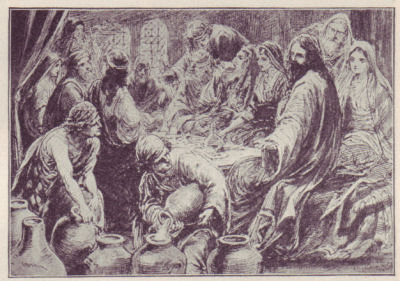 JESUS AT THE WEDDING FEAST |
They drew out water from the jars, and saw that it had been turned into wine. The ruler did not know from what place the wine had come, but he said to the young man who had just been married, the bridegroom, "At a feast everybody gives his best wine at the beginning, and afterward, when his guests have drunk freely, he brings on wine that is not so good; but you have kept the good wine until now."
This was the first time that Jesus used the power that God had given him, to do what no other man could do. Such works as these were called "miracles" and Jesus did them as signs of his power as the Son of God. When the disciples saw this miracle they believed in Jesus more fully than before. After this Jesus went with his mother and his younger brothers to a place called Capernaum, on the shore of the Sea of Galilee. But they stayed there only a few days, for the east of the Passover was near, and Jesus went up to Jerusalem to attend it. You remember that the feast of the Passover was held every year to keep in mind how God had led the people of Israel out of Egypt long before.
When Jesus came to Jerusalem he found in the courts of the Temple men who were selling oxen and sheep and doves for the sacrifices, and other men sitting at tables changing the money of Jews who came from other lands into the money of Judea. All this made the courts around the Temple seem like a market, and not a place for the worship of God.
Jesus picked up some cord, and made from it a little whip. With it he began to drive out of the Temple all the buyers and sellers. He was but on, and they were many; but such power was in his look that they ran before him. He drive the men, and the sheep and the oxen; he overturned the tables, and threw on the floor the money; and to those who were selling the doves he said, "Take these things away; make not my Father's house a house for selling and buying!"
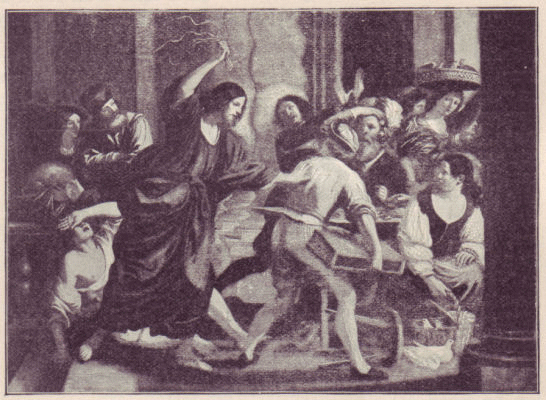 JESUS DRIVES THE BUYERS AND SELLERS FROM THE TEMPLE |
These acts of Jesus were not pleasing to the rulers of the Jews, for many of them were getting rich by this selling of sacrifices and changing of money. Some of the rulers came to Jesus, and said to him, "What right have you to come here and do such things as these? What sign can you show that God has given to you power to rule in this place?"
Jesus said to them, "I will give you a sign. Destroy this house of God, and in three days I will raise it up."
Then said the Jews, "It has taken forty-six years to build this Temple, and it is not finished yet. Will you raise it up in three days?"
But Jesus did not mean the Temple on Mount Moriah. He was speaking of himself; for in him God was dwelling as in a temple and he meant that when they should put him to death, he would rise again in three days. Afterward, when Jesus had died and risen again, his followers, the disciples, thought of what he had said, and understood these words.
While Jesus was in Jerusalem one of the rulers of the Jews, a man named Nicodemus, came to see him. He came in the night, perhaps because he was afraid to be seen coming in the daytime. He said to Jesus, "Master, we know that you are a teacher come from God, for no man can do these wonderful things that you do unless God is with him."
Jesus said to Nicodemus, "I say to you in truth, that unless a man is born anew he cannot see the kingdom of God."
Nicodemus did not know that this meant that to be saved we must have new hearts given to us by the Lord. He said, "Why, how can a man be born twice? How can one be born again after he has grown up?"
Jesus said to him, "I tell you of a truth, that unless a man is born of water and of the Spirit, he cannot enter into the kingdom of God."
By this he meant that we must be baptized by God putting his Spirit in us, if we are to become God's children. Jesus said also "As Moses lifted up the serpent in the wilderness, even so must the Son of Man be lifted up, that every one who believes in him may have everlasting life. For God sent not his son into the world to condemn (that is to judge) the world; but that the world through him might be saved."
We have already read in Story Thirty-two in Part First, how Moses lifted up the brazen serpent in the wilderness, and how that serpent pointed to Christ.
The Stranger at the Well
While Jesus was teaching in Jerusalem and in the country places near it, John the Baptist was still preaching and baptizing. But already the people were leaving John and going to hear Jesus. Some of the followers of John the Baptist were not pleased as they saw that fewer people came to their master, and that the crowds were seeking Jesus. But John said to them, “I told you that I am not the Christ, but that I am sent before him. Jesus is the Christ, the King. He must grow greater, while I must grow less, and I am glad that it is so.”
Soon after this Herod Antipas, the king of the province or land of Galilee, put John in prison. Herod had taken for his wife a woman named Herodias, who had left her husband to live with Herod, which was very wicked. John sent word to Herod that is was not right for him to have this woman as his wife. These words of John made Herodias very angry. She hated John, and tried to kill him. Herod himself did not hate John so greatly, for he knew that John had spoken the truth. But he was weak, and yielded to his wife Herodias. To please her he sent John the Baptist to a lonely prison among the mountains east of the Dead Sea, for the land in that region, as well as Galilee, was under Herod’s rule. There in prison Herod hoped to keep John safe from the hate of his wife Herodias.
Soon after John the Baptist was thrown into prison, Jesus left the country near Jerusalem, with his disciples, and went toward Galilee, the province in the north. Between Judea in the south and Galilee in the north lay the land of Samaria, where the Samaritans lived, who hated the Jews. They worshipped the Lord as the Jews worshipped him, but they had their own temple and their own priests. And they had their own Bible, which was only the five books of Moses, for they would not read the other books of the Old Testament. The Jews and the Samaritans would scarcely ever speak to each other, so great was the hate between them.
When Jews went from Galilee to Jerusalem, or from Jerusalem to Galilee, they would not pass through Samaria, but went down the mountains to the river Jordan, and walked beside the river, in order to go around Samaria. But Jesus, when he would go from Jerusalem to Galilee, walked over the mountains, straight through Samaria. One morning, while he was on his journey, he stopped to rest beside an old well at the foot of Mount Gerizim, not far from the city of Shechem, but nearer to a little village that was called Sychar. This well had been dug by Jacob, the great father or ancestor of the Israelites, many hundreds of years before. It was an old well then in the days of Jesus, and it is much older now, for the same well may be seen in that place still. Even now travelers may have a drink from Jacob’s well, as we read in Story Fourteen in Part First.
It was early in the morning, about sunrise, when Jesus was sitting by Jacob’s well. He was very tired, fro he had walked a long journey; he was hungry, and his disciples had gone to the village near at hand to buy food. He was thirsty, too; and as he looked into the well he could see the water, a hundred feet below, but he had no rope with which to let down a cup or a jar and to draw up some water to drink.
Just at this moment a Samaritan woman came to the well, with her water-jar upon her head, and her rope in her hand. Jesus looked at her, and in one glance read her soul, and saw all her life. He knew that Jews did not often speak to Samaritans, but he said to her, “Please to give me a drink.”
The woman saw from his looks and his dress that he was a Jew; and she said to him, “How is it that you, who are Jew, ask drink of me, a Samaritan woman?”
Jesus answered her, "if you knew what God’s free gift is, and if you knew who it is that says to you, 'Give me a drink,' you would ask him to give you living water, and he would give it to you."
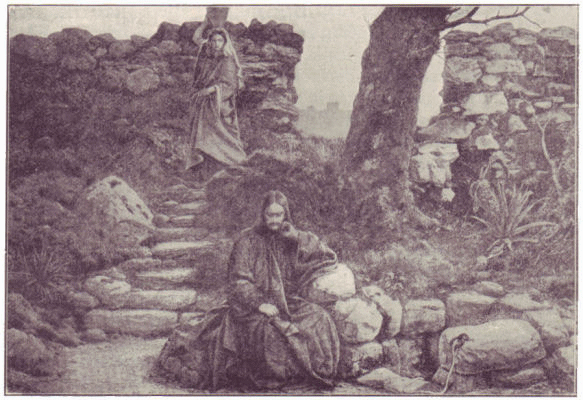 THE WOMAN OF SAMARIA SEES JESUS AT THE WELL |
There was something in the words and the looks of Jesus which made the woman feel that he was not a common man. She said to him, "Sir, you have nothing to draw water with, and the well is deep. Where can you get that living water? Are you greater than our father Jacob, who drank from this well, and who gave it to us?"
"Whoever drinks of this water," said Jesus, "shall thirst again; but whoever drinks of the water that I shall give him shall never thirst; but the water that I shall give him shall be in him a well of water springing up unto everlasting life."
"Sir," said the woman, "give me some of this water of yours, so that I will not thirst any more, nor come all the way to this well."
Jesus looked at the woman, and said to her, "Go home, and bring your husband, and come here."
"I have no husband," answered the woman.
"Yes," said Jesus, "you have spoken the truth. You have no husband. But you have had five husbands, and the man whom you now have is not your husband."
The woman was filled with wonder as she heard this. She saw that here was a man who knew what a stranger could not know. She felt that God had spoken to him, and she said, "Sir, I see that you are a prophet of God. Tell me, whether our people or the Jews are right. Our fathers have worshipped on this mountain. The Jews say that Jerusalem is the place where men should go to worship. Now, which of these is the right place?"
"Woman, believe me," said Jesus, "there is coming a time when men shall worship God in other places besides on this mountain and in Jerusalem The time is near; it has even now come, when the true worshippers everywhere shall pray to God in spirit and in truth; for God himself is a Spirit."
The woman said, "I know that the Anointed One is coming, the Christ. When he comes he will teach us all things."
Jesus said to her, "I that speak to you now am he, the Christ!"
Just at this time the disciples of Jesus came back from the village. They wondered to see Jesus talking with this Samaritan woman, but they said nothing.
The woman had come to draw water, but in her interest in this wonderful stranger she forger her errand. Leaving her water-jar, she ran back to her village, and said to the people, "Come, see a man who told me everything I have done in all my life! Is not this man the Christ whom we are looking for?"
When the woman was gone away, the disciples urged Jesus to eat some of the food which they had brought. A little wile before Jesus had been hungry, but now he had forgotten his own needs of food and drink. He said to them, "I have food to eat that you know nothing of, the food of the soul; and that food is to do the will of God, and to work for him. Do you say to me that there are four months before the harvest? You shall reap, and shall have a rich reward, gathering fruit to everlasting life."
Soon the woman came back to the well with many of her people. They asked Jesus to come to their town, and to stay there and teach them. He went with them, and stayed there two days, teaching the people, who were Samaritans. And many of the people in that placed believed in Jesus, and said, "We have heard for ourselves; now we know that this is indeed the Savior of the world."
The Story of a Boy in Capernaum, and of a Riot in Nazareth
From Sychar, the village near Jacob's well, Jesus went northward into Galilee, to Cana, the place where he had made the water into wine, as we read in Story Seven of this part. The news that Jesus had come back from Jerusalem, and was again in Galilee, went through all that part of the land, and everybody wished to see the prophet who had wrought such wonders.
There was one man living in Capernaum, a town beside the Sea of Galilee, who heard with great joy that Jesus was again at Cana. He was a man of high rank, a nobleman at the court of King Herod; but he was in deep trouble over his son, who was very sick, and in danger of dying. This nobleman went up the mountains in great haste from Capernaum to Cana, to see Jesus. He rode all night, and in the morning, when he found Jesus, he begged him to come down to Capernaum and cure his son. Jesus said to the man, "You people will not believe on me as the Savior, unless you continually see signs and wonders."
"O my lord," said the father, "do come down quickly, or my child will die."
"You may go home," said Jesus, "for your son will live."
The man believed the words of Jesus, and went home, but he did not hurry, nor did he ask Jesus to go with him. The next morning, as he was going down the mountains, his servants met him, and said, "Master, your son is living, and is better."
"At what hour did he begin to grow better?" asked the nobleman.
"It was yesterday, at seven o-clock in the morning, when the fever left him," they answered.
That was the very hour when Jesus had said to him, "Your son will live." And after that the nobleman believed in Jesus, and so did all who were living in his house.
Jesus had come to Galilee to preach to the people, and to tell them of his gospel. He thought that he would begin his preaching in the town of Nazareth, where he had lived so many years, where his brothers and sisters were living still, and where all the people had known hi. He loved the men who had played with him when he and they were boys together, and he longed to give them the first news of his gospel
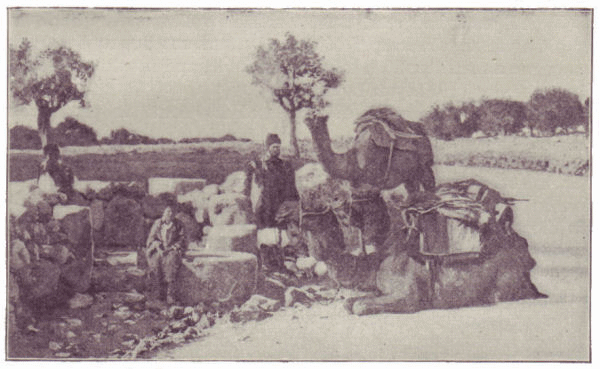 THE WELL OF THE WISE MEN, NEAR BETHLEHEM |
So Jesus went to Nazareth; and, as on the Sabbath-days he had always worshipped in the synagogue, he went to that place once more. He was no longer the carpenter, but the teacher, the prophet, of whom all in the land were talking, and the synagogue was filled with people eager to hear him, and, especially, hoping to see him do some wonderful works. Seated on the floor before him were men who had known him since he was a little boy, and perhaps some of his own sisters were looking down from the gallery behind the lattice-screen.
Jesus stood up, to show that he wished to read from the Scriptures, and the officer who had the care of the books handed him the roll of the prophet Isaiah. Jesus turned to the sixty-first chapter, and from it read:
|
The Spirit of the Lord is upon me, Because he hath anointed me to preach good tidings to the poor. He hath sent me to proclaim freedom to the captives, And recovering of sight to the blind, To set at liberty those that are bruised, To proclaim the year of God's grace to men. |
When Jesus had read these words he rolled up the book and gave it again to the keeper of the rolls, and sat sown; for in the synagogue a man stood up to read the Bible, and sat down to speak to the people. He began by saying:
"This day this word of the Lord has come to pass before you."
And then he showed how he had been sent to preach to the poor, to set the captives free, to give sight to the blind, to comfort those in trouble, and to tell men the news of God's grace. At first the people listened with the deepest interest, and they were touched with the kind and tender words that he spoke.
But soon they began to whisper among themselves. One said, "Why should this carpenter try to teach us?" And another, "This man is not teacher! He is only the son of Joseph! We know his brothers, and his sisters are living here" And some began to say, "Why does he not do here the wonders that they say he has done in other places? We want to see some of his miracles!"
Jesus knew their thoughts, and he said, "I know that you will say to me, 'Let us see a miracle like that on the nobleman's son in Capernaum.' Of a truth, I say to you, 'No prophet has honour among his own people.'
"You remember what is told of Elijah the prophet; when the heavens were shut up, and there was no rain for three years and six months. There were many widows in the land of Israel at that time, but Elijah was not sent by the Lord to any one of them. The Lord sent him out of the land to Zarephath, a town near Zidon, to a widow there; and there he wrought his miracles.
"And in the time of Elisha the prophet, there were many lepers in Israel that Elisha might have cured; but the only leper that Elisha made well was Naaman the Syrian."
All this made the people in the synagogue very angry; for they cared only to see some wonderful work, and not to hear the words of Jesus. They would not listen to him; they leaped up from their seats upon the floor, they laid hold of Jesus, and dragged him out doors. They then took him up to the top of the hill above the city, and they would have thrown him down to his death. But Jesus, by the power of God, slipped quietly out of their hands and went away, for the time for him to die had not yet come.
Very sadly Jesus went away from Nazareth, for he had longed to bring God's blessings to his own people. He walked down the mountains to the city of Capernaum, by the seashore, and there on the Sabboth-days he taught the people n the synagogues.
You can read the story of Elijah the prophet and the woman of Zarephath in Story Three of Part Fourth, and the story of Elisha healing Naaman the Syrian in Story Thirteen of Part Fourth. These were the stories of which Jesus spoke to the people in the synagogue at Nazareth.
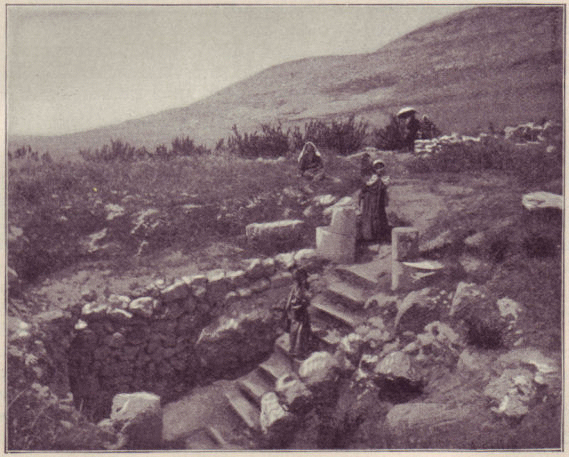 JACOB'S WELL AS IT IS NOW |
A Net Full of Fishes
You remember that when Jesus was by the river Jordan, a few young men came to him as followers or disciples. We have read of these men,—Andrew and John, Peter and Philip, and Nathanael, in Story Six of this Part. While Jesus was teaching near Jerusalem and in Samaria, these men stayed with Jesus; but when he came to Galilee, they went again to their homes and their work, for most of them were fishermen from the Sea of Galilee.
One morning, soon after Jesus came to Capernaum, he went out of the city, by the sea, followed by a great throng of people, who had come together to see him and to hear him. On the shore were lying two fishing boats, one of which belonged to Simon and Andrew, the other to James and John and their father Zebedee. The men themselves were not in the boats, but were washing their nets near by.
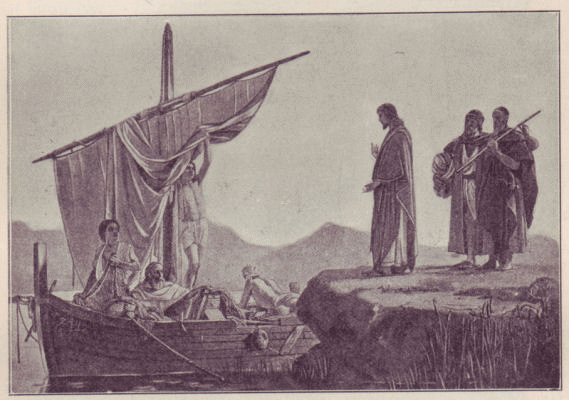 JESUS CALLS JAMES AND JOHN |
Jesus stepped into the boat that belonged to Simon Peter and his brother Andrew, and asked them to push it out a little into the lake, so that he could talk to the people from it without being crowded too closely. They pushed it out; and then Jesus sat in the boat, and spoke to the people as they stood upon the beach. After he had finished speaking to the people, and had sent them away, he said to Simon Peter:
"Put out into the deep water, and let down your nets to catch some fish."
"Master," said Simon, "we have been fishing all night, and have caught nothing; but if it is your will, I will let down the net again."
They did as Jesus bade them; and now the net caught so many fishes, that Simon and Andrew could not pull it up, and it was in danger of breaking. They made signs to the two brothers, James and John, who were in the other boat, for them to come and help them. They came, and lifted the net, and poured out the fish. There were so many of them that both the boats were filled, and began to sink.
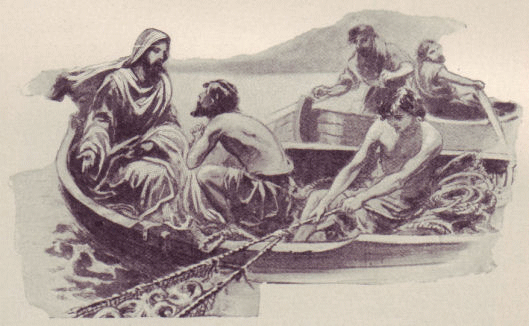 THE NETS WERE FILLED WITH FISHES |
When Simon Peter saw this, he was struck with wonder, and felt that it was by the power of God. He fell down at the feet of Jesus, saying, "O Lord, I am full of sin, and am not worthy of all this! Leave me, O Lord."
But Jesus said to Simon, and to the others, "Fear not; but follow me, and I will make you from this time fishers of men."
From that time these four men, Simon and Andrew, James and John, gave up their nets and their work, and walked with Jesus as his disciples.
On the Sabbath after this Jesus and his disciples went together to the synagogue, and spoke to the people. They listened to him and were surprised at his teaching; for while the scribes always repeated what the other scribes had said before, Jesus never spoke of what the men of old time had taught; but spoke in his own name, and by his own power, saying, "I say unto you," as one who had the right to speak. Men felt that Jesus was speaking to them as the voice of God.
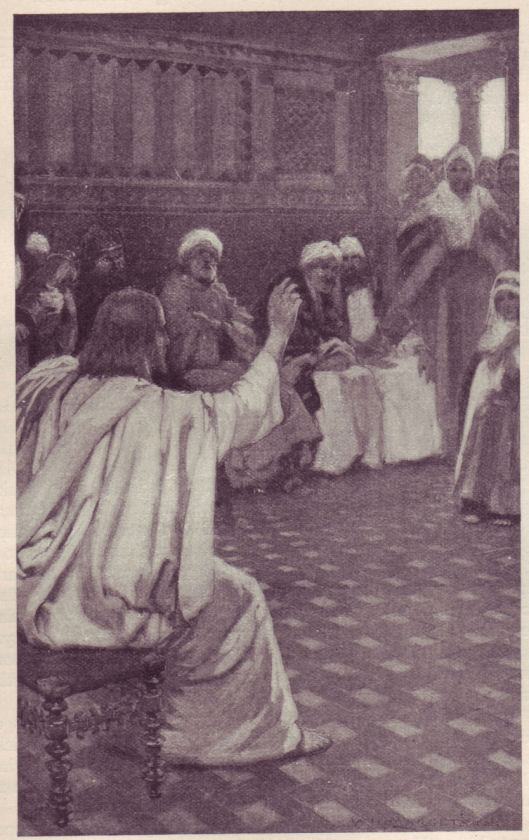 JESUS TEACHING AT NAZARETH |
On one Sabbath, while Jesus was preaching, a man came into the synagogue, who had in him an evil spirit; for sometimes evil spirits came into men, and lived in the, and spoke out from them. The evil spirit in this man cried out, saying:
"Let us alone, thou Jesus of Nazareth! What have we to do with thee? Hast thou come to destroy us? I know thee; and I know who thou art, the Holy One of God!" Then Jesus spoke to the evil spirit in the man, "Be still; and come out of this man!"
Then the evil spirit threw the man down, and seemed as if he would tear him apart, but he came out, and left the man lying on the ground, without harm.
Then wonder fell upon all the people. They were filled with fear, and said, "What mighty word is this? This man speaks even to the evil spirits, and they obey him!"
After the meeting in the synagogue Jesus went into the house where Simon Peter lived. There he saw lying upon a bed the mother of Simon's wife, who was very ill with a burning fever. He stood over her, and touched her hand. At once the fever left her; she rose up from her bed and waited upon them.
At sunset the Sabbath-day was over; and then they brought to Jesus from all parts of the city those that were sick, and some that had evil spirits in them. Jesus laid his hands upon the sick and they became well; he drove out the evil spirits by a word, and would not allow them to speak.
The Leper, and the Man Let Down through the Roof
After the great day of teaching and healing, of which we read in the last story, Jesus lay down to rest in the house of Simon Peter. But very early the next morning, before it was light, he rose up, and went out of the house to a place where he could be alone, and there for a long time he prayed to God. Soon Simon and the other disciples missed him, and sought for him until they found him. They said, "Everybody is looking for you; come back to the city."
But Jesus said, "No, I cannot stay in Capernaum. There are other places where I must preach the kingdom of God, for this is the work to which I am sent."
And Jesus went out through all the towns in that part of Galilee, preaching in the synagogues, and healing all kinds of sickness, and casting out the evil spirits. His disciples were with him, and great crowds followed him from all the land. They came to hear his wonderful words and to see his wonderful works.
While he was on this journey of preaching in Galilee, a leper came to him. You remember, from eh story of Naaman the Syrian (Story thirteen in Part Fourth), what a terrible disease leprosy was, and still is, in those lands, and that no man could cure the leper.
This poor leper fell down before the feet of Jesus, and cried out, "O Lord, if you are willing, I know that you can made me well and clean!" Jesus was full of pity for this poor man. He reached out his hand and touched him, and said, "I am willing; be clean!" And in a moment all the scales of leprosy fell away, his skin became pure, and the leper stood up a well man. Jesus said to him, "Do not tell any one; but go to the priests, and offer the gift that the law commands, and let them see that you have been cured."
Jesus said this because he knew that if the man should tell every one whom he met how he had been cured, such crowds would come to him for healing that he would find no time for preaching the word of God; and preaching God's word, and not healing the sick, was the great work of Jesus.
But this leper who had been healed did not obey the command of Jesus. He could not keep still, and told everybody whom he knew that Jesus, the great prophet, had taken away his leprosy. And it came to pass as Jesus had expected; such great crowds gathered in all the towns and villages to see Jesus, and to ask him to heal their sick, that Jesus could not enter the cities to preach the gospel. He went out to the fields and the open country, and there the people followed him in great throngs
After a time Jesus came again to Capernaum, which was now his home. As soon as the people heard that he was there they came in great crowds to see him and to hear him. They filled the house, and the courtyard inside its walls, and even the streets around it, while Jesus sat in the open court of the house and taught them. It was the spring-time and warm, and a roof had been placed over the court as a shelter from the sun.
In the crowd listening to Jesus were not only his friends, but some that were his enemies, Pharisees, men making a great show of serving God, but wicked in their hearts, and scribes who taught the law, but were jealous of this new teacher, whose words were so far above theirs. These men were watching to find some evil in Jesus, so that they might lead the people away from him.
While Jesus was teaching, and these men were listening, the roof was suddenly taken away above their heads. They looked up, and saw that a man was being let down in a bed by four men on the walls above.
 THE MAN LET DOWN THROUGH THE ROOF |
This man had a sickness called palsy, which made his limbs shake all the time, and kept him helpless, so that he could neither walk nor stand. He was so eager to come to Jesus that these men, finding that they could not carry him through the crowd, had lifted him up to the top of the house, and had opened the roof, and were now letting him down in his bed before Jesus.
This showed that they believed in Jesus, without any doubt whether he could cure this man from his palsy. Jesus said to the man, "My son, be of good cheer; your sins are forgiven!"
The enemies of Jesus who were sitting near heard these words, and they thought in their own minds, though they did not speak it aloud, "What wicked things this man speaks! He claims to forgive sins! Who except God himself has power to say, 'Your sins are forgiven?'"
Jesus knew their thoughts, for he knew all things, and he said, "Why do you think evil in your hearts? Which is the easier to say, 'Your sins are forgiven,' or to say, 'Rise up and walk?' But I will show you that while I am on earth as the Son of man, I have the power to forgive sins."
Then he spoke to the palsied man on his couch before them, "Rise up, take up your bed, and go to your house!"
At once a new life and power came to the palsied man. He stood upon his feet, rolled up the bed on which he had been lying helpless, placed it on his shoulders and walked out through the crowd, which opened to make a way for him. The man went, strong and well, to his own house, praising God as he walked.
By this Jesus had shown that, as the Son of God, he had the right to forgive the sins of men.
These enemies of Jesus could say nothing, but in their hearts they hated him more than ever, for they saw that the people believed on Jesus. They praised the Lord God, and felt fear toward one who could do such mighty works, and they said, "We have seen strange things to-day!"
 JESUS HEARS THE MOTHER'S PRAYER |
The Cripple at the Pool, and the Withered Hand in the Synagogue
While Jesus was living in Capernaum the time for the Passover of the Jews drew near, and Jesus went up to Jerusalem to keep the feast, as he had kept it a year before You remember that at that time he drove out of the Temple the people that were buying and selling. We read this in Story Seven of this Part. The feast which Jesus now kept was the second Passover in the three years while Jesus was preaching
While Jesus was at Jerusalem he saw in the city, not far from the Temple, a pool called Bethesda. Beside this pool were five arches or porches; and in these porches were lying a great crowd of sick and blind, helpless and crippled people. At certain times the water rose and bubbled up in the pool and it was believed that at these times it had power to cure diseases. We know that there are springs of water that will cure many kinds of sickness, and this may have been one of these.
On the Sabbath-day Jesus walked among these poor helpless and suffering people, who were waiting for the water to rise. Jesus looked at one man, and though no one told him, he knew that this man had been a cripple, without power to walk, for almost forty years. He said to this man, "Do you wish to be made well?"
The man did not know who Jesus was. He answered, "Sir, I cannot walk; and I have no man to carry me down to the water when it rises in the pool; but while I am trying to crawl down, others crowd in before me, and the place is full, so that I cannot reach the water and be cured."
Jesus said to the man, "Rise, take up your bed, and walk!"
The cripple had never heard words like these before; but as they were spoken he felt a new power shoot through his limbs. He rose up, took the piece of matting on which he had been lying, rolled it up, and walked away toward his home!
 JESUS HEALS THE CRIPPLE AT THE POOL |
Some one who saw him said, "Stop; this is the Sabbath-day, and it is against the law for you to carry your bed!"
The man did not lay down his load. He only said, "The one who made me well said to me, 'Take up your bed and walk.'"
The Jews said, "Who was this man that told you to carry your bed on the Sabbath-day?"
The man who had been cured did not know who it was that had cured him; for there were many standing near, and Jesus, after healing the man, had walked away without being noticed. But after this Jesus met this man in the Temple, and said to him, "You have been made well; do not sin against God any more, or something worse than disease will come upon you."
The man went away from the Temple, and told the Jews that it was Jesus who had made him well. The Jews were very angry at Jesus because he had cured this man on the Sabbath But Jesus said to them, "My Father works on all days to do good to men, and I work also."
These words made the Jews ready to kill Jesus, not only because, as they said, he had broken the Sabbath, but because he had spoken of God as his Father, as though he were the Song of God. He was indeed the Son of God, although they would not believe it.
After the feast of the Passover Jesus went again to Capernaum in Galilee, beside the lake. One Sabbath-day he was walking with his disciples through the fields of ripe grain; and the disciples, as they walked, picked the heads of grain, rubbed them in their hands, blew away the chaff, and at the kernels of wheat. The law of the Jew allowed any one walking through the fields to eat what he could gather with his hands, though it did not allow him to take any of the grain home. But the Pharisees, whose goodness was all for show, said that it was a breaking of the Sabbath to pick the ears and to rub them in the hands on the Sabbath-day. They said to Jesus, "Do you see how your disciples are doing on the Sabbath what is against the law?"
 JESUS AND HIS DISCIPLES IN THE FIELD OF GRAIN |
Jesus answered them, "Have you never read what David did when he was hungry? He went into the house of God, and took the holy bread from the table, and ate some of it, and gave some to his men, though the law said that only the priest might eat this bread. And do you not know that on the Sabbath-day the priests in the Temple do work, in killing and offering the sacrifices, yet they do no wrong? I say to you that one greater than the Temple is here; for the Son of man is lord of the Sabbath."
Jesus meant them to understand that he was the Son of God, that God lived in him even more fully than he lived in the Temple, and that he spoke as Lord of all.
We have read this, about David and the holy bread in the Tabernacle, of which Jesus spoke to the Jews, in Story Seven of Part Third.
On another Sabbath-day Jesus went to the synagogue. A man was there whose hand was withered The Pharisees watched Jesus, to see whether on the Sabbath-day he would make his hand well. Not that they felt for the poor man; they only wished to find some chance to speak evil against Jesus. Jesus knew all their thoughts, and he spoke to the man, "Rise up, and stand where all can see you!"
The man rose up from the mat where he had been sitting, and stood before all the people Then Jesus looked around upon them sternly, being sad because their hearts were so hard and cruel, and he said, "Is it against the law to do good on the Sabbath-day, or to do evil? To heal a man, or to try to kill a man, as you are doing? If any one of you owns a sheep, and it falls into a pit on the Sabbath-day, will he not take hold of it and lift it out? Is not a man worth more than a sheep? I say unto you that it is right to do good to men on the Sabbath-day."
And then, turning to the man, he said, "Stretch out your hand!"
The man obeyed the word of Jesus, and held out his hand. At once it became strong and well, like his other hand. Many of the people were glad as they saw this; but the Pharisees, who hated Jesus, went out very angry; and they met together to find some plan for putting Jesus to death.
The Twelve Disciples and the Sermon on the Mount
Among the Jews there was one class of men hated and despised by the people more than any other. That was "the publicans." These were the men who took from the people the tax which the Roman rulers had laid upon the land. Many of these publicans were selfish, grasping, and cruel. They robbed the people, taking more than was right. Some of them were honest men, dealing fairly, and taking no more for the tax than was needful; but because so many were wicked, all the publicans were hated alike; and they were called "sinners" by the people.
One day, when Jesus was going out of Capernaum to the seaside, followed by a great crowd of people, he passed a publican or tax-gatherer, who was seated at his table taking money from the people who came to pay their taxes. This man was named Matthew or Levi, for many Jews had two names. Jesus could look into the hearts of men, and he saw that Matthew was one who might help him as one of his disciples. He looked upon Matthew, and said, "Follow me!"
 JESUS CALLS MATTHEW |
At once the publican rose up from his table, and left it to go with Jesus. All the people wondered as they saw one of the hated publicans among the disciples, with Peter, and John, and the rest. But Jesus knew that Matthew would long afterward do a work that would bless the world forever. It was this same Matthew the publican, who many years after this wrote "The Gospel according to Matthew," the book which tells us so much about Jesus, and more than any other book gives us the words that Jesus spoke to the people. Jesus chose Matthew, knowing that he would write this book. A little while after Jesus called him Matthew made a great feast for Jesus at his house; and to the feast he invited many publicans, and others whom the Jews called sinners. The Pharisees saw Jesus sitting among these people, and they said with scorn to his disciples, "Why does your Master sit at the table with publicans and sinners?"
Jesus heard of what these men had said, and he said, "Those that are well do not need a doctor to cure them, but those that are sick do need one. I go to these people because they know that they are sinners and need to be saved. I came not to call those who think themselves to be good, but those who wish to be made better"
One evening Jesus went alone to a mountain not far from Capernaum. A crowd of people and his disciples followed him; but Jesus left them all, and went up to the top of the mountain, where he could be alone. There he stayed all night, praying to God, his Father and our Father. In the morning, out of all his followers, he chose twelve men who should walk with him, and listen to his words, so that they might be able to teach others in turn. Some of these men he had called before; but now he called them again, and others with them. They were called "The Twelve," or "the disciples;" and after Jesus went to heaven they were called "The Apostles," a word which means "those who were sent out," because Jesus sent them out to preach the gospel to the world.
The names of the twelve disciples, or apostles were these: Simon Peter, and his brother Andrew; James and John, the two sons of Zebedee; Philip of Bethsaida, and Nathanael, who was also called Bartholomew, a name which means "the son of Tholmai;" Thomas, who was also called Didymus, a name which means "a twin," and Matthew, the publican or tax-gatherer; another James, the son of Alphaeus, who was called "James the Less," to keep his name apart from the first James, the brother of John, and Lebbeus, who was also called Thaddeus Lebbeus was called also Judas, but he was a different man from another Judas, whose name is always given last. The eleventh name was another Simon, who was called "the Cananaen" or "Simon Zelotes;" and the last name was Judas Iscariot, who was afterward the traitor. We know very little about most of these men, but some of them in later days did a great work. Simon Peter was a leader among them, and John, long after those times, when he was a very old man, wrote one of the most wonderful books in all the world, "The Gospel according to John," the fourth among the gospels.
In the sight of all the people who had come to hear Jesus, Jesus called these twelve men to stand by his side. Then, on the mountain, he preached to these disciples and to the great company of people. Jesus sat down, the disciples stood beside him, and the great crowd of people stood in front, while Jesus spoke. What he said on that day is called "The Sermon on the Mount." Matthew wrote it down, and you can read it in his gospel, in the fifth, sixth, and seventh chapters Jesus began with these words to his disciples:
Blessed are the poor in spirit: for theirs is the kingdom of heaven.
Blessed are they that mourn: for they shall be comforted.
Blessed are the meek: for they shall inherit the earth.
Blessed are they which do hunger and thirst after righteousness: for they shall be filled
Blessed are the merciful: for they shall obtain mercy.
Blessed are the pure in heart: for they shall see God.
Blessed are the peacemakers: for they shall be called the children of God.
Blessed are they which are persecuted for righteousness sake: for theirs in the kingdom of heaven.
Blessed are ye when men shall revile you, and persecute you, and shall say all manner of evil against you falsely, for my sake.
Rejoice, and be exceeding glad; for great is your reward in heaven: for so persecuted they the prophets which were before you.
Ye are the salt of the earth: but if the salt have lost his savor, wherewith shall it be salted? It is thenceforth good or nothing, but to be cast out, and to be trodden under foot of men.
Ye are the light of the world. A city that is set on a hill cannot be hid.
Neither do men light a candle, and put it under a bushel, but on a candlestick; and it giveth light unto all that are in the house.
Let your light so shine before me, that they may see your good works, and glorify your Father which is in heaven.
Here are some more of the words of Jesus in this sermon:
I say unto you, Do not be anxious for your life what ye shall eat, or what ye shall drink; nor yet for your body, what ye shall put on you. Is not the life more than meat, and the body than raiment?
Behold the birds of the air: for they sow not, neither do they reap, nor gather into barns; yet our heavenly Father feedeth them. Are ye not much better than they?
Which of you, by taking thought, can add one cubit unto his stature?
And why take ye thought for raiment? Consider the lilies of the field, how they grow: they toil not, neither do they spin;
And yet I say unto you, That even Solomon in all his glory was not arrayed like one of these.
Wherefore, if God so clothe the grass of the field, which to-day is, and to-morrow is cast into the oven, shall he not much more clothe you, O ye of little faith?
Therefore take no thought, saying, What shall we eat? Or, What shall we drink? Or, Wherewithal shall we be clothed?
(For after all these things do the Gentiles seek? for your heavenly Father knoweth that ye have need of all these things.
But seek ye first the kingdom of God, and his righteousness; and all these things shall be added unto you.
Take therefore no anxious thought for the morrow: for the morrow shall take thought for the things of itself. Sufficient unto the day is the evil thereof.
This is what Jesus said about prayer to our heavenly Father:
Ask, and it shall be given you: seek, and ye shall find: knock, and it shall be opened unto you:
For every one that asketh receiveth: and he that seeketh findeth: and to him that knocketh it shall be opened.
Or what man is there of you, whom if his son ask bread, will he give him a stone?
Or if he ask a fish, will he give him a serpent?
If ye then, being evil, know how to give good fits unto your children, how much more shall your Father which is in heaven give good things to them that ask him!
Therefore all things whatsoever ye would that men should do to you, do ye even so to them: for this is the Law and the Prophets.
And this was the end of the sermon:
Therefore, whosoever heareth these sayings of mine, and doeth them, I will liken him unto a wise man, which built his house upon a rock:
And the rain descended, and the floods came, and the winds blew, and beat upon that house: and it fell not: for it was founded upon a rock.
And every one that heareth these sayings of mine, and doeth them not, shall be likened unto a foolish man, which built his house upon the sand:
And the rain descended, and the floods came, and the winds blew, and beat upon that house; and it fell: and great was the fall of it.
The Captain's Servant, the Widow's Son, and the Woman Who Was a Sinner
There was at Capernaum an officer of the Roman army, a man who had under him a company of a hundred men. They called him "a centurion," a word which means "having a hundred," but we should call him "a captain." This man was not a Jew, but was what the Jews called "a Gentile," a "a foreigner," a name which the Jews gave to all people outside of their own race. All the world, except the Jews themselves, were Gentiles.
This Roman centurion was a good man, and he loved the Jews, because through them he had heard of God, and had learned how to worship God. Out of his love for the Jews he had built for them, with his own money, a synagogue, which may have been the very synagogue in which Jesus taught on the Sabbath-days.
The centurion had a young servant, a boy, whom he loved greatly; and this boy was very sick with a palsy, and near to death. The centurion had heard that Jesus could cure those who were sick; and he asked the chief men of the synagogue, who were called it "elders," to go to Jesus, and ask him to come and cure his young servant.
The elders spoke to Jesus just as he came again to Capernaum, after the Sermon on the Mount They asked Jesus to go with them to the centurion's house; and they said, "He is a worthy man, and it is fitting that you should help him, for though a Gentile, he loves our people, and he has built for us our synagogue"
 A CENTURION COMES TO JESUS |
Then Jesus said, "I will go and heal him."
But while he was on his way, and with him were the elders, and his disciples, and a great crowd of people, who hoped to see the work of healing, the centurion sent some other friends to Jesus with this message:
"Lord, do not take the trouble to come to my house; for I am not worthy that one so high as thou art should come under my roof; and I did not think that I was worthy to go and speak to thee. But speak on a word where you are, and my servant shall be made well. For I also am a man under rule, and I have soldiers under me, and I say to one; 'Go,' and he goes; and to another 'Come,' and he comes; and to my servant, 'Do this,' and he does it. You, too, have power to speak and to be obeyed. Speak the word, and my servant will be cured."
When Jesus heard this he wondered at this man's faith. He turned to the people following him, and said, "In truth I say to you, I have not found such faith as this in all Israel!"
Then he spoke to the friends of the centurion who had brought word from him:
"go and say to this man, As you have believed in me, so shall it be done to you"
Then those who had been sent went again to the centurion's house, and found that in that very hour his servant had been made perfectly well.
On the day after this, Jesus, with his disciples and many people, went out from Capernaum, and turned southward, and came to a city called Nain. Just as Jesus and his disciples came near to the gate of the city they were met by a company who were carrying out the body of a dead man to be buried. He was a young man, and the only son of his mother, and she was a widow. All the people felt sad for this woman who had lost her only son.
When the Lord Jesus saw the mother in her grief, he pitied her, and said, "Do not weep."
He drew near, and touched the frame on which they were carrying the body, wrapped round and round with long strips of linen. The bearers looked with wonder on this stranger, and set down the frame with its body, and stood still. Standing beside the body, Jesus said, "Young man, I say to you, Rise up!"
And in a moment the young man sat up and began to speak. Jesus gave him to his mother, who now saw that her son, who had been dead, was alive again.
A great fear came upon all who had looked upon this wonderful work of Jesus. They praised God, and said, "God had indeed come to his people, and has given us a great prophet!"
And the news that Jesus had raised a dead man to life again went through all the land.
While Jesus was on this journey through southern Galilee, at one place a Pharisee, whose name was Simon, asked Jesus to come and dine at his house. This man did not believe in Jesus, but he wanted to watch him, and, if possible, to find some fault in him. He did not show Jesus the respect due to a guest, did not welcome him, nor did he bring water to wash Jesus' feet, as was done to people when they came in from walking. For in that land they wore no shoes or stockings, but only sandals, covering the soles of their feet; and they often washed their feet when they came into the house.
At meals they did not sit up around the table, but leaned on couches, with their heads toward the table and their feet away from it. While Jesus was leaning in this manner upon his couch at the table, a woman came into the dining room, bringing a flask of ointment, such as was used to anoint people of high rank. She knelt down at the feet of Jesus, weeping, and began to wet his feet with her tears, and then to wipe them with her long hair. She anointed his feet with the ointment, and kissed them over and over again.
 THE WOMAN WASHING THE FEET OF JESUS IN THE HOUSE OF SIMON |
This woman had not been a good woman. She had led a wicked life; but by her act she showed that in her heart she was truly sorry for her sins. When Simon, the Pharisee, saw her at the Saviour's feet he thought within himself, though he did not say it, "If this man were really a prophet coming from God, he would have known how wicked this woman is, and he would not have allowed her to touch him."
Jesus knew this man's thought, and he said, "Simon, I have something to say to you."
And Simon said, "Master, say on."
Then Jesus said, "There was a certain lender of money to whom two men were owing One man owed him five hundred shillings, and the other owed him fifty. When he found that they could not pay their debts, he freely forgave them, and let them both go free. Which of these two will love that man most?"
"Why," said Simon, " I supposed that the one to whom he forgave the most will love him the most."
"You are right," said Jesus. Then he turned toward the woman, and added, "Do you see this woman? I came into your house; you gave me no water for my feet, but she has wetted my feet with her tears, and has wiped them with her hair. You gave me no kiss of welcome, but she has not ceased to kiss my feet You did not anoint my head even with oil, but she has anointed my feet with ointment You have acted as though you owed me little, and you have loved me little; but she feels that she owes me much, and she loves me greatly. I say to you, 'Her sins, which are many, are forgiven.'"
Then he spoke to the woman, "Your sins are forgiven."
Those who were around the table whispered to each other, "Who is this man that dares to act as God, and even to forgive sins?"
But Jesus said to the woman, "Your faith has saved you; go in peace!"
And Jesus went through all that part of Galilee, preaching and teaching in all the villages, telling the people everywhere the good news of the kingdom of God.
Some Stories That Jesus Told By The Sea
After Jesus had journeyed through the southern parts of Galilee, teaching and healing the sick, he came again to Capernaum; and one day went out of the city to a place where the beach rose up gently from the water. There he sat in Simon Peter’s boat, as he had sat before, and spoke to a great crowd of people who stood on the beach.
At this time Jesus began teaching the people by parables; that is, by stories which showed the truths of the gospel. Everybody liked to hear a story; and the story would often lead people to think, and to find out the truth for themselves. The first of these parables or stories that Jesus gave was called "The Parable of the Sower."
"Listen to me," said Jesus. "A sower went out to sow his seed And as he sowed, some seeds fell by the roadside, where the ground was hard, where some of the seed was trodden down, and other seeds were picked up by the birds Some of the seed fell where the soil was think, because rocks went under it. These seeds grew up quickly, but when the sun became hot, they were scorched and dried up, because they did not have enough soil and moisture for their roots. Other seeds fell among briars and thorns, and the thorns kept them from growing. And some seeds fell into good ground, and brought forth fruit, thirty times as many as were sown, sixty times, and even a hundred times. Whoever has ears to hear this, let him hear!" When Jesus was alone with his disciples, they said to him, "Why do you speak to the people in parables? What does this parable about the man sowing his seeds mean?"
 THE SOWER |
And Jesus said to them, "To you it is given to know the deep things of the kingdom of God, because you seek to find them out. But to many these things are spoken in parables, for they hear the story, but do not try to find out what it means. They have eyes, but they do not see; and they have ears; but they do not hear. For they do not wish to understand with the heart, and turn to the Lord and have their sins forgiven them. But blessed are your eyes, for they see, and your ears, for they hear. Listen now to the meaning of the parable of the sower.
"The sower is the one who speaks the word of God; and the seed is the word which he speaks. The seed by the roadside are those who hear; but the evil one comes, and snatches away the truth, so that they forget it. The seed on the rock are those who hear the word with joy, but have no root in themselves, and their goodness lasts only for a little time. That which is sown among the thorns are they who hear, but the cares of the world, and seeking after riches and the enjoyments of this life, crowd out the gospel from their lives, so that it does them but little good. But that which is sown on the good ground are they who take the word into an honest and good heart, and keep it, and bring forth fruit in their lives."
Another parable or story given by Jesus to the people was, "The Parable of the Tares:"
"The kingdom of God is as a man sowing good seed in his field; but while people were asleep, his enemy came and sowed tares, or weeds, among the wheat, and then went away. When the shoots of grain began to have heads of wheat then the tares were seen among them. The servants of the farmer came to him, and said, 'Sir, did you not sow good seed in your field? How did the tares come into it?’
"He said to them, 'An enemy has done this.’
"Shall we go and pick out the tares from among the wheat?’ asked the servants.
" 'No,’ answered the farmer, 'for while you are pulling up the tares, you will root up also the wheat with them. Let both grow together until the harvest; and in the time of the harvest, I will say to the reapers, 'Take out the tares first, and bind them in bundles, to be burned; but gather wheat into my barn.' "
Another parable was that of "The Mustard Seed." He said:
"The kingdom of heaven is like a grain of mustard seed, which a man took and sowed in his field. This is the smallest of all seeds: but it grows up to be a large bush, almost a tree, so that the birds of the air light upon its branches and rest under its shadow."
Another parable was "The Leaven, or Yeast":
"The kingdom of heaven is like a little leaven, or yeast, that a woman mixed with dough when she was making bread. It worked through all the dough and changed it into good, light bread."
These parables Jesus told to the people as he sat in the boat and the people stood on the shore. But he did not tell them what the parables meant, for he wished them to think out the meaning for themselves. After giving the parables he sent the people away, and came back to the house in the city. There is disciples said to him, "Tell us the meaning of the parable of the tares growing in the field."
Jesus said to them, "The one who sows the good seed is the Son of man; the field is the world; the good seed are those who belong to the kingdom of God; but the tares, the weeds, are the children of the evil one; the enemy that sowed them is Satan, the devil; and the reapers are the angels. Just as the tares are gathered and burned in the fire, so shall it be in the end of the world. The Son of man shall send out his angels, and they shall gather out of his kingdom all that do evil and cause harm, and shall cast them into a furnace of fire; there shall be weeping and gnashing of teeth. But the people of God in that day shall shine as the sun in the kingdom of their Father."
And in the house Jesus gave to his disciples some more parables for them to think upon He said:
"The kingdom of heaven is like a merchant who was seeking precious pearls. This man found one pearl of great price. He went and sold all that he had, and bought the pearl.
"Once more: the kingdom of heaven is like a net that was cast into the sea, and took in fish of all kinds. When it was full, they drew the net to the shore Then they sat sown and picked out the good fish from among the bad. The good fish they put away for safe keeping, but the bad fish they threw away. So shall it be at the end of the world. The angels shall come, and shall place the wicked apart from the good, and shall cast them into a furnace of fire; there shall be weeping and gnashing of teeth."
"Peace, Be Still"
When the evening came, after teaching all day by the sea and in the house, Jesus saw that the crowds of people were still pressing around him, and there was no time for him to rest. Jesus said, "Let us go over to the other side of the lake."
So they took Jesus into the boat, and began to row across the Sea of Galilee. Other little boats were with them, for many wished to go with Jesus. While they were rowing, Jesus fell asleep, resting on a cushion of the boat. Suddenly a storm arose, and drove great waves of water into the boat, so that it was in danger of sinking, but Jesus slept on. The disciples awoke him, saying, "Master, Master, we are lost! Help us, or we shall perish!"
 JESUS ASLEEP IN THE BOAT |
Jesus awaked, and rose up, and looked out upon the sea. He said to the waves, "Peace, be still!"
And at once the wind ceased, the waves were quiet, and there was a great calm. Jesus said to his disciples, "Why are you afraid? How is it that you have so little faith in me?"
They all wondered at Jesus' power, and said to each other, "Who is this man whom even the winds and the sea obey?"
They came to the land on the eastern side of the lake, which was sometimes called "the country of the Gadarenes," from the people who lived in the large city of Gardara, which was not far away, and sometimes "Decapolis." As they were landing a man came running down to meet them. He was one of those poor men in whose body evil spirits were living. He would not stay in any house, but slept in the graveyard among the dead. Nor did he wear any clothes. They had often chained him, but he had broken loose from his chains, and no one was able to bind him.
When this man saw Jesus afar off he ran towards him, and fell down on his face before him. Jesus saw what was the trouble with this man, and he spoke to the evil spirit in him, "Come out of this man, vile spirit of evil!"
The spirit within the man cried with a loud voice, "What have I to do with thee, Jesus, thou Son of the Most High God? I call upon thee in the name of the Lord, do not make me to suffer!"
Jesus saw that this man was troubled more even than most men who had evil spirits in them. He said to the evil one, "What is your name?"
And the spirit said, "My name is Legion, because there are many of us." "A legion" was a name give to an army; and in this man was a whole army of evil spirits. There was on the mountain side a great drove of hogs feeding. The Jews were not allowed to keep hogs, nor to eat their flesh; and the evil spirits said to Jesus, "If we must leave this man, will you let us go into the drove of hogs?"
Jesus gave them leave; and the evil spirits went out of the man, and went into the hogs. The whole drove, two thousand in number, became at once wild. They rushed down a steep place on the mountain, and into the sea, and were all drowned.
The men who kept the hogs ran into the city near by, and told all the people how the man had been made well, and what had come to the drove of hogs, how they had been drowned. They saw the man who had been filled with evil spirits, now sitting at the feet of Jesus, no longer naked, but clothed, and in his right mind. But they did not think of what Jesus had done to this man; they thought only of the hogs that they had lost; and they begged Jesus to go away from their land.
Jesus turned away from these people, and went again to the boat on the shore; and then the man who had been set free from the evil spirits pleaded with Jesus that he might go with him. But Jesus would not take him into the boat. He sadi:
"Go home to your friends, and tell them how the Lord has had mercy on you, and has done great things for you."
The man went home and told all the people in the land of Decapolis the great things that Jesus had done for him.
And Jesus went on board the boat, and crossed over the lake, and came again to his own city of Capernaum.
The Little Girl Who Was Raised to Life
When Jesus and his disciples landed at Capernaum, after their sail across the lake, they found a crowd of people on the shore waiting for them. And a man came forward from the throng and fell down at the feet of Jesus. He was one of the chief men in the synagogue, and his name was Jairus. He said:
"O Master, come to my house at once! My little daughter is dying; but if you will come and lay your hands upon her, she will live."
And Jesus went with Jairus, and his disciples followed him, and also many people, who thronged around Jesus. In the crowd was a poor woman who had been ill for very many years from a sore out of which her blood ran, so that she was very weak. Many doctors had tried to help her, but they could not; and she had spent all her money, so that she was now very poor.
This woman had heard of Jesus; and she tried to come to him, but she could not reach him in the throng of people. She said to herself, "If I can only touch his garment, I know that the touch will make me well." And as Jesus passed by, she reached out her hand and touched the hem of his robe. At that instant she felt in her body that she was cured. Jesus himself felt her touch, and turning around, said, "Who touched me?"
 THE WOMAN TOUCHING THE HEM OF JESUS' ROBE |
Peter said to him, "Master, the crowd throngs around you and pressed upon you. How can you ask, 'Who touched me?' "
But Jesus said, "Some one has touched me; for I feel that power has gone out from me."
And he looked around to see who it was. Then the woman came forward, fearing and trembling over what she had done. She fell down before Jesus, and told how she had touched him and had been made well. But Jesus said to her, "Daughter, be of good comfort; your faith has made you well; rise up and go in peace."
And from that hour the woman was free from her disease. All this time, while Jesus was waiting, Jairus, the father of the drying child, stood beside Jesus in great trouble, for he feared that his child would die before Jesus could come to his house. And at that moment some one came to him and said, "It is too late; your daughter is dead; you need not trouble the Master any more."
But Jesus said to him, "Do not be afraid; only believe, and she will yet be saved to you."
Soon they came to the house where Jairus lived; and they could hear the people weeping and crying aloud. Jesus said to them, "Why do you make such a noise? The little girl is not dead, but only asleep."
Jesus meant by this that we need not be filled with sorrow when our friends die, for death is only a sleep for a time until God shall awake them. But they did not understand this; and they would not be comforted, for they knew that the child was dead.
Jesus would not allow any of the crowd of people to go into the room where the dead child was. He took with him three of his disciples, Peter, James, and John, and the father and mother of the child, and shut out all the rest of the people. On a couch was lying the dead body of a girl, twelve years old. Taking the hand of the child into his own, he said to her, "Little girl, rise up!"
 JESUS RAISING JAIRUS' DAUGHTER TO LIFE |
And the life of the little girl came again. She opened her eyes, and sat up. Jesus told them to give her something to eat; and he said to them, "Do not tell any one how the little girl was brought to life."
Already the crowds following him were so great that he could not teach the people in the city; and if it became known that he could raise the dead to life, the throng and the press of the multitudes would be greater. His great work was to teach and to bring life to the souls of men, rather than to heal, or to raise the dead.
And he went out once more among the villages of Galilee, teaching in the synagogues, and healing the sick people who were brought to him. He pitied the people, because there was no one to give them the gospel; and they were like sheep wandering and lost without a shepherd. He said to his disciples:
"The harvest truly is great, but the workers to gather the harvest are few. Pray to the Lord of the harvest, that he may send out reapers into these harvest-fields."
 JESUS HEALING THE SICK |
And after this Jesus sent out his twelve disciples to different places to preach in his name to the people. He sent them forth in pairs, two of them together, so that they could help each other. And he gave them power to heal the sick, and to cast out evil spirits from men. He said to them:
"Go to the lost sheep of the house of Israel; and as you go, preach, saying, 'The kingdom of heaven is at hand.' Heal the sick, cleanse the lepers, raise the dead, cast out the evil spirits; freely you have received, freely give. Do not take any money with you; but at every place ask for some good man, and stay at his house.
"And if any people will not listen to your words, when you go out of that house or out of that city, shake off the dust from your sandals, as a sign; and God will judge that house or that city.
"He that hears you, hears me; and he that hears me, hears him who sent me. And if any one will give to drink to one of these little ones a cup of cold water only in the name of a disciples, he shall not lose his reward."
The twelve disciples went out in pairs, as Jesus had commanded them, and preached in all the cities of Galilee, that men should cease from their sins and turn to God.
A Dancing Girl, and What Was Given Her
You remember that just before Jesus went from Jerusalem to Galilee, as we read in Story Eight of this Part, John the Baptist was put in prison by the king, Herod Antipas. Jesus stayed in Galilee for a year, and nearly all that time John the Baptist was alone in his prison near the Dead Sea. His followers, who were now very few, came to see him, and told him of the works that Jesus was doing. These were wonderful, but they were not what John had expected Jesus to do; and in his prison, with no one to explain what Jesus was saying and doing, John began to doubt a little whether Jesus were the Saviour who had been promised so long. Then, too, John's followers were inclined to feel jealous, because their master was now left alone, and all the people were seeking Jesus. John sent two of his followers to Jesus, to ask him this question, "Are you really the Saviour who is to come, or are we to look for some other as the promised Christ?"
When these men came with this message from John the Baptist they found Jesus in the midst of a great company of suffering people. They saw him making the sick well by his touch, giving sight to the blind, and casting out the evil spirits; and they listened to the words of Jesus as he taught the people.
When his work for the time was done, Jesus turned to the men who had come from John, and said to them, "Go and tell John what you have seen and heard, how the blind see, the lame walk, the lepers are made clean, the deaf hear, the dead are raised to life, and the poor have good news preached to them. And blessed is that man who believes in me without doubting."
After these men had gone to bear the words of Jesus to John, Jesus spoke to the people about John the Baptist. He said:
"What was it that you went out into the wilderness to see? Was it a reed shaken by the wind? Was it a man dressed in rich robes? Those who are clad in splendid garments, and sit at feasts, are in the houses of kings. Who was the man whom you went out to see? Was he a prophet of God? I tell you that he was a prophet, and more than a prophet; for he was the one who came to make men ready for the coming of the king. And I say to you, that among those who are born on the earth, there has never arisen a greater man than John the Baptist. Yet he who is the least in the kingdom of God is greater than John; for he can see with his own eyes, what John can only hear of from others, the works of the gospel."
All the common people who heard this were glad, for they believed that John was a prophet, and they had been baptized by him. But the Pharisees and the rulers were not pleased, because they had refused to listen to John the Baptist or to be baptized by him.
Not long after this the end came to the noble life of John the Baptist. A great feast was held on King Herod's birthday, and all the princes and nobles of his kingdom were in the palace, eating and drinking together. While they were making merry, the young daughter of the woman Herodias, who lived with Herod as his wife, came into the supper-room and danced before the guests. Herod was so greatly pleased with her dancing that he said to her, "Ask whatever you please, and I will give it to you."
He swore a solemn oath that he would give her whatever she might ask, even to the half of his kingdom. The girl went to her mother, and said to her, "Tell me, what shall I ask?"
Her mother told her what to ask, and she came back with haste to the king, and said, "I will ask that you give me here upon a plate the head of John the Baptist!"
The king was very sorry that he had made the promise, but he was ashamed to break his word in the presence of his princes. He sent a man to the prison, with orders that the head of John the Baptist should be cut off and brought. It was done; and the young girl took it upon a plate, and gave it to her mother Herodias.
So, as Herod's father, thirty years before, had caused all the little children of Bethlehem to be killed, as we read in Story Three of this Part, this King Herod, the son, caused John the Baptist, one of the best of men and a great prophet, to be put to death.
The followers of John the Baptist went to the prison, and took away his body and buried it; and then they went and told Jesus of all that had been done. After this they were among the followers of Jesus.
Herod the king heard of what Jesus was doing, the sick healed, the blind made to see, and the dead raised to life. Everybody by this time was talking of Jesus and wondering who he was. Some said, "This is the prophet Elijah come again to earth."
Others said, "If he is not Elijah, he is surely one of the prophets of the old time who has come to life."
But Herod said, "I know who this is. It is John the Baptist, whom I killed! He has come back to life, and by him all these great works are wrought!"
And Herod was in great alarm, for he was afraid of the man whom he had slain.
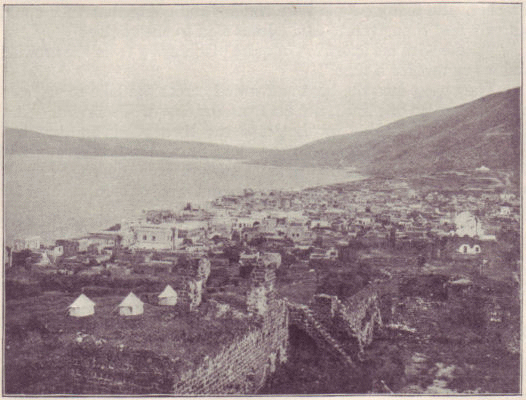 TIBERIAS, ON THE SEA OF GALILEE, WHERE HEROD LIVED |
The Feast Beside the Sea, and What Followed It
When the twelve disciples came back to Jesus, after preaching in his name among the villages of Galilee, they told him of all that they had done, and of what they had said to the people. The multitudes seeking after Jesus were now greater than ever before, for it was again near the time of the Passover, and very many on their way to Jerusalem turned aside to see and to hear the great Teacher. So many people were coming and going that they could scarcely find time even to eat. Jesus said to the twelve:
"Come with me apart into a quiet place, away from the crowds, and let us rest for a time."
They went into the boat and rowed across the lake to an open place, where no one lived, not far from the city of Bethsaida. But they could not be alone, for the people saw them going, and watched them from the shore, and went on foot around the northern end of the lake, and found them. When Jesus saw how eager the crowds were to hear him, he took pity on them and taught them, and healed such among them as were sick.
As it began to grow toward evening, the disciples said to Jesus, "This is a lonely place, and there is nothing here for such a crowd of people to eat. Send them away before it is too late, and tell them to go to the towns and get food."
But Jesus said to them, "They need not go away. You can give them food to eat."
They said to him, "Shall we go into the town and buy two hundred shillings' worth of bread, so that each one of them may have a little?"
Jesus turned to Philip, one of his disciples, and said to him, "Philip, where shall we find bread, that all these may eat?"
Jesus said this to try Philip's faith, for he himself knew what he would do. Philip looked at the great crowd, full five thousand men, besides women and children, and he said, "Two hundred shillings' worth of bread would not be enough to give to every one even a little piece."
Just then another of the disciples, Andrew, the brother of Peter, said to Jesus, "There is a boy here who has five loaves of barley bread and two little fishes; but what use would they be among so many people?"
Jesus said to the disciples, "Go out among the people, and divide them into companies of fifty and a hundred, and tell them to sit down in order."
So the people all sat down; and upon the green grass, arranged in rows and squares in their garments of different colors, they looked like beds of flowers.
Then Jesus took into his hands the five loaves and the two fishes which the boy had brought. He looked up to heaven, and blessed the food; and broke the loaves and the dried fishes, and gave the pieces to the disciples. They went among the companies of people, and gave to everyone bread and fish, as much as each needed. So they all ate, and had enough.
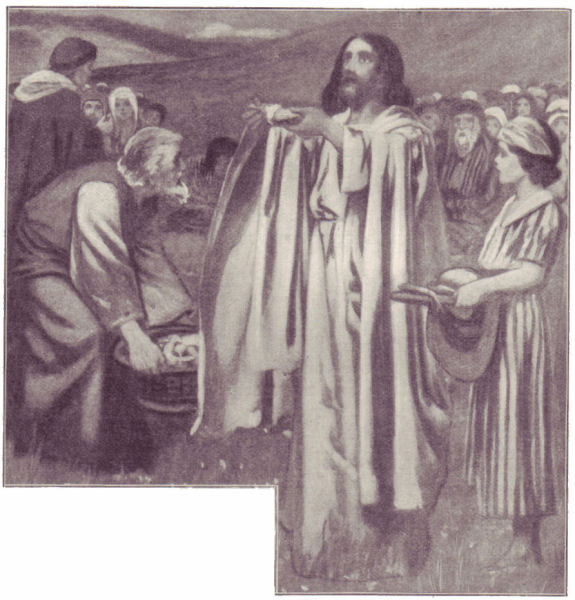 JESUS BLESSES THE FOOD |
Then Jesus said, "Gather up the pieces of food that are left, so that nothing may be lost."
Each of the disciples carried a basket among the people, and when they came to Jesus all the twelve baskets were filled with pieces that were left over of the five loaves and the two fishes.
When the people saw that here was one who could give them food, they were ready at once to make Jesus their king, and to break away from the rule of the Romans. Jesus was a King, but he would not be such as king as they wished. His kingdom was to be in the hearts of men who loved him, not a kingdom set up by the swords of soldiers. He found that his disciples were ready to help the people to make him a king, even against his own will.
So Jesus first compelled his disciples to go on board the boat, though they were not willing to do so, and to row across the lake to Capernaum. Then he sent away the great crowd of people who were still eager that he should be their king. And when all had gone away, and he was left alone, he went up into the mountain to pray. While he was praying in the night a great storm arose upon the lake, and from the mountain Jesus could see his disciples working hard with their oars against the waves, although they could not see him. A little after midnight, when the storm was the highest, Jesus went to his disciples, walking upon the water, just as though the sea was dry land. The men in the boat saw a strange figure coming near them upon the sea, and cried out with fear, for they thought that it must be a spirit. But Jesus called out to them, "Be of good cheer; it is I; be not afraid!" And then they knew that it was their Lord.
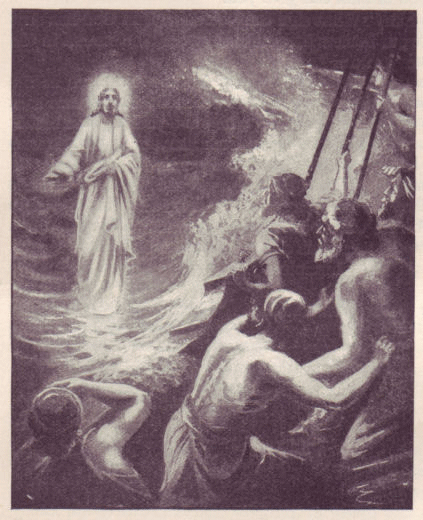 "BE OF GOOD CHEER, IT IS I" |
Peter spoke to Jesus, and said, "Lord, if it be thou, let me come to thee, walking upon the water." And Jesus said to Peter, "Come."
Then Simon Peter leaped overboard from the ship, and he, too, walked on the water to go to Jesus. But when he saw how great was the storm on the sea, he began to be afraid, and forgetting to trust in the word of Jesus, he began to sink. He cried out, "Lord, save me!"
And Jesus reached out his hand, and caught hold of him, and lifted him up, saying, "O man of little faith, why did you doubt my word?"
When Jesus came on board the boat with Peter, at once the wind ceased and the sea was calm. The disciples wondered greatly as they saw the power of Jesus. They fell down before him, and said, "In truth thou art the Son of God!" When they came to the shore, and the daylight arose, they saw that they were at the land of Gennesaret, a plain a little to the south of Capernaum. They went ashore; and as soon as the people saw Jesus, and knew who he was, they brought their sick to him, and begged that they might only touch the border of his garment; and as many as touched him were made well.
Soon after this Jesus came again to Capernaum, and went into the synagogue, which was full of people, some of whom had eaten of the five loaves a few days before. These people wished Jesus to feed them in the same way again, but Jesus said to them, "Seek not for food that passes away, but for the food that gives everlasting life, such as the Son of man can give you."
They said to him, "What sign can you show that God has sent you? Moses gave our fathers bread from heaven, the manna in the desert. What can you do?"
You have read of the manna which fed the Israelites in the wilderness in Story Twenty-four in Part Second. Then Jesus said to them, "It was not Moses, but God, who gave your fathers bread; and God gives you now the true bread from heaven, in his Son who came down from heaven, to give life to the world."
As soon as the people found that Jesus would not work wonders to please them, they turned away from him and left him, although only a few days before they would have made him a king. When Jesus saw that the great crowds of people were with him no longer, Jesus said to his twelve disciples, "Will you also go away and leave me?"
Then Simon Peter answered him, "Lord, to whom else can we go? for thou only hast the words that will give us everlasting life."
The Answer to a Mother's Prayer
After the feeding of the five thousand, and the talk which followed it in the synagogue of Capernaum, Jesus no longer sought to preach to the people in crowds, as he had preached before. He had spoken his last words to the people of Galilee, and now he sought to be alone with his disciples, that he might teach them many things which they needed. Jesus knew that in a few months, less than a year, he would leave his disciples to carry on the work of preaching his gospel to the world. Before that time should come Jesus wished to teach and train his disciples; so he tried to be apart from the people and alone with these twelve men.
With this purpose in his mind, Jesus led his disciples away from Capernaum, across Galilee westward, to the land of Tyre and Sidon, near the Great Sea. On the border of this land he came to a village, and in it went with his disciples into a house. Jesus did not wish the people of the place to know that he was there; but he could not be hid.
A woman of that place, who was not of the Jewish race, but belonged to the old Canaanite people, heard of Jesus' coming. She sought out Jesus, and fell down before him, and begged him to come to her house and cure her daughter, in whom was an evil spirit. At first Jesus would not answer her, for he had not come to that place to do works of healing. But she kept on crying and calling upon Jesus to help her daughter, until the disciples said, "Master, send this woman away, for she is a trouble to us, crying out after us!"
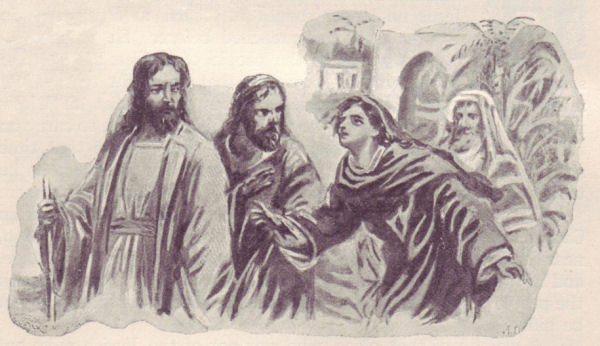 THE GENTILE WOMAN SEEKS JESUS FOR HELP |
They thought that a Gentile woman, one who did not belong to the race of Israel, was not worthy of the Lord's care. But Jesus wished to teach his disciples that he did care for this woman, though she was a Gentile and a stranger. To show them how strong was her faith, he said to her, "I am not sent to the Gentiles, but only to the lost sheep of the house of Israel."
But the woman would not be discouraged; she kept on saying, "Lord, help me!"
Jesus said to her again, "It is not fitting to take the children's bread, and throw it to the dogs!"
Then the woman said, "It is true, Lord; yet the little dogs under the table eat of the children's crumbs!"
And Jesus said to her, "O woman, your faith is great! It shall be done even as you ask. Go your way; the evil spirit is sent out of your daughter."
The woman believed the words that Jesus spoke. She went to her home, and there found her daughter resting upon the bed, freed from the evil spirit.
So many people sought to see Jesus in that place, that he left that land with his disciples, and went around Galilee, and came again to the country called Decapolis, on the east of the Sea of Galilee. You remember that Jesus had visited this country before, when he cast the army of evil spirits out of a man into the hogs, as we read in Story Sixteen of this Part. At that time the people almost drove Jesus away from their land; but now they were glad to see him, and brought their sick to him to be healed. Perhaps they had heard from the man out of whom the evil spirits had gone; how kind and good and helpful Jesus was.
They led to Jesus a man who was deaf, and could not speak plainly. He was what we would call "tongue-tied." They asked Jesus to cure him; but Jesus would not do his work as a sight for men to look upon. He took the man away from the crowd, and when he was alone with him he put his fingers into the man's ears and touched his tongue. Then he looked up to heaven, and gave a sigh, and said to the man, "Be opened!"
Then the man's ears were opened, and his tongue was set free, so that he heard and spoke plainly. Jesus told the man, and those with him, not to let others know what he had done; but they could not keep from telling the good news to everybody. They were full of wonder, for they had not before seen the works of Jesus; and they said, "He has done all things well; he makes even the deaf to hear, and the dumb to speak!"
And in the land of Decapolis, as before in Galilee, great crowds of people came to see and hear Jesus. They followed him, without thinking that they would need any food to eat; and Jesus said to his disciples, "I feel a pity for this people, for they have now been with me three days, and they have nothing to eat. If I send them home hungry, they will faint by the way, for many of them came from far."
The disciples answered him, "How can we find bread for such a great crowd of people, here in a desert place, so far from the villages?"
"How many loaves of bread have you?" asked Jesus. They said, "We have seven loaves and a few small fishes."
Then he told all the people to sit down on the ground. When they were seated, Jesus took the seven loaves and the fishes, and gave thanks to God, and broke them, and gave them to his disciples, and they gave them to the people. Then, as before, he caused them to gather up the food that was left, and they filled seven large baskets with the pieces. At this time four thousand men were fed, besides women and children. And at once after the meal, he sent the people to their homes, and with his disciples went on board a boat, and sailed across the lake to a place on the western shore. There he stayed only a short time, and then sailed northward to Bethsaida, at the head of the lake.
At Bethsaida they brought to him a blind man, and asked him to touch his eyes. But Jesus would not heal the man while a crowd was looking on. He led the man by his hand out of the village alone. Then he spat on the man's eyes, and touched them with his hands, and said to him, "Can you see anything?"
The man looked up, and said, "I see men; but they look like trees walking."
Then again Jesus laid his hands upon the man's eyes. He looked once more, and now could see all things clearly. Jesus sent him to his home, and said to him, "Do not even go into the village, nor tell it to any one in the village."
For Jesus wished not to have crowds of people coming to him, but to be alone with his disciples, for he had many things to teach them.
The Glory of Jesus on the Mountain
From Bethsaida on the Sea of Galilee, Jesus led his disciples still further north to Casearea-philippi, at the foot of the great Mount Hermon. The name of this place means "Philip's Caesarea;" and it was so called because it was under the rule of King Herod Philip, a brother of King Herod Antipas, who ruled in Galilee; and there was another Caesarea on the shore of the Great Sea, south of Mount Carmel. At Caesarea-philipi, Jesus asked his disciples this question, "Who do men say that I, the Son of man, am?" "The Son of man" was the name by which Jesus often spoke of himself.
They answered him:
"Some men say that you are John the Baptist risen from the dead; some say that you are the prophet Elijah, or the prophet Jeremiah, come again to earth."
Then said Jesus, "But who do you say that I am?"
Simon Peter answered for them all, saying:
"Thou art the Anointed One, the Christ, the Son of the living God!"
Jesus said to Peter:
"Simon, this has come to you not from men, but from my Father who is in heaven. You are Peter, the Rock; and on this rock I will build my church, and all the powers of earth shall not overcome it."
For the church of Christ is made of those believe what Peter said, that Jesus is the Christ, the Saviour of the world: and who obey Jesus as their Lord and King.
After this Jesus began to tell his disciples what things were to come upon him before many months. He said:
"We are going up to Jerusalem; and there the people will refuse to own the Son of man; and he shall suffer many wrongs from the rulers, and chief prists; and shall be killed; and on the third day he shall be raised to life."
But the disciples could not believe that such sad things would come to pass with Jesus. They thought that he would reign as a king and that high places in his kingdom would be given to themselves. Peter took Jesus apart from the rest, and said to him:
"Master, do not speak of such things. You will not suffer and die. You shall be a king!"
But Jesus saw that under Peter's words was the evil one, tempting him, and he said to Peter:
"Go from me, Satan, evil one! You would be a stumbling block to me, to make me fall! You are seeking not that which is of God, but that which is of men!"
For Jesus knew that while all men wished him to be a king, ruling over a kingdom on the earth, it was God's will for him to die upon the cross to save the world from sin. Then Jesus called the people to come near with his disciples, and he said to them all:
"If any man will come after me, let him give up his own will, and take up his cross, and follow me. For whoever has a will to save his life here, shall lose it hereafter. And whoever is willing to give up his life for my sake, shall find it again in the life everlasting. What gain will it be to a man to have the whole world, and to lose his own soul? For the Son of man will come in his glory, will all the holy angels, and then he will give to every man according to his acts. And if any man is ashamed to own the Lord now, the Lord will not own him in that day!"
One night, about a week after saying those words, Jesus called three of his disciples, Peter, James, and John, and with them climbed up the side of Mount Hermon. At a high place on mountain, the three disciples lay down to sleep, but Jesus sought his Father in prayer. While Jesus was praying, a great change came over him. His face began to shine as bright as the sun, and his garments became whiter than snow. The three disciples awoke, and saw their Lord with all this glory beaming from him.
 JESUS AND HIS DISCIPLES ON MOUNT HERMON |
And they saw two men talking with Jesus. These were Moses and Elijah, who had come down from heaven to meet Jesus; and they spoke with him of the death that he was to die in Jerusalem. As these men were passing from the sight of the disciples, Peter spoke, scarcely knowing what he was saying, "Master, it is good for us to be here! Let us make here three tabernacles, one for thee, and one for Moses, and one for Elijah!"
While Peter was speaking a bright and glorious cloud came over them all; and the three disciples felt a great fear as they found themselves in the cloud, and no longer able to see their Master. Out of the cloud came the voice of God, saying these words:
"This is my beloved Son, in whom I am well pleased; hear ye him!"
As the disciples heard this voice they fell upon their faces on the ground in great fear. And Jesus came and touched them saying, "Rise up, and do not be afraid."
Then they looked up, and lo, the bright cloud had passed away, the two men were no more in sight, and Jesus was standing alone. They walked together down the mountain; and Jesus said to them very earnestly:
"Do not tell to any man what you have seen, until the Son of man is risen from the dead.
They wondered what this "rising from the dead" could mean; for even yet they could not believe that Jesus would die. But they said nothing to any one, not even to the other disciples, of what they had seen upon the mountain.
When Jesus and the three disciples came down the mountain, they found many people around the other nine disciples. As the people saw Jesus they were filled with wonder, for some of the glory still remained upon his face; and they bowed before him. One man came to Jesus, and said:
"Master, look upon my son, my only child, and have mercy upon him; for he is terrible troubled by an evil spirit. At times he cannot speak, and then he will cry out suddenly. The spirit almost tears him in pieces; and makes him fall into the fire, and into the water. He foams at the mouth; and grinds his teeth, and pines away. And I spoke to your disciples, but they could not cast out the evil spirit."
And Jesus said:
"O ye people without faith, and wandering from God, how long must I be with you? How long must I bear with you? Bring your child to me."
While they were bringing the boy to Jesus, the evil spirit in him threw him down; and seemed to tear him apart; and he lay suffering and rolling on the ground. Jesus said to the boy's father:
"How long is it since this came to him?"
The father said, "Ever since he was a little child; but if you can do anything, have mercy on us and help us!"
"If I can!" said Jesus. "Do you not know that all things are possible to the one that believes in me?"
At once the father of the child cried out, "Lord, I believe! Help my lack of faith!"
Then Jesus spoke to the evil spirit in the boy:
"Dumb and deaf spirit, come out of this child, and never again enter into him!"
Then the spirit gave a cry, and came out, and left the child as one dead on the ground. Indeed, many who looked at him said, "He is dead!"
But Jesus took him by the hand and lifted him up; and the boy stood up well, set free from the evil spirit; and Jesus gave him to his father. And all who saw it wondered at the mighty power of the Lord.
When Jesus was in the house, his disciples asked him, "Why could not we cast out the evil spirit?"
And Jesus said to them, "Because you were wanting in faith. But this kind of evil spiritis can be sent out only through prayer and fasting."
While all were wondering at the great things which Jesus did, he said again to his disciples:
"Let what I say to you sink down into your hearts. The time is coming when the Son of man shall be given into the hands of men; and they shall kill him; and after he is killed, on the third day he shall rise again."
But they could not understand what he meant by these words; and they were afraid to ask him.
The Little Child in the Arms of Jesus
From Caesarea-philippi, in the far north, Jesus went with his disciples through Galilee, but not, as at other times, with a great multitude following him. At this time Jesus wished no one to know of his coming, for he had already preached to this people, and now he sought to be alone with his disciples. They came to Capernaum; and while they were there the officer to whom the Jews paid the tax of half a shekel, or about thirty cents, for each man, said to Peter, "Does not you Master pay the half-shekel?"
Peter said, "Yes." But when Peter came into the house, Jesus said to Peter, "Simon, do the kings of the earth take taxes of their own children, or of strangers?"
Peter said to him, "Of strangers, not of their own children."
And Jesus said, "Then the children of the King should be free from the tax. But that w3e may not cause trouble, do you go to the lake, and cast in a hook, and pull up the first fish that comes; and when you have opened his mouth you shall find in it a piece of money. Take that, and pay it to them for you and for me."
While Jesus was in the house, he said to his disciples, "What was it that you were talking about among yourselves while you were on the way?"
They looked at one another, and said nothing; for on the way they had been disputing as to who of them should have the highest places in their Lord's kingdom. Then Jesus said to him, "If any one among you wises to be first, let him be willing to be the last of all, and to be a servant of all."
And Jesus took a little child in his arms, and held him up before all his disciples, and said to them, "Unless you turn from your ways, and become like little children in spirit, you shall not enter into the kingdom of heaven. Whoever shall be gentle and lowly and willing to be taught, like this little child, he shall be the greatest in the kingdom of heaven. And whoever shall receive one such little child for my sake, he receives me. Take care not to despise one of these little ones; for I say unto you, that in heaven their angels do always look upon the face of my Father who is in heaven. For the Son of man is come to save that which was lost; and it is not the will of your Father who is in heaven that one of these little ones should perish." And Peter said to Jesus, "Lord, how many times should I forgive a brother when he has sinned against me? Till seven times?"
 JESUS TAKES A LITTLE CHILD IN HIS ARMS |
Jesus said to Peter, "I do not say that you should forgive him seven times only, but seventy times seven."
Then Jesus gave to his disciples the parable or story of the Unkind Servant:
"There was once a king who had an account made with his servants of how much money they owed him. One servant was brought before the king; and he owed the king a great sum of money, ten millions of dollars. The man had nothing with which to pay his debt, and the king commanded that the man, and his wife, and his children should be sold as slaves for the debt. Then the servant fell down before the king, and said, 'Be patient with me; give me time, and I will p ay all that I owe!'
"Then the king felt a pity for his servant, set him free, and let him go without any payment, giving him all that he owed.
"But that servant went out and found another servant who owed him a small sum, only ten dollars. He came tot his man, and took hold of him by the throat, and said, 'Pay what you owe me!' The man fell down before him, and said, 'Have patience with me, and I will pay you!' He would not wait for the man to earn the money, but threw the man in prison, to stay there until he should pay the debt. When his fellow-servants heard of what he had done, they were sorry for the poor debtor in prison, and came and told the king all that had been done. Then the king sent for the servant, and said to him, 'You wicked servant, I forgave you all your debt when you asked me to give you time. And you should have had mercy on your fellow-servant, just as I had mercy on you!' And the king was angry against the unkind servant, and sent him to prison, and ordered that he should be made to suffer until he should pay all his debt. So also shall my heavenly Father do to you, if from your hearts you do not forgive your brothers who have sinned against you."
At the Feast of Tabernacles
In the fall of every year there was held at Jerusalem "The Feast of Tabernacles." It was kept to remind the people of the time when the Israelites came out of Egypt and lived for forty years in the wilderness, more than a thousand years before the days when Jesus was on the earth. At this feast the people from all parts of the land came up to Jerusalem, and worshipped in the Temple. And as the Israelites had lived in tents in the wilderness, the people during the feast did not sleep in-doors, but made arbors and huts from green boughs on the roofs of the houses, and on the hills around the city, and slept in them at night.
Jesus and his disciples went from Galilee to Jerusalem to attend this feast. Just as Jesus was leaving, a man who had heard Jesus said to him, "Master, I will follow thee wherever thou goest."
And Jesus said to him, "The foxes have holes, and the birds of the air have nests, but the Son of man has not a place where he can lay his head."
There was another man to whom Jesus had said, "Follow me." This man said, "Lord, let me go and bury my father, who is very old and must die very soon, and then I will follow thee."
Jesus said to him, "Let the dead bury their own dead; but do you go and preach the kingdom of God."
And another said, "Lord, I will follow thee; but let me first go home and say 'good-bye' to those who are in my house."
Jesus said to him, "No man has put his hand to the plow, and looks back, is fit for the kingdom of God."
On his way to Jerusalem Jesus went through the country of Samaria, where the people hated the Jews. In one place the Samaritans would not let Jesus and his disciples come into their village, because they saw that they were Jews going up to Jerusalem. The disciples were very angry at such treatment of their Master; and James and John said to him, "Lord, shall we call down fire from heaven, to destroy this village, as Elijah the prophet did once?"
But Jesus would not allow them to do this to their enemies. He said to them, "Your spirit is not the spirit of my kingdom. The Son of man has not come to destroy men's lives, but to save them."
And they went to another village to find a resting place. At one town they met outside the gate ten men with the dreadful disease of leprosy, of which we read in the story of Naaman (Story Thirteen in Part Fourth). These men had heard of Jesus and his power to heal; and when they saw him they cried out aloud, "Jesus, Master, have mercy on us!"
Jesus said to them, "Go and show yourselves to the priests."
If ever a leper became well, he went to the priest, and offered a sacrifice, and then was allowed to go to his home. These men obeyed the word of Jesus, believing that he would cure them; and as soon as they started to go to the priests they found that they were already well. All but one of the men went on their way, but one turned, and came back to Jesus, and fell at his feet, giving praise to God; and this man was not a Jew, but a Samaritan. Jesus said as he saw him, "Were there not ten cleansed? But where are the nine? Were there none who came back to give glory to God, except this stranger?"
Then he said to the man, "Rise up, and go your way; your faith has saved you."
Jesus came to Jerusalem not on the first day of the feast, but in the middle, for the feast was held for a week. He stood in the Temple, and taught the people, and all wondered at his words. On the last and greatest day of the feast, when they were bringing water and pouring it out in the Temple, Jesus cried aloud, "If any man thirst, let him come to me and drink! He that believes on me, out of him shall flow rivers of living water."
While Jesus was teaching in Jerusalem he often went out of the city to the village of Bethany, on the Mount of Olives. There he stayed with the family of Martha, her sister Mary, and their brother Lazarus. These were friends of Jesus, and he loved to be with them. One day, while Jesus was at the house, Mary sat at the feet of Jesus, listening to his words; but Martha was busy with work, and full of cares. Martha came to Jesus, and said, "Master, do you not care that my sister has left me to do all the work? Tell her to come to help me!"
 JESUS AT THE HOME OF MARY AND MARTHA |
But Jesus said to her, "Martha, Martha, you are anxious and trouble about many things. Only one thing is needful; for Mary has chosen the good part which shall not be taken away from her."
The Man with Clay on His Face
One Sabbath-day, as Jesus and his disciples were walking in Jerusalem, they met a blind man begging. This man in all his life had never seen, for he had been born blind. The disciples said to Jesus, as they were passing him, "Master, whose fault was it that this man was born blind? Was it because he has sinned, or did his parents sin?"
For the Jews thought that when any evil come, it was caused by some one's sin. But Jesus said, "This man was born blind, not because of his parents' sin, nor because of his own; but so that God might show his power in him. We must do God's work while it is day; for the night is coming when no man can word. As long as I am in the world, I am the light of the world."
When Jesus had said this he spat on the ground, and mixed up the spittle with earth, making a little lump of clay. This clay Jesus spread on the eyes of the blind man, and then he said to him, "Go and wash in the pool of Siloam."
The pool of Siloam was a large cistern or reservoir on the southeast of Jerusalem, outside the wall, where the valley of Gihon and the valley of the Kedrom come together. To go to this pool the blind man, with two great blotches of mud on his face, must walk through the streets of the city, out of the gate, and into the valley. He went, and felt his way down the steps into the pool of Siloam. There he washed, and then at once his lifelong blindness passed away, and he could see. When the man came back to the part of the city where he lived, his neighbors could scarcely believe that he was the same man. They said, "Is not this the man who used to sit on the street begging?"
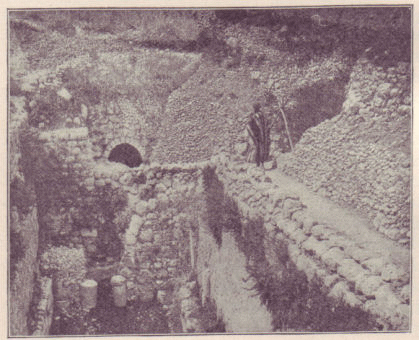 THE POOL OF SILOAM AS SEEN TO-DAY |
"This must be the same man," said some; but others said, "No, it is some one who looks like him."
But the man said, "I am the very same man who was blind!"
"Why, how did this come to pass?" they asked him. "How were your eyes opened?"
"The man called Jesus," he answered, "mixed clay, and put it on my eyes, and said to me, 'Go to the pool of Siloam and wash,' and I went and washed, and then I could see."
"Where is this man?" they asked him.
"I do not know," said the man.
Some of the Pharisees, the men who made a show of always obeying the law, asked the man how he had been made to see. He said to them, as he had said before, "A man put clay on my eyes, and I washed, and my sight came to me."
Some of the Pharisees said, "The man who did this is not a man of God, because he does not keep the Sabbath. He makes clay, and puts it on men's eyes, working on the Sabbath-day. He is a sinner."
Others said, "How can a man who is a sinner do such wonderful works?" And thus the people were divided in what they thought of Jesus. They asked the man who had been blind, "What do you think of this man who has opened your eyes?"
"He is a prophet of God!" said the man.
But the leading Jews would not believe that this man had gained his sight until they had sent for his father and his mother. The Jews asked them, "Is this your son, who you say was born blind? How is it that he can now see?"
His parents were afraid to tell all they knew; for the Jews had agreed that if any man should say that Jesus was the Christ, the Saviour, he should be turned out of the synagogue, and not be allowed to worship any more with the people. So his parents said to the Jews, "We know that this is our son, and we know that he was born blind. But how he was made to see we do not know, or who has opened his eyes we do not know. He is of age; ask him, and let him speak for himself." Then again the rulers of the Jews called the man who had been blind; and they said to him, "Give God the praise for your sight. We know that this man who made clay on the Sabbath-day is a sinner."
"Whether that man is a sinner or not, I do not know," answered the man; "but one thing I do know, that once I was blind, and now I see." They said to him again, "What did this man do to you? How did he open your eyes?"
"I have told you already, and you would not listen," said the man. "Why do you wish to hear it again? Do you intend to believe in him and be his followers?"
This made them very angry, and they said to the man, "You are his follower; but we are followers of Moses. We know that God spoke to Moses; but as for this fellow, we do not even know what place he comes!"
The man said, "Why, that is a very wonderful thing! You who are teachers of the people, do not know who this man is, or from what place he comes; and yet he has had power to open my eyes! We know that God does not hear sinners; but God hears only those who worship him and do his will. Never before has any one opened the eyes of a man born blind. If this man were not from God, he could not do such works as these!"
The rulers of the Jews, these Pharisees, then said to the man, "You were born in sin; and do you try to teach us?"
And they turned him out of the synagogue, and would not let him worship with them. Jesus heard of this; and when Jesus found him he said to him, "Do you believe on the Son of God?"
The man said, "And who is he, Lord, that I may believe on him?" "You have seen him," said Jesus, "and it is he who now talks with you!"
The man said, "Lord, I believe." And he fell down before Jesus and worshipped him.
The Good Shepherd and the Good Samaritan
After the cure of the man born blind, Jesus gave to the people in Jerusalem the parable or story of "The Good Shepherd."
"Verily, verily (that is, "in truth, in truth"), I say to you, if any one does not go into the sheepfold by the door, but climbs up some other way, it is a sign that he is a thief and a robber. But the one who comes in by the doors is a shepherd of the sheep. The porter opens the door to him, and the sheep know him, and listen to his call, for he calls his own sheep by name and leads them out to the pasture-field. And when he has led out his sheep, he goes in front of them, and the sheep follow him, for they know his voice. The sheep will not follow a stranger, for they do not know the stranger's voice."
The people did not understand what all this meant, and as Jesus explained it to them. He said:
"Verily, verily, I say to you, I am the door that leads to the sheepfold. If any one comes to the sheep in any other way than through me and in my name, he is a thief and a robber; but those who are the true sheep will not hear such. I am the door; if any man goes into the fold through me, he shall be saved, and shall go in and go out, and shall find pasture.
"The thief comes to the fold that he may steal, and rob the sheep and kill them; but I come to the fold that they may have life, and may have all that they need. I am the good shepherd; the good shepherd will give up his own life to save his sheep; and I will give up my life that my sheep may be saved.
"I am the good shepherd; and just as a true shepherd knows all the sheep in his flock, so I know my own, and my own know me, even as I know the Father, and the Father knows me; and I lay down my life for the sheep. And other sheep I have, which are not of this fold; them also I must lead, and they shall hear my voice, and there shall be one flock and one shepherd."
 THE GOOD SHEPHERD |
The Jews could not understand these words of Jesus; but they became very angry with him, because he spoke of God as his Father. They took up stones to throw them at him, and tried to seize him, intending to kill him. But Jesus escaped from their hands, and went away to the land beyond Jordan, at the place called Bethabara, or "Bethany beyond Jordan," the same place where he had been baptized by John the Baptist more than two years before, as we read in Story Five of this Part. From this place Jesus wished to go out through the land on the east of the Jordan, a land which was called "Perea," a word that means "beyond." But before going out himself through this land, Jesus sent out seventy chosen men from among his followers to go to all the villages, and to make the people ready for his own coming afterward. He gave to these seventy the same commands that he had given to the twelve disciples, when he sent them through Galilee, of which we read in Story Seventeen, and sent them out in pairs, two men to travel and to preach together. He said:
"I send you forth as lambs among wolves. Carry no purse, no bag for food, no shoes except those that you are wearing. Do not stop to talk with people by the way; but go through the towns and the villages, healing the sick, and preaching to the people, 'The kingdom of God is coming.' He that hears you, hears me; and he that refuses you, refuses me; and he that will not hear me, will not hear him that sent me."
And after a time the seventy men came again to Jesus, saying, "Lord, even the evil spirits obey our words in they name!"
And Jesus said to them, "I saw Satan, the king of the evil spirits, falling down like lightning from heaven. I have given you power to tread upon serpents and scorpions; and nothing shall harm you. Still, do not rejoice because the evil spirits obey you; but rejoice that your names are written in heaven." And at that time, one of the scribes,—men who wrote copies of the books of the Old Testament, and studied them, and taught them,—came to Jesus and asked him a question, to see what answer he would give. He said, "Master, what shall I do to have everlasting life?"
Jesus said to the scribe, "What is written in the law? You are a reader of God's law; tell me what it says?"
Then the man gave this answer, "Thou shalt love the Lord thy God with all thy heart, and with all thy soul, and with all thy strength, and with all thy mind; and thou shalt love thy neighbor as thyself."
Jesus said to the man, "You have answered right; do this, and you shall have everlasting life."
But the man was not satisfied. He asked another question, "And who is my neighbor?"
To answer this question, Jesus gave the parable or story of "The Good Samaritan." He said, "A certain man was going down the lonely road from Jerusalem to Jericho; and he fell among robbers, who stripped him of all that he had, and beat him; and then went away, leaving him almost dead. It happened that a certain priest was going down that road; and when he saw the man lying there, he passed by on the other side. And a Levite also, when he came to the place, and saw the man, too, went by on the other side. But a certain Samaritan, as he was going down, came where this man was; and as soon as he saw him he felt a pity for him. He came to the man, and dressed his wounds, pouring oil and wine into them. Then he lifted him up, and set him on his own beast of burden, and walked beside him to an inn. There he took care of him all night; and the next morning he took out from his purse two shillings, and gave them to the keeper of the inn, and said, "Take care of him; and if you need to spend more than this, do so; and when I come again I will pay it to you."
 THE GOOD SAMARITAN AIDING THE MAN WHO HAD BEEN ROBBED |
"Which one of these three do you think showed himself a neighbor to the man who fell among the robbers?"
The scribe said, "The one who showed mercy on him."
Then Jesus said to him, "Go and do thou likewise."
By this parable Jesus showed that "our neighbor" is the one who needs the help that we can give him, whoever he may be.
Lazarus Raised to Life
While Jesus was at Bethabara beyond Jordan, and ready to begin preaching in the land of Perea, he was suddenly called back to the village of Bethany, on the Mount of Olives, near Jerusalem. You remember, from Story Twenty-three, that Martha, and Mary, and Lazarus, the friends of Jesus, were living in this place.
The word came to Jesus that Lazarus was very ill. But Jesus did not hurry away from Bethabara to go to Bethany. He stayed two days, and then he said to his disciples, "Let us go again to Judea, near Jerusalem."
The disciples said to Jesus, "Master, when we were in Judea last the people tried to stone you and to kill you; and now would you go there again?"
Jesus said, "Our friend Lazarus has fallen asleep; but I go that I may awake him out of his sleep." The disciples said, "Master, if he has fallen asleep, he may be well."
For they thought that Jesus was speaking of taking rest in sleep; but Jesus meant that Lazarus was dead. Then Jesus said to them, "Lazarus is dead; and I am glad that I was not there to keep him alive; for now you will be led to believe in me all the more fully. But let us now go to him."
Then one of the disciples, named Thomas, said to the others, "Let us also go, and die with our Master!"
So Jesus left Bethabara with his disciples, and came to Bethany; and then he found Lazarus had been buried four days. Many of the Jews had come to comfort Martha and Mary in the loss of their brother. They told Martha that Jesus was coming, and she went to meet him, but Mary sat still in the house. As soon as Martha saw Jesus, she said to him very sadly, "Lord, if you had been here, my brother need not have died. And even now, I know that God will give you whatever you ask."
Jesus said to her, "Your brother shall rise again."
"I know that he shall rise," said Martha, "when the last day comes, and all the dead are raised."
Jesus said to her, "I am the resurrection, the raising from the dead; and I am the life. Whoever believes on me, even though he may die, he shall live; and whoever lives and believes on me shall never die. Do you believe this?"
She said to him, "Yes, Lord, I believe that thou art the Christ, the Son of God, the one who comes into the world."
Then Martha went to her home, and said to her sister Mary, but quietly, so that no other person heard her, "The Master is here, and he asks for you!"
At once Mary rose up to go to Jesus. Her friends thought that she was going to her brother's tomb, and they went with her. Jesus was still at the place where Martha had met him, near the village. When Mary came to him, she fell down at his feet, and said, as her sister had said, "Lord, if you had been here, my brother need not have died!"
When Jesus saw her weeping, and the Jews weeping with her, he also was touched, and groaned in his spirit, and was filled with sorrow. He said, "Where have you laid him?"
They showed him the place where Lazarus was buried, a cave, with a stone laid upon the door. Jesus wept as he stood near it, and the Jews said, "See how he loved Lazarus!"
But some of them said, "If this man could open the eyes of the blind, why is it that he could not keep this man whom he loved from dying?"
Jesus, standing before the cave, and still groaning within, said, "Take away the stone!"
Martha said, "Lord, by this time his body has begun to decay, for he has been dead four days."
Jesus said to her, "Did I not say to you that if you would believe, you should see the glory of God?"
They took away the stone, as Jesus had commanded. Then Jesus lifted his eyes toward heaven, and said:
"Father, I thank thee that thou didst hear me. I know that thou dost hear me always; but because of those who are standing here I spoke, so that they may believe that thou hast sent me."
Then, with a loud voice, Jesus called out, "Lazarus, come forth!"
And the man who had been four days dead came out of the tomb. His body, and hands, and feet were wrapped round and round with grave bands, and over his face was bound a napkin.
Jesus said to those standing near, "Loose him, and let him go!"
When they saw the wonderful power of Jesus in raising Lazarus to life many of the people believed in Jesus. But others went away and told the Pharisees and rulers what Jesus had done. They called a meeting of all the rulers, the great council of the Jews, and they said, "What shall we do, for this man is doing many words of wonder? If we let him alone everybody will believe on him, and will try to make him the king; and then the Romans will make war upon us and destroy our nation and our people."
 LAZARUS COMES TO LIFE AGAIN |
But the high-priest Caiphas said, "It is better for us that one man should die for the people than that our whole nation should be destroyed. Let us put this man to death."
And to this they agreed, and from that day all the rulers found plans to have Jesus slain. But Jesus knew their purpose, for he knew all things. His time to die had not yet come, and he went away with his disciples to a city near the wilderness and not far from Bethabara, where he had been before. And from this place he went forth to preach in the land of Perea, into which he had sent the seventy disciples, as we read in the last story.
Some Parables in Perea
Jesus went with his disciples through the land of Perea, on the east of the Jordan, the only part of the Israelite country that he had not already visited. The people had heard of Jesus from the sevently disciples whom he had sent through the land, as we read in Story Twenty-five, and in every place great multitudes of people came to see him and to hear him. At one time, one man called out of the crowd, and said to Jesus:
"Master, speak to my brother, and tell him to give me my share of what our father left us!"
Jesus said:
"Man, who made me a judge over you, to settle your disputes? Let both of you, and all of you, take care and keep from being covetous, seeking what is not yours."
Then Jesus gave to the people the parable or story of "The Rich Fool." He said:
"There was a rich farmer whose fields brought great harvests, until the rich man said to himself:
" 'What shall I do? for I have no place where I can store up the fruits of my fields. This is what I will do. I will pull down my barns, and will build larger ones; and there I will store all my grain and my goods. And I will say to my soul, "Soul, you have goods laid up enough to last for many years; take your ease, eat, drink, and be merry.' "
"But God said to the rich man, 'Thou foolish one; this night thou shalt die, and thy sould shall be taken away from thee. And the things which thou hast laid up; whose shall they be?' "
And Jesus said, "Such is the man who lays up treasure for himself, and is not rich toward God."
On one Sabbath-day, Jesus was teaching in a synagogue. And a woman came in who for eighteen years had been bent forward, and could not stand up straight. When Jesus saw her, he called her, and said to her:
"Woman, you are set free from your trouble of body."
He laid his hands upon her; and she stood up straight, and praise God for his mercy. But the chief man in the synagogue was not pleased to see Jesus healing on the Sabbath. He spoke to the people, and said:
"There are six days when men ought to work; in them, you should come and be healed, and not on the Sabbath-day."
But Jesus said to him and to the others:
"Does not each one of you on the Sabbath-day loose his ox or his ass from the stall, and lead him away to give him water? And should not this woman, a daughter of Abraham, who has been bound for eighteen years, be set free from her bonds on the Sabbath-day?"
And the enemies of Jesus could say nothing; while all the people were glad at the glorious works which he did.
At one place Jesus was invited to a dinner. He said to the one who had invited him:
"When you make a dinner or a supper, do not invite your friends, or your rich neighbors; for they will invite you in return. But when you make a feast, invite the poor, the helpless, the lame and the blind; for they cannot invite you again; but God will give you a reward in his own time."
And there went with Jesus great multitudes of people; and he turned, and said to them:
"If any man comes after me, he must love me more than he loves his own father, and his mother, and wife and children, yes, and his own life also; or else he cannot be my disciple.
"For who of you, wishing to build a tower, does not first sit down and count the cost, whether he will be able to finish. For if after he has laid the foundation, and then leaves it unfinished, every one who passes by will laugh at him, and say, 'This man began to build, and was not able to finish.'
"Or what king going out to meet another king in war, will not sit down first, and find whether he is able with ten thousand men to meet the one who comes against him with twenty thousand? And if he finds that he cannot meet him, while he is yet a great way off, he sends his messengers and asks for peace.
"Even so, every one of you must give up all that he has, if he would be my disciple."
While Jesus was teaching, many of the publicans, those who took up the taxes from the people, came to hear him; and many others who were called "sinners" by the Pharisees and the Scribes. The enemies of Jesus said:
"This man likes to have sinners come to see him, and he eats with them."
Then Jesus spoke a parable called "The Lost Sheep," to show why he was willing to talk with sinners. He said:
"What man of you, who has a hundred sheep; if one of them is lost, does not his ninety nine sheep in the field, and go after the one that is lost until he finds it? And when he has found it, he lays it on his shoulders, glad to see his lost sheep again. And when he comes home he calls together his friends and neighbors, and says to them:
" 'Be glad with me; for I have found my sheep that was lost!'
"Even so," said Jesus, "there is joy in heaven over one sinner who has turned to God, more than over ninety and nine good men, who do not need to turn from their sins."
 THE SHEPHERD GOES AFTER THE LOST SHEEP |
Jesus gave to the people also the parable of "The Lost Piece of Money." He said:
"If any woman has ten pieces of silver, and loses one piece, will she not light a lamp, and sweep her house carefully until she finds it? And when she has found it, she calls together her friends and her neighbors, saying:
" 'Be glad with me; for I have found the piece of silver that I had lost.' "
"Even so, there is joy among the angels of God over one sinner that turns from his sins."
 THE LOST PIECE OF SILVER |
Then Jesus told another parable, that one called "The Parable of the Prodigal Son." A prodigal is one who spends everything that he has, as did the young man in this parable. Jesus said, "There was once a man who had two sons. The younger of his sons said to his father:
" 'Father, give to me the share that will come to me, of what you own.' "
"Then the father divided all that he had between his two sons; and not many days after the younger son took his share, and went away into a far country; and there he wasted it all in wild and wicked living. And when he had spent all there arose a mighty famine of food in that country; and he began to be in want.
"And he went to work for one of the men in that land; and this man sent him into the fields to feed his hogs. And the young man was so hungry that he would have filled himself with the husks that were fed to the hogs; and no one gave anything to him. At last the young man began to think of his father's house; and he said to himself:
" 'How many hired servants of my father's have bread enough and to spare, while I am dying here with hunger! I will arise, and will go to my father, and will say to him, "Father, I have sinned against heaven and in your sight. I am no more worthy to be called your son; let me be one of your hired servants.' "
"And he rose up, to go back to his father's house. But while he was yet afar off, his father saw him, and ran, and fell on his neck, and kissed him. And the son said unto him:
" 'Father, I have sinned against heaven and in your sight. I am no more worthy to be called your son—'
"But before he could say any more, his father called to the servants, and said:
:;Bring out quickly the best robe, and put it on him; and put a ring on his hand, and shoes on his feet; and bring the fatted calf, and kill it, and let us eat and make merry; for this my son was dead and is alive again; he was lost and is found.' Now his elder son was in the field; and as he came and drew nigh to the house, he heard music and dancing. And he called to him one of the servants, and asked what these things might be. And the servant said to him:
" 'Your brother has come; and your father has killed the fatted calf, and is having a feast, because he is at home safe and sound.'
"But the elder brother was angry, and would not go in; and his father came out and urged him. But he answered his father, and said:
" 'I have served you for these many years; and I have never disobeyed your commands; and yet you never gave me even a kid, that I might make merry with my friends. But when this your son has come, who has wasted your living with wicked people, you killed for him the fatted calf!'
"And the father said to him:
" 'My son, you are always with me, and all that I have is yours. But it was fitting that we should make merry and be glad; for this your brother was dead, and is alive again; he was lost and is found.' "
By these parables Jesus showed that he came not to seek those who thought themselves so good that they did not need him; but those who were the sinful and the needy.
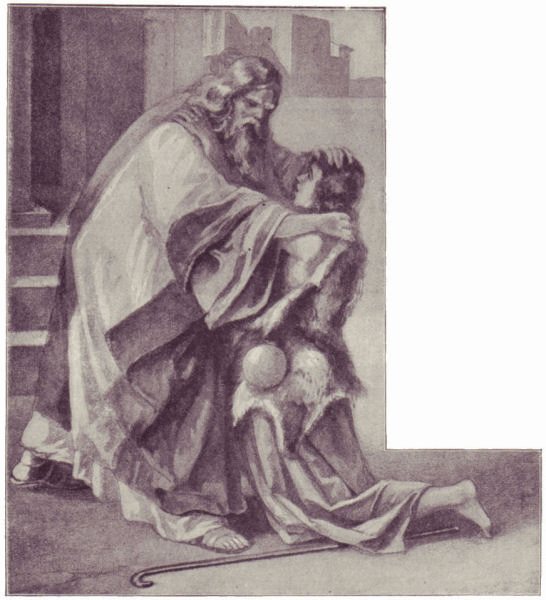 THE FATHER FELL ON HIS SON'S NECK |
The Poor Rich Man, and the Rich Poor Man
Another parable that Jesus gave was that of "The Rich Man and Lazarus." He said,
"There was a rich man; and he was dressed in garments of purple and fine linen, living every day in splendor. And at the gate leading to his house was laid a beggar named Lazarus, covered with sores, and seeking for his food the crumbs that fell from the rich man's table. Even the dogs of the street came and licked his sores.
"After a time the beggar died, and his soul was carried by the angels into Abraham's bosom. The rich man also died, and his body was buried. And in the world of the dead he lifted up his eyes, being in misery; and far away he saw Abraham, and Lazarus resting in his bosom. And he cried out and said, 'Father Abraham, have mercy on me, and send Lazarus, that he may dip the tip of his finger in water and cool my tongue, for I am suffering in this flame!'
"But Abraham said, 'Son, remember that you had your good things in your lifetime, and that Lazarus had his evil things; but now here he is comforted and you are in sufferings. And besides all this, between us and you there is a great gulf fixed, so that no one may cross over from us to you, and none can come from your place to us.'
"And he said, 'I pray, O father Abraham, if Lazarus cannot come to me, command that he be sent to my father's house, for I have five brothers, and let him speak to them, so that they will not come to this place of torment.'
"But Abraham said, 'They have Moses and the prophets; let them hear them!'
"And he said, 'O father Abraham, if one should go to them from the dead, they will turn to God.'
"And Abraham said, 'If they will not hear Moses and the prophets, they will not believe, even though one should rise from the dead!' "
And this was true, for as the people would not listen to the words of Moses and the prophets about Christ, they would not believe, even after Jesus himself arose from the dead. There was another parable of Jesus, called "The Unjust Steward."
"A certain rich man had a steward, a man who took the care of all his possessions. He heard that his steward was wasting his property; and he sent for him, and said, 'What is this that I hear about you? You shall soon give up your place, and be my steward no longer.'
"Then the steward said to himself, 'In a few days I shall lose my place; and what shall I do? I cannot work in the fields, and I am ashamed to go begging from door to door. But I have thought of a plan that will give me friends, so that when I am put out of my place, some people will take me into their houses, because of what I have done for them.'
"And this was his plan. He sent for the men who were in debt to his master, and said to the first one, 'How much do you owe to my master?'
"The man said, 'I owe him a thousand gallons of oil.'
"Then said the steward, 'You need only pay five hundred gallons.' Then to another he said, 'You need pay only twelve hundred bushels.'
"When his master heard of this which his steward had done, he said, 'That is a sharp, shrewd man, who takes care of himself.' "
And Jesus said, "Be as earnest and as thoughtful for the eternal life as men are for this present life."
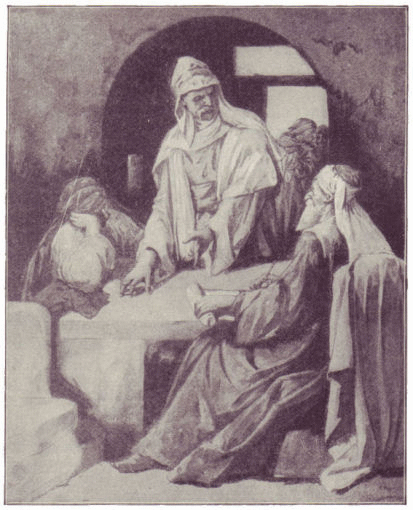 THE UNJUST STEWARD |
Jesus did not approve the actions of this unjust steward, but he told his disciples to learn some good lessons even from his wrong deeds.
Jesus spoke another parable to show that people should pray always, and not be discouraged. It was the parable of "The Unjust Judge and the Widow." Jesus said:
"There was in a city a judge who did not fear God, nor seek to do right; nor did he care for man. And there was a poor widow in that city who had suffered wrong. She came to him over and over again, crying out, 'Do justice for me against my enemy who has done me wrong!'
"And for a time the judge, because he did not care for the right, would do nothing. But as the widow kept on crying, at last he said to himself, 'Even though I do not fear God nor care for man, yet because this widow troubles me and will not be still, I will give her justice, or else she will wear me out by her continual crying.'
And the Lord said, "Hear what this unjust judge says! And will not a just God do right for his own who cry to him by day and night, even though he may seem to wait long? I tell you that he will answer their prayer, and will answer it soon!"
And Jesus spoke another parable to some who thought that they were righteous and holy, and set others at nought. This was the parable of "The Pharisee and the Publican."
"Two men went up into the Temple to pray, the one a Pharisee, the other a publican. The Pharisee stood and prayed thus with himself, 'God, I thank thee that I am not as other men are. I do not rob, I do not deal unjustly. I am free from wickedness. I am not even like this publican. I fast twice in each week. I give to God one-tenth of all that I have.' But the publican standing afar off, would not lift up so much as his eyes unto heaven, but beat his breast, saying, 'God be merciful to me, a sinner!'
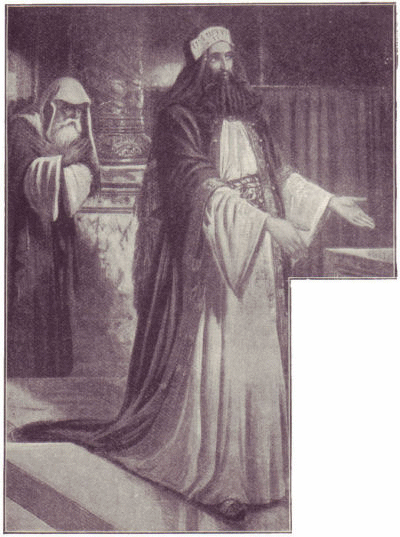 THE PHARISEE AND THE PUBLICAN |
"I say unto you," said Jesus, "this man went down to his house having his sins forgiven rather than the other. For every one that lifteth uphimself shall be brought low; and he that is humble shall be lifted up."
And at this time the mothers brought to Jesus their little children, that he might lay his hands on them and bless them. The disciples were not pleased at this, and told them to take their children away. But Jesus called them to him, and said, "Suffer the little children to come unto me, and forbid them not, for of such is the kingdom of God. Whoever shall not receive the kingdom of God as a little child, he shall not enter into it." And he put his hands on them and blessed them. And a certain young man, a ruler, came running to Jesus, and said, "Good Master, what shall I do that I may have everlasting life?"
"Why do you call me good?" said Jesus. "No one is good except one. that is God. You know the commandments; keep them."
"What commandments?" asked the young man.
"Do not kill; do not commit adultery; do not steal; do not bear false witness; honor thy father and mother."
The young man said, "All these I have kept from my youth up. What do I need more than these?"
"One thing more you need to do," said Jesus. "Go sell all that you have, and give to the poor, and you shall have treasure in heaven. Then come and follow me."
But when he heard this he turned and went away very sad, for he was very rich. And when Jesus saw this, he said, "How hard it is for those that are rich to enter into the kingdom of God! It is easier for a camel to go through the eye of a needle than for a rich man to enter into the kingdom of God."
At this the disciples were filled with wonder. They said, "If that be so, then who can be saved?"
And Jesus said, "The things that are impossible with men are possible with God."
And Peter said, "Lord, we have left our homes and all that we have, and have followed thee."
And Jesus answered him, "Verily, I say to you, there is no man who has left house, or wife, or brothers, or parents, or children, for the sake of the kingdom of God, who shall not have given to him many more times in this life, and in the world to come life everlasting."
Then Jesus again told his twelve disciples of what was soon to come to pass, even in a few weeks. He said, "We are going up to Jerusalem, and there all the things written by the prophets about the Son of man shall come true. He shall be made a prisoner, and shall be mocked, and treated shamefully, and shall be spit upon, and beaten, and shall be killed; and then the third day he shall rise again."
But they could not understand these things, and they did not believe that their Master was to die.
Jesus at Jericho
Jesus was passing through the land of Perea on his way to Jerusalem. His disciples were with him, and a great multitude of people, for again the feast of the Passover was near, and the people from all parts of the land were going up to Jerusalem to take part in the feast; and although Jesus had said, over and over again, that he was to die in Jerusalem, still many believed that in Jerusalem he would make himself king and would reign over all the land.
On one day James and John, two of the disciples of Jesus, who were brothers, the sons of Zebedee, came to Jesus with their mother. She knelt before Jesus, and her two sons knelt beside her. Jesus said to her, "What is it that you would ask of me?"
She said to him, "Lord, grant to me that my two sons may be allowed to sit beside thy throne, one of the right hand, the other on thy left, in thy kingdom."
"You do not know what you are asking," answered Jesus. "Are you able to drink of the cup that I am about to drink?"
By "the cup" he meant the suffering that he was soon to endure; but this they did not understand; and they said to him, "We are able."
He said to them, "My cup indeed you shall drink; but to sit on my right hand and on my left is not mine to give, but it shall be given to those for whom God has made it ready."
When the other disciples heard that James and John had tried to get the promise of the highest places in the Lord's kingdom, they were very angry against these two brothers. But Jesus called them to him, and he said, "You know that the rulers of nations lord it over them; and their great ones are those who bear rule. But not so shall it be among you. For whoever among you would be great, let him serve the rest. For the Son of man himself did not come to be served, but to serve others; and to give up his life that he might save many." Jesus with his disciples and a great multitude drew nigh to Jericho, which was at the foot of the mountains, near the head of the Dead Sea. Just outside the city, at the gate, was sitting a blind man begging. His name was Bartimeus, which means "the son of Timeus." This man heard the noise of a crowd, and he asked what it meant. They said to him, "Jesus of Nazareth is passing by." As soon as he heard this he began to cry out aloud, "Jesus, son of David, have mercy on me!"
 BLIND BARTIMEUS |
Many people told him not to make so great a noise, but he cried all the louder, "Jesus, son of David, have mercy on me!"
Jesus heard his cry, and stood still, and said, "Call the man to me!"
Then they came to the blind man and said, "Be of good cheer; rise up; he calls you!"
The blind man sprung up from the ground and threw away his garment, and came to Jesus. And Jesus said to him, "What do you mish me to do to you?"
"Lord, that I might have my sight given to me," answered blind Bartimeus.
Then Jesus touched his eyes, and said, "Go your way; your faith has made you well."
Then immediately sight came to his eyes, and he followed Jesus, while all the people who saw it gave thanks to God.
There was another man in Jericho who had heard of Jesus, and greatly longed to see him. This was a man named Zaccheus. He was a chief man among the publicans, the men who gathered the taxes from the people, and whom all the people hated greatly. Zaccheus was a rich man, for many of the publicans made great gains. Wishing to see Jesus, and being little in size, Zaccheus ran on before the crowd, and climbed up a sycamore-tree by the road, so that he might see Jesus as he passed by.
When Jesus came to the tree he stopped, and looked up, and called Zaccheus by name, saying, "Zaccheus, make haste and come down, for to-day I must stop in your house."
At this Zaccheus was glad. He came down at once, and took Jesus into his house. But at this many people found fault. They said, "He has gone in to lodge with a man who is a sinner!"
Because he was a publican, they counted him as a sinner. But Zaccheus stood before the Lord, and said, "Lord, the half of my goods I give to the poor; and if I have wrongly taken anything from any man, I give him four times as much."
And Jesus said, "To-day salvation has come to this house; for this man also is a son of Abraham. For the Son of man came to seek and to save that which was lost."
Jesus was now drawing nigh to Jerusalem, and all the people were expecting the kingdom of God to begin at once, with Jesus as its King. On this account, Jesus gave to the people "The Parable of the Pounds," saying, "A certain nobleman went to a far country, expecting there to be made a king, and thence to return to his own land. Before going away he called ten servants of his, and gave to each one a pound of money, and said to them, 'Take care of this and trade with it until I come back.'
"But the people of his own land hated this nobleman, and sent messengers to the place where had gone, to say, 'We are not willing that this man should be king over us.'
"But in the face of this message from the people, the nobleman received the crown and the kingdom, and then went back to his own land. When he had come home, he called his servants to whom he had given the pounds, so that he might know how much each had gained by trading. The first servant came before him, and said, 'Lord, your pound has made ten pounds more.'
"The king said to him, 'Well done, my good servant; because you have been found faithful in a very little, you shall bear rule over ten cities.'
"And the second came, saying, 'Your pound, lord, has made five pounds.' And his lord said to him, 'You shall be over five cities.'
"And another came, saying, 'Lord, here is your pound, which I have kept wrapped up in a napkin; for I feared you, because you are a harsh master; you take up what you did not lay down, and you reap what you did not sow.' He said to the servant, 'Out of your own mouth I will judge you, you unfaithful servant. If you knew that I was a harsh master, taking up what I did not lay down, and reaping what I did not sow, then why did you not put my money into the bank, so that when I came I should have had my own money and its gains?' And he said to those who were standing by, 'Take away from him the pound, and give it to him that has the ten pounds.'
"They said to him, 'Lord, he hath ten pounds already!'
"But the king said, 'Unto every one who cares for what he has, more shall be given; but the one who cares not for it, what he has shall be taken away from him.'
"And the king added, 'Those, my enemies, who would not have me to reign over them; bring them here, and slay them before me.' "
And after giving this parable Jesus went before his disciples up the mountains toward Jerusalem.
 JESUS ON THE MOUNT OF OLIVES LOOKING AT JERUSALEM |
Palm Sunday
From Jericho, Jesus and his disciples went up from the mountains, and came to Bethany, where his friends Martha and Mary lived, and where he had raised Lazarus to life, as we read in Story Twenty-six. Many people in Jerusalem heard that Jesus was there; and they went out of the city to see him, for Bethany was only two miles from Jerusalem. Some came also to see Lazarus, whom Jesus had raised from the dead; but the rulers of the Jews said to each other:
"We must not only kill Jesus, but Lazarus also, because on his account so many of the people are going after Jesus and are believing on him."
The friends of Jesus in Bethany made a supper for Jesus at the home of a man named Simon. He was called "Simon the Leper;" and perhaps he was one whom Jesus had cured of leprosy. Jesus and his disciples, with Lazarus, leaned upon the couches around the table, as the guests; and Martha was one of those who waited upon them. While they were at the supper, Mary, the sister of Lazarus, came into the room, carrying a sealed jar of very precious perfume. She opened the jar, and poured some of the perfume upon the head of Jesus, and some upon his feet, and she wiped his feet with her long hair. And the whole house was filled with the fragrance of the perfume.
But one of the disciples of Jesus, Judas Iscariot, was not pleased at this. He said, "Why was such a waste of the perfume made? This might have been sold for more than forty-five dollars, and the money given to the poor!"
This he said, but not because he cared for the poor. Judas was the one who kept the bag of money for Jesus and the twelve, and he was a thief, and took away for his own use all the money that he could steal.
But Jesus said, "Let her alone; why do you find fault with the woman? She has done a good work for me. You have the poor always with you, and whenever you wish you can give to them. But you will have me with you only a little while. She has done what she could; for she has come to perfume my body for its burial. And truly I say to you, that wherever the gospel shall be preached throughout the world, what this woman has done shall be told in memory of her." Perhaps Mary knew what others did not believe, that Jesus was soon to die; and she showed her love for him, and her sorrow for his coming death, by this rich gift.
But Judas, the disciple who carried the bag, was very angry at Jesus; and from that time he was looking for a chance to betray Jesus, or to give him up to his enemies. He went to the chief priests, and said, "What will you give me if I will put Jesus into your hands?"
They said, "We will give you thirty pieces of silver."
And for thirty pieces of silver Judas promised to help them take Jesus, and make him their prisoner.
On the morning after the supper at Bethany, Jesus called two of his disciples and said to them, "Go into the next village, and at a place where two roads cross, and there you will find an ass tied, and a colt with it. Loose them, and bring them to me. And if anyone says to you, 'Why do you do this?' say 'The Lord has need of them,' and they will let them go."
They went to the place, and found the ass and the colt, and were loosing them, when the owner said, "What are you doing, untying the ass?"
And they said, as Jesus had told them to say, "The Lord has need of it!"
Then the owner gave them the ass and the colt for the use of Jesus. They brought them to Jesus, on the Mount of Olives, and they laid some of their own clothes on the colt for a cushion, and set Jesus upon it. Then all the disciples and a very great multitude threw their garments upon the ground for Jesus to ride upon. Others cut down branches from the trees and laid them on the ground.
And as Jesus rode over the mountain toward Jerusalem many walked before him waving branches of palm-trees. And they all cried together:
"Hosanna to the Son of David! Blessed is he that cometh in the name of the Lord! Blessed be the kingdom of our father David, that cometh in the name of the Lord! Hosanna in the highest!"
These things they said because they believed Jesus was the Christ, the Anointed King, and they hoped that he would now set up his throne in Jerusalem. Some of the Pharisees in the crowd, who did not believe in Jesus, said to him, "Master, stop your disciples!"
But Jesus said, "I tell you, that if these should be still, the very stones would cry out!"
And when he came into Jerusalem with all this multitude, all the city was filled with wonder. They said, "Who is this?"
And the multitude answered, "This is Jesus, the prophet of Nazareth in Galilee!"
 JESUS RIDES INTO JERUSALEM |
And Jesus went into the temple, and looked around it; but he did not stay, because the hour was late. He went again to Bethany, and there stayed at night with his friends.
These things took place on Sunday, the first day of the week; and that Sunday in the year is called Palm Sunday, because of the palm-branches which the people carried before Jesus.
The Last Visits of Jesus to the Temple
On Monday morning, the second day of the week, Jesus rose very early in the morning and, without waiting to take his breakfast, went with his disciples from Bethany over the Mount of Olives toward Jerusalem. On the mountain he saw at a distance a fig-tree covered with leaves, and although it was early for figs to be ripe, he hoped that he might find upon it some figs fit to be eaten. Among the Jews, and by their law, any one passing a tree could eat of its fruit, even though he were not the owner; but he would not be allowed to carry any away.
But when Jesus came near to this tree he saw that there was no fruit upon it, neither ripe nor green, but leaves only. Then a thought came into the mind of Jesus; and he spoke to the tree, while his disciples heard his words, "No fruit shall grow on thee from this time forever." And then he walked on his way to Jerusalem. We shall see later why Jesus spoke those words, and what came from them.
You remember that when Jesus came to Jerusalem the first time after he began to preach, he found the courts of the Temple filled with people buying, and selling, and changing money, and he drove them all out. This we read in Story Seven of this Part. But that had been three years before; and now when Jesus came into the Temple on the Monday morning before the Passover he found all the traders there once more, selling the oxen, and sheep, and doves for sacrifices and changing money at the tables.
And again Jesus rose up against these people who would make his Father's house a shop and a place of gain. He drove them all out; he turned over the tables of the money-changers, scattering their money on the floor; he cleared away the seats of those that were selling doves; and whenever he saw any one even carrying a jar, or a basket, or any load through the Temple, he stopped him, and made him go back. He said to all the people, "It is written in the prophets, 'My house shall be called a house of prayer for all nations, but you have made it a den or robbers!' "
 JESUS DRIVES OUT THE TRADERS |
The Jews had made it a rule that no blind man, nor any lame man, could go into the Temple; for they thought only those perfect in body should come before the Lord. But they forgot that God looks at hearts and not at bodies. And when Jesus found that many blind and lame people were at the doors of the Temple he allowed them to come in, and made them all well.
And the little children, who always loved Jesus, saw him in the Temple, and they cried out, as they heard others crying, "Hosanna to the Son of David!"
And Jesus said, "Yes; and have you never read what is written in the Psalms, 'Out of the mouth of babes and little ones, thou hast made thy praise perfect?' "
And all the common people came to hear Jesus as he taught in the Temple, and they listened to him gladly, for he gave them plain and simple teachings, with many parables or stories. But the rulers and chief priests grew more and more angry as they saw the courts of the Temple filled with people eager to hear Jesus. They tried to find some way to lay hands on Jesus, and to kill him; but they dared not while all the crowds were around him.
All that day Jesus taught the people, and when night came he went out of the city, over the Mount of Olives, to Bethany, where he was safe among his friends.
And on the next morning, which was Tuesday of the week before Passover, Jesus again went over the Mount of Olives with his disciples. They passed the fig-tree to which Jesus had spoken such strange words on the day before. And now the disciples saw that the tree was standing, withered and dried, with its leaves dry and rustling in the wind.
"Look, Master!" said Peter.
"The fig-tree to which you spoke yesterday is withered!"
And Jesus said to them all, "Have faith in God, for in truth I say to you, that if you have faith, you shall not only do this which has been done to the fig-tree; but also, if you shall say to this mountain, 'Be moved away and thrown into the sea!' it shall be done. And all things, whatever they may be, that you ask in prayer, if you have faith, shall be given to you." Again Jesus went into the Temple and taught the people.
And Jesus gave another parable or story, that of "The Wedding Feast." He said:
"There was a certain king who made a great feast at the wedding of his son; and he sent out his servant to call those whom he had invited to the feast. But they would not come. Then he sent forth other servants, and said, 'Tell those who were invited that my dinner is all ready; my oxen are killed, and the dishes are on the table. Say to them, "All things are ready; come to the marriage-feast!' "
"But the men who had been sent for would not come. One went to his farm, another to his shop, and some of them seized the servants whom he sent, and beat them, and treated them roughly; and some of them they killed. This made the king very angry. He sent his armies, and killed those murderers, and burned up their city. Then he said to his servants, 'The wedding-feast is ready, but those that were invited were not worthy of such honor. Go out into the streets, and call in everybody that you can find, high and low, rich and poor, good and bad, and tell them that they are welcome.'
"The servants went out and invited all the people of every kind, and brought them to the feast, so that all the places were filled. And to all who came they gave a wedding garment, so that every one might be dressed as was fitting before the king.
"But when the king came in to meet his guests, he saw there a man who had not on a wedding garment. He said to him, 'Friends, why have you come to the feast without a wedding garment?'
"The man had nothing to say; he stood as one dumb. Then the king said to his officers, 'Bind him hand and foot, and throw him out into the darkness, where there shall be weeping and gnashing of teeth. For in the kingdom of God many are called, but few are chosen.' "
The enemies of Jesus thought that they had found a way to bring him into trouble, either with the people, or with the Romans, who were the rulers over the land. So they sent to him some men, who acted as though they were honest and true, but were in their hearts seeking to destroy Jesus. These men came, and they said, "Master, we know that you teach the truth, and that you are not afraid of any man. Now tell what is right, and what we should do. Ought our people, the Jews, to pay taxes to the Roman Emperor Caesar, or not? Shall we pay, or shall we not pay?"
And they watched for his answer. If he should say, "It is right to pay the tax," then these men could tell the people, "Jesus is the friend of the Romans, and the enemy of the Jews," and then they would turn away from him. But if he should say, "It is not right to pay the tax; refuse to pay it," then they might say to the Roman governor that Jesus would not obey the laws, and the governor might put him in prison or kill him. So whatever answer Jesus might give, they hoped he might make trouble for himself.
But Jesus knew their hate and the thoughts of their hearts, and he said, "Let me see a piece of the money that is given for the tax."
They brought him a silver piece, and he looked at it, and said, "Whose head is this on the coin? Whose name is written over it?"
They answered him, "That is Caesar, the Roman emperor."
"Well, then," said Jesus, "give to Caesar the things that are Caesar's, and give to God the things that are God's!"
 JESUS AND THE PIECE OF MONEY |
They wondered at his answer, for it was so wise that they could speak nothing against it. They tried him with other questions, but he answered them all, and left his enemies with nothing to say. Then Jesus turned upon his enemies, and spoke to them his last words. He told them of their wickedness, and warned them that they would bring down the wrath of God upon them.
Jesus was in the part of the Temple called "The Treasury," because around the wall were boxes in which the people dropped their gifts when they came to worship. Some that were rich gave much money; but a poor widow came by and dropped in two little coins, the very smallest, the two together worth only a quarter of a cent. Jesus said, "I tell you in truth that this poor widow has dropped into the treasure more than all the rest. For the others gave out of their plenty, but she, in her need, has given all that she had."
And with these words Jesus rose up, and went out of the Temple for the last time. Never again was the voice of Jesus heard within those walls.
 THE POOR WIDOW DROPS IN TWO LITTLE COINS |
The Parables on the Mount of Olives
After Jesus had spoken his last words to the people and their rulers, he walked out of the Temple with his disciples. As they were passing through the great gates on the east of the Temple the disciples said to Jesus, "Master, what a splendid building this is! Look at these great stones in the foundation!"
Jesus answered his disciples, "Do you see these great walls? The time is coming when these buildings shall be thrown down; when not one stone that you are looking upon shall be left in its place; when the very foundations of this house and this city shall be torn up!"
These words filled the followers of Jesus with the deepest sorrow, for they loved the Temple and the city of Jerusalem, as all Jews loved it, and to them its all seemed the ruin of the whole world. Yet they believed the words of their Master, for they knew that he was a prophet, whose words were sure to come to pass, and that he was more than a prophet, even the son of God. They walked with Jesus down into the valley of the brook Kedron, and up the slopes of the Mount of Olives. On the top of the mountain they looked down upon the Temple and the city; and then some of the disciples said to Jesus:
"Master, tell us when shall these dreadful things be? Give us some sign, that we may know when they are coming."
Then Jesus sat down with his disciples on the mountain and told them of many things that were to come upon the city and the world; how wars should arise, and earthquakes and diseases should break forth; how enemies were to come and fight against Jerusalem, and destroy it and scatter its people; and how trouble should arise upon all the earth. And he told them that he would sometime come gain, as the Lord of all; and that all who believe in him should watch, and be ready to meet him. Then he gave the Parable of "The Ten Young Women." This was the story:
"There were ten young women who were going out one night with their lamps in their hands to meet a wedding party. Five of these young women were wise, and five were foolish. Those that were foolish took with them their lighted lamps, but had no more oil that that which was in the lamps; but each of the wise young women carried also a bottle of oil. It was night, and while they were waiting for the bridal party they all fell asleep. At midnight they were all awaked by the sudden cry, 'The bridegroom is coming! Go out to meet him!'
"Then all the young women rose up, and trimmed their lamps. And the foolish ones said, 'Let us have some of your oil, for our lamps are going out.'
"But the other young women said, 'Perhaps there will not be enough for us and for you too; go to those who sell, and buy oil for yourselves.'
"The young women who had no oil went away to buy; and while they were away the bridal party came, and those that were ready went in with them to the feast; and then the door was shut. And afterward the other young women came, knocking on the door, and calling out, 'Lord, Lord, open to us!'
"And he would not open the door. Watch, therefore, for you do not know the day nor the hour when your Lord will come."
 THE COMING OF THE BRIDEGROOM |
Jesus also gave to his disciples another parable or picture of what shall come to pass at the end of the world. He said:
"When the Son of Man shall come in his glory, and all the angels of God shall come with him, then he shall sit on his glorious throne as King. And before him shall be brought together all the people of the world; and he shall divide them, and make them stand apart, just as a shepherd divides the sheep from the goats. And he shall put sheep on his right hand, and the goats on his left. Then the King shall say to those on his right hand, 'Come, ye, whom my Father has blessed; come, and take the kingdom which God has made ready for you. For I was hungry, and you gave me food; I was thirsty, and you gave me drink; I was a stranger, and you took me into your home; I was naked, and you gave me clothes; I was sick, and you visited me; I was in prison, and you come to me.'
"Then all those on the right of the King will say:
" 'Lord, when did we see thee hungry, and feed thee? or thirsty and gfave thee drink? And when did we see thee a stranger, and took thee in? or naked and gave thee clothes? And when did we see thee sick, or in prison, and come to thee?'
"And the King shall answer, and shall say to them:
" 'Inasmuch as you did it to one of these my brothers, even the very least of them, you did it to me.'
"Then the King shall turn to those on his left hand, and shall say to them:
" 'Go away from me, ye cursed ones, into the everlasting fire which has been made ready for the devil and his angels. For I was hungry, and you gave me no food; I was thirsty, and you gave me no drink; I was a stranger, and you did not open your doors to me; I was naked, and you gave me no clothes; I was sick, and in prison, and you did not visit me.'
"Then shall they answer him:
" 'Lord, when did we see thee hungry, or thirsty, or a stranger, or naked, or sick, or in prison, and did not help thee?'
"And the King shall say to them:
" 'Inasmuch as you did it not to one of these the least of my brothers, you did it not to me.'
"And the wicked shall go away to be punished forever; but the righteous unto everlasting life."
After these words, Jesus went with his disciples again to Bethany.
 THEY TOOK THE UNFAITHFUL SERVANT AWAY |
The Last Supper
On one of the days in the week before the Passover, the disciples came to Jesus at Bethany, and said, "Master, where shall we make ready the Passover for you to eat?"
Then Jesus called to himself the two disciples, Peter and John, and said to them, "Go into the city, and a man carrying a pitcher of water will meet you; follow him, and go into the house where he goes, and say to the head of the house, 'The Master says, "Where is my guest-room; where I can eat the Passover with my disciples?' "
"And he will himself show you a large upper room, furnished; there make ready for us."
Peter and John went into Jerusalem, and soon in the street they saw a man walking toward them carrying a pitcher of water. They followed him, went into the house where he took the pitcher, and spoke to the man who seemed to be its head:
"The Master says, 'Where is the guest-room for me, where I may eat the Passover with my disciples?' "
The man led them upstairs, and showed them a larger upper room, with the table and the couches around it, all ready for the guests at dinner. Then the disciples went out, and brought a lamp, and roasted it; and made ready the vegetables and the thin wafers of bread made without yeast, for the meal.
On Thursday afternoon, Jesus and his disciples walked out of Bethany together, and over the Mount of Olives, and into the city. Only Jesus, who could read the thoughts of men, knew that one of these disciples, Judas, had made a promise to the chief priests to lead them and their servants to Jesus, when the hour should come to seize him; and Judas was watching for the best time to do this dreadful deed. They came into the house, and went upstairs to the large room, where they found the supper all ready. The meal was spread upon a table; and around the table were couches for the company, where each one lay down with his head toward the table, so near that he could help himself to the food, while his feet were at the foot of the couch, toward the wall of the room. Their feet were bare, for they had all taken off their sandals as they came in.
Jesus was leaning at the head of the table, and John, the disciple whom Jesus loved most, was lying next to him. While they were eating, Jesus took bread, and gave thanks. Then he broke it, and passed a piece to each one of the twelve, saying:
"Take, and eat; this is my body which is broken for you; do this and remember me."
Afterward, he took up the cup of wine, and passed it to each one, with the words:
"This cup is my blood, shed for you, and for many, that their sins may be taken away; as often as you drink this, remember me."
While they were still leaning on the couches around the table, Jesus rose up, and took off his outer robe, and then tied around his waist a long towel. He poured water into a basin, and while all the disciples were wondering, he carried the water to the feet of one of the disciples, and began to wash them, just as though he himself were a servant. Then he washed the feet of another disciples, and then of still another. When he came to Simon Peter, Peter said to him, "Dost thou, O Lord, wash me feet?"
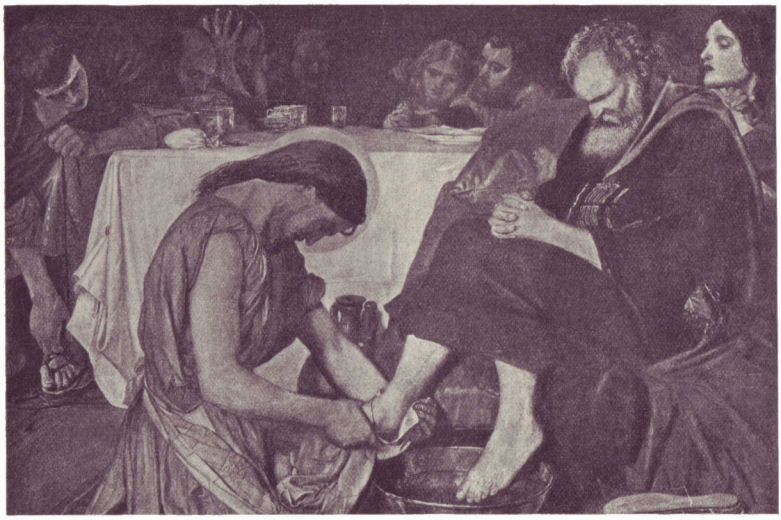 JESUS WASHES THE FEET OF PETER |
Jesus said to him, "What I do, you cannot understand now, but you will understand it after a time."
"Lord, thou shalt never wash my feet," said Peter.
"If I do not wash you," said Jesus, "then you are none of mine."
Then Peter said, "O Lord, wash not only my feet, but my hands and my head too!"
But Jesus said to him, "No, Peter; one who has already bathed needs only to wash his feet, and then he is clean. And you are clean, but not all of you."
For he knew that among those whose feet he was washing was one, the traitor, who would soon give him up to his enemies. After he had washed their feet, he put on his garments again, and leaned once more on his couch, and looked around, and said:
"Do you know what I have done to you? You call me 'Master' and 'Lord,' and you speak rightly, for so I am. If I, your Lord and Master, have washed your feet, you also ought to wash each other's feet; for I have given you an example that you should do to each other as I have done to you."
By this Jesus meant that all who follow him should help and serve each other, instead of seeking great things for themselves.
While Jesus was talking, he became very sad and sorrowful, and said, "Verily, verily, I say to you, that one of you that are eating with me shall betray me, and give me up to those who will kill me."
Then all the disciples looked round on each other, wondering who was the one that Jesus meant. One said, and another said, "Am I the one, Lord?"
And Jesus said, "It is one of you twelve men, who are dipping your hands into the same dish and eating with me. The Son of Man goes, as it is written of him; but woe to that man who betrays him and gives him up to die. It would have been good for that man if he had never been born."
While Jesus was speaking, Simon Peter made signs to John across the table, that he, leaning next to Jesus, should ask him who this traitor was. So John whispered to Jesus, as he was lying close to him, "Lord, who is it?"
Jesus answered, but so low that none else heard: "It is the one to whom I will give a piece of bread after I have dipped it in the dish."
Then Jesus dipped into the dish a piece of bread, and gave it to Judas Iscariot, who was lying near him. And as he gave it, he said, "Do quickly what you are going to do."
No one except John knew what this meant. Not all heard what Jesus said to Judas; and those who heard thought that Jesus was telling him to do something belonging to the feast, or perhaps, as Judas carried the money, that he should make some gift to the poor. But Judas at once went out, for he saw now that his plan was known, and it must be carried out now or never. He knew that after the supper Jesus would go back to Bethany; and he went to the rulers, told them where they might watch for Jesus on his way back to Bethany, and went with a band of men to a place at the foot of the Mount of Olives, where he was sure Jesus would pass.
As soon as Judas had gone out, Jesus said to the eleven disciples, "Little children, I shall be with you only a little while. I am going away; and where I go, you cannot come now. But when I am gone away from you, remember this new commandment that I give you, that you love one another even as I have loved you."
Simon Peter said to Jesus, "Lord, where are you going?"
Jesus answered, "Where I go, you cannot follow me now, but you shall follow me afterward."
Peter said to him, "Lord, what, cannot I follow you even now? I will lay down my life for your sake."
Jesus said, "Will you lay down your life for me? I tell you, Peter, that before the cock crows to-morrow morning you will three times deny that you have ever known me!"
But Peter said, "Though I die, I will never deny you, Lord!"
And so said all the other disciples; but Jesus said to them, "Before morning comes every one of you will leave me alone. Yet I will not be alone, for the Father will be with me."
Jesus saw that Peter and all his disciples were full of sorrow at his words, and he said, "Let not your hearts be troubled; ye believe in God, believe also in me. In my Father's house are many house; if it were not so, I would have told you; for I am going to make ready a place for you. And when it is ready, I will come again, and take you to myself, that when I am, there you may be also."
Then Jesus talked with the disciples a long time, and prayed for them. And about midnight they left the supper-room together, and came to the Mount of Olives.
The Olive Orchard and the High Priest's Hall
At the foot of the Mount of Olives, near the path over the hill toward Bethany, there was an orchard of olive trees, called "The Garden of Gethsemane." The word "Gethsemane" means "oil press." Jesus often went to this place with his disciples, because of its quiet shade. At this garden he stopped, and outside he left eight of his disciples, saying to them, "Sit here, while I go inside and pray."
He took with him the three chosen ones, Peter, James, and John, and went within the orchard. Jesus knew that in a little while Judas would be there with a band of men to seize him; that within a few hours he would be beaten, and stripped, and led out to die. The thought of what he was to suffer came upon him and filled his soul with grief. He said to Peter, and James, and John:
"My soul is filled with sorrow; a sorrow that almost kills me. Stay here and watch while I am praying."
He went a little further among the trees, and flung himself down upon the ground, and cried out:
"O, my Father, if it be possible, let this cup pass away from me; nevertheless, not as I will, but as thou willest!"
So earnest was his feeling and so great his suffering, that there came out upon his face great drops of sweat like blood, falling upon the ground. After praying for a time, he rose up from the earth, and went to his three disciples, and found them all asleep. He awaked them, and said to Peter:
"What, could you not watch with me one hour? Watch and pray, that you may not go into temptation. The spirit indeed is willing, but the flesh is weak."
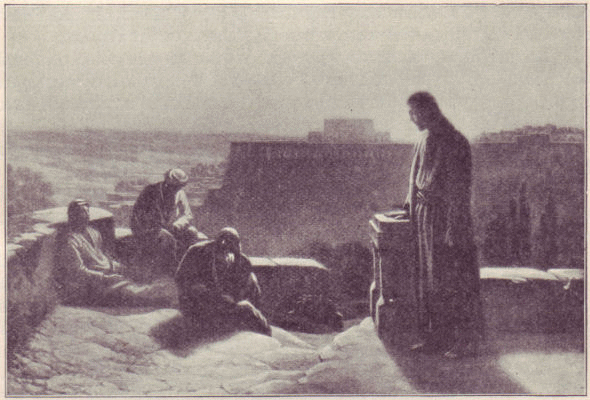 JESUS FINDS HIS DISCIPLES ASLEEP |
He left them, and went a second time into the woods, and fell on his knees, and prayed again, saying:
"O, my Father, if this cup cannot pass away, and I must drink it, then thy will be done."
He came again to the three disciples, and found them sleeping; but this time he did not wake them. He went once more into the woods, and prayed, using the same words. And an angel from heaven came to him, and gave him strength.
He was now ready for the fate that was soon to come, and his heart was strong. Once more he went to the three disciples, and said to them:
"You may as well sleep on now, and take your rest, for the hour is at hand; and already the Son of man is given by the traitor into the hands of sinners. But rise up, and let us be going. See, the traitor is here!"
The disciples awoke; they heard the noise of a crowd, and saw the flashing of torches, and the gleaming of swords and spears. In the throng they saw Judas standing, and they knew now that he was the traitor of whom Jesus had spoken the night before. Judas came rushing forward, and kissed Jesus, as though he were glad to see him. This was a signal that he had given beforehand to the band; for the men of the guard did not know Jesus, and Judas had said to them, "The one that I shall kiss is the man that you are to take; seize him and hold him fast."
Jesus said to Judas, "Judas, do you betray the Son of man with a kiss?"
Then he turned to the crowd, and said, "Whom do you seek?"
They answered, "Jesus of Nazareth."
Jesus said, "I am he."
When Jesus said this, a sudden fear came upon his enemies; they drew back, and fell upon the ground.
After a moment, Jesus said again, "Whom do you seek?"
And again they answered, "Jesus of Nazareth."
And Jesus said, pointing to his disciples, "I told you that I am he. If you are seeking me, let these disciples go their own way."
But as they came forward to seize Jesus, Peter drew his sword, and struck at one of the men in front, and cut off his right ear. The man was a servant of the high-priest, and his name was Malchus.
Jesus said to Peter, "Put up the sword into its sheath; the cup which my Father has given me, shall I not drink it? Do you not know that I could call upon my Father, and he would send to me armies upon armies of angels?"
Then he spoke to the crowd: "Let me do this." And he touched the place where the ear had been cut off, and it came on again and was well. Jesus said to the rulers and leaders of the armed men, "Do you come against me with swords and clubs as though I were a robber? I was with you every day in the Temple, and you did not lift your hands against me. But the words in the Scriptures must come to pass; and this is your hour."
When the disciples of Jesus saw that he would not allow them to fight for him, they did not know what to do. In their sudden alarm they all ran away, and left their Master alone with his enemies. These men laid their hands on Jesus, and bound him, and led him away to the house of the high-priest. There were at that time two men called high-priests by the Jews. One was Annas, who had been high-priest until his office had been taken away from him by the Romans, and given to Caiaphas, his son-in-law. But Annas still had great power among the people; and they brought Jesus, all bound as he was, first before Annas.
Simon Peter and John, the disciple whom Jesus loved, had followed after the crowd of those who carried Jesus away, and they came to the door of the high-priest's house. John knew the high-priest and went in, but Peter at first stayed outside, until John went out and brought him in. He came in, but did not dare to go into the room where Jesus stood before the high-priest Annas. In the courtyard of the house they had made a fire of charcoal, and Peter stood among those who were warming themselves at the fire.
Annas, in the inner room, asked Jesus about his disciples and teaching. Jesus answered him, "What I have taught has been open in the synagogues and in the Temple. Why do you ask me? Ask those that heard me; they know what I said."
Then one of the officers struck Jesus on the mouth, saying to him, "Is this the way that you answer the high-priest?"
Jesus answered the officer calmly and quietly, "If I have said anything evil, tell what the evil is; but if I have spoken the truth, why do you strike me?"
While Annas and his men were thus showing their hate toward Jesus, who stood bound and alone among his enemies, Peter was still in the courtyard, warming himself at the fire. A woman, who was a serving-maid in the house, looked at Peter sharply, and finally said to him, "You were one of those men with this Jesus of Nazareth!"
Peter was afraid to tell the truth, and he answered her, "Woman, I do not know the man, and I do not know what you are talking about."
And to get away from her he went out into the porch of the house. There another woman-servant saw him, and said, "This man was one of those with Jesus!"
And Peter swore with an oath that he did not know Jesus at all. Soon a man came by, who was of kin to Malchus, whose ear Peter had cut off. He looked at Peter, and heard him speak, and said, "You are surely one of this man's disciples, for your speech shows that you came from Galilee."
Then Peter began again to curse and to swear, declaring that he did not know the man of whom they were speaking.
Just at that moment the loud, shrill crowing of a cock startled Peter, and at the same time he saw Jesus, who was being dragged through the hall from Annas to the council-room of Caiaphas, the other high-priest. And the Lord turn as he was passing and looked at Peter.
Then there flashed into Peter's mind what Jesus had said on the evening before, "Before the cock crows to-morrow morning, you will three times deny that you have ever known me."
Then Peter went out of the high-priest's house into the street, and he wept bitterly because he had denied his Lord.
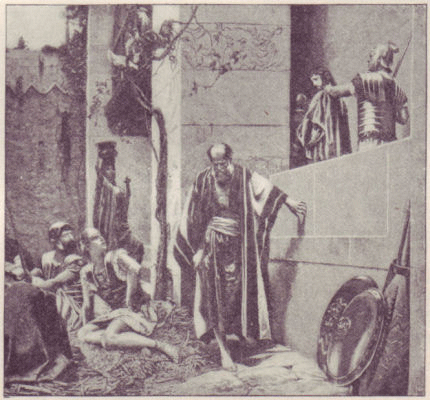 PETER WENT OUT AND WEPT BITTERLY |
The Crown of Thorns
From the house of Annas the enemies of Jesus led him away bound to the house of Caiaphas, whom the Romans had lately made high-priest. There all the rulers of the Jews were called together, and they tried to find men who would swear that they had heard Jesus say some wicked thing. This would give the rulers an excuse for putting Jesus to death. But they could find nothing. Some men swore one thing, and some swore another; but their words did not agree.
Finally the high-priest stood up, and said to Jesus, who stood bound in the middle of the hall, "Have you nothing to say? What is it that these men are speaking against you?"
But Jesus stood silent, answering nothing. Then the high-priest spoke again, "Are you the Christ, the Son of God?"
And Jesus said, "I am; and the time shall come when you will see the Son of man sitting on the throne of power and coming in the clouds of heaven!"
These words made the high-priest very angry. He said to the rulers, "Do you hear these dreadful words? He says that he is the Son of God. What do you think of words like these?"
They all said, with one voice, "He deserves to be put to death!"
Then the servants of the high-priest and the soldiers that held Jesus began to mock him. They spat on him, and they covered his face, and struck him with their hands, and said, "If you are a prophet, tell who it is that is striking you!"
The rulers of the Jews and the priests and the scribes passed a vote that Jesus should be put to death. But the land of the Jews was then ruled by the Romans, and no man could be put to death unless the Roman governor commanded it. The Roman governor at that time was a man named Pontius Pilate, and he was then in the city. So all the rulers and a great crowd of people came to Pilate's castle, bringing with them Jesus, who was still bound with cords.
Up to this time Judas Iscariot, although he had betrayed Jesus, did not believe that he would be put to death. Perhaps he thought that Jesus would save himself from death, as he had saved others, by some wonderful work. But when he saw Jesus bound and beaten, and doing nothing to protect himself, and when he heard the rulers vote that Jesus should be put to death, Judas knew how wicked was the deed that he had wrought. He brought back the thirty pieces of silver that had been given to him as the reward for betraying his Lord, and he said, "I have sinned in betraying one who has done no wrong!"
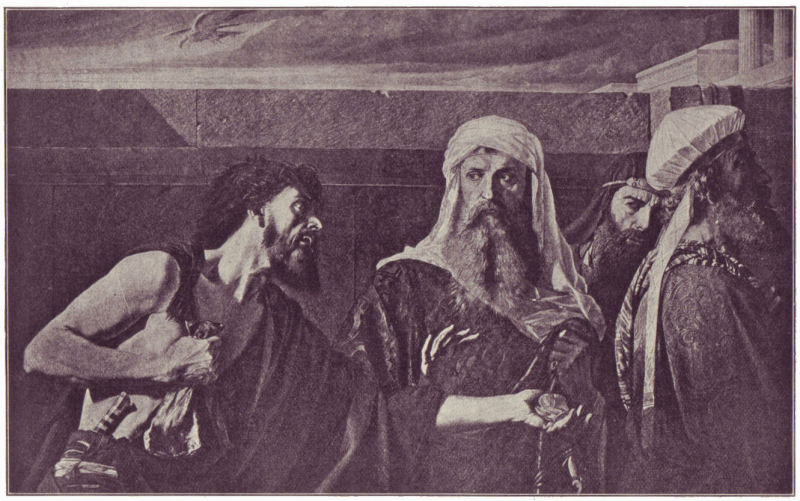 JUDAS RETURNS THE SILVER TO THE PRIESTS |
But they answered him, "What is that to us? You look after that!"
When Judas saw that they would not take back the money and let Jesus go free, he carried the thirty pieces to the Temple, and threw them down on the floor. Then he went away and hanged himself. And thus the traitor died.
After that the rulers scarcely knew what to do with the money. They said, "We cannot put it into the treasury of the Temple, because it is the price paid for a man's blood."
And when they had talked together, they used it in buying a piece of ground called "the potter's field." This they set apart as a place for burying strangers who died in the city and had no friends. But every one in Jerusalem spoke of that place as "The Field of Blood."
It was very early in the morning when the rulers of the Jews brought Jesus to Pilate. They would not go into Pilate's hall, because Pilate was not of their nation; and Pilate came out to them, and asked them, "What charge do you bring against this man?"
They answered, "If he were not an evil-doer, we would not have brought him to you."
Pilate did not wish to be troubled, and he said, "Take him away, and judge him by your own law!"
The Jews said to Pilate, "We are not allowed to put any man to death, and we have brought him to you. We have found this man teaching evil, and telling men not to pay taxes to the Emperor Caesar, and saying that he himself is Christ, a king."
Then Pilate went into his court-room, and sent for Jesus; and when he looked at Jesus, he said, "Are you the King of the Jews? Your own people have brought you to me. What have you done?"
 JESUS BROUGHT BEFORE PILATE |
Jesus said to him, "My kingdom is not of this world. If it were of this world, then those who serve me would fight to save me from my enemies. But now my kingdom is not here."
Pilate said, "Are you a king, then?"
Jesus answered him, "You have spoken it. I am a king. For this was I born, and for this I came into the world, that I might speak the truth of God to men."
"Truth," said Pilate, "What is truth?"
Then, without waiting for an answer, Pilate went out to the rulers and the crowd, and said, "I find no evil in this man."
Pilate thought that Jesus was a harmless man, but perhaps one whose mind was weak, and he could see no reason why the rulers and the people should be so bitter against him. But they cried out all the more, saying, "He stirs up the people everywhere, from Galilee even to this place."
When Pilate heard the word "Galilee," he asked if this man had come from that land. They told him that he had; and then Pilate said, "Galilee and its people are under the rule of Herod. He has come up to Jerusalem, and I will send this man to him."
So, from Pilate's court-room, Jesus was sent, still bound, to Herod's palace. This was the Herod who had put John the Baptist in prison, and had given his head to a dancing-girl, as we read in Story Eighteen of the Part. Herod was very glad to see Jesus, for he had heard many things about him; and he hoped to see him do some wonderful thing. But Jesus would not work wonders as a show, to be looked at; and when Herod asked him many questions, Jesus would not speak a word. Herod would not judge Jesus, for he knew that Jesus had done nothing wrong; so he and his soldiers mocked Jesus, and dressed him in a gay robe, as though he were a make-believe king, and sent him back to Pilate.
So Pilate, much against his will, was compelled to decide either for Jesus or against him. And just as Jesus was standing bound before him a message came to Pilate from his wife, saying, "Do nothing against that good man; for in this night I have suffered many things in a dream on account of him."
Pilate said to the Jews, "You have brought this man to me as one who is leading the people to evil; and I have seen that there is no evil in him, nor has Herod; now I will order that he be beaten with rods, and then set free. For you know that it is the custom to set a prisoner free at the time of the feast."
They set some prisoner free, as a sign of the joy at the feast. And at that time there was in the prison a man named Barabbas, who was a robber and a murderer. Pilate said to the people, "Shall I set free Jesus, who is called the King of the Jews?"
But the rulers went among the people and urged them to ask for Barabbas to be set free.
And the crowd cried out, "Not this man, but Barabbas!"
Then Pilate said, "What, then, shall I do with Jesus?"
And they all cried out, "Crucify him! Let him die on the cross!"
Pilate wished greatly to spare the life of Jesus. To show how he felt, he sent for water, and he washed his hands before all the people, saying, "My hands are clean from the blood of this good man!"
And they cried out, "Let his blood be on us, and on our children after us! Crucify him! Send him to the cross!"
Then Pilate, to please the people, gave them what they asked. He set free Barabbas, the man of their choice, though he was a robber and a murderer; but before giving way to the cry that he should send Jesus to the cross, he tried once more to save his life. He caused Jesus to be beaten until the blood came upon him, hoping that this might satisfy the people. As Jesus was spoken of as a king, the soldiers who beat Jesus made a crown of thorns, and put it on his head, and they put on him a purple robe, such as was worn by kings, and bowing down before him they called out to him, "Hail, King of the Jews!"
Then, hoping to awaken some pity for Jesus, Pilate brought him out to the people, with the crown of thorns and the purple robe upon him, and Pilate said, "Look on this man!"
But again the cry arose, "Crucify him! Send him to the cross!"
And at last Pilate yielded to the voice of the people. He sat down on the judgment-seat, and gave commands that Jesus, whom he knew to be a good man, one who had done nothing evil, should be put to death upon the cross.
 \LOOK ON THIS MAN." |
The Darkest Day of All the World
And so Pontius Pilate, the Roman governor, gave order that Jesus should die by the cross. The Roman soldiers then took Jesus and beat him again most cruelly; and then led him out of the city to the place of death. This was a place called "Golgotha" in the Jewish language, "Calvary" in that of the Romans; both words meaning "The Skull Place."
 JESUS LED AWAY TO THE CROSS |
With the soldiers went out of the city a great crowd of people, some of them enemies of Jesus, glad to see him suffer; others of them friends of Jesus, and the women who had helped him, now weeping as they saw him, all covered with his blood, and going out to die. But Jesus turned to them, and said:
"Daughters of Jerusalem, do not weep for me, but weep for yourselves, and for your children. For the days are coming when they shall count those happy who have no little ones to be slain; when they shall wish that the mountains might fall on them, and the hills might cover them, and hide them from their enemies!"
They had tried to make Jesus bear his own cross, but soon found that he was too weak from his sufferings, and could not carry it. They seized a man who was coming out of the country into the city, a man named Simon; and they made him carry the cross to its place at Calvary.
It was a custom among the Jews, to give to men about to die by the cross some medicine to deaden their feelings, so that they would not suffer so greatly. They offered this to Jesus, but when he had tasted it, and found what it was, he would not take it. He knew that he would die, but he wished to have his mind clear, and to understand what was done and what was said, even though his sufferings might be greater.
At the place Calvary they laid the cross down, and stretched Jesus upon it, and drove nails through his hands and feet to fasten him to the cross; and then they stood it upright with Jesus upon it. While the soldiers were doing this dreadful work, Jesus prayed for them to God, saying, "Father, forgive them; for they know not what they are doing."
The soldiers also took the clothes that Jesus had worn, giving to each one a garment. But when they came to his undergarment, they found that it was woven, and had no seams; so they said, "Let us not tear it, but cast lots for it, to see who shall have it." So at the foot of the cross the soldiers threw lots for the garment of Christ. Two men who had been robbers and had been sentenced to die by the cross, were led out to die at the same time with Jesus. One was placed on a cross at his right side, and the other at his left; and to make Jesus appear as the worst, his cross stood in the middle. Over the head of Jesus on his cross, they placed, by Pilate's order, a sign on which was written:
|
"THIS IS JESUS OF NAZARETH, THE KING OF THE JEWS." |
This was written in three languages: in Hebrew, which was the language of the Jews; in Latin, the language of the Romans, and in Greek. Many of the people read this writing; but the chief priests were not pleased with it. They urged Pilate to have it changed from "The King of the Jews" to "He said, "I am King of the Jews."
But Pilate would not change it. He said, "What I have written, I have written."
And the people who passed by on the road, as they looked at Jesus on the cross, mocked at him. Some called out to him, "You that would destroy the Temple, and build it in three days, save yourself. If you are the Son of God, come down from the cross!"
And the priests and scribes said, "He saved others, but he cannot save himself. Come down from the cross, and we will believe in you!"
And one of the robbers who was on his own cross beside that of Jesus joined in the cry, and said, "If you are the Christ, save yourself and save us!"
But the other robber said to him, "Have you no fear of God, to speak thus, while you are suffering the same fate with this man? And we deserve to die, but this man has done nothing wrong."
Then this man said to Jesus, "Lord, remember me when thou comest into thy kingdom."
And Jesus answered him, as they were both hanging on their crosses:
"To-day you shall be with me in heaven."
Before the cross of Jesus his mother was standing, filled with sorrow for her son, and beside her was one of the disciples, John, the disciple whom he loved best. Other women besides his mother were there, his mother's sister, Mary the wife of Cleopas, and a woman named Mary Magdalene, out of whom a year before Jesus had sent an evil spirit. Jesus wished to give his mother, now that he was leaving her, into the care of John, and he said to her, as he looked from her to John, "Woman, see your son."
And then to John he said, "Son, see your mother."
And on that day John took the mother of Jesus home to his own house, and cared for her as his own mother.
At about noon a sudden darkness came over the land, and lasted for three hours. And in the middle of the afternoon, when Jesus had been on the cross six hours of terrible pain, he cried out aloud words which meant:
"My Lord, my God, why hast thou forsaken me!" words which are the beginning of the twenty-second Psalm, a psalm which long before had spoken of many of Christ's sufferings.
After this he spoke again, saying, "I thirst!"
And some one dipped a sponge into a cup of vinegar, and put it upon a reed, and gave him a drink of it. Then Jesus spoke his last words upon the cross:
"It is finished! Father, into thy hands I give my spirit!"
And then Jesus died. And at that moment the vail in the Temple between the Holy Place and the Holy of Holies was torn apart by unseen hands from the top to the bottom. And the Roman officer who had charge of the soldiers around the cross saw what had taken place, and how Jesus died, and he said, "Truly this was a righteous man; he was the Son of God."
After Jesus was dead, one of the soldiers, to be sure that he was no longer living, ran his spear into the side of his dead body; and out of the wound came pouring both water and blood.
There were even among the rulers of the Jews a few who were friends of Jesus, though they did not dare to follow Jesus openly. One of these was Nicodemus, the ruler who came to see Jesus at night, as we read in Story Seven. Another was a rich man who came from the town of Arimathea, and was named Joseph. Joseph of Arimathea went boldly in to Pilate, and asked that the body of Jesus might be given to him. Pilate wondered that he had died so soon, for often men lived on the cross two or three days. But when he found that Jesus was really dead, he gave his body to Joseph.
Then Joseph and his friends took down the body of Jesus from the cross, and wrapped it in fine linen. And Nicodemus brought some precious spices, myrrh and aloes, which they wrapped up with the body. Then they placed the body in Joseph's own new tomb, which was a cave dug out of the rock, in a garden near the place of the cross. And before the opening of the cave they rolled a great stone.
And Mary Magdalene and the other Mary and some other women saw the tomb, and watched while they laid the body of Jesus in it. On the next morning, some of the rulers of the Jews came to Pilate, and said:
"Sir, we remember that that man Jesus of Nazareth, who deceived the people, said while he was yet alive, 'After three days I will rise again.' Give orders that the tomb shall be watched and made sure for three days; or else his disciples may steal his body, and then say, 'He is risen from the dead;' and thus even after his death he may do more harm than he did while he was alive."
Pilate said to them, "Set a watch, and make it as sure as you can."
Then they placed a seal upon the stone, so that no one might break it; and they set a watch of soldiers at the door.
And in the tomb the body of Jesus lay from the evening of Friday, the day when he died on the cross, to the dawn of Sunday, the first day of the week.
The Brightest Day of All the World
On Sunday morning, two days after the death and burial of Jesus, some women went very early, as soon as it was light, to the tomb in the garden. One of these women was Mary Magdalene, another was also named Mary, and another was named Salome. They were bringing some more fragrant gums and spices to place in the wrappings upon the body of Jesus. And as they went they said to each other, "Who will roll away for us the great stone at the door of the cave?"
But when they came to the cave, they saw that the seal was broken, the stone was rolled away, and the soldiers who had been on guard were gone. There stood the tomb of Jesus all open! They did not know that before they came to the tomb there had been an earthquake; and that an angel had come down from heaven and rolled away the stone, and sat upon it. When the soldiers on guard saw the angel, with his flashing face, and his dazzling garments, they fell to the ground as though they were dead, and as soon as they could rise up, they fled away from the spot in terror; so when the women came there was no man in sight.
 THE GUARDS OF THE TOMB FALL TO THE EARTH |
As soon as Mary Magdalene saw that the tomb was open, without stopping to look into it, she ran quickly to tell the disciples. A moment after she had gone, the other women looked into the tomb and they saw that the body of Jesus was not there. But they saw sitting at each end of the tomb a young man, clothed in a long white garment. Their faces shone like angels, and when the women saw they were filled with fear. One of the angels said to them:
"Do not be afraid; you are looking for Jesus of Nazareth, who was crucified. He is not here; he is risen, as he said that he would rise from the dead. Come, see the place where the Lord lay; and then go and tell his disciples, and tell Peter too, that Jesus will go before you into Galilee, and you shall see him there."
 THE WOMEN SEE THE ANGEL AT THE TOMB OF JESUS |
Then the women went away in mingled joy and fear. They ran in haste to bring this word of the angel to the disciples.
But while these women were looking into the tomb, and were listening to the angel, Mary Magdalene was seeking the disciples, to tell them that the tomb was open and the body of Jesus was not there; for she did not know that he had risen. She found Peter and John and said to them, "They have taken away the Lord out of the tomb, and we do not know where they have laid him!"
Then Peter and John at once went as quickly as they could go to the tomb. John outran Peter and came first to the tomb perhaps because he was the youngest. But when he saw the open door, and the broken seal, and the stone lying at on side, he stood still for a moment. John stooped into the cave, and he could see the linen cloths that had been wrapped around the body of Jesus lying together. But when Peter came up he did not wait, but pressed at once into the tomb; and then John followed him, and he too walked into the cave. Now he could see not only the long strips of linen rolled up; but in another place, carefully folded, the napkin that had been tied over the face of Jesus.
Then suddenly it flashed upon the mind of John, "Jesus has risen from the dead!" For he had not seen the angel, nor heard his words. From that moment John believed that Jesus was once more living. Both Peter and John went away, to think of the strange things they had seen. And very soon Mary Magdalene came back to the tomb. No one was there, for both the women and the disciples had gone away. Mary Magdalene did not know that Jesus had risen, for she had not the angel’s message.
She wept as she thought of her Lord, slain by wicked men, and not even allowed to rest in his greave. And still weeping, she stooped and looked into the tomb. There she saw two men in white garments sitting, one at the head, the other at the feet where the body of Jesus had lain. They were the two angels whom the other women had seen, but Mary Magdalene did not know this. One of them said to her, "Woman, why do you weep?"
She answered, "Because the have taken away my Lord and I do not know where they have laid him."
Something caused her to turn around; and she saw a man standing behind her. It was Jesus; but her eyes were held for a moment from knowing him. He said to her, "Woman, why do you weep?"
 MARY MAGDALENE MEETING THE RISEN JESUS |
She supposed that he was the gardener, and said, hardly looking at him, "Sir, if you have carried him out of this place, tell me where you have laid him, and I will take him away."
Then the stranger spoke her name, "Mary!" and she knew that he was Jesus, no longer dead, but living. She turned around, and fell down before him, and was about to seize his feet, as she said, "My Master!"
But Jesus said to her, "Do not take hold of me; I am not yet going away to my Father. But go to my brothers, and say to them, I go up to my Father and to your Father, to my God, and to your God!"
Mary Magdalene came and told the disciples how she had seen the Lord, and how he had spoken these things to her. So this was the first time that any one saw Jesus after he rose from the dead.
You remember that the other women, another Mary, and Salome, and the rest, had not seen the risen Christ, but they had seen an angel, who told them that he had risen, and would meet his disciples in Galilee. They went into the city, and were looking for disciples when suddenly Jesus himself stood before them, and said "All Hail!" That means, "A welcome to all of you!" They fell down before him and worshipped him. And Jesus said to them, as he had said to Mary Magdalene, only a few moments before, "Do not be afraid; but find my brothers, and tell them to go into Galilee and they shall see me there."
And this was the second time that Jesus showed himself living on the day when he arose.
On that same day two of the followers of Jesus were walking out of Jerusalem to a village called Emmaus, about seven miles away. While they were talking over the strange happenings of the day, they saw that a stranger was walking beside them. It was Jesus, their risen Lord, but they were held back from knowing him. The stranger said to them, "What words are these that you are speaking with teach other, which seem to make you so sad?"
One of the two men, named Cleopas, answered, "Are you even a stranger in Jerusalem, and have not heard of what things have taken place there in the last few days?"
The stranger said, "What things?"
And they said, "The things with regard to Jesus of Nazareth, who was a prophet mighty in his acts and his words before God and all the people; how the chief priests and our rulers caused him to be sentenced to death, and how he died on the cross. But we hoped that he was the promised One, who was to save Israel. And now it is the third day since he was put to death. And today some women of our company who were early at the tomb surprised us with the news that the tomb was empty, his body was not there; and they had seen a vision of angels, who said that Jesus was alive. Then some of us went to the tomb and found it just as the women had said; but they did not see him."
Then the stranger said to them, "O foolish men, and slow heart to believe what the prophets have said! Was it not needful for the Christ to suffer these things, and then to enter in his glory?"
Then he began with the books of Moses, and went through the prophets, and showed them in all the Scriptures the meaning of all that was told about Christ. And as they went on they came to the village to which they were going, and he acted as though he would go on beyond it. Then they urged and persuaded him to stay with them. They said, "Abide with us, for it is now almost evening, and the day is at its close."
And he went in with them and sat down with them to a supper. As they were about to eat he took the loaf of bread into his hands, and blessed it, and broke it, and gave it to them. And at that moment their eyes were opened and they knew that he was the Lord; and he passed out of their sight they said to each other, "Was not our heart burning within us while he talked to us on the road, and while he opened to us the words of the Scriptures?"
This was the third time that Jesus showed himself on that day. These two men hastened to Jerusalem that night to tell what they had seen. And they found ten of the disciples met together and saying, "The Lord has risen indeed, and has been seen by Simon Peter."
We do not know what Jesus said to Peter; but this was the fourth time that he was seen living on that day when he arose.
The ten disciples and other followers of Jesus were together in a room on that night, and the doors were shut. Suddenly Jesus himself was seen standing among them. He said, "Peace be unto you!"
Some of them were alarmed when they saw him and thought that he must be a spirit. Be he said to them, "Why are you troubled? And why do fears come to you? Look at the wounds in my hands and my feet! Handle me, and see. A spirit does not have flesh and bones, as you see that I have."
And he showed them his hands and his side. They could scarcely believe for the joy of seeing him again. He said, "Have you here anything to eat?"
They gave him a piece of broiled fish and of a honeycomb, and he ate before them. And he said, "This is what I told you while I was with you, that everything written of me in the law of Moses, and in the prophets, and in the psalms, must come to pass. It was needful that Christ should suffer thus, and should rise from the dead, and that everywhere the gospel should be preached in his name. I will send the promise of my Father upon you; but stay in Jerusalem after I leave you, until power shall come upon you from on high."
Then when the disciples saw that it was really the Lord, and that he was alive from the dead, they were glad. And Jesus said to them again, "Peace be to you, as my Father has sent me, even so I send you. May the Spirit of God come upon you!"
And this was the fifth time that Jesus showed himself alive on that day. This Sunday was the brightest day in all the world, because on it Jesus rose from the dead. And that Sunday in every year is called Easter Sunday.
 THE RISEN CHRIST BLESSING HIS DISCIPLES |
The Stranger on the Shore
When Jesus showed himself to the disciples on the evening of the day of his rising from the dead, only ten of the disciples was him, for Judas was no longer among them, and Thomas the twin (which is the meaning of his other name, Didymus) was absent. The other disciples said to Thomas, "We have seen the Lord!"
But Thomas said, "I will not believe that he has risen unless I can see in his hands the marks of the nails and the cross. I must see them with my own eyes, and put my hand into the wound in his side, before I will believe.
A week passed away, and on the next Sunday evening the disciples were together again, and at this time Thomas was with them.
The doors were shut but suddenly Jesus was seen again standing in the middle of the room. He said, as before, "Peace be with you."
Then he turned to Thomas, and said to him, "Thomas, come here, and touch my hands with you finger, and put your hand into my side; and no longer refuse to believe that I am living, but have faith in me!" And Thomas answered him, "My Lord and my God!"
 THOMAS ANSWERED, "MY LORD AND MY GOD!" |
Then Jesus said to him, "Because you have seen me, you have believed; blessed are they that have not seen, and yet have believed."
You remember that the angels had said to the women at the tomb of Jesus that his disciples should go into Galilee, that his disciples should go into Galilee and there they would see the risen Lord. They went to Galilee, and waited for some days without seeing Jesus. Finally Peter said, "I am going fishing."
"We will go with you," said the others. There were with Peter the two brothers, James and John, Thomas and Nathanael, and two other disciples. They went out upon the lake in the fishing goat, and worked all night, but found no fish. Just as the day was breaking they saw some one standing on the beach. It was Jesus, but they did not know him. He called out to them as one friend calls to another, "Boys, have you caught anything?"
They answered him, "No."
He said to them, "Cast the net on the right side of the ship, and you will find some fish."
They may have thought that standing on the shore he could see the signs of a shoal of fish, which they from the boat could not see. But the quick eyes of John, the beloved disciple, were the first to see who was this stranger on the shore. He said to Peter, "It is the Lord!"
 THE RISEN CHRIST ON THE SHORE SEEN BY THE DISCIPLES IN THE BOAT |
When Peter heard this, he flung around him his fisherman’s cat, and leaped into the water, and swam to the shore to meet his Lord. But the other six disciples stayed in the boat, and rowed to the shore, dragging after them the net full of fishes. When they came to the land, they found burning a fire of charcoal, and a fish broiling upon it, and a loaf of bread beside it. They all knew now that it was the Lord Jesus, and he said to them, "Bring some of the fish that you have now caught."
Simon Peter waded out to where the net was lying, filled with fish, and drew it to the shore. Afterward they counted the fish that were in it, and found them one hundred and fifty-three large fishes, besides small ones. Yet the net was not broken with all these fish in it. Jesus said to them, "Come now and breakfast."
 THE NET FULL |
He took the bread, and gave it to them, and gave them fish also; and the seven disciples ate a breakfast with their risen Lord. This was the third time that Jesus showed himself to his disciples in a company after rising from the tomb, the seventh of the times that he was seen.
After the breakfast, Jesus turned to Simon Peter, the one who three times had denied that he knew Jesus, and he said to him, "Simon, son of Jonas, lovest thou me?"
Peter answered him, "Yes, Lord, thou knowest that I live thee."
Jesus said to him, "Feed my lambs."
Then after a time Jesus said again, "Simon, son of Jonas, dost thou love me?"
Peter answered him as before, "Yes Lord; thou knowest that I love thee."
And Jesus said to him, "Tend my sheep."
The third time Jesus said to him, "Simon, son of Jonas, lovest thou me?"
Peter was troubled to have this question asked again and again, and he answered, "Lord, thou knowest all things; thou knowest that I love thee."
And thus Peter, after his fall, three times declared his love to Christ, and was again called to his place among the disciples.
After this the followers of Jesus met on a mountain in Galilee, perhaps the same mountain where Jesus had before given the teachings called "The sermon on the Mount," if which we read in Story Thirteen. More than five hundred people were gathered at this time; and there Jesus showed himself to them all. He said to them:
"All power is given to me in heaven and in earth. Go ye therefore and preach my gospel to all the nations of the earth, baptizing them in the mane of the Father and the Son, and of the Holy Spirit; teaching them to keep all the commands that I have given you. And I am with you always, even to the end of the world."
This was the eighth time that Jesus was seen after he rose from the dead. The ninth was when he showed himself to James, not the apostle of that name, but another James, who was called "The Lord’s Brother," and may have been a son of Joseph, the carpenter of Nazareth, and Mary his wife. We do not know what was said at this meeting; but from this time James was a strong believer in Jesus.
Once more, the tenth time, the risen Saviour showed himself to all his eleven disciples. It may have been in Jerusalem, for he told them not to leave the city, but to wait until God should send down upon them his Spirit, as he had promised. And Jesus said to them:
"When the Holy Spirit comes upon you, you shall have a new power, and you shall speak in my name in Jerusalem, and in Judea, and in Samaria, and in the farthest parts of the earth."
(670) Jesus led his disciples out of the city and over the Mount of Olives, near to the village of Bethany. And he lifted up his hands in blessing upon them; and while he was blessing them, he began to rise in the air, higher and higher, until a cloud covered him and the disciples saw him no more.
 JESUS TALKS WITH TWO OF HIS FOLLOWERS ON THE WALK TO EMMAUS |
While they were looking up toward heaven, they found two men, like angels, with shining garments, standing by them. These men said:
"O ye men of Galilee, why do you stand looking up into heaven? This Jesus who has been taken up from you, shall come again from heaven to earth, as you have seen him go up from earth to heaven!"
Then the disciples were glad. They worshipped their risen Lord Jesus, now gone up to heaven; and they went again to Jerusalem. And they were constantly in the Temple, praising and giving thanks to God.
The Church of the First Days
After the Lord Jesus had gone away to heaven, the eleven disciples and a small company of those who believed in Christ were left alone on the earth. But they were not sad, as were should have expected them to be. They were very happy, for their Lord had left with them his promise to send power from God upon them. Every day they met together, and praised God, and prayed, in the large upper room where Jesus had taken his last supper with them.
The eleven disciples chose a twelfth man to take the place which had belonged to Judas the traitor. His name was Matthias. With these were Mary, the mother of Jesus, and his brothers, and the women who had been at the cross and the tomb, and a number of others, men and women, who believed in Jesus as the Christ. The whole number of the company was one hundred and twenty people. In all the world these were all who at that time believed in Christ.
Ten days after Jesus went away to heaven there came a day which the Jews called "The Day of Pentecost," or "The Fiftieth Day," for it was just fifty days after the Feast of Passover. On that day the believers in Christ were all together in the upper room praying, when suddenly a sound was heard like the rushing of a mighty wind coming straight down from the sky. And what looked like tongues of fire seemed to be over the heads of all the company. Then the Spirit of God came upon them all, and they began to speak of Christ and his gospel with a power that none of them had ever known before.
This strange noise as of a sounding wind was heard all over the city, and at once a great crowd of people came together at the place to learn what the sound meant. There they saw these people, one hundred and twenty in number, singing, praising God, and telling of his wonderful works. And there was another marvelous thing. These people who had heard the noise, and had been drawn to the place, were Jews from many lands, who had come up to Jerusalem to worship, some from the lands far in the east, others from lands in the west, and others from isles of the sea. Every man heard these believers in Jesus speaking in the language of the land from which he had come! It was as though in every tongue of the earth men were telling of God’s wonderful work.
"What does all this mean?" asked some; and others said, "These people act as though they were drunken with wine!"
Then stood up Simon Peter, with the other apostles around him; for from that time the twelve disciples were called "apostles" which means "The men sent forth," because they were now sent out to win the world to Christ. Peter spoke in a loud voice to all the crowd of people, and said:
"Ye men of Judea and all ye that live in Jerusalem, listen to me. This which you see is what the prophet said long ago should come to pass, that God would pour out his Spirit upon men. This is the great day of the Lord, when everyone who shall call upon the Lord shall be saved. Jesus of Nazareth, one who wrought wonders and signs among you, you did put to death on the cross, by the hands of wicked men; but God has raised him up from death. We who have seen him living declare this to you, that he whom you killed on the cross is now the Lord and the Christ."
Then many of the people began to see how wicked had been the deed of their people in killing Jesus, whom God had sent to them as his Son; and they cried out to Peter and to the other apostles, "Men and brethren, what shall we do?"
And Peter answered them, "Turn away from your sins, believe in Jesus, and be baptized by the apostles. And on that day three thousand were added to the Church of Christ. And they, too, met with the believers daily in the upper room, and worshipped in the Temple, and listened to the teaching of the apostles.
And all the followers of Jesus were like one family of brothers and sisters. They who had money gave it to help those who were in need, and some who had lands and houses sold them, and gave all for those who were poor. All were happy, praising God, loving and loved by each other. And every day more and more of those who were being saved were united to the Church.
The Man at the Beautiful Gate
The two apostles, Peter and John, were one day going up to the Temple at the afternoon hour of prayer, about three o’clock. They walked across the court of the Gentiles, which was a large open square paved with marble, having on its eastern side a double row of pillars with a roof above them, called "Solomon’s Porch." In front of this porch was the principal entrance to the Temple, through a gate which was called "The Beautiful Gate." At this gate outside the Temple, they saw a lame man sitting. He was one who in all his life had never been able to walk; and as he was very poor, his friends carried him every day to this place; and there he sat, hoping that some of those who went into the Temple might take pity on him and give him a little money.
 PETER AND JOHN AT THE BEAUTIFUL GATE |
In front of this man Peter and John stopped; and Peter said, "Look at us!"
The lame man looked earnestly on the two apostles, thinking they were about to give him something. But Peter said:
"Silver and gold have I none; but what I have that I will give you. In the name of Jesus Christ of Nazareth, walk!"
And Peter took hold of the lame man’s right hand, and raised him up. At once the lame man felt a new power entering into his feet and ankle-bones. He leaped up, and stood upon his feet, and began to walk, as he had never done before in all his life. He walked up the steps with the two apostles, and went by their side into the Temple, walking and leaping, and praising God. The people who now saw him leaping up and running, knew him, for they had seen him every day sitting as a beggar at the Beautiful Gate; and every one was filled with wonder at the change which had come over him.
After worshipping and praising god in the Temple, the man, still holding fast to Peter and John, went out with them through the beautiful Gate into Solomon’s Porch. And in a very few minutes a great crowd of people were drawn together to the place to see the man who had been made well, and to see also the two men who had healed him.
Then Peter stood up before the throng of people, and spoke to them.
"Ye men of Israel," he said, "why do you look wondering on this man? Or why do you fix your eyes upon us, as though by our own power or goodness we had made this man to walk? The God of Abraham, of Isaac, and of Jacob has in this way shown the power and the glory of his Son Jesus; whom you gave up to his enemies, and whom you refused before Pontius Pilate, when Pilate was determined to set him free. But you refused the Holy One and the Righteous One, and chose the murderer Barabbas to be set free in his place; and you killed the Prince of life whom God raised from the dead. We who have seen him risen, declare that this is true. And the power of Jesus through faith in his name, has made this man strong. Yes, it is faith in Christ that has given him this perfect soundness before you all. Now, my brothers, I am sure that you did not know that it was the son of God and your own Saviour whom you sent to the cross. Therefore turn to God in sorrow for this great sin, and God will forgive you; and in his own time he will send again Jesus Christ. God who has raised up his Son is ready to bless you, and turn away every one of you from his sins."
While Peter was speaking, the priests, and the captain of the Temple, and the rulers, came upon them; for they were angry as they heard Peter speak these words. They laid hold of Peter and John and put them into the guard-room for the night. But many of those who had heard Peter speaking believed on Jesus, and sought the Lord; and the number of the followers of Christ rose from three thousand to five thousand.
On the next day the rulers came together; and Annas and Caiaphas, the two high priests, were there, and with them many of their friends. They brought Peter and John and set them before the company. The lame man who had been healed was still by the side of the two apostles. The rulers asked them:
"By what power or through whom have you done this?"
Then Peter spoke boldly to the priests and the rulers. He said: "Ye rulers of the people and elders, if you are asking us about the good deed done to this man who was so helpless, how it was that he was made well, I will tell you that by the name and the power of Jesus of Nazareth, whom you put to death on the cross, whom God raised from the dead; even by him this man stands her before you all strong and well. And there is no salvation except through Jesus Christ, for there is no other person under heaven who can save us from our sins."
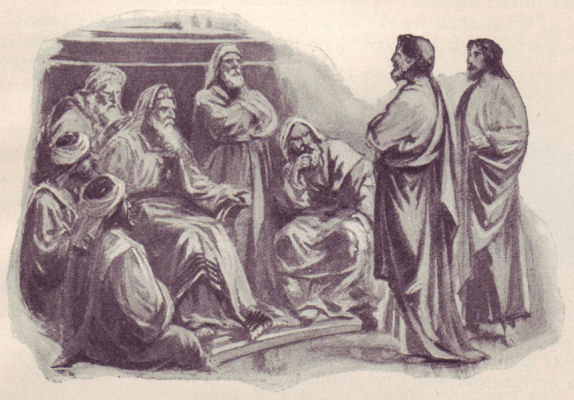 PETER AND JOHN BEFORE THE RULERS |
When these rulers saw how bold and strong were the words of Peter and John, they wondered, especially as they knew that they were plain men, not learned in books, and not used to speaking. They remembered that they had seen these men among the followers of Jesus, and they felt that in some way Jesus had given them this power. And as the man who had been healed was standing beside them, they could say nothing to deny that a wonderful work had been done.
The rulers sent Peter and John out of the council-room, while they talked together. They said to each other:
"What shall we do to these men? We cannot deny that a wonderful work has been done by them, for everyone knows it. But we must stop this from spreading any more among the people. Let us command them not to speak to any man about the name of Jesus; and let us tell them that if they do speak, we will punish them."
So they called the two apostles into the room again, and said to them: "We forbid you to speak about Jesus, and the power of his mane, to any man. If you do not stop talking about Jesus, we will lay hands on you, and put you in prison, and will have you beaten."
But Peter and John answered the rulers"
"Whether it is right to obey you or to obey God, you yourselves can judge. As for ourselves we cannot keep silent; we must speak of what we have seen and heard."
The rulers were afraid to do any harm to Peter and John, because they knew that the people praised God for the good work that they had done; and they would be angry to have harm come to them. For fear of the people, they let them go. And being let go, they went to their own friends, the company who met in the upper room, and there they gave thanks to God for helping them to speak his word without fear.
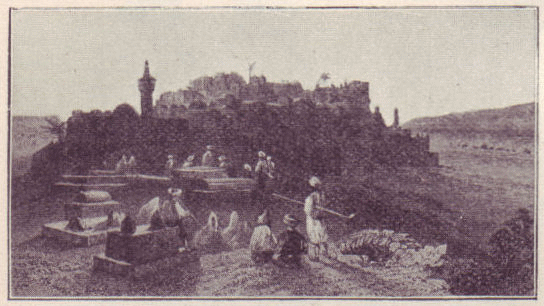 JOPPA |
The Right Way to Give and the Wrong Way
In those early days the Church of Christ in Jerusalem was like a great family; for each one was full of love for all the others. No one said of any thing that he owned, "This is mine," but the had all things together, as belonging to all. Those who owned lands or houses sold them, and brought the money, and laid it down at the feet of the apostles. This was not because a rule was made commanding it; but because each member loved the rest, and wished to help them. The money that was given in this free way the apostles divided among those that were poor, so that no one among those who believed in Christ was in need.
There was one man especially who gave away all that he had to help the Church. His name was Joseph, but he was called "Barnabas," which means "The one who encourages," because he was so helpful and cheering in his words. Barnabas sold his land, and gave the money from it to the apostles, that they might help with it those who were poor; and Barnabas spent all his time, as well as his money, in doing good.
But there was another man in the Church at Jerusalem whose spirit was not that of Barnabas, to give up all and live fully for the Lord. This man, whose name was Ananias, wanted to have the name of giving all, while he kept a part for himself. Ananias sold some land which he had owned, and agreed with his wife Sapphira to give a part of the money to the apostles for the Church, and to keep back a part for themselves. This they had a right to do, or even to keep it all. But they agreed together to act as though they were giving all the money, and that was agreeing together to tell a lie.
Ananias brought his money and laid it down before the apostles. But Peter, by the power of God, saw what was in the thought of Ananias, and said to him, "Ananias, why has the evil spirit filled your heart to tell a lie by your act, in keeping back part of the money? Before it was sold was not the land your own? And after it was sold, was not the money in your hand? You have tried to tell a lie, not to man, but to God; and God will judge you."
As Peter spoke these words, Ananias fell down before him, and in a moment was laying dead upon the floor. The young men in the meeting took up his dead body, and wrapped it with long rolls of cloth, and carried it out and buried it as was the manner of the Jews.
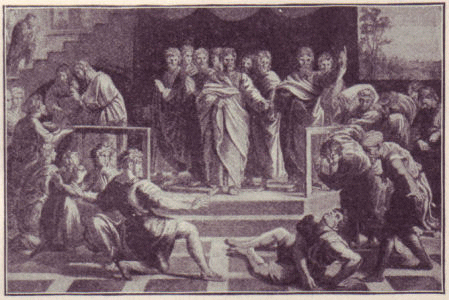 DEATH OF ANANIAS |
After three hours Sapphira, the wife of Ananias, came into the room. She did not know that her husband was dead, for no one had told her; such was the fear upon all.
Peter said to her, "Tell me, did you sell the land for so much?" And he named the sum that Ananias had placed before him.
Sapphira said, "Yes that was the price of the land."
But Peter said to her, "How is it that you two people agreed together to bring down God’s anger upon you? Those who have buried your husband are at the door, and they shall carry you out also!"
Then Sapphira fell down, struck dead by the power of God. The young men coming in found her dead; and they carried out her body and buried it beside her husband. A great fear came upon all the church, and upon all who heard how Ananias and Sapphira died. After that no one dared to try and deceive the apostles in their gifts to the Lord’s church.
And every day the apostles went to the Temple; and standing in Solomon’s Porch, they preached to the people about Jesus, and salvation through his name. They wrought many wonders also in healing the sick. From the houses those that were sick were brought out into the street, lying on beds and couches, so that as the apostle Peter passed by, his shadow might fall on them. And from the villages around Jerusalem they brought people that had diseases, or were held by evil spirits; and by the power of God in the apostles they were all made well.
All these wonderful works brought great multitudes to hear the apostles, as they spoke in Solomon’s Porch. Very many believed in Christ as they heard, and men and women in great numbers were added to the church.
But all these things, the wonders wrought, the crowds brought together, and the people believing in Christ, gave offence to the high-priest and the rulers: for they were the ones who had led in sending Jesus Christ to the cross, only a few months before. These rulers sent their officers, who seized all the twelve apostles, and thrust them into the common prison of the city. But at night, an angel of the Lord came and opened the doors of the prison and brought the apostles out, and said"
"Go and stand in the Temple, and speak to the people all the words of this life."
Then, very early in the morning, just at the breaking of the day, they went into the Temple and preached to the people. On that day the high-priest and all the rulers met together, and sent to the prison-house to have the apostles brought before them. But the officers who were sent did not find them in the prison. They came back to the rulers and said: "The prison we found shut and locked, and the keepers standing at the doors; but when we opened the doors and went inside we found none of the prisoners there!"
When the captain of the Temple and the rulers herard this they wondered greatly; for they could not understand it. Then came some one, who said, "The men whom you put in prison are standing in the Temple and are teaching the people!"
Then again the captain of the Temple went with his officers, and again took the apostles, but without doing them any harm, for they were afraid that the people would stone them if they dealt harshly with these men, whom all held in high honor. They brought them into the hall where the rulers were met together. The high-priest said to them:
"We told you not to speak in this name, or about that man; and now you have filled Jerusalem with your teaching, and you are trying to bring the blood of this man upon us."
But Peter, in the name of all the apostles, answered the high-priest;
"We must obey God rather than men. You put Jesus to death, hanging him upon the cross. But the God of our fathers raised him from the dead, and lifted him up to be at his right hand as a Prince and a Saviour, to give the forgiveness of sins. And we declare these things: and God’s Holy Spirit tells us that they are true."
When the rulers heard these words they were made very angry, and thought of causing the apostles to be slain. But there was among them one very wise man, named Gamaliel, a man who was held in honor by all the people. Gamaliel asked to have the apostles sent out of the hall, while he would speak to the rulers. When the apostles were taken away, Gamaliel said:
"Ye men of Israel, be careful in what you do to these men. If what they say comes from themselves alone, it will soon pass away; but if it be of God, you cannot destroy it, and you may even find yourselves to be fighting against God. My advice to you is; do no harm to these men and leave them alone."
The rulers agreed with these words. They sent for the apostles, and caused them to be beaten; then they commanded them again not to speak in the name of Jesus, and they let them go. The apostles went forth from the meeting of the rulers, happy in suffering for the name of Jesus. And in the temple and among the homes of the people they did not cease from preaching Jesus as the Saviour and the Lord.
Stephen with the Shining Face
We have read how the members of the church in Jerusalem gave their money freely to help the poor. This free giving led to trouble, as the church grew so fast; for some of the widows who were poor were passed by; and their friends made complaints to the apostles. The twelve apostles called the whole church together, and said:
"It is not well, that we should turn aside from preaching and teaching the word of God, to sit at tables and give out money. But, brethren, choose from among yourselves seven good men, men who have the Spirit of God and are wise, and we will give this work to them; so that we can spend our time in prayer and in preaching the gospel."
This plan was pleasing to all the church; and they chose seven men, to take charge of the gifts of the people, and to see that they were sent to those who were in need. The first man chosen was Stephen, a man full of faith and of the Spirit of God; and with him were Philip and five other good men. These seven men they brought before the apostles; and the apostles laid their hands on their heads, setting them apart for their work of caring for the poor.
But Stephen did more than look after the needy ones. He began to preach the gospel of Christ; and to preach with such power as made every one who heard him feel the truth. Stephen saw before any other man in the church saw, that the gospel of Christ was not for Jews only but for all men; that all men might be saved if they would believe in Jesus; and this great truth Stephen began to preach with all his power.
Such preaching as this, that men who were not Jews might be saved by believing in Christ, made many of the Jews very angry. They called all the people who were not Jews "Gentiles," and they looked upon them with hate and scorn; but they could not answer, the words that Stephen spoke. They roused up the people and the rulers, and set them against Stephen, and at last they seized Stephen, and brought him before the great council of the rulers. They said to the rulers:
"This man is always speaking evil words against the Temple and against the law of Moses. We heard him say that Jesus of Nazareth shall destroy this place, and shall change the laws that Moses gave to us!"
This was partly true and partly false; but no lie is so harmless as that which has a little truth with it. Then the high-priest said to Stephen, "Are these things so?"
And as Stephen stood up to answer the high-priest all fixed their eyes upon him; and they saw that his face was shining, as though it was the face of an angel. Then Stephen began to speak of the great things that God had done for his people of Israel in the past; how he had called Abraham, their father, to go forth into a new land; how he had given them great men, as Joseph, and Moses, and the prophets. He showed them how the Israelites had not been faithful to God who had given them such blessings. Then Stephen said:
"You are a people with hard hearts and stiff necks, who will not obey the words of God and his Spirit. As your fathers did, so you do also. Your fathers killed the prophets whom God sent to them; and you have slain Jesus, the Righteous One!"
As they heard these things, they became angry against Stephen that they gnashed on him with their teeth, like wild beasts. But Stephen, full of the Holy Spirit, looked up toward heaven with his shining face; and he saw the glory of God, and Jesus standing on God’s right hand, and he said"
"I see the heavens opened and the Son of man standing on the right hand of God!"
But they cried out with angry voices, and rushed upon him, and dragged him out of the council-room, and outside the wall of the city. And there they threw stones upon him to kill him, while Stephen was kneeling down among the falling stones and praying:
"Lord Jesus, receive my spirit! Lord, lay not this sin up against them!"
And when he had said this he fell asleep in death, the first to be slain for the gospel of Christ.
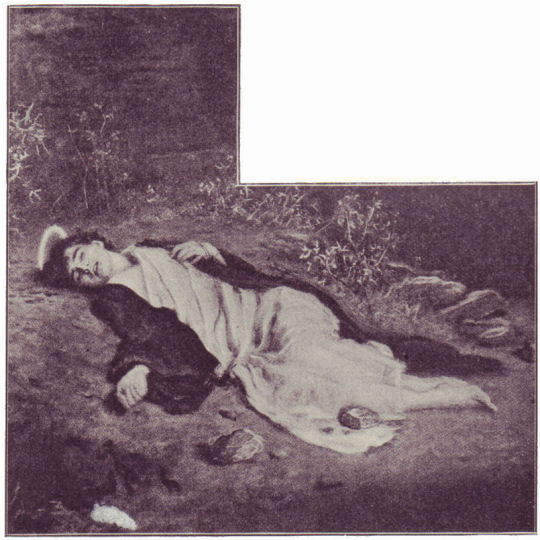 STEPHEN FELL ASLEEP |
Among those who stoned Stephen was a young man named Saul. He showed his fierce hate against Stephen and against the gospel which Stephen preached by holding the loose garments which the slayers of Stephen flung off, so that they might the more easily throw the stones upon him. Saul had heard Stephen speak; and he saw his glorious face, but he gave his help to those who killed him. And after Stephen had been slain, Saul went out to seize those who believed in Christ. He dragged men and women out of their houses, and thrust them into prison. He went into the synagogues and seized them as they were worshipping, and stripped off their garments, and caused them to be beaten.
By the hands of Saul and those who were with him the church of Christ, where so many had lived in love and peace, was broken up, and its members were scattered far and wide over the lands. The apostles stayed in the city, and no harm came to them, for they were kept hidden, but all the rest of the believers were driven away; and for the time the church of Christ seemed to have come to an end.
The Man Reading in the Chariot
We have seen how the first church of those who believed in Christ was broken up, and its members were driven away by the fury and rage of its enemy, the young man Saul. But as those who were scattered went into other places, they told the people about Christ and his gospel. And very soon new companies of believers in Christ began to rise up, all over the land. In place of one church n Jerusalem there were many churches among its cities and villages of Judea. Thus Saul, for all his hate toward Christ, really helped in spreading the gospel of Christ.
Among those driven away by Saul was a man named Philip, not Philip the apostle, but another Philip, who had been one of those chosen with Stephen to care for the poor. This Philip went down to the city of Samaria, near the middle of the land; and there he began to tell the people about Christ. These people were not Jews, but were of the race called Samaritans. The woman of Samaria, with whom Jesus talked at Jacob’s well, as we read in Story Eight of Part Sixth, was of this people.
The Lord gave to Philip the power to work many wonders among these Samaritans. At Philip’s word, evil spirits came out of men. Those who had the palsey were cured, and the lame were made to walk. The Samaritans saw these things done by Philip, and they believed that he spoke to them the words of God. Very many of them became believers in Christ, and were baptized; and there was great joy in that city.
At that time there was in Samaria a certain man named Simon, who had made the people believe that he had great power and could do wonderful things, by some magic that he used. But the works wrought by Philip through the power of Christ were so much greater and more wonderful than his own, that Simon himself listened to the teaching of Philip, claimed to believe in Jesus, and was baptized. But his heart had not been touched; he thought only that Philip’s magic was better than his own, and he hoped to find out what it was, so that he too could use it.
The twelve apostles, you remember, were still in Jerusalem; for they did not leave the city when Saul broke up the church. After a time Saul ceased to trouble, and some of the believers began to go back to Jerusalem. A new church grew up in that city around the apostles, though it never became as large or as whole-hearted as had been the church of the early days.
News came to the apostles of the great work wrought by Philip in Samaria, and they sent Peter and John to visit the new church in that place. Peter and John came to Samaria, and were glad when they saw how many and how faithful were the believers in Christ. They prayed for them, that the same power of the Holy Spirit that had come upon the disciples in Jerusalem might come upon those in Samaria; and the power of the Lord came when the apostles laid their hands on the heads of the believers.
When Simon saw that this strange power of God came with the laying on of the apostle’s hands, he offered Peter and John money, saying to them, "Sell me this power, so that I may give the Holy Spirit to those on whom I lay my hands."
But Peter said to him, "May your silver perish with you if you think to buy the gift of God with money! You do not really belong to Christ, and your heart is not right with God. Turn away from this your sin, and pray God that he will forgive you. For I see that you are yet in your sins, sins that are as bitter as gall; and you are fast bound in evil as with a Chain!"
Simon could not understand this, but he said, "Pray for me to the Lord, that none of these evils that you have named come upon me!"
After this Peter and John preached among many villages of the Samaritans, and then they went back to Jerusalem. Philip’s work in Samaria was now done, and an angel of the Lord spoke to him, saying:
"Rise up, and leave this city; and go toward the south, on the road that goes down from Jerusalem to Gaza."
This was a road through a desert region, without villages or people; but Philip at once obeyed the word that came from the Lord. He left Samaria and walked southward, until he came to the road between Jerusalem and Gaza. While he was on this desert road he saw a chariot drawing near, and in it was seated o black man reading from a roll. This man had come from the land of Ethiopia, in Africa, far to the south of Egypt. He was a nobleman of very high rank, the treasurer of the queen in that land; and though he was not a Jew, he had taken a journey of more than a thousand miles to Jerusalem, riding in his chariot all the way, that he might worship God in his Temple. He was now going back to his own land, and in his hands was the roll of the prophet Isaiah, from which he was reading aloud while he was riding on his journey.
As the chariot of this black man came in sight, the Spirit of the Lord said to Philip, "Go near, and stand close by the chariot."
And Philip ran toward the chariot, and spoke to the man, and said "Do you understand what you are reading?"
The nobleman answered him, "How can I understand it, unless some one tells me what it means? Can you show me? If you can, come up into the chariot and sit with me."
Then Philip came up and sat down in the chariot. The place where he was reading was the fifty-third chapter of Isaiah, with words like these:
|
"He was led as a sheep to the slaughter, And as a lamb before his shearer is dumb, So he openeth not his mouth. His story who shall tell? For his life is taken from the earth." |
These are the words that the prophet spoke of Jesus many hundreds of years before he came to the earth. Philip began with those words, and told the Ethiopian nobleman all about Christ. And the man believed, and took into his heart the word of the Lord. As they went on the way, they came to some water, and the nobleman said, "See, here is water! Why may I not be baptized?"
And Philip said to him, "If you believe with all your heart, you may be baptized."
And he answered, "I believe that Jesus Christ is the Son of God."
Then the nobleman gave order for the chariot to stand still; and Philip and the man went down into the water together, and he baptized him as a follower of Christ. And when they came up out of the water, the Spirit of the Lord took Philip away, so that the nobleman saw him no more; but he went on his way home, happy in the Lord.
Philip went next to a city near the shore, and there he preached; and from that place he went northward through the cities by the Great Sea, preaching in them all, until he came to Caesarea, and at Caesarea he stayed for many years.
The Voice That Spoke to Saul
Saul, The young man who had taken part in the slaying of Stephen, and who had scattered abroad the believers in Christ, was still the bitter enemy of the gospel. He heard that some of those who had fled away from Jerusalem had gone to Damascus, a city outside of the Jewish land, far in the north, and that they were still at work teaching Christ. Saul made up his mind to destroy this new church in Damascus, as he thought he had destroyed the church in Jerusalem. So he went to the high-priest, and said:
"Let me have a letter to the chief of the Jews in Damascus. I have heard that there are some followers of Jesus of Nazareth in that city; and I will go with some men, and will take these people, and bind them, and bring them in chains to Jerusalem."
The high-priest gave to Saul the letters that he asked for, and Saul found a band of men to go with him to Damascus. It was a journey of about ten days, riding on horses or mules. While Saul was on his way to Damascus he had time to think about Christ and his gospel. He saw again in his mind Stephen’s shining face, and heard his words, he thought of the sweet and patient way in which the followers of Jesus had met their sufferings and their wrongs at his hand. Deep in Saul’s heart there arose a feeling which he could not put down, that the gospel of Christ was true, and that it was wicked for him to fight against it. Yet he still went on, firm in his purpose to destroy the Church of Christ.
At last he came near to Damascus. Suddenly, at full noon, a light flashed from heaven, brighter far than the sun. For the time the light blinded Saul’s eyes, and it came so suddenly upon him that like a bolt of lightening it struck him down, and he fell upon the ground. In the midst of the light Saul saw One whom he had never seen before. And a strange voice came to him saying, "Saul, Saul, why are you fighting against me?"
And Saul answered the voice, "Who art thou, Lord?" Then the answer came, "I am Jesus, whom you are trying to destroy!"
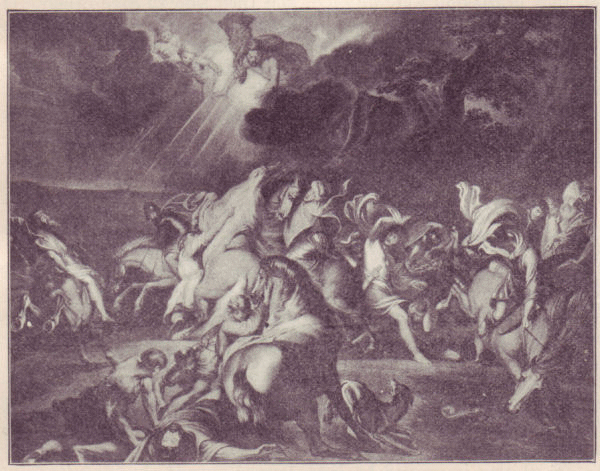 SAUL HEARS A STRANGE VOICE |
Then trembling with surprise and alarm, Saul said, "Lord, what wilt thou have me to do?"
And the Lord said to Saul, "Rise up, and go into the city, and it shall be told thee what thou must do."
Those who were with Saul wondered, for they had seen a light, and had heard a sound; but had beheld no face and had heard no words; for the vision of Christ had come to Saul alone. They raised him up from the ground, and found that his eyes had been made blind by the brightness of the light. They led him by the hand into the city, and took him to the house of a man named Judas. There Saul stayed for three days in the deepest suffering of mind and body. He could see nothing, and he neither ate nor drank. But in the darkness he was praying to God and to Christ with all his heart.
In the city of Damascus there was a follower of Christ named Ananias, a good man, held in respect by all who knew him. To this Ananias the Lord spoke, calling him by name, "Ananias."
And Ananias answered, "Here I am, O Lord."
And the Lord said to Ananias, "Rise, and go into the street named Straight, and find the house of Judas; and in that house ask for a man named Saul from Tarsus. This man Saul is praying; and in a vision he has seen a man named Ananias coming into his room and laying his hands on him, to give him his sight."
This command from the Lord was a surprise to Ananias. He answered the Lord, "Lord, I have heard from many people about this man Saul; what great evil he has done to all thy people in Jerusalem; and here he has an order from the high-priest to bind and to carry away all who call upon thy name! Shall I go and visit such a man as he?"
But the Lord said to Ananias, "Go thy way; for I have chosen this man to bear my name before the people of all nations, and kings and the children of Israel. And I will show him how many things he must suffer for my sake."
Then Ananias went, as the Lord had bidden him. He found the house, and he came to Saul. He laid his hands on the head of Saul, and he said, "Brother Saul, the Lord Jesus, who met you in the way as you were coming, has sent me, that you may have your sight, and that the Holy Spirit may come upon you. Now, wait no longer, but rise up , and be baptized, and call upon the name of Jesus, who will wash away your sins.
Then there fell from the eyes of Saul what seemed like scales, and at once his sight came to him. Saul was baptized as one who believed in Christ, and food was given him, and he became strong in body and in soul. Saul had gone forth to bind the disciples of Christ in Damascus; but now he came among them, no more as an enemy, but as a brother. And he went into the synagogues where the Jews worshipped in Damascus, and began to preach Jesus to them, declaring that Jesus is the Christ and the Son of God. And all that heard him were amazed and they said to each other, "Is not this the same man who in Jerusalem wrought ruin among them who believed in this name? And did he not come to this place, intending to bind the believers in Jesus, and bring them before the chief priests?"
And Saul grew stronger and stronger in his spirit and in his words. None of the Jews in Damascus could answer him, as he showed that Jesus us the Anointed One, the Christ? But he did not stay long in Damascus. After a time he left the city, and went away to a quiet place in the desert of Arabia, where he stayed for a year or longer, thinking upon the gospel and learning from the Lord.
And again Saul came to Damascus and again he preached Christ and salvation through his name, not only for Jews, but for Gentiles, all people besides the Jews. This made the Jews in Damascus very angry. They formed a plan to kill Saul, and they watched the gates day and night, hoping to seize him as he went out. But Saul’s friends, the disciples of Jesus, brought by night to a house on the wall, and let him down in a basket to the ground, so that he escaped from his enemies and went away in safety.
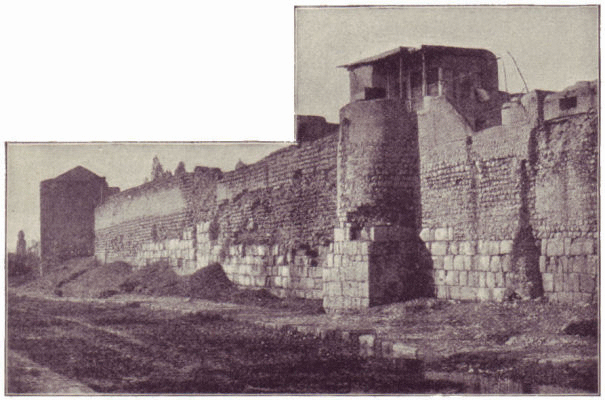 THE WALL WHERE SAUL WAS LET DOWN IN A BASKET, AS SHOWN TO-DAY |
Saul now journeyed back to Jerusalem. He had left it three years before, a bitter enemy of Christ; he came to it again a follower of Christ. But when Saul sought to join the believers in Jerusalem, they were all afraid of him; for they could not believe that one whom they had known as the fierce destroyer of the church was now a friend to Jesus. Then Barnabas, the man who had given all his land to the church, as we read in Story Three, believed in Saul when he heard his story, and brought him to Peter, and told how he had seen the Lord in the way, and how boldly he had preached in Damascus in the name of Jesus. Then Peter took the hand of Saul, and received him as a disciple of Christ. For a few weeks Saul stayed in Jerusalem; and he preached in the synagogues of the Jews, as Stephen had preached before, that Jesus is the Saviour not only of Jews but also of Gentiles ("Gentiles" was the name that Jews gave to people of every other nation except their own).
 DAMASCUS |
When Saul preached that Gentiles might be saved in Jesus Christ, it made the Jews angry, just as it had made Saul himself angry in other days to hear Stephen preach this same gospel. They would not listen to Saul, and they sought to kill him, as they had killed Stephen. One day Saul was praying in the Temple and the Lord came to him once again, and Saul saw Jesus and heard his voice saying, "Make haste, and go quickly out of Jerusalem, for the people here will not believe your words about me."
Then Saul said to the Lord, "Lord, they know that I put into prison and beat in the synagogues those who believed on thee. And when thy servant Stephen was slain I was standing by and was keeping the garments of those who stoned him."
And the Lord said to Saul, "Go from this place; for I will send thee far away to preach to the Gentiles."
Then Saul knew that his work was not to preach the gospel to the Jews, but to the Gentiles, the people of other nations. The disciples in Jerusalem helped him to get away from his enemies in the city, and led him down to a place called Caesarea, on the seashore. There Saul found a ship sailing to Tarsus, a city in Asia Minor. Tarsus was Saul’s birthplace and his early home. He went again to this place, and in that city he stayed for a few years, safe from the Jews. He was a tent-maked, and he worked at his trade while preaching the gospel in Tarsus. And we may be sure that Saul would not be silent about the good news of the gospel. He preached in Tarsus and in all the places near it.
 TARSUS |
Now Saul the enemy had become Saul the friend of the gospel, all the churches in Judea, and Samaria, and Galilee, had rest and peace. The followers of Christ could preach without fear; and the number of those who believed grew rapidly, for the Lord was with them.
All through the land, from Galilee down to the desert on the south, there were meetings of those who believed in Jesus as the Saviour, and the apostles Peter and John went among them to teach them the way of life.
What Peter Saw by the Sea
As the church was now planted in many cities throughout the land of the Jews, Peter, who was a leader among the apostles, went from place to place visiting the believers in Christ and preaching the gospel. At one time Peter went down to the plain beside the Great Sea, and came to a city called Lydda. There Peter found a man named Aeneas, who had the palsy, and culd not walk, and had been lying on his bed eight years. Peter said to him, "Aeneas, Jesus Christ makes you well; rise up and roll up your bed."
Then at once Aeneas arose, and was well; and he took up the roll of matting on which he had been lying so long, and laid it away. All the people in Lydda and in Sharon heard of this great work, and many turned to the Lord.
There had been living at Joppa, not far from Lydda, a very good woman, whom everybody loved. She was called "The Gazelle," which is the name of a beautiful animal, like a deer. For her name in Hebrew was Tabitha, and in Greek was Dorcas, words which mean "Gazelle". Tabitha, or Dorcas, was a believer in Christ, and like her Lord, she loved the poor and helped them. By her work and by her gifts.
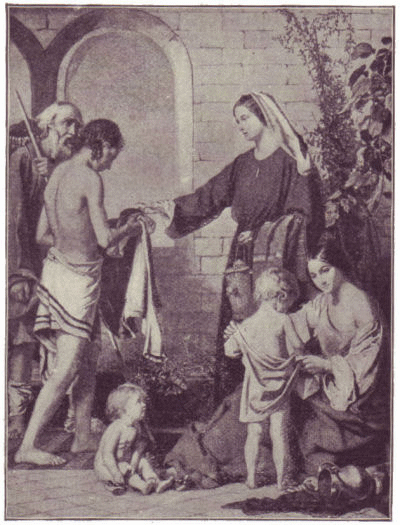 DORCAS HELPING THE POOR |
While Peter was at Lydda, Dorcas was taken ill and died. They laid her body in an upper room, and then they went two men to Lydda for Peter, begging him to come without delay. Peter went to Joppa at once; and when he came to the house where the body of Dorcas was lying he found the room filled with widows and poor women, who were weeping, and showing the garments which Dorcas had made for them. But Peter sent them all out of the room; and when he was alone with the body of Dorcas, he knelt down and prayed. Then he turned to the body and said. "Tabitha, arise!"
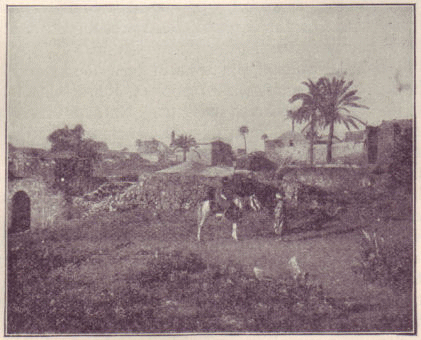 LYDDA AS SEEN TO-DAY |
And She opened her eyes; and when she saw Peter she sat up. Peter took her by the hand, and raised her up; then he called into the room the widows and the believers in Christ, and showed Dorcas to them, alive and well. The news of this wonderful work, of life given to the dead, amazed all the city of Joppa, and led many to believe in Christ. Peter stayed many days in Joppa, at the house of a man named Simon, who was a tanner, and lived near the sea.
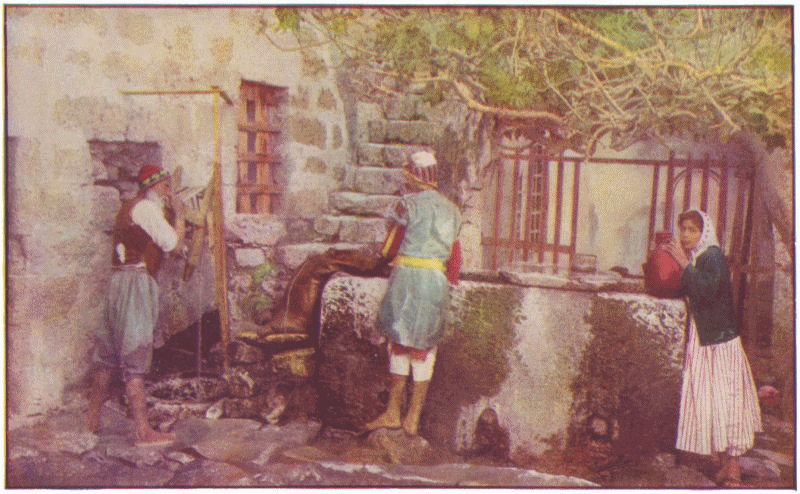 THE HOUSE OF SIMON THE TANNER IN JOPPA AS IT NOW IS |
At that time an officer of the Roman army was at Caesarea, about thirty miles north of Joppa, beside the Great Sea. His name was Cornelius; and he was the commander of a company of a hundred soldiers. We would call such an officer "a captain" but in the Roman army he was called "a centurion". The centurion Cornelius was not a Jew, but a Gentile, which was the name that the Jews gave to all people except themselves. Yet Cornelius did not worship idols, as did most of the Gentiles. He prayed always to the God of Israel, and feared God, and gave to the poor; and he taught his family to worship the Lord.
One day, in the afternoon, Cornelius was praying in his house, when an angel came to him and called him by name, "Cornelius!" Cornelius looked at this strange and shining being, and he was filled with fear, but he said, "What is it, Lord?"
And the angel said to him, "Cornelius, the Lord has seen your gifts to the people and has heard all your prayers. Now send men to Joppa, and let them bring to you a man named Simon Peter. He is staying in the house of Simon the tanner, who lives by the sea."
Then the angel passed out of sight, and Cornelius called two servants and a soldier who worshipped the Lord. He told them what the angel had said, and sent them to Joppa for Peter. These men traveled all night, following the road southward by the Great Sea, and about noon of the next day they drew near to Joppa.
On that day, just before these men came to Joppa at noon, Peter went up to the roof of the house to pray. He became very hungry, and wished for food; but while they were making ready the dinner he fell into a strange sleep, and a vision came to him. In his vision he saw what seemed to be a great sheet let down by its four corners from above. In it he saw all kinds of beasts, and birds, and creeping things. Some of these were animals and birds that the Jews were allowed to eat; but many others were of kinds that the old law forbade the Jews to eat; and such as were forbidden, the Jews called "common" and "Unclean". Peter saw in this great sheet many beasts, and birds, and creeping things that in his sight were common and unclean. As he looked, he heard a voice saying to him, "Rise, Peter; kill and eat."
Peter had always been very strict in keeping the Jewish rules about food, and he answered, "Not so, Lord; for I have never eaten anything common or unclean."
Then he hear the voice saying to him, "What God has made clean, do not thou make common or unclean."
Three times Peter heard these words spoken, and then the great sheet with all the living creatures in it was lifted up to heaven and passed out of his sight. Peter knew at once that the vision and the words which he had heard must have a great meaning; but as he thought upon it he could not see what the moaning was. While he was thinking of the vision and wondering at it, the Spirit of the Lord spoke to him, saying, "Peter, three men are looking for you. Go down to the door and meet them; and go with them, without doubting, for I have sent them."
Just at that moment, the three men from Caesarea Knocked at the door, and asked for Simon Peter. Peter met them, and said to them, "I am here, the man whom you are looking for. For what reason have you come to me?"
And they said, "Cornelius, a centurion at Caesarea, a good man, one that fears God, and is well spoken of by all the Jews, was yesterday commanded by a holy angel to send for you, and to listen to words from you.
Them Peter called the men into the house and heard all their story, and kept them there that night. On the next morning he went with them, and some of the believers from the church of Joppa went with the party. On the next day they came to Caesarea, and entered into the house of Cornelius. There they found Cornelius waiting for them, and with him a number of his family and his friends. As Peter came into the room, Cornelius fell down at his feet, and was about to worship him; but Peter raised him up, saying, "Stand up; I myself, also, am a man, and not God."
And as Peter looked around he saw many people that had net together; and they were all Gentiles, men who were not Jews. And Peter said, "You know that it is against the law of the Jews for a man that is a Jew to come into the house with one of another nation, or to meet with him. But God has showed me that I should not call any man common or unclean. For this reason I came at once when I was sent for. Now I ask for what purpose you have sent for me."
Then Cornelius said, "Four days ago I was praying, at three o'clock in the afternoon, when a man stood by me, clad in shining garments, and he said to me, 'Cornelius, your prayer is heard, and your good deeds are known to God. Send now to Joppa, and send for Simon who is called Peter.' I sent at once for you, and you have done well to come so soon. Now we are all here before God, to hear whatever God has given to you to speak to us."
Then Peter opened his mouth, and began to speak; for he saw now what the vision meant which he had seen on the housetop. He said, "I see now that God cares for all men alike, not for the people of one nation only; but that in every nation those that fear God and do right are pleasing to him." Then Peter began to tell the story of Jesus; how he lived, how he did good works, how he died, how he rose again, and how in Jesus Christ every one who believes may have his sins forgiven.
While Peter was speaking the Holy Spirit fell on all who were in the room. And the Jews who were with Peter were amazed as they saw the Spirit of God given to Gentiles, men who were not Jews. Then Peter said, "Can any man forbid that these should be baptized with water, upon whom the Spirit has come, and as he came upon us?"
Then by Peter's command these Gentile believers with Cornelius were baptized as members of Christ's Church. And Peter stayed with them a few days, living with Cornelius, and eating at his table, though he was a Gentile, something which Peter would never before have thought it right for him to do. Soon the news went through all the churches in Judea that Gentiles had heard the word and had been baptized. At first the Jewish believers could not believe that this should be allowed; but when Peter had told them all the story of Cornelius and the angel, of his own vision of the great sheet full of animals, and of the Spirit coming upon the Gentiles, then they all praised God, and said, "So to the Gentiles, as well as to the Jews, God has given to turn from their sins, and to be saved in Jesus Christ, and to have everlasting life."
How the Iron Gate Was Opened
You Remember that in the years while Jesus was teaching, Jerusalem and the part of the land near it was ruled by a Roman Governor, whose name was Pilate; and that he was the ruler who sent Jesus Christ to the cross. After some years, the emperor at Rome, who ruled all the lands around the Great Sea, gave all the country of the Jews to a man named Herod Agrippa, and made him King of Judea. He was the nephew of the Herod who killed John the Baptist, as was told in Story Eighteen of Part Sixth, and the grandson of the other Herod who killed all the little children of Bethlehem, in trying to kill the little child Jesus, as we read in Story Three Part Sixth. Herod Agrippa was the King of Judea when Peter saw the vision on the housetop, and preached to the Gentiles, as we read in the last Story.
Herod wished to please the Jews in Jerusalem; and he seized one of the apostles, James, the brother of John, one of the three disciples who had been nearest to Jesus. He caused his guards to kill James with the sword, just as John the Baptist had been killed by his uncle, Herod Antipas. When he saw how greatly this act pleased the chief priests and rulers, he laid hands on Simon Peter also, and put him in prison, intending at the next feast of the Passover to lead him forth, and to put him to death.
Peter, therefore, was kept in the prison, with sixteen soldiers around the prison to guard him, four soldiers watching him all the time; but all the church prayed very earnestly to God for him. On the night before the day when Peter was to be brought out to die, he was sleeping in the prison, bound with two chains, while guards before the door were watching. Suddenly a bright light shone in Peter's cell and an angel from the Lord stood by him. He angel struck him on the side, and awoke him, and said, "Rise up quickly."
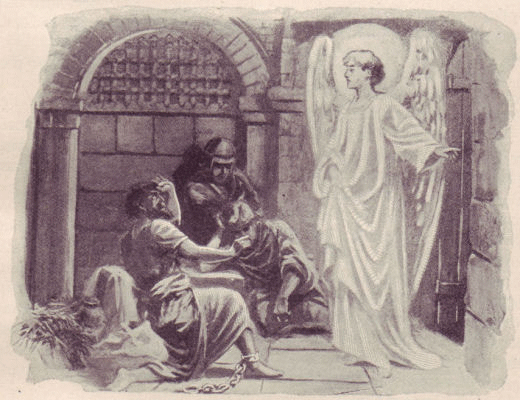 AN ANGEL ENTERS THE PRISON CELL |
And As Peter awaked and stood up, his chains fell from his hands. And the angel said to him:
"Tie your girdle about your waist, and bind your sandals on your feet."
And Peter did as he was told, scarcely knowing what he was doing. Then the angel said:
"Wrap your cloak around you and follow me."
And Peter followed the angel, thinking that he was dreaming. They passed the first guard of the soldiers, and the second; but no one stirred to hinder them. Then they came to the great iron gate on the outside of the prison; and this opened to them, as if unseen hands were turning it. They went out of the prison into the city, and passed through one street. Then the angel left Peter as suddenly as he had come to him. By this time Peter was fully awake and he said:
"Now I am sure that the Lord has sent his angel and has set me free from the power of King Herod."
Peter thought of what he should do, and where he should go; and he turned toward the house of a woman named Mary, who was near of kin to Barnabas; and who had a son named John Mark, then a young man, the same who many years afterward wrote "the Gospel according to Mark." At Mary's house many were net together, and they were praying for Peter.
Peter came to the house and knocked on the outside door, and called to those who were within. A young woman named Rhoda came to the door. She listened, and at once knew the voice of Peter. So glad was she that she did not think to open the door, but ran into the house, and told them all that Peter was standing at the door. They said to her, "You are crazed!"
But she said that she was sure that Peter was there, for she knew his voice. And then they said:
"It must be an angel who has taken Peter's form!"
But Peter kept on knocking; and when at last they opened the door, and saw him, they were filled with wonder. With his hand he beckoned to them to listen; and he told them how the Lord had brought him out of the prison. And Peter said to them:
"Tell these things to James and to the other apostles."
And then he went away to a place where Herod and his men could not find him. The morning came, and there was a great stir among the soldiers, as to what had become of Peter. Herod the king sought for Peter, but could not find him; and in his anger he ordered that the guards in the prison should be put to death. And not long after this Herod himself died so suddenly that many believed his death came from the wrath of God upon him. So Herod perished; but Peter, who he sought to kill lived many years, working for Christ.
The James of whom Peter spoke, when he said, "Tell these thing to James," was not James the apostle, the brother of John, for already that James had been put to death by Herod. He spoke of another James, a son of Joseph and Mary, a younger brother of Jesus, one who was always called "the Lord's brother." This James was a very holy man; and a leader of the church in Jerusalem, where he lived many years. Some time after this James wrote the book of the New Testament called "The Epistle of James."
The Earliest Missionaries
We Have seen how, after the death of Stephen, those who were driven out of Jerusalem went everywhere telling of Jesus. Some of these men traveled as far as to Antioch in Syria, which was a great city, far in the north, two hundred and fifty miles from Jerusalem. At first they spoke only to Jews, preaching the word of Christ; but soon many Gentiles, people who were not Jews, heard about the gospel and wished to have it preached also to them. So these men began preaching to the Gentiles, telling them about Jesus Christ and how to be saved.
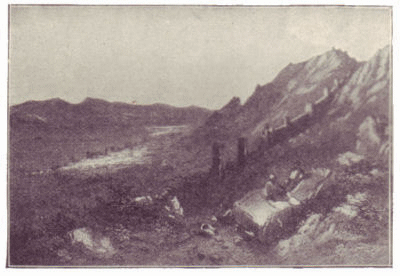 ANTIOCH IN SYRIA |
The Lord was with the gospel, and in a little time many believed in Christ, a great number, both of Jews and Gentiles. Thus at Antioch in Syria arose a church where Jews and Gentiles worshipped together and forgot that they had ever been apart. The news came to the mother-church in Jerusalem, that in Antioch Gentiles were coming to Christ. As all the followers of Christ in Jerusalem were Jews, they were not sure whether Jews and Gentiles could worship together as one people. It was decided, after a time, that some wise man should go from Jerusalem to Antioch and see this new church of Jews and Gentiles. For this errand they chose Barnabas, the good man who had given his land to be sold to help the poor, and who had brought Saul to the church when the disciples were afraid of him. So Barnabas took the long journey from Jerusalem to Antioch. When he saw these new disciples, so many, so strong in their love for Christ, so united in their spirit, and so earnest in the gospel, he was glad, and he spoke to them all, telling them to stand fast in the Lord. For Barnabas was a good man, full of the Holy Spirit and of faith.
The church at Antioch was growing so fast that it needed men for leaders and teachers. Barnabas thought of Saul, who had once been an enemy, but was now a follower of Christ. Saul was at that time in Tarsus, his early home; and to this place Barnabas went to find him. He brought Saul to Antioch, And there Barnabas and Saul stayed together for a year, preaching to the people and teaching those who believed in Christ. It was at Antioch that the disciples were first called by the name Christians.
At one time some men came from Jerusalem to Antioch, to whom God had showed things that should come to pass. These men were Prophets, speaking from God. One of them, a man named Agabus, said through the Spirit of God, that a great famine, a need of food, was soon to come upon all the lands. This came as Agabus the prophet had said, in the days when Claudius was emperor at Rome. Over all the lands food was very scarce, and many suffered from hunger. When the followers of Christ in Antioch heard that their brethren of Jerusalem and Judea were in need, they gave money, as each one was able, to help them; and they sent Barnabas and Saul with it. Barnabas and Saul carried the gifts of the church to Jerusalem, and stayed there for a time. When they went back to Antioch, they took with them the young man John Mark, the son of the Mary whose house Peter went when he was set free from prison, as we read in the last story.
Some time after they returned to Antioch, the Lord called Barnabas and Saul to go forth and preach the good news of Christ to the people in other lands. At one time, when the members of the church were praying together, the Spirit of the Lord spoke to them, saying, "Set Barnabas and Saul apart for a special work to which I have called them."
Then the leaders of the church at Antioch prayed, and laid their hands on the head of Barnabas and Saul. And Barnabas and Saul went forth, taking with them John Mark, the young man from Jerusalem as their helper. They went down to the shore of the Great Sea at Selucia, and took a ship, and sailed to the island of Cyprus, they met the Roman ruler of the island, a man named Sergius Paulus. He was a good man, and sent for Barnabas and Saul, that he might learn from them of Christ. But with the ruler was a Jew named Elymas, who claimed to be a prophet, and who opposed Barnabas and Saul in their teaching, and tried to persuade the ruler not to hear the gospel.
Then Saul, full of the Holy Spirit, fixed his eyes on this man Elymas, the false prophet, and said to him, "O thou man full of wickedness, thou child of the evil one, thou enemy of the right, wilt thou not stop to oppose the word of the Lord? The hand of the Lord is upon thee, and thou shalt be blind for a time, not able to see the sun!"
And at once a mist and a darkness fell upon Elymas, and he groped about, feeling for some one to lead him by the hand. When the ruler saw the power of the Lord in bringing this stroke of blindness upon his enemy, he was filled with wonder, and believed the gospel of Christ.
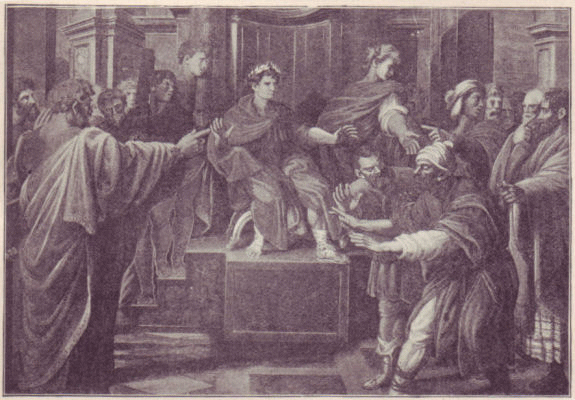 ELYMAS STRUCK BLIND |
From this time Saul ceased to bear his old name, and was called Paul. He was no longer Saul, but "Paul the Apostle," having all the power that belonged to Peter, and John, and the other apostles.
From the island of Cyprus, Paul and Barnabas and John Mark sailed over the sea to a place called Perga. At this place John Mark left them, and went back to his home in Jerusalem. But Paul and Barnabas went into the land of Asia Minor, and came to a city called Antioch. This was not Antioch in Syria, from which they had come, but another Antioch in a region called Pisidia. There they went into the synagogue, and Paul preached to both Jews and Gentiles. Not many of the Jews believed Paul's words, but a great number of the Gentiles, people who were not Jews, became followers of Christ. This made the Jews very angry, and they roused up against Paul and Barnabas all the chief men of the city and they drove Paul and Barnabas away. They went to Iconium, another city, and there they preached the gospel with such power that many of both Jews and Gentiles believed in Christ. But the Jews who would not believe stirred up the city against Paul and Barnabas. They gathered a crowd of people, intending to seize the apostles and to do them harm, and to kill them. But they knew of the coming of their enemies, and as they had now done their work in Iconium, and had planted the church, they quietly went away from the city.
The apostles Paul and Barnabas next went to the city of Lystra, in the land of Lycaonia, and there they preached the gospel. There were few Jews in that city, and they preached to the people of the land who were worshippers of idols. Among those who heard Paul speak at Lystra was a lame man, who had never been able to walk. Paul fixed his eyes on this man, and saw that he had faith to be made strong. He said to him with a loud voice, "Stand up on your feet!"
And at the words the man leaped up and walked. As the people saw how the lame man had been healed they were filled with wonder, and said, in the language of their land, "The gods from heaven have come down to us in the forms of men!"
They thought that Barnabas was Jupiter, whom they worshipped as the greatest of the gods; and because Paul was the chief speaker, they thought that he was Mercury, the messenger of the gods. In front of their city was a temple of Jupiter; and the priest of the temple brought oxen, and garlands of flowers, and was about to offer a sacrifice to Barnabas and Paul as gods. It was some time before the two apostles understood what the people were doing. But when they saw that they were about to offer sacrifice to them, Paul and Barnabas rushed out among the people, and cried out, "Men, why do you do such things as these? We are not gods, but men like yourselves. And we bring you word that you should turn from these idols, which are nothing, to the living God, who made the heaven and the earth, and the sea, and all things. It is God who has done good to you, and given you from heaven rains and fruitful seasons, filling you with food and gladness."
 PAUL AND BARNABAS REFUSE THE SACRIFICE |
And even with words like these they could scarcely keep the people back from offering sacrifices to them. But after a time some Jews came from Iconium. These Jews stirred up the people against Paul, so that instead of worshipping him, they stoned him, and dragged out of their city what they supposed was his dead body. Then they left him, and as the believers gathered around, weeping, Paul rose up alive, and went again into the city. On the next day he journeyed with Barnabas to Derbe. There they preached the gospel and led many as disciples to Christ. After this they went again to the cities where they had preached, to Lystra in Lycaonia, to Iconium and Antioch in Pisidia, and to Perga in Pamphylia, and visited the churches which they had founded. They encouraged the believers, telling them to continue in the faith, and saying to them that those who would enter into the kingdom of God must expect to meet with trouble, and that God would give them a full reward.
The Song in the Prison
After Paul and Barnabas brought to Antioch the news that the Gentiles had turned to the Lord, a great question arose in the Church. Some of the strict Jews said, "All these Gentile believers must become Jews, and keep the Jewish laws about food, and feasts, and washings and offerings."
Others said that the laws were made for Jews only, and that Gentiles who believed in Christ were not called upon to live as Jews. After many words on both sides, Paul and Barnabas, with other believers, went up to Jerusalem to lay this matter before the apostles and the elders of the Church. They listened to Paul's story of God's great work among the Gentiles, and talked about it, and sought God in prayer, and at last the apostles, and elders, and the whole Church in Jerusalem, sent a message to the Gentiles who believed, telling them that Jews and Gentiles were alike before God, that both were saved by believing in Christ, and that Gentiles who believed were not called upon to keep the laws given to the Jews only.
The apostles sent with Paul and Barnabas two men, Judas and Silas, to bring this news to the Church at Antioch. They came, and read the letter, which brought great joy to the Gentiles Believers. For now the Gentiles who believed in Christ were able to serve the Lord without obeying all the rules which the Jews themselves found very hard to keep.
After a time Paul said to Barnabas, "Let us go again and visit the brethren in the cities where we preached the gospel, and see how they are doing."
Barnabas was willing to go and wished to take again with them John Mark as their helper in the work. But Paul did not think it well to take with them the young man who went home in the middle of their journey, and left them to visit strange lands alone. Barnabas was determined to take Mark, and Paul refused to have him go, so at last Paul and Barnabas separated. Barnabas took Mark, and went again to the island of Cyprus. Paul chose as his helper Silas who had come from Jerusalem to Antioch, and Paul and Silas went together through the lands in Asia Minor, which Paul had visited on his earlier journey. Everywhere they sought out the churches, which before had been planted by Paul and Barnabas, and they encouraged the disciples to be faithful in the Lord.
When Paul came to Derbe and Lystra he found a young man named Timothy, whose mother was of the Jewish race and a believer in Christ. Timothy had known the word of God from his childhood; he had given his heart to Christ, and all the believers in Christ at Lystra and Iconium knew him and spoke well of him. Paul asked this young man Timothy to leave his home and to go out with him as his helper in the gospel. Timothy went and from that time was with Paul as a friend and a fellow-worker, dearly beloved by Paul. Paul, and Silas, and Timothy went through many lands in Asia Minor, Preaching the gospel and planting the church. The Spirit of the Lord would not let them go to some places, which were not yet ready for the gospel, and they came down to Troas, which was on the sea, and opposite to the land of Macedonia in Europe.
While they were at Troas a vision came to Paul in the night. He saw a man of Macedonia standing before him, and pleading with him and saying, "Come over into Macedonia, and help us."
When Paul told this vision to his friends they all knew that this was a call from the Lord to carry the gospel of Christ to Macedonia. As soon as they could find a vessel sailing across the sea they went on board, and with them went a doctor named Luke, who at this time joined Paul. Luke stayed with Paul for many years, and Paul called him "the beloved physician." Afterward Luke wrote two books, which are in the Bible, "The Gospel according to Luke," and "The Acts of the Apostles."
Paul and his three friends set sail from Troas; and on the third day they came to the city of Philippi, in Macedonia; and there they stayed for some days. There was no synagogue in that city, and scarcely any Jews; and on the Sabbath-day Paul and his company went out of the city gate to the riverside where was a place of prayer. There they sat down and talked with a few women, who had met together to pray. One of there was a woman named Lydia, who had come from Thyatira in Asia Minor, and was a seller of purple dyes. She was one who was seeking after God, and the Lord opened her heart to hear the words of Paul, and to believe in Christ. She was baptized, the first one brought to the Lord in all Europe; and with her all in her house were baptized also. Lydia said to Paul and to his company, "If you count me as one who is faithful to the Lord, come into my house, and stay there."
She urged them so strongly that they all went to Lydia's house, and made it their home while they were in the city. One day while they were going to the place of prayer, a young woman who had in her an evil spirit, met them. She was a slave-girl, and through the spirit in her, her owners pretended to tell what was to happen; and by her they made great gains of money. As soon as she saw Paul and his friends, she cried out, "These men are servants of the Most High God, who tell you the way to be saved."
And this she did day after day, following Paul and his companions. Paul was troubled to see her held in the power of the evil spirit; and he spoke to the spirit, " I command thee in the name of Jesus Christ to come out of her!"
And in that very hour the spirit left the girl. But with the evil spirit gone from her, there were no more gains to her masters. They were very angry, and took hold of Paul and Silas, and dragged them before the rulers of the city, and they said, "These men, who are Jews, are making great trouble in our city, and are teaching the people to do what is against the law for Romans."
And they stirred up the crowd of the lowest of the people against them. To please the throng, the rulers stripped off their garments from Paul and Silas, and commanded that they should be beaten with rods. When they had received many cruel blows, they were thrown into the prison, and the jailor was charged to keep them carefully. He took them, all beaten and wounded, into the dungeon, which was in the very middle of the prison, and made their feet fast in the stocks.
But about midnight Paul and Silas were praying and singing hymns of praise to God, and the other prisoners were listening to them. Suddenly there was a great earthquake, so that the foundations of the prison-house were shaken; every door was opened, and all the chains on the prisoners were loosed, and all could have gone out free if fear had not held them in their places. The jailor of the prison was suddenly roused out of sleep and saw the prison-doors wide open. By the laws of the Romans, a man in charge of a prisoner must take his place if his prisoner escaped, and the jailor, thinking that the men in the prison had gotten away, drew out his sword, and was just going to kill himself, when Paul called out, "Do yourself no harm, for we are all here."
Then the jailor called for lights, and sprang into the room where Paul and Silas were, and, trembling with fear, fell down at their feet and cried out, "O, sirs, what must I do to be saved?"
And they said, "Believe on the Lord Jesus Christ, and you shall be saved, and those in your house with you."
And that night, in the prison, they spoke the word of the Lord to the jailor, and to all that were with him. The jailor washed their wounds, and he and all his family were baptized in that hour. Afterward, he brought them from the prison into his own house, and set food before them. And the jailor and his household were all happy in the Lord, believing in Christ.
The rulers of the city knew well that they had done an unjust act in beating Paul and Silas, and thrusting them into prison; but they did not know that Paul and Silas, though Jews, were also free citizens of Rome, whom it was unlawful to beat or to put in prison without a fair trial. In the morning the rulers sent their officers to the jailor, saying, "Let those men go." And the jailor brought their words to Paul and said, "The rulers have sent to me to let you go; therefore, now come out of the prison, and go in peace."
But Paul said, "We are free citizens of Rome, and without a trial they have beaten us, and have cast us into prison. And now do they turn us out secretly? No, indeed, let those rulers come themselves and bring us out!"
The officers told these words to the rulers, and when the learned that these men were Roman citizens, they were frightened; for their own lives were in danger for having beaten them. They came to Paul and Silas, and begged them to go away from the prison and from the city. Then Paul and Silas walked out of the prison, and went to the house of Lydia. They met the brethren who believed in Jesus, and spoke to them words of comfort and of help. And then they went out of the city. In Philippi, from this time there was a church which Paul loved greatly and to which in after-times he wrote "The Epistle (or letter) to the Philippians."
Paul's Speech on the Hill
From Philippi, Paul and Silas went to Thessalonica, which was the largest city in Macedonia. There they found many Jews, and a synagogue where the Jews worshipped. For three weeks Paul spoke at the meetings in the synagogue, and showed the meaning of the Old Testament writings that the Saviour for whom all the Jews were looking must suffer, and die, and rise again from the dead. And Paul said to them:
"This Jesus whom I preach to you, is the Christ, the Son of God and the King of Isreal."
Some of the Jews believed Paul's teachings, and a far greater number of the Greeks, the people of the city who were not Jews, became followers of Christ. And with them were some of the leading women of the city, so that a large church of believers in Christ arose in Thessalonica.
But the Jews who would not believe in Jesus were very angry as they saw so many seeking the Lord. They stirred up a crowd of the lowest people of the city, and raised a riot, and led a noisy throng to the house of a man named Jason, with whom they supposed that Paul and Silas were staying. The crowd broke into the house, and sought for Paul and Silas, but could not find them. Then they seized Jason, the master of the house and some other friends of the apostles, and dragged them before the rulers of the city, and cried out:
"These men who have turned the whole world upside down, have come to this city, and Jason has taken them into his house. They are acting contrary to the laws of Caesar the emperor, for they say that there is another king, a man whose name is Jesus."
The rulers of the city were greatly troubled when they saw these riotous people, and heard their words. They knew that Jason and his friends had done nothing against the law of the land; but to content the crowd they made the believers promise to obey the laws, and then they let them go free. The brethren of the church sent away Paul and Silas, in the night-time, to the city of Berea, which was not far from Thessalonica. There again they found a synagogue of the Jews, and, as in other places, Paul went into its meetings and preached Jesus, not only to the Jews, but also to the Gentiles, many of whom worshipped with the Jews.
These people were of a nobler spirit than the Jews of Thessalonica, for they did not refuse to hear Paul's teachings. They listened with open minds, and every day they studied the Old Testament writings, to see whether the words spoken by Paul were true. And many of them became believers in Jesus, not only the Jews, but the Gentiles also; for those who study the Bible will always find Christ in its pages. But the news went to Thessalonica, that the word of Christ was being taught in Berea. The Jews of Thessalonica sent some men to Berea, who stirred up the people against Paul and Silas. To avoid such a riot as had arisen in Thessalonica, the brethren in Berea took Paul away from the city, but Silas and Timothy stayed for a time.
The men who went with Paul led him down to the sea, and went with him to Athens. There they left Paul alone, but took back with them Paul's message to Silas and Timothy to hasten to him as quickly as they could come. While Paul was waiting for his friends in Athens, his spirit was stirred in hem as he saw the city full of idols. It was said that in the city of Athens the images of the gods were more in number than the people. Paul talked with the Jews in the synagogue, and in the public square of the city with the people whom he met. For all the people of Athens, and those who were visiting in that city, spent most of their time in telling or in hearing whatever was new. And there were in Athens many men who were thought very wise, and who were teachers of what they called wisdom. Some of these men met Paul, and as they heard him, they said scornfully, "What does this babbler say?"
And because he preached to them of Jesus, and of his rising from the dead, some said, "This man seems to be talking about some strange gods!"
There was in Athens a hill, called Mars' Hill, where a court was held upon seats of stone ranged around. They brought Paul to this place, and asked him, saying, "May we know what is this new teaching that you are giving? You bring to our ears some strange things, and we wish to know what these things mean."
Then Paul stood in the middle of Mars' Hill, with the people of the city around him, and he said:
"Ye men of Athens, I see that you are exceedingly given to worship. For as I passed by I saw an altar, upon which was written these words, 'TO THE UNKNOWN GOD.' That God whom you know not, and whom you seek to worship, is the God that I make known to you. The God who made the world and all things that are in it, is Lord of heaven and earth, and does not dwell in temples made by the hands of men; nor is he served by men's hands, as though he needed anything. For God gives to all men life, and breath, and all things. And he has made of one blood all the peoples who live on the earth: that all men should seek God, and should feel after him, and should find him; for he is not far away from any of us. For in him we live, and move, and have our being: even as some of your own poets have said, 'For we also are the children of God.' Since we are God's children, we should not think that God is like gold, or silver, or stone, wrought by the hands of men. Now God calls upon men to turn from their sins; and he tells us that he has fixed a day when he will judge the world through that man Jesus Christ whom he has chosen, and whom he has raised from the dead."
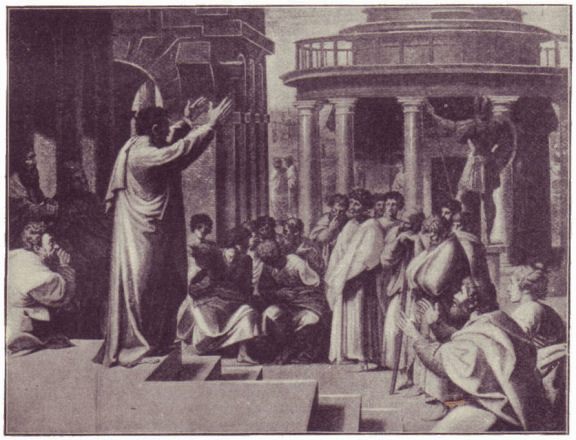 PAUL PREACHING ON MARS' HILL |
When they heard Paul speak of the dead being raised, some laughed in scorn; but others said, "We will hear you again about this." After a time Paul went away from Athens. Very few people joined with Paul, and believed on Jesus. Among these few was a man named Dionysius, one of the court that met on Mars' Hill, and a woman named Damaris. A few others joined with them; but in Athens the followers of Christ were not many.
Paul at Corinth
Paul went from Athens to Corinth, another city in the land of Greece. He was alone, for his fellow-workers, Silas and Timothy, had not yet come from Thessalonica. But in Corinth, Paul met people who soon became his dear friends. They were a man named Aquila and his wife Priscilla, who had lately come from Rome to Corinth. Every Jew in those times was taught some trade, and Paul's trade was the weaving of a rough cloth used for making tents. It happened that Aquila and Priscilla were tent-makers also, and so Paul went to live in their house, and they worked together at making tents.
On the Sabbath-days Paul went into the synagogue, and there preached the gospel and talked about Christ with the Jews and also with the Greeks who worshipped God in the synagogue. Some believed Paul's words, and some refused to believe, but opposed Paul, and spoke against him. After a time Silas and Timothy came from Thessalonica to meet Paul. They brought to him word about the church at Thessalonica, and some questions that were troubling the believers there. To answer these questions, Paul wrote from Corinth two letters, which you can read in the New Testament. They are called "The First Epistle to the Thessalonians," and "The Second Epistle to the Thessalonians." These two letters are the earliest of Paul's writings that have been kept. We do not know that Paul wrote any letters to churches earlier than these; but if he did write any, the letters have been lost.
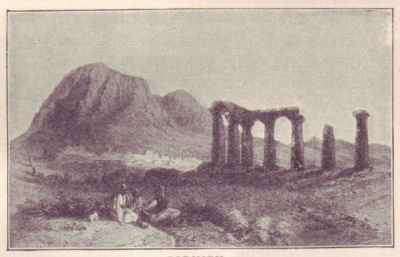 CORINTH |
Now that Silas and Timothy, as well as Aquila and Priscilla, were with Paul, he was no more alone, and he began to preach even more earnestly than before, telling the Jews that Jesus was the Christ of God. When he found that the Jews would not listen, but spoke evil words against him and against Christ, Paul shook out his garment, as though he were shaking dust from it, and he said to the Jews, "Your blood shall be upon your own heads, not on me; I am free from sin, for I have given you the gospel, and you will not hear it. From this time I will cease speaking to you and will go to the Gentiles."
And Paul went out of the synagogue, and with him went those who believed in Jesus. He found a house near to the synagogue belonging to a man named Titus Justus, a Gentile who worshipped God, and in that house Paul preached the gospel to all who came, both Jews and Gentiles. Many who heard believed in Christ, and were baptized; and among them was a Jew named Crispus, who had been the chief ruler of the synagogue. But most of those who joined the Church of Christ in Corinth were not Jews, but Gentiles, men and women who turned to God from Idols. One night the Lord came to Paul in a vision, and said to him, "Paul, do not be afraid; but speak and do not hold thy peace. I am with thee, and no one shall come against thee to do thee harm; for I have many people in this city."
And Paul stayed in Corinth a year and six months, teaching the word of God. After a time the Jews in a great crowd rushed upon Paul, and seized him, and brought him into the court before the Roman governor, "This man is persuading people to worship God in a way forbidden by the law."
Paul was just opening his mouth to speak in answer to this charge when Gallio, the governor, spoke to the Jews, "O ye Jews, if this were a matter of wrongdoing or of wickedness, I would listen to you. But if these are questions about words, and names, and your law, look after it yourselves, for I will not be a judge of such things." And Gallio drove all the Jews out of his court. Then some of the Greeks seized Sosthenes, who was the chief ruler of the synagogue, and beat him before the judge's seat in the courtroom. But Gallio did not care for any of these things; for he thought it was a quarrel over small matters.
After staying many days Paul took leave of the brethren in the church at Corinth, and sailed away in a ship across the Ægean Sea to Ephesus, which was a great city in Asia Minor. With Paul were his friends Aquila and Priscilla. At Ephesus, Paul went into the synagogue of the Jews and talked with them about the gospel and about Christ. He could stay only for a little while, although they asked him to remain longer; but he said, "I must go away now; but if it be the will of God, I will come again to you."
And he set sail from Ephesus, but left Aquila and Priscilla there until he should return. Paul sailed over the Great Sea to Caesarea, in the land of Judea. At that place he landed, and from thence went up to Jerusalem, and visited the mother-church. Then he journeyed back to Antioch, the city from which he had set forth.
And this was the end of Paul's second journey among the Gentiles preaching the gospel.
Paul at Ephesus
The Apostle Paul did not stay long at Antioch, but soon started out for another journey among the churches already formed and into new fields. He went through Syria, the country around Antioch, and then to the region near Tarsus, which had been his early home, everywhere preaching Christ. He crossed over the mountains and entered into the heart of Asia Minor, coming to the land of Galatia. The people in this land were a warm-hearted race, eager to see and to hear new things. They listened to Paul with great joy, and believed at once in his teachings. Paul wrote afterward that they received him as an angel of God, as though he were Jesus Christ himself, and that they were ready to pluck out their own eyes and give them to him, so eager were they to have the gospel.
But soon after Paul went away some Jewish teachers came, saying to these new believers, "You must all become Jews, and take upon you the whole Jewish law, with all its rules about things to be eaten, and fasts, and feast-days, or you cannot be saved."
And the people in Galatia turned quickly away from Paul's words to follow these new teachers; for they were found of change, and were not firm in their minds. There was danger that all Paul's work among them would be undone. But as soon as news came to Paul of their sudden turning from the truth of the gospel he wrote to them a letter, "The Epistle to the Galatians." In this letter he called them back to Christ, and showed them that they were free and not slaves to the old law, and urged them to stand fast in the freedom which Christ had given them.
Paul went through Phrygia, and from that land came again to Ephesus, which he had visited before, as we read in the last Story. This time he stayed in Ephesus more than two years, preaching the gospel of Christ. At first he spoke in the synagogue of the Jews, telling the Jews that Jesus was the Anointed Christ, the King of Israel, and proving it from the prophets of the Old Testament. But when the Jews would no longer listen to him, but spoke against the way of Christ, Paul left the synagogue, and spoke every day in a school room which was opened to him. His work became so well known that almost all the people in Ephesus, and many in the lands around the city, heard the work of the Lord.
God gave to Paul at this time great powers of healing. They carried to the sick the cloths with which Paul had wiped the sweat from his face, and the aprons that he had worn while he was at work making tents, and the diseases left the sick, and evil spirits went out of men. These wonderful works drew great crowds to hear Paul, and led man more to believe in his words.
There were in that city some Jews who wandered from place to place, pretending to drive evil spirits out of men. These men saw how great was the power of the name of Jesus as spoken by Paul, and they also began to speak in Jesus' name, saying to the evil spirits in men, "I command you to come out, in the name of Jesus, whom Paul preaches."
And the evil spirit in one man answered two of these pretenders, "Jesus I know, and Paul I know; but who are your?"
And the man in whom the evil spirit was, leaped upon them, so that they ran out of the house naked and covered with wounds. Everybody in the city, both Jews and Greeks, heard of this, and all knew that even the evil spirits feared the name of Jesus as spoken by Paul. And many of those who had dealt with evil spirits came and confessed their deeds and turned to the Lord. And some who had books claiming to tell how to talk with spirits brought them, and burned them as bad books, although the books had cost a great sum of money. Thus the work of the Lord grew in Ephesus, a great number believed in Christ, and a large church arose.
Paul now began to feel that his work in Ephesus was nearly finished. He thought that he would go across the Ægean Sea, and visit the churches at Philippi and Thessalonica and Berea, in the land of Macedonia, and then the church at Corinth in Greece, and then go once more to Jerusalem.
"And after I have been there," said Paul, "then I must also see Rome."
So to prepare for his coming into Macedonia he sent Timothy, and another friend named Erastus, while he himself stayed in Ephesus for a time longer. But soon after this a great stir arose in that city over Paul and his preaching.
In the city of Ephesus was standing at that time an idol-temple, one of the greatest and richest in all the world. Around the temple stood a hundred and twenty great columns of white marble, each column the gift of a king. And in it was an image of the goddess Diana, which the people believed had fallen down from the sky. People came from many lands to worship the idol-image of Diana; and many took away with them little images like it, made of gold or silver. The making and selling of these little images gave work to many who wrought in gold and silver, and brought to them great riches.
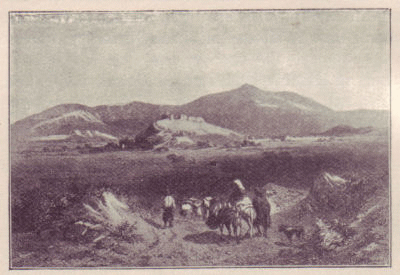 EPHESUS |
One of these workers in silver, a man named Demetrius, called together his fellow-workmen, and said to them, "You know, my friends, that by this trade we earn our living and win riches. And you can all see and hear that this man Paul has persuaded and turned away many people, not only in this city, but also throughout all these lands, by telling all men that there are no gods which are made by hands. There is danger that our trade will come to and end, and danger, too, that the temple of the great goddess Diana may be made of no account. It may be even that the goddess whom all Asia and all the world worships shall fall down from her greatness." When the workmen heard this they became very angry, and they set up a great cry, shouting out, "Great is Diana of the Ephesians! Great is Diana of the Ephesians!"
And soon the whole city was in an uproar; people were running through the streets and shouting, and a great multitude was drawn together, most of them not knowing what had caused the crowd and the noise. In the side of the hill near the city was a great open place hollowed out, having stone seats around it on three sides. It was used for public meetings, and was called "the theatre." Into this place all the people rushed, until it was thronged; while Demetrius and his fellow-workers led on the shouting, "Great is Diana of the Ephesians!"
They seized two of Paul's friends who were with him in the city, Gaius and Aristarchus, and dragged them with them into the theatre. Paul wished to go in, and try to speak to the people but the disciples of Christ would not let him go; and some of the chief men of the land, who were Paul's friends, sent word to him, urging and beseeching him not to venture into the theatre.
The noise, and the shouting, and the confusion were kept up for two hours. When the throng began to grow tired, and were ready to listen, the clerk of the city came forward, and quieted the people, and said, "Ye men of Ephesus, what is the need of all this riot? Is there anyone who does not know that this city guards the temple of the great goddess Diana, and of the image that fell down from the heavens? Since these things cannot be denied, you should be quiet, and do nothing rash or foolish. You have brought here these men, who are not robbers of temples, nor have they spoken evil against our goddess. If Demetrius and the men of his trade have a charge to bring against any men, and the courts are open, and there are judges to hear their case. But if there is any other business, it must be done in a regular meeting of the people. For we are in danger for this day's riot, and may be brought to account for this gathering of a crowd."
And after the city clerk had quieted the people with these words he sent them away. When the riot was over, and all was peaceful again, Paul met the disciples of Christ and spoke to them once more. He had been in Ephesus for three years preaching; and while there he had written, besides the epistle or letter to the Galatians, that to the Romans, and two letters to the Corinthians, the believers in Christ at Corinth in Greece. He now sailed away from Ephesus, across the Ægean Sea to Macedonia, where he had preached the gospel before on his second journey.
Paul's Last Journey to Jerusalem
After his three years at Ephesus in Asia Minor, Paul sailed across the Ægean Sea to Macedonia. There he visited again the churches in Philippi, Thessalonica and Berea. Then he went southward into Greece, and saw again the church at Corinth, to which shortly before he had written two long letters. While Paul was visiting these churches he told them of the believers in Christ among the Jews in Jerusalem and Judea; that many of these were very poor, and since they had become disciples of Christ the other Jews would not help them. Therefore Paul asked the Gentile churches everywhere to send gifts to these poor people. He said in his letters:
"These people have sent the word of Christ to you; now send to them your gifts to show that you love them, and to show that you thank God for the gift of his Son who saves you from your sins."
From each of the churches men were chosen to go with Paul to Jerusalem and to carry these gifts. From Berea, the place where so many had studied the Scriptures, as we read in Story Eleven, went a man named Sopater. From Thessalonica went Aristarchus and Secundus. From Derbe in Asia Minor, Gaius and Timothy were sent; and from the other churches in Asia Minor, Tychicus and Trophimus. All these went on before, and waited for Paul at Troas, on the shore of the Ægean Sea. Paul's friend Luke the doctor joined him again at Philippi, and they sailed together to Troas. There the other disciples met them, and they stayed for a week.
On the evening of the first day of the week, a farewell meeting was held at Troas, for Paul and his party, who on the next day were to start on their journey to Jerusalem. The meeting was in a large upper room on the third story of a house, and it was filled with people who had come to hear Paul. While Paul was speaking, one young man, named Eutychus, who was sitting in a window, dropped asleep, and in his sleep fell out of the window upon the ground, two stories below. He was taken up dead; but Paul went down, and fell on him, and placed his arms around him saying, "Do not weep for him, for his life is still in him."
Then Paul went up again, and broke the bread with the believers and held with them the Lord's Supper; and then he talked again for a long time, even until the break of day. And they brought the young man living, at which they were very happy.
All the rest of the party going to Jerusalem except Paul, went on board the ship at Troas. But as the ship was to stop on the way at a place called Assos, Paul chose to go to the place on foot. At Assos, they took Paul on board, and sailed for some days among the islands of the Ægean Sea, and stopped at Miletus, which was not far from Ephesus. Paul did not wish to go to Ephesus, but he sent to the elders of the church, asking them to come and meet him at Miletus. They came, and Paul said to them:
"You know from the first day that I set foot in this part of Asia, after what manner I was with you all the time, serving the Lord with a lowly mind, and with tears, and with many troubles which came upon me from the plots of the Jews. You know, too how faithfully I spoke to you, teaching you in public and from house to house, to repent of your sins, and to believe in our Lord Jesus Christ.
"And now, bound in my spirit, I am going to Jerusalem, not knowing what shall come upon me there, except that the Holy Spirit tells me in every place that chains and troubles will meet me. But I do not hold my life of any account, as dear to me; so that I may run out my race in Christ, and may do the work given me by the Lord Jesus, to preach the good news of God's grace. And now, I know that you all, among whom I went preaching the kingdom, shall see my face no more.
"Take heed to yourselves, and to all the flock which the Holy Spirit has placed in your care, as shepherds to feed the church, which the Lord Jesus bought with his own blood. I know that after I go away, enemies, like savage wolves, shall come among you, not sparing the flock, and also among yourselves men shall rise up speaking false things and leading away disciples after them. Therefore watch, and remember that for three years I did not cease warning you, night and day, with tears.
"And now, I leave you with God, and with the word of his grace. Which is able to build you up and to make you fit to dwell among his holy ones. I have not sought among you gold, or silver, or fine clothing. You yourselves know that these hands of mine have worked for my own living, and to help those who were with me. I have tried to show you by my own life how that you should in the same way help those who are weak, and remember the words of the Lord Jesus, 'It is more blessed to give than to receive.' "
When Paul had said this, he kneeled down and prayed with them all. And they all wept, and fell on Paul's neck and kissed him; for they felt very sad at his words, that they should see his face no more. They went with him to the ship, and saw him sail away from them.
Paul and his company sailed among the islands and toward the land of Judea, and went ashore at Tyre. There they found disciples, and stayed with them a week. Some of these spoke to Paul in the Spirit of God, and told him not to go into Jerusalem. But Paul had set his face toward that city; and when he found a ship going from Tyre to Judea, all the disciples, with their wives and their children, went with him out of the city; and all knelt down together on the beach and prayed, before they parted from each other. Paul's party left the ship at a place called Ptolemais, from which they walked down the shore to Caesarea. This was the place where years before Peter had given the gospel to the Roman centurion Cornelius, as we read in Story Seven. And there Paul found Philip, the man who had preached to the Samaritans and to the nobleman from Ethiopia, of whom we read in Story Five. In those old days, Paul then Saul, had been Philip's enemy, and had driven him out of Jerusalem. Now they met as friends, and Paul stayed as a guest at Philip's house.
While they were at Caesarea, an old man named Agabus, came down from Jerusalem. He was a prophet, to whom God had shown some things that were to come to pass. We have read of a prophecy by this man before, in Story Nine. This man came to Paul, and took off Paul's girdle, and with it bound his own feet and hands, and he said:
"Thus saith the Spirit of God, 'So shall the Jews at Jerusalem bind the man that owns this girdle, and shall give him into the hands of the Gentiles.' "
When they heard this, all Paul's friends, and Philip, and the disciples of Caesarea, pleaded with Paul and begged him not to go up to Jerusalem. But Paul answered:
"What are you doing, weeping and breaking my heart? I am ready not to be bound only, but also to die at Jerusalem for the name of the Lord Jesus!"
When they saw that Paul could not be moved from his purpose, they ceased trying to persuade him, saying, "The will of the Lord be done."
After some days in Caesarea, Paul and his friends, with some of the believers from Caesarea, went up the mountains to Jerusalem. So Paul was once more, and now for the last time, in the city of his people.
The Speech on the Stairs
When Paul and his friends came to Jerusalem, they met with the church in that city, and gave the money which had been gathered among the Gentiles to help those of the Jewish believers in Christ who were poor. The Apostle James, the Lord's brother, who was at the head of the church in Jerusalem, gave Paul and his friends a glad welcome, and praised God for the good work wrought among the Gentiles.
About a week after Paul had come to Jerusalem, he was worshipping in the Temple, when some Jews from the lands around Ephesus saw him. They at once stirred up a crowd, and took hold of Paul, crying out:
"Men of Israel, help! This is the man who teaches all men everywhere against our people, and against our laws, and against this Temple. Besides, he has brought Gentiles into the Temple and thus has made the holy house unclean!"
They had seen with Paul, walking in the city, one of his friends from Ephesus who was not a Jew, and they started the false report that Paul had taken him into the Temple. When the Jews set up this cry against Paul, all the city was stirred up, and a great crowd gathered around Paul. They dragged Paul out of the Temple into the outer court, and were about to kill him, in their rage.
But in the castle on the north of the Temple was a Roman guard of soldiers, a thousand men under the command of an officer whom we should call a colonel, but who they called "the chief captain." Word came to this officer that all Jerusalem was in a riot, and that a wild mob had seized the Temple. He called out companies of soldiers and their centurions, or captains, and rushed quickly into the Temple and into the midst of the crowd who were beating and trampling upon Paul. The chief captain took Paul from their hands, and, thinking that he must have done something very wicked to call forth such a riot, ordered him to be fastened with two chains.
Then he asked who this man was and what he had done. All began to answer at once, some shouting one thing and some another, and as the chief captain could understand nothing in the confusion, he commanded the soldiers to take him into the castle. The crowd made a rush to seize Paul and take him away from the soldiers, but they carried him through the throng and up the stone steps that led into the castle, while all around, at the foot of the stairs, was the multitude of angry Jews, crying out, "Away with him! Kill him!"
Just as they reached the platform at the door of the castle, Paul in a quiet manner, spoke to the chief captain in his own language, which was the Greek tongue. He said, "May I say something to you?" The officer was surprised, and he answered Paul, "Do you know Greek? Are you not that man from Egypt who some time ago rose up against the rulers, and let out into the wilderness four thousand men who were murderers?"
But Paul said, "I am a Jew, of Tarsus in Cilicia. I belong to no mean city. I pray you, give me leave to speak to the people."
The chief captain thought that if this man should speak to the people he might learn something about him, so he gave him leave. Then Paul, standing on the stairs, beckoned with his hand to the crowd to show that he wished to speak. Soon everybody became quiet, for all wanted to hear; and then Paul began to speak to the people. But he did not speak in Greek, as he had spoken to the chief captain. He spoke in the Hebrew tongue, their own language, which they loved to hear. And when they heard him speak in Hebrew, their own tongue, they were all the more ready to listen to him. And this was what Paul said:
"Brethren and fathers, hear the words that I speak to you. I am a Jew, born in Tarsus of Cilicia, but brought up in this city in the law of our fathers; and I was earnest for God, as all of you are this day. And I was a bitter enemy of the way of Christ, binding and putting in prison both men and women who believed in Jesus. The high-priest himself knows this, and all the council of the elders; for they gave me letters to our people In Damascus. And I went on a journey to that place to bring in chains from Damascus to Jerusalem those who followed Jesus, to punish them.
"And it came to pass as I made my journey and drew nigh to Damascus, suddenly there shone from heaven a great light round about me. And I fell to the ground, and heard a voice saying to me, 'Saul, Saul, why are thou fighting against me and doing me harm?' And I answered, 'Who art thou, Lord?' And he said to me, 'I am Jesus of Nazareth, whom you are trying to destroy!'
"Those who were with me saw the light, but they did not hear the voice that spoke to me. And I said, 'What shall I do, Lord?' And the Lord said to me, 'Rise up, and go into Damascus, and it shall be told thee what things are given to thee to do.'
"When I stood up I could not see, from the glory of that light, and I was led by the hands of those who were with me into Damascus. And a man named Ananias, a man who worshipped God and kept the law, of whom all the Jews in the city spoke well, came to me, and standing by me, said 'Brother Saul, receive the sight.'
"And in that very hour I looked up and saw him. And he said to me, 'The God of our fathers hath chosen thee to know his will, and to see the Holy One, and to hear his voice. For thou shalt speak in his name to all men, telling them what thou hast seen and heard.'
"And afterward, when I come back to Jerusalem, and was praying in the Temple, I saw the Lord again, and he spoke to me, 'Go forth, and I will send thee far hence to the Gentiles.' "
The Jews listened to Paul quietly until he spoke that word "Gentiles," which roused up all their wrath. They began to cry out, 'Away with such a fellow from the earth! It is not fit that he should live!"
And as they flung off their garments, and threw dust into the air in their rage, the chief captain ordered that Paul should be taken into the castle and beaten with rods until he should tell what dreadful thing he had done to arouse such anger. For the chief captain, not knowing the Jew's language, had not understood what Paul had said.
They took Paul into the castle, and were tying him up to beat him, when Paul said to the centurion who stood by, "Have you any right to beat a Roman citizen who has not been tried before a judge?"
When the centurion heard this he went in haste to the chief captain, and said to him, "Take care what you do to that man, for he is a Roman citizen!"
Then the chief captain came and said to Paul, "Tell me, are you a Roman citizen?"
And Paul answered, "Yes, I am."
The chief captain said, "I bought this right to be a citizen with a great sum of money."
And Paul said to him, "But I am a free-born citizen."
When those who were about to beat Paul knew that he was a Roman citizen, they went away from him in haste, and the chief captain was afraid, because he had bound Paul; for no one might place a chain on a Roman citizen until he had been tried before a Roman judge.
They took Paul into the castle, but were careful not to do him an harm.
Two Years in Prison
After Paul had been rescued from the Jewish mob, he was taken into the castle on the north of the Temple for safekeeping. The chief captain wished to know for what reasons the Jews were so bitter in their hate against Paul; and to learn this he commanded the chief priests and rulers to meet together, and brought Paul down from the castle, and set him before them. Paul looked earnestly upon the council, and said to them, "Brethren, I have lived with a right feeling toward God all my life until this day."
The high-priest, whose name was Ananias, was sitting in the council, clad in the white garments worn by all priests. He was so enraged at those words that he said to those who were standing near Paul, "Strike him on the mouth!"
And Paul roused to sudden anger at such unjust words, said in answer, "God shall strike you, o whited wall! Do you sit to judge me by the law, and yet command me to be struck against the law?"
Those that were standing by said to Paul, "Do you speak such words against the high-priest of God?"
"I did not know," answered Paul, "that he was high-priest. It is written in the law not to speak evil of a ruler of you people."
Paul saw that there were two parties in the council, and by a few wise words he made some of the rulers friendly to him, so that they stood up and said, "We find no evil in this man. Perhaps a spirit has spoken to him, or an angel."
This made the rulers of the other side all the more furious, and such a quarrel arose between them that the chief captain feared that Paul would be torn in pieces, and he again sent down soldiers to take him by force from the council and to bring him into the castle.
On the night after this, while Paul was in his room in the castle the Lord stood by him and said, "Be of good cheer, Paul; for as you have spoken for me at Jerusalem, so shall you speak for me at Rome."
Early on the next morning more than forty of the Jews laid a plan to kill Paul, and bound themselves together by an oath, swearing that they would neither eat nor drink until they had slain him. These men came to the chief priests, and said, "We have bound ourselves under a great oath that we will taste nothing until we have killed Paul. Now, do you ask the chief captain to bring Paul down again to meet the council, so that they may hear him, and try his case once more. And while he shall be on his way to the council we will rush in and kill him."
Now Paul had a sister living in Jerusalem, and her son heard of this plot, and came to the castle, and told it to Paul. Then Paul called one of the officers, and said to him, "Take this young man to the chief captain, for he has something to tell him."
So the officer brought the young man to the chief captain, and said to him, "Paul, the prisoner, called me to him, and asked me to bring this young man to you, for he has something to say to you."
Then the chief captain took the young man aside, and asked him, "What is it that you have to say to me?"
And he said, "The Jews have agreed to ask you to bring Paul before the council again; but do not let him go, for there are more than forty men watching for him, who have sworn an oath together that they will neither eat nor drink until they have killed Paul."
The chief captain listened carefully, and then sent the young man away, after saying to him, "Do not tell any one that you have spoken of these things to me."
And after the young man had gone the chief captain called to him two centurions, captains over a hundred men, and he said to them, "Make ready two hundred soldiers to go as far as Caesarea, and seventy men on horseback, and two hundred men with spears, at nine o'clock at night."
And he told them also to have ready horses for Paul, so that he might send him safe to Felix, the governor of the land, at Caesarea. And he wrote a letter in this manner:
"Claudius Lysias sends greetings to the most noble governor Felix. This man was seized by the Jews, and would have been killed by them, but I came upon him with the soldiers, and took him from their hands, having learned that he was a citizen of Rome. And to find out the reasons why they were so strongly against him, I brought him down to their council. But I found that the charges against him were about questions of their law, but nothing deserving death or bonds. When I heard that there was a plot to kill the man, I sent him at once to you, and told his enemies to go before you with their charges."
So in the night almost five hundred men were sent with a guard for Paul. He was brought out of the castle, and taken that night as far as to Antripatris, about forty miles. On the next day the soldiers left him, thinking him to be no longer in danger, and returned to Jerusalem, while the horsemen rode on with him to Caesarea, where the governor Felix lived. The officer in charge gave the letter to the governor. He read the letter, and then asked Paul from what land he had come. Paul told him that he belonged to the land of Cilicia in Asia Minor. And Felix said, "I will hear your case when those who bring charges against you have come."
And he sent Paul to be kept in a castle which had once belonged to Herod. After five days the high-priest Ananias and some others came to Caesarea, bringing with them a lawyer named Tertullus. And when Paul was brought before them in presence of Felix, the governor, Tertullus made a speech charging him with riot and lawbreaking, and many evil deeds. They said also that he was "a ring-leader in the party of the Nazarenes," which was the name they gave to the Church of Christ. And the Jews all joined in the charge, saying that all these things were true. After they had spoken, the governor motioned with his hand toward Paul, showing that he might speak, and Paul began, "I know that you have been for many years a judge over this people, and for that reason I speak to you willingly. For you may know that it is only twelve days since I went up to worship at Jerusalem. Nor was I quarreling with any one in the Temple nor stirring up a crowd in the Temple, or the synagogues, or in the city. Nor can they prove to you the things that they have said against me.
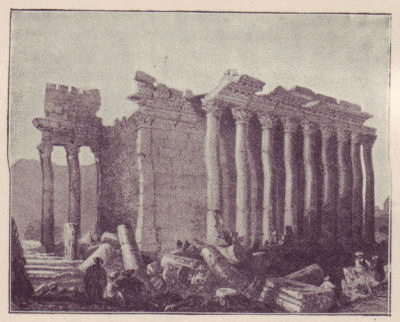 A HEATHEN TEMPLE |
"But I do own to this, that after the way which they call 'the party of the Nazarenes,' so do I serve the God of our fathers, believing all things in the law and in the prophets, and having a hope in God that the dead shall be raised up. And I have always tried to keep my heart free from wrong toward God and toward men.
"Now after many years, I came to bring gifts to my people, and offerings for the alter. And with these they found me in the Temple, but not with a crowd, nor with a riot. But there were certain Jews from Asia Minor who ought to have been here, if they have anything against me."
Felix knew somewhat about the Church of Christ, and he said "When Lysias, the chief captain, shall come down, I will settle this case."
And he ordered Paul to be kept under guard, but that his friends might freely come to see him. After a few days Felix and his wife Drusilla, who was a Jewess, sent for Paul, and heard from him with regard to the gospel of Christ. And as Paul preached to him, of right living, and of ruling one's self, and of the judgment of God that should come upon sinners, Felix was alarmed, and said, "Go away for this time; when a fit time comes, and I am ready to listen, I will send for you."
Felix was not a just judge, for he hoped that Paul might give him money, so that he might set Paul free; and with this in his mind he sent for Paul, and talked with him many times. Two whole years passed away, and Paul was still in prison at Caesarea. At the end of that time Felix was called back to Rome and a man names Porcius Festus was sent as governor in his place. Felix wished to please the Jews, and he left Paul a prisoner.
The Story That Paul Told to the King
When Festus came to rule over the land of Judea, in the place of Felix, who had kept Paul in prison so long, he went up to Jerusalem to visit that city. There the chief priests and the leading men spoke to him against Paul, and they asked that he might be sent to Jerusalem to be tried. It was their plan to kill Paul on the way. But Festus told them that Paul should be kept at Caesarea, and that he himself would soon go there.
"Let some of your leaders go down with me," said Festus, "and bring your charges against him, if you have any."
When Festus came down to Caesarea he called them all together, and sat upon the judge's seat, and commanded Paul to be brought. Then the Jews said evil things about Paul, declaring that he had done wickedly. But they could not prove any of the things which they spoke against him. And Paul said, "I have done no wrong against the law of the Jews, nor against the Temple, nor against the rule of Caesar th emperor."
Festus wished to please the Jews, for he did not know their secret purpose to kill Paul. He said, "Are you willing to go up to Jerusalem, and there be tried upon these charges before me?'
But Paul said, "I am standing before the Roman court where I ought to be judged. I have done no wrong to the Jews, as thou knowest very well, and no man shall give me into their hands. I ask for a trial before Caesar, the emperor at Rome."
It was the law throughout the Roman lands that any citizen of Rome, as Paul was, could ask to be tried at Rome before Caesar, the emperor. When Festus heard Paul's words, he said, "Do you ask to be tried before Caesar? Then unto Caesar you shall go."
So Paul was taken back to the prison at Caesarea to be sent to Rome when his time should come. A few days after this a Jewish ruler named Agrippa, with his sister Bernice, came to visit Festus. He was called "King Agrippa" and he ruled over a part of the land on the east of the river Jordan. While Agrippa and Bernice were at Caesarea, Festus said to them, "There is a certain man left a prisoner by Felix, of whom the chief priests and elders of the Jews asked, when I was at Jerusalem, that I should give orders to have him put to death, or give him into their hands. I told them that the Romans never give judgment against any man until he stands face to face before his enemies, and can make answer to their charges. When they came down to this place, and the man was brought before them, their charges were not the wicked acts that I expected to hear of; but they had some questions about their ways of worship, and about somebody names Jesus, who was dead, but who Paul said was alive. As I could not understand these questions, I asked Paul whether he would go up to Jerusalem, and there be tried. But Paul asked for a trial before Caesar, and I am keeping him to be sent to the emperor at Rome."
"I would like," said Agrippa, "to hear this man myself."
"To-morrow," said Fetus you shall hear him."
So on the next day, Agrippa and his sister, Bernice, and Festus, with the chief men of the city and the officers of the army, came in great state to the hall of judgment, and Paul was brought before them, chained to a Roman soldier. And after a few words by Festus, Agrippa said to Paul, "You may now speak for yourself."
Then Paul spoke in words like these:
"I think myself happy, King Agrippa, to give answer before thee of all the things charged against me by the Jews, because I am sure that thou dost know all the Jewish ways and the questions about the law. I ask they, then, to hear me. My way of life from my youth all the Jews know, for I have lived among them; and if they tell the truth, they would say that I was of those who kept the laws of our people most carefully. And now I stand here to be judged for the sake of the promise which God made to our fathers; that promise to which our twelve tribes, serving God day and night, hope to come. And on account of this hope, O king, the Jews charge me with doing evil; because I believe that Jesus Christ rose from the dead to be the King of Israel. Why should it be something thou canst not believe, that God does raise the dead to life?
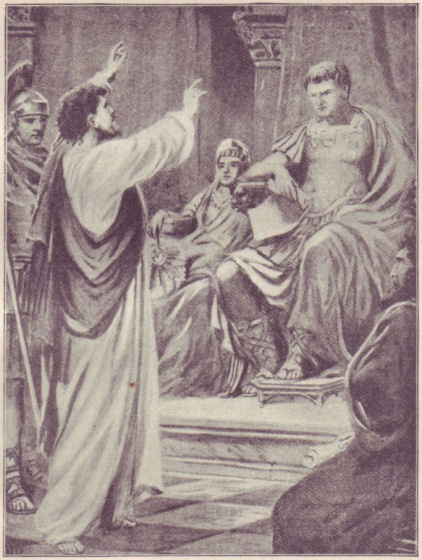 PAUL BEFORE AGRIPPA |
"In former times I really thought with myself that I ought to do many things against the name of Jesus of Nazareth. And this I did in Jerusalem; for I shut up many good men and women in prisons, and when they were put to death I gave my voice against them. I caused them to be beaten and I tried to make them curse the name of Jesus; and being exceedingly mad against them, I sought for them even in cities far away.
"And as I journeyed to Damascus with letters from the chief priests, at mid-day, O king, I saw on the way a light from heaven, abut the brightness of the sun, shining around me and those who were with me. And as we all fell down upon the ground, I heard a voice saying to me, 'Saul, Saul, why are you fighting against me?'
"And I said, 'Who art thou, Lord?'
"And the Lord said, 'I am Jesus, whom you are trying to destroy. But rise up, and stand upon your feet, for I have shown myself to you to make you my servant and my messenger to tell of what you have seen, and of what I will show you. I will keep you safe from the Jewish people and from the Gentiles, to whom I send you, to open their eyes, and to turn them from darkness to light, and from the power of Satan, the evil one, to God, that their sins may be forgiven, and that they may receive a reward among those that are made holy by faith in me.
"O King Agrippa, I did not disobey the voice from heaven, but first at Damascus, and then at Jerusalem and throughout all the land of Judea, and also among the Gentiles, I have spoken, telling men to turn from sin to God, and to show deeds of right-doing. This is the cause why the Jews seized me in the Temple and tried to kill me. Having gained help from God, I stand unto this day, speaking to people, small and great, saying only what is given in the law of Moses and in the prophets: that the Christ must suffer and die, and that he by rising from the dead should give light to our people and to the Gentiles."
While Paul was speaking, Festus said with a loud voice, "Paul, you are mad! Your great learning has turned you to madness!"
For Festus, being a Roman, knew nothing of Jesus or of the truths which Paul spoke.
But Paul said to him, "I am not mad, most noble Festus. I speak only sober and truthful words. The king knows of these things, and I speak freely to him. None of these things are hidden from him, for these things were not done in secret. King Agrippa, dost thou believe the prophets? I know that thou dost believe."
And Agrippa said to Paul, "A little more and you will persuade me to become a Christian!"
And Paul said, "I would before God, that whether with little or with much, that not only thou, but also all that hear me this day, might become such as I am, except these chains!"
After these words, King Agrippa, and Bernice, and Festus the governor, and those who were there, went away by themselves, and they said to each other, "This man has done nothing deserving death or prison."
And Agrippa said to Festus, "This man might have been set free if he had not asked to be tried before Caesar."
Paul in the Storm
When Paul chose to be tried before Caesar the emperor which was his right as a Roman, it became necessary to send him from Caesarea in Judea to Rome in Italy, where Caesar lived. In those years there were no ships sailing at regular times from city to city, but people who wished to go to places over the sea waited until they could find ships with loads sailing to those places. Paul and some other prisoners were given into the charge of a Roman centurion or captain named Julius, to be taken to Rome. Julius found a ship sailing from Caesarea to places on the shore of Asia Minor, which would take them a part of the way to Rome. He took Paul and the other prisoners on board this ship, and with Paul went his friends, Luck the doctor and Aristarchus from Thessalonica. Perhaps Timothy also was with them, but of this we are not certain.
They set sail from Caesarea, after Paul had been in prison more than two years; and the followed the coast northward to Sidon. There they stopped for a day; and Julius the centurion was very kind to Paul, and let him go ashore to see his friends who were living there. From Sidon they turned to the northwest and sailed past the island of Cyprus, and then westward by the shore of Asia Minor. At a city called Myra they left the ship, and went on board another ship, which was sailing from Alexandria to Italy with a load of wheat from the fields of Egypt.
Soon a heavy wind began to blow against the ship, and it sailed very slowly for many days; but at last came to the large island of Crete, and followed its southern shore in the face of the wind until they found a harbor, and they stayed for a few days. But this harbor was not a good one, and they thought to leave it and sail to another.
Paul now said to them, "Sirs, I see that this voyage will be with great loss to the load and the ship, and with great danger to the lives of us all."
And he urged them to stay where they were at anchor. But the owner of the ship and its captain thought that they might sail in safety; and Julius the centurion listened to them rather than to Paul. So when a gentle south wind began to blow, they set sail once more, closely following the shore of the island of Crete. But soon the wind grew into a great storm, and the ship could not face it, and was driven out of its course. Behind the ship was a little boat, and this they drew up on board; and as the ship creaked and seemed in danger of going to pieces, they tied ropes around it to hold it together.
The storm grew and drove the ship away from the island into the open sea. To make the vessel lighter they threw overboard a part of the load; and the next day they cast into the sea all the loose ropes and everything on the ship that could be spared.
Day after day went on, with no sight of the sun, and night after night with no sight of the stars. The great waves rolled over the ship and beat upon it, until those on board hardly hoped to save their lives. In their fear, for days the men and the prisoners had eaten nothing. But in the midst of the storm, Paul stood up among them and said:
"Sirs, you should have listened to me, and not have set sail from Crete, for then we might have been saved much harm and loss. But even as it is, be of good cheer; for though the ship will be lost, all of us on board shall be saved. This night there stood by me an angel of the Lord, to whom I belong, and whom I serve, and the angel said to me, 'Fear not, Paul; you shall yet stand before Caesar; and God has given to you all those who are sailing with you.'
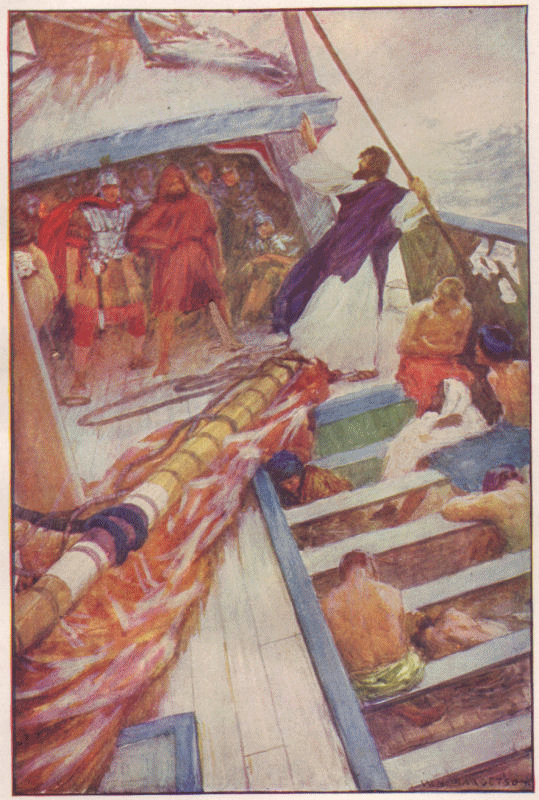 PAUL IN THE STORM AT SEA |
"Now friends, be of good cheer; for I believe God, that it shall be even as th angel said to me. But we must cast upon some island."
When the storm had lasted fourteen days, at night the sailors thought that they were coming near to land. They dropped down the line and found that the water was twenty fathoms deep: then after a little they let down the line again and found the water only fifteen fathoms deep. They were sure now that land was near, but they were afraid that the ship might be driven upon the rocks; so they threw out from the stern or rear-end four anchors to hold the ship; and then they longed for the day to come.
The sailors let down the little boat, saying that they would throw out some more anchors from the bow, or front of the ship, but really intending to row away in the boat and leave the ship and all on board to be destroyed. But Paul saw their purpose, and he said to the centurion, "Unless these sailors stay in the ship none of us can be saved."
Then the soldiers cut away the ropes of the boat, and let it fall off, so that the sailors could not get away. And as it drew toward daylight, Paul urged them all to take some food. He said:
"This is the fourteenth day that you have waited without any food. Now I beg of you to eat, for you need it to keep your lives safely. You will all be saved; not an hair shall fall from the head of one of you."
He took some bread and gave thanks to God before them all; then he broke it and began to eat. This encouraged all the others, so that they too took food. There were in all on board the ship, sailors and soldiers, and prisoners, and others, two hundred and seventy-six people. After they had eaten enough they threw out into the sea what was left of its load of wheat, so that the ship might be less heavy upon the waves, and might go nearer to the shore.
As soon as the day dawned, they could see land, but did not know what land it was. They saw a bay with a beach, into which they thought that they might run the ship. So they cut loose the anchors, leaving them in the sea, and they hoisted up the foresail to the wind, and made toward the shore. The ship ran aground and the front end was stuck fast in the sand, but the rear part began to break in pieces from the beating of the waves.
Now came another danger, just as they were beginning to hope for their lives. By the Roman law, a soldier who had charge of a prisoner must take his prisoner's place if he escaped from his care. These soldiers feared that their prisoners might swim ashore and get free. So they asked the centurion to let them kill all the prisoners, while they were still on board the ship. But Julius the centurion loved Paul, and to save Paul's life, kept them from killing the prisoners. He commanded that those who could swim should leap overboard and get first to the land. Then the rest went ashore, some on planks, and some on broken pieces of the ship. And all came safe to the shore, not one life being lost.
And then they found that they were on the island of Melita, which is in the Great Sea, south of the larger island of Sicily.
How Paul Came to Rome, and How He Lived There
The people who lived on the island of Melita were very kind to the strangers who had been thrown by the sea upon their shore. It was cold and rainy, and the men from the ship were in garments drenched by the waves. But the people made a fire, and brought them all around it, and gave them good card. Very soon they found that many of the men were prisoners, who were under guard of the soldiers.
Paul gathered a bundle of sticks and placed them on the fire, when suddenly a poisonous snake came from the pile, driven out by the heat, and seized Paul's hand with its teeth. When the people saw the snake hanging from his hand, they said to each other, "This man must be a murderer. He has saved his life from the sea, but the just gods will not let him live on account of his wickedness."
But Paul shook off the snake into the fire, and took no harm. They looked to see his arm swell with poison, and to see him fall down dead suddenly. But when they watched him for a long time and saw no evil come to him, they changed their minds, and said that he was a god, and were ready to worship him.
Near the place where the ship was wrecked were lands and buildings belonging to the ruler of the island, whose mane was Publius. He took Paul and his friends into his house and treated them very kindly. The father of Publius was very ill with a fever and a disease called dysentery, from which people often died. But Paul went into his room, and prayed by his side; then he laid his hands on him, and the sick man became well. As soon as the people of the island heard of this, many others troubled with diseases were brought to Paul and all were cured. The people of Melita after this gave great honor to Paul and those who were with him; and when they sailed away they put on the ship as gifts for them, all things that they would need.
The centurion found at anchor by the island a ship from Alexandria on its way to Italy, which had been waiting there through the winter. The name of this ship was "The Twin Brothers." After three months in the isle, the centurion sent on board this ship his soldiers and prisoners, with Paul's friends; and they sailed away from Melita. After stopping at a few places on their voyage, they left the ship at Puteoli, in the south of Italy, and from that place they were led toward Rome. The church at Rome, to which Paul had written a letter in other days, heard that he was coming, and some of the brethren went out to meet him a few miles from the city. When Paul saw them, and knew that they were glad to meet him, even though he was in chains, he thanked God, and took heart once more. He had long wished to go to Rome, and now came into the city at last, but as a prisoner, chained to a Roman soldier.
When they came to Rome, the good centurion Julius gave his prisoners to the captain of the guard in the city; but from the kind words spoken by Julius, Paul was allowed to go to a house by himself, though with the soldier who guarded him always at his side. After three days in Rome, Paul sent for the chief men among the Jews of the city to meet in his house, because he could not go to the synagogue to meet with them. When they came, he said to them:
"Brethren, though I have done no harm to our people, or against our law, yet I was made a prisoner in Jerusalem, and given into the hands of the Romans. When the Romans had given me a trial they found no cause for putting me to death, and wished to set me free. But the Jews spoke against me, and I had to ask for a trial before Caesar, though I have no charge to bring against my own people. I have asked to see you and to speak with you, because for the hope of Israel I am bound with this chain."
They said to Paul, "No letters have come to us from Judea, nor have any of the brethren brought to us any evil report of you. But we would like to hear from you about this people who follow Jesus of Nazareth, for they are a people everywhere spoke against."
So Paul named a day, and on the day they came in great number to Paul's room. He talked with them, explaining the teaching of the Old Testament about Christ, from morning until evening. Some believed the words of Paul, and others refused to believe. And when they would not agree, Paul said to them as they were leaving, "Truly indeed did the Holy Spirit say of this people, in the words of Isaiah the prophet, 'Hearing ye shall hear, and shall not understand, and seeing ye shall see, and yet not see. For this people's heart is become hard, and their ears are dull, and their eyes they have shut; for they are not willing to see, nor to hear, nor to understand, nor to turn from their sins to God.' But know this, that the salvation of Christ is sent to the Gentiles; and they will listen to it, even though you do not."
And after this Paul lived two years in the house which he had hired. Every day a soldier was brought from the camp, and Paul was chained to him for all that day. And the next day another soldier came; each day a new soldier was chained to Paul. And to each one Paul spoke the gospel, until after a time many of the soldiers in the camp were believers in Christ; and when these soldiers were sent away they often carried the gospel with them to other lands. So Paul, though a prisoner, was still doing good and working for Christ.
Then, too, some of Paul's friends were with him in Rome. The young Timothy, whom Paul loved to call his son in the gospel, and Luke the doctor, of whom he wrote as "the beloved physician," were there, perhaps in the same house. Aristarchus of Thessalonica, who had been with him in the ship and in the storm, was still with Paul. Mark, the young man who years before went with Paul and Barnabas on their first journey from Antioch, visited Paul in Rome.
At one time, when Paul had been a prisoner nearly two years, a friend came to see him from Philippi in Macedonia. His name was Epaphroditus, and he brought to Paul a loving message from that church, and also gifts to help Paul in his need. In return, Paul wrote to the church at Philippi a letter, "The Epistle to the Philippians," full of tender and gentle words. It was taken to the church by Epaphroditus and by Timothy, whom Paul sent with him, perhaps because in Rome Epaphroditus was very ill, and Paul may have thought it better not to have him go home alone.
In Rome a man named Onesimus met Paul. He was a runaway slave who belonged to a friend o f Paul, named Philemon, living at Colosse in Asia Minor, not far from Ephesus. Paul led Onesimus to give his heart to Christ, and then, although he would have liked to keep him with himself, he sent him back to Philemon, his master. But he asked Philemon to take him, no longer as a slave but as a brother in Christ. This he wrote in a letter which he sent by Onesimus, called "The Epistle to Philemon". Onesimus carried at the same time another letter to the church at Colosse. This letter is "The Epistle to the Colossians." And about the same time Paul wrote one of the greatest and most wonderful of all his letters, "The Epistle to the Ephesians," which he sent to the church in Ephesus. So all the world has been richer ever since Paul's time by having the four letters which he wrote while he was a prisoner at Rome.
It is thought, though it is not certain, that Paul was set free from prison after two years; that he lived a free man, preaching in many lands for a few years; that he wrote during those years the First Epistle to Timothy, whom he had sent to care for the church at Ephesus, and the Epistle to Titus, who was over the churches in the island of Crete; that he was again made a prisoner and taken to Rome; and from his Roman prison wrote his last letter, the Second Epistle to Timothy, and that soon after this the wicked Emperor Nero caused him to be put to death. Among his last words in the letter to Timothy were these:
"I have fought a good fight; I have run my race; I have kept the faith; and now there is waiting for me the crown which the Lord himself shall give me."
The Throne of God
You remember the apostle John, "the disciple whom Jesus loved." When John was an old man, he was made a prisoner by a cruel emperor of Rome, and was kept in a little island called "the isle of Patmos," which is in the Ægean Sea, not far from Ephesus. While John was shut up on this island the Lord Jesus Christ came to him, and showed him some things which were to come to pass.
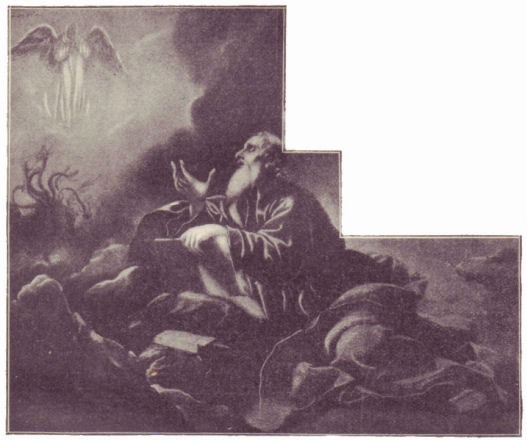 JOHN ON THE ISLE OF PATMOS |
It was on the Lord's Day, the first day of the week, when suddenly John heard behind him a loud voice, as loud as the sound of a trumpet. He turned to see from whom the voice came; and then he saw seven golden candlesticks standing, and among them One whom John knew at once as his Lord Jesus Christ. Yet Christ, as he saw him, was far more glorious than he had been while living as a man on the earth. He was dressed in a long white garment, with a girdle of gold over his breast; his hair wand his face were so shining that they seemed as white as snow; his eyes flashed like fire; his fet were like polished brass, glowing as a furnace; and his voice sounded like the rushing of a mighty torrent of waters. In his right hand were held seven stars; and a glory came from him brighter than the sun.
When John saw his Lord in all this splendor, he fell at his feet in great terror. Then he felt the right hand of Christ laid upon him; and he heard his voice, saying:
"Fear not; I am the first and the last, and the Living One. I was dead, and now I am alive for evermore. Write the things which you have seen, and other things which I will show you, and send them to the seven churches in Asia. The seven stars which you see in my hand are the ministers of the seven churches; and the seven candlesticks standing around me are the seven churches."
Then the Lord gave to John the words of a letter which he commanded John to write to the seven churches in that part of Asia, of which churches that at Ephesus was the first. To each church was to be sent a different letter, the word of the Lord Jesus to that church, praising it for some things, and rebuking it for others. When these words had been given to the churches, John saw a door opened in heaven; and he heard a voice like the sound of a trumpet, saying to him, "Come up to this place, and I will show thee things that shall come to pass."
Then at once John was taken up to heaven, and he saw the throne of God, and One sitting upon it whom he could scarcely see for the dazzling glory around him. And over the throne was a rainbow of many colors. Around the throne were twenty-four old men, the elders of the church, dressed in white, with crowns of gold on their heads. Out of the throne came lightning, and thunder, and the sound of voices. Before the throne was a sea of glass like crystal, and beside the throne were four strange living creatures, each having six wings. And these living ones were saying "Holy, holy, holy, is the Lord God, the Almighty, which was and which is, and which is to come."
And then the elders would fall down and worship him who sits on the throne, and lay their crowns at his feet, and say, "Thou art worthy, O God, our Lord, to have the honor, and the glory, and the power; for thou didst create and make all things."
Then John saw in the right hand of the One sitting on the throne a book, in the form of a roll, written on both sides, and sealed with seven seals. And a mighty angel called out with a loud voice, "Who is worthy to open the book and to loose its seals?"
And no one in all the heaven, or on the earth, or under the earth, was able to open the book or to loosen its seals. Then John began to weep, because there was found no one worthy to open the book or even to look upon it. But one of the twenty-four elders spoke to John, saying, "Weep not; see, the Lion of the tribe of Judah, he who came from David, has won the right to open the book and its seven seals."
Then before the throne, and among the elders and the four living creatures, John saw standing the Lamb of God, Jesus Christ, with the wounds of the cross upon him, in hands, and feet, and side. He came and took the book from the right hand of the One who was sitting on the throne. And as he took the book the four living creatures, and the twenty-four elders, all fell down before the throne. Each held a harp and a golden bowl full of incense, such as was used in the Temple, as a sign of the prayers of God's people. And hey all sang a new song, with the words:
"Worthy is the Lamb who was slain to have the power, and riches, and wisdom, and might, and honor, and glory, and blessing."
The City of God
Again John saw the throne of God, and before it, and before the Lamb of God, stood a multitude of people so great that no man could count them. They were dressed in white robes, and branches of palm were in their hands, and they cried with a loud voice, "Salvation unto our God upon the throne, and unto the Lamb."
And all the angels were standing around the throne, and around the four living creatures, and around the seats of the twenty-four elders; and the angels fell down on their faces, and worshipped God saying, "Amen: Blessing and glory, and thanksgiving, and honor, and power, and might, be unto our God forever and ever."
Then one of the elders spoke to John, and said, "Who are these dressed in white robes? And whence did they come?"
And John answered, "My Lord, thou knowest who they are, and whence they came, but I do not know."
Then the elder said, "These are they who have come up out of great trouble and sorrow, and have washed their robes, and made them white in the blood of the Lamb. For that cause they are before the throne of God, and they serve him day and night in his temple; and he that sitteth upon the throne shall spread his tent over them. They shall hunger no more, neither shall they thirst any more, nor shall the heat of the sun strike upon them. But the Lamb who is in the midst of the throne shall lead them as a shepherd, and shall guide them unto fountains of waters of life. And God shall wipe away every tear from their eyes."
After this, John heard a great voice out of the throne, saying, "Behold, the tabernacle of God is with men; and God shall dwell among men, and they shall be his people, and he shall be their God. And God shall wipe away all tears from their eyes; and there shall be no more death; neither shall there be weeping or crying, nor pain, any more."
And He that was sitting upon the throne said, "Behold, I make all things new. I will give to him who is thirsty of the fountain of the water of life freely."
Then John seemed to be standing upon a great and high mountain; and he saw a glorious city, the new Jerusalem, coming down out of heaven from God, having the glory of God. Over the city was a rich light, like that which glows in some precious stone, clear as crystal. Around the city was a lofty wall, and on each side of the wall were three gates; for the city was four-square, having twelve gates in all. Besides each gate stood an angel, and on the gates were written the names of the twelve tribes of Israel. And the wall had twelve foundations, and on them were written the names of the twelve apostles of the Lord. The wall was like jasper, and the city was built of pure gold, but a gold which seemed clear like glass. The twelve gates were twelve pearls; each one of the gates was one great pearl. And the street of the city was pure gold, as clear as glass.
John could see no Temple in the city, and it needs none; nor the lord God and Jesus Christ the Lamb of God are its Temple. And the city has no need of the sun nor of the moon to shine upon it for the glory of God given it light, and the Lamb of God is as a lamp in it And the gates of the city shall not be shut by day, for there shall be no night there.
And the nations of men shall walk in the light of this city, and the kings of the earth bring their glory into it; and all the honor and glory of the nations of earth shall be brought into it. And into it shall never come anything that is evil or unclean, or any one who does what God hates, or any one who makes a lie. But they only shall come into it whose names are written in the Lord's book.
And John saw a river of water of life, clear as crystal, coming forth from the throne of God and of the Lamb, and flowing through the street of the city. On each side of the river was growing the tree of life, bearing its fruit every month, twelve times in the year; and the leaves of the tree were to heal all people of their diseases. And in the city the Lord God and the Lamb shall reign as kings.
When John had seen and heard all these things, he fell down to worship the angel who had showed them to him. But the angel said to him, "Do not worship me, for I am a fellow-servant with you and with your brethren the prophets, and with those who keep the word of the book: worship God."
And the angel said to John, "Do not seal up the words of what you have heard and seen, but tell them to all men. And the spirit and the bride, the Church of Christ, say 'Come.' And let him that hears say 'Come.' And let him that is thirsty come; and whoever will let him take the water of life freely."