History of the Church: Early Modern Times - Notre Dame |
The Religious Revolt of the Sixteenth Century
![[Illustration] from Church - Early Modern Times by Notre Dame](books/sisters/leading4/zpage001.gif "[Illustration] from Church - Early Modern Times by Notre Dame")
I. General Causes of the Religious Revolt
The opening decades of the sixteenth century witnessed a movement which, ere the century was little more than half over, had bred a spirit of rebellion against all authority, such that, during a hundred and fifty years, every country of Europe in succession was convulsed by civil and religious wars. The religious revolt, erroneously styled the Reformation, had its origin in Germany.
Up to the close of the fifteenth century the social condition of the Germanic people seems to have been little short of ideal. The peasantry, industrious and frugal, were protected by wise and beneficent laws; the artisan population flourished under the direction of the great guilds, education was open to all, and culture, evidenced by the splendid works of art to be found everywhere in church and guild hall, exercised a refining influence over the lives and homes of even the poorer classes. Never were works of zeal and charity better seconded by the people, or the needs of their parishioners more cared for by their pastors. Intellectual activity received a fresh impetus from the invention of printing. The multitude of books, adapted for both simple and learned, poured forth from the numerous presses of town and monastery, would pass credence if authentic records were not there to testify to their number and excellence. Contemporary authors are unanimous in attesting the high average morality of the Germanic peoples of this time. The political aspect of affairs was less happy: causes were at work which would have demanded a great central authority either to give them wise direction, or to check undue development. But herein the ideals of the sovereign and of the subordinate princes conflicted. Great emperors, such as Maximilian I. (1493-1519), and great legists, saw the necessity of consolidating the Empire, which was but a loose suzerainty; but their patriotic efforts in this direction were rendered abortive by the princes, whose only aim was to shake off all allegiance and claim complete independence. Moreover, a strong revolutionary spirit was inculcated and fostered by the Renascence legists, many of whom, fresh from the great Bologna University, strove to supersede the old Germanic laws by the famous Justinian code. Though the great legislator condemned the existence of slavery as contrary to the natural law, the provisions of his code necessarily dealt with a state of society that had but just shaken off the trammels of paganism, and in which only two great social classes existed, the lord and the slave, the holder of wealth and his chattels. The Teutonic laws, while recognizing and providing for serfdom, were yet the natural development of feudal tenure. They protected the rights of the free labourer, the producer of wealth, and favoured the growth of the great mediaeval institutions by which trade and commerce were regulated. It is not as a question of the respective values of the two systems that this dispute has to be considered, but as introducing an element of insecurity and unrest among a hitherto contented people. The breach in the continuity of their national life and customs, bitterly resented by the peasant class, left them an easier prey to the more serious innovations that were to follow. Janssen considers this disunion between the emperor and his subject princes and the introduction of the Justinian code to be powerful factors in preparing that state of things in Germany which made the religious revolt possible. It is no doubt true that the great nobles found in the Roman code a powerful auxiliary in strengthening their hands Just at a time when an ever-growing commerce was redistributing the wealth of the country. Hitherto, especially in Germany, land had been capital, and had been made productive by labour. Now capital was taking the form of money, and monopolies were upsetting the relations between the various branches of industry. Already the first symptoms were to be seen of an evil that has continued to our own day. Capitalists were taking advantage of defenceless labourers, and the ranks of the rich and of the poor were parting gradually farther asunder. These considerations explain the strong language of the theologians of the day and of men as widely different as Ribadeneira, the historian of St. Ignatius, and Sully, Minister of Henry IV., against commerce and manufactures.
When the sixteenth century opened, the struggle for wealth had already assumed vast proportions. The sight of the rapidly-made fortunes of merchants whetted the general appetite for money, which, like a mischievous leaven, was at work in every rank of society. At this period, says Janssen, were witnessed the most extraordinary contrasts—an almost unparalleled self-devotion in the multiplication of religious Orders, and of works of charity, with a sordid selfishness that made money-grabbers out of bishop and prince, priest and noble, monk and peasant alike. Through the devotion of centuries, the Church had grown to be the richest body in the Empire. Hence, ecclesiastical preferments became the great prizes in the race for wealth. A most deplorable abuse was that many monasteries closed their doors to all but nobility or wealth. Add to this the evil of nominations to benefices being in the hands of laymen, and the rapid deterioration of morals can be understood. Beginning from above, it gradually worked down through the masses, and the worldliness and splendour of episcopal and abbatial palaces were reflected, as far as means allowed, around the hearth of the peasant. Such examples could not but bear sad fruit. Men grew up with a contempt for the station in which they were born. We find complaints that the poor squandered their narrow means in striving to dress and live like their betters; and that every form of robbery, violence, fraud, usury, falsification of goods and coins was rife; that passions were let loose, and that feastings, gaming, fighting, and dueling were the order of the day.
One other feature of the times must be noted. In Germany, as elsewhere, literary men were banded into schools—the Humanists and the Schoolmen, or, as they were often styled, the Poets and the Theologians. Their disputes were acrimonious, and the Humanists often passed from attacking their opponents to attacking the profession of their opponents, the Order to which they belonged, the Church which protected them, and the doctrines preached from her pulpits. Hence the people were familiarized with the sound of conflicting opinions, accustomed to hear public disputations on controverted points, and they were nothing loath to be called on to judge of the merits of the rival teachers. We find that the wildest propositions were made, often unchecked, as to the right of free examination of doctrine and, above all, free interpretation of the Bible. A special rancour embittered the quarrel when a great Humanist, Reuchlin, an eminent Greek scholar, revived the study of Hebrew in Germany. All eyes were drawn towards the Jews, just then in no great favour, and fears were entertained lest Judaism should assert itself. The excited violence of the partisans for and against the Hebraic movement widened the breach between Humanists and Theologians to the utmost. Their mutual flattery and the abuse of their opponents form a strange page in the literature of the times. Things were at this juncture when the publication of an Indulgence by Pope Leo X., in 1515, fanned the flame to still greater fury. The Indulgence was granted for donations towards completing the dome of St. Peter's in Rome, then in course of construction. An attack on the Indulgence was led by Luther in October, 1517, when he openly combated not merely the Indulgence as then promulgated, but the doctrines on which the granting of an Indulgence is based and the authority of the Holy See which grants it.
II. Lutheranism and its Early Effects
Luther's earlier career was a preparation for this act. An unhappy childhood, followed by brilliant studies which won for him extravagant praise; a sudden adoption of the religious state through motives of terror; an exaggerated scrupulosity; a constant resistance to his superiors, who strove in vain to check the extravagant practices by which he sought to regain peace of mind—all presaged some such violent course on the part of a man whose judgment seems to have been unable to control the frenzied imaginations to which he was subject all his life. Pursued by violent alternatives of scrupulosity and elation in his earlier days, later on, by dread of assassination amounting to monomania, in his maturer years he frequently thought himself face to face with the evil one—a belief which wrought him up to paroxysms of anguished fear.
In 1507 he had left his monastery at Erfurt for the newly-founded University of Wittenberg in Saxony„ where he was soon promoted to a professorship. During the ten years which preceded his "Thesis Against Indulgences," he seems to have been gradually evolving a creed of his own and abandoning one by one the doctrines of the Church. He had already broached his principal tenets—the absence of free will in man and justification by faith alone—in a course of Lenten sermons in 1517. In spite of ecclesiastical censure, he continued his erroneous teaching. The proclamation of the great Indulgence was merely the occasion, and not the cause, of Luther's open attack on the Church. It was, of all subjects, one which would ill fit in with Luther's new faith, and accordingly he immediately threw down the challenge that any similar opportunity would have called forth. This took the form of "Seventy-five Theses Against Indulgences." Public attention was roused, and Luther's action was favourably viewed by many. Tetzel, a learned Dominican, to whom the preaching of the Indulgence had been entrusted, replied by a clear statement of the doctrine of the Church on the matter. Luther, however, daily gathering partisans around him, continued to preach. He called loudly for reforms, and promulgated what he called his gospel, but as yet gave no sign of wishing to break altogether with the Church. The most influential of his adherents were the leading Humanists, including Erasmus, Reuchlin, and Hutten, the great fighting Baron Franz von Sickengen, together with Mutian and the whole Nuremberg School of Philosophers.
In 1520, however, he declared himself a Hussite, and published his famous "Appeal to the Nobles Against Rome" and his "Babylonian Captivity." In these documents he denounced the luxury of the clergy, a point which certainly called for reform; but he went farther. He stated that all men were priests, hence judges in matters of doctrine; that the temporal power was supreme, and existed only for the punishment of offences; that where evil was found the temporal power was bound to chastise even ecclesiastical offenders. To win support for himself and his tenets, he strove to bribe the emperor by suggesting the confiscation of the States of the Church and the abolition of the papal protectorate of Naples. To gain the bishops, he proposed a national Church with independence of Rome, to the barons he offered the right of nomination for their younger sons to bishoprics, while before the people he laid the attractive prospect of pillage of churches, abolition of fasts and feasts, and of excommunication.
Luther's publications having been maturely examined at Rome, he was excommunicated in November, 1520. With the utmost contempt Luther burned the Papal Bull, and "all Germany was convulsed with excitement." Frederick of Saxony declared himself protector of Luther, whose credit grew from day to day.
While these last events had been taking place, Charles V. had become Emperor of Germany. In 1519 Maximilian I. had died, and several candidates had appeared for the imperial throne. The most noteworthy were Francis I. of France, and Charles, Archduke of Austria, grandson of Maximilian I. Intrigues were rife, the electors bribed and took bribes. Every sentiment of honour seemed gone. At length a momentary flash of patriotism—the determination not to be ruled save by a German—prevailed, and Charles was elected. It may be mentioned in passing that this cost him and his successor forty years of warfare with France.
![[Illustration] from Church - Early Modern Times by Notre Dame](books/sisters/leading4/zpage011.gif "[Illustration] from Church - Early Modern Times by Notre Dame")
The position of the young emperor was not enviable. His hereditary dominions were one scene of ferment and disorder. Spain was in revolution. Naples was hourly expecting an attack from the Turks. Italy, under French influence, was threatening to rise in rebellion, while in Austria his authority was greatly compromised. The Netherlands seemed the only quarter where peace reigned, and these lands were shortly to be no exception to the rule. With Germany added to these vast dominions, the emperor-elect was, in name, master of half Europe. But Germany, composed of numerous almost independent States whose princes were devoted to their own interests alone, whose cities were in constant conflict with the princes, and whose populations were torn with religious strife, did but augment the difficulties which were too great for one man to cope with. Charles V., however, nothing daunted, took up the gigantic tasks, and immediately after his coronation in 1520 convoked a Diet to meet him at Worms early in the following year. There he laid before the assembled representatives of the Empire the bold projects he was entertaining—namely, the restoration of peace, law, and order throughout his dominions; the establishment of a Council of Regency to act in his absence from the Empire; the recovery of the provinces in North Italy lost to the Austrian throne; the repulse of the Turks; and his own coronation by the Pope. The Council of Regency was established, but for the other projects funds and an army were necessary preliminaries, and the German princes were ill-disposed to grant either. Moreover, the religious troubles already seriously threatening the public peace demanded instant attention. An exhaustive catalogue of abuses, with a petition for redress of grievances, was drawn up in order to be laid before the Pope. Then it was that Luther, called at the beginning of the session to answer the charges against him, was invited to explain his proceedings. Luther's approach to Worms had been one long ovation. The populace treated him as a saint, and his writings and his portraits, decorated with an aureole, were publicly distributed. But riots also broke out along his passage, and his sermons were followed by scenes of excitement and violence. After a short hesitation, he boldly declared to the Diet his determination of holding by his gospel. All attempts to win him having failed, the emperor, together with all the princes, except Frederick of Saxony, united in an edict against Luther and his adherents. Luther was being taken back to Erfurt when Frederick of Saxony, to save him from all harm, had him carried off and transported to the strong castle of Wartburg.
From Wartburg Luther directed the progress of the new gospel. Itinerant preachers spread his doctrines far and wide. The violence of his partisans of the lower classes caused Luther some uneasiness, and in 1522 he returned to Wittenberg to be nearer the centre of operations. It was now evident that the movement meant a real rupture with the Church, and many of those who had at first seen in Luther's bold attacks only the strong action of a zealous if a somewhat imprudent reformer, openly returned to the ranks of the defenders of the faith.
But Luther's preaching was already bearing fruit. As early as 1520 he had begun a systematic attack on the Church. He had not hesitated to call on emperors and princes to rid themselves of Pope and Cardinals, and to destroy "this pest" from the face of the earth by the edge of the sword. In 1523 he issued a manifesto demanding the suppression of episcopal jurisdiction. Thus he threatened not only the Church, but the State, as most of the bishops were reigning princes of the Germanic Empire. Shortly after this proclamation Franz von Sickengen, sword in hand, took upon himself to carry out Luther's programme; but he added to it an ideal of his own, that of raising the lower aristocracy to power as a counter-poise to the imperial princes. Having called a number of these men, who bore the unenviable title of the "Robber Nobles," round his standard, he proclaimed his intention of "hewing a gap for the gospel." An attack on the archbishopric of Treves followed, during which churches and monasteries were wrecked and pillaged, while the villages were given up to the flames. A tardy union of some of the German princes at length stopped Sickengen's career of devastation. He himself fell mortally wounded during the siege of his own castle, where he had taken refuge. His failure caused the utter ruin of the "Robber Nobles," whose overthrow tended to consolidate still further the power of the sovereign princes.
Meanwhile, Adrian VI. was preparing to meet the demands of the Diet of Worms in a most conciliatory spirit. He acknowledged the existence of serious abuses in the exercise of ecclesiastical prerogatives, expressed his intention of instituting reforms, and promised a General Council on German soil. Janssen says: "It was a solemn moment in the history of the Germanic peoples." The Orders, assembled at the second Diet of Nuremberg, 1523, accepted the Pope's propositions with gratitude. Pending the Council, it was determined that the preaching of heretics and the publication of their writings should not be countenanced, but the princes dispersed, and none of the things they had undertaken were put into practice. Even the spiritual princes were supremely indifferent to the course of events. Luther, inspirited by their neglect, went to lengths as yet unattempted. He forbade Mass to be celebrated at Wittenberg, and called on the religious to throw off their vows and marry. Many obeyed his summons, and swelled the ranks of the Lutherans.
Even from 1521 a notable falling-off of the numbers of students in the universities was remarked. Luther had attacked these venerable institutions, and his words took rapid effect. Schools were equally abandoned, almsgiving diminished, and charitable institutions languished for lack of means. Luther himself writes: Under the papacy everyone was beneficent and gave freely, but now, under the Gospel regime, avarice reigns, each thinks but of fleecing his neighbour and enriching himself." During these transactions one of the most terrible events that Germany had yet seen was slowly maturing. The condition of the peasantry and of artisans, under the exactions of the nobles and the influence of commerce, was becoming desperate. There is little doubt that even had Luther's doctrine not been there to excite them to revolt, some great uprising must have taken place; but Lutheranism added to the movement a ferocity which seems ever to characterize religious wars.
Between 1524 and 1525 the whole of Central Germany rose in rebellion. Bavaria alone did not join the ranks of the insurgents. The vast insurrection massed itself under the banner of the "Gospel," and enrolled the peasantry, artisans, and townsfolk in the "Gospel Brotherhood." The leaders were itinerant preachers or apostate priests, and though their ostensible object was the defence of the Gospel, there was a deeper motive at work. They were determined to cast off the yoke of their grasping rulers, and to obtain once more equitable administration of justice, public security, and freedom from arbitrary exactions. They frustrated their own ends by their violence. A long catalogue of horrors sums up the story of this terrible year. It culminated in a massacre at Weinsburg, in which, for the first time, nobles were among the victims. As long as the attacks had been confined to the Church and ecclesiastical property, the princes had looked on unmoved. It must be remembered that in those days armies only existed when they were needed. When the princes saw the danger nearing themselves they took alarm, and summoned their retainers around them. From the moment a disciplined force took the field, the Peasants' Revolt was over. It was followed by a series of savage slaughterings, in which all alike were hewn down, even the very beasts of the field not escaping. Exorbitant fines were levied on the towns which had contributed either men or money to the insurgents, and ceaseless executions by fire and sword terrified the inhabitants into submission. It is said that widows and orphans from over a hundred thousand ruined homesteads roamed over a desolate waste, in vain seeking subsistence. The starving band was swelled by the maimed and blinded wretches who had escaped with their lives from the hands of the torturing executioner. The nobles were pitiless in their revenge. It was on ecclesiastical lands alone that the poor found relief. They were allowed to share all that had been left to the churches and monasteries when they had ransacked them in their day of brief triumph.
This most terrible insurrection was, by his contemporaries, attributed to Luther, not only in his own country, but in other lands. "The atrocious character of this war," says one, "is attributed to the seditious preachers and sectaries, to the libels and pamphlets disseminated everywhere." Erasmus, in writing to Luther, says: "We are gathering the bitter fruits of your genius. You do not own the rebels, but they own you readily enough." Blessed Thomas More, in summing up the effects of Lutheranism, counts this civil war, in which he says there were "so many thousand slain that the land lieth in many places in manner desert and desolate."
Yet, when he saw how literal was their obedience to his teachings, Luther turned against the people, and called upon the princes to exterminate them. He boasted that their overthrow was his work, and from that time his exhortations were addressed to the ruling powers rather than to the people—the "lord Omnes," whom now he declared to be worthy of death. Up to this time not one prince—not even Frederick of Saxony—had openly declared for Luther, for his revolutionary speeches had alienated them from him. Even during the revolt Luther's attacks on the rulers were severe. He openly blamed their tyranny, the intolerance of their yoke, and declared them responsible for the awful scenes going on around. But after the suppression of the rebellion his language changed. Hereafter he taught the absolute omnipotence of the sovereign and the duty of passive obedience by the subjects. Thus the power of the princes was strengthened by Luther's action, and they were not slow to profit by it.
It will be remembered that Luther had taught the Universal Priesthood of Christians. The natural consequence was that men came to regard themselves as a gospel or a law each to himself, and not only this, but each could assert his right to teach others. Obedience even to an ecclesiastical superior was therefore out of the question, and multiplying sects soon showed how literally Luther's words were taken. Religious anarchy necessarily followed, and sect after sect arose, as one person after another felt himself inspired with some new light on the meaning of the Sacred Writings. It would be impossible to follow the history of even the chief sects. Those which were the most extravagant in their doctrine and most violent in their opposition to the old faith, and with whom the Lutherans themselves frequently came into collision, were the Anabaptists and Zwinglians. It soon became apparent that the new gospel had founded no new religious society—it had but overthrown the old, and had substituted nothing but disorder and division in its place. Fearful lest the abolition of all authority should result in universal destruction of every vestige of Christian virtue, the chiefs of the religious revolution called on the temporal rulers to come to the fescue. This placed the Church at the mercy of the State, and was the origin of the State Churches which everywhere took their rise at this epoch.
This organization imposed on the temporal prince the duty of deciding all moot questions of doctrine, and made him master of the goods of the Church.
The double doctrine of the unlimited power of the temporal prince over his subjects, and of the subordination of the Church to the State, converted to the new doctrines a great number of princes greedy of the wealth of the clergy. With incredible rapidity one State after another saw its sovereign embrace Lutheranism. Albert of Brandenburg, Grand Master of the Teutonic Knights, not only gave in his adhesion to the new gospel, but acting on Luther's advice, he took possession of Prussia which he held for his Order, made it a hereditary duchy with the consent and assistance of the King of Poland, and, disregarding his vows, married Princess Dorothy of Denmark.
The sovereign princes of Saxony, Hesse, Brandenburg-Culmback, Brunswick-Anhalt, and Mechlingen, within two or three years of each other, all forsook the Church and set up Lutheranism in their States. This was not accomplished without severe measures against Catholics. Everywhere the churches were violently taken from them, priests and monks were driven away, and unchecked spoliation and sacrilege followed. In the free cities—most notably Magdeburg, Halle, and Halberstadt—things were carried farther. Not only did the town authorities confiscate Church property, abolish titles and dues both ecclesiastical and imperial—taking on themselves, moreover, the prerogatives of both bishop and emperor—but open persecution was resorted to in order to force Catholics to embrace Lutheranism, and the most brutal extravagances were committed by the partisans of "the Gospel." There are many instances of convents of nuns heroically withstanding every attempt to pervert them.
In the year marked by the outbreak of the Peasants' Revolt, Luther wrote his abusive reply to Henry VIII.'s "Treatise on the Seven Sacraments." The following year he married Katherina von Bora, an ex-nun whom he had induced to abandon the religious state. In 1526 the new sect received its first organization. As we have seen, it was at this time that State Churches were established, and it became necessary to frame some kind of rules for their administration. At the first Diet of Spires (1526) it was determined that each separate congregation should manage its own affairs, that a joint commission of pastors and laymen should appoint preachers to the various churches, and that the supreme authority in all matters appertaining to Church government should be vested in the head of the State. The sectarian body, thus consolidated, found itself in a position to put on a bold front. It demanded and obtained, until the meeting of a General Council, a recognition of its existence as a separate religious party, subject to the condition of not propagating its doctrines.
In 1527 an event occurred which could not fail to have a disastrous effect on the position of religious affairs in Germany. Charles V. was still engaged in his war with Francis I. The French monarch had allied himself with the Pope and with Henry VIII. of England in a defensive league against the emperor. A band of Spanish and German imperialists, under the command of the Constable de Bourbon, a Frenchman fighting against his own sovereign through private animosity, stormed Rome, and during two months gave up the city to scenes of atrocities and vandalism unparalleled in history. Charles, though he disclaimed responsibility for the act, did not fail to profit by its occurrence, for he would not withdraw the troops till he had obtained his ends. The sight of a Catholic monarch permitting his armies thus to insult the common Father of Christendom shocked the whole world, and the lesson was not lost on the sectaries. They added demand to demand, and by each concession were emboldened to further exactions. In 1529, at the second Diet of Spires, it was declared by the emperor that the permission previously given to the sectarians to continue as they were until the General Council, had been misinterpreted, and that as they had attempted to impose their belief on others by force, this permission was retracted and annulled. The sectarians declared that to renounce the work commenced was to be false to their consciences, hence they protested against any such measure. Thus they adopted an avowedly hostile attitude towards both the Church and the State, and the nucleus of a new political party was formed.
But the new gospel had to encounter opposition from its own adherents. At Marburg a conference was held between the leaders of the sects, and a furious contest broke out between Luther and the Swiss divines, with Zwingli and Oecolampadius at their head. The point in controversy was the nature of the Presence of our Lord in the Eucharist. Luther maintained that the substance of the body of Christ was present in the consecrated Host, together with the substance of bread, while the view that the Sacrament was merely commemorative was held by his opponents, and is ascribed to Zwingli or to Carlstadt, one of Luther's earliest opponents. No fusion of views was possible, and not only did the conference end in a stormy fashion, but the sects split up into rival factions, Luther's adherents forming the Lutheran Church, those of Zwingli taking the title of the Reformed Church. The Calvinists also used this appellation.
Up to this time no formal profession of faith had been made by the new sects. Their tenets were ever fluctuating, and doctrines were added or changed as circumstances suggested. But at the Diet of Augsburg, 1530, the Protestant princes having insisted that religious affairs should take precedence of all subjects to be laid before the Orders, the emperor required that a declaration of their views and opinions should be drawn up and examined before the needed reforms in Church and State were treated of. Melanchthon was charged to draw up the document, which received the approbation of Luther before it was read in presence of the Diet. It consisted of two parts, the first summing up in twenty-one articles the chief tenets of Protestantism, and the second in seven chapters treating of the abuses which they alleged had been introduced into the practice of the Church. Under this head they included communion under one kind, the celibacy of the clergy, private Masses, the obligation of confession, the laws of fasting and abstinence, monastic vows and episcopal jurisdiction. This document, which was the occasion of many disputes among the sectarians, became known as the Confession of Augsburg, and formed a kind of creed for the new faith. The Confession of Augsburg was not accepted by all the sects. The Zwinglians drew up their own; this is known as the Confession of the Four Cities. About this time, too, Luther's catechisms were published. It would be superfluous to give a summary of Lutheran doctrines, so often were they modified, but they had as their basis justification by faith alone, private interpretation of Scripture, absence of moral freedom in man, and the repudiation of Catholic teaching on the seven points before mentioned. A series of conferences was held with a view to getting Catholics and Protestants to come to some agreement, but necessarily the attempt was futile, the real point at issue being the infallible authority of the Church in matters of doctrine, and not merely one or more articles of belief. No Catholic could yield this point, and no Protestant could accept it. Several subsequent attempts at ending the religious differences by conferences were set on foot. All equally ended in failure. Every effort to secure mutual toleration was likewise abortive. The Lutheran princes felt that their cause was lost if once the Catholic faith were permitted in their States, and Holy Mass once more publicly offered. Luther himself wrote at this time: "If I would, it were very easy for me, by the help of two or three sermons, to reinstate my people in papacy, and to found anew pilgrimages and Masses," and .he added that he did not think there were ten men in Wittenberg who would resist, were he to propose to return to the ancient ways. But Luther had openly taught that the Mass was idolatry, hence his followers could not tolerate it among them, and they considered it their duty to proscribe Catholic worship in Lutheran States.
From various causes, political and religious, the protestant princes began to form alliances among themselves in opposition to the emperor, and in 1531 they combined into one great body, the Smalkald League. They strove to obtain support from foreign sovereigns, especially from Henry VIII.—whose projected repudiation of Catherine of Aragon would necessarily outrage the emperor, her nephew—and from Francis I. of France, the sworn enemy of Charles V. Moreover, when the Turks invaded Germany they refused the emperor their assistance. In all the dangers which threatened the Empire at this juncture, the Protestant princes were to be found in the ranks of the enemies of their country, and in open defiance to the demands of their sovereign. The political situation became at last so full of perils that Charles V. entered into alliance with the revolted princes by the Religious Peace of Nuremberg, 1532. The campaign then undertaken against the Turks ended in failure, and a new coalition was set on foot in which German Protestants, French Catholics, and Turkish Mohammedans united against the Empire, 1534.
A counter-league was formed by the Catholic princes in 1538, and warfare seemed imminent. The allied Protestant princes, supported by France, had everything ready for an attack on the Catholic States, when the sudden illness of Philip of Hesse caused an adjournment of hostilities, and a truce was signed, to the great regret of Calvin and Bucer, who openly blamed the conduct of the Protestant princes in coming to terms with the Catholics.
![[Illustration] from Church - Early Modern Times by Notre Dame](books/sisters/leading4/zpage025.gif "[Illustration] from Church - Early Modern Times by Notre Dame")
Meanwhile, in Munster, Protestantism had kindled a veritable anarchy, and John of Leyden and the other leaders were inciting the population to a general revolution. A similar movement was going on in Lubeck, which openly revolted from Christian of Denmark. Both cities were reconquered by their sovereigns, but the example had been given which before long was to be widely followed throughout Central Europe.
During these political events Protestantism itself had not been idle. Immediately after the death of Clement VII., and the election of Paul III., the question of a General Council was renewed. The new Pope was most zealous in the cause of the reunion of Christendom and the reformation of morals, and worked hard to promote the great gathering from which so much was hoped. He announced the meeting of prelates for 1537. But Francis I. put obstacles in the way, and the Protestant princes, whose design in calling for a council had not been to facilitate the work of reunion, but only to add another element of difficulty to the already complicated relations between the Pope, the emperor and the French sovereign, declined to have anything to do with it, and even proposed a counter-Protestant Council. Luther, however, was unable to carry out this project, owing to the dissensions among the preachers; but he drew up the Smalkald Articles, from which several of the Articles of the Augsburg Confession were eliminated, and other passages added especially abusive against the Pope and blasphemous against the Holy Mass. A period of grave disputes followed between the sectaries. Luther, to conciliate the Swiss, modified one of his Articles of Faith respecting the Eucharist, and agreed to the suppression of the Elevation during Mass in the States of Philip of Hesse. In 1542 the Elector of Saxony, having forbidden the enthronization of the lawfully chosen Bishop of Nuremberg, Luther, assisted by three preachers, consecrated an individual selected by the elector for the position, The revenues of the diocese were seized by the crown, a nominal stipend only being allotted to the prelate. This example was speedily followed by the neighbouring Protestant States, with so much rapacity that even Luther declared against the proceedings.
The public peace was at last violated by the invasion of the Duchy of Brunswick by the allied Protestant princes, who were victorious, setting up a new government, and exacting oaths of fidelity from the inhabitants. The sack of churches and convents followed, and disorder and persecution reigned unchecked. Even the Diet of the Empire approved these proceedings, the Imperial Chamber alone protesting—1542. For three years longer a kind of armed truce was maintained, during which the Turks were making fresh inroads on the frontier of the Empire, while the emperor was striving in vain to unite the discordant elements around him.
It was about this time that Luther died. The previous year, 1545, the longed-for Council had at length met. The event was hailed by the heresiarch with bitter insults. His last writings against the Pope and the Church are unrivalled for their hatred and scurrility. Worn out by passion and disease, his mind darkened with the horror of the evils he had evoked, and at enmity with his colleagues, racked with doubts as to the life he had led, this miserable man died, February 18, Charles V. at last thought of conquering by force men whom he could not gain by compromise or concession, and assembled his troops at Ratisbonne, 1546. But for the few adherents the emperor could rally round him, the allies counted numerous well-equipped regiments, though they were without resource in money. Hence, throughout the ensuing war, the Protestant troops were quartered on the unhappy people. Without formal declaration of war, the allied princes began to pillage. The story of the ten years' war which followed belongs rather to German history than to that of the Church. It is a dreary catalogue of burnings, pillagings, and carnage. One great victory, that of Muhlberg, 1547, encouraged the Imperial party at the beginning of hostilities. But Maurice of Saxony, the prince on whose assistance the emperor counted most, betrayed him to Henry II. of France. Albert of Brandenburg, the apostate Sovereign of Northern Prussia, overran the Empire, and the whole country was one vast conflagration. The people were ruined, agriculture had failed, arts and sciences had vanished, anarchy was rampant everywhere, morals had sunk to an appalling degradation. The Catholic clergy had almost disappeared. The Lutheran doctors were in constant disaccord. Thus the people were left without assistance of any kind, spiritual or temporal, in their extreme misery. At the Diet of Augsburg, 1555, after another futile attempt at reconciliation by conferences, an arrangement called the Peace of Augsburg was drawn up. It brought no advantage except to the adherents of Luther. They had gained all they fought for—unlimited peace, undisputed possession of Church property, full control of ecclesiastical affairs wherever they were in power, each potentate having full liberty to direct his subjects in matters of doctrine and discipline. The position of Catholics was fraught with difficulties of every kind, and little more than half a century later the great struggle again broke forth, but this time with an unprecedented fury that completed the ruin of the once magnificent German Empire.
Beyond the borders of the Empire the spread of the new doctrine was no less rapid. Before the movement was ten years old, Protestantism in some form or other had penetrated into every Teutonic nation on the Continent; and it is significant that everywhere it found entrance by force, was maintained by the secular arm, and everywhere when revolts arose against the sovereign, Protestantism was found supporting the rebellious. Whenever a Catholic sovereign strove to stem this invading tide of heresy, organized opposition to his mandates was immediately raised; even arms were not unfrequently appealed to, and concessions were wrung from the government at the point of the sword.
The Eastern Cantons of Switzerland were lost to the Church through the influence of Zwingli, a Swiss military chaplain, while the Western Cantons embraced the sect of the Anabaptists. Zurich and Constance were the first to take up the new doctrines. This was in 1523. In the next year Zwingli married. Furious contests followed with Luther about the "Lord's Supper," in which Luther maintained, while Zwingli denied, the presence of our Blessed Lord. The famous Oecolampadius was one of Zwingli's associates in the contest. Shortly after this, war broke out between the Catholic and Protestant Cantons. In the Battle of Cappel (153l) the Catholics were victorious and Zwingli was among the slain. The Catholics, at the exhortation of the Pope, used their success mildly, which Luther bitterly regretted. He would have had the Zwinglians and Anabaptists exterminated.
Denmark's apostasy was due to its sovereign. Frederic I., in 1527, at the Diet of Odensee, obtained a decree from the magnates that Catholics and Lutherans should be on equal footing. Twelve years later was solemnly promulgated a new form of ecclesiastical organization which a Wittenberg professor had been invited to draw up.
Sweden, under the leadership of Gustavus Vasa, threw off all allegiance to Denmark in 1523. It was the deliberate policy of this monarch to prevent the clergy, an especially influential body in Sweden, from holding too much power. Therefore, against the will of the people, who were staunch Catholics, the "Reformed "Religion was introduced. The Swedes, however, were not aware of the whole extent of their misfortune, for certain external observances were retained with a view of keeping them in the dark as to what had taken place.
In Norway, still under Danish yoke, the new gospel was forced on the people by the government. The heresy found its way even to Iceland as early as 1550.
Wherever the Teutonic knights held commanderies, Protestantism was introduced, and the secularized territory became a hereditary possession in the family of the apostate ruler.
Even in Austria and Bavaria the new sects gained considerable foothold, and for a time it seemed as though these nations, too, would be lost to the Church.
Among Sclavonic peoples, Hungary early gave a home both to Lutheran and Calvinistic doctrines. The war between the Empire and the invading Turks, lasting from 1526 to 1633, gave opportunities for innovations to spread silently among a people crushed down by misfortune; but, as a nation, Hungary has never abandoned the true faith.
Protestantism also found its way into Poland, and there gained many adherents.
At the date of the opening of the Council of Trent, 1545, Protestantism had almost reached its high-water mark in Europe. From the time that it closed (1563) a gradual retrogression set in, of which the causes will be noted later.
III. Further History of the Revolt
It is not possible to do more than indicate the influence which the great Religious Revolt had on the subsequent history of Europe. There is not an event of any importance which was not affected by it, as religious differences were frequently made a pretext for taking sides on questions which had little to do with religion; hence we find that military expeditions, social development, commercial enterprise, literary and scientific activity, and even musical compositions, are all coloured by the prevailing tone of the day. Effects which would have resulted naturally from causes already operating, were regarded as arising from Protestantism or Catholicism, as the case might be, and the blame would be imputed by the rival, or the glory claimed for its own partisans by each side respectively.
The sixteenth century was an age of powerful monarchs, Charles V. in Germany, Francis I. in France, Henry VIII, in England, and Suleyman the Magnificent in the East. Each of these sovereigns was in his own way aiming at royal supremacy, controlling the action of the Church, centralizing all administrative power in his own hands, curtailing the liberties of the subject, and weakening the power of the nobles. The Continental monarchs each grasped at territorial aggrandisement as well, or at least sought to preponderate in European politics. Each of these rulers, therefore, in framing his policy, used religious rivalry to further his own ends. Thus, Francis I. while persecuting the Calvinists in his own dominions, leagued with the Lutherans of Germany and called in the Turks against Charles V. We have seen Charles V. fighting the Pope, while to repel the Turks he allied himself with the Protestant princes of the Empire. Hence the history of the earlier half of the sixteenth century is mingled with the narrative of theological strife, but a little later there arose a series of events which were not only coloured by the religious quarrels of the day, but which actually grew out of them. Such were the Revolt of the Netherlands from the unity of the Empire, the Huguenot wars in France, the Establishment of the Church of England as by law reformed, and the Thirty Years' Civil War in Germany. Each of these demands a brief account.
![[Illustration] from Church - Early Modern Times by Notre Dame](books/sisters/leading4/zpage033.gif "[Illustration] from Church - Early Modern Times by Notre Dame")
Religious Wars
I. Revolt of the Netherlands
![[Illustration] from Church - Early Modern Times by Notre Dame](books/sisters/leading4/zpage034.gif "[Illustration] from Church - Early Modern Times by Notre Dame")
The Netherlands, previous to the Revolt, consisted of a group of seventeen provinces, lying on and around the delta of the Rhine and the Meuse. They formed a tract of thickly populated and wealthy territory, and though each was governed by a sovereign duke or count, these states had never been wholly independent; but from the days of the Teutonic Invasion, they had formed an appanage of one or the other of the great Continental powers. For a hundred years they had been attached to Burgundy when, in 1482, by the marriage of Mary, heiress of the ducal house, to Maximilian I. these provinces became united with Austria. They, therefore, formed part of the vast inheritance which fell to the share of Charles V. when he succeeded his father. But Charles V. shortly after was elected Emperor of Germany. Hence the Netherlands followed the fortunes of the rest of the imperial domains.
In 1556, the year after the Peace of Augsburg, Charles V.—worn out by his struggles with heretics, with his unruly subject-princes and with enemies both Christian and Turk—in a strangely dramatic scene laid down the sceptres he had wielded for wellnigh forty years, and declared his intention of withdrawing from the world and its cares to prepare for death in a monastery. The Netherlands fell to the share of his son Philip, who was also to rule over Spain; while the states of the Empire were confirmed to Ferdinand, brother of Charles V., who had long assisted him in the government. Philip II. was a Spaniard by birth and education, and after four years he withdrew from the Netherlands, leaving as regent his half-sister, the Princess Margaret of Parma, who was to be assisted in the administration by a Council of State, while each province had its own governor or stadtholder. Of these, William of Nassau, Prince of Orange, Stadtholder of Zealand and Holland, was the most remarkable. When Philip withdrew, he bequeathed to the regent a double source of danger to the peace in the shape of a large body of Spanish troops, and a decree just issued at his request by the Holy See for the multiplication of bishoprics, a measure to which the existing bishops and their flocks were much opposed. Add to this, heresy was beginning to appear, and was exciting alarm in every direction. Almost at once the Council of State split up into rival parties. The Prince of Orange intrigued for the recall to Spain of the President Granville, and then took the lead, though still in subordination to the Princess Margaret. The religious difficulties growing every day more acute, Philip, in spite of remonstrances offered by the regent and council, sought to stem the evil by edicts against heretics. The government would have delayed the publication of the king's letters, but Orange urged on the measure which played too well into his hands to be held in abeyance. A terrible panic seized the people. Thousands of seditious pamphlets were published, exciting the popular imagination by depicting the speedy advent of the Inquisition with its attendant horrors. A tide of emigration set in that did not cease until the Netherlands had seen its sons scattered far and wide over Europe, Africa, and Asia. But the heretical preachers grew in boldness, and there is a terrible monotony in the recital of the burnings, sacrileges, robberies, and general vandalism that followed. In a fortnight four hundred churches were destroyed in Flanders alone. The nobles, headed by a band of about thirty Calvinists, had joined in a league to protest against the introduction of the Inquisition, but they soon found that Orange was leading them into a revolt against their Church and their sovereign. The greater number withdrew from the league, and Orange entered into open opposition to the regent's party. An attempt on the part of the government to institute energetic measures, caused the leaguers to raise the standard of revolt. Orange refused a new oath of allegiance which was tendered to the nobles, and withdrew into Germany. With his departure peace seemed about to be restored to the distracted country, when Philip sent as governor of the Netherlands the brave but sternly severe Duke of Alva, 1568.
The regent, feeling herself affronted, withdrew from her false position, and the people gave themselves up to a frenzy of terror, which was not lessened by the action of Alva. He formed a tribunal known by the people as the "Council of Blood." Arrests, trials, and condemnations became the order of the day. Orange, cited before this Board, refused to appear, and gathering forces from Huguenot and Protestant sources, recrossed the frontier and declared war in 1572. Revolts immediately broke out in various quarters, and Alva took more stringent means of repression. Two very popular noblemen—Egmont and Horne—who had for a time been leaguers, were executed; an exorbitant taxation to support the army was threatened, and, in spite of remonstrances, was finally imposed on the people. Philip, thinking the Netherlands had been sufficiently punished, sent a decree of amnesty, but Alva delayed to publish it; and when at last he did proclaim it the exceptions to the general pardon were so numerous that the people would not bear with the governor any longer, but petitioned Philip for his removal. Alva was recalled in 1573, but war had broken out, Briel had been seized by the rebels, the great siege of Leyden had been begun by the royalists, and to save the city, Orange, who, aided by the famous "Beggars of the Sea," had fitted out a fleet, sent it to the relief of the place by water, while he flooded the land around so that the royalists might be obliged to retire.
The struggle continued for some years, but after many negotiations the Pacification of Ghent was signed; and again matters seemed to be settling down when Orange once more threw the country into disorder. The governor named to succeed Alva died, and at length Don Juan of Austria, the victor of Lepanto, a splendid soldier and most conciliatory ruler, was sent to pacify and re-establish order in the distracted and impoverished country. By the Perpetual Edict, generous terms were granted to the people, hope was springing up anew, when a third time Orange threw the nation back into a state of misery and bloodshed. He had refused to accept the edict, and he now sought by underhand measures to sow suspicions, both in the people against Don Juan, and in Don Juan against the people, warning each side against treachery. The too credulous Netherlanders accused the governor to Philip. Fearing an attack, Don Juan shut himself up in the fortress of Namur and recalled a Spanish regiment. War broke out, and Don Juan almost immediately succumbed to fever.
Alexander Farnese, another brilliant general, was sent to the Low Countries, 1578. The leaders of the revolt were foiled for a time and their hopes fell. Fresh measures of pacification were set on foot, but the provinces, differing in their demands, split up into two distinct groups—the northern, insisting on liberty of worship for the Protestants and forming a league called the Union of Utrecht; while the southern, by the confederacy of Arras were as firm in maintaining the supremacy of Catholicism. Up to this time there had been no question of withdrawing allegiance from Spain, but now, at the instigation of Orange, the northern provinces proclaimed the king deposed, and offered the crown to the fourth son of Catherine de Medici, that Duke of Alencon who was suitor for the hand of Elizabeth of England. War was renewed with increased fury. Alencon fled, and Dudley, Earl of Leicester, was for a short time regarded as king. At this juncture, William of Orange was assassinated (1586), and his son Maurice was elected to succeed him as leader of the Protestants. Things prospered with the revolted party. The defeat of the Armada gave them a great advantage.'.' Moreover, Farnese was recalled by Philip, who then sent him against Henry of Navarre, at that time engaged in the siege of Paris. The Netherlanders were thus freed from war on their own territory, but events were complicated by a war with France, which dragged on another miserable term of twenty-four years. The breach between the northern and southern provinces was, however, final. The latter were ceded by Philip to his daughter Isabella and to her affianced husband, Albert of Austria, as a separate kingdom, in 1598, and an era of peace began for the distracted and ruined country. The northern provinces remained severed from the Empire, and soon began to be regarded as an independent republic and the champion of Protestantism in every part of the world. The position of the united provinces, or Holland, as the group began to be called, was formally recognized by the Treaty of Westphalia (1648) at the conclusion of the Thirty Years' War in Germany. It was during this memorable revolt that Holland laid the foundations of her great Colonial Empire.
II. The Huguenot Wars in France
Religious disturbances characterize the history of France from the first preaching of Calvin in 1536. They deepened into civil war by the middle of the century, and continued to desolate the country with almost unbroken strife to its close.
France was not fortunate in the monarchs who ruled her during this crisis. From 1515 to 1547 Francis I., a clever and unscrupulous intriguer, a I brilliant and dashing sovereign, but an utterly worthless man, directed the affairs of the nation to his own profit only. A rivalry with Charles V. of Germany, begun when both were candidates for the imperial crown, ran through his whole career and determined most of his policy. The wars between the two monarchs, continued under their respective sons, were largely mixed up with religious matters, and it was during these unsettled. years that Calvinism, the peculiar form of Protestantism adopted in France, spread throughout the land.
Calvin was a Frenchman, and had studied at the University of Paris, where he imbibed the new heresy. He then gave up the idea of becoming a priest, and put himself into the hands of the reformers. In 1536 he settled in Geneva, for it had become unsafe for him to remain in France, as Francis had just then one of his fits of religious zeal, and was persecuting the followers of the new gospel. Calvin shortly became the great reforming authority in Switzerland, while in Geneva itself he was absolute master even in the temporal order. He tolerated no opposition to his rule or difference from his teaching in belief; exile or death awaited those who ventured to profess another creed than his. From Geneva Calvin directed his disciples in France, to which he never returned. His doctrine was more absolute than that of Luther; the predestination of the elect and justification by faith alone were its essential tenets, but, unlike Luther, he would have the Church to be independent of the State. Calvin was perhaps the most highly gifted of all the reforming leaders, and his works, especially those on the Scriptures, still hold a high position in the opinion of Protestants.
The sovereigns succeeding Francis I. (namely, Henry II., the husband of Catherine of Medici, and three of her sons: Francis II., husband of Mary Stuart, Charles IX., and Henry III.), alternately flattered or persecuted the followers of Calvin, as best suited their policy at the moment. Except during the lifetime of her husband, who both neglected and despised her, Catherine was the leading spirit in France. She came of the grand ducal house of Florence, and inherited the magnificent tastes of her ancestors, with all their luxury, immoderate living, and loose notions about religion. An astute, unprincipled ruler, who seemed not to know what honour or truth meant, she trimmed her sails to every wind that blew, and used every means, fair or foul, to compass her ends. Her court reflected her character, and there she played off friends and enemies against each other with eminent success for a not inconsiderable fraction of the century.
One of the chief difficulties which beset Catherine's path was the rivalry between the nobles. The Guises of Lorraine were furious enemies of Conde and Vendome, two brothers of the rising Bourbon family. The Guises were special objects of animosity to Catherine, and when the Huguenots, as the French Calvinists were called, espoused the Bourbon side, Catherine took up their cause, in spite of the mischief they were working in the nation. These sectaries were not merely religious devotees, but they were an active power in the country, a vast secret society recruited from every rank, engaged in undermining the king's authority, levying contributions, training soldiers—in a word, getting ready. for a war, which it was foreseen must break out. For there had been frequent quarrels between the Catholics and the Huguenots, in which blood had been freely spilt, and there was a growing dread in the Catholic party of what would happen if the Huguenots got the upper hand. And that it was no idle fear was shown by the terrible scenes that had been enacted in Germany and the Netherlands—scenes that were repeated in France wherever the Huguenots were at all powerful. It was by an instinct of self-preservation that the Catholics banded themselves together, and demanded the suppression of the new doctrines. It was known that the Huguenots were striving to attain to power. The Conspiracy of Amboise, in 1560, headed by Conde, had been detected in time to prevent the surrender of the king into the hands of the Huguenots. Another event, now well known, but then only suspected, had taken place. Conde had made a treaty with Elizabeth of England, promising to give up, in return for her assistance, the three important strongholds—Rouen, Dieppe, and Havre-de-Grace.
Hostilities broke out after what is called the Massacre of Vassy, in 1562. A quarrel between the soldiers of Guise and a band of Huguenots resulted in a number of the latter being killed. The next ten years saw three successive wars, during which France was given up to a vandalism that has rarely been equaled. The accumulated treasures of hundreds of years were ruthlessly destroyed. Yet this is little compared with the massacres that followed one another in rapid succession. The most terrible was the Michelade, or systematic slaughter of Catholics on St. Michael's Day, 1567. Though during the war the military advantage remained with the Catholics, liberty of worship and general amnesty were granted to the Huguenots by the treaties closing each period of hostilities. As they increased in numbers and in influence these sectaries became more violent, and when, shortly after the treaty of St. Germain (1570), Catherine de Medici gave her daughter Margaret in marriage to Henry of Navarre, now the recognized leader of the new sect, the Huguenots were at the height of power. But they ruined their own cause by striving to bring on a war with Spain, while the hatred between the Catholic and Huguenot court nobles soon threatened once more to plunge the country into a civil war.
In 1572, on August 22, an attempt was made to murder Admiral Coligny. The Huguenots proclaimed their intention of taking a signal revenge. Catherine de Medici, terrified at the prospect of an outbreak in the palace, by threats and prayers, forced her son Charles IX. to agree to forestall the Huguenot vengeance by a similar measure. An infamous plot was immediately concocted, and two days later put into execution. At the ringing of the great bell on the night of St. Bartholomew an indiscriminate massacre of Huguenots throughout Paris took place. Some of those in the court itself feigned to embrace Catholicism in order to save their lives; among these was Henry of Navarre. During two months similar tragedies were enacted in other towns. The Catholics, stung to frenzy by a long series of acts of injustice and barbarous cruelty, retaliated with vengeance that has left a terrible stain on their character and caused many an attack on their religion. The hunted Protestants found shelter and safety under the roof of Catholic prelates and priests, but, as may he supposed, the effect of Catherine's most inhuman policy was to widen yet more the breach between Catholics and Huguenots.
Queen Joan, mother of Henry of Navarre, gathered the sectaries round her at La Rochelle. Her son, nerved to activity by his mother's spirited conduct, withdrew from the court in whose vicious atmospheres he had spent four years, abjured Catholicism, and began to gather allies for a renewed struggle. The fourth son of Catherine de Medici, the Duke d'Alencon before mentioned, was on the Huguenot side. An alliance had been proposed between himself and Elizabeth of England, who agreed to consider the offer in the hope of finding support in France should England be attacked by Spain. The Huguenots in their turn counted on Elizabeth's aid in their difficulties.
In 1577 the Catholic party formed itself into a league, which gave cause for apprehension to the popes, though its aim was one of legitimate defence of religion. Philip II., who regarded himself as the champion of the Catholic cause throughout Europe, backed up the League, and worked with it against the Calvinistic party. Though war did not yet break out in France, the French were mixed up with troubles in the Netherlands. Alencon put himself forward as leader of the revolted party there, but had to retire. His death in 1584 brought about that renewal of the civil war in France, which is called the War of the Three Henrys.
The King of France, Henry III., was childless, and there was no relative with royal blood in his veins nearer than Henry of Navarre, whose only claim was descent from St. Louis of France. Henry of Guise and the League, by much intriguing, managed to get the king under their power, and treated him with such insolence that he strove to throw off their yoke by causing Henry of Guise and his brother the Cardinal of Lorraine to be murdered, 1588. The remaining Guise, Charles of Mayenne, headed the League, and made war on Henry III., who threw himself into the hands of Henry of Navarre. The early years of the war saw but few important battles, yet the country was a scene of disorder and desolation from one end to the other.
But in 1590 Henry of Navarre began a series of brilliant military exploits, which won him first the admiration and later the submission of the whole of France. The siege of Paris was begun, but it ended when Henry III. was assassinated. The south of France then decared for Henry of Navarre, but the League setup the aged Cardinal of Bourbon as king, and kept Henry from the throne for three years longer. His great victories at Ivry and Arques, his renewed siege of Paris, from which he had to withdraw when attacked by the famous Alexander Farnese, Duke of Parma, whom Philip II, sent against him, and, finally, the second siege of Rouen, made it apparent to all that the conqueror had at last come. But it was the sight of the Spanish generals fighting Frenchmen that threw all parties into the arms of Henry of Navarre. The Spaniards were hated by the French, who, moreover, were weary of the long and disastrous war. Nothing but his religion stood in the way of Henry, who, after many conferences on the subject with Jesuits and others, at length followed the advice of his sage counsellor Sully, and asked to be reconciled with the Church. This move so evidently coincided with his political interests that it is no wonder his sincerity was mistrusted. It was remembered that he had abjured Calvinism to save his life, and that as soon as all danger was past he had thrown over Catholicism.
The moment was a critical one. Faction was rife in France. Spain was intriguing to secure the crown for its own nominee, and the League, abandoned by the Pope since it had developed into a revolutionary coalition, instead of pursuing patriotic aims, had no worthy candidate to oppose to Henry of Navarre, and had expressed itself ready to acknowledge Spanish suzerainty. Pope Clement VIII. hesitated to accept Henry's submission, and time went on, Spain ever urging the Holy Father not to believe in the truth of Henry's assertion, Henry sending ambassador after ambassador to implore his readmission into the Church, and the Sacred College, divided in its estimate of Henry, begging the Pope to delay his decision. Henry at length took the matter into his own hands, and in 1593 abjured heresy He was absolved conditionally "saving the authority of the Holy See." The religious orders favoured the petitions of Henry IV. and the Jesuits and Oratorians, notably St. Philip Neri himself, pleaded his cause with the Pope. It is said that Cardinal Baronius, an Oratorian and the Pope's Confessor, was the instrument by which the long delayed boon was granted. The Pope solemnly absolved Henry from all censures in 1595, and he was crowned King of France.
All Henry's sagacity and kindly spirit were scarcely sufficient to maintain peace between the rival factions, which still threatened to keep France in a turmoil. Despite his opposition, the Leaguers went on with their war with Spain and the Netherlands. It was only in 1598 that the Peace of Vervins put an end to this source of trouble. The same year saw the Edict of Nantes proclaimed. This treaty gave the Huguenots perfect equality with Catholics in all civil matters, but in certain places only were they allowed free exercise of their religion. Though these were in very considerable number, the restriction sufficed to keep the Huguenots among themselves, and was calculated to prevent the spread of their false doctrines.
But their close organization and their resentment of the religious inequality between themselves and Catholics were a danger to the state, and throughout the reign of Henry IV. it needed all his tact to prevent their insurrections. After his assassination by a fanatic in 1610, France again passed through a great crisis occasioned by court intrigues, during which the Huguenots strove to consolidate their power by the formation of a central council of administration, by whose decisions all their affairs were to be regulated. This was held to be contrary to the terms of the Edict of Nantes, and when they called the meeting at Rochelle, King Louis XIII., son of Henry IV., laid siege to the place, but without success. All the other Huguenot cities were taken, however, and the Huguenots were forbidden to hold any meetings unless for the regulation of Church affairs.
In 1626 the Duke of Buckingham (when in France negotiating the marriage of Charles I. with Henrietta Maria, sister of the king) held out hopes to the Duke of Rohan, the Huguenot leader, that help might be forthcoming from England. Buckingham did succeed in landing some forces in the Isle of Rhé, and then he returned to England to gather reinforcements. The French king and his great minister, Richelieu, themselves advanced to besiege Rochelle, while the Huguenots waited vainly for the promised aid from England. Charles, however, was straining every nerve to fulfil Buckingham's promise of sending them money and ships, and at length, by signing the Petition of Right, he gathered a sum large enough for the purpose. Buckingham was starting with the forces when he was assassinated. The fleet arrived too late to render any assistance, and Rochelle capitulated to Cardinal Richelieu, 1628.
Catholicism was restored in Rochelle, and the power of the Huguenots was at an end. They were allowed to practise their religion as before, but a period of emigration set in, especially among those who held most strongly to their belief. Another cause combined to lessen materially the number of the Huguenots: large numbers were returning to the faith of their ancestors, and the sectaries were for a time almost lost sight of in the reviving Catholicism of the seventeenth century.
III. The Thirty Years' War in Germany
1618–1648
The Peace of Augsburg, by which Charles V. had sought to settle the religious disputes which for over thirty-five years had convulsed the Empire, was a terrible legacy to his successors, as it satisfied no one. The next emperor—his own brother Ferdinand I.—went beyond the terms of the Treaty and gave absolute freedom to the Protestants. Maximilian II. followed in his footsteps. His son and successor, Rudolf II., had to combat with the ever-increasing power and arrogance of the sects whose dissensions caused grave anxiety. Matthias—brother of the last-named sovereign—was elected to succeed him, and his reign witnessed an outbreak of civil war which has rarely been equaled for the slaughter, misery, ruin, and devastation which it caused.
Though called the Thirty Years' War, this struggle is really a series of wars in which the Catholic princes of Germany, together with the emperor on the one side, fought a succession of enemies drawn from all the surrounding nations on the other. Leagued with each opponent in turn, the Protestant princes strove for individual independence or aggrandizement while ostensibly maintaining the cause of religion. The attacking nations had each equally interested views, and though these wars go in history by the name of religious wars, it can only be because religion was made the excuse for selfish or political aims. It is difficult to discover any trace of true zeal for the spiritual good of the people in any of the great leaders on the Protestant side; while, on the Catholic side, the war was essentially a struggle for existence maintained against desperate odds. The outbreak occurred in Bohemia. Emboldened by the concessions of Maximilian II., the Protestants had, contrary to an imperial rescript, begun to erect churches on Catholic lands. Matthias commanded that these buildings should be demolished (1618). Revolts immediately resulted; an attack was made on the royal castle at Prague, and two of the king's councillors, who were obnoxious to the Protestants, were thrown out of the window into the moat below, but escaped unhurt. Hostilities continued till the death of Matthias in 1619, when Ferdinand, King of Bohemia, was elected emperor. The Protestants nominated as King of Bohemia Frederic V., the Elector Palatine. This involved the Rhine provinces (the Palatinate) in the struggle. During this war Frederic V. was aided by his father-in-law, James I. of England.
Frederic V., after his great defeat at the Battle of the White Mountain (1620), gave up his attempt at securing the Bohemian crown, but he had engaged himself in a war which was not terminated when its principal object was gone. The Protestant party gained several successes, but the Palatinate was invaded by Spaniards and Bavarians, and Frederic sought refuge in Holland (1621). Two years later he was declared to have forfeited his electoral dignity, which was conferred on the brave Catholic champion, Maximilian of Bavaria.
Christian IV. of Denmark, partly to revenge himself for personal slights and partly in defence of Frederic, the deposed elector, and the Protestant cause generally, took up arms against the emperor. For six years war was carried on with great animosity. Wallenstein, for a time the greatest support of the Catholic party, carried everything before him. Tilly, another great imperialist general, also won several victories. The Protestant army, under their famous leader Mansfeld, made a dashing raid into the south-eastern provinces of the Empire—Silesia, Moravia, and Hungary. The Catholic leaders, instead of following the enemy, struck out northwards and invaded Pomerania and Denmark. Christian IV. was compelled to sign the Peace of Lubeck (1630), by which both he and Frederic, the former elector, submitted to the emperor.
The advantage was now clearly on the Catholic side, and the emperor profited by it to issue a decree known as the Restitution Edict, by which the Protestants had to return to the Catholics the churches they had taken from them. This exasperated the sectaries, and Gustavus Adolphus of Sweden, who had long been on the lookout for a chance of interfering in the struggle on his own behalf, though ostensibly in favour of the Protestant cause, declared war, and in 163o invaded Pomerania with an army of fifteen thousand men. Even this force would not have availed him had not two—for him—fortunate events coincided with his advance. First, Richelieu, the French Minister of State, desirous of overthrowing the power of Austria, proffered him a large subsidy; and secondly, the emperor, forced by the electoral princes, dismissed his all-successful general—but too-powerful subject—the Prince Wallenstein. Gustavus had the struggle to himself. The Protestants were slow in joining their self-made ally, and only Tilly remained to combat on the Catholic side. The two armies, shortly after the sack of Magdeburg by Tilly, met at Breitenfeld, where Tilly was severely defeated.
Two years of plundering by the Swedish army followed. Gustavus took province after province, again defeated Tilly, and marched on to Vienna. The peril was imminent. Ferdinand recalled Wallenstein on his own terms. The armies met at Lutzen (1632), and Gustavus Adolphus fell. But so fiercely did the Swedes revenge his death that Wallenstein was driven off the field. Yet the loss of their leader did not cause the invaders to withdraw. The Protestants placed their cause in the hands of the Swedish Chancellor, Oxenstierna. He reorganized their party, fought their battles, and found them allies. Though he sustained a great defeat at Nordlingen (1634), he did not abandon the Protestant cause, remaining in Germany until he saw its prospects brightening.
England and Saxony now withdrew from taking any part in this war, and the Peace of Prague terminated hostilities between these countries and the Empire. But Oxenstierna had won over France and Holland. These powers, joined by Savoy, opened war on the imperialists and their ally Spain in 1635. It was at this juncture that Richelieu took up the conduct of the war. He bore everything before him. He swept the invading Netherlanders from Picardy, overthrew the imperial army in repeated battles, disorganized the powers of Spain, and assured everywhere the ascendancy of French arms. War raged all over the German provinces; some of the Lutheran princes took sides with the emperor against his multitudinous enemies. The Swedes gained the most noted battles in the struggle, and carried ruin and devastation up to the gates of Vienna. Conde and Turenne defeated the imperial leaguers in the Palatinate, and at the terrible second battle of Nordlingen completely destroyed all their hopes of retrievement. The emperor was now deserted by all his allies except Maximilian of Bavaria, and at length (in 1648) signed the Peace of Westphalia, by which this disastrous struggle was ended. The Protestants and their allies gained the whole advantage. Each of the winners in the various stages of the struggle received some province torn from the unity of the Empire. For instance, the states around the Baltic were ceded to Sweden, France had Alsace, Brandenburg obtained the secularized lands of the Teutonic Order. The whole Empire was disintegrated, for even the provinces which remained to it claimed to have—and were recognized as holding—political independence. The existence of Holland and Switzerland as independent Republics was also ratified.
![[Illustration] from Church - Early Modern Times by Notre Dame](books/sisters/leading4/zpage055.gif "[Illustration] from Church - Early Modern Times by Notre Dame")
The Turks in the Sixteenth and Seventeenth Centuries
![[Illustration] from Church - Early Modern Times by Notre Dame](books/sisters/leading4/zpage056.gif "[Illustration] from Church - Early Modern Times by Notre Dame")
The struggle between the Turks and European Christendom up to the fall of Constantinople has been narrated. The Turks had, by this great victory, become a European as well as an Asiatic power, and it was not long before the influence of their presence was felt in political circles. Sovereigns, such as Francis I. of France and Henry VIII. of England, had no scruple in courting the ancient enemy of Christendom and forming alliance with a Moslem power. But princes nearer the Turkish frontiers found them far from peaceful neighbours, and for a century and a half the struggle went on between them with varying success.
Suleyman the Magnificent, contemporary with a the three great western monarchs of the first half of the sixteenth century, won many victories over Christian powers. He conquered Belgrade, drove the Knights of St. John from Rhodes (1522), invaded Hungary in 1526, overthrew and slew the Hungarian sovereign, Louis II., at the Battle of Mohacz, and made the country tributary to Turkey. A renewed invasion in 1529 brought Suleyman to the gates of Vienna, but he was driven back, and in 1532 he made a truce with Charles V. Some years later he annexed Hungary, and governed it as a Turkish province. The constant danger from the Turks tied the hands of this emperor in his dealings with his revolted Lutheran subjects. Up to 1566, when Suleyman died, wars and sieges were almost uninterrupted. But the Empire was not the only power attacked. Turkish corsairs swept the Mediterranean and kept the states along the coast in a condition of abject terror. The Knights of St. John alone withstood the terrible admirals of Suleyman, and one of the most awful sieges in history, that of Malta, was sustained by them with success, in 1565, against the whole force of the Turkish navy. The infidels were checked, but not disheartened. Though Selim II., who succeeded in 1566, was not equal to his father in talents and enterprise, his generals and admirals were as determined as before to contest the power of the Christians at least by sea. They seized Cyprus in 1571, and treated their captives with merciless cruelties and revolting atrocity.
Pope Pius V. determined to stem their career of conquest, and to come to the aid of the Cypriots. He could turn for help to Spain only, the one Catholic state with power and will to help a forlorn cause. Philip II., who, whatever his faults, never turned a deaf ear to pleading in favour of distressed Catholics, sent his half-brother, Don Juan of Austria, with a splendid fleet to co-operate with the Venetians—the traditional enemy of the Turks—and the Knights of St. John, who volunteered their aid. The Catholic forces were headed by a small band of brave men, strong in the justice of their cause and in the knowledge that all Catholic Christendom was in prayer for their success.
Pope Pius V. had organized a crusade of prayer. He had sought for spiritual arms with the more diligence that human aid was but small. The Rosary Confraternities were indefatigable in their correspondence with the wishes of one who was their Pontiff and their brother, for Pius V. was a Dominican. In spite of the outcry against pilgrimages which, in consequence of Protestant teachings, had resounded throughout Europe, no day but saw its streams of pilgrims wending their way to the famous shrines of Our Blessed Lady. Loretto especially attracted thousands.
The Catholic fleet gathered at Messina, a magnificent spectacle witnessed by an enthusiastic crowd. Sail was set for the old battle-ground of the Peloponnesian War—the open sea south of the entrance to the Adriatic—and there, just oft the famous Naupactus, now called Lepanto, the Catholics came in sight of the Turks. It was Saturday evening, and preparation for the battle went on during the night. The soldiers all made their confession, and as day dawned, showing them their mighty enemy, they knelt to pray. The signal was given, and the ships advanced to meet the splendid crescent of four hundred and thirty vessels bearing down on them before a steady wind as to assured victory. But before the fleets met, the wind suddenly fell and then rose from the opposite quarter, throwing the Turks into confusion, but sweeping the Christian fleet with swelling sails down on their crowded foe. All day the fight went on, stubbornly contested. Towards nightfall a panic seized the Turks, and they strove to turn their prows to flee. A fierce storm broke at the same time, and completed the havoc. The Christians followed in hot pursuit, and captured many vessels, while ship after ship of the Turks was driven shorewards by their terrified crews and wrecked rather than that they should fall into the hands of the enemy. The loss on both sides was tremendous. Thirty thousand Turks are said to have been slain; forty vessels of their proud fleet alone remained to them. The moral result of the fight was incalculable. The Turks never recovered their lost prestige, and though several desperate attempts to re-establish their power have been made by successive sovereigns, their decline dates from the Battle of Lepanto. It is well known that on the memorable Sunday which Rome had spent in prayer, Pope Pius V. assisted in vision at the victory which he announced to those around him at the very moment it occurred. The Festival of Our Lady of the Holy Rosary commemorates this triumph which the voice of Christendom attributed to Our Blessed Lady.
Turkish attempts to gain a foothold in Central Europe still went on. The Protestants of Hungary in 1683 invited the Turks to their assistance. Moslem armies had been making inroad into Poland, and had been repeatedly driven back by the great patriot warrior Sobieski, who in 1675 had been elected King of Poland.
The Turks readily entered into a league with the insurgents, and advanced through Hungary plundering and slaughtering all in their way. At length they laid siege to Vienna, which was reduced to extremities. The Pope and the emperor called on Sobieski to come to the rescue. Though the monarch had settled down to the much-needed work of restoring order and prosperity to his kingdom, he started at once to give the demanded aid. A rapid march across the plains towards Vienna, and a daring ascent of the Kahlenberg mountain with his whole army and artillery, brought him to the heights above Vienna before the Turks had time to realize that he was coming. The sight of the king at the head of his army, as they dashed down by five steep valleys to confront the enemy camped round the city, so paralyzed the Turks that at first they dared not offer much resistance. Despair, however, nerved them to a desperate struggle, but they finally gave way and fled, leaving the ground strewn with silks and jewelry, splendid tents, and all their implements of war. The Emperor Leopold I. treated the heroic deliverer of Vienna with scant courtesy, but Pope Innocent XI. thanked Sobieski in the name of Europe for his victory over the Moslems. From this time the Turks almost disappear from the pages of Church history.
![[Illustration] from Church - Early Modern Times by Notre Dame](books/sisters/leading4/zpage061.gif "[Illustration] from Church - Early Modern Times by Notre Dame")
The True Reform
![[Illustration] from Church - Early Modern Times by Notre Dame](books/sisters/leading4/zpage062.gif "[Illustration] from Church - Early Modern Times by Notre Dame")
I. Movement Towards Reform in the Church
It is impossible to study at all closely the story of the sixteenth century without coming to the conclusion that, deep as was the corruption of these days, there are many redeeming features which chequer the darkness. All was not unmitigated evil, but hidden away in many a humble home there was a strong Christian spirit still to be found —there were being formed by the Holy Spirit of God saints whose noble aspirations were not unworthily seconded by pious parents, by simple priests and monks and nuns whose names have not reached us, but whom we meet casually in the stories of the great servants of God. This is specially remarkable in the lives of the Spanish saints, each of whom is represented as springing from a more than ordinarily holy family and being surrounded by fervent Christians. For instance, one has only to recall the names of St. Lewis Bertrand, St. Ignatius of Loyola, St. Francis Xavier, St. Francis Borgia, St. John of the Cross, St. Teresa and her saintly companions, to be convinced of this fact. Nor is this feature confined to Spain. The early days of blessed Canisius of Nimeguen; of blessed Peter Favre, a Savoyard—not to speak of others—bear the same testimony. In England similar examples may be found. Memory at once suggests the names of the holy Countess of Richmond and her chaplain, blessed John Fisher, and the centres which they influenced. Blessed Thomas More's household presents one of the loveliest pictures in our history. The Jesuits, Brouet and Salmeron, in the days of Henry VIII., are loud in the praise of the Irish people and of their fidelity to the Church and the Holy See, and Luther himself is our witness for Germany. He often draws the contrast between the behaviour of the people after the preaching of the New Gospel and that witnessed before. For instance, in speaking of the decay of almsgiving, he says: "In the days of papistry everyone was compassionate and benevolent, giving freely with both hands," and then goes on to reproach his disciples with their avarice. Anyone at all familiar with Luther's writings could multiply passages. The legate whom the Pope sent to the Worms Diet in 1521, Jerome Aleander, bears the same testimony when he compares what he witnessed then with what he had seen eleven years earlier, when but a celebrated exponent of Greek in the northern Universities; and the histories of all the northern nations—notably Norway, Sweden, and their dependencies—have a similar tale to tell. The fact is forced home that, whatever the faults were which marred the fair fame of the Church at this lamentable period, they were immensely and universally aggravated by the religious revolt.
But the violence of the evil proved its own remedy. There was a reaction as beneficial in its instincts of results as the excitant which occasioned it was disastrous, and this movement towards reform which was already at work in the Church produced a marvellous outburst of fervour, culminating in the heroism of a veritable multitude of saints. The annals of the seventeenth century are as glorious as those of the sixteenth century are deplorable.
Even before the rupture from the Church, which was instigated by Luther, there had been holy men at work sanctifying themselves, and striving to raise the moral tone of those around them. It was as though the great needs of the times called out the best efforts of saintly-minded men. Thus was inaugurated, in silence and unpretending humility, the great work of reform which followed the Protestant revolution. Among others may be mentioned the Dominicans, Blessed Matthias Carrieri of Mantua, who reformed several convents of his order in the middle of the fifteenth century, and Blessed James of Ulm, who died in 1491, a lay-brother of the same congregation, who had great influence in Bologna. Contemporary with both these was another saintly Dominican, Venerable Yves Mahyeuc, Bishop of Rennes, 1462-1541, who was confessor to both Anne of Brittany and her husband, Charles VIII., and whose diocese amply repaid his zeal. Blessed John Angelus Porro, a Servite, who died in 1506, caused piety to flourish in all the country between Siena and Florence. The Italian Camaldolese reformed themselves about 1522.
The reform of the Benedictines began in the fifteenth century. It was the work of St. Justina of Padua. To cut at the root of the evils which had brought about the degradation of monasticism, he introduced the custom of triennial appointments of abbots and other superiors, thus making the possession of a benefice for life an impossibility. All the Benedictine houses adopted St. Justina's reform, and when the patriarchal house of Monte Cassino joined the movement, Pope Julius II. called the whole Italian reformed body of Benedictines the Cassinese congregation. In Spain a reform on similar lines was inaugurated, and the famous Valladolid congregation was the result. German Benedictines ranged themselves under the Bursfeld Union, which in 1502 numbered ninety houses. The movement did not reach France till the seventeenth century.
Another widespread renovation of fervour was due to St. Cajetan of Thiene and his colleague, Cardinal Caraffa, afterwards Pope under the title of Paul IV. St. Cajetan, born in 1480, when still young, attracted great attention in Rome by his ability and holy life, and was named one of the Protonotaries Apostolic. He was, therefore, a member of the papal court, into which he introduced an unwonted spirit of piety and order. He also reawakened the religious element in the ancient confraternity of the Love of God. Similar fruits of zeal followed in Venice, whither his director bade him go for a time. On his return to Rome, he found that a considerable number of eminent men were formulating plans for the reform of clergy and laity with more zeal than success. Among these was Caraffa, in whom Cajetan recognized a kindred spirit, and, with two associates, they succeeded in carrying into effect the desires of the others. This was in 1524. The Pope gave the four ecclesiastics leave to renounce their benefices, and to found an institute of regular clerks, whose object would be to train model priests, who, in absolute poverty, should devote themselves to realizing the sanctity of their state, and to rousing a corresponding fidelity in the people committed to their care. The members of the new institute soon became known as Theatines, for Caraffa was Bishop of Theatin. Their fervour was contagious, and a wonderful improvement began to manifest itself in those quarters of Rome where their influence was felt. The good work was abruptly interrupted' ,by the terrible sack of Rome in 1527. The narrative of the sufferings of the Theatines during this awful visitation is simply appalling. When liberated from their persecutors, they fled to Venice, where they set to work in the same devoted way. Another foundation was made at Naples, where St. Cajetan had great difficulty in preserving the poverty of his institute intact. He rendered great service to Naples by striving to control the excited populace. who were driven to excesses of all kinds by the attempt of the Spaniards to impose the Inquisition. The troubles were appeased on the very day of his death in 1547.
Meanwhile Caraffa had been created cardinal, and on the death of Pope Marcellus (1555), he was elected to the vacant throne. As Paul IV. he worked hard to spread his Order. Many Theatines joined the work of foreign missions, and evangelized Eastern Asia and part of the East Indies, notably Sumatra and Borneo. This brief sketch has taken us into the days when many another work of zeal was renovating the face of the Church.
The Capuchin branch of the Franciscans was reformed in 1528. The movement originated in the Order itself, and quite a number of saintly members, especially lay-brothers, have left their mark on their Order. Of these, St. Felix of Cantalice, the friend of St. Philip Neri, was one of the most noted.
The first project of general reform was due to Pope Paul III. in 1536. He named a congregation composed of the most holy and learned among the cardinals and prelates who surrounded him. These good men seem to have taken a most gloomy view of the situation. Indeed, the picture they drew of the evils of the times is about as unfavourable as that given by the Church's enemies themselves; and the measures they proposed were most drastic in character: for instance, they would have had all religious Orders of men extinguished, by forbidding them to receive novices. But God was watching over His Church, and reform was already inaugurated; but, to take wide expansion, it needed the authorization of the supreme power on earth, and when the time was ripe this was forthcoming.
II. The General Council of Trent
It will be remembered that in 1522–23, at the Diet of Nuremberg, the papal legate, in the name of his Holiness Adrian VI., had proposed that a General Council should be held on German soil. Though the proposition was met with a demand for redress of grievances, the authority of the Church and the Holy See was fully recognized. The Convocation was fixed for the following year. But the social war had broken out; the Orders of the German Empire were at strife; hostility was strong between France and the Empire. The Protestant party repeatedly appealed to a General Council against decisions which trammelled their action; but their object appears to have been either to gain time or to harass the Catholic party in Germany, whose relations with the Holy See, through the conduct of Charles V., were at this time exceedingly strained. At Rome there was also some hesitation as to holding the Council in the domains of a sovereign who seemed disposed to carry things with a high hand, and time after time the project was adjourned. The Council was actually convened for 1537, and Mantua was the place named for meeting. But Francis I. declared against it, and gave his support to the Smalkald League, which also opposed the project, and attempted to convene a counter-council. Dissensions amongst the Protestant divines frustrated the endeavour. At length, in 1544, the Peace of Crespy terminated the long hostilities between Charles V. and Francis I., and Pope Paul III. immediately profited by the tranquillity thus granted to Europe to call the much-desired Council. He assigned Trent, on the frontiers of the Austrian Tyrol, as the meeting-place, and May of the next year as the date.
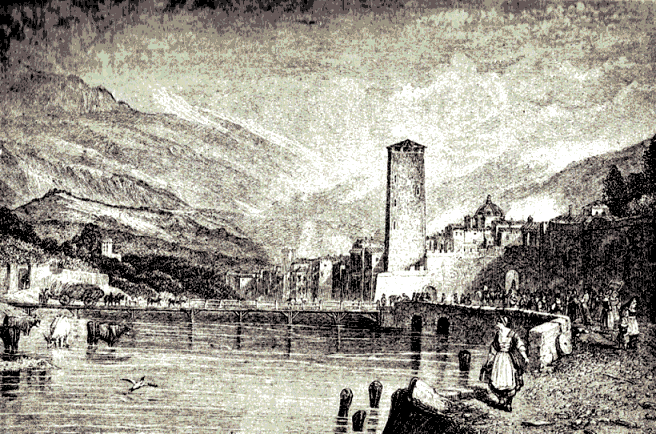 TRENT IN TYROL |
This time the effort was successful. The Fathers were at their post by December 13, and the great work was taken in hand. They must have needed superhuman courage to face the problems that lay before them. There were the sad records of twenty-five years of the unbridled licence of Protestantism, with its consequent perversion of the doctrines of faith, together with the disciplinary abuses which had existed in the Church itself previous to that time—a prospect that would have appalled any but those who were the guardians of the divine deposit of truth. But, strong in our Lord's promise of abiding help and presence, they manfully set to work to build anew the shattered fabric of discipline, and to promulgate in clearer terms the infallible teaching of the Church.
Practically the most important points to be settled regarded thy relative rights of the popes and the sovereigns, and the popes and the bishops; for the action of ecclesiastics in preceding times had confused the sphere of the spiritual and temporal authorities, and men were uncertain whether papal authority was of Divine or of human right. Again the question had been raised: Was the Pope above or subject to Canon Law? Also the duties of bishops to their dioceses, and of priests to their parishioners, and the reform of religious Orders had to be settled and enforced. In the domain of doctrine the field to be covered was a no less vast one, as it embraced every tenet attacked or repudiated by the new sectaries. In short, the principal points were—Sin, Justification, Grace and Free-will, Prayer and the Seven Sacraments, the Holy Sacrifice, Indulgences, Purgatory, and Prayers for the Dead.
As usual, the earliest sessions of the Council were devoted to settling the method of procedure, and it was determined that questions of doctrine and discipline should go hand in hand, the same matter being treated from the double point of view. The mornings were to be set apart for seeking out the sources of the evils complained of, and for finding suitable remedies; the evenings were to be devoted to the explanation and definition of the Church's teaching, and to meeting the objections of her opponents. One cannot fail to be struck with the very important services rendered to the Council by the papal theologians, Salmeron and Laynez, members of the newly-founded Society of Jesus. To the former was given the task of formulating the topic to be introduced, and to the latter the very momentous duty of sifting all the opinions, reducing the mass of evidence into logical sequence, and of summing up the whole matter under discussion. Later on Laynez was also charged with the stupendous labour of searching out the erroneous statements of heretics on the points in question, and he performed his task to the satisfaction of the Fathers of the Council.
The Council had sat from December 13, 1545, to March 11, 1547, when an epidemic broke out in Trent. Ten sessions, or series of sittings had been held, and the subjects treated of had been those named above, down to the Sacrament of Confirmation exclusively. An interruption at a time when such an important work was proceeding so smoothly seemed to all most inopportune. The majority of Fathers therefore decided, with the approbation of the President, to adjourn to Bologna. But the Spanish and German prelates, instigated probably by Charles V., their sovereign, refused to go, as they would no longer be on imperial territory. The War of Smalkald had broken out between the Protestants and the emperor, who was again on unfriendly terms with the Pope.
The Bologna assembly, therefore, had no general sessions, but smaller assemblies or committees met, in which the question on Penance was completed, and that on the Holy Eucharist prepared. While the Fathers still sat at Bologna, Pope Paul III. died, and the Council was prorogued. After the election of Pope Julius III. the Council entered on its second period at Trent.
In September, 1551, the Fathers again assembled. Six more sessions were held, during which the great question of the Blessed Eucharist was treated. Early in 1552 the Protestants asked to be received, and work was suspended awaiting the arrival of their deputies. Several German towns and the States of Wittenberg and Saxony sent representatives, but none of their theologians appeared. At this juncture Maurice of Saxony, now in open hostility to the emperor, rapidly swept across the intervening provinces, seizing towns by the way. The emperor narrowly escaped, but the victorious general sat down at Innsbruck in perilous proximity to Trent. The bishops were dispersed, and Julius III. suspended the Council (1552).
Eleven years passed. Marcellus II. had succeeded Julius III. Neither this Pope nor the next in order—Pope Paul IV —recalled the Council. It was not till the end of his reign that Pius IV. again summoned the Fathers. Events fraught with immense importance to the Catholic world had been taking place, and when, in 1562, the Pope reassembled the Council at Trent, the Fathers met under far different auspices from those which had greeted the first assembly. Time had smoothed away many of the difficulties surrounding the earlier sessions. Several of the prelates, who might from personal motives have shown some opposition to measures of reform, were dead. A spirit of deep religious earnestness pervaded the new assembly; in spite of religious and political troubles, a notable amelioration in the state of Christendom was making itself felt, and experience had shown the Fathers the way of acting that would win without wounding. The remaining work of the Council was carried through rapidly, but thoroughly. The topics of the Holy Sacrifice, of Holy Orders, of Matrimony, of Purgatory, and Prayers for the Dead were treated. Then came the questions relative to the authority of popes and bishops, and that of the reform of the clergy. On the first point, contrary to the desires of the Sorbonne, it was declared that the Pope is above a General Council. The decrees promulgated on the latter point did little more than solemnly approve the system already working such marvels under the direction of the great men to be hereafter noticed.
The sessions closed on December 4, 1563. It was a momentous occasion, and the Fathers of the Council felt all its import. The highest authority on earth had traced out the paths to be trodden, the doctrines of the faith had never before been so ably defended or so clearly defined, and never had it been more evident that the Spirit of God was at work in His Church. They who had been the Fathers of the Council, cardinals, bishops, heads of religious Orders, dispersed to carry far and wide the decrees of the great assembly, and to strive by every means in their power to put them into practice. The finishing touch was given to the labours of the Council when the Catechism of Trent was published three years later.
The Catholic Reaction in Europe
It must not be forgotten that momentous events had been occurring in England, France, Germany, and the Netherlands during the eighteen years over which the sessions of the Council of Trent were spread. But during these troublous times the work of God, too, had been going on, and the state of the Church was full of promise. The reforms already noticed were bearing rich fruit. Institutes for the formation of a holy secular clergy Lad sprung up under the hands of St. Philip Neri and St. Charles Borromeo—the older Orders had been reformed, new religious congregations had arisen, and the nations severed from the Church by heresy were in many places being won back to the unity of the faith. The impetus given to the Christian education of youth was little short of 76 marvellous, and from recently-discovered lands stories were coming of hosts of the heathen being received into the bosom of the Church. Everything seemed to promise a Golden Age. But, though these glorious works developed as time went on, there has never been a truce in the deadly warfare waged against them by Protestant sectaries; and that so little, comparatively speaking, has been realized by such splendid activities must be reckoned to the account of the hand-to-hand struggle going on all over the globe between the Church and the spirit of heresy and of infidelity engendered by the great revolt of the sixteenth century.
I. Rejuvenescence of Older Religious Orders
The reform of the older congregations of the Church seems to have been the work of numerous holy members, whose silent influence gradually leavened the whole body, and brought about a renewal of the ancient fervour which had made them such powerful instruments for good. The fresh fields of labour opened up by the discoveries of the sixteenth and seventeenth centuries seem to have invigorated these holy federations with a new ardour; and the religious of several of them—notably the Franciscans and Dominicans—are to be found everywhere in the wake of the pioneers of the New World.
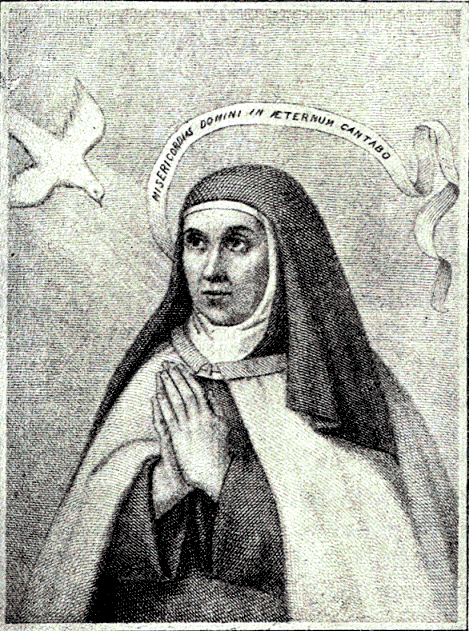 ST. TERESA |
The ever-living story of St. Teresa's grand work in the Church is but an exquisitely finished example or a type of what was going on in the silent cloisters of many lands.
It is unnecessary to rehearse the oft-told tale of the Spanish saint's holy childhood and girlhood, with its brief interlude of a vanity we should be tempted to call innocent had not Teresa, with eyes enlightened by heavenly intuition, looked on it as so grave a misconduct.
Thirty years of exemplary religious life (1533–1562), not unmarked by human faults and frailties, but closed with a complete surrender of her whole self—with all the rich treasures of heart and mind with which she was dowered—to the absolute following out of the Divine Will, prepared her for her life's work: the reform of the ancient Order of Carmel, which claims descent from the Old Testament Schools of the Prophets founded by Elias.
With no other thought but that of leading a life of perfection in company with a few generous souls, Teresa led the way by founding, not without great opposition, a poor little convent, which she dedicated to St. Joseph, in Avila itself, the city where she had been born, and in which she had lived so long as a religious in the convent of the Incarnation. Here the young community followed the primitive rule in extreme poverty and fervour. Nine years later (in 1571) the General of the Order, seeing the immense good likely to spring from the multiplication of convents such as Teresa governed, gave her leave to extend her work, and bade her make other foundations, not only for women, but also for men. Her inimitable narrative records the story of the seventeen convents for nuns and the fifteen for friars which she established during the eleven years of life which were left to her. In 1580 St. Teresa had the happiness of seeing her work placed on a firm basis by the separation of the reformed convents from those of the mitigated rule.
She died on October 4, 1582. It was the year in which the correction of the calendar, made by order of Pope Gregory XIII., was to take effect; the precise ten days to be omitted were those intervening between October 4 and 15. Hence the Feast of St. Teresa, fixed for the day after her death, falls on October 15.
Strictly speaking, St. Teresa did not reform existing convents—at least, of women; she founded communities which embraced the reformed rule. Her institute spread into other lands after her death, and in many a quiet cloister her heroic daughters still follow in her footsteps, and, like their glorious foundress, are a powerful means of grace to the cities which afford them, perhaps too often, only a grudging hospitality.
II. Foundation of New Institutes
So many of the great works of zeal enumerated at the head of this section owe their existence either directly or indirectly to the Society of Jesus, that it would be impossible to follow their history without giving some brief account of the source to which they are due.
There is some analogy between the peace-loving patriarch of monks (St. Benedict) and the warrior general of the Jesuits (St. Ignatius of Loyola),and still more between the position held by their respective foundations in the ages in which their lot was cast. Owing something of their individuality to the times which gave them birth, both saints impressed strong characteristics on their own and later days—something of which is mirrored in the titles by which they are known to posterity. As the Benedictine Order embraced within its wide horizon every activity tending towards improvement in early mediaeval days, whether in literature, law, medicine, or ancient and contemporary lore, so did the Society of Jesus easily hold the front rank among the men who regenerated Europe after a worse than pagan scourge had smitten the nations. And what they did not accomplish personally was almost undoubtedly the result of their influence, for there is scarcely a measure of reform instigated in Europe subsequent to 154o—the date when the Society was approved by the Holy See—that may not be traced to a man brought up under Jesuit auspices or converted by the spiritual exercises.
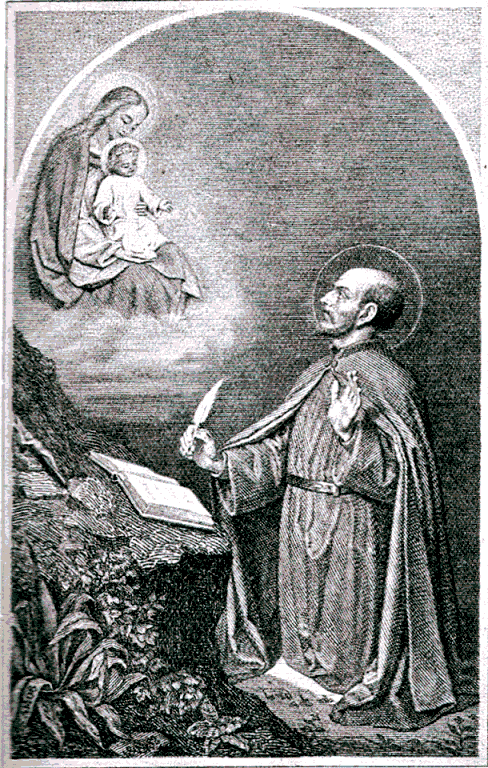 ST. IGNATIUS OF LAYOLA |
Ignatius of Loyola, to whose marvellous personality these results are, under God, due, was a noble Spaniard, forming in his own person a link between medieval and modern times. A typical knight of the most romantic chivalry, he yet had all the clear intuition, practical common sense, and long-sighted prudence of a man of business of to-day; grace and an indomitable will wrought these constituents into a monumental sanctity whose effects the world will feel till its last day.
Converted on a bed of suffering, in 1522, while reading the lives of Jesus Christ and His saints, Ignatius, by severe penance, long prayers, and pilgrimages, sought to repair the frivolities of his early life. During this time he went through every kind of trial and suffering, both mental and physical, thus gaining that deep knowledge of human nature, with its aspirations, struggles, temptations, and victories, which made him henceforth a leader of souls. He early felt that the defects of his education would prove an obstacle to apostolic work of any kind, and on his return from Palestine in 1524 he bent himself to acquire the rudiments of Latin and philosophy, without giving up a species of missionary work in which he was engaged. But he soon found that his method was faulty, and that he must follow the beaten track of knowledge; and in the Paris University he began to lay solid foundations of scholastic learning. It was not until ten years had elapsed that, in 1534, he finally gathered round him the little band of men who were to form the nucleus of his Society, the idea of which, shown to him at Manresa, was not yet fully developed in his mind. Favre, Bobadilla, Rodriguez, Xavier, and Laynez—all professors or students of the University—were they who, on the now famous Montmartre, made their vows and prepared to enter on a life of apostleship. Gradually the plan of\ the great Society he was to found, and the work he was to do, unfolded itself before Ignatius. In 1539 he presented to Pope Paul III. the draft of the new Institute. This was approved the following year. Meanwhile, members had been multiplying, for the famous exercises learned by Ignatius from Our Lady herself at Manresa had been producing great fruits. Each of the disciples of Loyola brought the unanswerable logic of this master-piece of spiritual science to bear on the souls with whom they came in contact, and something like the enthusiasm which followed the preaching of the Dominicans or the ministrations of the Franciscans in the thirteenth century was witnessed wherever the new missionaries appeared. To follow the footsteps of any one of the first Jesuits throughout his career is to read.the ever-recurring story of spiritual renovation in belief and practice. Such is the glory of Laynez in Venice, Padua, Trent, Sicily, and among the fleets sent against the famous corsair Dragut. Rodriguez had equal success in Portugal. Salmeron, Le Jay, and Favre—with his great conquest, disciple, and successor, Canisius—did the same for Germany. Each nation had its apostles, and the same scenes are recounted again and again.
Meanwhile Laynez and Salmeron had been sent as papal theologians to Trent. Their action in the Council had enormous influence on the after-history of the Society. The virtue of the men themselves won universal admiration, their learning and the extreme prudence of their manner of acting conciliated esteem for their Order, and the solemn approbation of the Society given by the Council placed it on so secure a basis that it has weathered every storm by which it has hitherto been assailed. Before the Council closed, St. Ignatius was dead, and Laynez ruled the Society in his stead; but the founder had framed the grand plan of his Company, had laid down principles of guidance for his sons, and had started every class of work for souls which they have since made their own.
Unlike many another great originator, Ignatius had lived to see the chief desires of his heart realized: his institute had been confirmed by more than one pope, the book of the spiritual exercises had been approved, and the constitutions of. his Order had been promulgated in every place where his sons were labouring. This body of rules was solemnly adopted by the General Congregation of the Society which met on the death of St. Ignatius to nominate his successor, and it was also again approved by the Holy See.
Some of the works begun by this saint have since been taken up by other Orders as their special end, and the Society no longer engages in them, but St. Ignatius has perhaps made no greater mark on the subsequent history of the world than by his educational foundations. From the first, teaching was recognized as a fundamental duty of the Society, and there was not a centre in which Jesuits were stationed that had not its school, its college, or its university. When St. Ignatius died, about a hundred establishments already existed; and they multiplied with a rapidity that speaks volumes for the influence of the movement, when it is remembered how carefully the saint had laid down the law that the staff of professors should be not only adequate in number, but efficient in qualifications. It would be impossible to follow the spread of these centres of renovation and of culture. It must suffice to say that one hundred and fifty years after the death of St. Ignatius there were more than seven hundred of them scattered over the face of the globe, the lowest number of students recorded as attending any of them being given as three hundred. And it must be remembered that these colleges were directed by men eminent not only for virtue, but for learning, who gave as a sacred duty their best years to the cultivation of the minds and hearts of the youth committed to their care. St. Ignatius and his successors in the generalate required from those who demanded a college or a university for their town that a modest endowment should be provided, enough to cover the expenses of the professors. This was in order that no fee should be asked or received for tuition, and that thus the benefit of the most complete and thorough education should be within the reach of all. These Jesuit establishments were to the Catholic youths of the early modern times what the great universities had been to the European world in the Middle Ages, with this difference—that the students of the Jesuits, with no small gain to themselves, were more directly under the guidance and control of the masters than in the earlier scholastic bodies.
Under the fifth general of the Society, Claudius Aquaviva, a man of commanding sanctity and genius, a complete system of studies was drawn up—the famous Ratio Studiorum. It was the fruit of long experience, of wide research and broad principles, and was the work of a series of committees of great Jesuit educators called together from the most famous teaching-centres of Europe. It regulates not only the subjects to be taught, but lays down the scope and aims, the principles and practice, of the great art of teaching.
It would be an interesting but almost endless task to record the names of the most famous professors and students of Jesuit colleges, and the libraries of precious works which are due to their patient researches or inspired genius. In every walk of knowledge their names are to be found.
Perhaps the most famous of the Jesuit colleges were two begun by St. Ignatius himself. That established for the youth of the eternal city had for its temporal founder St. Francis Borgia, and came to be known as the Roman College. On account of its free tuition, it at first met with great opposition, but the unqualified success of its teaching silenced all criticism and defeated its enemies, while popes and cardinals were loud in its praises. It was here that public distribution of prizes, with an exhibition of the powers of the students in oratory, declamation, and music was first established—an institution due, it is said, to Laynez, the second general. Twenty colleges at different times sent their students to assist at the Jesuit courses, so great was their fame. Here the most promising of the young members of the Society were sent to study: hence we find St. Aloysius Gonzaga, St. Stanislaus Kostka, and St. John Berchmans numbered among the students of the Roman College, which has, moreover, given eight popes to the world, besides a crowd of men eminent in every line of intellectual life or moral excellence.
The second foundation which Ignatius also settled in Rome was the Germanic College. Its aim was—though not closing its doors to seculars—to form a highly educated body of clergy for Germany. The great disciples whom their founder had sent to labour among the nations in which Lutheranism had its head-quarters were instructed to send to Rome young men whom they considered fit for the priesthood. These were trained under the eye of Ignatius, and soon became so grounded in science and virtue that, on their return to their native country, they did wonders in bringing back to the faith many whom ignorance and heresy had perverted. It is a patent fact that Protestantism made no further advances after the Council of Trent; and that it did not is due to the heroic stand made against it by the Jesuits and their colleges. As Guizot says: "The Society was instituted to fight the Religious Revolt." In spite of its immense importance, the Germanic College suffered extreme penury for a long period. In 1573 Gregory XI II. placed it beyond the possibility of distress by an adequate endowment. The students of this college still form a marked feature in Roman streets, with their picturesque orimson cassocks and broad black sashes. Few of the great names of the next generation of German rulers, lawyers, prelates, warriors, and scientists but are to be found on the bead-roll of the Germanic College.
Perhaps no other feature of the period was more powerful in effecting a return to Catholicism in heretical countries, and in arousing anew the true spirit of the faith where the fundamentals had not been lost, than the Jesuit schools. But there were many other influences at work, though perhaps more local in character than those due to the Society of Jesus. The city of Rome itself owes its spiritual renovation to St. Philip Neri. The ministrations of this gentle saint were long almost unnoticed, for his method was unostentatious, and his works of zeal of the humblest character. He frequented hospitals, aided the dying, talked cheeringly and lovingly of the good God and the way of serving Him, and exercised an almost magnetic influence over all that came under the spell of his gracious presence and winning manners. Men gathered round him instinctively; where he led they followed, whether it was to perform self-denying acts of charity for the sick or for pilgrims, or to make the stations of Rome, or to assist at exposition of the Blessed Sacrament. At length his director insisted on his embracing the priesthood, and Philip, without changing his methods, found his power over men grow. The results of his sacred ministration in the confessional, and his familiar but priestly conversations, will be known only at the last day. Philip loved to gather the young around him, and to make virtue attractive by surrounding it with sweet and beautiful associations. Wise religious superiors sent their novices to join the happy throng of lads that sang and prayed and played round that gentle master on the fair slopes of the Aventine.
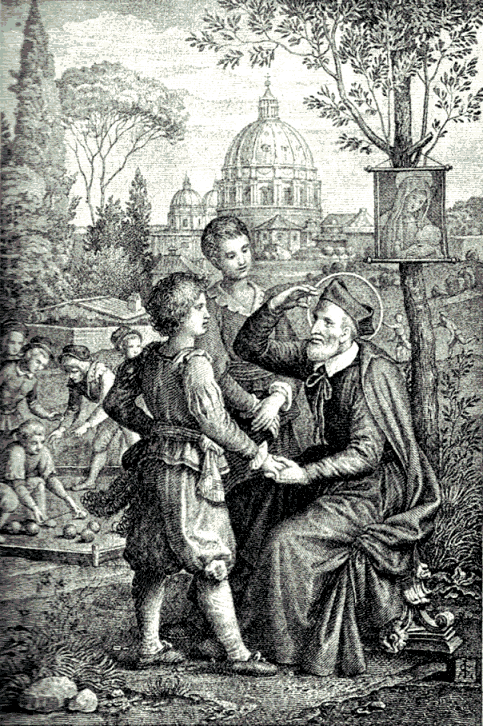 ST. PHILIP NERI. |
Among the disciples who clustered round St. Philip, a little bind of priests attached themselves more closely to him and lived under his guidance, forming something like a community, though Philip had no thought or desire of becoming a religious founder. The first church where they met, and whither crowds repaired to assist at the simple sermons and glorious choral services which, from the first, characterized the meeting of St. Philip's sons, was called the Oratory. Though one church after another was taken—as each in turn became too small to admit the ever-increasing number that flocked thither—the name remained. St Philip's churches are Oratories, his sons Oratorians; and a species of sacred drama set to music, first brought to perfection in the church of St. Philip, and under his inspiration, is still called an oratorio.
Palestrina, the prince of Church musicians, was a disciple of St. Philip, and held for ten years the post of maestro in the Oratory at the same time that he conducted the papal choir at Santa Maria Maggiore. It was in the arms of St. Philip that (in 1594) the great composer breathed his last, "true, even upon the brink of death, to that sympathy with piety and purity which had drawn him, during half a century, to devote to their illustration and furtherance all the beauties of his fancy, and all the resources of his learning."
St. Philip, in spite of his retiring humility, was drawn into most of the stirring events of his day. The very spirit of the Council of Trent seemed to be alive in him, and his action lent effective aid to the popes and bishops in carrying out its decrees by training good priests, by making Church services splendid and, at the same time, attractive, and by adopting a style of preaching understood by all, thus popularizing holiness of life. To combat Protestantism in one of its strongholds, Philip caused his great disciple Baronius to compile the "Annals of the Church." This was to answer the "Magdeburg Centuries"—a series of historical works purporting to be an account of thirteen centuries of Church history. The preparations were worthy of the work. Baronius was commanded to treat only of ecclesiastical history in his sermons, and to repeat the course over and over again for thirty years. Then Philip bade him write. Baronius was able to complete the story of only twelve centuries, but his work is a monument of painstaking research and noble devotion to the Church.
When King Stephen Bathori reinstated Catholicism in Poland, St. Philip founded the Polish College at Rome, on the model of the Germanic College of St. Ignatius About the same time Pope Gregory XIII. founded the English College to provide priests for our country, then under the stress of the Elizabethan persecution; and Philip, when meeting the young collegians, was wont to salute them as "Flores Martyrum."
As we have already seen, St. Philip had a good deal to do in securing for Henry IV. of France the long-sought-for absolution which brought peace to France. Shortly after this event, at a ripe old age, though with undimmed lustre of intellect and warmth of heart, Philip's bright and happy spirit passed to eternal joy, May 26 1595.
Perhaps the greatest work of St. Philip was the silent moulding of the hearts of the great men around him, till one and all who came under his influence became transformed, or were strengthened to lead a more than usually holy life. Not only was he the friend of all the saints of his) day, but he was the centre of cardinals, prelates and religious: he inspired each with lofty aims, and each in his turn became a means of holiness to others. Among the most famous of this group of saintly men were St. Charles Borromeo, Cardinal and Archbishop of Milan, and his nephew, Cardinal Frederic Borromeo, who succeeded him in his diocese. Twenty-three years younger than St. Philip, St. Charles was yet of mature sanctity when they first met, and the two saints instinctively recognized each other's holiness. None was more indefatigable in working for the interests of the Church than St. Charles Borromeo. To him it is largely due that the Council of Trent was called and brought to a successful conclusion by his uncle, Pope Pius IV. He, too, had the principal share in compiling and producing the Trent Catechism. To aid him in reforming his diocese he would have had the sons of St. Philip in his episcopal city, but some little difference of views in the two saints frustrated this project. He called in the Jesuits to his aid, gave them charge of the secular college, and entrusted to them the ecclesiastical seminary until his own oblates were able to take charge of it. St. Charles died in 1584, at the early age of forty-six; but by princely munificence in restoring churches, by zealous preaching, by the training of his clergy, and by self-sacrificing labours, he had completely changed the face of his diocese: his Helvetic College had provided for a supply of well-qualified priests for Switzerland. He had also brought about an alliance of the seven Catholic Cantons—the Borromean League—for the defence of the faith of these peoples who were placed, as it were, in the stronghold of Calvinism.
 ST. CHARLES BORROMEO HEALING THE PLAGUE-STRICKEN. |
Another eminent bishop and apostle of the age was St. Francis of Sales, a pupil of the Jesuits both at the Paris and Paduan Universities With the assistance of his cousin, Louis of Sales, who obtained for him the provostship of the Genevan Chapter, he overcame his father's opposition to his vocation, and was ordained priest, at twenty-six years of age, in 1593. He was a Savoyard, and his whole career was passed within the limits of this Alpine land, which now forms two departments of France, but was then an independent dukedom. In the great duel between Clarles V. and Francis I., the dukes of Savoy sided with the former. They thus found themselves placed between two enemies—the French on the west, and the Calvinistic Cantons of Switzerland on the northeast—and cut off from their ally, the German Emperor. During the long wars between France and Germany, Savoy was repeatedly invaded, and large slices of her territory were absorbed by France and by the Swiss. In 1536 the Chablais, a very important section of the duchy—that lying to the south of the Lake of Geneva, and a rich and populous part of it—was seized by the Canton of Berne, and retained for more than fifty years. The people changed faith when they changed masters, so that when Charles Emmanuel of Savoy regained the Chablais by treaty with Henry IV. (1589) the inhabitants were bitter Calvinists.
 ST. FRANCIS DE SALES. |
Shortly after the ordination of St. Francis the duke begged the Bishop of Geneva to send some priests to convert the restored province. It was a dangerous mission, and the bishop felt that none could be better entrusted with it than the young provost, who was already attracting much attention by his talents for preaching and his priestly. virtues. Again the aged father interposed, and' strove to prevent his son from undertaking the perilous task;, but Francis was firm, and, with his cousin, set out on the Feast of the Exaltation of the Holy Cross, 1594. For a year and a half almost no results were seen, though Francis had exposed himself unceasingly and with dauntless courage to every hardship and danger, seeking the mountaineers among the snow-clad fastnesses, crossing frozen torrents to say Mass for a few faithful Catholics, braving assassins, or preaching to congregations whose numbers could be counted on the fingers. At length people began to be interested in this intrepid missionary who toiled on so patiently at his thankless task, and by Lent, 1596, his sermons were listened to with profound attention. Then Francis boldly defied the Calvinistic ministers to prove the truth of their belief. They met to concert a plan of attack and defence, but not being able to come to a common ground of agreement, excused themselves by alleging the imprudence of holding a conference without the consent of the duke. Private conferences, however, were held, and great numbers were reconciled to the Church. the most influential being the Governor of Thonon, who henceforth was of great assistance to St. Francis. By order of the Pope, St. Francis on three occasions presented himself before the aged Beza, successor of Calvin, and strove to win the old man to reconsider his position. Though he is reported to have been greatly disturbed by the arguments of the saint, he finally declared: "My side is chosen." And if he ever desired to return to the Church, guards placed around him, to watch him night and day, prevented any such attempt. Beza died in 1605.
Though Francis began to work marvels, he felt that single-handed he could not hope to win back the whole country to the faith. He therefore begged the duke to send Jesuits and Capuchins to his aid, to set up a Catholic press for the dissemination of popular pamphlets on Catholic belief, and to open an establishment at Thonon where converts could in peace earn their own livelihood, or at least be secured against want. But what seems to have been the most fruitful measure employed by Francis was the solemn Exposition of the Forty Hours, which he held first at Thonon and afterwards in other places. Most wonderful results followed these times of fervent prayer, and the people simply flocked into the Church. Five years were passed in this way, and then Francis was named coadjutor to the aged Bishop of Geneva. He was able to carry out his idea of a Holy House of Refuge and Formation for Converts, and he joined to it three other departments, the whole forming a sort of university on a novel plan. The special needs of the diocese suggested the attempt. It was founded at Thonon, 1599, and comprised a seminary and residence for priests; a body of missionaries under the control of Capuchins; a college for the young, directed by Jesuits; and the home where converts were instructed in the faith, and provided with means of earning their livelihood. St. Francis also set on foot the Confraternity of Our Lady of Compassion for the conversion of heretics, which, three centuries later, Pope Leo XIII. confirmed and encouraged, giving for its special object the conversion of England.
As administrator of the diocese after the death of Claude de Granier, Francis was able to complete the conversion of all his people. Throughout the summer months he insisted on catechism being given on each Sunday during the two hours preceding vespers, himself setting the example at Annecy. He watched carefully over the education of his clergy, and examined with the greatest care all the candidates for Holy Orders. He held half-yearly synods, visited the various monasteries under his jurisdiction, and with the prudence, patience, and gentle tact for which he was renowned, he succeeded in rousing anew the religious spirit in hearts that had long been dead to its influence. When, after a lengthy visitation of his flock, he sent a report to the Holy Father, he was able to give the consoling testimony that, except in the Swiss section, not one single person in the diocese was a heretic. It is calculated that he won over fifty thousand sectaries to embrace the true faith.
Henry IV. had the greatest esteem for St. Francis, and showed it in many ways. The Swiss promised him their allegiance, and the use of their troops against the Duke of Savoy, on condition that he would re-establish Protestantism in the Chablais. But, at the solicitation of Francis, Henry declined an offer so advantageous from a military point of view. Later he permitted Francis to send missionaries into his Swiss possessions, and did his best to secure the saint for one of the French dioceses, treating him with the utmost honour when he visited Paris.
St. Francis of Sales will always be held in veneration for his splendid writings, which are as perfect models of literature as they are of simple and lovable piety, the "Introduction to a Devout Life" being the most widely known. He founded, with St. Jane Frances de Chantal, the Order of the Visitation, being one of the earliest saints to recognize the need for communities of women who would devote themselves to works of mercy outside their convent walls. The times were not ripe for such an immense step in the development of religious life, and the project had to be dropped, though the name remains to testify to the clear-sighted wisdom of the holy man. He had a good deal to do with the foundation of the Oratory in France, having suggested the idea to Cardinal de Berulle, and done all in his power to foster the new institute. He helped the saintly Madame Acarie in carrying out her project of bringing St. Teresa's Carmelites into France. In his own diocese he multiplied communities, and proved himself a true father to the religious under his care. He toiled without respite at his numerous works of zeal—always gentle, always full of winning gaiety and attractive piety—till struck down by apoplexy, December 28, 1622.
In France the movement towards reform was much retarded by the civil wars which lasted up to the close of the sixteenth century, and by the bitter quarrels between the religious parties which characterize the whole period. When once the tide turned, the splendour of the reaction was almost unprecedented. The mere enumeration of the names of those who made the France of the seventeenth century glorious with sanctity would fill a page, but would give very little idea of the work accomplished. Every kind of zealous labour was cultivated: the reform of religious Orders, the foundation of schools, of confraternities to honour the Blessed Sacrament, to stop swearing and dueling, and to provide poor girls with marriage portions—such are a few of the projects set on foot. Everything was undertaken on a large scale; but several new features were added whose usefulness has been recognized more fully as time has gone on. Such were the work of the priests of the mission, of the training of secular clergy, and of active Orders of charity. This last, however, did not originate in France, though some of its most illustrious propagators belong to that country.
 ST. VINCENT DE PAUL. |
St. Vincent of Paul's Lazarist Fathers, founded in 1624, were the pioneers in the work of giving missions among the people. During eight months in each year the members of the Society dispersed in bands whose numbers were proportioned to the density of the population to be evangelized, and passed from village to village and from town to town preaching, catechizing, hearing confessions, and winning thousands to the profession and practice of their faith. Other bodies of priests having the same object were formed from time to time, and it is touching to read of the avidity with which these ministrations were almost everywhere received.
Most of the societies of religious men which sprang up subsequent to the Council of Trent had for object the supplying of worthy priests for the ministry of the altar and the care of souls; but the training of the so-called secular priests had not made much progress, though the establishment of seminaries for the purpose was one of the special means of reformation pointed out by the Council. It was reserved for an extraordinarily holy group of men of the first half of the seventeenth century to realize this important ideal. Pere de Condren, successor of Cardinal de Berulle as Superior-General of the French Oratory, was, under God, the originator of the project. Its accomplishment was due to Monsieur Olier, whose influence on his contemporaries was almost unbounded. He gathered around him a band of devoted priests, and with them evangelized the disreputable parish of St. Sulpice, which contained the notorious Faubourg St. Germain—the scene of the worst excesses of the dissolute Parisian nobility—and made it the model for a spontaneous reform that, reaching in turn every parish in the great city, spread throughout France, and so changed the face of the land that vice became unfashionable. During this period of renovation the project of an ecclesiastical training college was developed, and the seminary of St. Sulpice became the type on which were moulded the very numerous establishments of the same nature which gradually covered the land.
The religious Orders of charity are exceedingly numerous. To mention a few of the best known must suffice: St. Jerome Emilian, of a noble Italian house, and his disciples—the Somaschans—became the protectors of orphans. The Barnabites undertook many charitable works among the poor, and devoted themselves with great zeal to religious instruction; and St. Joseph Calasanctius founded schools for the most forsaken outcasts of great cities. The first Order devoted exclusively to the education of girls dates from the sixteenth century. St. Angela of Merici is claimed as the foundress, though she did little more than suggest the idea and make a first essay. She was witness of the distressing state of things consequent on religious revolt, and with womanly intuition recognized the utter neglect of the education of girls as largely chargeable with the evils of the time. A vision in which Our Lord told her she was to found an educational Order, strengthened her convictions, and she gathered a number of little girls around her, and began to teach them household arts and sacred science. However, she seems to have interrupted the work for many years, until Our Lord reproached her for her neglect of His wishes. Then she set to work to draw up a rule and to gather helpers. There was no question of founding an Order, so the members remained at home, merely assembling for prayers, teaching, and visiting the poor for the purpose of giving religious instruction. They chose St. Ursula as their patron, and were called Ursulines. For five years all went on very prosperously, then Angela died (1540). In many different centres the work was taken up and separate foundations were made, though a kind of union was preserved by each being placed under the patronage of St. Ursula. Hence there is considerable diversity in the various branches or congregations of which the Order is composed. The freedom of action which St. Angela established was gradually exchanged for conventual life, and though some Ursulines are cloistered and others are not, all have adopted a religious costume, live in community, and take the vows of religion.
The Paris house, which became the model of many of the French convents, grew out of the attempt of Madame Acarie to found a Carmelite convent. While negotiating their coming, she was preparing a number of young girls to be presented to the daughters of St. Teresa when they should arrive. As she did not find signs of a contemplative vocation in all, she had them trained to teach, foreseeing the great good that would result from an institute which should devote itself to the education of girls. Her cousin, the celebrated Madeleine de Ste. Beuve, warmly took up the idea when it was laid before her, and in 1610 she built a convent which she dedicated for this purpose. She had the consolation of seeing a numerous and fervent community grow up, many affiliations started, and multitudes of young girls receiving the blessing of a thorough Christian training. From the Paris foundation sprang another yet more famous—that of Canada—shortly to be mentioned. The Bordeaux congregation was very numerous, and others had their centres in Dijon, Lyons, Arles, etc., each of which has some distinctive characteristic.
St. Charles Borromeo introduced the congregation into his diocese, endeavouring to get Ursuline nuns established in all the large cities of Northern Italy. He had founded eighteen convents in the Milanese province before his death. During the first hundred years of its existence the Order spread into almost every country of Europe.
But perhaps the best known of all the institutes of charity are the Daughters of St. Vincent of Paul, whose devotedness wherever suffering reigns, whether in hospital or on the battlefield, in prisons or in orphanages, is beyond all praise.
This was the earliest example of a religious community of uncloistered women devoting itself to works of zeal. Founded in 1633 by St. Vincent of Paul, with the co-operation of Madame le Gras, it was approved by the Holy See as early as 1655 and incalculable are the effects of the example of this pioneer Order of charity. Since then every form of ministration that womanly hearts can plan and womanly hands can carry out has been opened up; and countless multitudes of consecrated virgins will bless God for the inspiration executed by the devoted father of the poor, St. Vincent of Paul, which has thrown open to them a career of such holy usefulness.
It would be possible thus to follow up saintly bishops and priests, religious and seculars, in their work of renewing again the face of the Church, but the task would be too long. It may safely be said that, thanks to these devoted men and women, by the middle of the seventeenth century a marked change had come over most of the European nations. Nowhere was there complete success, but the spirit of this age was very different from the apathetic decadence of the sixteenth century. Regarded from a merely human point of view, it can scarcely be doubted that the frenzy of the Protestant sectaries had aroused a corresponding ardour in Catholics, but it is as absolutely certain that rarely has any period of Church history to show in such exuberance the marvellous effects of Divine grace working in the souls of men and women of every age and condition. On the whole, in spite of a nascent heresy in France and the sad scenes still being enacted in many parts of Europe, notably in the British Isles, it may be said that the outlook was hopeful for the faith, if not for the political prosperity, of Catholics when the peace of Westphalia (1648) closed the story of the Protestant revolt.
But Europe was no longer the only continent which owned the sway of St. Peter. While thousands on her soil had been throwing off allegiance to the Holy See, thousands in far-distant lands had been gathering under the banner of the Cross, and enrolling themselves in the army of the Church Militant.
The Rise of Foreign Missions
![[Illustration] from Church - Early Modern Times by Notre Dame](books/sisters/leading4/zpage107.gif "[Illustration] from Church - Early Modern Times by Notre Dame")
I. New Fields Opened to the Church.
Europe, at the beginning of the fifteenth century, had little more than traditional knowledge of the two great continents lying nearest her on the globe.
The victories of the Turks in the East, and their continual attempts to push their western front farther into the heart of the continent, deterred European peoples from making any effort to cross the lines of their dauntless foe and to explore the lands known to lie still farther east. The stories of the Polo family—the Venetians who, between 1254 and 1295, crossed Asia even to the Pacific shore—were almost the only sources of knowledge of that continent open to Europeans of the fifteenth century; and the maps constructed from their statements by the Nuremberg geographers are curious in the extreme, Asia being carried so far round the globe as to bring China within a measurable distance of Spain. These quaint maps are said to have inspired the attempt of Columbus to get to India by sailing west. Africa was known only for a short distance inland from the shores of the Mediterranean. Some mariners of Dieppe claim to have made a settlement on the Guinea Coast in 1364, and an Italian map of 1367 exists, showing the coast as far as Bojador. Had Arabic literature been available to Europeans, Africa might have been fairly well known, for, from the eleventh to the fifteenth century, the dark continent had been giving up its secrets to its Mohammedan masters. But, previous to 1492, America had no existence for the Old World, for though it is certain that Danes and Norwegians had been there before the close of the tenth century, all trace of the discovery had been lost.
Fifty years of exploration effected a revolution in geography that was only equaled by its results on the subsequent history of the globe. To Prince Henry the Navigator, son of John I. of Portugal, and grandson of John of Gaunt (1394-1460), is due the inauguration of the mighty movement. Gazing from his palace at Sagres across the ocean that lay unbounded before him, Henry felt the desire of finding the lands hidden beyond the horizon. He had served in the wars against the Moors of Morocco, and had seen and heard what had further excited his curiosity. He devoted himself to improving navigation, and, from 1433 to 1460, had a number of young nobles trained as mariners in a naval school attached to his palace. Thence he sent out expeditions, each of which distanced the achievement of the earlier ones, till the whole African coast to Sierra Leone was laid open, and the Azores, Madeira, and Cape Verde Islands were acquired. After the death of Henry the discoveries were continued, and trading relations were established along the whole coast. The Cape of Storms—now of Good Hope—was doubled by Bartholomew Diaz in 1487. Vasco Da Gama passed into the Indian Ocean ten years later, and sailed on to Calicut. Arab traders were monopolizing the commerce, and Da Gama had to fight his way out of the port. An attempt to found a colony in the newly-discovered land led to the opening up of South America also. Ocean currents carried the vessels out of their course, and the crews, under Cabral, landed on the coast of South America in 1500. The Portuguese, intent on settling in India, made no stay for the time being, but they took possession of the place, which, from its producing Brazil wood in abundance, was afterwards called by that name. Da Gama, treated at first with the neglect experienced by nearly all the great explorers of those days at the hands of their rulers and countrymen, succeeded in consolidating the power of the Portuguese in India by 1524. After a desperate struggle with the Mohammedan power in the East, they made many important settlements, and for a time they were practically masters of the South Atlantic and Indian Oceans, for Diaz and Da Gama had placed Africa and Southern Asia in their hands, while Cabral had given them Brazil. It must not be forgotten that China was visited as early as 1516. Japan was opened to foreigners some thirty years later.
 CHRISTOPHER COLUMBUS |
But Cabral was not the first European to set foot on American soil. Columbus, a young and adventurous Genoese, had been voyaging, sometimes in the service of Rene of Provence, sometimes on his own account, and had sailed beyond Iceland, a hundred miles ahead, he says himself. Whether any traditions of the old connection between Iceland and a western land came to the ears of Columbus is not known, but the bold project of reaching India across the Atlantic had been conceived, and for seven years Columbus sought a sovereign who would give him the means of realizing it. John II. of Portugal, Henry VII. of England, the Spanish Dukes of Medina Sidonia and of Medina Coeli, all refused assistance. . Christopher Columbus at length secured the interest of Isabella of Spain, and with a tiny fleet of three vessels he dared to face the great unknown. After two anxious months of westward sailing, land hove in sight, most probably Watling Island in the Bahamas. Cuba and Hayti were visited, and Columbus set out to return. One vessel, the Santa Maria, had been wrecked, the other two parted company in a storm, but both arrived the same day at Lisbon, less than eight months from their departure. Three other voyages followed; the West Indian Islands were visited, the southern shores of the Mexican Gulf explored, and the Spanish flag was planted in several places. The story of these expeditions can hardly find place here. Spain was not grateful to her hero, who died in obscurity (1506).
Mexico was gained for Spain by Hernando Cortes. He landed at Vera Cruz in 1519, and after a long contest with the brave natives, and a desperate siege of the capital, found himself master of the wealthy and highly civilized Mexican Aztecs.
Peru was invaded by the five Pizarro brothers about 1532. They crossed the Panama Isthmus and sailed down the Pacific coast, taking possession and founding cities in the name of Spain. All the brothers eventually met their deaths in consequence of quarrels among the conquerors, who could not agree on their respective regions of influence. Paraguay was settled as a dependency of Peru by Mendoza in 1535, but Spanish supremacy was long opposed by the powerful Guarani Indians. Other adventurers extended their conquests in North America, and by 1540 Spain had, in America alone, fifty-seven viceroys governing the vast provinces which a half-century had added to her sway. Spanish vessels had also been crossing the Pacific. Magellan, a Portuguese who had been treated with disdain by his sovereign, offered his services to Spain, and, proceeding down the Atlantic, passed through the strait which since bears his name, sailed westwards across the great ocean, and discovered the Philippines in 1521. Magellan was killed there, but his ship was successfully navigated homewards, and, still sailing west, reached Spain—the first vessel to circumnavigate the globe. A rush for the new lands followed, and during the period of colonization the mastery of the seas changed hands.
As early as 1493 Portuguese and Spanish interests in the newly opened-up countries threatened to conflict. To prevent war, Alexander VI., by the Bull of Partition, settled the limits of the regions of influence of Spain and Portugal respectively. He decided that the former might operate up to the 37th degree of longitude counted west from the Cape de Verde Islands, while the latter should enjoy prescriptive rights up to the same line of demarcation—reached, however, by an easterly course. The famous map on which the Pope traced the boundary-line is still kept at the Museum in Rome. By the same Bull the Pope provided for missionaries being sent to heathen lands.
At first Spain and Portugal carried everything before them, but the Netherlanders, during their struggle with Spain, had developed a powerful navy. England determined to share in the new prizes, and strengthened her fleet also. In 1580 Spain and Portugal were united under one crown, and the power of the combined forces might well have seemed invincible. The defeat of the Armada (1588), however, threw the balance on the side of the Protestant Powers, and from that time the English and the Dutch began to gain the ascendancy. England had her East India Company in 1600, and the Dutch followed with theirs two years after. Twenty years later the two Protestant Powers were fighting it out between them, the Dutch winning the day at Amboyna (1622). The transference of the supremacy of the seas from Catholic to Protestant hands was most disastrous for the work of the missions.
In the northern part of the American continent England and France took shares as well as Spain. The Dutch and Swedes had their settlements also.
England claimed the right of settling by priority of discovery, the Cabots, under a charter of Henry VII., having been the first to sight Nova Scotia and Cape Breton Island (1497). France made her first settlement on the St. Lawrence (1534), and took possession in the name of Francis I. Spain had seized on Florida in 1512, and after the conquest of Mexico pushed northwards and westwards. By the middle of the seventeenth century the three European nations practically divided the continent between them. England held, in the north, nearly all the land fringing Hudson Bay and Labrador (with a claim to what would now be called Hinterlands), on the east, a broad tract of land sloping towards the Atlantic seaboard, broken into, however, by the Swedish and Dutch possessions, and, on the west, a line of coast on the Pacific shores, together with the great island of Vancouver which it faced. The French possessions lay within the English, and occupying the broad prairie lands which form the basin of the Mississippi, stretched to the most outlying ranges of the Rockies. They had, however, three splendid outlets on the coast—the central portion of Hudson Bay, the mouth of the St. Lawrence, and the mouth of the Mississippi. Spain held the southern part of the continent, including California, Arizona, New Mexico, Texas, and Mexico proper, with Florida an outlying province. The isthmus provinces, Guatemala, Honduras, and Nicaragua, were also in Spanish hands.
Thus, during the sixteenth and seventeenth centuries, all the great continents were thrown open to Europeans, and a novel form of emigration had been set up—the race for new lands to be conquered and new fields of wealth to be explored. With few exceptions, the story of early colonization is marred by deeds of cruelty and injustice to the native populations, and the student of missionary enterprise knows too well that everywhere the spread of the faith was hindered, and the best efforts of heroic priests and religious thwarted, by the greed and cruelty of the adventurers from Christian lands.
Before attempting to sketch the outlines of the attempts made up to the close of the eighteenth century to convert the newly-discovered peoples, it may be well to give some idea of who they were: only thus can the magnitude of the task be estimated.
II. Peoples of Newly-Found Lands
Very little change had taken place in the distribution of the various races inhabiting Africa since the Portuguese landed. Then, as now, there were two strongly-marked branches of the human family dividing its broad surface between them, Caucasic in the north and Ethiopic in the south. The former are represented by the Hamites, a people divided into many sub-families, but all having some features in common. They are tawny, dark-haired, sometimes lithe and active, sometimes strongly built, and very hardy and enduring. They are the descendants of the original inhabitants of Africa, and are addicted to warfare. Once masters of and inhabiting the whole of the northern portion, they still occupy an extensive area, including part of the south-western shores of the Mediterranean, the vast interior of the Sahara, Egypt, part of Abyssinia, and the adjacent provinces of Kaffir, Galla, and Somali. The Tuaregs are the most powerful representatives of this section. Between the Hamite territories and the Mediterranean for the greater part of its length, down the west coast of Africa and across the Soudan—forming, as it were, a fringe around the Hamites—are the Arabs, another Caucasic people, but of the Semitic branch, brown in complexion, hardy, muscular and enterprising in character, nomadic in habits, and the slave-dealers of the world. There has been considerable intermingling of these two northern peoples, who, where they touch the great southern race, the Ethiopic, are often found to share their characteristics also. The Arabs are far inferior to the other races in number; but much restricted as is the area of their supremacy now, in the fifteenth and sixteenth centuries it was felt over the whole continent.
The Ethiopic people are of two very dissimilar types, the Soudanese negroes and the Bantu races. The former are confined to regions north of the equator, and are the African negroes proper. They dwell in the hottest part of the continent from Guinea and Senegambia across the Soudan to the Nile Valley, but north of the Congo Basin. The slave people of America and the West Indies are mostly derived from this stock. The Bantu races occupied almost the whole of the southern part of the continent when Europeans first landed on their coasts. They are a wonderful group, showing by their speech a common origin, and though there are many varieties among them, they are a fine people, capable of civilization, and far superior to the true negro in their characteristics. They often form large and powerful states, and exhibit military genius in no small degree. The south-western half of the peninsula south of the Torrid Zone was, and still is, where whites have not penetrated, inhabited by blacks of a lower type, Hottentots and Bushmen, the former supposed to be the last survivors of an earlier people, the latter belonging to a very curious type, the so-called Pygmies. There are other Pygmies in different parts—tiny people—sometimes black, sometimes brown like the Aruwimi found by Stanley in 1888-89.
All the northern group—Arabs, Hamitic races, and many of the Soudanese negroes—were Mohammedans when the Portuguese landed. A few schismatic Christians were known to exist in Egypt and Abyssinia, and attempts had been made from time to time to win them back to the unity of the faith, but without success. All the Bantu tribes were, as they still are, Nature worshippers: fetishism and witchcraft form prominent features of their religious system.
The two Americas, when discovered, were inhabited by a remarkable race of men, absolutely of the same type from one end of the continent to the other, the Eskimo alone being of a different origin. Unlike in minor characteristics, there is a remarkable sameness in these people as they are described by their conquerors. They are spoken of as brave, hospitable, enduring, tractable when kindly treated, capable of civilization—of culture almost—fine of form and feature, warm complexioned and extremely agile, though physical stamina seems to have been wanting. Injustice and cruelty made them vindictive, treacherous and irreconcilable enemies of the white man. Most of the enormous expanse thrown open to European influence was fairly thickly populated. Some tribes still subsisted on the produce of the chase alone, and these formed the lowest grade in a long ascending scale of civilization which reached its culminating point in Mexico and Peru, where the invaders found an organized government and large cities, with buildings of architectural merit and beauty. Agriculture was in high perfection; mining and working in metals were practised, and schools existed where the youth of both sexes learned reading, writing, and some form of calculation. Poetry was not unknown, and astronomy had made some advances. It is now usual to consider the American Indians as a great off-shoot of the Mongolic stock. They worshipped many gods, mostly impersonations of natural phenomena, and had a clear belief in a future state.
Asia presents a great contrast to both Africa and America as regards its inhabitants. The cradle of the human race, the centre from which the great invasions of the rest of the globe had radiated, and which had been re-entered and partially conquered by each in turn of the dominant western races—Egyptian, Greek, Roman, and Arabian—its peoples were numerous, strongly marked in their differences of character, civilization and religion, but all adverse to the coming among them of strangers, possibly through reminiscences derived from the experience of their ancestors. The three main stocks are represented, each having numerous varieties. Some very ancient tribes are still to be found inhabiting, as the last remains of an early people generally do, the extreme points of the most outlying peninsulas, or the summits of their mountain chains. The affinities of these are not well established. The Caucasic type is well represented by the highly intelligent Hindus, the warlike Afghans, Beluches, Kurds, and Armenians, and the indolent Persians and Caucasians, who all form part of the Aryan group. Kin to these are the Slays of Russia and the Samoyedes of Siberia. In and round Palestine and Arabia there is a thick sprinkling of Semitic people—Jews, Arabs, Syrians. But the majority of the myriad inhabitants of the massive continent are of the Mongolic type. The Turko-Tartars of Central Asia, the Mongols proper of East China, the Manchurians of North-west China, the Tunguses and Yakuts of the Arctic shores, form a very prominent group. The Central Chinese, the Japanese, and the Coreans are three distinct varieties of another family, with kindred branches in Thibet, Burma, Siam, and Annam, the monosyllabic character of their language distinguishing them from the other races of the same stock.
It is beginning to be considered certain that the Oceanic Malay population belongs to the Mongolic stock, strongly modified by admixture with Ethiopic races. The pure black type is found only among the Papuans, but the inhabitants of Australia, of Melanesia, and of Tasmania (the last now extinct), are Ethiopic in characteristics. This last-named group was unvisited by the earlier explorers.
Four centuries ago the same religions were practised in Asia as at the present day, though there have been modifications in the belief and form of worship, and in the races following them. One of the most ancient was Brahminism, which arose among the Hindus when, some time previous to 1000 B.C.—that is, during the days of the Hebrew Judges—the Aryan immigrants settled in India. They were already, civilized, and had a definite form of worship described in their sacred books, the "Vedas." It is supposed that gradually they split up into castes, the highest consisting of priests only (the Brahmins), the next of warriors, and the third of traders. These original castes at first numbered none but Hindus among them, but later on marriages outside that race must have taken place. A fourth caste, the Sudra, lower than the others, was made up of aborigines, the subject race; while outside the castes—literally the outcasts of all—were the Pariahs. The different castes are still strictly inclusive, marriages taking place within each section, but not outside its limits, and intercourse between them, even for necessary matters, being as restricted as possible. Later on a network of castes grew up within each section, so that there is now a species of strongly-marked clanship dividing the people into closely hemmed-in sets. The old Vedic traditions and practice having become obscured about 250 B.C., a reform took place, which developed into Buddhism. It made rapid progress, but did not take firm root among the Hindus proper, though the Greek settlers, who remained behind after Alexander the Great's invasion, were among those who adopted and retained it. Hence there are still Buddhists in India, though Brahminism revived again, and became much stricter than before, each village gradually forming a unit by itself, a complete little state, shunning intercourse with outsiders. During this period of renewed activity the ruling powers erected magnificent temples, a system of cramping superstition with degrading sacrifices was inaugurated, and, what is without doubt, demon-worship was set on foot.
For four hundred years, beginning about A.D. 1000, Mohammedan invaders overran India. They established the Mogul Empire, which lasted on, at least nominally, till the middle of the nineteenth century the subject States preserving, however, some kind of independence. In the eighteenth century the States began to recover a larger freedom, the Mogul Empire gave place to four Mohammedan kingdoms, one or other of which in turn laid claim to the older title. No strictly Mohammedan State remains except Bengal, though the religion is very widely spread. It cannot be said that the Hindus were converted, but Moslem colonies planted among them have largely affected their views on religious questions.
Buddhism, before its decay in Hindustan, began an active propaganda in the neighbouring nations with such success that, in some form or other, it was adopted by nearly all the Mongol peoples: in fact, at the present day, five hundred millions, out of the one thousand four hundred million inhabitants of the globe, are said to be Buddhists. Its originator was Gautama, of whom many extraordinary stories are told. After long study and prayer, he is supposed to have discovered that existence is the Curse of mankind, and that extinction is supreme happiness. This he endeavoured—and such of his followers as have the courage to follow him to the bitter end endeavour—to obtain by crushing out everything in themselves that contains the germ of a hope or a desire, since, according to their tenets, to desire is to live. For death is not extinction to the Buddhist—only the passage into another form of life, lower or higher, as the life in the human form has been tending upwards or downwards. This is the doctrine of transmigration of souls. They have no notion of God, and no word to express the notion. The duty of man, they say, is to tend to elevate himself by cultivating right thoughts, right feelings, right words, and so on; the end of which course of action will free him from pain, from life, from existence, and he will find his perfection when he is landed in nothingness. Those who strive to follow Gautama's teachings to the full form a kind of religious Order, and these are regarded as being on the road to that state of final bliss. As to the others, it is supposed that in some later incarnation they may get to the point when they too will be of the elect: until then endless transmigrations have to be gone through. Buddha, though figured in what are often called idols, is not a god, but an ideal man —the man who has succeeded in realizing his last beatitude, so that more than one Buddha is represented; neither are the prayers and homage paid before these statues petitions or worship, properly so called: they are not paid to the deified man or his image, but are rather elevations of self—at least, this is what advanced Buddhists profess. There seems little doubt, however, that in many of the sects idolatry, pure and simple, is practised.
In China Buddhism has mingled with the system of morality taught by the sage Confucius, who died in the fifth century B.C. China was distracted by wars between its petty sovereigns, and Confucius strove, but without success, to unite them by common interests into one great Empire. He collected the ancient traditions of the country, and wove them into a system of religion and government which, after his death, attracted great interest, and caused him to be revered with almost Divine honours as the greatest of Chinese. In Japan, Buddhism, broken up into numberless sects, claims the adherence of the greatest part of the population, though the State religion—Shintoism —is practised side by side with it, and not infrequently by the same persons.
In Western Asia there were still a number of Christian peoples, most of which were schismatical. These were principally the Maronites, Armenians, and Syrians, who in belief were either Nestorians or Monophysites.
![[Illustration] from Church - Early Modern Times by Notre Dame](books/sisters/leading4/zpage114.gif "[Illustration] from Church - Early Modern Times by Notre Dame") MAP ILLUSTRATING THE EXTENTION OF THE CHURCH THROUGHOUT THE CENTURIES. |
| Century | Country or Nation | |
|---|---|---|
| I. | Palestine, Arabia, Asia Minor, Greece, Italy (Rome). | |
| II. | Gaul, North Africa, Spain, Britain. | |
| III. | Persia, Italy (Milan), North France. | |
| IV. | Britain, Armenia, Switzerland; (Goths), etc. | |
| V. | Persia, Ireland, Scotland; progress in France. | |
| VI. | England (Saxons); Flanders, North Scotland. | |
| VII. | England (Angles), Holland. | |
| VIII. | Westphalia. | |
| IX. | Scandinavia, Sweden, Bohemia. | |
| X. | Russia, Denmark, Poland. | |
| XII | Norway, Persia. | |
| XIV. | China (Pekin). | |
| XV. | Canaries, Congo, Cuba, Hayti, etc. (Columbus). | |
| XVI. | Mexico, Central and South America, Japan, China, India, Cochin China, Siam. | |
| XIX. | Soudan, North Africa, Tasmania, New Zealand, Uganda, Central Africa, Australia, South Africa, Oceania. |
III. The Work of the Missioners
Such was the field of labour thrown open to the zeal of the Catholic missionary by the discoveries of the sixteenth century. The full significance of the conquests made is only recognized when the dates marking them are set beside those giving the contemporary facts of European history. It is startling to find great defections from the true faith in the Old World set off by the foundation of dioceses and colleges, conversions and martyrdoms, in the New World, or in the newly opened-up parts of the eastern continent. Such are the compensations God Himself provides for the Church in the days of her deepest distress.
It would be a mistake, however, to forget that the Church was missionary before the sixteenth century. Her Divine Founder is the Archetype of Missionaries. His Apostles followed in His footsteps. The first preachers in every land, to every race, whether in Rome, Ireland, or Bulgaria, to Saxon, Hun, or Icelander, were missionaries. Every age has had its apostles, who abandoned their own people to carry afar the tidings of salvation; but it was when naval enterprise crossed the watery barrier that had so long kept Europe shut up within her own restricted area that the Church could fully realize the scope of the command she had received to teach all the nations.
The missionaries were mainly drawn from the religious Orders—Franciscans, Dominicans, Augustinians, and Jesuits. The two first named were only developing the spirit of their respective founders: St. Francis of Assisi himself and some of the earliest of his sons had started to convert the Moslem; St. Dominic's Order had been established for the conversion of heretics. The Augustinians took up a new task, but the Jesuits made labours among infidel peoples one of their distinctive works from the very first.
One of the most striking features of the conversion of the heathen in these times is the rich outpouring of grace which showed itself, not only in the intrepid heroism of the new apostles, but in the gifts of tongues and miracles which many of them shared, and in the vast multitudes that entered into the fold of Christ. When there are exceptions to the rule, this nearly always occurs in places where European greed and licence caused the unfortunate neophytes to draw the contrast between the words of the Christian preacher and the deeds of his flock.
Missionary Work in the Old World
The work of preaching to heathen peoples seems to have been simultaneous with the discovery of the lands in which they dwelt. Every flotilla had its chaplains, who, as soon as they found themselves in presence of an unbelieving race, strove to win it to the true faith. Franciscans and Dominicans entered the Canary Isles with the first explorers (1477).
I. Africa
The early records of missionary labour in Africa are scanty, but from about fifty years later details of the preaching of the Gospel became fairly numerous. It would seem that very few attempts were made to reach the interior; indeed, even on the coast settlements, the missionaries everywhere had to contend with the Moslem Power which held the great continent enthralled. There is nowhere that tide of conversions which cheered the labourers in other fields, and a general character of unfruitfulness marks the beginning of each settlement. The Congo mission is an example. Under the first Dominicans (1485) and Franciscans (1490) conversions were numerous, but the fervour of pastors and people was not sustained. Two of the Jesuits sent out in 1547 had to be recalled, and the Mohammedans induced the sovereign of the west coast to expel those who replaced them. These latter were devoted men who endeavoured to find a new field on the east coast. At Monomotapa, between the Limpopo and Zambesi, Father Silveria converted a large number of chieftains, with their king. The Mohammedans worked on this monarch's fears, and he allowed the Jesuits and fifty of the neophytes to be massacred (1561). But the Zambesi basin became later a more fruitful soil. By 1624 the Society had several residences where the Fathers devoted themselves to the spiritual needs of the Portuguese, while others preached to the native population. Later on, the Congo mission also had its bright days. In Angola, and on the Guinea coast, the same story is repeated.
It is hardly astonishing that missionary labour should have been unproductive in East Africa, for it was there that one of the most repulsive features of Pagan and Mohammedan society was reproduced by Christians and even by Catholics. The Church had abolished slavery by centuries of wise and gentle legislation, but the greed of the fifteenth-century explorers and traders set it up anew, and Protestant England developed it to a frightful extent. The vile traffic was set on foot, it is said, by an exchange of black slaves for captured Moslems made during the Portuguese wars with the Moors (1442). At once the value of negro labour and the helplessness of the savage were recognized, and the initiative was given. Very early after the conquest of South America, negroes were imported thither by the Portuguese. Las Casas, hoping to save the poor Indians from a miserable fate, suggested that negroes would be more profitable as labourers. The hint was only too well acted on, and thousands were imported yearly. Charles V. chartered a trading company in 1517, and determined the number to be sent to the West Indies at four thousand slaves a year. This limit was set at the entreaty of Las Casas, who bitterly repented the result of his suggestion.
English traders developed the hideous traffic to an alarming extent. Hawkins seized, by force or stratagem, on the helpless inhabitants of the Guinea coast, and sold them in Hispaniola (1562). Elizabeth appointed Hawkins commander of a squadron of slavers two years later. Under James I. and Charles I. two companies were chartered for the same trade. Charles II. incorporated two more, the last bearing the title of the Royal African Trading Company. Ivory was the ostensible, but slaves the real, object of traffic. About 1688 the British monopoly was over, yet, though Dutch and Spaniards carried large numbers, in 1771 British vessels alone transported close on fifty thousand slaves to the West Indies. England has the inglorious distinction of inaugurating a yet more infamous slavery, to be mentioned later.
While the faith was being introduced among the savage tribes, the schismatic Christians were not forgotten. The Prester John of Abyssinia , in the middle of the sixteenth century, petitioned Portugal to send Catholic priests to minister to his subjects. Jesuits were commissioned by the Pope with the dangerous task, but, when their envoy arrived, the face of things had changed. The schismatics had worked on the fears of the sovereign, telling him that, by admitting Portuguese priests, he was preparing the way for the subjugation of his kingdom, and the Jesuit envoy was sent back as he came. Oviedo, one of the number destined for the mission, could not brook the thought of abandoning the field committed to his care, and alone he faced the monarch (1557). For two years he had defended the faith in conferences with schismatics and Mussulmans, when a new sovereign began a cruel persecution of his Christian subjects. Fear of the Portuguese alone prevented the Abyssinians from giving Oviedo the martyr's crown, but he was exiled into the depths of the Sahara, where, during long years, he preached to and converted the blacks, enduring extremes of poverty and suffering. After his death, in 1577, the Jesuits succeeded in penetrating into Abyssinia, where a flourishing mission sprang up, and many schismatics were reconciled with the Church.
A similar attempt was made to bring back the Egyptian Copts to the unity of the faith. In 1560 the Patriarch of Alexandria begged the Holy Father to send missionaries to them. Paul IV. sent two Jesuits, who began by engaging the learned Egyptians in theological arguments. These men, feeling that victory would be with their adversaries, excited the populace and the Jews against them, and the papal nuncios had to flee for their lives, taking with them, as the only fruits of their attempt, some Christians whom they had redeemed from captivity.
II. Asia
 THE MIRACLES OF ST. FRANCIS XAVIER. |
Meanwhile Asia was beholding wonders of conversions. St. Francis Xavier had carried the faith into the Indies as early as 1542, and for seven years he gathered into the Church tribe after tribe of the poor outcasts of Southern India. The Fishery Coast, Travancore, and Meliopore, were the scenes of his early triumphs. Then his insatiable zeal carried him to Malacca, Amboyna, the Moluccas, and the island he calls of the Moro. Before he started for Japan, in 1549, he had already a numerous band of zealous workers around him, for whose well-being this man, greedy of suffering for himself, showed the most tender solicitude.
Japan opened its doors to the apostle, but the clever intellectual people were not so easily converted as the simple pariahs of India. Long and learned discussions with the Bonzes (Buddhist priests of Japan) were necessary before they would yield to the preaching of Xavier. His austerity of life, his commanding eloquence, his miracles, and an irresistible charm of manner, won him many converts; but the pride of the Bonzes and the dissolute habits of the people, were, at times, insurmountable obstacles. He returned to Goa for a few months in 1552 to revisit his converts, whom he found in a flourishing state. He then determined to evangelize China, but his projects were long thwarted by the Governor of Malacca. At last Xavier started, and after a tempestuous voyage reached Sancian, and was making his preparations for landing in that vast country never yet opened to Europeans when he was struck down by fever. He died at the age of forty-six, whitened by toil and consumed by zeal. One unanimous cry of mingled grief and praise arose from every nation he had evangelized, and his sanctity was recognized far and wide. If ever a saint was canonized by the voice of the people, it was St. Francis Xavier. His labours in India were continued by his brethren in religion, but no great development took place until, in 1606, Robert De Nobili came to labour among them. The first Jesuits had worked exclusively for the lowest classes: they were thus cut off from all intercourse with any of the higher castes. The new-comer resolved to win the Brahmins to the faith, and for this end he isolated himself from his brethren, spent years in solitary penance and study, and, in fact, went through the training which the Hindu priesthood supposes. At length he began to discuss theological topics with the Brahmins; then he opened a school which was largely attended by the priestly caste. De Nobili was blamed for adopting the customs and clothing of the Hindus, and accused to Pope Gregory XV. A Dominican of Goa undertook his defence, and the Jesuit was allowed to continue his self-denying life and labours. He is said to have won a hundred thousand Brahmins to the faith. When blind and worn out with age, he still laboured for his neophytes, composing, in various Hindu dialects, books to facilitate the study of these languages to future missionaries. Great numbers of devoted men followed in the footsteps of Xavier and Nobili, and in spite of the Dutch, whose action was calculated to wreck the missions in the Indies, the faith has never been wholly extirpated from among the native tribes.
Ceylon was won to the faith by Franciscans and Oratorians as early as 1546; Cochin China by Father De Rhodes, S.J., a hundred years later. After labouring on the missions for thirty-nine years, this intrepid man was exiled from Cochin China. He then went to Rome to beg for help towards further labours. Innocent X. gave him leave to recruit associates, and by his eloquent pleadings he gathered a large band. Monsieut Olier, the founder of St. Sulpice, begged to be allowed to join him, but De Rhodes, seeing the mighty work he was doing for the French clergy, refused to accept him. The troop of missionaries started for the East, the aged De Rhodes directing his own steps towards Persia, where he laboured till his death in 1660.
The work of St. Francis Xavier in japan was continued by his religious brethren with equal zeal. During the twelfth century Japan had developed a species of feudal system, which has only given way to a constitutional government in our own days. The numerous petty sovereigns were but nominally subject to the emperor, and feudal strife, with its sudden changes of fortune and dynasty, continued with unabated fury up to the beginning of the seventeenth century. This unsettled state of things naturally reacted on the work of the missions. At first kingdom after kingdom was won to the faith, and it seemed at one moment as though the whole people would enter the true fold, so rapid was the process of conversion. While things were in this prosperous way, a sudden change of government was the means of wrecking the Church in Japan for a time. The Emperor Nobununga, who had protected the Christians, was killed in a popular rising. The Christians supported the claims of the son of the late emperor, but their party was not strong enough to hold its own, and the prince fled. One of the victorious lieutenants caused himself to be proclaimed, taking the title of Taicosama. The Christian party submitted to prevent a civil war, and for some years the new emperor favoured them throughout his dominion. But two young girls having refused to be numbered among his consorts, the Taicosama, urged on by Bonzes, began a persecution. Ucondono, the leading Catholic, made a magnificent confession of faith, and was exiled with his whole family. A feudal sovereign apostatized and shed the first Christian blood to convince the Taicosama of his fidelity. The severity exercised on the Christians had the contrary effect to that anticipated—multitudes hastened to give in their submission to the Church. The persecution was interrupted for a time by the return from Rome of an embassy which the Jesuits had sent thither. The envoys, four young Japanese, gave such enthusiastic reports of their reception, and of the wealth and strength of the Western world, that the Taicosama was appeased, especially as the accounts were accompanied by magnificent gifts from Europe.
About this time the tale was spread that Western' monarchs were accustomed to send missionaries to prepare the way for armies, and this fabrication destroyed a flourishing Church. A second persecution was set on foot, and several Jesuits and Franciscans were put to death. As at the first, outburst of persecution, new crowds entered the Church. There was a short lull in the storm when Cubosama became emperor, but he was worked upon by Spaniards, English, and Dutch to regard the Portuguese Jesuits as endeavouring to secure commercial monopoly for their sovereign. The most terrible persecution yet experienced began, and the fervour of the Christians went to an extraordinary length. They formed a Confraternity of Martyrdoms, they added their own names to the lists of the proscribed, and signed a resolution in their blood that the Jesuits should not be exiled. This document fell into the hands of the governors, and all but twenty-six Jesuits were immediately deported. Those who remained lay hidden away in forests and caverns and awaited better days, while their flocks showed heroic courage. An imprudent attempt of other missionaries to work openly in favour of Catholicism provoked the fury of yet another emperor, and again a terrific storm was let loose on the Christians. No less than twenty thousand five hundred and seventy persons are said to have been put to death, yet the neophytes again multiplied daily. The most frightful tortures were employed, but in vain. The Jesuits were given up to incredible sufferings. The ardour of persecution was constantly fanned by English and Dutch traders, who, desirous of transferring the rich commerce of Japan from the Portuguese to their own marts, constantly excited the sovereign against the Catholics. By 1634 all the missionaries had been killed, only one European remained, the Jesuit Ferreyra, and he had apostatized. The population was decimated, and it seemed as though Catholicism had been stamped out of the soil. No merchant could enter a Japanese port save by trampling on a crucifix. The Jesuits, with characteristic devotedness, sent men to try to win back their apostate brother. They were martyred, but their efforts were not lost. At eighty years of age Ferreyra recanted, and died a martyr—the last of the Jesuits (1652) —and the story of Catholicism in Japan was interrupted for two hundred years.
China, the land which had excited the zeal of St. Francis Xavier, was only opened to the influence of Christianity by a long patience. Every early attempt had met with signal failure, and the Jesuits, taught by experience, began to discover that zeal alone is not enough to insure success. Valignani, a Jesuit who was the very soul of the Eastern mission, founded a special novitiate where future missionaries could study the manners and spirit of the Chinese. Ricci, an eminent pupil from this school and a brilliant mathematician, presented himself to the Chinese as teacher of astronomy, geography, and mathematics (1583). His first endeavours were to win the higher classes, as only through them could the lower be reached. When discussing problems in science, he inculcated the first ideas of truth. He led his hearers gradually from truth to morality—from morality to God. His inventions won him an introduction to the court of Pekin, and his prestige was secured. After seventeen years of patient toil the Jesuit could work openly as a missionary. The nobles and the learned were converted in large numbers. The people begged that the Word of God might be announced to them. But the upper classes, not yet imbued with the spirit of a Gospel which was to be announced to poor as well as to rich, opposed themselves strenuously to such an innovation. Ricci, however, overcame all obstacles. He was soon able to open a novitiate at Pekin, and to admit Chinese youths among the aspirants. Hardly anywhere else had it been allowed, or even possible, so soon to commence to form a native clergy, but with the intelligent and docile Chinese the experiment was successful. Father Ricci died in 161o, and Father Schall succeeded him at the head of the Jesuit mission in China. Just then broke out a most lamentable dispute which imperilled the very existence of the Chinese missions. After long examination the Jesuits had felt convinced that the reverence given to Confucius and other illustrious Chinese of bygone days was merely ceremonial, and contained no idolatry, therefore they did not prohibit it. On the other hand, they made a very restricted use of the crucifix, which the Chinese mind could not appreciate. When in 1633 Dominican and Franciscan missionaries arrived to aid with the work, they were immediately struck by what appeared to them a dangerous innovation, and they denounced the action of the Jesuits to headquarters. While the question was being examined in Rome, the Chinese also got hold of the matter in dispute, and so highly incensed were they at the insult offered to their ancestors that they exiled the newly-arrived missionaries, together with several Jesuits. It was just at this time that a revolution occurred by which the Chinese dynasty was overthrown, and a Tartar prince from Manchuria was placed on the throne (1644). He was favourable to the Christians, but on his death the regents who governed during the minority of the succeeding emperor, instigated by the Buddhist priests and Mohammedan authorities, gathered together all the priests and other religious in China and shut them up in prison. While confined together, the Dominicans and Jesuits discussed the Chinese customs, and the former attested by a formal document that the Jesuits had acted prudently in the course they had taken with regard to the honour given to Confucius, and that they had not concealed the Mystery of the Cross as had been supposed. The prisoners were liberated when the young emperor attained his majority, but Father Schall soon succumbed to the sufferings he had undergone. Father Verbiest succeeded him in command of the Jesuit missions, and through his great influence with the emperor, there was almost entire liberty for the development of the faith. Numerous converts were received, and for a few years the state of the Church in China was highly satisfactory.
The discussion on "Chinese Customs," however, came up again, to the detriment of the missions. It was impossible for the Chinese to have confidence in teachers who appeared at variance among themselves. At length, in 1693, the customs were condemned by the Holy See, and the Jesuits immediately submitted. Not so their flocks, and the prohibition had to be confirmed in 1715 and 1742. When the Chinese began to refuse the public signs of veneration to ancestors, which before they had not scrupled to use, a general outcry arose, which deepened into a persecution in 1722. For a hundred years Chinese Christians of every rank suffered with heroic courage—many enduring martyrdom, the horrors of which equaled the worst inflictions of Roman tyrants. But the faith has never been stamped out.
The Philippines and neighbouring islands were converted by Spanish Augustinians, Dominicans, and Franciscans. As early as 1579 there was a bishop at Manila, and in a very short space of time the native population was converted. After a brief, but severe, persecution, during which a very large number were martyred, there was a steady development of Christianity, though a fairly large proportion of the people are still Mohammedans.
A very early reunion of Arabic schismatics with the Holy See occurred in 1533, when a Nestorian bishop submitted to papal authority, and was named Patriarch of Chaldea. A large number of Nestorians came over a little later: they are known as Chaldeans by those who still retain heretical tenets. In 1577 the Malabar Christians, or Christians of St. Thomas, also a Nestorian body, were received back into the unity of the Church.
In 1609 Henry IV. of France obtained from the Sultan permission for the Jesuits to settle in the Levant. Franciscans joined them in 1625. In a few years Greece, Syria, Persia, and Armenia, had a numerous staff of missionaries, and many conversions followed. The Maronites of the Lebanon were at this time won back to the faith.
Missionary Work in the New World
I. South America
Franciscans and secular priests began the work of evangelizing the Indians of Brazil, and this mission was at first productive of much fruit. But the ever-increasing cruelty and rapacity of the Portuguese were more than the missionaries could control. Then John III. of Portugal begged St. Ignatius to send Jesuits to their aid. This absorption by the Society of missions initiated by other Orders seems to have been very frequent, and may be partly accounted for as follows: The earliest missionaries came from religious Orders formed of independent provinces whose supply of subjects was necessarily limited, whereas the Society was a great organization with central government, whose resources were developing at a marvellous rate. The Jesuits, moreover, from the first, won for themselves very considerable renown by their learning and their virtue, and, we may add, their institute had that charm of novelty. which drew all eyes upon them, and thus it was that so many eager aspirants to sanctity sought to enter their ranks. The support of Catholic sovereigns, which they often enjoyed, is another cause, and the tremendous opposition which has ever accompanied their work must also, strange as it sounds, be reckoned as an element of their success.
The first Jesuits laboured among the Portuguese, striving to stem divisions, tending the sick, and founding colleges, but, at the same time, befriending the unfortunate natives to the best of their power. Father Azevedo, who had seen the pitiable condition of the Indians when in Brazil as visitor, implored to be allowed to return as a missionary. His wish was granted by St. Francis Borgia, then General, and seventy members of the Society volunteered to accompany him. They set out, but, on nearing the coast of Brazil, a Dutch fleet bore down upon them. The missionary flotilla broke up, and the ships were separately attacked. Every Jesuit of the band was put to death except the novice cook, whom the Dutch carried off to serve them. He afterwards escaped to tell the tale.
Undaunted by this wholesale martyrdom, another band of Jesuits set sail the following year, this time under the intrepid Anchieta, deservedly styled the Apostle of Brazil. He traversed the country on foot, everywhere preparing the harvest which later corners reaped. Carrying his altar and his slender stock of food and clothes on his back, he penetrated into trackless forests, forded streams, scaled mountains, pursuing the Indians—as they fled at the very sight of a white man—and winning them by his passionate tenderness and devotion.
Not only on the high seas did the Calvinists attack the missionaries, but on land they were their bitterest enemies—though it may be questioned whether their animosity did as much harm to the cause of the faith as the scandalous lives of the Portuguese and Spanish settlers.
In a very few years after its discovery, Peru was flooded by Spaniards. The noble Incas, whom it is impossible to regard as savages—were subjected to the most inhuman treatment. Some amelioration in their condition was procured by the vehement denunciation of Las Casas. One of the most successful of the missionaries was St. Francis Solano, a Franciscan, who began to preach on the east coast near La Plata, and who had a gift of tongues similar to that enjoyed by St. Francis Xavier. He spoke in one language, and was heard in many. He made thousands of converts, and at last reached Peru, where he preached to the people of Lima. He foretold the destruction of the city if the people did not repent of their misdeeds. A multitude of Incas, who shortly after entered the city, were converted to a man, and this example was not lost on the townsfolk. Faith was not dead in the souls of these unhappy men, and the whole town was stirred. The confessionals were besieged, and a real improvement was manifested, which St. Turibius, Bishop of Lima, strove to maintain. Jesuits were soon on the spot, and the Church of Peru became a very famous one. Colleges and schools were multiplied, and, for many years, in spite of varying systems of government—sometimes just, sometimes harsh—the faith continued to prosper. St. Rose of Lima and St. Juan Massias, both of the Order of St. Dominic, were the first-fruits of sanctity produced by Peru.
Paraguay. Nothing, however, equals the results obtained in Paraguay. In the annals of missionary labour no pages are so brilliant and so instructive.
Seeing that the cruelty of the Spaniards had impressed the natives most unfavourably, the Jesuits obtained from Philip III. the exclusive right of settling in Paraguay. The confidence of the Indians was gradually won, and, little by little, they were prepared for Christianity by the most judicious training. They were led to practise the arts of civilization, to till the ground, to build, to work in metals, and all the while the truths of faith were gently inculcated. Gradually a happy and prosperous people, numbering hundreds of thousands, were gathered in the Reductions—as the Christian settlements were called—where Jesuits were priests, fathers, and governors all at once. They had developed an ideal republic, where vice was almost unknown, where aptitude and virtue were the titles to elevation, where goods were held in common, where the military art was practised in such perfection that these former savages could repulse organized troops and return in triumph with almost undiminished numbers, where music and architecture developed as in their native soil, and where devotion to the bishop, the Pope, and to the faith were the leading characteristics of tie race. The records of these, the happy days of Paraguay, read like a fairy-tale, and no one who has not opened them can be aware of what the Church can effect among savages when her action is untrammeled. Not that the Jesuits had no difficulties from outside to contend with, but these they bore without letting their peaceful subjects feel the full brunt of the storm. It was too good to last. Attacks of hostile tribes, instigated by the Spaniards, were the first trial, accusations against the Jesuits by Spanish ecclesiastics and traders followed, the cession of Paraguay by the Spaniards to Portugal augmented the difficulty—but still the work in the Reductions went on. As the influence of the Jesuits spread, and larger numbers of tribes were incorporated, so also did the opposition intensify. But the final blow was struck by another hand.
II. Central America
Numbers of Spanish Franciscans and Dominicans first evangelized the southern shores of the Gulf of Mexico and the Caribbean Sea. The most famous of the missionaries was the Dominican, St. Lewis Bertrand. Before starting for the New World he had shown himself a zealous master of novices, an indefatigable preacher, and a prudent superior. But the stories of the Indians and of their sufferings touched his heart, and he begged his superiors to allow him to join his brethren in the Far West. The stories of the seven years he spent in and around New Granada are almost incredible—his ardour for penance, startling even in a Dominican, his incessant miracles, and the conversions that followed his preaching, counted by tens of thousands. The ferocity and unbounded licence of the Spaniards proved such a hindrance to his labours that he returned to Europe to lay formal complaint against them at the Spanish courts. He was not allowed to go back to his beloved Indians. It was among the negroes imported to this part of Central America that the Jesuit, St. Peter Claver, devoted himself about fifty years later.
III. North America
The work of converting the native peoples or North America stretched over a longer period than that of any other part of the continent—it was not finished till the close of the eighteenth century. Spaniards converted the southern territory, French the northern, and English a small section of the eastern shores.
The Spaniards first landed in Florida in 1512. The earliest missionaries in all these southern provinces, except in Mexico itself, where they were protected by the Spaniards, were killed almost as soon as they lamed. Repeated attempts were at last blessed by success, and Florida welcomed the faith. The Indians soon became thoroughly civilized and industrious. Then St. Augustine, the first Catholic city of the West, was founded (1565). Franciscans, Dominicans, and Jesuits, had been the missionaries.
With Cortes, conqueror of Mexico, came numerous ecclesiastics. A band of Franciscans, led by Martin of Valencia (1524), began the work of conversion. In spite of the terrible war waged against them by the Spaniards, the Aztecs embraced the faith with such eagerness that they numbered above a million in 1550. A constant stream of missionaries had poured into the country and had achieved this splendid result. Churches multiplied all over the land, and when Jesuits arrived a university was founded. So thorough had been the conquest of Mexico by Cortes that the country was spared the long agony that so many other parts of America underwent before the white man had obtained the mastery over the red, too often by exterminating him.
Between 1542 and 1544 New Mexico and Texas, States adjacent to Mexico, were entered. Nearly a hundred years elapsed before any real progress was made in the first-named region. Band after band of missionaries was martyred, and nothing but the dauntless determination of the religious Orders to win all the peoples to the faith would have enabled them to persevere in the apparently fruitless task. But victory was won at last. In Texas, more directly under Spanish influence than New Mexico, the faith spread rapidly. Franciscans were the chief apostles of these regions, and they even penetrated into California as early as 1601, though the western coast peoples were not all converted till the end of the next century. A celebrated Franciscan, Juniper Serra, founded many missions, and was named Prefect Apostolic in 1774, leaving a large and very flourishing Church, which continues to develop.
No account of Spanish missionary enterprise would be complete without some notice of the advocate of the Indians, Bartholomew de Las Casas, Bishop of Chiapa, in Mexico. He had been among the first settlers in the New World, where he became a priest, and when the conquerors of Cuba divided among them both the newly-acquired territories and their Indian inhabitants, he received his share along with the rest. But he soon saw what revolted him in the treatment of the helpless natives by his countrymen, and he returned to Spain to implore protection for the victims. Sixteen times he crossed the ocean to try to wring concessions in favour of the Indians from the court of Spain. Hoping to mitigate the sufferings of a people too weak to perform the cruel tasks set them, he proposed that negroes should be sent to do agricultural work in the West Indies, hence he is often accused of being the originator of the slave-trade.
He endeavoured to induce Spanish peasants to settle in the New World, but in vain. He wrote several works to expose the frightful cruelties exercised on the Indians, and to claim justice for them. In this he was seconded by Pope Paul III., who, in 1537, declared that the Indians were men and not brutes, as the conquerors pretended, and had the rights of men. The bold words of Las Casas were not wholly unfruitful, for the "New Laws," restraining the powers of the settlers, were promulgated by Charles V., who, however, had the weakness to annul them some years later; but to the last the holy bishop, his heart torn with anguish at the sufferings of the hapless people of Central America and the West Indies, strove to mitigate their lot. He returned to Spain to die, after sixty years devoted to the cause of his beloved Indians. Yet he had accomplished but little. The Spaniards and Portuguese had come for gold, and they cared not how they wrecked the future of the country provided they gained the object of their desires. Nothing was allowed to come between them and the realization of their hopes. Hence, a country which would have been one of the most productive on the face of the earth was depopulated by as wholesale and reckless a slaughter as it is possible to conceive.
The early days of missionary enterprise under French auspices were of a different character.
The French first landed in Canada. They started towards the end of the reign of Henry IV., and that sovereign realizing that, if the Indians were to be converted, they ought not to have before their eyes the spectacle of white men quarrelling over their religious tenets, forbade his Calvinist subjects to land in Canada. The settlers won ascendancy over the natives by gentle and prudent measures, and though, later on, the Indians were subjected to cruel treatment, like that encountered elsewhere by the native races, it must be confessed that the French were not the aggressors. It was when Dutch and English Protestants obtained the mastery that evil days fell on the hapless neophytes.
Jesuits were the first missionaries, and among them the heroic Brébeuf holds a very prominent place. No sketch can do justice to the lives or the men who conquered the savage Hurons and Iroquois to the faith of Christ. These two tribes were perpetually at war, but this was not the only difficulty the Jesuits had to encounter. The nomadic habits of the people made the lives of the Fathers one long journey. Wherever the Indians went they followed, and by long patience and gentleness they won them to the practice of Christian virtues. Like the Jesuits of Paraguay, they sought to convert by civilizing, not by preaching, and the long-enduring fruits of their toil showed how superior their plan was to that so often attempted elsewhere—where a tribe would be converted, baptized, and left to itself until the next missionary passed that way. The civilizing Jesuits, if so they may be called, also kept their neophytes a very long time on probation before admitting them to the Sacrament of Baptism, but the conversions were none the less sincere and lasting for such a precaution.
The Canadian Jesuits, too, were the first to recognize the benefit that would be derived if women were to be associated to their labours. They found it hard where the training of the women was neglected to get the idea of a Christian home realized. Perhaps a good deal of the fluctuating fortunes of missionary labour in other places may be traced to this want of recognition of the need of woman's co-operation. At any rate, the experiment of missionary nuns was tried in Canada, and the results were solid and lasting. Women were beginning to show great activity in all works of zeal, and when the appeal was made in France several religious communities set sail. The Hospitalieres of Dieppe and the Ursulines of Paris each sent three sisters (1639), under the care of Madame de la Peltrie, who herself entered the Ursuline Convent. A very eminent member of the same Order was Mother Mary of the Incarnation, whose letters to Europe served to win many volunteers for the Canadian mission. She was a woman of courage and enterprise, and her influence over the Indians was very strong. They had an intense respect for the nuns, whose example and teaching brought happiness and virtue into their own homes. The story of the Jesuits and of their fellow-labourers in Canada is a stirring one.
Canada was the centre from which the neighbouring districts were converted. The Indians of Maine had been visited by Spanish missionaries in 1609. These zealous men had fallen victims to their devotedness, and the faith was forgotten. Thirty years later, instigated by a converted Indian from Quebec, the Abnaki tribe of Maine petitioned for missionaries. It is thought that these Indians are of an earlier race than the great body of the people. They are more steadfast in character, and make very faithful Catholics. Father Druilhettes, S.J., paid them several visits, and succeeded in converting the people. Other Orders followed up the work of the Jesuits, and established a flourishing mission.
New York State was the land of the Iroquois, the fiercest of all Indian tribes. They seized on a boatful of missionaries going down the St. Lawrence, among whom was the young Jesuit, Isaac Jogues. They tortured the Father in the most fearful manner. His hands were left without fingers, and were pierced the whole length of the arm, from the thumb to the elbow, by stakes roughly driven in. He was kept prisoner for fifteen months, when the Dutch helped him to escape to Holland. The heroic missionary could not rest without attempting to convert his torturers, and at his own request he was sent back to Canada. The Pope allowed him to say Mass in spite of the condition of his mutilated hands: no one had a better right to offer the Holy Sacrifice, he explained, than one who had suffered like his Divine Master. Father Jogues had not the joy of seeing many of the Iroquois converted, but he gave his life for them (1646), and in the end a large number submitted to the religion of the Cross. In order to secure for the Indians the necessary conditions for leading a Christian life, a purely Catholic settlement was made at St. Louis Rapids. Indians of all tribes were admitted, and they became very thorough Christians. Among others, Daniel Garanontie and Catherine Tehgahkwita are wonderful examples of almost heroic virtue.
The most adventurous of the Jesuits was Father Marquette, one of the Sulpician missionaries of Quebec. He had heard from the Indians of a mighty river which he longed to explore. But his work was too engrossing to allow him to abandon his neophytes for adventures, however exciting. Yet his wish was granted, for he was named to accompany, as chaplain, a small band of explorers headed by Jolliet (1673). Guided by Indians, they crossed the prairies until they came to the great river, down which they rowed for many days and nights, seeing no living being to right nor to left. The Illinois Indians were the only ones visited, and on them Father Marquette made so deep an impression that they implored him to come back to them, which he promised. The explorers dared not push into Spanish territory, as France was then at war with Spain; but they learned enough to make them .conclude that the Mississippi flowed into the Gulf of Mexico, and not through California into the Pacific, as had been supposed. The magnificent river to its outlet into the Mexican Gulf was secured for France by La Salle, who named the basin of the river Louisiana, after Louis XIV., then reigning. Jesuits gradually followed the conquerors down the valley. The Illinois were the first to be evangelized, Father Marquette himself being their apostle.
Only one Catholic colony has ever been founded by England, that of Maryland, a beautifully fertile country lying around Chesapeake Bay. Lord Baltimore, a convert to the Catholic faith, conceived the idea of founding a colony where his persecuted co-religionists might take refuge, and he obtained a charter from Charles I. for the purpose. This document, drawn up by Baltimore and signed by Charles, is the first instance of legislation in which toleration for all religions is granted. The intending colonist died almost immediately after. His second son, Leonard Calvert, who eventually succeeded to the title, undertook to carry out his father's idea. He took with him two Jesuits, Fathers White and Altham, and about two hundred English and Irish emigrants of good birth. The first Mass was said in the new colony on the Annunciation, 1634, and the State was named Maryland, in honour of Queen Henrietta Maria. The most happy relations were established with the native tribes, and Maryland soon became a really Catholic land. Refugees of no matter what denomination were given a generous hospitality, with the result that a body of Puritans who had been expulsed from Maine plotted to overthrow Governor Calvert and take his place. The governor and the missionaries had to flee (1644), but two years later he was restored, and the Jesuits were able to return. The interval had shown Maryland Catholics what Puritan toleration was like. The sectaries in their turn learned the nature of Catholic revenge—one man only, the ringleader, suffered, the others were pardoned.
Every political event in England found an echo in North America. With the triumph of Puritanism under Cromwell, religious animosities were let loose. English and Dutch, enemies as they were, joined in a fierce persecution and warfare against Catholics, and the missionaries were captured and sent to Europe. The Restoration gave a few more years of peaceful progress to Catholicity in America, but the Revolution destroyed almost all the flourishing missions, not only of Maryland, but of Canada and the neighbouring States. It was at this time that the English white slave-trade was inaugurated. Cromwell sent out thousands of Irish men, boys, and girls, with a good number of English Royalists, as slaves to the West Indies. Christian Indians from North America were also deported thither. In all the other settlements on the east coast—English, Dutch, or Swedish—some form of Protestantism was followed. These colonists waged continual war against the Catholic neophytes, and many of the missions were extinguished. Also, as long as the Dutch supremacy of the seas lasted—1623–1713—no Catholic missions were safe; the missionaries were waylaid on the high seas, and ports were shut against their entrance. Their converts were corrupted by drink and false doctrines, or else slaughtered when staunch to their faith. It must be confessed that, in those days, the hostility of England to the work of Catholic missions was no less marked than that of her Dutch antagonist.
IV. The Organization of Propagation of the Faith
To regulate the rapidly increasing work of foreign missions, Pope Gregory XV. carried out an idea already suggested—that of establishing a congregation of cardinals to watch over and guide the work of the propagation of the faith (propaganda fidei) in heathen lands (1622). His successor, Urban VIII., added two very important sections to this great work: the first, an international college where young men from every converted nation (not of Europe), should be assembled and trained for the priesthood. There they still gain, as they could do nowhere else, a practical knowledge of the Catholicity of the Church, and of subordination and devotion to the Holy See. Thence they go forth to their own countries, and strive to win their own peoples to the one flock of Christ. The second work, rendered absolutely necessary by the variety of tribes and nations flocking into the true fold, was that of multiplying books in each language for the use of the missionary and his catechumens. A series of presses was set up, and types of every description were gathered at an enormous cost. The work still continues in full vigour, and develops almost yearly. Side by side with the work of preaching, the missionary has always made it a point to study the people among whom he finds himself—literature, manners, customs, the productions of the country, natural and manufactured—nothing escapes his attention: he maps out his mission and its environs, he compiles vocabularies, he collects specimens of the work of his neophytes, and sends all home to interest his religious brethren and their friends in the distant work, Hence a wonderful library and museum has grown up in Rome, where an almost unlimited store of treasures rewards patient investigators. The records of the earliest missionaries are still searched for data of political importance—e.g., the Venezuelan Court of Arbitration studied the letters of missioners to obtain information respecting the original boundaries of the States in question.
At every stage of the world's history the story of the contact of civilized with savage races is written in blood. There is nothing to choose in this respect between Spanish or Englishmen, Portuguese or Dutch. The French seem an honourable exception in their treatment of the North American Indians. But there is a great difference to be noticed between the action of Catholic and heretic missionaries. From first to last, from Catholic centres there has been but one unanimous protest against the cruelty of their co-religionists, and petitions to the Pope and representations to sovereigns. They have set on foot energetic measures of every kind on behalf of the helpless savage, and crowds of devoted men have sacrificed their comfort, their health, their lives even, in the attempt to soften the lot of the persecuted, or to die with them. It has been reserved for our own days to hear a non-Catholic proclaim in the face of the world that the white race has a duty to fulfill when it becomes master of a people in a lower stage of civilization.
![[Illustration] from Church - Early Modern Times by Notre Dame](books/sisters/leading4/zpage160.gif "[Illustration] from Church - Early Modern Times by Notre Dame")
The Last Days of Catholic England
![[Illustration] from Church - Early Modern Times by Notre Dame](books/sisters/leading4/zpage161.gif "[Illustration] from Church - Early Modern Times by Notre Dame")
The British Isles contributed their quota to the religious disturbances which swept over Europe in the sixteenth century. But the predisposing causes and the course of events vary considerably from the corresponding phases on the Continent, and, moreover, the development is so different in each of the three constituent nations that the story of each must be dealt with separately.
Except that Lollardy had not died out in the land, there was little in the period immediately preceding the English schism to prognosticate so dire a catastrophe. Had Henry's desire to divorce Queen Catherine not coincided with the religious revolt abroad, he might certainly have called down excommunication on himself, but England would not have severed herself from the Church for his sake, nor would such severance have suggested itself to him as a possible solution of his difficulty. There was not that spirit alive in our country which would have made her the birth-place of Protestantism, supposing that Germany had been a staunchly Catholic land.
It was certainly a time of transition, and such times are always fraught with possibilities for good and for evil.
The effects of the Wars of the Roses had not yet worn themselves out, nor had the nation recovered from the havoc caused by the Black Death which had swept away half the population; agriculture was at a low ebb, for sheep farming was showing itself a profitable investment, and to supply extensive sheep-walks, few landlords, lay or spiritual, hesitated to throw their cornfields into grazing lands. The exchequer had been filled to over-flowing by the exactions of Henry VII., but little of the wealth fell to the share of the people. An important class was coming into existence, small landowners and traders, and new nobles—with little to lose but everything to gain. Without the traditions that a long line of ancestral grandeur brings with it, they were merely a race of place-hunters and time-servers. Though vessels were afloat on the high seas, searching for new lands, they were not manned nor owned by England, whose days of naval glory had not yet dawned. The nation craved peace and rest after the long terrors of a civil war, and this may explain in part the apathy with which the despotic measures of the Tudor sovereigns were met.
It does not appear that there was any bitter feeling prevalent against the Church and her institutions such as stirred the Germanic peoples. The most recent researches go far to prove that the disastrous torpor caused by the Black Death had been succeeded by a period of revivification Most certainly there was considerable activity in church building and decoration, and very marked assiduity in frequenting pilgrimages, not quite the sort of thing one would expect to find characterizing a people dissatisfied with their bishops and clergy, or with the teachings of their faith. There is no doubt that there was a dearth of priests in several parts of the country, and many monasteries were still lamenting the empty places left by the terrible scourge of the preceding century—the Black Death. Moreover, it had grown to be the custom of the land that bishops should hold many of the great offices of state. Kings turned to them to act as ambassadors, and to transact for them all important affairs—even Blessed John Fisher complained of the injury he was obliged to inflict on his diocese by prolonged absences. It is probable that this want of personal supervision on the part of the bishop reacted unfavourably on the zeal and efficiency of the parochial clergy. But we must not take too literally the statements made that few priests knew how to preach. The simple Sunday homily—a familiar instruction on Christian Doctrine and Practice—was not in those days counted as preaching. A sermon was a solemn discourse in the form of a complete treatise, and was delivered only on occasions of importance, and generally in presence of an influential audience—for instance, the famous sermons of which St. Paul's Cross, London, was the frequent scene.
There is plenty of evidence to show that the people turned to the friars, especially the Franciscans, always popular in England, for spiritual help and teaching. These excellent men were scattered over the land, and did valuable service in keeping up the fervour of religion among the people. The Observants, or Reformed Franciscans, were more than usually holy, and their devotedness was preparing many among them for the martyr's palm. The great majority in the houses of the Benedictines were living lives of edification, and Green says that there is no sign that the nation was not on good terms with the monks. Moreover, the terrible increase of the sufferings of the poor after the monasteries had been suppressed shows that these homes of learning and industry had been also centres of intelligent assistance to their poor dependents. The churches and abbeys themselves, with their stored treasures speaking of the faith and piety of centuries, were admitted to be wonderful by visitors from other lands. All the practices of Catholic life were in full vigour, and it is impossible to detect in contemporary writings, in records of visitation of bishops, or in letters from foreigners in England, any sign of a great national decadence in faith or morals. The most that can be gathered is that perhaps the average standard was not high, but it must also be remembered that vice makes a great deal more show than virtue, and that history would read tamely enough were records of the former element to be omitted. Neither had the Renascence movement produced in England that contempt for religion and that licence of manners it had occasioned on the Continent. It had the countenance of virtuous men like Fisher and More, and though Dean Colet made speeches very like those of the Lutheran reformers, he had died before there was any breach with the Church and he cannot be classed with them. Erasmus had certainly introduced a tone of criticism that was echoed in the upper circles of English society and that bore fruit when Lutheranism began to find adherents in England.
But there was sufficient to cause uneasiness in those who could see beneath the surface. Blessed John Fisher spoke plainly enough to the Bishops in Synod on this head (1518).
Fox, Bishop of Winchester, was labouring at the sanctification of his diocese as earnestly as Fisher himself, and Wolsey was not idle. His great colleges were destined to give learned pastors to the people, though the means by which they were founded—the suppression of numerous small monasteries—formed an unhappy precedent. Wolsey also projected holding a Council of Reform, but the question of Henry's divorce prevented its meeting. Warham, Archbishop of Canterbury, enforced certain measures after Wolsey's disgrace. There was no formal legislation , renewed attention to old decrees was all that was needed.
Though Blessed Thomas More had foreseen the evils that would result from Luther's teachings, probably no one in 1528 would have dared to predict that thirty-five years hence Our Lady's Dowry would have become one of the leading Protestant States of Europe. The downward steps came in rapid succession, but there are three well-marked stages in the fall of the ancient Church of England—subservience to the temporal power, schism, and finally heresy. The details of each phase of this sad history have been so, often and so well told that it is proposed here merely to give, in broad outline, the salient features of the movement,
I. England dragged into Schism
In 1529 Wolsey was disgraced, stripped of all Henry VIII. could take from him, offices, titles, and money, and was exiled to his diocese of York in revenge for the failure of the "king's great matter"—the divorce case between Henry and Catherine of Aragon—though the offence with which he was charged was having used legatine powers contrary to the Statute of Praemunire. Henry knew that there was no single person in his realm beside himself but loathed the question of the divorce—the people were against it, for they loved and respected the virtuous Queen, and the enmity which it brought about between England and the Imperial domains (Charles V. was nephew to Catherine) endangered their one source of riches, the wool-trade with the Netherlands. The clergy were against it, for since the vigorous defence of the Queen by Fisher, the saintly Bishop of Rochester, many had been studying the question. Fisher, and the Observant Friars, and many others, were writing and preaching against it, and Thomas More, the Chancellor and most eminent layman in Europe, would never vouchsafe a single word in Henry's favour. Outside of England the most open bribery had extorted favourable replies on the matter from some universities, but it was known that not a voice in which there was an echo of conscience could be heard on Henry's side. The Pope, who certainly had no wish to quarrel with Henry, said, a very short time after Wolsey's fall, that he had pushed indulgence for the king beyond law and equity . . . but he could not violate the immutable commandments of God. Henry was on the point of giving up the cause and of resigning himself to the inevitable, when Cromwell, a confidential agent whom Wolsey had employed in his most unpopular business, came forward with a suggestion. Let Henry follow the example of the German princes and make himself Head of his Church as well as of the State. England was like a two-headed monster, with Pope and king to rule her: with one head, things would go better. Cranmer, who had been employed on the divorce business, had already told Henry that his case had been mismanaged; he ought to have dealt with the affair at home. Henry listened, and reflected. It is suggested that Wolsey's example was not lost on his master. The great cardinal had virtually united almost plenary powers in his own hands. He was chancellor, practically master of the State, as well as Cardinal Primate and Papal Legate a latere, therefore only just beneath the Pope in his authority over the Church in England. Cromwell was ready with a plan. Henry must find support, and he must guard against opposition. Parliament would supply the first; it had already been showing its powers and might be used against the clergy, the riches of whose endowments contrasted with the poverty of the rising classes in a marked way. Parliament was therefore entrusted with the examination of certain alleged ecclesiastical abuses. Opposition would come from the clergy, and this must be stopped. Hence probably originated the preposterous charge against the nation of having incurred penalties under the Praemunire Statute through Wolsey's exercise of legatine power. The laity were pardoned, but the clause against the clergy was used to force from them the recognition of Henry's headship.
Seeing their peril, the clergy offered a fine in atonement for their supposed fault, and Henry took the opportunity of extorting not merely money, but a statement which he used with terrible force later on. He demanded that the clergy should recognize him as their Supreme Head. Fisher of Rochester made a most spirited opposition in the Southern Convocation, and induced the bishops to introduce at least a saving clause "as far as the law of God permits."
Tunstall of Durham, in the Northern Convocation, objected to the vagueness of the term, which he said might be interpreted against Papal supremacy; yet Henry's will was complied with, and, in an address of gratitude from the clergy, when the king finally accepted a very heavy sum from them in lieu of the ordinary penalties of Prmunire, they inserted the new title (131). Though not a doctrinal statement, it was enough for Henry's purpose for the time being.
In 1532 an Act was passed, known as the Submission of the Clergy. By it the clergy promised not to legislate in future without the Royal Assent, and that existing canons should be revised by the king. Henry, now having the clergy in his power, proceeded to attempt to coerce the Pope. He induced Parliament to pass a bill granting Annates to the king, instead of to the Pope, as had hitherto been done. The Annates, or First Fruits, were a species of ecclesiastical succession duty, and formed a considerable source of revenue to the Pope, just as ordinary succession dues do now to the State. The Act was not to come into operation at once, but only when the king should ratify it, hence it could be used as a threat in case the Pope should still delay sentence in Henry's favour. During this year More resigned the Great Seai, which was given to Audley.
An event now happened which worked well with Henry's plans. Warham, Archbishop of Canterbury, died. He had been one of those whose opposition to Henry had been somewhat marked. Contrary to his usual system—for Henry, like his predecessors, was fond of holding the temporalities of a vacant see—the king at once set about finding an archbishop. Cranmer, then on an embassy to Charles V., was sent for to return home at once. He reached England in the middle of December. It must be remembered that he had been married before his ordination, and that while in Germany he had again taken to himself "a wife." To this man Henry offered the vacant see as the price of the divorce—the knowledge which the King had of Cranmer's marriage giving him a hold over the future archbishop. The breach with Rome was yet only contemplated, not consummated, so the Bulls of consecration were asked for in the ordinary way. They were obtained with great celerity, for they arrived in time for Cranmer to be consecrated on March 30, 1533. There was no misunderstanding between master and man, for immediately before his consecration Cranmer, in the presence of witnesses, solemnly protested that the oaths to the Pope which he was about to take, were to be void and null, as he did not intend to be bound by them. He was then consecrated, and, by an act of solemn perjury, swore the same allegiance to the Holy See as his predecessors from St. Augustine. The preconcerted plan was then carried out. Cranmer, April 12, implored Henry to let him examine a case which compromised the king's salvation. Henry, the same date, by letter, thanking his spiritual father for his interest, gave his consent. Five weeks later, Cranmer declared the marriage with Catherine to have been invalid from the first. Catherine, already driven from the court, was to content herself with the style and dower of Princess of Wales, and Anne Boleyn was crowned June 1, 1533. But to make the baseness of the whole proceeding more thorough, Henry had already, on January 25, five months before Cranmer's sentence, gone through the marriage ceremony with Anne. Princess Elizabeth was born on September 7. While these measures were going on in the Court Spiritual, Parliament had passed the Act of Appeals, forbidding any appeal to the Pope from awards made in English courts.
England's two greatest men—Fisher, Bishop of Rochester, and More, the former chancellor—had opposed the divorce. The former had been imprisoned to keep him out of the way during Cranmer's solemn farce, and the latter had absented himself from the coronation. These men must be made to feel the king's wrath, and be thus intimidated into declaring for Henry in his meditated rupture with Rome. They were therefore accused by the king's order of complicity in the so-called treason of the Holy Maid of Kent, and their names were inserted in a Bill of Attainder. More's name was struck off, as it was apparent he had never been mixed up in the affair, but the bishop was condemned to imprisonment and confiscation of goods, March 23, 1534, though there is no record of the sentence being carried out.
It was during the closing months of 1533 that the Pope had taken up with warmth the case between Henry and Catherine. Henry had even been holding out hopes of a submission to the Pope, getting Francis I., who, from political motives, desired a reconciliation between England and the Holy See, to negotiate the matter for him. But in the midst of the intervention of the French monarch, a messenger arrived from Henry appealing from any adverse decision the Pope might make to a General Council. Clement VII. still did not precipitate matters. A consistory was held, and not one cardinal declared in favour of the divorce, three only proposed further delay and investigation. The final award was given against Henry, March 25, 1534.
But before the news could reach England, Henry had taken the fatal step which was to rend his realm from the unity of the Church. The repudiation of Catherine included the question of the succession. If Henry's marriage were invalid, Princess Mary could not be his lawful heiress. Princess Elizabeth, according to his theory, was heir to the throne of England. An Act of Succession was therefore passed in Parliament, March 30, 1534. It was the work of Cromwell. In the preamble or introduction to the Act was embodied the statement of the king's supremacy, which had been extorted from the clergy in 1531, and an oath was to be tendered, obliging all to accept the succession as arranged by Parliament. The particular form of oath to be taken was not given, and it appears to have varied according to the individuals called on to swear, but in each case it contained the recognition of the royal supremacy. The Bill was immediately put in force, and among the first called on to take the oath were Blessed John Fisher and Blessed Thomas More, whose refusal to swear is all the more glorious when contrasted with the sad subservience of the bishops and clergy who now, though still hardly knowing what they did, dragged the whole nation into schism. That laymen should follow where their pastors led can be small matter of surprise, and there can be no doubt there was great confusion of mind as to the exact nature of papal supremacy, Men were not clear that it was of Divine institution, and absolutely essential for the maintenance of the unity of the Church, but they did know that never before had a Christian people sworn such an oath to a temporal sovereign. The servility of the other Acts passed by the Parliament of this year baffle description. The king was made absolute lord and master of the Church; its dues were to be paid to him; he was to nominate the bishops to be elected; the communication of bishops with the Pope was abolished, and the acknowledgment of royal supremacy, hitherto contained in the preamble to the Act of Succession, was drafted into an Act, the saving clause being omitted, a very explicit form of oath being introduced, which, by a curiously crooked piece of retrospective legislation, was imposed, as that which ought to have been used in the past, and was binding for past as well as future.
Though the nation at large had bowed before Henry's will, besides Fisher and More, the illustrious prisoners in the Tower, there were three religious Orders whose members made a steady resistance—the Carthusians, the Brigittines, and the Franciscan Observants.
These were marked out for punishment. In addition to their refusal to sign the new oath, the Franciscans had been staunch supporters of the validity of Catherine's marriage, and had been the spiritual advisers of the Holy Maid of Kent. Those implicated in the last-named affair, Rich and Risby, had been executed as traitors; all the rest were severely treated—some were sent by cartloads to the Tower, others dispersed among monasteries whose members had subscribed this oath, and the remainder were exiled. Blessed John Fisher was arraigned and executed for high treason on May 4. Three Carthusian priors were executed with a Brigittine monk and a secular priest, June 22; other Charterhouse monks followed shortly after, while a still larger number were starved to death in prison.
On July 6, Blessed Thomas More was beheaded.
Pope Paul III. was now on the papal throne. His advisers strongly urged him to excommunicate Henry The Bull was drawn up, but never published, as neither of the two great monarchs of Europe, Francis and Charles, who might have been charged with its execution, could be counted on.
The lay Head of the Church had now to legislate for his spiritual flock. As his duties were quite new to him he needed assistance, and this he sought by nominating Thomas Cromwell as his vicar-general, giving him precedence of all lords, lay and ecclesiastical.
The first measure was to provide preachers and doctrine for the people. The clergy were to be the mouthpieces of the royal will; even the very heads of their sermons were prescribed. The second was as follows: A general visitation of the kingdom was announced, with the suspension of all episcopal duties and prerogatives. On a humble petition from the bishops they were allowed to resume the exercise of their powers as the king's deputies during the king's pleasure. But the visitation of monasteries was carried out, as it was a preliminary calculated to blind the nation as to the motives of the intended suppression During six weeks, the four visitors appointed by Cromwell rushed through the kingdom, striving to extort a voluntary surrender of monastic property, or a confession of crimes. They laid a report before Parliament, in which all the greater houses were declared to be homes of virtue, and the lesser dens of vice. No evidence of any kind beyond the report seems to have been forthcoming, and, only after great opposition, the Bill of Suppression of Lesser Monasteries was passed, the monasteries and their revenues being placed in the king's hands. A very limited number of the monks and nuns had voluntarily retired; of the few who had signed a confession of guilt all were pensioned; the rest—that is, the faithful and virtuous religious—were turned adrift, their old monastic dwellings were given over to spoliation, while the king drew all the revenues. These events took place in 1536. The same year saw the death of the injured Queen Catherine of Aragon, the fall and execution of Anne Boleyn, exactly the same sentence being pronounced by Cranmer against the validity of her marriage and the birth of her daughter, as had three years earlier been promulgated against Catherine. Henry's marriage with Jane Seymour, and the erection of six new bishoprics, complete the events of the year.
At last the nation rose in revolt. In the northern counties a formidable insurrection, known as the "Pilgrimage of Grace," demanded the restoration of the monasteries, the punishment of Cromwell, the extirpation of heresy, and the dismissal of the new bishops, that is, those who were known to lean to Protestantism and who were most active against papal supremacy. Therefore the insurgents showed their wish to see England reunited with the Holy See. The rights of the Princess Mary were also insisted upon. The Duke of Norfolk was sent to parley with the leaders, and at length the king promised a general pardon with the understanding that all grounds of complaint should have a patient hearing at a Parliament to be summoned at York. The insurgents immediately disbanded, but the western counties having risen, this was made the excuse for the non-observance of the king's promise. Ruthless vengeance was taken; all the leaders were put to death; gibbets were erected all over the land, and thousands perished. Nothing could exceed the brutality of Henry's instructions to Norfolk respecting the punishment of the people. Cromwell took the opportunity afforded him by the action of some of the monks during the rising to destroy all the remaining monasteries. On one pretext or another they were all suppressed. No Act of Parliament was passed to authorize the spoliation. Advantage was taken of local circumstances, the cowardice of some abbots, the complicity of others in one of the many matters which had been prohibited by law, to eject the monks and hand the revenues to the king. As many monks as could crowded to the universities, hoping to live there in peace. By 1540 the work was done, not a monk was to be seen in the kingdom in the habit of his Order, thousands of religious men and women were wandering homeless and destitute throughout the land, while tens of thousands of poor, who had hitherto lived as tenants on the abbey lands, swelled the vagrant throng. The nation at last sank into a helpless and silent submission. The ten years from 1530 to 1540 are called Cromwell's Reign of Terror. He had made himself master of Henry by working on his fears of assassination and treachery, and he had made himself master of the people by his spies. They were everywhere reported everything, and no act or word that could be construed in an evil sense was left unpunished. But, in 1540, Cromwell himself fell, hated by all. He is regarded by Froude as the creator of Protestantism in England.
But Henry and his ministers had other work besides cowing the nation into an abject submission. They had to teach the people what to believe, for this could not be trusted to the bishops, who, since the rejection of papal supremacy, had gradually broken up into two distinct sets: those who favoured Lutheranism and those who remained faithful to such of the doctrines of the Church as Henry had not yet tampered with. Each side, however, was careful to submit to Henry's decisions whatever they were, and while holding other opinions and beliefs they faithfully taught as they were bid. In 1536 the Lower House of Convocation drew attention to heretical tenets abroad in the land, and Henry and his theologians composed a book of articles as a guide to the teachers of religion in England. It first ,jstated that the three Creeds—the Apostles', the Nicene, and the Athanasian—were necessary to salvation; secondly, it explained the three Sacraments, which are the ordinary means of justification, viz., Baptism, Penance, and the Eucharist; and, thirdly, it laid down that the use of images and the honouring of saints were highly profitable to those who practised them with devotion. The whole tone of the book was Catholic and it contained no innovations of doctrine. "The Ten Articles," as the compilation was called, was to be read to the people without comment. An explanation of the same was published shortly after, and called the "Institution of a Christian Man." In this book, papal supremacy was denounced, obedience to the king inculcated, and salvation was denied to all outside the pale of the Church.
But innovations of another kind were being introduced. Several holidays of obligation were suppressed, the shrines of saints were rifled and images and relics were destroyed, the most honourable and pious motives being put forward to cloak the nature of the spoliation. At Cranmer's suggestion the king granted a licence to print and circulate a version of the Bible in English in place of Tyndale's, which Archbishop Warham had induced Henry to forbid. At first there was little restriction made as to the reading of the new version, but when riotous scenes occurred, Henry limited the right of reading the Scripture to persons of learning.
But, in spite of Henry's watchfulness over his flock, the nation was gradually drifting into heresy. The new tenets had been gaining ground during the last two years. Many German sectaries had found their way into the country and were disseminating their doctrines. The Bible had become the occasion for many theological disputes, and on several different occasions executions took place. In 1532 four heretics were burnt; 1533, Frith and Hewit suffered; 1535, fourteen German Anabaptists; in 1538 one man and one woman were burned; and in 1539 Lambert was sentenced by Henry himself. But as the heretics were not intimidated, Henry in person presided in Convocation over a theological discussion, whose result was the promulgation of the famous Six Articles, 1539, which thoroughly frightened Cranmer and others of the clergy who were upholders in secret of the doctrines and practices of Luther. Those who refused their consent to these Articles were punished by burning.
In 1543 Henry published a treatise, drawn up by his order, and known as the King's Book. It contained a statement of the doctrines treated in the "Institution of a Christian Man," adding those of Transubstantiation and the sufficiency of Communion under one kind. The following year saw some changes in the Liturgy. The Office of St. Thomas Becket was expunged. The Litany was revised by Cranmer, the invocations of saints being omitted, and the following year the King's Primer or Private Prayer-Book was issued, all others being suppressed. In 1545, also, all chantries and guilds, except purely trade guilds, were done away with, and their endowments (though the Act stated that the money was needed for the wars then going on) found their way into the pockets of the courtiers who had devised the expedient. By this time the nobles engaged with Henry in the government had split up into two distinct religious factions. On one side, Norfolk, Gardiner, and a good number of the bishops who were inclined not to resist—no one dared do that—but to dislike further innovations; and, on the other, Hertford, Cranmer, and the men holding Lutheran or Calvinistic tenets. Each party strove to ruin the other with the now rapidly sinking king, but the quarrel was worked out in the succeeding reign when England openly embraced heresy.
II. Heresy forced upon England
Edward, son of Henry VIII. and Jane Seymour, succeeded to the throne at the age of nine, January, 1547, Henry's desire that the balance between the two politico-religious parties should be maintained was frustrated by the craft of Hertford and the Reformers, who took on themselves the office of protector and council, excluding as likely to hinder their action two important members of Henry's council—Wriothesley the Chancellor, and Gardiner, Bishop of Winchester—the latter of whom, for opposing the measures of the new masters, was soon after confined to the Tower.
Religious enactments occupied a large share of the attention of the young king and his counsellors. The first year of his reign was a very buss one. A copy of a Book of Homilies was sent to each bishop, with orders that no preaching was to be allowed, these sermons instead ware to he read in every church. A command was issued that all statues were to be broken and painted glass windows destroyed. Parliament repealed all laws against heretics, and the Six Articles were annulled. The guilds and chantries spared by Henry VIII. were now suppressed, and the proceeds disappeared in a general scramble. A new Communion Service in English was inserted in the Latin Mass just after the priest's Communion, and was to be used for the laity, who were to receive under both kinds, A new Catechism was issued in which was embodied the doctrine of Cranmer and his party The drift of these innovations was evidently to prepare the way for more drastic changes in the near future. But we are not to suppose that the nation acquiesced in these measures, for they were the work of but a small number of partisans.
Poverty was on the increase and troubled the new rulers. To provide for the indigent, the most inhuman Act of Vagrancy was passed, by which beggars were enslaved to Complainants and barbarous treatment was allotted them. The first Poor Law ordering relief to be supplied to the indigent was also passed in this reign.
Early in 1548, religious prohibitions followed. No candles were to be used oh Candlemas Day or ashes on Ash Wednesday. Processions out side the church were abolished. A more vital change was being prepared. Cranmer was drawing up a Prayer-Book or new English Liturgy, to supersede the Missal and Breviary. Though the framework of the new service had main lines corresponding to the principal parts of the Mass, everything that could indicate the sacrificial character was omitted, the canon being almost entirely pared down. The document was signed by all the bishops at liberty except Day of Chichester, but signature was not approval, and Thirlby, during the discussion which followed its introduction into Parliament, moreover revealed that when they had signed, the word "Oblation" was still in the canon, but that it had been erased since. Parliament, however, accepted the new Prayer-Book, January 15, 1549, and pains and penalties were to follow on refusal to use it after the given date. The same Parliament, after some demur, permitted the marriage of clergy.
As the day drew near when the Mass was to be celebrated for the last time, the people seem at length to have realized what all these changes meant, and the southern and midland peasants rose in revolt. The northern men had been too ruthlessly punished by Henry VIII. to dare another rising. Fifteen counties sent their men into the field to demand the restoration of the Mass and of the ancient religion, but they were put down. A second and more formidable insurrection followed. Foreign mercenaries were brought over to stamp out resistance. On Whit Sunday, 1549, the ancient churches heard for the first time the cold soulless worship of Protestantism replace the glorious Mass. The Blessed Sacrament was gone, and around the desolate fanes the tide of rebellion rose with renewed violence. Eleven-twelfths of the people still clung to the old faith and appealed to the protector, Somerset, for support. But Somerset was suspected, partly because of his lenient measures with the "rebels," and he fell, to be replaced by Warwick. The revolt was stamped out in blood, and what Green calls "the Protestant Reign of Terror," commenced. Bishops Bonner, Day, and Heath were consigned to the Tower. Gardiner's imprisonment was made more severe, and he was deprived of his bishopric.
In January, 1550, a new Ordinal, completely changing the essential form of the Sacrament of Orders was decreed by Parliament and published within three months. It was the work of Cranmer and his colleagues. Just as the Prayer-Book had got rid of the Sacrifice, so did the Ordinal get rid of the Sacrificer.
Heretics—that is, persons teaching doctrines other than those favoured by Cranmer and the rulers—had begun to multiply, and numerous executions took place. The young king made use of strong measures to shake the constancy of his sister Mary, and for a long time deprived her of Mass; but she appealed to the Spanish court, and she had her own way, in spite of her brother.
During this and the next year, very large numbers of foreign sectaries carne over to England to help to disseminate the reformed doctrines. They began to complain of Cranmer's New Prayer Book, as it contained enough resemblance to the old Liturgy to afford Gardiner, Bonner, and others grounds for basing their arguments in favour of the sacrificial nature of the Mass upon it. A second Book of Prayer was therefore drafted by Cranmer and submitted to the Swiss party of Reformers for approval. Bucer and Peter Martyr were especially consulted. Knox also overhauled it, and appeared satisfied. It must be remarked that this new Liturgy was never even presented to Convocation, and even the order of the principal parts was overturned so that no resemblance between the old and the new remained. When every vestige of the reality was gone, everything that in any way referred to or recalled the sacrifice was expunged, Parliament passed the Second Prayer-Book and made its use obligatory under serious penalties. Even to ridicule it was to be severely punished. To make quite sure that the breach with the old faith was complete, the stone altars were all to be destroyed, the altar-stones being frequently put in the middle of the aisle or at the entrance of the Church to insure their being trodden underfoot, and wooden tables were used instead. So zealous was the reform party that the new service was translated into French for use in the Channel Islands: the English version, however, was to suffice for Ireland. It was time that the new Church should have something definite to believe. So Cranmer again set to work, this time to compile a creed for the Church of England. His summary was passed about in manuscript among his followers, and was then laid before bishops and divines. Finally, when it had been corrected all round, it was published by the authority of the king. It was printed in Forty-two Articles, both in Latin and English (1552). This compilation was never ratified by Parliament, and there is no record that it was ever accepted by Convocation as a body.
A code of ecclesiastical law was next taken in hand by Cranmer. Green remarks: "The sufferings of the Protestants had failed to teach them the worth of religious liberty," so that banishment or perpetual imprisonment was decreed for heresy and several other crimes. This code, however, was never ratified.
The young king and his advisers had not improved the condition of England, either at home or abroad. There had been considerable spread of the reformed doctrines, especially in London; but it is also remarked, even by Protestant writers, that the moral decadence of England at this period was rapid, and the characters of the professors of the reformed religion are placed in a most painful light. Green's picture of the state of the country is instructive; the following lines slightly abridge his account: "Ecclesiastical order was almost at an end; patrons of livings presented their dependents to the benefices in their gift and pocketed the stipend. All teaching of divinity ceased at the universities, the students, indeed, had fallen off in numbers, the libraries were in part scattered or burnt, the intellectual impulse of the new learning had died away. One noble measure, the foundation of eighteen Grammar Schools . . . had no time to bear fruit in Edward's reign . . . politics were dying down into a squabble of a knot of nobles over the spoils of the Church and the crown. While the courtiers gorged themselves with manors, the treasury grew poorer. The coinage was debased, and poverty and discontent were abroad in the land."
Edward, setting aside his father's will, which had been confirmed by Act of Parliament, was induced to name as his successor, the Lady Jane Grey, daughter of Warwick, now Earl of Northumberland. This was done to secure for England the blessing of a Protestant sovereign.
III. The Restoration of the Ancient Faith
Edward VI. died July 6, 1J53. On the 19th, Mary entered her capital. The intervening fortnight had seen many fateful events, the nine days' reign of Lady Jane Grey; the gathering of the nobles and people around Mary; the fall of the Protestant party under the Duke of Northumberland; his imprisonment, together with that of his most influential supporters and of his poor young tool, the anti-queen herself.
As before, we have merely to record in the briefest way the sequence of events relating to religion, though here, as all through the Tudor Period, religious events, to be thoroughly understood, must be looked at in connection with the political complications to which so many of them were due.
The difficulties of Mary's position were considerable; she was almost alone in her persistent profession of Catholicism. They were few indeed who had not temporized under Henry VIII., or were not followers of the Edwardine Creed, while the so-called reform party was daily recruiting subjects from the more serious minded section of the people. No one upheld the ancient faith among those in authority. How strong was its hold on the people in spite of the dearth of instruction and of the want of the Blessed Eucharist which had marked the past sad years, can be judged by the joy with which they welcomed it back. The nation waited in expectancy for Mary's first acts. In a people fallen so low as our English fore-fathers under Edward, it is not surprising to note that the greatest anxiety which arose seems to have been respecting ill-gotten goods. Thousands held Church property in some form or other, and the restoration of Catholicism might mean restitution.
Mary's policy was marked from the first. She aimed at reinstating her own and her mother's honour, at getting all anti-papal legislation of Henry VIII. and Edward VI. repealed, at restoring the Catholic Mass, and substituting Catholic bishops for the heretics then occupying the sees, but fortunately for her, she followed the advice of her imperial cousin, Charles V., who counselled prudent slowness, and tact, and action, concerted with her Parliament. Accordingly she dealt leniently with the supporters of Northumberland's plot and with rioters who attacked such of the priests who, unauthorized, began to say Mass in public. But at once Mary put herself in communication with the Holy See, and Bishop Bonner, whom, with Gardiner, she had liberated as soon as she set foot in the Tower, began, with the secret approbation of Julius III., to fill up the dioceses. A small group of bishops remained who were not Reformers—some of them men, who, though they had weakly yielded to the father, had all, more or less, energetically opposed the progress of the Reformation under the son; others, whose sympathies were with the old faith, though they had floated with the tide. Gardiner had no choice, and where he found that bishops of this class had been validly consecrated, he appointed them to one or the other see as soon as they had declared themselves penitent for the past, professed their allegiance to the Holy See, and sought reconciliation at his hands. Twelve were thus reinstated and fourteen were consecrated. The rest of the bishops, all Edwardine, were ousted, as were also the married clergy. A similar method was taken with regard to the priests. Those validly ordained and penitent were retained and the others dismissed. Churches were quickly re-opened; monks and friars came back from exile; and the people gladly took up again the practice of their faith, rendered more dear from the proscription it had endured.
The exchange was already going un when Parliament met in the autumn of the same year: it was soon seen that what weighed most heavily in the balance was the fate of Church property held in lay hands. Still, two important Bills were passed without a word of opposition—one reinstating Queen Catherine and her daughter in their respective rights, and the other annulling every one of the Edwardine Acts relating to religion (they were nine in number), restoring the ancient worship and replacing everything in the condition in which it was when Henry VIII. died. Further it was not safe to go at present.
Momentous events occurred before legislation could again be made respecting religious matters: Wyatt's insurrection, in which France played so iniquitous a part, Mary's marriage with Philip, son of Charles V. (contrary to the advice of every influential man in the kingdom), the imprisonment of Cranmer and others of the more violent of the Reformers, and Cardinal Pole's embassy from the Holy See. He did not land until his attainder was repealed by the first Bill of the third Marian Parliament. He had come with the fullest powers to authorize all holders of Church property to retain unmolested possession of their spoil. The question of reunion with Rome was carried in both Lords and Commons almost by acclamation. Next day Pole pronounced solemn absolution over all present as representatives of the whole nation and announced the restoration of communion with Holy Church. Then came the necessary legislation. All statutes on religious matters since the twentieth year of Henry VIII. were repealed. The Pope's grant of Church property to those in actual possession was ratified in the most ample way according to English law, and full jurisdiction was restored to the Pope and the bishops.
Mary strove to pay her debt of gratitude to the Friars Observant who had suffered so much for the defence of her mother's cause, by reinstating them at their old convent in Greenwich. The Dominicans in exile were also recalled, and the Benedictines were, after some necessary arrangements with the existing Chapter, replaced in possession of their old monastery of Westminster. The Community was made up as follows: an aged monk named Fecknam (amongst those who were liberated from the Tower at Mary's accession), fifteen others who renounced wealthy livings for the poverty of the cloister, and twelve novices, who were all clothed on the same day. The Brigittines also returned, and religious life again flourished for a short span of years.
From her private means Mary did all she could to succour the ecclesiastics, who really were reduced to great straits, as all endowments were gone and the question of who was responsible for their support had yet to be settled. Though Mary's wish to give up the Church lands that had fallen into the royal hands was bitterly opposed, she renounced as much as she could in their favour.
Although all writers agree in praising the perfect sincerity of Mary, and the reluctance that she felt to inflict severe punishment upon those who had injured her the most, yet the popular prejudice against her is still very strong in England, and owes its existence mainly to the numerous executions for heresy which have invested her reign with a lurid colouring that three hundred years have not dispelled. Impartial historians recognize that if she had executed Cranmer, Ridley, and Latimer, for high treason, together with Northumberland, no one could have blamed her; while many of the heretics of a lower class had committed crimes for which their lives were justly forfeited. But Mary regarded heresy as a treason against God, of a deeper dye than any rebellion against herself; and she did not see that the frequent religious changes of the past thirty years had dulled the Catholic instincts of the mass of the people, so that when they saw men burned at the stake for heresy, they were inclined to look upon them rather as martyrs to what they thought to be true, than as traitors to the truth of God. Alphonso de Castro, a Spanish friar, preaching before the court, condemned these executions as contrary, not only to the spirit, but to the text of the Gospel. It was not by severity, but by mildness, that men were to be brought into the fold of Christ; and it was the duty of the bishops not to seek the death, but to instruct the ignorance of their misguided brethren. Such sentiments, coming from Philip's own confessor, made a deep impression, and it was some weeks before the advocates of severity could rekindle the fires of Smithfield, and procure a reprimand to be sent to Bishop Bonner for his remissness in handing heretics over to the secular arm. Cardinal Pole was also denounced for having put a stop to the punishment of heretics in the diocese of Canterbury. It is difficult to say who was really responsible for the death of the two hundred persons burned in the space of four years by order of Mary's Council; but the evil effect on the minds of the people was undoubtedly one of the main causes of the success of the Protestant revolution under Elizabeth.
The Church of England as by Law Established
I. The Protestantism of Elizabeth
On the day of Mary's death, November 17, 1558, Elizabeth was proclaimed queen.
The story that she notified her accession to Pope Paul IV., and received so discourteous a reply that she was driven into the arms of the Protestant party, is discredited by Lingard, who points out that there is no trace in any official documents, English or Roman, of an ambassador accredited by Elizabeth to the Roman See. Moreover, Carne, Mary's ambassador, was dismissed by letters dated February 9, after Elizabeth had met her Parliament. As late as February 14, Carne, in writing to Elizabeth, says a cardinal had told him the Pope wished to have some one accredited from her.
Be this as it may, when Elizabeth opened Parliament, January 25, there was no hesitation as to the course to be adopted. The programme of measures to be passed had been drawn up by the Royal Council, and the Bills to be laid before the Lords and Commons were as follows:
"An Act for restoring of Tenths and First Fruits to the Sovereign, enforcing anew Henry VIII.'s Act of Annates."
"An Act of Supremacy recognizing Elizabeth as Head of the Church and abrogating the jurisdiction of the Pope."
"An Act of Uniformity by which the Second Prayer-Book of Edward VI., slightly modified by Cecil, was ordered to be used in the Divine Service and in the Administration of the Sacraments instead of the Catholic Liturgy."
Thus in less than ten weeks from her accession the queen and her ministers had determined on seizing upon Catholic revenues, jurisdiction, and worship, and had sketched out a complete plan of the Church of England as by law established, and had provided for its being a thoroughly national Church, with a supreme head in the person of the sovereign.
But there had been previous signs of what was coming. The Bishop of Carlisle had received orders not to elevate the Sacred Host at the Consecration at midnight Mass. He replied that he could not obey in such a case, and Elizabeth and her court withdrew directly after the gospel. The Bishop of Winchester had been imprisoned for the sermon he preached at Mary's funeral, and a proclamation had been issued, saying that no change was to be made in the order of Divine Service till the queen should have consulted her Parliament, while all preaching was prohibited. In consequence, the bishops had met and had decided that it was not lawful for them to assist at the queen's coronation.
Bishop Oglethorpe, of Carlisle, at last consented to crown the queen, if she agreed to communicate and take the ordinary coronation oath and conform to the rites of the Roman Pontifical, which she did.
The Catholic bishops on their side had also prepared for the struggle that was sure to come. They had met in Convocation, and had drawn up a solemn declaration of their adherence to the Catholic faith in Five Articles, which included: (1) The Real Presence; (2) Transubstantiation; (3) The Sacrifice of the Mass; (4) Supremacy of the Pope; (5) Denial of the Right of Laymen to rule the Church.
The Universities of Oxford and Cambridge united in a similar confession of faith. The documents were laid before the Lords. But Convocation was not allowed to treat of the measures under consideration. It was to a Parliament carefully prepared for the purpose that were entrusted the queen's projects. In the Lords—by promises to Catholic peers of sundry favours, and that they personally should not be called on to take the oath of supremacy if they passed it, by creation of five Protestant peers, and by the exclusion of six of the sixteen bishops who formed the whole of the episcopal bench—a majority of three was secured. The Lower House had been packed; the writs served to the sheriffs, enjoining them to get members elected for the, queen's first Parliament, had indicated the persons to be returned. Yet, in spite of these precautions, the Bills became law only after violent opposition and by a species of chicanery. At each division the bishops voted unanimously against the Bills, and spoke against them whenever the opportunity arose. Beside the three principal measures named above, Parliament gave back to the Crown the Church property which had been restored to the clergy, and, moreover, empowered the sovereign to take possession of the lands still remaining attached to the various bishoprics as they became vacant, provided that an equivalent in tithes and parsonages were paid to the new prelate.
In the incredibly short space of three months legislation respecting religion was complete, and England was provided with her new faith. This was the work of a party of reformers, some of whom were fresh from the Continent, where they had passed several years in exile among Swiss and German Calvinists, the Lutherans having refused to give them hospitality as their opinions about the Eucharist were so very extreme. To finish with the doctrinal aspect of Elizabeth's reign, it is necessary to add that the Forty-two Articles of the Edwardine Creed were retouched and considerably modified by Archbishop Parker and Convocation in 1562. Nine years later they again underwent revision, but even yet had not taken the form in which they still exist. That was accomplished only in 1604 by order of James I.
The next step was to get the nation to recognize the Church as conceived by Parliament. Bishops, clergy, and people were dealt with in turn. The bishops, a few at a time, were called before Elizabeth and offered the choice between the oath of supremacy and deprivation. With one exception, Kitchen of Llandaff, they refused the former, and they were all imprisoned, first in the common prison, later in an ostensibly less rigorous but probably far more harassing confinement in one of the palaces of the new bishops.
Then came the turn of the clergy. Successive visitations were made to oblige them to conform. The first lasted only six months, and had to be abandoned, results were so barren. A very large number of canons, deans, heads of colleges, were deprived, and out of 9,400 priests, only 8o6 consented to take the oath. A large number went to Ireland, others abroad, and many became chaplains in private families, and thus were enabled to continue their ministry. It is uncertain what became of the others, but it seems likely that many, especially in the north and west, were quietly left to themselves, as it was impossible to sweep away such an enormous number of men, and equally impossible to find others to take their places. That a very large number were left in possession is proved by a second visitation being ordered three years later, when more than a third of the benefices were found to be vacant. Again there was a weeding out of faithful priests, and many of the married clergy ousted by Mary (some say three thousand) were reinstated and the Catholics turned out.
The Catholic people were to be coerced into becoming Protestants. Every non-attendance at the new Sunday service was to be punished by a fine; and it must be remembered that more than three-fourths of the people of England were Catholics when these laws were passed. It naturally took some time for the minority to force its creed on the majority, but all the power, the wealth, and the dignities were on the side of the Protestant party; Catholics had nothing but patient endurance and silent resistance to offer in defence of their faith, and this they did offer to a heroic degree.
But the most curious phase has yet to be dealt with—the way, namely, in which the English Church was provided with new pastors. Unlike many other Protestant sectaries, Elizabeth and her Council decided to have bishops as well as priests. They knew it was necessary that the new bishops should be consecrated, or the people would not accept them as lawful pastors. But bishops must be consecrated by other bishops; the law of the Church says—"one archbishop and two bishops, or four bishops, or at least three, in which case the consent of all the other bishops of the province must be given in writing." But a note in Cecil's handwriting exists: "There is no archbishop, and no four bishops: what is to be done?" For every Catholic bishop was in prison, except Kitchen of Llandaff, and he refused to act. Four men who had been bishops under Edward were got together. One, Barlow, the man chosen to be consecrator, had, it is said, not been consecrated, but merely elected; two had been consecrated by Edward's ordinal (a form so vague that one hundred years after its adoption, it was replaced by a more explicit ritual), and one had been consecrated in Henry's reign by a valid form. This man, by God's Providence, was present as an assistant only. The four began by recognizing the election of Parker the archbishop-designate. Then Barlow, using the invalid formula of the Edwardine ordinal, consecrated Parker, who at once confirmed the election of the men who had consecrated him, and, finally taking them as his assistants, he consecrated as many more as were needed to fill up the vacant sees. There had evidently been a doubt, not only in the minds of their opponents, but in their own, as to whether such consecration would be valid, for the question. was put to some of their theologians, who replied, that since the plenitude of jurisdiction resided in the sovereign, her consent would supply all that was wanting.
But there was absolutely no body of educated men to draw upon to provide clergy. As many as possible of the Edwardine ministers were reinstated, and to supply the places of the deceased or ejected Catholic priests anyone that could manage to read the service was entrusted with a parish, though he was not allowed to administer the Sacraments; and Green says: "The new Protestant clergy were often unpopular, and roused the disgust of the people by their violence and greed. The marriages of the clergy became a scandal, which was increased when the gorgeous vestments of the old worship were cut up into gowns and bodices for the priests' wives."
As time went on, the position of the adherents of the old faith became more difficult. Events were taking place not only in England, but in Scotland and on the Continent, that considerably aggravated Protestant hatred for Catholics, and laws of ever-increasing severity were passed on five different occasions—1571, 1581, 1585, 1587, 1593. All through the long struggle between Mary Queen of Scots and her nobles Elizabeth's support was lent to the Calvinists, while Catholic sympathy and Catholic help were given to the unfortunate sovereign. The Netherlands were engaged in their struggle against Philip II. every story of Spanish cruelty was re-echoed in England with telling effect, and Flemish refugees, pouring into the country, fanned the flame of hatred against the Catholic religion, which was supposed to be the cause of their sufferings. French Huguenots looked to Elizabeth for aid, and she extended it in turn, often secretly, to every group of reformers engaged in a struggle with their sovereign. Hence England rose in importance, as she was leagued with an influential body in each State. But the firmer the friendships made with Protestant insurgents abroad, the more bitter the position of Catholics at home. It was, however, when Elizabeth and her Council recognized that Catholicism in England would not, as they fondly hoped, be allowed to die out by the extinction of the priests that persecution began in stern earnest. In 1568 Dr. Allen opened a seminary at Douay to supply England with priests. In 1578 another was begun in Rome by Pope Gregory XIII. Numbers of Catholic young men, escaping from England, gladly went to the one or the other to be trained for the missions, and thence returned to help their persecuted countrymen at home. In 1580 the first Jesuits found their way into England, and they were followed by a continual stream of missionaries of their Order. Colleges were founded by them at Valladolid, Lisbon, and Seville in Spain, and St. Omer in France. The Benedictines, after some experience that Spanish air and Spanish food told on the health of the young Englishmen who had entered among them in considerable numbers, agreed to select one or two houses to which all aspirants should be sent. From these, several missionaries also came to England. Indeed, so numerous were the valiant priests who streamed into the country that it was often a difficult matter to provide for them all, so impoverished were even those who had been the wealthiest among the Catholics. But nothing contributed more to make the position of our afflicted countrymen embarrassing and painful than the excommunication pronounced against Elizabeth by Pius V. (1571). The document was affixed to the door of the palace of the Bishop of London, and all were free to read the pains and penalties decreed against their sovereign. A suspension of the sentence was procured by the Jesuits, but according to Roman custom it was not annulled. Thus a political offence seemed to be mixed with the religious, and Catholics henceforth were punished as traitors, while even among themselves they were not agreed as to how far the Bull obliged them in conscience. Elizabeth's Government was quick enough to seize upon and foment any difference of opinion among Catholics, and the very unsettled state of affairs respecting the government of the Church in England, following on the death of the last bishop in 1584, added to their troubles. Neither did the advent of the Armada (1588) help to lighten their burden. Actual martyrdoms began in 1570, when B. John Felton was put to death for affixing Elizabeth's sentence of excommunication to the entrance of the palace of the Bishop of London. From 1583 to 1603, each year—one only excepted—there were numerous executions, mostly of priests, amounting to about two hundred; but many others, besides thousands of men, women, and even children, were punished by fine, imprisonment, or torture, for non-compliance with the statutes against religion published in this reign. Thousands more sought refuge on the Continent; but it would be impossible in so short a summary as this even to sketch the daily round of harassing anxiety, poverty, privation, insult, and outrage of every kind which made up the lifelong martyrdom of the faithful Catholic in the brave days of old. In 1581 Dr. Allen was named by Pope Gregory XI II. Prefect of the English mission. He held the office and directed English Ecclesiastical affairs till his death, 1595. In 1598 an arch-priest was appointed. This office existed till 1621. From this time till 1655, vicars-apostolic had charge of the English Church.
The conviction that our English forefathers did not give up their faith is forced on the reader of Tudor history. They were led blindly into schism by blind guides under Henry, and though there may have been scenes of riot and plunder when the monasteries were sacked, these cannot be regarded as indicating the real feelings of the people. A mob will take up almost any cry, and many a one in the heat of popular excitement will say and do that which his calmer judgment would condemn. Neither did the English nation voluntarily embrace Protestantism The risings of the peasantry under Henry, Edward, and Elizabeth were a deliberate protest against the introduction of a new religion, and the long list of recusants of all classes, the references, so numerous, which the records of their sufferings contain of unnumbered others who were present at Mass, who sympathized with the sufferings of the martyrs, or who underwent hardships for their religion, prove that the attachment of the English to the faith of their fathers was deep and sincere. It was the loss of the Mass and cowardly attendance at heretical worship that undermined the constancy of our ancestors. Little by little, craft and cruelty thinned the diminishing flock, while the ranks of the "Reformed" were continually swelled by immigrant refugees from the Continent, and at last England found herself not only a Protestant, but a persecuting land.
II. The Persecution of Catholics
Terrible as had been the position of Catholics under Elizabeth, there was to be no mitigation of their fate under James I. Their hopes had been raised when, in March, 1603, the Scottish monarch ascended the English throne. They knew that, "unlike Elizabeth, James had no cause for fearing the Roman See; it had never questioned his legitimacy, it had assisted him when King of Scotland, its adherents in England had almost universally hailed his accession to the crown with loyalty and rejoicing, and the Pope had sent messages to him offering to assist in securing the allegiance of the Catholics by removing any priests who might be obnoxious to him." Many Catholics had done all they could to assist him by their dutiful affection, and it seems certain that the impression existed that James had given assurances that Catholics should meet with some form of toleration. Moreover, the Queen Anne of Denmark was known to be a Catholic, and it was hoped she would interfere in behalf of her co-religionists. They were grievously disappointed; and hardly was James seated on the throne than the Catholics discovered there was to be no favour for them, and far from benefiting by having a Catholic queen, the royal lady's conduct gave scandal by her concealment of her religion, and by the open concessions she made to the demands of the king as to her attendance at Protestant worship and other religious practices.
It is fair to say that the discovery of the Main and Bye Plots, in both of which Catholics as well as Protestants were implicated, had a good deal to do with embittering James against both parties. But be the cause what it may, the penal code of Elizabeth, far from being relaxed, was put in full force with additional severities. Still the number of martyrs annually executed under James never reached the average under Elizabeth. In 1604 peace was signed between England and Spain, and the Spanish minister, Velasco, endeavoured to obtain some amelioration for the Catholics. James absolutely refused to listen to anything on the subject. Continual and ruinous fines exacted with insolence, not only by officials, but by needy courtiers and their menials, to whom the farming of the taxes was entrusted; the cruel searches to which they were exposed night and day; the prospect of imprisonment, torture, and a traitor's death—such was the life of a Catholic in the days of James I.
Then occurred the conspiracy known in history as the Gunpowder Plot. Concerning every single point of the whole story the contradictions are so absolute that it is a matter of no small difficulty to attempt to record what happened. A contemporary priest says that the earliest plotters were wicked and desperate wretches, Catholics in name only. It is certain that some of these had been engaged in questionable transactions, yet there is ample testimony by persons, by no means friendly to the Catholic cause, that they "were the least disreputable gang of conspirators who ever plotted a treason."
The story of the plot is derived principally from the confessions of two of the earliest conspirators, Thomas Wright and Guy Fawkes, from the despatches sent by the English Government to foreign courts, and to the ambassadors of those courts resident in England, and from the official relation published by order of James I. All other sources of information bearing on the trial were suppressed. The outline of the plot; the determination to blow up James I. and the Parliament; the hiring of a house by Percy; the attempt to mine through the foundations from Percy's house under the House of Lords; the hiring by Percy of a cellar under the House of Lords, vacated just at the right moment; the storing therein of the powder; the delivery of a warning letter to Lord Monteagle by Tresham; the discovery of the powder and of Fawkes less than twenty-four hours before the fatal moment, are too well known to be detailed, and it must be repeated we should know none of these things had we not the documents above mentioned.
It was suggested at the time that the conspiracy did not originate with the Catholics, but that James's secretary, Cecil, had concocted it in order to have them at his mercy; that the idea once communicated was taken up and carried out by men made desperate by seeing the daily persecution to which their co-religionists were exposed. Whether this be so or not, it is certain that at first five men were implicated—Catesby, who has the name of originating the plot, and who certainly was the chief agent in getting others to join; Percy, whose conduct throughout draws suspicion on him as being either the dupe or the tool of someone behind the scenes (for instance, his frequenting Cecil's house at night during the time the plot was being hatched; his travelling upon the king's especial business, with writs empowering him to demand horses at each halting-place, within three days of the 5th of November); Thomas Winter and Fawkes, both soldiers of fortune; and Wright, a convert, who had already been much harassed on account of his religion. Six others were entrapped during the course of the year, and, later on, Rokewood, Everard Digby, and Tresham were invited to join on account of their wealth and position. It is only fair to say that it was with extreme difficulty that they could be induced to join. They were won solely by Catesby's specious arguments.
Warnings were repeatedly given to Cecil by France and Flanders that something underhand was being attempted against the Government, but were apparently unheeded. The friends of the conspirators also noticed their preoccupation, and endeavoured to prevent the perpetration of a dangerous resistance, but to no purpose.
As time went on the plot grew, and at last, so the confessions state, it was determined, once Parliament was blown up, to seize upon Prince Charles and have him proclaimed by Catesby, and to name a Protector—surely a mad programme, even if it had not been so criminal. A party of Catholic nobles was to be invited by Digby to a hunting-match, and as soon as the news that the rest of the plan had been carried out should reach them, Digby was to divulge the secret, to call on his guests to rise for God and the country, and then to set to work to raise forces. In spite of the fact that the conspirators had reason to suspect that Tresham had betrayed them, it appears they did not abandon their desperate undertaking. When it failed, and Fawkes was taken, Percy and those who had remained in London rode, on November 5, without stopping, except to change horses, to Duncombe, where the hunting-match had been that day begun. It would seem that they told a lying tale to Digby, saying that the king was dead, and that a rising would still be successful. As soon as some idea of what was going on got abroad, all the gentlemen but three rode off, indignant at the wicked ruse by which they had been trapped thither. All attempts to raise the country were unsuccessful: one Catholic noble after another condemned the plot, and refused absolutely to have anything to do with it. The conspirators had got as far as Holbeche, on the southern borders of Staffordshire, before they gave up all hopes. Here they seem to have realized the nature of their act, and, kneeling down, they begged God to forgive them, and they prepared to die. They had been followed by the justices of the counties through which they had passed. The castle was surrounded, and in the courtyard they fought, sword in hand, against men armed with guns. Four were shot—Catesby, Percy, Thomas Winter, and T. Wright. The rest were captured, some on the spot, others at a distance.
At once the whole body of Catholics, the archpriest at their head, condemned the murderous attempt. The trial of the conspirators was long and protracted, as there were many efforts at inculpating persons who had really had nothing to do with the plot. From the first there was a deliberate determination to find out that the Jesuits were at the bottom of the affair, although every one of the conspirators declared that they had nothing to do with it. It transpired that Father Gerard was the friend and confessor of Everard Digby, and that he had given Holy Communion to the first five on the day they took the fatal oath to be true to the plot, though they all declared on oath he knew nothing of what was going on. Catesby had induced Digby to join on the ground that the Jesuits approved the plot. Catesby had asked Father Garnet whether in a war, during a battle or a siege, it was lawful to kill the innocent with the guilty, and had twisted the answer he had received on a general hypothetical case into an explicit approval of this particular case of blowing up innocent members of Parliament with a guilty king and guilty ministers, not in a war at all, but in a planned assassination. Catesby, again, had been to confession to Father Grcenway, and had told him of what was in hand, and had given him leave to consult his superior, Father Garnet. It was evident, therefore, that these two fathers knew something of the plot, and an attempt was made to draw Father Gerard also into the accusation; but on this occasion Father Garnet only was taken. The eight conspirators were put to death, and then the trial of the Jesuit began. Nothing could be extracted from him beyond what the prisoners had already confessed, until he was decoyed into a conversation with another Jesuit prisoner, Father Oldcorne, spies being placed in a hollow part of the wall to listen to them. Some compromising words passed between them. When charged with accusations based on these conversations, Garnet denied, but Oldcorne, interrogated separately, acknowledged. The former then justified himself by saying that all his information was derived from confessions: hence he might not speak hitherto, but that Catesby had given leave for the matter to be spoken of if it came out in any other way. He was examined three-and-twenty times, and at length was condemned to suffer the death of a traitor. At his execution he begged pardon for not having done that which he might have done, from the general knowledge he had of what was going on, to hinder the plot. The knowledge he derived from confession, he explained again, he could not use.
If Cecil planned the plot, he may certainly be said to have attained his aims. His reputation, position, and wealth were wonderfully enhanced. Catholics and Jesuits were at his mercy. The whole nation hated them, and they might be persecuted without let or hindrance. His personal rival, the Earl of Northumberland, as well as other Catholic lords, were punished—the first because he was the employer or relative of Percy, the others because the conspirators had wished to warn them against going to Parliament on the fatal 5th.
If the conspirators were the originators, they had injured every one they sought to help. In spite of the fact that not one Catholic was implicated, except those directly concerned, the Parliament which met after the discovery of the plot passed against the unhappy Catholics seventy fresh enactments of such extreme severity that the courts of neighbouring sovereigns protested at the scandalous and tyrannical laws. The adherents of the ancient faith were covered with odium, and much of the hatred that has been an heirloom in so many a Protestant home against the Catholics, Jesuits, and the Sacrament of Confession, is traceable to this most iniquitous attempt. Moreover, a new Act was passed, termed an Act of Allegiance, by which Catholics were called upon to reject the Pope's authority in temporal matters. A very large and influential body of Catholics, including several religious Orders, believed the oath might be taken in conscience; another party, led by the Jesuits, maintained that it could not. Their refusal exasperated James, and, as eventually the Pope declared in favour of the second opinion, many priests and others suffered death rather than take the oath.
The whole reign of James is marked by ceaseless harassing of Catholics. But when the king sought a Spanish alliance, he consented to negotiate respecting the penal laws pressing upon Catholics, and from 1618 to 1628 no one was put to death for the faith in England. As there seemed a loophole of escape in that direction, the Spanish party, which had played such an important part in politics since Mary's reign, was swelled by many influential Catholics. The nation at large was bitterly opposed to any such union, and demanded a war with Spain and the continuation of the penal laws of religion.
III. Religious Dissensions and Civil War
At the marriage of Charles I. with Henrietta Maria, youngest child of Henry IV. of France, the King of England promised that his consort should have full liberty to practise her religion, should also have the control of her children's education until their thirteenth year, and, by a secret treaty with the French king, that the penal laws against Catholics should be relaxed. When he met his first Parliament, the Puritans, now becoming a most influential body in the State, presented a petition that the whole penal code should again be put in force against Catholics. It is said that Pope Urban VIII., when told of the intended marriage between Charles and the French princess, had replied: "If the King of England relax the penal laws against Catholics, his subjects will kill him "; and it seems as though Charles's reluctance to break the secret treaty, and his desire to spare the Catholics, was really the beginning of the long struggle with the Puritan party, which ended in his own execution. Before he met his second Parliament, circumstances had made him decide on a specious expedient. He said he did not consider himself bound by the marriage treaty to the French king, regarding it merely as a means to an end, and that now he had his queen it was not necessary to carry out the conditions on which he obtained her, and he commanded the magistrates to watch over the strict execution of the penal laws. The second Parliament enacted additional laws against Catholics. All were now ordered to denounce those whom they knew to be Catholics, and schoolmasters, always suspected of being priests in disguise, had to answer for themselves and their pupils before a justice. One martyr suffered in 1628.
Charles I. had no liking for seeing his Catholic subjects persecuted, and gradually their position became somewhat easier. About 1612 they were allowed to compound the monthly fine of Leo for non-attendance at church for an annual rent charge, domiciliary visits were discontinued, and it was known that the king himself at times accompanied his queen to her services, and that many members of his court were well affected towards Catholics. Several of these ameliorations were due to the good offices of Panzani, a papal envoy, who had been sent to inquire into the state of religion in England. He found that there were many points that needed attention. It will scarcely be believed that, throughout the whole of the time of protracted and desperate suffering, our persecuted forefathers had been deprived of the Sacrament of Confirmation, because, except for very brief intervals, there was no bishop in the country; even the holy oils for extreme unction had to be procured in Ireland or Flanders. Panzani reported that there was a great desire among the secular clergy and many of the leading nobility to have a bishop appointed, while the regular clergy opposed the appointment as inexpedient. He said that he found about one hundred and fifty thousand Catholics of various degrees of fidelity to the Church, and less than one thousand priests; but that, though many things needed settling, and the temptations were very great, very few scandals had to be recorded among them. A great diversity of opinions existed as to what a Catholic might or might not do under the existing laws—for instance, with regard to paying Easter dues, as the receipt supposed the person to have communicated in the Protestant Church previous to payment. The oath of allegiance was a great source of difficulty. The oath of supremacy Charles would not exact, but he could not allow his subjects to refuse that of allegiance, and here again there was no uniform standard, some allowing, others forbidding it. There was also the inevitable result of a number of earnest, well-intentioned persons all Iabouring at the same work within a restricted area, but acting from different points of view, without anyone at the head to define limits, or pour oil on the waters that were occasionally troubled by excess of zeal. There was misunderstanding, friction, and heartburning.
Negotiations were opened up for official intercourse between the Holy See and England, and for three years a papal envoy resided at the court of Charles I. In 1632 the king granted letters patent to Lord Baltimore to found a colony on Chesapeake Bay for Catholic refugees. Two years later the project was effected, and the new State, named Maryland in honour of Henrietta Maria, was founded. But political troubles were thickening round Charles I., who wanted the will or the power to prevent the numerous executions for religion which took place between 1642 and 1649. It was not at such a time that much could be done to organize the Church, and the question of a bishop for England was left in abeyance. It is to be remarked that throughout the later Tudor and the whole Stuart period conversions to the ancient faith were comparatively numerous—this is, not counting those who, having abjured, directly or indirectly, were reconciled.
The close of the Civil War almost coincides with the Peace of Augsburg, which, on the Continent, brought some species of order into the chaos resultant on the religious strife of the past century. But in England circumstances concurred to keep the animosity of the Protestants against the Catholics at fever heat for many a year after things were apparently beginning to settle in France and Germany, and it was not till the eighteenth century dawned that persecution in an active form ceased to be the daily bread of the diminished remnant of the once-flourishing Catholic Church of the British Isles. It is true the old faith had received so severe a blow in Scotland that we hear no more of Catholics for many a long day to come; but in Ireland, even to a greater extent than in England, where already the pressure of persecution was very heavy, the story is one uninterrupted record of sufferings. Did one not know that the blood of martyrs is the seed of the Church, it would be a matter of wonder that the faith was not stamped out in the three kingdoms.
IV. The Political Ruin of the Catholic Body
The restoration of monarchy in the person of Charles II. brought with it a new experience for Catholics—disappointed hopes even more bitterly overthrown than in the days when James I. ascended the throne. In spite of the desire of Charles II. to alleviate the condition of his Catholic subjects, who had all shown devoted loyalty to his father and himself, every legal and political right was gradually stripped from them. For instance, by the Conventicle Act, 1662, Catholics, in company with the Puritans, especially obnoxious to the Cavaliers and Episcopalians now reinstated in power, lost the right of assembling for religious worship. The Five-mile Act prevented priests from approaching within five miles of a township, and from acting as tutors or schoolmasters. The loss of the king's Bill for Indulgence to Dissentients from the Church of England took from them any hope of a mitigation of their sufferings. But worse was to come. The leading spirits of the great political factions which were gradually evolving themselves out of the elements of disagreement left by the preceding struggle between the nation and the king, made use of the rabid hatred of Catholicism, still alive in the people, whenever it was necessary to oppose a rival, to distract attention from their own doings, to curry favour with a popular party, or to cover some false step. Thus Shaftesbury, a determined enemy to James, Duke of York, succeeded in getting the Test Act passed in 1673. The duke had become a Catholic two years before, many suspected that the king had done the same, and several important officers of State were Catholics. This measure robbed all the most ancient nobility of the country of their right of sitting in the House of Lords, and the whole body of their co-religionists from that of representation in the House of Commons, besides debarring them from any chance of distinguishing themselves in the service of their country. Shaftesbury had a further step in view—the exclusion of the Duke of York from the throne. To gain this end the iniquitous fabrication of the "Popish plot", was, if not invented, at least used and fostered by the same unscrupulous statesman. All through the reign of Charles II. he had been busy fomenting the dislike and distrust of the nation against Catholics; but after his second administration, in 1678, he surpassed himself in the ingenuity with which he contrived to get credence for Titus Oates, and to rouse the people to a paroxysm of fear and rage. Flaunting before them the fiction of some great and mysterious danger, he managed to produce one of those phases of excited feeling which Englishmen from time to time allow to get the better of their common sense. The Bill against James II. did not pass, but the weapons were forged which, together with his own imprudence, drove the hapless monarch from the throne a few years later.
One fruit of the "Popish Plot" was seen in the imprisonment of over two thousand persons on suspicion of implication, and in the conviction of a number of innocent priests and laymen, who suffered the death of traitors—the last of the English martyrs, whose constancy shows the metal of which our Catholic ancestors were fashioned. The most illustrious and the latest victim of Shaftesbury's malevolence was Venerable William Howard, Viscount Stafford, who suffered in 1680. The next year witnessed the martyrdom of Venerable Oliver Plunket, Archbishop of Dublin, whose trial, even for those fanatical times, was a master-piece of injustice.
James, Duke of York, succeeded his brother in 1685. The nation had been for many years exposed to the recurrence of strong waves of conflicting feelings, excited by the uncertain policy of the sovereign, by religious dissensions, by the intrigues of a court party notorious for its immorality, and by the unscrupulous machinations of statesmen. It would have needed a ruler of consummate prudence, tact and experience, a man gifted with the qualities that inspire confidence and esteem, to manage the English people under such circumstances. James II. was not eminent in these qualities; he was, moreover, a Stuart—a man without political intuition, and of unyielding tenacity to his own views. But a far more powerful and prudent man than James II. would have had his best efforts baffled or sterilized by the self-interested action of the men who held the offices of State. His one aim was to reinstate the Catholic religion in its place of honour in the country; theirs to trim their sails to whatever wind might blow, and secure their position and their fortune at any sacrifice of honour or probity. Apparently regardless of the complex state of feeling in the country, and of the venality of his Ministers, James blundered on from one measure to another with such fatality that, if he had been following the lead of an insidious foe under the guise of a friend, he could hardly have adopted a course of action better calculated to ruin himself and his religion than that which he worked out to the bitter end.
In the four short years he was on the throne James contrived to arouse the dislike and distrust of every section of his subjects. He outraged his Parliament, alienated Churchmen, provoked the universities, embittered the political party which espoused Monmouth's cause, roused the indignation of the most peaceful of his people by the unrelenting harshness of the punishments meted out by his officers, but which were ascribed to James himself; and by his injudicious measures of protection for the Church, and of choice of advisers, he awakened the opposition of even the Catholics themselves.
When, in 1688, an heir was born to James, the Protestant party appealed to William, Prince of Orange, for help. The long-prepared-for petition was cordially met, and the sequel quickly developed itself. The unfortunate sovereign met with treachery on every side; the prince, a consummate statesman, played his cards carefully, and before long the Dutchman occupied the throne of the Stuart. Patriotic feeling must indeed have been dead when Englishmen could tamely submit to the yoke of a foreigner. Like his father, James was never so great as in misfortune. His withdrawal was dignified, and in his exile his best qualities shone out brightly, winning for him universal respect. Catholics, after the brief respite afforded them by the reign of James II.,. in which the tenacity of the old faith in the hearts of the people had once more been shown, settled down to a renewed period of patient endurance for the sake of religion.
These things form but the outer features of English Catholic life in the seventeenth century. Of what their daily existence was we as yet know too little, but the deficiency is being gradually filled by the publication of the graceful chronicles of religious Orders, of the records of public offices, and of some of the long unknown treasures stored in municipal and family archives. They paint for us the lifelong suffering from privation, contempt, isolation, and injustice which was the lot of our forefathers, their consistent loyalty to the Stuart cause, their devotedness to the faith, and their heroic obedience to the Holy See. Excluded from participation in any public business, the nobles and landed gentry lived a life of seclusion on their diminished manors, while their poorer fellow-Catholics had even a more bitter experience in the liability they were constantly under of seeing their modest possessions sold to pay fines for abstention from Protestant service. Yet there was the same steadfast adherence to the faith in high and low—a new proof, if any were needed, of the quickening effect of the breath of persecution on Christian life. In spite of the most stringent laws, sometimes not put in force through the kindness or apathy of their Protestant neighbours, our ancestors managed to get their Mass and their monthly Sacraments. They read their Catholic books, published at a great risk by some devoted men, and circulated with hardly less danger. They sent their children to the little schools kept on in secret through the troublous times, or separated themselves from them for years, when they confided them to one or other of the numerous establishments which, on the opposite coast of the Channel, opened their doors to these exiled scholars of penal times. Needless to say, this sweet picture of heroic Catholic endurance has its dark places in the inevitable mingling of very human, but in this case specially regrettable, weaknesses with the strength of supernatural faith. This painful element is provided by the continuance of the old trouble between regular and secular clergy, which, as an undercurrent of surprising acerbity, can be traced throughout the whole history of the times.
However, one of the most marked features of this period of external persecution and internal dissension is the wonderful vitality of religious life. The full story would be an entrancing one, but it can only be touched here. Very soon after the dark days of persecution began monasteries abroad were sought by those who could no longer find a sheltering cloister in their native land. Then came the experience that English folk, both men and women, get on better among themselves than with foreigners, and numerous foundations were made in hospitable lands where fervent youth of both sexes could dedicate their lives to prayer and suffering for their persecuted brethren at home. Round. these monasteries and convents little colonies of exiled Catholics were often formed. The Benedictines early formed an English congregation for both sexes on foreign shores, and Poor Clares, Carmelites, and Augustinianesses had each several houses in Germany, France, or Belgium.
But, strange to say, it was in these days of persecution that was founded the first institute for religious women that England has contributed to the Church. This was the Institute of English Virgins, founded by Mary Ward, a descendant from an old family of York. She was born in 1585, spent her childhood among scenes of persecution and suffering for the faith, and was remarkable for her great piety. She early felt a desire to consecrate herself to God, and opposed every design of settling her in the world. It was long before the path God had marked out for her became clear. After she had spent about a year as lay-sister of the Poor Glares at St. Omer, she had to leave. Soon afterwards she succeeded in founding a house of the same Order at Gravelines, for young English ladies. Mary had passed seven months as a novice in this convent, when again she understood that she must not find her rest there. Accordingly she returned to England, where she endeavoured to do all the good she could among both Catholics and Protestants.
A few young girls, the foundation-stones of a new institute, gathered round her and shared in her works of zeal. With them, in 16og, she returned to St. Omer, and forming a little community, they began to devote themselves to the education of English children. They adopted the rule of the Society of Jesus, and made some filiations in England and on the Continent. At home they wore no religious dress, and were to be found in private families, acting as governesses or nurses, and striving to support wavering souls or to encourage the strong. In this mode of life they met with many obstacles, and were opposed with much violence by one section of the Catholic body.
Mary Ward was the originator of the idea of religious women governed by a mother-general and entirely free from cloister. This novelty was the reason of much of the opposition she met with from ecclesiastics at home and abroad. But the institute was doing good work, and it spread rapidly. Very flourishing communities were formed in Belgium, Germany, and Italy. But the gathering storm broke at last, and the enemies of Mary succeeded in obtaining from Pope Urban VIII. a decree suppressing the institute (1631). Mary herself was committed to an ecclesiastical prison as a heretic and rebel. After some months of extreme suffering she was released, but the Bull of Suppression having been meanwhile published, her convents were closed. Most of the religious were dispersed homeless—some even had to beg their bread. A few, especially in Germany, continued to live together, without distinctive dress or name. A little company even gathered in Rome under the eye of the Pope himself, who befriended them. These small bands formed the nucleus of a second institute, following a rule slightly modified from that earlier observed. Mary returned to England, and a number of young girls gathered around her. She died at York (1645), where the community which she founded still exists. In 1703 Pope Clement XI. issued a Bull of Confirmation, by which the Institute of the English Virgins was formally reinstated.
Fidelity of Ireland to the Faith
At the time when Henry VIII. began his quarrel with the Holy See, and for a long time before, Ireland was practically governed, under the supremacy of the English sovereign, by a powerful family of the Geraldines, Earls of Kildare. They were probably of Florentine extraction, and had come over to England with the Normans, but they had thoroughly identified themselves with the Irish in all their pursuits, alms, and feelings, and were devoted Catholics. They were more to the Irish than their own native chiefs, and when the Reformation came they were the champions of the Catholic cause.
When Henry declared himself head of the Church, he exacted the same recognition from Ireland as he had received in England, but he met with great opposition from the clergy, and in the first Parliament of 1536 the Act of Succession was passed only by depriving the ecclesiastical dignitaries of their right to vote, and leaving all in the hands of the laymen. The Oath of Supremacy was administered with the same penalties as in England, and the Act suppressing monasteries was also put in force, only a few in remote districts escaping, all the confiscated property being kept by the king or given to his nobles. Many of the monks were slaughtered during the period of confiscation.
In 1540 all the chieftains acknowledged the king's temporal and spiritual authority. It is to be presumed that as Henry's lordship over Ireland was of a vague nature, they did not know to what they were committing themselves. The people apparently knew nothing of what had been done. The next year Henry's demand to be recognized king was unanimously granted to him and his successors. In 1542 the exiled Primate of Ireland begged Paul III. to send Jesuits to Ireland to help his flock, deprived of their chief pastor. Paschasius Brouel and Salmeron were sent, and during a month, in spite of the great danger they incurred, as Henry feared above anything the introduction of Bulls from Rome, they went about among the people encouraging them to be true to the Church. The joy of the people was so great at the sight of priests sent direct to them from the Holy Father in Rome that the emissaries of Henry soon discovered something was on foot, and a price was set on the heads of the legates, who, according to their instructions, returned to Italy. It would seem as though persecution ceased, and to the end of Henry's reign there was peace in Ireland. But a great change came over the land when the English sovereigns and their councils strove by main force to oblige the people, so rightly tenacious of their national manners and customs, to live like Englishmen under English law, to see colonies of English planted in their most productive lands, and, above all, to accept the religion which persecution was inflicting on England. Hence the story of the ensuing three hundred years is a story of bitter strife, oppression, wrong, and revenge.
Under Edward VI., though the doctrines and worship of Protestantism were promulgated by the Lord-Deputy St. Leger, there was no serious attempt to force the State religion on the Irish people. The new service was not translated into Irish, the English formula were to be used, as it would have hindered the plan of Anglicizing Ireland had the use of the Irish tongue been employed in the Church. Hence, as Lingard remarks, the English perpetrated the very thing for which they blame the Catholic faith—the use, for liturgical purposes, of a language the people could not understand. Five Irish bishops accepted the new service; in other places, only when armed force was used, was it adopted. Dowdall, Archbishop of Armagh and Primate of all Ireland, staunchly defended the rights of the Church, and in consequence the primacy was taken from him and attached to the See of Dublin, but the Reformation took no hold on the country.
When Mary was married to Philip II., the two sovereigns assumed the title of King and Queen of Ireland. But Cardinal Pole suggested that the Pope ought to have been asked to grant the right of raising the lordship into a kingdom. Pope Marcellus, who had just been elected to the Pontificate, graciously granted the Bull, which was delivered to the Archbishop of Dublin to keep. The names King's County and Queen's County commemorate the double accession. Ireland had peace as far as religious affairs were concerned during Mary's reign. No persecutions of Protestants are recorded, and there were many who fled from England to enjoy the security that Ireland afforded to religious refugees. Thus, Catholic Ireland and, later on, Catholic Maryland gave the first examples of religious toleration in centuries characterized by persecution of conscientious objectors.
Two years after Elizabeth's accession, Ireland shared the fate of England in seeing Protestantism established as the State religion. The steps followed in the same order; first the Act of Supremacy, with deprivation of all clergy who refused to take it; then the Act of 'Uniformity, obliging all, under pain of fine, to assist at Protestant worship; but they never got as far as replacing all the clergy. In spite of all laws to the contrary, the Irish bishops and priests retired to the woods and fastnesses of the mountains, whither their flocks followed them for the ministration of the Sacraments and Holy Mass. The utmost cruelties were wreaked on all priests who fell into the hands of the officers of the Crown. In the larger towns also there was much tyranny used in forcing the people to go to church. To elude the fine, people would often go to Mass in the morning and to the Protestant church in the evening. The churchwardens soon discovered the ruse, and used to make a roll-call of the parishioners at the morning service. Hundreds of priests and monks are said to have been put to death for religion, among these being refugee priests from England. The people at last rose in rebellion, but their chiefs, having no concerted plan, were one after another defeated. Then the lands of the insurgent nobles were confiscated, and the attempt to plant Ireland with English colonies led to fearful sufferings. Essex was sent to carry out the project. He waged savage war on the Irish, slaughtering and devastating mercilessly. At his death Ireland was offered to English adventurers as a scene for colonial enterprise. This cruel injustice was viewed with horror by the natives both of Irish and English descent, and they sought the aid of Catholic powers against England. France and Spain were too busy to attend to them, but the Pope sent a little army, which stopped to aid Sebastian of Portugal in his war in Morocco, and the greater number were slain. A small band making its way into Ireland was, after many adventures, cut to pieces by Sir Walter Raleigh.
Throughout the remainder of Elizabeth's reign, warfare amongst the chieftains and rebellions against England make up the story. But the years from i600 to 16oz saw misery hitherto unequalled in Ireland. There was a deliberate attempt on the part of the English to produce a famine, and thousands were victims of the fiendish plan. Munster first, then Ulster were thus treated. Like the English Catholics, the Irish received James I. loyally; like them, they anticipated the restoration of Catholicism, and, like them, they were doomed to bitter disappointment. But once again it was found that English law could be imposed with success only in the neighbourhood of Dublin, and even there, as nearly every one was a Catholic, and no one would yield, the project of enforcing the Acts of Uniformity and Supremacy had to be abandoned.
But James was more successful with his plantations than his predecessors had been, and the whole of Ulster was settled by English and Scotch "undertakers." All the holders of the larger estates had to be Protestants, and their tenants had also to follow the established religion. The smaller estates might be held either by Catholics or Protestants, the former not being obliged to take the Oath of Supremacy. Ulster was thus Protestantized. The ousted natives, with many a bitter memory rankling in their breasts, clung to their hills, glens and bogs, and could not be turned out. Smaller plantations were made in Leinster.
It must be remembered that during the whole of this time, and for long after, it was to Ireland that English Catholics looked for the Sacrament of Confirmation. From time to time an Irish bishop would venture into England and confirm as many as presented themselves. From Ireland, too, the holy oils were brought for use in the Sacraments of Baptism and Extreme Unction.
In 1616 James appointed Oliver St. John Lord Deputy of Ireland, but had to recall him, as by his enforcements of all the penal statutes he raised such dangerous opposition that his longer stay would have plunged the country into rebellion. Lord Falkland, a mild and tolerant ruler, was named; there was peace in the land as long as he remained in Ireland. Catholics again began to build churches and open schools in spite of Protestant outcries. Charles I. recalled him in 1629, and persecution began in earnest. Such commotions arose that the king had to give orders for the justices to desist in their attempts to put down the Mass and make people frequent Protestant worship.
But in 1633 Wentworth was appointed to govern Ireland. He inaugurated a system of reckless tyranny, affecting Catholics and Protestants alike, but falling most heavily on the former. He broke the royal word to the natives, harassed them with fines, compositions, and plantations, and incurred the hatred of all ranks of people, whatever their origin or religion. He, moreover, did his utmost to ruin Ireland's flourishing wool-trade. He was recalled in 164o, but not before he had goaded the Irish into rebellion. The wildest tumult prevailed—assassinations, whole-sale massacres and depredations of all kinds, continued during many years. In many places Protestants were singled out for vengeance, but often the Catholic priests exposed themselves to save the hunted heretics.
There had been for a long while a good deal of bitter feeling between the old Irish Catholic party and the early English settlers who had been converted by intermarriage with Irish, and who are sometimes known as Anglo-Irish. The clergy tried to get them to work together during this time of rebellion. A General Assembly, or Parliament, known as the Confederation of Kilkenny, met and declared they were all loyal subjects to the king, whom they regarded as overruled by Puritans, but otherwise favourable to them. They undertook to rule the country for the time, elected a Supreme Council, and named generals for the Catholic army. But there was also a Puritan party against the king, and a Protestant loyalist party for the king. Thus four politico-religious factors existed.
The lord-lieutenant, ostensibly a Royalist, was really on the Parliamentary side, so the confusion was complete. Charles tried to treat with the Confederates, and a cessation of arms was agreed upon. But the English Parliament signified to the Puritan party not to accept the terms. The king attempted a secret treaty, promising full toleration for religion, but disavowed it when Parliament discovered what he had been doing.
In 1645 a Papal nuncio was sent to Ireland to pacify the differences which still existed between the Anglo-Irish and the old Irish factions, to propagate the faith and sustain the king. Unfortunately the result was a complete split in the Catholic Confederacy, the old Irish, headed by the nuncio on one side, demanding the complete restoration of Catholic worship in all its splendour; the Anglo-Irish, on the other, declaring themselves satisfied with the mere exemption from the Oath of Supremacy. A similar rift occurred in the army, with the result that Dublin was given up to the Parliamentarians in 1647. At length, after seven years of warfare, a peace was signed, and the abolition of the penal laws was promised. This was in 1649; a fortnight later Charles I. was beheaded. Then Ireland's troubles began in desperate earnest.
The savage military conquest of Ireland accomplished under Cromwell, Ireton, and Ludlow, was followed by a series of events which left the Catholic population reduced to extreme poverty, the majority being shut up in but a fraction of the island, and that the least productive part. Famine, pestilence, the expatriation of all men who were willing to serve in the armies of France and Spain, the transportation of their wives and children into slavery in the West Indies were the earliest misfortunes. A legal process of spoliation termed the settlement of the Irish completed their misery. The barren hillsides of Connaught and Clare—about one-sixth of the area of the country—were allotted to such of the Irish land-owners as escaped condemnation for having fought against the Protestant usurpers of their hereditary rights. Disputes respecting the division of the lands went on for many dreary years, but by the strenuous efforts of Charles IL, some kind of arrangement was come to, and it amounted to this: Protestants, the majority still occupying Ulster, held possession of all the fine estates and productive areas, the remainder only being distributed among the Catholics. That more was not done for the Catholics was due to furious opposition between the rival claimants for the debatable lands. This takes us as far as 1665. Every Act passed in England under Charles II. against Nonconformists was, of course, echoed in Ireland, but in spite of every kind of proscription not a few of the Protestants were converted to the old faith as time went on by intermarriage with the native population.
During the reign of James II. the Irish Catholics were for a short time in the ascendancy. Measures for the restoration of the supremacy of the Catholic party were as injudiciously set on foot as in England. It was unnecessary to seek means of converting the people, who, Anglo-Irish and Celtic natives alike, were all staunch adherents of the old faith. Only the recent settlers were Protestants, and of these large numbers immediately fled to England or to the Continent, fearing what might befall them if they remained. The lord-lieutenant, Talbot of Tyrconnel, who, in 1686, succeeded Clarendon, endeavoured, but without success, to sever Ireland from England by working for the repeal of the Act of Settlement. He foresaw the result of the difficulties in which James had involved himself and wanted to prevent Ireland coming under the dominion of a Protestant sovereign. While England welcomed the Dutchman, Ireland held out for James II. War broke out—James arrived to lead the Irish troops, but fled when ill success attended their arms.
The story of the three years of desperate strife that followed does not belong to Church history. Its sequel, however, must be touched on, as the future fortunes of Catholicism in Ireland were largely coloured by the conditions under which the war terminated. William, who admired the gallant bravery of the Irish, accorded them apparently generous terms after the capitulation of Limerick. Liberty of worship was granted them, a simple oath of allegiance being enforced, pardon without confiscation was accorded to all who had taken up arms for King James, and a choice was given to the soldiery either to enter the service of William and Mary or that of any foreign prince. Many chose the latter, and were conveyed at the expense of the government, with all their belongings, to France or Spain. Unhappily for Ireland, after a short time of comparative peace and awakening prosperity, means were found of evading the terms of the treaty and before long a new era of trial began for the people—perhaps the most severe they had ever endured.
Presbyterianism in Scotland
The fifteenth century was a lamentable period for Catholic Scotland. The Church had become enormously wealthy, her benefices were all in royal or lay gift, and they were systematically filled by individuals, often without Orders, whose only claim was royal or noble blood. Morality was at a low ebb, and the people were in a state of gross ignorance that left them a prey to any innovators. The strong feudality, which plays such a marked part in Scottish life, bound the whole clan to the chieftain in such a way that he could dictate whatever line of conduct seemed good to him with regard to religious as well as feudal matters.
Early in the sixteenth century, James V. came to the throne, but began to rule only after a long minority. He married French princesses, first, Madeleine, daughter of Francis I., and on her death Mary of Guise, of the powerful Lorraine family, the great opponents of the Huguenots. James was a practical Catholic, and withstood the efforts of the reformers, who quickly found their way to Scotland. The two Beatons, uncle and nephew, successively Archbishops of St. Andrews, assisted the king in putting down heresy. Patrick Hamilton, lay-abbot of Kirne, was one of the earliest to embrace the new doctrines. He was summoned for trial, but fled to Germany, where he was further encouraged in his errors by Luther and Melanchthon. Returning to Scotland, he was condemned as a heretic and burned (1527).
Henry VIII. was most anxious that his nephew James should imitate his example and break with the Pope, and he invited the Scottish king to meet him at York, to confer on the point. James, distrusting Henry, did not appear, though he had said he would, and Henry, exasperated, sent an army to invade Scotland, renewing the old claim of supremacy. James advanced with his army to the Border, but beyond that point the Scottish nobles would not go. The English attacked and routed them at Solway Moss (1542).
I. Civil Troubles accelerate Progress of Heresy
James's little heiress, Mary, was born a few days later, and he foretold that the Scottish crown would pass from the hands of the Stuarts through her. He died within a week, and Scotland was left for nineteen years to the government of regents, the first being James Hamilton, Earl of Arran. During the following years, when Henry sent one army after another into Scotland, many of the finest of the Scottish abbeys, all those near the Border, were destroyed, notably Melrose, Kelso, Roxburgh and Dryburgh. Cardinal Beaton was at the head of ecclesiastical affairs, and in 1546, he caused Wishart, a noted reformer, to be burnt. This man was in the pay of Henry VIII., and besides abetting heresy, he had been detected in a plot to overthrow the government by killing Beaton. Very shortly afterwards the cardinal was assassinated, in revenge for the death of Wishart, and his place was taken by the rebels and held for fourteen months against the regent. The French came to the assistance of the royal party, and among others Knox was taken prisoner and conveyed to .France. He escaped, went to England, thence to Geneva, where he wrote his inflammatory treatise "Against the Monstrous Regimen of Women," attacking Mary of Guise and Mary of England.
In 1554 the queen-mother became regent. She had in 1548 sent her little daughter to France, to get her out of the way of the English, who wanted to marry her to Edward VI. In 1559 the princess married the Dauphin of France. All this time Calvinism was gaining ground in Scotland, and when Knox returned in 1559, matters went forward rapidly. Already the country was deluged in blood, for the nobles had profited by this opportunity of plundering the rich bishoprics and abbeys. The Protestant lords, forming themselves into what they called the "Congregation of the Lord," were engaged in a work of wholesale destruction: nothing escaped their blind fanaticism.
II. Distracted State of Scotland
Knox fanned the flame, and in 1560 all bishops and clergy were driven from their livings, and a Confession of Faith was drawn up, which was accepted by the Scottish Parliament. Papal Supremacy was abolished, the Mass was done away with, and all laws favourable to Catholics were repealed. The Act embodying these measures was never ratified by the regent; still, it was regarded as law. The new Scottish Church was organized by Knox on a Presbyterian and democratic basis. Every parish had its court, composed of ministers and lay-elders. This was called the Parochial Assembly; each group of parishes formed a Presbytery; a group of Presbyteries composed a Synod, or Provincial Assembly. The General Assembly was the Supreme Court for the whole country. The lords opposed this state of affairs. They had not got rid of bishops and priests to submit to Genevan ministers.
Things were in this condition when Mary Queen of Scots returned to the distracted country. Her mother and her husband had died within a few months of each other, so the young sovereign was left alone to confront the difficulties of her position. Mary wisely did not attempt any violent measures. She merely asked for liberty to hear Mass in her own chapel. Knox furiously called on his followers to prevent this. The lords gathered round Mary and withstood the reformers, and civil strife followed for some years. Mary acted with great energy, but her nobles began to turn against her when she married Darnley, and after his murder and her marriage with Bothwell, they broke out into open revolt. Mary was taken prisoner (1567), and shut up in Lochleven Castle. Here she was forced to abdicate, and she fled to England to find another prison and, in the person of Elizabeth, another gaoler. After nineteen years of imprisonment she was put to death. Her son, James VI., was brought up a Protestant. When he came of age he did not approve of the doings of the Presbyterian party, and strove to restore ecclesiastical government by bishops. The Scots would have none of them, and episcopacy was abolished (1580). Charles I., with fatal results to himself, attempted the same thing. But the restoration of Catholicism was not within the programme of either sovereign. Scarcely any country has been so rapidly and so thoroughly Protestantized as Scotland. It is said that one important factor in producing this result was Scottish clanship. When any lord went over to Calvinism, his whole clan followed. When a chieftain continued faithful, so did his clan. In the Northern Highlands and in the Western Isles several clans continued for many years almost exclusively Catholic. There are still some Scottish glens in which no other worship has ever been offered to God but that of Holy Mass.
![[Illustration] from Church - Early Modern Times by Notre Dame](books/sisters/leading4/zpage241.gif "[Illustration] from Church - Early Modern Times by Notre Dame")
Chronological Outline
| Date | Events | |
|---|---|---|
| 1506 | † Christopher Columbus. | |
| 1511 | Establishment of first American bishoprics. | |
| 1512 | Eighteenth General Council—Lateran V. | |
| 1517 | Publication of Theses of Luther. | |
| 1520 | Excommunication of Luther. | |
| 1521 | Diet of Worms. | |
| 1525 | Revolt of the peasants. | |
| 1527 | Rome sacked by troops of Charles V. | |
| 1529 | Diet of Spires. Publication of Luther's Catechism. | |
| 1531 | League of Smalkald. | |
| 1532 | Cranmer pronounces divorce between Henry and Catherine. | |
| 1535 | † Blessed John Fisher. Blessed Thomas More. | |
| 1545 | Nineteenth General Council—Trent. | |
| 1546 | † Martin Luther. | |
| 1552 | Forty-two Articles of Church of England. | |
| 1552 | † St. Francis Xavier. | |
| 1554 | England's reunion with Holy See. | |
| 1555 | Religious Peace of Augsburg. | |
| 1556 | † St. Ignatius of Loyola. Thomas Cranmer. | |
| 1560 | Suppression of Catholicism in Scotland. | |
| 1562 | Ratification of the Thirty-nine Articles in England. | |
| 1563 | Close of the Council of Trent. | |
| 1571 | Battle of Lepanto. Edicts of persecution against Catholics in England. | |
| 1572 | St. Bartholomew's Day. † St. Francis Borgia. John Knox. | |
| 1579 | Foundation of English seminary in Rome. | |
| 1582 | Reform of the calendar. † St. Teresa. | |
| 1587 | † Mary Stuart. Persecutions in Japan. | |
| 1595 | Henry IV. of France absolved by Clement VIII. | |
| 1595 | † St. Philip Neri. | |
| 1600 | The great Jubilee. | |
| 1605 | Gunpowder Plot in London. | |
| 1611 | Reductions in Paraguay | |
| 1618 | Thirty Years' War | |
| 1622 | Congregation de Propaganda Fidei founded. | |
| 1622 | † St. Francis of Sales. | |
| 1632 | Colony of Maryland founded. | |
| 1637 | Suppression of Christianity in Japan. | |
| 1647 | Presbyterian Confession of Scotland. | |
| 1648 | Peace of Westphalia. |
Short List of Books
From Which More Detailed Information Can be Obtained
- I. GENERAL CHURCH HISTORY (See Part II.).
- RELIGIOUS REVOLT ON THE CONTINENT.
- Janssen: L'Allemagne et la Reforme (3 vols.; also in English).
- Pastor: History of the Popes.
- Crdtineau Joli: Histoire des Jesuites (6 vols.).
- Nameche: Histoire Nationale—Belgique (5 vols.).
- Drane: History of France.
- Various Pamphlets in Catholic Truth Society Series.
- Stone: Reformation and Renaissance.
- CATHOLIC REACTION
- Stewart Rose: St. Ignatius Loyola.
- Hughes, S.J.: Loyola.
- Great Educators Series. Blessed Petre Favre. Blessed Pierre Canisius. Vies de Ribadeneira, Salmeron le Jay, etc.
- Capecelatro: St. Philip Neri.
- Healy Thompson: Life of Monsieur Olier. St. Francis of Sales.
- Coleridge, S.J.: St. Teresa.
- Miss A. M. Clarke: St. Francis Borgia.
- FOREIGN MISSIONS
- Coleridge, S.J.: St. Francis Xavier.
- Procter, O.P.: St. Lewis Bertrand.
- Helps: Las Casas.
- Sir James Marshall: Foreign Missions. Father Isaac Jogues.
- Englehardt: Franciscans in California. St. Peter Claver and Others. Canada. Story of the Empire Series.
- Hughes: History of the Society of Jesus in North America.
- Missiones Catholicm, Propaganda, Rome.
- RELIGIOUS REVOLT IN THE BRITISH ISLES
- Phillips: Extinction of the Catholic Hierarchy.
- Dom A. Gasquet, O.S.B.: Old English Bible , and other Essays.
- Dom A. Gasquet, O.S.B.: Henry VIII and Monasteries.
- Dom A. Gasquet, O.S.B.: Eve of the Reformation.
- Rev. Ethelred Taunton: English Black Monks.
- Dom Bede Camm: A Benedictine Martyr.
- Lingard: History of England.
- Hendricks: London Charterhouse.
- Mrs. Hope: First Divorce of Henry VIII.
- Life of a Conspirator, by one of his Descendants.
- Gerard, S.J.: What was the Gunpowder Plot?
- Bridgett, C.SS.R.: . True Story of the British Hierarchy Deposed by Elizabeth. Blessed Thomas More. Blessed John Fisher.
- Morris, S.J.: Troubles of our Catholic Forefathers.
- Autobiography of Father Gerard, S.J.
- Pollen, S.J.: Acts of English Martyrs.
- Simpson: Blessed Edmund Campion.
- Thaddeus, O.S.F.: Franciscans in England.
- Stone: Faithful unto Death.
- Challoner: Missionary Priests.
- Cobbett: History of the Protestant Reformation.
- Various Pamphlets of Catholic Truth Society.
- Numerous Publications of Societe St. Augustin. Records of the English Province of the Society of Jesus.
- Stone: Mary the First, Queen of England.
- Courson: Condition of Catholics under Charles II.
- MISCELLANEOUS
- The Turks: Cardinal Newman's Lectures.
- Miss Drane's Works.
- Bishop Brownlow: Slavery and Serfdom in Europe.
- The St. Nicholas Series: Blessed Thomas More; Blessed Edmund Campion, Cardinal Pole; Cardinal Allen.
- Lady Amabel Kerr: Christopher Columbus.
The books mentioned above can be obtained from Messrs. BURNS OATES & WASHBOURNE LTD., 28 Orchard Street, W. 1, and 8-10 Paternoster Row, E.C. 4, London; 248, Buchanan Street, Glasgow; 74, Bridge Street, Manchester; and 39, John Bright Street, Birmingham.