Mexico - M. D. Kelly |
The Awakening of Spain
All ages have their pervading spirit. In the fifteenth century it was, in Western Europe, a spirit of unrest, of curiosity, of adventure. Twice before in the history of the world had the same phenomenon been seen on a gigantic scale, and on all three occasions the sea had been the path along which men had passed in their craving to o'erleap the baffling bounds of the world they knew. It had tempted the Greeks to sift the fabled wonders of their day, from Colchis in the stormy east to the pillars of Hercules in the stormy west, to face the rising sun in their search for the golden fleece, and to pursue him as he set behind the garden that glowed with the golden apples of the Hesperides. It had allured the wild Northmen along its frozen margin, westward and southward to a land where the grape ripened in the open air, eastward to the outpost of European civilisation, to take service in the Emperor's Varangian guard at Constantinople. And now again, when all memory of the New World discoveries of these hardy rovers had faded from the minds of men, this same spirit, thrilling through Western Europe, led the venturesome to yet greater quests on the broad bosom of the ocean. Has this mighty sea no bourne, they questioned, save the bottomless abyss? Does the sunset hold no mystery? Or is there, perchance, as the creators of Atlas declared, far out in the gleaming West a new Atlantis inestimably rich with the gifts of Mother Nature?
To seek an answer the sailor left the safe shores of Europe and perilled his life on the dangerous deep. Foremost in this quest for the unknown were the Portuguese, driven to the sea by their narrow land. In his castle near Cape St. Vincent, whence he could gaze on the Atlantic, Prince Henry, the Navigator, gathered round him the most learned geographers and skilled seamen of his day. Sunny Madeira, green and fertile, was discovered by his ships, which, venturing farther voyage by voyage, explored the coasts of Africa itself even to the torrid zone. For long the Portuguese feared to sail south of the river Senegal, for might not the vertical rays of a flaming sun consume them in their wooden boats? But they steered boldly westwards into the open sea, and came to the Azores, nine hundred miles from any continent. The death of Prince Henry checked for a time the ardour for exploration, but in the reign of his grand-nephew John II., Portuguese vessels dared to cross the line, and followed the coast in its eastern bend, until at last Cabo Tormentoso, the Stormy Cape, was sighted far away in the south. Like wildfire through Europe flew the story of this great achievement, and in all adventurous souls stirred a like passion for discovery. With some, greed was the master motive; of these was the King of Portugal himself, who dreamed night and day of a sea-passage round Africa to the Indies, which would bring to his treasury the untold wealth of the East. To this end he toiled unceasingly to prepare an expedition which should double the Stormy Cape, rechristened the "Cape of Good Hope." Yet in his feverish striving he flung to the winds a chance of gaining the glory and riches for which his soul was athirst.
To the Court of Portugal, whence all men's eyes turned so eagerly to the East, came the Genoese Christopher Columbus, with his strange creed—"Look to the unknown West if you would reach the golden East!" John listened, but was not convinced. There might be land, as Columbus urged, beyond the great Atlantic, and it might be part of the Indies, but it was after all only a vague possibility, and he could not at such a moment, when he needed every resource for his own project, support so wild a scheme.
Denied by Portugal, Columbus turned to Spain, where reigned Ferdinand of Aragon and his wife, Isabella of Castile. He chanced on an unlucky time, when the joint sovereigns of Christian Spain were straining every nerve to capture Granada, and to wrest from the Moslem his last foothold in their land. Cold and distrustful, the king would have naught to say to the mad dreamer; but Isabella, more generous in nature, was fired by the splendour of the dream. She would help this Genoese, for might she not thus win countless heathen hordes to the faith she loved so well? "I will assume the undertaking," said she, "for my own crown of Castile, and am ready to pawn my jewels to defray the expenses, if the funds in the treasury shall be found inadequate." So it was Spain at last which sent Columbus forth on the broad and perhaps boundless ocean. And to Spain, therefore, fell the lion's share of the treasures of the New World.
To the Englishman of to-day Spain is not a land of energy or of progress. It is not to her that he turns to mark history in the making, nor to seek guidance in his heavy task of world-wide dominion. She is to him the land of rugged mountain and of silver stream, of castle-crowned rock and of old-world city, of races mediaeval in feeling or Eastern in thought, a land attuned to the music of the guitar, to the strains of which the mind wanders dreamily back over the vanished pageantry of a glorious past. For Spain, most westerly of European countries, lies under the blight which has for centuries sapped the energies of the East. Her glance, like that of the Orient, is directed backwards, and drugged with indolent pride in what has gone, she has lost zest to strive for what is to come. But on the day that Isabella, first queen of united Spain, turned from receiving the submission of Granada, the last strong-hold of her country's age-long oriental foes, to give to the ardent Genoese her mandate to explore the Occident, no people of Europe faced the widening future with higher hope or loftier courage.
Of a strange nature was the vigour which Spain was destined to display, singularly unlike the vigour of the modern world, except, perhaps, in its greed for riches. So marked it was in its outline, that to this day we associate with the word "Spaniard" the dominant qualities of the heroes of her golden age. To understand the conquerors of Mexico, it may help if we look at the stock and circumstances from which they sprang.
Nearly seventeen centuries before the fall of Granada, restless warring tribes, hemmed in by the sea before them and the Pyrenees behind, possessed the land of Spain. Pure Celt, or pure Iberian, or blended Celtiberian, these men had retained in their mountain fastnesses, through centuries of conflict, a fierce and untamed spirit. Nowhere within her boundaries had all-conquering Rome to face a more determined foe, just as nowhere within her boundaries did her intellectual supremacy bear finer fruit. The courage, the love of adventure, and the intelligence of the Spaniard are qualities ingrained in his stock.
With the decay of the Roman empire, Hispania, enfeebled by Roman luxury, fell almost without a blow when Frank and Sueve, Vandal and Goth, bursting unopposed through the Pyrenees, traversed her from end to end. Three hundred years did Gothic kings hold turbulent sway over a conquered and sullen people. Christians the conquerors were, but arrogant and luxurious; though rude and ignorant they were not deterred by their faith from living in their rock-castles like brigand chiefs. Sudden was their downfall. In the days of King Roderic there swept like a storm-cloud across the straits of Gibraltar the Moors or Saracens. Swift were the steeds and keen the scimitars of these fierce soldiers of Islam, and strange and bewildering their way of fighting. For seven days did Roderic and his knights wage desperate battle against the infidel invaders. Each day the Saracens triumphed, and on the eighth, when the king himself was slain, the banner of Spain was torn to shreds, and the standard of the Cross was trodden under foot. Thenceforth the Moslem ruled supreme in Spain, for broken and scattered was the Gothic chivalry, and the mass of the people, ground down by years of oppression, cared little for a change of masters.
A few brave spirits there were who refused thus tamely to submit. To the mountains of the Asturias fled "old Pelayo," beloved of Spanish song. There he dwelt with his followers in the dark recesses of a cave which could only be approached by a ladder of ninety steps. Wild honey at first was almost their only food, and many died of hunger, until they numbered at last but thirty men and ten women.
"What are thirty barbarians, perched up on a rock?" said the Moors contemptuously; "they must inevitably die!" But in spite of incredible hardships the refugees lived on, growing year by year in numbers and in strength, until they became a terror to all the country-side. Their life of peril and isolation, with every man their foe, made them savage and ruthless, wild and ignorant. No chance had they to acquire the refinement and civilisation with which the Moors were endowing Spain. In the fertile valleys beneath them were rich cities where art, literature, and science were springing to a glorious life, but to the Christians who broke forth from their strongholds in the mountains to ravage with fire and sword the prosperous land around, one art alone was known—a truceless warfare with the infidel Moor.
Curiously intermingled with their fierce joy in battle was an equally fierce passion for the Christian faith. Bereft of pleasure in their life on earth they had ever before them the thought of a heaven in the life to come, where they would reap a rich reward while their enemies writhed in the everlasting flames of hell. Even in their mountain caverns they practised with scrupulous piety the rites and ceremonies of their religion, and they rushed to battle fortified by the belief that God and the saints were fighting on their side.
"He who shall perish here with his face to the foe," said one of their priests as he "shrived them clean" before a battle, "his sins I take upon me, and God will receive his soul." Thus armed, the Christians of Asturias by perpetual forays drove the Moors farther and farther south, and won back step by step their lost dominions. With their conquests they spread over Spain the fervent but fanatic faith bred by the frowning mountains. This dark bigotry, lying like a pall o'er the sunny land, was to prove in the years to come a blight upon their race. It left on the Spanish character an impress which time has never effaced. It explains not only the hold which the Inquisition with its hideous tortures had on Spain, but the callous cruelty which the Spaniard wreaked on the heathen Indians in the New World across the seas.
As happens with all ignorant peoples dwelling among the wild and lonely mountains, the imagination of the Spanish Christians was vivid and had a strong superstitious bias. The saints often appeared in bodily form to aid them in their conflict with the Moors. A pious bishop, who was wont to rebuke his flock for calling St. James, or Santiago, a knight, for he was "a fisher who never rode, or even mounted a horse," fell one day into a trance, when there appeared to him, in shining armour, the apostle himself, bearing in his hands the key of a Moorish city besieged by the Spaniards. As the bishop gazed in wonder, Santiago mounted a snow-white horse and rode like "a goodly knight" three times round his own church. Ere he vanished he revealed to the bishop the day and hour at which the gate of the Moorish city would open to the Christians. The prophecy came true, and Santiago became thenceforth the patron saint of Spain, whom many a time and oft the conquerors of Mexico beheld in the forefront of a fight.
When the Spaniards were strong enough to wage war against the Moors on equal terms, their uncouth barbarity was tempered by the Moorish chivalry, and they gleaned almost insensibly something of the skill and knowledge of the Moslem. But beneath the knightly veneer they remained at heart still savage, rapacious, fanatical.
In the Cid Campeador, the national hero, half-legendary, half-historic, we find embodied the distinctive spirit of the Spaniard. By his valour in single combats he won the title of Campeador, or Challenger, and many is the story told of his heroic courage, the quality valued above all others. When the king of Morocco encamped before Valencia with "fifty times a thousand men-at-arms right well equipped, " the Cid led his wife and daughters up into a tower and exclaimed, "Great gladness has come to me from lands beyond the sea. My daughters and my wife shall see me in the fray; they shall see how homes are won in this heathen land, yea, well shall they behold how their daily bread is gained!"
"The Moors of Morocco," says the old Poema del Cid, "ride right bravely; in through the garden-grounds boldly they come. Ready are the hosts of the Christian folk. . . . Wisely did my Cid admonish his men. . . . Right willingly they go to smite the fifty thousand. So it pleased God that they routed them. My Cid wielded his lance and laid hand to his sword. So many of the Moors did he slay that they could not be counted, and from his elbow down the blood kept dripping. . . . Thence returned he who was born in happy hour. Well was he pleased with the hunting of that day. Dearly did he prize Babieca, his horse, from head to tail. . . . Joyful is my Cid and all his vassals that God had showed such favour to them that they had conquered in the field."
The cupidity and cruelty of the Spaniard which in after years ripened so terribly beneath the tropical sun in the New World is not absent from the character of this gallant national hero. The Cid, the pattern of chivalry, was not ashamed to torture a captive foe to death in the hope of extorting money. When besieging a Saracen city he treated all fugitives with horrible barbarity. Irrespective of age or sex, they were burnt alive, worried by dogs, or torn to pieces with pincers, while those who were believed to be wealthy were tortured in full view of the city walls, until their kinsmen offered rich ransoms for their release. In warfare with the infidel the Cid did not disdain to employ the ugly weapon of treachery. Fair words and empty promises often gained time, and well he knew that the priest would "shrive him clean" from the sin of a broken truce. We cannot wonder that the rude conquerors of Mexico scorned to keep faith with their heathen foes.
To his own men the Cid ever behaved "full courteously," and like a "gentle knight." Etiquette, still so prized by the Spaniard, was strictly observed by his company. "The Cid's wont was to eat by himself apart at a higher table, seated on his settle, and the other famous knights ate elsewhere at high tables with much honour. And no knight made bold to sit down with them unless he were such as to deserve to be there. The other knights who were not so well approved in arms used to eat each one at a table, presided over by a senior. Such was the ordinance of the household of the Cid, and each one knew the place where he should sit him down to eat. And one and all strove with all their might to gain sufficient fame to sit down to eat at the table of the famous knights."
Thus did this state of constant warfare foster in the Spaniard an inordinate love of renown, which supplied the motive for many a deadly duel and many a doughty deed. "If you would know who were the good men of that day," says the Chronicler, describing a tilt at arms with the misbelievers, "it behoves one to tell you, for though they are departed, it is not fitting that the names of those who have done well should die, nor would they who have done well themselves, or who hope so to do, think it right; for good men would not be so bound to do well if their feats should be kept silent." During the siege of Granada single combats became so numerous that Ferdinand, fearing to lose his best warriors, forbade his knights to accept a Moorish challenge. But to listen tamely to the taunts of the Moors who galloped insultingly across the plain which separated the city from the Christian camp, was more than the high-mettled Spaniards could endure. The story is told of a knight surnamed "He of the Exploits," who resolved on vengeance despite the orders of the king. In the dead of night he rode to a postern gate in the city walls, surprised the guards, galloped to the chief mosque, and nailed on the door a label inscribed, Ave Maria. Ere he could return Granada awoke. From every side mustered Moorish soldiers, and it was only by prodigious deeds of valour that "He of the Exploits" fought his way out alive. Ever after his descendants held the right to sit in the choir of the mosque church during the celebration of High Mass.
To the Christian knights in their camp without the walls of fair Granada the days and months went swiftly and gaily by. Tilt and tourney, fierce fray and wily stratagem rejoiced their hearts, while the rich booty won by their keen Castilian blades fired still further their natural avarice. But on the Moors within the great gates the slow, cold hand of famine was closing its deadly grip, and a day came at last when word was sent to his Catholic Majesty, King Ferdinand, that Granada could hold out no longer.
Across the plain ride in triumph the exultant Spanish cavaliers. Through the open gates they pass and enter the Alhambra, the glory of the Moors, a palace rich and beautiful beyond compare. And now from a battlemented tower shines forth the silver cross, while beside it waves the banner of St. James and the emblazoned flag of Castile and Aragon. "Santiago! Santiago!" cry the Christians, gazing spell-bound in the plain beneath the walls, and the king and queen fall to their knees in devout thanksgiving, while the whole army kneels behind them chanting in unison a solemn Te Deum.
The Moorish king fleeing to the mountains turned to gaze back upon the glistening towers of his lost city. "Allahu Akbar!" he exclaimed with tears, "God is most great!" and ever since the spot whence he bade farewell has been called "The Last Sigh of the Moor."
Granada conquered, the young nation after centuries of ceaseless conflict found herself suddenly at peace. The infidel foe so long within her bounds was utterly destroyed, but the passion for adventure, for warlike renown, for plunder, still burned in the Spanish blood. If an outlet were not found for these fierce energies there was danger that united Christian Spain would erelong be racked by lawless brigandage or civil strife.
At this moment came Columbus pointing to a new path by which the Spaniard might win glory and riches, and find scope for his valour, his violence, his fiery religious zeal. Tradition pictures the great navigator, grave and dignified, with the rapt eyes of a seer, pleading with the wise and kindly Isabella in one of the beautiful halls of the Alhambra. The Queen was seated on the throne of the Khalifs. Slender columns, walls cut into tracery exquisite as lace, a dome-ceiling azure and white like the mid-day heaven, but bright with golden stars and moons, formed a strange Arabic setting to the audience which was to bring to the persecutors of the Moors the gift of a New World. Amid such surroundings, the gentle Isabella, with the Moors lying broken beneath her feet, sent forth across the ocean the stern and merciless people whom constant warfare had bred in the sunny land of Spain.
The Open Gate
A new world beyond the ocean! All Europe thrilled with wonder and wild surmise. "Is it indeed," men asked, "as Columbus believes, the other side of Asia? Or perhaps some great and unknown continent? How strange may be the denizens of that far country! How marvellous the products! Will there be gold, silver, gems for each and all who sail across the sea?" None could answer, yet the wildest stories flew from lip to lip. The New World was a fairy-land of treasure guarded by monstrous dragons and men of weird and hideous shape. Yet even such dread perils could not deter the throng of bold Spaniards who, resolved to "fish for gold," sailed westwards with Columbus on his second voyage.
Well-equipped was this fleet sent forth by the monarchs of Spain, for even the cold calculations of Ferdinand, the wary and suspicious, melted before the glory of the great discovery. He hastened to secure for Spain a legal title to the possession of this new world unveiled by the humble Genoese adventurer. Did not all the lands of the earth belong to Jesus Christ, and therefore to his Holiness the Pope, Christ's Vicar and representative? To the pope Alexander VI. he therefore turned to sue for the right of dominion over the wide alluring West. A man of scheming brain and evil life, the Pope was guided in all his deeds by self-interest alone. To secure the protection of Spain he graciously consented, "out of his pure liberality, infallible knowledge, and plenitude of apostolic power," to grant in full right to Ferdinand and Isabella all the countries inhabited by infidels, which they had discovered or should hereafter discover.
To prevent this princely grant from interfering with one formerly made to the king of Portugal, his Holiness decreed that an imaginary line drawn from pole to pole, a hundred leagues to the westward of the Azores, should serve as a limit between the dominions of the rival kingdoms. All lands to the east of this line he bestowed on Portugal, to the west, on Spain, with the pious wish that the Christian faith might thus spread far and wide to perishing heathen peoples.
The ardent, soul of Isabella had ever in view the service of God, and her missionary zeal needed no prompting from the Pope. Several hooded friars were sent with Columbus and his motley band of "fishermen for gold." Alas for the glittering hopes of the eager adventurers! Little gold did they find in those islands which Columbus, still firm in his mistaken belief, had named the Indies. The soil, it is true, was fertile, the natives gentle, timid, and easily subdued, but "Gold! Gold!" was the cry of the Spaniards, and loud were their curses when they found it not.
In one of the islands, which he named Hispaniola, now St. Domingo, Columbus founded a colony, but with such turbulent, discontented settlers it was indeed a hard and thankless task. In vain did he seek to protect the unhappy natives from the insolence and cruel exactions of his followers. The soil must be tilled, and hard manual work was little to the taste of the lordly conquerors, so the Indians were perforce pressed into service and virtually enslaved.
Columbus on his third voyage discovered the mainland of the continent, but the glory of this achievement was stolen from the great Admiral by a wily Florentine who followed in his track. This man, Amerigo by name, wrote on his return so artful and vainglorious an account of his voyage that he reaped all the honour of the discovery of the continent, and in time the New World actually came to be called by his name.
To his colony of Hispaniola, seething with mutiny and misery, Columbus strove meanwhile to restore order; but all in vain, for the proud Spanish hidalgos scorned the upstart foreigner and bitterly resented his efforts to protect the Indians. It was only at great cost that he succeeded at last in restoring the semblance of peace and order. A tract of land with an allotted number of natives was granted to each rebel. Thus originated the terrible system of repartimientos, or distributions of Indian slaves to the settlers, which made Spanish colonisation so deadly a curse.
Dogged continually by the spite and jealousy of his enemies, Columbus met with the most shameful insults, and judged guilty by an ignorant commissioner deputed by the Crown to try his case, was actually sent back to Spain loaded with cruel fetters. Not with the will of the monarchs of Spain was the great Admiral thus dishonoured; Isabella wept tears of bitter regret as she heard how her agent had treated this man who, as an old writer says, "had he lived in the days of ancient Greece or Rome, would have had statues raised and temples and divine honours dedicated to him as to a divinity." Yet though the generous Queen lavished "especial kindness and good-will" on the discoverer, he was not restored to his position of authority in Hispaniola, where under the new and horrible system of repartimientos the Indians were wasting away by hundreds. The tender soul of Isabella bled at the story of their sufferings. Resolving at once to supersede the commissioner, she appointed a new governor named Ovando, and decreed that all Indians were free as her own subjects, and to be treated as true and faithful vassals of the Crown. Deprived of his command in Hispaniola, Columbus turned his thoughts to schemes for fresh discovery. To find in the New World, which he still supposed to be part of Asia, a strait joining the Atlantic to the Indian ocean was his all-consuming desire. What a glorious achievement to open a water-way to the jewelled East where art and commerce reigned supreme! His New World had been dubbed by treasure-seekers "a land of vanity and delusion," a grievous disappointment to the monarchs he served, and Ferdinand looked with jealous eyes on the success of the Portuguese who had reached the Indies by rounding the Cape of Good Hope, and were already gleaning a golden harvest. Surely if Columbus could find a road to these rich coffers, shorter and safer than the perilous voyage round Africa, even the rapacious Spaniards must owe him at last some need of gratitude.
For near two years the great Admiral importuned in vain for ships wherewith to carry out his bold designs. From Ferdinand, to whose nature his passionate enthusiasm was absolutely alien, he met with cold civility and veiled neglect. Weary and worn he was, and old before his time, when, in March 1502, he at length set forth on his last voyage. His fleet, consisting only of four small ships, was paltry enough for an undertaking of such magnitude, but he received, ere he sailed, a cheering letter from Queen Isabella whom he was never again to see.
This quest of a phantom strait was doomed, of course, to failure, but as Columbus touched the shores of Central America he heard rumours from natives there of a dazzling empire far away in the interior of the continent. With so scanty an equipment he could not hope, however, to explore further. "I have but opened the gates for others to enter," he exclaimed bitterly, as he returned home unsuccessful and well-nigh broken-hearted, only to learn that Isabella his steadfast friend was dead. Henceforth he despaired of reward or gratitude from the court of Spain, and in 1506 he ended his strenuous life in poverty and disappointment.
Ere Columbus left for the last time the shores of the New World there had arrived in Hispaniola a bold and resolute youth who was destined to enter the magic gate thrown open by the great discoverer, and to win the golden empire of his dreams.
Hernando Cortés, to whom this good fortune befell, was born in 1485 at the little town of Medellin, in Estremadura, in the south of Spain. Two old chroniclers indeed fix the date of his birth in 1483. They are both zealous supporters of Holy Church, and one of them declares "that Cortés came into the world the same day that that infernal beast, the false heretic Luther, entered it,—by way of compensation, no doubt, since the labours of the one to pull down the true faith were counterbalanced by those of the other to maintain and extend it!" "The same year that Luther was born in Eisleben," says the other, "Hernando Cortés was born in Medellin, the first to disturb the world and put under the devil's banner many faithful ones whose fathers and grandfathers for long years were Catholics, and the second to bring into the pale of the Church infinite multitudes who for numberless years had been under the power of Satan, wrapped up in vice and blind with idolatry."
All unconscious of this high destiny, Hernando Cortés indulged in a frankly misspent youth. His father, Martin Cortés, a captain of infantry, poor, though of honourable stock, had planned for his son a calling more profitable than his own. "It is the lawyers with their endless lawsuits who pile ducat upon ducat," thought the old soldier, "Hernando shall go to Salamanca and study law." To Salamanca, the great Spanish university, Hernando went, but he did not study law. Glib of tongue and quick of brain he could, probably, have spun out a lawsuit, and have amassed the coveted ducats as well as any lawyer of his day, but he chose a less arduous course and speedily became the bane of his tutors. Two years of turbulent idleness, and then, gay and unruffled as ever, the youth suddenly reappeared in his home at Medellin to the intense annoyance of his father.
To the quiet household of old Martin Cortés the wild spirits, overbearing temper, and mad pranks of young Hernando were a continual outrage. Just at this time, 1502, the finest fleet hitherto fitted out for the New World was about to sail. It was under the command of Don Nicolas de Ovando, who was to succeed Columbus as Governor of Hispaniola, and it was to transport to that troubled isle two thousand five hundred Spanish colonists. To the relief of all his friends Hernando elected to join the expedition. But one night as, on mischief bent, he scaled a high wall, a loose stone turned under his foot and he was flung heavily to the ground. While he lay at home, bruised and disabled, the fleet sailed.
Two long profitless years went by before the boy had another chance. He was nineteen when at last, in 1504, the year of Queen Isabella's death, he set sail in a very small ship for the Western Indies. So stormy was the voyage that at one time courage failed, and all on board gave themselves up as lost, when suddenly on the topsail yard perched a white dove! "The saints are with us!" cried the sailors, and following the bird's flight, they soon reached the friendly shores of Hispaniola.
Hardly was Isabella cold in her grave ere her humane decrees for the protection of the Indians were annulled. "Her death," says a missionary priest, "was the signal for their destruction." The hateful system of repartimientos was at once re-established. Ovando, the Governor, had found it impossible to make the colony pay without forced Indian labour, for the Spaniards would not themselves work the mines or till the soil. A strong, capable man, though hard and cruel, he was not slow to seize the opportunity afforded by Isabella's death. Ferdinand's scruples were easily overcome, and soon every Spanish colonist boasted his share of slaves.
Hernando Cortés, as became a young Spanish hidalgo, set foot in the New World with a lordly contempt for work, and a firm resolve to gain, at the sword's point if need be, the gold for which he lusted. To Ovando's offer of land and slaves he replied with fitting scorn, "I came to get gold, not to till the soil like a peasant!" But gold lay not to everyone's hand. The youth had perforce to pocket his pride and take up the work which he so much despised.
Goaded to despair by starvation and labour far beyond their strength, the Indians strove at intervals to throw off the intolerable yoke, and Cortés varied the monotony of his life by joining in the suppression of these revolts. This struggle between ignorant, timid, naked savages and mail-clad Spanish soldiers with cavalry and cannon, cannot be dignified by the name of warfare, for the natives were, without compunction, brutally and treacherously hounded to death by thousands. The rules of European chivalry, always neglectful of the low born and the poor, were utterly regardless of these pagan, dark-skinned peoples, held to be mere beasts of burden, not entitled to the rights and privileges of men. In a few years after Isabella's death it was computed that more than six-sevenths of the population of Hispaniola had disappeared from the fair isle of their birth.
Where now would the ruthless invaders find slaves whose agonising labour should sate their avarice? Realising that the prosperity of his colony was once more at stake, Ovando, resourceful and unprincipled, planned a speedy remedy. There dwelt in the Lucayo Islands a simple, unsuspicious folk who could doubtless be enticed by Spanish guile to board the ships of the white men; and then transported to swell the thinned ranks of slaves in Hispaniola. It was not difficult to gain Ferdinand's assent to this infamous proposal, for which Ovando advanced a specious excuse. In their own free land the Lucayans lived and died in heathen darkness. Would it not then be an act of grace, most pleasing to the saints, to carry them to a Spanish colony where they might learn from their masters the doctrines of the Christian faith?
To the shores of the Lucayos came one day mighty ships bearing beautiful white-skinned men who spoke with winning accents to the wondering natives in their own tongue. "We have sailed," they declared, "from a delicious land where roam the happy spirits of your departed ancestors. They send us to invite you to come and share their bliss." Eagerly the confiding people listened to the fairy tale, and forty thousand gladly followed the beneficent strangers. Poor deluded creatures! They hoped for heaven: in Hispaniola they found a veritable hell.
Amid such scenes of treachery and violence matured the character of Hernando Cortés. Who can wonder that with courage and self-reliance he learnt also something of the unscrupulous greed and callous cruelty so characteristic of his race and age. He was, however, of too gallant and enterprising a spirit to find satisfaction in mere slave-driving, and he only awaited an opportunity to exchange his monotonous life for one of glory and adventure. A new governor, eager to promote all schemes of discovery and conquest, now ruled in Hispaniola, for Diego Columbus, the son of the great Admiral, had succeeded, after years of striving, in ousting his father's old enemy, Ovando. In 1511, when he called for volunteers to aid in the conquest of the neighbouring isle of Cuba, Hernando Cortés, with many other restless youths, at once offered his services.
Don Diego Velasquez, a soldier of rank and fortune, was given command of the expedition. An old chronicler describes this captain, who was to set young Cortés on the path to glory, as "possessed of considerable experience in military affairs, having served seventeen years in the European wars; as honest, illustrious by his lineage and reputation, covetous of fame, and somewhat more covetous of wealth."
The conquest of Cuba proved an easy task, and, thanks to a good Dominican friar, was effected without much wanton cruelty, though, as in the case of all Spanish settlements, some red crimes stain its story. All the Dominican missionaries protested against the repartimientos, and did much to curb the brutality of their countrymen, but this one, Fray Bartolomé de las Casas by name, stands forth supreme as the noblest man of his time. With heroic courage he waged a truceless war against the dark bigotry and selfish cruelty amid which his lot was cast. The fire and genius of the man, coupled with his absolute sincerity, gave him an extraordinary influence over wily, unscrupulous princes, rapacious adventurers, broken-spirited Indians, and even gained the grudging respect of fanatic ecclesiastics, lost themselves to the ordinary instincts of humanity. It is wonderful that so enlightened and courageous a man should have escaped the fires of the Inquisition, but doubtless it was to this very quality of utter fearlessness he owed his safety. In
|
The darkness of that battle in the West, Where all of high and holy died away, |
Las Casas,
|
Who reverenced his conscience as his king; Whose glory was, redressing human wrong, |
won for himself a title more illustrious than any which monarch could bestow—"Protector of the Indians."
Realising that he could do little for these poor tortured creatures while slavery was sanctioned by government, Las Casas in 1515 reluctantly left his work in Cuba where he had been much helped by the friendship of the Governor Velasquez, and returned to Spain to plead the cause of liberty and mercy. Ferdinand's long reign was soon to close. He had outlived his good genius, Queen Isabella, and the most promising of his children. Now suspicious to the last of all around him, he was dying, lonely and unloved. At heart he was superstitiously anxious to make his peace with Heaven, and Las Casas came at the right moment "when the strong man shall bow himself," and "God requireth that which is past."
In words which were "as goads" to the monarch on whom the shadow of death was falling, the Dominican spoke of the awful desolation and misery which Spanish rule had brought to the Western World. He pictured the wronged and wretched Indians, writhing under the driver's whip, tortured and slain at will by their merciless masters, and dying of hunger in the fertile land of their own inheritance. Boldly the priest declared that on Ferdinand's soul rested the guilt of their blood. A nation enslaved cried to Heaven for vengeance on their oppressor. With growing fear the king listened. In vain he protested that it was in the service of God he had sanctioned slavery, since multitudes of heathens were thus driven into the fold of Christ. In that solemn hour, and before the searing sincerity of the friar's words, "God forbids us to do evil that good may come of it," such specious excuses melted away.
|
In that hour of deep contrition, He beheld, with clearer vision, Through all outward show and fashion Justice, the Avenger, rise. All the pomp of earth had vanished, Falsehood and deceit were banished, Reason spake more loud than passion, And the truth were no disguise. |
Smitten with remorse, Ferdinand promised to redress the terrible wrong, and Las Casas turned away rejoicing. Bitter was the blow when this hard-won victory proved too late! Death stepped in ere the king had fulfilled his good intentions, and the friar was left to mourn the ruin of his high hopes.
A poor imbecile daughter, Joanna, the widow of the Archduke of Austria, was Ferdinand's nominal successor, but as she was quite incapable of ruling, her son Charles was proclaimed King of Spain. This boy of sixteen, who soon afterwards became the Emperor Charles the Fifth, the greatest monarch in Europe, had been born and brought up in his father's dominions in the Netherlands. Flemish in speech, manners, and sympathy, he cared little for Spain, and left its government for a time to a regent Cardinal Ximenes. Before this man, courageous and honourable, but both bigoted and politic, Las Casas now pleaded for his Indian flock. Ximenes listened, and at once sent out to Hispaniola a commission to inquire into and if possible redress the condition of the natives. But the commissioners, while they did all they could by many careful regulations to protect and relieve the Indians, pronounced that the hateful system of repartimientos was absolutely necessary for the welfare of the colony, which would without forced native labour inevitably fail.
Not for a moment would Las Casas accept this attempt at compromise. No regulations, no conditions could justify the accursed evil of slavery. Doomed to continual disappointment he battled on all through the strenuous years of his long life, in the New World and the Old, for this glorious cause of liberty. His great history of the Indies is a passionate plea for the enslaved people. He did not live to realise his high ideal, but who shall say that his attempted projects, his deeds of patient heroism, his words of thunder were in vain. Even in his own day public opinion in Spain as to the rights of humanity began insensibly to change, and Cervantes wrote, "Liberty is one of the most valuable blessings that Heaven has bestowed upon mankind."
A Glimpse Within
Under Diego Velasquez the conquered isle of Cuba became one of the most prosperous of Spanish colonies, and the young adventurer, Hernando Cortés, shared at first in the general good fortune. Wild and wayward, he soon, however, lost the Governor's favour. Velasquez was greatly interested in a family named Xuarez, and Cortés had promised to marry one of the daughters, the beautiful Catalina. The Governor's attempt to force the inconstant youth to hold to his word led to a most violent quarrel, and Cortés threw in his lot with some "malcontents" who were hatching a plot against Velasquez. Secret meetings led to a timely arrest, and the intriguer soon found himself in irons under the hatches of a ship which was to carry him to the court of justice in Hispaniola. It was night-time, and Cortés, abetted surely by his guards, actually managed to loosen his fetters, gain the deck, and escape in a small boat ere the ship sailed. Once on shore he sought sanctuary in a church. Taught by grim experience, he hastened to make his peace with the Governor, and consented to an early marriage with the fair Catalina. The story runs that the reconciliation was effected in a most daring way. It is said that Cortés one night left his sanctuary and suddenly appeared before the astonished Governor. His glib tongue must have served him well, for a messenger, sent to announce the prisoner's escape, found the enemies peaceably sleeping together in the same bed!
Wide estates and many slaves were bestowed on the repentant hidalgo, who now sunned himself in the Governor's favour, and soon grew rich and influential. By cultivating his lands and working his gold mines he gained in a few years a fortune of two or three thousand castellanos. "God," says Las Casas in his History of the Indies, "who alone knows at what cost of Indian lives it was obtained, will take account of it!"
Tame prosperity soon palled on Cortés. Restless still he longed for fresh adventure, as every year brought news to Cuba of the discovery of hitherto unknown shores and seas. Ponce de Leon, an unworldly-minded old knight, searching for the fabled fountain of youth, reached in his wanderings the glowing coasts of Florida. Alas, for his cherished dream! Many a silver spring he found, but none which could give back to him the long-lost vigour of his youth. Balboa from a mountain top beheld the mighty Pacific, and Cortés, as he heard on every tongue the glorious story, burned with impatience to think that others were gathering the laurels which he had hoped to wear. But Fortune the fickle is not always forgetful, and she was soon to bring to him a chance more splendid far than even his wildest dreams.
To Cuba there returned one day a battered ship with a well-nigh exhausted crew. Sore wounded though he was and near to death, the captain, a gallant hidalgo named Cordova, was carried at once to Velasquez. Strange was the story which this man with his dying breath poured into the Governor's hungry ears. Cruising among the islands to the north of Cuba in search of slaves, he had been driven by a furious gale far to the south, and had reached at last an unknown coast. Here, instead of huts of reeds and rushes, houses of stone rose before his astonished eyes. Landing, he was met by natives dressed in the finest cotton, and decorated with ornaments of wrought gold, who greeted him with cold, unfriendly looks. "What is this country?" he asked in the Indian dialect of Cuba. The reply came in a strange tongue. "Tectetan," "I do not understand you." But to the Spaniards the country became forthwith Yucatan. Hostility did not stop at looks. So fierce an attack was made on the unwelcome visitors that it was only with great difficulty and loss they regained their ships.
Yet curiosity drove the undaunted Spaniards to persist in their efforts to obtain some nearer knowledge of this race so superior in civilisation and spirit to the ignorant and nerveless inhabitants of the isles. Coasting westwards from Cape Catoche, the eastern point of the large peninsula, they made several attempts to explore the country, but every landing cost them dear. Of the crew, half left their bones on that inhospitable shore, and but one man returned scatheless.
With absorbing interest Velasquez and his friends listened to the words of the dying captain, and when they saw the curiously wrought gold ornaments exhibited as proof of the romantic story, their eyes gleamed with the light of desire. It was at once determined to explore this new country which lay beyond the islands, and four ships were fitted out under the command of Juan de Grijalva, the Governor's nephew.
Leaving the port of St. Jago de Cuba on the first of May 1518, Grijalva, taking a more southerly course than Cordova, reached the isle of Cozumel, which nestles close to the eastern shores of Yucatan.
Here and on the adjoining mainland the Spaniards were amazed to find great stone crosses. Had the saints already vouchsafed to these heathen peoples some glimmering of the Christian faith? Could this be the blessed Island of the Seven Cities? In great excitement sailors recalled the ancient legend. It was said that a pilot, old and bewildered, reached one day in a battered ship the harbour of Lisbon. He had been driven by storms he "knew not whither," until he came to an isle in the midst of the ocean where were seven noble cities peopled by Christians who spoke the ancient Castilian tongue. They told him that they were the descendants of a band of Spaniards who had escaped from Spain at the time of the Moslem conquest. Led by seven bishops the exiles had embarked on the stormy ocean whither the infidels dared not follow, and they had made at last this beauteous island where each bishop had founded a Christian city. The old pilot, on his return to his ship, was swept out to sea by a sudden storm, and saw no more of the mysterious island. But the legend of his strange discovery had never been forgotten, and now as Grijalva's men, following Cordova's track, coasted the peninsula of Yucatan, they watched out eagerly for traces of their long-lost countrymen. And Grijalva, as he caught glimpses here and there of white-walled villages, in his enthusiasm christened this fair peninsula, with its signs of the handiwork of civilised man, "New Spain."
On the southern shores of the great Mexican Gulf the explorers left their ships, and taking to the boats penetrated a considerable way up one of the rivers which the natives called Tabasco. Rounding a wooded headland they came suddenly on a large body of Indians glittering in warlike array. Their cacique, however, proved not hostile, but intensely curious as to his strange visitors whom he was evidently anxious to impress. He accepted their presents of glass and beads, and offered in return a rich treasure of golden armour. Continuing their westerly course the Spaniards had, to their great joy, many other opportunities for this lucrative trade. They explored several noble rivers, one of which they dubbed the Rio de Alvarado, after their most popular captain. On the banks of another stream farther to the north they were greeted by the cacique of a still more imposing native host, who informed them by signs that he was the subject of a mighty emperor whose people were called Aztecs or Mexicans. "The golden empire of Columbus!" thought Grijalva, resolving to despatch the thrilling news forthwith to Velasquez. Alvarado, to whom he entrusted the message and all the treasure, sailed accordingly in the swiftest ship for Cuba.
Grijalva himself explored the coast still further, sailing as far as the river called Panuco. Many an unwonted sight the Spaniards saw in this new land. In one bright isle they entered a white stone temple and found on the altar the mangled limbs of a human being. In horror they made haste to sail away from this unhallowed Isle of Sacrifice. What, they questioned, can be the religion of this race who perform such horrid rites, and yet worship the sacred Cross? In a neighbouring island, which he named St. Juan de Ulua, Grijalva was tempted to plant a settlement, but, short as he was of both provisions and men, he realised that it would be a foolhardy experiment. Velasquez, moreover, who was a captious master, had only authorised him to explore and to trade.
Alvarado meanwhile, with his burden of treasure and his great news, set Cuba aflame with excitement and desire. The exultant Governor despatched his chaplain to Spain with a bounteous share of the gold, and a request that he might be empowered to conquer and colonise this rich country he had caused to be discovered. Without waiting for an answer, or even for Grijalva's return, he began at once to prepare a large armament. Intensely jealous in nature, he was resolved not to entrust this new expedition to his nephew, who had, he feared, already gained too much glory by the first.
When Grijalva returned to St. Jago de Cuba, after six eventful months, he met, therefore, to his surprise and dismay, with but a cold reception. Bitter was his disappointment to find that another was to command the armament already equipped to open out the alluring land he had himself discovered. His services were calmly ignored, and he was reproached, most unjustly, for not having attempted more.
No conquest, indeed, had Grijalva made, no settlement effected, yet to him must ever belong the honour of being the first European to set foot on the soil of Mexico. Misguided was Velasquez to set aside so honest and faithful an envoy. Blind he was to choose as his new commander a man bold and resourceful, but possessed with an overweening ambition—Hernando Cortés! The longed-for chance had come!
Velasquez aimed at the impossible. He sought to make, by deputy, a great conquest, and yet to keep all the glory to himself. To secure this end he had chosen for his captain-general a man, as yet undistinguished, of no rank, and quite without political influence in the home-country. Cortés, he fondly hoped, would prove a useful tool and no rival, for did he not owe his present prosperous position entirely to the Governor's favour? He was, moreover, a man of enterprise and resolution, well fitted to lead an expedition.
On the twenty-third of October 1518, a few days before Grijalva's return, Cortés formally received his commission. He was solemnly charged to treat the natives with humanity, and to make their conversion his chief object. He was to inform them of the "grandeur and goodness" of the monarch of Spain, and to invite them "to give in their allegiance to him, and to manifest it by regaling him with such comfortable presents of gold, pearls, and precious stones as, showing their own goodwill, would secure his favour and protection." He was instructed to make a survey of the coast, to send back to Velasquez full reports of the products and people of the new country, with any treasure he might acquire. Finally, he was to take "the most careful care to omit nothing that might redound to the service of God or his sovereign."
A Stolen March
Tall and of commanding presence, with lofty brow and dark piercing eyes, the new captain-general seemed in person a man born to rule. A fine horseman and skilful fencer, he was strong enough to endure great hardship, and in battle he knew no fear. Keen were his wits as his own Castilian sword, and his winning tongue served him well with the turbulent spirit of his followers. To the banner of such a leader rallied all the men in Cuba who would fain carve their way to fortune. Cortés clearly saw that self-interest alone was their incentive, and so he kept ever before them the golden prize. Such men, who knew no duty to king or country, could be bound only by personal allegiance, and this their leader, by every art, sought to inspire.
Ships, provisions, arms, all were needed. Something indeed did Velasquez contribute, but for the most part Cortés had to draw upon his friends, while every peseta of his own was sunk in the venture.
Day by day grew the popularity of the young commander, and in the rich dress and lordly bearing of his subordinate the jealous eyes of the Governor of Cuba read insolence. In his heart was born a fear and the wish that he had not given to Cortés the command of this expedition.
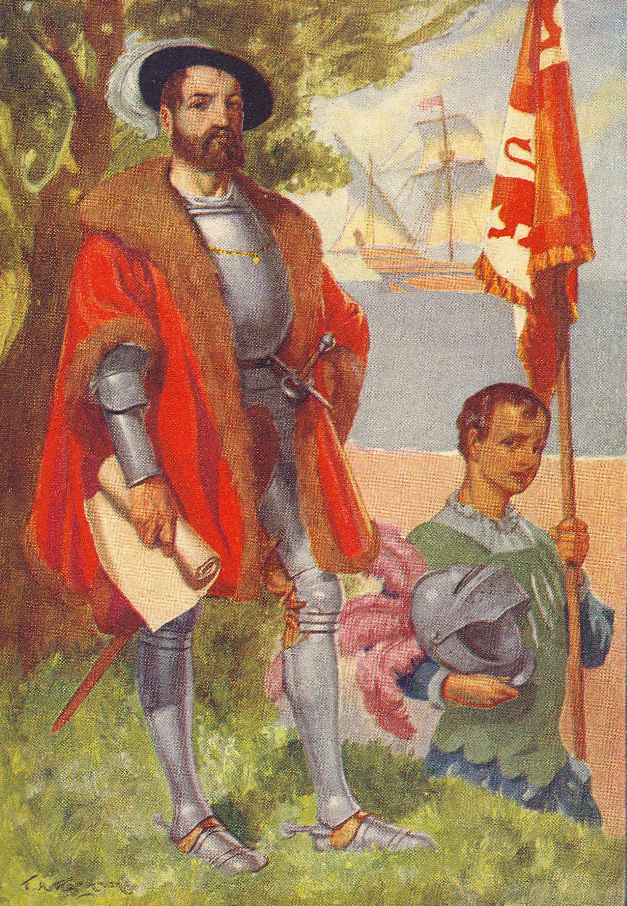 PORTRAIT OF CORTES |
Now Velasquez had a jester who hated the new favourite of fortune, and waited the moment to do him an ill turn. One morning, as the Governor and his lieutenant visited the port to watch the work on the ships, the jester called out:
"Have a care, master Velasquez, or we shall have to go a-hunting, some day or other, after this same captain of ours!"
At the sound of these words, which seemed to voice his own suspicions, Velasquez looked narrowly at his companion, and asked him brusquely, "Hear'st thou the rogue?"
"A saucy knave who would be bettered by a whipping!" replied Cortés smoothly.
The matter dropped, but the seed had fallen on ground prepared. From that instant Velasquez resolved to take the command from the captain he had so rashly chosen. Fearing to depose for no just reason so popular a leader, he worked secretly to accomplish this end.
Cortés, meanwhile, was quick to notice the change in the Governor's manner, and he was warned also by a trusty friend. Ruin stared him in the face, for had he not staked his all upon this venture? The ships were not ready, men were lacking, provisions were short, but the very night of the warning he gave orders that the little fleet should weigh anchor. High-handed perforce were his actions that night. Meat was his greatest need, but that was in part remedied by a raid on the butcher, to whom he flung in payment his golden chain. By midnight every man was on board, and the ships dropped down the bay.
In the morning Velasquez was roused by incredible news. The expedition had sailed, his enemy had forestalled him! Assuring himself that it was an impossibility, he hurriedly dressed and galloped down to the quay. But, alas! there were the ships rapidly dwindling in the distance.
When Cortés saw from his ship that the Governor, with his little group of officers, had come to the waterside, he put off in a small armed boat and came near the shore. "And is it thus you part from me?" Velasquez called out furiously; "a courteous way of taking leave, truly!"
"Pardon me," replied his lieutenant suavely, "time presses, and there are some things that should be done before they are even thought of. Has your Excellency any commands!" Velasquez was speechless with impotent anger, and Cortés, waving farewell, returned to his ship once more.
With the ships insufficiently equipped it was, however, impossible to undertake the voyage to Mexico, and the fleet put in at Trinidad, on the southern coast of Cuba. Here Cortés issued a proclamation and raised his standard, a banner of black velvet embroidered in gold, bearing in its centre a red cross surrounded by blue and white flames, and this motto: "Friends, let us follow the Cross; and in that sign, if we have faith, we shall conquer!" His call for volunteers met with ready response. Haughty hidalgo and common soldier, cavalier and man-at-arms, all were welcome. Most welcome were Alvarado, Sandoval, and others who had sailed under Grijalva.
When Velasquez heard that Cortés was still in Cuba, he hoped even yet to balk his rebellious subordinate. Orders were sent to the commandant of Trinidad to seize the captain-general as a traitor. But rumours of this raised the soldiery to such fury that they threatened to burn the town to ashes if a hair of their captain's head was touched.
Anxious to avoid all broils, Cortés, however, preferred to move his camp. He chose Havana, because there much cotton was grown, and he could add to the armour of his troops those quilted jackets so useful as a defence against the arrows of the Indians.
The enmity of Velasquez, still unsated, led him to make yet another attempt, which also proved unavailing, for "all the soldiers, officers and privates, would have cheerfully laid down their lives for the Captain." So says Bernal Diaz, old soldier and unbiased chronicler.
A man of experience was this Diaz, who had sailed with Cordova on his ill-starred voyage. Nothing dismayed he had followed also Grijalva, and had resented the treatment accorded by Velasquez to that brave man. And now he was eager to go once more to the golden land of which he had caught a fleeting glimpse. Little did he know the desperate perils which awaited him. Yet perhaps if he had known all his stout heart would not have quailed.
Years after, when he was an old man, he wrote the story of all the strange adventures, the hairbreadth escapes, the defeats and the victories which he and his comrades passed through as they followed their fearless captain, to whom toil and danger were as nothing. He wrote that he might keep green the memory of his brave comrades, long since dead. "Where are now my companions? They have fallen in battle, or been devoured by the cannibal, or been thrown to fatten the wild beasts in their cages! They whose remains should rather have been gathered under monuments emblazoned with their achievements, commemorated in letters of gold; for they died in the service of God and of his Majesty . . . and also to acquire that wealth which most men covet."
This vivid narrative, the glowing testimony of an eye-witness, is far more valuable than the courtly and polished history of Gomara and other writers. With Bernal Diaz we live the daily life and share the dangers and toils of the Conquistadores. No mere eulogy of Cortés is this chronicle, for the stout old soldier allows no valiant man to miss his due meed. Truth breathes in every line, even when with simple boastfulness he tells the story of his own achievements. "If we did not speak well of ourselves," says he, "who would? Who else witnessed our exploits and our battles—unless, indeed, the clouds in the sky and the birds flying over our heads?"
From Havana the fleet sailed to Cape St. Antonio, the nearest point to the continent. There Cortés mustered and reviewed his forces. The ships were eleven in number, some of them small and open. His chief pilot had not only sailed on the two former expeditions to Yucatan, but had also been with the great Columbus on his last voyage. There were one hundred and ten sailors, five hundred and fifty-three soldiers, and about two hundred Indian slaves from Cuba, with ten heavy and four light guns. Bernal Diaz describes each one of the sixteen horses, for they had been brought from Europe and were worth their weight in gold.
Cortés harangued his men with a few last stir-ring words—"I hold out to you a glorious prize, but it is to be won by ceaseless toil. . . . If I have laboured hard and staked my all, it is for love of renown. If any among you covet riches more, be but true to me, as I will be true to you and to the occasion, and I will make you masters of such as our countrymen have never dreamed of! You are few in number, but strong in resolution; and, if this does not falter, doubt not that the Almighty who has never deserted the Spaniard will shield you! Your cause is just, and you fight under the banner of the Cross!"
On a fair and cloudless day, the 18th of February 1519, the little fleet set sail for the coast of Yucatan, but before it had been long at sea a sudden storm arose. Driven southwards from their course the ships were scattered, and the capitana, or admiral's ship, was the last to make the isle of Cozumel.
Very wrathful was Cortés to find on his arrival that the Captain Alvarado had already sacked the temples and terrified the friendly natives into precipitate flight. Many a time and oft in the course of his long campaign the general was to pay the cost of this dashing officer's violence and wanton cruelty. The simple inhabitants of Cozumel were, however, easily persuaded by friendly signs and presents to return to their homes once more.
While lingering here to refit his battered ships, rumours came to Cortés of Spaniards held in degrading bondage by the Indians of the mainland. A Spanish ship, 'twas said, had been wrecked long years before on that inhospitable coast. This story recalled to Bernal Diaz, who had sailed with Cordova, the cry of "Castilian! Castilian!" yelled by the Indians near Cape Catoche as they drove back the white men with fury to their ships. Here was a mystery, and Cortés, his blood boiling at the thought of a Castilian enslaved, at once despatched a rescue party to the opposite coast under the captain Diego de Ordaz, who was ordered to remain there eight days and to offer a tempting ransom for the Christians.
The time of waiting was employed by the general in exploring the island and in converting the natives. The process of conversion was extremely swift and simple. The Indian idols were broken in pieces by the zealous soldiery, the image of the Virgin was set up in a place of honour, the intimidated natives were harangued by the two Spanish priests, and then baptized by hundreds into the Christian Church.
Ordaz returned after eight days without news of the captives. Impatient to be gone, the general at once embarked his men. They had, however, sailed but a few leagues ere a leak in one of the ships forced them to put back to their safe harbour in Cozumel. Just as they were once more on the point of embarking, a canoe, paddled with desperate speed by three or four natives, was seen crossing the strait. Directly it touched the shore a man, dark in colour as a native, leaped out calling wildly to the white men in a jargon, partly Spanish, partly Indian. About his shoulders and waist hung a few rags, and in a bundle on his back was the remnant of an old book of prayers. The soldiers, astonished and pitiful, led him at once to their general, whom he saluted In Indian fashion, making low obeisance and then touching the ground with his right hand and lifting it to his head. Raising the wretched man, Cortés covered him with his own yellow mantle lined with crimson, and welcomed him as a comrade, while officers and men gathered round to hear the rescued Christian's romantic story.
His name was Jeronimo de Aguilar, and for eight weary years he had been a captive. Wrecked on some sunken rocks, called the Vipers, he had been stranded with fifteen companions on the coast of Yucatan. As they wandered famishing along the shore they were attacked and carried off by natives. Cooped up in a kind of pen they were at first well treated and remarkably well fed, but too soon did they learn the horrible reason for their bounteous repasts. They were being fattened for a cannibal feast! One night their captain and four other unfortunates, whose flesh seemed fair and tempting, were dragged from the pen and gleefully sacrificed in the neighbouring temple. With shudders the survivors listened to the succeeding sounds of loathsome banqueting and horrid orgy. Armed with the frantic strength of despair they managed that very night to break from their prison and fly to the dark and lonely forest. Here they roamed starving and desolate for many harrowing days, fearing at every turn to be trapped by their cannibal hunters.
Driven by their anguish to seek at last the haunts of men they fell into the hands of another tribe whose cacique elected to use them as slaves, not victims. Forced to cut wood, draw water, and carry intolerable burdens, the Spaniards soon sank under the hardships of their lot. Finally all perished save two: one, a sailor named Gonzalo Guerrero, and the other Jeronimo de Aguilar, who had fortunately found favour in the eyes of the cacique. The sailor, a man of fine physique, was sold into a neighbouring tribe. Proud of their acquisition these natives treated him with great respect, and his powers in warfare soon won for him the proud position of an Indian brave. In time he even became a chieftain and was given the hand of a dusky princess.
Aguilar, meantime, who had been trained as a priest, steadfastly refused all offers of Indian brides. His sober and upright behaviour much impressed the savage cacique, who made him keeper of his household and his wives and wise man to the tribe. In spite of this honourable estate the white man never ceased to pine for his countrymen and home. Hardly could he conceal his joy when there appeared one day in the village three natives from Cozumel bringing tidings of the arrival of white and bearded warriors in that isle, whose captain had actually sent a letter offering a ransom for the release of all captive Christians.
This letter Aguilar translated to the cacique, to whom so peculiar a way of sending news seemed to savour of magical power. But the Indian proved most reluctant to lose his favourite white man, and it was only by working first on his fears and then on his cupidity that Aguilar obtained his release. The white men, he declared, were gods armed with thunder and lightning, able to wreak vengeance on all their enemies and willing to lavish priceless gifts on their friends. The sight of the shining beads and baubles borne by the messengers decided the wavering cacique. Aguilar was free, but mindful of his old comrade, he sent the letter of Codes to Gonzalo Guerrero who lived in a different province, and lingered yet awhile in the Indian village awaiting a reply.
When Guerrero, now a great warrior chieftain, received this offer of deliverance his heart leaped for joy. Not all his barbarous splendour, not the beauty of his dark-eyed princess, not his pride in his many children would have kept him back from the land of his birth. More potent was the bond which held him captive in his far-away western home. His face and hands were tattooed in many colours, a heavy golden ring dragged down his nose, while from his slit ears and lips hung jewelled ornaments. Gorgeous he might appear to his Indian braves, but ridicule only would greet him from bearded Spanish sailors. The messengers returned without him, and it was this delay which so nearly destroyed Aguilar's chance of return to civilised life.
The mishap which had compelled Cortés to put back to the shores of Cozumel proved a blessing not only to the poor exile, but to the whole adventure, since Aguilar, who, though he did not know the Aztec language, could speak the dialect of Yucatan, soon made himself invaluable as interpreter to the little army.
The Fringe of the Mexican Empire
Bidding a glad farewell to Cozumel, the island of delays, the adventurers doubled Cape Catoche and turned westward to the great gulf beyond which lay the glittering goal of their high hopes. They deemed it best to follow the coast-line, and soon reached an opening recognised by Grijalva's men as the river Tabasco, where they had met with so friendly a reception.
Anxious to visit the town of Tabasco, Cortés left the ships at anchor and rowed up the river with a small force. Gloomy and forbidding seemed this stream, for on either hand dense growth of mangrove trees encroached on the water, making a thick screen beyond which the Spaniards could not see. But ever and anon the glint of weapons amongst the scrub raised the fear that the natives did not mean this time to trade in their former friendly way. It was growing dusk, and the sight of a group of menacing warriors barring the way induced Cortés to encamp on an island in midstream.
The rising mists of dawn revealed on bank and water a warlike array. It was ever the policy of Cortés to leave behind him an unbroken record of victory, and though Tabasco was but a step on the road to Mexico, he resolved to teach the natives a lesson and at all hazards to take up his quarters that night in the town.
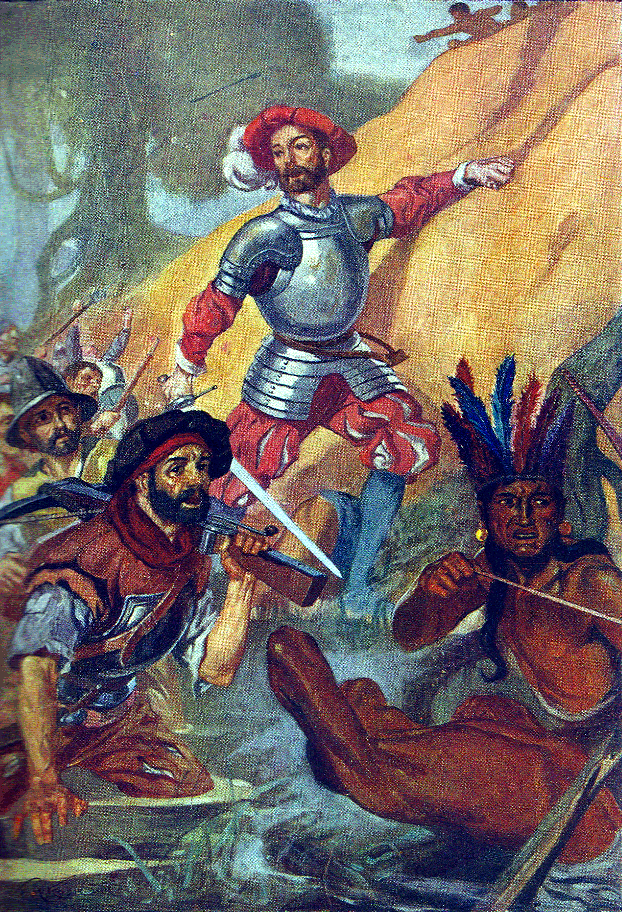 HE FOUGHT BOLDLY IN THE FRONT RANK. |
The captain, Alonzo de Avila, with a detachment of a hundred men, was despatched secretly down the river with orders to march on the town from the rear, while the main body prepared to advance openly. But before beginning the attack, Cortés, conforming to the instructions of the Royal Council in Spain, caused his interpreter to make a grandiloquent and to the Indians quite incomprehensible proclamation. This manifesto, which had been drawn up by learned divines in Spain, was used by all Spanish discoverers in the New World to justify their high-handed actions. "I, Hernando Cortés," so began the extraordinary formula, "servant of the high and mighty kings of Castile and Leon, civilisers of barbarous nations, their messenger and captain, notify and make known to you that . . . all the people of the earth , . . were given in charge, by God our Lord, to one person, named Saint Peter." Then followed an account of the Pope's donation "of these islands and continents of the ocean sea, and all that they contain, to the Catholic kings of Castile." To resist a Spanish army was thus clearly rank rebellion, and the proclamation ended with a threat: "If you do not submit, . . . by the aid of God . . . I will subdue you to the yoke and obedience of the Church and of his Majesty; and I will take your wives and children, and make slaves of them . . . . and I will do you all the harm and injury in my power, as vassals who will not obey their sovereign. . . . And I protest that the deaths and disasters, which may in this manner be occasioned, will be the fault of yourselves, and not of his Majesty, nor of me, nor of these cavaliers who accompany me. And of what I here tell you, and require of you, I call upon the notary here present to give me his signed testimonial."
Held spellbound for the moment by this curious and foolish method of beginning battle, the Indians now replied in the only way they understood—by a storm of arrows. So sudden and fierce was the attack that boats were overturned and Spaniard and native were soon wrestling furiously in the water. The stronger race prevailed and the Indians were at last forced back to the banks. Cortés was easily recognised as leader, and "Strike at the Cacique!" was the cry of the savages, "Strike at the Cacique!"
Struggling up the slippery bank the Spaniards gave hot pursuit to the Tabascans, using gun and crossbow. Terrified by the thunder and lightning the natives retreated to their village, where the fight was continued from street to street. The opportune appearance of Avila completed the rout and the Spaniards were left masters of a deserted town. The inhabitants had taken all their goods with them in their flight, so the conquerors found little gold, "a circumstance," says Las Casas, "which gave them no particular satisfaction."
As a sign of occupation Cortés, with his sword, made three cuts in the bark of a large ceiba tree, the centre of Tabasco, proclaiming that, in the name and behalf of the Catholic sovereigns of Spain, he would hold and defend the place with sword and buckler against all comers.
At daybreak the Spanish scouts brought news of the massing of Indian troops in the neighbourhood, and Cortés at once sent to the ships for his reserves of men, horses, and guns. Following his former successful tactics he decided to make a detour to the rear of the enemy with his cavalry, fifteen horsemen in all, while the main body of the army attacked them in the front.
Over fields of maize and through plantations of cacao, irrigated by numerous canals, the infantry, commanded by Diego de Ordas, marched impeded by the difficulty of dragging the cannon over the rough ground. It was some hours before they came in sight of the dusky foe, who at once rushed forward with the utmost courage. "I recollect," says Bernal Diaz, "that when we let off the guns, the Indians uttered loud cries and whistling sounds, and flung earth and straw into the air, that we should not see the havoc we wrought."
Just when the Spaniards were growing desperate rang out the war-cry of their general, "San Jago and San Pedro!" and the farthest ranks of the enemy began to scatter like chaff before a whirlwind. Cortés and his horsemen to the rescue! Panic-stricken at the sight of these monsters with two heads and hoofed legs, for to them horse and rider were one, the whole Indian army broke and fled. Leading the shining cavaliers, the devout Spanish soldiers beheld the patron saint of Spain on his grey War-horse. "Cortés, indeed," says one old chronicler, "supposed it was his own tutelar saint, St. Peter, but the common and indubitable opinion is, that it was our glorious apostle St. James, the bulwark and safeguard of our nation." Truthful old Bernal Diaz confesses frankly, "Sinner that I am! It was not permitted to me to see either the one or the other of the apostles on that occasion."
So complete was the victory that Cortés felt strong enough to send by prisoners a stern message to the vanquished. "I will overlook the past," he declared, "if you at once tender your submission. Otherwise I will ride over the land, and put every living thing—man, woman, and child—to the sword!" Las Casas in his History remarks sarcastically, "And this was the first preaching of the gospel by Cortés in New Spain!"
A body of chiefs, in sombre garb, followed by a train of slaves bearing presents, waited next day on the Spanish general. Bowing to the ground "before the bearded assembly, and swinging before them the censer in token of reverence," they humbly begged for pardon and tendered their submission. "The blame of bloodshed is on your head!" said Cortés haughtily, and the bewildered Indians meekly agreed. Then only did the victor graciously consent to receive the gifts of gold and slaves, which included twenty girl bread-makers, with stones in their hands for pounding maize. When asked whence came the gold, the caciques, pointing to the west, replied "Mexico."
Burning to reach that "promised land" the Spaniards expounded, somewhat hurriedly, "the truths of the gospel they had come so far to bring," and the two priests, Father Olmedo and Father Diaz, baptized the conquered Tabascans. It was Palm Sunday. In solemn procession, bearing branches of palm, the Christians marched to the heathen temple, where Mass was celebrated. Then still carrying the palms, they rowed down the river to the sound of sacred chants, and once more rejoined their ships.
Great was the joy when on Holy Thursday, 1519, they dropped anchor off the island named by Grijalva, San Juan de Ulua, now known as Vera Cruz. They seemed to be expected, for a large pirogue immediately put off from the mainland and steered for the flagship. Cortés welcomed the natives on board, but found to his annoyance that not even Aguilar could understand their speech. As he was wondering what to do in this dilemma he noticed that one of his Tabascan slave-girls was carrying on an eager conversation with the visitors. Here was the means of communication. Aguilar translated the words of Cortés into Tabascan for the maiden, who then interpreted them for the Aztecs.
In this somewhat clumsy way it was ascertained that the natives were subjects of the great Aztec emperor Montezuma, who dwelt far away beyond the mountains. He had heard of the coming of the white men, and desired that they should be received by Tendile, the Aztec governor of that province, with courtesy and hospitality. Cortés replied that his object was to see and treat with the people of these lands, and declared that "none should receive injury by him, and that he hoped they would have cause to be satisfied with his arrival there."
When his visitors had departed he turned to Aguilar to inquire how this slave, picked up in the land of Tabasco, could speak the Aztec language. Malinche or Marina, as the Spaniards had christened her, then told them the strange story of her life.
On the death of her father, a cacique and ruler of a large province in Mexico, her mother speedily married again, and when a son was born her one aim was to give him the poor girl's heritage. One night she was seized and secretly sold to some traders, whilst the mother, pretending to her people that Malinche was dead, lavished money on a magnificent mock funeral. The child was taken to Tabasco, and there bought by a chief, and thus by a freak of fortune she came into the hands of the white strangers and was carried back to her own country. To find a faithful interpreter was to the Spaniards a matter of supreme importance, and when Cortés saw that she was quick and bright, and would soon learn Spanish, he was greatly pleased. Malinche herself was charmed to be of use to these wonderful white men, who treated her so kindly. "She was handsome and clever," says Bernal Diaz, "and one that would have an oar in every boat." "She looked," adds the old soldier with admiration, "the great lady that she was." Another chronicler calls her "beautiful as a goddess." She was always treated by the Spaniards with the greatest courtesy, and addressed invariably as Dona Marina.
As the Indians seemed so friendly, Cortés decided to disembark his whole force and form an encampment. The spot seemed suited to his purpose; a sandy foreshore commanded by low hills on which the artillery could be mounted. He received every assistance from the natives, both in the building of huts and the provisioning of his men.
On Easter Sunday there came with much state to the camp Tendile, the Aztec governor. The richness of his dress and the dignity of his bearing much impressed the Spaniards, accustomed as they were to the frightened servility of the Indians of the isles. "From what country do you come?" "asked this chieftain, "and for what reason do you visit our coasts?"
"I am the subject," replied Cortés, "of a potent monarch beyond the seas, who has kings and princes for his vassals. Acquainted with the greatness of the Mexican emperor, my master has sent me as his envoy to wait on Montezuma with a present in token of his goodwill, and a message which I must deliver in person. When can I be admitted to your sovereign's presence?"
Haughtily the Aztec governor demanded, "How is it that you have been here only two days and already request to see the emperor?"
"But surely," said Cortés smoothly, "kings always receive ambassadors from monarchs powerful as themselves? I cannot leave the country without seeing Montezuma."
"I am surprised," returned Tendile, somewhat appeased, "to learn that a monarch rules as powerful as Montezuma, but if it is so, doubtless my master will be happy to communicate with him. I will send my couriers with your royal gift, and you shall hear shortly the will of Montezuma."
Tendile's slaves then brought forward gifts of beautifully woven stuffs and curiously wrought golden ornaments, on which the adventurers gazed with rapt and greedy eyes. Cortés in his turn presented a carved and gilded chair for Montezuma, and various collars and bracelets of glass, a substance, it appeared, unknown to the Mexicans. A glittering brass and gilt helmet, worn by one of the Spaniards, attracted the attention of Tendile, who remarked that it greatly resembled the headpiece of one of the Aztec gods, and expressed a wish to show it to Montezuma. Cortés immediately gave it to him, saying at the same time, "It will not be amiss to return it filled with gold-dust, that we may compare the quality of the metal with that in our own country."
Some of the Spaniards had been watching mean-while with wonder and admiration an Aztec scribe, who was busy with brush and pencil transcribing the scene before him in a picture-writing which would tell more vividly than any words what manner of men had come to the Mexican shores. Resolving to give him a subject which should strike awe into the heart of Montezuma, Cortés ordered Alvarado, most dashing of cavaliers, to lead a cavalry charge on the hard smooth beach, and Mesa, the gunner, to give an artillery display.
The galloping horses, so easily controlled by their riders, seemed to the Aztecs the most marvellous sight they had ever seen, but the flaming thunder of the cannons and the deadly balls crashing into sand-hills and forest turned their amazement to secret terror. With all the cunning of his craft the painter meanwhile essayed to depict for Montezuma these dread beings at the portals of his empire and their "water-houses" at anchor in the bay.
"If your emperor has any gold," said Cortés to the governor, who now with much ceremony took his leave, "ask him to send some to me, for I and my companions have a complaint, a disease of the heart, which is cured by gold."
Two hundred miles from the coast was the city of the Mexican emperor, and yet Tendile promised that his royal master would receive the message of the strangers in less than twenty-four hours. As there were no horses in Mexico news was carried every inch of the way by swift couriers trained to run from childhood. A chain of post-houses, six miles apart, connected the capital with the coast, and as the stages were so short each courier could bear the message onward at full speed, while in every hamlet his gay or sombre garb announced the tenor of his news.
A Mysterious People
When Tendile with his stately retinue had left the Spanish camp, captain and priest, soldier and sailor, gave vent to loud-voiced wonder. Where had this dark-skinned race learned to weave such exquisite fabrics? Whence came their skill in metal-working? Whence their proud dignity of bearing? Where above all had they acquired the high art of government? Well organised indeed must be this Indian empire, when the monarch from his capital beyond the mountains could rule with so sure a hand his most distant provinces.
Well might the Spaniards marvel. And, as they came to know more fully, in their strenuous fight for gold, this rich civilisation with its mixture of savage barbarism, their wonder daily grew. But no mission had the rude conquerors to peer into the origin and history of the mysterious people they purposed to despoil, and in the fires of their fierce bigotry was doomed to perish many a record which might have revealed to us the secret of the past.
In the far away bygone ages did these unknown tribes, crossing vast tracts of land and water, come from the Old World to the New? Curiously alike were many of their legends and customs to those of the Egyptians, the Hebrews, the Chinese, and the Tartars. Did they perchance cross from the coasts of Africa ere the mighty earthquake in one fatal day and night engulfed for ever beneath the billows Atlantis, that vast island which stretched, so the Greeks believed, across the ocean from Libya westward? Or was Asia, the great mother of nations, their ancient homeland? The wild wars of the Tartars may have driven many a tribe across the Behring Strait. This seems perhaps the most probable of theories. There is certainly something of the Mongol in the Mexican physique.
In the land of Anahuac settled a roaming people whose story we can only dimly guess. If they came from the wintry north, this country, which is now called Mexico, must have seemed a paradise on earth. Between two high mountain ranges stretches a lofty plateau, beautiful alike in scenery and climate. Lying a bare twenty degrees north of the equator, it would be hot as the plains of India if it were not for its altitude. Such a height, indeed, in the latitude of New York would mean an Arctic climate, but to Mexico it gives almost perpetual spring. Midway across the plateau is a valley with five fair lakes, while from the snow-capped mountains rivers flow eastward to the Atlantic and westward to the Pacific.
Almost all early civilisations have taken their rise in warm, well-watered lands, not too enervating in climate. In Egypt, China, Chaldea, the people gained an easy livelihood from the rich alluvial soil, and had time to think of arts and crafts. So it was in Anahuac, whose very name means near the water. While the Indians of North America endured all the hardships and uncertainties of a hunter's life, the dwellers in this sunnier land learned to till the soil, and then, rewarded by its rich yield, had leisure and strength to invent many an art which added to the beauty and comfort of life. Lost is the history of these primitive inhabitants, but massive ruins of palaces, temples, and pyramids, ancient perhaps as those of Egypt, bear witness to their skill.
Earliest of the settlers in Anahuac, from whom tradition tries to lift the veil, were the Toltecs. From "an ancient red land" they came far away in the north, driven from their home by their fierce neighbours the Chichimecs. They were led by seven chieftains but God was their great commander, and from the stars Hueman, their high priest, read His will. A hundred years they wandered before they reached the land of Anahuac, and founded there, towards the close of the seventh century, a wonderful empire. North of the valley of the five lakes they built their capital Tula. So many and so fine were their palaces and temples that the name Toltec became a synonym for architect. In astrology, soothsaying, and the calculation of time, they were well versed. "The aged Hueman," who must have lived three hundred years, or had successors of the same name, "assembled all the wise men to join him in his final work on earth" some time after the foundation of the empire. Together they prepared the "Book of God," in which they represented by paintings every event in their history from the Creation to their arrival at Tula. In this divine book, which, unfortunately, is known to us only through tradition, they depicted their knowledge of agriculture, of metal-working, and of other arts, their system of government, the rites of their religion, their reading of the stars, and mystical prophecies concerning the future.
The Toltecs were not warlike, and after four hundred years their empire seems to have melted away before the onslaughts of the Chichimecs who had followed them from the north. Savage and ignorant, the new-comers lived only on game and natural roots and fruits, were clothed only in the skins of beasts, and had no weapons save the bow and arrow. Their sway in Anahuac was short, for they were speedily followed and absorbed by more civilized tribes, worthier successors to the Toltecs, who still lingered in the land of their lost empire.
This race, which inherited the Toltec glory, consisted of several kindred tribes. They all left their ancient home at the same time, but the Tezcucans were the first to enter Anahuac, while the Aztecs or Mexicans, lingering on the way, did not reach the land of plenty until the beginning of the thirteenth century, some time after the settlement of their brethren.
According to tradition these tribes came, like the Toltecs, from the far north. "Our fathers," they said, "dwelt in a happy and prosperous place called Aztlan, which means whiteness. In this place there is a great mountain in the middle of the water which is called Culhuacan, the crooked mountain, because it has the point somewhat turned over towards the bottom. In this mountain were some hollows where our fathers lived for many years; and there they had much repose. . . . They went about in canoes, and made furrows in which they planted maize, red peppers, tomatoes, beans, and all kinds of seed that we eat." But at last there was heard in the forest for many days a bird crying "Tihui! tihui!" which means "Let us go! let us go!" The priests declared it was a message from the gods bidding their people seek a new home, so they set forth on the long wandering which brought them at length to Anahuac.
The Aztecs, who came last to the beautiful valley, found that the Tezcucans had already built on the largest of the five fair lakes a city, to which they had given the name Tezcuco. From place to place in the land of Anahuac the Aztecs roamed, but nearly a hundred years went by ere they made a permanent settlement. It was said to be in the year 1325 that they paused one day on the western shore of Lake Tezcuco, and there beheld an eagle with a serpent in its talons, perched upon a cactus, which sprang from a hole in the naked rock. "It is an omen!" cried the high priest, "here your wanderings shall cease, and here you shall found a great city." Here then the Aztecs sank piles in the shallows of the lake on which to build their huts, and a temple for their god, to whom they offered in sacrifice a human being. Thus arose Tenochtitlan, which means a cactus on a stone. In after years the city was called also Mexico, in obedience to the command of the war-god Huitzilopotchli or Mexitli. Giving to his people the distinguishing mark of a patch of gum and feathers to wear upon their foreheads, he ordained "Henceforth bear ye not the name of Azteca, but Mexica." Fierce and warlike, the Aztecs soon became a power in the land, for, keeping many of their own blood-thirsty customs, they acquired most of the arts and crafts of the Toltecs.
The Tezcucans, a gentler tribe, had entered meanwhile still more fully into the heritage of skill and knowledge left behind by the old inhabitants. But suddenly in 1418 a terrible disaster befell them. The savage chief of the neighbouring Tepanecs swooped down on their provinces, slew their monarch, and reigned supreme and merciless in beautiful Tezcuco.
The history of these times is told by a Tezcucan chronicler, who wrote soon after the Spanish Conquest. He wrote in Castilian, that the insolent white men might read of the vanished glories of the dark race, whose empire they had trampled into dust with remorseless iron heel.
Romantic are the stories he tells of the adventures of Nezahualcoyotl, the heir to the Tezcucan crown, who was forced to wander, like Alfred of England, a fugitive and outcast in the mountains and forests. The young prince was pursued for many years by the vindictive hate of the Tepanec usurper, who promised to whoever should capture him, dead or alive, broad lands and the hand of a noble lady. But no Tezcucan was base enough to betray his prince. One day the fugitive just turned the crest of a hill as his pursuers climbed it on the other side. Breathless and driven, in all the wide country no hiding-place could he see. Fields of chian lay around him, and a solitary maiden was patiently reaping this plant, the seed of which made a pleasing drink. The prince flung himself at her feet, and swiftly she piled over him the stalks she had been cutting, and turned once more to her labour. The pursuers passed by and Nezahualcoyotl breathed again. On another occasion he was hidden by some loyal soldiers in a large drum, around which they were dancing. Even torture could not wring from the faithful people the secret of the hiding-places of their prince, and they only awaited an opportunity to rise against the Tepanec tyrant.
The opportunity came when the Mexicans, now a powerful nation, proffered their aid. The Tepanecs were defeated, and the usurper was dragged from his palace, sacrificed with all the bloody rites of the fierce Aztec religion, and the Tezcucan king was restored to his throne.
This was the glorious age in the annals of Anahuac on which the Tezcucan chronicler loves to dwell. Guided by Nezahualcoyotl, the wisest and most enlightened of Indian monarchs, the three powers of Tezcuco, Mexico, and Tlacopan made an alliance so triumphant and so steadfast that it endured unbroken until the coming of a strange white nation wrought ruin to all the glories of this wonderful Indian race.
Glories indeed they were. Even the proud princes of Europe need not have disdained to imitate some of the institutions of the Indian Nezahualcoyotl. What king at that time could boast in his realm a council of music? Great power had this body in Tezcuco, and many were its duties. It encouraged and supervised, not music only, but every science and art. With zealous care it watched over the education of the young, and woe betide the teacher or pupil whom its examinations found wanting! Poets and historians were summoned before the council on certain days to compete for the rich prizes which the three allied princes were pleased graciously to bestow. Nezahualcoyotl himself was a poet, and very beautiful are some of the songs which have come down to us in the Spanish translation of the Tezcucan chronicler.
No wonder that under such a king the Tezcucans became the most refined and civilised of all the people of Anahuac. The Mexicans, their rivals in luxury, splendour, and power, were but humble disciples in the crowning glory of science and culture.
The Mexican king was glad to imitate the form of government and code of laws which the great Nezahualcoyotl devised. Very stringent were these laws, and very perfect was the system by which they were enforced even in the remotest districts of the Tezcucan dominions. In every province were numerous officers, appointed by the people themselves, whose duty it was to watch the conduct of a certain number of families, and report any breach of the law to the provincial court of justice. Important cases were referred to the supreme council of justice, which met every eighty days in the capital.
The splendour of this supreme tribunal, over which the king himself presided, is described by the old Tezcucan chronicler: "In the royal palace of Tezcuco," he says, "was a courtyard, on the opposite sides of which were two halls of justice. In the principal one, called the 'tribunal of God,' was a throne of pure gold, inlaid with turquoises and other precious stones. On a stool, in front, was placed a human skull, crowned with an immense emerald, of a pyramidal form, and surmounted by an aigrette of brilliant plumes and precious stones. The skull was laid on a heap of military weapons, shields, quivers, bows and arrows. The walls were hung with tapestry, made of the hair of different wild animals, of rich and various colours, festooned by gold rings, and embroidered with figures of birds and flowers. Above the throne was a canopy of variegated plumage, from the centre of which shot forth resplendent rays of gold and jewels. The other tribunal, called 'the king's,' was also surmounted by a gorgeous canopy of feathers, on which were emblazoned the royal arms. Here the sovereign gave public audience and communicated his dispatches. But when he decided important causes, or confirmed a capital sentence, he passed to 'the tribunal of God,' attended by the fourteen great lords of the realm, marshalled according to their rank. Then, putting on his mitred crown, encrusted with precious stones, and holding a golden arrow, by way of sceptre, in his left hand, he laid his right upon the skull and pronounced judgment."
Magnificent as an Asiatic despot and stern in the execution of his laws, Nezahualcoyotl yet loved his people, and sometimes chose to discard his state and wander in disguise among the humblest of his subjects. It is said that he met one day a boy gathering sticks in a field.
"Why do you not go into a neighbouring forest?" inquired the king.
Sullenly the boy replied, "It is the king's wood, and death is the punishment for trespass."
"What kind of man is your king?" asked Nezahualcoyotl curiously.
"A very hard man," grumbled the boy, "who denies his people what God has given them."
What was the dismay of the boy when he was summoned next day to the palace and confronted with his monarch in whom he at once recognised the curious stranger! He soon found he had no cause to fear. Rewarding him for his honesty, the king declared that he intended henceforth to alter the severity of his forest laws.
Many such stories are told by the Tezcucan historian, who declares that in seasons of scarcity the great king was "particularly bountiful, remitting the taxes of his vassals, and supplying their wants from the royal granaries." Taxes were paid in the produce and manufactures of the country, and the share which each district must contribute was explicitly laid down. On certain days there would flock to the capital tamanes, or carriers, bearing chests of maize, chian, beans, ground chocolate, loaves of white salt, reams of paper, pieces of armour, bags of gold dust, tiles of gold, loads of mantles, bundles of cotton, handfuls of feathers, copper axes, precious stones, and many other rich and rare commodities. Adjoining the royal palace were vast warehouses and granaries where the tribute was stored, and the king's receiver-general kept an exact account of every contribution.
Content though the Mexicans were to adopt the policy and institutions of Nezahualcoyotl, they refused to follow his lead in the vital question of religion. Rather did they seek to imbue the Tezcucans with their own dark, blood-stained superstition, and even in his own realm the great king did not really succeed in his attempt to restore the pure faith of the ancient Toltecs, though human sacrifices were limited to slaves and captives. Once, indeed, the king himself, in a moment of weakness and despair, sank under the influence of the priesthood who lusted always for human blood. Many wives he had and many children, but the queen, his one lawful wife, had borne him no son. Who then would be his successor? "The gods," cried the priests, "must have victims ere you can have a son!" The king consented, but all in vain did the blood of slaughtered captives stain the altars of the gods. Never again did Nezahualcoyotl swerve from his enlightened faith. "These idols of wood and stone can neither hear nor feel," he solemnly declared, "much less could they make the heavens and the earth, and man, the lord of it. These must be the work of the all-powerful, unknown God, creator of the universe, on whom alone I must rely."
Forty days did he fast and pray, and then strove more earnestly than ever to wean his people from the ferocious rites of their Aztec allies. To "the unknown God, the cause of causes," he built a temple, and on the summit he placed a tower nine stories high, to represent the nine heavens; a tenth story was added with a black roof sparkling with golden stars without and inlaid with precious stones within. On the top of the tower were musical instruments to summon the worshippers to prayers. Before the temple was completed the longed-for son was born, and named by his father Nezahualpilli, which means "the prince for whom one has fasted."
Retiring to his country palace the old king spent his last years in the peaceful study of astrology and in meditations on death and the after-life, which he expressed in sad but beautiful poetry. Did he perhaps foresee the downfall of his race as he sang? "All things on earth have their term, and, in the most joyous career of their vanity and splendour, their strength fails, and they sink into the dust . . . . Rivers, torrents, and streams move onward to their destination. Not one flows back to its pleasant source. They rush onward, hastening to bury themselves in the deep bosom of the ocean. The things of yesterday are no more to-day; and the things of to-day shall cease, perhaps, on the morrow." Yet the plaintive song ends bravely, "Let us take courage, illustrious nobles and chieftains, true friends and loyal subjects, let us aspire to that heaven where all is eternal and corruption cannot come. The horrors of the tomb are but the cradle of the sun, and the dark shadows of death are brilliant lights for the stars."
The Aztecs
A sad day it was for all Anahuac when in 1470 the great Nezahualcoyotl died, for in the reign of his successor, a sage, but no warrior, the Tezcucans fell more and more under the influence of the fierce Aztecs across the lake. Montezuma I., a bold, ambitious monarch, now ruled in Mexico. A war-like prince he was, and victory always crowned his arms, until the terror of his name spread far and wide. He was soon recognised as head of the triple alliance, and arrogantly adopted the proud title of Emperor, while Nezahualpilli, the king of Tezcuco, became more like a great vassal than an independent monarch.
Just seventeen years before the coming of the Spaniards the terrible Montezuma died, and the four chief counsellors of the empire met, according to Aztec custom, to choose his successor from the members of the royal family. Gruesome were the titles of these four electors. The first was called the Prince of the Deathful Lance, the second the Divider of Men, the third the Shedder of Blood, and the fourth the Lord of the Dark House. Their choice fell on a nephew of the last emperor, also a Montezuma. Both soldier and priest, he seemed a ruler who would be to his people, in the words of the electors, a "steady column of support." When the news of his election was brought to him he was humbly sweeping the pavement of the great temple, and as he listened to the eloquent good wishes of his subjects, thoughts of his own unworthiness moved him to tears.
To bring home captives to grace his coronation was ever the first duty of an Aztec monarch, and Montezuma II., who led his armies at once against a rebel tribe, returned in triumph with a goodly throng of victims for the gods. Never had Tenochtitlan known so brilliant a scene. With music and games and dances, and the awful pomp of priestly ceremonies, the exultant Aztecs celebrated the coronation of their emperor. From far and near the people flocked to see the magnificent sight, and even some noble Tlascalans, the hereditary enemies of the Aztecs, were present in disguise. They were recognised, but amidst the general joy the new emperor deigned to forgive these daring intruders.
In the very heart of Montezuma's dominions lay this little independent republic of Tlascala, fenced in by its mountains and impassable gorges, a constant menace and source of weakness to the Aztec. In vain did the allied armies of the empire march against the hardy mountaineers. No Indian force could wrest from them the liberty they had so passionately maintained for over two hundred years.
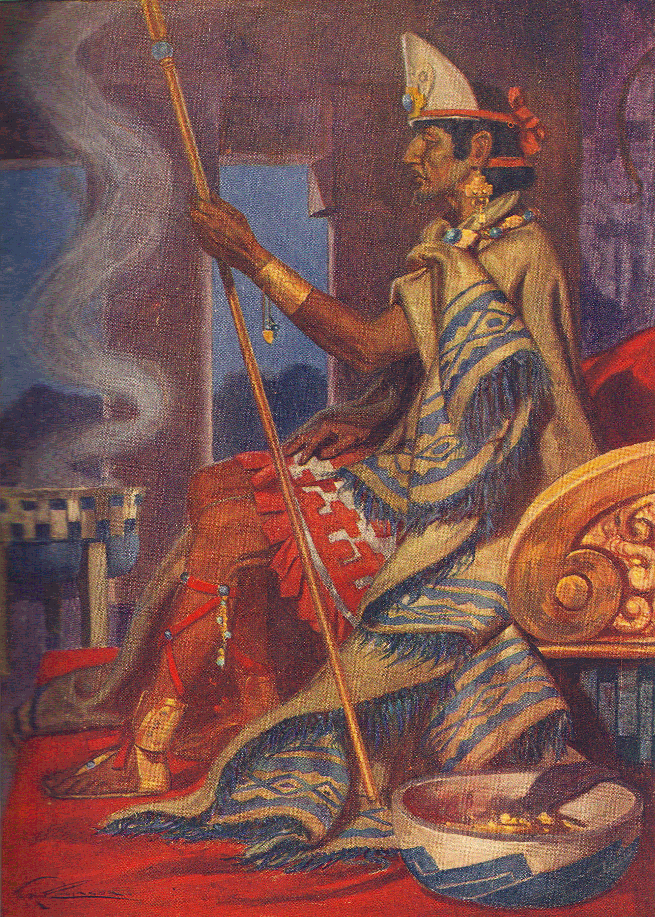 MONTEZUMA |
Victorious on every other hand, Montezuma extended his empire from the Atlantic to the Pacific, and far to north and south conquered tribes acknowledged the Aztec sway. By terror alone were these subject peoples ruled. No love or loyalty could they have for the distant emperor who exacted from them a tribute so grinding that it drove them to frequent revolt. Then would the Aztec armies mercilessly ravage their lands and carry off the rebels by hundreds to slavery and sacrifice.
Hardly less dreaded than the tribute-gatherers were the Aztec merchants, who took high rank in Mexico, and travelled supported by small armies through the wide empire to the countries beyond its bounds. They often served as ambassadors, and were highly honoured by the emperor, who addressed the most aged and revered of their number as "uncle." Drastic was the punishment meted out to all who dared to resist or molest these haughty traders. One of the old Mexican paintings represents the execution of a cacique and his family, with the destruction of his city, for maltreating the persons of some Aztec merchants.
Trade and agriculture, so despised in Spain, were much respected in Mexico. "Apply thyself, my son," said an old cacique, "to agriculture, or to feather-work, or some other honourable calling. Thus did your ancestors before you. Else, how would they have provided for themselves and their families? Never was it heard that nobility alone was able to maintain its possessor." Each trade had its own quarter in the capital, its own cacique, its special god and festivals.
A strange mixture indeed were the Aztec people, in some ways so civilised and refined, in others so barbarous and cruel. They did not scruple to slaughter throngs of innocent victims, yet they established in all their chief cities hospitals where the sick were tenderly nursed and the wounds of the warriors bound and healed. "Their surgeons," says a Spanish chronicler, grimly, "were so far better than those in Europe that they did not protract the cure in order to increase the pay!"
In shining contrast, not only with the brutality of other North American Indians, but with the jealous despotism of the civilised Asiatic races, was the respect and consideration with which the Aztecs invariably treated their women. Indeed, even in Europe the peasant woman, ignored by knightly chivalry, was often compelled to work like a slave in the fields, while in Anahuac she only shared in such light labour as sowing the seed and husking the corn.
As for the Aztec ladies, their life was easy and happy. Shut up in no hateful harem, they were free to walk unveiled through the streets of their city and to share in the festivities and amusements of the men. The youths and maidens delighted to end a feast with dancing, while their elders sat on drinking pulque and watching the graceful movements of their children. To every guest a gift was offered, and then they withdrew, "some commending the feast," says an old Spanish writer, "and others condemning the bad taste or extravagance of their host; in the same manner as with us."
Though polygamy was allowed in Mexico, marriage was regarded as sacred and celebrated with the most solemn rites. Letters have been preserved which show how close and tender were family ties.
"My beloved daughter," writes a mother to an Aztec maiden just entering on life, "very dear little dove. . . . The first thing that I earnestly charge upon you is, that you deserve what your father has now told you; since it is all very precious, and persons of his condition rarely publish such things. . . . The second thing that I desire to say to you is, that I love you much, that you are my dear daughter. . . . See that you receive our words, and treasure them in your breast. Let your clothes be becoming and neat, that you may neither appear fantastic nor mean. When you speak, do not hurry your words from uneasiness, but speak deliberately and calmly. . . . Neither mince, when you speak, nor when you salute, nor speak through your nose; but let your words be proper, of a good sound and your voice gentle . . .
"In walking, my daughter, see that you behave yourself becomingly, neither going with haste, nor too slowly; since it is an evidence of being puffed up to walk too slowly, and walking hastily causes a vicious habit of restlessness and instability. . . . And when you may be obliged to jump over a pool of water, do it with decency, that you may neither appear clumsy nor light. When you are in the street, do not carry your head much inclined, or your body bent; nor as little go with your head very much raised; since it is a mark of ill-breeding; walk erect, and with your head slightly inclined . . . Walk through the streets quietly, and with propriety. . . . Do not look upon those whom you meet with the eyes of an offended person, nor have the appearance of being, uneasy. . . . Show a becoming countenance that you may neither appear morose nor too complaisant . . .
"See, likewise, my daughter, that you never paint your face, or stain it or your lips with colours, in order to appear well. . . . But that your husband may not dislike you, adorn yourself, wash yourself, and cleanse your clothes; and let this be done with moderation; since if every day you wash yourself and your clothes, it will be said of you that you are over-nice; they will call you tapetetzon tinemaxoch.
"My tenderly loved daughter, see that you live in the world in peace, tranquillity, and contentment all the days that you shall live. See that you disgrace not yourself, that you stain not your honour, nor pollute the lustre and fame of your ancestors. See that you honour me and your father, and reflect glory on us by your good life. May God prosper you, my first-born, and may you come to God, who is in every place!"
This conception of one supreme God "omnipresent, that knoweth all thoughts, and giveth all gifts," was a heritage from the ancient Toltecs which the Aztecs were fast losing under the influence of their priests, whose power grew ever more formidable as Montezuma, becoming less of a soldier and more of a priest, gave himself up to the dark mysteries of superstition.
In the fierce faith taught by the Mexican priesthood were many gods, most of them blood-thirsty and sinister monsters. To the service of each god, with its endless rites and ceremonies, were dedicated hundreds of priests, who had quarters within the temple precincts. Much land was attached to the chief temples, teocallis, and the priests soon acquired great wealth. In their hands was the education of the young and the care of the hieroglyphical paintings. Wellnigh as mighty as the emperor himself were the two high priests, who stood at the head of this vast and powerful order.
Chief among Aztec deities was Huitzilopotchli, the war-god, whose altars reeked with human blood. All-armed he had been born into the world, a spear in the right hand, a shield in the left, and a crest of green feathers on his glittering helmet. For this "devil incarnate" had been built, about twenty-eight years before the coming of the Spaniards, the great teocalli, the pride of Mexico.
Not less savage was Tlaloc, the god of rain, who in seasons of drought demanded children for his victims ere he would deign to open the heavens. The tears of the little ones as they were borne through the streets robed in white and wreathed with flowers, were held to foreshadow the coming of the life-giving rain. Parents sometimes freely offered their own children, for all who died this terrible but glorious death gained in the future life a place in the highest heaven.
In this after-world warriors who had fallen in battle and the victims of the gods passed at once into the presence of the Sun, whom they followed with songs and dances in his shining progress across the skies. Their spirits, after some years of this triumphant glory, gave life to the clouds and to the sweetest singing-birds, and dwelt happily in the gardens of Paradise for ever and ever. The good who died tamely of disease knew no such bliss, but enjoyed, nevertheless, a future life of indolent contentment, while the wicked sank to a place of everlasting darkness.
To the bodies of the dead, which were arrayed like gods, were fastened pieces of paper, charms against the dangers of the dark road of death. The bodies were burned, and the ashes, collected in an urn, were treasured by relatives. At the funeral of a wealthy man many slaves were sacrificed.
Curiously like the Christian was the Aztec rite of baptism. At dawn all the relations of the child assembled in the courtyard of the house, lighted by torches of fragrant pine. When the sun had risen, the midwife or priestess, taking the baby in her arms, turned her face towards the west, and sprinkling water over the head of the child prayed, "May these heavenly drops remove from you the sin which was given to you before the beginning of the world, and cleansed by these waters may you be born anew." Then the midwife bestowed on the child the name of one of its ancestors, and with great rejoicing the friends and relatives congratulated the happy parents.
One thrilling festival the Aztecs celebrated which might come but once in a man's life. Four times, they held, since the Creation had mankind been swept away. Time was divided into cycles of fifty-two years, and it was believed that some day at the end of a cycle the sun would be for a fifth time darkened, and the whole wide world destroyed. Hence as the last year of a cycle drew to its close, fear and foreboding fell like a pall o'er the land of Anahuac. On the last five "unlucky" days the people gave way to wild despair. They tore their garments, and broke in pieces their pots and pans and furniture, and even their household gods. No fire was lit in any house, and the sacred temple flames were left to die untended. With fasting and supplication the evening of the last day was awaited.
Then a procession of priests, bearing in their midst a fair and spotless victim, left the city gates and wound their way to a lofty hill six miles distant. There on the summit was stretched the victim, and at midnight on his bare wounded breast was kindled the New Fire. To the funeral pile the flames soon spread, and as they flared high into the sky the people watching on hillside and valley, from village and city, broke forth into shouts of exultant joy. Swift runners lighting their torches at the sacrificial fire bore them here and there over the country-side, and erelong the great Sun himself, rising in his glory, proclaimed that the gods were indeed granting a new cycle of time to the world.
In rapturous festivity were passed the following thirteen days. Houses and temples were furnished afresh, and the people, donning their gayest garments, filled the flower-bedecked streets with music and laughter.
Still more fantastic was the festival of the god Tezcat, the "soul of the world." Each year a young captive, beautiful in person and noble in blood, was chosen to be the earthly image of the god. "Tezcat who died yesterday is come again!" sang the people, prostrating themselves before him in adoration, wherever he passed attended always by reverend elders and royal pages. For a year he lived as a god in luxury and splendour, his only duty to appear often in the streets that the people might at the sound of his lute rush forth to worship Tezcat the mighty.
At the beginning of the twelfth month the four loveliest maidens in the land, arrayed and named like the four chief goddesses, were given to him as brides. For one month he lived with his wives, feasting each day with the chief nobles of the city. But when the last day came the mad revelry ceased, and the captive was borne across the lake in a royal barge to a place named "Melting of Metals," where rose a teocalli, called the "House of Weapons."
Here in the sight of worshipping crowds he bade farewell for ever to his four weeping brides. Then the priests led their victim up the steep track which, winding round and round the pyramid, reached at last the summit. At each turn he must fling to the winds his musical instruments, his garlands of flowers, or some gay emblems of his godhead. Five priests, in robes embroidered with mystic scrolls, at a sign from the high priest, who was clothed in scarlet, seized their prey and stretched him upon the jasper stone of sacrifice. Two held his arms, two his legs, and one his head, while the high priest, with wild incantation, raised his curved knife of flint-like itztli, struck open at a single blow the victim's breast, and tore from it the bleeding heart. The multitudes below sank to their knees as the trophy was first held up an offering to the Sun, and then laid at the feet of the image of Tezcat. "This," cried the priest, "is a type of human destiny, for all earthly splendour is but a shadow which flees away!"
Most horrible was the end of the festival. The head of the slaughtered victim was set upon a stake called the "post of heads," and the body was dressed and served up by skilled cooks with delicious sauces at the religious banquet which followed the sacrificial ceremony. It was only in obedience to their blood-thirsty religion that the Mexicans were cannibals, and then they strove with elaborate art to disguise the human flesh by flavourings and seasoning.
Amid the gloom of foul and deathly superstitions the story of Quetzalcoatl, the Fair God, shines with welcome relief, for here, as among all primitive peoples, is seen the ideal man personified in the hero demi-god. Tall and strong he was, with white skin, dark hair, and flowing beard, this god who had dwelt among the people of Anahuac far back in the golden age. He it was who taught them the arts of gem-cutting, metal-casting, husbandry, and government, and under his rule the spirit of peace and plenty settled upon the land. He was "God of the Air," and in his time the birds sang more sweetly and the flowers bloomed more freely than ever before or since. No sacrifice would he allow save offerings of fruits and flowers.
But the Fair God had a deadly foe in Tezcat, the savage "Soul of the World." Mad with jealousy this blood-stained monster resolved to drive the Plumed Serpent, as Quetzalcoatl was called, from the land of Anahuac. Now it chanced one day that the Fair God was ill, and there came to the gate of his palace an aged man bearing a medicine which he declared would give immediate health and strength. In an evil moment Quetzalcoatl quaffed the magic drug, and at once his sickness left him, but in his mind sprang a craving to depart. "Drink again!" cried the old man, who was really the god Tezcat in disguise. Once again the Fair God drained the cup, and the second draught instilled into his very blood an irresistible passion to wander.
Burning his palaces of gold and silver, turquoise and precious stones, he set forth on his journey followed by bright-feathered singing birds, and where he passed the flowers gave forth a sweeter scent. At the city of Cholula, thenceforth sacred, he paused for twenty years, and in his honour a great pyramid was raised. But again the potent poison in his veins drove him from his palace, temple, and people. To the eastern sea he made his way, and there awaited him a magic boat of serpents' skins. Before embarking he turned to his weeping followers and bade them bear this solemn promise to his faithful people: "One day I will come again with my descendants and will rule once more as god and emperor."
So the Aztecs looked ever for his coming. And when rumours had reached them of the landing of Columbus in the far-away islands of the ocean their expectation daily grew. White-skinned strangers had come among the Indian races, surely the Fair God was on his way!
A Kingdom Divided Against Itself
The coming of Quetzalcoatl, so longed for by the people, was awaited by their emperor Montezuma with dread unspeakable. The very thought of losing rank and power, though to a god, made the days of the mighty monarch a nightmare, and the courtiers whispered as they watched his sombre face—"He is well named Montezuma, the man of gloom." By ceaseless sacrifice he strove to propitiate the gods and to avert his doom, but portent after portent seemed to presage coming evil.
On a calm and windless day the great salt lake encircling Tenochtitlan was troubled, and its waters raging in wild unrest o'er wall and causeway swept down the very streets of the city, while the emperor trembled in his palace. On one of the towers of the great teocalli descended a ball of fire which no man could extinguish until the turret crashed in ruin. At night a comet streamed across the sky and Montezuma grew sick with foreboding fear. Most terrible portent of all, there appeared in the east on several nights in succession "a flood of fire thickly powdered with stars." And while this baleful light spread over the eastern sky, staining blood-red the white summits of the two great volcanoes, a sound of wild and unearthly wailing filled the air. Fateful omen! From the east would the Fair God come!
Almost distraught, Montezuma sent for counsel to Nezahualpilli, the learned king of Tezcuco, who was steeped in the lore of astrology. To the imperial palace in Tenochtitlan came the grey-bearded monarch, the son for whom the great Nezahualcayotl had fasted. Gloomy was his face, and his prophetic words but added to the emperor's despair.
"So sure am I that the days of our empire are numbered," he said, "that I will play you at dice for my kingdom of Tezcuco. You shall stake three fighting cocks, and I will set against them my realm itself. If you win, all shall be well with the land of Anahuac, but if I win the glory of our race shall vanish like snow before the coming of the children of the Sun." So the two kings played this fateful match and Nezahualpilli won the cocks.
"We have played against destiny and we have lost!" cried the sage. "Would that you had won my kingdom! Swiftly now will come the day of doom!" So saying he arose and returned across the lake to his city of Tezcuco. Soon came word to Montezuma that the astrologer-king, brooding o'er the downfall of his race, was dead.
Two sons, Cacama and Ixtlilxochitl, disputed the succession, and for a time Tezcuco was torn with civil strife, until the strong hand of the Aztec emperor placed Cacama on the throne. But the younger son, henceforth Montezuma's deadly foe, still ruled in the hill-fastnesses of the northern part of the kingdom.
Many months passed by in suspense. The solemn words of Nezahualpilli grew fainter, and hope even began to creep into the emperor's heart. Then came like a thunderbolt the news of Grijalva's landing. But the time was not yet, and Grijalva sailed away. Had the gods heard his prayers, accepted his sacrifices?
Alas! who can escape his fate? Once more the dreaded strangers seek his shores, bringing in their train thunder and lightning and fierce, fiery animals for war. In the pictured scroll he gazes on these white-skinned metal-clad men, and from the trembling tongue of his fleet courier he hears the bold words of their chief. They wish to march to his very citadel, they demand an audience, to no subordinate will they commit the message of their own all-powerful lord. Montezuma is perplexed. Who is this lord, this monarch so mighty? Quetzalcoatl? The Aztec hesitates. He temporises.
Eight days did Cortés await the answer to his message in his camp on the sandy shore. This was the tierra caliente, the hot region of Mexico, and all day long the sun beat mercilessly down on the palpitating, breathless land. Hard by was a fever-haunted marsh, and several of the Spaniards fell sick with malaria. Tormented by myriads of tropical insects they would have found the place insupportable but for the kindness and attention of the natives, who lavished on the strangers cooling fruits and food of all kinds. Some of them, indeed, by Tendile's command, built booths of branches near the Spanish camp, and passed their time in cooking tempting dishes for Cortés and his officers.
On the eighth day appeared Tendile himself with two stately Aztec nobles and a numerous train of attendants. A hundred slaves bore the multitude of gifts sent by their imperial master. To the general's large tent they made their way, and the slaves waving their censers filled the air with incense, while the nobles did reverence in Aztec fashion. Then on brightly coloured mats before the Spaniards' dazzled eyes they spread glittering shields, embossed helmets, collars, bracelets, sandals, all of purest gold; crests and head-dresses of gorgeous feathers wrought with gold and silver thread and adorned with precious stones; curtains, coverlets, and robes of finest cotton interwoven with the soft fur of rabbits, dyed in rich colours and embroidered with devices of birds and flowers.
Cunningly fashioned were the ornaments in wrought and cast gold and silver, representing birds and beasts with jewelled eyes and movable wings and limbs. Most beautiful, perhaps, of all these truly royal gifts were the mantles of that exquisite feather work peculiar to the Mexican people. From the plumage of countless parrots, whose haunt was in the forests, came the bold and brilliant shades, while the humming-birds who lived in the honeysuckle bowers of Mexico supplied the softer and more delicate tones. True artists were the feather-workers, and held in high esteem.
A silver moon, a golden sun, the size of a carriage wheel, and elaborately carved with plants and animals, inflamed the cupidity of the Spaniards, who valued this alone at twenty thousand pesos de oro (about £50,000). Last of all was offered to Cortés the Spanish helmet filled to the brim with grains of gold.
With courtly formality the ambassadors then delivered the message of their master. "Montezuma rejoices," they said, "in the arrival of such brave men in his country, and is pleased to hold this communication with their powerful king, for whom he feels the deepest respect. He regrets much that owing to the distance of his capital he cannot receive the strangers at his court, but the journey is beset with so many difficulties that they must not dream of attempting it. It is the emperor's wish, therefore, that they should return at once to their own land bearing his gifts to their master as proofs of friendship."
This reply, so courteous yet so unwelcome, called for all the diplomacy of Cortés, who dissembled his disappointment in effusive thanks for Montezuma's munificence. "It makes me," he declared, "but the more anxious to see and speak with your gracious monarch in person. It will be indeed impossible for me to present myself before my own sovereign without having accomplished this great object of my voyage. One who has sailed over two thousand leagues of ocean holds lightly the perils and fatigues of so short a journey by land."
The ambassadors promised to convey this message, but held out no hopes of a favourable answer, and it was with some reluctance that they accepted for their master a handsome Venetian glass cup, some Holland shirts, and a few worthless trinkets.
All thoughts of discipline were lost as the adventurers crowded to the general's tent to gaze on the treasure which they had seen borne through the camp by the long train of Aztec slaves. Roused to a frenzy of greed and daring the bolder spirits cried, "Let us strike inland at once and seize this treasure-house!" With others caution prevailed. "How civilised, how powerful must be this rich empire whose subjects are so skilled," they said soberly; "it will be madness to attempt the conquest with our small force. Let us return and report what we have seen to Velasquez."
Difficulties now gathered round the general, dissensions broke out among his followers, and the secret friends of Velasquez began to show their hand. Cortés had never intended to be a cat's-paw for the Governor of Cuba, nor even to share with him the rewards of this expedition. He realised that until he was independent he could not really cope with the situation, so he determined to found a crown colony and cause himself to be elected commandant, answerable to the king of Spain alone.
After ten days the Aztec envoys returned with more gifts, but curter and briefer was their message. Montezuma forbade the strangers to advance farther, and requested them to leave his shores without delay. "This is a rich and powerful prince indeed," said Cortés to his officers, "yet it shall go hard, but we will one day pay him a visit in his capital! "At this moment the vesper bell rang out and the Spanish soldiers flung themselves on the sands before the great wooden cross in the centre of the camp, and offered their evening prayer, while the envoys looked on curiously. Father Olmedo then strove earnestly to expound to them the Christian faith. They listened with cold but courteous indifference, and with a few words of haughty command to the Aztecs whom Tendile had ordered to attend on the Spaniards, they left the camp.
That very night the supply of provisions suddenly ceased, and all the natives silently disappeared from the neighbourhood. The Spaniards were left without food on the scorching sands, and the ravages of fever added fuel to their smouldering discontent. Resolving to move his camp, Cortés sent two ships to explore the coast northwards, and find if possible a safer harbour and a healthier situation. But each day the soldiery clamoured still more insistently, "Let us return to Cuba before we bring the force of the whole Mexican empire on our heads!"
At this juncture fortune came to the general's aid. Five Indians appeared one morning in the camp. In dress and appearance they seemed to differ from the Aztecs. They lacked the striking dignity of manner, and were decorated in more barbarous fashion. To their under-lips were fastened golden leaves, and rings of gold with bright blue stones hung from their split nostrils and ears. Marina could not at first understand their language, but she soon found that two of them could speak the Aztec tongue. They belonged to the ancient tribe of the Totonacs who had dwelt in freedom for many centuries on the eastern slopes of the plateau of Anahuac. They had been conquered, however, by the armies of Montezuma, and very bitter did they find their bondage. Their cacique had heard of the wonderful white men, and petitioned for their aid to throw off the yoke of his oppressors. He invited the Spaniards to visit him in Cempoalla, his chief city, which lay to the north along the coast near to the spot where Cortés had decided to pitch his new camp.
Lavishing every attention and honour on the five Totonacs, the Spanish general pondered over their proposal with thankful heart. This Mexican empire, then, outwardly so strong and united, had enemies already within its gates! His keen eye saw here an invaluable aid to the foreign conqueror. Promising the Totonacs that he would visit Cempoalla, he gave orders to break up the encampment and prepare for the march northward. This command enraged still more the discontented soldiers, who, going in a body to Cortés, called him a traitor and demanded to be taken home. To their surprise the general at once consented, and ordered the whole army to be in readiness to embark the following day.
And now in fury rushed to the general's tent all those bold spirits who wished to be led to Mexico. "Are we to be dragged back now?" they cried, "when we stand on the threshold of a golden empire!" All night the uproar continued, until the ardour of the bold so infected the waverers that by the next morning an almost complete revulsion of feeling had taken place. When it came to the point hardly a man wished to renounce the treasure so nearly within his grasp, and unanimously they besought the general to go forward. With well-simulated reluctance Cortés gave way. "Since you so much wish it," he said, "I will found a settlement in this new country for the glory of the Spanish name. But no unwilling soldier shall aid me. Whoever wishes may return to Cuba!" With ringing cheers the army prepared for its onward march.
Ever ready to strike while the iron was hot, Cortés proposed to elect at once the civil magistrates for the projected colony, which was to receive the name of Villa Rica de la Vera Cruz. Two alcaldes were appointed,—one a personal friend of the general, the other an adherent of Velasquez. Then followed the elections to the minor offices. When all was settled Cortés, cap in hand, presented himself before this new municipal council and resigned the office which he had received from Velasquez. Not a word was spoken until their former leader had retired, then with one consent the councillors, in the name of his Catholic Majesty of Spain, re-elected him as Captain-General, with the added honour and title of Chief Justice to the colony.
The ships with the heavy guns on board were to follow the coast until they came to the chosen harbour. The army, leaving with joy the mosquito-infested marsh lands, struck out through more fertile country. Grassy plains broken by clumps of cocoa groves and palm forests rejoiced their hearts. Beneath the trees the deer were grazing and startled pheasants rose at their very feet. Here they saw for the first time the turkey, a native of Mexico, and hitherto unknown to Europeans. Twelve Totonacs met them to act as guides through the jungle, where rioted the prickly aloe, and where gorgeous tropical creepers and dark purple vines clothed the trunk of every tree. Roses, honeysuckle, and flowers of every hue vied with the colours of the brilliant birds and butterflies. Few were the songsters, but the scarlet cardinal sang sweetly as a nightingale, and the strange mocking-bird roused the echoes of the forest.
Amidst all this varied beauty stood a temple and on its altar the mangled corpse of a human being. Shuddering, the Christians turned away, vowing to purge the land of its savage blood-stained deities.
Next morning as they drew near Cempoalla, they were met by crowds of people in holiday attire, who flung on them garlands of flowers, and decked the horses with chaplets of roses. Women in gay cotton robes mingled freely in the throng.
Entering the city the Spaniards were struck with the appearance of the houses, which were well built and plastered with stucco. They were led at once to the palace, where they were received by the lord of Cempoalla, whom Bernal Diaz distinguishes as "the fat cacique." Quarters were provided for the whole army in the wide courtyard of the chief temple, and the general gave strict orders that no annoyance was to be offered to the natives.
On the morrow Cortés, with Marina and one of his officers, visited the palace, where the cacique gave him much information as to the condition of Anahuac. "The great Montezuma," he said, "dwells in a strong city in the midst of a lake far off among the mountains. He is a stern prince, and merciless in his exactions. If we dare to resist him, his armies pour down from the mountains of the west, and, rushing over the plains like a whirlwind, sweep off our young men and maidens to slavery and sacrifice."
"Do not fear," replied Cortés, "if you will be true to me I will enable you to throw off the yoke of Montezuma. A single Spaniard is stronger than a host of Aztecs."
The chief then told him of other conquered tribes equally discontented, and also of the republic of Tlascala, independent and irreconcilable.
Bidding farewell to his new friends, Cortés marshalled his men to march on to the coast, where they were to meet the ships and build their settlement. Visions of conquest danced before his kindling eyes. Alone he had not feared to face the Aztecs; with native allies he felt that victory would be sure and speedy.
Passing through another Totonac city, the Spaniards were kindly received by the people. While they were conversing amicably with the leading men of the place a message was brought to the cacique, who at once withdrew from the Spaniards in constrained silence.
At this moment five richly dressed strangers entered the market-place, and passed by the adventurers with haughty disdain. "Their hair was shining," says Bernal Diaz, "and, as it were, tied on the top of the head, and each of them had in his hand a bunch of roses which he occasionally smelt." They were Mexican collectors of tribute, and were hurriedly joined by the notables of the place, to whom they administered a severe reprimand for entertaining the Spaniards. In expiation they demanded young men and women to sacrifice to the gods.
The indignation of Cortés knew no bounds. He urged the Totonacs to seize and imprison the imperial tax-gatherers, pledging his word to support them in their rebellion. After some persuasion this was done.
Having thus embroiled the Totonacs with Montezuma, he determined to reap all possible advantage from the occurrence, and that night secretly set free two of the prisoners to carry a message to their emperor, saying that the Spaniards were still his friends.
No course was now open to the rebellious tribe but to throw in their lot with the white men, and the caciques of all the Totonac cities came at Cortés' summons to swear allegiance to the king of Spain.
This strong alliance gave the invaders confidence to establish their settlement. "For the site of our town," says Bernal Diaz, "we chose a plain half a league from the fortress where we now were; and tracing out the foundations of the church, square, arsenal, and fort, we raised all the buildings to the first story, and also the walls and parapets with loopholes and barbicans. Cortés was the first to carry earth or stones or dig in the foundations. His example was followed by all the officers and soldiers, some digging and others making the walls of clay, bringing water, and at the kilns making bricks and tiles; others seeking provisions or timber, and the smiths preparing the iron-work. In this manner we continued until, with the assistance of the natives, we had nearly completed the church, houses, and fortresses."
While this work was in progress an embassy arrived from Montezuma, who had heard of the insult offered to the tax-collectors and also of their rescue. He sent thanks and a costly gift to the Spaniards, informing them of his conviction that they were the Teules or god-like beings so long announced by the oracles. He would spare the Totonacs while the strangers were in their midst, but the time for vengeance would come. "How formidable must these Teules be," thought the people of the country, "whom even the great Montezuma fears!"
To bind the Spaniards to them in close alliance the Totonacs proposed intermarriage, and offered to them seven noble maidens attended by slaves. Father Olmedo saw here an opportunity; the Church, he said, could not sanction such a union unless the Totonacs gave up their hideous worship and accepted Christianity. Indignantly the natives refused. Then cried Cortés to his men, "Though it cost the lives of all, this very hour their false gods shall be demolished!" At the word the soldiers rushed to the chief temple. The cacique immediately summoned his warriors to arms, while the dark-robed priests, their flowing hair matted with blood, roused the whole city to frenzy. Cortés at once seized both cacique and priests, and commanded them to pacify the people. "If a single blow is struck," he exclaimed, "the whole town shall perish!" "Hiding his face the cacique cried, "The gods will avenge their own wrongs!"
The idols were then flung from the temple and burnt by the zealous Christians, the walls of the chamber of sacrifice were purged and covered with stucco, while in the place of the sacrificial stone an altar was built and dedicated to the Virgin. Seeing that the gods made no resistance, the Totonacs were quite willing to embrace the new faith. Exchanging their dark robes for white, even the heathen priests, with candles in their hands, marched in solemn procession behind an image of the Virgin Mary covered with flowers.
This holy work accomplished, the Spaniards with much complaisance returned to their own city, the Villa Rica de la Vera Cruz.
Cortes Burns His Boats
On their return to the Villa Rica the Spaniards found a Spanish ship at anchor in the harbour. The captain, a roving adventurer anxious to join the Mexican expedition, had sailed in search of Cortés. He had but twelve men and two horses on board, but the general, who had lost his own dark chestnut in the first camp, gave them warm welcome. Less welcome was the news that Velasquez was leaving no stone unturned to discredit his rebellious lieutenant in the eyes of the Spanish court.
Strong and prompt was the action of Cortés. Little as he could spare the men, he resolved to send a ship to Spain with all the treasure he could amass and a letter to the emperor Charles V. himself, justifying his actions, describing his discoveries, his battles, and the glorious possibilities of the great empire he was about to conquer. To show their devotion to their commander the newly elected magistrates and citizen soldiers of Villa Rica wrote also to his imperial majesty telling of the foundation of their colony and begging him to confirm Cortés in his authority.
A still more striking proof of their devotion was the fact that each captain, each soldier, gave up at the request of their leader the treasure already gained that the trophy sent to Spain might be indeed incomparable, and that the emperor might see for himself that "the land teemed with gold as abundantly as that whence Solomon drew the same precious metal for his temple."
The treasure-ship, manned by fifteen sailors, left the shores of Mexico on the 26th of July. The cavalier in charge had been given strict instructions on no account to call at Cuba, but anxious to know if all went well with his estates, he ventured to anchor for a few hours off the northern coast of the island. In that brief time one of the sailors escaped from his comrades and disappeared on shore. The ship sailed on her way without him. The runaway meanwhile crossed the island to St. Jago, and poured forth to Velasquez all the doings and projects of Cortés. Filled with fury, the Governor at once despatched two swift vessels in pursuit of the treasure. Too late! With prospering winds the little ship had flown on its way, and in October she reached Spain in safety to dazzle the eyes of the emperor with her rich cargo.
And now arose in the colony on the Mexican coast a new trouble. The priest Juan Diaz, jealous perhaps of the favour shown to Father Olmedo, conspired with five of the soldiers to steal away in the night-time in one of the ships. Cowards they were who dreaded the dangers of sojourn in a hostile land, and who hoped to reap a reward by acting as informants to Velasquez. At the last moment one of the traitors betrayed the plot, and stern punishment befell his companions. The priest, by virtue of his office, was spared, but the two ringleaders were hung, and the pilot was condemned to lose his feet. "Would that I had never learned to write!" exclaimed Cortés, as he signed the death-warrants of his men.
For the first time Cortés was depressed. He realised that he must make the soldiers feel that their only course was to go forward. Never would he conquer Mexico while his turbulent men might at any time frustrate him by retreat. Daring and drastic was his solution of the difficulty. The ships should be destroyed! The army stranded on the shores of Mexico!
The work of destruction must be done secretly, for the men would never consent to such a desperate expedient. Bidding Alvarado lead the troops to Cempoalla, Cortés, aided by a few of his most faithful and trusted followers, dismantled all the ships save one of sails, cordage, and iron, and then remorselessly sank them to the bottom of the bay.
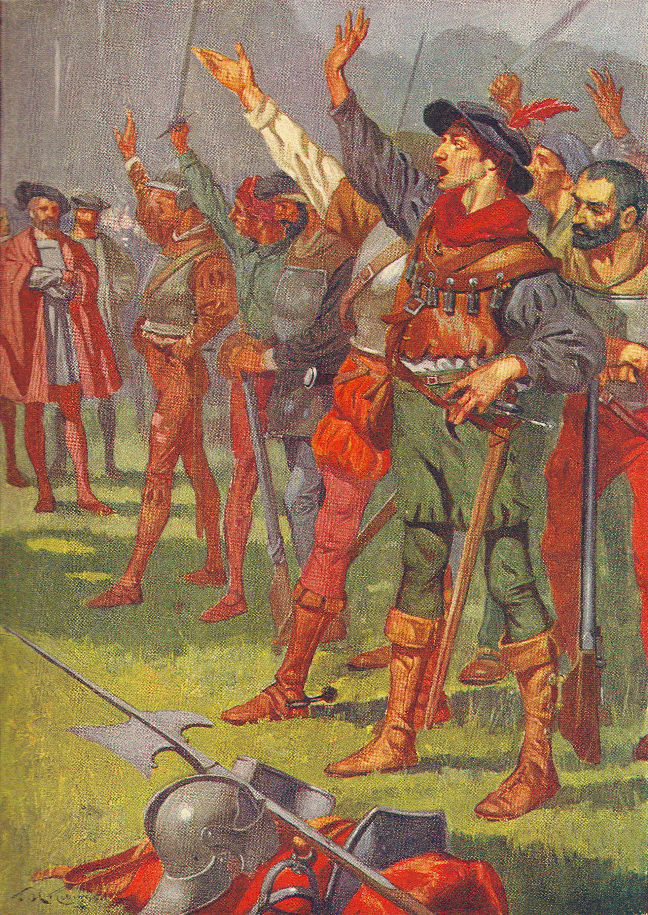 "TO MEXICO! TO MEXICO!" |
When the news reached the army it seemed for a moment that they would turn and rend this man who had so betrayed their confidence. "Our general," they clamoured in fury and despair, "has led us like cattle to be butchered in the shambles!"
"Fellow-soldiers!" cried Cortés, in the tone of mingled authority and comradeship so dear to his men, "the ships were mine, the only property I possess in the world, so their destruction is my greatest sacrifice. But I have done it for the sake of the cause. The hundred sailors will now be free to fight in our ranks. And what use would the ships have been to us? If we succeed we shall not need them. If we fail, we shall be too far in the interior to reach the coast. Have confidence in yourselves, you have set your hands to the work; to look back is ruin! As for me, I remain here while there is one to bear me company. If there be any so craven as to shrink from the dangers, let them go home, in God's name. There is still one vessel left. Let them take that and return to Cuba. They can tell there how they deserted their comrades, and patiently wait till we return loaded with the spoils of the Aztecs!"
Once more the general's subtle eloquence swayed his men, who with renewed enthusiasm shouted, "To Mexico! To Mexico!"
Two hundred and fifty men under Escalante were sent back as garrison to Vera Cruz. There remained for the march inland about four hundred infantry, fifteen cavaliers, and seven guns. Thirteen hundred Totonac warriors also volunteered, and the baggage and guns were transported by several hundred tamanes or carriers.
On the 16th of August the expedition set out to see, as Bernal Diaz quaintly says, "what sort of a thing the great Montezuma was of whom we had heard so much."
The march lay at first across the tropical country of Eastern Mexico. Through moist, perfume-laden woods the soldiers struggled, where the vanilla orchid encircling the trees flung down a tangle of graceful roots.
Here and there were plantations of prickly cactus, to whose leaves clung myriads of the cochineal insects which gave to the Mexicans their richest crimson dye. It was the rainy season, hot and enervating, but as the road wound gradually uphill a cooler breeze refreshed the weary men. Oaks took the place of palms and orchids, and the liquid amber tree began to show its beautiful foliage. Here in this temperate region the sea-breezes as they cooled on the mountain side brought frequent mist and rain. Resting at a village, the soldiers gazed back at the "tierra caliente," sloping from their feet toward the shining line of the ocean. In the south the mighty Orizaba, the Star Mountain, with its snow-capped peak, glittered in the sunshine. Above them frowned the mountain barrier which they must climb to reach their goal.
On again they marched, always upwards, across the base of the great volcano Cofre de Perote. On all sides yawned fearful chasms and canons with vertical walls two or three thousand feet in depth. Cut to the bone by the bitter wind and storms of sleet and hail, the Spaniards looked in amazement from their bare and arid surroundings down upon the glowing verdure clothing the feet of some dizzy precipice. Even the Europeans suffered from the change of temperature, and the lowland Indians, unprotected by armour or quilted coat, perished in numbers.
Struggling through a narrow pass, they at length emerged on to a fertile plateau, which was found to extend, north and south, for several hundred miles. Here fields of maize and acres of the tall-stemmed aloe, crowned with its dark leaves and yellow flowers, gladdened their eyes. What the palm is to the Old World the aloe is to the New. From the pulp of the leaves the Mexicans made paper; from the fibres cord and cloth; the thorns were natural pins and needles. The whole leaf thatched their houses. The root was eaten as a vegetable, and from the sap they made an excellent wine.
A few hours' march through this cultivated region brought the army to the outskirts of a large town. Without the walls was a ghastly monument composed of the skulls of human beings. Bernal Diaz, who counted them, declares that there were a hundred thousand! Thirteen temples, each with its chamber of sacrifice, dominated the city.
Tired and hungry after their difficult journey across the mountains, the Spaniards were much disheartened when the cacique of the place received them with cold, inhospitable reserve. When asked if he were subject to Montezuma, he replied haughtily, "Who is there that is not a vassal to Montezuma?" He then spoke in vaunting terms of the greatness and power of his emperor, and of his impregnable capital, which stood in a lake in the centre of a wide valley. It was connected with the land by causeways with drawbridges, and was guarded day and night by war-canoes. "The words which we heard," boasts old Diaz, "however they may have filled us with wonder, made us—such is the temper of the Spaniard—only the more earnest to prove the adventure, desperate as it might appear."
Without orders from the emperor the cacique refused at first to show any hospitality to his unexpected visitors, who were perhaps foes of the Aztec monarch. "Should Montezuma command it," he said, "my gold, my person, and all I possess shall be at your disposal." It was Marina at last who overcame his scruples by telling him how the emperor had honoured these noble Teules with the richest gifts of his treasure-house. Only then did he consent to give quarters and food to the famishing strangers.
In spite of the unfriendly attitude of the people, Cortés and his soldiers, their zeal inflamed by the sight of the skulls, resolved to convert them, by force if need be, to Christianity. From this rash attempt they were only dissuaded by the wisdom and sincerity of Father Olmedo. "These people are sure to resist," he said, "even to death, and a forced conversion, where we have no time to stay and teach the truths of our religion, is useless."
After three days' rest the march was resumed, and the inhabitants of the next town at which the Spaniards arrived met them in more friendly spirit, advising them not to proceed by way of warlike Tlascala, but to go through the peaceful town of Cholula. The Totonac allies, however, loudly dissented. "The Cholulans," they declared, "are false and perfidious, but the Tlascalans are frank and fearless, and enemies of Mexico."
Keeping to his original plan, Cortés sent four of the allies as envoys to Tlascala, asking permission to pass through that country. They were to present as a gift a cap of crimson cloth, a sword and a crossbow. After waiting three days in vain for an answer, the army set out hoping to meet the envoys. The soldiers marched always in armour, with the cavalry in the van and the baggage and heavy-armed men in the rear. "We are few against many, brave companions," said Cortés, "be prepared then, not as if you were going to battle, but as if actually in the midst of it!"
The road, which ran at first by the side of a river flowing through a wooded plain, wound gradually upwards into wilder and more broken country. In a defile the horsemen suddenly pulled up. The way was blocked by a great stone wall nine feet high, and wide enough for twenty men to march along the top. The two ends of the wall overlapped, leaving a narrow passage—the only entrance, and one well protected by strong battlements.
As the Spaniards gazed on this huge structure with its trap-like passage their hearts almost failed them. Unseen foes might lurk behind those threatening parapets. But Cortés, putting spurs to his horse, made for the narrow lane, crying, "Forward, soldiers! the Holy Cross is our banner, and in that sign we shall conquer!"
Tlascala the Brave—Allies at the Point of the Sword
The cavalry dashed through the passage, which was, however, quite undefended, and the whole army entered unopposed the jealously guarded territory of Tlascala. The horsemen riding on had advanced some miles into the country when they perceived in the distance a small body of men retreating as if in fear. Swiftly the cavaliers gave chase, when suddenly the fugitives turned on their pursuers, and at the same moment hundreds of Tlascalans sprang up from ambush and joined in a fierce attack on the strangers. They showed no fear of the horses, two of which were killed and decapitated in triumph. Cortés and his cavaliers would soon have been overwhelmed had not the infantry rushed up at the critical moment and opened a hot fire on the enemy. At the flash and report of the guns the natives did indeed recoil, but they retired without panic and in good order.
Marching on through fields of maize and aloe the Spaniards encamped for the night in some deserted huts on the banks of a river. For their supper they were reduced to eating Indian dogs and wild figs. Watch was kept through the night, which passed, however, quietly away.
At dawn the camp was astir. When all was ready for the march Cortés gave his directions. The mounted men were to ride three abreast, and to strike always at the faces of the foe. The little army had advanced but a short distance when two Indians were seen approaching in a state of evident terror and exhaustion. They were the Totonac envoys who had escaped in the night from the sacrificial cage into which they had been ruthlessly flung. Breathlessly they warned the Teules that a Tlascalan army was close at hand.
And now shrill and high rose the whistling Indian war-cry, and a flight of arrows startled the foremost ranks of the Spaniards. Fierce and sudden was the Tlascalan attack, and suspiciously sudden their retreat. But the blood of the Spaniards was up. "St. Jago and at them!" cried the cavaliers, and furiously pursuing they found themselves the next moment in a narrow, rugged glen difficult for horses and impracticable for guns. Attacked on every side, they strove to escape from this death-trap and cut their way onward to the entrance of the pass. But there they found, to their dismay, an angry sea of gleaming helmets and waving banners! To advance seemed certain death, but to retreat was impossible.
In vain the cavalry hurled themselves against the dense ranks of the Tlascalans, who had learned to aim their blows at the horses. They succeeded in killing one, and captured the rider alive to serve as a victim for sacrifice. Around the fallen man the fight raged most fiercely, and he was rescued by his comrades with desperate courage, only to die shortly afterwards of his wounds. As for the body of the horse, it was borne off in triumph by the Indians, and was afterwards hacked in pieces and sent through all the districts of Tlascala.
"Forward, comrades!" shouted Cortés to his cavaliers, "if we fail now the cross of Christ can never be planted in the land. When was it ever known that a Castilian turned his back on a foe?" In answer, his horsemen charged with such fury that they swept through the mass of the enemy to the open plain beyond. Hard upon their heels came the infantry, straining every nerve to bring the artillery into action, and the havoc wrought by the guns turned the tide of battle. The Tlascalans drew off, carrying with them their dead and wounded, for the Spaniards were too exhausted to press home their advantage.
In this action the Totnacs had been of the greatest service, fighting hand to hand in the thickest of the press. "I see nothing but death for us," said a Cempoallan chief to Marina, who shared every danger of her beloved master. "The God of the Christians is with us," she replied with steadfast faith, "and He will carry us safely through."
The army encamped for the night in a temple on the rocky hill of Tzompach, and the men spent the following day in tending to their wounds, overhauling their weapons, and making fresh arrows, while the cavalry scoured the country for the much-needed provisions.
Still Cortés hoped for peace, and for the friendship of the gallant little republic. Releasing all the prisoners, he sent a letter by two of the chiefs proposing once more an alliance, or at the least neutrality. The messengers were met by Xicotencatl, the great general of Tlascala, who was encamped with his army two leagues from the hill of Tzompach. Insolent was his answer: "The Spaniards will be welcome in our city, where their flesh will be hewn from their bodies for sacrifice to the gods! To-morrow I will deliver this answer in person!" At this savage message, "being but mortals, and like all others fearing death," says Bernal Diaz, "we prepared for battle by confessing to our reverend fathers, who were occupied during the whole night in that holy office."
The Spaniards had no mind to await the promised visit inactive in their camp, and the next day Cortés gave them a few last orders before leading them forth to fight. At all costs they were to keep their ranks unbroken. The infantry were to thrust with the point rather than to strike with the edge of their swords, and the cavaliers were to charge at half-speed, aiming at the eyes of the Indians. A ceaseless fire was to be kept up, some loading while others discharged the guns. They had advanced but a short distance when they came in sight of the army of Xicotencatl, which seemed to cover the whole plain. Over the mighty host waved the banner of the republic emblazoned with a golden eagle, whose outspread wings were studded with emeralds and silver. Every chieftain had his banner, and foremost in the ranks was the proud standard of Xicotencatl himself, bearing as its device a heron on a rock.
The gorgeous colouring of paint and feather-work, the glittering of copper lance-head and golden cuirass, were dazzling in the sunlight. To add terror to their appearance, the helmets of the chiefs were formed like the heads of ferocious beasts, decorated with gold and gems and gleaming, grinning teeth. From their crests floated choice and brilliant plumes denoting rank and family. But their weapons were poor as opposed to Spanish steel and powder. Very deadly, however, was the "Maquahuitl," a wooden pole three feet in length, armed on each side with two razor-like blades of itztli, and tied to the warrior's wrist that it might not be wrested from him in battle. Their other arms were bows and arrows, darts and javelins, and they bore shields made of reeds quilted with cotton, and adorned with feather-work, gold, and silver.
Not long had the Spaniards to study this martial array. Letting fly such a cloud of arrows that "the sun was actually darkened," the Tlascalans, yelling their hideous battle-cry, swept down upon the strangers, throwing them into complete disorder. It was only the superiority of tempered steel which enabled the Spaniards to rally and reform. Again and again did the massed battalions of dusky warriors try to break through the serried ranks bristling with sword-points, only to be flung back reeling and broken. Their very numbers told against them, they hampered each other and afforded an easy mark for the artillery.
But the repeated charges might at last have worn out the little band of invaders had not dissensions arisen amongst the foe. One of the Tlascalan caciques whom Xicotencatl had called a coward, first challenged his general to a duel, and then withdrew from the fight, taking with him his whole division.
The battle was over, but once again at such cost that the Spaniards made no attempt to pursue, but returned at once to the hill of Tzompach. Surely after this defeat, thought Cortés, even this intrepid race will welcome peace, and once more he sent by prisoners a letter proposing friendship and alliance. This time they were to deliver their message to the rulers in the capital itself, and not to the fierce young general in his camp.
The republic was governed by four great lords who sat in council together, each surrounded by his inferior chieftains. Anxiously they debated the white man's proposals, and opinion was divided as to the answer they should return. Doubt as to the origin of the foreigners was rife. Maxixcatzin, one of the four ancient lords, was for peace and alliance with the strangers, who might perhaps be gods, and certainly were mighty warriors. But the young Xicotencatl hotly urged war to the death on these invaders of Tlascala, who had already shown themselves to be enemies of the gods of Anahuac. In their dilemma the councillors turned to the priests, who gave this oracular reply: "The Spaniards, though not gods, are children of the Sun. From the sun do they derive their strength, and when his beams depart their power also fails." Now the nations of Anahuac never waged war in the night-time, and it may be that the priests, who knew well that the Christians were their foes, hoped by these words to incite their people to change their tactics, but continue the warfare. It was resolved to attack the camp of the strangers in the darkness. One night, as a Spanish sentinel looked out across the plain, he noticed in the moonlight a dark mass moving towards the hill. At once the alarm was given, and the Spaniards, who slept with their weapons at their side, and with horses ready saddled, sprang to arms. On crept the Tlascalans, their heads just showing over the maize. The camp was all in darkness, doubtless their foes were sleeping. Suddenly, "St. Jago, and at them!" rang out from above, and down the hill charged the children of the Sun, horsemen and footmen looming huge in the moonlight. The Tlascalans, completely surprised, and unused to fighting at night, lost their wonted nerve and fled, mercilessly cut to pieces by the victors.
The patience of Cortés was exhausted. This time his envoys bore an arrow, with a letter sternly demanding instant submission.
A few days later forty Indians climbed the Hill of Tzompach wearing white badges as a sign of peace, and the soldiers, glad the war was ended, entertained them kindly. Marina, however, discovered that these men were really spies of Xicotencatl, and Cortés, bent on breaking this stubborn resistance, had all their hands cut off, and sent them thus mutilated back to their master. "The Tlascalans," he said, "may come by day or night, they will find us ready!"
Though the Spaniards through all this trying time had presented a bold and united front to the enemy, discontent, weariness, and, indeed, despair, had eaten into the heart of the camp. When one small republic had taxed their energies to the utmost, what might they expect when opposed with the resources of an empire! No praise is too high for the man who, under such circumstances, could control and inspire a lawless soldiery.
Even to the Captain-general it was a relief when Xicotencatl came in person to sue for peace. No longer would the mountaineers resist a foe whom no stratagem found unprepared, whom no ruse could deceive.
"You will find my countrymen," said the chief to Cortés, with dignity, "as faithful in peace as they have been fierce in war. Our gifts can be but of little value, for the Aztec emperor has left us nothing but our freedom and our arms."
"From your brave people," replied Cortés, "they are more precious than a house full of gold."
From this time Tlascala never failed the children of the Sun, to whom she had vowed her friendship.
There now arrived from Montezuma an embassy bringing many compliments and much treasure. Montezuma had heard of their victory over the unconquerable republic, and was more than ever anxious to prevent their advance on his own capital. To the offer of a rich bribe if they would but turn back, Cortés gave the unchanging answer that he must see the emperor himself.
Leaving the "Tower of Victory," as they had called their temple-camp, the Spaniards proceeded to Tlascala, where they were received with great rejoicing. Every show of enmity had disappeared, and the streets were decked with flowers as if for a festival. They were bidden that evening to a banquet in the palace of Xicotencatl, the blind father of the young general. Quarters were assigned to them in one of the chief temples.
During the three weeks of their stay they became familiar with the native mode of life, and were much struck with the advanced stage of civilisation and the excellence of the public institutions, so great a contrast to the barbarities of the religion. On the roofs of the well-built houses were terraced gardens. In the apertures for windows and doors hung mats fringed with tinkling bells. The Spaniards were amazed to find luxurious public baths of vapour and hot water. A well-organised police system kept the town always orderly and quiet. Though a large market was held every week, there were also many shops, among which those of the barbers were especially noticeable.
The city consisted of four wards, separated from each other by high stone walls, each ruled by one of the four great chiefs of the republic. Shut in by natural barriers and at constant war with the surrounding tribes, the state was perforce self-supporting, and the inhabitants were therefore agricultural. The climate, more rigorous than in other parts of the table-land of Anahuac, had bred a bolder and finer race.
As in Cempoalla, so here the natives desired to seal this new alliance by intermarriage, and again the Spaniards wished to insist first on the conversion of the nation. This suggestion, however, was so firmly rejected that Father Olmedo saw at once the inexpediency of pressing the matter at that time, and hastened to curb the rising zeal of his militant flock. Some marriages, however, did take place. The daughter of Xicotencatl was given to Alvarado, whose bright face, fair complexion, and golden hair had won the hearts of the Indians. He was called by them Tonatiuh, the Sun, while Cortés was known as Malinche, the Aztec name for Marina, who was ever at his side.
Word now came from Montezuma actually inviting the invaders to Mexico. He begged them not to remain among the "base and barbarous Tlascalans," but to proceed to Cholula, whither he would send a suitable escort. Vehemently the new allies protested. Montezuma, they declared, was not to be trusted, and sought but to entrap the strangers in his island city. But if the Teules had resolved to accept the invitation, let them avoid Cholula at all hazards. Cortés thought they were right, but to choose another route would look like fear or weakness, and it was ever his policy to leave no unvisited stronghold behind him.
Six thousand Tlascalans took service under the banner of Castile, and subsequently proved their friendship in many a hard-fought fray.
Cholula the Sacred—Craft Meets Craft
When a day's march from Cholula the army was welcomed by some of the notables of the city, but passage was refused to the Tlascalans, who encamped therefore without the gates.
As the strangers proceeded through the crowded flower-decked streets they thought they had never seen so fine a town as this sacred city of Anahuac. "It is more beautiful from without," wrote Cortés later in a letter to Charles V., "than any city in Spain, for it is many-towered and lies in a plain. And I certify to your Highness that I counted from a mosque there four hundred other mosques and as many towers. It is the city most fit for Spaniards to dwell in of any that I have seen here, for it has some untilled ground and water so that cattle might be bred, a thing which no other of the cities we have seen possesses; for such is the multitude of people who dwell in these parts that there is not a hand-breadth of uncultivated ground." The luxury of the dress and life of the Cholulans seemed in keeping with the place, but the black robes of a countless priesthood lent a sombre and sinister tone to the otherwise joyous city.
Here Quetzalcoatl, the benignant, had rested on his way to the coast, and here was erected in his honour a pyramid, great as that of Cheops, crowned with a temple. Hither flocked thousands of pilgrims to worship. Gorgeous was the image of the Fair God; round his neck was a collar of gold, from his ears hung pendants of turquoise, in one hand he bore a jewelled sceptre, in the other a painted shield with his device as lord of the air and the winds, while from his mitre sprang plumes of undying fire.
When the Spaniards had been entertained for two days in the spacious city, some Mexican nobles arrived who spoke privately to the Cholulan chiefs and then withdrew. The caciques who had been so friendly now became cold and haughty, and the supply of provisions ceased. The streets were almost deserted, and "the few inhabitants that we saw also," says Bernal Diaz, "avoided us with a mysterious kind of sneer on their faces." The Totonacs, who had wandered through the town, declared that the roads had been barricaded, and that stones and weapons had been placed on the roofs of the houses. Cortés grew anxious, and now an incident occurred which verified his worst fears.
The wife of one of the Cholulan caciques who had taken a great fancy to Dona Marina came one day to the Spanish quarters, eagerly begging that the Aztec girl should visit her house. When Marina refused, darkly whispered the Cholulan woman, "A fearful fate will befall you if you do not come." Suspecting a plot, Marina feigned to consent and began to collect her jewellery and clothes. The woman then told her that Montezuma had sent bribes to the Cholulan chiefs, asking them to fall on the Spaniards as they were leaving the city. All was ready for a surprise attack, and without the town lay a large Mexican army. With a hasty excuse Marina left the cacique's wife busy with her clothes, and hastened to inform Cortés of the danger. He was appalled at the news that Montezuma was so sure of success that he had sent manacles to bind the Spaniards! To force his way through the streets of a city where both cavalry and artillery would be useless, and where on every housetop enemies would be stationed, was quite impossible. Yet to stay on inactive in his quarters meant starvation. At last he resolved to outwit the Cholulans by so terrible a surprise that they would not only be punished for their treachery, but would never dare to face a Spaniard again.
Sending a message to the Tlascalans to be ready to march into the city when a certain signal was given, he summoned his officers and unfolded to them his plan. He then sent word to the Cholulan chiefs that he intended to leave their city in the morning, and asked for tamanes and an escort of two thousand warriors.
At daybreak he placed a cordon round the great courtyard of his temple quarters, and at each of the three entrances a strong guard. The remainder of his men with the artillery were stationed without the gates. Soon afterwards the Cholulan caciques arrived with an even larger number of men than Cortés had demanded, and entered the courtyard. The gates closed behind them. Then the Spanish general, summoning the chiefs to approach him, told them sternly that he had discovered all their treachery. If they had intended to attack their guests, why had they not done it openly, he asked, as had the Tlascalans? Such crimes could not be suffered to pass unpunished.
Suddenly a musket-shot rang out, and at the signal the Spaniards opened a deadly fire on the Cholulans, who were so closely crowded together that they had no room to fight. To escape was impossible, and the struggle soon degenerated into a massacre. In vain the warriors in the city rushed to rescue their countrymen, and hurled themselves against the mail-clad foes who guarded the gates with their terrible cannon. And now the Tlascalans fell fiercely on their rear, and caught thus between two fires the rescuers broke and fled. Some of them made for the temple of Quetzalcoatl, for had not the Fair God promised that if in time of dire necessity they dragged down his walls a deluge would flow thence to overwhelm their enemies? Many with bare hands tore at the stones, but, alas! no miracle rewarded their frenzied efforts, no vengeful flood gushed forth, showers of crumbling brick-dust alone mocked their faith. In the towers of the temple they sought refuge, only to perish miserably in the flames of the wooden structures fired by the Spaniards.
It was a scene of horrid carnage. "We slew many of them," says Bernal Diaz, "and others were burnt alive; so little did the promises of their false gods avail them."
To quell the tumult he had himself aroused was no easy task even for the iron will of the conqueror, but at last both Spaniards and allies were gathered under their banners, the streets were cleansed, the dead buried. For fourteen days Cortés remained in Cholula, giving up all his time, with statesmanlike foresight, to the work of reconstruction. The country people were brought in to open the shops and carry on the daily work which was at a standstill for lack of hands. The cacique had been among the slain, so another was appointed in his place. The victims for sacrifice were freed, their cages demolished, and in the temple of Quetzalcoatl a cross was planted. But Cortés could not wipe away the traces of the terrible massacre. Black and smoking ruins showed their unsightly scars where shining temples had so lately stood, and never did the sacred city regain her former glory.
There has been much controversy as to the necessity for this wholesale slaughter. On ethical grounds it is of course unjustifiable. But it must be judged by the standards of that age, when even in Christian Europe towns were sacked without mercy, and the inhabitants, regardless of age or sex, put to the sword. In the New World, where human sacrifice prevailed, life was still less valued. As to the expediency of the deed there is no doubt. Throughout Anahuac the Spaniards gained in prestige, the most valuable of all aids to a small body of invaders. In the capital consternation reigned. The gods were indeed come, and who could stay their onward march? To propitiate the dread beings Montezuma sent humbly disclaiming any share in the recent treachery. His slaves bore as usual costly offerings.
The way now lay open to Mexico. The Totonacs, however, feared to proceed, such was their dread of "the great Montezuma," so Cortés allowed them to return to their own country laden with the rewards of faithful service. The Tlascalans, on the other hand, were eager to advance, and Cortés was obliged to refuse thousands of fresh volunteers.
The first stages of the march led across wide savannahs and through well-kept plantations. Several caciques, who had heard of the downfall of Cholula, came from their cities to greet the conquerors. They all complained of the tyranny of Montezuma, and warned Cortés that the main road to Mexico had been blocked to force the Spaniards to follow a more dangerous route commanded by hidden forts.
Gentle rises soon brought them to the foot of that great mountain barrier which separates the plains of Cholula from the valley of Mexico. Here the road branched, and the main track was much encumbered with fallen timber and great stones. Acting on the information he had received, Cortés removed the obstacles, continued on his way, and entered wild and broken country swept by icy blasts. Two giant volcanic peaks, among the highest in North America, guarded the pass, Popocatepetl, the "Smoking Hill," and Iztaccihuatl, "the White Woman." From far-distant Tlascala had been seen the smoke and flames of the former in ceaseless eruption. And to Montezuma in his island city, the same sight had seemed to forecast the doom of his empire.
No man, declared the Tlascalans, might ascend the Smoking Hill and live. Hearing this, ten of the cavaliers at once determined to make the ascent, and to their surprise several of the Tlascalans, not to be outdone in courage by their white friends, volunteered to accompany them. Passing successively through forests with dense undergrowth and belts of pine, they emerged on to the bleak, lava-strewn mountain side. Strange groanings and rumblings came from beneath their feet, and the Indians, who had climbed on manfully to this point, suddenly declared with looks of terror that they could go no farther. The mysterious noises, they said, were the groans of the tormented spirits of wicked rulers chained beneath the Smoking Hill. The ten climbed on, coming at last to the snow-line. Without rope or alpenstock they clambered over the slippery ice often on the brink of ghastly chasms and crevasses. Dizzy and faint from the rarefied air they drew near the summit, but Popocatepetl was awake! A rush of burning smoke and glowing cinders drove back the rash intruders. To show how far they had climbed into the region of perpetual snow, they took down with them some mighty icicles. Cortés, much pleased with the bravado of these gallants, mentioned the matter in his next missive to Charles V., and Ordaz, the leader, was allowed to quarter on his shield a burning mountain.
Refreshed by this brief halt, the army defiled through the pass. The cold was intense, and the Spaniards could hardly have survived the bitter nights but for the stone shelters which the Mexicans had erected at convenient intervals for their travelling merchants and couriers.
Having passed the crest of the Sierra the march became easier; the mighty walls of rock grew lower, and suddenly turning a sharp angle of the road the weary, travel-worn soldiers gazed on a view so entrancing that all their toils were forgotten. The Valley of Mexico lay before them. Across green woods and yellow cornfields, shining streams and glowing gardens, gleamed the glancing waters of five beautiful lakes with white-towered cities on their shores. So rare was the air at this altitude that distance did not dim brilliance of colour or distinctness of outline, and in such a light the rampart of porphyry rocks encircling the whole valley seemed of richest purple. Beyond the largest lake—Tezcuco—rose the dark cypress-covered hill of Chapoltepec, while in the very midst of the waters glittered the palaces and temples of Mexico, or, as the Aztecs loved to call it, Tenochtitlan, the city of the eagle and cactus.
This haughty capital it was on which the Spaniards fixed their eyes. There lay the reward of all their toil. No wonder that they cried with joy, "It is the promised land!"
Could the stern conqueror gaze now on this valley so marred by his countrymen, what would be his thoughts? Gone are the sheltering forests, and much of the land scorched by the merciless sun lies barren and deserted. Gone too are the many white-towered cities, and dead is the blossom of Aztec civilisation.
The Great Montezuma
In the green land of the valley the Spaniards were met by another embassy from Montezuma. The envoys had expected to meet the strangers on the farther side of the mountains, and were astonished at the ease with which they had surmounted that formidable barrier. They had been sent to offer Cortés bribes and yearly tribute for his king if he would even now turn back. In vain, no humiliation on the part of the emperor could change the foreordained.
When Montezuma had received the news that the Spaniards were actually in the valley and marching towards the capital, he retired to sacrifice and prayer alone. The gods were dumb, no good omen answered his supplication. "We are born, let that come which must come!" cried the unhappy man at last. Even from his council he received no help; opinion was divided, some were for amicably receiving the strangers, others, and among these his brother Cuitlahuac, would drive them from the land. Hopeless himself, Montezuma inclined to the peaceful party, exclaiming, "Of what avail is resistance, when the gods have declared themselves against us!" He determined to send his nephew Cacama, the lord of Tezcuco, with other nobles, to welcome the invaders.
The prince with his retinue found the Spaniards at Chalco, the most southerly of the five lakes. Cortés was much impressed with the dignity of Cacama's bearing and by the courtesy of his greetings. When the imposing cortege had retired, the army followed the southern shore of the lake until a great dyke was reached leading across to the narrow peninsula which separates the fresh waters of Chalco from briny Tezcuco. This stone roadway with its evidence of engineering skill excited the admiration of the Europeans, while they were charmed with the gay scene around them. The waters were bright with chinampas, the floating gardens so beloved by the Mexicans; myriads of canoes darted to and fro. "And when," says Bernal Diaz, "we saw from thence so many cities rising up from the water, and other populous places on the terra firma, and that causeway straight as a carpenter's level, we remained astonished, and said to one another that it appeared like the enchanted castles they tell of in the book of Amadis! Some even of our soldiers asked if this that they saw was not a thing in a dream!"
Near the shores of Lake Tezcuco lay Iztapalapan, the wonderful City of Gardens, where Montezuma had prepared a royal reception for his guests. The palace, which belonged to Cuitlahuac, was most magnificent, and here the Spaniards were entertained. The ceilings were of sweet-smelling cedar wood, and the walls were hung with tapestry of fine cotton. But the gardens, unrivalled in Europe, were the glory of the place. They occupied a large tract of land and were watered by means of aqueducts and canals. The grounds were laid out in regular squares, and numerous paths trellised with roses, honeysuckle, and brilliant creepers ran in every direction. Flower-beds, scientifically arranged, astonished the rough soldiers. In the orchards were rare fruit-trees brought from distant lands. An aviary and a great reservoir of sculptured stone full of curious fishes attracted the attention of all. "I thought within myself," says Bernal Diaz, "that this was the garden of the world."
At sunrise next morning the Spaniards marched on to the great causeway which fled across the salt lake to the city of Mexico. It was the eighth of November, a day glorious in the annals of Spain.
Each soldier looked grave and anxious; he was leaving the open country behind and committing himself to the very citadel of the enemy. Cortés, ever alive to the spirit of his men, ordered the trumpeters and drummers to play, and it was to the strains of a triumphant march that the Spaniards went forward.
In the van rode the cavalry, horseman and horse alike glittering in steel mail. At their saddle-bows hung heavy battle-axes. In his right hand each cavalier carried a lance which rested on his iron shoe, and from the lance a silken pennon waved. Plumed helmets and gay scarfs gave colour to the cavalcade. Foremost rode Cortés with his two favourite captains on either side,—Alvarado, dauntless in bearing and splendid in dress, and modest young Sandoval, in whom "courage was combined with judgment." Father Olmedo, bareheaded and dressed in rough black serge, followed the horsemen on his mule. Then came in order a chosen guard with the flag of Spain, the artillery drawn by slaves, the infantry, cross-bowmen, gunners, and the tamanes with the baggage. With insolent pride marched in the rear the two thousand Tlascalans, who were to enter for the first time the city of their ancient foes.
About a mile and a half from the walls, at a point where a smaller dyke branched off to the western shore, the causeway was barred by the famous stone fort of Xoloc, twelve feet high with towers at either end. A mighty gate swung open for the army to pass through, and, as it clanged heavily behind, each Spaniard breathed a prayer to his guardian saint. They were but four hundred in number, and they were entering an island city of over three hundred thousand inhabitants from which retreat would be wellnigh impossible. "And now let who can tell me," boasts Bernal Diaz with pardonable pride, "where are the men in this world to be found except ourselves who would have hazarded such an attempt?"
As the Spaniards crossed the wooden drawbridge which joined the causeway to the city they beheld, slowly approaching, a procession so magnificent that an awestruck whisper passed through their ranks—"It is the emperor! the great Montezuma himself!"
Three ushers with golden wands walked in advance to clear the way. Then barefooted and bareheaded came princes of the blood carrying on their proud shoulders the royal palanquin glittering with gold and surmounted by a canopy of green feathers sprinkled with precious stones. Behind, with reverent mien and downcast eyes walked an escort of nobles richly dressed in green and silver.
The procession halted, and a carpet of white cloth was spread on the ground. Then leaning on the arms of Cuitlahuac, his brother, and the lord of Tezcuco, his nephew, the emperor descended from his palanquin and advanced on foot to meet his guests. His cloak and tunic were embroidered with jewels, and the dark-green feathers which floated from his headdress were powdered with emeralds and pearls. The very soles of his sandals were of pure gold, and the leather thongs were rimmed with gems. He was tall and thin, with regular features, pale complexion, and scanty black beard, and his manner as he greeted the Spanish general was dignified and kingly.
Cortes presented Montezuma with a chain of coloured crystals, and advanced to embrace him, but Cuitlahuac, with a look of horror, flung back the outstretched arm of the impious stranger who presumed to touch the sacred person of the emperor. Greetings exchanged, Montezuma, leaving his nobles to escort the visitors to their quarters, re-entered his palanquin and was borne back to his palace.
Along a broad paved avenue, which stretched in a straight line right through the centre of the capital from the southern to the northern causeway, the Spaniards passed, lost in wonder at the throngs of people and the splendour of the city. Houses of red stone, one story high, but covering great space, lined the streets. Between them and on the flat roofs edged with parapets were terraced gardens, and the air was sweet with the perfume of flowers. The houses had airy windows, balconies entwined with flowering creepers, and porches with columns of sculptured marble. Here and there the line of stately dwellings was broken by an open square or towered temple with its never-dying fires. Numerous canals spanned by drawbridges intersected the streets.
Everywhere swarmed the people. From street, canal, temple, balcony, window, and housetop the Aztecs gazed curiously on the strangers, their horses, and their guns. But when they beheld the hated Tlascalan stalk defiantly down their streets dark grew their faces, though, in obedience to the emperor's command, they uttered no word or sound.
On one side of a great square rose the mighty temple of Huitzilopotchli, and on the other a pile of low stone buildings, which had been in old days the royal palace, and was now assigned to the Spaniards for their quarters. Here Montezuma was waiting to receive his guests. Placing round the neck of Cortés a curiously wrought collar made of gold and of the shells of crawfish, the emperor withdrew, saying, with gracious courtesy, "This palace belongs to you, Malintzin. Rest after your fatigues, and in a little while I will visit you again."
In spite of the friendly reception, the first care of the Spanish general was to examine and fortify his quarters. Though only one story high, the vast palace easily held the whole army, including the allies. It was encircled by towered walls of massive stone along which Cortés stationed sentinels. At the gates he placed his cannon. This done, the soldiers were allowed to sit down to the sumptuous repast prepared for them by Mexican slaves. Very pleasant and indeed luxurious was their new abode, with tapestry-covered walls and floors strewn with mats or rushes. In the sleeping-rooms were beds of woven palm leaves with coverlets and sometimes canopies of cotton.
The hour of siesta over, the emperor paid his promised visit. He asked many questions as to the king and country of his guests, and showed great courtesy to all the captains, taking care to learn their names, and presenting them ere he retired with magnificent gifts. Each soldier also received two loads of rich mantles. "And all this he did," says Diaz, "in the most free and gracious manner, like a great monarch as he was."
All day long the citizens crowded the top of the great temple opposite, eager to catch a glimpse of the strangers. All day long they restlessly walked the street below talking of the portentous beings within their gates. But when darkness fell, and the evening guns thundered for the first time through the city, they turned away shuddering at "the voices of the gods."
In the morning Cortés returned the emperor's visit, taking with him Alvarado, Sandoval, Ordaz, and five of the soldiers, among whom was Bernal Diaz. Montezuma's new palace, which was built of red stone ornamented with marble, was so vast that it contained quarters for a large guard and a great armoury. In a spacious aviary, tended by three hundred slaves, were birds of brilliant plumage, and it was here that much of the feather-work was fabricated. Enormous eagles, vultures, and other fierce birds of prey from the snow-clad Andes were in a separate house, and were fed daily with five hundred turkeys. The menagerie of wild animals and reptiles, in roomy houses kept scrupulously clean, seemed to fill the Spaniards with horror rather than with interest. "In this accursed place," says Bernal Diaz, "were poisonous serpents with somewhat in their tails that sounds like castanets. They were kept in vessels filled with feathers where they reared their young. . . . These beasts and horrid reptiles were retained to keep company with their infernal gods, and when these animals yelled and hissed the palace seemed like hell itself." With more pleasure Diaz speaks of the gardens which were "irrigated by canals of running water and shaded with every variety of tree. In them were baths of cut stone, pavilions for feasting or retirement, and theatres for shows and for the dancers and singers; all were kept in the most exact order by a number of labourers constantly employed."
Through many stately rooms with hangings of feather-work exquisite in colour and design the Spaniards were led to the audience-chamber where Montezuma awaited his visitors. At the threshold the Aztec officers cast off their sandals, and flinging over their rich garments a robe of coarse nequen made from aloe thread, they entered with deep obeisance the sacred presence, All, save the members of his family, approached the emperor in this humble garb.
Montezuma received his guests graciously as ever, placing Cortés at his right hand. The Spanish general then proceeded to make a valiant attempt to convert the heathen monarch, explaining to him at great length the mysteries of the Christian religion. Faithfully Marina tried to interpret the abstruse doctrines, and then Montezuma, who had listened with the utmost courtesy, replied, "I doubt not that your God is good, but my gods, also, are good to me. It is not worth while to discourse further of the matter." He spoke of Quetzalcoatl and of the belief that the Spaniards were the god's descendants. "You, too," he said in a laughing manner, for he was gay in conversation, "have been told, perhaps, that I am a god and dwell in palaces of gold and silver. But you see I am of mere flesh and blood, and my houses are of lime and stone and timber! Rest now from your labours, Malintzin; you are here in your own dwellings, and your every want shall be supplied."
Attendants then brought forward such rich gifts that each soldier received at least two heavy gold collars for his share. With many expressions of gratitude, Cortés observing that it was past midday, the emperor's dinner hour, took leave. "And on the way home," says Diaz, "we could discourse of nothing but the gentle breeding and courtesy of the Indian monarch."
But when the Spaniards had left him the gracious smiles forsook Montezuma's face. How strong they were, these gods or god-like men! With what confidence had they spoken of their lord who ruled the world, and their God whom they wished to make all men worship. A foreboding of coming evil which he was powerless to avert possessed the emperor as he flung himself moodily on his luxurious cushions. He took all his meals in solitary state, for his numerous wives lived in their own apartments, and only appeared when summoned by their master. His attendants, barefooted and in robes of nequen, were yet nobles of the highest rank. They now placed around him a screen of carved wood embossed with gold, and covered with a white cloth the low table at his side. Four beautiful women presented, on bended knee, water in a silver basin for the emperor's hands, and towels of the finest cotton. Then from the hundreds of dishes placed on the matted floor Montezuma chose which he would have. The plates, which were of fine red and black Cholulan china, were given away at the end of every meal to the attendants. The fish, which was served first, came fresh every day from the Gulf of Mexico. The meats, which were kept hot in chafing-dishes, were dressed in a great variety of ways, for the Aztecs were well versed in the art of cooking. To the four ancient lords who stood at a respectful distance Montezuma gave from time to time "as a mark of particular favour a plate of that which he was eating."
After pastry and sweetmeats a golden goblet of foaming chocolate, flavoured with vanilla and other spices, was presented to the emperor. All manner of delicious fruits were then placed before him, gathered from the tropical groves of the coast and the orchards of the temperate plateau.
When the meal was over the fair maidens presented once more the silver basin of sparkling water, the ancient lords retired, and pipes were brought of gilded wood containing "liquid amber, mixed with an herb they call tobacco." While the emperor lay and smoked, buffoon and jester, juggler, minstrel and dancing-girl sought in vain to chase from his brow the lines of heavy care. Dismissing them all at last, he sank to sleep in the heavy, scent-laden air; but not to rest, for in his dreams echoed the iron tramp of the horses and the thunder of those dread engines brought by the steel-clad children of the East.
Mexico the Golden
In the Old Palace meanwhile Spaniard and Tlascalan, rejoicing in the rest and good fare, took no thought for the morrow. Not so their general. Ever gay and confident in manner, he realised clearly the peril of his position in the heart of a fortified and perhaps hostile city. His first care must be to inspect the town and its strongholds, and for this he requested the emperor's permission.
Readily consenting, Montezuma detailed four nobles as guides. With a flourish of trumpets and drums, cavalry and infantry marched into the great square. Crowds of citizens had assembled to gaze once more on the strangers. Many women of both high and low degree mingled freely among the men. They all wore several embroidered petticoats of different lengths, a chemise matching the skirts, and a bright-coloured scarf crossed like a fichu at the throat, and hanging down with tasselled ends almost to the feet. They had no veils or any kind of head-dress save a simple fillet of flowers which caught back their dark and flowing tresses. The richer ladies wore a loose mantle over their embroidered chemise and skirts, and bound their hair with a jewelled fillet.
The streets through which the Spaniards passed were watered and swept daily by a thousand labourers, and were so clean that "a man could walk through them with as little danger of soiling his feet as his hands." The canals were used as highways with paths of pavement on either side.
It was market-day in Mexico, and the Aztec nobles led the way to the busy square, where the Spaniards stood astonished at the multitude of people and the regularity which prevailed. Nowhere in Europe, not even in Rome or Constantinople, had they seen a market-place so vast, so skillfully laid out, and so well managed. "The entire square was enclosed in piazzas, under which great quantities of grain were stored and where were also shops." Every merchant had his particular place, which was distinguished by a sign. Goldsmiths, jewellers, potters, furniture-makers, feather-work artists, sculptors, all were there. In one of the deep porticoes hung beautiful fabrics and robes. In another, and here the Spaniards gazed long, were exhibited weapons and armour, all of copper, stone, or tin, for the use of iron was still unknown to the Aztecs. Out of the same stone, which formed the blades of the deadly maquahuitl, razors and even mirrors were manufactured. Here and there were booths where busy barbers plied their trade, or chemists sold their healing drugs. One quarter of the market was reserved for provisions, and here were the hunters with their game, and the fishermen carrying their fish caught that day in the fresh waters of Lake Chalco or in the silvery mountain streams. Here too were delicious fruits, green vegetables, and gorgeous flowers. Tables with pastry, bread, cakes and cups of chocolate or pulque, the aloe-wine, tempted the passer-by. In another quarter were live animals for sale, and near them gangs of miserable slaves. The Aztecs sold according to number or measure, and their currency consisted of bits of tin stamped with a letter like T, bags of cacao, and quills filled with gold dust. A court of justice was held in the market-place, where to all caught cheating summary punishment was meted out by the policemen who patrolled the square.
The soldiers, fascinated by the sights around them, were loath to leave, but Cortés was informed that the emperor awaited them in the great Temple of Huitzilopotchli.
Retracing their steps, the Spaniards came to the "wall of serpents," sculptured in stone, which surrounded the vast quadrangle in which lay this mighty temple—a city within a city. Four turreted gateways with arsenals above and barracks beside them opened into the four principal streets.
In the great central courtyard, where the horses slipped at every step on the polished stone pavement, the cavaliers dismounted and gazed curiously around them. Lanes branched off in every direction leading to the numerous buildings which filled the vast enclosure. There were granaries, storehouses, and gardens, so that the temple inhabitants could in time of need be self-supporting. There were houses for the priests and for the priestesses; schools where boys were taught picture-writing, astronomy, and above all, the ceremonies of their religion and traditions of their race; while the girls learned the arts of weaving and embroidery. There were several teocallis or sacred turrets, and on their flat roofs flamed the never-dying fires.
But high above all other buildings towered in the centre of the quadrangle the great teocalli of Huitzilopotchli. This mighty structure was solid and made of earth and pebbles, the whole coated with hewn stone. It was shaped like a pyramid, and its four sides faced north, south, east, and west. It was encircled by five terraces, each one smaller than the one below. A flight of steps led from the ground to the first terrace, round which the pilgrim must pass to gain the steps leading upward. The fifth and last platform could only be reached by passing four times around the pyramid. This laborious ascent had been devised to add to the magnificence of the religious festivals. The procession of priests with their banners and music winding slowly round and round the great teocalli to reach the shrine on its summit must have been a gorgeous spectacle to the people in the streets below.
Refusing the offer of the Aztec priests to carry him up, Cortés with Dona Marina and his captains climbed to the summit, where Montezuma received him with kindly courtesy.
"You are weary, Malintzin, with the ascent," said the emperor.
"To the Spaniards," replied Cortés vauntingly, "fatigue is unknown!"
At one end of the smooth-paved summit were two towers with the shrines and images of the gods; in front of each blazed its altar fire. At the other end was the jasper stone of sacrifice, and the huge drum of serpents' skins struck only in a time of great triumph or danger.
Montezuma then took Cortés by the hand and told him to look at the wonderful view below. There lay the city with its crowded streets and canals, glittering temples, flower-crowned palaces, and the three great white causeways which stretched far across the dancing waters of the lake to the northern, southern, and western shores. To the west rose cypress-covered Chapoltepec, "the grasshoppers' hill," crowned with the emperor's country palace. From here was carried across the lake in a skillfully constructed aqueduct Mexico's supply of pure water. In the south gleamed Lake Chalco. Far on the horizon stood out against the deep blue sky the white peaks of the volcanoes.
For long did Cortés gaze at the symmetrical plan of the city, but turning at last to the emperor he asked permission to enter the two-towered chapels. Montezuma at once led his guests to the shrine of Huitzilopotchli, a huge idol with a great face and terrible eyes. He was bedecked with jewels; round his body coiled golden serpents, and on his neck was a chain strung alternately with golden hearts and silver heads. In his right hand he held a bow, in his left a sheaf of golden arrows. Beside him stood his page, a little idol bearing his lance and shield. On the altar were three bleeding hearts torn from the victims of that day's sacrifice; the walls and floor were dark with human blood.
In the other tower was the image of Tezcat, the "Soul of the World." This was an idol of polished black marble covered with golden ornaments, with mirrors for eyes, and a shield of burnished gold in which he saw reflected all the doings of the world. Here too lay offerings of human hearts, and "the stench was more intolerable," says the old chronicler, "than that of all the slaughter-houses of Castile!" Even to the god of the harvest, a figure half-alligator, half-man, said to contain the germ and origin of all created things, the Aztecs had made bloody sacrifice. "We thought," says Bernal Diaz, "we never could get out soon enough, and I devoted them and all their wickedness to God's vengeance."
"I do not know, my Lord Montezuma," exclaimed Cortés, "how so great a king and so learned a man as you are should not have collected in his thoughts that these idols are not gods, but devils? If you will but permit us to erect here the true cross, and place the images of the blessed Virgin and her Son in your sanctuaries, you will soon see how your false gods will shrink before them!"
But at the words Montezuma's face grew dark, and the priests scowled blackly at the impious stranger. With much dignity the emperor replied, "My Lord Malinche, these are the gods who have led the Aztecs on to victory since they were a nation, and who send the seed-time and the harvest in their seasons. Had I thought you would have offered them this outrage I would not have admitted you into their presence."
Gladly the Christians turned to descend, but Montezuma remained behind to expiate by sacrifice his sin in permitting the strangers to enter the shrines.
Among the smaller teocallis in the courtyard was one to which Cortés turned with some curiosity, for it was dedicated to Quetzalcoatl. But even the worship of the Fair God, who had forbidden human sacrifice, had been profaned by the bloodthirsty priests. The tower, which was round, had an entrance in imitation of a dragon's mouth, and its horrid fangs were dripping with human blood. Glancing down the throat the Spaniards saw within the ghastly instruments of sacrifice, and they christened the hateful place henceforth as "hell."
Passing by a wooden pyramid strung with thousands of skulls, the Christians breathed a sigh of relief as the great gate in the serpents' wall closed behind them, and they found themselves once more in the gay and busy street. It was with gloomy faces that they returned to their quarters in the old palace. They had seen the strength of the city, and they had seen the horrors of its religion. It was the sights in the great temple which sobered the faces of the rank and file. If any disaster came to their little force each soldier saw before him the dreadful fate of the victim.
To cheer and occupy his men, Cortés on the following day ordered one of the halls in the Old Palace to be transformed into a Christian chapel. While at work the soldiers noticed that part of the wall had been newly plastered over. Pulling down the plaster, they found a door concealed beneath. It was quick work to force it open, and there before their dazzled eyes lay masses of gold, silver, jewels, and costly fabrics! It was Montezuma's treasure-room of which they had heard vague rumours. "I was a young man," says Bernal Diaz, and it seemed to me as if all the riches of the world were in that room!" But Cortés, who was not yet prepared to risk offending the emperor, ordered the door to be closed up once more, and forbade the soldiers to speak of their discovery.
Montezuma a Prisoner
Day and night the Spanish general studied with anxious care the possibilities and dangers of his strange position. Well he knew that on his action depended the lives of all his men. While in Cholula bad news had come to him from the settlement on the coast, but fearing to dishearten the soldiers on the very eve of their entrance into Mexico, he had until now concealed the painful story.
Juan de Escalante, whom he had left as command-ant of the garrison at Vera Cruz, had received, soon after the departure of Cortés, a message from an Aztec chief named Quauhpopoca, begging that four Spaniards might be sent to escort him to the Spanish settlement. He wished to give in his allegiance to the white men, but feared to venture to their town without protection. The four soldiers were despatched, and found to their horror that the request was but a treacherous ruse. Two of them were murdered in cold blood, but the other two managed to escape to Vera Cruz.
With fifty of his men and several thousand Totonac allies, Escalante marched at once to take vengeance on the Aztec chief. In the fierce fight which followed the Totonac allies fled, and the Spaniards would surely have suffered defeat but for "the aid of the blessed Virgin who was distinctly seen hovering over their ranks in the van." They were at length victorious, but at great cost. One Spaniard was captured alive by the enemy, and seven, including Escalante himself, died of their wounds. To the great Montezuma the Indian prisoners attributed the hostile action of their chieftain, and to the emperor had been sent the head of the captured white man.
As Cortés pondered the painful story he felt sure that Montezuma's present hospitality was but a mask to conceal some dark design. At any moment he might turn on his unwelcome guests, and even if by force of arms he could not subdue them, he might yet by cutting off retreat starve them to death in the midst of his island city. Only in one way could the Spanish general frustrate possible treachery and insure the safety of his little band.
Calling a council of his officers Cortés listened to all their suggestions. But no plan seemed to save the critical situation. Then he himself proposed a scheme, so daring, so extraordinary, that all were startled. This was, to seize and hold as a hostage the great Montezuma himself!
"Impossible!" cried some. "To what end?" asked others. But the general, self-confident and sure as ever, calmed their fears and gave his reasons. He himself would entice the emperor into Spanish quarters. Once there, so strongly fortified was the Old Palace, it would be easy to hold the royal prisoner. The Mexicans would fear to attack or to starve the Spaniards, lest by so doing they should imperil the sacred person of their monarch. The trappings and show of empire should still remain to Montezuma, but in reality his keepers would rule the land.
It was a bold plan, and the soldiers, blindly trusting the general who had never yet failed them, gave their assent. The night was passed in prayer that Heaven might smile upon the deed of the morrow. But Cortés, through all the hours of darkness, was heard restlessly pacing up and down his chamber wrapt in his schemes for the future.
In the morning the whole army was drawn up in the courtyard ready to sally forth at the first alarm. Several detachments of picked men sauntered along the streets leading to Montezuma's palace, as if they were merely viewing the city. Thirty of them were ordered to wander as if by chance into the grounds of the palace itself. Then Cortés set out to visit the emperor, who had consented to receive him. He was attended by Dona Marina and by five of his most daredevil cavaliers, Pedro de Alvarado, Gonzalo de Sandoval, Francisco de Lujo, Velasquez de Leon, and Alonzo de Avila.
Courteously and even gaily Montezuma welcomed his guests. At the entrance of these august strangers whom the emperor delighted to honour, his attendants retired with deep obeisance. In friendly talk the time slipped by, but just as the Aztec was explaining his favourite game, the Spanish general, with an abrupt change of manner, stepped forward and sternly accused him of having instigated the treacherous assault on the garrison at Vera Cruz. The startled monarch, eagerly denying the charge, took from a bracelet at his wrist his signet, the image of Huitzilopotchli, and calling one of his attendants, ordered that the guilty cacique should be summoned at once to Mexico.
In gentler tones Cortés thanked the emperor, and declared that he was now quite satisfied as to his innocence. My companions in arms, however," he added, "will not be convinced of your good faith unless you will deign to prove it by taking up your abode in our quarters until the affair is quite cleared up by the arrival of Quauhpopoca from the coast."
Aghast the monarch listened to this extraordinary proposal. Finding his voice at length, he exclaimed, "When was it ever heard that a great prince, like myself, voluntarily left his own palace to become a prisoner in the hands of strangers?"
"Not a prisoner," replied Cortés, "your own court and household shall be round you. You shall exercise your kingly power as usual. It will be but a change of residence, and you will have Spaniards to serve you as well as your own people."
In vain the Spanish general argued and entreated. Montezuma was not to be persuaded. "Never would my subjects," he said proudly, "consent to such a degradation!" Then as the voice of Cortés grew sterner and more insistent, the wretched king, made a coward by his superstitious fears, pleaded, "Spare me this disgrace! Take as hostages one of my sons and one of my daughters!"
Time was passing, and the Spaniards, anxious lest a rumour of their attempt should reach the royal guard, grew impatient. Leon at last, tall and stalwart, with a great red beard and a rough, fierce voice, drew his sword, exclaiming, "Why waste words on this barbarian! In Christ's name, let him yield himself our prisoner, or we will this instant plunge our swords in his body!"
At the word the other captains advanced with naked blades, and Montezuma terrified, turned to Marina for an explanation of the fierce words and gestures.
"Go with the white men!" cried the girl eagerly. "If you yield they will treat you kindly; if you refuse, they will kill you!"
One last piteous, hunted look the emperor cast around him. Gleaming swords, iron mail, and the stern faces of the strangers hemmed him in. Despairingly he murmured, "The gods have abandoned me! I will go with you."
With deep respect the captain now addressed the unhappy monarch, and Cortés declared that none should ever hear of the humiliating scene. Montezuma, tortured with shame at his own weakness, assented gladly to the suggestion that his visit to the Old Palace should appear to be entirely by his own free will. Ordering his palanquin, he sent for his chief nobles, and told them that the gods had advised him to go and abide for a time with the white strangers.
Strange was the procession which now passed through the crowded streets. The royal palanquin surrounded by an escort of Spaniards! Three squares and three bridges had been passed when there arose a sullen murmur in the crowd. A whisper grew that the emperor was a prisoner! The murmur swelled into a tumult. The people blocked the way, calling to their monarch and threatening the strangers.
Unarmed as they were, they would yet by mere force of numbers have rescued their lord, but even as they threatened, the curtains of the palanquin were drawn aside, and Montezuma in a calm, clear voice demanded the cause of their clamour. A sudden silence fell upon the crowd, the people sank to their knees and listened as to the voice of a god.
"Return in peace to your homes," said the emperor. "Of my own free will I am visiting my trusted friends!"
Bewildered and abashed the Aztecs fell back, and the Spaniards passed on their way unmolested. So in the very heart of his capital, from the midst of a devoted people who would have given their life's blood to save him, with his warriors within call, the Aztec emperor was carried through the gates of the Old Palace—a prisoner.
Montezuma was received, as Cortés had promised, with the utmost deference. His apartments were furnished with every luxury, and he was attended by his favourite wives and pages. He was free to receive his subjects and to transact the business of the empire. But well did he know that in spite of all this pomp and ceremony he was a captive. Only a limited number of Aztecs were admitted at one time, and day and night a guard kept watch at the gates and also in the emperor's antechamber. So wearisome even to the tireless Spaniards became this ceaseless watching, that a soldier at Montezuma's door exclaimed bitterly one day, "Better this dog of a king should die than that we should wear out our lives in this manner!" The man was punished, but the incident increased the emperor's anxiety to escape from his veiled bondage.
And now arrived Quauhpopoca from the coast accompanied by his son and fifteen nobles, in obedience to the messenger with the royal signet.
Humbly clad in nequen the chieftain entered the presence of the emperor, bowing to the ground with the usual salutation, "Lord, my lord, great lord!" He was received with haughty displeasure, and told that as his offence had been against the Spaniards, the Spanish general should judge him. Montezuma hoped by this act to propitiate his gaolers and win his freedom.
With great dignity the chieftain bore himself before his alien judge, confessing at once that he had plotted to overthrow the white strangers in Vera Cruz, since he considered them to be the enemies of his country. In grim silence Cortés listened, and then passed his ghastly sentence. The cacique with his son and the fifteen nobles were to be immediately burnt alive in front of the palace. With Montezuma's permission the arsenals of the great temple were despoiled, and the arms and missiles piled high in the courtyard of the Old Palace. Here, in the blaze of their country's weapons, the Aztec nobles bravely met their death.
Just before the execution Cortés entered the emperor's apartment followed by a soldier carrying fetters. Sternly he told his prisoner that the cacique had declared before his death that Montezuma had ordered the assault. Then, commanding the soldier to fasten the fetters on the shrinking monarch, the general strode away.
Racked with humiliation, the once great Montezuma lay in silence amid his weeping attendants, who strove to wedge their garments between the irons and their master's feet. So broken in spirit he seemed that he did not even resent this last degradation, but actually thanked Cortés when he reappeared and removed with his own hands the shameful bonds. With "honeyed words" the Spaniard expressed his deep regret that he had been obliged to punish one whom he loved as a brother.
Horrible to modern minds seems this cruel execution of seventeen men, whose only fault was obedience to their emperor and love of their country. But the old conquerors themselves did not for a moment question the morality or humanity of the sentence. The life of an Indian and a heathen was almost worthless in their eyes, and even in this dark deed they felt that God was their guide. "As soon as this chastisement was known," says Bernal Diaz, "it struck universal terror, and the people on the coast returned to their submission. Now, let the curious consider upon our heroic actions! . . . Now I am old, I say that it was not we who did these things, but that all was guided by the hand of God, for what men on earth would otherwise have ventured, their numbers not amounting to four hundred and fifty, to have seized and put in irons a mighty monarch, and publicly burned his officers for obeying his orders, in a city larger than Venice, and at a distance of a thousand and five hundred leagues from their native country!!!"
One day followed another, and still the emperor of the Aztecs remained a prisoner in the hands of his guests. He was treated with all honour, and seemed often to forget his degradation in some new interest or pleasure. He was attended always by Orteguilla, a page of the general's, who had already learnt to speak Aztec. He loved to watch the soldiers at their military drill, and soon learned to know all the captains and many of the men. On his favourites, and especially on Leon, the captain of his guard, he delighted to bestow princely gifts. His favourite game was totoloque, in which the players aimed with golden balls at a golden target. He declared gaily one day that Tonatiuh must not score, as "he did not say that which was true," at which "we all," says Diaz, "burst out laughing, because Alvarado was a little addicted to exaggeration!" Once when Cortés would have punished a soldier who had stolen a cup from the royal treasury, now reopened, Montezuma intervened. "Your countrymen," he said, "are welcome to the gold, if you will but spare what belongs to the gods."
But at times his captivity seemed to prey on the emperor's mind, and bitter grew the thought that he could not even worship at the shrines of his gods. Cortés, not daring to show the Aztec people too plainly that Montezuma was a prisoner, promised at last to allow him to visit the great temple, with a warning that if there was any attempt at a rescue his life would pay the forfeit.
With banners and music a splendid procession of nobles and courtiers left the gates of the Old Palace. In the midst was the royal palanquin, surrounded by Spanish captains and followed by a hundred and fifty picked Spaniards in battle array. Sullen and puzzled were the faces of the multitude who prostrated themselves as the emperor passed. At the teocalli priests were waiting to carry up their lord, but in front and at the rear tramped a guard of the mailed strangers. Four times as it wound its way upward did this unwonted procession, Aztec priest and white-skinned warrior, pass before the sombre gaze of the kneeling throngs below.
To prevent human sacrifice Father Olmedo was at the emperor's side, but his efforts were in vain, for on the preceding night four victims had been offered to the gods in Montezuma's name. His devotions fulfilled, the Aztec monarch was borne peaceably back to the Old Palace through his silent, watchful subjects, who at his slightest sign or word would have torn him from his gaolers.
Cortés, meanwhile, was carefully making his plans. He recognised the importance of his settlement in the Villa Rica de la Vera Cruz, and was anxious to appoint in the place of Escalante a man of tact who would maintain peaceful relations with the Indians. For this purpose he chose Alonzo de Grado, an indifferent soldier, but a handsome, talented man and something of an orator.
The general, who seemed to have had some scorn for this fine gentleman, said to him in parting: "Now, Senor de Grado, go and possess your wishes; you are commandant of Villa Rica, and see that you fortify it well, and mind I charge you on no account to go out and fight the wicked Indians, nor let them kill you as they did Juan de Escalante." This, Bernal Diaz tells us, Cortés said ironically, knowing the condition of the man, and that all the world could not have got him to put his nose out of the town!
For once the general had made a mistake. De Grado paid no attention to the fortifications, but spent his time in feasting and in scheming against his leader with the adherents of Velasquez. His fall was speedy. Sandoval arrived one day as new commandant, with orders to arrest De Grado and send him prisoner to Mexico. A very different man was Sandoval. Only about twenty-two years of age, he was felt by all to be absolutely reliable and trustworthy. "He was a plain man and one who did not know much of letters, not avaricious of gold, but attentive to his business like a good officer, seeing that his soldiers did their duty well and taking good care of them. He was robust in body, his legs rather bowed, and his countenance masculine; his voice was rough and somewhat terrible, and he stammered a little. . . . He had the best horse that ever was seen—a chestnut, with a star in his forehead, and his near foot white, his name was Motilla." And the old soldier concludes his description of this officer so loved by his men with the proud words: "Sandoval was an officer fit for any station!"
The new commandant soon made himself very popular with the natives by his affability and humanity, and immediately began to put the fort into proper repair. Very promptly he executed his orders to send to Mexico a supply of ironwork, cordage, and sails for the construction of two ships. The general's greatest anxiety was the fact that the Aztecs could at any time cut off all communications and all supplies, and hold the Spaniards prisoners within the city. He had resolved, therefore, to build two vessels large enough to carry the army across the lake. Fortunately he had among his men a skilled ship-builder named Martin Lopez. Montezuma, who consented to have timber brought from the royal forests, took a child-like pleasure in watching the construction of the vessels.
From Orteguilla, whose duty it was to keep the emperor amused and in good humour, Cortés learned that he had a desire to go hunting in the forest. The Spanish ships were now finished, and the general offered to convey Montezuma and his suite in the wonderful water-houses to the woods across the lake. He hoped that a day in the open country would make the captive seem indeed a guest.
In the swiftest ship embarked with the emperor and his retinue Leon, Alvarado, De Oli, and Avila, "all men who had blood in their eyes," two hundred soldiers and artillery-men with four brass guns. The guest was well attended. The wind blew very fresh, and the ship with the flag of Spain waving from its mast seemed to fly across the lake, leaving the native canoes far behind. Well might the Aztecs shudder as over the waters thundered the "voices of the gods." The forest, which was strictly preserved, abounded in game such as deer, hares, and rabbits. A good archer the emperor proved, and for long the hunt continued, but wherever he roamed the Spaniard was at his side to remind him that the apparent liberty of the forest would assuredly end in the guarded chamber of the palace.
Tribute to the King of Spain
In his stately city on the eastern border of the great salt lake, Cacama, king of Tezcuco and nephew of Montezuma, brooded with dark suspicion on his uncle's prolonged stay in the quarters of the strangers. Surely he must be a captive! Never of his own free will would the emperor of the Aztecs consent to such a humiliating position. Cacama resolved to raise the great lords of the empire to rescue their monarch, even against his will, from the hands of the white men. Montezuma's brother, Cuitlahuac, the lord of Iztapalapan, his nephew Guatemozin, and the lord of the allied state of Tlacopan, readily consented to aid in the attempt.
Ever on the watch, Cortés ere long heard of these plots which were being hatched on the opposite shore of the lake, and strong in the complete sway he had acquired over the mind of Montezuma, he sent a haughty message to the young king of Tezcuco, warning him to beware of the people of the monarch of Spain, the ruler of all the world.
Equally haughty was Cacama's reply, "I acknowledge no such authority. I know nothing of the Spanish sovereign nor his people!" Even a summons from Montezuma to appear before him at the Old Palace did not move the resolute young king, though the emperor's slightest wish had ever been law to all his subjects. But well Cacama knew that his uncle was now a mere tool of the Spaniards, and bold as before was his answer, "When I visit the capital it will be to rescue it, the emperor, and our common gods from bondage. I will come, not with my hand in my bosom, but on my sword,—to drive out the detested strangers who have brought such dishonour on our country."
Now there were certain Tezcucan nobles in the pay of Montezuma, and at the bidding of Cortés, the wretched emperor actually commanded these traitors to seize his nephew their king, by fair means or foul, and send him to Mexico. To a lonely house over-hanging the lake Cacama was enticed, and then suddenly seized, bound hand and foot, flung into a canoe, and borne swiftly across the water to Mexico. As a criminal he was brought before Montezuma, but proud and brave as ever, he would make no effort to win favour from the Spaniards, and boldly accused his uncle of treachery and cowardice. Loaded with fetters he was thrown into a dungeon, and his younger brother was proclaimed, by order of the emperor, king of Tezcuco.
By this same wondrous talisman, the command of the great Montezuma, Cortés was able to capture also the lord of Tlacopan, and Cuitlahuac the lord of Iztapalapan, with others who were suspected of sharing in Cacama's plot.
The Spaniards now began to feel as if this fair land of Mexico really belonged to them, for was not its all-powerful emperor a mere puppet in their hands? Parties sent out to explore the country and to search for gold found that the much-coveted metal was gathered from the beds of rivers some hundreds of miles away. So secure was Cortés in his position as dictator to the emperor that he actually dared to diminish his small force. Velasquez de Leon was despatched with a hundred and fifty men to found another colony and fort on the shores of the Atlantic about sixty leagues south of the Villa Rica de la Vera Cruz.
Surely now the time had come, thought Cortés, when he might safely demand from Montezuma a public sign of vassalage to the Spanish emperor. What a triumph to write to Charles V. that an unknown adventurer had won as a new vassal to Spain the monarch of a rich and mighty empire!
To the Old Palace came at Montezuma's summons all his princes and chief lords. Then in a voice broken by sobs their monarch addressed them. He spoke of the coming of Quetzalcoatl and his descendants from the land of the rising sun. The prediction had been fulfilled. The white strangers had sailed from the east over the ocean to claim the land of their sire. The Aztecs must not seek to resist the gods.
"You have been faithful vassals of mine," said the emperor, "during the many years that I have sat on the throne of my fathers. I now expect that you will show me this last act of obedience by acknowledging the great king beyond the waters to be your lord, and that you will pay him tribute in the same manner as you have hitherto done to me."
The emperor's will was law. In silent bitterness each noble took the oath of allegiance to Don Carlos of Spain, while the Spanish notary recorded the curious ceremony. So intense seemed the distress of the Aztecs at the act of humiliation that "even though it was in the regular way of our own business," says Bernal Diaz, "there was not a Spaniard who could look on the spectacle with a dry eye."
To show that the Mexicans were vassals in deed as well as word, Cortés at once sent Montezuma's tax-gatherers throughout all Anahuac to collect tribute for the Spanish emperor. As his own share the Aztec monarch gave all the riches of his treasure-chamber.
In twenty days the collectors returned and the tribute was piled in the courtyard of the Old Palace. As Cortés gazed on the shining heaps of gold-dust, the bars of gold and silver, the ornaments, the feather-work, the ingenious toys and trinkets, he exclaimed, "Surely it is a treasure such as no monarch in Europe can boast!"
"I regret," said Montezuma, "that it is not larger, but it is somewhat diminished by my former gifts. Take it, Malintzin, and let it be recorded in your annals that Montezuma sent this present to your master."
And now the soldiers began to clamour for an immediate division of the spoil. The treasures were counted and valued, and some of the larger ornaments taken to pieces by Mexican goldsmiths. The value was reckoned at about one million four hundred and seventeen thousand pounds sterling in our own currency. Equally divided, the share of each soldier would have been over three thousand pounds. But one-fifth had to be deducted for the Crown and another fifth for the general. Then the expenses of the expedition had to be defrayed, compensation given for the loss of killed horses, and a portion set aside for the men left behind in Villa Rica. To the cavaliers, crossbowmen, and musketeers had been promised a double share. "Thus," says Bernal Diaz, with hot indignation, "by the time all these drafts were made, what remained for each soldier was hardly worth stooping for!"
"Is it for this," cried the men with all the fury of balked greed, "that we left our homes and families, perilled our lives, submitted to fatigue and famine, and all for so contemptible a pittance? Better to have stayed in Cuba, and contented ourselves with the gains of a safe and easy traffic. When we gave up our share of the gold at Vera Cruz, it was on the assurance that we should be amply requited in Mexico. We have, indeed, found the riches we expected; but no sooner seen, than they are snatched from us by the very men who pledged us their faith!"
All the general's consummate tact, all the magic of his winning tongue, and the power of his personality were needed to calm these men almost ripe for mutiny. The division, he declared, had been perfectly fair. If they thought his own share was too much he was willing to divide it with the poorest soldier. "This treasure," he went on, "is nothing to what we shall gain in the future when the whole country with its rich mines is ours. But never shall we possess this empire while we are divided against ourselves." The soldiers were pacified at last, and consoled themselves with "deep gaming, day and night, with cards made out of the heads of drums."
The holy Virgin and the saints had been ever with the adventurers, who now felt that as Christians they ought to brave any danger to plant the true cross if possible in the very sanctuaries of the abominable idols. Cortés, with several of his cavaliers, formally requested Montezuma to deliver up to them the great teocalli itself, that they might worship their God openly in the sight of the whole city.
Horror-struck at the very suggestion, Montezuma exclaimed piteously, "Why, Malintzin, why will you urge matters to an extremity that must surely bring down the vengeance of our gods, and stir up an insurrection among my people, who will never endure this profanation of their temples."
Dismissing his officers, Cortés, left alone with the emperor, bent him as usual to his will. He promised, however, not to insult the shrines of the Aztec gods if one of the sanctuaries on the great teocalli was given to him for a Christian chapel. "But," he added threateningly, "if this request is refused, we will roll down the images of your false gods in the face of the city. We fear not for our lives, for, though our numbers are few, the arm of the true God is over us."
Shrinkingly the Aztec emperor gave his sanction, and the priests were ordered to leave free for the Teules one of these most sacred sanctuaries of their gods.
Much had the Aztec people borne, at their emperor's command, from these insolent strangers, but when they saw a procession of white men mount the sacred summit to celebrate in the very shrine of an Aztec god their own religion, their fury knew no bounds. With disgust and scorn the Aztec priests looked on the flower-decked crucifix and image of the Virgin which had ousted their glittering, blood-stained god, and with wild chants and ceremonies they strove to rouse still more the temper of their people. Message after message was sent to Montezuma that no longer would his subjects brook the presence of the impious white men.
The Spaniards had gone too far. From the emperor's altered manner Cortés divined that trouble was in the air. The almost cringing subservience of the Aztec had given place to cold, abstracted reserve. He conferred much with his nobles and the priests, and the little page Orteguilla who could speak Aztec was not suffered to be present at these meetings.
At last came a summons to Montezuma's apartments. Escorted by some of his chief cavaliers, Cortés, grave and anxious, obeyed the unwonted request. The emperor, who had regained some measure of his old kingly dignity, spoke in firm, impressive tones, "The gods of my country," he said, "offended by the violation of their temple, have threatened that they will forsake the city if the sacrilegious strangers are not sacrificed on their altars or driven at once from the land of Anahuac. I am your friend and do not wish for bloodshed. Leave the country therefore without delay. I have only to raise my finger and every Aztec in the land will rise in arms against you!"
With well-concealed consternation Cortés listened to these unwelcome words, but his reply was guarded and courteous. "I much regret two things, my lord. One is, that if I leave in such precipitation I shall be obliged to take your Majesty with me. The other, that we cannot all return immediately, as our ships were destroyed when we first landed on your territory. Wherefore we must build others, and I should be obliged if you would give us labourers to cut and work the wood. I myself have ship-builders, and when the vessels are completed we will take our departure."
To so reasonable a request Montezuma could not refuse his consent, and he undertook to restrain the fury of his people until the ships were finished. Labourers and the Spanish shipwrights were at once despatched to the coast, but Cortés gave secret orders to Martin Lopez to delay the work as much as possible. He hoped that time might bring a turn of fortune and that reinforcements might arrive from Europe.
So the Spaniards kept their quarters in the Old Palace, and kept too their royal prisoner. But the triumphant sense of owning the country was theirs no more. Sullen, threatening looks met them in the streets, and every moment they expected an attack. Constant watch and guard were kept as if in a siege, the soldiers never sleeping out of their armour. "Without meaning to boast," says old Diaz, "I may say of myself that my armour was as easy to me as the softest down, and such is my custom, that when I now go the rounds of my district, I never take a bed with me unless I happen to be accompanied by strange cavaliers, in which case I do it only to avoid the appearance of poverty, but, by my faith, even when I have one I always throw myself on it in my clothes; such it is to be a true soldier! Another peculiarity I have is, that I cannot sleep through the night, but always awaken and get up in order to contemplate the heavens and the stars, and thus I amuse myself, walking backwards and forwards, as I used to do when on guard without hat or cap; and glory be to God, I never yet caught cold, nor was a jot the worse for it. I mention these things that the world may understand of what stuff we, the true conquerors, were made, and how well drilled we were to arms and watching."
Spaniard Against Spaniard
It was the month of May 1520. More than a year had gone swiftly by since the adventurers on a cool, clear February day first set sail from Cuba. Strange had been their adventures and strenuous their deeds, and now for six months they had been quartered in the very heart of a mighty and hostile city, its king their prisoner in all but name.
Rumours of their startling success and of the treasure ship sent to Spain had come to the ears of Velasquez, and inflamed still further his bitter resentment against Cortés. He resolved to spare neither time nor money in equipping a fleet and army strong enough to annihilate the force of his rebellious officer and to conquer the golden Mexico.
All Cuba was alive with the bustle of preparation, and the hammers of the shipwrights resounded on many a quivering plank. Eighteen ships were fitted out; and nine hundred men, allured by lavish promises of reward, enlisted under the Governor's banner. Of these, eighty were horsemen and eighty gunners. It was an armada of which Velasquez felt justly proud, and he decided at first to take the command himself. But with advancing years he had grown too stout to ride and fight, and he felt also that he could not, like any knight-errant, wander from Cuba his own colony. Yet to whom could he entrust this expedition on which all his hopes were set? He chose at last a captain named Narvaez, a tall, red-bearded man with a lordly bearing. A good horseman and valiant soldier, he was yet a braggart and utterly without foresight and judgment. Rash and careless of the feelings and safety of his soldiers, he lacked altogether that personal magnetism which made Cortés a born leader of men.
In the end of April the expedition anchored off the sandy coast of St. Juan de Ulua. A Spaniard sent by Cortés on a roving errand in search of gold, wildly excited at the sight of the armada, hastened to meet his countrymen. To Narvaez he gave a glowing account of the great achievements of his commander. "Cortés rules over the land like its own sovereign," he declared, "so that a Spaniard may travel unarmed from one end of the country to the other without insult or injury." With amazement and righteous wrath Narvaez listened to the story, and resolved to build a settlement without loss of time and summon Villa Rica to surrender. Pig-headed and arrogant, he would listen to no advice, but pitched his camp on the very spot which Cortés had found so unhealthy.
A priest and four soldiers despatched to Villa Rica received short shrift from stout-hearted Sandoval, who refused to allow them even to read their proclamation to the garrison. When they waxed insolent, they were without more ado seized and bound on the back of Indian tamanes, who instantly set out for Mexico accompanied by a guard of twenty Spaniards. The bewildered men, "hardly knowing if they were dead or alive, or if it was not all enchantment," were borne post-haste day and night by fresh relays of Indians, until at the end of four days they reached the salt waters of Lake Tezeuco. But swift as was the journey, news of the arrival of a strong force of Spaniards on the coast had reached the ears of Cortés while the tamanes and their burden were still on the road.
In every corner of his great empire Montezuma had watchful spies, and hardly had Narvaez landed ere couriers were bearing to Mexico a full account in picture-writing of the numbers and equipment of these new visitors. After some hesitation the emperor told the news to Cortés. The white men, he declared, need now no longer wait on the tardy shipbuilders. They could return in the vessels of their countrymen, and the empire would be free from the burden of their presence. Montezuma spoke as if Cortés would now be certain to depart, but his face was pale and troubled, for he feared in his heart that the coming of reinforcements would encourage the iron general to remain and finish his grim work of robbery and desecration.
"Blessed be the Redeemer for His mercies!" exclaimed Cortés, and little did the emperor suspect that he viewed the fresh arrival with equal anxiety. Well the Spaniard knew that no such armada could have been sent out from Spain in so short a time. It had been equipped for his undoing by the venomous zeal of the Governor of Cuba.
One of the soldiers of the escort soon appeared with a letter from Sandoval confirming his worst fears; the guard was outside the city waiting to hear the general's will. Cortés at once ordered that the prisoners should be unbound, mounted, and brought to the Old Palace in honourable fashion. The Aztecs must not suspect that the Spaniards were divided against themselves or see the humiliation of a white man.
On these envoys of Narvaez, therefore, was lavished every honour and courtesy, and under such treatment they soon became the firm friends of so generous a commander. Cortés was quick to gather from his guests that the common soldiers had not come, like Narvaez, to punish a rebel, but to gain gold, and might therefore be easily induced, by the hope of reward, to desert the cause of Velasquez. He gave the envoys a letter to Narvaez begging him to lay aside all hostility, and then he "anointed their fingers so plentifully with gold that though they came like roaring lions they went back like lambs." Father Olmedo was despatched later, ostensibly to bear another letter proffering friendship, but with secret orders to win the officers and men to the interests of Cortés.
Both letters were received by Narvaez with derision and abuse, and one of the captains declared loudly, "As to this rebel Cortés, I will cut off his ears and broil them for breakfast!" Far different was the attitude of the soldiers, who listened greedily to their comrades as they spoke of the splendour and generosity of Cortés. Father Olmedo fanned this feeling, and distributed much gold as a foretaste of his general's favour. This was contrasted by the men with the miserable avarice of Narvaez, who used to say "in his lofty tones" to the major-domo, "Take heed that not a mantle is missing as I have duly entered down every article!" Thus there soon arose in the camp a strong party for Cortés.
Meanwhile there was anxious debate in the Old Palace in Mexico. The adventurers seemed indeed to be between the upper and the nether mill-stone. If Narvaez, posing as the saviour of the imprisoned emperor, marched to Mexico, the whole city would join him, and they would die like rats in a trap. On the other hand, if Cortés returned to the coast and attacked Narvaez he would perhaps never more regain the city he had worked so hard to win. He decided, however, to march forth and meet the most pressing danger. Alvarado was left in Mexico with a garrison of a hundred and forty men, and with orders to guard the emperor as a most precious jewel, and not to rouse or offend in any way the susceptibilities of the Aztec people.
Only seventy men did Cortés lead across the great causeway to do battle against the army equipped with such care by Velasquez. Even though valiant and stout of heart, they were glad to meet in Cholula, Leon with a hundred and twenty of their comrades. He had hastened from the coast at the news that his general needed all his forces. Near Tlascala they met Father Olmedo and his companions returning from the camp of Narvaez, which was now pitched in Cempoalla, the city of the Totonacs. "What greeting and embracing!" says Bernal Diaz. "We all got round to hear their narrative. . . . Our merry, droll friar took off Narvaez, mimicking him to admiration! Thus were we all together like so many brothers, rejoicing and laughing as if at a wedding or a feast, knowing well that to-morrow was the day on which we were to conquer or die opposed to five times our number."
In the wild mountain passes the little army was met by Sandoval with sixty soldiers from the garrison at Villa Rica. At the same place waited Totonac tamanes, bearing long double-headed spears tipped with copper. These they brought at the command of Cortés, who knew by grim experience of what service they would be against cavalry. The Spaniards were at once drilled in the use of these weapons, and then the general reviewed his forces—two hundred and sixty-six foot soldiers and five horsemen. On again they marched down into the glowing tierra caliente, where the scorching sun made the way seem weary, and violent tropical showers drenched the soldiers to the skin. Three miles from Cempoalla a roaring river barred their way, and here Cortés allowed his men to rest. Night-time was drawing on, the sky was dark with storm-clouds, and the rising moon gave but a fitful gleam.
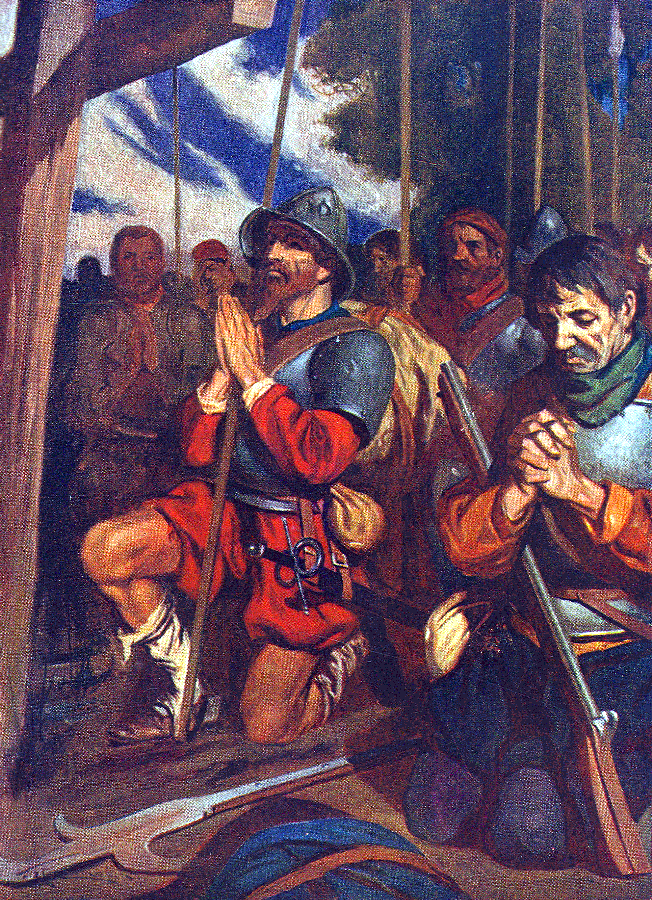 THE WHOLE ARMY KNELT IN THE MUD AND CONFESSED THEIR SINS. |
While his enemies were making this rapid march, Narvaez was wasting his time in idle ease. "Why are you so heedless? cried the old cacique of Cempoalla. "Do you think Malintzin is so? I tell you when you least dream of it he will be upon you!" Roused at last, Narvaez set out and reached the raging river several hours earlier than his foes. The rain was lashing down, the trees groaning, and all nature seemed alive with storm, but of man there was no trace. The troops, unused to hardship, began to grumble. "Of what use is it to remain here fighting with the elements?" they cried. "There is no sign of an enemy, and how could one approach in such weather? Let us return to our camp and be fresh for action if Cortés should come in the morning. Narvaez, wishful himself to get back under shelter, consented, and leaving two sentinels behind, they returned to their quarters in the temple of Cempoalla. The artillery and cavalry were stationed in the square, the infantry in the three teocallis. On the summit of the highest Narvaez took up his own position, and then with his mind quite at ease retired to sup and to sleep.
He had an enemy who took no sleep in time of danger. After a brief rest Cortés marshalled and harangued his men. In answer to his appeal every man cried out that he was ready to conquer or die. It was the eve of Whitsunday, and a surprise attack was planned for that very night. The watchword was to be Espiritu Santo. To Sandoval with sixty picked men was given the proud task of capturing Narvaez himself.
In the driving rain and darkness the Spaniards with the aid of their long pikes struggled through the wild waters of the river. Two unfortunates were swept away, the others gained the opposite bank in safety. Marching along a road nearly impassable with mud and brambles, the vanguard suddenly fell on their knees. They had come to a wayside cross erected months before on their march to Mexico. The whole army knelt in the mud and confessed their sins to the priest. On one side of the road a little clump of timber lay, and here the baggage was left, and the cavaliers tethered their horses.
In profound silence the soldiers marched on. The sentinels of Narvaez were surprised and one of them captured. The other fled to Cempoalla to give the alarm, but Narvaez and his sleepy followers actually refused to believe him. "You have been deceived by your fears," they exclaimed insultingly, "you have mistaken the noise of the storm and the waving of the bushes for the enemy, who are far enough on the other side of the river!" So they turned once more to slumber, the foe almost at their gates.
Unchallenged the attackers entered the city and passed silently through the sleeping streets. They were nearly at the temple ere the alarm was given. Then indeed the trumpets rang out, the soldiers seized their arms, and the gunners rushed to their guns. Too late, the enemy were upon them. "Espiritu Santo!" cried Cortés, hurling his company on the guns, and before the fury of the onslaught the gunners gave way and fled. Then Sandoval with his sixty followers forced his way up the stairway of the chief teocalli, and gaining the summit grappled with the commander and his guard. Right gallantly Narvaez fought, but a spear at last pierced his left eye, and he sank to the ground crying, "Santa Maria, aid me! I am slain!" With a supreme effort his men dragged him into the sanctuary on the summit, and there they made their last stand. In vain; Martin Lopez, the shipwright, a very tall man, set fire to the thatch of the roof, and those inside were forced to rush out into the midst of their foes.
"Victory! Victory for the Espiritu Santo! Long live our king and Cortés! Narvaez is dead!" shouted the victors, and at the cry the captains defending the other teocallis at once surrendered. As for the officer who had talked of broiling the ears of Cortés for his breakfast, he was seized with a sudden illness and could fight no more. The victory was won. A handful of men, without cannon or horses, had completely vanquished the strong force of Velasquez. Narvaez, not dead, but sore wounded, lay a helpless prisoner. The darkness and the storm had been the greatest aid to the attackers, and myriads of fire-flies had been mistaken by the sleepy garrison for an army with matchlocks. Very shame-faced were the soldiers of Narvaez when the morning dawned and they saw by how small a force they had been vanquished.
Surrounded by his captains, Cortés, a mantle of orange colour thrown over his shoulders, sat in state to receive the homage of his rival's officers and cavaliers. Willingly enough they came to kiss his hand, not sorry, perhaps, to change commanders. Narvaez and one or two of the really hostile men were led before him in chains.
"You have reason, Senor Cortés," said the humiliated general, "to thank Fortune for having given you the day so easily."
"I have much to be thankful for," replied Cortés, "but for my victory over you I deem it as one of the least of my achievements."
With fair words and many gifts the soldiers of Narvaez were conquered still more completely than by the blows of the night before. Indeed, the veteran adventurers grew jealous, and grumbled that the general had forsaken his friends for his foes. Alonzo de Avila, an imperious and turbulent captain whom Cortés could not bear to have near him, voiced their complaints. He was, however, a valuable and gallant soldier, and the general pacified him with many presents, but took care for the future to employ him on business of importance at a distance.
Soon vanished the discontent of the men, and dividing up his now large force, Cortés gave every soldier some definite work to do. Ordaz and Leon were each despatched with two hundred men to form new settlements, Lugo with another company was sent to the coast to dismantle the fleet.
But now came from Alvarado in Mexico news so threatening that the glory and joy of the recent victory seemed to disappear like the rays of the sun behind a lowering storm-cloud.
Mexico Roused at Last
The city of Mexico was roused at last! Her people were in arms against the insolent strangers. They had burnt the water-houses; they had attacked the Old Palace, undermined the defences, and killed and wounded many of the garrison. This was the alarming news which Cortés received in the hour of victory. "Hasten to our relief," wrote Alvarado, "if you would save us or keep your hold on the capital!"
Swift to answer the appeal, Cortés recalled his scattered troops, and with one thousand foot soldiers and nearly a hundred horsemen at once set out for Mexico. Only one hundred men, under an inferior officer, were left to garrison Villa Rica, for the general could not in such a crisis leave Sandoval behind. At Tlascala they were warmly welcomed, and their fighting force augmented by two thousand warriors.
Crossing the mountain barrier the veterans proudly pointed out to the men of Narvaez the lovely valley of Mexico, and described how its people would throng to welcome the wonderful white Teules. Down they marched into the glowing valley, but no crowds came forth to meet them, no flowers strewed their path. By the shores of the gleaming lakes they passed, but no canoes gave life and interest to the scene.
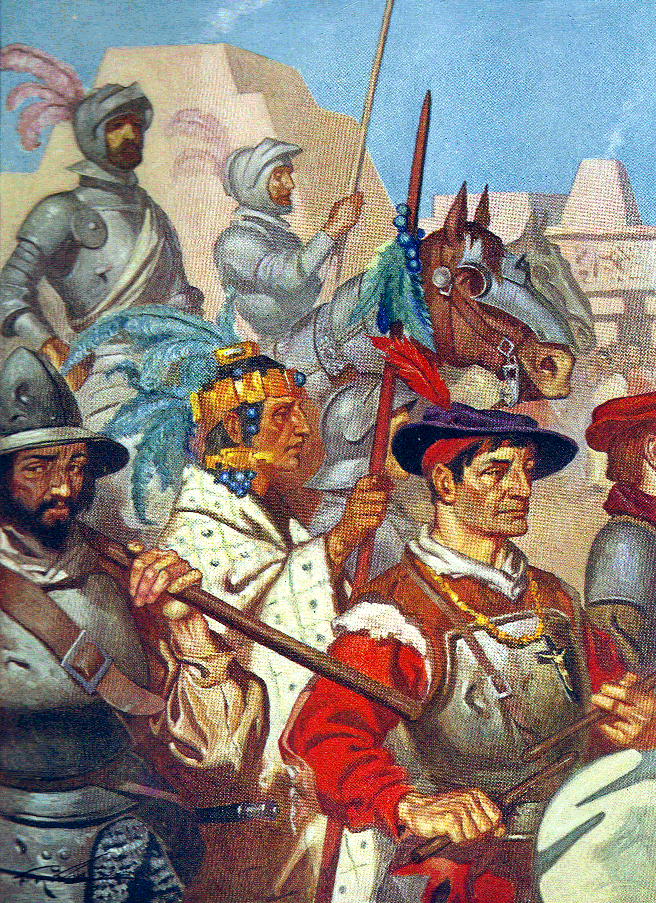 THE ARMY ENTERED MEXICO TO THE SOUND OF MARTIAL MUSIC. |
Early in the morning of the 24th of June, Cortés, at the head of his army, rode on to the great southern causeway. The sun shone brightly on the white-towered city with its smoke and temple-fires, on the glancing waters and on the marching army; but its radiant beams revealed no other sign of life. The lake was deserted. Presently, however, far in the distance a sentinel canoe was descried darting rapidly away. The ominous stillness, more appalling than the noise of battle, was broken only by the steady tramp of the soldiers. The men of Narvaez, looking fearfully around at every step, began to grumble. This was not the reception they had been promised.
Would the fort of Xoloc be barred against them? No, it too was deserted, and unopposed they marched to the walls of Mexico.
"Sound the trumpets!" cries Cortés, "that our comrades may know that rescue is at hand!"
To the sound of martial music they entered the city, and as they crossed the drawbridge they heard the guns of the garrison in answer. Alvarado was still holding out, and at the thought their drooping courage revived.
All was silence in the city, no living thing crossed their path as they marched through the empty streets. At every canal they found a broken bridge, but the tamanes were able to replace the timber, which still lay on the banks. What a trap was this island city! The canals were too wide for a horse to jump, and too deep for an armed man to wade; and the vessels built with such care by Martin Lopez had been destroyed! Gloomy and anxious were the faces of both captains and men as they reached the Old Palace. But wide open were the gates flung, and out rushed their comrades with tumultuous welcome, while the trumpets and guns echoed through the silent city.
The cause of the sudden revolt and open hostility of the Aztecs was the first inquiry of Cortés. He found that Alvarado, the beloved Tonatiuh of the Indians, had himself provoked it by the most wanton cruelty. On a certain date in May a festival in honour of Huitzilopotchli was always held in the great temple. As Alvarado was governing Mexico in the name of Montezuma the caciques had requested his permission for the use of the temple. Consent was given on condition that the Aztecs came unarmed and offered up no human sacrifice. Vague rumours came to the ears of the Spaniards that the caciques intended to take advantage of the gathering to rouse the people to insurrection. Without waiting to prove the truth of this story, Alvarado, mindful perhaps of Cholula, resolved to intimidate the Aztecs by a most terrible blow.
On the appointed day six hundred caciques in gorgeous garments bedecked with gold and jewels assembled in the great temple. The Spaniards joined the throng, the music rang out, and the gay whirling dance began. Suddenly at a signal from Alvarado the mailed soldiers rushed with drawn swords on the unarmed and unsuspecting chiefs. To fight was impossible, to escape hopeless. The poor wretches who tried to scale the serpent-wall were shot or cut down. "The pavement ran with streams of blood," says an old chronicler, "like water in a heavy shower." The carnage did not cease till every Aztec lay dead. Then the Spaniards rifled the bodies of the gold and ornaments and returned to their quarters. The victims were all nobles of high rank, and the dastardly deed roused the city to indignation unspeakable. "Vengeance!" was the cry on every lip, and hardly had the murderers returned to the Old Palace ere it was assaulted with such fury that it might even have been stormed had not Montezuma appeared on the battlements and besought his people to depart. Sullenly they obeyed, resolving to blockade if they might not attack.
With a dark and angry face Cortés listened to the story. Then in a tone of repressed fury and bitter disdain he said to Alvarado, "You have been false to your trust. Your conduct has been that of a madman!"
At this moment Montezuma entered the courtyard borne in his palanquin, clad in his royal robes and surrounded by his family and attendants. As Cortés looked from the splendour of the procession to his own ragged, hungry soldiers his heart grew harder and more bitter. "I salute you, O Malinche, and welcome your return," said the emperor, and Marina in her sweet, clear voice translated the courteous words. Fixing the emperor with a cold stare, the general turned away without a word of greeting in reply.
Montezuma, who had restrained the violence of his subjects, and had shared his own provisions with the garrison, was cut to the heart at the deliberate insult. Returning to his apartments he sent to request an interview.
But Cortés, whose temper seems for once to have completely given way, exclaimed angrily, "What have I to do with this dog of a king who suffers us to starve before his eyes?" Leon, Olid, and Lugo hastily interposed, begging the general to be more considerate to the emperor, whose kindness and generosity had never wavered. The implied censure seemed to irritate Cortés the more.
"What compliment am I under to a dog who leaves us to die of famine?" he exclaimed. Then turning to the Aztecs he said sternly, "Go, tell your master and his people to open the markets, or we will do it for them at their cost! Begone!"
A reply soon came from the emperor. "My people," he said, "are ready to attack Malinche and his followers. Cuitlahuac, my brother, the lord of Iztapalapan, whom he holds a prisoner, is the only man I can depend on to keep the peace and open the markets." So Cortés, in sore need of provisions, set free Cuitlahuac, who had been imprisoned with Cacama, king of Tezcuco. But the lord of Iztapalapan, brave and patriotic, far from calming the Aztecs, became their leader against the Spaniards, and returned no more to the Old Palace. Cortés, meanwhile, not realising the imminence of the danger, despatched a solitary messenger to Villa Rica to tell of his safe arrival.
And now from every side, by the causeways, by the lake, up the canals, up the streets, came pouring into Mexico all the tribes summoned by Cuitlahuac and Guatemozin, nephew of Montezuma and bravest of Aztecs. Louder and nearer each minute grew the distant thunder of the mingled war-cries, and as the Spanish captains mounted the palace roof an appalling sight met their startled eyes. The whole valley seemed dark with warriors!
A white man came staggering down the street bearing no lance, but many wounds, and shouting as he ran. It was the messenger to Villa Rica, and as his comrades dragged him in through the gates flung open to receive him, he cried, "The city is all in arms! The drawbridges are up, and the enemy will soon be upon us!"
The noise of the advancing multitudes grew into deafening uproar as they swept into the streets surrounding the Old Palace. Yelling their war-cries, with their banners tossing above them, and in their midst frenzied priests clashing cymbals and leaping in fierce exaltation, they advanced at a run. Suddenly from behind the parapets on all the flat house-tops around sprang up myriads of warriors, who swarmed also on the terraces of the teocallis in the great temple. The Old Palace was but one story high, except in the centre, where another had been added, and was much lower therefore than the surrounding buildings, which offered a strong vantage-point to the Aztecs.
At the first alarm every Spaniard had rushed to his post. Aghast as they were at the great array which seemed to have appeared as if by magic against them, there was no panic or confusion, so marvellous was their discipline. Here and there through the walls which surrounded the Old Palace they had pierced holes for the guns, and the gunners but waited the word of command.
Three times did the drum of serpent skins boom forth from the great teocalli, and at the last stroke the Aztecs rushed forward raining their missiles thick and fast into the palace courtyard. With their guns the Spaniards answered, and terrible was the effect on an enemy whose dense ranks were so easy a mark that "the gunners loaded and fired with hardly the trouble of pointing their pieces." But nothing could daunt the spirit of the Aztecs. Those behind pressed forward to take the place of the slain, and scaling the wall fought hand to hand. At Guatemozin's command balls of burning cotton were shot into the enclosure, and though the palace was of stone the huts of the Tlascalans were of reeds and wood and speedily caught fire. The Spaniards had no water to spare, and they were obliged to pull down part of the walls ere they could stay the flames. Over the breach the Aztecs rushed, only to be driven back by the heavy guns.
When night fell the natives withdrew to collect their dead and wounded, and the garrison, thankful for the respite, repaired the defences. At daybreak, just as the Aztecs prepared to renew the assault, the guns thundered forth, mowing down their foremost ranks, and then out of the gates dashed Cortés and his cavalry, followed by the infantry and Tlascalans. So headlong was the charge that the Spaniards, scattering all before them, rode unopposed down the wide street. But soon a barricade barred the way, and while they waited for the guns to come up and clear the road, missiles were showered from the roofs on either side, and the Aztecs falling on the rear did deadly work among the Tlascalans.
The way was cleared, but at every bridge the struggle was renewed, and the Spaniards, though victorious at all points, suffered severely. At last Cortés sounded a retreat, darkness was falling, and his men were weary with the fight. Several hundred of the citadel houses had been burnt down, but the way back seemed even more difficult than the advance. "The Mexicans fought with such ferocity," says Bernal Diaz, "that if we had had the assistance that day of ten thousand Hectors, we could not have beaten them off! Some of our soldiers who had been in Italy swore that neither among Christians nor Turks, nor the artillery of the king of France, had they ever seen such desperation as was shown by these Indians." Cortés himself fought like a hero, rescuing single-handed one of his cavaliers who had been unhorsed and almost overwhelmed by the foe. Not until the gates of the Old Palace clanged behind them did they feel themselves in safety.
All night long the Aztecs encamped around the Spanish quarters, and though they did not continue the fight their warlike yells showed they were far from subdued in spirit. "The gods have delivered you at last into our hands!" they cried, "Huitzilopotchli has long wanted his victims. The stone of sacrifice is ready! The knives are sharpened! The wild beasts in the palace are roaring for their offal, and the cages are waiting for the Tlascalans, false sons of Anahuac, who are to be fattened for the festival!" Even the stout-hearted Spanish veterans shuddered as they heard the savage threats and thought of what the morrow might bring forth.
The Death of Montezuma
True to their threats, the Aztecs renewed the assault early next morning, and Cortés soon realised that his men, few in number as compared with the enemy, could not long stand the strain of such fighting. He felt that their only hope lay in the emperor, who must be induced to appease his subjects once more by promising that the Spaniards would, if permitted, immediately leave the city.
"That have I to do with Malintzin?" exclaimed Montezuma bitterly, "I do not wish to hear from him. I desire only to die!" At last, however, Father Olmedo won his reluctant consent. "I will speak to my people," he said, "but it will be useless. They will neither believe me nor the false promises of Malintzin. You will never leave these walls alive."
So the emperor of the Aztecs, preceded by the golden wand of empire, but surrounded by a Spanish guard, mounted the palace roof to speak for the last time to his faithful people. He was arrayed in his royal robes, and on his weary brow rested the gorgeous crown of Mexico. A sudden silence fell on the battling multitudes below as they gazed on the monarch they had so long revered.
For a moment Montezuma was speechless with emotion, then, in a tone of kingly dignity, he said: "Why are you here in arms against the palace of my fathers? Is it that you think your sovereign a prisoner? If so, you have acted rightly. But you are mistaken. The strangers are my guests. I remain with them only from choice, and can leave them when I list. Have you come to drive them from the city? They will depart of their own accord if you will open a way for them. Return to your homes, lay down your arms, and the white men shall go back to their own land, and all shall be well again within the walls of Tenochtitlan."
But when the people heard their emperor declare that the ruthless invaders of their city were his guests and friends, a frenzy of patriotic wrath swept through the multitude. "Base Aztec!" they cried, "coward! woman! fit only to weave and spin!" and, before the Spaniards could shield him, Montezuma was struck senseless to the ground by a shower of stones and arrows. A sudden horror at their own deed instantly smote the Aztecs, who scattered in every direction with groans of bitter mourning, leaving the great square silent and deserted. The emperor, restored to consciousness, lay speechless in his apartments, refusing steadfastly to eat, and when his attendants strove to heal his wounds he tore away the bandages. His one longing was for death.
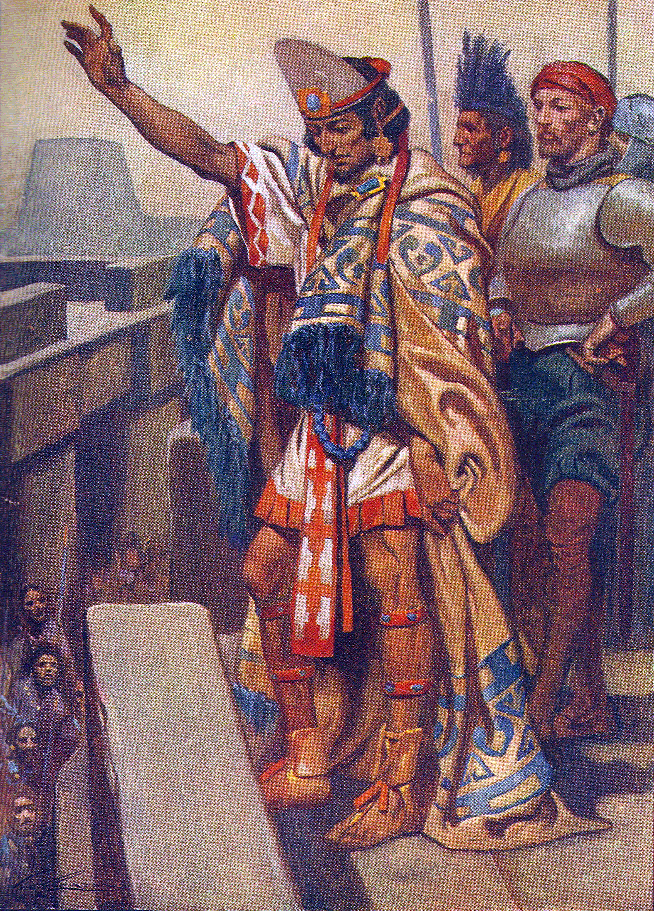 "RETURN TO YOUR HOMES. LAY DOWN YOUR ARMS." |
The Aztec warriors soon rushed back to their posts, thirsting for vengeance. The great teocalli of Huitzilopotchli, nearly a hundred and fifty feet high, afforded so strong a vantage-point, that Cortés saw that at all costs he must dislodge the band of caciques who from its terraces and summit deluged the Old Palace with blinding missiles. Three attempts had the Spanish captains made in vain, and now the general, though wounded, resolved to capture the tower himself. Fastening a spear to his left arm, which was disabled, with three hundred of his bravest followers and several thousand Tlascalans, he charged the gateway of the serpent wall and galloped into the great courtyard. Leaving the gunners, bowmen, and Tlascalans to hold the square, which was soon won, Cortés and his cavaliers sprang up the stairway of the great teocalli. Desperate was the ascent, and many a good soldier was hurled to the bottom by the storm of javelins, spears, and stones from the terraces above. For nearly a mile round the four platforms and up the five stairways the Spaniards fought their way, aided by the gunners and bowmen in the courtyard, who picked off the dusky warriors above.
At last the summit was gained, and there was waged so wild and fierce a battle that the troops in the city below ceased their warfare to gaze fascinated at this conflict in mid-air. No wall or parapet protected the edge, smooth and slippery was the stone pavement, and sometimes two wrestling figures locked together in furious struggle rolled headlong over the dizzy brink. For three long hours did the fight endure, but one after another the caciques and priests fell before the keen Castilian swords. At the shrine of Huitzilopotchli the survivors took their last stand, and on them rushed the mailed strangers with their glittering steel, Cortés, as usual, to the fore. Suddenly two caciques, unarmed, flung themselves on the Spanish general, dragged him by main force to the edge of the summit, resolved to leap into death with their country's foe! But at the brink one of them stumbled, and Cortés, tearing himself away, escaped the horrible fate. At length the battle was ended. Every Aztec was slain, and forty-five of the most gallant cavaliers had perished also, while each man bore gaping wounds. "Here Cortés showed himself," said Bernal Diaz, "the man that he really was!"
The first act of the conquerors was to enter the two sanctuaries. They found, to their wrath, that the image of the Virgin Mary had been removed, but the horrible Huitzilopotchli still stood in his niche, before him his censer of smoking hearts, torn perhaps from Christian victims! Out of the chapel, across the broad summit and over the brink of the precipice the vengeful victors hurled the mighty god, while the crowds below gazed in frozen horror. Then setting fire to the sanctuary itself, they returned, unopposed, to their own quarters. And the flames, rising like banners in the sky, announced to the people in all the fair valley of Mexico that their religion was tottering to its fall.
That very night the tireless general made a sortie, and the flames of three hundred burning houses lit up the grim strangers at their work of destruction. Surely now, thought Cortés, he had proved himself master, and broken the spirit of the enemy. Requesting a parley, he mounted the roof of the Old Palace with Marina by his side.
"You have seen your gods trampled in the dust, and your warriors falling on all sides," he called to the listening Aztecs. "If you will lay down your arms and return once more to your obedience, I will yet stay my hand. But if you do not, I will make your city a heap of ruins, and leave not a soul alive!"
The Spaniard did not yet understand the spirit of his foes. Defiantly they answered—
"You have destroyed our temples and massacred our warriors. Many more, doubtless, will fall under your terrible swords. But we are content if for every thousand Mexicans we can shed the blood of a single white man! Look out on our terraces and streets, see them still thronged with warriors as far as your eye can reach! Our numbers are scarcely lessened while yours are diminishing every hour. You are perishing from hunger and sickness. Your provisions and water are failing, and you must soon fall into our hands. The bridges are broken down and you cannot escape! There will be too few of you left to glut the vengeance of our gods!"
The words were but too true, and the hearts of the bravest veterans sank, while as for the soldiers of Narvaez, they showered maledictions upon Cortés, who had led them with his specious promises into such a death-trap. Retreat was the only possible course, and anxiously the general considered when and by what way it could most safely be effected. He decided that the western causeway leading to Tacuba would be safer, because shorter, than the great southern dyke. But before beginning the perilous retreat he resolved to make a sortie to clear the road and build up the broken bridges.
Early the next morning the palace gate opened, and out dashed the cavaliers, scattering the dense ranks of the enemy. Behind came the Tlascalans dragging along with ropes three strange-looking machines. The Aztecs gazed with fear and curiosity. The monsters seemed to be square towers, two stories high, and they rolled heavily along on wheels. Suddenly from each of the machines doors dropped down, the muzzles of guns appeared, and both house-tops and street were swept with a withering fire. Then from the upper story ladders were flung out on to the roofs of the houses, and armed Spaniards springing across grappled with the astonished Aztec warriors, set fire to the buildings, and replacing the ladder returned to their tower of defence.
Down the long street went these mantas, leaving behind them a burning track. They were protected by a vanguard of cavalry and a rearguard of infantry, and in vain did Guatemozin strive to stop their progress. But at last they came to a palace so high that from its commanding roof the Aztecs could hurl with ease their clouds of missiles. Crash after crash struck the mantas, until at last they fell to pieces, and many of the men within were crushed to death.
Abandoning the ruined machines, the Spaniards now found the way barred by a canal, and fierce was the fight ere they were able to restore the broken bridge. Seven canals cut the street to Tacuba, and at each there was the same hard struggle. Very weary were the men whom Cortés led back at night to the Old Palace, but early next morning they were perforce once again in the saddle, and before the day closed a way had been rebuilt over each canal. Strong companies of infantry under Alvarado were stationed at each bridge.
To the general there now came a message that the Aztecs wished to confer with him in his quarters at the Old Palace. With thankful heart, hoping that their spirit at last was broken, Cortés rode hastily back, and at once consented to the Mexican proposal that two priests captured in the teocalli should be released to bear his terms. One of these priests was the teoteuctli, or high priest of Mexico, a mighty power among the Aztecs. Forth they went from the enemy's quarters to the wild welcome which awaited them in the city. But on no errand of peace were they bound, and no intention had they of ever returning to the Old Palace. The request for a conference had been but a ruse.
Cortés and some of his officers, very tired with the long day's fight, were hurriedly eating a much-needed meal, and debating as to the result of their offers of peace, when a frantic message came that the detachments under Alvarado had been overpowered at three of the bridges. Flinging themselves into the saddle, Cortés and his cavaliers rode at once to the rescue. "Christo y Santiago!" rang out the battle-cry, and Alvarado and his men rallied once more. Each bridge was regained, but as the general rode back victorious down the long street he found to his dismay that the enemy had actually fallen with renewed ferocity on the infantry guarding the chief bridge, which they had again destroyed.
Once more a desperate struggle, while the Spaniards strove to repair the bridge and make good their retreat. Right gallantly did the cavaliers cover the infantry at their work, and never did Cortés himself fight more recklessly. Until the last man had crossed he held the foe at bay, and then, as some of the planks had given way, he leaped his horse across a gulf six feet in width. His escape was looked on by the old Spanish chroniclers as a miracle, and they record that the holy Virgin, robed in white, was seen at his side throwing dust into the eyes of the Aztecs.
As the darkness fell the Indians scattered, and the Spaniards were left to retrace their steps unmolested to their quarters. More dejected, battered, and worn they were after their victory than after many a more doubtful fray, and bad news awaited the general's return. The Aztec emperor lay at the point of death, and had asked for Malinche.
During these two days of battle Montezuma, refusing all food and all remedies, had been slowly dying on his couch in the Old Palace. As Cortés clanked in his armour into the death-chamber, he saw Father Olmedo holding the ivory crucifix before the emperor's dying eyes, and beseeching him to find everlasting happiness while there was still time. But true to his own religion, the Aztec replied, "I have but a few moments to live, and will not at this hour desert the faith of my fathers."
Turning eagerly to Cortés, he committed to his care "my most precious jewels, my children." He begged Malinche to request his master, the monarch of Spain, to see that if their country fell they should yet not be left destitute, but given some portion of their rightful inheritance. "Your lord will do this," he said, "if it were only for the friendly offices I have rendered the Spaniards, and for the love I have shown them—though it has brought me to this condition!" According to the conquerors, from whom alone we have the story of Montezuma's death, he added, "But for this I bear them no ill-will." It is hard to believe that their report was absolutely true!
So on the 30th of June 1520 the great Montezuma died in the quarters of the white strangers, who had sailed to his shores from the land of the rising sun, bringing with them fire and sword and ruin to all that he held most dear.
Eighteen years had he ruled as emperor of Anahuac, yet he was but forty-one, in the prime of life, when he met his miserable end. "Thus," says a native historian, "died the unfortunate Montezuma, who had swayed the sceptre with such consummate policy and wisdom, and who was held in greater reverence and awe than any other prince of his lineage, or any, indeed, that ever sat on a throne in this western world. With him may be said to have terminated the royal line of the Aztecs, and the glory to have passed away from the empire, which under him had reached the zenith of its prosperity!"
In simpler language old Bernal Diaz, who had known and loved the munificent, gentle-mannered Aztec, tells of his death. "The tidings were received with real grief," he says, "by every cavalier and soldier who had known him, as if he had been our father—and no wonder, seeing how good he was!"
Early in the morning the body of the emperor, arrayed in his robes of state, was borne by six Aztec nobles, through the gates of the Old Palace, to his people in the city.
La Noche Triste
Montezuma, so often a shield to the Spaniards, was dead, and now their one thought was how most quickly to escape from his city. Should the retreat be attempted by night or by day?
There was among the common soldiers a man named Botello "who spoke Latin, had been at Rome, and was said to be a necromancer; while some declared he had a familiar, and others called him an astrologer." This man predicted that if Cortés did not attempt the retreat the last night of the month of June, not a Spaniard would be left alive. If that night was chosen the flight would be successful, though Botello himself would perish. So much influence had the astrologer on his comrades, that Cortés decided to please his men and leave the city that very night.
The question of what to do with the sick and wounded troubled the general. They were far too numerous to be all carried away, and Cortés reluctantly declared that the three hundred wounded Tlascalans must be left behind. As to the Spaniards, those who could not possibly march should be borne in litters. A few hours later Father Olmedo came to the general with a brave story of Indian resolution and heroism. He had seen the Tlascalan caciques go to their wounded warriors. He had seen each stricken man bare his breast with smiles of heroic joy to receive his death-blow from the javelin of his chief, resolved to save the honour of his race. When the Aztecs entered the deserted palace they would find no victims for their gods. Only the dead would await them!
The preparations for retreat went rapidly forward. Martin Lopez, the carpenter, was ordered to construct a portable bridge of very strong timber, to be thrown over the canals where the enemy had broken down the bridges. With great care Cortés arranged for the transport of the treasure belonging to the Crown, entrusting it to a strong Castilian guard, under Alonzo de Avila, one of the royal officers. Much booty had, perforce, to be left behind, and greedily the soldiers eyed the glittering heaps. "Take what you will of it," said the general; "better you should have it than these Mexican hounds. But be careful not to over-load yourselves. He travels safest in the dark night who travels lightest." The veterans listened to the warning, but the soldiers of Narvaez eagerly seized loads of gold and great bars of silver.
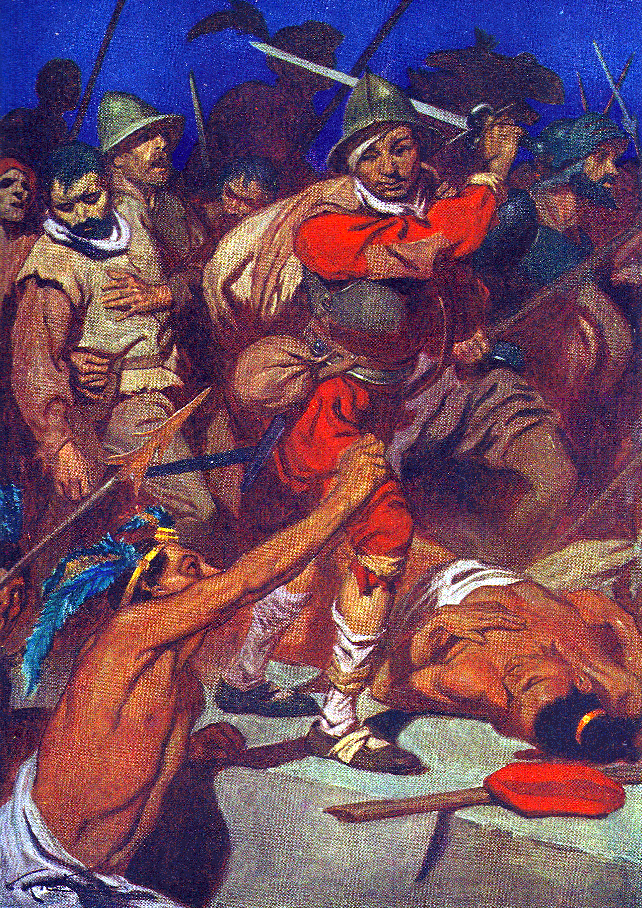 ALL SENSE OF ORDER AND DISCIPLINE WAS LOST. |
At last the darkness fell. Wild and stormy was the night, and the fugitives shivered as they peered fearfully into the icy gloom without the palace walls. At midnight all was ready, and Cortés rode to the gateway to see his army pass forth. Two hundred infantry formed the vanguard under the command of Sandoval, supported by Ordaz, Lugo, and twenty cavaliers. Then came a large band of Tlascalans bearing the portable bridge. They were escorted by the captain Magarino and forty picked Spaniards, who had all sworn to defend to the death their charge on which so much depended. In the centre, protected by a strong guard, under the command of the general himself, came the baggage, the artillery, the wounded, the prisoners, and the women. Marina and Montezuma's daughters were carried in curtained palanquins. The rearguard, consisting chiefly of the infantry of Narvaez, was commanded by Alvarado and Leon. In silence they all filed past, and then Cortés, with one last look of bitter regret at the palace where he had lorded it as ruler of an empire, galloped out into the night after his devoted army.
Through the silent city they hurried, starting at every sound, for might not the enemy spring up at any moment from the dark alleys on either side? And how could they fight entrapped in the street, and burdened with wounded and baggage? But only the tramp of the horses, the rumble of the carriages, and the driving rain and wind broke the stillness of the night.
With a sigh of relief and a prayer of thanksgiving, Sandoval passed with the vanguard out from the cramping street on to the open causeway, which was broken by three canals. At the first gaping chasm they waited for Magarino and his bridge.
Suddenly a loud shrill sound pealed forth, and the hearts of the fugitives stood still. As they listened with strained white faces, another blast rang out and yet another, until from every quarter of the city the warning note seemed to echo. Then boomed forth the blood-curdling drum of Huitzilopotchli, crying for vengeance on the impious strangers. The Aztecs were awake!
Hastily the bridge was laid down, but even as the vanguard marched across they heard the sound as of the gathering of a mighty multitude, and the report of a gun in the city behind told them that their comrades had been already attacked. Louder and nearer grew the distant sounds, and just as Cortés, with his company and the baggage, reached the bridge, out of the dark water, on either side, sprang up a fleet of canoes filled with white-clothed warriors. So furious was the storm of missiles that the infantry, panic-stricken, pressed wildly on the cavaliers, who were thus driven across the bridge. Cortés attempted in vain to make a stand. The horsemen, riding down their assailants, swept by, and after them struggled the infantry with the baggage. Every moment added to the multitude of canoes and increased the carnage. All sense of discipline was lost, and each man fought and prayed for himself, straining forward over friend and foe. For a time Cortés stayed his horse by the bridge, but at last he too was swept onward. Those who could, struggled madly after the general's flying horse, but the sick and the wounded, the women and the prisoners, were all slain. There fell Cacama, the heroic young king of Tezcuco, and the two princesses, the fair daughters of Montezuma. Marina, rescued and borne to the vanguard by some Tlascalans, was fortunately saved.
Meanwhile the rearguard, under Alvarado and Leon, were still in the city where Guatemozin in person led the Aztecs. To this gallant young prince had been given the chief command by his uncle, Cuitlahuac, who had been elected king at the death of Montezuma. Desperate was the fight and great was the havoc wrought by the guns, but at last the gunners were slain, and the fiery monsters captured by the exultant foe. Leon then, valiant both on horseback and foot, ever ready to bear the brunt of battle, made a last heroic stand, and the pile of Aztec dead that rose around him and his brave followers bore witness to the desperation with which they sold their lives.
All this time Magarino with his faithful band of Spaniards and Tlascalans had been defending the bridge for his comrades. At last up galloped Alvarado with but a remnant of his men. Carving their way across, they shouted to Magarino that they alone survived of all the rearguard. It was time to raise the bridge and carry it forward to the next canal. But it had been wedged so firmly into the soft banks by the weight of men, horses, and gun carriages, that the utmost efforts to move it were of no avail. Yet Magarino, with despair in his heart, laboured on amidst a terrible storm of missiles. The safety of the whole army depended on him, for how could they escape without the bridge? Closer and closer pressed the Aztecs, ghost-like in their white tunics, and one by one Spaniard and Tlascalan dropped dead at their captain's side. Magarino, left almost alone at his post, gave up the work at last, and with a despairing cry, "Todo es perdido! All is lost! Save yourselves!" fought his way with his few surviving followers across the fateful bridge.
Long before this Sandoval and the vanguard had reached the second canal, where they waited impatiently for the coming of the bridge. Here, too, the waters were covered with the canoes of the Aztecs, who sprang on to the causeway to grapple with their foes. "Santiago!" cried the captain to his men, "stand firm. We must hold the canal for Magarino." But, goaded by the fierce attack, the infantry forced the horsemen to the brink of the yawning gulf, and Sandoval, calling to his cavaliers to follow, dashed into the water and swam his horse across. The infantry were left a writhing, leaderless mass on the other side. Would Magarino never come? Many of the men in despair hurled themselves into the canal, but few reached the bank. Weighed down by armour, they sank beneath the dark waters, or were dragged on board the canoes—victims for the gods!
Cortés, riding up with his guard of horsemen, beheld a scene of hopeless confusion. Not even his presence could restore order now. Swimming his horse across, he strove with his fearless cavaliers to hold the canal until the coming of the bridge. At his side fell his favourite page, but still the general held to his post, praying that Magarino might hasten.
And now the cry arose, "Todo es perdido! The bridge cannot be raised! Magarino will not come!" All chance of escape seemed to vanish, and wilder than ever grew the panic. In front was the bridgeless canal, behind and on either side the foe. Instinct drove the despairing soldiers blindly forward, and those in front were flung into the gulf by the mad rush behind. Cortés, as he saw the struggling men and horses drowning in the swirling waters, or finding a rescue worse than death in the Aztec canoes, turned his horse at last and galloped after the van-guard with the bitter cry, "Todo es perdido!" The canal was soon filled with baggage and the bodies of men and horses, and over this ghastly bridge clambered those who came last.
The general, galloping on, found the vanguard halting before the third canal. Here the attack was not nearly so fierce, for the mass of the enemy was behind. The cavaliers calling to the foot soldiers to follow, made the plunge and swam across, and though many were drowned, most of the company reached the bank in safety. Riding to the end of the causeway, Cortés led his miserable little band on to the mainland.
At this moment a rumour came that some of the rearguard still survived, but that they would all be lost unless rescued. Careless of danger, Cortés, Sandoval, Olid, De Morla, and other brave cavaliers turned their horses back along the causeway. "Santiago! Santiago! To the rescue!" they cried; and Alvarado, on foot and wounded, but defending himself at the last canal against a host of assailants, was right glad to hear the battle-cry. His beloved mare Bradamante, whom he always called his sweet-heart, had been killed under him, and all his followers had fallen save seven Spaniards and a few Tlascalans. Several times the Aztecs could have slain the hated Tonatiuh, but they had sworn to carry him off for sacrifice.
Cortés and his cavaliers diverted the attack, though De Morla paid the forfeit with his life. Alvarado, breaking through his foes, stood for an instant alone on the brink of the canal. Flinging away his shield and sword, and planting his long lance on the wreckage at the bottom of the water, he leapt into the air, cleared the wide gulf, and stood safe among his comrades, while Spaniard and Aztec alike gazed in wonder at the mighty feat. "This is truly the Tonatiuh—the child of the Sun!" exclaimed the Indians in awestruck tones, and to this very day they call the place "Alvarado's Leap." Mounting behind Cortés, the hero rode with his rescuers safely to the mainland. Weary perhaps with slaughter, or eager for the spoil scattered along the causeway, the Aztecs did not long pursue the wretched remnant of the once dreaded strangers.
On the steps of an Indian temple not far from the lake, Cortés sat down in the dismal dawn to count his losses by the number of the living. Chilled and wounded, with ragged, blood-stained clothes and broken armour, the men passed slowly by. The artillery and baggage were lost, most of the horses had been killed, and not a single musket remained. As the general looked in vain for Velasquez de Leon, Francisco de Morla, and many another trusted comrade, he could not restrain the tears of bitter regret. Most of the soldiers of Narvaez, overloaded with treasure, had perished, and Botello the astrologer was, as he himself had predicted, among the slain. Over four hundred Spaniards and four thousand Tlascalans, at least, must have fallen on that terrible night, ever afterwards called La Noche Triste.
Wearily they tramped through the city of Tacuba towards the open country—their only refuge. At a hill crowned with a stone temple, a good stronghold in which to encamp, they halted. But it was held by some Aztec warriors, and the jaded Spaniards declared at first that they could fight no more. Urging them on with his wonderful power of persuasion, Codes charged up the hill, and easily took possession of the temple. Deeply thankful were the fugitives to find at last shelter and rest. Drying their sodden garments at glowing fires, they dressed their wounds, cooked their much-needed food, and then threw themselves down to forget their miseries in sleep.
So ended one of the most disastrous retreats which history records.
Recovery
Only one day did the Spaniards rest in the temple on the hill, which lay too near to Mexico for safety. At midnight they set out once more, leaving their fires burning to deceive the enemy. Through the darkness they travelled safely, bearing the sick and wounded in the centre of the company, but when daylight came bands of Indians were seen gathering on the hills.
With stones and darts and arrows these skirmishers, who were not Aztec warriors, but natives of the valley, harassed the retreating Teules, not venturing, however, to attack them at close range. At night the little army encamped in the wayside villages, which they found always deserted and destitute of food. Even in the cornfields nothing had been left but stalks, and the fugitives soon began to suffer terribly from hunger. They lived chiefly on the wild cherry, and once when a horse had to be killed Cortés himself describes how appetising seemed its flesh, and in fact even its hide!
Some of the soldiers dropped dead on the road-side; others, too weak to keep up, fell behind and were captured by the enemy; others, again, searching for cherries, strayed from the ranks and met with the same evil fate. A few of the Spaniards who had actually carried treasure safely through la Noche Triste were now compelled to fling it away.
"The devil take your gold," said Cortés to one of these men, "if it is to cost you your life!" The general, though wounded, shared the scanty fare of his men, and was ever at hand to cheer on the weak and fainting. "There was no people," says an old chronicler, "so capable of supporting hunger as the Spaniards, and none were ever more severely tried than the soldiers of Cortés." He might have added that the Tlascalans showed equal courage and endurance.
On the sixth day of the march the Indians on the hill-sides shouted in triumph, "Hasten on! You will soon find yourselves where you cannot escape!" Too soon did the Spaniards learn the meaning of the grim words.
They had taken the longer route to Tlascala skirting the northern lakes, and they came now in view of the ever silent Micoatl, the "Pathway of the Dead." Here stood the giant pyramids built by that mysterious people who dwelt in the land of Anahuac long ages before the Aztecs left their ancient home in the north. Here, too, lay a buried city, Tiotihuacan, the "Habitation of the Gods." The Aztecs declared that the largest pyramid was sacred to the sun, the lesser to the moon, while the smaller mounds had been dedicated to the stars. They said that on the Pyramid of the Sun had stood in old time a mighty statue made of one solid block of stone facing the east, with a burnished shield on which fell each morning the first ray of the rising god.
But the Spaniards, famished, weary, and anxious, cast no glance of wonder at these monuments of the past. When they reached the summit of the mountain road, and looked down on the valley of Otumba below, a sight arrested their eyes more stupendous to them at that moment than the greatest and hoariest of ruins. Glittering in war-like array, a mighty host stretched over the valley as far as the eye could see. "Neither in front, nor in the rear, nor on the flanks," declared Cortés, "could any part of the plain be seen which was not covered by the Indians."
Well might Spaniard and Tlascalan tremble at the sight, and even the general, as he formed his men for the coming battle, felt that hardly by a miracle could they win through so vast an opposing force. He had only twenty horses, but fortunately they were fairly fresh, as he had not allowed the wounded soldiers for two days past to mount behind the cavaliers. As he glanced at the set faces of his men, pale beneath their bronze, he realised that there was no need to urge them onwards. Each man knew that to retreat was hopeless. They must fight, or perish like slaves on the block of sacrifice.
In dogged despair they marched down to meet the foe, resolved at the worst to sell their lives dearly. "Oh, what it was to see this tremendous battle!" cries Bernal Diaz; "how we closed foot to foot, and with what fury the dogs fought us! such wounding as there was amongst us with their lances and clubs and two-handed swords, while our cavalry, favoured by the plain ground, bore down their opponents with couched lances, still fighting manfully, though they and their horses were all wounded; and we of the infantry, negligent of our hurts, redoubled our efforts to bear them down with our swords. . . . Then to hear the valiant Sandoval, how he encouraged us, crying out, 'Now, gentlemen, is the day of victory!' Yet in spite of their valour, complete destruction threatened the little band, who seemed like an island in the midst of a raging sea."
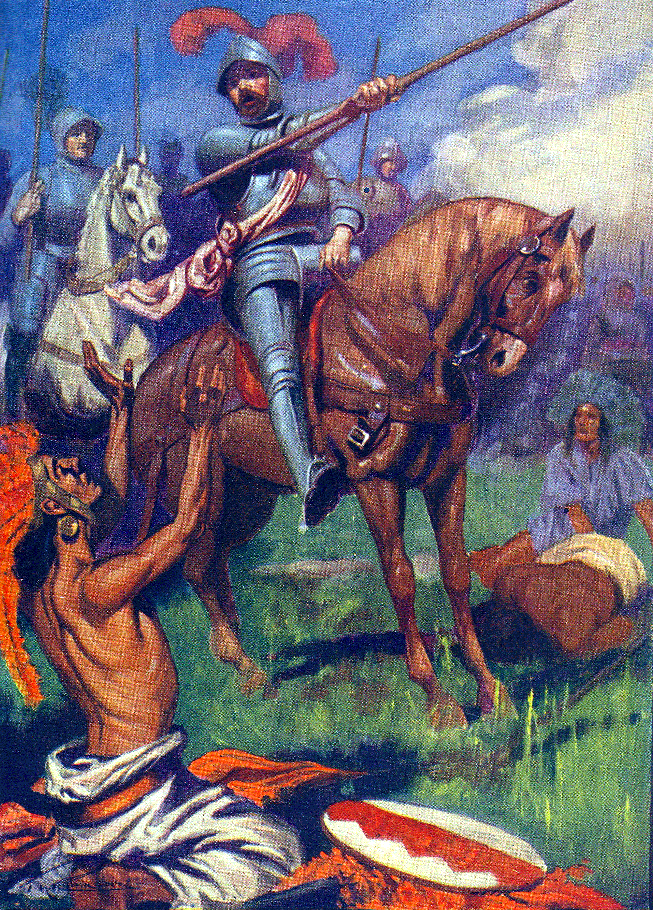 "THERE IS OUR MARK! FOLLOW AND SUPPORT ME!" |
Suddenly Cortés beheld but a little distance away the golden banner of the commander-in-chief, who was borne in a litter and surrounded by a guard of young caciques.
"Gentlemen!" he cried to Sandoval, Alvarado, Olid, Avila, and other cavaliers, "there is our mark! Follow and support me!"
"Christo y Santiago!" rang out the battle-cry, and by the very fury of their charge the cavaliers made a path to their goal. Flinging to right and left the guard of warriors, Cortés sprang on the litter and hurled the commander to the ground, where he was speedily despatched by a young cavalier, who offered to his heroic general the golden banner. The news of this miraculous deed and their commander's death spread such panic among the Aztecs that they immediately broke and fled, hotly pursued by Spaniards and Tlascalans, who, forgetting their hunger, thirst, fatigue, and wounds, thought only of victory and revenge.
So ended the glorious battle of Otumba, when the Spaniards and their allies, few in number, wounded, weary, famished, with but twenty horses, and without cannon or muskets, put to flight a mighty Indian army. They themselves believed that it was a miracle, for had not some of the soldiers seen St. Jago on his milk-white horse leading on the cavaliers?
An old chronicler attributes the victory, with more reason, entirely to the general, who "by his single arm saved the whole force from destruction." Cortés, unexpectedly modest about his own exploit, thus describes the battle in his letter to the Emperor Charles: "We went on fighting in that toilsome manner a great part of the day, until it pleased God that there was slain a person amongst the enemy who must have been the general, for with his death the battle altogether ceased."
The next morning the victors continued their march to Tlascala, and Spaniards and allies alike greeted the first sight of the mighty boundary wall with shouts of joy. But Cortés, remembering the story of death and disaster he was bringing to the little republic, wondered anxiously if the people would demand from the strangers the blood of their fallen countrymen. The Tlascalans, however, flocked to meet the army with all kindliness. For a day or two the soldiers rested in a frontier village, and then the great chiefs of the republic came to welcome them and invite them to the capital.
"Oh, Malinche, Malinche!" said Maxixca, the most ancient lord, "how it grieves us to hear of your misfortunes and of the multitude of our own men who have perished with yours! Have we not told you many times that you should not trust in these Aztecs? But now the thing is done, and nothing more remains at present but to rest and cure you. Wherefore we will go immediately to our city. We have made common cause together, and we have common injuries to avenge, and come weal or woe, be assured we will stand by you to the death!"
With these generous words the Tlascalans, carrying the sick and wounded in hammocks, led their allies to the capital, where they were received as honoured guests. But as they passed down the city streets, mingled with the shouts of welcome was the wailing of many a woman who looked in vain for the father, husband, or son who would return no more.
For many weeks the Spaniards rested in Tlascala, slowly recovering from their wounds. Cortés himself lay helpless for days in the palace of Maxixca with two wounds on his head and one in his left hand. But even in his fever and weakness he was making plans for retrieving his broken fortunes. His resolve remained unchanged—Mexico must be conquered. Terrible had been the loss, yet the ship-builder Martin Lopez, the interpreters Marina and Aquilar, and most of the captains were safe, and Cortés, as he weighed his chances of recovery, refused to give up hope.
When the soldiers found that the general had sent to Villa Rica for reinforcements, and realised that he was thinking of fresh battles rather than of retreat, they were filled with amazement and in many cases with consternation. His own men, indeed, were proud of his intrepid spirit, and had an almost child-like confidence in his skill and good fortune, but the soldiers of Narvaez were loud in their anger and discontent. The very thought of further warfare, with their crippled resources, seemed mere madness. They drew up and signed a written remonstrance, demanding to be led back to the coast immediately.
Not for a moment was Cortés moved by remonstrance or grumble. He was resolved, as he wrote to Charles V., "not to descend to the coast, but at all hazards to retrace his steps and beard the enemy again in his capital."
Calling his men together, he made a stirring appeal to their honour and their courage. "Will you leave your conquest, half-achieved, for others more daring and adventurous to finish?" he asked. "How can you, with any honour, desert your allies and leave them unprotected to the vengeance of the Aztecs? To retreat but a single step towards Villa Rica will proclaim our weakness. It will be easy now to retrieve our losses if you will have patience, and abide in this friendly land until the reinforcements, which will be ready to come in at my call, shall enable us to act on the offensive. If, however," he added with scorn, "there are any who prefer ease at home to the glory of this great achievement, I will not stand in their way. Let them go, in God's name! I shall feel stronger in the service of a few brave spirits, than if surrounded by a host of the false or the faint-hearted."
Fired as usual by their leader's words, his own veterans swore to stand by him to the last, while the soldiers of Narvaez, somewhat ashamed, promised to delay their departure for the present.
Just at this time there arrived at Tlascala six Aztec ambassadors sent by the emperor Cuitlahuac. They brought presents of cotton and salt, articles not found and therefore much valued in Tlascala. They came to proffer alliance and to beg the chiefs of the republic to sacrifice the white men—the common foes of the nations of Anahuac. If they harboured the strangers they would surely incur the wrath of the gods whose temples and altars the Spaniards had wantonly profaned. Let them take warning by the fate of Montezuma, whose friendship the white men had requited with bonds and tyranny.
Up sprang the young warrior Xicotencatl from his seat in the council-chamber. "Let us," he cried, "unite with men of our own religion and language rather than with these strangers who worship no god but gold!"
Indignantly the ancient lords called out, "You would desert our guests, who have fought our battles and sought refuge within our gates, to join the Aztecs, ever fair in speech but false at heart!" And in righteous wrath arose Xicotencatl's blind old father to thrust his son with contumely from the council-chamber.
Cured by the long rest, and strong in the support of the Tlascalans, Cortés now marched against a neighbouring tribe which had massacred twelve Spaniards on their way to Mexico. The prestige of the Spanish name must be restored, and the Indians taught that a dire vengeance would fall on all who injured a white man. These Tepeacans had once sworn allegiance to Spain, so Cortés chose to regard them as rebels, and when after two fierce battles he captured their town, the inhabitants were all branded as slaves with the letter G, standing for Guerra—war.
At Tepeaca, which lay on the Mexican frontier, the Spaniards made their headquarters. The surrounding country was fertile, provisions were plentiful, and with the Tepeacans for their slaves they waxed once more strong and arrogant. But each day their indefatigable general led them forth to skirmish or to fight.
At the news that the white strangers were actually on the war-path again, Mexican garrisons were sent to all the frontier cities. The haughty pride of these Aztec warriors, however, often estranged the native caciques, who readily consented to intrigue with the Spaniards. In this Cortés saw his strongest weapon. By means of the subject tribes alone would he overthrow the Mexican Empire.
In a narrow valley at the foot of a rugged hill, with a stormy mountain torrent on either side and in front a stone wall, twenty feet high, stood a strong fortress city manned by a garrison of several thou-sand Aztecs. Secret word came to Cortés that if he would attack this place its cacique and citizens would turn on the garrison from whom they had endured much wrong and insolence. They were true to their word. Directly the Spaniards appeared in the valley they rose with unexpected fury against the Aztecs, who, unable to face at the same time treachery within and the cannon of the strangers without, were soon overwhelmed. Their citadel was stormed and every Aztec slain. "I should have been very glad to have taken some alive," says Cortés, "who could have informed me of what was going on in the great city, and who had been lord there since the death of Montezuma. But I succeeded in saving only one, and he was more dead than alive."
Too late to save their fortress, a Mexican army rushed down from the hill-tops, and fell fiercely on the Tlascalan force keeping guard in the valley below. "They mustered," says Cortés, "at least thirty thousand men, and it was a brave sight for the eye to look on—such a beautiful array of warriors, glistening with gold and jewels and variegated feather-work!" Out of the city, now all aflame, dashed the Spaniards to the aid of their allies, and the Aztecs were driven back in headlong flight. It was midday, and so scorching was the sun that it was "with difficulty one could pursue or the other fly." But desire for revenge gave wings to Tlascalan and Spaniard alike, and they followed the foe to their encampment on the very summit of the hills, where much rich booty rewarded their efforts.
Victory brought new allies to Cortés, and once again the fame of the white men rose high. Tribes discontented with the Aztec rule, and eager to be on the winning side, sent from far and near to offer their allegiance to Malinche. In two pitched battles Sandoval defeated the Mexican armies which had been stationed between Tepeaca and Vera Cruz to cut off communication with the coast.
Exulting in his change of fortune, Cortés began to mature his plans for the siege of Mexico itself. Never again would he trust to the fatal causeways. La Noche Triste had taught him that to conquer Mexico he must command the lake. Martin Lopez, the shipwright, was sent to Tlascala with orders to build there thirteen ships which could be taken to pieces and carried on the shoulders of Indians over the mountains to the shores of Lake Tezcuco.
By great good luck valuable reinforcements now arrived from Cuba, sent by Velasquez, ignorant of the fate of Narvaez, to aid in the overthrow and capture of the rebel Cortés. The newcomers, finding that Narvaez was a prisoner, did not scruple to enlist under the victorious general, who thus gained a hundred and fifty men, many horses, and the ammunition and guns he so much needed.
At Tepeaca was founded a Spanish colony, which was named Segura de la Frontera—Security of the Frontier. Here Cortés wrote his second letter to the Emperor Charles V., recounting all his strange adventures since the departure from the Villa Rica de la Vera Cruz. He requested that Mexico might henceforth be named "New Spain of the Ocean Sea," and he begged that a commission might be at once sent out to prove the truth of his statements.
A letter signed by both officers and men was also written to his Majesty, complaining of the malice of Velasquez, and justifying the actions of their own beloved commander. They besought the Emperor to confirm Cortés in his authority, declaring with truth that, from his knowledge of the land and its people and the devotion of his soldiers, he was "the man best qualified in all the world to achieve the conquest of the country."
These important missives were entrusted to Ordaz, who was sent at once to the coast to take ship for Castile. At the same time Alonzo de Avila was despatched to St. Domingo to report to the Royal Court of Audience in that island, and to obtain further supplies of ammunition.
The Tribes Throw Off Their Yoke
Within the city of Mexico the Spaniards had an ally on whose aid Cortés, in his deepest calculations, had never counted, yet more deadly far than sword-thrust or gunshot. Strength, wealth, rank, and skill were powerless against the new foe, which swept through the island city with death always in its train. It attacked the king in his palace and the beggar in the street. Where three or four had fallen in battle a hundred perished at the touch of this dread fiend—la viruela, the smallpox.
A negro slave had come over in one of the ships of Narvaez. He was a sick man when the fleet reached the coasts of Mexico, but his fellows had carried him ashore on a litter. He was the first negro on the continent of America, and he was dying of smallpox, until now unknown in Mexico. He died, and left behind a horrible legacy. All those who had gathered to gaze on this man of a strange race were stricken by the dire disease, always fatal, for in their ignorance they sought to cool the fever by bathing in cold water. Through all the land of Anahuac the smallpox spread with lightning speed. The Spaniards alone, a stronger race and familiar with the disease, seemed to escape its baneful breath. It was in the crowded capital that la viruela wrought its greatest havoc, and there the people perished "like cattle stricken with the murrain."
Cuitlahuac, the emperor, was one of the first to fall. Four months only had he reigned in Montezuma's place, but in that time he had rallied his subjects and driven the strangers with slaughter from his city. To the royal palace on the cypress-crowned hill of Chapoltepec he dragged himself to die, and with his last breath he bequeathed "the intolerable burden of government" to his nephew Guatemoc, or, as he was usually called, Guatemozin, the tzin or lord Guatemoc.
In their magnificent robes of office, attended by three hundred of the nobles of Mexico, the four great lords, the electors of the empire, met together and confirmed Cuitlahuac's choice. But first arose the teoteuctli, the high priest, garbed in sable, to invoke by solemn prayer the blessing of the supreme God.
"O Lord!" he cried, "Thou knowest that the days of Cuitlahuac, our king, are at an end. Thou hast placed him beneath Thy footstool. He has trodden the path which we all must tread, and he has gone to the house whither we all must follow, the home of everlasting shadows. There, where none shall trouble him, he is gathered to rest. . . . Thou gayest him joys to taste, but not to drink; the glory of empire passed before his eyes like the madness of a dream. With tears and prayers to Thee he took up his load, with happiness he laid it down. To Thee he should be thankful, thou King of kings, Master of the stars, who has lifted from his shoulders so great a burden, and from his brow this crown of woes, paying him peace for war and rest for labour . . . Who now shall bid the drum and the flute to sound and gather together the men mighty in battle? Our Lord and our defence! wilt Thou, in Thy wisdom, elect one who shall be worthy to sit on the throne of Thy kingdom, who shall not fear nor falter, who shall comfort and cherish Thy people even as a mother cherisheth her children?"
Then in a loud voice cried the chief of the four electors, "Guatemoc, in the name of God and with the voice of the people of Anahuac, we summon you to the throne of Anahuac. Long may you live, and justly may you rule, and may the glory be yours of beating back into the sea those foes who would destroy us. Hail to you, Guatemoc, emperor of the Aztecs and of their vassal tribes!" And the three hundred nobles of Mexico echoed the ringing words, "Hail to you, Guatemoc, emperor of the Aztecs!"
Young for his great and difficult position, the new emperor was not only brave and resolute, but wise and skilful far beyond his years. He loved his country with an all-consuming passion, and his dearest wish was to free Mexico from the yoke of the stranger. Bernal Diaz describes him as "elegant in his person for an Indian, very valiant, and so terrible that his subjects trembled in his presence." On the day of his coronation Guatemozin married his cousin Tecuichpo, Montezuma's youngest and fairest daughter. A mere girl, she too had a brave spirit, and was well fitted to help her heroic husband.
With heart and soul the young monarch worked to prepare for the struggle he knew must come. Through his spies he learned the movements of the Spaniards. The defences of the city were strengthened, warriors were called in, and the weak and useless were sent into the country. The armies were drilled and exercised, and messages were sent to all the tributary states rousing them to attack the Teules. A high price was offered for the head of a white man, and great was the reward for a white prisoner—a victim for the gods.
Cortés meanwhile had returned in triumph to Tlascala with banners, booty, and files of captives to grace his march. Tumultuous welcome greeted him, and he was proclaimed "Avenger of the Nation." The people were much flattered to see that the great Teule was wearing deep mourning for Maxixca, the ancient lord of the republic, who had died during his absence, a victim to la viruela. Maxixca's successor, a boy of twelve, was easily persuaded to become a Christian, and even the blind old Xicotencatl consented to give up the faith of his fathers and receive baptism. With great goodwill the Spaniards and their allies worked together to prepare for the coming campaign.
Under the direction of Martin Lopez the ship-building went rapidly forward. The timber was cut into shape, and marked for each particular part of the ships. Sails, rigging, and iron-work were brought by Indian tamanes from Vera Cruz, while pitch, hitherto unknown to the natives, was obtained from the neighbouring pine-woods.
No difficulty seemed to daunt the general. When gunpowder ran short he called for volunteers to ascend Popocatepetl and bring back sulphur from the crater! A young cavalier, Montano, at once set out with four comrades. Climbing the volcano, they reached the edge of the crater and gazed down into its blinding depths, whence rose volumes of sulphur-laden steam. Drawing lots, it fell to Montano himself to descend, and his comrades lowered him in a basket slowly downwards with many prayers to the Virgin and St. James. At length at a depth of four hundred feet they paused, while the daring man gathered the sulphur from the chasm walls. Several times was Montano thus lowered into the crater, until at last his mission was accomplished. Cortés was delighted with the young cavalier's hardihood, and mentioned it in his next letter to Charles V., adding, however, that it would be, on the whole, less arduous to import powder from Spain!
By Christmas-time all was ready for the march to Mexico. Cortés realised clearly the difficulties of discipline in this strangely-mingled force he was to lead against the "Queen of Cities." In the obedience of his own veterans he had complete confidence, but he must also control the men of Narvaez, the adventurers who had lately joined his standard, and the varying and often rival tribes of Indian allies. Before setting out, therefore, he laid down more stringent regulations. Brawling, duelling, charging the enemy without orders, purloining booty without leave, were all crimes to be punished with great severity. Every soldier was to remember that the conversion of the heathen was the great object of the expedition, "without which the war would be manifestly unjust, and every acquisition made by it a robbery."
On the 28th of December, Innocents' Day, six hundred Spaniards passed in review before their general with trumpets sounding and colours flying. There were forty horsemen, eighty gunners and cross-bowmen, and nine cannon. Then came the gorgeous array of Tlascalans, led by the four great chiefs of the republic. So great was the multitude of allies indeed, that the general, thinking of provisions, did not dare to take them all with him on his march to the valley of Mexico.
Once more Spaniard and Tlascalan climbed together the mountain barrier and gained unchallenged the summit of the pass. Once more they paused in the difficult descent to gaze on the sun-bathed valley. Bitterly the veterans recalled their sufferings and their comrades lost, and thought with savage joy of vengeance for the past. "It made us feel," said Cortés, "that we had no choice but victory or death, and our minds once resolved we moved forward with as light a step as if we had been on an errand of certain pleasure."
The general had decided to make his headquarters in Tezcuco, whence he could prepare for the investment of Mexico by subduing the surrounding country and thus cutting off supplies. He did not intend to attempt an assault on the capital itself until the thirteen brigantines were finished, transported, and launched.
At Cacama's death the emperor of Mexico had chosen for Tezcuco a new and warlike king, and the Spaniards feared as they marched across the valley that they would have to fight for the possession of the town. They were much surprised, therefore, to be met by an embassy from the Tezcucan prince bearing the golden flag of friendship. The king sent welcome to the Teules, but begged them not to enter his city until the following day, when the preparations for their reception would be complete. Suspecting treachery Cortés refused to wait, and entered Tezcuco that very evening, the 31st of December.
No king, no caciques came forth to welcome the visitors. Through wellnigh deserted streets they were led to the vast palace of Nezahualpilli, empty now and silent. Climbing a tower to discover the cause of this ominous stillness, Cortés found that the lake was dark with the canoes of the inhabitants who were escaping with their goods, and on the shores also he beheld hastening towards the hills a throng of fugitives. Guards were at once posted at the gates to turn back those who had not yet departed, but the king himself was already flying over the waters in his swift canoe to Mexico.
From his home in the fastnesses of the mountains Cortés summoned to Tezcuco Ixtlilxochitl, the brother who had waged war with Cacama for the throne, and who had wrested from him his dominion in the hills. Ever since the death of his father Nezahualpilli, this prince had cherished in his heart a bitter hatred against the Mexicans, by whose aid alone his brother had ruled as king. He but waited a time for vengeance, and now that hour had come.
Gladly he accepted from the hands of Malinche the crown of Tezcuco, declared vacant by the flight of his brother. Right willingly he swore to spend himself in the service of the white men; and so faithfully he kept his oath, that he did more than any other of his race to destroy the liberty of Anahuac. No wonder that the Tezcucan chronicler has grim stories to tell of the prince's birth and stormy boyhood.
When the horoscope of the babe was cast, so threatening and ill-omened were the stars, that the astrologers, 'twas said, implored Nezahualpilli to destroy his infant son at once. The king refused, and Ixtlilxochitl grew up a fierce and turbulent spirit. At twelve years old he had his own little army of boy companions, and passed his time in learning the arts of warfare, practising often on the peaceful citizens, and causing wild frays in the city. One night he even dragged from their houses and garrotted in the streets the wise men who had counselled his destruction. For this outrage he was seized and brought before his father, but coolly he vindicated his conduct. "If they have suffered death," he said, "it is no more than they had intended for me."
Truly the vengeful young prince was a useful ally to the Spaniards, and Cortés took much trouble to instruct him in the Castilian tongue and Christian faith. At his election to the throne many of the inhabitants returned, and the Spaniards, with Indian labour at their command, securely fortified their quarters in this beautiful city, whence they could watch the proud capital over the water.
Tezcuco lay more than a mile from the lake, and to Ixtlilxochitl was given the task of directing the eight thousand labourers who were set to make the necessary connection for the brigantines by constructing a canal.
Leaving Sandoval in command of the garrison, the general set out to attack Iztapalapan, Cuitlahuac's fair City of Gardens, which was built partly on piles in the water and partly on the narrow strip of land which divides the salt lake of Tezcuco from the fresh waters of Chalco. After a sharp tussle a band of Aztec warriors on the outskirts of the city turned and fled. In the heat of pursuit and "covetousness of victory" the Spaniards and their allies followed the enemy into the town, scarcely noticing that Indians were labouring at the great sluice-gate which shut in the waters of the salt lake. In the houses in the water the Aztecs made a last desperate stand, and the fight did not cease until every fugitive was slain. Wildly both Spaniards and Tlascalans massacred and pillaged, finishing their work of spoil by the light of burning houses as the darkness fell.
Suddenly they heard with vague alarm a sound of rushing water, and from one to another passed the warning cry, "The lake is rising! Back while we can to the shore!" "And then," says Cortes, "our Lord brought to my memory this sluice-gate which I had seen broken in the morning. Had we remained three hours longer not a soul could have escaped!" Laden with spoil, the surprised soldiers hastened after their leaders, stumbling painfully through the dark waters. But when they reached the opening in the dyke the current was so strong that all who could not swim or who clung to their burden of booty were drowned.
Wet, weary, and supperless, with powder spoiled, guns useless, and no plunder, the discomfited men tramped back along the shore from their disastrous raid. "What provoked us most," says Diaz, "was the laughter and mockings of the Indians on the lake." As daylight dawned they saw that the height of salt Tezcuco and fresh Chalco was the same, and between them lay a channel. Showers of missiles added to their distress, but without staying to fight, Cortés led them at last safely, but "in very bad humour," through the gates of Tezcuco.
Though the raiders returned empty-handed and in piteous plight, their expedition had not been a failure. The fate of Iztapalapan, ruined for ever by fire and flood, struck terror through all Anahuac. Never did the fairy-like gardens, with their rare plants and birds and fishes, recover from the onslaught of the strangers, who not much more than a year before had wandered wonder-struck through the trellised paths.
And now every day arrived embassies both from distant tribes and from cities in the very valley of Mexico itself, to offer allegiance to Malinche. They were eager to throw off the Aztec yoke, and hoped by aiding the strangers to regain their ancient liberty.
With consummate skill Cortés fanned their hatred of the Aztecs, and formed against Mexico a strong coalition.
Not unopposed was he allowed thus to undermine the Mexican empire. Guatemozin well knew that the allegiance of the tribes meant victory or ruin, and did all he could to combat the wiles of his enemy. He freed the subject caciques from their tribute, and offered them posts of honour in the empire. To the wavering or hostile cities he despatched Aztec garrisons, and was swift to punish all rebel towns.
Many were the appeals for aid which came to Cortés, who declares in a letter to Charles the Fifth, "Beyond our own labours and necessities, the greatest distress which I suffered was in not being able to succour our Indian friends, who, for being vassals of your Majesty, were harassed and molested by the Mexicans." By uniting all the rival tribes, however, and persuading them to aid each other against the Aztec, the general accomplished more than by going to their help himself. Long had the peoples of Anahuac groaned under Mexican tyranny, but local jealousies and the lack of a leader had always made attempts at rebellion futile. Now as they took service under the mighty Malinche their feuds were all forgotten in their common hatred of Mexico. In vain were Guatemozin's tireless efforts; the canker of long years of oppression and injustice had eaten into the very heart of his empire.
Awaiting the Brigantines
Word came from Martin Lopez that the brigantines were ready to be transported, and Sandoval was at once despatched with a strong escort to Tlascala. On the way he came to a village whence all the men seemed to have fled. A few women and children alone lurked in the deserted houses. Entering the temple, the Spaniards were, to their horror, confronted by the ghastly heads and skins of many of their comrades, murdered at that spot some time before. There too lay their arms and clothing and the hides of their horses, and on the wall one of the captured soldiers had written in charcoal, "Here was taken the unfortunate Juan Juste with many others of his companions." With angry curses the Spaniards turned away from the pitiful sight, and dire would have been their vengeance had the men of the village been at hand, but Sandoval, the most merciful of the Conquistadores, insisted on sparing the women and children.
As they drew near Tlascala the road for many miles was seen to be darkened by a mighty procession. Eight thousand tamanes, escorted by twenty thousand warriors, were carrying the materials for the ships. Sandoval distributed his Spaniards among the Tlascalans, and onward they toiled over the mountains, expecting at every turn to be attacked. Only the devastating smallpox can explain the inertness of the Aztecs in allowing this all-important convoy to reach Tezcuco unopposed.
In pomp and triumph, with drums beating and trumpets sounding, the long array defiled for six hours through the city gates with shouts of "Castilla! Castilla!Tlascala! Tlascala! Long live his Majesty the Emperor!" Well might they exult, for it was indeed, as Cortés himself said, "a marvellous thing that few have seen or even heard of—this transportation of thirteen warships on the shoulders of men for nearly twenty leagues across the mountains!"
"We come," proudly said the Tlascalan chiefs to Malinche, "to fight under your banner, to avenge our common quarrel, or to fall by your side. Lead us at once against the foe!"
"Wait," replied Cortés. "When you are rested you shall have your hands full."
Not yet could the brigantines be launched, for the canal was still unfinished, so the general resolved to employ the time of waiting in subduing the cities on the northern shores of Lake Tezcuco. Sandoval was again left in command of the garrison, while Cortés himself led the expedition.
Before the Spanish cavalry and cannon fell city after city, until at last the victors, rounding the lake to its western shore, came to Tacuba of painful recollection. There stretched the fateful causeway, and here was the city through which they had fled in the dreary dawn which had revealed the havoc of La Noche Triste. Inflamed to a fury beyond control by the sight of this spot where they had suffered so much, Spaniards and Tlascalans hurled themselves on the Aztecs drawn up without the walls, scattered them with great slaughter, and captured the city itself. The allies, in their frenzy for revenge, regardless of the commands of Cortés, burnt to ashes a whole quarter of the town.
In Tacuba the Spaniards remained for some time, sallying forth daily to skirmish with the Aztecs. They were decoyed one day on to the causeway itself by the favourite Mexican feint of flight. Midway along the perilous dyke the enemy turned like tigers on their pursuers, while hundreds more rushed forth from the city, and myriads of canoes seemed in an instant to cover the water on either side. Sore beset were the Spaniards as they retreated slowly along the narrow way, striving to keep an unbroken front to the foe. Many of the Aztecs were armed with long poles to which were fastened swords of Castilian steel, the spoil perhaps of La Noche Triste. With one of these weapons the general's own standard-bearer was struck down into the lake, and dragged forthwith on board a canoe. With herculean strength, his standard still in his hand, he tore himself from the grasp of the Indians and sprang back upon the causeway to the sheltering ranks of his comrades. With some loss the troops at length regained the land.
On another occasion the enemies met with but a broken bridge between them, and Cortés, who was anxious to find out if the Aztecs would come to terms, rode forward making signs that he wished for a parley.
"Is there any great chief among you," he called out, "with whom I may confer?"
"We are all chiefs," replied the Mexicans. "Speak openly whatever you have to say."
Then as Cortés remained silent they cried mockingly, "Why do you not make another visit to our city? Come in, come in and rest yourselves! But perhaps Malintzin does not expect to find there another Montezuma!" To the Tlascalans they cried, "Women! who dare not venture near Tenochtitlan save under the wing of the Teules!" With these taunts they fiercely renewed the fight.
After six days the Spaniards returned to Tezcuco. They had subdued many towns and won many victories, but they had also seen that the capital was strongly defended at every point, and that the Aztecs, even though defeated, remained indomitable.
To the Spanish quarters there came envoys from the friendly city of Chalco on the eastern shore of the fresh-water lake. "Aid us against the Mexicans!" was their prayer, and in answer Sandoval, with three hundred foot and twenty horse, was despatched to their relief. Thoroughly as always the young captain did his work, storming two of the Aztec fortresses from which the Chalcans had suffered most annoyance. The capture of one was indeed a gallant feat, for the Spaniards had to climb a bare steep rock down which the enemy hurled boulders and galling missiles. Reaching the summit, they grappled fiercely with the garrison, many of whom were flung down the precipice to be dashed to death in the stream below, where the water soon ran red with blood. For a full hour, declares one chronicler, the victors could not drink from the polluted stream, but old Bernal Diaz says, "For as long as one might take to say an Ave Maria!"
Good news from the coast came to Cortés that three Spanish ships with two hundred men and seventy or eighty horses had arrived at Villa Rica. The new-comers lost no time in making their way to Tezcuco. One of the cavaliers, named Julian de Alderete, was a man of some distinction, and had been sent to Mexico as royal treasurer to look after the interests of the Crown. With the soldiers came a friar who brought, says Diaz, "a number of bulls of our lord St. Peter, in order to compose our consciences if we had anything to lay to our charge on account of the wars. The reverend father made a fortune in a few months and returned to Castile."
The brigantines were not even yet completed, and Cortés set out once more with a strong force, resolved to subdue the Aztec fortresses in the mountainous country to the south of Lake Chalco. These citadels were perched on high and almost inaccessible cliffs, which hung threateningly over the wild gorges through which the army must pass. After many desperate climbs and much hard fighting, Cortés succeeded in carrying several of these fortresses, but on the ninth day he came suddenly on a strong city surrounded on all sides but one by deep ravines.
At the bottom of the gorge before which the Spaniards halted raged a foaming mountain torrent. The bridges were broken down, and the garrison in the city, evidently prepared for an assault, harassed their foes with showers of arrows. It was a Tlascalan at last who solved the general's difficulty of attack. Some distance below the town the chasm was bridged by the intertwining branches of two mighty trees, and over this perilous arch the mountaineer climbed, followed by many of his hardy countrymen and several Spaniards. More heavily built and armed than their allies, three of the white men crashed through the branches into the gulf below. The others, passing safely over, surprised the garrison and held them in fierce fight until Cortés had repaired a bridge and crossed over with the rest of his army, when the impregnable City of Ravines was easily captured.
Leaving the barren mountains where water and food were scarce, the Spaniards gladly turned northwards, skirting the western shores of the lakes. In the fresh waters of Chalco stood the island-city of Xochimilco, named the Field of Flowers, from its countless floating gardens. Strong and wealthy it was, and many battles did the Spaniards wage ere they succeeded in its capture. In one contest Cortés himself was overpowered and seized by the foe, who were dragging him off to sacrifice when a Tlascalan warrior, followed by two Spaniards, sprang to the rescue. With their aid Cortés tore himself free, leaped on his horse and faced the enemy. At this critical moment the cavaliers galloped up and drove back the Indians in confusion. Had not the Aztecs vowed to take Malintzin alive he would assuredly have been slain.
Xochimilco sacked and burnt, since they were not strong enough to hold it, the Spaniards, loaded with booty, continued their march northwards. On the way the cavaliers, in hot pursuit of some flying Aztecs, fell into an ambush, and two of the general's own grooms were captured alive. The others managed to regain the main body and to reach Tacuba in safety.
The sun shone brightly, and as Alderete, the treasurer, who had been but a few weeks in Anahuac, stood by the side of Cortés on the teocalli of Tacuba, he exclaimed at the beauty of the scene. But on the general there seemed to have fallen a mood of deep dejection. His face was very sad, and his eyes were full of most unwonted tears as he too gazed at the lovely valley.
"Senor Captain," said one of the cavaliers consolingly, "let not your Honour be so sad, it is after all but the fortune of war."
Not, however, of his lost servants only was the general thinking, but of all the miseries which war must bring on the fair land before him and on his own devoted followers also.
"You are my witness," he replied, "how often I have tried to persuade yonder capital peacefully to submit. It fills me with grief when I think of the toil and dangers my brave men have yet to encounter before we can call it ours. But the time is come when we must put our hands to the work."
In after-days the Spanish minstrels, singing the exploits of their national heroes, chose this scene for one of their romances. Bernal Diaz gives the opening lines:
|
In Tacuba stood Cortés, With many a care opprest, Thoughts of the past came o'er him And he bowed his haughty crest, One hand upon his cheek he laid, The other on his breast. |
Wretched enough was the march from Tacuba northwards round the lake to its eastern shore, for it rained without ceasing and the roads were deep in mud. Weary were the soldiers when once more they reached Tezcuco, weary and worn and diminished in numbers. But they were met by Sandoval and Ixtlilxochitl with the joyful news that the canal was finished and the brigantines ready to be launched.
In his own camp Cortés was now threatened by a danger as great as any he had encountered in his expedition. A common soldier, one of the men of Narvaez, conspired with some of his fellows to murder the general and his chief captains. They were terrified at the thought of being led once more into Mexico, and knowing well that nothing could change the bold resolution of Cortés, decided that in his assassination lay their only hope. They intended to offer him a letter as he sat at table, and while he read it to stab him to the heart. With him should perish also Sandoval, Alvarado, and Olid.
The day before the deed one of the conspirators repented, and going to the general's quarters, flung himself at his feet, confessing the whole plot. Calling Sandoval and Alvarado, Cortés at once sought out and arrested the ringleader, who attempted to swallow a scroll containing the signatures of his fellow-conspirators. Seizing the list just in time, the general glanced at it and then actually destroyed it himself. The ringleader was hanged from the window of his own quarters, a warning to the guilty schemers who trembled at the sight. Great was their surprise to find no further measures taken to unravel the plot.
Summoning the whole army before him, Cortés spoke of the base villainy for which their comrade had been hanged, but pretended that as the wretched man had made no confession he knew not who had been the other traitors. By this clever policy he turned the conspirators into zealous supporters, anxious by every means to vindicate their loyalty. As for his own men, the incident aroused them to a frenzy of devotion, and they insisted that thenceforth their beloved leader should always be surrounded by a trusty body-guard under a cavalier named Antonio de Quinones.
The Siege Begins
It is a bright, breezy April day, and the streets of Tezcuco are gay with flags and flowers. Eager crowds are hurrying towards the gardens of the palace, for the canal on which eight thousand labourers have toiled for two months past is finished, and the water-houses are to be launched to-day. In vain have the curious natives striven to watch the building of these wonders, stern Spanish guards seemed ever on the look-out to drive back all intruders. Three times have Mexican spies stolen into the palace gardens to burn the brigantines, only to be instantly discovered and frustrated. But now the ships are ready, and all the city is invited to witness the launching of the "first navy worthy of the name in American waters." Every Spaniard confesses his sins, and Father Olmedo calls down from Heaven a solemn blessing. A shot rings out, and to the sound of music the white-sailed brigantines, with the flag of Spain floating from their masts, glide proudly down the canal and out on to the waters of the lake. A roar of admiration bursts from the watching throngs, and with one accord the Spaniards break forth into the solemn Te Deum.
The launching of the ships was followed by a grand review of the army, never before so strong and well equipped. It mustered now eighty-seven horsemen, eight hundred and eighteen Spanish foot-soldiers, and fifty thousand Tlascalans led by the younger Xicotencatl.
The army was divided into three battalions. The first, under Alvarado, was to take up its quarters at Tacuba, and blockade the western causeway. The second under Olid, was to encamp at Cojohuacan, the city commanding the branch causeway which joined the southern avenue at Xoloc. The third under Sandoval was to march on Iztapalapan, which had been refortified by the Aztecs. Cortés himself intended to take the command of the brigantines.
The Tlascalans who were attached to Alvarado's division were the first to set out. On the road, Xicotencatl, who had from the first nursed in his heart a hatred for the arrogant Spaniards, infuriated by an insult to one of his followers, suddenly abandoned the army and turned back to Tlascala. To the messengers immediately despatched to beg him to return he replied:
"If my father had listened to me he never would have become the dupe of the treacherous strangers."
Continuing on his way the cacique had almost reached the borders of Tlascala when he heard behind him the ring of iron hoofs. Up dashed the cavaliers, and in a flash Xicotencatl was seized, bound, and carried back to Tezcuco, there to be hanged like a common malefactor. To Tlascala a message was sent informing the elders of the republic that among the Spaniards desertion was always punished with death.
Success seemed ever to wait on the ruthless white men. Alvarado at Tacuba broke down the aqueduct which carried fresh water to Mexico from cypress-crowned Chapoltepec. Sandoval captured Iztapalapan. Cortés with the brigantines waited grimly for the swarm of Aztec canoes which sallied forth from the city on battle intent. Like gnats they gathered round the warships. At this moment a breeze arose, and the Spanish fleet moving forward crashed into the light canoes, breaking and sinking them in every direction, while over the waters far and wide the guns spread havoc and death. The rout was complete. The brigantines, from this time masters of the lake, proved, as Cortés himself said, "the key of the war."
With the aid of the fleet it was easy work to capture the Fort of Xoloc, and at that important point Cortés made his camp. In vain did the Aztecs, fighting day and night, make desperate efforts to retrieve their mistake in leaving such a post so weakly garrisoned. Breaking up a small piece of the causeway, Cortés made a channel for his ships, and the Aztecs, riddled on either side by the terrible guns, were driven back to the city in head-long flight.
The Spaniards held the western causeway of Tacuba, the great southern avenue of Iztapalapan with its branch to Cojohuacan, and now Sandoval was sent with a strong force to blockade the northern dyke. Mexico was thus completely beleaguered, with its causeways in the hands of the strangers and its lake controlled by the all-powerful brigantines.
On the ninth day of the siege was planned a simultaneous assault by Sandoval from the north, Alvarado from the west, and the general himself from the south. Early in the morning Cortés and his infantry marched along the causeway, with the protecting brigantines on either side. The Aztecs strove to make a stout defence at every gap, but were always driven back by the withering fire from the ships on their flanks. The way thus cleared, the Spaniards swam across, while the allies stayed to fill up the breach and make a passage for the artillery and horses.
The causeway was passed and the city entered. Here advance was more difficult, since the brigantines could not sail up the shallow canals. Only before the deadly thunder of the cannon did the Aztecs fall back, and it was hours before the Spaniards fought their way to the great square in the heart of the city. For a moment, as if by one consent, the soldiers halted to gaze at this place of terrible memories. There stood the Old Palace, where rose the great teocalli, the scene of such triumphs and such horrors. But their general was on other thoughts intent: loud and clear rang out his voice, "St. Jago! St. Jago! To the Temple! Forward all!"
Fiercely charged the white men in answer to the battle-cry, carrying all before them. Dashing up the stairways and round the terraces of the teocalli, some of the more daring soldiers gained the summit, tore down the new image of Huitzilopotchli, hurled the frantic priests over the dizzy brink, and descended in triumph only to find their comrades below flying in confusion. The Aztecs had rallied, and the Spaniards were driven headlong across the square, leaving the cannon in the hands of the enemy.
Suddenly above the tumult the Indians heard the tramp of galloping horses coming nearer and nearer down a side street. The cavaliers were upon them! Panic-stricken in their turn, they fled before the charge without noticing in their terror of rider and horse from what a mere handful they were fleeing. As dusk drew on the Spaniards returned in good order along the great street, taking their rescued cannon with them, but pursued by the Aztecs "so rabidly" that the rearguard had hard fighting before the Camp of the Causeway was reached at last in safety.
Well pleased was Cortés with the day's work. He had proved his strength by forcing his way into the very heart of the city, and he had burnt down so many of the fortress-houses that the way would be easier for another assault.
Alvarado and Sandoval had each kept the Aztecs hard at work on the western and northern causeways. They had not, however, been able to enter the city, as they could not, unaided by the guns of the ships, make their way across the breaches. Before the next assault three of the brigantines were sent to each commander.
But three days later Cortés, after hard fighting, once more entered the great square in triumph. With savage joy the Spaniards hurled themselves on the Old Palace and burnt it to the ground! Hard by stood the graceful airy House of Birds, a high building of wood most beautifully carved. During all this strenuous time the Aztecs had tended with utmost care these birds of brilliant colour or exquisite song. Now the Spaniards flung torches at the building, which was in a moment ablaze with flaming banners across the sky. With screams of terror a few of the strong-winged birds of prey burst through the burning lattice-work and, spreading their cramped wings, soared far away from the fated city. Roused to fury, the Mexicans attacked the now retreating destroyers so fiercely that every soldier bore some wound ere he regained the Camp of the Causeway.
In spite of weariness and wounds the Spaniards returned each day to the attack, and always found that the Aztecs, equally untiring, had once more broken down the bridges so laboriously raised, for Cortés could not spare a strong enough guard to protect his work by night.
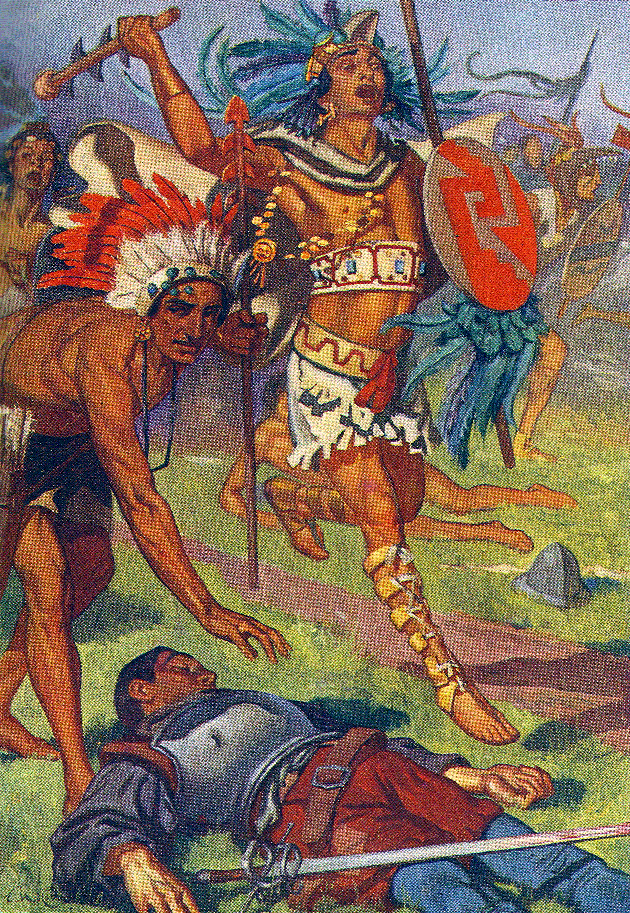 AGAIN AND AGAIN THEY RETURNED TO THE ATTACK. |
On the western causeway, which was shorter, Alvarado did station at night-time a strong company to defend the bridge nearest to the city. Their only shelters were flimsy huts which let in the rain and wind, and Bernal Diaz, who was in this division, gives a vivid description of all their hardships. They tried to cure their wounds by burning them with hot oil and binding them with strips of Mexican blanket. But, says the old chronicler, "a soldier named Juan Catalan also healed them by charms and prayers, which, with the mercy of our Lord Jesus, recovered us very fast." Sitting in mud and water they ate their "miserable food of maize and herbs withal! but, as our officers said, such is the fortune of war!"
It was the rainy season, and even the general's own division in the Camp of the Causeway suffered much from the cold and wet. To relieve their misery Cortés set the allies to work on erecting barracks of stone and wood. So wide was the causeway near the Fort of Xoloc that these shelters were constructed to hold two thousand men.
Message after message did Cortés send to Guatemozin offering fair terms of peace, but though food grew scarcer and scarcer in the city the young emperor scorned even to reply to the "perfidious strangers." Too well did the Aztecs remember the treachery of Tonatiuh to put faith in the promise of a Spaniard!
All that a general could do unaided by warships, cannon, cavalry, and steel weapons, Guatemozin did. Reorganising the old way of Aztec warfare, he made surprise attacks after dark, and kept a strict guard during the night, his warriors relieving each other in Spanish fashion. Simultaneous assaults were made on the three divisions of the besieging army. Open battle with the brigantines had proved useless, so among the tall rushes near the southern shores of the lake an ambush was laid. Stakes were driven into the shallow waters, and then several canoes rowed past the proud warships, tempting pursuit. Two of the smaller brigantines immediately gave chase and were lured into the ambush. Entangled among the stakes they had small chance in the furious fray which followed. Most of the white men were wounded and one of the brigantines was captured.
With such a foe the Spaniards could take no rest. "So ceaseless were our battles," says Bernal Diaz, "by day and by night, during the three months in which we lay before the capital, that to recount them all would but exhaust the reader's patience, and make him to fancy he was perusing the incredible feats of a knight-errant of romance."
The Bridge of Affliction
Very weary grew both officers and men of the long, toilsome siege, and very earnestly they urged their general to give up his plan of slowly starving the city into surrender. "Better far," they cried, "to encamp in the market-place than to retreat each evening to the causeways!" But the sure judgment of Cortés saw at once the weak points in such a course. They might become the besieged instead of the besiegers, and endure another Noche Triste! At last, however, yielding to the temper of his men, he gave a reluctant consent, and a simultaneous assault was agreed upon.
Cortés divided his own force into three companies, one to advance along each of the streets leading from the southern dyke to the market-place. Strict orders were given to the captains to secure retreat by filling up all breaches and levelling all barricades in their forward march. No needless risks were to be taken. "I knew," he says, "from the men they were they would advance to whatever spot I told them to gain, even if it cost them their lives."
Early on the appointed day Cortés, marching on foot at the head of his infantry, advanced up one of the side streets, while the gallant but rash Alderete, the royal treasurer, commanded the company in the main avenue.
Slowly but surely the general's division drove the enemy before them, filling up each gap they crossed, throwing down each barricade. From the adjoining streets they could hear their comrades' shouts of victory, and several messages came from Alderete to say he was not far from the square.
Fearing this rapid advance, Cortés left his own company and went with his bodyguard to the main street. There lay an open breach nearly twelve paces wide! Intoxicated with victory no man in the race for glory had stayed to fill up the gap. Suddenly, as the general was trying to remedy the fault, fierce and wild rang out the Aztec battle-cry, followed by a rushing sound like the tramp of a multitude of flying men.
In a moment Spaniards and allies appeared racing wildly onwards towards the open breach. Behind were hosts of yelling warriors, and on either side of the street the waterways were dark with canoes, while the house-tops bristled with Aztecs raining death on the struggling mass below. Cortés and his bodyguard on the farther side of the gap watched in helpless horror.
Alderete in his rash haste had fallen into one of Guatemozin's traps, and his men, overwhelmed and panic-stricken, were now flying for their lives. Plunging into the gulf, they tried to swim across, but many were drowned and many more were captured. The general, who with outstretched hands strove to rescue his unfortunate followers, was speedily recognised by the enemy, and now the cry, "Malintzin! Malintzin!" rose high above the tumult of the fight. Six Aztec warriors springing from their canoe, seized their arch foe, the most splendid of victims, and dragged him towards their boat. To the rescue dashed Christoval de Olea, and ere he received his death-blow four of the Mexican chiefs were slain. Cortés, wounded in the leg, lay on the ground disabled beside his faithful follower. More warriors rushed up, and. Malintzin was once more dragged in triumph into the water.
"The general is taken! The general is taken!" flew from lip to lip, and at the terrible words Quinones, captain of the bodyguard, followed by several of his men, rushed into the water, tore Cortés from the very arms of the Aztecs, and lifted him with a desperate effort to the roadway. At that instant the page, who ran up with a horse for his master, fell mortally wounded, and Guzman, the chamberlain, sprang forward to take the boy's place. But even as Cortés was lifted into the saddle some Aztec warriors seized the unfortunate Guzman, flung him into a canoe, and rowed swiftly away.
"My master's life is too important to the army to be thrown away here," exclaimed Quinones, as he resolutely turned the horse's head from this "bridge of affliction." Surrounded by his faithful body-guard, Cortés reached at last his own division, which he found broken and confused. The few who remained of Alderete's company struggled up, and with difficulty the troops regained the Camp of the Causeway, shattered and exhausted and pursued to the last by the triumphant foe.
Alvarado and Sandoval, meanwhile, had united their forces, and had almost reached the market-place, when they heard with sinking hearts the Aztec yells of victory, and the sounds of desperate battle growing fainter in the distance. Their comrades must be retreating! And now their own enemies were reinforced by a strong body of Aztecs—the warriors who had just routed the general's own division. Five bleeding heads were flung before the Spaniards, and with savage glee the Indians shouted, "Thus will we slay you as we have slain Malintzin!" Then at the blast of Guatemozin's horn they made so furious an onslaught that, "though it is now present to my eyes," says Diaz, "I can give but a faint idea to the reader. God alone could have brought us off safe from the perils of that day!"
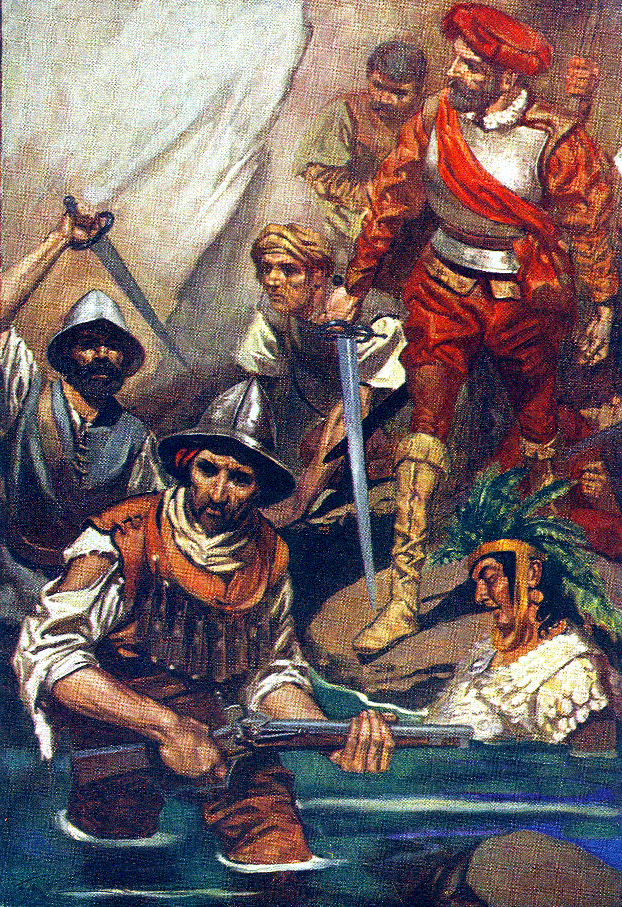 CORTES AND HIS MEN AT THE GAP. |
Was Cortés indeed slain? Sandoval could not rest until he had heard the fate of his beloved leader. Wounded as he was he mounted his good chestnut Motilla, and rode alone to the Camp of the Causeway. He was chased by some of Guatemozin's scouts, but Motilla, the best horse in the army, bore him swiftly onward, and the arrows glanced harmlessly from his steel armour.
"The general is safe!" were the first glad words he heard at the camp, but then followed a story of disaster. Sixty-two Spaniards had been captured alive! Many were wounded and many had been killed, but death and wounds were as naught to the horror of capture.
"O Senor Captain! what is this?" exclaimed Sandoval as he met his general.
"Son Sandoval," answered Cortés, with tears in his eyes, "it is for my sins that this misfortune has befallen me; but the fault is with the treasurer Alderete, who was ordered by me to fill up the bad pass where the enemy threw us into confusion." Then to this most trusted officer he told his plans. For some days the men must rest and recover their nerve, fighting only to defend their camps.
"You must take my place," he said, "for I am too much crippled at present to discharge my duties. You must watch over the safety of the camps. Give especial heed to Alvarado's. He is a gallant soldier, I know it well; but I doubt the Mexican hounds may some hour take him at disadvantage."
It was the hour of vespers when Sandoval reached Alvarado's camp, and the sun was sinking in a sea of golden light. Suddenly into the peace and stillness of the evening broke a blood-curdling sound—the drum of Huitzilopotchli! The camp was not a mile from the city, and with one accord the soldiers turned to gaze at the great temple. In fascinated horror they watched a long procession of priests and warriors winding snake-like round and round the terraces of the teocalli with white-skinned victims in their midst. In the clear air the soldiers could almost recognise their comrades. "We perceived," says Diaz, "that when they had brought the unfortunate victims to the summit, where were the adoratories, they put plumes upon their heads, and with a kind of fan in the hand of each made them dance before their accursed idols. When they had done this, they laid them upon their backs, on the stone used for the purpose, where they cut out their hearts, alive, and having presented them yet palpitating to their gods, they drew the bodies down the steps by the feet, where they were taken by others of their priests. Let the reader think what were our sensations. 'Oh, heavenly God!' said we to ourselves, 'do not suffer us to be sacrificed by these wretches! do not suffer us to die so cruel a death!' and then how terrible a reflection, that we could not relieve our poor friends thus murdered before our eyes!"
They were roused from their frozen gaze by another onslaught on the camp. "Look!" yelled the Aztecs as they charged the Spanish lines, "that is the way in which you all shall die, for our gods have promised this to us many times!"
There was joy and exultation in the city of Mexico. The gods had spoken at last! In the darkness of the night Guatemozin sent across the lake from city to city the heads of white men and of horses with this message, "The priests announce that Huitzilopotchli is appeased by the sacrifice of so many of his foes, and will deliver the strangers into the hands of his faithful people ere eight days have passed!"
With sinking hearts the allies heard this prediction. They too had gazed on the sacrifice of the Teules, whom they had once deemed invincible, and perhaps divine. Surely they had sinned to aid the foes of their gods, and now the time of punishment was at hand. Silently in the night-time they began to steal away from the Spanish camps to expiate their sin. Tribe after tribe disappeared, and Cortés was powerless to prevent the desertion. Even the faithful Tlascalans, with the words of the priests ringing ominously in their ears, returned to their little republic. Several of the caciques with their own immediate followers indeed remained. They had fought by the side of the white men in victory and in defeat, and the feeling of comradeship was strong within them. Ixtlilxochitl, the new king of Tezcuco, also held to his allegiance, though most of his subjects departed.
At last out of every thousand only about two of the allies remained. Day and night the soldiers had to watch and fight, for fierce and unceasing were the Aztec attacks, and every evening the dismal roll of the great drum announced over city and lake that fresh victims were being led to the stone of sacrifice.
Yet amid all the toil and danger the courage of the Spaniards did not fail. A few had brought their wives with them to Mexico, and these women set a noble example of heroism and endurance. They had refused to be left in Tlascala. "It is the duty of Castilian wives," they said proudly, "to share the danger of their husbands—to die with them, if need be!" One of these women named Beatriz de Palacios used to don her husband's armour, and when he was overcome with weariness, mount guard in his place. Another once rushed into the fight when the soldiers were retreating, and led them on with sword and lance. But it was the wounded who had most cause to bless the women, since the greatest service they rendered was the tending of the sick. And so, in watching and fighting, the eight days passed painfully away.
No Surrender!
The fateful day dawned, and still the city was beleaguered on every side, while within its walls the Aztecs were dying of famine and plague. Why was the war-god deaf to the frantic prayers of his faithful people? Had the victims been too few? "He shall have more!" cried the warriors, rushing again to battle.
Shamefaced and doubtful of their reception, the allies came stealing back to the Spanish camps. Huitzilopotchli and his priests had lied, or was the god impotent against the Teules? The Tlascalans, who had halted on the road, were the first to return. Cortés, only too thankful for the reinforcement, received them all kindly. He would permit them, he said, to share the joys of victory, though the Spaniards, he took care to add, did not really need their services.
The supreme importance of appearing strong and victorious induced the general to send help to a tribe of allies in a distant province, though, as he said himself, "God knows the peril in which we all stood!" To the remonstrances of his captains he replied, "The greater our weakness, the greater need have we to cover it under a show of strength." The wisdom of this plan was soon proved by the return of all the allies; and new tribes, eager to be on the winning side, offered their aid.
As the Spaniards grew stronger the Mexicans grew steadily weaker. Against starvation and disease they could not fight, yet "we found them," says Cortés, "with more spirit than ever." He had now a new plan for bringing the siege to an end. The city, which he called "the most beautiful thing in the world," should be utterly destroyed. Every building should be torn down, and every waterway filled up with solid masonry. Slowly would the Spaniards and their allies advance, but sure and terrible would be their progress. "That which is lofty," said the general, "shall become level; that which is water dry land."
Hoe in hand the allies, protected by Spanish cavalry and guns, flocked by thousands to the work. In vain were the despairing efforts of the Aztecs to save Tenochtitlan from the spoilers. Houses, palaces, temples, all were razed to the ground, and the rubbish was used to fill up the canals. A bare open space soon surrounded the city where the cavalry and artillery could have full play. Surely now, thought Cortés, the Aztecs will submit. Rats, lizards, and a slimy substance gathered from the surface of the lake were all the poor wretches had to eat.
To their emperor the Spaniards sent word, "You have done all that brave men can do. You have now no hope but in immediate surrender. Take pity on your brave subjects who perish daily before your eyes, and on the fair city whose stately buildings are fast crumbling into ruin. Return to your allegiance. The past shall be forgotten. The persons and property of the Aztecs shall be respected. You shall be confirmed in your authority, and Spain will once more take your city under her protection."
In the Aztec citidel gathered a council of haggard, war-grimed princes, chiefs, and priests, to consider the Spanish proposals. Some voted for surrender, but up rose the wild fanatic priests.
"Peace is good, but not with the white men!" they cried. "Think of the fate of Montezuma, who showed them kindness! Think of their treatment of Cacama! Think above all of the massacre of the noblest of our land by Tonatiuh! Better to trust in the promises of our own gods who have so long watched over the nation. Better, if need be, give up our lives at once than drag them out in slavery among the false strangers!"
"Since it is so," said Guatemoziri, "let us think only of supplying the wants of the people. Let no man henceforth who values his life talk of surrender. We can at least die like warriors!"
The only answer the Spaniards received to their offers of peace was an assault so furious that but for their cannon they would have been overwhelmed. Indeed, these fiery monsters which the Aztecs must meet on causeway and lake and street made the struggle most unequal, and dreary, even in the telling, is the story of these latter days when proud Tenochtitlan became "a desolation among the nations."
Sometimes the Aztecs, who had their own code of chivalry, would cease their fearless but hopeless battling, while one of their warriors stood forth and challenged a Teule or Tlascalan to single combat. Then upon the azotea or roof of some building was waged a mortal duel, while the opposing armies watched and cheered on the combatants. One day a valiant Aztec, armed with Castilian sword and buckler, sprang upon a house-top and offered battle to any Teule who would meet him. A young page of Cortés, burning to win laurels, at once accepted the challenge. Small and slight he seemed as he faced the Aztec, but he was agile and skilled in the use of the weapons, which were to the Indian awkward and unwonted. A sharp struggle ended in victory for the boy, who ran his foe through the body and returned in triumph to his comrades.
Of no avail was Aztec valour to stay the work of ruin. Farther and farther into the city the destroyers made their way, and black was the trail they left behind them.
"Go on!" shouted the Mexicans bitterly to the allies, "the more you destroy, the more you will have to build up again hereafter. If we conquer, you shall build for us, and if your white friends conquer, they will make you do as much for them!"
A band of warriors fought till every man was slain to save from the spoilers their royal palace, the beauty and pride of all the land. Well might the doomed people cry with the prophet of old, "A fire devoureth before them, behind them a flame burneth; the land is as the garden of Eden before them, behind them a desolate wilderness; yea, and nothing shall escape them."
Appalling even to the conquerors seemed the hideous downfall of the magnificent buildings which had once so aroused their wonder and admiration. "It was a sad thing to see their destruction," says Cortés himself, "but it was part of our plan of operations, and we had no alternative."
As the Spaniards drew near the quarter of the city where the Aztecs were still holding out, ghastly were the sights which met their eyes. The starving people had even devoured the bark and leaves off the trees, and had torn up the ground searching for roots and weeds. With dead and dying the streets were strewn, for the living were too few to bury the multitude who perished daily by famine and pestilence. To the Aztecs funeral rites had ever been very sacred, and bitter it was to leave their dead to be trampled into the dust by the foe or devoured by birds of prey. Too anguished now they were even to bear the corpses within the shelter of the houses, and worse than ever grew the black and horrible plague.
More harrowing still were the sights within the dwellings, where women, children, and sick or wounded men lay helpless to fight or fly. Cortés gave orders that the mercy for which they scorned to ask should be shown to these wretched creatures, but the allies in the fierceness of victory were beyond control, and all alike were buried in the burning ruins.
And now only one broad canal separated the general and his division from the great market-place towards which Alvarado from his western causeway was also making his devastating way. The canal was defended by the Aztecs, and as night was drawing in Cortés encamped on the bank, deciding to postpone the attack until the next morning. Suddenly a brilliant light shot from a teocalli near the market, and flared high into the midnight sky. Was some devilish rite being celebrated in that bloodstained tower? But no, as the Christians watched they called to each other with shouts of joy that the building itself was in flames! Alvarado must have reached the market-place.
With a will Spaniard and ally laboured at day-break to fill up the wide canal, and the Aztecs were impotent to stay the work. Soon the cavalry were able to gallop across, and then indeed the Indians, weak and worn as they were, had no choice but flight. Alvarado and his officers hastened to greet and embrace their comrades in the general's division, for they had not met since the beginning of the siege.
Climbing the ruined temple from which waved in triumph the flag of Spain, Cortés gazed at the scene around him. Less than two years before he had stood by the side of Montezuma on the summit of the great teocalli, and had marvelled at the beauty of the rich island city, the crown of all the lovely valley. What a change had those two years wrought! Where palaces had stood, surrounded by green gardens aglow with flowers and cooling fountains, stretched now a black and smoking desert. The gleaming canals, alive with canoes and gay with chinampas, had for ever disappeared; seven-eighths of the city lay in ruins, and Cortés, as he stood on the teocalli, was planning its utter destruction.
"There was in the army," says Bernal Diaz, "a soldier who boasted of having served in Italy and of the great battles he had seen there. This man was eternally talking of the wonderful military machines which he knew the art of constructing, and how he could make a stone engine which should in two days destroy the whole quarter of the city where Guatemozin had retreated. He told Cortés so many fine things of this kind that he persuaded him into a trial of his experiments." The machine, which took several days to make, was built on a great platform in the centre of the market-place. Here, in the happy, prosperous days of Tenochtitlan, jugglers and mountebanks had charmed the populace with many an ingenious trick. In the machine was placed a huge rock, and the Aztecs on the house-tops hard by watched with terror while the engineer set in train his death-dealing creation. The rock, according to the proud inventor, would be hurled with terrific force upon a neighbouring palace. "But, behold! instead of taking that direction, the stone flew up vertically into the air," and then crashed down again upon the catapult and smashed it into pieces. Cortés was ashamed and much enraged, but it continued, says Diaz, the joke of the army for many a day.
More and more horrible grew the sufferings of the besieged, but still they declared that never would they submit, and they yet had spirit to fight and taunt the Spaniards.
"The treasure you hope to win," they cried, "is buried where you will never find it!"
Brave as the men were the Aztec women, nursing the sick, and aiding the warriors by supplying them with stones and arrows. Two ladies of high rank remained three days and nights up to their necks in the water among the reeds, and this is but an instance of the unspeakable sufferings which tenderly nurtured women heroically endured. In the ever-narrowing Aztec quarters the dead bodies soon lay so thick that "a man could not set his foot down unless on the corpse of an Indian." Yet the courage of Guatemozin never failed, and his subjects, catching his noble spirit, felt with him that death even in such dreadful forms was indeed better far than submission to the false strangers.
The Last Stand
"You are the children of the Sun!" cried an Aztec chief to Cortés and his cavaliers as they approached the barricade he was defending, "but the Sun is swift in his course. Why are you then so tardy? Why delay so long to put an end to our miseries? Rather kill us at once that we may go to our god Huitzilopotchli, who waits for us in heaven to give us rest from our sufferings." Wan and despairing were the faces of the cacique and his followers, and their eyes were wild with hunger and pain.
In pitying tones the conqueror replied, "I do not desire your death, but your submission. Why does your master refuse to treat with me when a single hour will suffice for me to crush him and all his people? Go bid him confer with me at noon in the market-place to-morrow."
At the appointed time Cortés awaited the coming of the emperor. But four caciques came without their lord, who would not consent to a conference. They were offered food which they ate ravenously, and then the general sent them back to Guatemozin with provisions and an earnest request for a personal interview.
The messengers soon returned with a gift of cotton cloth, but a curt refusal from their master to meet or treat with the enemy. "Go back," said Cortés, "and urge him to alter his desperate resolve. When he sees that I suffer you to go and come unharmed, you who have been my steady enemies no less than himself throughout the war, he will surely come. He has nothing to fear from me."
The next day came a message that the emperor would meet Malintzin at noon in the market-place, and Cortés at once gave orders to delay the general assault he had been planning. Noon came and the Spaniard waited in vain for many hours. Guatemozin did not appear.
At last the allies, who had been left outside the city, were called in and the whole army marched on the enemy's quarters. The Aztecs were prepared. In front were the strongest warriors, behind, the weak and wounded, and on the roofs and terraces, women and children armed with stones and arrows. This pitiful resistance was of no avail, and the horrible struggle soon became a mere massacre of the famine-stricken people. Canals and streets ran red with blood, and the Spaniards themselves sickened at the slaughter. "The piteous cries of the women and children in particular," says Cortés, "were enough to break one's heart." But he could not check the ferocity of the allies, who outnumbered his own men by many thousands. "Never," he declared, "did I see so pitiless a race, or anything wearing the form of men so destitute of humanity!"
Night at last gave pause to the carnage. In the Spanish camp the hours of darkness were passed by the camp-fires in music and festivity. The Aztecs spent the night preparing for a last stand and for death.
In the morning Cortés, not wishing to continue the massacre, called to some Aztec chiefs, "Your emperor surely will not see you all perish when he can so easily save you! Prevail on him to confer with me!"
The message was given, but unflinching was the answer: "Guatemozin is ready to die where he is, but will hold no parley with the Spaniards. Let Malintzin work his pleasure."
"Go then," said Cortés sternly to the messengers, "prepare your countrymen for death. Their hour is come.
A short time longer the general held his hand, then as no sign of submission came a musket was fired, and at the signal Spaniard and ally rushed to the assault. Through all the long bright hours of the summer day the butchery continued. To the last gasp the Aztecs fought until their bodies bridged the canals, blocked the streets, and polluted the very lake itself.
Towards evening some canoes were seen trying to escape across the water which was veiled by the smoke of the guns from the brigantines. Giving chase, one of the Spanish ships came up with a large and well-manned boat, and the captain ordered his men to shoot. At that moment the rowers cried out, "It is the emperor himself," and the Spaniards at once lowered their bows. Cortés had given explicit orders that the Aztec monarch was on no account to be slain, but captured if possible alive. With his maquahuitl in his hand, Guatemozin, who did not wish to be spared, stood up in the canoe a mark for the cross-bowmen, but when he saw that they were resolved to take him alive he cried, "Lead me to Malintzin, I am his prisoner, but let no harm come to my wife and my followers."
He was taken on board the brigantine with the empress and his attendants, and the captain begged him to command the Aztec warriors who were still fighting in the other canoes to cease the hopeless combat. "It is not necessary," replied Guatemozin; "they will fight no longer when they see their prince is taken." On the terrace of one of the few buildings still left standing, a crimson cloth was spread, and there Cortés with Dona Marina at his side awaited his royal prisoner. With deep interest he looked at the Aztec monarch who was now led before him. He saw a tall, slight, young warrior with flashing eyes and a skin remarkably fair for an Indian. Weak and haggard as he was, he yet stood before the conqueror with an air of princely pride and dignity. For a moment he too gazed at the steel-clad white man in silence. At last he said, proudly and calmly, "I have done all that I could to defend myself and my people. My efforts have failed. Deal with me as you list." Then pointing to the dagger at the Spaniard's side he added, with sudden passion, "Draw that poniard from your side, and rid me of life at once!"
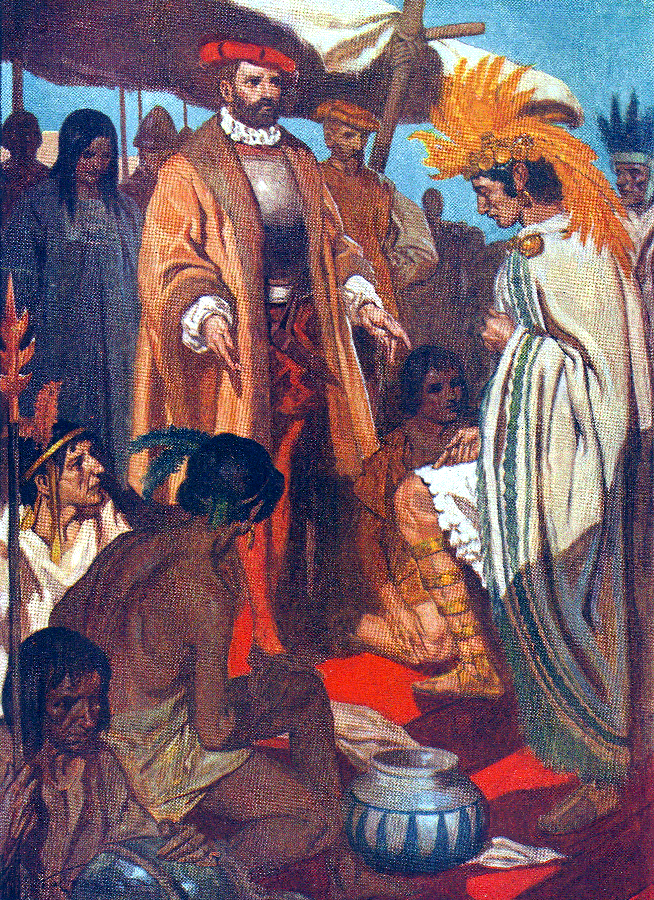 YOU WILL DEAL WITH ME, MALINTZIN, AS YOU LIST. |
"Fear not, Guatemozin," replied Cortés with courtesy, "you shall be treated with all honour. A Spaniard knows how to respect valour even in an enemy."
With a strong guard under Sandoval, Guatemozin and his beautiful young wife, Montezuma's daughter, were sent to Cojohuacan on the western shore of the lake. Alvarado and Olid were ordered to draw off the troops to their quarters on the causeways for the night, since the heaps of unburied dead made the air of the town like poison. As the royal prisoners passed out of the desolate city in the heavy dusk of the sultry summer evening, the rain came down in torrents as if to add to the gloom of the dreary scene. And all night long a terrific tropical thunderstorm raged over the valley of Mexico. In the brilliant flashes of the angry heavens the wretched Aztecs who still survived, cowering among their dead, could see the ghastly ruins of their beloved city.
But the Spanish soldiers, exultant with victory, and overjoyed that their long weeks of watching and fighting were at an end, slept in security hardly broken by the storm. So used had they become to the sounds of midnight battle, that "we felt," says Diaz, "like men suddenly escaped from a belfry where we had been shut up for months with all the bells ringing about our ears!"
In this wise, after three months' heroic defence, fell the great city of Mexico on the day of St. Hippolytus, the 13th of August 1524. Never have a people shown more desperate devotion to their country and their prince than this strange race of civilised barbarians hidden for so long from the eyes of Europe in their beautiful valley in the heart of the great New World.
Day dawned on a pitiful sight. By command of Cortés the survivors were suffered to leave the city unmolested, and miserable creatures, "whom it was a grief to behold," dragged themselves feebly along the causeways, the strongest supporting the weak. When they had all gone, the work of cleansing the city was taken in hand.
"It is true, and I swear 'Amen' to it," says Bernal Diaz, "that all the lake and the houses and the barbicans were full of the bodies of dead men so that I do not know how I may describe it. In the streets and in the courts there were no other things, and we could not step without treading on them. I have read of the destruction of Jerusalem, but whether there was such a mortality in that I do not know."
With the victors feasting and riot now took the place of vigils, fasts, and battles. The general gave a banquet to all his officers and cavaliers. Father Olmedo was much distressed at the unseemly revelry, and sought to check it through Sandoval, always upright and sober. But even Cortés himself dared not now interfere with his turbulent followers, who considered that by hard work they had earned a time of gaiety and licence.
The next morning the victory was celebrated by a solemn procession of the whole army with Father Olmedo at its head, bearing the image of the Virgin Mary. The soldiers repeated the litany as they marched, while above them waved the tattered banners of Spain which had been all through the long campaign. Then the good priest preached to the rough soldiers whose toils and dangers he had so bravely shared, reminding them that they had conquered in the strength of God, and beseeching them to treat the vanquished Mexicans with justice and with kindness.
Mexico a Province of Spain
Far and wide, from the Gulf of Mexico to the shores of the Pacific, throughout the length and breadth of Central America, spread the astounding news that Mexico, the imperial, and as men thought impregnable city, had fallen before the power of a strange and mighty race. Who then could hope to withstand these god-like beings with their mysterious engines? Day by day the Spanish camp was crowded with envoys from distant tribes offering allegiance to the renowned Malintzin. Awestruck they listened to the thunder of the cannon, and gazed on the horses and white-sailed brigantines. But the blackened waste which lay where shining Tenochtitlan had once stood was to them the most convincing proof that the Teules were gods indeed. Tribes which had scorned to submit to Mexico hastened to claim the Spaniard's protection, and Cortés found that he was owned as lord over a vast and ever-growing empire.
But whereas the Indian races were docile and submissive, the Spanish soldiers grew turbulent and rebellious. "Where is the promised treasure?" they cried; "Mexico is captured, but where is the spoil?" A report spread that the Aztecs had buried it and that Guatemozin knew the hiding-place. "If he will not reveal it," clamoured the greedy adventurers, "he must be put to the torture!" Louder grew their fury and discontent when Cortés refused to consent to so shameful a deed.
"The general," they cried, "has taken the gold for himself, and that is why he refuses to torture the Indian!"
Every morning libels against Cortés were found scribbled in prose and verse on the white walls of the barracks. It was said that he had taken one-fifth as commander and another as king. Discontent became so open and widespread that Cortés actually sought to pacify his men by allowing them to put Guatemozin and the cacique of Tacuba to the torture. Nothing can excuse the cowardice and treachery of such a concession. Under torture as in battle the Aztec emperor showed a heroic spirit. When the lord of Tacuba cried out in his agony, Guatemozin called to him in rebuke, "Am I then taking any pleasure in my bath?" The sufferers admitted that some treasure had been thrown into the lake, but the divers who were at once sent down to search found nothing of much value. Cortés, ashamed of the base cruelty, ordered the torture to cease in time to save the lives of his noble captives.
"Go on! the more you destroy, the more you will have to build!" were the taunting words the Aztecs had flung at the allies of the white men during the siege. With what bitterness these unfortunate Indians, false sons of Anahuac, must have now recalled the gibe. Mexico was to be rebuilt by their labour. Multitudes of workmen were needed for such a task in a country without beasts of burden, and the Aztecs themselves were weak and few in number. The allies, therefore, were forced to work like slaves, bearing on their shoulders stone and timber. So great was the number of the labourers that food became very scarce, and many died from sheer starvation. But still, under the relentless Spaniard, the work went on, more Indians were driven to fill the place of those who failed.
With magic speed a new city sprang up where the old Mexico had stood. To the Emperor, Charles the Fifth, Cortés wrote that he wished to raise this city "to the rank of queen of the surrounding provinces as she had been of yore." He told in this letter the whole story of the siege and conquest. The missive was entrusted with the royal fifth of the treasures to Avila and Quinones, who at once set out in a swift ship for Spain. Quinones, the faithful captain of the guard, lost his life on the voyage. Misfortune dogged the steps of Avila also. Just as the ship drew near the shores of Spain she was captured by a French privateer, and the commander was carried prisoner to Francis I., king of France. Right glad was Francis to seize on the treasure, to which he declared he had as good a right as his Majesty of Spain. "I should like," he said, "to see the clause in Adam's testament which entitles my brothers of Castile and Portugal to divide the New World between them!"
Avila, clever and politic, though proud and over-bearing, gained the friendship of his gaoler, and succeeded in sending his letters to Spain. The Emperor was then in Flanders, and the mind of his regent was poisoned against Cortés by the friends of Velasquez. It was not until October 1522, when Charles the Fifth returned to his Spanish realm, that a favourable answer was sent to the unknown adventurer who had made so marvellous a conquest. Then indeed his splendid service was duly recognised and rewarded. Cortés was made Governor, Captain-General, and Chief Justice of New Spain.
To Mexico the welcome news was sent by messengers, who stopped at Cuba on their way to trumpet in the ears of Velasquez the honour given to his hated rival. To effect the ruin of Cortés had become the one object of the Governor's life, and the triumph of the upstart was more than he could bear. His rage and misery knew no bounds, and he survived the blow but a few months, dying, it is said, of a broken heart.
As Governor of New Spain, Cortés was able to do still more towards rebuilding the city of Mexico. A strong citadel was built, with a dockyard for the brigantines, and on the site of the great temple was raised a magnificent cathedral, for which the Spaniards used the images of the Aztec gods as foundation stones. Urged by Father Olmedo, the conquistadores built many churches and hospitals. The good priest spent all his time in trying to relieve the hard lot of the wretched Indians. The Spaniards, who, greatly to their disgust, had received land instead of treasure, were too indolent or proud to work and too poor to pay for labour. Consequently all the natives, even the allies, were soon enslaved, the Tlascalans alone being left in their old freedom. The first care of Cortés was the conversion of the Indians. In their letters to Spain the conquerors had begged the Emperor to send out holy friars to Mexico for this purpose, adding, however, that they hoped "his Majesty would be pleased not to suffer any scholars or men of letters to come into this country to throw us into confusion with their learning, quibbles, and books!" The coming of the friars marked the final downfall of the Aztec religion. Zealously they sought to obliterate every trace of the pagan faith, and in the process most of the exquisite picture manuscripts enshrining the ancient history of Tenochtitlan were ruthlessly destroyed.
With infinite skill and tact Cortés organised his new and vast province, seeking to develop both its agricultural and mineral resources. But in his restless, adventurous mind teemed schemes for further conquest. "I doubt not," he wrote to the Emperor, "I will put your Majesty in possession of more lands and kingdoms than the nation has ever heard of!" His dearest wish was to discover "this great secret of a strait," that phantom waterway which all navigators felt sure must connect the Atlantic with the Pacific. Alvarado, who was sent to explore by land the western shores of the isthmus, conquered Guatemala. Sandoval explored and conquered along the eastern coast north of Vera Cruz. Olid was despatched with a squadron to cruise round the peninsula of Yucatan, steer southwards for Honduras, and make a settlement on its northern coast. There, where the isthmus narrows towards Darien, Cortés hoped to discover the elusive strait.
Olid, hitherto ever loyal to his chief, proved now a traitor. Intoxicated with his conquests, he proclaimed himself absolute lord of Honduras! Resolved to punish the rebel, Cortés set out himself by land to march to Honduras with a strong force of Spaniards and Indians. He was joined by Sandoval and by many of his veterans. Bernal Diaz was reluctant to leave his pleasant farm, but "Cortés," he says, "commanded it, and we dared not say No!" Guatemozin and the chief Aztec captives were forced to go also, for it was judged unadvisable to leave them behind in Mexico.
Passing southwards through the fertile coast-land, Cortés summoned to meet him all the caciques of the district. Among them came the unnatural mother of Marina, with the young step-brother for whose sake the girl had been so cruelly enslaved. Many years had passed away, but mother and daughter at once knew each other, and the wretched woman flung herself at the feet of this stately girl, who had become in some mysterious way the honoured friend of the all-powerful strangers.
"Mercy!" she cried, "I only ask for mercy!"
"Have no fear," replied Marina, raising her up with a tender embrace. "I am sure," she said, turning to her Spanish friends, "my mother knew not what she did when she sold me to the traders. I forgive her freely."
To her mother she said, "God has been very gracious to me in making me become a Christian . . . If I had been made the chieftainess of as many provinces as there are in Mexico, the only use I could make of this power would be to do more service to my Lord Cortés." Bernal Diaz, who was present, declares, "All these things I heard, and I swear to it. Amen."
Sometime during this expedition Marina was married to a Spanish cavalier, and given large estates in her native province, so Cortés lost the beautiful interpreter, without whose aid he could hardly have made his great conquest.
The march to Honduras, which began so brightly through friendly and open countries, soon became more and more difficult, and indeed disastrous. Through dense, untrodden forests, over treacherous marshes, across wide, unfordable rivers and stony mountains, the Spaniards and Indians struggled, starving and exhausted.
In this terrible extremity an Indian informed Cortés that Guatemozin and the other Aztec chiefs were plotting to fall on the Spaniards in some difficult pass where cannon and horse would be useless. They intended, said the informer, to kill every Spaniard, and then return to Mexico and attempt to reconquer their city. The man produced a paper on which were painted the faces of all the Aztec lords in the conspiracy. According to Diaz, Guatemozin denied all share in the plot, but Cortés declared that the Aztec emperor refused in his pride to answer the charge at all. Dreading any attempt at revolt in that land of forest and marsh, and fearing that Guatemozin, whether he wished it or not, would always be a centre for rebellion, Cortés resolved without further proofs that he must die.
The captive monarch and his cousin, the prince of Tacuba, were at once condemned to be hanged from the branches of a great tree on the wayside.
"O Malinche! long have I known the falseness of your words," cried Guatemozin, as he was led out to die. "Better that I had fallen by my own hands! May God demand of you this innocent blood!" "Death is welcome," said the prince of Tacuba, "since I am to die with my lord, the king of Mexico!"
Over the dreary expedition fell a yet deeper gloom. Cortés himself was depressed, sleepless, and unusually irritable, as if regretting his dishonourable treatment of the noblest of Aztecs. As for the soldiers themselves, Bernal Diaz says frankly, "Among us there was but one opinion on the subject,—that it was a most unjust and cruel sentence."
Honduras was reached at last, and there they found that Olid had been killed in the midst of the disorders with which his province was racked. They were therefore welcomed by their countrymen, who marvelled at their terrible march, and rejoiced at "the presence of the general so renowned throughout these countries."
Dead Sea Apples
The conqueror is once more entering his city of Mexico, and natives and Spaniards alike throng to meet him with tumultuous joy. Two years of blood-stained anarchy have marked the absence of his iron hand. Reports of his death in the far-away marshes of the south have bred dissension and despair on every side, and now intensify this passionate welcome which seems to know no bounds. But the cheers die painfully away as the people gaze on the wan, haggard face of their idol. How changed! how aged! His intimate friends hardly recognise this ghost of the once brilliant Hernando Cortés. Not all the horrors and hardships of the siege of Mexico left such traces of suffering as this terrible march to Honduras.
Not for long was Cortés permitted to rule his province in peace. Such stories had his enemies sent to the Emperor in Castile that commissioners arrived from Europe to investigate the conduct of the Governor of New Spain. The conqueror, ever impatient of petty interference, found his actions trammelled and his influence undermined at every turn. At last he resolved to go to Spain and justify himself before the Emperor in person.
"In all the state of a great lord," with a retinue of Aztec chiefs, and many rich presents and specimens of Mexican animals and plants for the Emperor, Cortés set sail for he Spain. News of his father's death came just before he left the shores of Villa Rica, but Sandoval was at his general's side ever ready to support and console.
In the month of May the conqueror of Mexico landed at Palos, where the discoverer of the New World had disembarked just thirty-five years before. To the convent of La Rabida Cortés retired to rest and give thanks for his safe arrival. Sandoval, who had fallen ill, remained at the little in inn at Palos, whither his chief was soon summoned by the news that the young captain was dying. It was but too true. The gallant soldier, who had come safely through such appalling perils in far-distant lands, was dying almost within sight of the home he did not live to see. "Those whom the gods love die young," and pity the young soldier who left behind him a memory of unsullied honour, and escaped those "slings and arrows of outrageous fortune" which so embittered the last years of the Conquistadores? On a pine-clad hill looking westward over the waves of the Atlantic his comrades laid their best-loved captain to rest, and for nine days Cortés delayed his journey to the Court that he might pray in the convent by the sea for the soul of his most loyal friend.
"In the pomp and glory, not so much of a great vassal, as of an independent monarch," with a long retinue of Indian chiefs in all their barbaric splendour, Cortés, himself in deep mourning, marched to Toledo, where the Emperor had promised to give him audience. Cheering crowds, eager to gaze on the victor and his trophies, lined the roads, and as he drew near the city he was welcomed by nobles of the Court.
Graciously did Charles receive his magnificent subject, and with flattering interest he listened as the soldier told in simple, vivid words the story of all that he and his comrades had endured and done in that strange land beyond the sea. With eager curiosity the monarch examined the trophies of the conquest, and many were the questions he asked as to the products and value of his new possessions.
All honour was given to the conqueror, who was created Marquess of the Valley of Oaxaca, a vast province in Mexico. "Your Majesty's kind expressions and generous treatment," declared Cortés, "make me not only forget all my toils and sufferings, but even cause me regret that I have not been called to endure more in your service."
As the fair Catalina, the wife thrust upon him by Velasquez, was dead, Cortés was free to marry a young and noble lady, the daughter of a count and the niece of a great duke. The Marquess was able to present his bride with jewels worthy of a queen—five exquisite emeralds cut by Aztec jewellers into the shape of a rose, a horn, a fish with eyes of gold, a bell with a pearl for a tongue, and a cup with a foot of gold attached to a large pearl by four golden chains. The Empress is said to have turned a cold shoulder to the Marquess because his gifts to her Majesty were not so fine as these jewels he gave to his bride.
The Emperor soon left his realm of Spain to the guidance of the Empress and set out for Flanders. Honour and rich lands he had given to Cortés, but he had been resolute in depriving its conqueror of the government of New Spain. Henceforth a Council, sent out from the mother country, was to direct the affairs of the province.
In the summer of 1530 the Marquess, with his wife and his old mother, landed in Mexico. They were gladly welcomed by both Indians and colonists, who were eager to pour forth their many grievances under the oppressions of the Council. But Cortés soon found that he had no power to right their wrongs, and retired in disgust to his valley of Oaxaca. There on the sunny slope of a hill he built a palace and cultivated his estates, planting sugar-canes and importing cattle and sheep. But the adventurer tired of so tame a life, and longed to make fresh discoveries and to win new conquests. Allured still by the phantom strait, he spent much of his great fortune in fitting out exploring expeditions. Leaving his fertile valley, he hazarded his life on many a dangerous voyage, but met with steady misfortune. No golden empire, no beneficent strait rewarded these years of restless striving and wearing hardship.
When at last he returned to Mexico, it was but to find that during his absence the Council had been despoiling his property. Once more Cortés resolved to seek redress in Spain. He set out in 1540, taking with him his eight-year-old son Don Martin. Ten years had passed away since his first triumphant return, and ever since that brief time of glory "everything," as Bernal Diaz remarks, "had turned to thorns with him."
In Spain his path proved as difficult as in Mexico. The Emperor was in Italy, and when, after a long year of waiting, he returned, it was to organise an expedition against the pirate stronghold of Algiers. Cortés at once volunteered, and embarked on the admiral's ship with his little son. Disastrous indeed the expedition proved. A mighty tempest wrecked the navy, and the Marquess and his son only saved their lives by swimming. The loss of his priceless emeralds made the disaster "fall more heavily on the Marquess of the Valley than on any other man in the kingdom except the Emperor."
Cortés seemed doomed to disappointment. Charles, who, ten years before, had welcomed him so warmly, now listened to his suit with coldness. He had already rewarded the conqueror, and felt that he was not responsible for the misfortunes which had since befallen him. Pizarro, moreover, had just conquered for Spain the dazzling empire of Peru, which far outshone Mexico in the treasure so coveted by the Spaniard. The deeds of Cortés were for the moment quite eclipsed.
In vain did he address one last pathetic letter to the Emperor:—"Sacred Cesarian Catholic Majesty: I thought that, having laboured in my youth, it would so profit me that in my old age I might have ease and rest; and now it is forty years that I have been occupied in not sleeping, in eating ill, and sometimes neither well nor ill, in bearing armour, in placing my person in danger, in spending my estate and my life all in the service of God and for my king. . . . I see myself old, poor, and indebted, and I foresee labour and trouble until my death. Please God that the mischief may not go beyond death, since, whosoever has such toil in defending his bodily estate cannot avoid injuring his soul."
After seven years of the law's delays the Marquess decided to return to Mexico, that he might make his account clear with God, "since it is a large one that I have . . . and it will be better for me to lose my property than my soul." But on the way to the coast he was seized at Seville by a fatal illness. He was carried to a little village inn without the city, and there, tended by his devoted son, Don Martin, now fifteen years old, he "arranged his affairs for this and the next world."
"It was the Lord's will," says Diaz, "to take him from this troublesome state on the second day of December 1547 . . . and he was at the time of his death sixty-two years old."
As the stern conqueror lay dying, did the thought of a nation enslaved by his act assail his harassed soul?
We do pray for mercy; And that same prayer doth teach us all to render The deeds of mercy.
Had the mercy which he now sought so earnestly been shown to Guatemozin and his people? Did he seek, perhaps, to expiate the past when he bequeathed to Mexico money for the foundation of a hospital, a convent, and a college for missionaries? On his heir Don Martin he laid a solemn charge: "Because doubts have arisen with respect to those natives of New Spain who have been made slaves . . . whether they can be held with a sufficiently good conscience or not, and up to this time the question is not settled, I desire that it should be ascertained what in this matter ought to be done in respect of those which I hold. And I charge upon my son and heir Don Martin, and upon his successors, that they should use all diligence for the discharge of my conscience and theirs in this matter."
In the hour of his own extremity Cortés did not forget the veterans who had served him so loyally and well. He left money for two thousand masses to be said for the souls of his followers. His high position as Marquess had not made him too proud to keep up his friendship with his old comrades. "He preferred," says Diaz, "to be called Cortés by us than by any title; and with good reason, for the name of Cortés is as famous in our day as was that of Caesar among the Romans or of Hannibal among the Carthaginians."
And as the personality of Caesar and of Hannibal could seize upon Roman and Carthaginian alike, so did the personality of Cortés seize upon the imagination of his followers. "In his whole appearance and presence," says Diaz, "in his discourse, his table, his dress, in everything, in short, he had the air of a great lord. His clothes were in the fashion of the time; he was not fond of silks, damasks, or velvets, but everything plain and very handsome; nor did he wear massy chains of gold, but simply a small one of prime workmanship, bearing the image of our Lady the Blessed Virgin with her precious Son in her arms, and a Latin motto; and on the reverse, St. John the Baptist with another motto. He wore on his finger a ring with a very fine diamond, and in his cap, which, according to the fashion of that day, was of velvet, he bore a medal, the device of which I do not recollect. His table was always magnificently attended and served with four major-domos, a number of pages, and a great quantity of plate both gold and silver. He dined heartily at midday and drank a glass of wine mixed with water. He was not nice in his food, nor expensive, except on particular occasions when he saw the propriety of it. He was very affable with all his captains and soldiers, especially those who accompanied him in his first expedition from Cuba.
"He was a Latinist, and, as I have been told, a bachelor in laws. He was also something of a poet and a good rhetorician; very devout to our Holy Virgin, and his advocates St. Peter, St. James, and St. John the Baptist in particular; and charitable to the poor. When he was much enraged the veins in his throat and forehead used to swell, and when in great wrath he would not utter a syllable to any one. With his men he was very patient; and they were sometimes impertinent and even insolent. He was very determined and headstrong in all business of war, not attending to any remonstrances on account of danger. When we had to erect a fortress Cortés was the hardest labourer in the trenches; when we were going into battle he was as forward as any.
"He was fond of cards and dice, and while playing was always in good humour, indulging freely in jests and repartees. In his campaigns he paid strict attention to discipline, constantly going the rounds himself during the night, visiting the quarters of the soldiers, and chiding those whom he found without their armour and accoutrements, saying, 'It is a bad sheep which cannot carry its own wool.'
"He was frank and exceedingly liberal in his disposition until the last few years of his life, when he grew close. But we should consider that his funds were employed on great and costly enterprises, and that none of these after the conquest, neither his expedition to Honduras, nor his voyages to California, were crowned with success. Perhaps it was that he might have felicity in heaven. And I believe it was so, for he was an honourable cavalier and a devoted worshipper of the Virgin, St. Peter, and other saints. May God pardon him his sins, and me mine, and give me a righteous ending, which things are of more concern than all conquests and victories over Indians."