Native Fairy Tales of South Africa - Ethel McPherson |
The Magic Lute
Marailane was a great chief who had many wives, but his heart's delight was Lielie, the beautiful girl whose laughter was like the sound of running water and whose singing was sweeter than the notes of the mountain birds.
Marailane loved sweet sounds above all things, and from a far country he had brought back a magic lute which at his bidding gave forth wonderful music, and which men said had never been fashioned by human hands. Because he loved Lielie above his other wives he hung the lute upon the wall of her hut, and when he came back wearied by the fierce heat of noonday he would take it down from its place and enjoy its wonderful melodies as he rested. The lute was dearer to him even than Lielie, and he bade her guard it carefully; above all, he charged her not to touch it or to show it to the other women.
But the women, who had heard the magic music floating through the door of the hut, begged Lielie to let them hear it in its full beauty and look upon the cunning with which the lute was fashioned. Some, the boldest, dreamt of taking it in their hands. They tried to bribe Lielie with the offer of their bracelets and anklets, but she always said them nay, until one night, when Marailane had gone forth to the veld to tend his flocks, oppressed by her loneliness, she summoned her sisters into the hut and pointed to where the lute hung upon the wall with the moonlight playing upon its silver strings.
The women seated themselves in a circle upon the ground, and there was a hush while Lielie took down the lute and laid it upon a mat in the centre of the circle, wondering the while at her own daring.
For a space all was silence, and then there poured forth notes of such maddening sweetness that the women held their breath. Louder and sweeter grew the music, till it filled the hut and floated far out across the veld and reached the ears of Marailane as he lay upon the dry earth watching his flocks. So wroth was he at Lielie's disobedience that the women in the distant hut felt his anger and with one accord they fled and hid themselves. Then the music suddenly ceased, and Lielie with trembling hands lifted up the dumb lute and hung it again upon the wall, but with a loud crash it fell at her feet. Stricken with dismay, she too fled from the hut and sought her native village. The way lay down a steep hill-side; more than once Lielie stumbled and fell, but at last she reached her father's dwelling, and lay down to rest with fear in her heart.
Meanwhile, with fierce anger in his bosom, Marailane strode across the veld, and came to his hut, where the magic lute lay mute upon the ground. It was in vain that he summoned the music, and ere sleep came to him that night he resolved fiercely that Lielie should suffer for the wrong that she had done him.
In the morning his wrath flamed again into a great fire, and calling one of his men, he bade him go to the village where Lielie had taken refuge with her father and say: "The Great One summons his wife to return and restore the music to the magic lute, which is dumb because of her evil-doing."
And when Lielie heard the words of the messenger, she bent her head, saying, "I have been summoned. I will come."
Then she began to ascend the hill which led to her husband's village. The way was steep, and when she had climbed half-way she stayed to rest, leaning upon her staff of iron. Then from far off she was seen by Marailane's men; they came near, and in their rage they stoned her; she turned to flee, and they ran after her and beat her with sticks. In her flight, Lielie fell over the edge of a gorge, whereupon, thinking she was dead, her pursuers returned to their village.
But when the moon was high in the heavens Lielie woke from her swoon. She was faint from her wounds, but her heart was strong; bravely she rose from the ground and made her way out of the gorge, sometimes creeping upon her hands and knees, till she came again within the friendly gates of her father's kraal. When her father and mother saw her thus sorely hurt they carried her into a hut and tended her, placing healing herbs upon her wounds. The days passed, and as Lielie grew strong again, her beauty flowered once more till she was as fair as she had been on the day on which she went forth to be the bride of Marailane.
She was the joy of the whole village, and the people would have kept her with them, but Lielie's love was still to her husband, whose wrath was upon her because she had robbed him of the magic music.
"I must go back to him," she said to her heart; and so one day when Marailane had summoned his men for a great singing feast, and she heard the sound of their voices from the hill above, she said to her father and mother: "I will go back to my husband. I will bring back to him the music."
Not caring to thwart her, her parents brought forth armlets and anklets of shining brass and decked her as if she were a bride. They put into her hand a staff of iron and blessed her; then, with a troop of maidens to accompany her, she set forth once again to climb the steep hill leading to Marailane's village.
When the revellers saw the bridal procession coming toward them their singing ceased, and Marailane, going to meet the maidens, saw among them Lielie, the wife who he thought lay dead in the gorge.
Now that his wrath was quenched he mourned for her who had been his heart's delight, and great was his joy. That night when the great moon cast its light upon the veld the sweet notes of the magic lute once again floated out from the door of Lielie's hut and filled the night with beauty.
Senkenpeng and Bulane
For many moons no rain had fallen, and the parched brown earth had ceased to yield its fruit. All the fountains were dried up, and on the barren veld the lean cattle sought pasture in vain; the sight of them with drooping heads, their bones showing beneath the shrunk hides, filled with grief the hearts of the herd-boys.
Not a cloud hung in the bare blue dome overhead; at evening the sun dipped below the horizon in hot and sullen splendour, and the wind of dawn brought no refreshment to the parched and weary earth.
The men no longer walked with head erect and swift of foot; while, hard pressed by thirst and famine, the maidens drooped like flowers in the heat of noon.
It was the sunset hour, and within the village the mothers whose breasts had run dry tried in vain to soothe the little ones whose fretful wailing disturbed the still air and reached the ears of the Chief Rasenkepeng, who sat brooding over the sorrows of his people, not knowing how he might help them.
Day after day the Rain-maker had climbed the hill that rose behind the village, and had stood through the long hot hours with rod lifted toward heaven, praying that the rain might fall and save the people, but not a drop had descended upon the earth. Day by day Rasenkepeng, the Chief, had waited at the base of the mountain, joining with his people in their prayers, and still the heavens were as brass.
The time had come when the people must seek a new country or die, and Rasenkepeng sat alone communing with his heart.
"Lo, my people die of thirst," said he, "and Bulane, the Water God, hears not our prayers. I will therefore send forth my son Maphapho to seek a land watered by streams, and thither will I lead my people."
So he summoned Maphapho to his presence, and bade him go next day in search of a land through which ran rivers and where the mountain pools were filled with water.
And Maphapho, the tall, limber youth who drew to himself the eyes of all the maidens, obeyed gladly, and chose from the young men of his father's people those who were to accompany him on his quest.
At sunrise the next day he set forth with his comrades equipped as if for a hunting expedition, and wistfully the famine-stricken people watched them make their way across the veld toward the distant mountains.
The whole day they journeyed, but everywhere the land was parched and the river-beds dry, while beneath their feet crackled the withered grass.
At the end of the long day Maphapho withdrew from his comrades and, gazing round him, saw gleaming in the light of the setting sun a pool of water. He hastened thither and stooped to quench his thirst, but as his lips touched the surface of the pool, all unseen, Bulane, the Water God, struck him in the face, and would not let him drink.
Then Maphapho filled the hollow of his hand with water and raised it to his lips, but Bulane again struck him, and the water was dashed from his hand.
Wondering, Maphapho rose to his feet and said: "Why, O Lord of the Water, may I not quench my thirst at this fountain?"
And the voice of Bulane made answer: "Tell Rasenkepeng, your father, that unless he send me his daughter Senkenpeng, all his people shall die of thirst, and they and their cattle shall be wiped off from the face of the earth."
Maphapho loved his sister dearly, and knew her to be the darling of her father's heart, so when he heard these words he bowed his head in grief, but he answered Bulane, saying, "I will obey the command of my Lord, but know that Senkenpeng is more precious to my father than all his lands and his herds of cattle."
Then because he was faint from thirst and wearied with the long march, he stooped and drank his fill from the cool spring. And when he was refreshed he filled the water-pots which he had brought with him and returned to his companions.
The young men, without seeking repose, retraced their steps and journeyed through the night until at dawn they reached the village where Rasenkepeng and the headmen awaited their return. Maphapho told his father how that Bulane, the Lord of the Water, had demanded that Senkenpeng should be sent to him, and the Chief's look was overcast, for this daughter was dearer to him than life. He would have withheld her from going, but the first among his warriors said: "Lo, thy people die of hunger and thirst. Send for thy daughter and let her choose."
And when Senkenpeng stood in their midst and heard that Bulane, the Lord of the Water, had summoned her, she said: "Surely my people shall not perish. I will go to Bulane that they may live."
And so next day, when the wind of dawn blew from the mountains, Maphapho led forth his sister, and the young men and maidens of the village made ready to accompany her, as if she were setting forth as a bride.
Her mother wept bitterly at the parting, and her father, blessing her, said: "May you go softly all your days, and may your face be as the morning sun!"
But Senkenpeng shed no tears; she went forth with Maphapho and her companions, until at sunset they reached the pool whence had come the voice of Bulane.
Here they left her, and Senkenpeng stood solitary in the silence amid the hills.
The sun sank in red and golden splendour behind clouds of sullen darkness. The glory of the day gave place to the sweet coolness of night; the stars shone in the vast dome overhead, and from behind the hills the moon rose to sail in majesty across the heavens.
Wearied with her long march, Senkenpeng longed for rest.
"Where shall I sleep?" she asked.
obediently she spread her mantle of skins on the ground.
She slept till she was awakened by the falling rain and the scent of the earth refreshed by the welcome moisture. Then her heart rejoiced, for she knew that salvation had come to her people.
The sky was dark with heavy rain-clouds and the moon and stars were hidden. The air was chill, and Senkenpeng rose to seek shelter, saying, "It is raining. Where shall I sleep?" Again the voice replied: "Here, just here." She lay down again, and drawing her mantle round her once more she slept.
When she woke it was to find herself in a hut more magnificent than that in which her father dwelt. It was furnished with rich skins, and on the walls hung shields and weapons of war. Near her stood meat and drink, but she was alone, nor was there any sign of human life around her.
The rain was still falling, and Senkenpeng rejoiced; she knew that the watercourses in her father's land were now filled, and that the earth would once more yield its increase.
The days passed, the earth grew green again, and Senkenpeng lived in her solitude with heart untroubled. In the ninth month a child came to her and to the unseen husband upon whose face she had never looked. It was a man-child, whose strength and beauty surpassed that of all other children, and Senkenpeng loved her son exceedingly.
Her solitary days were ended; for two happy years the hut was filled with the sound of happy laughter and the soft crooning of lullabies.
Then one day Senkenpeng felt a great longing to see her people again and to show them her son.
"May I go home again?" she asked of her unseen husband, and a voice made answer: "Go."
The next day accordingly she set out with her boy and journeyed till she came to her father's village, in which since the coming of the rain there had been joy and prosperity.
Senkenpeng was received with great joy, and her father's heart was full to overflowing at the sight of his daughter. He rejoiced also in her beautiful child, but when he asked her about her husband she would give no answer.
At last the time came to return, and when Senkenpeng had made ready, her young sister asked that she might accompany her, and Senkenpeng said: "Come with me, for I live alone."
So the sisters journeyed to the hut together, and took up their abode there; but with the coming of the younger sister peace left the home. The girl did not love Senkenpeng's son, but chid him and was fretted by his childish ways. And it happened that one day when his mother had gone to draw water from the spring, she used him ill, striking him and saying, "Nobody knows who your father is, or where he lives," and she continued to scold him.
But Bulane heard her reproaching his son, and when, shortly after, she left the hut, he entered it and, taking the boy between his knees, sat down and played with him.
Presently the girl returned, and when she saw the great Chief, clad in a scaly mantle shining like silver, seated in the hut, she trembled. Then, when he spoke, saying, "It is I who am the father of the child whom you abuse," she was so smitten with fear that she fled from the hut and returned to her own people.
Meanwhile Senkenpeng had come back from the spring, and seeing a strange warrior playing with her child, her heart was filled with fear; she shook like a leaf when he spoke to her, asking, "Who is your husband, Senkenpeng?"
"Nay, my lord, I know not," was her reply.
"I am he," he answered—"Bulane, Lord of the Water, who demanded you from your people. This is my son, whom your sister reproached because none had seen his father. Now you and he shall know me, and I will leave you no more."
And Senkenpeng rejoiced to have Bulane at her side, for he was true to his word, and never left her. He brought his people and their cattle to live near, and a village grew up round the hut which once had been so solitary.
The Daughter of the Sword
In days long past there dwelt a great King whose dominions extended from the rising of the sun to its setting, and who had conquered lands far to the North and the South.
Now, on the day on which the mightiest of his foes was overthrown a daughter was born to him, and because her birth came in the hour of victory while the spears of his warriors hurtled through the air and the vanquished lay upon the ground like mown grass, he named her the Daughter of the Sword.
And this daughter was dearer to him than any of his other children; he loved her above them all for her beauty and for her haughty spirit. So proud was he of this fair child that he vowed that when she became a full-grown maiden her coming of age should be celebrated by the slaying of many cattle brought from the East and the West, from the North and the South, which should be driven into her presence at the point of the sword. In such vast hordes should they come that the trampling of their feet would raise a cloud of dust so dense that the face of the sun would be darkened.
And the Daughter of the Sword looked forward to the day when such honour should be done to her.
The years passed, and the Princess grew to be a fair and stately maiden. When she had reached her full stature she went far out on to the veld with her damsels, and having chosen the place of her sojourn, she bade them go back to the village and tell her father to send the cattle according to his promise.
The King, well pleased, ordered his men to drive twenty oxen into the presence of his daughter, but when they approached, the Princess looked disdainfully upon them and said: "I see nothing."
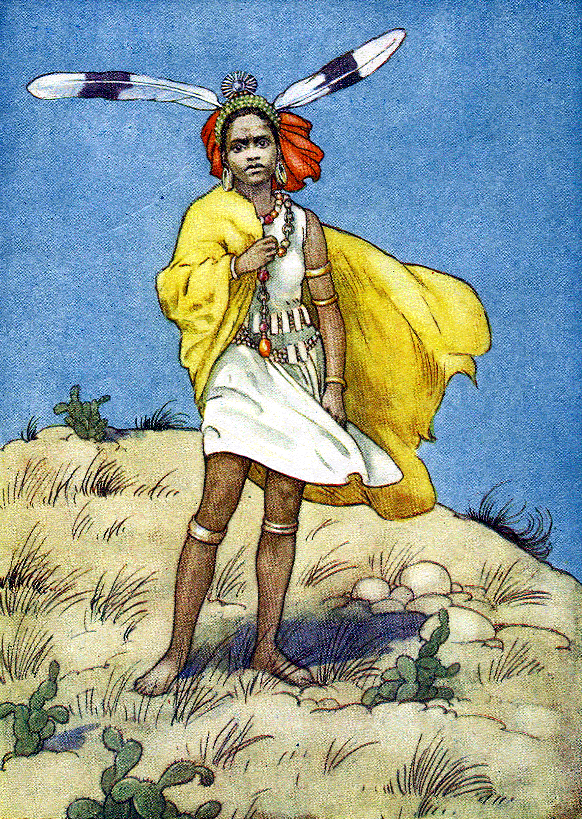 THE DAUGHTER OF THE SWORD. |
The men returned to the King, who bade them once more go into his daughter's presence and take with them forty head of cattle. But the Daughter of the Sword refused to look upon them, saying again, "I see nothing."
The King, who rejoiced in the pride of his daughter, now ordered a hundred oxen to be driven from the kraals, but the Princess still wore the same high look as before, and pointing upward said: "There is the globe of the sun, and until it is darkened according to the saying of my father, I will never return to my home."
It was in vain that the King sought to satisfy her. From far and near he sent forth his men to lay tribute upon the people, and though the oxen now numbered many thousands they were rejected by the Princess.
At last he levied a great army and bade the warriors go far beyond the bounds of his kingdom and bring in all the cattle from the neighbouring lands.
The army went forth, and it came to pass that after many days the hosts came to a green and fertile valley where many thousands of cattle were grazing. The hides of the beasts were smooth and sleek, and their branching horns glistened in the sunlight. It was a goodly sight, for in that valley lay the wealth of one mightier than the father of the haughty Princess.
The warriors went stealthily to the far end of the valley, and with shouting and with blows from their spears they began to drive forth the frightened beasts.
But a voice from the heights called out: "To whom belong these cattle which you are driving away?"
And looking up, they saw stretched upon the hills a huge monster, the Lord of the Cattle, whose form was so mighty that upon it grew vast forests, and so great was his length that whole countries lay upon his back. In some of these lands it was early harvest, while in others it was winter. But, laughing, the warriors cried, "Out upon you, you hairy beast," and with blows from their spears they drove the frightened multitude across the plains to where abode the Daughter of the Sword. Their coming was heralded by a noise like thunder, and the dust of their hoofs rose in a mighty cloud which darkened the face of the sun.
"Behold now!" cried the King's daughter, "the promise of my father is fulfilled," and her heart was satisfied.
In honour of the Princess multitudes of cattle were slain, and when the warriors had eaten their fill, there was still food for the vultures and the crows which came flocking to devour the remainder of the carcasses.
In their exultation the warriors said nothing to the King about the monster which lay upon the hills, nor did they tell him that he had challenged them for carrying away his cattle.
The feastings and rejoicings over, the Daughter of the Sword remained in the hut with her mother and little sister. It was now the time of harvest, and one day when all the people of the village had gone forth to work on the land she and her sister were left alone, and while they lay resting in the heat of noon the ground beneath their feet was shaken as if by an earthquake, and there was a rumbling as of thunder. But fear did not enter their hearts, for in their veins ran the blood of princes.
The younger girl rose and went forth to see what had happened, and there at the entrance to the village stood the monster, the Lord of the Cattle, whose feet had broken down the fence.
She made haste to return to her sister, crying, "Child of the King! At the gateway there stands a mighty monster, mightier than any beast which I have seen, and he has broken down the fence which surrounds the village."
Even as she spoke two leaves blown from a tree growing on the back of the monster fluttered into the hut, and bade the younger Princess go to the spring and draw water. The girl, wondering at the command from such strange messengers, took a jar and went to the stream, but when it was filled and she would have returned to the hut, her feet were rooted to the ground, and she could not withdraw them.
Meanwhile the Leaves had addressed the Daughter of the Sword, bidding her go to a neighbouring hut and fill a jar with water. At first the Princess haughtily refused to do their bidding, but when they commanded her a second time she rose and went, although her heart was filled with anger that she, a royal princess, should be compelled to obey.
She returned with a jar full of water, and the Leaves now bade her light a fire, grind the corn, and bake the bread.
It was in vain that she protested that she, a King's daughter, knew not how to do such humble work. "Look, my nails are long," said she, showing them her hands, which were the hands of idleness.
Then one of the Leaves took a knife and pared her nails, and raising one of the grindstones, showed her how to grind the corn.
So with anger in her heart the Daughter of the Sword ground the corn and baked the bread, and when it was ready, at the bidding of her new masters, she filled large baskets with food and poured thick milk into a calabash, and when all was ready the Leaves bade her carry the bread and the calabashes to the gate of the village where the monster was waiting.
But the Princess answered haughtily, "How can I carry the load of three men?"
"We will help you," replied the Leaves, and they bore the milk and bread to the monster, who opened his huge jaws and swallowed all that there was in the twinkling of an eye.
Then the Leaves returned to the hut and despoiled it of everything that was in it—the water-vessels, the sleeping-mats and the skins—and took them to the monster, who devoured all that they placed before him.
Then they ranged through the village, robbing the huts of all that was within them, and these things, too, the monster swallowed.
Next at their command, the Daughter of the Sword arrayed herself in her petticoat adorned with beads and decked herself with her necklace of brass and with her bracelets and her armlets, and went to where the monster stood at the gate of the ravaged village.
"Climb up on to my back," he commanded, and the Princess obeyed.
Now the little sister, whose feet were rooted to the ground on the river-bank, felt her sister's departure, and at that moment her feet were loosened, and she ran to her mother who was busy in the harvest fields, crying, "My sister, the Daughter of the Sword, has gone 1 In my heart I felt her departure."
The mother ran back to the village. Everywhere she sought her daughter, looking into all the huts which had been despoiled, but nowhere did she find her child.
Her tears fell like rain, and she hastened back to the fields, saying to the harvesters: "My child has been carried away by the monster who was plundered of his cattle."
Then the men armed themselves and followed the spoor of the great beast till they came upon it, where it stood waiting for them.
At the sight of the warriors the Lord of the Cattle laughed, and said: "Do what you will do quickly that I may go, for the sun has set already."
Then one after another the men hurled their spears against the monster's side, but they hurled them in vain. Some struck against a rock and were turned aside, some sank harmlessly into the grass, while others splashed into a pool.
The monster was unhurt, but because of the weeping of the mother and the little sister, the Lord of the Cattle allowed the Daughter of the Sword to descend from his back and take farewell of them. He would not, however, allow her to remain long with them, and ordered her once more to mount upon his back.
Then he began to mock the people who had followed him, and with steps that shook the earth he crashed forward through the bush till those who followed could go no farther for weariness.
The Lord of the Cattle journeyed with the Princess till he came to a cave, where he bade her alight. In the cave she found a pillow, a sleeping-mat, some bread, and a jar of water. Here he left her, saying, "I am avenged, for I have spoiled your father. He would have received many head of cattle when your bridegroom claimed you, but now he will never see you again. He robbed me of many cattle, and now in my turn I have spoiled him."
And the Daughter of the Sword remained where he had left her, and there befell her many strange adventures which are written in the hearts of her people.
The Queen of the Pigeons
Once upon a time there lived a maiden who was as fair as a star. She was the delight of the village, and her mother loved her above all else in the world.
One day when the men of the village had gone out hunting and the women were at work in the fields, the maiden, leaving her young companions in the kraal, went out on to the veld to gather the soft grass. Suddenly while she stooped to her work there came flying from out of the West a flock of grey wood-pigeons who hovered above her. And seeing that she was fair, they lifted her up from the earth and bore her away over the fields where the women were hoeing the ground. The girl, weeping, called out to her mother: "Mother, mother, the Pigeon-folk are carrying me away!"
The woman looked up from her work, and seeing her child, stretched out her arms and tried to reach her, but the Pigeons rose above her head, and then sank again till the girl was almost in her grasp. Then they rose again, mocking her, and flew away.
They flew toward the sunset, and the mother, weeping, followed the Pigeons, begging them to restore her child, but they heeded her not. When darkness fell they alighted upon a tree, and stayed there through the night, keeping the girl with them, while the mother, wearied with her long journey, lay down beneath the tree and slept so heavily that at dawn she did not hear the rustling of the grey wings when the birds took flight, nor did she wake till the sun was high in the heavens.
Then when she found that the Pigeons had gone, taking with them her child, she returned to the village to tell her people of the misfortune that had overtaken her.
Meanwhile the Pigeons had reached their own country, proud of the captive whom they had brought with them.
Now, when the King of the Pigeons saw the beautiful maiden he desired her for his wife and made her his Queen. And for years she lived among the Pigeon-folk, and bore her husband three sons, but she could not forget her own people, for whom her heart yearned. Years passed, and her sons grew to be tall and manly lads, and one day when the King was about to set forth on a hunting expedition with his warriors, he told the Queen that his sons must accompany him. She assented, but before starting she called them apart and told them how they must leave the hunt and come back to the village, and from thence return with her to her native land. They were to feign hurt or sickness, one after another, and ask leave of their father to return.
When the King's train had left the village, the Queen was alone with her husband's mother, who distrusted her, and feared that this stranger-wife meant ill toward her son.
Meanwhile before the huntsmen had gone far afield the youngest of the King's sons stumbled and asked leave of his father to return to the kraal. The King, suspecting nothing, sent the boy home.
A little farther on the second boy, feigning illness, received his father's permission to return; and the third, complaining of a burning pain in his head, was sent back also.
Then when all three had reached the kraal, the Queen gathered together her possessions and set out with her sons, believing that no one had seen her. But the King's mother knew all that was happening, and going to the outskirts of the village she raised her shrill voice, crying, "Yi! Yi! The Queen has gone forth, and has taken her sons with her."
Her voice was heard by one of the hunters, whose ears were as keen as the hare's, and he said: "Hark! Some one is calling. Some one says that the Queen has gone away and taken with her the King's children."
But the others were angry with him, saying, "Hold your tongue. You will bring ill-luck upon the King's children."
And because men hate those who tell evil tidings, they slew him and went on their way.
Meanwhile the voice of evil omen sounded again across the veld, and this time it was heard by another of the hunters, who bade his fellows listen. "I hear a voice," he said, "crying out that the Queen has gone away with her children."
And they, believing that he meant to bring harm to the young Princes, slew him also.
A little farther on the shrill voice was heard for the third time, and yet another of the hunters bade them pause, and he too would have been slain, but he said:
"Ye have already slain two of the King's men because they have harkened to the warning. I too hear it, but slay me not. Let me return to the village to see whether or no this thing be true."
And they listened to his words, and brought him before the King, who harkened to his story and then said: "Let the man go forth to the kraal and bring back tidings of the Queen and my sons."
So the hunter returned with haste to the village, and when he found that the Queen had gone, taking her sons with her, he went back to the King and told him of their departure.
Hereupon the King of the Pigeons called together all his vast army, and from all quarters of the heavens there came the whirr of grey wings, and so great was the host that the sky was darkened, nor could the face of the sun be seen. And when all were assembled the King told his warriors how the Queen had set out with his children. For the honour of his name they must be brought back.
And when the King had spoken there was a stirring of angry wings like the sound of a stormy sea beating upon the shore, and with the King at their head, the Pigeon army swept southward in pursuit of the truant Queen.
Meanwhile the Queen had reached a great sea, the farther shore of which could be dimly seen against the sky, and standing where the waves broke round her feet, she cried t "Sea, Sea, be divided, that I and my children may cross."
At the sound of her voice the waters parted, and the Queen and her children walked upon the dry land and reached the farther shore in safety. Then the waters rolled back with the crash of thunder, just as the army of Pigeons reached the margin of the sea.
On the opposite side they could see the Queen and her sons, and they wondered how she had crossed, seeing that the waters were so vast that their wings would not bear them to the other shore.
When she saw the Pigeons on the farther shore, the Queen thought how she might deceive them, and plaited a long rope of grass which she flung across the waters, shouting, "Lay hold of this rope, and I will pull you across."
The Pigeons hastened to take the rope, while the Queen sought for a sharp stone; then, when all were clinging to the rope, she severed it, and the King and his whole army sank into the sea. The waters closed over them, nor was one left to tell the tale of destruction.
Then the Queen and her sons returned to her own people, and her home-coming was celebrated with dancing and singing and great rejoicings.
The Tall Princess and the Haunted Pool
There is a land wherein lies a haunted pool, one fraught with peril to those who trust themselves to its waters, for in its depths there dwells a terrible monster whom all men fear.
Now, in the days long passed, there ruled a King over this country, whose daughter, the stately Untombinde, was taller than any other maiden, and who was so bold that she knew not fear. She had heard of the pool and of the danger lurking beneath its still waters; nevertheless one day when the rains had fallen and the rivers were in flood she said to her father and mother: "I am going to the haunted pool," but they laid a command upon her that she should not go, and she yielded to their will.
But next year when the streams were full and overflowed their banks she again made ready to depart, and again her parents restrained her, but the third time, seeing that her heart was set upon the adventure, they let her go.
Then Untombinde went to the girls of the village and chose from among them two hundred to accompany her, and they took rank as if for a wedding procession, one hundred to the right of the path and one hundred to the left, and set forth laughing and singing on their way.
By and by they met a company of traders upon the road, and they stopped them and gathered round the men, asking, "Which among us all is the fairest?"
And the merchants made answer: "All are fair, but there is none of you to compare with the Princess Untombinde, who is as beautiful as the good green grass after rain, and who is as stately as a tree of the forest."
So angry were the other girls whose charms were thus slighted that they fell upon the merchants and slew them, and then went on their way. It was a goodly sight to see the procession as it made its way across the veld, for the sun shone upon the girls' armlets and anklets of brass and upon the ornaments on their breasts and glinted from the many-coloured beads of their petticoats.
Before sunset they came to the haunted pool, and, hot and tired with their long march, they hastily flung off their gay gear and plunged into its depths. As its cool waters flowed over their smooth brown limbs they shouted with delight, and tossed their arms above their heads, and sported till they were weary.
The youngest of the maidens was the first to leave the pool, and when she came to the spot where she had left her petticoat and her ornaments of brass she found that they were no longer there. In vain she sought them, and in her despair she sat down and lamented. One after another, as the girls came forth from the pool, they found that their garments and their ornaments had disappeared, and they were in sore straits.
Untombinde was the last to leave the pool, and when she stood upon the bank the maidens clustered round her, saying, "What shall we do? The Lord of the Pool has stolen our petticoats, our bracelets and our anklets I "and their tears flowed freely.
But Untombinde did not join in their wailing, and towered above them in disdainful silence while they made their complaint.
One said peevishly, "It is Untombinde who has brought us into this trouble "; and another, "Let us beg the monster to restore our clothes and our jewels."
"Beg for them if you will," said the Tall Princess, "but I, a King's daughter, ask no favour of man or monster," and she turned aside scornfully while the girls one after another pleaded, saying, "Lord of the Pool, give us back our raiment and our ornaments, that we may depart; for it is Untombinde, the King's daughter, who has brought this trouble upon us."
One by one, in answer to their prayer, the girls received back from the monster their possessions, and clad themselves, and made ready to depart. But Untombinde stood with folded arms and refused to make supplication, when her companions besought her to ask the monster to restore her clothes. In reply she answered haughtily: "I, the King's daughter, beg from no one." And these words so angered the Lord of the Pool that he seized her and dragged her beneath the waters.
Then the terrified girls made their way back to the village and, weeping, went into the presence of the King and told him of the fate of the Princess.
"I warned her of what might befall," he answered mournfully, "but she would not heed my words, and now she will never return to my house." Nevertheless, he desired to avenge his daughter, and, gathering together his army, he bade them go forth and slay the Lord of the Pool.
In full battle array the warriors set forth upon their quest, and before long they encountered the monster, who had risen from the pool to meet them. At sight of the warriors the creature opened his mighty jaws and swallowed every man of them, even as he had swallowed Untombinde. Then, swollen with his prey, the Lord of the Pool pressed forward until he came to the village, devouring all that lay in his path.
Then the King went forth to meet the monster, and grasping his sharpest spear he stood up to do battle with the slayer of his people where, distended to the girth of a mountain, it lay crouching upon the ground. With a sure stroke he pierced its great side and all whom it had devoured came forth, and among them was Untombinde, the fearless Princess. Then amid the sound of great rejoicing he took his daughter back to the kraal, where her mother awaited her coming.
The Marriage of Untombinde
There was once a great King who ruled over broad lands. He was the father of many sons, but the first of his wives had borne no child. Yet because she was the daughter of a great King she maintained her state, and though they were jealous that the King still paid her so much honour, the other women of the kraal dare not mock at her openly.
The Queen shed many tears because she was childless, and one day when she sat alone and sorrowful in front of her hut, two Pigeons alighted near by.
"If we give you a child, what will you give us in return?" asked one.
The Queen, overjoyed, offered everything that she possessed: her mantle of skins, her bracelets and anklets of brass, her carved pillow and her staff. The Pigeons refused them all, saying, "We have no need of such things, but in your hut stands a vessel filled with the seeds of the castor plant. Give these to us, and you shall bear a son."
Gladly the Queen went into the hut, and bringing out the pot scattered the seeds upon the ground. These the Pigeons ate until not one was left.
Then with their beaks they wounded the Queen's side and flew away.
The Queen spoke to no one of their coming, but waited in patience, and when the ninth moon was on the wane she gave birth to a son, fairer than any child born within the kraal. Fearing the jealousy of the other women, she wrapped the little one in the skin of a boa-constrictor and hid it from their eyes, having secretly sent the glad tidings to her father's house.
So carefully did the Queen conceal her son that in time it was said, "The Queen's son is dead," or "The young Prince has been lost." Later it was whispered in closest confidence that he had been changed into a snake.
As the years passed less respect was paid to the Queen, whose child was surrounded with so much mystery, and her hut, which till then had stood in the place of honour, was removed to the lower end of the kraal, as if she were indeed a childless woman.
Her son was now growing toward manhood, and when he learnt why he was compelled to live in hiding, fear took possession of him, and he refused to remain longer with his mother.
"If I stay here with you," he said to her, "I shall be slain by other children of my father's wives." Then he left her home, nor could she find him though she sought him through the whole countryside.
At last, when she had lost all hope, she built a hut for him, sighing, "Let his house be ready, lest he return."
Each night at dusk she went to the empty hut, placing within it meat and drink for her son. When she returned at daybreak the food was still untouched.
It was rumoured, however, in the neighbouring villages, that the King's heir still lived, though none knew where he was hidden, and there were not lacking royal maidens willing to be the bride of the mysterious Prince. As one after another these Princesses came to the kraal, the King would say, "My heir is not here. Nevertheless, the girl may remain; let her be given in marriage to one of my other sons."
The unseen heir was almost forgotten, and for years no maiden had come to the kraal to present herself as his bride, when the daughter of a neighbouring king, Untombinde, the Tall Princess, came and stood at the upper end of the kraal. The people asked her why she had come; she answered: "Your King has a son, the heir to his kingdom. I come to be his bride."
"The King's heir was lost when he was a child," was the reply; and the Queen wept because her son was not there to claim so fair a bride.
The people told Untombinde to depart, but she refused to go. Then the King said: "My youngest son has no wife; let her remain as his bride." But the Princess would not consent to marry him, nor would she leave the kraal. Wondering at her beauty and at her courage, the Queen had a hut built for her as if she were in truth her own son's bride, and bade her stay there.
When night fell the Queen entered the hut and placed within it a portion of meat, some sour milk, and beer as if for the bridal meal.
"Why do you do this?" asked Untombinde.
I have done it nightly for years. I did it before your coming," said the Queen; and she departed, leaving the girl alone.
Untombinde lay down and slept, and when she woke at dawn she saw that some one had entered the hut in the night and had eaten of the food.
A little later the Queen came in, and seeing that part of the food had gone, asked who had partaken of it. "I do not know," replied Untombinde.
"Did you not see the man?" asked the Queen.
"I have seen no one," said Untombinde, and the Queen guessed that it was her son who had visited the hut, for no maiden touches the bridal meal before her wedding.
The next night the Queen again brought food, and again Untombinde slept till she awoke to feel some one softly touching her face.
"What are you doing here?" the intruder asked. "I have come to marry the King's heir," was her answer.
"But the Prince was lost when he was a boy. Whom will you marry in his stead? The King's youngest son is seeking a wife. Why do you not take him for a husband, instead of waiting for a man who was lost years ago?"
"I will marry none but the King's heir," repeated Untombinde.
"Let us eat and drink," said the unseen visitor, but Untombinde would touch no food; for before the marriage feast a bride must not satisfy her hunger. She would, however, have lit a fire had the stranger allowed her, but he would not, lest she should see his face. He stayed beside her until the dawn, and then silently disappeared. Untombinde, wondering, tried the fastenings of the wicker door, and found that they had not been disturbed.
When the Queen came into the hut that morning, she asked the Princess with whom she had conversed in the night; Untombinde would not tell her.
The third night the strange visitor came again, and this time he bade her touch his body, which was smooth and slippery like a snake's. The girl's hands glided from it, and she was afraid.
Then he bade her light a fire, and while she was busy with her task a loud voice said: "Hail, Chief! hail, thou who art as great as the mountains!"
Looking up, Untombinde saw in the flickering light a tall and goodly man. Her heart went out to him.
"I am the King's heir," he said, and questioned her about his mother. She told him how the Queen still grieved for him, and how daily she came and placed food within his hut to be ready should he return. When the grey light of dawn stole into the hut, he said: "I am going, I must leave you." But Untombinde detained him still.
"Where do you live?" she asked him gently.
"Underground," he answered. "I left my mother's hut when I was a child, for my brothers would have slain me else, because I am my father's heir, and I, who am younger than they, would have ruled in his stead when he died. Therefore I left the kraal." As she listened, and marked the sadness of his face, Untombinde's heart was filled with pity, and she would not let him depart.
"Bring my mother here," he said at last, and Untombinde hastened to call the Queen. At the sight of her son her tears fell like rain, and she said: "Come with me that your father may look upon you and be glad."
When the King saw his son restored to him in strength and beauty, he commanded that a great feast should be prepared, and that his wedding should be celebrated with the Princess Untombinde by whose love and courage he had been restored.
The Kingdom Above the Earth
In the days of our father's fathers, say the Zulus, there lived a powerful cannibal whose dwelling was behind a great wall of rock, and in this rock no sign of any doorway could be discerned. Nevertheless, when the cannibal said, "Be opened," a door swung open, and when he said, "Be shut," it rolled to again. How this could be was known to no man, though some said that the opening and the closing was done by the swallows. Yet, strange to say, though none might open the rock from without, it could easily be opened from within by the touch of a light hand.
It happened that the cannibal who dwelt behind that rock had taken a maiden captive, and kept her there, intending to eat her when she was ripe for roasting. As that was not yet, he left her one day behind him while he went forth to hunt. Within the house was the carcass of a sheep, and before setting out he said to her: "Do not cook that sheep while I am away, for if other cannibals smell roasting flesh, they will come and carry you off."
He was so long absent that the girl grew hungry, and defying her master's orders, made a fire and set the meat to roast. By and by there was such a savoury smell that the cannibals from all round came to the rock-dwelling, snuffing, and saying, "Um, Um, whence comes this good smell?" Their Chief, knowing the words by which the rock was opened, cried: "Rock, open to me that I may enter." But the wise birds knew he was not the master, and would not turn the door upon its hinges. Nor would the girl, hearing a strange voice, open it from within.
"Away," she said, "let the long-haired cannibal depart. He is not the owner of this place."
Finding that the rock would not open, all the cannibals save their Chief departed, and he considered by what device he might yet gain admission. After a time he went to his own home, and taking a hoe, scraped his throat until his voice was weak and hoarse like that of the owner of the rock-dwelling. Then he came back and said in husky tones: "Rock, open to me," as before. The swallows knew him for an intruder, and did not obey his command; but the girl was deceived and let him enter. When she saw that he was a stranger, she was so terrified that she could neither speak nor move; but the cannibal, who was hungry, took no heed of her, and falling upon the roasting sheep, ate till he was satisfied. Feeling strong and lusty after his meal, he then said to the girl, "Stay here while I go hunting," and left her alone once more.
The girl feared that when he returned he would kill and eat her; so she laid a plan by which she might escape him and all his hungry brethren.
Now, in that house there were great stores of sesamum, for the cannibals like to eat it with the flesh of men; and having filled a calabash to the brim with the grain, she took it with her, and set out.
By and by the cannibal came back from his hunting, and called out, "Rock, open for me that I may enter!" But the door remained fast shut, though he called again and yet again.
Guessing by this that the girl must have fled, he summoned all his men and went in pursuit of her; and because they were fleet of foot they gained upon her easily. With shouts of joy at the sight of their prey they hastened on, and looking back she saw her danger.
Then she scattered a portion of the sesamum upon the ground, and as they stopped to eat it, sped on her way. When they had eaten all that she had scattered, the cannibals were soon once more hard upon her heels. Again she scattered the sesamum, and again they stopped to eat. This happened a third time, and while they were still eating, the girl came up to a tree that was taller than all the others. She climbed up until she reached the topmost bough, which was slender, and fit for the nest of a bird. There she rested from her exertions.
Meanwhile the cannibals, finding that their prey had escaped them, and having eaten all the grain, gathered round the foot of the tree and looked up angrily at the girl, who was beyond their reach. Then they took their axes and hewed at the great trunk, so that the tree swayed to one side and seemed about to fall. All at once it stood upright again, and this happened each time it appeared to be on the point of falling as the result of their heavy blows. As it rose and towered against the sky, they could see the girl perched on its topmost bough, high above their reach.
The maiden's brother was hunting with his great dogs, and from very far off saw his sister's plight. Being only one against so many, he dared not attack the cannibals, so he sauntered up to them in a friendly way, and seizing an axe pretended to help them. After a few feeble strokes he feigned weariness, and putting down his axe, poured snuff upon the ground, and told the cannibals to refresh themselves. And because they were weary with the chase and with hewing the tree, they ceased from their work, and accepted his invitation. Then while they rested and took snuff, he hid their axes. They had thus nothing with which to defend themselves when he set his dogs upon them, and so they were all slain by these fierce beasts.
When all were dead, and the young man had climbed the tree to join his sister, he found that they were in a beautiful country far above the earth. Safe from all their troubles, they wandered about till they came to. a stately house, green as the leaves of the forest, and with a fair, burnished floor. Here they abode for a long time, for they feared to return to earth lest any cannibals should be lying in wait for them.
They were happy in the peace of their new home, but after many days the girl began to long for the old life, and to pine for her mother and sister. So they descended. They had far to travel, and before they reached their mother's house the moon had waned, and a new moon come in its stead. At last they came to their journey's end, and then there was great rejoicing. Many were the questions asked of them, for it had been thought that they were dead. To all they made answer, "We come from a fair country above the earth where we tarried long," but told no more.
Never again could they find the tree which led up to the wonderful land above the earth.
The Moon-Child
In ages past there lived a mighty Chief, Bulane, distinguished from all other men by a sign on his breast—the full round moon. His father and his fathers of long ago had all borne the same sign, but none of the children of Bulane were moon-children. Some were marked, it is true, by a crescent or a star, but on none was the full moon, the sign of his race, and this grieved Bulane.
The Chief had two wives. The elder, whom he loved dearly, was mother of many children, but the younger had none. For this reason the head-wife scoffed at her, and said many unkind things. The younger woman accepted her gibes in silent patience, but when at last a child was given to her, she rejoiced exceedingly. It was a son, and on his breast was a full moon, the mark of royal lineage.
This filled the head-wife with rage and jealousy, and while the young mother was fast asleep, she took the new-born babe from her arms, and threw it beneath the pots at the back of the hut, thinking it would be smothered. She then placed a dog in the sleeping mother's arms, and going to the Chief, she told him that the child was a monster and had been born dead. Though deeply grieved, Bulane bade her tend the young wife kindly, and she returned to the hut.
To her dismay, she found the moon-child had not been killed as she intended, but had crawled from underneath the pots and was playing with a mouse on the ground. Knowing the woman's evil heart, the clever little animal at once dragged the child into its hole, where he remained, hidden away.
The head-wife, frightened out of her senses for fear that what she had done might be discovered, hastened back to Bulane, complaining of pain, and saying she was certain she could not recover until the hut in which the monster had been born was burnt to the ground. Bulane, who loved her, ordered that this should be done, not knowing of her wickedness.
The mouse, however, had overheard the conversation, and as the young mother was taken out before the hut was set alight, he carried the child away to the cattle kraal. Meanwhile, the hut blazed and crackled until nothing of it remained, and the wicked heart of the head-wife was at rest.
But one day when she went to the cattle kraal, she saw the moon-child sitting under a cow, and knew that she had been cheated of her revenge. Again she feigned illness, telling Bulane she could never be eased of her pain unless the cattle kraal was burned down. Much troubled at her continued sickness, Bulane ordered that this should be done also; but again the mouse had overheard. This time he took the child to the camp of some traders, and left him to their care.
He was a sweet-tempered little fellow, and soon became the darling of these men, who loved him for his pretty ways. Months passed, and presently one of Bulane's people came to make purchases from the traders. Seeing in their midst a little child whose small round face was strangely like that of the great Chief, he took him, wondering, in his arms, and found that he bore upon his breast the sign of the royal race.
Then he knew him to be indeed the son of Bulane.
When the Chief heard what his man had seen, he at once set out for the traders' camp. Seeing that the child was in truth his son, he carried him back with him to the kraal, and laid him in his mother's arms.
Then Bulane ordered many oxen to be slaughtered, and much beer to be brewed. A great feast was prepared to celebrate the return of the moon-child, whom he named as his heir, and the young mother's heart rejoiced. As for the wicked head-wife, she was driven away, and sent back to her father's people.
The Princess and the Frog
Many years ago there lived a Queen who was beloved by her husband above any of his other wives. They hated her, not alone for this, but because she was the daughter of another King as powerful as her husband. Therefore they laid plans to do her an injury.
The Queen's first-born, a daughter, was fair as a star, and she loved her exceedingly. The jealous women plotted to make away with her, and one day, when the Chief was absent on a hunting expedition, they said: "Let us go and cut fibre for the mats."
To this the Queen agreed. Before setting out, the women went round to all the young girls of the kraal, the nurses, and forbade that any one of them should carry the Queen's baby. When all were assembled ready to start, the Queen called to her child's nurse to carry the little one; but the girl refused, and among the nurses not one could be found to take charge of her.
Sorely hurt and insulted, the Queen put her babe on her own back and set out with the other wives. Burdened with the child, she found it heavy work to cut and gather the fibre, and the other women laughed at her because she could cut so little. They worked until the heat of noon became so fierce that they could work no longer; then they made their way to a green valley through which flowed a stream, plashing and breaking over the stones with the sound of sweet music. Here they rested in the shade of the trees. The Queen spread a couch of soft grass for her babe, giving her a bundle of fibre to play with, and the little Princess cooed and twittered like a bird until she fell into a soft sleep, while her mother rested at her side.
When the fierce heat had passed, and the women rose and went back to their work, the young girls following with the children, they did not rouse the Queen. Suddenly waking from a heavy sleep, she saw them far ahead and, forgetting her slumbering babe, for she was not accustomed to carry her, she ran after her companions. Not until she had reached the kraal at sundown and laid down her load of fibre did she remember her child.
"What have you done with your child?" cried the other women in mocking tones.
The distracted Queen ran back to the valley; but, alas! the little one had disappeared, and the poor woman returned weeping, tortured by biting remorse.
Meanwhile an old woman of the household of a neighbouring queen had gone to draw water from the stream near which the babe had been left sleeping. The child was now awake, and finding herself alone, had begun to cry. Hearing her wailing, the old woman searched until she found her lying under a bush. Since she saw no one in charge of her, she called, trying to summon her mother; but in vain—there was no response.
"This must be a royal child," she thought, gazing at her rare beauty. Then she hastened back to her mistress and said: "Come with me. I have something to show you."
Delighted at the sight of so fair a child, the Queen ordered the woman to take her to the royal hut, and to wash and tend her.
Now, a few months earlier this Queen had borne a son, and because her heart went out to the foundling, she suckled her with her own child. The little girl throve under her care, and as she grew to womanhood her beauty was the joy and wonder of the tribe. The Queen loved this foster-child as if it were her own.
When the boy and girl had reached their full stature the people said: "It is fitting that the Queen's son and the girl whom she has reared should marry. There was never a nobler youth or a fairer maiden."
So the chief men of the tribe went to the young Prince and said: "Marry this maiden, who is the fairest among our people and worthy to be your wife."
But he answered: "What is this that you ask of me? I cannot marry my sister. Did we not both draw milk from the same breast?"
"She is not your sister," they answered. "She was found lying among the reeds by the river, and no one knows whence she came."
Then the youth, wondering at their words, went away greatly troubled.
Meanwhile one of the old women of the tribe said to the young girl: "You are to be married."
"And who is to be my husband?" she asked, surprised.
"The Queen's eldest son," was the answer.
"Alas!" she cried, "what is this that is required of me? You know well that I cannot marry my brother."
"The Prince is not your brother," said the old woman. "You were found by the river in the valley when you were a helpless babe."
At this the girl's heart grew heavy and perplexed, and, taking her water-pot, she went to the valley. When she had filled her pot she sat down on the river bank and wept till her tears fell into the stream. Thus her grief was made known to the King of the Frogs, who dwelt in its depths.
At sunset she returned to the kraal, and sat silently in the Queen's hut, not tasting her food. Seeing that something was amiss with the girl, the Queen questioned her kindly, but beyond complaining of pain in her head, she made no answer, and lay down upon her mat. She could not sleep, and in the faint light of dawn rose and went to draw water from the stream. Seated on the bank, her tears again began to flow, and this time the King of the Frogs rose from the water, saying, "King's daughter, why are you weeping?"
"Because they say that I must marry my brother," she answered.
"I will help you, if you will let me," said the frog. "Go back to the hut and bring here all your pretty things—your bracelets and anklets of brass, your petticoat of beads, your pillow and your staff."
Then the Princess returned to the village, and taking her ornaments of brass and beads, she put them into the water-pot and slipped unseen from the kraal. The sun had scarcely risen above the world's edge and all but herself were sleeping. When she reached the valley the frog was waiting for her on the bank.
"Do you wish me to take you back to your own people?" he asked. The girl bent her head in assent.
"Have you the courage to let me swallow you and all your belongings?" he asked next. And again she bent her head.
Wondering at her courage, the frog opened his mouth and, having swallowed the maiden and all that she had brought with her, set out for her father's village.
When he had gone some distance he met a troop of young men coming along in single file. At the sight of the monstrous frog their leader bent down and picked up a stone, saying to his fellows, "Let us slay this creature."
But the frog addressed him and said: "Kill me not, for I am taking a royal Princess back to her father's house." Hearing this, the young men forbore to molest him, and the frog continued his journey.
Within sight of the village, the frog opened his jaws and bade the maiden come forth with all her trappings and adorn herself. When she had done so, and stood leaning upon her staff with the sun glinting upon the shining brass of her armlets and anklets, her beauty surpassed that of all other maidens.
"Go, Princess, to the house of your mother, the Queen," said the frog; "go, and fill her heart with gladness."
As the girl walked through the village all eyes were fixed upon her, and the people wondered who might be the maiden whose beauty was like that of grass refreshed by the rain. When the Princess came to her mother's hut she found the Queen seated at the doorway.
"Damsel, whence come you? '" she asked looking up at the lovely stranger.
"I am upon a journey," answered the girl.
"Women who have daughters such as you should be happy," said the Queen, gazing at her wistfully. "Alas for me! My heart is heavy, for my child was lost. I left her in the valley long years ago."
"Why did you leave her?" asked the stranger "Did you not love her?"
"I loved her dearly," answered the woman, "but the other queens would not let me have a nurse for her. They made me carry her myself, and because I was not accustomed to this, I forgot her and left her behind. But a mother's heart has long memories, and for all these years I have remembered the little one whom I left in the valley."
"I am your child," said the girl softly; "but had you loved me you could not have forgotten me on that sad day."
The Queen's eyes searched the face of the girl, and she knew that she was indeed her child. Flinging her arms around her, she showered upon her names of praise and blessing till the heart of the Princess was satisfied.
Then the Queen put on her mantle of state, and crowned herself with a head-dress of bright plumage. Thus arrayed, she seized a staff of brass, went into the cattle-shed and leapt with joy, shouting, "Halala! Halala!" till the people gathered round, asking, "Why does the Queen rejoice thus—she who was always so sad of heart, and who ceased to sing the day that her child was lost?"
Having learnt the good tidings, one of the women went round the village telling the people that the lost Princess had returned. When they heard this, they came crowding round the door of the hut, demanding that they might see her. But those who had plotted her death drew to one side with fear, murmuring to each other: "This child whom we thought we had slain has come back from death. We shall surely be put to shame and our children will be supplanted."
Meanwhile a messenger had hastened to the King. When he reached his presence he cried: "O King, your child who was dead has come back to life again!"
"Thou art mad!" exclaimed the King. "If thou hast lied to me, then thou shalt surely die. But if what thou sayest be true, then go round to all my people and tell them the good news. Raise a cry in all places that they may come to a feast, bringing with them fat oxen for the slaughter."
At the King's bidding the messenger ran from place to place crying aloud the good news. "The Princess has come back from death. Make haste and bring your oxen, that there may be a feast."
Thereupon the people rejoiced, and taking their shields and their spears, with gifts to gladden the Princess who had come back from death, they drove the oxen into the presence of the King.
So many oxen were slaughtered that there was meat for all, for the old men and the old women, for the sick, and for all who were not able to journey to the King's village.
Now, when the King had received the news of his daughter's return he went to the hut where she tarried and said: "Come forth, my child, that I may see you."
But she made no answer and remained within the hut. Then to do her honour he ordered twenty oxen to be slain, and again he summoned her. This time she came to the doorway, but stood still within it. To satisfy her the King ordered ten more oxen to be slain, and then she came to receive her father's greeting.
"Go forth, my child," he said, "go forth into the cattle kraal that we may dance for you, and show our gladness that you, whom we counted as dead, have come back to us."
Led by her father, the Princess went to the kraal where the warriors had assembled, and with clash of spears and loud shouting they danced until the sun went down. The people looked on rejoicing, all save the evil queens who had plotted her death. They and their children stood on one side with fear in their hearts.
When the dancing was done the King summoned his men, saying, "Let a fat ox be killed and cooked, that my child who was lost may eat." This was done, and all through the night there was feasting and merry-making.
From that day forward the King went to dwell with the Queen and the child who had been restored to them.
"My child, how came you to return to us?" he asked his daughter.
"I was brought back by a frog," was her answer.
"And where now is your deliverer?"
"He is yonder in the bush," replied the Princess.
Hereupon the King commanded that oxen should be taken and that the frog should be brought in state to his presence. And when this was done he ordered that a feast should be prepared for him also, and that there should be dancing in his honour.
"How can I reward you for having brought back my daughter?" asked the King.
"My desire is for black, hornless cattle," said the frog.
"It shall be even as you wish," said the King; and having been presented with a herd of black cattle, the frog was taken back to his own country escorted by many warriors. Here he built a great town, where he lived in state and plenty, giving meat in abundance to all who asked it of him. Many came asking leave to dwell under his rule. He became one of the mightiest rulers in the land, and his renown was great.
In time it came to pass that the fame of the Princess's beauty reached the ears of a great King who desired that she should become the bride of his son; so he summoned his councillors and bade them go and see for themselves whether these reports were true.
"If she be as fair as men say," he told them, "ask her in marriage for my son. Remember ye are the King's eyes, and if ye choose a damsel who is not worthy of my son, then your honour is ended."
Thus exhorted, the councillors obtained leave to look upon all the daughters of the King. With one accord they choose the lost Princess for their Prince's bride, saying, "This is the fairest of all the King's daughters."
At this the hearts of the wicked queens were filled with anger and jealousy, but her mother said: "I did well when I gave birth to this fair daughter."
When their King heard the councillors' praise of the damsel, he bade them go again to fetch her, taking with them a gift of a thousand oxen.
The dust raised by the trampling feet of cattle was so great that the bride's people believed that a vast host was coming to attack them, and the King bade his warriors arm themselves to do battle. But when the oxen drew near and he saw that it was the bridal gift, he said: "It is well." Forthwith he commanded the young men and the damsels of the village to form a bridal procession to escort his daughter to her bridegroom, and he gave her a portion of five hundred oxen and brass and beads in plenty. Having blessed her, he sent her forth to meet the bridegroom and his father, who awaited her coming with impatience.
When she arrived they saw that her beauty was even greater than they had heard, and they celebrated the wedding with dancing and great feasting. When the feast was ended, the bride took in her hands the gift of brass and going before her husband's father, said: "Sire, take care of me forever; for now I am in thy hands."
And the King blessed her and built a great town for her, where she dwelt in honour among his people.
The Two Brothers
There were once two brothers, the only children of aged parents, but though the boys had grown up side by side, they bore one another but little love. The elder was sadly jealous of the younger, who was pleasant of countenance and fair-spoken, hating him because men looked upon him with favour.
One day the two youths went out hunting. Before they had killed any game they came upon a deserted village whence all the inhabitants had fled. Nowhere was there any sign of life, but in the centre of the village stood a long row of water-pots, which had been turned upside down.
"This is a strange thing," said the younger. "Let us turn these pots over and see whether there is anything in them."
"No," replied the other, "there may be witch-craft in this. It is not wise to handle them." So saying he drew back, and would have fled from the village; but the younger laughed at his fears and began to turn over the pots.
"There is nothing in this," said he, lifting the first; "nor in this, nor in this," he went on. But when he lifted the last of the row, out stepped a little old woman, overjoyed at being released from her captivity. Instead, however, of thanking the youth who had set her free, she turned to the elder, saying, "Come with me that I may reward you."
Fearing the adventure, he hung back; then the old woman beckoned to the younger brother, who followed. Thereupon the elder, fearing that he should be mocked as a coward, took courage and went with them.
They journeyed for many days till the moon, which was young when they started, waned. By this time they had reached an open country, grown with good green grass, and here they halted. The old woman pointed to a tree of wide girth which stood apart from any others and was of great age.
Take your axe," said she to the younger brother, "and hew a hole in its trunk."
It was a task for a giant, but the young man did her bidding, and at the third stroke there appeared a great hole in the tree, from which there came forth first a fine bullock and then a whole herd of sleek cattle. Next followed a sheep, a goat, and a great white ox.
When all had come forth the old woman bade the young men depart, taking with them the cattle as a reward for delivering her from her captivity.
Journeying homeward, the brothers had to pass through a dry country that had been scorched by the sun. For many moons no rain had fallen, and the hard earth wounded their feet as they trod its surface. The trees stretched out leafless, blackened arms, as if deriding them, and the thirst-stricken beasts moved painfully on their way.
But one day when their strength was well-nigh spent, the younger of the brothers heard the sound of rushing water, and with hope in his heart he hastened forward till he came to the edge of a precipice which dropped sheer down from the mountain-path they were treading. Stretching himself upon the earth, he leaned over the edge of the rock. At its base he saw a deep clear pool fed by a waterfall that poured down at the other side of the ravine, but so steep was the descent that no man could find a place for his foot. Lifting his head, he cast a despairing glance at his brother.
"I die of thirst," said the elder, who had followed wearily. "Take this rope and bind it round me, that you may lower me to the pool. If I do not drink I shall surely die."
The younger did his bidding, and when he had quenched his thirst drew him up again.
"It is now my turn, brother," he said, binding the rope round his own body. "Let me down that I too may slake my thirst."
The elder lowered him that he might drink, and then, because his heart was evil, let slip the rope, leaving his brother to perish.
When he reached home, his parents questioned him, saying, "Where is your brother, and whence come these fine cattle and sheep?"
"Has he not yet returned?" said the youth. "He should have been here by now, for he set out homeward before I did. As for these cattle and sheep, they were given to me by an old woman."
Satisfied with his answer, the old people went to rest, but in the night the woman dreamed strange dreams—dreams of evil which had befallen her younger son. When the first streaks of light stole into her hut, she heard a bird calling, "Tshiyo, tshiyo! Your son has been left to perish by the water's edge!"
She wakened her husband. "Hark!" she cried. "The bird tells of evil done to our son. Do you not hear it calling?"
But the man laughed at her fears, saying, "It is the honey bird calling us to where the honey is hidden, that he may share our feast when we rifle the hive."
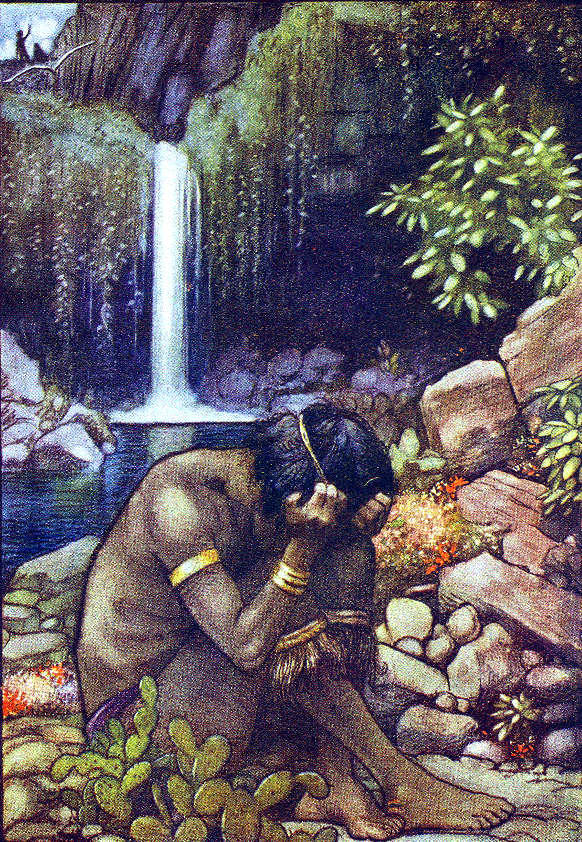 SITTING WITH HIS HEAD BURIED IN HIS HANDS. |
But the woman was not to be silenced, and at last her husband gave way. They followed the bird till they came to the mountain pass where the brothers had halted on their journey. It paused for a moment on the edge of the precipice, and then flew down into the ravine, still calling.
Throwing himself upon the ground, the man leaned over the edge of the rock and saw his son, who had given himself up for lost, seated on the edge of the pool with his head buried in his hands.
The man called aloud, saying, "How come you to be at the bottom of this ravine?"
Looking up and beholding his father the young man told him all that had befallen him and his brother; how they had come upon the deserted village, and had released the old woman, and how she had rewarded him with cattle and sheep.
When he had heard his story, the man hastened back to his hut to fetch a rope, while the mother waited at the top of the precipice and threw down to the boy the food that they had brought with them. Having eaten, his strength was renewed.
Before sunset the man returned, bringing with him a rope, which he threw down to his son. The young man bound it round him, and his father drew him up again. At the sight of her boy the woman wept for gladness, but the father's heart was filled with anger at the cruelty of his first-born. He vowed to punish him with death; but when they reached home they found that the evil-hearted youth had gone, nor did he ever return.
The Childless Woman
In the days when the world was fresh from the Creator's hand, there lived a woman who had no children. Because of this she grieved much and wept in secret, for her husband had ceased to love her, while the other women of the village mocked and pointed their fingers at her as she passed.
One day when she was seated at the door of her hut, two pigeons flew in and scattered the ashes of the fire over the floor, calling to one another, "Vukutu, Vukutu."
"They also come to mock me," said the woman, "because I have no child to scatter the ashes."
And she bent her head and wept anew.
Then one of the pigeons came to her, saying, "Make a wound in your breast, and let the blood from the wound fall into this pot. Cover it over, and there let it be for nine months; but when the ninth moon is at the full, take off the cover and in the pot you will find a child."
The woman did as the pigeon had commanded, and for nine long months she guarded the pot which stood in a corner of the hut, wondering and turning over in her heart the words which the pigeon had spoken.
When the ninth moon hung a great golden ball in the heavens, she knelt before the pot and lifted the cover, and there within lay a beautiful man-child, stronger and fairer than any babe born within the kraal.
While she knelt, the woman heard a sudden fluttering of wings, and through the door of the hut there flew in a pigeon.
"Wrap your child in blankets," it said; "wrap him up well, and keep him hidden from sight that the other women may not see him."
Then the bird flew out into the moonlight, and there came another, saying, "Give your son food enough for a man that he may grow quickly."
So the woman wrapped the child in blankets and took him to the back of the hut, that none who passed might see him. She gave him food enough for a man, as the pigeon had said; and lo! before the sun set on the next day he had grown from a helpless babe to a youth, tall and lissom as a sapling.
When darkness fell the woman lit a fire in her hut, and again covered her son with blankets, bidding him lie still lest he should be seen.
That night her husband returned from a hunting expedition. He was weary, and sat down to rest while she made ready his supper, nor did he perceive the boy who was hidden at the back of the hut.
When the woman had served her husband she took a portion and set it before her son, saying, "Eat this, my child."
"Whose child is this?" asked the man. "To whom are you giving meat?"
"To my son," answered the woman.
"But you have no son," he exclaimed.
"Nay, but I have," said she. "The pigeons told me to draw blood from my breast, and let it lie in a pot until it grew to be a child. I listened to their wisdom, and behold, here is my son."
The man was overjoyed, and the woman rejoiced because her reproach had been taken from her. They lived together in peace and happiness until the end of their days.
The Daughter of the Ostrich Egg
Ohale was a man who had no possessions, neither had he a wife. He lived apart from Mother men, and to keep himself from starving he hunted field-mice. He lived upon their flesh, and clad himself in garments made from their skins.
One day when he was out hunting he found an ostrich egg lying upon the ground, and instead of eating it then, he carried it to his hut, where he hid it, saying, "When the wind blows from the North I will eat this egg."
Next day when he returned from the chase, bringing only a few miserable little mice, Mohale saw with astonishment that a meal of bread and beer was spread for him, just as if he had left a wife at home.
"Mohale," said he to himself, as he sat down to eat, "can it really be true that you have no wife? For if so, who can have baked the bread and brewed the beer?"
The next day also when he returned a meal was spread, and again the next day and the next.
This continued until one night when as Mohale was resting after his supper, he heard the sound of something cracking, and from the ostrich egg hidden at the back of the hut there stepped forth a young and beautiful girl.
Mohale gazed at her in delight and wonder, and seeing that she was fair and kind, he asked her to be his wife. She consented, but she said: "Mohale, you must promise me that even when you have drunk too much beer, you will never call me 'Daughter of the Ostrich Egg.'"
Mohale promised, and he and his wife lived happily together. One day toward sunset she said to him: "Mohale, would you not like to become a great Chief and rule over a tribe of warriors?"
He answered: "Surely, I should wish to be a Chief."
Thereupon his wife rose, and going to the spot where a fire had been burning, she took a stick and stirred the ashes.
Next morning when Mohale woke from sleep he heard the sound of many voices outside the hut, as if a great concourse of men had assembled, and the lowing of many cattle. As he looked round him, he saw to his surprise that the poor hut in which he slept had become like a royal dwelling, while at his side lay a mantle of rich fur, such as is worn by kings. Springing to his feet, he went to the door, and there he saw the assembled men, who came forward, saluting him and crying, "Hail! Great Chief. Hail!"
So Mohale found himself the ruler of a great people, and he lived in plenty and content, loving the wife to whom he owed so much.
But one day a quarrel arose between them, and he reproached her because she had crossed his will. Not knowing what he said, for he had drunk too freely of beer, he broke the promise that he had made her.
"Did you call me the Daughter of the Ostrich Egg?" asked the woman.
"Yes," said Mohale, "I did." And he repeated it. His wife made no answer, but turned and left him.
That night Mohale lay down as usual, wrapped in his mantle of rich fur; but toward dawn he woke shivering. Putting out his hand, he found that his fine mat had disappeared. He lay upon the bare ground, with nothing to cover him but the wretched cloak made of the skins of mice which he had worn when he was a poor man. He called to his wife, but no answer came.
At daybreak he rose, and going to the door saw that the village over which he ruled had disappeared, with all his men and their cattle. Turning back to his hut he found that it had shrunk from a royal dwelling to the poor habitation he had known before. Henceforth until his death Mohale lived alone in poverty, hunting field-mice that he might not hunger.
The Kingdoms of the Dead
Uncama was a little, hairy old man, so old that no one remembered the time when he was young and strong. Even the old men said that he was bent and stooping when they were children.
His wife and sons had died long ago, and Uncama lived alone in a hut outside the village and spoke to few.
Strange tales were told of him, and men said that he had seen things which none other had looked upon, for in his youth he had visited the Kingdoms of the Dead. And this was how it came to pass.
One day when Uncama went into the garden he found that some one had been eating his mealies, so the next morning he rose at dawn to watch for the thief. The dew still lay upon the grass, and Uncama saw the spoor of a porcupine and followed it until he came upon the animal just as it was entering a hole in the ground.
Uncama, anxious to kill the thief, hastened after it, and his heart was so full of revenge that he did not fear to enter the bowels of the earth, saying, "I will go on until I catch the porcupine and kill it."
Because of the darkness he stumbled at every step, nor could he keep pace with the porcupine, and when at length his eyes grew accustomed to the gloom, he could not again pick up the spoor.
He was now weary and lay down to rest. He slept long, and when he awoke he went forward again, not in pursuit of the animal which had eaten his mealies, but that he might satisfy his curiosity and reach the far end of the tunnel into which he had entered. By and by he came to a broad river, which he forded, and seeing open country before him, he pressed on until in the distance he perceived a gleam of light. As he advanced he heard children shouting and dogs barking. The smoke of fires rose from the veld, and Uncama knew that he must be near a village; but he feared to approach, thinking, "These people do not know me. I am a stranger, and it may be that they will kill me."
But he lingered for a while watching the children at their play, and then he turned back the way he had come. Having forded the river once more, in time he came to the entrance of the tunnel through which he had followed the porcupine, and made haste to return to his hut. His wife was sitting in the doorway, but when she saw him she rose and smote her hands together, crying out in fear. And all the people of the village came flocking round, asking, "What is this?"
She answered: "Hau! This is Uncama, my husband, who has come back again." And the people, thinking that it was the wraith of one who had died, lifted their voices and sang the funeral dirge.
"Behold!" said his wife to Uncama, "I have buried your pillow and your water-pot, saying you were dead. I have burned your blanket and your mat."
Then Uncama told her all that had befallen him, and how he had seen people living in a village under the earth.
From that day Uncama dwelt apart, and men shunned him as one who had come back from the Kingdoms of the Dead.
When the World was Young
In the beginning of time when the world was young, four men lived in brotherhood upon a stony hillside; and because in those days men were ignorant, the comrades knew no arts save those of slaying wild beasts for their food and of kindling a fire wherewith to cook the flesh. They knew not how to build a hut nor how to fashion a water-pot, nor how to dress the skins of the animals which they had slain.
And so, hunting by day, and by night sleeping on the ground beneath the stars, the companions lived in fellowship, sharing the food which the chase had provided, until one day on the slope of the mountain opposite to their abode the youngest beheld a woman. He knew not that she was a woman, for until then he had only seen his companions. The longer he looked at the stranger, the more perplexed he became, for though she had hands and feet like his own, they were smaller, and her body was softly rounded. He watched her for some time, and saw that, instead of going forth to hunt, she sat still all day; nor did he ever see her kindle a fire.
At last he said to his companions: "Who may this be, who sits still all day, and who never goes forth to hunt?"
"We know not: it is nothing to us," said they. But the young man said: "I am going to speak with this stranger."
So he climbed the hill where the woman dwelt, and said to her: "Since you do not go forth to hunt, what do you eat?"
"I do not eat. I do but drink water," she replied.
More puzzled than ever, he returned to his comrades, and told them what the woman had said. They answered: "What is that to us?" and lay down to sleep.
The next morning the young man took a portion of meat, and went again to visit the woman.
When he arrived he kindled a fire, and having roasted the meat, he gave her a portion, which she ate eagerly. Before leaving her, he gave her yet another piece of flesh, saying, "When you are hungry once more, roast this and eat it."
On his return his comrades received him with harsh words, saying, "If you give the meat we have slain to the stranger, then you shall no longer hunt with us." But he made no promise that he would not return to her.
Meanwhile, having eaten of the meat, the woman was seized with thirst, and to store sufficient water to quench it, she took clay and fashioned a pot, which she dried in the sun. This she filled at the spring, but because the pot was not hardened by fire it fell to pieces, and the water was spilled on the ground. Then again she took clay, and this time she made two pots. Having learnt from the man how to kindle a flame, she made a fire and hardened them. In one she stored water, and in the other she put the meat and seethed it; when it was ready for eating she laid it on a flat stone, leaving the gravy in the pot. The next time the young man came to visit her she gave him a portion of the meat, saying: "Eat this, taste it"; and she gave him also some of the gravy to drink.
Perceiving that it was good, the man returned to his companions and said: "The stranger has moulded earth: in some of it she keeps water, and in some of it she cooks meat. Taste the meat that she has cooked, and see if it is not good."
This they did, and finding it savoury, one of the men went up to the woman, who gave him gravy to drink from the pot. It was pleasant to the taste, and he marvelled; but having gazed at the woman and her pots, he returned to his companions. When they questioned him, he answered: "She is not like us; she is of another kind," nor did he again go to visit her.
But the youngest of the comrades climbed the hill, and there he abode with the woman.
As for the others, they went away from the hillside which had so long been their dwelling-place, leaving the man and woman together.
Umnandi the Goat-Girl
Once long ago there lived a girl named Umnandi, whose mother had died when she was a babe. She was left to the care of the other women of the kraal, but none of these were kind to her except her old grandmother, who loved the child.
Umnandi was as good as she was pretty, and deserved her name, which means 'The Gift of Heaven,' but nevertheless she was harshly treated and kept hard at work. She had to fetch water from the spring, grind the corn and bake the bread, and she got no thanks for her trouble. The task that she liked best was herding the goats, for then she was away from the scolding women; but it was hard to come home at night to be sent to bed hungry because there was no porridge left for her supper. No matter how hard she worked, she was told that she was a lazy good-for-nothing, not worth her salt.
Umnandi often cried herself to sleep, and as years passed her lot did not improve. The other girls of the kraal were sought in marriage by great Chiefs, who paid a rich lobola of cattle for their brides. The kraal prospered on these wedding gifts, which the brides' relatives held in trust for them, but no one asked Umnandi's hand in marriage, though she was far more beautiful and far more lovable than any of the other maidens of the house.
The older women said many unkind things to her, mocking her because she had no lover, and saying that she was not worth her keep.
Umnandi took her troubles to her grandmother, but in spite of all her love the old woman could do little to make her lot easier.
One day when Umnandi had been making the bread, she took the stick with which she had stirred the meal, and scraping off what still clung to it put it to her lips for she was hungry. Seeing this, one of the women snatched the stick from her hands, and struck her a blow on the head, saying, "It is not for a lazy girl like you to eat food which our other children have brought to us."
By this she meant that as Umnandi had not been claimed as a bride and no lobolo had been paid for her, she was a burden to the kraal.
Crying bitterly, Umnandi ran to her grandmother's hut. The old woman gave her some of her own supper and comforted her as best she could, but next day things were even worse. Two of the goats had strayed and everyone blamed Umnandi; while she was looking for the truants the bread was burnt to cinders, and Umnandi was scolded by all for her neglect.
The poor child could bear it no longer, but ran from the kraal, vowing she would never come back.
"A good riddance," cried one of the women, and the others took up the cry and chased the girl, throwing stones after her and striking at her with their sticks.
The children joined in, and if Umnandi had not been swift of foot she would surely have died, for they set the dogs upon her and had no mercy.
But Umnandi ran like the wind, and at last, when she was out of the sight and hearing of her enemies, she lay down to rest. When she woke the sun had set, and overhead hung the great clear dome of heaven lit by countless stars.
Refreshed by her sleep, she rose to continue her journey, dreading lest the cruel folk of the kraal should pursue her. She was hungry, and from close at hand came the savoury smell of cooked meat. There was no hut within sight, and the girl was puzzled, till she saw at her feet a supper such as she had never eaten; but she dared not touch it.
"It must belong to some one else; if I eat it he will surely kill me," she thought, and went hungry on her way. By and by, however, she grew so faint for want of food that she sat down, and behold! in front of her lay dishes as tempting as those she had left untouched. This time she ate, and no one came to reproach her.
When she had eaten, Umnandi lay down again upon the earth, and slept until the sun had climbed high in the heavens.
For three days Umnandi continued her journey, meeting no one and seeing no living thing, save a buck darting from cover and racing across the plain, or a troop of ostriches running swiftly along the horizon. Each day in the same mysterious fashion a meal was spread for her, and now that she was no longer starved or tormented by the cruel women of the kraal, she grew even more beautiful than before. A stranger meeting her would have said, "This must surely be the daughter of a king."
One evening just at sunset Umnandi came to a grand hut standing by itself. She looked inside, and knew that it must be the hut of a great Chief, for on the walls were hanging brightly polished spears, and on the ground lay rich skins, while the water-pots and cooking vessels were of the finest. Umnandi would have taken shelter there, but feared to do so, and being tired after the day's journey, she lay down upon the grass just outside the hut and sank into a deep slumber.
By and by, the Chief to whom the hut belonged returned, and seeing some one sleeping on the ground, went to look who it was who had entered his domain. When he saw the beauty of Umnandi his heart was filled with love, and lifting her in his arms he bore her into the hut.
This Chief was under a spell by which he had been forbidden to make himself known to anyone for two years to come; and so when morning broke Umnandi found herself alone, and knew not how it was that she came to be within the hut. There was no sign of any inhabitant, but a meal was spread before her, as on her journey, and for many months she lived happy and secure, seeing and conversing with no one.
At last one day a son was born to her, and Umnandi was very happy playing with her baby boy and watching him grow big and bonny. When he began to toddle she thought she would like to take him to show her grandmother, and to ask her leave to bring back a young girl from the kraal to keep her company.
Now, though Umnandi had never seen her husband, he heard all her thoughts and knew her wishes; so that night while she slept, he had everything she needed put into the hut. When she awoke she found not only a basket of food, but a parasol of reeds to shelter her from the heat of the noonday sun, and a stout staff to help her over the rough ground. She set out with a light heart in the cool morning air, her babe strapped on her back.
When Umnandi reached the kraal, the people who had used her so ill now received her with honour, for she was no longer the hungry drudge of former days. She bore herself like a queen, and she was adorned with rich ornaments of brass.
"Umnandi must be the wife of a great Chief," said they, and forgetting their past unkindness, came forward to welcome her. But Umnandi's memory was longer, and she had not forgotten how they had driven her forth with sticks and stones, So instead of entering the huts of the other women, she went straight to her grandmother, who was overjoyed at her return, and at the sight of the beautiful boy.
Umnandi spent many happy days with the old woman; and when the time came for her to return to her unseen husband, she said: "Grandmother, let me take back with me Lielie, the little girl who draws water for you."
"Let it be so," answered her grandmother, and Lielie was happy to go with Umnandi and the babe.
They set out upon their journey, and Umnandi warned Lielie that strange things would happen.
At night an unseen hand spread a supper for them, and Lielie cried out in astonishment.
"Ask no questions," said Umnandi, "but let us eat." In this way they were fed from day to day till they reached their journey's end, and when they entered the hut all was ready for their coming.
Lielie was full of wonder at seeing no husband, but Umnandi would tell her nothing. One day the child ran out of the hut, and Lielie would have followed him, fearing he would fall into the stream.
But the mother said: "Let him go, Lielie; he has gone to see his father and will come back to us soon." The child did this every day, but never once did Umnandi or Lielie catch sight of his father.
Umnandi was an industrious girl, and now that she had some one to help her take care of the child, she said to Lielie: "Let us plant mealies. Up there on the mountain-side is a patch of land which will serve nicely for a mealie field."
Lielie agreed, and just at that moment a bag of seed and a hoe appeared outside the hut, lying ready for their use.
"Put Baby on your back and come with me," said Umnandi, picking up the bag of seed and the hoe, and away they went chattering gaily. When they came back at night supper was waiting for them, and tired with the day's work they ate heartily, and then slept soundly till the morning. There was still more land to hoe and plant next day, and as before they found the seed waiting for them. They set out again, but at noon they discovered they had used up all the seed.
"Go back to the hut, and fetch more," said Umnandi, and Lielie set off on her errand.
When she drew near the hut she saw a crowd of people with herds of cattle moving in the same direction, and so frightened was she that she fell upon her face, and would not look up until one of the women, speaking kindly to her, and bidding her not be afraid, took her by the hand and led her into the hut where sat a man of kingly bearing.
"Go back to the field," he said when he saw her, and tell my wife Umnandi that there is no more seed. But be sure you do not say that I am here, or that a feast is being made ready."
Lielie ran back as fast as she could. "There is no more seed," said she to Umnandi, and picking up the child, the two set out on their homeward way.
As they drew near, Umnandi saw the crowd and asked Lielie what it meant; but the girl, remembering the command of the Chief, made no answer. At last they reached the hut and the Chief came out. The child knew his father and ran to greet him, and lifting him in his arms the man greeted Umnandi, saying to her, "Know me, Umnandi, as your husband. These are my people. They have come to build a village round my hut and to dwell with me."
Then a great feast was prepared, and the Chief told Umnandi how he had been laid under a spell, but that now it was broken. And henceforth they lived together in love and happiness.
Zim the Cannibal
Once upon a time there lived a brother and sister, named Demane and Demazana. They were twins, and their mother had died when she gave them birth. Their father died too when they were babes, and there was no one to look after them except their uncle and aunt.
As they had ten children of their own, they were not at all pleased at having two more mouths to feed, and it fared but ill with the brother and sister. They were given the poorest mats and the most uncomfortable corner of the hut to sleep in, and when there was not enough porridge to go round, it was they who had to go short. They were the drudges of the household, and if Demane did not bring in a large bundle of fire-wood, or Demazana did not grind enough corn, they were beaten and scolded.
The two children were very much attached, and comforted one another in their troubles. When they were about fourteen years old, Demane said to his sister: "I am tired of being beaten and scolded. Let us run away and live by ourselves. I can hunt for food, and you can grind the corn and roast the meat and keep the house tidy."
This seemed delightful to Demazana, and she agreed. So the next morning, just before dawn, they crept out of the hut and set out. It was very cold, and they wrapped their blankets round them to shield them from the wind that came sweeping over the veld. Demane had with him a bundle of hunting spears, and under her blanket Demazana carried a cooking pot; they possessed nothing else in the world.
"Have we far to go?" asked Demazana, a little frightened at the adventure.
"Yes," answered Demane. "We must go right beyond that distant hill"; and he pointed to a kopje over the summit of which the first light of dawn was breaking.
"We must make haste," he added, "for if my uncle finds that we have gone he will come after us."
Demazana stepped out bravely, and her heart grew braver as the sun climbed up the heavens and warmed the earth. At noon they rested in the shadow of a rock, making a meal of the prickly pears which grew near by, and drinking from the stream that flowed at their feet.
At sundown they reached the hill which in the morning had seemed to lie at the edge of the world, and here they found a large, dry cave where they might rest. There were two openings in the walls of the cave through which the air and light came in, and to protect themselves from prowling jackals or thieves, Demane made a strong door from the branches of trees. That night they slept undisturbed.
The next morning Demane made ready to go a-hunting, but before he set out he said to his sister: "Don't cook the hare which I caught last night, because if there are cannibals round here they will smell the roasting flesh, and will come and carry you away."
Demazana promised, but as the day wore on and her brother did not return, she lit a fire and put the hare to roast. She was hungry, and made sure that Demane had not been able to catch anything. He would come home famished, and would be glad to find a nice supper.
"I am sure there are no cannibals about," she said, looking out over the veld. But she was wrong, for if she had only known it, Zim, the hungriest cannibal in all Africa, was lurking quite near the cave. To make things quite safe, as she imagined, she fastened the door on the inside, and then put the meat to roast.
By and by it began to smell in a most appetising fashion, and Zim crept up to the door of the cave, as he had done the night before when he saw the children go in. He had listened to what they said to one another, and so knew all about them.
When he got to the door, he began to sing: "Demazana, Demazana, open the door to me. I have come back from hunting, and I have brought a fat buck."
Now, being a cannibal, Zim had a rough, hoarse voice, and Demazana knew that it was not her brother who stood without, so she answered him, saying, "It is not my brother who sings. His voice is not like yours."
Zim went away, but came back again in a little while, singing in a softer voice and pretending that he was Demane tired with hunting, and hungry for his supper; but Demazana knew that it was not her brother, and would not let him enter.
Zim was determined to get the better of the girl, so he went to his brother cannibals and asked them what he should do to soften his voice.
"Take a red-hot iron and burn your throat with it," said the wisest among them, "then your voice will be as sweet as Demane's."
Zim straightway did this, and going back once more to the cave, sang:
"Demazana, Demazana, Open the door to me."
This time Demazana was deceived by his singing, and opened the door.
In rushed Zim, seized the frightened girl and carried her off across the veld. But Demazana was a clever girl, and while she struggled with Zim, she contrived to gather up a handful of ashes from the hearth. As he bore her away, she let them fall on the ground, so that when her brother found she had gone he would be able to trace her.
When Zim reached his own hut, he found that his wife and children had gone to gather firewood to roast the girl he had promised them for supper. He went out to call them home, but before leaving the hut he put Demazana into a sack, and tied it up so that she could not get out.
Meanwhile, Demane had returned very late from his hunting; all he had to show for his day's work being a swarm of bees, which he shut up in a leather bag. When he found that his sister had disappeared, and saw the fire and the roasting hare, he guessed what had happened, and his heart was heavy.
At first he could find no trace of his sister, but soon he spied the ashes which she had let fall, and followed the trail till he came to the cannibal's hut. Zim was sitting there alone, for he had not been able to find his wife and children, who had wandered far out on to the veld in their search for wood.
Demane entered the hut, and, pretending to be faint and weary, he dropped on to the earth and said: "Father, I beg you to give me some water to drink, for I have travelled far, and I die of thirst."
It was not often that a fine young victim walked straight into his clutches, so Zim said good-naturedly, "I will go and draw water for you,. if you will promise not to touch the sack which lies in the corner."
Demane promised, and Zim went off to the stream which ran at some distance from the house. As soon as he had gone, Demane opened the sack, and great was his joy to see his sister, none the worse for her adventures. She crept out quietly, and in her stead Demane put the bees, which he still carried in the leather bag. Then he and Demazana hid themselves in the bush near the house and waited to see what would happen.
First Zim's wife and children came back, and at once they set about making the fire; a few minutes later in walked Zim, carrying the pot of water. When he saw that Demane had vanished, he was very angry; but, after all, was there not a nice plump girl tied up in the sack in the corner?
"I will catch the youngster to-morrow," said he; and meanwhile we will eat his sister. Wife, open the sack that stands in the corner—there is something nice to eat inside!"
The woman undid the string round the mouth of the sack and put in her hand. She drew it out again quickly.
"It bites," she cried, and would not go near it again.
Then Zim sent first his son and then his daughter to bring the victim out of the sack, but they too gave it up, complaining that the savage creature had bitten them.
Zim was very angry by this time, and calling them hard names, he drove them from the hut, shut the door, and widely opened the sack himself. Out flew the angry bees and stung him till he bellowed with pain. They stung his face and his head, and even his eyes, so that he could not see. Blinded and maddened with pain, he rushed round the hut trying to find the door. But as he had fastened it on the inside his wife and children, though alarmed at the noise, were not able to come to his rescue.
At last Zim found a hole in the roof of the hut, through which he escaped. He rushed toward the river, still howling with pain, and behind him followed the bees, still stinging him in their rage. Into the river he plunged, and by magic was straightway turned into a tree, on a branch of which the bees immediately swarmed.
When his wife and children saw what had happened, they were too frightened to return to their hut, and went away to a far country. Other cannibals also soon heard of Zim's fate; they too took their departure and never returned.
When they had all gone, Demane and Demazana broke into Zim's hut, and there they found rich treasure which he had stolen from the people whom he had devoured. There were beautiful skins, fine earthen pots, and ornaments of brass, and all these they carried away to their cave, where they lived for many years happy and untroubled by cannibal folk.
The Horns of Plenty
At the entrance to a kraal a brown-skinned boy sat watching the sunset. He was thin and small, and he had been crying. Out on the veld the other children were laughing and shouting, but he did not join in their play, for his heart was sore. He had had no supper, and the women of the kraal were all so busy looking after their own children that they had forgotten him The boy's mother had died when he was a babe, and ever since he had been driven from one hut to another His father was out all day hunting and snaring birds, and when he came back at sundown seldom spoke to his little son. That day one of the women had beaten him because the load of firewood which he had brought back was small, and his heart was hot with anger.
"I will go away and never come back," he said to himself. So when darkness settled over the land, and all were sleeping, he rose from the ground, and going to the cattle-shed took one of his father's oxen. Having mounted it, he rode out into the night.
He did not know where he was going, but he wanted to leave behind him all the women who were so cruel to him and who let him hunger.
When he was far from the kraal, he got down from the ox and lay under a tree. He slept until the sun came up again over the edge of the world, when he continued his journey, rejoicing at being far away from those who had ill-treated him.
By and by he noticed a cloud of dust on the horizon, and presently he saw that it was caused by the feet of a herd of cattle coming toward him.
At the head of the herd was a great bull, fierce and strong of aspect.
"Get down from my back," said the ox he was riding. "I am going to fight the bull; but have no fear, for it is I who will be the victor."
The boy dismounted and stood aside to watch the fight between the two strong beasts, who ran at one another with heads lowered and with angry bellowings, pawing the ground till they were hidden from sight in the cloud of dust raised by their trampling feet. The struggle was long and fierce, but at last the ox overthrew his foe, as he had foretold. Then he bade the boy mount again, and once more they went on their way.
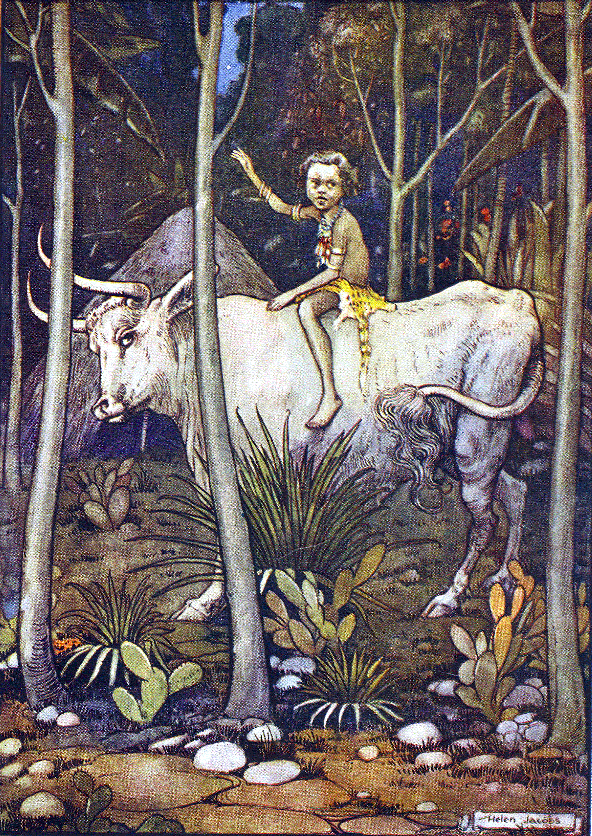 HAVING MOUNTED THE OX, HE RODE OUT INTO THE NIGHT. |
As the day wore on the boy grew hungry. The ox said to him: "Strike my right horn, and food will come forth."
The boy did as he was commanded, and there came forth meat and drink, and he ate till his hunger was satisfied.
When he had finished his meal, the ox said: "Strike my left horn."
The boy obeyed, and the food still remaining entered the horn.
All through the long hot day they journeyed across the veld till, when the sun was low, the boy saw another herd of cattle coming toward them, led by a bull even stronger than the one which they had encountered that morning.
Wearied with the long march and the struggle with his first foe the ox walked with a slow and heavy tread. But he bade the boy once again dismount, saying, "I am going to fight with yonder bull. I shall be overthrown, and death will take me; but have no fear. When I am dead remove my horns, and carry them with you wherever you go; for they will give you food and drink when you are hungry and athirst."
The boy dismounted, and summoning all his strength, the ox rushed toward his foe with lowered head. The fight was long and fierce—fiercer far than the struggle of the morning; but victory was not to the ox, and with a deep groan he sank dead upon the earth.
The boy's heart was sad at the loss of his friend, but remembering his command, he took the horns from his head and went his way.
Night fell, but he journeyed on till he came to a Hut, where he found a man dwelling by himself. The boy asked for a night's lodging, and the man bade him welcome, but said that he could give him no food, for famine had fallen upon the country-side, and everywhere men hungered, eating weeds instead of corn.
The boy laughed. "I have something better to offer you than weeds," he said.
Thereupon he struck the right horn of the dead ox. Forthwith it yielded meat and drink in abundance, and they ate and were satisfied. Then the boy stretched himself on the ground and slept soundly, but the man, who had known the pinch of hunger for many a weary day, lay awake thinking how he might deceive the boy and secure for himself the bountiful horns. At last among the lumber in the hut he found two horns which exactly resembled those his guest had brought; and he laid them beside the sleeping lad, taking away those which belonged to him by right.
At daybreak the boy was ready to start on his travels once more, and suspecting no evil, he picked up the horns that lay beside him and journeyed toward the rising sun.
When the sun beat down fiercely upon the plain at noon he sought the shadow of a rock, and struck the horn, expecting that as before it would satisfy his need; but no food came.
He struck twice and thrice; then, guessing that his host of the night before had robbed him, he retraced his steps and reached the hut just as the sun was setting. He paused outside and listened; the man was begging the horn to give him food, but the horn, answering to no voice save that of its real owner, remained sealed. Then the boy entered, and fearing his vengeance the man ran out into the night, nor did he return. The boy made a good meal of the food which the horn supplied to him and lay down to rest.
Next morning he once more set out, and at night-fall saw a hut standing by itself on the plain. He went up and boldly asked the man who dwelt there for a night's lodging; but he got a rude answer, for he was dusty and travel-stained, and the owner of the hut had no mind to entertain a vagabond.
Hurt by the man's roughness the boy wandered farther till he came to a river, in which he bathed his dusty limbs. Then he struck the horn, for he was hungry as well as weary, and from it there came not only meat and drink, but a mantle of skins and ornaments of brass, such as those worn by the sons of a Chief. Clad thus, next day the boy travelled farther on till he reached a village, and at the sight of the stranger in such regal attire the Headman came forward and bade him to a feast. He was treated with all honour, and remained with the Headman for many days.
Now the Headman had a beautiful daughter, and seeing how fair she was, and how gentle, the boy loved her, and the girl's heart answered to his. This being so, her father ordered oxen to be slain, and a great feast prepared to celebrate their marriage. Ever after they lived in peace and plenty, for the horns never failed to yield food and raiment, and all good things in abundance.
The Dumb Prince
Sekolomi, the Chief's son, was as brave and handsome a youth as ever tracked the wild buck to its lair or led his warriors to battle; but he was dumb. He could hear the grass grow and the buds burst their sheaths in the Spring, but he could hold converse with no one. Yet though his spirit was thus imprisoned, Sekolomi bore himself as a ruler of men, and none could doubt his royal birth.
Now, it happened one day that when he and certain of the young men of the tribe were out hunting, a flight of birds, whose plumage was of a rare and wonderful beauty, passed over their heads. The young men at once hurled darts, but the birds flew on, and they had to chase them for many a weary mile before they brought their quarry to earth. By this time night was falling, and they were far from home; so they looked round to see where they might rest until the morning. One saw at a distance what seemed to be a deserted hut, and finding no one in possession, they flung the birds into one corner of it and lay down to rest.
All slept soundly save Sekolomi, in whose heart was a dim fore-knowledge of evil. About midnight he heard some one approaching the hut, and presently a wicked-looking old woman entered and picked up the dead birds. Then she looked round upon the sleeping men, and fixing her eyes upon the watching youth, she said, "First I shall eat these birds, and then when it rains I shall eat Sekolomi." Then she disappeared into the darkness.
Next morning when the young men woke they saw that the birds had vanished, and they were angry, for they had wished to make head-dresses of their gay plumage. At the door of the hut they saw the marks of foot-prints, but these were soon lost in the long grass, and they could not track the thief. Sekolomi alone knew what had happened, and his lips were sealed.
The young men had no mind to return without feathers for their head-dresses, so they once more went out to hunt. They found birds even more beautiful than those which they had slain the day before, and determined not to let themselves be robbed a second time. Before lying down that night they drew a cord made of plaited grass across the entrance to the hut, and tied strings from the cord to their feet. By means of these they would be roused from their sleep if anyone tried to come in.
There was no rest that night for Sekolomi, who lay awake waiting for the terrible old woman. At midnight she came, but not daring to force her way into the hut on account of the cord across the entrance, she contented herself with muttering as before: "These birds will I eat, and then when it rains I will eat Sekolomi."
With the first light of dawn the young men awoke, and gathering up their beautiful spoil, set out at once with it in the direction of their village.
Sekolomi, however, had been so alarmed by the second appearance of the old woman, and was so confused by want of sleep, that it was not until he had gone some distance that he realized that the bright-hued bird which he had brought down had been left behind in a corner of the hut.
So distressed was he that his lips were opened.
"I have forgotten my beautiful head-dress," he exclaimed. "Which of you will return with me to recover it?"
"A miracle has happened!" the young men cried. "The son of our Chief has spoken."
But none was bold enough to return with him. Each offered him his own spoil instead, begging him not to go back to the place of danger. He gave no heed to their entreaties, and since no one would accompany him, determined to set out alone. Before leaving his comrades he planted his staff in the ground, saying, "If this staff falls to earth, you will know that I am dead, but as long as it remains upright, it is a sign that all is well with me."
His companions saw him go with many misgivings and, fearing to see the staff fall to the ground, sat down to await his return.
Meanwhile Sekolomi had reached the hut without adventure. He had picked up the bird, which still lay where he had left it, but when he came out with it in his hand, he saw not far away the terrible old woman who had visited the hut by night engaged in a fierce struggle with another hag as evil-looking as herself. Sekolomi hoped to pass them unseen, but they caught sight of him, and ceased their fighting that they might chase him. Luckily he was fleeter of foot than they; moreover, a thick fog rose and hid him from their view, and they gave up the pursuit.
Meanwhile the comrades of Sekolomi saw the staff they were watching, tremble. The eldest of them cried: "Brothers, the son of our Chief is in danger; let us hasten to his help!"
Thereupon they set out to his rescue; and in truth he was sore in need of help. Encircled by the fog, he had fallen into a pool wherein dwelt a great snake, which wound itself tightly round his body and made him gasp for breath. He could not shake it off, but managed to scramble out of the pool, and even to walk, though his progress, so handicapped, was slow.
He was now in sight of his comrades, but when they saw him encircled by the snake, they fled and left him to his fate. So ashamed were they afterward of their cowardice that never again did they show their faces in the Chief's kraal.
When at last he arrived at the spot where his staff was planted in the ground, Sekolomi halted and began to sing: "Snake, snake, unfold your coils, and let me take a pinch of snuff."
The snake obeyed, and unwinding its great scaly body, allowed Sekolomi to breathe and to refresh himself. Then once more it coiled round him. So he continued on his way, released now and then from its deadly folds, but only for a few moments.
At last, worn out, Sekolomi drew near to his father's kraal; but it was night, and all the people were sleeping, and there was none to welcome him. At the entrance to the village, however, there was an empty hut, and into this he crept. As he lay down, he begged the snake to release him, that he might rest, but the monster refused, and Sekolomi fell asleep, still tightly enfolded in its clasp, and fearing that he would never awake.
In the morning all the village gathered round the hut where Sekolomi slept, for a herd boy, astir at the first streak of dawn, had seen the Chief's son lying in the monster's coils, and had carried the news to the village.
When he awoke, Sekolomi again begged the snake to relax its hold, but in vain; nor would it yield to the prayers of the Chief or of Sekolomi's mother. But when it smelt the roast oxen which the Chief had commanded to be slain to celebrate his son's return, it unwound its coils and, setting its victim free, glided toward the spot where the meat was cooking and gorged until it could no longer move.
Then came the men of the kraal armed with axes and would have slain it when a woman none had seen before stepped forward, saying, "You must not kill him, for, know you, he is my son."
The young men answered, "No matter; we will slay him, for he has tried to kill the son of our Chief." And forthwith they fell upon the monster.
When it was dead they wrapped the body in the skin of an ox, and placed it on the head of the woman, saying, "Carry away the body of your son from the kraal. It is the body of an enemy, and we will not have it in our midst."
And without mercy they drove her away.
When they returned to the village they found that Sekolomi had quite recovered from his weariness, and the dread he had felt of the snake. He could now speak as clearly as any one. His father ordered more cattle to be slain, and there was joy and feasting.
The Girl with the Lute
Uncounted years ago there lived a girl, the daughter of a Chief, whose beauty was like that of the young grass after rain. There were many suitors for the hand of this fair maid, but she refused all who sought her in marriage, saying that she preferred to remain within her father's kraal. The girl's name was Modisa, but most often men spoke of her as the Girl with the Lute. She was always to be seen with a lute in her hand, and she played upon it so sweetly that no feast was fitly celebrated without her presence. She sang as beautifully as she played, and indeed, so wonderful was Modisa's music, that when the day's work was done the women would cease their chatter, and the men their grumbling, to listen in silence to her songs as they floated out across the veld under the star-lit heaven.
One day Modisa and her brother Masilo were invited to a feast in a village far from their own home. The giver of it was a powerful Chief named Maraka, and not only did he rule over broad lands and own many thousand head of cattle, but it was said that he could cause thunder and lightning to come forth at will, and that rain would descend from the heavens at his bidding.
He received Masilo and Modisa with great honour for the fame of Modisa's beauty and of her sweet singing had reached his ears. When the feast was over he asked her to sing and play upon her lute. Such singing had never been heard before, and with heart aflame the great Chief asked the beautiful girl to be his wife. She answered him as she had done all her suitors, saying that she did not wish to leave her father's kraal.
The Chief's eyes blazed with wrath. Was he who commanded the storm to be denied by a girl, no matter how fair she might be, and even though her voice was like the plash of water in a mountain stream? The proud maiden should suffer for her insolence! So, when the feast was ended, Maraka caused the rain to fall in black torrents; and the women of the village, knowing that Modisa had offended him, refused her shelter. From hut to hut she went asking for hospitality, but no one would let her in. Masilo knew nothing of his sister's plight, for he had taken refuge in a hut belonging to a young man.
The rain fell still more heavily; and at last Modisa, wet and shivering, came to the hut of Maraka's grandmother, and demanded a lodging.
"My hut is full," said the old woman crossly, for she did not wish to incur the wrath of her grandson.
"If you do not give me shelter," said Modisa desperately, "I will kill you."
This frightened the old woman, and she said sulkily: "Well, then, come in, if you must."
Next morning the rain had ceased, and Modisa rejoined her brother and his companions and they set off home again. But the way was difficult, for all the rivers were swollen with the rains, and each little rill had become a roaring torrent. They journeyed on till at last they came to a stream which was so full that it had overflowed its banks; it was running so swiftly that it seemed as if they could not pass the flood.
"You cannot cross this alone, little sister," said Masilo, "but put yourself between me and this tall youth and we will carry you over." Modisa let them take her arms, but so strong was the flood that she was swept from their grasp and flung back upon the shore. A second and a third time they tried to bear her across, but the current was too powerful and they had to leave her on the bank.
Taking her lute, Modisa touched the strings and sang a song of farewell, bidding her brother tell her father and mother how the power of Maraka had caused the floods, and that it was he who would not let her cross the stream.
Masilo answered her song from the opposite shore, bidding her follow the river bank, and not attempt to cross the torrent.
Modisa watched him out of sight; then, tired from the struggle against the rushing stream, she made for herself a resting-place among the reeds, where she might sleep without fear of being disturbed. She lay down and soon sank into a deep slumber; but she had forgotten to hide her lute, and a woman who passed by saw it peeping out from among the tops of the rushes.
"What can that be, I wonder?" she said, and, pushing aside the reeds, she found Modisa sleeping with her head pillowed upon her arm.
"Ah!" she exclaimed. "What a pretty maiden Just the wife for my son!"
Then, touching Modisa on the shoulder, she said, "Come with me, my child." And Modisa, not knowing where else she might find shelter, picked up her lute and went with her to the kraal in which she lived. When they entered the woman's hut, Modisa saw lying within it a large quantity of freshly killed meat, which the woman said was for her son.
"You are to be his wife," she added, "and you must cook this meat and lay it at the threshold of his hut out yonder. You will not see him, for he never comes out, but each day you must carry him food."
Modisa trembled at the thought of this strange, secret bridegroom, but there was no escape, and when the meat was cooked she placed it in a basket and at the woman's bidding carried it to the hut and laid it on the threshold. Then she brought a calabash of milk, and in obedience to her orders withdrew. An hour later she was sent to bring back the basket and the calabash, and of the great repast there was left not so much as a morsel of flesh nor a drop of milk.
On her return her mother-in-law said, "Take this corn, my daughter; grind it and bake bread."
Modisa did as she was told; and when the bread was baked there was water to draw, and more meat to be laid at the door of this unseen ravenous husband for whom, it seemed, she must slave all day.
Weeks passed in unending toil, and Modisa's step was no longer light as it had been when the grass scarce bent beneath her footfall. No longer did she sing as she went about her work, and her lute lay idle in a corner of the hut.
As she passed through the village carrying baskets of food, the women looked at her with pitying eyes, and one old grandmother laid her hand upon her arm, and said: "Why, my poor child, do you stay here? I who am old have seen many a bright young girl like you sacrificed to this devouring monster. Go hence, before your beauty is faded and your strength departed."
"Alas! Where shall I go, Mother?" she made reply. "I am far from my home, and Maraka is angry with me. He will not let me cross the river which divides me from my father's land."
With a sigh the old woman turned away, and Modisa lifted the heavy basket and went on.
But at last her patience came to an end, and one night she left the kraal. As she fled across the veld, she feared to look over her shoulder lest she should see some one in pursuit.
For several hours no one noticed her flight, but finding that no meat was brought to his door at sunrise, the monster she had served came bellowing from the hut where he had been hidden so long, and rushed in anger through the village. At his approach the women caught their children to their breasts and shut themselves within their houses.
Modisa heard him coming, for the earth trembled as he drew near. Although her heart stood still with fear, she summoned up her courage, and began to sing. The voice which had so long been silent rang out pure and clear as the notes of a mountain bird, and all at once the monster stopped in his onward rush. Lying upon the ground, he began to coil and uncoil his great body, fascinated by the sweetness of the girl's voice. Seeing him thus at rest Modisa ran once more, for in the distance she had caught sight of her mother-in-law hastening across the veld. In her hand the woman carried the skin of an ox, and as she approached, her monstrous son roused himself to continue the pursuit of Modisa.
To gain time, she once more began to sing, and at the sound of her voice the monster again lay down. But the respite was short, for no sooner did she begin to run than he gave chase, and meanwhile, too, his mother was gaining on her.
At last Modisa entered into her father's pastures, and when he saw her one of the little herd-boys called out in greeting, "Whence come you, Modisa?"
"Look! Look!" cried the frightened girl. "Do you not see the column of dust which is rising over there. It is raised by a great snake which will devour me if you do not run quickly to the village and call my father and my brothers."
With one swift glance at the monster, the boy turned and ran to the village, and the Chief and all his men came up in haste, armed with darts and spears which they flung at the monster, now close upon the trembling Modisa's heels. Spears pierced its scales, and, maddened by pain, it moved still more swiftly toward its prey. Modisa felt its hot breath upon her face, and with the courage of despair she began to sing once more. The huge snake's rage died suddenly away, and stretched on the ground, it began once more to coil and uncoil its scaly length in lazy enjoyment of the music. While it lay prone the Chief and his men beat it to death with their sticks.
By this time its mother had reached the scene. At the sight of the dead monster she wept, saying, "Alas, my son! Alas! He is dead, and how shall I bring him back to life again?"
"Go," said she, turning to the men, "go to the village and slay a black ox, and bring it here to me."
She spoke like a queen, and the men obeyed without question. When they had brought the slaughtered beast, she took its flesh and bones and laid them with the body of her son in the skin which she carried with her. Then she kindled a fire and let them burn till nothing was left but a few blackened ashes. These she gathered together and put into a clay pot, which she sealed and gave to Modisa, bidding her guard them carefully till the corn was ripe.
"Obey me," she said, "and you will be rewarded."
Modisa placed the pot in a corner of her hut, and guarded it carefully, letting no one touch it but herself, and wondering what might be the promised reward.
Back again among her own people, she forgot her troubles, and her beauty renewed itself from day to day. Her lute, so long silent, sent forth tones even sweeter than of old, and songs more mellow and golden poured from her lips. The summer passed, and through the long hot days Modisa was the joy and wonder of her father's household. Within her hut she still cherished the ashes of her strange and terrible husband, pondering what might be the meaning of the old woman's charge to her. One day when the corn was ripe and the harvesters were busy on the land, she broke the seal of the pot, and from the ashes there rose up a young Chief, tall and straight as a poplar. He bore himself proudly, but as he looked at Modisa there was the light of a great love in his eye, and he claimed her for his wife.
Long ago, he told her, he had been laid beneath an evil spell, but now the power of the enchanter was broken. During the tedious weeks that he had lain shut up within the clay vessel, the sound of her lute had cheered him and filled his heart with dreams of a fair and loving wife. And when Modisa gazed upon this husband, who had once been so cruel a task-master, and was now so tender, her heart sang in gladness, and without fear she left her father's kraal and followed her husband to his own land.
The Lost Beads
Seven maidens set out one morning to draw water from the river, and when their pitchers were filled, six sat down on the bank to wait for the seventh, who had gone a little farther on. Whileshe was absent her companions took of their beads and hid them in the sand, saying, "When our sister comes back, let us tell her that we have thrown them into the river, and see if she will do likewise."
So when she returned, they called out: "Sister, we have thrown our beads into the river! Do you likewise, and see what will happen!"
Feeling curious, the girl flung hers into the water, when immediately her companions dug up theirs from beneath the sand, and, laughing, went homeward, carrying their water-jars upon their heads.
The girl was in deep distress at losing her beautiful ornaments for nothing, so she went to the edge of the water, crying, "Pool, Pool! Show me my beads, which I flung into your depths."
The pool answered: "Pass on."
The girl followed the river bank till she came to another pool, larger and deeper than the one she had left, and gazing into it, she cried again: "Pool! Pool! Show me my beads."
At first there was no answer, but when she spoke once more the waters of the pool divided, and a voice said: "Enter! Your beads are here."
The girl dived from the bank and beneath the waters she found a hut with a piece of ground in front of it. Out of the hut came a poor old woman, hopping on one leg. She had only one arm and was covered with with sores. The girl looked at her with pitying eyes as the poor creature stood in front of her.
"Why do you not laugh at me, little sister?" asked the old woman. "See how miserable I am."
"I am sorry for you," answered the girl.
"Then come and dress my Wounds," said the woman; and while the girl did this she told her that she was the slave of a cruel Dimo who hunted for human beings and devoured them.
"He has eaten my arm and one leg," said she, "but he does not kill me entirely because he needs me to cook for him. If he catches you, he will kill you and eat you, but because you have been kind to me, little sister, I will protect you."
When the girl had dressed her wounds, the old woman fetched food and set it before her, saying, "Eat this, and when you have finished, hide behind this wall, for the Dimo will soon be here, and if he has caught nothing for supper he will be furious and devour you. Beware when you hear a light wind rise, and a few drops of rain fall. These are the signs of his coming."
The girl had not long been in hiding when the wind rose and a few raindrops fell pattering on to the earth. Then came the Dimo, and he was indeed terrible to look upon, for his mouth was red, and he had tusks like a wild pig, while over his shoulders fell long matted hair. He had brought nothing back from his hunting, and he was hungry. As he entered the hut, he said to the old woman: "I smell a human being. Where are you hiding him?"
"I am hiding nobody," said the old woman. "You can finish eating me, if you like; there is nobody else in the house."
Now, hungry as he was, the Dimo did not wish to eat the old woman, so he lay down and went to sleep, snoring so that he shook the hut. Next morning he was awake early, and went off hunting again.
As soon as he had gone the old woman went to the girl and adorned her with beads far more lovely than those she had thrown into the pool. She gave her beautiful brass rings for her ankles, and bracelets of fine workmanship, wrapping round her a rich mantle of skins fit for a royal princess. Then she put into her hand a small round stone, which she bade her keep carefully until she was a mile from the pool, when she must throw it over her shoulder without looking back.
"If you do as I bid you,' said the old woman, the Dimo will not catch you; but beware of looking backward, or you will be lost. Go in peace," she went on, blessing the girl, "and may the rain fall upon you!"
When the young girl was a mile away from the Dimo's pool, she threw back the stone which the old woman had given her. She had now reached the pool into which she had flung her beads, and there, sitting on the bank, was her younger sister, who sprang up with joy at sight of her whom she had given up as lost.
"We have sought you everywhere," she cried, "and we feared you were dead."
"Give me water from your pitcher," said the elder girl; and when she had quenched her thirst they set out on their homeward way.
There was great rejoicing when she entered the village, and the girls who had persuaded her to throw away her beads crowded round her, glad to see that the trick which they had played her had not caused her death.
But when they saw how richly she was dressed, some were jealous, and asked her whence came all the fine things she wore. Then the girl told them what had happened to her, and how the old woman had saved her from the Dimo.
When she had finished her story the six girls talked among themselves, saying, "It is just like her luck. It would never have happened to any of us."
"Why not?" asked one. "Let us go to the pool, and perhaps the old woman will give us beads and ornaments of brass."
Early next morning, when all but they in the village were still sleeping, the six maidens set out, and by and by reached the Dimo's pool. But when the old woman came hopping out on one leg, they laughed at her rudely. "Come dress my wounds," said she; but at this they only laughed the more.
While they were mocking the poor creature, a light wind rose and drops of rain began to fall. The Dimo was coming, but the old woman did not warn the cruel girls of his approach.
When he saw them standing there before his hut, the monster caught first one and then the other, till all six were his prisoners. Then he carried them into his hut, and killed and ate them. Because they had been so cruel to her, the old woman did nothing to save them from their fate.
The Snake with Five Heads
At the foot of a high mountain there dwelt a man who had two daughters, the elder of whom was named Kazi and the younger Zanyani. Kazi was a tall, beautiful girl, but she was selfish and bad-tempered and always quarrelling with her father and Zanyani. She was lazy too, and never took her share of the work, but left Zanyani to gather the firewood, draw the water, and mend the thatch of the hut. If she could help it she would never grind the corn, and when she baked the bread it was always burnt to cinders. In fact, Kazi was so disagreeable and troublesome that as soon as she was grown up her father determined to find her a husband, that he and Zanyani might be able to live in peace.
One day he set out upon a journey, leaving the girls to take care of themselves. When he came to the village to which he was bound, he got through his business as quickly as he could, and then went to drink beer and talk with his friends.
They told him all the news of the village: how there had been a swarm of locusts which had eaten half the crops, how a tiger had come down from the hills and killed three sheep, and, most exciting of all, that the Chief wanted a wife.
The Chief of this village was a great and powerful ruler, but he had never been seen by his people. Some said that he had five heads, each with cruel jaws and a pointed tongue, and that he ate all who angered him.
When Kazi's father heard that the Chief was looking for a wife, he said to himself that his elder daughter would just be the right bride for him, since she was so proud and so self-willed that she would never allow him to bully her, while she was so haughty that he knew she would never consent to marry anyone less than a Chief.
When he reached home again, he said to his daughters: husband?"
"I would," said Kazi, not giving Zanyani a chance to speak.
"Let it be so," answered the father. "To morrow I will call together my friends, and we will escort you to a great Chief who is seeking a wife."
"I do not want you or your friends," answered Kazi rudely. "I will go by myself."
At this her father was angry, for it was not fitting that a daughter of his should go unattended to her bridegroom, or without an ox for the wedding feast; knowing, however, that it were easier to check the wind in its course than to tame the will of his daughter, he bade her do as she pleased.
Early next morning Kazi rose and adorned herself with her anklets and armlets of brass, hanging round her throat a necklace of bright-coloured beads. When she looked at her image in the clear pool beside the hut, she laughed with pleasure, for in truth she was fair enough to win the heart of any man, though she came to him empty-handed.
Then she ran back to the hut, and having filled a basket with bread and wild fruit, she set out on her journey. The sun was rising over the edge of the veld, touching the hill-tops with golden light; the air was frosty, and Kazi ran as quickly as her brown feet could carry her till the blood tingled in her veins, and she began to sing for gladness.
She cared nothing for her father's displeasure. Why should not she, the beautiful Kazi, go unattended to the village of her bridegroom? Let girls less fair than she take gifts of oxen; let these, if they chose, go escorted by their fathers and the village folk!
When she was a league or so from home, Kazi sat down beside a tall aloe to eat her morning meal and to bask in the warm sunshine. By and by something touched her foot, and glancing down, she saw a mouse, which looked up at her as if it had something to say.
"What is it, little sister?" she asked; and the mouse replied: "Shall I show you the way to the Chief?"
Kazi laughed scornfully and said, "Go away, you foolish little creature. Do you think I cannot find my way to him without the help of a little brown mouse like you?" And she pushed it roughly from her.
"If you go alone, you will meet with trouble," said the mouse; but Kazi only laughed, and the small creature ran away.
When she was rested Kazi rose and continued her journey till she came to a brook which was overhung by trees. Sitting down on the bank, she put her feet into the cool running water. It was now noon, and the warm silence was unbroken save for the croaking of the frogs.
Feeling much refreshed, Kazi again went on her way. By and by she saw an old woman sitting on a stone by the wayside.
The old woman greeted her, and said, "I know who you are and where you are going, and therefore I give you warning. Toward sunset you will come to a wood where the trees grow thick as the blades of grass. When you Obter this wood they will mock you with their laughter, but heed them not, for they cannot hurt you unless you laugh back. If you do, then beware, for harm will befall you.
"On the edge of the wood you will see a calabash of thick milk lying on the ground, but no matter even if you are faint with hunger, touch it not. When you have gone farther, you will meet a man carrying a pot of water, and he will offer you a draught; but though your tongue cleave to the roof of your mouth, beware of letting a drop pass your lips."
"First a mouse, and now an old woman," said Kazi, tossing her head. "What wise counsellors! Thank you for your good advice, but I shall do just as I please!"
The old woman made no answer, and Kazi went her way, singing defiantly. By and by she came to the wood of which she had been told, and in the gathering darkness she heard the sound of mocking laughter. She entered boldly, but soon her anger rose, for it seemed as if the trees were pointing their branches like long fingers and making game of her. The mocking laughter grew louder as she went deeper into the wood, and the trees bent and shook with merriment. Kazi grew still more angry. How dare they laugh at her expense! Were not all who knew her proud spirit afraid of her, and was she to be jeered at by trees? The wood was dark and thickly grown, and from its secret places came the cruel sound in rising notes. It was too much; Kazi stamped her foot in anger, and then laughed back—a laugh as cruel and mocking as that of the trees.
For a moment there was silence, and so still was the air that the girl's heart stopped beating. Thick darkness gathered round her, and there was a deep roll of thunder. Then from the depths of the wood came a peal of laughter, louder and more pitiless than before.
Kazi was so terrified that she began to run, and never stopped till she reached the edge of the wood and found herself out on the open veld. Panting with fear, she lay down on the grass to rest and to regain her courage, and by and by when she was refreshed she sat up and looked about her. A few yards away lay a calabash of thick milk, just as the old woman had foretold, but though Kazi remembered the warning, she did not heed it, and eagerly drank the milk.
It was now almost dark, but Kazi had no mind to lie down to rest so near the wood of mocking laughter. So she continued her journey, and after she had gone some little distance she saw coming toward her the strange figure of whom the old woman had spoken.
It was a sight to make anyone shake with fear, for as he drew near Kazi saw that under one arm the man carried his head, and a water-pot under the other. He was bent almost double and walked with a strange, shuffling gait.
Kazi was a bold girl, but if she had not been determined to set at naught the old woman's warning, she would have run away from him. Conquering her fears, she walked boldly up to him and asked him for a drink of water.
Without a word he handed her the calabash and, the girl drank, trembling the while, for the black eyes of the head which he carried under his arm rolled without ceasing, and its teeth chattered noisily.
When the man was out of sight Kazi lay down and slept, and early next morning made ready to enter the village where lived the Chief whose bride she intended to be. When the people saw the tall, beautiful stranger, they gathered round her, asking who she was and why she had come.
"I have come to be the wife of your Chief," she answered haughtily.
"But where is your escort, and where are your oxen? Who ever knew a bride come to her husband without a retinue? The Chief is away, and will not return till nightfall; but you had best go yonder into his hut and prepare his food."
The women of the kraal then led the stranger to the empty hut and gave her corn to grind.
Now Kazi had always left the grinding of the corn to her sister, and because she was unaccustomed to the task, the flour was full of hard lumps. The next thing was to make the flour into cakes and put them to bake, but so careless was Kazi that she let them burn black.
"I can't grind corn, and I can't cook," said she; "but what does it matter, for when I am the wife of the great Chief I shall do no work."
It was now growing late, and Kazi went to the door of the hut to watch for the coming of her bridegroom. The moon had risen and was flooding the veld with light; but there was no sign of an approaching figure, and long did Kazi wait, wondering whence he would come.
All at once the sky was darkened and the hut was suddenly filled with a rushing wind. In a moment the storm ceased, and Kazi saw that a great snake with five heads was close beside her. In each of the five heads gleamed a pair of fiery eyes, which were fixed upon her. "So you are my wife," said the terrible being. The proud Kazi meekly bent her head and waited the pleasure of this horrible bridegroom.
"You are fair to look upon," he said; "but bring me the cakes you have made ready for my supper. I am hungry."
 A GREAT SNAKE WITH FIVE HEADS WAS CLOSE BESIDE HER. |
Kazi looked at the blackened cakes, and for the first time in her life felt sorry that she was so poor a cook. Trembling, she laid them before the snake, who glanced at them with scorn.
"True," he said, "you are fair to look upon, but you are a careless, idle woman "; and he struck her a blow which killed her.
About a year after Kazi's death, news went round that the Chief was again seeking a wife, and Zanyani's father asked her whether she would like to be the bride. The girl consented, and her father chose from his herd a fat ox for slaughter at the wedding feast. Then he summoned his companions to escort the bride, and Zanyani, like a well-mannered maiden, raised no objection.
When all was ready, she set out, attended by her father and a procession of warriors in their bravery of waving plumes and brightly polished spears. As they went upon their way they sang and rejoiced.
On the first part of the journey they met with no adventures. They passed through the mocking wood, hearing no sound but the rustle of leaves, and no headless monster met them; but when they neared the village the little mouse ran out and stopped in front of the bride, saying, "Shall I show you the way?"
"If it please you, little sister," answered she; and the mouse guided them to a place where two roads met, and then vanished into the bush. At the cross-roads the old woman was waiting, and she bade them follow the road to the left. About half a mile from the village to which they were bound the procession halted to rest, and Zanyani strayed a little from the path. Presently a girl carrying a water-pot came toward her, and stopped to ask her who she was, and why she thus wandered by herself.
"I have come to be the bride of the Chief of yonder village," she answered.
"He is my brother," said the stranger; "and since you are to be my sister, let me tell you that, strange and fierce as he seems, he is gentle and good to those whom he loves, and you need not fear. Go to his hut with your father and the bridal escort," She continued. "There my mother will give you corn to grind. When you have ground it, bake it into cakes, and if these are good, my brother will treat you well."
Zanyani thanked the girl and took leave of her; then returning to her father, she told him what had happened.
The journey was now resumed, and the procession escorted Zanyani to her husband's hut. As the friendly stranger had said, the Chief's mother was waiting to receive her new daughter-in-law. She gave the bride corn to grind and then left her alone in the hut.
By and by there lay ready a row of cakes made of fine flour, baked as only a skilled cook could bake there; and Zanyani sat down to wait the coming of the bridegroom.
Night fell, and presently there came the sound of a rushing wind, and the snake with five heads came forth. He glanced first at the bride and then at the cakes, and into his fierce eyes came a gentler light. Having swallowed the cakes, and finding them good, he turned to Zanyani, saying, "Are these of your baking?"
Zanyani bent her head in assent, and the horrible form began to change. From the scaly slough of skin that fell from him there rose a tall and handsome warrior. He looked tenderly upon the girl.
"You have freed me from the spell which has lain upon me this many a year," he told her. "It could only be broken by the willing service of a gentle wife."
Then the Chief came forth among his people, and the wedding was celebrated with feasting and joy.
Tanga the Child of Night
Long ago there lived a woman who had no children, and her husband never ceased to reproach her on this account. Her grief was bitter, and she suffered much from his unkindness, until he left her. In her loneliness she was happier than in the days when she had to bear his harsh words.
Left to herself, she often lingered by the river, and when at night the moonlight turned the surface of the stream into a silver mirror, she would sit for hours on its banks. Her favourite resting-place was beneath a spreading date-palm, and there she would remain through the quiet hours listening to the plash of the waters till the sun came up in glory over the world's edge.
Sometimes she wept, thinking of the child which would never now be hers. One night when her tears had fallen fast she heard the piping of a bird, and looking round saw a little wag-tail hopping about restlessly in front of her. She held out her hand; the bird perched on her finger, and then sprang to her shoulder straining to reach her ear. It was clear that he had something to say to her, so she bent her head to catch his message. Before long, he twittered softly, she would possess a baby girl, fairer than any other that had gladdened a mother's heart. She was to be named Tanga, and lest ill should befall her, she must never leave the shelter of the hut from the rising of the sun until its setting. Under the starlit sky, in the gracious moonlight, she would grow more beautiful than the moon herself.
The woman's heart sang with gladness, and night after night she sat beside the river thinking of the joy that was to be hers. The little bird came always to share her happiness, but when at last her babe was born it vanished and was heard no more.
Now began happy days for the mother. Through the hours when the sun, the Eye of Day, ruled in the heavens, she kept the child safe within the hut, but when night fell she took her to her resting-place beneath the date-palm, and watched her grow in beauty, softly bright, like unto the moon and stars.
Years passed, till Tanga was a full-grown maiden. The fame of her beauty spread about the countryside till it reached the ears of her father, who, filled with remorse and a longing to see his fair daughter, returned to his wife. He gave a great feast, to which were bidden all the Chiefs from the neighbouring kraals, and among them were many suitors for Tanga's hand. The girl's choice fell upon a youth who for strength and courage was worthy of her.
When the wedding feast was over, Tanga took leave of the mother who loved her so tenderly, and left the home of which she had long been the joy.
The bridal procession set forth under the stars, for the bridegroom had been warned that evil would befall his wife if she went abroad by day, and had sworn to shield her from harm.
Tanga would have been happy and blessed in her new home, for her husband loved her with a great love, but for his father's hatred. From the first he had distrusted this strange bride, who kept within the shelter of the hut while the sun ruled and wandered forth only at night. He called her harsh names and gave her cold looks; nor was he kinder when her child was born, but continued to lash her with his tongue, in spite of his son's remonstrances.
When the boy was but a few months old, Tanga's husband had to go upon a long journey. After his departure her troubles increased, for the old man grew more cruel every day. Knowing that Tanga dared not venture into the daylight, he plotted to make her leave her hut before sunset, and one morning commanded her to fetch him water from the spring. In vain she begged him not to send her; he swore that if she did not go he would beat her.
In her hut there was water standing in a calabash; this Tanga sent to him, as if she had fetched it from the stream. But the old man, who had been watching, knew that she had not ventured into the daylight, and flung it to the ground, saying that it was not fresh. Going in anger to her hut, he raised his stick and compelled her to leave its shelter. Tanga weepingly took the pot to the river, but when she leaned over the bank to fill it, the Water Spirit rose and dragged it from her hand.
She returned to the kraal with the empty pot, but though she told the tyrant what had happened, he drove her back again. This time when the Water Spirit rose, he seized her and bore her to his home beneath the waters, where he dwelt in state. Wooing Tanga very tenderly, he begged her to be his wife, bringing her chains of rare shells to hang round her neck and crowning her with garlands of blue water-lilies. But Tanga said nay to all his entreaties, and wept ceaselessly for the child whom she had left.
There was sorrow and consternation in the kraal at her disappearance, and the old man began to fear his son's anger. None of the women could still her babe's cries, and when night fell the nurse took him in her arms and carried him to the stream. The sound of his weeping reached Tanga beneath the water, and she rose to the surface, holding out her arms. The little thing knew her, and with a gurgle of delight he stretched out his own in return. Fairer than ever in her garland of blue lilies, with the chain of gleaming shells round her neck, Tanga took him to her heart and held him in a close embrace till the night faded and the sun rose over the horizon. Then she gave him to the nurse, bidding her return at sunset.
Each night the girl came back with the child, and soothed by the hours spent with his mother, he throve, and ceased to fret in the daytime.
The old man, suspecting that Tanga was alive and in hiding, questioned the girl as to where she went when she was out with the child. She answered that she walked in the woods and fed him on wild berries, which satisfied his hunger.
Time passed, and at last Tanga's husband returned and demanded to know what had become of her. When he learnt what had happened his anger knew no bounds; he would listen to none of his father's excuses. Seeing, however, that the child throve, he also questioned the nurse, who told him all.
That evening he too went down to the river and hid himself among the reeds. As Tanga rose to the surface of the water at the sound of her baby's cries, he came out and flung round her a rope he had brought. But the Water Spirit, who knew all she did, seized her and dragged her down again, with a roar of anger causing the waters to rise till they over-flowed the banks. So enraged was he that the tide was red as blood, and followed the man back even as far as the kraal.
For many moons Tanga was not seen again, and the child wept uncomforted. But night after night she was heard singing beneath the waters, and her husband, seated on the river-bank, heard her voice raised in pleading:
"Why do they not send to my father and mother?" she chanted sadly. "Here I lie a captive, but my mother could bring me back to earth." Then the singing ended; and there was no sound, none save that of weeping.
As her husband went back to the kraal, wondering whom he could send to her parents as a messenger, a cock stepped in front of him, saying, "Master, send me. They will heed what I say."
"Go," he replied, "and luck be with you."
For two days and two nights the cock journeyed till he came to the kraal where Tanga's parents dwelt.
As he entered, the boys threw stones at him, but he lifted his wings and flew on to the roof of the Chief's hut, where he crowed so loudly that all the people came running to know what might be the meaning of the disturbance.
All having assembled, he told the story of Tanga's captivity and of the cruel father-in-law. When he had ended he was fed with corn, and Tanga's parents treated him with great honour. With him for a guide, they set out to rescue her; for, be it known, Tanga's mother was a worker of spells and charms.
When they reached the village where dwelt Tanga's husband, her mother ordered an ox to be slain—an ox which bore her daughter's name, and was for her use alone. The beast having been slain, she cut up its flesh into pieces, muttering charms as she did so. These pieces she flung into the river; as they sank, Tanga rose to the surface and swam to the bank, for now the power of the Water Spirit was ended for ever.
Her husband was waiting there to receive her, holding their child in his arms. In triumph the lost wife was led back to the village, where the rest of her days were spent in peace and happiness with those she loved.