Opening the West with Lewis and Clark - Edwin Sabin |
Peter Wins His Spurs
To twenty-one, and then to thirty-eight below zero dropped the thermometer. The captains forbade the men to venture far from the fort, and the sentinels were relieved every half hour. The air was so filled with ice haze that two suns seemed to be shining.
Of course not much work could be done out of doors, in such weather. However, with the first warm spell, at twenty above, Pat, the boss carpenter, hustled his squad to complete the fence. Lustily chopping with broad-axes they rapidly turned out pickets that were two feet wide, four inches thick, twelve feet long and sharpened at both ends. These were set upright in a shallow ditch and spiked, edge against edge, to the stringers.
Finally Pat swung the heavy gate to and fro on its leathern hinges; it closed perfectly, and the bar that fastened it dropped easily into place. That was the last touch, and Pat heaved a sigh of relief.
"'Tis a good job well done, lads," he complimented. "An' jest in time. To-morrow we cilibrate."
"Why, Pat?" queried Peter.
"Sure, ain't to-morrow Christmas?" rebuked Pat. "That's a new wan to ye, mebbe?" And Peter needs must have "Christmas "explained to him.
Yes, the captains had decided to celebrate. They instructed Chaboneau to tell the Mandans that on the morrow the white men were to have a great medicine day, and that no Indians should come near. That night, in the mess cabin, Patrick Gass passed another word.
"It's all o' yez up 'arly in the mornin', boys," he said. "We'll wake the captains with thray rounds, so they'll know we've not forgot." And he winked.
In his bunk Peter was roused with a jump, amidst the grayness, by a thunderous noise. He sprawled to the floor—he heard a voice giving sharp orders, and before he could reach the door there was another thunder. Had the Sioux come? No! It was Christmas, and the celebration had begun. He opened the door—powder smoke wafted into his nostrils, the men had formed two lines down the middle of the street, their rifles were leveled, and "Whang!" they all spoke together.
"Hooray!" now the men cheered.
"Christmas Day in the mornin'!" shouted Pat, waving his cap. The door of the captains' cabin opened and the captains stood gazing out; York's black face peering over their shoulders. "Merry Christmas to yez, sorrs," welcomed Pat, with a bow and a scrape. "It's only welcomin' the day, we are, an' christenin' the flag with a bit o' powder." For from the flagstaff in the street floated the United States flag.
"Very good," approved Captain Lewis. "Merry Christmas to each of you. You may dismiss the men for the day, Sergeant."
What a jolly day this day of Christmas proved to be. Nobody worked, everybody was merry. After breakfast in the mess hall, which was a cabin with a table down the centre seating twenty on a side, and a huge fireplace at one end, and a loft for the cooks and their supplies, the table was moved, One-eyed Cruzatte and George Gibson tuned their fiddles, and the men danced and capered.
There was a big dinner, of juicy meats, stewed corn, stewed dried pumpkin, with plum pudding at the close. The captains were present, in uniform. There was more dancing, and story-telling; not until late at night was the fort quiet. All the Indians had kept away.
Thus was passed Christmas Day, 1804, at this first United States fort west of St. Louis, 1600 miles up the River Missouri, in the centre of a North Dakota yet to be named.
"When do we have another Christmas, George?" asked Peter, eagerly.
"Not for a long time, Peter," laughed George. "Christmas comes only once a year."
For, you see, Peter had a great deal to learn.
Now Fort Mandan settled down to a winter routine. The United States flag floated. The swivel cannon from the barge had been planted in the street, its muzzle commanding the entrance. Just outside the gate a sentry constantly paced, by day; another sentry walked a beat on the top of a mound of earth that half circled the rear of the fort and banked the store-rooms against the cold. John Shields, the blacksmith, established his forge—and that, also, was great medicine. The Indians crowded about to watch the bellows fan the charcoal into ruddy heat. Even the interpreters were astonished, when John set to work.
"Ma foi!" exclaimed Toussaint Chaboneau. "I go get my squaw's kettle. She haf one hole in him."
Away he ran, and returned with Sa-ca-ja-we-a, bringing her kettle. A gentle little woman was the girlish Sa-ca-ja-we-a, or Bird-woman, of the far distant Snake nation; everybody was fond of her. John Shields willingly took the kettle, and patched the hole in it; and beaming with smiles the Bird-woman hastened to put it on her fire again.
But the wife of Jessaume had a kettle which could not be mended; and very indignant and jealous she left the fort, with her kettle and her children, and went across the river to her own people.
"Huh!" said Jessaume, shrugging his shoulders. "She be so bad, guess I get 'nodder wife."
John Shields not only mended kettles for the women, but he mended the battle-axes and tomahawks of the men. From scraps of sheet-iron and tin he manufactured a marvelous variety of articles—hide-scrapers, punches, arrow points, and occasionally a whole battle-ax. For these, the Indians from the villages traded corn and beans and dried pumpkins, so that John proved to be a valuable workman.
William Bratton and Alexander Willard sometimes helped him; and as they were gun-smiths too, they repaired the rifles of the expedition and the few fusils of the Indians.
The weather blew warm, and cold again. There were hunting excursions; and on January 1, 1805, which, Peter learned, was called New Year's, there was another celebration, like that of Christmas.
"Ze Mandan, dey reques' we pay visit to deir village an' show ze squaw an' boys how ze white mans dance," informed Chaboneau, in the morning, after a call from Big White.
So the captains gave permission for Cruzatte and George Gibson to take their violins, and for York and Patrick Gass and a dozen others to go, and entertain the village of Big White.
They trapsed gaily across the river, and in the lodge of Chief Black Cat, who lived at this village, Francois Labiche, one of the boat-men from Cahokia, opposite St. Louis, danced on his head to the music of the two fiddles, and thereby greatly astonished the Indians.
The village rewarded the dancers with buffalo robes and corn; and that evening Head Chief Black Cat brought to the fort another quantity of meat packed on his wife's back.
"Let the white medicine dancers visit my other villages, or there will be jealousy," he urged.
"I will haf no more hair," complained Francois Labiche.
Forty below zero sank the thermometer. John Newman froze his feet so badly that he was unable to walk in, and a rescue party with horses were sent to get him.
Captain Clark, with Chaboneau as guide, led a hunting party down-river, with the thermometer eighteen below. Chaboneau returned alone, to say that Captain Clark had obtained some meat, but that the horses could not carry it on the slippery ice.
"Your wife is ill, Chaboneau," informed Captain Lewis. And Chaboneau rushed for his lodge. Forth he darted again.
"My wife she ver' seeck," he cried, wringing his hands. "W'at s'all I do? I fear she die, ma pauvre Sa-ca-ja-we-a (my poor Sa-ca-ja-we-a)."
"I'll try to tend to her, Toussaint," said Captain Lewis; and got out the medicine chest.
But all that night, and part of the next day the groans of the little Bird-woman could be heard.
"Dere is one remedy I hear of," spoke Jessaume. "I sorry my wife lef'. But sometime de Injun gif de rattle of de rattlesnake."
"Let's try that, then," bade Captain Lewis.
So the captain broke open the specimen bales in the store-room and found a dried rattlesnake skin. With Chaboneau jumping about imploringly, he crumbled two of the rattles into water, and this the suffering Bird woman drank. Everybody at the fort was interested.
Soon from the lodge of Chaboneau issued a new sound—a feeble, shrill, piping wail. But the groans of Sa-ca-ja-we-a had ceased. Out again darted Chaboneau, his leather face beaming.
"One fine boy," he shouted, capering. "It is all right. One fine boy. I t'ink he look like me."
The next day, which was February 12, the hunting party returned, having left their meat in a pen to protect it from the wolves.
"I have the honor to announce a new recruit, Captain," reported Captain Lewis, saluting Captain Clark, a twinkle in his eyes.
"What's his name, Merne? Chaboneau?" demanded Captain Clark, smiling broadly, with cold-reddened face.
"He is leetle Toussaint," proclaimed Chaboneau. "One fine boy who look so han'some as me."
"B' gorry," uttered Sergeant Pat, "an addition to our number, is it? Faith, he has good lungs, but I thought it was a weasel chasin' a rabbit."
The next morning four men and three horses to haul sleds were sent down to get the meat; but at evening they came back empty-handed. A hundred Sioux had robbed them. Captain Lewis set out at sunrise, to punish the robbers. Only three or four Mandans went. Chief Black Cat said that his young men were out hunting, and the villages had few guns, so his people could not help the white soldiers.
Captain Lewis was gone six days. He did not overtake the Sioux, but he brought up the meat—part of it on a sled drawn by fifteen men.
Mr. Gravelines, the trader, arrived from the Ankara nation. The Sioux sent word by the Arikaras that they would hereafter kill the white soldiers whenever they caught them.
But nobody at the fort minded these threats. February slipped into March, and all thoughts were turned upon the onward journey as soon as the river opened.
The thermometer rose to forty above zero. A flock of ducks were seen; flying up stream.
"The first sign," quoth Sergeant Gass.
The weather was "open an' shet," as said Pat, with wind, sunshine, and snow flurries. But the ice in the river began to move, a little; another sign of spring. The captains decided that the barge was to be sent back to St. Louis, with the specimens, and the Corporal Warfington squad and other extra men. Under the direction of Captain Clark and Patrick Gass, the carpenter, boat timber was cut, and small pirogues, or canoes, were built, to take the place of the barge. John Shields was busy all the days long, making battle-axes to trade for a fresh supply of corn.
The store-room was ransacked and the clothing and such damp stuff was hung out to dry. Great strings of geese and swans and ducks passed, northward bound. The rising river burst into a channel; down it floated ice cakes, carrying buffalo, elk and deer. The Indians, running out across the firmer ice, killed them with spears. The canoes were finished and brought out of the timber, and to the bank at the fort. All hands weie put at work loading.
This was an anxious time for Peter. Was he to be sent down with the barge, or was he to be taken on, with the captains and Pat and all?
"I go," announced Chaboneau. "I engage' as one interpreter, for ze journey to ze Rock Mountains an' ze salt ocean. I take my young wife, an' my baby, but I leave my of wife."
"Do I go, Pat?" queried Peter.
"Well, now, I dunno," drawled Pat, pausing to wink at Toussaint. "An' what would we do with a boy, yonder up amongst the white bear an' the two-headed Injuns? For I hear there be giants, wearin' two heads on their shoulders. Sure, they'd ate a boy with only one o' their mouths."
"I hunt," asserted Peter.
"Would ye kill bear an' buff'lo with the bow an' arrer?" teased Pat. "Ain't we got Drouillard an' Fields an' the captains an' meself, all handy with the gam?
"I show you, Pat," exclaimed Peter.
Two steps he made, and grabbed his bow and quiver, where they were lying on the gunwale of the barge. The quiver was full of iron-pointed arrows, which John Shields had equipped for him. Out he ran, upon the ice of the river. His quick eye had noted a black object floating down the channel aboard a floe. No Indian was after it, yet. He would show that he was as good a hunter as any Indian.
Buffalo? Mc? Deer? Wah! It was crouching, and he could not yet tell. But fast he ran, in the slush, dodging air-holes, and with the ice weaving and bending beneath him. Suddenly, as he approached, heading off the floe, the creature stood. It was no buffalo, or elk, or deer; it was a bear.
Wah, again! Also, hooray! Voices were shouting at him, to turn back; but, no, he would not turn back, even for a bear. He was a hunter. He rani faster, because he was afraid that some of the men would come with guns.
He reached the edge of the channel. The bear, stiffened, lowered its head, and bristled, showing every fang. No "white bear "was it, evidently. It was a brown bear, but an old one, large and cross. Below, a few yards, the channel narrowed; the floe might lodge there, or the bear be enabled to spring from it to the other ice. Peter must act quick. He knelt and bent his bow—drew the arrow clear to the iron point, so that his arm holding the bow was straight and the hand of the other arm was against his shoulder. That was the way to shoot. The bear was right in front of him, balancing on the ice cake. Twang-thud! The arrow struck true—was buried to the feathers where the bear's neck met shoulder.
Now another! Up reared the bear, roaring and clawing, and the floe swerved in toward the channel's edge. Peter in his haste to pluck a second arrow, string it and launch it, slipped and fell sideways—and on the instant the floe had touched the channel edge, where the channel narrowed; roaring, the bear had sprung ashore, and roaring he was coming, the arrow feathers dripping red and his tongue dripping red, and crimsoned froth slathering his open jaws. The bristles on his back were full six inches high:
All this Peter saw in a twinkling. He had time only to launch his arrow. But he took good aim, there on his knees; whang-thud!—his second arrow landed near the first; and away he ran. From the bank at the fort men, both white and red, were running, too; running to help him. They waved their arms and weapons, shouted loudly.
Peter changed his course. They should not help him. He would show Pat, and the captains, and everybody, what he could do. He glanced over his shoulder. The bear was close. A bear could easily outrun a boy, or a man, and for a short distance, a horse. Aside leaped Peter, digging in his moccasined heels, for foothold in the soft spots; another, arrow was on the bow-string; with scratching of claws and furious growl the bear slid past. But Peter had turned in a flash, and while turning had drawn his bow. Whang-thud! The arrow sank almost out of sight in the bear's ribs, forward where the heart should be.
"Hooray!" cheered the shouting men.
The blow had knocked the bear down. He went sliding, in a struggling heap. Now he roared indeed, and twisting his head bit at tile arrow. Up he rose, sighted Peter, and on he came. Peter lost a moccasin, his foot slipped. He stood his ground, held his breath, and took very careful, cool aim—bending his bow till it quivered in his grasp. A moment more, and the bear would rear, to strike him—and he loosed the taut string. The arrow struck the bear right in the nape of the burly neck; his head was low, bear fashion, and Peter had taken the chance. Down sprawled the bear, as if smitten by lightning, for the arrow point had cut his spine. He shivered, and was still. The four feathered ends jutted from his hide. He was a dead bear.
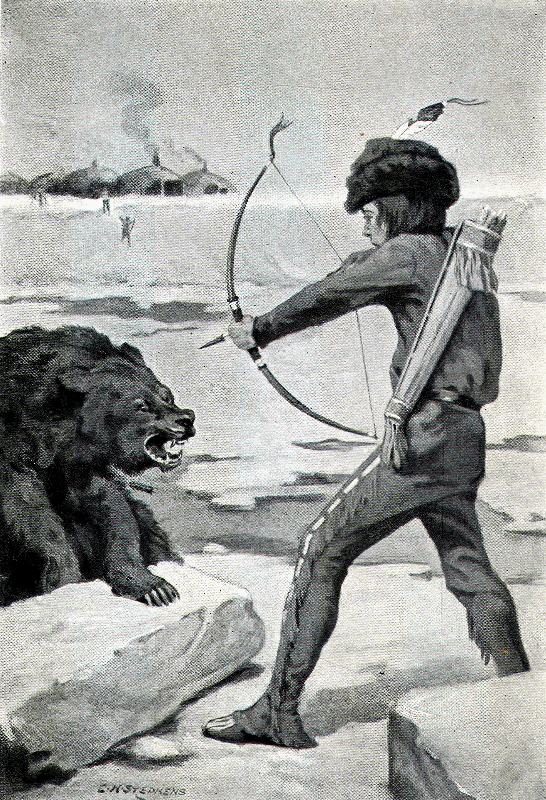 UP HE ROSE, SIGHTED PETER, AND ON HE CAME. |
"Glory be!" panted Sergeant Pat, arriving. "An' ye did it all by yourself! But, sure, I thought I see ye 'aten up entoirely."
"Huh!" grunted Little Raven, second Mandan chief, prodding the lax, furry carcass with his spear. "Heap boy. Make big hunter."
All together they dragged the bear, at the end of Pat's belt, to the barge. Peter, of course, said nothing. But when Captain Clark clapped him roundly on the shoulder, and Captain Lewis said, Well done, Peter," he knew that he stood a good chance of being taken up-river. The Long Knife was not much given to idle words; but he appreciated deeds. The bear proved to be very old, very thin, with tusks worn to stubs. Hunger had driven him out of his winter hole early. The hair of his hide was loose. Nevertheless he was a large specimen.
"We'll send his head to the President," remarked Captain Lewis to Captain Clark. "No such bear as this can be found in Virginia or Kentucky."