Tudors and Stuarts - M. B. Synge |
How Men and Women Lived Four Hundred Years Ago
 KING HENRY VIII, AT THE FIELD OF THE CLOTH OF GOLD. |
It is always easier to grasp the great movements of history when the figures moving across the ever-shifting scenes appear as real men and women; when we can picture to ourselves their dress and their food, their manners and their customs, the houses in which they lived, and the work in which they were employed. Thus, and thus only can we live again in the ages that are past.
It is four hundred and thirty years since the first Tudor began to reign. The period, known to history as the Tudor period, begins with Henry VII in 1485 and ends with Queen Elizabeth in 1603. During this interval a whole family reigned in turn, Henry VII, his son Henry VIII, and his three grandchildren Edward VI, Mary and Elizabeth.
What was life in England like during these five reigns? We must first imagine a country without many of those modern comforts which to-day we look upon as necessaries. To begin with, there were no trains, no motors, no cabs, no steamers or bicycles. Thus people had to ride on horseback or walk or row on the rivers to get from one place to another. There was no electric light or gas; so the Tudors had either to go to bed with the sun, or work by means of candles and lamps. There were no pavements or shops till Elizabeth's reign; the people bought and sold on market-days in the open market or made what they needed at home.
There were no libraries; books were expensive even for the rich; many of the poor people were taught by the religious orders and the clergy were largely recruited from the ranks of the labouring classes. There were no letters or newspapers or post-offices or pillar-boxes. Letters and messages were carried from place to place by men on horseback, and no telegraph or telephone wires disfigured the country.
Then again they had no tea or coffee to drink. All the people (from monarch to peasant) drank beer; they drank beer for breakfast, beer for dinner and beer for supper at six. They had no potatoes, no cabbages, cauliflowers, carrots or lettuces; they had no strawberries or rhubarb, no currants or lemons. Neither had they tobacco to smoke, or soap to wash with, or pencils to write with, or pianos to play.
And yet, without these things, which play so large a part in our lives to-day, it was a "Merrie England" in the days of the Tudors, except when insurrections and religious persecution brought misery to many homes. The monarchs delighted in the rich display of pomp, in royal journeys through the land, in tournaments, and in Christmas revels, when England rang with mirth from end to end. "Sports and fooleries, feasts and frolics, games and revels filled the joyous days from All Hallows' Eve to the Feast of Pentecost."
The beating of drums, the shrill blast of trumpets, the ringing of many bells were as music in their ears. And when we read that the musicians of Queen Elizabeth's household included eighteen trumpeters, seven violinists, six men who played flutes and six who played sackbuts, we feel there must have been some want of refinement in this matter.
But the people were light-hearted. Dancing was a very favourite amusement; every one danced, from the kings and queens to the milkmaids; even grown men and women danced round the May-pole every May Day.
They had not learnt to take pity on the suffering in those early days; so they saw no horrors in their favourite amusement of bear-baiting, and the pain of animals filled them with no pity. They were familiar with public executions, which were performed by the local butcher on market-days, and they could look at martyrs burning at the stake without shrinking. It was an age when different religious opinions were not tolerated, an age of torture by the horrible rack and thumbscrew, an age of human agony unrelieved by sympathy. "This is how we punish traitors in England," Queen Elizabeth once informed a stranger, who had counted three hundred heads hanging piked on London Bridge.
![[Illustration] from Tudors and Stuarts by M. B. Synge](books/synge/tudors/zpage012.gif "[Illustration] from Tudors and Stuarts by M. B. Synge") A KING TRAVELING WIHT AN ESCORT OF BILLMEN. |
To impress their subjects with a due respect for their power, the Tudor sovereigns spent enormous sums of money on display. Their clothes were magnificent, with their costly splendour and brightness of colour. No King of England ever rivaled Henry VIII's magnificence at the Field of the Cloth of, Gold. No monarch, ever surpassed Queen Elizabeth in the splendour and glory of her yearly progresses, or journeys, through the home counties from country house to country house.
This extravagance in dress was copied; by the nobles of England. The gorgeous clothes of Wolsey rivaled those of his king. He wore crimson silks and satins, a tippet of costly sables, red silk gloves, a scarlet hat, and silver gilt shoes inlaid with pearls and diamonds! Men in those Tudor times were as particular about their dress as women. Their wardrobes were full of furs, frills, ruffs and feathers; they wore doublets, or stuffed garments, of gold-coloured cloth, coats of crimson satin, long hose, fur-lined hoods, rings, brooches, chains, jewelled caps and broad-toed shoes with Tudor ribbon roses on the instep. A pointed beard and a large ruff marked the courtier of the sixteenth century. Ruffs were also worn by women during the reign of Elizabeth—their whole dress was stiff and unnatural. They wore large round petticoats stiffened with whalebone, so large round the hips that a sort of table was formed on which the arms could rest, while the upper part of the figure was squeezed into a stiff pointed bodice with low neck and full sleeves. Equally elaborate were the head-dresses of the Tudor ladies, for they all wore wigs and dyed their hair in imitation of the queen.
 VISITORS ARRIVING AT THE PORCH OF A MANSION, MONTACUTE, SOMERSET, IN THE DAYS OF QUEEN ELIZABETH. |
Neither were their houses and palaces less elaborate. Hampton Court, built by Wolsey and given by him to Henry VIII, was typical of Tudor glory, containing rich tapestries, cushions embroidered with gold and silver, counterpanes lined with ermine. At Whitehall, famous for its library, books were bound in velvet studded with precious stones and clasped with clasps of gold. There was no simplicity anywhere.
Large four-post beds were a feature of the age; these were made with massive pillars bearing a weight of heavy curtains edged with gold and silver lace. Small panes of glass were now used for the first time for the windows of the Tudor palaces. Gardens too were laid out in front of the palaces—gardens with stately terraces, broad flights of steps, vases and fountains and yew hedges cut into strange shapes A great improvement which now became common was the use of chimneys to carry off the smoke. As much care was bestowed on the chimneys and gables as on the rest of the building, so as to ensure a pleasing effect.
![[Illustration] from Tudors and Stuarts by M. B. Synge](books/synge/tudors/zpage014.gif "[Illustration] from Tudors and Stuarts by M. B. Synge") CHIMNEYS OF THE TUDOR PERIOD. |
Yet with all their luxuries and their wealth, and in spite of the picturesque gables and carved gateways of their houses, it is strange to find a great want of refinement in the daily lives of the Tudors. They had no carpets in their rooms and their floors were covered with rushes or earth only changed once or twice a year! It is true, fresh rushes were often strewn over the old ones, but the smell in hot weather was almost unbearable and a perfumer was called in to sweeten the air. There was dirt everywhere: the streets were never cleaned; refuse and mud lay about in heaps. The early Tudors seldom washed, they had no baths; they ate with their knives and their fingers before forks came into use, though it is true that a basin of water was handed round during meal-times to take the grease from their fingers.
With all their want of cleanliness and sanitation, it is hardly surprising to hear of frequent outbreaks of plague and "sweating sickness." For the first time in history, it occurred to Tudor doctors to isolate patients to prevent infection—that is, to keep sick people apart to prevent the sickness from spreading. They gave orders that the door of an infected house should be marked with a wisp, which later became a cross with the words: Lord have mercy upon us." A member from the plague-stricken house had to carry a white rod for forty days, and the penalty for concealment was death. Small-pox was very common during this period, both among rich and poor. Elizabeth herself had it and her dwarf lover, a French duke, was badly marked with it.
Now this picture of social life in England four hundred years ago has been mostly about the monarchs and nobility of the realm. For very little was written in the Tudor period about the poor people. During the early part of the time their lives were very miserable, their wages very low. In country districts we are told "they were scarce able to live and pay their rents at the proper days without selling of a cow or a horse."
 CHRISTMAS FESTIVITIES AT HADDON HALL IN TUDOR DAYS. |
The monasteries had looked after the poor up to the end of the fifteenth century, but with their destruction by Henry VIII all alms and relief were stopped. The result was that beggars "increased mightily," until they became a trouble to society. At last Parliament had to deal with those who had been reduced to poverty, and in the reign of Elizabeth some important Poor Laws were passed concerning the ever increasing band of paupers.
But there was also the yeoman or farmer class, who were employers of labour. These played an important part in the nation, before the rise of the wealthier traders of the middle classes, towards the end of our period. The farmers lived for the most part in houses of timber and wattled plaster—their rooms had no chimneys, they slept on straw covered with a coarse coverlet or on a mattress of flock with a bolster of chaff. They dined off wooden plates and ate with wooden spoons. Their bread was made of barley or rye, sometimes of peas, beans and oats, for only the rich could afford wheaten bread.
We hear of the farmers' wives as patterns of industry. Not only did they spin cloth from the wool and linen from the flax produced on the farm, but they had to measure out the corn to be ground. The poultry, pigs and cows were under their charge, and they looked after the brewing and baking. The farmer's wife grew herbs to lay on the floors and herbs for medicines, while she might even be required to make hay, to drive the plough and to sell butter and fowls at market.
Then we must remember that for a great part of the year salt meat had to be eaten, for there was no food for the cattle in winter-time. So the farmers' wives had a busy time curing and salting their animals in the autumn.
But towards the end of our period, all the conditions of life in England improved. The spirit of adventure that took Elizabethan sailors to foreign lands also helped trade. Ships sailed forth from London, Southampton, and Bristol, laden with woollen goods made in England, and returned from the Mediterranean ports laden with silks, oils, wines, Turkey carpets, and spices. So fast did England's foreign trade grow, that after a time London became quite an important commercial centre.
At last the Royal Exchange in the City was built by Sir Thomas Gresham and opened in state by Queen Elizabeth. It was a great brick building, roofed in slate, with galleries all round containing shops, where all this foreign produce could be bought and sold. Here various new things were seen for the first time in England. Here, amongst other things, were turkeys, tobacco, potatoes, apricots and currants, beside Venetian silks and Turkey carpets, damasks, serges and stockings.
Thus merchants grew rich and prosperous and we get the beginnings of that commercial activity which was to raise England to such a proud position as the greatest commercial centre of the world at a later date.
 A TUDOR HOUSE AND GARDEN&#COMPTON WYNYATES, NEAR STRATFORD-ON-AVON. |
It is hard to realize how difficult it was to get from place to place in those days. The merchant could only transport his wares by water or by packing them on the backs of horses. The roads were almost impassable in winter and bad weather with mud and standing water. Thus every place became more or less self-contained, and had little trade with other places. As we have seen, men grew their own hay and corn, they bred their own sheep and oxen. Women milked the cows, made butter and cheese, spun their own linen and made their own clothes without sewing machines.
There were few schools for the children of the poor. Indeed, the suppression of the monasteries in the reign of Henry VIII removed the centres of education where boys could learn Latin and prepare to become priests. After this, there were grammar schools built in some of the large towns, but still most of the children in England were not taught to read or to write. They were trained to use their hands, however, and were apprenticed, sometimes at the age of seven, to carpenters, joiners, builders, silversmiths and others.
The Tudor sovereigns were supreme. There was no popular government, as there is to-day. There was a small House of Lords, and a House of Commons, which assembled at the bidding of the king or queen. The monarch could decline to let a bill become law, even if passed by both Houses. Queen Elizabeth declined to pass forty-eight bills out of ninety-five in the course of her reign.
Perhaps at no period in our English history did the people suffer from so many religious changes as they did in this Tudor period. Yet through all the changes, we read that in the days of the Tudors the English were a "God-fearing people, chivalrous to women, kind to the stranger, hospitable, devoted to the queen and willing to die for their country."
"Let your first action be the lifting up of your mind to Almighty God in hearty prayer, with continual meditation and thinking of Him to whom you pray," wrote Sir Henry Sidney to his son Philip at Shrewsbury school.
In Elizabeth's time strict attendance at the new Church services was insisted on. She imposed heavy fines on all who absented themselves for conscience' sake from them.
But of the great changes in the English Church, as well as of the New Learning, famous voyages and discoveries, the defeat of the Spanish Armada and many other interesting events, the following pages will tell.
![[Tudor Geneology] from Tudors and Stuarts by M. B. Synge](books/synge/tudors/zpage022.gif "[Tudor Geneology] from Tudors and Stuarts by M. B. Synge")
Henry VII, Columbus, and Cabot. The Age of Discovery
 THE CHILDREN OF HENRY VII. |
Henry VII, the first Tudor sovereign, came to the throne in 1485, at the end of the Wars of the Roses. He was busy, during the first twelve years of his reign, in and the making sure of his throne; he had to put down two "pretenders," Lambert Simnel and Perkin Warbeck, and he determined to get rid gradually of all those whose Yorkist blood made them dangerous rivals. The young Earl of Warwick was beheaded after an imprisonment of fourteen years—his only crime was that he was the last prince of the House of York.
As soon as his throne was safe, Henry was anxious to make England a real power abroad, which she could not be during the Wars of the Roses, and he did this mainly by peaceful and tactful dealings with foreign kings and without fighting a single battle. The time was now ripe to arrange two important marriages which would further strengthen his position and his family. In those days, countries were treated as if they were princes' estates, and they often passed from one ruler to another by marriage. So the marriages of princes and princesses were very important events. The way in which Henry VII managed the marriages of his children shows us much of his own character and that of the times in which he lived. Months were spent in deciding how much money the bride should bring to her future husband, and Henry VII took care to gain every penny he could in this way.
After the victory of Bosworth over Richard III, and after the murder of the Earl of Warwick, the Spanish envoy could report to his royal master that "not a doubtful drop of royal blood" was left in England. So a marriage treaty with Spain could be settled; and there was a solemn betrothal of Prince Arthur of England and Princess Catharine of Aragon at Woodstock, and later on the marriage was celebrated at St. Paul's. London gave itself up for ten days to the enjoyment of jousts and masques, mummeries and dancing, bowls and archery, feasting and banqueting.
But Arthur died the next year, and arrangements were then made to betroth Catharine to the English king's second son, who afterwards became Henry VIII. This alliance with Spain lasted for forty years, until Henry VIII got tired of Catharine.
 THE LADY MARGARET, MOTHER OF KING HENRY VII. |
Let us now turn our attention to Scotland. The disorder of the Middle Ages lasted longer in Scotland than elsewhere. There was no unity in the country. The Lowlands were peopled by the children of the old Angles and Normans and were still ruled by feudal lords. The Highlands were the homes of the children of the fierce old Picts and Scots and were still under the sway of tribal chiefs. These lords and chiefs were the real rulers of the country. Although kings of the House of Stuart had been on the Scottish throne for more than a hundred years, its kings were not much stronger than some of the great Scottish lords. The bitterness caused by Edward I's war with Scotland had never died out. The old quarrels went on—always on the borders and on the seas, and now and then in set battles, especially when England was at war with France. Thus, Scotland and England were still separate kingdoms, each having its own king and fond of fighting each other on every possible occasion.
Henry VII wisely aimed at a lasting peace with Scotland which would end the long friendship of Scotland with France. It was decided that Henry's daughter Margaret should be married to the Scotch King James IV. From this marriage was descended James VI of Scotland, who became later James I of England. In this way Henry VII made the most important step towards the real union of Great Britain since Parliament was set up in the reign of Edward I.
![[Illustration] from Tudors and Stuarts by M. B. Synge](books/synge/tudors/zpage027.gif "[Illustration] from Tudors and Stuarts by M. B. Synge") JAMES IV OF SCOTLAND. |
It is not unlikely that Henry had in his mind the dream of that Plantagenet king—a union of the two crowns—though there could be no immediate prospect of this being realised, But under his successors there was a break in the friendship and good relations which Henry established with Scotland; the Scotch were severely defeated at the battle of Flodden in Henry VIII's reign, and there was a renewal of the long Scottish alliance with France.
But by far the most famous events of Henry VII's reign were the great discoveries and the great increase in trade and commerce. English trade in those days was in its earliest and humble stages. English ships did little more than ferry goods across the narrow seas between this island and the Continent—exporting Cornish tin and Derbyshire lead, and especially wool to Flanders, and importing wine from Gascony and cloth from Flanders. But even much of this trade, and all the trade with distant parts, was in the hands of foreign shippers, except that the men of Bristol carried on some business with Iceland.
![[Illustration] from Tudors and Stuarts by M. B. Synge](books/synge/tudors/zpage029.gif "[Illustration] from Tudors and Stuarts by M. B. Synge") COSTUME OF THE EARLY TUDOR PERIOD. |
But now a time of stir and adventure was beginning. In all directions the English merchants found foreigners to oppose them and they had to struggle hard to get a footing. The products of South Europe and the riches of India and China in the East were brought to England each year in the fleets of the merchants of Venice. The Mediterranean trade was in the hands of the large ports of the South of Europe—Barcelona and Marseilles, Pisa and Genoa, Florence and Venice. The Baltic trade was jealously guarded by the German merchants, who had their factories or stations all over North Europe—even so far north as at Bergen in Norway and at Novgorod in Russia. The Steelyard, situated where Cannon Street Station now stands, was the Germans' headquarters in London. The English merchants hated these Germans, and so strong was the feeling against the foreigners that at one time they dared scarcely show their faces in the streets of London.
But English trade and shipping was now receiving a great stimulus from voyages of discovery, It was in Henry VII's reign that the most important discovery in all history was made—when Columbus reached the Discovery; West Indies and thus opened the way to a New World, and won for Spain the largest share of the riches of this New World. Five years later, John Cabot sailed into the "sea of darkness" (as the Atlantic was called) and reached the mainland of North America, and Henry VII showed his interest in these wonderful over-sea voyages by rewarding Cabot. The next year Vasco da Gama, the Portuguese mariner, found a sea-route to India round the Cape of Good Hope.
![[Illustration] from Tudors and Stuarts by M. B. Synge](books/synge/tudors/zpage030.gif "[Illustration] from Tudors and Stuarts by M. B. Synge") THE IDEA OF TEH WORLD IN THE TIME OF COLUMBUS. THE WORLD AS KNOWN TO-DAY IS SHOWN IN FAINT OUTLINE; THE WORLD AS GUESS AT IN 1492 IS SHOWN IN BOLD OUTLINE. |
Let us see what these great discoveries meant to Europe and England. Almost all parts of the world are now known to us, except the South Pole. This makes it very difficult for us nowadays to realise that five hundred years ago very little of the world was known to men in Europe. Men's exact knowledge of geography at that time did not go beyond Europe and the countries round the Mediterranean, and the West Coast of Africa.
The huge Continent of Asia was still unknown except by hearsay and by the reports of the famous travellers of the Middle Ages, the brothers Polo of Venice. Their accounts of the strange lands they visited in the thirteenth century we can still read. The Atlantic had been "a sea of darkness," and nobody knew what lay beyond it, but the discovery of America soon made it a highway between the Old and the New World.
The last quarter of the fifteenth century was a great age of discovery. Portugal and Spain, who had for many centuries been crusading against enemies in their own lands, now became eager to discover new lands, and to make Christians of the heathen peoples. The sailors of Portugal ventured eastwards over the sea round the west coast of Africa towards India, While Spain made for the west in the opposite direction.
The Portuguese sailors had already got as far south as the mouth of the Gambia River in West Africa. But in the year after Henry VII came to the throne, the Portuguese sailor, Bartholomew Diaz, got much further south and found a Cape of Storms, as he had good reason to call it, at the extreme southwest coast of Africa. The supposed great wealth of India still tempted the Portuguese mariners. Their king decided that the Cape of Storms must be called the Cape of Good Hope, and twelve years later Diaz found his way round South Africa right across the ocean to India, and the good hope was at last realised.
Meanwhile, the famous navigator of Genoa, Christopher Columbus, had been making up his mind that as the world was round, it must be possible to reach India more easily by sailing West, instead of East as the Portuguese were doing. It was now very important to find another and easy way to India, as the hated Turks barred the way to it overland. At last, after much disappointment and trouble, he found a friend in the Queen of Castile (Spain). In 1492, his three little ships sailed from Palos near Cadiz to try their fortunes on the "sea of darkness." Columbus himself commanded the largest vessel, the Santa Maria, which had a crew of fifty men. About two months from the date of setting out, Columbus sighted a little island, which he thought was a part of India or Cathay (China), and the group of islands to which it belongs has ever since been called the "West Indies." But though he did not know it, he had really found a New World—America, as you will see if you look at a map of the world.
 THE SANTA MARIA, FLAGSHIP OF COLUMBUS. |
It was not till after his death that men realised what the great discovery meant, and the brave Columbus was badly treated by the nation he had made wealthy.
These wonderful discoveries had far-reaching effects. Italy and the Mediterranean were no longer the centre of the world, and their great merchant cities would no longer have the rich trade of the East all to themselves.
Up till now the luxuries of the East—its spices, silks and velvets, gems and jewels, scented woods, etc.—had been brought to Europe overland from China and India by Arab traders. From the Arabs, these Eastern goods reached Venice by way of Egypt and the Red Sea, and Genoa by way of Constantinople and the Black Sea. From Venice and Genoa they were sent through Central Europe to the North German traders, and by them they were handed on to the nations of the north.
But the Turks took Constantinople in 1453 and Egypt came under their rule some fifty years later. The European traders were afraid to go by the old routes where they would meet the cruel Turks. The nations therefore who could reach India quickest by the new sea routes would now reap the rewards of the Eastern trade. Spain drew great wealth from the newly-found mines of America, and Portugal founded a brilliant if short-lived empire in India and grew fat on its trade.
What was England doing while all this was going on? She was not yet ready for her full share in the New World. For she was troubled by the Wars of the Roses, and later on by the religious strife of Henry VIII's reign. It was not till Elizabeth's time that England was ready to enter the race with Spain and Portugal, never to turn back again. But even now England showed great interest in the story of these marvellous voyages. Sir Thomas More goes so far as to say that books about these discoveries were in every man's hands. Henry VII himself helped and rewarded the Cabots, father and son.
John Cabot was born in Genoa, but he lived his early life in Venice. He tried, but without success, to get Spain or Portugal to help him in his adventures over the seas. So he left Venice for Bristol, which was then the second town in England and the port most interested in discoveries. This town was already famous for its voyages in search of the famous "Seven Cities of the East" and the "Island of Brazil," which were said to be immensely wealthy.
Henry VII sent the Cabots on a voyage of discovery, and the next year they returned with the report that they had found land on the other side of the ocean. Whether this land was Labrador or the Island of Newfoundland is not quite clear. They had at any rate discovered a part of the mainland of North America, but they thought it was the land of the great Khan, that is, the Emperor of China.
Think a moment what these discoveries meant in those days! This voyage was made with one small sailing ship and eighteen men of Bristol. They had for many a long day and night to brave without charts the terrors of unknown seas and the icy winds, just as the men of Columbus had had to do. Then they only found dreary shores where they saw no human beings, although they did find a kind of fishing net. Well might the men of Bristol make a great fuss of Cabot on his return. "He is styled the great Admiral," writes the Venetian envoy, "vast honour is paid to him; he dresses in silk and the English run after him like mad people." In the next year Cabot again crossed the ocean to try and find a North-West Passage from Europe to India, but the ice and the snow off the coasts of Greenland drove him back, as they did many another brave sailor who followed his example, even to our own days.
The Cabots were not solely in the service of England. Sebastian Cabot, the son, was employed by the King of Spain, and by the Emperor Charles V, and the Venetians; and he made several voyages of discovery for them. He was map-maker to King Henry VIII, who sent him to try again to discover the North-West Passage. Edward VI made this great Venetian the Grand Pilot of England, and gave him a pension. The merchants of London were now growing in wealth and influence, and Sebastian Cabot settled a great dispute between them and the merchants of Germany. Later came Elizabeth, who not only gave Charters to numerous trading companies, but also shared in the gains from their voyages and in the treasure seized from Spanish ships by her "sea-dogs."
Thus all the Tudor sovereigns showed their interest in the new lands and new trades across the great ocean. All this time, ships were being made, and sailors and pilots were being trained. Such were the tiny beginnings of our great Empire.
How Henry VII Ruled England and Prepared the Way for Henry VIII
We have seen how King Henry VII secured his throne, how he allied himself with Spain and Scotland, and how he encouraged commerce. It is now time to learn how he governed this country after the end of civil strife.
Henry did not consult Parliament very much. What the country needed after the Wars of the Roses was not new laws but obedience to the laws already made. Murders and riots were very frequent. The coroners neglected their duties and murderers often escaped without punishment. Land was still being enclosed—that is, the old half-acre strips of land were thrown together and hedges put round the whole so as to enclose it. Waste lands and common lands, which belonged to the villagers, were also often enclosed or hedged in. In this way the plough land was constantly being turned into sheep runs. It took fewer men to look after the sheep than to plough the land and to sow and reap the corn; so the dispossessed villagers and discharged ploughmen had nothing to do but to join the large crowd of wandering beggars. Sometimes the peasants, in their anger at enclosures, would pull down the hedges and fill in the ditches which had been made when the land was enclosed for sheep runs.
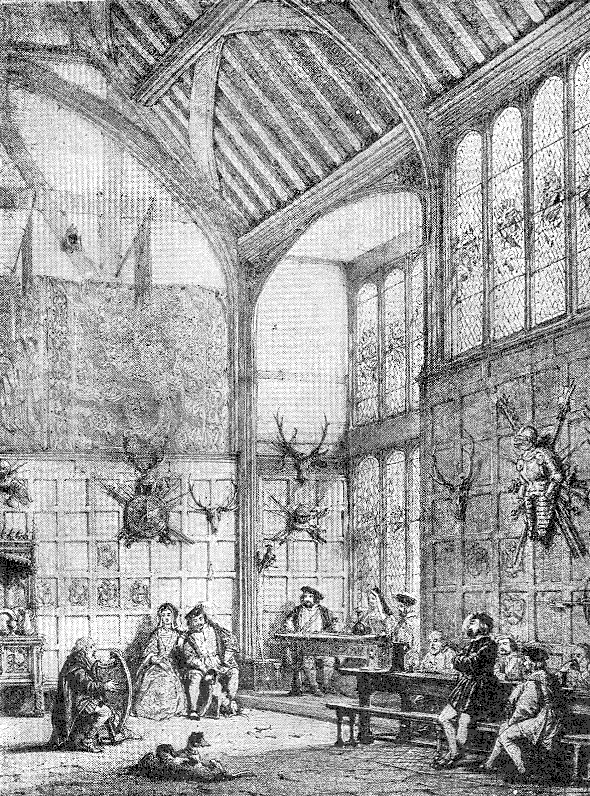 AN ENTERTAINMENT IN THE HALL AT OCKWELLS, BERKSHIRE, IN THE TIME OF HENRY VII. |
A visitor to England from Venice wrote that there were more thieves and robbers in England at this time than in any other country in the world. Few people, he said, dared go alone into the country except in the middle of the day, and fewer still dared go out in the towns at night, and least of all in London.
Henry VII tried to deal with these disorders. It was the duty of the Justices of the Peace—who were gentlemen with landed estates—to help to rule the country districts. These men were now made to do their duty in a better way, and to keep the ale-houses in order, where men played cards and dice, and bowls and tennis. A law was also made that beggars were to be set in the stocks for three days, for it was found much too costly to keep all these wanderers in prisons.
Henry used the middle class rather than the nobles to help him in his work. The nobles could spend their time at his court in gay pageants, tournaments or tilting matches, and other amusements, such as hunting and hawking. But the king chose his servants from the clergy and lawyers, "vigilant men and secret, and such as kept watch with him upon almost all other men," says Bacon.
![[Illustration] from Tudors and Stuarts by M. B. Synge](books/synge/tudors/zpage038.gif "[Illustration] from Tudors and Stuarts by M. B. Synge") A TILTING MATCH IN THE DAYS OF HENRY VII. |
If Henry did not often call Parliament, where did he get the money for the expenses of his government, for fighting his foes, and for the safe-guarding of the sea? His first Parliament gave him tonnage and poundage for life, that is, the old taxes on commerce. This Parliament also gave him power to get back all crown lands which had been granted away since the Wars of the Roses began. This was a handsome present, for many of the old crown lands had passed into other hands during these wars. Henry, as king, also took the property of his enemies who had been accused of treason against him. For in those days, when a baron or great landholder rebelled, or was on the losing side in a battle, his property was confiscated or taken over by the king.
When Henry wanted further funds, he tried all other kinds of ways to get money. His favourite trick was to ask for free-will offerings from the wealthy, which they had to give whether they liked it or not. When Henry invaded France, he gave orders that "the sparing were to be pressed for money because they saved, and the lavish because they spent."
Another device for getting money was by fines. Henry was once visiting his friend the Earl of Oxford, when the earl drew up his little army of retainers to line the route in honour of the king. But this broke the king's law against the keeping of armed retainers. The king enjoyed the earl's good fare, but before parting he said to him : "My lord, I thank you for your good cheer, but I may not have my laws broken in my sight; my attorney must speak with you." The earl was fined £10,000!
In Henry's later days, after the death of his wife Elizabeth, people were made to pay fines, for all sorts of offences, by his hated agents Empson and Dudley. These men were looked upon as "ravening wolves, horseleeches and shearers," from whom no man was safe. It was the greedy and crafty Henry VII who through these men started that state robbing and pillaging which went on in the next two reigns. What with the Star Chamber (a new court to deal with the nobles) and Henry's demands for fines and loans, the great men of England had indeed a hard time of it, and many of them found themselves made so poor that they were imprisoned for debt.
Henry's chief vice was greed. He knew that he and his son could not be free from the control of Parliament unless they had a well-filled treasury. But he could spend when he thought it worth while, as indeed is shown by the building of his beautiful chapel in Westminster Abbey, where his body rests. He encouraged traders and craftsmen, and so, while he kept the nobles poor in order to break their power, the country generally prospered.
We have seen that the power of the king got stronger and stronger during Henry's reign. He was able to deal many blows at the great nobles, and we shall see that his son Henry VIII tried to bring the clergy and the Church also under the rule of the king.
The Church claimed certain old privileges which sometimes interfered with the course of justice, as did the old privileges of the great lords. In England the Pope insisted, among other things, that (1) clergymen who were guilty of crimes should be tried as a rule only in the Church Courts, and that (2) the king's officers could not arrest people in churches. The first of these claims was known as Benefit of Clergy and the second as Right of Sanctuary. Anyone then who could claim that he was a clergyman could insist on trial in the Church Courts, and anyone who fled to a church was safe from the king's officers.
This independence of the clergy was, of course, liable to be abused by scoundrels. Clergymen included not only those who were priests but all whose work was reckoned to be in any way ecclesiastical. As the punishments which the Church inflicted were lighter than the very severe penalties by which the king tried to enforce order, it was possible for criminals sometimes to evade the punishments which most men thought their crimes warranted.
Towards the end of Henry's reign some famous men, like Sir Thomas More, thought it was better that the king should be the responsible authority for maintaining justice and order in his kingdom, and viewed with approval the limitation of the rights of sanctuary and benefit of clergy, as they were less necessary in the sixteenth than they had been in the twelfth century.
 A MAN IN ARMOR AND A BISHOP OF THE TIME OF HENRY VII. |
In the general decay of the Church organization at the close of the Middle Ages other abuses had crept in, which earnest churchmen desired to have remedied. In Britain some of the clergy entered the service of great noblemen and landowners, and were more devoted to getting in the rents for their masters than to their spiritual duties. The monasteries, too, had grown very wealthy, being amongst the largest landowners in the country. Prosperity had made certain abbots worldly in their outlook, so that they set a bad example in exacting high rents, and in enclosing common fields to extend still further the production of the high quality of wool for which English farmers and some of the monasteries in particular were famous. On the other hand, the monasteries still performed a useful service in relieving the poor, and maintaining schools and libraries.
Henry VII sent Sir Edward Poynings to Ireland as Lord Deputy, and the new governor applied his master's policy of curbing the nobles by prohibiting maintenance of large retainers, and getting the statute passed known as Poynings' Law, which forbade the Irish parliament from passing any laws which had not received the king's approval.
Henry VII died at the age of fifty-two in 1509. Although his reign has no great event like the Armada, he did important work for England, and without it the glories of the reign Elizabeth would not have been possible. He not only united England, but he prepared also for future union with Scotland. He was, certainly a tyrant, crafty and greedy, and he ruled the barons with a rod of iron. But he took care that there should not be a whole host of other tyrants to trouble the land. He found England weak and cut off from all influence in Europe, and he left her strong and ready to take the first place.
How Henry VIII Changed the Old Order; or the Breach with Rome
Henry VII was succeeded on the throne by his son Henry VIII, whose reign is one of the most important in English History.
His first minister was Thomas Wolsey; he was the son of an Ipswich wool merchant, and soon all Europe was ringing with his fame. So much power did he obtain that it was said he "ruled both the King and the whole realm." Honors were heaped upon him; he was made in quick succession Archbishop of York and Chancellor by the King, and Cardinal and Papal Legate (or Ambassador) by the Pope,
So long as he was useful to his royal master, his power and influence increased; but so soon as he could not carry out the King's wishes, he fell from power. Henry VIII grew tired of his first wife, Catharine of Aragon, and fell in love with her maid Anne Boleyn; so Henry sought from the Pope, as supreme judge in Canon Law, that is the law of the Church, a declaration that his marriage with Catharine, his brother's widow, was not valid, or sound in law. This the Pope refused, but he appointed judges to hear the evidence. As Wolsey failed to get the divorce, Henry VIII soon found some pretext to have him arrested. Before he could be tried, he fell ill and died suddenly at Leicester Abbey.
 WOLSEY'S ARRIVAL AT LEICESTER ABBEY. |
Henry VIII now determined to try other methods—to get his way with or without the Pope.
From the days of William the Conqueror, English kings had on many occasions tried to limit the power of the Church in this country. The Church, however, invariably resisted these encroachments on her privileges, but frequently agreed to a working arrangement by which the king's legitimate interests might be safeguarded. This happened, as you will remember, in the dispute between Henry I and Anselm respecting the investiture of bishops.
By the time Wolsey's career had ended, Henry VIII had learned how great were his powers. He had now made up his mind to get rid of Catharine, so that he might marry Anne Boleyn. To get his way, he was determined to subject the Church and, the clergy to his own authority and continue to be the absolute ruler not only of the State but of the Church also.
So far he had worked with the Pope. Now he intended to become master of Parliament and of the Church, and through these to threaten the Pope. If, after many threats, the Pope would not divorce him, then he would have no more of the Pope in England. "Well-beloved subjects," said the king, "we thought that the clergy of our realm had been our subjects wholly, but now we have well seen that they are but half our subjects." Henry VIII determined to finish the work of Henry II, who quarrelled with Becket about the rights of the Church. The clergy should be put severely under him, just as the nobles had been.
The Parliament that assembled in 1529 was one of the most important in our history. The same year was also a landmark in the history of Europe, for it was then that the followers of the German monk Luther became Protestants. That is, they took what was then the strong step of "protesting" against the Emperor's decree against Luther, which made all religious changes in Germany unlawful. Luther had already made serious attacks on the Pope and burned before a large crowd, the papal bull issued against him.
This Long Parliament was not chosen freely like the Parliaments in our day. The king sent down letters ordering the electors to choose certain persons named by him. A Parliament so elected was bound to be favourable to the king and willing to carry out the wishes of such a strong ruler as Henry had proved himself to be.
 LUTHER BURNING THE POPE'S BULL AT WITTENBERG. |
At its very first meeting, Parliament attacked the clergy and limited their fees. The clergy replied that the "Commons seek the goods, not the good, of the Church."
The next year there was no meeting, for Henry tried once more to get the Pope to divorce him. But the Pope was immovable. The Emperor Charles would not be bribed by Henry, for he was not, he said, a merchant to sell the honour of his aunt (Queen Catharine). The queen herself stood up passionately for her rights—"Go where I will, I shall still be his lawful wife."
Two new advisers to the king now came to the front. One, Thomas Cranmer, had been a chaplain in the Boleyn family, and had suggested to the king that he should find out what the universities of Europe thought about his divorce.
Cranmer now became archbishop, and the foremost of the Reformers in England. He was a man of great caution and succeeded in winning Henry's confidence completely. He wanted the king, rather than the Pope, to be supreme in the Church in England. He believed that it was best that the King of England should be the sole lord in his own land, and now helped the king to become supreme.
The other new favourite, Thomas Cromwell, gave the king a hint that he might first make himself master of the Church and then get it to divorce him. Cromwell, like Wolsey of old, soon began to rule in everything concerning Church and State.
The next year, in the Long Parliament's second session, the first step was taken to make the king head of the Church, and, as he hoped, to frighten the Pope to do what he wanted. The nation was now accused of breaking the same law as Wolsey had broken, for they had recognised. Wolsey as the Pope's Legate. It made no difference to this self-seeking king that he himself had asked the Pope to make Wolsey legate. The king pretended to pardon the nation, but the clergy had to buy their pardon by paying him huge sums. They were also made to call Henry "as far as the law of Christ allows, supreme head of the Church," and to agree to make no new Church laws without the king's consent. The first great blow was thus struck at the freedom of the Church, and the king took the Pope's place in the English Church.
At the next session, the king carried the war against the Pope still further, for he would not allow anything or anybody to thwart his will and desires. The clergy were at last under his thumb. Henry now had a law passed that the clergy should no longer pay their first year's incomes to the Pope, as had been the custom for many centuries. But the Pope was still the Emperor's prisoner. The next year Henry took the law into his own hands and married Anne Boleyn. Soon afterwards, Archbishop Cranmer declared that the marriage with Catharine was void from the first. At the end of the year, the Princess Elizabeth was born and the Pope excommunicated both her parents. It seemed as if a crusade of Catholic nations would be sent against Henry, but the Emperor and the King of France were too busy with their own quarrels to march against England.
Parliament had already passed a law against the right of the clergy to appeal from the English courts to the Pope at Rome. The clergy could therefore no longer ask a foreign court to protect them, and the King of England was supreme over all in his own realm. At last the Pope gave his sentence against Henry, amid great rejoicings and the firing of cannon at Rome. But the crafty Henry knew how to take his revenge. In the fifth and most famous meeting of this Parliament, the breach with the Pope was made final.
An Act was passed declaring that Anne Boleyn's children should succeed to the throne, thus shutting out Mary, the daughter of Catharine. Then came an Act of Supremacy, which summed up all the previous laws against the clergy and the Pope. The king became the "only Supreme Head on earth of the Church of England," and all the powers and wealth in England which once belonged to the Pope now passed to the king.
But Henry could not allow anybody to differ from him, for fear the people should rebel against his new power. A new and terrible Treasons Act was passed, thundering out terrible and hideous penalties against those who should even suggest in speaking or writing that the king was a heretic or a tyrant.
The king still called himself the Defender of the Faith, and said that there was no separation in England from the Catholic faith of all Christian countries, though the Pope had no more power here.
Thomas Cromwell now became Vicar-General of the Church, and acted as chief officer over both Church and State. He was not slow to show what the king's supremacy meant. A visit to all churches, monasteries, and colleges was decided upon, but it was the turn of the monasteries first.
For many centuries, the abbeys and monasteries had done a most important work for the country. They helped the poor in the days before workhouses; they tended the sick, and acted as doctors; they were the only inns for travellers, both rich and poor. They acted as bankers, taking care of valuables. They were pioneer farmers and wool-traders; and for many centuries they had been the centres of learning and education.
However, no chronicler existed in the abbeys in Henry's days. The abbeys were very wealthy; the king and others cast longing eyes on their possessions. Vague charges were made against the abbeys, that many of the monks were idle and lazy, that their charity had been carelessly given, that thereby "sturdy vagabonds were encouraged," and these vagabonds were the plague of the country-side. With the rise of the middle class, there were many men who saw with envy and greed the broad acres of the abbeys, and these men would be only too glad to share in the plunder.
So Cromwell sent some men round to the monasteries to report to them of their condition. But these men were dishonest and untrustworthy. They thought most of pleasing their master, and were always ready to help themselves to bribes and to the gold and silver crosses of the abbeys and monasteries.
Their visits were paid to the numerous monasteries very hurriedly in a single summer, and their reports were so bad that they were called the Black Book.
The monks were looked upon as the soldiers of the Pope and the abbeys were so many of his garrisons in this country. The king and his advisers therefore thought they were very dangerous to the king's rule over the Church. It was claimed that the smaller houses were of little use, and in some cases there may have been vice.
All was now ready for Parliament to condemn the monasteries. Cromwell took steps to inflame the citizens of London against the monks by giving them numerous pamphlets and sermons. The king told the House of Commons "that he would either have the Bill or some of their heads." So the Long Parliament at its last meeting passed an Act destroying the smaller monasteries. The people fondly hoped that when the king had got the wealth of the abbeys there would be fewer taxes to pay. But although about three hundred and seventy-six houses were destroyed, most of the wealth went to the king and his friends.
By the destruction of the abbeys, poverty and misery were increased. The poor lost some of their best friends, and some ten thousand people, monks and their dependents, lost their living. The poor nuns were cast adrift with a gown apiece, and others fared not much better. The wealth of the monks went to make new nobles, who would therefore have a lasting though selfish interest in the breach with Rome. In this way the Reformation would not be undone.
This memorable Parliament had now finished its work. Henry VIII had compelled the clergy and the nation to make him supreme ruler in the Church as well as in the State, and the greatest change in our history had now been effected. With all its cruelty, hard-heartedness and pillaging, we should not nowadays call the Age of the Reformation a religious age. Still we must take care not to judge by modern ideas the doings of three hundred years ago. There were many devout people then as now, and the services of the old Church still held sway over the hearts of the nation.
There existed a strong religious life and feeling; even memories of the teachings of Wycliffe and of the Lollards had never been quite lost. These memories were now being revived and strengthened by the teachings of the German Reformer Luther which were gradually becoming known in this country.
![[Illustration] from Tudors and Stuarts by M. B. Synge](books/synge/tudors/zpage054.gif "[Illustration] from Tudors and Stuarts by M. B. Synge") LANTERN OF TEH EARLY TUDOR PERIOD. |
Thomas Cromwell and the Destruction of the Monasteries
Sir Thomas More had given Cromwell good advice when he entered, the King's Council. "Master Cromwell, you are now entered in the service' of a most noble, wise, and liberal prince. If you will follow my poor advice, you shall, in your counsel-giving to his Grace, ever tell him what he ought to do, but never what he is able to do. For if the lion knew his own strength, hard were it for any man to rule him."
The lion already knew his strength. He had used Cromwell to help him to cast off the Pope and had so taken the first and greatest step towards forming a National Church. The time was now come when he would show the nation that everybody—whether clergyman, noble, or the humblest follower of Wycliffe or Luther, nay even Parliament itself—must bend to the king's will.
A terrible reign of terror, such as England fortunately has seldom if ever known in her history, marks this gloomy middle period of Henry VIII's reign. Cromwell now took steps, at his master's bidding, to "tune the pulpits"; that is, priests were compelled to preach such sermons as should cause men to favour the king's rule over the Church. Schoolmasters were made to revile the Pope in the presence of their scholars. Cromwell's spies were all over the country, ready to report to their master every word, written or spoken, which could be regarded as an offence. Erasmus might well say that "men felt as though a scorpion lay beneath every stone."
One of the first martyrs for the old Church was Elizabeth Barton, known as the Holy Maid of Kent. Although only a servant, she became famed for her saintliness. Miracles were said to be done by her, and she had the gift of prophecy. In those days people were much disturbed by what was passing and perhaps easily believed the prophecies of such a far-famed person. She spoke against the divorce and predicted the king's death. This could have a very dangerous effect on the nation at such a time of ferment. The king decided that she must be executed and made an example to others.
Bishop Fisher and Sir Thomas More were accused of knowing of her predictions and not revealing them to the king, who tried to have them both condemned as traitors without a trial. But Parliament would not agree to this.
Now More was one of the most learned and best known men in England. When he was young he had prepared himself for a religious life by scourging himself with rods, and wearing a hair shirt and sleeping upon bare boards. He did not, however, become a priest, but he gained great fame not only as a lecturer and author, but also as a lawyer and statesman. "What did Nature," wrote Erasmus, "ever fashion daintier, sweeter, or happier than the character of Thomas More?" In the early years of his reign, Henry VIII was very devoted to More. He used often to visit and dine with More in his house at Chelsea, walking in his garden with his arm round More's neck.
But More knew the character of his royal friend. "I have no cause to be proud of the king's friendship," said More to his son-in-law Roper, "for if my head would win him a castle in France, it should not fail to go."
Wolsey made him Speaker in the House of Commons, and as Speaker, More showed his great courage to do what was right. When Wolsey went in all his pomp to the House of Commons to demand a great grant of money for the king, the Speaker was not afraid to stand up for the rights of Parliament. "Would you had been in Rome, Master More, when I made you Speaker," remarked Wolsey afterwards. After Wolsey's fall, More became Chancellor and the chief minister of Henry VIII, but he soon resigned.
As a loyal subject of the king, he was quite ready now to accept Anne Boleyn as queen. But neither he nor Bishop Fisher could take the oath which Henry demanded, because they truly believed that the Pope was the Vicar of Christ on earth, and that Henry could not be the Head of the Church. It was a very serious thing for the king to be opposed by men like Fisher and More, whose learning and piety were renowned through Europe.
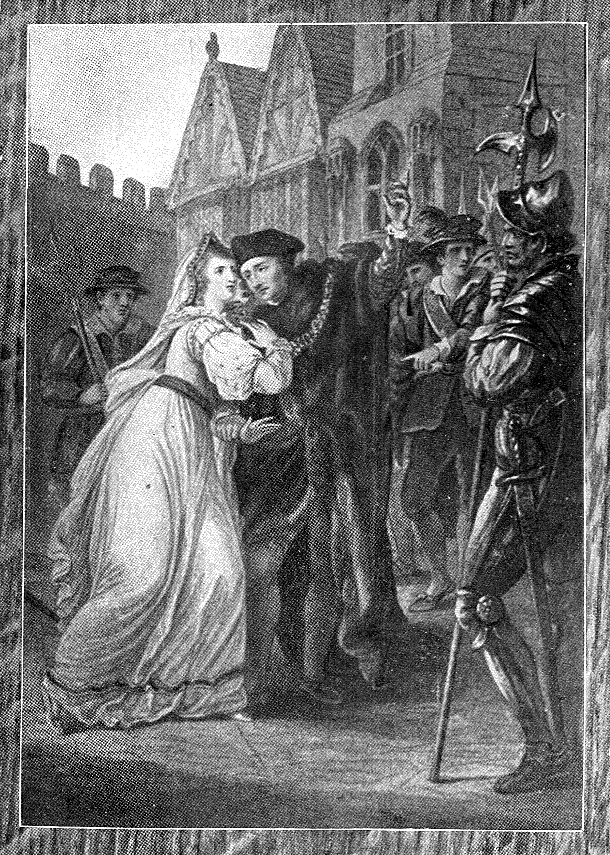
All possible means, fair and foul, were taken to compel these two brave and good men to call Henry Head of the Church. Bishop Fisher was the old friend of the Tudor family. But he had been fearless in supporting Catharine and the liberty of the Church. Neither of these men would go against his conscience, and the king at last had them both executed—to the horror and disgust of all Europe. "Had we been master of such a servant," said the Emperor Charles when he heard of More's death, "we would rather have lost the best city of our lands than have lost such a worthy councillor."
The friars at this time did most of the preaching in the country. All their houses were now visited, so that they might take the oath acknowledging Henry as Head of the Church. Many of them submitted.
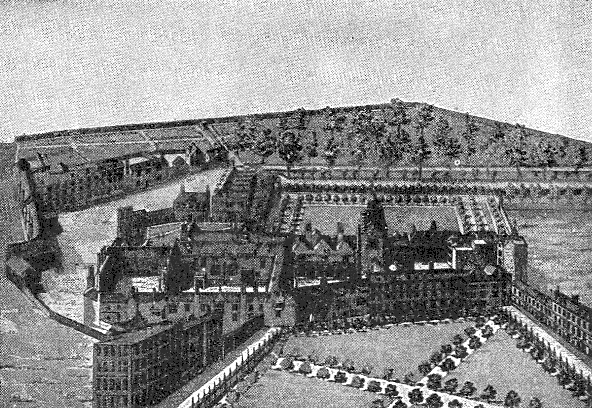 AN OLD VIEW OF TEH CHARTERHOUSE. |
The monks of the famous Abbey of the Charterhouse in London were the most renowned and the most pious in the country. These stood their ground against the self-willed king, just as Fisher and More had done. Their prior, everywhere known for the beauty and piety of his character, was sent to the Tower. Cromwell compelled a jury to say that the prior and his brethren were guilty, and these pious, noble men were hanged, drawn, and quartered at Tyburn, in accordance with the barbarous custom of those days.
Thus the most learned and pious men in the realm were struck down. Men had almost lost their most simple rights of liberty. Not even Henry VIII could persuade his Parliament to agree to this butchery without a good deal of murmuring and questioning.
Meanwhile, Luther's teachings were spreading in the country. Heresy, (which Henry considered the 'reformed' teachings of Christianity') was very common, especially in the eastern counties, where a great many Flemish weavers had settled, for (it was said) every weaver was a heretic. All over the country, Lollard and Lutheran books were secretly read. More preaching went on in the villages than was ever known before, for sermons had seldom been heard except at Lent. Men in the towns gathered together in the ale-houses to discuss the Scriptures rather than to drink ale, as they used to do.
The burning of forbidden books and of heretics went on as usual. Some Cambridge gospellers, devoted to the study of the Bible, were burnt by the Bishop of Norwich. Tyndale offended Henry by calling the Bible the "Head of the Church." The heretics used his English New Testament, and Henry took care that he too should suffer burning, even though he was living in Flanders.
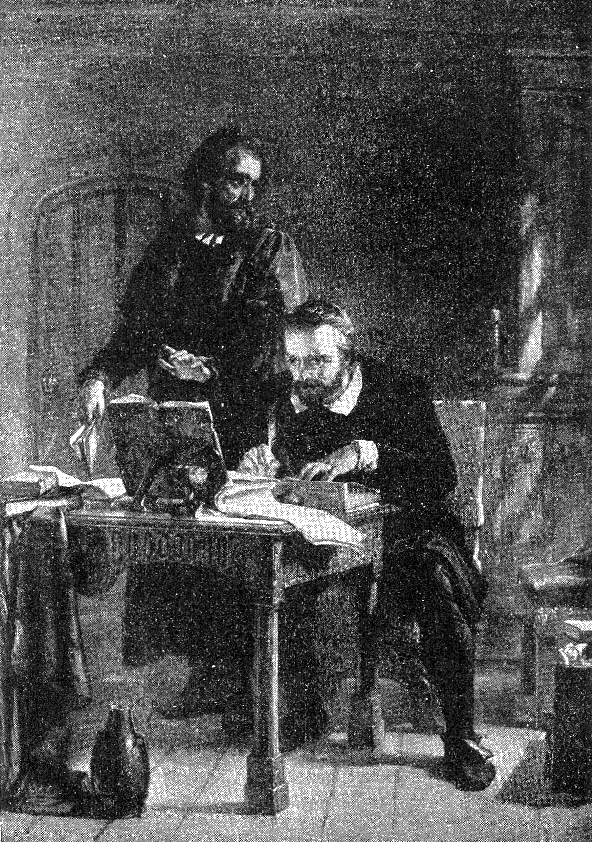 TYNDALE TRANSLATING THE NEW TESTAMENT INTO ENGLISH. |
All these changes and troubles caused much discontent in the country, especially in the North and West. There were fewer towns and roads in those parts, new ideas spread more slowly than in the South, and so the North the North and West remained the most backward and West districts till the days of steam and factories in the nineteenth century. And as there were fewer roads and larger wastes, the monasteries were very badly missed by travellers.
Everywhere the clergy were terrified of the king. The poor had lost some good friends in the monks. The nobles hated the new men, such as Cromwell, in the council. Cromwell was told to his face that he was the cause of all this rebellion and wickedness, and that he was daily trying to strike off men's heads.
His servants were at this time roaming all over England, destroying beautiful abbeys, taking away their valuables, tearing the lead off the roofs and pulling down the bells to sell them to the highest bidders. The storm now burst, first in Lincolnshire, where thirty-seven abbeys had been destroyed, then in Yorkshire, where no less than fifty-three abbeys had been spoiled. These two counties had been in the midst of all this terrible havoc.
The men of Louth, in Lincolnshire, seized the king's officer, put his register on the bonfires, and ordered all the English Testaments to be burnt, for they were afraid of heresy. The movement spread throughout the county. The king sent his ambassador to say he was horrified that his business should be stopped by the "rude commons of one shire, and that the most beastly and brute in the whole realm." The ringleaders Were captured and some fifty were gibbeted in the various towns of Lincolnshire.
In the same year a much more serious rising took place in Yorkshire and soon spread to all the northern counties. This was called the Pilgrimage of Grace: Men complained that their abbeys had been destroyed. Their kind landlords, the abbots, had been turned adrift; and now there was no one to build them bridges and highways and provide meat for strangers. The men of the North hated heresy and image-breaking, and loathed Cromwell and his men, but they stated that they were thoroughly loyal to their king.
These pilgrim rebels wore as a badge the Five Wounds of Christ. They lit beacons all over the wolds, and rang the church bells to tell their friends of their rising. Led by a brave young lawyer named Robert Aske, they marched through Yorkshire, York and Hull opened their gates to them, and with an army of thirty thousand men they reached Doncaster. Here they were met by the king's forces, and after some discussions, pardons were offered them.
But the faithless king did not keep his word, and there wasp a second rising. A terrible and barbarous revenge was now taken. The king told his officers that the people of every rebel town, village, and hamlet were to be hanged up on the trees, and their heads were to be set up in every town. They were to do this without pity or respect. Abbots, friars, landowners—all the leaders of this religious crusade, were executed. Seventy-four rebels were hanged in Carlisle alone. Some of the finest abbeys, including the magnificent Furness Abbey in Lancashire, were now destroyed by the king's orders.
Henry VIII had thus, in his cruel and heartless way, crushed out the first serious rebellion in England since the days when the Cornishmen marched to Blackheath some fifty years before.
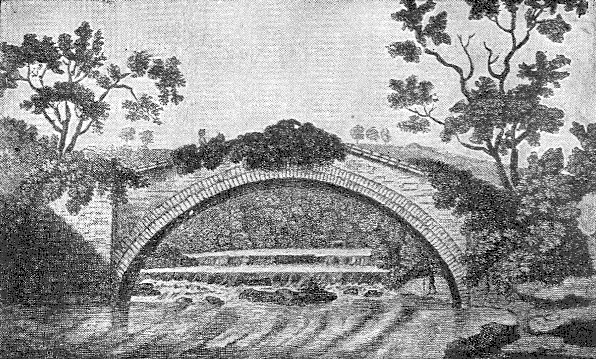 BRIDGE ON THE URE, IN YORKSHIRE, BUILT IN TEH REIGN OF HENRY VIII. |
The men of the North had taken up the cause of the monks, and Cromwell and his master now decided that the larger monasteries must share the fate of the smaller. The Long Parliament had specially, spared them because of their "good conduct," Yet it was now given out that they were to be destroyed because of the "slothful and ungodly lives of the monks." Most of the, monks submitted; those who did not were accused of wickedness or treason.
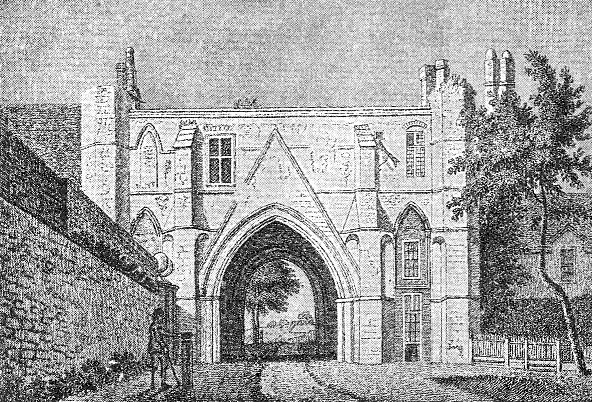 THE GREAT GATE OF READING ABBEY. |
The brave and noble abbots of Reading, Colchester, and Glastonbury would not give in to the cruel king. They were accused of treason, and a sham trial was held.
In reality they were murdered by the king and Cromwell. We can still see Cromwell's notebook, in which he had written "The Abbot of Glaston to be tried at Glaston, and to be executed there." This saintly old abbot, whose only offence was that he had obeyed his conscience, was actually tied to a hurdle and dragged past his abbey, and then beheaded on the hill near the village.
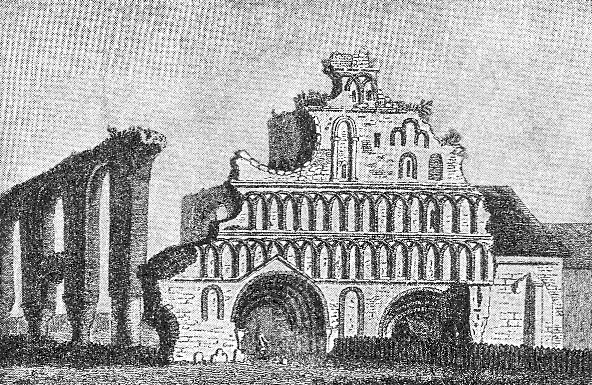 RUINS OF ST. BOTOLPH'S PRIORY, COLCHESTER. |
Some six hundred and sixteen abbeys were handed over to the king. In lands and rents they were worth about twenty million pounds, reckoned in our money. Men hoped again that taxes would not be wanted, that the poor would be provided for, and that new schools and bishoprics would be founded. The Navy was indeed strengthened, and half a dozen new bishoprics were founded. But, as before, most of the wealth went to the king and his courtiers, and new nobles and landlords grew fat on the property of the monasteries. Such men would take care that the English Reformation should never be undone. The thirty-one mitred abbots no longer sat in the House of Lords, and for the first time the other nobles had a majority in that House.
And this was the end of the monastic system in England. There is scarcely a town or village in this land where we cannot still find traces and sometimes beautiful remains of the splendid abbeys of the Middle Ages. The monasteries had done a great work in the land. The destruction of the larger abbeys was one of the blackest deeds in this cruel reign, and many noble men and women were made to suffer terrible hardships through no fault of their own.

On account of Henry's treatment of the Church, the Pope expected that France, Scotland and the Emperor would combine to attack England. The terrible Henry replied to the Pope by destroying the family and relatives of the man who was trying hard to bring about this European invasion. This was Cardinal Pole, once Henry's friend and now his bitterest foe. Pole's aged mother, the Countess of Salisbury, was thrown into prison, and two years later she was beheaded without a trial—perhaps the most wicked and cruel crime of this reign.
The king also beheaded Anne Boleyn, the mother of Elizabeth, and the very next day he married Jane Seymour. Jane died soon after the birth of her son, Prince Edward. Cromwell then persuaded Henry to marry a German princess, Anne of Cleves, who was a follower of Luther. The famous artist, Holbein, had painted a flattering picture of her, but Henry disliked her from the first, and soon got her to retire.
Although Cromwell had only just been made Earl of Essex for getting rid of the abbeys, he was now condemned for treason and heresy. The king had him executed without a trial—in the same way as others had been executed.
Both at the beginning and the end of Henry's reign there was war with France and Scotland. His most successful martial achievement was the invasion of France in 1512, when he routed the French cavalry at the Battle of Spurs. That was in his young days, when he took great delight in manly and warlike exercises. He was then fond of tennis and archery and skilled in the use of the sword; armour that he wore is still in existence.
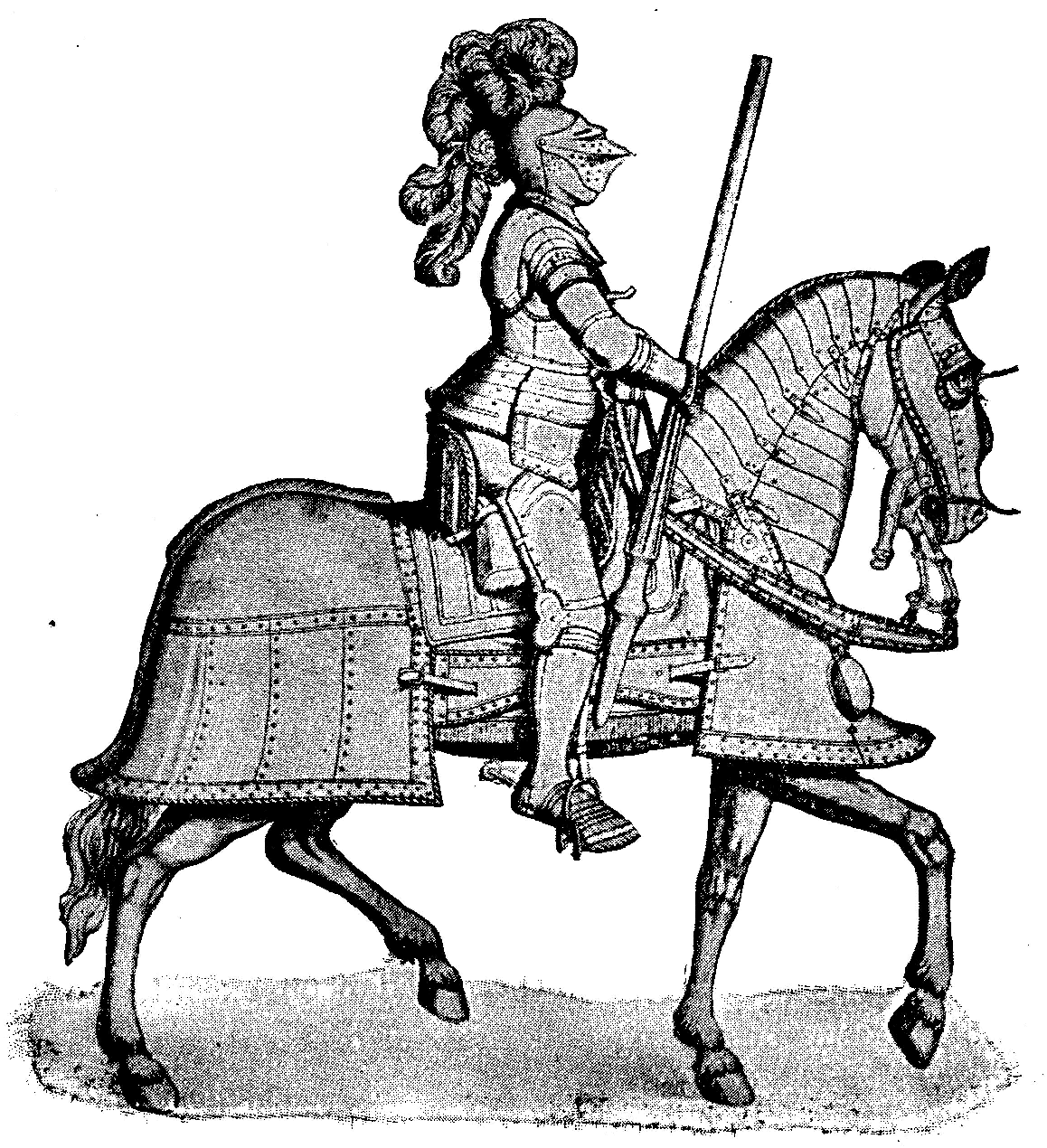 COMPLETE SUIT OF ARMOR OF THE TIME OF HENRY VIII. |
Scotland was humbled at the Battle of Flodden. The French king later tried to secure the friendship of Henry, but the famous meeting between the two kings at the gorgeous Field of the Cloth of Gold came to nothing. It is to Henry's credit that throughout his reign he kept England free from the horrors of civil war and from foreign invasion—at a time, too, when there was very real danger of both. This had a beneficial effect on the trade of the country, and in spite of his many acts of cruelty, Henry retained his popularity to the end of his days.
But Henry's reign was very wasteful. It is said that he took more money from the realm than all his predecessors on the throne. He plundered no less than six hundred monasteries, ninety guilds, and one hundred and ten hospitals. He took pensions from France, he issued coins which were not up to standard value, and he made poor men suffer thereby. He raised forced loans and made men pay "free-will offerings" or benevolences; and yet he was always in want of money.
We may all agree with a great historian that Henry VIII was a man of iron will and determined purpose, and a man who would have been infinitely greater and better and more fortunate if he would have lived for his people and not for himself. That he was able to retain the respect of his people, and even the love of many of them, was due to the fact that in a great measure he was like themselves—free, open, and merry, with a hearty friendly manner towards rich and poor alike.
"The habits of all classes," says Froude (a famous modern writer on this period), "were open, free, and liberal. We read of 'merrie England' of these days and of the glory of hospitality, by the rules of which all tables, from the table of the freeholder to the table of the baron's hall and abbey refectory, were open at dinner-hour to all comers, without constraint or reserve. To every man according to his degree there was free beer and free lodging; bread, beef, and beer for his dinner; for his lodging perhaps only a mat of rushes in a spare corner of the hall, with a billet of wood for a pillow, but freely offered and freely given; the guest probably fared much as his host fared, neither worse nor better. There was little fear of abuse of such licence; for any man found at large, and unable to give a sufficient account of himself, there were the ever-ready parish stocks or town gaol.
"The hour of rising, winter and summer, was four o'clock, with breakfast at five. In the country every unknown face was challenged and examined; if the account given was insufficient, he was brought before the justice. Thieves were then hanged so fast, Sir Thomas More tells us, that there were sometimes twenty on one gibbet. If the village shop-keeper sold bad wares, if the village cobbler made 'unhonest' shoes, if servants and masters quarreled, all used to be looked after by the justice. At twelve the country gentleman, the justice of the peace, dined; after dinner he went hunting, or to his farm."
Throughout all the changes of this and the succeeding reigns the country gentleman remained a power in the land. It was he who chiefly benefited from the material destruction wrought by the Reformation. Some of the old abbeys, in the hands of their new owners, were transformed into luxurious mansions. While the Reformers pulled down Gothic churches and monasteries, the country gentlemen built palatial houses for themselves in a new style derived from Italy.
 AFTER THE DISSOLUTION: WROXTON ABBEY, OXFORDSHIRE, AT THE END OF THE SIXTEENTH CENTURY. |
The Protestant Edward VI and the Catholic Queen Mary; Violent Changes (1547-1558)
Edward VI (1547-1553)
Edward VI was only nine when his father, Henry VIII, died, and the story of his six years' reign is a story of disorder and misrule. But it was not the boy's fault; he was like clay in the hands of his ministers. His father had appointed him, in his will, a council of advisers, in which men of moderate views evenly balanced the extreme men. Unfortunately, there was not a single man strong and wise enough to rule the country in such difficult times.
For the first three years of the reign, Edward's uncle, Hertford, now created Duke of Somerset, managed to get the lead. In this short time he ruined the of attempts made by Edward's father and grandfather to bring Scotland closer to England, and he went to war with France. In 1549 there was in the West a great rising against the imposition of the new religion; this rising was put down with the utmost barbarity.
 EDWARD SEYMOUR, DUKE OF SOMERSET. |
After Somerset's fall, Warwick, Duke of Northumberland, took his place, and intrigued to get his own daughter-in-law, Lady Jane Grey, recognised as the young king's successor. She was Edward's cousin, and being Lady Jane very fond of Lady Jane, he was persuaded to give his consent to settle the crown on her. Somerset was at least a sincere Protestant, and he had real sympathy with the poor, though he was a weak but not a cowardly man. Of Northumberland it is difficult to say anything that is good. Under both men the real power was in the hands of a set of grasping, selfish, hard-hearted nobles, who "embezzled, plotted, and misgoverned" while pretending to reform the Church and to found a purer religion.
As soon as the late king's strong hand was removed, a crowd of foreign Protestant teachers burst into the country. The robber nobles, who formed the Government, took advantage of the turmoil, and proceeded to rob the Church still further. Another reign of terror began. The, young king was fond of learning and of study, and his teachers had made him a strong and sincere Protestant. But he was not able to restrain his wicked nobles, who spoiled the churches while pretending to reform religion.
A royal visitation of all churches was ordered in 1547, with the object of eradicating all Catholic usages. Processions were forbidden; new communion tables of wood were set up instead of the old stone altars. Images and pictures and precious manuscripts were destroyed; the plate and valuables of the churches were looted. Beautiful old painted windows, which could never be replaced, were smashed. The people naturally hated all this destruction of what they regarded as sacred and precious relics, which their forefathers had loved. Many of the treasures in the parish churches had been made by their ancestors' own hands, for they had loved to work for and adorn the churches in which they worshipped. Almost every church, large or small, lost some treasure in the great pillage of Edward VI's reign.
![[Illustration] from Tudors and Stuarts by M. B. Synge](books/synge/tudors/zpage075.gif "[Illustration] from Tudors and Stuarts by M. B. Synge") LETTER SENT BY EDWARD VI TO HIS UNCLE, THE DUKE OF SOMERSET, AFTER HIS VICTORY OVER THE SCOTS. |
But that was not all. The property of hospitals was taken away from them, and even the guilds were robbed. These guilds were clubs for self-help, to which artisans and other workers paid their savings, so that they and their families might not be left without help when sickness or death or other troubles overtook them. Henry VIII had destroyed the monks, the friends of the poor and needy, and now Edward VI's robber nobles took away the funds of the people's mutual help societies.
The Protestant religious teachers of the time were sincere and well-meaning men, but the actual men who carried out whop these violent changes were nothing but greedy rogues. "Thousands became gospellers for the sake of the Church lands," said Latimer, the greatest of the Protestant Reformers, who did not hesitate to denounce the Government. In one of his sermons Latimer told the Court that "we of the clergy had too much, but now we have too little. Schools are not maintained, the preaching office decays. The gentry take the profits of the Church, and benefices (church livings) are given to servants for keeping of hawks, hounds, and horses. The clergy are forced to put themselves into gentlemen's houses and serve as clerks of kitchens, surveyors, or receivers of rents."
 KING EDWARD VI. AND HIS COUNCIL. |
The whole country was in a wretched state. The violent changes, not only in religion but also in village farming, were upsetting home-life everywhere. Enclosures of village lands and of commons had been going on at a rapid rate, and many tenants had been turned out, and many of the new landlords were harsher than the old easy-going abbots. "Sheep," as More had written, "which are naturally mild and easily kept in order, may be said to devour men and unpeople not only villages but towns." For sheep-farming needed fewer labourers to see after the sheep on the pasture-land than did the ploughing, the sowing, and the harvesting when it was arable or plough land. Labourers lost their work, because there was more competition for work now when there was less of it, and wages fell. Yet the price of food and necessaries kept on rising.
No wonder the country was full of sturdy beggars or vagabonds. These went on increasing in numbers in spite of the terrible penalties which were now imposed upon them. Any person found loitering for three days was to be branded with a "V" (for vagabond) on his breast. The man who found him loitering might have him for a slave and keep him on bread and water and broken meat. If the slave attempted to run away, then he was to be branded with an "S" on his cheek and forehead, to show that he was a slave for ever.
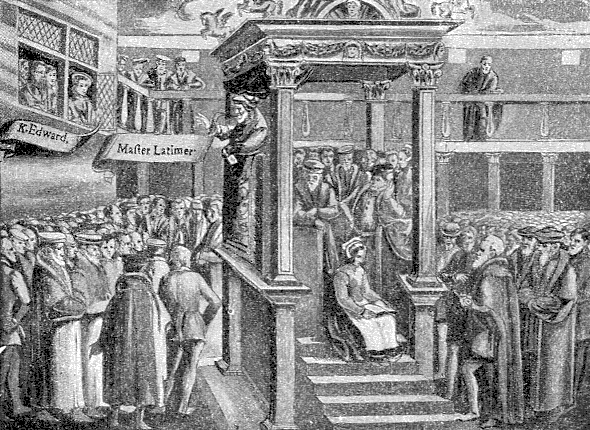 LATIMER PREACHING BEFORE EDWARD VI. |
Bishop Latimer, in another of his outspoken sermons, told the landlords and rent-raisers that poor men, who lived on their labour, could not with the sweat of their brows get a living. All kinds of victuals were very dear—pigs, geese, capons, chickens, and eggs. Not only were the clergy poor, not only did the agricultural labourers suffer, but the yeomen farmers, the sturdiest class in the country, found themselves equally badly off.
"My father was a yeoman," said Latimer, "and had no lands of his own. He had only a farm rented at three or four pounds a year at the utmost, and of his farm he tilled so much as kept half a dozen men. He had a walk for a hundred sheep, and my mother milked thirty kine. He was able to find the king harness for himself and his horses, and I can remember that I buckled on his harness when he went to Blackheath Field. He kept me at school, or else I should not have been able to preach before the king's majesty now. He kept hospitality for his poorer neighbours, and some alms he gave to the poor. All this he did on the said farm. Whereas, he that now has it pays sixteen pounds or more each year for rent. He is not able to do anything for his king, for himself, nor for his children, or give a cup of drink to the poor." Such was Latimer's account of his own father's farm and of the poor condition of the farmer who came after his father.
 BISHOP LATIMER. THE SON OF A YEOMAN, HE BECAME PREACHER TO KING EDWARD VI., AND WAS BURNED IN THE REIGN OF MARY. |
An important measure carried out by the Protestants under Edward VI was the introduction of a new Church service-book in the English language for national use. Edward VI's first Prayer Book was issued in 1549. An Act of Uniformity to enforce its use was also passed by Parliament, which suppressed the Latin Mass book of old and ordered that there should be a uniform Church service in English throughout the land.
But all these rapid changes only served to upset the people, who had for many years been also suffering from poverty and misery; and there were rebellions during this reign both in the South-West and in the East of England. The rising in Norfolk was by far the most serious. Gentlemen were even hanged under the "Oak of Reformation," on Mousehold Hill at Norwich, for the wrongs they had done to the people, that is, for enclosing villages and commons. The revolt was headed by Robert Ket, a farmer and banker of Wymondham, who called himself King of Norfolk and Suffolk. Ket and his followers seized Norwich, but it was not long before the Earl of Warwick suppressed the rising, and Ket might be seen hanging in chains from Norwich Castle.
The Earl of Warwick, soon to be the Duke of Northumberland, after this took the first place in the King's Council". The boy king had been ailing for some time he had been brought up in the new Protestant' doctrines and remained in that belief till his death in his sixteenth year.
The rule of the Protestant nobles had ended in disgrace. The sweeping changes imposed upon the people in regard to their religion, the dissolution of the monasteries and confiscation of the religious endowments of the craft-gilds, aggravated the violent social upheaval already in progress, due to changes in village farming through enclosure and the conversion of arable land into pasture.
After the death of the young king, the selfish Duke of Northumberland tried to make Lady Jane Grey queen—she was the granddaughter of Henry VIII's sister Mary and she had married the duke's son. She was a charming, gentle, and clever woman, fond of books and study, and she did not desire the crown thus forced upon her by relatives who were greedy for power. For her own part, she had no wish to live any other life but that of a peaceful English gentlewoman. The people, too, refused to acknowledge her, and rallied round the Princess Mary, the eldest daughter of Henry VIII. "The Lady Mary hath a better title," said the Londoners, and the duke's scheme failed.
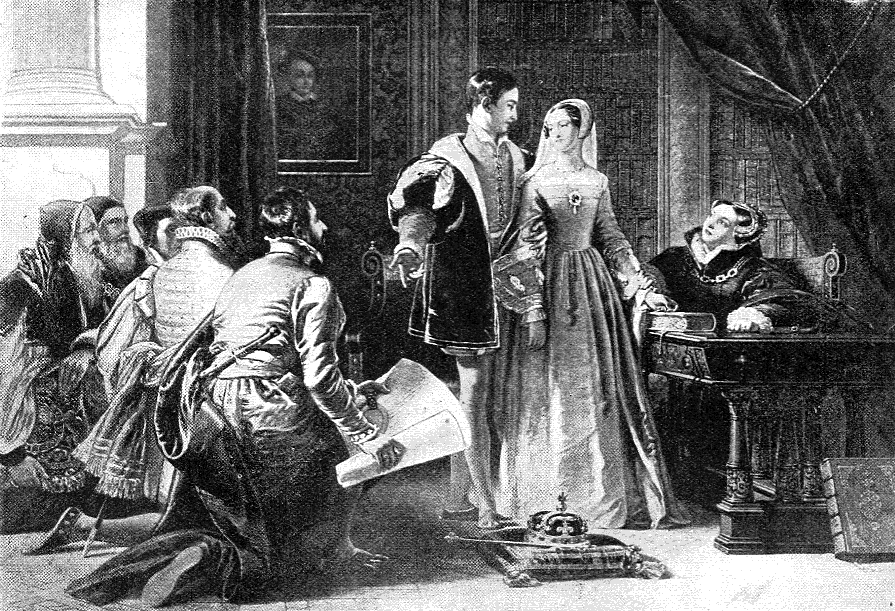 HER FRIENDS AND RELATIONS PRESSING LADY JANE GREY TO ACCEPT THE CROWN. |
Queen Mary and King Philip of Spain (1558-1558)
All England knew the new queen was a staunch Catholic. She had not hidden the religion "which" (she said) "God and the world knoweth she hath ever professed from her infancy." All England welcomed her as the daughter of Henry VIII. She had opposed the religious changes produced by her brother's ministers, and was determined to restore the old religion.
The new queen soon got Parliament to undo all the acts of Edward's reign concerning the Church. The Latin Mass was restored, and five Catholic bishops were at once brought back.
Now Mary had set her heart on marrying Philip King of Spain; but to this there was much opposition in Parliament and the country. Spain at this time was the strongest of the Catholic countries in Europe, and weak England would simply become a province of Spain.
Risings and plots took place all over the country—in the Midlands, on the Welsh border, in Kent, and in the West. Sir Thomas Wyatt headed a rebellion in Kent to save the country from "Spanish fleets and Spanish slavery," and to make Elizabeth queen. But Mary threw herself on the protection of the citizens of London. "Good subjects," she said to them, "pluck up your hearts and stand by your sovereign like true men. Fear not these rebels, for I assure you, I fear them not at all!"
 LADY JANE GREY. |
The daughter of Henry VIII triumphed, and the Spanish marriage was celebrated in July, 1554. Wyatt's rising failed, for his men would not be traitors and fight against their queen. Some hundred of the rebels suffered death. Poor young Lady Jane Grey and her husband were beheaded, and in ten days her father and Wyatt suffered the same fate. The Princess Elizabeth, daughter of Anne Boleyn, was arrested, and it was only by the special wish of Philip that her life was saved.
Soon after the marriage, Cardinal Pole came to restore the nation to the communion of the Church of Rome. Parliament knelt to him at Westminster, a Parliament that Mary had taken care, like her father, to fill with men of a "wise, grave, and Catholic sort." All Henry VIII's laws against Rome were now repealed.
The heresy laws of Henry IV and Henry V became again the laws of the land; and these laws sanctioned the fearful punishment of heretics by burning at the stake.
 PHILIP II. OF SPAIN AND QUEEN MARY. |
Neither Catholics nor Protestants had learned to tolerate the views of men who differed from them in religious matters. It was commonly believed that those who thought wrongly about religion—heretics, as they were called—were enemies of society, and should therefore be put to death. Mary in particular was very bitter against heretics, and insisted on carrying out executions even when the bishops and others who had to try those accused of heresy advised her to exercise clemency.
Between two and three hundred Protestants, convicted of heresy, suffered death by burning in the last years of her reign (1555—1558). Among these were Cranmer, who had been Archbishop of Canterbury during the reigns of Henry VIII and Edward VI, and others like Ridley and Latimer, famous as preachers and bishops. Cranmer, having joined in the first rebellion against Mary, could have been executed for high treason. Latimer and Bishop Hooper of Gloucester had refused to take part in such conspiracies, but their loyalty in that respect did not save them from the queen's severity. The continual burnings had not the desired effect of rooting out heresy; on the other hand, the sympathy which they evoked for the Protestants who thus suffered made it easier for Elizabeth, when she came to the throne, to reverse the religious policy of her sister.
Mary's marriage with Philip involved her in a Continental war which proved very disastrous for England. The English lost Calais in 1558 and Mary died shortly after.
As the second daughter of Henry VIII, Elizabeth stood next to the throne. She had a very unhappy time under her sister, Queen Mary. She had been arrested, brought to London, and taken in a barge to the Tower. She trembled at the thought of being detained in the Tower, for she knew too well the fate of others sent there by the stern queen.
Later on, Elizabeth was taken from the Tower by water to Richmond and carried in the queen's own litter by easy stages to Woodstock, where she was shut up and guarded by soldiers night and day, so that there was no chance of escape. She was allowed no books, no pens, no ink, no paper, and as the months went by, she envied even the milking maids, whose songs reached her from the distance, crying that their lot was indeed happier than hers.
One day she was taken to Hampton Court and summoned to her sister's bedroom. She had not seen the queen for two years. She at once threw herself on her knees before her, and declared that she had never plotted against her. "I humbly beseech your Majesty to have a good opinion of me to be your true subject, not only from the beginning hitherto, but for ever." The queen was much touched by this, and Elizabeth was set free. Once more she appeared at Court, and was honoured by the queen. Philip too treated her with all respect, not from any feelings of affection, but because he realised that she would probably be Queen of England after Mary's death. It was to his interest, therefore, to be friendly and respectful in his manner towards her. She was now allowed to go back to her books and her studies, for she had a real love of learning, spoke French well, and read Greek and Latin books with her tutors. And, like all accomplished young ladies of that time, she was skilled in needlework, and derived pleasure from playing on the lute and the virginal.
Mary's life was drawing to a close. During the summer of 1558 she was very ill, and when autumn came it was clear she was dying. In the grey twilight of a November morning Mary passed away. Messengers hastily rode to carry the news to Elizabeth, who, falling on her knees, cried aloud in Latin: "This is the Lord's doing, and it is marvellous in our eyes."
 ELIZABETH RECEIVING THE NEWS OF HER ACCESSION. |
Elizabeth Queen of England, Mary Queen of Scots, and the National Church
"Few rulers," it has been said, "ever ascended a throne better prepared for her task than did Elizabeth." Like the nation, she had suffered deeply. She had certainly been in danger of execution for a time, and had been under restraint more or less stringent throughout Mary's reign; during this period she had outwardly conformed to the Catholic religion, whatever her private opinions might have been. She had learnt to depend on no one but herself. She loved England as she loved nothing else in the world beside herself, and she was resolved to make her country great and flourishing.
But she was called to no easy task this November morning in 1558. Never had England been in greater trouble than when Elizabeth mounted the throne. Here is an account of the country at this time: "The queen poor; the realm exhausted; the nobles poor and decayed; good captains and soldiers wanting; the people out of order; justice not executed; all things dear: division among ourselves; war with France and Scotland; the French king bestriding the realm, having one foot in Scotland and the other on Calais."
England's hope lay in the new queen. The people had watched her growing in their midst from childhood to womanhood. Her twenty-fifth birthday had just passed. They knew her to be "a bold horsewoman, a good shot, a graceful dancer, a skilled musician, and an accomplished scholar."
She at once showed her wisdom by appointing Sir William Cecil her chief minister. He belonged to an old Welsh family that had always been loyal to the Tudor monarchs, no matter what their religion might be. He himself had served under the new queen's father, Henry VIII, her, brother Edward, and her sister Mary. "This judgment I have of you, that you will not be corrupted with any manner of gifts; that you will be faithful to the State; that without respect of any private will, you will give me that counsel that you think best."
In these words the new queen addressed her minister, who indeed served her right well for the next forty years. And it is interesting to remember that a descendant of this very Cecil, Lord Salisbury, served Queen Victoria, some three hundred years later, for an even longer term of years.
Elizabeth realised that she must destroy a great deal of Mary's work and build up much that she had destroyed. Her coronation took place at Westminster on Sunday, January 15th, and thus the first Protestant Queen of England commenced her reign. Very gradually Elizabeth began to introduce those changes that govern the public worship of England to-day. Before the first year of The Church made her reign was over, the Act of Uniformity was passed in order to keep the Church services uniform. It ordered all to use the new Prayer Book of Edward VI, as revised by a small body of Protestants at Elizabeth's request. An Act of Supremacy was also passed, and in this Elizabeth took the title of "Governor" instead of "Supreme Head" of the Church, but she insisted on keeping the management of Church affairs in her own hands. Those who offered objections she answered loftily: "I will do as my father did."
In the new Archbishop of Canterbury, Matthew Parker, she had a tower of strength. Bishops, driven abroad during the reign of Mary, returned home. Eleven Catholic bishops were deprived of their sees and imprisoned, and their sees filled by Protestant bishops.
The sudden death of the King of France had set Mary of Scotland and her husband Francis II on the French throne, and the new Queen of France assumed the royal arms of England. Elizabeth sent to object, but the answer was that "the Queen of Scotland bore those arms as the descendant of Margaret Tudor, her grandmother, the eldest daughter of Henry VII." Elizabeth herself bore, amid other titles, that of "Queen of France," and Mary urged that the French arms should be taken off the English shield, and the title dropped, if the royal arms of England were to be given up by her. Twelve sovereigns of England have borne the arms and style of France," replied Elizabeth proudly, "and I will not resign them" And so began the life-long quarrel between Elizabeth and her cousin Mary.
During the absence in France of Mary Queen of Scots, her mother had been acting regent in Scotland, and had been collecting French troops for the protection of the realm. This reached the ears of Elizabeth, and she at once sent ships to Berwick with troops in case of possible invasion. The French army was besieged in Leith.
The Treaty of Edinburgh was the result. By it, all French troops were withdrawn from Scotland and a council of twelve nobles, partly appointed by Elizabeth, were to carry on the government. It was also decided that "since the kingdoms of England and Ireland rightly belonged to the serene Elizabeth," therefore the King and Queen of France should not use the title or arms of England. But everything was changed when the King of France died, and soon after Mary returned to her own kingdom in Scotland.
Mary's grief at leaving France was pitiful. She was to sail from Calais to Leith to avoid risks of capture from English ships. At the sight of the ships at Calais ready to take her away from France, she burst into tears. Indeed, all those present were weeping as she stepped on board, accompanied by her four Marys, who had attended her to France twelve years before. The sails were set and the galley was getting out to sea, when Mary cried through her tears: "Adieu, France! beloved France, adieu!" The breeze died away, "the weary rowers slumbered on their oars." Mary had cried herself to sleep, begging to be awakened before the shores of the land she loved had faded quite away. As daylight dawned they wakened her, and looking out over the summer sea, she cried once more: "It is past. Farewell! farewell to France, beloved land which I shall behold no more!"
The English fleet was on her track, but a thick fog protected her little ship, and after a dangerous voyage of four days, Mary landed in Scotland early one morning in the summer of 1561. She had left her home as a happy little queen of six years old. She returned to her kingdom, after twelve years, a childless widow, alone, unprotected.
 JOHN KNOX'S HOUSE, EDINBURGH |
During these twelve years of Mary's absence, the Reformation, which had made itself felt in other countries, had taken strong hold in Scotland. The great leader of the Protestant party in that country was John Knox, a stern and unbending Reformer. Mary, the queen, was a staunch Roman Catholic. Though she put up with the Psalm-singing of Knox's choir under her windows at Holyrood for the first three nights after her arrival, it was impossible that she and Knox should ever really agree. She tried to get rid of him by bringing an accusation of treason against him, but Knox was acquitted.
The realm of Scotland now passed through an unhappy time. Mary married her young Roman Catholic cousin, Lord Darnley; both Elizabeth and Knox strongly objected. Before long, Darnley became jealous of Mary's secretary, Rizzio, and the secretary was murdered in the presence of the queen and her husband.
Three months after this tragedy, a son was born to Mary and Darnley—destined to be King James VI of Scotland and James I of England. But even the arrival of a fair son did not bring the unhappy couple together.
 RIZZIO AND MARY QUEEN OF SCOTS. |
Now comes a terrible tragedy which will ever remain a blot on the history of Scotland. Eleven months after the murder of Rizzio, Darnley himself was found murdered in a building outside Edinburgh. The whole world was horrified, and it was not less horrified when, two months later, Mary became the wife of Bothwell, who was regarded as the murderer of her late husband and the "foulest ruffian among her subjects.'' A shudder ran through the whole country and the Scottish nobles turned against her.
The Scottish Reformers were determined that Mary should resign the crown, on which she had brought such disgrace. She had her choice between that or death, and thus she was forced to give up the throne in favour of her infant son. So the baby prince was crowned James VI of Scotland, when little over a year old. He was taken to Stirling Castle to be educated, while Mary's half-brother, Murray, acted as regent.
Mary escaped from Lochleven Castle, where she had been imprisoned; then followed the defeat of her troops by the Regent Murray at Langside and her flight into England. A pitiful letter from her found its way to Elizabeth: "I entreat you to send for me as soon as possible," she wrote, "for I am in a pitiable condition, not only for a queen, but even for a gentlewoman, having nothing in the world but the clothes in which I escaped, riding sixty miles the first day . . . Have compassion on my great misfortunes and permit me to come to you. Your very faithful and affectionate good sister and cousin and escaped prisoner, Marie, Queen."
Elizabeth had a difficult part to play. She was sorry for the hapless plight of her royal kinswoman. But she was most anxious she should be closely guarded in Carlisle Castle, and not allowed to escape a second time. From Carlisle, Elizabeth had her removed to Bolton Castle, in Yorkshire. Though she was allowed a household of her own, she was strongly guarded by Elizabeth's orders. Mary was now but twenty-seven. She never had her freedom again.
Spain and the Sea-Rovers
The imprisonment of Mary was not merely an unfriendly act between two queens. There was conflict between Catholics and Protestants in several European countries at the time. Elizabeth on the throne of England represented the Protestants. The Catholics hoped, if Mary came to the throne, the old religion and the Pope's authority would be brought back to England.
All Europe was looking on. Abroad the struggle was still fiercer. Spain, under Elizabeth's brother-in-law Philip, had managed to kill or exile most of the Protestants of that country. It was a harder task to banish them from the Netherlands, which was at this time subject to the King of Spain. The Dutch fought hard for their Reformed religion, and numbers of Englishmen crossed over to help them, secretly encouraged by Elizabeth.
 QUEEN ELIZABETH KNIGHTING DRAKE ON BOARD THE GOLDEN HIND. |
In France the conflict took a yet more deadly turn. Here the Protestants were known under the name of Huguenots, and these too had been secretly encouraged by Elizabeth.
On the night of August 24, 1572, a terrible massacre of Huguenots occurred in Paris. For long the Huguenots and Catholics had been at war, and when the Huguenots seemed to be gaining political supremacy, the French king's mother took this cruel means to prevent it. Elizabeth, on receiving the news, plunged into mourning, but she could not afford to quarrel with France, when Spain, as we shall, soon see, was none too friendly.
As the great Spanish invasion and the defeat of the Armada rank among the most famous events of Elizabeth's glorious reign, we must see what circumstances led up to them.
Charles Kingsley wrote a well-known story called "Westward Ho!" These two words contain the secret of the strained relations between Spain and England.
Up to this time Spain was, without doubt, mistress of the sea. She had built the best ships and sent off the best sailors to discover new worlds. She ruled over Portugal, over part of Italy, Sicily, the Netherlands and those parts of North and South America that she had conquered. Her ships were in every part of the known world, and she was growing rich with trade and treasure, This sunny land of Spain, "washed by the waters of the great Atlantic on one side and the blue Mediterranean on the other, was yet looking round for new worlds to conquer, when as yet the other nations of Europe had scarce ventured beyond their own fishing-grounds."
But for some time past England had been waking up; the blood of the old Vikings was stirring in her people, The desire for gold was urging on her merchants, and stories of adventure were firing her young men. All eyes were gazing out to sea "Westward Ho!" was the cry. "Whosoever commands the sea, commands the trade of the new world, commands the riches of the world, and consequently the world itself," said Raleigh, whose half-brother, Sir Humphrey Gilbert, five years before the Armada, founded the first British colony in Newfoundland.
At Elizabeth's accession, the new spirit of adventure showed itself in acts of piracy and plundering in the "Narrow Seas," as the English Channel was called those days. Here hardy mariners would sail forth from the southern ports of England, to harry and plunder Spanish ships plying between Lisbon and Antwerp or London. Their only care was to worry the Spaniard and fill their own pockets.
 PLYMOUTH HARBOUR IN THE DAYS OF DRAKE. |
Elizabeth could not recognize these sea-rovers, who swept the Channel, and yet she liked the courage of the sailors who had the pluck to attack great Spanish galleons, five times the size of the little English ships. She admired the reckless daring that drove them forth to their life of plunder. If they failed, they got their deserts—torture, dungeon, and death at the stake. But soon the Narrow Seas were too small for their ambitious spirits, and they roused the fury of the Spaniards by crossing the Atlantic to trade and plunder in the West Indies.
Francis Drake is a name familiar to every child. Who does not know that this was the Drake who sailed right round the world in an English ship, and brought the Spanish treasure to his country and his queen? Here he is, a young man of twenty-two, sailing out of Plymouth harbour on this October day, about three hundred and fifty years ago, on as daring a venture as any young sailor could find. Brought up in his Devonshire home, Drake had early acquired hostile feelings for the Spaniards. Queen Mary's marriage to Philip of Spain was unpopular in the West.
As a lad, he had seen the pirates sail out from Plymouth on their perilous ventures. He had sailed himself in a trading vessel to the Netherlands, and he had been in West Indian waters. Now he was sailing with Hawkins out into the West to the "Treasure House of the World," hoarded by the Spanish. After filling their ships with negroes from the West Coast of Africa, the little fleet under Hawkins and Drake reached the West Indies and the slaves were secretly sold to the Spaniards.
On they went to the coast of Mexico with a hundred negroes still left for sale. Here they found twelve large Spanish ships laden with gold and silver. They were at the mercy of Hawkins, but he did not touch them. He only got leave from the Spaniards to repair his battered ships before returning to England.
Suddenly the Englishmen were attacked by the Spaniards, five hundred of the crews were slain, and it was with the greatest difficulty that Hawkins and Drake with three of their ships managed to escape and get out to sea. But a great storm arose and scattered their ships. Drake in his little fifty-ton Judith ploughed his way across the broad Atlantic Ocean, and sailed alone into Plymouth harbour one day early in the New Year of 1569. Hawkins followed some days later. From this time onwards, Hawkins and Drake were sworn enemies of the treacherous Spaniards and thirsting for revenge.
Meanwhile England and Spain were getting every day nearer to war, but Elizabeth was still trying to keep on good terms with France. Drake did not improve matters by his voyage in 1572. He now left Plymouth with a little fleet and a crew of seventy-three men and boys on a desperate venture. They went to the place where the Spaniards collected the treasure from their mines, and Drake meant to fill his ships with gold and silver or die in the attempt. He very nearly lost his life, for as he and his lads from Devon stood at last on Spanish ground, gazing at piles of gold and silver, such as the world had never dreamt of before, he suddenly grew faint from loss of blood from a wounded leg. His lads carried him to the ship and they sailed away from the dangerous spot.
But before he left Central America, he was guided by a native to the highest ridge in the Isthmus of Panama. Here he found a tree of giant growth having steps hewn in it for ascent, and from the top Drake gazed on the Pacific Ocean. It was the first time that any Englishman had looked on the boundless waters of that vast ocean.
"Almighty God of His goodness give me life and leave to sail once in an English ship on that sea," he cried, falling on his knees. And some years later his prayer was fulfilled.
The Spanish Armada (1588)
Philip of Spain continued his preparations for invading England. He felt that the conquest of Elizabeth's kingdom would enable him to complete his triumph over the obstinate people of the Netherlands. His warlike plans were known to all.
Plots for murdering Elizabeth and placing Mary Queen of Scots on the English throne were discovered. This brings us to the last chapter in the life of the unfortunate Queen of Scots, who never lived to see the disastrous end of Philip's ambition.
Mary had been moved from castle to castle. The cold bleak air of one of these, Sheffield Castle, told on her health and she suffered great pain from acute rheumatism. To the end of her life she remained stiff and lame from rheumatic pains. She had been continually begging Elizabeth to grant her freedom, yet all the time she was corresponding somehow with her Catholic friend the Duke of Norfolk, in order to effect her escape from her long imprisonment.
The Duke of Norfolk was now executed. Mary was accused of plotting against Elizabeth.
The rest of the story is soon told. Mary was tried in the great hall of Fotheringay Castle, declared guilty, and executed. A very outburst of horror at the deed arose over Europe.
Preparations for the Invasion
 SPANISH SOLDIERS IN BLACK ARMOUR. |
Philip of Spain pushed on his preparations for the conquest of England. Not only did he wish to overthrow Elizabeth and suppress the Protestant religion in England, but also to put an end to English smuggling and interference in Spanish America and to stay the hands of Englishmen in the Netherlands. This England seemed to him to be "going ahead" too fast. A new energy was arising, and Englishmen were exploring outside their island-home for the first time in history. On this new energy Spain looked with a jealous eye. Spain was supreme by land and sea—the greatest force in Europe at this time. Philip was anxious to keep up his unequalled position and maintain the Catholic religion throughout the world.
The news of coming invasion started off Drake on a new enterprise. With some twenty-five ships supplied by merchant adventurers, and four supplied by the queen herself, he went off in 1587 to divide the gathering fleet of Spain and if possible to stop the supply of food. Elizabeth had given her consent. But hardly had Drake passed out of Plymouth harbour than she repented having allowed such a vigorous pirate as Drake to make war on Philip in his own waters. It was too late—Drake was already hurrying to Cadiz—where he found Spanish preparation already well-advanced.
"The like preparation was never heard of, nor known, as the King of Spain hath to invade England. His provisions of bread and wines are so great as will suffice forty thousand men a whole year," he wrote home.
The English sea-rover was soon at his old work, and his exploits in Cadiz harbour made the world ring with admiration of his daring. He sank great Spanish galleons; he burnt large vessels laden with biscuits, wheat, and wine; he created terror among the Spanish seamen and discovered for his country the strength of the foe.
"I have singed the King of Spain's beard," he said on his return home. He had done more than this. He had stimulated the Spanish to still greater effort for the overthrow of England. Philip was now irritated beyond endurance, and he put out all his strength to accomplish his life's desire and defeat England. While his ships were getting ready to sail, let us see how England was preparing for this great ordeal.
 MILITIA-MEN OF THE REIGN OF ELIZABETH. BILLMAN, HALBERDIER, MUSKETEER, ARCHER. |
The hundred "beef-eaters" and Yeomen of the Guard at court formed the only standing army in England paid by the crown at this time. The very year before Elizabeth's accession, Philip and Mary had created a lord-lieutenant in every county in England. It was the duty of this magnate to choose officers for his county, to decide on the number of able-bodied men to be supplied by each parish, and to take command of the militia, as it was called, in case of war. To-day, the Territorials are under the lord-lieutenant of each county. The men as a rule volunteered when danger was at hand, but the full number had to be made up by compulsion.
When formed, the troops were divided into "bands" of about two hundred men under a captain. Later on, these were formed into, "regiments." The men had no regular uniform—the only feature common to all was the red St. George's Cross worn on their jackets.
For the past eight years the regular militia had been trained in the use of fire-arms—bows and arrows were fast disappearing, though pikes and halberds were still carried.
The English volunteers had learnt the art of was in France, Flanders, and Ireland, where military schools had been formed, and the volunteers had drilled the, sons of knights and squires at home. Thus it was, when the long-talked-of peril was near, a hundred thousand armed men sprang into being at a few days' notice.
"How many men and ships must we provide? asked the City of London. "Five thousand men and fifteen ships" was the answer.
At the end of two days double this number, ten thousand men, and thirty ships, were placed at the queen's disposal. Such was the loyal feeling of Elizabeth's people in the face of danger.
 QUEEN ELIZABETH AT TILBURY. |
The queen herself reviewed her land forces. The troops assembled at Tilbury in great spirits, longing to fight the Spaniards. Mounted on a war-horse, in a breast-plate of glittering steel, with a general's truncheon in her hand, "Elizabeth rode bare-headed through the ranks. She was greeted with thunders of applause—a just reward for her courage, for those in authority had begged her not to appear in public at this critical hour.
"My loving people," she cried, let tyrants' fear! I have always so behaved myself, that under God, I have placed my chiefest strength and safeguard in the loyal hearts and goodwill of my subjects. Therefore; I am come amongst you at this time, . . . for I am resolved, in the midst of heat and battle, to live or die amongst you all; to lay down for my God and for my kingdom and for my people, my honour and my blood even in the dust. I know that I have but the body of a weak and feeble woman, but I have the heart of a king and a king of England too, and think foul scorn that Spain . . . should dare to invade the borders of my realm. Rather than any dishonour to the kingdom should come by me, I myself will take up arms. I myself will be your general, the judge and rewarder of every one of your virtues in the field. . . . I do not doubt but by your obedience to my general and your valour in the field, we shall shortly have a famous victory over the enemies of my God, of my kingdom and of my people."
But the land forces had nothing to do, for already the ships of England had dispersed the "Invincible Armada." Elizabeth's "sea-dogs" had done the work and driven the Spanish ships to destruction. They were men trained in the rough school of Hawkins and Drake, such as Frobisher, Raleigh, Grenville, men with reckless daring and genuine seaman's skill.
England had no proper navy at this time. Elizabeth owned thirty-four ships of varying sizes and shapes, but these were in bad repair and she always grudged spending money on them. Indeed, she was so mean and indifferent over her sailors, that she was actually trying to reduce her naval expenses by giving her seamen fish, oil, and peas, instead of meat, when, her very country was in danger!
At last delay was no longer possible.
Every ship fit for service was hastily manned. Merchants came forward with their little craft ready to bear all expenses themselves in a very outburst of patriotism. Supplies were hastily issued, and a very mixed little English fleet of some two hundred ships got ready to meet the greatest fleet in the world that had ever put to sea. But the English ships were manned by men of grit and power—men trained on the sea, schooled in storm and tempest, hardened by want and endurance. As a builder of ships, Hawkins had no equal; for skill in seamanship none could touch Sir Francis Drake. The whole fleet was under the command of Lord Howard; Sir John Hawkins commanded the Victory, Sir Martin Frobisher the Triumph—Drake as vice-admiral was on the Revenge. In the hands of these men lay the safety of England.
How the Armada was Defeated
Meanwhile the great Spanish Armada had sailed at last from the harbour with a light wind, the sun shining on the numerous sails and lighting up the red crosses. Every seaman, officer and soldier had been through a solemn service before joining the fleet. But Philip's hopes that the English Catholics would help his cause were doomed to disappointment, for Catholics and Protestants alike came forward to resist the invader.
The whole of the great Spanish fleet was under the command of the Duke of Medina Sidonia. He had in vain assured his king that he knew nothing about the sea and nothing of war.
 THE DUKE AND DUCHESS OF MEDINA SIDONIA. |
Bad weather and the clumsiness of the great ships delayed the fleet. Three weeks were spent in passing from Lisbon to Cape Finisterre, and it was not till, Friday evening, July 19th, that they sighted Lizard Point in Cornwall. They intended to take possession of England on the morrow.
But they had already been sighted by a Cornish fishing-boat, and report of the enemy's approach soon reached Plymouth. It is said when the news arrived the English admiral was playing bowls at Plymouth Hoe with his captains. Lord Howard would have started off at once, for he knew the English ships were all riding at anchor in ports along the English Channel at the mercy of the foe. But Drake refused to be hurried.
"There is time to finish the game first and beat the Spaniards afterwards," said Drake.
So the famous game was finished and then the old sea captains got to their work in good earnest. There was no sleep in England that Friday night. Bonfires were lit all round the coast, ports and harbours filled rapidly with armed men, bells rang out, horsemen gathered in the villages, swift messengers flew from point to point.
By daybreak on Saturday everything was ready. But the Spanish fleet did not come into sight till three o'clock that afternoon. To English eyes it looked like a vast array of floating castles arranged in the form of a crescent or half-moon, the horns of which were some seven miles apart. It approached "very slowly, though with full sails, the winds being, as it were, weary with wafting them and the ocean groaning under their weight."
 THE SPANISH FLEET SAILING UP THE CHANNEL IN THE FORM OF A HALF MOON, WITH THE ENGLISH FLEET PURSUING IT. |
The Spaniards soon found that they had been seen and there was no chance of surprising Plymouth, as they had intended. So they resolved to make their way to the Isle of Wight and effect a landing there.
Howard allowed them to get within sight of Plymouth. Then on Sunday morning he hoisted sail and led his sixty or seventy ships to the rear of the great Armada. The first shot was fired, and soon Drake, Hawkins, and Frobisher were sailing round the outskirts of the unwieldy Spanish galleons, firing into them and inflicting injury, while the Spanish guns from high decks fired over their heads. For six hours that Sunday afternoon fighting continued and by three o'clock the invaders were in great confusion. On Monday the high-towered galleons moved onward, "like Thames barges piled with hay." The low English ships, sailing double the pace, again harried them and shot away, as if by magic, before the wind.
On Tuesday the Armada had reached St. Alban's Head (Dorsetshire). A famous crowd of Elizabeth's courtiers, including Sir Walter Raleigh, had hurried to the coast. They sailed out, into the Channel to help the English fleet in their work of skirmishing and harrying the rear of the Spanish fleet.
By Thursday the Armada was off the Isle of Wight and there was some sharp fighting, which forced the Spanish flagship to retreat. Thence the two fleets passed onwards quietly along the coast of Sussex to Boulogne. To the Prince of Parma, who was waiting with troops on the coast of the Netherlands to join him, the poor Duke of Medina Sidonia wrote: "The enemy pursue me. They fire upon me most days from morning till nightfall. They have men and ammunition in abundance. I must request your excellency to send me two shiploads of shot and powder immediately. I am in urgent need of it."
On Saturday the 27th the wind rose the Spanish admiral knew nothing of our dangerous coast and decided to anchor in the Calais Roads. Amid squalls and driving showers from the west, the Armada ran across to the French coast. The English followed, but they were not yet strong enough to attack. The captains held a council of war—the fate of England depended on their verdict. "Considering their hugeness," said one, "'twill not be possible to remove them but by a device."
This device was to drive the Spanish Armada out to sea by means of fireships. Some said it was Queen Elizabeth's own idea. Anyhow, some old ships were filled with gunpowder, pitch, and brimstone, and their masts were smeared with pitch. They were then conducted near to Calais and at a given signal they were set on fire. The wind was rising, rain pelted down, and in black darkness the fierce south-wester blew the blazing fireships into the centre of the crescent fleet of Spain.
"Cut your cables! Get up your anchors!" shouted the captains of the Spanish ships in an agony of fear.
With sails set, amid confusion and panic, the Spanish ships were driven out by wind and tide into the angry sea of Ostend. "God hath given us so good a day in forcing the enemy so far to leeward," wrote Drake hurriedly. "God bless her Majesty, our gracious sovereign. This day's service hath much appalled the enemy."
This was Sunday night. The Spaniards had suffered a severe loss in the Capitana, "the very glory and stay of the Spanish navy." Then on Monday, July 29th, they were attacked off Gravelines by the English fleet led by Drake in the Revenge. The fighting of this day decided the fate of the Armada. The battle began at nine in the morning, while the enemy were struggling to regain their crescent form in a strong north-west wind and a heavy tide.
 THE DEFEAT OF THE SPANISH ARMADA. |
All through that summer day firing went on. Spanish guns, which were worked on high rolling platforms by soldiers unused to the sea, sent their shot into the air or into the water, while the little English ships poured into the great galleons a continuous rain of shot. For six long hours they fought, until the English reported that "the last cartridge was spent and every man was weary with labour." Every Spanish ship received its share of injury; three great vessels were hopelessly wrecked. Drake thought that five thousand at least must have perished by gunshot or drowning.
Still "their force is wonderful great and strong," wrote the admiral, "but we pluck their feathers by little and little."
The Spaniards themselves were now hopeless. With sails torn and masts shot away, the once crowded ships were helpless. The Duke of Medina Sidonia was in despair.
"We are lost," he cried to one of the bravest captains. "What are we to do?"
"Let others talk of being lost," was the courageous answer. "Your Excellency has only to order up fresh cartridges."
But a council of war decided to hurry the Armada back to Spain by the north of Scotland, for the wind was against their return by the Channel, neither did they care to encounter the English again. So the Armada sped northward in full sail. "Notwithstanding that powder and shot was well near all spent," said Howard, "we set on a brave countenance and gave them chase."
The chase lasted from Monday to Friday.
"We have the army of Spain before us," wrote Drake on the Wednesday. "There was never anything pleased me better than seeing the enemy flying with a southerly wind to the northwards."
Driven onwards by a strong wind, the English ships sped on after the Spaniards, right up through the wild North Sea, till they reached the Firth of Forth. But the work of destruction was reserved for a mightier foe than Drake. No sooner had he given up the chase owing to want of food and powder, than a violent storm arose, "more violent than was ever seen before at that time of the year." Among the lonely Orkneys, the storms of the northern seas broke on the flying Armada like a fury. Amid driving squalls of wind and rain, the Spaniards at last guided their shattered ships to the great rollers of the Atlantic, only to meet greater perils on the Irish coast.
They had no pilot to warn them of the dangers of the way and the wind blew them hither and thither. Some eight thousand men perished off the Giant's Causeway in the north of Ireland, and many a stout galleon was dashed to pieces.
At last some fifty battered ships reached Spain out of the hundred and thirty-two that had started. They had ten thousand sick and stricken men out of the thirty thousand that had left her shores for the conquest of England some months before. And it is not surprising to hear that Philip of Spain shut himself up in his royal palace near Madrid, and "no one dared to speak to him."
Coins and medals were now struck to commemorate the victory. In November a great thanksgiving service was held at St. Paul's, which was attended by the queen in full state. She was taken through the streets seated in a triumphal car with a canopy over it in the shape of a crown on four pillars, in front of which stood a lion and dragon supporting the arms of England. The chariot was drawn by two milk-white horses.
"Thou didst blow with Thy winds and they were scattered," preached the Bishop of Salisbury at St. Paul's. A more suitable text could hardly have been chosen, and it was inscribed on many of the medals issued after the Armada.
Though the Armada had failed, the spirit of Philip was unbroken. After the first outburst of grief, he was making fresh preparations for action. "It is not honourable for her Majesty to seem to be in any fear of the King of Spain," said the people, and expedition after expedition left England to seize treasure, and pillage the Spaniards, wherever they might be. Some were successful and some failed, but Elizabeth's "sea-dogs "were not to be daunted.
The Doings of Elizabeth's Sailors after the Armada
It would take too long to tell of all the Spanish treasure that found its way into English harbours, and of all the adventures that befell the Elizabethan explorers. But one story must be told, as it has come to us from the pen of Sir Walter Raleigh. It has been made the subject of a poem by Lord Tennyson, called the "The Revenge—a Ballad of the Fleet," and this tells us in beautiful verse of the daring seamanship of Englishmen under the Tudors.
It was three years after the defeat of the Armada when Sir Thomas Howard and Sir Richard Grenville started off on a private enterprise to seize the West Indian fleet returning to Spain with its treasure. The queen had encouraged the enterprise by finding seven ships, and Sir Walter Raleigh had fitted out one; so the little fleet left Plymouth in the spring of 1591 bound for the West Indies.
Hearing of the plan, King Philip sent out a large fleet of fifty sail to conduct the treasure ship safely home and defeat the English pirates. And so it fell out one day that when Howard was cruising about among the West India Islands, a Spanish fleet bore down on the little English ships. Being totally unprepared for battle, Howard sailed away. But somehow Grenville did not set off in time and the fifty great ships sailed towards him. It was too late to escape and soon the Spanish ships were close, and they were about three times as large as the Revenge.
Sir Richard refused to turn from the enemy, for he felt that he would rather die than dishonour himself, his country and her Majesty's ship. He thought he could fight his way through the fleet, and—
|
"The little Revenge ran on sheer into the heart of the foe, With her hundred fighters on deck and her ninety sick below." |
(noindent) But the Spanish ships closed round the Revenge. Sir Richard with his handful of men fought hand-to-hand for their lives, as even Englishmen had rarely fought before. The fight, which had begun at three in the afternoon, did not end till daybreak.
|
"And the sun went down, and the stars came out far over the summer sea, But never a moment ceased the fight of the one and the fifty-three. Ship after ship, the whole night long, their high-built galleons came; Ship after ship, the whole night long, with her battle-thunder and flame; Ship after ship, the whole night long, drew back with her dead and her shame, For some were sunk and many were shatter'd, and so could fight us no more God of battles, was ever a battle like this in the world before?" |
"Fight on! Fight on!" cried Sir Richard, though he had been badly wounded and was in great pain. "All the powder to the lash barrel was now spent, all the pikes broken, forty of the best men slain and most of the rest hurt," says Sir Walter Raleigh. They had fought for fifteen hours and could fight no more. And—
|
"Sir Richard cried in his English pride, 'We have fought such a fight for a day and a night As may never be fought again! We have won great glory, my men! And a day less or more At sea or ashore, We die—does it matter when? Sink me the ship, master gunner—sink her, split her in twain! Fall into the hands of God, not into the hands of Spain!'" |
But the men had wives and children at home, and they would not let the gunner sink the ship. Sir Richard lay dying, and they carried him on board one of the Spanish galleons. The Spanish Admiral treated him with every care and courtesy, and did all that was possible to soothe his sufferings.
|
"And they praised him to his face with their courtly foreign grace; But he rose upon their decks, and he cried: 'I have fought for queen and faith like a valiant man and true; I have only done my duty as a man is bound to do: With a joyful spirit I, Sir Richard Grenville, die! And he fell upon their decks and he died." |
"All England was soon ringing with this story. Sir Richard Grenville was dead—he had lost the fight, lost his men, lost his ship, lost his very life. But he had gained such glory for England, for England's ships, for England's seamen, as the world had never seen before. It is said that the action of this one little English ship struck a deeper terror into the hearts of the Spaniards than even the destruction of the Armada itself."
The Revenge had gone down in a terrific storm that broke over the Western Isles before she could be taken into port, and as the Revenge sank "she seemed to summon Drake to his doom." She was the most famous ship in all England's navy, and on her model all new ships had been based. She had been given and commanded by Drake, who was now longing to punish the Spaniards for her loss. It was known that Philip was preparing a new Armada, and the queen did not like to allow Drake to go far away from England. But at last she gave leave: so Drake and Hawkins started off on a joint venture to capture a disabled Spanish treasure ship of enormous value lying at Puerto Rico.
It was to be their last voyage. The enemy was again prepared. The expedition failed and Hawkins, now an old man of seventy-five, died of "combined disease and grief." Drake only lived eleven weeks longer. Failure had come to him who had never failed before. Sickness broke out on board, and at last, broken in spirit as he was at the death of his old friend, it took hold of him. Delirium seized him. He rose from the bed where they had laid him, and called like a "dying Viking for his arms." But they laid him down, and one January day in 1596, "as quiet as a sleeping child, the sea-king died."
Elizabeth's three leading mariners, Frobisher, Drake, and Hawkins, were now all dead But Sir Walter Raleigh lived. He had loved the sea and was ready for adventure, but he had higher aims than these daring sea-rovers who dreamt of revenge and gold. Throughout his life Raleigh sought to plant English colonies in America. He had failed in Virginia, but he had himself since reached the Isthmus of Darien in Central American and only returned when summoned by the queen. He had fallen into disgrace by marrying secretly one of Elizabeth's maids-of-honour, for which offence he was thrown into the Tower of London.
After his release, he left England to search for a city supposed to exist in South America and called El Dorado, or the golden city. This city was said to be richer than Peru, and the Spaniards had so far failed to find it. Raleigh failed too, but he discovered lands up the great Orinoco.
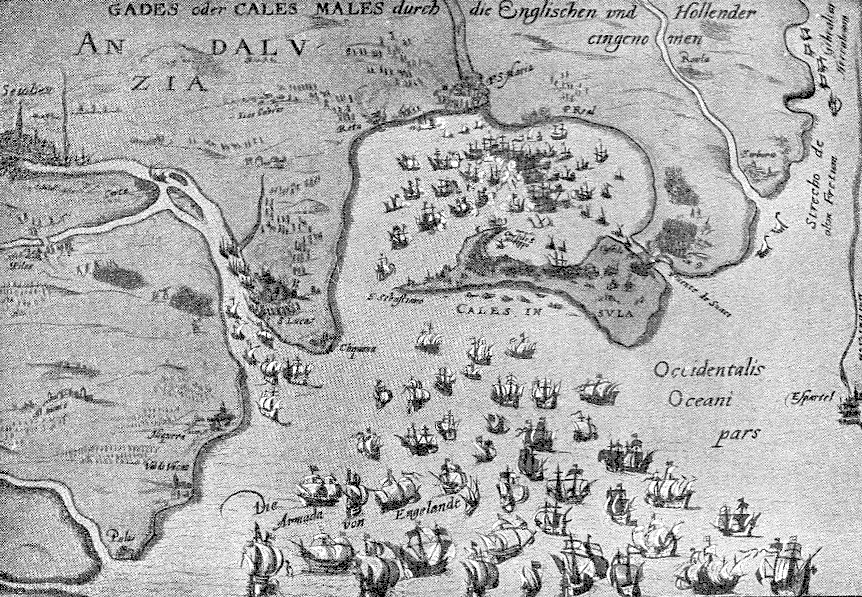 THE ENGLISH ATTACK ON CADIZ IN 1596. |
The last expedition for his queen, in 1596, was successful. A league between England, France, and the Netherlands had been planned to withstand the power of Spain. Suddenly news ran through England that Philip had captured Calais from the French. This must be revenged and at once. An expedition was fitted out by Howard, Raleigh, and Essex to repeat Drake's exploit of "singeing the King of Spain's beard." It was the largest fleet ever prepared by England against Spain. Elizabeth contributed seventeen ships, and seventy-six were hired and volunteered. On a Sunday in June, Lord Admiral Howard, who was in command of one hundred and fifty ships, reached Cadiz and anchored quietly in the harbour, to the utter amazement of the Spaniards. Next day a great battle was fought, beginning at five in the morning. By one o'clock all was over and the Spaniards were defeated by sea. Then Essex, in command of three thousand soldiers, leapt on shore, Cadiz was taken and sacked and the English returned home victorious.
"You have made me famous, dreadful, and renowned," wrote the queen to her victors, "not more for your victory than for your courage. Never was there heard in so few days so great a gain obtained. I charge you let the army know, both on sea and land, that I care not so much for being queen, as that I am queen of such subjects."
With the death of Philip of Spain in 1598, all danger from that quarter was over. "I die like a good Catholic," he murmured as he lay dying, "in faith and obedience to the Holy Roman Church." He had failed either to convert or to conquer England, and his death affected but little the country over which he had once ruled as king.
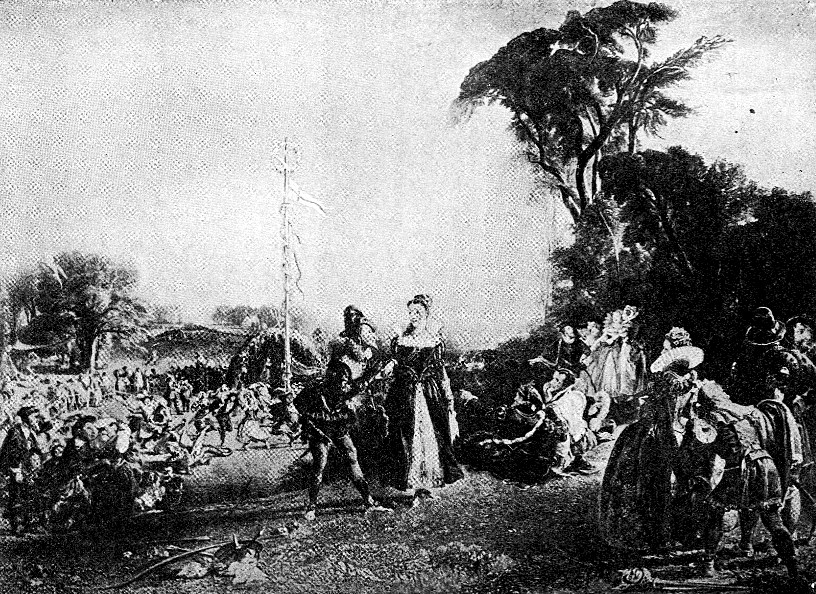 MAY DAY IN THE TIME OF QUEEN ELIZABETH. |
England's Greatness in the Days of Elizabeth; Spenser and the Great Shakespeare
Rebellion in Ireland took over one of the queen's subjects, Edmund Spenser. Another rebellion sent him back to England. During the intervening years, he wrote one of England's greatest poems, called the "Fairie Queene." He had gone to Ireland as secretary with Lord Grey, Elizabeth's new Viceroy. The misery, and poverty of the Irish at once struck him. He contrasted the unhappy country with his own "merrie England," with its peace and order, its thriving homesteads, wealthy cities and contented people.
When Elizabeth decided to plant English colonies in Munster, Spenser received three thousand acres in Cork. He made his home at Kilcolman Castle. The queen's viceroy grew in his mind as the image of perfect justice, and in the "Fairie Queen" he becomes the great Knight of Justice.
At Kilcolman, Spenser was quietly working out his great poem, when his old friend Raleigh came to visit him in his quiet retreat. Spenser showed him the first three books of the "Fairie Queene." Raleigh at once saw its merit. He saw that the new poem was immensely better than anything that had appeared in England since the days of Chaucer, and hurried Spenser off to England. The queen must hear it, for Elizabeth was Gloriana, the "Fairie Queene "herself. Elizabeth was pleased—she allowed the poet a pension of £50 a year, and the poem was dedicated to her.
 SPENSER READING THE FAIRIE QUEENE TO RALEIGH. |
The poem was received with quite a thunder of applause the silence of two hundred years had been broken and Spenser's name was on every lip. Here was a new world—a new England. Hearts were stirred by the deeds of men, the spirit of adventure was everywhere, fearless sailors were exploring unknown seas. In the new poem men found a world of "lofty enterprise, of ceaseless labour and conflict for a great aim," yet over all reigned "an air of quietness and peace."
Spenser, later on, brought three more books of his poem to England, where they were eagerly read. But a little later Kilcolman Castle was attacked during an Irish rebellion and set on fire. Though Spenser and his wife escaped to England, it is said their new-born child perished in the flames. Anyhow, three weeks later Spenser died utterly ruined and broken-hearted. But he had left his imperishable life-work behind to refresh and inspire many a tired generation—long after both he and his queen had been laid to rest in Westminster Abbey.
But if the age of Elizabeth produced Spenser and his great poem, the "Fairie Queene," yet more important to the world at large were the plays of Shakespeare, which sprang into being at this time. The Elizabethans themselves had no idea what a really great man was their poor writer of plays, Shakespeare. The drama was new to them, but we know to-day that he was the greatest dramatist the world has ever seen in any country or in any age, and that his plays are among England's most priceless possessions.
Of the man himself, we know very little. He was born in 1564 at Stratford-on-Avon, but obtained his living in London as an actor and play-writer. He had little book-learning, "small Latin and less Greek," but he knew mankind, he understood human nature, and the art of expression. Spenser leads us into a world of dreams, with dim unreal figures passing across a shadowy stage. But Shakespeare gives us a world of real men and women; they are flesh and blood like ourselves, they have joys and sorrows and anxieties, they live and they die.
The Spanish Armada had come and gone before Shakespeare wrote his first play, but he had come to London as a young man of about twenty-two, probably as an actor, a year or two before. At this time there were only two theatres in London—"Burbage's Theatre" and "The Curtain," though a little later the Globe Theatre in Southwark was built. But Elizabeth had always loved plays, and quite early in her reign we find her using her choir boys of Chapel Royal to act plays to her on Sundays. The Puritans found fault with her for this, but she tried to reform not by putting an end to plays, but by encouraging better ones.
 THE GLOBE THEATRE AS IN WAS IN SHAKESPEARE'S TIME. |
Many a time young Shakespeare must have acted in the courtyard of inns, which were used right through the reign of Elizabeth for the performance of plays. The poorest part of the audience sat or stood under the open sky in the court-yard or "pit" as it was called, while there were covered seats in the galleries running round the pit for the more wealthy onlookers. And the new theatres were made in that way.
Plays began at one o'clock, they were advertised by bills in the town, while the hoisting of a flag told the people that the play was about to begin. In between the acts the audience ate apples, cracked nuts, played cards or smoked. The stage fittings were rough. Foreign countries were shown by labels, a few flowers represented a garden, heroes rode in on hobby-horses. The parts were taken by men and boys—no woman acted in the days of Queen Elizabeth.
All the world was there. The stage was crowded with nobles and courtiers, while apprentices and citizens thronged the benches in the yard below.
There are few more startling facts in the age of Elizabeth than this sudden rise of the English drama. The way had been prepared by others, but Shakespeare soon out-topped them. He thoroughly understood the brilliant life that had gathered round Elizabeth. It was a world of comedy, of wits, of fun and laughter. "Love's Labour Lost" was played before the queen at Christmas, 1590. A "Comedy of Errors" and the "Taming of the Shrew," which quickly followed, must have set the audiences laughing from beginning to end. In "The Midsummer-Night's Dream," Shakespeare dealt with a fairyland of his own creation.
 A PAGE FROM ONE OF THE EARLY EDITIONS OF SHAKESPEARE'S WORKS. |
Historical plays followed, and Shakespeare's historical plays were magnificent. They were immensely popular. Their loyalty and devotion to England delighted the patriotic subjects of the queen. Such lines as these had never been heard on any stage before:—
|
"This royal throne of kings, this sceptred isle, This earth of majesty, this seat of Mars. This other Eden, demi-paradise; This fortress, built by Nature for herself, Against infection and the hand of war; This happy breed of men, this little world, This precious stone set in the silver sea, This blessed plot, this earth, this realm, this England."
|
Then there was the famous Falstaff in "Henry IV." It is said that Queen Elizabeth was so pleased with him, that she ordered Shakespeare to write a play showing Falstaff in love, which he did in the "Merry Wives of Windsor."
But as the reign drew to its close, a change came over the poet. He was only thirty-six, but he could no longer write the light comedy of his earlier days. "The outer world suddenly darkened around him." His friends passed away; Essex fell on the scaffold; some of his patrons were exiled from court. Shakespeare suffered acutely.
Then he began to write tragedies; and the audiences no longer laughed and made merry over his plays. The year before the death of the queen, one of his greatest tragedies called "Hamlet" appeared. He wrote his play of "Henry VIII" after Elizabeth's death.
Elizabeth was a great queen. She ruled over England during one of our most critical periods, and she brought her country successfully through its troubles. When she rode into London, a young woman of five-and twenty, to take up her duties as queen, the fortunes of the country were low. Spain was growing daily more powerful in Europe and in the New World of America. When she died forty-five years later, the power of Spain was broken, the Reformed Church was established, the New World was opened to Englishmen. It must be remembered that England was England only in those days. There were as yet no colonies. Scotland and Ireland had each its own Parliament. This was the England over which Elizabeth ruled. She never left it, and never travelled to Ireland or Scotland.
Yet she delighted in the spirit of adventure that inspired the mariners of her day to sail hither and thither in search of gold and fame. She herself would wave them a last farewell; she was the first to welcome them if they ever returned. Thus did the "Queen of the Northern Seas" gather round her person devoted and faithful friends. The new awakening inspired Englishmen in every direction, but all enterprise centred round Elizabeth's court. Thither Spenser brought his "Fairie Queene," Bacon his Essays, Sir Philip Sidney his sonnets, Sir Walter Raleigh his great schemes for founding colonies.
The expeditions of Hawkins, Drake, Davis, Frobisher, Sir Humphrey Gilbert, Sir Richard Grenville, Sir Walter Raleigh were all undertaken with her sanction and help. She sent Leicester to the Netherlands to help the Dutch and Essex to Ireland to enforce her rule, though both failed in the end. Before her Shakespeare acted his plays, and it was her interest and encouragement that helped to raise the drama to its height. And moving quietly behind the flash and pomp of Elizabeth was the stately Lord Burghley, faithful, firm, far-seeing, loving God and Queen and Country.
The old statesman and faithful servant passed away, and Elizabeth could never speak of him without shedding tears. But heavy with grief though she was, she kept up her queenly splendour, and continued her wonderful progresses from country house to country house.
When Elizabeth was sixty-nine and had reigned for forty-three years, she passed away—the last of the Tudors.
 THE LAST MOMENTS OF QUEEN ELIZABETH. |
Such was England's great queen. But what of England's people? And how did they live during these momentous years of our history? There was movement and activity everywhere, and it was a time of progress for the working classes. A growing demand for English wool gave more work to the increasing populations of the country. Waste lands were made fit for pasture, more and more sheep were reared, more and more men and women toiled in their homes to turn the home-grown wool into flannel and cloth for clothes.
In various parts of England to-day there are still houses which remind us of that old cloth-weaving industry. Lavenham, in Suffolk, is famous for its quaint old cottages, in some of which the inhabitants still use the old hand-looms for the making of a kind of horse-hair cloth; but the most picturesque building in this interesting village is the hall of the Guild of Corpus Christi, where the clothiers' guild (or club) held its meetings, admitted the apprentices, regulated work, prices, and wages, and occasionally feasted together.
 THE ORIGIN OF THE STOCKING LOOM. |
The little homesteads of the rural workers were mostly self-contained; nearly every family grew its own corn and made its own bread, reared sheep and spun the wool into cloth, pastured cattle and made its own butter and cheese. The children all helped, for there was no schooling; they were taught and trained by their parents. As yet, there were no large towns full of shops like ours; markets were held at stalls in the open street, and it was a sign of prosperity that the townsmen were now going to the expense of building shelters at the market crosses. There were no great tall chimneys, no manufactories, and machinery to be worked by steam was not invented. There was not much encouragement to inventors, and William Lee, who invented the stocking-frame by watching the movements of his wife's fingers when knitting, had to go to Paris, where he was befriended by the French king, Henry IV.
Housing was improving, but the dwellings of the people were nearly all of wood. The richer classes built fine mansions of brick and stone, of which imposing gateways and porches were always a feature. The roads were still poor and travelling difficult. Only noblemen and very rich people could afford carriages; and it was a common sight to see two people riding the same horse, a woman being often seated behind a man on a cushion called a pillion.
 THE GUILDHALL, LAVENHAM, SUFFOLK. |
But the country was terribly overrun with beggars at this time, for the closing of the monasteries, and the ever-increasing practice of sheep farming in place of corn growing, had caused many men to be turned adrift. Elizabeth passed some famous Poor Laws, which have remained in force for several hundred years. Those who could work, but would not work, were punished by being beaten with whips, and sent back to their native village, "there to put themselves to labour as true men ought to do." Every parish was thus forced to support and maintain its own "paupers," as these people were called, and the workhouse system grew up in our midst.
So we see that the "Merrie England" of Elizabeth had its darker side, that the poor were very poor and the rich were very rich. But between the two was rising that important class of people known to history as the "middle class"—honest traders, shop-keepers and manufacturers, who played their great part in the commercial development of our great country.
The Great Drama of the Stuart Period
 THE STUART KINGS AND QUEENS |
The Stuart period begins with the accession of James I, and ends with the death of his great-granddaughter, Queen Anne. It covers a little more than a century, so that the "Age of the Stuarts" and the "Seventeenth Century" mean practically the same thing.
The Stuarts had been kings in Scotland for more than two hundred years. They became kings of England because the Tudors left no direct heirs. They ceased to be kings because they entered into conflict with Parliament, and Parliament proved too strong for them.
The period is one of the richest in all our long history. It is full of stirring incidents; plots, insurrections, civil wars, revolutions, restorations, follow one another with startling rapidity. The political changes were so important that they have affected the whole life of the nation, and their consequences can be seen in the government of every civilised country to-day.
The fortunes of the reigning family, the Stuarts, were so striking that they have furnished material for hundreds of romances and stories. The mother of James I, Mary Queen of Scots, had been beheaded by Elizabeth; yet James, on the death of Elizabeth, was raised from the throne of a small, wild, poor, and turbulent country, to be the ruler of three kingdoms, at a time when the rest of Europe was so distracted by war and civil strife that he might have become one of the greatest monarchs in Christendom, But "the wisest fool in Christendom," as a French king called James I, achieved nothing, and his son, Charles I, after vainly attempting to rule as a despot, like the kings of France or Spain, ended his days on the scaffold—the only king in all our history publicly put to death. His two sons, Charles II and James II, spent nearly half their lives as exiles and wanderers. Both lived to be kings; but one of them, James II, driven from his throne and country, lived out his old age as a pensioner at the Court of his cousin, England's greatest enemy, Louis XIV of France.
Nevertheless, both the daughters of James II became queens of England. Mary, with her husband, James's own nephew, reigned whilst her father was in exile at a foreign Court. Anne was made queen by an Act of Parliament, which excluded James's son, for by that time Parliament was strong enough to make and unmake sovereigns.
Whether on the throne or off, the Stuarts were born to wring trouble into England. Civil war had brought one king to the block. Revolution had driven another from the throne. Yet for two more generations the plots and insurrections of the "Jacobites"—those who upheld the cause of the dethroned and exiled Stuarts—kept their Hanoverian successors, George I and George II, constantly on the watch.
One event of the seventeenth century can never be forgotten. Only once in a thousand years has the succession of kings and queens in England been broken; and that was in the eleven years from 1649 to 1660, when the monarchy was thrown down and a Republic or Commonwealth was set up. That fact alone tells us much, for such great changes never occur without great causes. The whole history of the seventeenth century centres round the long and mighty struggle between king and Church on the one side, and Parliament and Puritans on the other. The events of the whole period may be pictured as the five acts of a great drama.
In the first act, the actors take their places on the stage, and the cause of strife appears. James I and Charles I, with their courtiers and statesmen, find themselves more and more opposed to the Commons in Parliament; whilst the bishops are opposed to the Puritans. King and Church join hands. Charles, with his bold statesman, the Earl of Strafford, and Laud, the Archbishop of Canterbury, are joined by all who rally to the cry of "Church and Crown." Opposed to them stand those who wish for government by Parliament, and a reformed "Puritan" Church. John Pym, John Hampden, John Eliot, and Oliver Cromwell stand forth as the leaders of a new Church and a new State.
In the second act, the country is a field of battle for seven weary years. Parliament triumphs over the king; the army triumphs over Parliament; Cromwell, the successful general, triumphs over both Parliament, and army, and becomes the dictator of England, under the title of Protector of the Commonwealth, and England for eleven years has no king.
In the third act, the chief figure is Cromwell. Like a giant he struggles to create a new England. The king is dead; the royal family is in exile; the old Church of England is silenced; the Cavaliers, or followers of the Stuarts, are deprived of all power and their estates impoverished. The protector, with the aid of his Puritan soldiers, enforces order, and attempts to rule England with the sword in one hand and the Bible in the other. For ten years a small religious sect, the Independents, armed and led by a great general and statesman, hold the chief power in the realm. The death of Cromwell is the end of the third act.
In the fourth act all is quickly changed. The stern and sombre Puritan gives place to the "Merrie Monarch," Charles II, who is restored to the throne of his ancestors. The Church of England is restored too, and in its triumph the Church once more turns to persecuting Puritan clergymen and preachers—John Bunyan amongst others.
So far the, course of events had been, (i) Preparation, (ii) Strife, (iii) the Triumph of Puritanism, (iv) the Triumph of the restored Church and king. The last act was (v) Reconciliation. This last revolution, that of 1689, preserved the monarchy, but preserved Parliament too, with all its rights. It preserved the national Church, but it also preserved the Nonconformist Churches. Persecution gave place to toleration for all but Roman Catholics. In all its main points the settlement of 1689, in both Church and State, is the settlement ender which we still live.
The age was essentially one of conflict and revolution, and such things try the temper and character of a nation. Englishmen may well, therefore, be proud that, even in the hour of strife and civil war, her soldiers and statesmen were of noble mould. Few men could escape the struggle, and everyman risked his life for the cause in which he believed.
Eliot, the first leader of the Commons, died in the Tower. Strafford, the king's faithful and brave, but misguided servant, died like his master, Charles, on the scaffold. Archbishop Laud paid for his zeal by his life. Hampden died of the wounds he received on the battlefield. Falkland, one of the noblest of the king's supporters, rushed to a welcome death at Newbury. Rupert, the prince of Cavaliers, and Cromwell, the great captain of the Roundheads, came almost unharmed through a hundred fierce fights. Never did men take up arms with purer motives on both sides, and never was civil war waged with greater courage and humanity.
 JOHN EVELYN. |
Even apart from the severe conflicts and passions of the age, it was very rich in great and noble names. Shakespeare's finest work belongs as much to James's reign as to Elizabeth's. Raleigh, the last of the great Elizabethan adventurers, lived until 1618. Bacon wrote his greatest works, and Ben Jonson his greatest plays, after Elizabeth's death. Milton lived through the Civil War and far into the reign of Charles II. In this age Bunyan produced his "Pilgrim's Progress." In this age George Fox founded the "Society of Friends." The events of the time and the character of the people are handed down to us by famous writers of diaries like Samuel Pepys and John Evelyn; historians like Lord Clarendon; writers of memoirs like Mrs. Hutchinson; chroniclers like Rushworth. We can thus read in the words of eye-witnesses the whole story of the century.
John Evelyn himself saw the meeting of the famous Long Parliament in 1640, with the king riding in state to its opening. Six months afterwards, "on the 12th of May," he writes, "I beheld on Tower Hill the fatal stroke which severed the wisest head in England from the shoulders of the Earl of Strafford." He saw the beginning of the Civil War, and then went abroad. But he was in England on the 30th of January, 1649, the day of the king's execution, and kept himself indoors, fasting and praying. He saw too "the superb funeral of the protector, Oliver, lying in effigy, in royal robes and crowned with a crown, sceptre, and globe, like a king." In 1660 he was present at the entry of Charles II into London. "I stood in the Strand and beheld it, and blessed God."
Many other less pleasing sights he witnessed; for example, in 1665, when the Great Plague was raging in London. In 1666 he saw the "whole south part of the city burning, from Cheapside to the Thames and all along Cornhill, Tower Street, Fenchurch Street, Gracious Street, and so along to Baynard's Castle, and now taking hold of St. Paul's Church, to which the scaffolds contributed exceedingly."
"God grant," he says, "mine eyes may never behold the like, who now saw above 10,000 houses all in one flame." Again, he tells us of a year later, when the Dutch sailed up to Chatham,, "a dreadful spectacle as ever Englishman saw, and a dishonour never to be wiped off."
Nearly twenty years later, on the death of Charles II, he says, "I can never forget the inexpressible luxury and profaneness, gaming, and all dissoluteness, and total forgetfulness of God, it being Sunday evening six days before the king's death, which I was witness of . . . a French boy singing love songs, in that glorious gallery [in Whitehall], whilst about twenty of the great courtiers and dissolute persons were at a game of Basset round a large table, a bank of at least £2,000 in gold before them. . . Six days later was all in the dust."
Hardly any event of note did he miss, and as a very old man, in 1704, he saw the rejoicings on the news of the Battle of Blenheim, and "the queen in a rich coach with eight horses none with her but the Duchess of Marlborough."
An age cannot be lacking in interest that includes Gun-powder Plot and the Battle of Blenheim, three revolutions, a long civil war, insurrections and, plots without number; and which could produce characters as diverse as Laud and George Fox; Strafford and John Lilburne, the Leveller; Pym, the first leader of the House of Commons, and Montrose, the royalist poet and Cavalier; Charles II, and John Milton. Nor can the age that saw the establishment of Parliamentary government, and the beginnings of our American Colonies, be wanting in importance in the history of the world.
It is of this famous age that the following chapters will tell you.
NOTE.—This Chapter should be read again, after the last chapter of the book.
A Picture of England Three Hundred Years Ago
In that month of April, 1603, when King James I was enjoying his first taste of English hospitality in the houses of great noblemen and wealthy gentlemen, whilst passing on his way from Edinburgh to London, Cromwell was a boy of four, perhaps playing about the house of his rich uncle, another Oliver Cromwell, who feasted King James for two nights at Hinchinbrook, in Huntingdon. John Hampden, Cromwell's, cousin, an orphan, nine years old, the heir to great and ancient estates in Buckinghamshire, was beginning to go to school. at Thame. Wentworth, a year older, the eldest son of a rich Yorkshire baronet, was already preparing for Cambridge University, Laud was a clergyman and a learned Fellow of St. John's College, Oxford. Charles, the future "royal martyr," was a baby of three.
Of the other great actors in the struggle that was to make the age famous, only John Pym was at this time a grown man. Rupert and Fairfax, the rival cavalry leaders; Falkland and Hyde, the worthiest counsellors of the royalist cause, were not yet born. Many things were in preparation for the coming struggle in James's reign of twenty-two years, and it was the people then growing up who made the great Puritan Revolution. What sort of an England was it that they saw around them? How did the men and women of that time live, and what were they thinking and doing?
In its outward appearance the country has not wholly changed even in three hundred years, and those who will use their eyes can still see much that our forefathers saw then. In every cathedral city, in every large town, in all our older villages, there still stand the very buildings, cathedrals, old parish churches, mansions, even cottages and inns, that were in daily use in King James I's days. The gabled and timbered houses, with their heavy oak beams, their paneled rooms, their galleries and staircases, their carved chimney-pieces and huge open fireplaces, are still to be found in hundreds. We can still see the very pictures and portraits that hung on the walls of mansion and manor-house, and the carved furniture that adorned the rooms. We can still walk on the terraces and garden-paths laid out by the famous gardeners of that age, and enjoy the shade of the very trees they planted.
![[Illustration] from Tudors and Stuarts by M. B. Synge](books/synge/tudors/zpage156.gif "[Illustration] from Tudors and Stuarts by M. B. Synge") CARVED SIDEBOARD AND DESK OF STUART DAYS. |
Yet for all that, what we can see to-day are mere relics of a bygone England, and if we could go back to that age we should feel as if we were in a foreign country. It must have looked very different even in the open country; for the now familiar hedges did not then divide the fields, except in the few districts where scientific farming was beginning. The old open-field system of farming—without hedges and without rotation of crops—was still largely practised.
Wastes and commons, and woods of great extent, were plentiful even in the south and middle of England, whilst the north was almost a wilderness, A few wild boars were still to be found in the royal forests; the last wolf had not yet been killed in the north; foxes were so plentiful as to be shot and trapped as vermin; deer wandered in great herds. Badgers and wild cats were not uncommon. Eagles and bustards were numerous, and in the fens clouds of cranes sometimes darkened the sky.
The south and east of England were then the most civilised parts. They contained the richest and most thickly peopled counties. The north was a wild region, thinly peopled, possessing only a few cities such as York, Newcastle, and Carlisle, and a few new manufacturing towns such as Leeds, Sheffield, and Manchester. The population of England and Wales to-day is over thirty-six millions. It was then only about four millions—less than the population of London to-day. The greatest towns were London, with 400,000; Bristol and Norwich, with about 25,000 each. Few other cities had a population of 10,000. Besides York, Newcastle, Exeter, and Plymouth, the chief towns lay in the middle and south—Oxford Gloucester, Nottingham, Lincoln, Coventry, Leicester, Southampton, Portsmouth, and Shrewsbury. Hull was a great port. Chester was then more important than Liverpool. Manchester and Sheffield, Birmingham and Leeds, were old villages rising into new towns, through their manufactures of cloth and hardware. But the biggest of them had not more than 4,000 inhabitants.
The old walls still stood round the ancient cities of York, Oxford, Exeter, Lincoln, Chester, and Colchester, whilst many English and Welsh towns still had standing large portions of the old defences and gates, of which there is now little trace. The walls were generally too weak to admit of defence by artillery; but as the Civil War proved, they were still useful. For nearly all these cities withstood regular sieges, as did also a score of old castles that had lasted since the Middle Ages. Such were the castles of Pembroke, Harlech, Raglan, Pontefract, Scarborough, Beeston, Sherborne, Arundel, as well as others less famous. Even more modern houses could still be fortified. Lathom, Basing, Faringdon, Wardour, Lacock, and many others, resisted for weeks, and sometimes months, the local forces brought against them.
The towns themselves were picturesque. No rows of houses, every one alike, existed as nowadays. Huge gables, quaint windows, beams arranged to form a pattern, porches and pillars, allowed plenty of scope for individual taste. But the streets were narrow, and the houses consequently dark; drainage was bad, and so floods and damp were a constant evil; open sewers were a great danger to health.
|
"Long in populous city pent, Where houses thick and sewers annoy the air," |
wrote Milton, thinking of his own London. Want of proper sanitation made plague and fever a constant scourge.
 A ROYAL PROCESSION PASSING CHEAPSIDE CROSS IN THE DAYS OF CHARLES I. |
In spite of ever-growing trade, all but the very largest towns were still almost self-supporting. To-day every town draws its food and other supplies from the whole world, whilst its special manufactures are carried in turn to supply the needs of other towns and countries. In those days trade was still chiefly local. Flour, beef, mutton, bacon, poultry, eggs, butter, and cheese, came into each place from the immediate neighbourhood. Beer was home-brewed. Workmen of almost every imaginable trade worked in their own homes or in small workshops with a master craftsman, a few journeymen, and two or three apprentices.
Saddlers, painters, coach-builders, wheelwrights, joiners, weavers, dyers, combers, spinners, embroiderers, skinners, glovers, cutlers, shoemakers, plumbers, founders, goldsmiths, blacksmiths, farriers, pewterers, brewers, bakers, coopers, masons, carpenters, etc., were all to be found in every big town. A few places were noted for special wares, and the cloth trade was gradually spreading from the Eastern Counties to the Northern, but no factories had yet arisen.
By far the larger number, probably three-quarters, of the people, lived not in the towns, as nowadays, but in the villages and the countryside. And life in the country was simpler and ruder than in the towns. Even the oldest industry, farming, was conducted very clumsily, although new ideas were coming in from a country which taught England many things in the seventeenth century. Most of the improvements in the common arts of life came to us just then from Holland. Farming, gardening, various methods in manufacture, painting, ship-building, draining, banking, and many other things, including republican ideas and religious doctrines, were influenced by contact with Holland during the whole of the century.
It was in James's reign that root crops began to be properly cultivated. This gave better supplies of food to the cattle in winter. Hitherto large numbers of cattle had to be killed and salted before winter, for want of good cattle food. Consequently people ate salt meat throughout the winter. The sheep and cattle of those days were much smaller than ours; for it is only through special selection and breeding that our modern beasts have been produced. The best breeds of horses came from abroad, and the Netherlands furnished some of the finest.
One of the greatest hindrances to trade, and to progress in other ways, was the badness of the roads. A horseman might gallop, with frequent changes on the road, from London to Edinburgh in three days, as, did the man who carried the news of Elizabeth's death to James. But a journey by coach or waggon was an affair of weeks. In winter, even the few main roads were often impassable. Beyond the Trent, even the Great North Road became in places a mere cart-track. Travellers between one town and another often lost their way in rough weather. After rain, coaches stuck fast, and had to be rescued by a team of oxen brought from a neighbouring farm. The floods between even London and Ware, in Hertfordshire, sometimes compelled passengers to swim for their lives. A. traveller at Stamford was stopped four days by floods, and only attempted to proceed when he found a company of fourteen members of Parliament, with guides, on their way to Westminster. A viceroy going to Ireland took five hours to travel fourteen miles between St. Asaph and Conway.
 THE GRAND STAIRCASE, HATFIELD HOUSE. |
For all but the heaviest goods, pack-horses were the best means of transit, as they were less dependent than coaches or waggons on the state of the roads. The age of stage-coaches had not yet begun. Only in the days of the Commonwealth did hackney coaches first appear. The state coaches of royal personages and of the nobles and great gentlemen were oftener seen in the towns than on the country roads.
Not only were the roads bad; they were dangerous from another cause. The days of the most famous highwaymen were not until after the Civil War, but already the roads were infested by robbers, many of them being younger sons of gentlemen. Bad roads and the absence of any real system of police made highway robbery a secure and profitable employment, whilst inn-keepers in remote parts were often suspected of being in league with the thieves. The parish constable, who was often at the same time a small farmer, would raise the hue and cry among his neighbours when a robbery was heard of but the pursuit ended at the parish boundary, and the tired farmer and his rustics would be glad to sit down and then return to their farms, thankful to be rid of a troublesome fellow and to have escaped a broken head or a shot from a pistol.
 STUART EMBROIDERERS. |
John Evelyn tells a story of riding within three miles of Bromley, in Kent, when two cut-throats started out of a thicket, and striking with long staves at his horse, threw him down, took his sword, and hauled him into the wood, where they could rob him securely. "After robbing me," he says, "they bound my hands behind me and my feet, having pulled off my boots. They then set me up against an oak with most terrible threats to cut my throat if I offered to cry out. They told me they had pistols and long guns and were fourteen companions!" This was in populous Kent.
In the wild Northern Counties rough private warfare had only just died out, and on the Scotch borders moss-trooping and marauding still went on occasionally. Bands of robbers long survived in Northumberland and Yorkshire. Even in Charles II's time it was still the custom for the judges on circuit, with the whole body of barristers, country, attorneys clerks, and serving-men, to travel from Newcastle to Carlisle armed and escorted as if in an enemy's country. No wonder that houses were still fortified, and that the inmates slept with arms by their sides.
Nevertheless the country was growing richer and more peaceful. The Tudor period had seen the decay of the castle and the rise of the palace and mansion. Old castles might still be defended in a civil war, but no nobleman now ever dreamt of building a new castle. Palaces and mansions, like that of the Cecils at Hatfield, Holland House at Kensington, or the houses of that famous lady called Bess of Hardwick at Bolsover, Hardwick, and Chatsworth, were being built not for defence, but for beauty and comfort. The famous architect, Inigo Jones, was employed by the first two Stuart kings and their nobles. He built largely in the Italian style, and the Banqueting House, Whitehall, designed to be part of a new royal palace which was never completed, is the best example of his work.
The feudal system had all but gone. There were still relics in the shape of troublesome customs. But Parliament was already bargaining with the king to get rid of them.
The nobility no longer possessed the great powers they had enjoyed in the Middle Ages; the Tudors had done away with all. that. But they were still the leaders of social life, and supplied most of the great politicians and statesmen, except during the Commonwealth. In the Civil War they raised troops from their own tenantry. One of them, the Marquis of Hertford, was rich enough to furnish £120,000 at one time to the king's war-chest, whilst the Marquis of Newcastle estimated what he spent in the same cause at nearly a million pounds sterling. These sums would equal five or six times the same amount in our money.
Yet it was the other side, the side of the more numerous middle classes, that won. The country gentry, and the middle classes, and the merchants and citizens in the towns were rising both in wealth and in influence in the State. It was mostly the country squires of good family, like Hampden, Cromwell, Hutchinson, and Ludlow, who came to the front in the war and in Parliament.
The greatest changes since the early seventeenth century have taken place in the position and influence of the towns. Life and society in the country have changed far less. Labourers, tenant-farmers, freeholders, squires, and great landowners, whose families have been settled in one spot since the Norman Conquest, are still found all over England.
In every county some great nobleman was lord-lieutenant and responsible for raising and arming the militia, which was then the principal and almost the only armed force in the country; No standing army existed. The county train-bands or militia had never seen actual warfare, and were badly equipped and officered. On special occasions men were "impressed" or compelled to serve as soldiers or sailors. It was the question of the raising and control of an army and navy that, amongst other things, brought Charles I into conflict with the Parliament and led to civil war.
 ARMS AND ARMOR OF THE STUART DAYS. |
How were soldiers armed, and how did they fight? The foot-soldiers relied chiefly upon the pike and the musket. The days of archers were over a generation ago. The pikemen wore steel caps, breast-plates and back-plates, and a covering of steel for the thighs. The musketeers had enough to do to carry and use their muskets without burdening themselves with armour, so their coats of mail and steel plates were not used. The musket itself was a clumsy and rather ineffective weapon. It was so long and heavy that few men were strong enough to hold one and take aim steadily. So the barrel was laid in a forked rest, which, of course, had to be carried. As there were no cartridges, the soldier had to carry a smouldering string—the match. What with his bullets in a pouch and his powder in a flask, his wads of paper or rag, his burning match, his forked rest, and the heavy musket itself—remembering that the shot did not after all carry very far—the musketeer was not by any means the most dangerous sort of enemy.
No wonder such soldiers were swept off the field by horse-soldiers or cavalry. The pikemen, when trained to stand firm, did far more damage in a battle, and, in fact, pikemen were always used to protect the musketry while they fell back to reload their guns.
The knights, of olden days had given place to the more quickly-moving cavalry. Generals and a few of the higher officers still wore suits of complete armour, as is shown by a visit to the Tower of London, where some of the very suits worn at that time are kept. But the bulk of the cavalry only helmet, breast-plate and back-plate, and tasset for the thighs, carried a couple of pistols, and, instead of a lance, relied chiefly on the sword.
Dragoons—that is, horsemen armed with a short and light musket—were used to precede an army, sometimes by acting as dismounted infantry and seizing positions before the regular foot-soldiers could come up. The seventeenth century was, however, the great age of cavalry, and most of the important battles of the Civil War were chiefly decided by the skilful use of horse and sword, not by gunpowder.
Under James I the navy was in a poor state. The Admiralty was not only inefficient, but so dishonest that money voted for ships and stores was pocketed by officers and contractors, whilst the ships were rotting and their sailors were disbanded. Charles I made many improvements, and the famous "ship-money" was spent in building and equipping a better fleet than had ever been sent out.
Charles's finest ship, the Sovereign of the Seas, was, a three-decker, 230 feet long and of 1,700 tons burden, and carried about 130 guns, the heaviest being 60-pounders. This ship had a long life. It was rebuilt, and at different times it was under the command of Blake, Monk, Penn, the Duke of York, Rupert, Russell, and others. At last it was burnt by accident. The common ships of that time were small vessels of 200 to 500 tons. Compare these with our huge "Dreadnoughts" of to-day!
Far away in the West Indies and the Spanish Main, Englishmen were still carrying on in their own fashion the traditions of Drake and Hawkins, but the sea-dogs of Elizabeth were becoming buccaneers, that is, adventurers; who were mere pirates; under self-appointed leaders. More respectable adventurers and traders were exploring North America and the East Indies, where they came in conflict with the Dutch. Elizabeth had sanctioned the formation of the East India Company in 1600. Virginia and Newfoundland were beginning to be colonised. Baffin and Hudson left their names in Baffin's Bay and Hudson's Bay, whilst in 1620 the Mayflower sailed with the Pilgrim Fathers, the founders of New England, across the Atlantic Ocean.
If we turn from what men were doing to what they were thinking and saying, we come upon some striking facts. The plays of Shakespeare and Ben Jonson, written mostly in the early years of the seventeenth century, are full of thoughts so modern that they might have been uttered to-day. Both writers had left the Middle Ages behind them, and would have felt at home with the writers and thinkers of the nineteenth century. There are passages in both writers that might have been written as a satire—to poke fun at many of the popular notions put forward in the last century, and even in our own days. Of a somewhat different character were the writings of the great Puritan poet, John Milton, whose lofty verse gave expression to all that was best in the religious thought of the age.
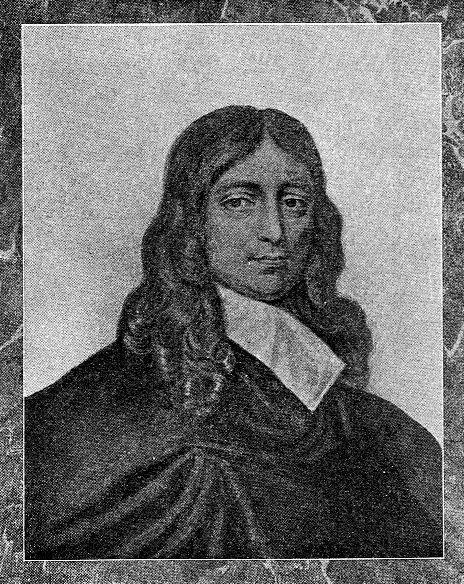 JOHN MILTON. |
There were two main directions in which men's thoughts were bent, especially during the first half of the century; and there were two great passions that left their mark on our history. Ever since the country had, been set free from the danger of invasion by the defeat of the Spanish Armada, people had had time to think about the internal affairs of the nation and to brood over religion. They began to wish for more freedom in both politics and religion. They wanted a greater share in government and in deciding what the national religion should be. We shall find these two passions asserting themselves over and over again throughout the age of the Stuarts. Religion and politics are mingled in almost every great event Thus, the Pilgrim Fathers and many of the later American colonists were religious refugees; the wars with Scotland were "Bishops' Wars," fought for the sake of establishing bishops in Scotland; the great Civil War was a war of Church and Crown against Puritans and Parliament. Cavaliers were Churchmen; Roundheads were Nonconformists; and these two eventually merged into Tories and Whigs, names which will become very familiar to us from the reign of Charles II onwards.
It was to be an age of intense seriousness on one side, and of licence and dissipation on the other. Puritans, who thought it sinful to play games, who turned Sunday into a sombre and joyless day, who made of the Bible a guide for the smallest concerns of life, and who found in prayer-meetings inspiration for the execution of a king, were to match themselves against dissolute pleasure-lovers, who scoffed at praying tinkers and preaching soldiers. There were, of course, saints and sober Christians on both sides, but the two parties had very different ideals of life.
The greatest learning and the noblest poetry existed side by side with the grossest superstition. Nearly eighty thousand so-called witches are said to have been put to death—many of them by being burnt alive—in less that eighty years.
It was to be an age of strife, but the strife was not for ignoble things, and it produced heroes in plenty on both sides. Well might a later poet cry:—
|
"Great men have been among us: hands that penned, And tongues that uttered wisdom,—better none: The later Sidney, Marvel, Harrington, Young Vane, and others who called Milton friend These moralists could act and comprehend: They knew how genuine glory was put on; Taught us how rightfully a nation shone In splendour: what strength was, that would not bend But in magnanimous meekness." |
What Gunpowder Plot Was (1605)
The memory of Gunpowder Plot has been kept alive by boys and girls for more than three hundred years, and the story is so well known that it would hardly be worth telling again, except for the information we can gather from it about several matters that affected the lives of our forefathers.
Those who have read the history of the Tudor period will know that all through the sixteenth century a struggle went on between Catholics and Protestants, and that in Elizabeth's reign the Protestants gained the upper hand, made the Church of England a Protestant Church, and passed severe laws against the Catholics. In the rest of Europe the conflict was not yet decided, and the greatest "wars of religion" had still to be fought. Frederick, the Elector Palatine, and leader of the German Protestants, was a son-in-law of James I, but the English king gave him little support. For thirty years (1618-1648) half the Continent was devastated through war, and many thousands of lives were lost before Protestants and Catholics settled down in peace. Even long after the Thirty Years' War, the fear that "Popery" would be revived in England was one of the strongest influences affecting our national history, as we shall see.
Persecution on account of religion has now almost ceased. But in the sixteenth and seventeenth centuries it was still the practice for the rulers of each nation to decide what the State religion should be, and to compel every person to conform to the religion of the national Church. If the rulers were Catholics, the practice of the Protestant religion was put down; if they were Protestant, then the Catholics were persecuted. The idea of allowing or tolerating more than one religion in the same country was hardly thought of. The history of England in the seventeenth century was very largely occupied by disputes between rival branches of the Protestant Church, ending in some sort of toleration for all except Catholics. It took more than another century for Catholics to gain toleration in England.
 FREDERICK, ELECTOR PALANTINE, SON-IN-LAW OF JAMES I. |
Persecution takes many forms. One of the mildest forms is the exclusion of men and women from certain offices and positions on account of their religious belief. A stronger form of persecution is to fine and imprison people for conducting their religious services in public. A still stronger form of persecution is to banish, or imprison, or put to death all who refuse to attend the services of the national Church. The worst persecution of all is the torture and execution of people who are suspected of not believing in the doctrines of the Church, although they may be willing to attend its services.
All these forms of persecution have been practised in England. In the reigns of Elizabeth and James I the laws against the Catholics included all but the worst form of persecution. Except in the case of specially favoured persons, Catholics were not allowed to hold any office in the State. The public performance of the mass could be punished by heavy fines, and even by death. A priest caught conducting his services in England could be hung, drawn, and quartered for treason. Even to hear mass in secret made any person liable to a fine and imprisonment for a year, whilst to assert that the Pope had any power in England was an act of treason.
Catholics could not even stay at home and be quiet. They were compelled to attend the national Church service. If they had sufficient property they could be fined £20 a month until they complied with the law. Less wealthy people were liable to lose two-thirds of their lands, and even poor people could be fined and imprisoned.
How, it may be asked, after forty years of such treatment, did any Catholics manage, to survive?
Just as there was no regular police system to detect and catch criminals, so there was no regular means of enforcing the laws against the Catholics. Except when some special alarm was raised, the laws were left to be carried out by the local magistrates, who were the country gentry and landowners. In many parts, especially in the north and west, and on the borders of Wales, there were numbers of Catholic noblemen and gentlemen whose neighbours did not care to put the laws in force against them.
Hence for generations, in scores of country mansions, the Catholic religion was secretly, and sometimes openly, preserved. Priests were kept as chaplains, and in times of danger they could easily be hidden in secret chambers. Occasionally there would be an outburst of priest-hunting. Rascals, who cared nothing for religion, would join Protestant fanatics who thought they were obeying the commands of the Old Testament against idolaters, and go in bands to search the houses of suspected Catholics, destroying furniture and carrying off valuables and clothing.
The Catholics were thus in the position of criminals, liable at times to be seized and imprisoned, whilst their priests were in danger of being hanged. Only where some great Catholic nobleman could keep out the mischievous rabble did the Catholics manage to live in peace. It is fairly safe to assume that wherever to-day we find a Catholic community in our villages, they have maintained themselves ever since the days when the Catholic squires kept their chapels and priests, hidden away from their neighbours, through nearly two centuries of bitter persecution and we can find many such villages in Derbyshire, Yorkshire, Shropshire, Staffordshire, and Lancashire.
When James I became king it was an anxious time for both Catholics and Protestants. All Elizabeth's laws against Catholics were still in force, and the Puritans, who were growing in numbers and strength, were eager to crush out Catholicism in England. James had not quite made up his mind what he meant to do. Before he gained the throne he had had friendly talks with several leading Catholics, and had certainly led them to expect that he would not continue to persecute. Personally he was in favour of some scheme of toleration, or even of joining Protestants and Catholics in some sort of common religion.
The Catholics hoped much from the new king. The extreme Protestants, on the other hand, felt very doubtful. His mother had been a Catholic; his wife was secretly a Catholic; but as the Scottish Church was a Presbyterian Church, and therefore thoroughly Protestant, the Puritans hoped James would favour the extreme Protestant section in England.
Before he had been on the throne a year, James had offended both the Puritans and the Catholics. He offended the Puritans by refusing to allow any further reforms in the Church. He disappointed the Catholics by denying his promises and allowing the fines against them to be collected. When this was followed by persecution, when priest-hunting began again, and when Jesuits and priests were banished, the anger of the Catholics was aroused.
In our own times, whenever a law is felt to be unjust, there are means whereby those who suffer can make known their grievances, and get them removed without doing violence. Freedom of speech, the right to hold public meetings, the freedom of the Press, and the influence that can be brought to bear upon members of Parliament, all make in our days any resort to violence both wicked and foolish. In those times even the right of petitioning the king was hardly allowed, for we know that ten Puritans who signed the famous Millenary Petition were thrown into prison. When men cannot gain their ends by open means, they generally resort to secret plots. In the Middle Ages, and even until modern times, secret plots to capture or overturn the government were common in every country in Europe. In 1604 a few reckless Catholics began to look about for a remedy, for they were in despair of gaining toleration for their religion from a king who had broken his word and from a House of Commons that hated the Catholics.
First a certain priest, William Watson, formed a very foolish plot to seize the king at Greenwich and compel him to grant toleration. The plot was revealed to James. Watson and another priest were hanged and for about a year the Catholics were looked upon with favour by James, because they had refused to agree with Watson's plot. But as the persecution soon began again, another plot was set on foot. This was the famous Gunpowder Plot.
The chief facts to notice about the plot are, that it was not a widespread conspiracy, but was confined to a few persons; that these were mostly gentlemen of means and of good family; that the proposal to blow up Parliament was only a means to gain possession of the government and to set up a new Catholic government; and that the memory of the plot helped to keep alive the bitter hatred of the Catholics for generations afterwards.
 THE GUNDPOWDER CONSPIRATORS. |
The story of the plot itself is simple. Robert Catesby, a Warwickshire squire, had been mixed up in Essex's rebellion in Elizabeth's reign. He had been imprisoned and all but ruined by the heavy fines imposed on him. He had become a fanatical Catholic; he was a bold soldier, and inspired courage and confidence amongst his friends. He gathered about him a small band of friends. Thomas and Robert Winter were among the first to join him; the former was a soldier and a scholar, who, after fighting against Spain, had become a Catholic, and had been on a mission to Spain to get help for the English Catholics.
Thomas Percy, a violent and arrogant man, the steward of the Duke of Northumberland, to whom he was distantly related, was another who early joined in the plot. He was one of those to whom James had promised some sort of toleration, and in his disappointment he had declared to Catesby that he would kill the king. Catesby persuaded him to wait and join in a greater adventure.
Guy Fawkes was at first not one of the principal conspirators. He was the son of a lawyer at York. Becoming a Catholic, he served in the Spanish army in Flanders. When, in 1604, Catesby and Winter wanted a trustworthy soldier to help them to carry out their plot, he was chosen, and engaged to serve them faithfully.
The intention was to blow up the king, lords, and commons assembled in the Houses of Parliament, as soon as they met for the second session, which was expected to be in February, 1605. This was to be the signal for a great Catholic rising. One of the princes was to be seized and proclaimed king, with a council of Catholic noblemen to govern the country. The second part of the plot was the more important, but all the preparation they were ever able to make was to arrange for an assembly of about eighty Catholic gentlemen at Dunchurch, in Warwickshire, under pretence of holding a hunting match.
The first part of the plot almost succeeded. About March, 1604, five conspirators, including Catesby, Thomas Percy, and Guy Fawkes, met in a lonely house behind St. Clement's, London, swore an oath of secrecy, and took the sacrament from a Jesuit priest, who knew nothing of the plot. They hired a house close to the Parliament House, but they did not get possession until December. Then they began to dig a mine underneath the Houses, storing their materials in another hired house placed in charge of a new member of the plot. It was slow work. No labourers could be engaged. All the gentlemen worked with their hands, and the rubbish which they dug out was buried in the garden at night. Fawkes kept watch as a sentinel.
At Christmas they learnt that Parliament was not to meet until October. In March, whilst working at their mine, they heard a loud rumbling noise. Their fears were changed to hopes when they learnt that it came from an adjoining cellar, which ran right under the Parliament House, and that it was possible to hire this and so gain access to the very spot they wanted to reach. Percy immediately got a lease of the cellar, and shortly twenty or thirty barrels of gunpowder were carried into it and covered with billets of wood and faggots.
There were still nearly six months to wait. The conspirators were in want of money to secure horses and arms and to enlist supporters for the rising that was to follow. They therefore introduced to the conspiracy some wealthy young Catholics, including Sir Everard Digby and Francis Tresham.
During the summer there were disturbances among the Catholics on the Welsh border. There was wild talk of an insurrection. Priests were found preaching to large congregations, in spite of the law. The sheriff of Herefordshire had a conflict with a large body of Catholics, and under the old penal laws three men were executed for attempting to convert their neighbours.
Meanwhile the plot was ripening, when, happily, it was betrayed to the Government. Francis Tresham, and others too, felt that they ought to warn the Catholic noblemen who were members of Parliament. Tresham sent a warning to his brother-in-law, Lord Monteagle. Everybody has heard of the curious letter which Lord Monteagle received, just as he was going to supper at his house at Hoxton, from a mysterious tall gentleman:—
"My lord, out of the love i beare to some of youere frends i have a caer of youer preservation therefor i would advyse yowe as yowe tender youer lyf to devys some excuse to shift of youer attendance at this parleament . . . for thowghe theare be no apparance of anni stir yet i say e they shall receyve a terrible blowe this parleament and yet they shall not seie who hurts them."
Lord Monteagle sent the letter to Cecil (Lord Salisbury), the king's chief minister. The plotters knew that the letter had been sent, but, like men bereft of all sense, they supposed its contents would not be understood, and that it was still safe to go on. Several, including Guy Fawkes, remained in London. Others went into the country to prepare the rising.
Lord Salisbury, however, knew all he wanted; but to flatter the king he showed him the letter, and allowed him to enjoy. the credit of discovering its meaning. James, on reading the letter, of course instantly suspected gunpowder. The cellars underneath the Houses were searched on the night before Parliament was to sit. The barrels of gunpowder were discovered. Fawkes, still on guard, was seized and carried to, the king.
Before dawn, on the 5th of November, the streets of Westminster were alive with people, alarmed at the rumour of a Catholic rising. They mobbed the Spanish ambassador's. house. The trained bands were called out. The sheriffs were ordered to capture the conspirators, who by this time were racing along the highroad towards Worcester.
Digby had assembled his hunting party—about eighty, including retainers—at Dunchurch. When Catesby arrived he announced the discovery of the plot, and tried to persuade his friends to rise in insurrection. But the party rapidly dispersed. The leaders and a number of serving-men fled to Holbeach, in Staffordshire, where they took refuge in the house of Stephen Lyttleton. On the way they seized arms and armour at Hewell Grange. At Holbeach a slight explosion of gunpowder caused an alarm, and raised their fears. The sheriff and his soldiers surrounded the house.
Two of the conspirators escaped. Catesby and two others were killed by the sheriff's men. Percy was wounded, and died in a day or two. Digby and, four others were captured and taken to London. Robert Winter and Stephen Lyttleton, after reaching Hagley, where they hid for two months, were betrayed by a servant. Two Jesuit priests, suspected of being concerned in the plot, were caught near Worcester, in a secret room behind a gentlewoman's chamber.
The plot had utterly failed, and the prisoners could only expect the vengeance of the Government. It was still usual to torture prisoners suspected of treason. The faithful Fawkes was tortured, and so was one of the priests. But little more was learnt than Salisbury knew already. All the arrested conspirators were executed, except Tresham, who died in prison before his trial.
The effect of the plot was to increase the hostility of the nation against the Catholics. The penal laws were again enforced. Catholics who had begun to attend Church were now required to take the sacrament. Churchwardens and constables were fined if they did not prosecute known recusants, and were rewarded for their success. New fines were inflicted on those who kept Catholic servants. Recusants were forbidden to come within ten miles of London. They were forbidden to practise as attorneys or physicians; they could not be executors of a will, nor guardians of children. They might not be married except in the Church of England.
Their books could be destroyed, and their houses visited by the magistrates in search of arms. It is said that courtiers bought from the king the shameful privilege of seizing land and property belonging to the wealthier Catholics.
For another century the Catholics were persecuted and were cut off from public life. Gunpowder Plot had sealed their fate, and had given new life to the popular hatred, which burst out time after time. Even in the days of George III—when the Gordon Riots, with the cry "No Popery," placed London in the hands of a howling mob for three days and nights—popular fury against Rome was still a living force in England.
The Misrule of the Stuarts—James I (1603—1625)
The word "king" has many different meanings. It may mean a "constitutional king," who reigns in state as king, but does not govern except through ministers and a parliament. It may mean an absolute despot, whose subjects' lives and property are at the disposal of his will and caprice. Or it may mean anything between these two extremes.
In the sixteenth and seventeenth centuries the power of kings, instead of growing less, appeared to be growing greater. This is shown by the despotic rule of Henry VIII in England, which has been described in a previous chapter; and, in the middle of the seventeenth century, by the rise of a great French king, Louis XIV, who became the most powerful and absolute monarch France had seen for nearly a thousand years.
So far from kingship being dead, gunpowder and standing armies had put new weapons in its hands. Parliaments still existed, but most men believed that a strong king was needed to keep the nation in order and defend it against enemies abroad. So long as men believed this, the supreme power would lie with kings and not with parliaments.
 JAMES I. AND HIS QUEEN, ANNE OF DENMARK. |
Such was the state of things when James I became king at the beginning of the seventeenth century.
Most of the troubles of James's reign would have been soon forgotten, if they had not had such important effects in his son's reign. By themselves, they seem like trivial quarrels that might have been settled by a little common sense and forbearance. What are the affairs that all the history books about James's reign are full of? A petition of Puritan clergymen to abolish some of the ceremonies and practices of the Church; disputes about the privileges of Parliament; bargains about feudal dues; protests by the Commons against "monopolies," against "benevolences "; protests in defence of their right to advise the king; petitions against marrying the Prince of Wales to a Catholic; and such like matters.
But these apparently petty conflicts between an angry and talkative king and his solemn Puritan Parliaments, jealous about the smallest of their, rights, were signs of the times such as a wise man would have taken to heart. They were the beginnings of that great struggle, the Civil War, which altered the whole destiny of the English race. James's reign is therefore like the first act in the play; we see its meaning only in the light of what happens farther on.
The first thing to understand is this trouble between the Puritans and the bishops. We need not believe that either side was entirely in the right; but when people believe in a thing so thoroughly that they are willing to lay down their lives in defence of it, even if they happen to be in the wrong, it is well to take notice of them. When there are two such sets of people, and their beliefs are opposed to one another, only two courses are open. The first course is to allow both parties to keep their own opinions, and to try to live side by side without quarrelling. That is toleration. The other course is for the two parties to fight it out, either by persecution or by open war.
It seems strange enough now that two branches of the Christian Church should have fought one another like heathens. But in those times nearly every nation clung to the view that there ought to be one religion only within the same state. Therefore, just as Christians had fought against heathens, just as Catholics had fought against Protestants, so, when two parties arose within the English Church, they too began to fight.
Ever since the Reformation, there had been two sorts of Protestants in England, although the division was not clearly marked at first. Some, whom we shall call the Anglicans, desired to be free from the Pope and Rome, but though they did not accept the teaching of the Roman Catholic Church and the authority of the Pope, they wished to keep as much as possible of the old ceremonies, prayers, sacraments, and Church government. They regarded the Church of England as still part of the true Catholic Church, and attached great importance to the proper succession of bishops.
Others, whom we shall call Puritans, wished to be completely separated from Rome. They looked upon the Roman Church as wicked and idolatrous. They wished to simplify the services of the Church, and wanted to do away with what they regarded as image-worship. Instead of altars they wanted communion tables; instead of rich vestments and surplices, they preferred a plain black gown for their clergymen. As for bishops, whilst some were willing to keep them, others wished to have ministers chosen by the congregation, and to have an assembly of ministers and laymen to make rules for the Church, without any interference either from bishop or king.
Probably the mass of the people had no very strong opinions, and were willing to accept whatever was arranged for them by their lawful rulers. But most of those who thought seriously about their religion came to belong either to the first party or the second. This broad division is important, because in after-times there arose out of it our existing Church of England on the one hand and the various Nonconformist Churches on the other.
Queen Elizabeth had attempted to make the Church "comprehensive," that is, she tried to adopt such doctrines and services as would enable everybody to belong to the national Church. And for a long time many people believed that the Church could be made to suit all kinds of people. When James became king, there were many proposals for adapting the Church services to meet the wishes of all sections. But when they began to discuss the proposals, it soon became clear that the differences of opinion were too great to be settled in such a way.
The Anglicans thought it would be sinful to give up the ancient ceremonies and sacraments, whilst the Puritans thought it was idolatry to pay attention to them. Hence it became a struggle between these two religious parties for the control of the national Church. Whichever got the upper hand would be likely to persecute the other, as we shall see, for this struggle in different ways goes on throughout the century. One of the very first incidents in this struggle was the famous "Hampton Court Conference," held by James I as a result of the Millenary Petition, signed by a thousand Puritan ministers who desired certain changes in the Church.
The English system gave great power to the king. There was no pope to interfere on the one hand, and no general assembly on the other. He alone appointed the bishops; the bishops controlled the rest of the clergy, whilst the congregations had no voice in the matter. James saw from the first the great advantage of this system to himself, and determined not to give in at all to those reformers whom he regarded as Presbyterians in disguise. "No bishop: no king," he said pithily. He declared that he would make the Puritans conform to the Church or he would "harry them out of the land." His temper towards the Puritans was shown by the fact that ten of those who had presented the Millenary Petition were committed to prison.
![[Illustration] from Tudors and Stuarts by M. B. Synge](books/synge/tudors/zpage191.gif "[Illustration] from Tudors and Stuarts by M. B. Synge") A BIBLE CHEST. |
From the conference the Puritans had gained nothing, except the king's consent to a new translation of the Bible, a few trifling alterations in the Prayer Book, and the promise of an enquiry into the best means of obtaining a preaching clergy. The new translation of the Bible was a great event, for it gave us the "authorised version," which has been read by all the English-speaking world for three centuries.
On the other hand, the Puritans lost a great deal; for as the king had supported the Anglicans, so they now supported the king where he claimed the most extraordinary powers. This alliance between king and bishops was to have a great effect on the nation's affairs for the next two generations. The laws which compelled men to use the services of the Established Church were made more binding upon the clergy, and three hundred of them gave up their livings rather than make the promises required from them. Some went to Holland to join those "Separatist" Churches founded by the "Dissenters" of Elizabeth's time. Most of the Puritans remained in the Church, but the discontent went on growing.
From this time we see the Puritan party becoming not only a Church or religious party, but also a State or political party, which was largely in opposition to the king. The alliance between the king and the bishops thus led to that other alliance between Puritans and Parliament. Many things led to this. The High Church party, or Anglicans, were to some extent in sympathy with the Catholics. Their own most loved ceremonies were very much like those. of the Roman Catholic Church. The Puritans, on the other hand, hated the Catholics intensely. They were constantly urging the Government to put the penal laws in force against the Catholics. They wished to sweep them out of the country. They believed that many of the Anglicans were really Catholics trying to betray the Church of England to Rome. They saw Catholics favoured at Court. They knew that there were many secret Catholics; the queen herself was one. They were therefore full of suspicion, and their suspicions of a great Catholic conspiracy haunted the minds of the Puritans for many years.
The temper of the Puritans was sharpened by persecution. Their own habits of life marked them out from their neighbours and tended to draw them together. They turned themselves to Bible-reading, preaching, and private prayer. They abstained from many simple amusements, denounced dancing and stage plays as wicked, as, in fact, many of the plays of the time were. They turned the old-fashioned English Sunday into a day on which nothing was to be done but what belonged to religious worship.
These men thus lived a life of severe restraint. They believed that they had the direct guidance of God in the meaning they placed upon their reading of the Bible, and they used certain texts as plain commandments, regarding themselves as the "Elect of God" and their opponents as idolaters. Such men were enemies worth the respect of the most absolute king. When they turned their attention to politics they showed the same seriousness, the same intense faith, and the same hatred of compromise that they felt in religion.
The House of Commons was their stronghold, for, from the latter days of Elizabeth, a majority of its 450 members were either Puritans or in sympathy with Puritans. When men are out of sympathy with one another it does not need great occasions to make them quarrel. The House of Commons was extremely jealous of its customs and privileges. Even the Tudor sovereigns had respected these—they might have used the House of Commons as a tool, but they generally took care neither to disturb its customs nor violate its privileges. James had none of the Tudors' tact. He was in reality far less of a tyrant, but he wanted to have his powers acknowledged, and he liked to lecture Parliament on his own supremacy.
The Misrule of the Stuarts—Charles I and the Petition of Right (1625—1628)
The events of James's reign were, except in their remote consequences, dull and tedious. Charles's reign was the most dramatic and tragic in our whole history. From the first year of his reign events moved rapidly, until the nation was plunged into civil war and revolution. The causes were great, Crown and Church against Parliament and the Puritan religion; and the men on both sides were noble.
Charles himself, with all his faults, was a tragic figure. Born with the century, he was twenty-five when his father died. He was tall and athletic, good at tennis, and a fine horseman, a good shot, and a good sportsman. His face was dark, but handsome and dignified. His melancholy fate, and the genius of his portrait painter, Vandyke, have made his face more familiar to posterity than that of any English king. His manners were refined, and his bearing towards his friends was full of charm. He was much more serious than his father, more attentive to his business as a king, less wide in his ideas, but held more strongly to his purposes.
He purified the Court of the drunkards and revellers of his father's time; his personal friends were better men than James's boon companions. He loved beautiful things, and was almost the first collector of our national art treasures. He was religious, and his personal life was pure; he was a generous husband and father. He was not cruel, and although obstinate, he was no Henry VIII crushing a nation under his brutal will. He even believed himself to be the protector of the nation's welfare and the saviour of the national Church.
How was it, then, that with these qualities he was fated to be the one king in our history executed as the enemy of the people? The answer is to be found in two different circumstances. The first is one over which he had little control. A contest of some kind between king and parliament was unavoidable. Charles was, as it were, born into this great struggle. The second is that his abilities were not such as to make him a successful tyrant when matched against men like Pym, Eliot, Hampden, and Cromwell. And his untrustworthiness, when he got into difficulties, caused his enemies to think it unsafe to have further dealings with him.
Nearly every mistake that James made in dealing with the affairs of the nation, Charles repeated and carried much further. He quarrelled with his Parliaments, and he dismissed the first and second after each had been assembled for a few months only.
His third Parliament made itself famous by winning the first decisive victory in the long contest, for it secured the passing of the Petition of Right into an Act of Parliament. It is worthy of note that at this time Charles had no supporters at all in the House of Commons, except a few officials who represented the king's government. Wentworth, who was soon to become Charles's greatest minister, was the leader of the Commons when a Bill was proposed to make it unlawful in future to imprison men without trial, or to raise loans, or to billet soldiers on householders.
The billeting of soldiers was no light grievance in times when soldiers were often undisciplined ruffians, who had; received no pay, and who lived on a sort of free plunder. "In my county," said Sir Walter Earle, of Dorsetshire, "under colour of placing a soldier, there came twenty in a troop to take sheep. They disturb markets and fairs, rob men on the highway, insult women, breaking houses in the night, and enforcing men to ransom themselves, killing men that have assisted constables to keep the peace."
Charles wished Parliament to vote supplies and to rely on his promise "to maintain all his subjects in the just freedom of their persons, and safety of their estates." At this, the Commons determined to go further. Wentworth's bill had merely proposed a new law, saying nothing about the king's misdeeds. Sir Edward Coke, who had been Chief Justice of England; Sir John Eliot, the Cornish squire, once Vice-Admiral of Devon, and more than once imprisoned for his bold speeches; John Pym, a Wiltshire member, and the future leader of the House; John Selden, the most learned lawyer in the land; these now led the Commons. They drew up the famous Petition of Right, which was really a statement that the king had already broken the laws of the land by "(1) levying gifts, loans, benevolences, and taxes without the consent of Parliament; (2) imprisoning persons without showing cause; (3) billeting soldiers on householders against their wills; and (4) issuing unlawful commands for ruling by martial law."
In this petition the Lords agreed. The Parliament was so united that Charles saw he must give way or lose the grants—five subsidies, probably the most liberal grant ever voted up to that time.
The victory of Parliament had been gained. The news was shouted in the streets. The City churches rang their bells; bonfires were lighted, and men thought that strife was over. In reality it had only just begun. Before many days disputes arose again. Charles was angry, and prorogued Parliament until January, 1629. When Parliament assembled in January, they at once took up the tale of grievances, both in State and Church. In March the king ordered the Commons to adjourn, and a strange scene occurred.
Without the presence of the Speaker, sitting in the chair, no business could be transacted. The Speaker—Finch—rose to obey the king's order. The members wished to continue their discussion, if only for a few minutes. Two members held down the Speaker in the chair, whilst Eliot moved three resolutions: "(1) That whosoever shall bring in innovation in religion, or seek to extend Popery, (2) whosoever shall counsel the taking and levying of the subsidies of Tonnage and Poundage, not being granted by Parliament, (3) whosoever shall voluntarily pay the said subsidies of Tonnage and Poundage, shall be reputed a capital enemy to this Kingdom and Commonwealth, and a betrayer of the liberty of England."
 JOHN HAMPDEN. |
In the tumult that followed, Eliot threw his paper of resolutions into the fire, despairing of the House voting on them. The king's messenger was knocking at the door to take away the Speaker's mace. Holies remembered the resolutions, word for word, and put them himself to the vote, which was carried.
The king dissolved Parliament. He had made up his mind to call no more, and for eleven years no Parliament sat. Eliot, Holles, and Valentine were sent to the Tower, where Eliot died four years later.
Thus, the first session of Charles's Third Parliament had seen the granting of the Petition of Right. The second session ended in scenes of violence, and Parliament was dismissed by the king, with threats that "the vipers amongst them should meet with their reward."
 THE DUKE OF BUCKINGHAM. |
Between the two sessions, two striking events had happened. Buckingham, the vain, incompetent, foolish favourite of the king, was assassinated. Wentworth, the strong-willed, ambitious statesman, had entered the service of the king.
The Misrule of the Stuarts—Charles I and the Eleven Years' Rule without Parliament (1629—1640)
The eleven years in which Charles ruled without calling any Parliament was the next stage in the great struggle. It would be wrong to suppose that in this time the king's government was so tyrannical and oppressive that the nation was goaded into insurrection. The rebellion, when it did come, was not a rising against a cruel despot by men who had suffered in person, but a struggle for principles which men believed were necessary, if the greatness and happiness of the whole nation were to be preserved.
In this time, as at all others, Charles showed that he was a poor statesman. He thought that if he only suspended Parliament for some years, the people would be ready to come round to his views and accept his terms. He tried the experiment of governing without a Parliament, before he had taken any sufficient measures for securing a revenue. In his efforts to raise money, he adopted such foolish expedients that the very men most likely to rally round him were irritated and offended.
Under old and obsolete laws he imposed fines on the gentry for not having had themselves made knights. He called upon the ports, the coast shires, and finally upon the inland shires as well, to pay "Ship-money," to raise money with which to improve and strengthen the navy.
 VANDYKE PAINTING THE PORTRAIT OF CHARLES I. |
This was the tax that caused most noise. At first, many people paid the tax, considering it either as a customary due or as a sort of voluntary gift. When, however, the County of Buckinghamshire was taxed to the amount of £4,500, one of the richest squires of the county, a gentleman of an ancient family, John Hampden, refused to pay his share, which was a small sum of perhaps thirty or forty shillings. He refused in order that the question of the lawfulness of the tax might be tried in the law courts. The case would not have been of great importance, but for the extraordinary judgment delivered by the king's judges. One of them, Finch, declared that "Acts of Parliament are void which bind the king not to command his subjects, their persons and goods, and I say their money too, for no Acts of Parliament make any difference."
In spite of all his efforts, Charles found that his income was insufficient to carry on any war, and in the affairs of Europe England ceased for a time to be of any account. Very soon, within his own kingdom, he found himself helpless from the same cause. For whilst entering upon a struggle against Parliament for control over taxation, Charles committed the folly of entering upon another struggle against the same people, and a more dangerous struggle, for it concerned their religion.
For a whole generation the majority of the House of Commons had been Puritan in religion. Charles gave his support to the opposite party, led by Bishop Laud; and at the very time when the nation was angered by his quarrels with Parliament, he gave Laud his whole support and allowed him a free hand to do what he would with the Puritans. Next to Charles himself, it was Laud more than any man who ruined the royal cause, for he stirred up fiercer passions than all Charles's tax-gatherers.
 PORTRAIT OF CHARLES I. |
Not only were the idle and worthless clergy punished, but the preachers of Puritan doctrines were silenced by being brought before the Church courts. Some congregations did not like the views of the parish clergyman, so they supported a lecturer who preached more to their taste, and spread Puritan teaching among the humbler classes. Laud promptly suppressed them. Some wealthier Puritans kept private chaplains: he forbade the practice. Others took to holding services in private houses or other buildings, sometimes in the midst of London and the towns, sometimes in the country. Laud rooted out these most strictly.
 PORTRAIT OF HENRIETTA MARIA. |
<
Puritans who wished to emigrate to New England in America found themselves stopped by Orders in Council but they were Laud's orders. His fiercest wrath was reserved for the writers of books and pamphlets.
In 1633 Charles had gone to Edinburgh to be crowned as King of Scotland. He found the Scottish Church still Presbyterian, in spite of the existence of some bishops whom James had set up. He wished to carry out his father's plan of having a real episcopal church in Scotland, and in this project Laud eagerly supported him. By 1637 the whole scheme was ready. New laws for the government of the Scottish Church were proclaimed, insisting on the strictest observance of the new Prayer Book.
The first attempt to read the new Prayer Book was not made until July. By this time the Scots were prepared for it, but not in the sense Charles and Laud desired.
In no church was the service undisturbed; and it was plainly impossible to make the Scots accept the Prayer Book without a. war. For after months of protests and petitions, the Prayer Book meanwhile not being read, the Scots bound themselves by a renewal of the Covenant, or agreement to defend the Church against all new customs. On the evening of February 28th, 1638, on a tombstone in Greyfriars Churchyard, the people of Edinburgh began to sign their names to the Covenant, and the mass of the Scottish nation followed their example. The Covenant was a protest against Popery, and it was because Laud's religion was regarded by the Puritans, English and Scotch alike, as in reality the same thing as Popery, that it roused such passionate hatred.
The signing of the Covenant was an act of rebellion. A war for the bishops and Prayer Book in Scotland followed. Then Charles called a Parliament—the "Short" Parliament—but its members would not grant him money until he satisfied them. A second "Bishops' War" followed; then the Long Parliament was called.
The Story of the Long Parliament
The meeting of the Long Parliament was one of the greatest events in all history. Never before and never since has such a situation arisen. For anything at all like it, we must go back to Simon de Montfort's summoning of the first Parliament, or forward to the calling of the States-General in the French Revolution (1789).
Previous Parliaments had met to vote supplies for the work of the Government, and to seek redress of grievances before the passing of new laws. The Long Parliament met to carry out a revolution, although few of the members would have dreamt of calling their intention by that name.
The first six months were occupied chiefly by a tremendous struggle to secure the death of Strafford—a struggle for life between Parliament and its most dangerous enemy. The chief charges against Strafford were that he had, whilst President of the Council of the North, and especially whilst ruling in Ireland, made use of a "tyrannous power above and against the laws, over the lives of his Majesty's subjects. He had slandered the House of Commons to his Majesty, and did advise his Majesty that he, the king, was free from all rules of government, and that he had an army in Ireland which he might employ to reduce this kingdom. And he had also encouraged the wars between England and Scotland." What all this meant was that Strafford had been the chief adviser when the king tried to do away with the ancient liberties of the nation and to set up a despotic rule.
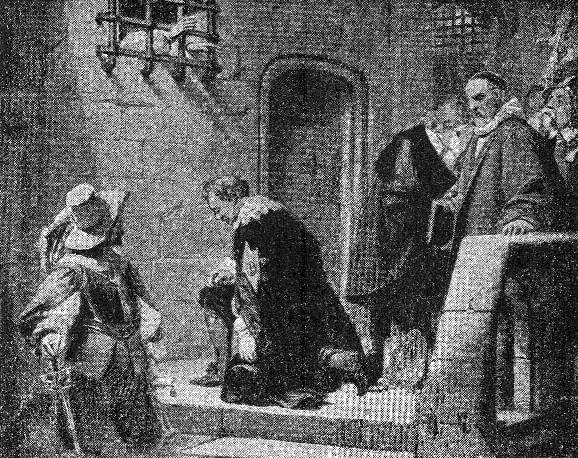 STRAFFORD ON HIS WAY TO EXECUTION RECEIVING THE BLESSING OF ARCHBISHOP LAUD. |
In November, 1640, Strafford arrived in London. He at once advised the king to accuse the leaders of the Commons of treason for their correspondence with the Scots. The secret was betrayed to Pym. Next day Pym moved his impeachment of Strafford, and when Strafford went to take his place in the Lords, he was ordered to withdraw, and was put under arrest. The Commons kept strict watch that he was not allowed to escape.
Laud was also sent to the Tower and accused of high treason by the Commons. Not until March did Strafford's trial begin. The Commons in the meantime prepared their charges against him, and passed resolutions to limit the power of the bishops, and to put an end to the unlawful taxes, and to secure that henceforth Parliament should be called at least every three years. Strafford was executed on May 12th, before an immense crowd of the citizens of London.
The Long Parliament had struck down its most dangerous enemy. After the death of Strafford no minister could ever set Parliament at defiance again. It secured that the king's right to call Parliament as he wished should cease. An Act—the Triennial Act—was passed, which said that if the king called no Parliament for three years it should assemble without the royal summons.
In the terror inspired by the army plots Parliament went further. It compelled Charles to agree that the "present Parliament should never be dissolved except with its own consent." The collecting of taxes without consent of Parliament was made illegal. Ship-money was finally made unlawful. The Courts of High Commission, the Star Chamber, and the Council of the North, and other similar courts were abolished. By these means an end was put to all the practices of levying taxes without consent of Parliament, all the prosecution of persons by illegal courts, all the exercise of power, except in the Church, by the bishops. The king was no longer the supreme power in the realm.
The Long Parliament set itself as actively to reform the Church as to limit the king's power in State matters. From the time of the Hampton Court Conference the bishops had been the staunchest allies of the king. Led by Laud, the clergy had even granted liberal supplies of money to Charles when the Short Parliament had refused them; and had passed new laws declaring that the most high and sacred order of kings is of divine right, and that for subjects to bear arms against their king is to resist the power ordained by God.
When, however, the Parliament decided to reform the Church, it was found easier to denounce the bishops and to curtail their powers than to agree upon what the Church of England should be. How should it be governed? What should its services be? What should its doctrines be? The more extreme Puritans wanted to do away with bishops altogether, and to have the Churches governed by some laymen and some clergymen, in place of the bishops. In December, 1640, a petition from 15,000 London citizens had asked that episcopacy might be destroyed "root and branch." This phrase gave its name to the bill brought into the House of Commons by the extreme Puritans, including Cromwell. After some time the bill was supported by Pym and Hampden.
It was this bill that gave the king his party. For whilst the more conservative House of Lords was willing to cut down the power of the bishops, a strong section in both Houses would on no account agree to sweeping changes in the government and services of the Church. Sir Edward Hyde and Lord Falkland were the leaders of this section. The Root and Branch Bill only passed the Commons by a small majority, and was rejected by the Lords, and later on dropped.
The king declared boldly that he would die in the maintenance of the Church of England. From that moment Parliament was divided into two parties: Puritans on the one side, who stood for the Parliament and a reformed Church; on the other side a Church or Anglican party, who stood for the Church first and for agreement with the king.
Ever since the death of Strafford, Charles had been constantly making plans and listening to plots, to get the better of the English Parliament. He knew that there were fierce divisions among the Scottish nobles, and he had reason to think he could create a royalist party in Scotland. If only he could get a Scottish army on his side he could beat the Parliament by its own weapon. For it was by the support of the Scots that the English Parliament had got the upper hand.
Charles tried to win the affection of the Scots by granting everything the Presbyterians wanted, whilst he intrigued with their enemies. But Argyle, the leader of the Scottish Parliament, was too shrewd, and defeated Charles's plans. Then occurred an event which seemed to bring discredit on the king. A plot was formed to seize—and probably to murder—Argyle, and place his power in the king's hands. The plot was betrayed. The king's part in it was never known, but in England it was regarded as a proof that the king was ready for any step which would give him the advantage over Parliament.
Charles returned to London in November, but before that time other important events happened. Among Charles's schemes had been one to bring over the Irish army to help him against the Scots (and perhaps against the English Parliament too). The queen had encouraged him to bargain with the Irish Catholics for help. Many of the Irish Catholics believed that, by rising in rebellion, they would be able to throw off the hated Protestant settlers, who governed Ireland solely in the Protestant interest. Undoubtedly Charles's dealings with the Catholics had raised their hopes and indirectly led to the insurrection.
 SIGNING THE COVENENT IN THE GREYFRIARS CHURCHYARD, EDINBURGH, IN 1638. |
As the rebellion went on unchecked for months, the terror it inspired was only equaled by that of the Indian Mutiny two hundred years after, London was in a panic; and the effect on the House of Commons was to hurry on the revolution. The Irish rebellion was perhaps, so they thought, a sign of a great Catholic plot. The king had intrigued with the Scots; might he not be in the same way responsible for the Irish rising?
At any rate, it would not be safe to entrust the king with an army, even to put down the Irish rebellion. The king must be made to appoint only such councillors as were approved by Parliament. Cromwell moved that the Earl of Essex should have power to command the trained bands in defence of the kingdom. Pym and his party pressed forward a further attack on the king, in the shape of a Grand Remonstrance.
The Grand Remonstrance was a long recital of all the misdoings of Charles and his councillors in Church and State since the beginning of the reign. But the real importance of if was that it proposed to take away the king's power to do wrong, by making him choose only such councillors as the Parliament could confide in. It also demanded that the Church should be reformed by a general assembly of the most grave and learned clergy.
It was clear from the debates that the men who were most eager for a Puritan reformation of the Church—Cromwell, Pym, Hampden, St. John, Hazelrig, Strode, and others—were also most eager to take from the king his power over the army and the appointment of all officers in the State. The Church party were, therefore, almost driven to side with the king, when he declared for the maintenance of the Church as it already existed.
The two parties were narrowly divided. The Remonstrance was carried in the Commons at midnight in November, 1641, by a majority of only eleven. The division was now a division between Parliamentarians and Royalists. For the Puritans, though reduced to a small majority, were determined to force their way. "If the Remonstrance had not passed," said Cromwell, "I would have sold all I had the next morning, and never have seen England any more."
Charles had now a splendid opportunity for both good and evil. The Church party was ready to his hand. By acting in open alliance with it, but avoiding all plots and appeals to force, he might soon have regained his position. But within a few months he had made a worse mistake than ever.
Charles had at his command a body-guard composed of reckless ruffians. He had tried to place the Tower of London in charge of one of the worst of these soldiers named Lunsford, and Charles only dismissed him after a warning that the London apprentices would storm the Tower unless Lunsford were removed. One affray had already taken place between Lunsford and the citizens, and the Commons had asked the king for a guard to protect the Houses of Parliament.
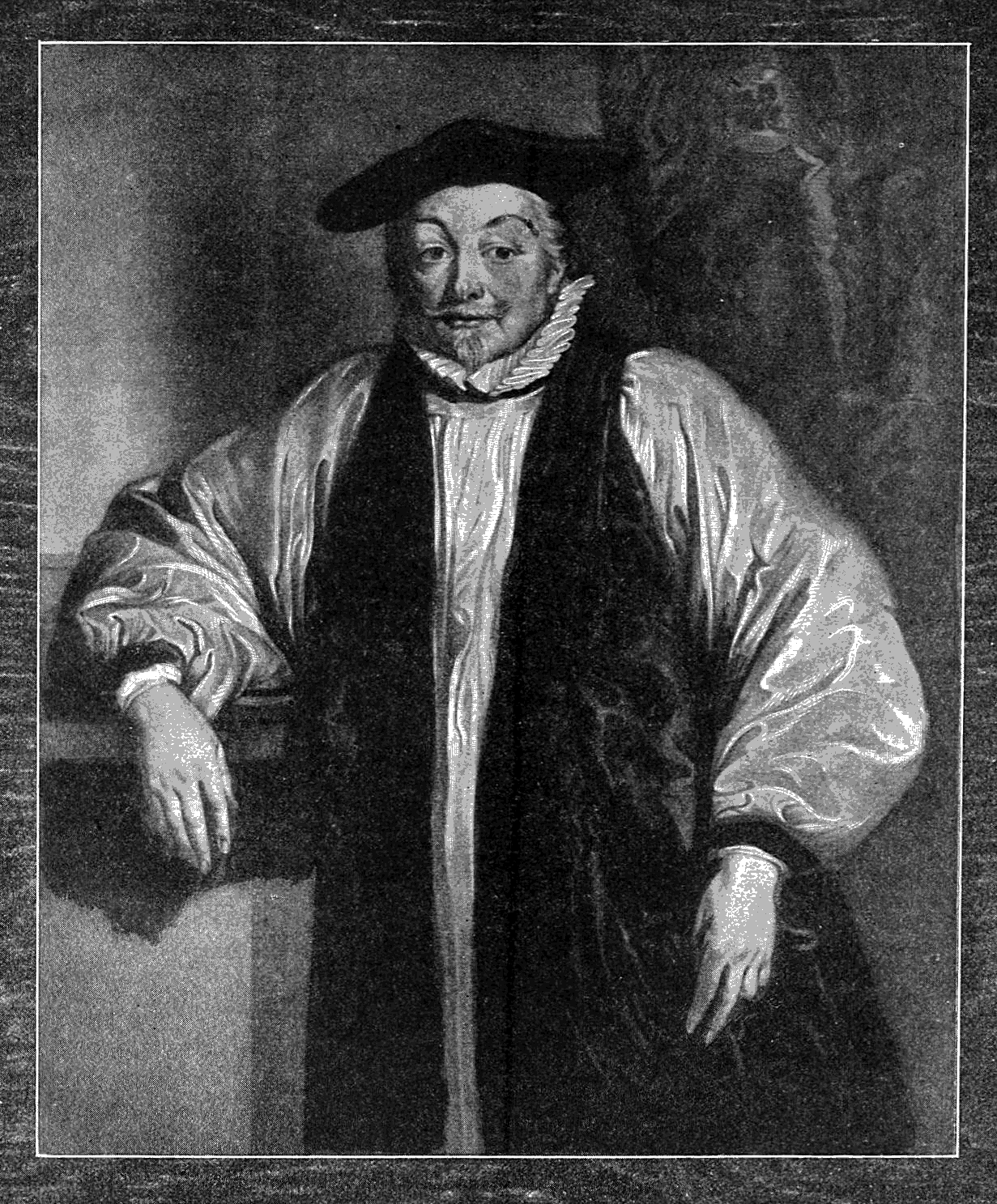 ARCHBISHOP LAUD. |
Charles answered that "the security of all and every one of you is as much our care as the preservation of us and our children." Yet, within a few days, fearing that some Puritan members intended to impeach the queen, he had Lord Kimbolton, together with the Five Members, Pym, Hampden, Holles, Hazelrig, and Strode, impeached of high treason, for plotting with the Scots to invade England. Charles intended, by having the leaders thrown into prison, to strike terror into his enemies.
But the news of his plans leaked out. The members took refuge in the City. Charles hesitated until his foolish, but high-spirited wife urged him. "Go, you coward, and pull these rogues out by the ears, or never see my face again."
At three o'clock on January 4th he threw himself into a coach at Whitehall, and, followed by hundreds of his armed soldiers (among them many noted ruffians), went to the House of Commons.
No king had ever before entered the House of Commons. The soldiers remained at the doors. "By your leave, Mr. Speaker, I must borrow your chair a little," he said. "Gentlemen, I am sorry for the occasion of coming unto you. . . . No king that ever was in England shall be more careful of your privileges, . . . yet you must know that in cases of treason, no person hath a privilege, and therefore I am come to know if any of those persons that were accused are here.
"Is Mr. Pym here?" There was no answer.
"Are any of these persons in the House?"
"May it please your Majesty," answered Lenthall, the Speaker, "I have neither eyes to see, nor tongue to speak in this place, but as this House is pleased to direct me, whose servant I am here."
"Well," said the king, "I think my eyes are as good as another's. I see all the birds are flown. I do expect from you that you shall send them unto me as soon as they return hither."
As he retired, cries of "Privilege" were raised. The soldiers had waited impatiently. "They had come," said one of them afterwards, because they heard that the House of Commons would not obey the king, and therefore they came to force them to it. If the word had been given, they should certainly have fallen upon the House of Commons."
Next day the king went to the City to demand from the Common Council in the Guildhall the Five Members. The streets were crowded, and there were cries of "Privilege of Parliament." On his way back, a bold man threw into his coach a paper, on which were written the ominous words, "To your tents, O Israel."
![[Illustration] from Tudors and Stuarts by M. B. Synge](books/synge/tudors/zpage215.gif "[Illustration] from Tudors and Stuarts by M. B. Synge") CHAIRS OF THE TIME OF CHARLES I. |
That night a large number of the trained bands, and many other citizens armed with halberds, swords and clubs, appeared in the streets, prepared to resist any attack by Royalist guards, and to defend the Parliament against any further assaults. The House of Commons accepted, as guard, companies of the City trained bands. Some thousands of Buckinghamshire squires and yeomen, Hampden's friends, marched into London to protect their hero.
The king prepared for flight, and on January 10th he left Whitehall. It was not until seven years afterwards that he entered once more the palace of Whitehall, a prisoner, on his way to trial in Westminster Hall.
The Great Civil War
The Character of the War
As the Civil War is the central fact in the history of the Stuart family, it is worth while trying to understand how it was fought. A number of questions arise. Who fought for the king? Who for the Parliament? Which parts of England did each party occupy? Did the war consist of a few big battles, or was it raging everywhere at once? Was it fought by professional soldiers? What part did the ordinary citizens and peasants play?
First, then, who fought for the king? It was the attacks of the Puritans on the Church and the bishops that drove over to the king's side nearly all those who wished to preserve the Church of England. It was as the defender of the Church that Charles gained his best supporters. This is the clearest division of all. The Anglicans were, almost to a man, on the Royalist side. Of the members of the House of Commons, about 175 joined the king. The great majority, about 300, remained at Westminster, or took part in the war on the Parliamentary side.
The Catholics all joined the king, and the reason must be evident to those who have read the preceding chapters. The greater number of the peers, some eighty or more, also joined the king, and so did the bulk of the country squires, except in the Eastern and in some of the Southern counties.
Who fought for the Parliament? First, the Puritans. These were of all ranks, but chiefly from the middle classes both in town and country. There were amongst them a few peers: the Earls of Essex, Manchester, Warwick, Denbigh; Lords Brooke and Fairfax, and some others, in all about thirty. Large numbers of the most prominent citizens in London and the large towns, large numbers of freeholders and yeomen (especially in the Eastern counties), merchants and manufacturers, the corporations of Puritan towns even in the West of England: all these supported the Parliament.
How was England divided geographically between the two parties? Speaking quite generally, a line drawn from Scarborough to Southampton represents the main Geographical division. Parliament held nearly all to the east and south of this line, and so they had what was in those days by far the richer and more thickly peopled half of the country. Until after the end of the First Civil War, the Parliamentary army never got firm hold of the country north and west of that line.
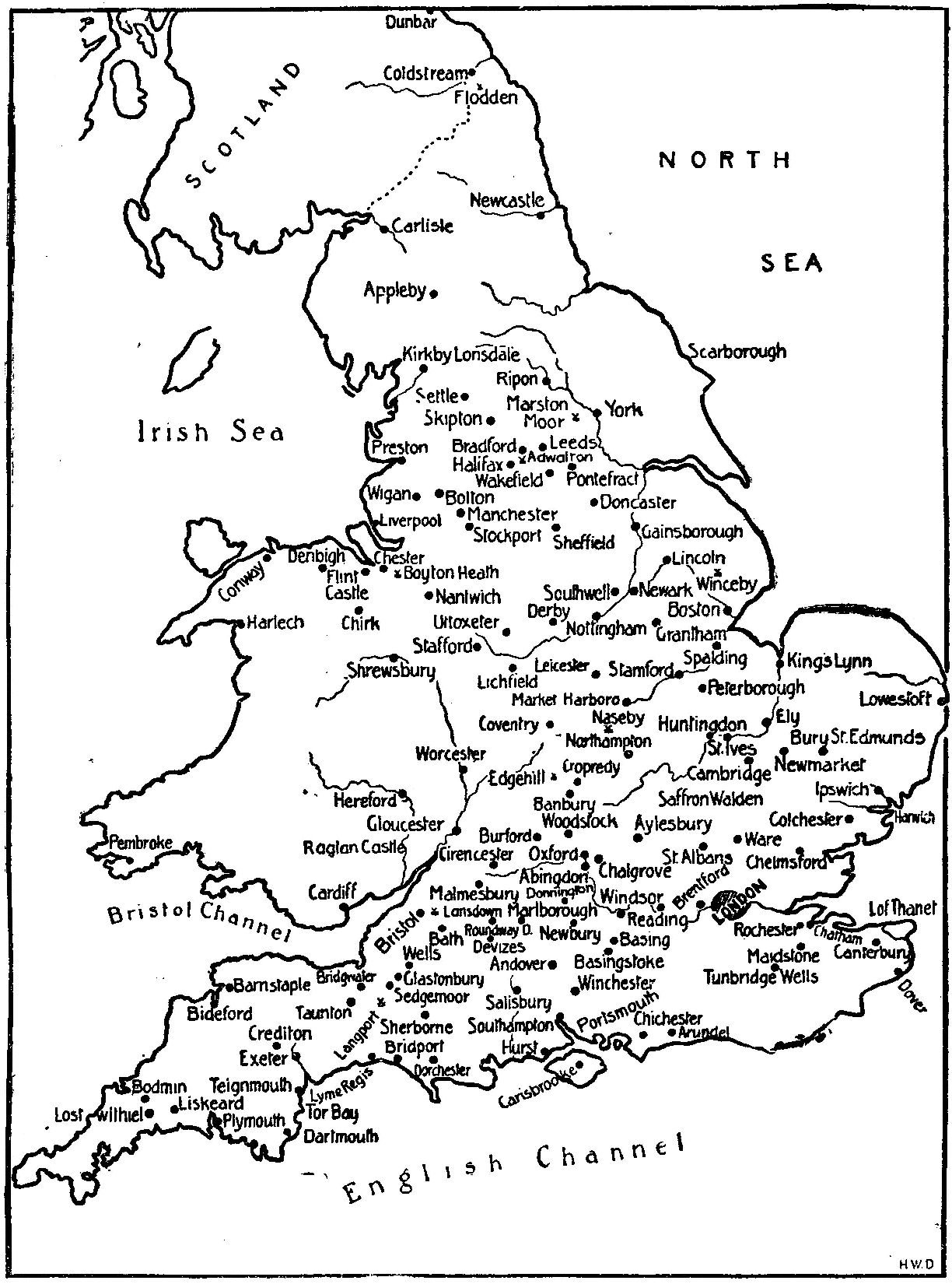 A MAP OF ENGLAND AND WALES, SHOWING THE CHIEF PLACES WHERE BATTLES ADN SIEGES TOOK PLACE DURING THE CIVIL WAR. |
But it must not be overlooked that there were many Royalists in the East and South, and many Puritans in the West and in Yorkshire. Even in Puritan London there was a king's party, and even in Charles's headquarters at Oxford and York there was a Puritan party. There were Puritan towns such as Plymouth, Bath, Gloucester, Dorchester, Nottingham, Liverpool, Manchester, Hull, Scarborough, and others, surrounded by districts in the Royalists' hands; and Royalist towns in Sussex, Hampshire, Berkshire, and Buckinghamshire, surrounded by the Parliamentary forces. Parliament held nearly all the ports, and thus with its hold on the navy and its possession of the chief seat of government, it had an immense advantage.
How was the war fought? A mere list of the great battles gives little idea of what really happened. In nearly every part of England there stands some castle or manor house; which has its story of fighting in the Civil War: Basing House in Hampshire; Lathom House in Lancashire; Wardour Castle in Wiltshire; Cawood, Pontefract, and Scarborough Castles in Yorkshire; Sherborne Castle in Dorset; Pendennis Castle in Cornwall; Beeston Castle in Cheshire; Raglan Castle in Monmouth; Flint, Denbigh, Conway, Chirk, Harlech, Pembroke, and Montgomery, in Wales; these are but a few of the isolated strongholds that stood sieges and assaults in the Civil War. Again, hardly a town in England failed to witness some incident that helped to decide the issue. London, Colchester, Gloucester, Exeter, Oxford, York, Nottingham, Hull, Leicester, Manchester, Liverpool, Stockport, Bolton, Coventry, Bristol, Reading, and many others, saw active fighting, whilst some underwent regular sieges.
In most of the great battles there were from 10,000 to 20,000 engaged on each side; but at the same time, in bands and small garrisons all over the country, there were several times this number under arms. For if the Roundheads (Puritans) withdrew their forces from Lincolnshire or Wiltshire, the Royalists would step in and occupy the district; or if the Royalists relaxed their hold of Somerset or Warwickshire, the Roundheads immediately rushed in.
 THE DEFENSE OF WARDOUR CASTLE AGAINST THE ROUNDHEADS. |
Alongside of the great campaigns there went on, in half the counties, hundreds of local skirmishes and assaults on houses and castles.
Battles of Edgehill, Marston Moor, and Naseby
If we take as the opening of the war the setting up of the Royal Standard at Nottingham on August 22nd, 1642, we find that the first nine weeks were spent by each side in marching and counter-marching.
Charles stayed until September 13th at Nottingham. Prince Rupert, the dashing cavalry leader, whose soldiers from the first gained a bad name for plundering and riotous behaviour, levied a contribution of £500 from Puritan Leicester. Then Charles fell back through South Derbyshire and Staffordshire to Shrewsbury, gathering troops and money. Meanwhile Essex, with the Parliamentary army, was in Northamptonshire, but he moved westward to keep a check on the king.
From Shrewsbury, Rupert made a dash on Worcester, and at Powicke Bridge, in a slight skirmish, he proved the superiority of the Royalist horsemen over the Roundheads. This had the effect of giving the Cavaliers greater confidence when they met the Roundheads a month later at Edgehill. By this time Charles had about 15,000 men round him, and thought himself strong enough to march straight for London.
On October 21st he reached Southam (in Warwickshire). Essex's army marched in the same direction to prevent the king reaching London. On the 22nd, a Saturday, Charles encamped at Edgecot. If he proceeded further in the same direction he would have to march into what was the enemy's country, with the Puritan army behind him. He therefore decided to turn round and meet Essex, who was now at Kineton (South Warwickshire). By Rupert's advice he took up a strong position at Edgehill, and about one o'clock on Sunday afternoon the battle began.
In most of the pitched battles of this war, the main body of foot-soldiers was placed in the middle, with forces of cavalry on each side. So it was here. Prince Rupert commanded the Royalist right, facing Sir Faithful Fortescue. His dashing Cavaliers carried all before them. Sir Faithful turned traitor and joined Rupert against his own side. On the left wing, too, the Royalist horse had an easy victory. The victorious cavalry rushed on in pursuit for miles, leaving the two bodies of infantry struggling in the middle. Here the slaughter was great, but the Parliament's men held their own.
 A PURITAN SOLDIER PREACHING. |
The result of the whole fighting was a doubtful gain to the king. He was able to resume his march towards London, seize Banbury Castle, and enter Oxford without a blow. But Essex's main army, strengthened by the regiments following from Worcester, was still as strong as the king's, and was following at his heels.
The excitement in the Puritan counties and London was now tremendous. If Charles should enter London all would be lost. Messengers were sent from Parliament to open negotiations with him, but he refused to receive them. Rupert tried to take Windsor Castle by storm, but failed. Already the reputation of his soldiers for plundering, and excesses of other kinds, had alarmed the Londoners, who quickly assembled in thousands to defend their beloved city.
Six thousand new recruits joined Essex, who had managed to reach London before the royal army. On November 11th Rupert was at Brentford, where on the 12th he smashed up two regiments, fell on the town, and sacked it, although many of the inhabitants were Royalists. But the prompt succour sent by the City of London saved the capital and the Parliamentary cause.
On the morning of the 13th November, 24,000 men stood under arms at Turnham Green. Had they all been trained soldiers and led by an enterprising general, the king would have been caught in a trap; for Kingston Bridge was held by 3,000 Parliamentary troops who could have attacked him in flank. But Essex acted with caution, perhaps rightly, and Charles had to withdraw, first to Reading, then to Oxford, leaving garrisons at Reading, Wallingford, and Abingdon.
It was now that Oxford became the king's headquarters, from December, 1642, until June, 1646, and the memory of that occupation is still preserved. The old walls were then complete, and earthworks were thrown up outside from the present Balliol College cricket ground and the "King's Mound" to St. Giles's Church and beyond. The citizens and scholars helped in the work. The waters of the river on the south and east sides could be turned to the defence of the city.
For nearly two years, until Marston Moor, the events of the war are difficult to follow, and we can only see any connection between the different operations if we try to understand Charles's plan. He had his own headquarters at Oxford and held most of the country round it. Another Royalist army, led by the Marquis of Newcastle, held Yorkshire and the North of England. A third under Sir Ralph Hopton occupied Cornwall and the West of England.
Now if Charles could bring these three armies towards London at the same time, he could probably defeat any army of the Parliament and capture London itself. That done, he had little more to fear. His plan, however, never succeeded because, firstly, Newcastle could never shake off the Roundheads under Lord Fairfax and his more famous son, Sir Thomas Fairfax; nor could he break through the Puritan forces of the Eastern Association (Norfolk, Suffolk, Essex, Cambridge, Herts, Hunts, and Lincoln), led by Cromwell, who was becoming noted as the finest cavalry leader on the Puritan side. Secondly, Hopton could not venture to leave the West whilst strong towns like Bristol, Gloucester, Plymouth, Taunton, and others remained in the hands of the Roundheads. Thirdly, because if the northern and western armies did not act with him, Charles's own forces could never be strong enough. Nevertheless, for most of the time before Marston Moor, the Parliamentary armies were acting on the defensive.
There was a skirmish at Chalgrove (June 18th, 1643), and a Royalist victory at Newbury (September 20th, 1643). Chalgrove had struck down Hampden; Newbury claimed another noble victim, this time from the king's side, the gentle and chivalrous Falkland. Weary of the strife and turmoil of the times, fearing the bigotry of the fanatic Puritans, and mistrustful of the shifty king, he rode gladly to his death, hoping to find peace in a soldier's grave.
 THE STORMING OF BRISTOL BY THE ROYALISTS. |
Between Newbury in September, 1643, and Marston Moor in July, 1644, several notable events happened. A treaty was patched up with the Irish rebels and the king got some regiments from Ireland. Pym, the great Parliamentary leader of the House of Commons, died in 1643. He was the man who had organised everything from the impeachment of Buckingham, the Petition of Right, and the Attainder of Strafford, down to the alliance with the Scots.
The Scottish Presbyterians now allied themselves to the Parliament by the signing of the Solemn League and Covenant at Westminster, on September 25th, 1643. They sent an army under Alexander Leslie (Lord Leven) and his cousin, the more famous David Leslie, to check Newcastle's forces in the North (January, 1644). Cromwell had already prevented their attack on the Eastern Counties by his victory at Winceby.
The way was shortly open for a forward movement by the Roundheads, and it soon began. The campaign that ended in the battle of Marston Moor began like a game of chess. For months the Roundheads in Lancashire, helped by Fairfax, had overpowered the Royalists everywhere except at Lathom House (near Ormskirk), defended by the Countess of Derby. Rupert had to wait until May before he could leave the Midlands for its relief, and by that time other troubles had arisen. The Royalists were shut up in York and besieged by the Roundheads.
Rupert now determined on a bold stroke, which relieved Lathom House and left him free to proceed to York. This city was reached on July 1st. The Royalist Marquis of Newcastle could now escape, and the two royal armies at once took up their quarters at Marston, six or seven miles west of York; the Scots and Fairfax, now joined by the Earl of Manchester and Cromwell, drawing off a little to the south.
It looked as if Rupert's movement had been a complete success, But he was not content with relieving the Northern army; he wished to inflict a decisive defeat on the Parliamentarians. He told the more cautious Newcastle that he had the king's most positive orders to fight at all costs. But the king was ignorant of the circumstances. Newcastle, Rupert, and Goring had not more than eighteen thousand men, whilst Manchester and Cromwell, the Fairfaxes and the Leslies mustered about twenty-seven thousand. Rupert, however, had his way. He seized a strong position with open ground in front, where his cavalry could move easily.
The Parliamentary army had also a good position on a slope or ridge between Tockwith and Long Marston. A ditch and hedge hindered their attack, and neither side wished to risk being caught there. For hours on the afternoon of July 2nd the armies lay facing one another. They were in the usual sort of order, foot-soldiers in the middle and cavalry on each side. Manchester was in chief command. Cromwell and David Leslie, with 4,000 horsemen, were on the left; next them came Manchester's foot; next the Scottish foot under Alexander Leslie; next Lord Fairfax's foot; and on the right wing Sir Thomas Fairfax's Yorkshire cavalry.
 THE BATTLE OF MARSTON MOOR. |
Opposite them Rupert's own cavalry faced Cromwell's; Newcastle's foot faced the middle, and Goring's cavalry faced Fairfax. Cromwell was only in subordinate command, but as events turned out it was his battle. "Is Cromwell there?" asked Rupert of a prisoner. "And will they fight? If they will, they shall have fighting enough." "If it please God," said Cromwell, "so shall he."
At six o'clock no movement had been made. "We will charge them to-morrow morning," said Rupert, and went off to supper. In a few minutes Cromwell had begun the attack. Sending a body of dragoons to clear the way over the ditch and hedge, he followed up rapidly with some heavy cavalry. A regiment of Rupert's horse met them and were swept back. This brought, Rupert himself to the front, rallying his men. And now the stoutest and fiercest troopers on both sides charged with all their force.
"We came down the hill in the bravest order and with the greatest resolution that ever was seen," wrote one of them afterwards. "Cromwell's division of 300, in which himself was in person, charged the first division of Prince Rupert's, in which himself was in person. Cromwell's own division had a hard pull of it. They stood at the sword's point a pretty while, hacking one another, but at the last, so it pleased God, he brake through them, scattering them before him like a little dust."
David Leslie, with another body of cavalry, was now supporting Cromwell, and together they routed Rupert's horsemen completely, although Cromwell was wounded on the neck and for a time disabled.
This, however, was only part of the battle. Further along the line Manchester's foot, led by Crawford, had made a successful attack, but in the centre, the Scottish foot, led by Alexander Leslie (Lord Leven) and William Baillie, were hard pressed by Newcastle's Whitecoats, and so also were Lord Fairfax's foot; whilst on the extreme right, Sir Thomas Fairfax's cavalry were being swept off the field by Goring's horse. The bulk of Goring's men pursued Fairfax's retreating regiments for miles. On that side the Royalists believed themselves sure of victory, and already sent off messengers to Oxford to announce it; and no wonder, for many had fled as far as Tadcaster, and old Leven reached Wetherby thinking the battle was entirely lost. Meanwhile Fairfax, wounded and almost alone, managed to reach Cromwell to tell him the news of the disaster.
By this time the left wing, Cromwell's and Leslie's cavalry, were occupying the ground from which they had swept Rupert. They could thus wheel round still further and close in upon the Royalist infantry—Newcastle's—who were in a deadly struggle against Crawford and a few Scottish regiments. Crawford's foot had from the first pressed back the enemy, and with the Scottish regiments who kept their ground, he saved the situation, until Cromwell and Leslie with the victorious cavalry could come to their help.
The decisive movement was Cromwell's. First clearing the ground of the few undefeated horsemen who had not joined in the pursuit of Fairfax, he and Leslie now bore down on the mass of Newcastle's foot, and caught them between his own horsemen and Crawford and Baillie's foot. The slaughter was terrible. Newcastle's finest regiments made a gallant and desperate stand. "By mere valour, for one whole hour, they kept the troops of horse from entering amongst them at near push of pike; and when the horse did enter, they would have no quarter, but fought it out until there was not thirty of them living."
By nine o'clock all was over. Four thousand Royalists had been killed. Newcastle rode off to Scarborough and took ship to the Continent. Rupert collected the remnants of his army, 6,000 men, left York to the Roundheads, and rode off towards Chester. It was the first great and decisive victory of the Parliamentary armies, and whilst many had fought bravely, the victory was chiefly due to Cromwell's judgment and resolution and to the irresistible onslaught of his Ironsides. It was in this battle that Rupert gave Cromwell the nickname "Old Ironside," and his own soldiers accepted it. "We never charged but we routed the enemy. God made them as stubble to our swords"; so wrote Cromwell in describing the battle.
After Marston Moor, Cromwell persuaded Parliament to reorganise the army, and a fine "New Model Army" was the result; the half-hearted leaders were also got rid of.
Soon the two armies again met in the decisive battle of Naseby. Charles, with Rupert and Langdale and Astley—for Goring was unable to join in time—had only 9,000 men. Fairfax had 14,000. But the king had heard of the new army, and thought his own old soldiers would make short work of it. He despised Fairfax, the new "brutish general," as he called him. And, indeed, but for Cromwell's unerring judgment and resolution, the king's confidence might have been justified. It was, compared with some others, a simple battle.
On the Parliamentary side, Skippon was in the middle with the infantry. Ireton had some cavalry on the left. Cromwell, with over 3,000 horse, had the right wing. On the opposite side Rupert faced Ireton, Astley faced Skippon, and Sir Marmaduke Langdale faced Cromwell.
Rupert swept all before him, and Ireton, with five regiments, was driven back. Ireton himself was wounded, and was for a time a prisoner. But, as usual, Rupert went too far. Whilst he was capturing the baggage train, the main action was being neglected. Astley's foot held the centre in check, and on the side where Rupert's horse had swept off Ireton, the Roundheads were exposed to a flank attack. Skippon himself was severely wounded.
It was Cromwell who, by the same tactics as he had used at Marston, once more turned the scale. He sent forward Whalley, with a regiment of Ironsides, to charge Langdale. They carried all before them, and this left Cromwell, with his reserve cavalry, free to charge the Royalist centre. Joined by Fairfax, he soon made an end of the king's foot regiments. Before Rupert could return, whole regiments had surrendered, and the rest were flying back towards Leicester. A thousand had been killed. Five thousand prisoners, the king's baggage, his artillery, and his letters, fell into the Parliament's hands.
From Naseby to the end of the first civil war, the time was spent in crushing out isolated fragments of the Royalist army, and in capturing fortified houses and castles. Goring was finally crushed at Langport, in Somerset, while Bristol, defended by Rupert, capitulated early in September. Bridgwater, Lyme, Taunton, Bath, Winchester, Devizes, Sherborne, all fell in a few weeks.
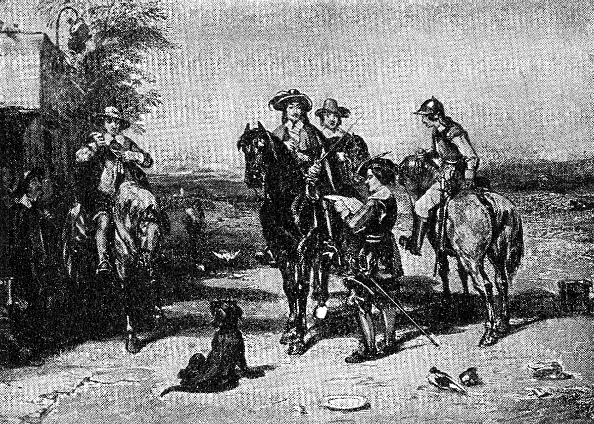 KING CHARLES ON HIS WAY TO THE SCOTS: HIS MASTER'S PAPERS BEING EXAMINED BY A ROUNDHEAD PATROL. |
Long and tedious were the attempts that Charles made to get terms from the Parliament, and meanwhile he kept up the game of trying to secure support, now from the Irish, now from the Scots. At length, at three in the morning of April 27th, 1646, disguised as a servant, with his beard and hair closely trimmed, Charles rode out of Oxford, over Magdalen Bridge, and by a roundabout route, passing through Slough, Harrow, St. Albans, Melton Mowbray, and Stamford, reached Southwell on May 7th at seven in the morning. The distinguished personage who was supposed to be his master pretended to be on the Parliament's side, and thus got through the Roundhead patrols with little difficulty. In a few hours Charles had surrendered himself a prisoner to the Scottish army encamped at Newark. The Scots had now a great prize in their hands, and moved off to Newcastle,
Bargaining between King, Parliament, Scots, and Army (March. 1646, to April, 1648)
Charles was a prisoner with the Scottish army from May to December, 1646. Long. discussions went on, and the Presbyterians tried to convert the king to their form of religion. But Charles refused to come to terms, as they asked him to give up the English Church and establish Presbyterianism, at least for ten years. The English Parliament, also largely Presbyterian, bargained with the king and with the Scots. It was arranged that the Scots should hand over the king to the English Parliament, on receiving payment of their arrears. In January, 1647, therefore, Charles was lodged under guard at Holmby House, in Northamptonshire, and the Scots went home.
And now there began a most extraordinary series of bargainings between king, Parliament, and army. The two latter quarrelled; Cromwell threw in his lot with the army and had Charles seized and brought to the army headquarters at Newmarket.
The army was now supreme, and made Charles an offer called the Heads of the Proposals. The king was to be restored, but for ten years Parliament was to control the militia, and the appointment of ministers of the Crown. These terms were refused. The quarrels between the different parties continued, Charles escaped to the Isle of Wight, and early in 1648 the second civil war broke out, after Charles had managed a treaty with the Scots.
The Royalists were besieged at Colchester, and Cromwell gained a decisive victory over the Scots at Preston, and the second civil war (April–August, 1648) was soon over.
 COLONEL PRIDE REFUSING ADMISSION TO THE PRESBYTERIAN MEMBERS OF PARLIAMENT. |
After this there was little hope of mercy for the king. The army had made up its mind that Charles was responsible for all the blood shed during the second civil war. The Presbyterians still wished to treat with the king, but the army officers on December 6th sent Colonel Pride to Westminster to turn out the Presbyterians by force. Standing with a guard of soldiers at the entrance to the Parliament House, he arrested forty-five members, turned back ninety-six others, and admitted only those, about fifty or sixty, who were known to be in agreement with the wishes of the army. This action of Colonel Pride is known as "Pride's Purge."
Trial and Death of Charles I
Meanwhile the king was removed from Carisbrooke to Hurst Castle, and on December 23rd was brought to Windsor. During the next week his fate was discussed. Cromwell tried hard to find a way by which the king's life could be spared. When he found that Charles would rather part with his life than give up his kingly power, and that the leading officers were equally determined to accept no terms proposed by the king, Cromwell took the firm resolution that the king must die. When someone objected that the king could not be tried by the court set up by the Rump Parliament, "I tell you," said Cromwell, "we will cut off his head with the crown upon it."
The trial of the king was a strange and terrible scene. Before he could be tried at all, several revolutionary measures were necessary, even though the House of Commons had been made a mere shadow of the army when Colonel Pride "purged" it. First the Commons passed an Ordinance to form a special court for the king's trial. The House of Lords, also reduced to a shadow—there were now only seven members—rejected the Ordinance. The Commons then passed resolutions that the people are, under God, the origin of all just power, and that the Commons, in Parliament assembled, have the supreme power. Their acts were to have the force of law, even without the agreement of the Lords and the king.
 KING CHARLES ON THE SCAFFOLD SPEAKING TO BISHOP JUXON. |
On January 6th, 1649, the Act was passed, creating a High Court of Justice for the trial. The Act stated all the king's crimes; these were—that he had tried to ruin the ancient laws and liberties of this nation, and had carried out his design with fire and sword, and had levied and maintained a cruel war in the land against the Parliament and kingdom.
Of the 138 Commissioners named to act as the judges at the trial, only sixty-eight appeared on the day of the trial, January 20th. At one o'clock the Court assembled in Westminster Hall. At the south end a wooden platform was erected on which sat the whole body of the king's judges, with Bradshaw as President of the Court.
A chair covered with crimson velvet was placed directly in front of the President, and in it sat the king guarded by Colonel Hacker. Colonel Axtell with a large body of soldiers kept back the crowd of spectators. John Cook, the Solicitor of the Commonwealth, read the charges against Charles Stuart and impeached him as a tyrant, traitor, murderer, and a public and implacable enemy of the Commonwealth of England. Whilst this was read, Charles attempted to interrupt by touching the solicitor with his silver-headed staff. But the head fell off, and no one offering to pick it up for him, he stooped down for it himself. Hearing himself styled a traitor, he burst into a laugh.
Charles demanded of his judges by what authority he had been brought to the bar. Bradshaw replied, "By the authority of the people of England."
Charles refused to plead, except before a lawful authority. "It is not my case alone," he said; "it is the freedom and liberty of the people of England; and do you pretend what you will, I stand more for their liberties. For if power without law may make laws, and may alter the fundamental laws of the kingdom, I do not know what subject he is in England that can be sure of his life, or anything that he calls his own."
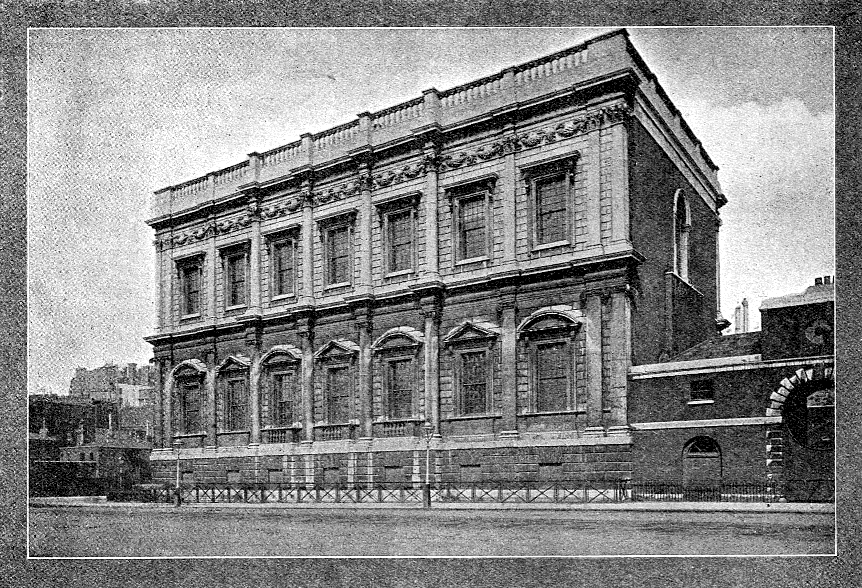 THE BANQUETING HOUSE, WHITEHALL. |
On the 27th, after nearly a week of private discussion, the Court delivered sentence, that the king was guilty and must be beheaded as a traitor. He had refused to plead before the Court, but he asked that he might address the Lords and Commons instead. After the sentence he attempted to speak. "Your time is now past," replied Bradshaw. He struggled to be heard. "Guard, withdraw your prisoner," ordered Bradshaw. "I am not suffered to speak," cried Charles. "Expect what justice other people will have."
Even yet there was a faint hope for the king's life. The night after the trial he slept at Whitehall for the last time. On Sunday the 28th he listened to the prayers of the Church read to him by Bishop Juxon. At five o'clock he was led to St. James's Palace, perhaps to be out of earshot whilst his scaffold was prepared. Meanwhile the regicides (or king-killers), as the king's judges came to be called, were almost overwhelmed by appeals and protests and petitions to spare the king's life.
The Prince of Wales sent a blank sheet of paper signed and sealed by himself, on which the Parliament might inscribe any terms they pleased. The death-warrant had not yet been signed by nearly all the judges, and many repented having signed it. It was Cromwell's stern unbending will that forced the judges to carry out their own sentence.
The king bore himself with great dignity. He spent much time in prayer, burnt his papers, distributed various gifts, and Execution of took leave of his children. His wife he had not seen for nearly five years. On Monday night he slept at St. James's, and on the last day, Tuesday, he rose before daylight. "Let me have a shirt, more than ordinary," he said to his servant Thomas Herbert. "The season is so sharp as probably may make me shake, which some will imagine proceeds from fear. Death is not terrible to me. I bless my God I am prepared."
Bishop Juxon read the morning service, and Charles continued in prayer until Colonel Hacker knocked at the door to summon him to Whitehall. Accompanied by the bishop, Colonel Tomlinson, and Herbert, he walked across St. James's Park between a double row of soldiers. At Whitehall he had to wait some hours, for the scaffold had to be prepared, so as to make any attempt at resistance impossible.
 KING CHARLES'S LAST INTERVIEW WITH HIS CHILDREN. |
About two o'clock the king stepped forth, probably from the central window of the Banqueting House. Juxon was still with him. The others on the scaffold were Colonels Hacker and Tomlinson and the two masked executioners. Around the scaffold were troops of horse and foot, and behind them surged the crowd.
Charles could not be heard below, but addressing himself to Juxon and Tomlinson, he declared that "Not he but the Parliament had originated the Civil War." He prayed that his enemies might be forgiven. "For the people . . . I must tell you that their liberty and freedom consists in having government, those laws by which their lives and their goods may be most their own. It is not their having a share in the government: that is nothing appertaining unto them."
He then knelt down, placed his neck on the block, and in a moment all was over. "Behold the head of a traitor," cried the executioner. A groan of horror arose, and the troops began to patrol the street and to disperse the angry crowd.
A poet living at that time—Andrew Marvell, whose sympathies were with the Parliament—wrote these lines on the king's death:—
|
He nothing common did or mean Upon that memorable scene, But with his keener eye The axe's edge did try; Nor called the gods, with vulgar spite, To vindicate his hopeless right; But bowed his comely head Down as upon a bed. |
Oliver Cromwell, the Commonwealth, and the Triumph of Puritanism (1649-1660)
During the, ten years that followed the death of Charles, the history of England depended largely upon the conduct of one man, Oliver Cromwell.
 OLIVER CROMWELL. |
The country gentlemen, neither poor nor noble, together with the trading and manufacturing classes, formed the backbone of the Puritan cause, and like most of the leading Puritans, Cromwell sprang from this middle class. In appearance he was a strongly built man about 5 feet 10 inches, with a fine head. His face was not handsome, but his large, rough-hewn features had a kindly expression, as you can see in his portraits. His nose was large, his eyes a blue-grey, his mouth large and firm; he wore his hair long, as was usual in his time. He dressed plainly and sometimes carelessly, but even his enemies admitted his dignified bearing on all great occasions.
Cromwell himself was descended from the sister of Thomas Cromwell, the famous minister of King Henry VIII. He was educated at Sidney Sussex College, Cambridge, entering the University on the very day on which Shakespeare died at Stratford. Afterwards he went to Lincoln's Inn, London, according to the custom which made the study of law common amongst English gentlemen. He inherited two small estates near Huntingdon, which he managed himself. He married the daughter of a well-to-do city merchant, and at twenty-nine was elected Member of Parliament for Huntingdon.
From the first, long before the Civil War, Cromwell's chief interest lay in supporting the cause of the Puritan religion. It is, in fact, in the lives of individual men, such as Cromwell, Eliot, Pym, Hutchinson, Fairfax, and hundreds more, that we see how much religion had to do with the revolution. Cromwell spent much time in prayer and Bible-reading and in hearing sermons. He subscribed to maintain Puritan preachers or lecturers, for many of the clergy were not to the liking of their Puritan congregations.
Of his conduct down to the death of the king, after what has been related in the last chapter, little more need be said. Indignant as he was with those who, he thought, had caused the second civil war, his personal feelings towards Charles softened. He risked his own popularity with the army and the Independents in trying to secure terms for the king and to preserve his life. But he shared the same superstitious feelings as most of the army leaders, and believed that it was God's command that the king should be brought to trial. When he was convinced that the execution of the king was a duty imposed by God, he struck down all opposition until the deed was done.
With the death of the king a new chapter in Cromwell's career opens. Hitherto the revolution had been destructive. But in every revolution a time comes when new forms of government must be created and new rulers set up.
Cromwell was no anarchist; he was not even a Republican like Ludlow, whose sole idea was "that the nation might be governed by its own consent." His chief aims were to secure "liberty of conscience" for what he called the "people of God," by which he meant all Protestants. He believed in order and good government, and wished to see Parliament once more restored to what it had been before the war. But he recognized that for the present a strong authority must be set up.
In February, 1649, the House of Commons voted that the House of Lords was useless, dangerous, and ought to be abolished. The House of Commons at that moment was simply the Rump, that is, the members left after Pride's Purge, and not even all those, for some had not come back after the king's execution. On February 8th the office of king was voted, by the same authority, to be unnecessary, burdensome, and dangerous. And after thus getting rid of the king and the lords, an Act established the English Commonwealth or Republic. It was intended that a new Parliament should be elected in due course, but for the present the remnant of the old Long Parliament was to make the laws, and a council of forty-one—of whom only about fifteen sat regularly—was to see the laws carried out.
For three years this was the Commonwealth of England. It was surrounded by enemies. The royalists were ready to rise. The Scots were preparing to invade England. The extreme democrats, called the Levellers, the most famous of whom was John Lilburne, were ready to overturn the Government and set up a pure democracy, that is, a government of annual Parliaments elected by manhood suffrage, every man having a vote, and with Parliamentary control over everything.
 CROMWELL REFUSING THE CROWN. |
Considering its great difficulties, the new Council of State managed its affairs well. It had an army of 44,000 men, the best troops in Europe. The navy was strengthened, new ships were built, the sailors were better paid and better fed than ever before, and England began to be a great sea power.
But it was useless to pretend that it was a popular Government. Even the liberty and worship that was allowed was hateful to the Presbyterians. Without the powerful army the Government could not have existed a single week. The expenses were greater than they had ever been under Charles I. Heavy taxes had to be levied, and the Royalists were ruined by having to pay heavy fines.
The first trouble came from the Levellers. Cromwell saw that they must be put down. "I tell you," he said, thumping the Council table, you have no other way to deal with these men but to break them or they will break you." Lilburne, the leader, was sent to the Tower, but mutiny broke out in the army. Three of the ringleaders were shot in Burford churchyard. The rest were pardoned, and the trouble was over for the present.
The next business was to finish the war in Ireland, which had begun with the Irish rebellion of 1641. The Royalist forces were led by James Butler, Earl, Marquis, and finally Duke of Ormonde, and after the king's execution he had proclaimed the Prince of Wales as Charles II. The situation was one of hopeless confusion when Cromwell sailed for Ireland in August, 1649, having been delayed four months by the task of equipping his army of 12,000. Ormonde and the Royalists were now allied with the native Irish, and if they had acted promptly, they might have swept the Parliamentary forces out of Ireland. But Ormonde was kept too busy with his enemies to face Cromwell on his arrival. He could only throw a garrison into Drogheda, which Cromwell slaughtered without mercy, when he stormed it on September 10th. Wexford and Dundalk were soon captured. Waterford held out until 1650, when Cromwell sailed for England, leaving the rest of Ireland to be subdued by his lieutenants.
His next workday in Scotland. The danger from Scotland was far greater than from Ireland, for already, in 1648, the Scots had sent a great army into England, which only Cromwell's astonishing success at Preston had defeated. The danger was imminent. But Cromwell won a great battle over Charles II and the Scots at Dunbar (September 3rd, 1650), and delivered his final blow at Worcester on the same day in the following year.
The young king escaped after Worcester with a troop of Scottish horse. The Earl of Derby directed him to a safe retreat at Boscobel. Here, with Colonel Careless, he spent a day in a large oak-tree, whilst the woodman Penderel and his wife kept watch. Soldiers passed near in search of Royalist fugitives, but the king was not discovered. From Boscobel, mounted on a miller's horse, and in a threadbare coat and breeches of coarse green cloth, he rode to Moseley, accompanied by the six brothers of the Penderel family.
In the night, Charles proceeded to Bentley disguised as the servant of Mistress Lane, and three days after reached Abbotsleigh. After many adventures, aided by loyal friends who risked their lives to save him, he reached Bridport, hoping to get a ship. But the shipmaster was suspicious, and Charles had to hide, first near Salisbury, and then make his way to Brighton, where a loyal merchant got him a vessel, and the owner—although he had discovered who his passenger was—carried him across to the Norman coast.
 CROMWELL'S FAMILY LISTENING TO MILTON PLAYING THE ORGAN AT HAMPTON COURT. |
Worcester was the last stage of the Civil War in England, and Cromwell now turned his attention to the government of the country, while General Monk reduced Scotland to a province of England, and thus for the first and only time conquered it. Whatever may have been his views in earlier days, Cromwell now realised that the country needed a strong ruler. After all the anarchy of the last few years, no government of any sort could exist without the help of the sword. He realised, what the men of the Rump did not realise, that the existing (so-called) Parliament was a sham; that it exercised its powers simply by leave of the army; and that until the whole nation was at peace with itself the army would be the real ruler of the country.
These ideas were shared by a majority in the army, so that Cromwell was able to count upon its support. But the Rump, instead of dissolving itself in order to make room for a new Parliament that the army leaders had been asking for ever since the king's execution, now proceeded to pass a bill to ensure all its members a seat in the new Parliament without re-election. Cromwell lost patience. He dissolved the Rump and was declared Lord Protector of the Commonwealth by another Parliament.
Despairing of a "healing and settling" by Parliament, Cromwell determined at all costs to keep the nation from civil war. Plots were forming. The leader of the Scottish mutineers was sent to the Tower. General Harrison, the man who fed on prophecies and believed the second coming of Christ was at hand, had to be put in prison to prevent another rising. The leader of the Levellers was seeking to raise a rebellion against "the tyrant Cromwell." Royalists in the West were proclaiming Charles II. Swiftly Cromwell crushed out these dangerous fires and, boldly throwing off all appearance of legal right, he began to act as a great Constable set by God to keep order over the nation.
He now used the army as his police officers and divided England into ten or twelve large districts, over each of which he set a major-general. For about two years, whilst Cromwell used despotic power, the major-generals kept the whole of England under military rule. Dangerous Royalists were placed under arrest; special taxes or fines (10 per cent. of their property) were levied from former Cavaliers. Races, cock-fights, and bear-baitings were prohibited to prevent seditious meetings. Ale-houses were closely watched and many were closed; rogues and vagabonds were put into the stocks. The old ejected clergy of. the Anglican Church were forbidden to act as chaplains or tutors; the use of the Common Prayer Book was forbidden; newspapers were restricted.
To the Cavaliers it seemed a reign of terror. Yet, except for the repression of the Anglican and Catholic worship and the fines levied on the old Cavaliers—acts for which long afterwards the Puritans paid dearly—the stern rule of the despotic protector and the major-generals was a time of peace and prosperity.
An Act was passed to give servants, apprentices, and scholars a holiday once a month. Cromwell himself hunted, hawked and played bowls. Education was encouraged, and the protector wished to set up a new university for the North of England either at York or Manchester, and he actually founded a college at Durham. If the Anglicans were hardly treated, the new sects had great liberty. George Fox won Cromwell's sympathy, and by his protection went on with his preaching and prophesying, founding the Society of Friends, commonly called Quakers.
Whatever may be said in defence of Cromwell's rule by the major-generals as a measure to prevent the outbreak of civil war, it was the most unpopular of his acts, and it made Englishmen hate the name of a standing army for two generations. For the common people and the Cavaliers resented the interference with their daily habits. The country gentry were indignant at the fines they had to pay.
Cromwell himself disliked this military despotism, but he believed that it was necessary. It was his firm intention to retain power until the nation was "healed and settled," and could once more be governed lawfully by a king through Parliament. In September, 1656, he called a second Parliament, but took care to exclude a hundred of the most troublesome members. Next year he withdrew the major-generals. The Parliament by "the Humble Petition and Advice" begged him to assume the title of king and to rule by a Parliament of two Houses, It was not a mere name that they were thinking of. They believed that the new-fangled Governments of the last few years would never take root, but that if the old Government of King, Lords and Commons could be restored, with Cromwell as king, the country would get used to it.
Cromwell would have accepted the crown, for he had long been convinced that a king, under some title or other, was necessary. But his strongest supporters, the army officers, were opposed to the name, and he was unwilling to risk the loss of their support. He was now installed "protector," and there was a ceremony, almost like a royal coronation.
But like all the previous schemes, it was destroyed by the quarrels of the various sections of Parliament and army. For when the two Houses met, all the old red-hot Republicans in the Commons broke out again in disputes. Fearing that the divisions in Parliament were encouraging the Royalists once more to rebel, Cromwell urged them to cease their quarrels.
When he heard that the Republicans were making claims that had never been made before, nor have ever been made since, Cromwell in anger took coach to the House of Lords, summoned the Commons to the Painted Chamber, and put an end to their sitting. "I do dissolve this Parliament," he said, "and let God be judge between you and me."
For seven more months Cromwell reigned alone, but his strength was exhausted. The long campaigns of the Civil War had more than once brought him to death's door, but he had recovered. He was now nearly sixty, and the incessant work and the terrible anxieties which the constant struggles with his Parliaments caused him, wore him out. "A great place, a great authority, is a great burden," he said. "I can say in the presence of God I would have lived under my woodside, to have kept a flock of sheep, rather than undertake such a government as this is."
Whilst a great storm, long remembered, was raging over London, his mighty spirit, humbled like a little child's, was passing away. He prayed for "God's cause and God's people." "Thou hast made me, though very unworthy, a mean instrument to do them some good and Thee service. And many of them have set too high a value upon me, though others wish and would be glad of my death. But, Lord, however Thou dost dispose of me, continue and go on to do good for them. Give them constancy of judgment, one heart, and mutual love, and go on to deliver them. Teach those who look too much upon Thy instruments to depend more upon Thyself. Pardon such as desire to trample upon the dust of a poor worm, for they are Thy people too. And pardon the folly of this short prayer, even for Jesus Christ's sake, and give us a good night, if it be Thy pleasure."
He was buried in Westminster Abbey, in the Chapel of Henry VII, amongst kings; for he had been a king and more than a king. No statesman ever had greater trials to endure and none ever devoted himself more whole-heartedly to serve his nation.
In spite of all the unpopularity of the Puritans, the nine years of Cromwell's rule had made the Commonwealth Government secure against all foes from without. The army was an invincible host, such as no English king had ever previously commanded. The navy was such as Charles I had only dreamt of. Early in the days of the Commonwealth the Dutch had given shelter to Charles, insulted the English representatives, allowed the English ambassador to be murdered, acted as lords of the sea, and refused all the proposals for friendship put forward by the Commonwealth. A short war, in the course of which the Commonwealth greatly strengthened the navy, soon taught the Dutch to respect the English flag.
The Navigation Act (1651) closed the English and Colonial ports to Dutch ships; and Robert Blake fought for two-years against the famous Admirals Tromp and Ruyter. Admiral Tromp fought a drawn battle against Blake, off Hastings, and drove him into the Channel, flaunting a broom at his mast-head. But Blake soon drove the Dutch to their own shores, and, after further fighting, a favourable peace was concluded. The English admirals, Blake and others, chased Prince Rupert from the seas, where he had begun to wage a semi-piratical war on English ships.
 GENERAL MONK AND LORD FAIRFAX. |
Cromwell made the courts of France and Spain bid for his support; he demanded from Spain freedom to trade with Spanish America, and freedom of religion for Englishmen in all Spanish dominions. "You might as well ask for my master's two eyes," declared the Spanish Ambassador; so Cromwell turned to the French alliance and sent out a fleet to the West Indies. That expedition was a failure, but on its way back the fleet seized Jamaica. Blake in the Mediterranean put down the pirates of Tunis. He also destroyed the Spanish West India fleet at Santa Cruz in Teneriffe—the greatest naval victory since the Armada.
The prestige of the Commonwealth was so great abroad that the French, at Cromwell's wish, compelled the Regent of Savoy to stop the persecution of the Protestants in the Vaudois. Six thousand Ironsides went to help the French against Spain, and won a great victory at the Dunes outside Dunkirk. The reward for this was that the English held Dunkirk, until Charles II was pleased to sell it, a few years after his Restoration.
Foreign nations looked upon Cromwell's Government as a firmly settled power, and the exiled wanderer, Charles, with scarcely bread enough to eat, shifted about from place to place. The Royalists had almost ceased to hope, when Cromwell died. Even then they could effect nothing until the quarrels of the Republicans themselves opened the door for the king.
Cromwell had named his eldest son, Richard, as his successor: But it was not long before General Monk, the governor of Scotland, marched to London, and proclaimed a free Parliament, which invited Charles II to return as king.
On his birthday, May 29th, Charles entered London: Everywhere flags were flying, bells and music sounding. "But in the midst of the general joy, one spot presented a dark and threatening aspect. On Blackheath the army was drawn up to welcome the sovereign. He smiled, bowed, and extended his hand graciously to the lips of the colonels and majors. But all his courtesy was vain.
"Betrayed by their general, abandoned by their leaders, surrounded as they were by a nation in arms, the gloomy silence of their ranks awed even the careless king with a sense of danger. But none of the victories of the New Model were so glorious as the victory which it won over itself. Quietly and without a struggle, the farmers and traders who had dashed Rupert's chivalry to pieces, who had mastered the Parliament, and held even Cromwell in awe, became farmers and traders again, and were known among their fellow-men by no other sign than their greater soberness and industry."
The Reign of Charles II—The "Merrie Monarch" (1660—1685)
We read that in May, 1660, Charles II entered London in triumph, and that the whole nation seemed to give itself up to feasting and revelry. John Evelyn, who saw it, writes: "Shouting with inexpressible joy, the ways strewed with flowers, the bells ringing, the streets hung with tapestry, fountains running with wine, the mayor, aldermen, and all the companies, in their liveries, chains of gold, and banners; lords and nobles, clad in cloth of silver, gold, and velvet; the windows and balconies all set with ladies; trumpets, music, and myriads of people flocking, even so far as Rochester . . . I stood in the Strand and beheld it and blessed God. And all this was done without one drop of blood shed . . . but it was the Lord's doing."
We may well ask what it all really meant. Did it mean that the Civil War had been a mistake, and that the nation wished to be ruled by kings, as it had been in the days of the Tudors and the Yorkists?
Doubtless many of the old Cavaliers thought so. But when they saw the king restored, they forgot that he had been restored, not by a royalist victory, but by a parliamentary general (Monk).
The king was restored without any of those treaties such as had been discussed years before between Charles I and the Parliament. His promise that everything should be settled by a free Parliament was thought to be more satisfactory than any treaty. The Restoration was therefore the restoration of Parliament as well as of Monarchy, and the fact that the Parliament turned out to be composed of Royalists was due to the temper of the nation and to nothing else.
There is no doubt that the event known as the "Restoration" was a very important crisis in our history. It was a revolution, just as the setting up of the Commonwealth had been; and, just as the character of Cromwell in that period influenced the destinies of the whole nation, so the character of Charles II helped to decide the direction in which the nation was to develop. But Charles influenced our history as much by what he did not do, as by what he did. Had he been a king with a strong will and a taste for hard work, he might have become a despot like Louis XIV, his cousin, then reigning in France. It was fortunate for England that Charles threw away the opportunities which a foolish nation placed in his hands.
The newly elected Parliament was to meet in May. In the interval, the country was strongly royalist in feeling. It was then that the trial and execution of the Regicides took place. The elections resulted in a strong Cavalier Parliament. Only about sixty Presbyterians gained seats, although London continued to send four. This Parliament sat until 1679, and is known as the Long Parliament of the Restoration. This, of course, was contrary to the Triennial Act, but that Act was repealed as being a reflection on the king. Charles knew he was not likely to get a Parliament more favourable to him, so he took care not to dissolve it for eighteen years.
His first work was the restoration of the Church of England. Charles himself cared little about the Church. His private inclinations were towards Catholicism, and eventually he became a secret Catholic. He wished to secure toleration for Catholics, and would have agreed to some toleration for the Presbyterians. But the temper of the House of Commons was now so violently Anglican, that even without Clarendon the restoration of the Church was certain.
The discredit of the famous persecuting statutes belongs rather to the Commons than to Clarendon, the minister, although it is true he opposed the king's desire for toleration. The first of these acts, the Corporation Act (1661), was directed against the Presbyterians, who were still numerous and influential in the towns. This act compelled all members of town councils or corporations, mayors, aldermen, councillors, and other officers, to receive the Holy Communion according to the rites of the Church of England. They had also to call the king Supreme Head of the Church and to take the oaths of allegiance and non-resistance to the king. By this means all power in the boroughs was placed in the hands of Anglicans, who thus could see that Anglican members were elected to Parliament.
In the following year the old Act of Uniformity, passed in 1559, was renewed. By this act it became impossible for any one to hold a Church living, or to be a tutor or a schoolmaster, who would not swear that he believed everything in the Book of Common Prayer. All the clergy were also compelled to be ordained by a bishop.
More than 1,200 rectors and vicars gave up their livings rather than conform to these laws, and for some years in many parts of the country it was difficult to find men able to take their places.
It was, however, still possible for the Presbyterians and other Puritan sects to worship in their own chapels, and the ejected clergy swelled the ranks of these "Dissenters." So a further act was now aimed at them. The Conventicle Act forbade more than five persons besides the members of a household to meet for worship except according to the Prayer Book, under penalties of fine and imprisonment. For a third offence the offenders could be sent out of the country.
Lastly, a Five Mile Act was passed, and this forbade "any nonconformist minister to come within five miles of any corporate town (or borough), or of any place in which he had formerly held a living; unless he would swear that he believed it to be unlawful to take up arms against the king, or try to change the Government either in Church or State."
These were harsh laws, but it was still possible to evade them; and even without evading them, it was still possible for Nonconformists to exist. Their numbers grew in spite of fine and imprisonment. The persecution of the Dissenters, like that formerly practised against the Catholics, was never very systematic. Every now and then there would be an outburst of persecution, and the gaols would be filled with men whose only offence was a conscientious objection to conform to the Prayer Book. Even a single magistrate could harass and ruin any poor Dissenter in his neighbourhood.
Foreign affairs, particularly our relations with France and Holland, were of great importance from Charles's accession until the end of the period (1715). The King of France, Louis XIV, was Charles's cousin; and just about the time of Charles's restoration, he was by his own industry and ambition trying to make France the most powerful monarchy in Europe. The main fact in European history from that time until 1715 was the struggle against Louis, who was seeking to make himself master of Spain, of the Spanish Netherlands (now Belgium), of the States bordering on the Rhine, and even of Holland itself. Alliances were formed, chiefly by Holland, to resist and break down the French power.
In 1665 this great struggle had not yet begun, but by his attack on Holland, Charles foolishly played into Louis's hands. For Holland and England were the two strongest naval powers, and Louis was glad to see them destroy each other. It was his policy to prevent England from allying with Holland. With this purpose, after the first Dutch war was over, he bound Charles by secret treaties not to ally with the Dutch. Charles was a clever diplomatist, and extorted vast sums of money from Louis as the price of his agreement. But it was a shameful bargain, for it meant that an English king was bribed to act against the real interests of the English nation, and to support a Catholic tyrant against a free Protestant nation (Holland).
The Dutch war was the first stage in this dishonest, foolish foreign policy. In the year following the Great Fire of London and the Plague, the Dutch actually sailed up the Thames and burned sixteen ships at the gates of Chatham Docks. London was in a panic, and those who were not frightened were ashamed.
In order to give toleration to the Catholics, Charles was willing to give it to the Nonconformists. He issued a Declaration of Indulgence in 1672, which suspended the penalties against Catholics and Nonconformists alike. But the next year the Protestant party passed the Test Act, requiring all officers of the crown to take the sacrament according to the Church of England. The Duke of York, the heir to the throne, had declared himself a Catholic. In 1678 the rumour of a great Popish plot was spread. The Whigs—as the Roundheads came to be called—introduced the Exclusion Bill to exclude the duke from the throne, but the Tories—the successors of the Cavaliers—rallied round the duke and the king. Charles II died in February, 1685.
The main course of events during the reign has been told, but it is difficult to see just how much had been gained or lost during the twenty-five years since the Restoration. It must have seemed to the Whigs that the Civil War had been fought in vain. In reality it was not so. More progress had been made than the people of the time were aware of. First of all, Charles II had never attempted, as his father had, to oppose a united Parliament. He could only go as far as the Tory party would support him, and his power was therefore dependent on a party that frequently had half the nation on its side. Secondly, it was only by accepting a pension from France that he had been able to maintain so much independence. Thirdly, he had to consent to many things distasteful to him. Parliament insisted on its right not only of fixing the amount of supplies for the Government, but of deciding upon what objects the money should be spent. And it was in this reign that the House of Commons asserted the right, against the House of Lords, that they alone had control over all votes of money.
The Whigs had almost succeeded in altering the succession to the throne. They did succeed in getting one law passed which ranks among the greatest laws in English history; this was the great Habeas Corpus Act. Magna Charta had said, "No freeman shall be taken and imprisoned unless by the lawful judgment of his peers, or by the law of the land." Nevertheless, during hundreds of years it was possible for a king to evade the law in the case of men arrested for political crimes. Many attempts had been made by Parliament to prevent kings interfering with the course of justice, and to secure either a speedy trial or the release of such prisoners. The Habeas Corpus Act now secured this end, by making judges and other officers liable to a heavy fine if they refused to bring men to trial at the first opportunity.
In addition to all this, Shaftesbury and the Whig lords who acted with him had shown that, without resort to civil war, a large party in Parliament, backed by the voters in the country, could make it difficult for any Government to act in defiance of the wishes of the people. Political parties had come into existence; and in a few years that party which could secure a majority of members on its side in the House of Commons would be able to control the Government. For good and evil, this was one of the greatest results of the political life of the reign of Charles II.
It remains to say something of some other matters of interest in this reign. The Great Plague has been mentioned. This happened in 1665, during the war with the Dutch. There had been many previous plagues. Indeed, in the Middle Ages plague was seldom absent for any long time; and in the seventeenth century London had suffered several times.
The city itself was very unsanitary, and the new districts that had grown up to the east and south were still worse than the city. For months the plague raged. At the end of August the streets were deserted, and business was almost suspended except for the supply of food. All who could escaped from the plague-stricken city, except a few doctors and Puritan clergymen. In September a thousand persons a day died, and altogether some eighty thousand, or about one-fifth of the whole city population, were carried off by the plague alone.
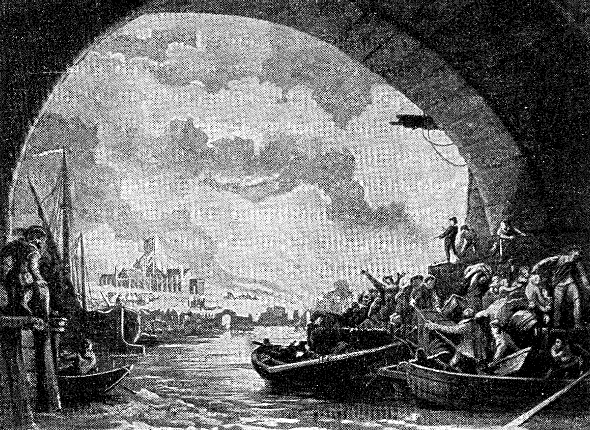 THE GREAT FIRE OF LONDON. |
Next year, 1666, the Great Fire broke out. Pepys writes in his Diary, September 2nd, 1666: "Some of our maids, sitting up late last night, called us up, about three in the morning, to tell us of a great fire they saw in the city. Bye and bye Jane comes and tells me she hears that above three hundred houses have been burnt down to-night, and that it is now burning all Fish Street by London Bridge. . . . So off I go to the Lieutenant of the Tower, who tells me it began this morning in the king's baker's house in Pudding Lane . . . Everybody endeavouring to remove their goods and flinging them into the river, or bringing them into lighters." His account is the most vivid we possess, but too long to quote in full.
Charles II's reign was not fruitful in great men. In literature, the one great name that stands out above all others is that of John Milton. But although he lived on until 1674, and wrote his greatest poems in the early years of the Restoration period, he belongs to the earlier age, when Puritanism was triumphing over its foes. He wrote in defence of the Parliament, and even justified the execution of the king. The Commonwealth appointed him Latin Secretary to the Council of State. But he soon became blind, partly in consequence of his close attention to his duties and to study.
When the Restoration came, misfortune fell upon him. He was imprisoned for a short time and lost much of his property. He was, however, able to live in quietness and obscurity, in a house in Artillery Walk, Bunhill Fields, London. His greatest poems, "Paradise Lost," "Paradise Regained," and "Samson Agonistes," were all written in this last period of his life. No one who has not read these magnificent poems can realise the grandeur of Puritanism at its highest and best.
Writers were not wanting in Charles II's reign. John Bunyan wrote his marvellous "Pilgrim's Progress" and other works, such as "The Holy War" and "Grace Abounding." But he, too, belonged in sympathy to the previous age, and of all the writings of the seventeenth century, his are the most expressive of the popular Puritan spirit.
Dryden, Andrew Marvell, Otway, Cowley, Edmund Waller, Butler, and other poets were a sad falling off from the age of Shakespeare and Milton. Clarendon's History, the Diaries of Pepys and Evelyn, and other memoirs give us wonderful pictures of the men and manners of the time. But, with these notable exceptions, books and plays were more frivolous, and written mostly for amusement.
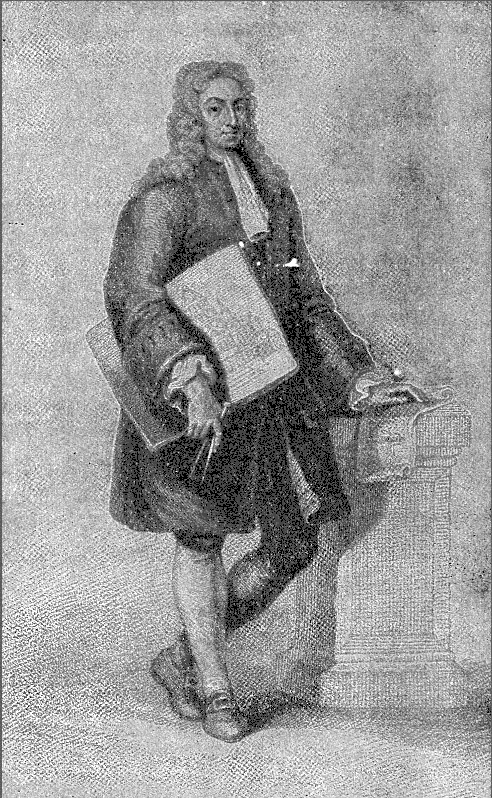 CHRISTOPHER WREN. |
In art nearly all the greatest painters were foreign, and these were greatly inferior to their predecessors, Rubens and Vandyke, whom Charles I had employed. One very great architect there was, Sir Christopher Wren, the, builder of St. Paul's Cathedral, Greenwich Hospital, and scores of London churches. The Fire of London furnished him with the greatest opportunity any English architect has ever enjoyed, and Wren has left more monuments of his genius than any of his successors.
Henry Purcell, the first notable English musician, lived at this time. In natural science, Sir Isaac Newton and Robert Boyle began their researches and discoveries, and gathered round them in the Royal Society, founded in 1662, a band of scientists—careful thinkers and writers—who did much to spread an interest in real knowledge of the natural world.
James II and the Glorious Revolution (1688)
With the accession of James II we seem to take up the thread of events, especially the struggle between King and Parliament and the fight against Popery, that had been suspended by the Restoration.
The king's position was more secure than ever after the defeat of the Duke of Monmouth, the Whig candidate for the throne, who had raised rebellions for "the defense of the Protestant religion." The rebellions Act had placed a standing army in his hands. Parliament had voted ample supplies. The King of France, and the enemies of the King of France, were each anxious to secure his support. He now felt strong enough to effect the second part of his design. Had he attempted only to secure toleration for the Catholics, he would have met with little opposition; and the more prudent of the Catholics, even the Pope himself, wished him to adopt this course. Instead, he began to set the Test Act at defiance. He granted places in the army to zealous Catholics. He bluntly told the Parliament that he had appointed officers who were not qualified by the law, but he could guarantee their fidelity, and was determined to keep them in his service. As Parliament—though a Tory one—refused to repeal the Test Act, he tried to get the judges to override the act by deciding, in a famous lawsuit, that the king could "dispense'. with that or any other Act of Parliament. Next, he placed Roman Catholics in important positions not only in the State, but in the English Church itself. He actually appointed an avowed Catholic to be Dean of Christ Church, Oxford.
James's next step was a bid for popularity in another direction. Charles II had often wished to secure toleration, and had therefore published a Declaration of Indulgence, which was rejected by his next Parliament. With James, the desire for toleration was a mere pretence. He wished to assert his power to dispense with any law whatsoever, and to unite the Protestant Dissenters with the Catholics to overthrow the power of the English Church. In April, 1687, be published a Declaration of Indulgence suspending all the laws against both Catholics and Protestant Dissenters.
It was a great temptation to the Dissenters, but most of them stood firm. They refused to accept a toleration that could only be got by sacrificing the laws of the country and the whole authority of Parliament to suit the schemes of a popish king. William Penn—the great Quaker, and the founder of Pennsylvania—and a few others went over to the king's side; but Richard Baxter, John Bunyan, and other leaders of the persecuted sects, who had suffered imprisonment, were not to be bought over, although James made great efforts to secure their support. So the Dissenters supported the Church of England in resisting the Declaration, and as a result some of the old intolerance was weakened. Eminent Churchmen began to see that the laws against the Protestant Dissenters must be relaxed. In the next reign the Toleration Act put an end to a century of persecution, as far as the Protestants were concerned.
James's first Declaration failed. Next year he published. another. Even yet he had not got to the end of his folly; for he now committed the most unwise act of his reign and one that cost him his crown. The clergy were ordered to read the Declaration from their pulpits on the last two Sundays in May, 1688, in London, and on the first two Sundays in June elsewhere. The Dissenters in London joined with the other clergy. Many of the greatest preachers of the age met in London and pledged themselves not to read the Declaration. A memorable meeting took place at Lambeth round the table of the Archbishop of Canterbury. A few bishops and the Earl of Clarendon were present. They decided to call together the most eminent leaders of the Church.
They little thought they were preparing a Revolution. They met again, and there they drew up the Petition of the Seven Bishops. Sancroft, Archbishop of Canterbury, Lloyd of St. Asaph, Turner of Ely, Lake of Chichester, Ken of Bath and Wells, White of Peterborough, and Trelawney of Bristol, all signed. Compton of London, having been suspended, did not sign. They stated that the Church was and ever had been faithful to the throne, that the bishops would in Parliament show that they were in favour of granting some toleration, but that the Declaration was illegal, and that they could not in conscience publish an illegal Declaration in the house of God.
 PORTRAITS OF THE SEVEN BISHOPS. |
The petition was carried to James himself by six of the bishops. Sancroft stayed behind, as he had been forbidden to come to court. James had heard that the bishops were disposed to obey. He met them therefore in good humour, but when he read the petition he broke out in anger. "This is a standard of rebellion," he said.
The bishops retired. The king kept the petition in his hand; but some one had obtained a copy, and in a few hours it was hawked in the streets and sold by thousands. When Sunday came, out of a hundred London churches the Declaration was read only in four, and in these the congregations hastily left the church.
Before such signs of public indignation James hesitated. Sunderland and the Catholic lords in his council advised that the bishops should be merely reprimanded by the king. But Jeffreys advised that they should be tried as criminals for "publishing a seditious libel." They were first summoned to the Council Chamber in the hope that they would retract. They refused. James therefore gave orders to commit them to the Tower.
A week later they were brought before the Court of King's Bench, passing on their way through great crowds of admirers. The trial was not to take place before June 29th, and Lord Halifax had already arranged that twenty-one of the greatest peers of the realm would give bail for Bishops. The country was raging with indignation. The peasants and miners of Cornwall sang a ballad still remembered—
|
"And shall Trelawney die, and shall Trelawney die? Then thirty thousand Cornish boys will know the reason why." |
It was in these weeks before the trial of the Seven Bishops that a son was born to James. Instead of rejoicing, the nation was filled with rage and disappointment. Thousands had been content to serve the king faithfully while he lived, because they believed the Protestant cause was secure in the succession of James's Protestant daughter and the Prince of Orange. The birth of a son, who would certainly be brought up in the Catholic faith, increased all that hatred and fear of the Catholic cause which the king's conduct had aroused. In another week it was rumoured, and the rumour was well founded, that Sunderland, the king's chief minister, had openly become a Catholic. This was at the very time that the greatest leaders of the National Church were awaiting their trial for obeying their consciences and defending the Church.
 TRIAL OF THE SEVEN BISHOPS. |
The trial began before the four judges of the King's Bench. Great lawyers were engaged on both sides. The court was crowded with peers and members of Parliament. Even the judges themselves were awed by the solemnity of the occasion and the presence of the greatest and most powerful men in the kingdom. After the speeches of the lawyers and the summing-up of the judges, the whole nation waited for the verdict.
While the rest of the court went home, the jury remained all night in a locked room under guard, without food or water—such was the custom of the time—considering their decision. Great numbers of people walked the neighbouring streets till dawn. Messengers came every hour from Whitehall to know what was happening. Not until six in the morning were the jury agreed. At ten the court met again to hear the verdict.
As the words "Not Guilty!" were heard, Lord Halifax, who was in court, sprang up and waved his hat. The ten thousand persons who filled the great hall raised a mighty "Not guilty!" shout. The crowd outside took it up, and the boats on the Thames answered with another. Guns were fired. Horsemen set off to carry the news over the whole country. The churches were opened, the bells were rang. All the following night London gave itself up to rejoicings. Bonfires were ablaze everywhere.
James might well be disturbed by these signs of the times. By his rashness and bigotry he had succeeded in doing what neither his father nor his brother had done. He had united the Church of England and the Protestant Dissenters, Tories and Whigs, Cavaliers and Roundheads, in one spirit of resentment against the crown.
On the very day that the bishops were acquitted, seven of the leading noblemen despatched a letter inviting William, Prince of Orange, to come at once to England to lead the nation against James. This letter was the outcome of a conspiracy, but one which deserves a place among the greatest events in our history. It was conceived by men who had great claims to act in the name of the nation, and who proved by their actions that they could carry out a revolution which preserved far more than it destroyed. James tried to make concessions; but he was now deserted by his friends, including the rising general, John, Lord Churchill. William landed at Torbay (November 5th, 1688); James fled to France, and so abdicated the throne.
William III and the Revolution Settlement
William, Prince of Orange, was one of the greatest men of his own age, and one of the greatest kings who ever reigned over England. Yet he was never popular in England, and was worse served than the worst king who brought misers upon the nation he governed.
Before proceeding with the narrative of William's career, there is one aspect of the Revolution that must receive attention. For sixty years, if we go back no further than the Petition of Right in 1628, there had been strife between King and Parliament. There had been a long civil war, the execution of a king, the establishment of a republic, a military despotism, a Restoration, and now another Revolution. James had been driven from the throne chiefly because of his attempt to overthrow the Church of England and to impose Catholicism on the nation. Had James been a member of the Church of England, his civil tyranny alone would never have provoked a revolution; for the Parliament was prepared to support him.
Nevertheless, now that the occasion had come, the Whigs were desirous of setting the monarchy upon a new footing, and of placing the power of Parliament beyond the reach of attack. All previous attempts to arrive at a just balance of power between crown and Parliament had failed. With a man less wise and moderate than William, this attempt also would have failed.
The Convention Parliament drew up a Declaration of Right, which stated what the chief illegal acts of James had been. It went on to, declare that the king had no power to suspend or dispense with laws; nor to levy taxes without consent of Parliament; nor to keep a standing army in time of peace. Further, that elections to Parliament ought to be free; that speech in Parliament ought to be free; that Parliaments ought to be held frequently; and that no one but a Protestant should be king or queen of England. They then offered the crown to William and Mary as joint sovereigns, on their accepting and ratifying the Declaration of Right. This was afterwards made into an Act of Parliament, and so the "Bill of Rights" still stands as one Of the few great Acts of Parliament upon which the British Constitution rests.
Parliament for the first time declared its right freely to dispose of the crown, and, acting on this right, it decided also the succession to the throne. For it gave to William, and not to Mary, the right to act as king, both whilst Mary lived and so long as he survived. It gave the succession first to the children of William and Mary; then to her sister Anne and her children; then to any heir of William. The doctrine of divine right—of the Lord's Anointed—was thus put an end to by Act of Parliament.
All previous attempts to make kings dependent on Parliament for their supplies had only been partially successful. The king's revenue was now so ordered that he simply could not carry on the ordinary government in time of peace without frequent resort to Parliament. As for the army and navy, without the annual votes of supplies from Parliament it was absolutely impossible to maintain them. As William's whole policy was dependent upon having an army to fight Louis on the Continent, this made the control of Parliament perfectly secure.
Again, although William was free to choose his own ministers, and did so from both parties at the same time, he soon found that it was better to choose his council from the party which had a majority in meat the House of Commons, for unless the House of Commons supported the acts of his ministers, all sorts of obstacles could be put in his way. A general election thus decided which party was to direct the government, for the Cabinet was now chosen from the party which had a majority in the House of Commons; and this has ever since been the most important feature in the Constitution of the country.
We can now turn to the chief events of William's reign. In spite of the wrangling of parties and the intrigues of self-seeking politicians, some good measures were enacted. Among the first of these was the Toleration Act. It might have been expected that the Dissenters, who had really done so much to support the Revolution, would have been now rewarded by complete toleration. William and the Whigs would have granted this, but the Tory Churchmen would only consent to the penal laws being suspended. The old penal laws were not repealed; but any Dissenter who would take certain oaths was relieved from the penalties. The Corporation and Test Acts were still retained, and thus for a century more, although not persecuted, the Dissenters were still excluded from office in the State, the corporations, and the army. They were also excluded from the Universities.
 KING WILLIAM III. |
 QUEEN MARY II. |
But they submitted loyally and waited until the nineteenth century for complete toleration. The Catholics, on the other hand, hated by Whigs and Tories alike, were oppressed by new laws, both in England and Ireland.
Scotland and Ireland both required William's attention. Scotland was a separate kingdom. Its people were strongly Presbyterian, but by means of packed Parliaments and the special powers of the crown, the country had been ruled in the interests of the followers of the bishops. The Scottish Parliament took advantage of James's "desertion" to effect a more complete revolution than had taken place in England. They abolished "prelacy," or the rule of bishops, altered the constitution of their Parliament, and put restrictions on the power of the crown, before they offered it to William. He had no choice but to accept their terms, for the kingdom was divided by fiercer factions than England; a "Jacobite" party was forming, supported by whole clans of the Highlanders.
 KING WILLIAM III. AT THE BATTLE OF THE BOYNE. |
The Jacobites caught William's general at a disadvantage in the Pass of Killiecrankie (Perthshire), but the revolt soon died down. There followed, however; a terrible crime: because the Macdonalds of Glencoe did not take the oath to William in time, they were nearly all put to the sword at the terrible Massacre of Glencoe.
Affairs in Ireland were worse than in Scotland. The Ulstermen were cooped up in Londonderry, besieged by a French and Irish army, and suffered the agonies of famine before they were relieved by William. Next year (1690), William defeated James at the Battle of the Boyne. Still Ireland took another fifteen months to. conquer.
The war ended by the Treaty of Limerick, which promised the Catholics the privileges they had enjoyed in Charles II's time. The Irish Protestant Parliament, however, repudiated the terms, though the Irish were entitled to them by every sentiment of honour.
Whilst William had been winning, the Battle of the Boyne in Ireland, England had passed through a great danger. On June 30th, the very day the two armies faced each other across the Boyne, the English Admiral Herbert, now Lord Torrington, was shamefully beaten by the French, under Tourville. Torrington behaved badly, both by retreating before the French fleet until he received positive orders from the Government to fight at all costs, and by allowing the brunt of the battle to fall upon his Dutch allies, who formed part of his fleet of sixty ships. By the battle off Beachy Head, the French became for the moment masters of the Channel, and burnt the town of Teignmouth. It was two years before the English wiped out the national disgrace by the great victory of La Hogue, won by Admiral Russell in May, 1692.
To William the affairs of England were but a part of that great struggle against France which was the supreme object of his life. Louis had at his command the richest nation, the greatest army, the best generals, that had been seen in Europe for a thousand years. William had to rely upon uncertain alliances with Austria, Spain, Brandenburg, and England. To keep them faithful to their promises, to get them to act together, and with such means to hold in check the mighty power of France, was a great achievement.
Although war was declared against France in 1689, William could not go to the Continent until two years afterwards. He was an unlucky general. He hardly ever won a victory. Yet he achieved his ends by holding on in spite of defeat, and keeping his armies together. Consequently, although Louie won nearly all the battles, France was worn out and defeated in the long run.
The good queen, Mary, had died in 1694. In September, 1701, James II died at St. Germains. The last of Anne's children had died in 1700. It was therefore necessary to decide the question of the lawful succession to the throne. The Act of Succession (or Act of Settlement) decided that the crown was to descend to Anne, then to Sophia, Electress or Princess of Hanover (a grand-daughter of James I of England), and to her heirs, being Protestants. It carried further the principles of the Bill of Rights by providing that all future monarchs must belong to the Church of England; that no English sovereign should leave the kingdom without the consent of Parliament; that no pensioner or placeman should serve as a member of Parliament; that no pardon under the Great Seal should prevent impeachment by the Commons, and that the judges should hold their offices during good behaviour, and not be removed except by an address from both Houses of Parliament. Thus we see that the efforts of the Long Parliament had after all not been in vain. William III was the first "constitutional king," that is, the first king who really ruled through Parliament.
William died on March 8th, 1702, in consequence of a fall from his horse. He was preparing for a renewal of the great war against France, which was to be carried out by England's greatest general in the next reign.
Queen Anne and Marlborough
It is difficult to describe Anne's character, except by saying what she was not. She was not clever, she was not beautiful, she had no gifts of any kind; she had not behaved well to her father, nor to her sister. Her piety was mixed with superstition; her honesty was spoiled by obstinacy. She had no real independence of character, and always relied upon some one to think for her and decide for her. From childhood she had been entirely in the hands of a clever woman, Sarah Jennings, who married John Churchill—known to history as the first Duke of Marlborough.
William's death left Marlborough to carry out his policy. France was now more powerful than in the previous war, for Spain and Bavaria were joined in alliance with her. Against them were united Austria, Holland, the new kingdom of Prussia, a few other small German States such as Hanover, Portugal, the Duchy of Savoy (which furnished a great general, Eugene), and England (which furnished an army, much money, and Marlborough).
The war was fought in Italy, in Spain, in Germany, in Flanders, and on the sea. The hero of it was Marlborough. He had two great tasks—first, to keep the allies acting together; next, to defeat the French on the battlefield. He found the second task easier than the first. There was, in fact, only one of the allies with whom it was possible to act in harmony. That was Eugene of Savoy, with whom Marlborough struck up a great friendship.
The war was on a grand scale, for the opposing armies often numbered sixty thousand on each side. Of these, not more than about twelve thousand were Englishmen. Many were veterans who had gained experience in William's wars, but there were the usual supplies of raw recruits gathered from the gaols, pressed-men, bankrupts, and able-bodied men who had no lawful calling or occupation, or visible means of support." Yet out of such material Marlborough created the finest army of his age. As far as his means would allow, he looked after the welfare of his men, and his discipline and training enabled his troops to perform deeds that astonished his enemies.
War was declared in 1702. Marlborough drove back a great French army from the Lower Meuse, and took some strong fortresses. Early in 1704, in secret conjunction with Eugene, he devised the most daring and brilliant of his campaigns, that of Blenheim (August 13th, 1704).
Marlborough's fame was spread over Europe. The queen had already created him Duke of Marlborough after his first campaign. He now received further rewards, and began to build at Woodstock the great palace (Blenheim Palace) that still reminds us of his greatest victory. The very week before Blenheim was fought, Admiral Rooke also captured Gibraltar, and defeated soon after a French fleet that attempted to recover it. The importance of this great event was seen during the next hundred years, for it enabled British fleets to hold the Mediterranean.
 THE ARTICLES OF THE ACT OF UNION PRESENTED BY THE COMMISSIONERS TO QUEEN ANNE. |
For the next six years Marlborough conducted great campaigns, chiefly in Flanders. He defeated the French at Ramillies (1706), Oudenarde (1708), and Malplaquet (1709). But the achievements of the war after 1709 brought no further advantage either to England or the Allies. At home the Tories were planning for the overthrow of the Whig party and of Marlborough himself. A new Parliament was elected, and this was strongly Tory, and Marlborough's power was over.
In 1713 the Peace of Utrecht was signed. England gained from France valuable lands in North America—Hudson's Bay, Newfoundland, and Nova Scotia, as well as St. Christopher in the Leeward Isles. From Spain she gained Gibraltar and Minorca, and—what must be read with shame, although it did not seem shameful to our ancestors—the monopoly of the slave trade to the Spanish colonies for thirty years. The French, too, were to expel the Pretender (the son of James II) from France.
The original cause of the war, the Spanish Succession, was settled by allowing Philip V to remain king: but Spain was only to keep her colonies, not her other possessions in Europe. A great part of the latter went to the Archduke, now Emperor of Austria.
The greatest political event of the reign of Anne was the Act of Union with Scotland.
In the last reign great jealousy existed between the two kingdoms. In matters of trade they were like two foreign countries, and thus the trading companies of the two countries came into conflict with one another.
In a few years, however, the Scots saw that they had more to gain in trade by a real union with England than they had to lose in independence. The Act of Union provided for forty-five Scottish members to sit in the House of Commons and sixteen peers in the House of Lords. The Scottish Church, which was Presbyterian, was to remain as it was, and Scottish laws which differed in several ways, from English, was also to remain unchanged. But trade was to be free between the two countries, and taxes and coins were to be the same in each country.
The last act in the drama of the Stuart period was now nearly over. It ended in a strangely dramatic scene. The queen herself was not only a Tory, but at heart a "Jacobite." If the Pretender had been a Protestant, there is no doubt she would have secured him as her successor, in spite of the Act of Settlement. The Tories opened negotiations with James, in the hope that he would declare himself a Protestant. To his honour, he refused, then and always.
Notwithstanding his refusal, the Jacobite minister, Bolingbroke, continued his plots. Harley, now Lord Oxford, was undecided, and it was therefore necessary to remove him. For a few days Bolingbroke was really Prime Minister. It looked as if he would bring about a Jacobite revolution, for he put Jacobites into office, and assured the Pretender of his support.
Suddenly, at the end of July, 1714, the queen had a fit of apoplexy; she lay speechless, and was evidently dying. The moment had come when a decisive blow must be struck either for James or George of Hanover. The Whigs were preparing to fight. The Cabinet met at Kensington. What they were going to do will, perhaps, never be known, But a strange scene is said to have taken place. The Whig Dukes of Argyle and Somerset availed themselves of their privilege as Privy Councillors, and appeared in the Council chamber. The Duke of Shrewsbury, an old and respected Whig, who had of late years joined the Tory governments of Anne, was present and welcomed them. They called the physicians, who declared the queen was dying. The Council resolved that Shrewsbury should be appointed Lord Treasurer, and took upon them to summon all the Privy Councillors, mostly Whigs, living in London. The dying queen consented to Shrewsbury's appointment, and Bolingbroke was baffled. The Whigs ordered four regiments to London, and equipped the fleet to protect the ports against Jacobite invasions. On August 1st the queen died.
George I was at once proclaimed. A Whig Government was formed, a new Whig Parliament was soon elected, and the Age of the Stuarts passed away.
A Review of Life and Progress in Stuart Times
Between the accession of James I and the death of Anne, a period of little over a century, great changes in the life of the nation were witnessed.
James I and Charles I had begun by regarding Parliament as a mere royal council, to be summoned and dismissed at will. By the time Anne came to the throne, the various revolutions had placed the sovereign in a much humbler position. The idea of ruling without Parliament was dead. Queen Anne could only choose ministers who had the support of the House of Commons. The great struggle between King and Parliament had come to an end. The two Houses, united, were so strong that Anne only once ventured to refuse assent to a Bill, and since then the so-called "royal veto" on a Bill has never been exercised.
Through the complete control over taxation, finally gained at the Revolution by the Bill of Rights, the House of Commons was the more powerful of the two. But for a long time the House of Lords played a very active part. Peers generally formed a majority in the royal council, which was becoming a real "Cabinet." The wealthier peers, who owned land in a large number of the smaller boroughs, controlled the elections in these towns, and thus had great influence over the House of Commons. The House of Lords used its powers very freely, especially in rejecting Bills from the Commons, and it exerted a strong check on the House of Commons. But if it came to a contest the Commons could win, through their control over taxes.
Not only had Parliament as a whole won its victory, but the two great political parties, Whigs and Tories, had become so well organised that the government could only be carried on by one party at a time. That is to say, the monarch could no longer choose his ministers from both parties. If the Whigs had a majority in the House of Commons, the king or queen must form a Whig government. If the Tories had a majority, then the government must be formed from the Tories. Thus we began to have not only Parliamentary Government, but Party Government.
In the Church also, a change equally great in its effect on the lives, of the people had taken, place. In 1604, every subject of the king could, be compelled, by and imprisonment, to conform to the one national Church. In the middle of the century, the national Church had been overthrown and its services forbidden. With the restoration of monarchy, the national Church was restored, and the Nonconformists were again persecuted. But by the time of Anne such persecution had ceased, and toleration for all Protestants was secured. The laws against Catholics were not repealed. In practice, however, Catholics were seldom disturbed, and although the exercise of their religion was illegal, it was openly carried on.
Personal liberty was much greater than it had ever been before, and, greater than in any other country. The Habeas Corpus Act of 1679 secured people against being kept in prison by the orders of the crown. By this act; every prisoner could claim a speedy trial; or be released on bail. Besides that, the judges themselves could no longer be dismissed by the king: only a vote of both Houses of Parliament could remove a judge from his post. There were thus to be no, more judges like Jeffreys, and no more decisions like that on "ship-money."
People could speak their minds more freely. In James I's time, men discussed questions of politics with bated breath. In Anne's time everybody was free to talk about everything. Newspapers, first begun in, the days of the Civil War and the Commonwealth, had become more common and cheaper. In Anne's reign the first daily paper, called the Daily Courant, was established. Coffee-houses were used as clubs, and the interchange of ideas helped to create public opinion.
Even the pulpit had become a popular institution. It was an, age of great preachers. Sermons, especially in London, were listened to as popular lectures are now. Missionary and other societies flourished. Parish libraries began to be formed, and movements for popular education spread to every part of the country.
Wealth was increased by increased trade, both at home and abroad, and by improvements in industry and agriculture. When James I became king there was no trade with America. The first real colony at Jamestown was established in 1607 by the newly formed London Company. In 1620 the Pilgrim Fathers sailed and founded the New England States. By the time of Queen Anne the American colonies spread from the St. Lawrence southwards along the American seaboard to the River Savannah, and the trade with Britain was of great value. The East India Company, founded in 1600, had gone on for. over a century, increasing its trade. Several islands in the West Indies had been added to the British Dominions, and a foothold had been gained in Africa on the Gold Coast.
Trading companies made expeditions to Russia, Persia, and China, and explorers traversed the South Seas and discovered yet another new continent—Australia. Adventurers and explorers were the necessary pioneers of trade and colonies. The race of Elizabethan "sea-dogs" was succeeded by a race of buccaneers. These were naval adventurers, banded together in free companies and living by plundering foreign ships and towns, chiefly in the West Indies and South America. The distinction between piracy and adventure was not very clear, and our own shipping was in constant danger from pirates.
Nevertheless, foreign trade increased. The imports of all kinds which found their way into the homes of Englishmen, especially of the rich, gradually affected the mode of life of the whole nation. Coffee was introduced about the time of the Long Parliament. Tea came a little later in Charles II's time, and was in general use in Anne's day, except among the poor, for it still cost from thirteen shillings to twenty shillings a pound. Silks, spices, wines, tobacco, Chinese pottery, paper, glassware, calicoes and other cloths, mechanical inventions, works of art, foreign fashions in dress and manners, all helped to change the habits of the rich and to stimulate our own industries.
Foreign refugees were continually coming into the country, particularly the French Huguenots or Protestants, after Louis XIV banished thousands of them in 1685. They much improved the silk manufacture, the linen trade, the manufacture of sail-cloth, tapestry, hats and paper, surgeons' instruments, and glassware. They introduced new kinds of pottery, and discovered new processes which enabled the English potters soon to become famous. Calico-printing, introduced at this time by foreigners, was a new industry entirely.
Thus, both in trade and manufactures, we learned much from the example of other nations, and especially from the Dutch and French. Even the great Bank of England, founded at this time, was an idea borrowed from the Dutch. William Paterson, a Scotsman, brought it forward, and Charles Montagu, William III's Chancellor of the Exchequer, in conjunction with some of the leading London merchants, carried it out. The expenses of the Government in time of war were more than could be met by the ordinary taxes. Money had to be borrowed. Previous to this time, either the Government had to pay extravagant rates of interest, which in the long run came out of the pockets of the taxpayers, or it did not pay at all, and that was both dishonest and ruinous to the traders and merchants who had lent money.
The idea now brought forward was to form a company which was to lend over a million pounds to the Government, Interest at a reasonable rate was to be paid from the taxes called "customs"; and the company was given special privileges to carry on the work of banking. Owing to the support of the Government, the credit of the bank was so secure that people were willing to place their money in it to such an extent that the bank was able to lend more and more to the Government; and these loans to the Government became the famous National Debt.
The importance of all these money schemes is that they show how much richer and more enterprising the people were becoming, and what a much greater part trade was occupying in the national affairs.
Population increased more than in any preceding century, and although not more than one-sixth of the population lived in the towns, it was the towns that grew most rapidly. London kept the lead with about 700,000 people; it was still about seventeen times the size of the next largest town, Bristol. Manchester had grown to about seven thousand, and Liverpool to six thousand. The American trade was bringing prosperity to Liverpool, which began to build its first docks in 1709, and was soon to become the third port in the kingdom. Sheffield and Birmingham were becoming what were then large towns of about five thousand inhabitants.
The roads were still bad, but communication was improving. Hackney coaches had been started in London during the Commonwealth, but it was in Charles II's day that stage coaches became regular means of travel. "Flying" coaches began to run about fifty miles a day of a charge of one shilling for five miles; but these only ran between the large towns in the south, and on the Great North Road. The toll-bar system was then first set up—payments had to be made at the bars or gates—for the improvement of the roads. But it was often necessary to engage guides between one town and another, and a new profession sprang up—that of the highwaymen. The most notorious of these highway robbers, Claude Duval, a good swordsman. and a good shot, made himself a terror to men, whilst to ladies he behaved with the greatest politeness.
By such rascals, traveling all over the country was made dangerous. But inns were generally good and plentiful. It became more and more common for the well-to-do to visit London with their families in the "season," and to go to the newly created watering-places in the summer. Owing to Queen Anne's patronage, and the genius of Beau Nash, who caused the town to be specially adapted for the reception of visitors, Bath became the fashionable resort, for a long time.
The theatres became a regular feature in the larger towns, but London was the first home of the stage. At the Restoration, there were only two theatres open in London, but by Anne's time there were several more, and the first opera was begun. The great musician, Handel, came to England; and by his operas and oratorios, and concerts gave the first great impulse to popular music.
In some ways the age of Anne was like our own times. If we were to go back to James I's time we should find
ourselves strangers to the habits and thoughts of the early days of the Stuarts; but we would be more at home
with the men and women of Anne's time. They lived under a Constitutional Monarchy; party politics played much
the same part that they do now; trade and manufactures were becoming daily of more importance; their
amusements and social life also were to some extent like our own. On the other hand, we are richer; we can
travel more easily; we live more in large towns, and work in factories, instead of in our own homes. The
seventeenth century had done very much to produce Modern England, the England that we live in, and to make us
strangers to the Middle Ages.
Summary of Chief Dates—Tudor and Stuart Periods
I. Revision Dates
| 410. | Romans left Britain |
| 901. | King Alfred died |
| 1066. | Norman Conquest |
| 1215. | The Great Charter |
| 1265. | The First Parliament |
| 1314. | Scottish Independence |
| 1428. | Joan of Arc saves France |
| 1476. | Caxton's Printing Press |
II. Tudor and Stuart Sovereigns
| 1485-1509. | Henry VII |
| 1509-1547. | Henry VIII |
| 1547-1553. | Edward VI |
| 1553-1568. | Mary |
| 1558-1603. | Elizabeth |
| 1603-1625. | James I |
| 1625-1649. | Charles I |
| 1649-1660. | Commonwealth |
| 1660-1685. | Charles II |
| 1685-1688. | James II |
| 1689-1694. | William and Mary |
| 1694-1702. | William III alone |
| 1702-1714. | Anne |
Chief Events
| 1486. | Cape of Good Hope discovered |
| 1492. | Columbus discovers the New World |
| 1517. | Luther makes his "Protest" |
| 1534. | Act of Supremacy |
| 1649. | Edward's VI's First Prayer Book |
| 1587. | Mary Queen of Scots executed |
| 1588. | Spanish Armada defeated |
| 1801. | First Poor Law |
| 1605. | Gunpowder Plot |
| 1620. | Puritans found New England (America) |
| 1628. | Petition of Right |
| 1638. | Scots sign National Covenant |
| 1642. | Civil War begins |
| 1649, | Trial and Execution of Charles I |
| 1655. | Jamaica captured |
| 1660-1665. | Acts against Nonconformists |
| 1678-1685. | Popery Plots and Riots |
| 1688. | William of Orange invited by the Whigs |
| 1689. | Bill of Rights secures triumph of Parliament |
| Toleration Act—Toleration for Nonconformists | |
| 1701. | Act of Settlement secures Protestant Succession |
| 1704. | Battle of Blenheim. Marlborough defeats the French |
| Capture of Gibraltar by England | |
| 1707. | Union of Scotland and England |
Questions and Composition Exercises
Tudor Period
(1) With the help of the Table on page 22, make a genealogical tree of the Tudor sovereigns (with dates).
(2) Compare the way people "shopped," delivered letters, and amused themselves, in Tudor times and to-day.
(1) Describe the map on page 30, so as to show what were men's ideas of the geography of the world. before the
great discoveries.
(2) Imagine yourself one of the crew of the Santa Maria and describe the voyage across the "Sea of Darkness."
Describe England in the reign of Henry VII under these headings (a) The peasants, (b) Nobles, (c) Clergy and
monks.
(1) Name the chief things that Henry VIII did to separate the English Church from the Pope.
(2) Find out from the book what two great events took place in 1529.
(1) Give an account of the Destruction of the Monasteries.
(2) Why was Thomas Cromwell so much hated? Tell the story of his fall.
(1) State the object of the Act of Uniformity.
(2) Compare Mary's reign of terror with Thomas Cromwell's.
(1) Describe the condition, of England in 1558, and compare it with the England of to-day.
(2) Name the chief things that Elizabeth did to "establish" the National Church.
(3) Tell the story of Mary's return from France to Scotland as if you had been with her all the time.
Imagine yourself to be one of Drake's companions, and write a letter home to tell your friends how Drake first
saw the Pacific.
(1) What were the chief reasons why Philip of Spain decided to invade England?
(2) "The singeing of the King of Spain's beard"—what was that?
(3) The Armada. Tell its story-taking care to make an outline first. (Name and compare the leaders on each
side, and their objects; the famous Friday night in England and how the news of the Armada spread; the fight
in the Channel, the fireships, the storm and the wrecks.)
(1) Tell the story of the last voyage of Drake and Hawkins.
(2) How was it a second Armada did not come to England?
(1) Describe the theatres and acting of Shakespeare's days.
(2) Tell the story of any one of the plays which you have read.
(3) What do you think were the most important events in the reign of Elizabeth?
(4) Compare the position of (a) England, (b) Spain at the beginning and end of Elizabeth's reign.
Stuart Period
(1) Write down the Stuart sovereigns in order of their succession.
(2) Who was John Evelyn? Make a list of the events of which was an eye-witness.
(1) Write a description of England 300 years ago under these headings: (a) Farming; (b) Appearance of country,
wild animals, etc.; (c) Towns, trade, and population; (d) Roads and travelling; (e) The "wild north"; (f) Army
and navy.
(2) "Religion and politics are mingled in almost every great event"—give examples of this.
(1) Why was it there so much persecution in England 300 years ago?
(2) What were the (a) object, (b) result of the Gunpowder Plot? How was it betrayed?
(1) How did the Puritans differ from the Anglicans?
(1) Describe Charles I's third Parliament, and show what part Eliot took in it.
(1) Name some of Charles I's arbitrary acts during the Eleven Years.
(1) "The meeting of the Long. Parliament was one of the greatest events in all history." Show this by making a
list of its doings.
(2) Give an account of the Arrest of the Five Members as if you had been an eye-witness.
(1) Why do you think the Civil War was fought?
(2) Say briefly (a) how the country was divided between the two parties; and (b) how the Civil War was fought.
(3) Describe any one battle of the Civil War, preferably that which happened nearest your own home.
(4) Mention any incidents which throw light on the character of (a) Rupert, (b) Cromwell, (c). Charles I
(1) "The trial of the king was a strange and terrible scene." Describe it, and show why.
(2) Write down your opinion of the character of Charles I, referring, to any of his words or acts which you
can remember, and showing his good as well as his bad points.
(1) Describe Charles II's escape and wanderings after the Battle of Worcester.
(2) Why was Cromwell's rule unpopular? Could this be avoided?
(3) May 29th, 1660. Describe the events of this day in London, as if you had been present and were writing to
tell a friend in the country.
(1) What was the Clarendon Code? And what is the strict meaning of the word "Nonconformist"?
(2) Summarise the most important events of the reign of Charles II.
(1) "Then 30,000 Cornish boys will know the reason why." Explain this.
(2) What led to the invitation to William of Orange to become King of England?
(1) Write some account of the Revolution Settlement under these headings: (a) Control by Parliament; (b)
Beginning of Party Government; (c) Toleration for Dissenters.
(2) What was the Act of Settlement (1701)? What was its object?
(1) How was it that the Duke of Marlborough was such an important man? What had his European victories to do
with England?
(2) Show how the country was in danger of Jacobite invasions towards the end of Anne's life.
(1) Show what progress the country had made under the Stuart Rule (1603—1714). Use these headings: (a)
King, Parliament, Party Government; (b) Church and Nonconformists; (c) Judges; (d) Life of the people,
amusements, etc.; (e) Travel and inns; (f) Towns and population.
(2) Describe the characters of six of the most important men of the Stuart period.
(3) Explain why Parliament was so much more important during the Stuart period than during the Tudor period.
(4) What do you know of Milton, Bunyan, and Pepys?
(5) Describe the character, aims and difficulties of (a) Oliver Cromwell, (b) William III.
(6) Whom do you prefer—Henry VIII or Charles I? State your reasons fully.