Opening the West with Lewis and Clark - Edwin Sabin |
Captain Lewis Meets the Enemy
The party seemed to be overhauling the cache here as if in a great hurry to go on; but the captain waved greeting, and Joe Fields straightened up, to grin.
"Yez got back mighty quick," accused Pat. "Didn't yez go? An' where are the hosses?"
"Sure we went," retorted Joe. "Hasses? We've turned 'em loose, of course; and you'll be turnin' yours loose, too, in a minute. So tumble off and I'll help you unpack. There's no time to waste. You ought to 've been along, Pat. We had a beautiful brush with the Injuns."
"Didn't I tell yez?" reminded Pat. "Annywan hurt?"
"None of us. We wiped two of them out, though—and a ball cut the captain's ha'r. 'Twas this way," continued Joe, as he tugged at a rope end, to release the pack of meat: "On the fust day, 'fore we 'd gone more 'n twenty mile from the falls, we struck Injun sign in shape of a wounded-busier trail; and after that we kept guard all night, for fear of our hosses. When we got to the Maria's we turned down, after scoutin' 'round a bit. Found a lot of old Injun lodges, but didn't see any Injuns till the 26th. Then the cap'n sighted a bunch o' hosses, thirty of 'em, through his spy-glass—and next several Injuns, on a hill, lookin' at Drouillard, who was across the river.
"'Bout half the hosses were saddled, which meant more Injuns somewhere near. Our hosses were too tuckered to run far, and of course we couldn't leave Drouillard; so the cap'n said: 'We'll go right on to those Injuns, boys; put on a bold front, and we'll have it out with 'em. Don't let 'em think we're afraid. They may not be the Grosvent's.' When the Injuns fust saw us comin', they acted like they were more afraid of us than we were of them. But we finally got together, the cap'n made the peace sign, and told 'em our other man had the pipe and after he'd come in we'd smoke. So Reub and one of the Injuns went after Drouillard.
"There were only eight of 'em. They were the Big-bellies, all right, but they had nothin' except two guns, and clubs and bows and arrers. We thought we could take care of ourselves; and that night we all camped together. The cap'n told us in case of trouble to stick up and keep together and save the baggage.
"We slept in the same lodge with 'em. The cap'n had given three of 'em a flag and a medal and a hand-kerchief; but he put Reub on guard for the night, and told him to watch sharp and wake us quick, so's to look after the hosses, if the Injuns tried to sneak out. He and Drouillard lay down with the Injuns, and Reub and I stayed at the fire in the lodge entrance.
"I went to sleep. Just at sunrise I woke up with a jump. Reub had yelled—and there was an Injun runnin' off with my gun and his, and Reub in chase. Drouillard was up and yellin', too—'Let go my gun! Let go my gun! ' he bawled, and I see him wrestlin' with another Injun, and the cap'n aimin' at another with his pistol. But I had to have my gun, so I ran after Reub and the fust Injun. Before I got there, Reub had caught him and knifed him, and had both guns. Drouillard had his gun by this time, and all the Injuns came pourin' out of the lodge, makin' for the hosses, with the cap'n and his pistol followin' the third Injun.
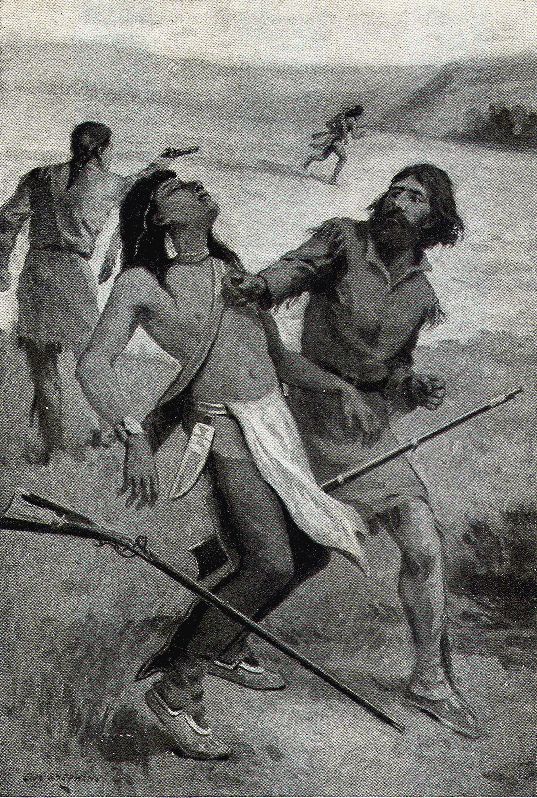 'BEFORE I GOT THERE REUB HAD CAUGHT HIM AND KNIFED HIM.' |
"We drew a bead on the fellow, but he dropped the cap'n's gun, and the cap'n wouldn't let us shoot. ' Look out for those other rascals! ' he ordered. ' "They're trying to drive off the hosses! ' So Reub and Drouillard and I ran after six who were roundin' up the most of the hosses; and the cap'n set out after his Injun and another who were drivin' away a bunch. He made 'em leave twelve, but they kept on, with his hoss, and that he was bound to get. He didn't have his bullet pouch or his hat; and when they were just 'bout to disappear in a little gully he told 'em to surrender the hoss or he'd fire. With that they turned on him, and fire he did, downin' one of 'ern slick as a whistle, but the fellow had life enough to fire back an' sent a ball through the cap'n's ha'r.
"The cap'n had only his pistol, now, so he quit, and the other Injun made off with the hoss. Drouillard had turned back to help the cap'n, but Reub and I follered our Injuns till we got four of our own critters, and then we let the rest go. Didn't matter, 'cause there were the twelve left by the Injuns, so we'd come out ahead in the little game. Besides, we had the lodge, four shields, two bows and quivers, and a gun. Likewise the flag we 'd given, and the medal—but we left the medal on the neck of the Injun Reub had killed, so as to show what kind of people we were.
"Well, we didn't hang 'round there long, you bet. The Injuns had said the main band was only a day and a half away, and when the cap'n had invited 'em to bring their chiefs to council he of course told 'em where our camp was—at the mouth of the Maria's. Now we were desperate afraid the Injuns 'd out-foot us and attack you-all at the river. We took four best horses, and only what meat we could carry, rode a hundred miles, with an hour and a half of rest, camped at two in the mornin', then rode another twenty miles and struck Ordway comin' down with the canoes. We got aboard and here we are—and the cap'n is in a powerful hurry to join Cap'n Clark below."
That was * true; for, as said Drouillard: "Dose Blackfeet now will hold all white men as enemies."
This cache had caved in, and much of the supplies had spoiled. The red pirogue also was found to be worthless, except for its spikes. Captain Lewis hustled the work of loading, the rest of the horses were turned loose, and down the river again voyaged all. Sergeant Ordway was in charge of the five canoes, Sergeant Pat and squad had charge of the white pirogue, which was the flagship.
A sharp lookout was kept for the Big Bellies on the banks. However, nothing happened. The mouth of the Yellowstone was several days ahead and when it was reached, no Captain Clark or others of that party appeared in sight. When halt was made, to look for sign, traces of the captain's camp were found, and in the sand Lepage discovered the scrawl:
W. C. a few miles further down on right hand side.
"When was that written, Lepage, do you think?" queried Captain Lewis.
"Mebbe two, mebbe t'ree day ago," said Baptiste. "De rain haf washed it."
"At any rate, he's safe," uttered the captain, with much satisfaction. "I expect the mosquitoes drove him out of here. Whew t "For the mosquitoes were worse than ever. "We'll overtake him to-morrow."
But they did not overtake the captain's party on the morrow, nor on the next day. On the third day, which was August 11, the canoes stopped to take aboard some meat; the white pirogue continued on, until Captain Lewis espied a herd of elk in some willow brush, near the shore.
"Turn in, boys," he bade. "Wait here. Come on, Cruzatte. We'll get a few of those fellows."
Out he leaped, gun in hand; and he and One-eyed Cruzatte disappeared in the brush.
"Faith, let's hope there aren't Injuns there, too," quoth Sergeant Pat. "It's a likely place for an ambush."
"Hardly stands to reason there'd be elk whar there are Injuns," remarked Alec Willard.
Everybody waited anxiously; gazed and listened. Two rifle-shots were heard, distant.
"There's meat, I reckon," said Alec.
Presently another shot; and in about ten minutes out from the willow brush and to the sandy shore burst Captain Lewis. He was running, limping, staggering—held been wounded—the left thigh of his leather breeches was stained red!
"To your arms, boys!" cried Sergeant Pat. Captain Lewis staggered on, to the white pirogue. "I've been shot, men," he panted. "Not mortally,
I think. Indians are in that thicket. Cruzatte is some where there, too."
"Did you see any Injuns, cap'n?"
"No; the ball came from ambush, just as I was aiming at an elk. Gass, take the men and follow me. We must rescue Cruzatte. I'd lost sight of him."
"Willard, you and the two Fields," roared Pat, springing into the shallows. "The bloody Big-bellies ag'in
But Peter went also, with his bow and arrows.
Nobody objected. The captain led on for about one hundred steps, when his leg gave out and he almost fell.
"I can't travel," he gasped. "I'll return to the boat. If you're overpowered, Sergeant, keep your men together and retreat in good order, and we'll fight from the river."
"Yis, sorr." And Pat gallantly plunged ahead, into the brush. "Kentucky an' the Irish ag'in the red-skins, lads," he cheered. "But mind your eyes."
This was exciting. The willows were thick—good hiding-place. Where was Cruzatte-poor old Cruzatte with the one eye? Peter stuck close behind Pat. His nostrils were wide, his eyes roved, his every sense was on the alert. He was Oto once more. Now was heard a crashing, before. Elk? Indian? Hah!
"That's a mighty quare sort o' Injun, to be makin' all that noise," muttered Pat, peering, his rifle advanced at a ready.
And through a little open space here came Cruzatte! He was striding along, with stained hands, his rifle on his shoulder, making for the boats and plainly much satisfied with himself.
"Hist!" said Pat. "Cruzatte! 'Asy now." Cruzatte started, and crouched.
"Have ye seen Injuns?"
"Non," answered Cruzatte. "I shoot one elk, follow 'nodder."
"Come back to the boats with us, an' step lively," ordered Pat. "There be Injuns 'round. They shot the cap'n in the leg."
"My gracious!" stammered Cruzatte. "But I see no sign."
"Nayther do we. Sure, it's powerful suspicious," muttered Pat.
They found the captain all prepared to defend himself in the pirogue. He had laid out his rifle, pistol and pike, and was propped behind the air-gun that could shoot forty times.
"What did you discover?" he challenged.
"Not a thing, sorr," reported Pat. "An' Cruzatte, here, knows no more about the Injuns than the rist of us."
"Where have you been, Cruzatte?"
"I shoot wan elk, same time you shoot. Den I see nodder in brush, I shoot at heem, he vaneesh an' I try to find heem, but he get away."
"Oh, you did! How much of him did you see when you shot?"
"B' gorry, you shot the cap'n!" bellowed Sergeant Pat. "That's what you did. Ye're blind as a mole! B' gorry, you shot the cap's—ye shot your commandin' officer, an' by that ye're to be coort-martialed an' shot yourself!"
"Non, non!" wailed old Cruzatte, wringing his hands. "I no mean to shoot heem. I see wan leetle brown spot in brush—look jus' like wan elk-fur, long way off; I take aim, bang!—I fink I see elk run, an' I run to ketch heem. I no mean to shoot my capitaine. It wan grand mistake."
"Didn't you hear me call?" demanded the captain. "I suspected maybe that ball came from your rifle and I hallooed as loud as I could. Why, by the shock you couldn't have been more than forty paces!"
"I hear notting. I hear not one word," protested Cruzatte.
"The ball coming from so dose, and you not answering, I of course thought of Indians," continued the captain.
"B' gorry, give me wan chance at him an' I'll close his other eye," besought Pat; and all the men murmured angrily, while poor Cruzatte shivered with fright.
"I no mean to shoot my capitaine," he babbled.
"Never mind, men," said the captain. "It was an error. My leather breeches are just the shade of an elk hide, remember. Let's dress the wound. I doubt if it's serious."
The ball had passed dear through his left thigh, and had furrowed the right; but it seemed not to have touched the bone or any artery. After the wounds had been dressed and lint stuffed into the holes, the canoes with the other elk hunters arrived; and not waiting to explain much the captain insisted upon them all pushing along, to catch up with Captain Clark.
Now that he himself was laid up, this was more necessary than before. All he could do was to rest, half sitting, in the stern of the white pirogue. His leg had so stiffened that he could scarcely move it.