Opening the West with Lewis and Clark - Edwin Sabin |
Peter Meets the Chiefs
The hour was early when Pat stuck his head over the partition, and to Peter said: "Whisht! Are ye awake, Peter?"
"H'lo," answered Peter.
"I'll fetch ye a bite to eat, an' wather to drink," said Patrick. "An' ye best lie hid till we start, when the Injuns go. 'Twon't be long."
"Aw-right," answered Peter.
Patrick passed in to him some dried meat and a canteen of water. After that the day seemed to move very slowly. Here on the boat all was quiet, particularly in Peter's end. However, outside on the shore there was a constant sound of voices, from the 'Nited States camp.
The sun rose high, as betokened by the close warmth where Peter lay hidden. He felt as though he must get out and see what was going on. So he peered over the top of the partition, to find whether the forecastle was empty. It was. He slipped down into it, and stealing through and worming flat across the deck, peeped through a crack in the gunwale.
Little Thief and his Otoes and Missouris had not yet gone. They were holding another council with the 'Nited States. More talk! The 'Nited States chiefs and warriors were sitting, and the Otoes and Missouris were sitting, all forming a great circle.
One after another the Otoes and the Missouris arose and talked, and the white chiefs replied; but of all this talk Peter understood little. After a time he grew tired; the sun was hot, and he went back into his nook. He still had meat and water enough.
It was much later when he awakened, to hear people in the room beyond his partition. There were white men's voices—one voice sounded like that of his other friend, George Shannon. And there were groans. Soon the white men left—all except the man who groaned. He stayed. Evidently one of the white men was sick, and had been put into a bed.
Dusk was falling, and Peter thought that he might venture out and stretch his legs. The sounds from the sick man had ceased; maybe he slept. Peter peered over. Everything was quiet; and forth he slipped—only to discover that in the open door was sitting, amidst the dusk, a watcher. It was the United States warrior, George Shannon. He saw Peter, poised about to leap down, and smiled and beckoned. Peter lightly went to him.
George Shannon looked worn and anxious. "Are you all right, Peter?"
"Yes. Aw-right."
"A soldier—very sick," said George, and pointed to a bunk.
"What name?" asked Peter.
"Charles Floyd. He danced and got hot. Lay down on the sand all night and got cold. Now very sick."
"Huh," grunted Peter. "Mebbe get well?"
"I don't know," said George, soberly.
That was too bad. Why didn't they call in the black medicine-man?
Except for George and the sick Charles Floyd, the boat was deserted; for on the shore another dance and feast were in progress. Chief Little Thief and his Indians were staying, and the 'Nited States appeared to be bent upon giving them a good time.
All that night the sick Charles Floyd moaned at intervals, in the bunk; and George Shannon and Patrick Gass and others kept watch over him; while Peter, on the other side of the partition, listened or slept. Toward morning, when Peter next woke up, he had been aroused by tramp of feet over his head, and splash of water against the boat, and orders shouted, and a movement of the boat itself.
They were starting, and he was starting with them! Hoorah! Now he was not hungry or thirsty or tired; he was excited.
Yes, the boat was moving. He could hear the plashing of oars, and the creak as the sail was raised. And in a few minutes more the boat leaned and swerved and tugged, and the river rippled under its bow.
Peter waited as long as he possibly could stand it to wait. Patrick Gass had said for him to lie hidden until Chief Little Thief had left, and the boat had started. Very well.
All was silent in the room beyond. He peered, and could see nobody. Over the partition he once more squirmed, into the top-most bunk; and feeling with his toes let himself down. The door was shut, but it had a window in it that he might look out of; and if anybody opened, he would dive under the table or under a bunk, until he saw who it was.
The sick man in the bottom 'bunk opposite suddenly exclaimed. He was awake and watching.
"Who are you?" he challenged weakly.
With his feet on the floor, Peter paused, to stare. He saw a pale, clammy countenance gazing at him from the blanket coverings—end at that instant the door opened, and before Peter might so much as stir, the chief with the red hair entered. Peter was fairly caught. He drew breath sharply, and resolved not to show fear.
The chief with the red hair was all in buckskin, and wore moccasins on his feet, and on his head a round hat with the brim looped up in front. His face was without hair and was very tanned, so that it was reddish brown instead of white, and his two eyes were clear, keen gray. His hair was bound behind in a long bag of thin skin. He had rather a large nose, and a round chin; and was heavy.
"Well!" he uttered. He glanced swiftly from Peter to the sick man's bunk, and back again to Peter. "What's this?"
"He stole down from above, Captain," said the sick man.
"How are you, Sergeant? Any better?"
"No, sir. I'm awful weak, sir."
"Much pain?"
"Yes, sir. I've been suffering terribly."
"I'm sorry, my man. We'll do all we can for you." Now the chief spoke to Peter. "Who are you? How'd you come here?" His voice was stern and quick.
"I hide," said Peter.
"Where?"
Peter pointed.
"Who brought you here?"
"I come. Night. Swim down river. Hide." For Peter had no notion of telling on Patrick Gass and George Shannon.
"Humph! You did!" And the chief with the red hair grunted. "Ran away, eh? Who was your thief?"
"We-ah-rush-hah. First Osage, then Oto, but me white."
"Where's your mother?"
Peter shook his head.
"Where's your father?"
'Peter shook his head.
"Here's a pretty pickle," muttered the chief with the red hair—and Peter wondered what he meant. "Well, you come along with me." And he added, to the sick man, "I'll be back directly, Charley; as soon as I've turned this stow-away over. Do you want anything?"
"No, sir. I'm sleepy. Maybe I'll sleep," and the sick man's voice trailed off into a murmur.
"Come here," bade the red-haired chief to Peter, beckoning with his finger. And Peter followed Captain William Clark, of the United States Artillery, and second in command of this Captains Lewis and Clark government exploring expedition up the Missouri River, through the doorway, into the sunshine and the open of the great barge's deck.
Captain Clark led straight for the stern, but on the way Peter, keeping close behind him, with his quick eyes saw many things. The white warriors, in buck-skins or in cloth, were busy here and there, mending clothes and tools and weapons and assorting goods, or viewing the river banks—and all paused to gaze at him. The big sail was pulling lustily, from its mast. At the stern two warriors were steering. In the barge's wake were sailing the two smaller barges, the red one and the white one. They followed gallantly, the river rippled, the banks were flowing past. Nothing was to be seen moving on the banks, and the site of the Omaha village, and the sand sprit where the council with Little Thief had been held, were gone. Good!
Before the cabin in the stern of the barge were standing the slim, yellow-haired chief and Patrick Gass, and they were watching Peter coming. The slim chief was dressed in his blue clothes and his odd hat, and wore his long knife by his side. His hair hung in a tail. Patrick Gass was dressed as always. His eyes twinkled at Peter, as if to say: "Now, what are you going to do?"
Peter knew what he was going to do. He was going to stay with the 'Nited States.
But the slim chief's face betrayed no sign. He simply waited. For this Captain Meriwether Lewis, of the First United States Infantry, the leader of the exploring expedition sent out by President Jefferson and Congress, was not much given to smiles, and was strong on discipline. A thorough young soldier, he, who felt the heavy responsibility of taking the expedition safely through, with the help of Captain Clark.
"Here's what I've found, Merne," announced Captain Clark, with half a laugh.
"Who is he, Will?" Captain Lewis's query was quick, and his brows knitted a trifle.
"He says he's white. I found him in the forec'sle when I went in to see about Floyd."
"How is Floyd?"
"No better."
"How'd that boy get there?"
"Ran away from the Otoes, he says, and hid himself in the bows beyond the bulkhead. Like as not he's been there a day or two."
"What's your name?" demanded the Long Knife Chief, of Peter.
"Peter."
"What else?"
"Peter—Kerr."
"Where did you live?"
"Oto. No like Oto. No like Indian. White boy."
"Hah! Did the Otoes steal you?"
"Osage. Oto buy me."
"Where did the Osage get you?"
"Do—not—know," said Peter, slowly, trying to speak the right words. "Kill—father. Take mother. She die. Long time ago. Me—4 white."
"Sure, Captain, didn't we hear down St. Louis way of a fam'ly by the same name o' Kerr bein' wiped out by the Injuns some years back," spoke Patrick Gass, saluting. "'Twas up country a bit, though I disremember where, sorr."
"Yes, but there was no boy."
"There was a bit of a baby, seems to me like, sorr," alleged Sergeant Gass. "An' the woman was carried off, sorr."
Captain Lewis shrugged his shoulders impatiently.
"Very well, Pat. You go forward and you and Shannon see if you can do anything for Floyd. Don't let him move much. He's liable to be restless."
"Yes, sorr." Patrick Gass saluted but lingered a moment. "If I might be so bold, sorr—"
"What is it?"
"Sethi' as how the boy's Irish'
"Irish! He's as black as an Indian!"
"Yes, sorr. But the eyes an' hair of him, sorr. An' sure he has an Irish name. An' I was thinkin', beggin' your pardon, sorr, if you decided to kape him a spell, Shannon an' me'd look after him for ye, sorr. We Irish are all cousins, ye know, sorr."
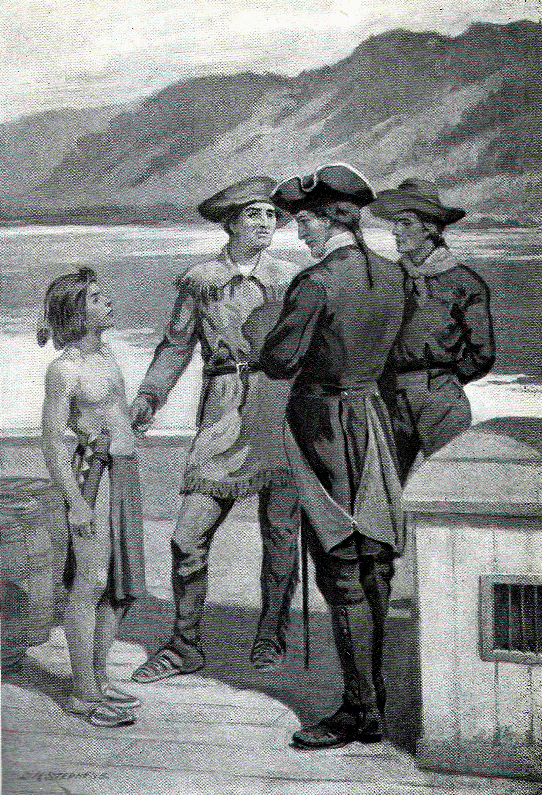 'HERE'S WHAT I'VE FOUND MERNE.' |
Young Captain Lewis's mouth twitched; he shot a glance at Captain Clark, who smiled back.
"Does that sound to you like an Irish name, Captain? More like good old English, to me!
"I was thinkin' again, sorr," pursued Pat, "that more like it's O'Kerr."
"That will do, Gass. Go forward and find Shannon, and the two of you tend to Floyd." Patrick saluted and trudged away. Captain Lewis continued, to Captain Clark: "There's something back of this, Will. Gass is too willing. I'll wager he and Shannon know more than we do."
"Oh, it's the Irish in him, Merne. Do you think they smuggled the lad aboard?"
"If they did—who brought you on this boat?" demanded the Long Knife Chief of Peter.
Peter shrugged his shoulders.
"I come," he said.
"Why?"
"Go with 'Nited States. Up big river."
"Who taught you to speak English?"
"My—mother," stammered Peter. "No English; 'Merican; Kentucky."
"Kentuckian!" blurted Captain Clark. "He is white, sure enough. That comes pretty close to home-folks, Merne. I know some Kerrs there, myself."
"But the question is, what are we to do with him?" reminded Captain Lewis, sharply. "We can't cumber ourselves with useless baggage, and we can't start out by stealing children from the Indians."
"No; and yet it sort of goes against the grain to let the Indians keep any children they've stolen," argued Captain Clark.
"Yes, I agree with you there, Will," answered Captain Lewis. "But the President instructed us to make friends with all the tribes. We could have shown the Otoes they were wrong, and could have offered to buy the boy or have made them promise to send him to St. Louis if we couldn't send him ourselves. This looks* like bad faith."
"Shall we stop and put him ashore, Merne?"
"If we put you ashore will you go back to Weah-rush-hah?" queried the Long Knife Chief, of Peter.
Peter had not comprehended all that had been said, but he had listened anxiously—and now he did understand that they were talking of putting him off.
"No!" he exclaimed. "No go back to We-ah-rush-hah. 'Maha catch me; Sioux catch me; Oto whip me. No Indian; white." And he added: "I follow boat."
"If you give the order, Merne, we'll stop and send him back with an escort," teased Captain Clark, who knew very well that Captain Lewis would do no such thing. "And we'll tell the Otoes to forward him on down to St. Louis: You think they'd do it, do you?"
Captain Lewis tapped uneasily with his foot.
"Oh, pshaw, Will," he said. "We can't stop and waste this fine breeze, even to send back a boy. When we land for dinner will be the proper time. We may meet some traders, bound down, and he can be started back with them, to St. Louis. Meanwhile Gass and Shannon must take care of him."
"He can be sent down river with the first party that take back the dispatches," proffered Captain Clark.
Patrick Gass came clumping up the deck and again saluted.
"Sergeant Floyd wishes might he speak with Cap'n Clark, sorrs."
"How is he, Pat?"
"Turrible weak, sorr, but the pain be not so bad."
"Go ahead, Will," bade Captain Lewis. "You enlisted him. He knows you better. If I can do anything, call me."
The Red Hair Chief hastened away. The Long Knife Chief spoke to Patrick Gass.
"You'll take charge of Peter until we send him back, Patrick. Draw on the commissary for such clothes as he needs. We can't have him running around naked, this way, if he's white."
"Yis, sorr," replied Patrick Gass. "Come, Peter, lad; come with your cousin Pat, an' we'll make your outside as white as your inside."
Peter gladly obeyed. He was rather afraid of the handsome young Long Knife Chief, but he was not afraid of Patrick Gass—no, nor of the Red Hair.
When dressed in the clothes that Patrick found for him, Peter was a funny sight. There was a red flannel shirt—to Peter very beautiful, but twice enough for him, so that the sleeves were rolled to their elbows, and the neck dropped about his shoulders. And there was a pair of blue trousers, also twice enough for him, so that the legs were rolled to their knees, and the waist was drawn up about his chest, and the front doubled across where it was belted in.
"Niver you mind," quoth Patrick, while the 'Nited States men gazed on Peter and howled with merriment. "Sure, I'm a bit of a tailor an' if we can't fit you with cloth we'll fit you with leather. Let 'em laugh. Laughin's good for the stomick."
And Peter did not mind. These were white people's clothes, and he was proud to wear them, although they did seem queer.
The sun had passed the overhead. At some orders the barge was swung in for shore; the two smaller boats followed. Now would he be sent back, or left; or—what? Landing was made on the right-hand side, which was the country of the Iowan and of the Sioux: not a good place, Peter reflected, for him. But scarcely had the barge tied up, and Peter's heart was beating with anxiety, when Captain Clark hastily emerged from the forecastle; another soldier trod close behind.
Captain Clark went to Captain Lewis; the soldier proceeded slowly, speaking to comrades. He arrived where Patrick was keeping friendly guard over Peter.
"Charley's gone," he said, simply, his face clouded, his voice broken.
"Rest his soul in pace," answered Patrick. "Sure, I'm sorry, Nat. Did he say anything?"
"He knew. He asked the Captain to write a letter for him, to the folks at home.. After that he went to sleep and did not wake again, here."
"Faith, he gave his life for his country," asserted Patrick.
So the sick man had died. This much Peter easily guessed. It turned dinner into a very quiet affair. Nothing more was said of leaving Peter ashore, nor of sending him back; but as soon as the dinner was finished the boats all pushed out and headed up river, along a bank surmounted by rolling bluffs.
After about a mile by sail and oars, everybody landed; and the body of Sergeant Charles Floyd, United States Army, the first of the expedition to fall, was buried on the top of a bluff. Captain Clark read some words out of a book, over the grave; and upon the grave was set a cedar post with the name, Sergt. C. Floyd, and the date, Aug. 20, 1804, carved into it. Then three volleys from the rifles were fired.
The boats proceeded on for a camping-place, which was found about a mile up, on the right-hand or north sue, near the mouth of a little river. The bluff of the grave was referred to as Floyd's Bluff, and the little river was called Floyd's River.
All the men, including Peter, felt sorry for Sergeant Nathaniel Pryor. Floyd had been his cousin. They felt sorry for those other relatives and friends, back at the Floyd home in Kentucky.
Fifty years later, or in 1857, the grave of the sergeant was moved a few hundred feet, by the Sioux City, Iowa, people, so that it should not crumble into the Missouri River; and in 1895 a monument was placed over it. To-day Floyd's Bluff is part of a Sioux City park.
The camp this evening was only thirteen miles above the Omaha village and the place where Chief Little Thief had come in to council, so that Peter very easily might have been sent back. But the death of Sergeant Charles Floyd seemed to be occupying the thoughts of the two captains; it made the whole camp sober. To-night there was no dancing or music, and Peter slept aboard the barge with nobody paying especial attention to him. Of this he was glad, because he feared that, once ashore, he would be left behind—the 'Nited States would try to sail on without him.